Saul had failed to bear the test of faith in the trying situation at Gilgal, and had brought dishonor upon the service of God; but his errors were not yet irretrievable, and the Lord would grant him another opportunity to learn the lesson of unquestioning faith in his word and obedience to his commands.
When reproved by the prophet at Gilgal, Saul saw no great sin in the course he had pursued. He felt that he had been treated unjustly, and endeavored to vindicate his actions, and offered excuses for his error. From that time he had little intercourse with the prophet. Samuel loved Saul as his own son, while Saul, bold and ardent in temper, had held the prophet in high regard; but he resented Samuel’s rebuke, and thenceforth avoided him so far as possible.
But the Lord sent his servant with another message to Saul. By obedience he might still prove his fidelity to God, and his worthiness to walk before Israel. Samuel came to the king, and delivered the word of the Lord. That the monarch might realize the importance of heeding the command, Samuel expressly declared that he spoke by divine direction, by the same authority that had called Saul to the throne. The prophet said, “Thus saith the Lord of hosts: I remember that which Amalek did to Israel, how he laid wait for him in the way, when he came up from Egypt. Now go and smite Amalek, and utterly destroy all that they have, and spare them not; but slay both man and woman, infant and suckling, ox and sheep, camel and ass.” The Amalekites had been the first to make war upon Israel in the wilderness; and for this sin, together with their defiance of God and their debasing idolatry, the Lord, through Moses, had pronounced sentence upon them. By divine direction, the history of their cruelty toward Israel had been recorded, with the command,628“Thou shalt blot out the remembrance of Amalek from under heaven; thou shalt not forget it.” For four hundred years the execution of this sentence had been deferred; but the Amalekites had not turned from their sins. The Lord knew that this wicked people would, if it were possible, blot out his people and his worship from the earth. Now the time had come for the sentence, so long delayed, to be executed.
The forbearance that God has exercised toward the wicked, emboldens men in transgression; but their punishment will be none the less certain and terrible for being long delayed. “The Lord shall rise up as in Mount Perazim, he shall be wroth as in the valley of Gibeon, that he may do his work, his strange work; and bring to pass his act, his strange act.” To our merciful God the act of punishment is a strange act. “As I live, saith the Lord God, I have no pleasure in the death of the wicked; but that the wicked turn from his way and live.” The Lord is “merciful and gracious, long-suffering, and abundant in goodness and truth, . . . forgiving iniquity and transgression and sin.” Yet he will “by no means clear the guilty.” While he does not delight in vengeance, he will execute judgment upon the transgressors of his law. He is forced to do this, to preserve the inhabitants of the earth from utter depravity and ruin. In order to save some, he must cut off those who have become hardened in sin. “The Lord is slow to anger, and great in power, and will not at all acquit the wicked.” By terrible things in righteousness he will vindicate the authority of his downtrodden law. And the very fact of his reluctance to execute justice, testifies to the enormity of the sins that call forth his judgments, and to the severity of the retribution awaiting the transgressor.
But while inflicting judgment, God remembered mercy. The Amalekites were to be destroyed, but the Kenites, who dwelt among them, were spared. This people, though not wholly free from idolatry, were worshipers of God, and were friendly to Israel. Of this tribe was the brother-in-law of Moses, Hobab, who had accompanied the Israelites in their travels through the wilderness, and by his knowledge of the country had rendered them valuable assistance.
Since the defeat of the Philistines at Michmash, Saul had made war against Moab, Ammon, and Edom, and against the Amalekites629and the Philistines; and wherever he turned his arms, he gained fresh victories. On receiving the commission against the Amalekites, he at once proclaimed war. To his own authority was added that of the prophet, and at the call to battle the men of Israel flocked to his standard. This expedition was not to be entered upon for the purpose of self-aggrandizement; the Israelites were not to receive either the honor of the conquest or the spoils of their enemies. They were to engage in the war solely as an act of obedience to God, for the purpose of executing his judgment upon the Amalekites. God intended that all nations should behold the doom of that people that had defied his sovereignty, and should mark that they were destroyed by the very people whom they had despised.
“Saul smote the Amalekites from Havilah until thou comest to Shur, that is over against Egypt. And he took Agag, the king of the Amalekites, alive, and utterly destroyed all the people with the edge of the sword. But Saul and the people spared Agag, and the best of the sheep, and of the oxen, and of the fatlings, and the lambs, and all that was good; and would not utterly destroy them. But everything that was vile and refuse, that they destroyed utterly.”
This victory over the Amalekites was the most brilliant victory that Saul had ever gained, and it served to rekindle the pride of heart that was his greatest peril. The divine edict devoting the enemies of God to utter destruction was but partially fulfilled. Ambitious to heighten the honor of his triumphal return by the presence of a royal captive, Saul ventured to imitate the customs of the nations around him, and spared Agag, the fierce and war-like king of the Amalekites. The people reserved for themselves the finest of the flocks, herds, and beasts of burden, excusing their sin, on the ground that the cattle were reserved to be offered as sacrifices to the Lord. It was their purpose, however, to use these merely as a substitute, to save their own cattle.
Saul had now been subjected to the final test. His presumptuous disregard of the will of God, showing his determination to rule as an independent monarch, proved that he could not be trusted with royal power as the vicegerent of the Lord. While Saul and his army were marching home in the flush of victory, there was deep anguish in the home of Samuel the prophet. He had received a message from the Lord, denouncing the course of the630king: “It repenteth me that I have set up Saul to be king; for he is turned back from following me, and hath not performed my commandments.” The prophet was deeply grieved over the course of the rebellious king, and he wept and prayed all night for a reversing of the terrible sentence.
God’s repentance is not like man’s repentance. “The Strength of Israel will not lie, nor repent; for he is not a man, that he should repent.” Man’s repentance implies a change of mind. God’s repentance implies a change of circumstances and relations. Man may change his relation to God by complying with the conditions upon which he may be brought into the divine favor, or he may, by his own action, place himself outside the favoring condition; but the Lord is the same “yesterday, and to-day, and forever.” Saul’s disobedience changed his relation to God; but the conditions of acceptance with God were unaltered,—God’s requirements were still the same; for with him there “is no variableness, neither shadow of turning.”
With an aching heart the prophet set forth the next morning to meet the erring king. Samuel cherished a hope that, upon reflection, Saul might become conscious of his sin, and by repentance and humiliation, be again restored to the divine favor. But when the first step is taken in the path of transgression, the way becomes easy. Saul, debased by his disobedience, came to meet Samuel with a lie upon his lips. He exclaimed, “Blessed be thou of the Lord; I have performed the commandment of the Lord.”
The sounds that fell on the prophet’s ears disproved the statement of the disobedient king. To the pointed question, “What meaneth then this bleating of the sheep in mine ears, and the lowing of the oxen which I hear?” Saul made answer, “They have brought them from the Amalekites; for the people spared the best of the sheep and of the oxen, to sacrifice unto the Lord thy God; and the rest we have utterly destroyed.” The people had obeyed Saul’s directions; but in order to shield himself, he was willing to charge upon them the sin of his disobedience.
The message of Saul’s rejection brought unspeakable grief to the heart of Samuel. It had to be delivered before the whole army of Israel, when they were filled with pride and triumphal rejoicing over a victory that was accredited to the valor and generalship of their king, for Saul had not associated God with the success of Israel in this conflict;631but when the prophet saw the evidence of Saul’s rebellion, he was stirred with indignation, that he, who had been so highly favored of God, should transgress the commandment of Heaven, and lead Israel into sin. Samuel was not deceived by the subterfuge of the king. With mingled grief and indignation he declared, “Stay, and I will tell thee what the Lord hath said to me this night. . . . When thou wast little in thine own sight, wast thou not made the head of the tribes of Israel, and the Lord anointed thee king over Israel?” He repeated the command of the Lord concerning Amalek, and demanded the reason of the king’s disobedience.
Saul persisted in self-justification: “Yea, I have obeyed the voice of the Lord, and have gone the way which the Lord sent me, and have brought Agag the king of Amalek, and have utterly destroyed the Amalekites. But the people took of the spoil, sheep and oxen, the chief of the things which should have been utterly destroyed, to sacrifice unto the Lord thy God in Gilgal.”
In stern and solemn words the prophet swept away the refuge of lies, and pronounced the irrevocable sentence: “Hath the Lord as great delight in burnt-offerings and sacrifices, as in obeying the voice of the Lord? Behold, to obey is better than sacrifice, and to hearken than the fat of rams. For rebellion is as the sin of witchcraft, and stubbornness is as iniquity and idolatry. Because thou hast rejected the word of the Lord, he hath also rejected thee from being king.”
As the king heard this fearful sentence, he cried out, “I have sinned; for I have transgressed the commandment of the Lord, and thy words; because I feared the people, and obeyed their voice.” Terrified by the denunciation of the prophet, Saul acknowledged his guilt, which he had before stubbornly denied; but he still persisted in casting blame upon the people, declaring that he had sinned through fear of them.
It was not sorrow for sin, but fear of its penalty, that actuated the king of Israel as he entreated Samuel, “I pray thee, pardon my sin, and turn again with me, that I may worship the Lord.” If Saul had had true repentance, he would have made public confession of his sin; but it was his chief anxiety to maintain his authority, and retain the allegiance of the people. He desired the honor of Samuel’s presence in order to strengthen his own influence with the nation.
“I will not return with thee,” was the answer of the prophet; “for thou hast rejected the word of the Lord, and the Lord hath rejected thee from being king over Israel.” As Samuel turned to depart, the king, in an agony of fear, laid hold of his mantle to hold him back, but it rent in his hands. Upon this, the prophet declared, “The Lord hath rent the kingdom of Israel from thee this day, and hath given it to a neighbor of thine, that is better than thou.”
Saul was more disturbed by the alienation of Samuel than by the displeasure of God. He knew that the people had greater confidence in the prophet than in himself. Should another by divine command be now anointed king, Saul felt that it would be impossible to maintain his own authority. He feared an immediate revolt, should Samuel utterly forsake him. Saul entreated the prophet to honor him before the elders and the people by publicly uniting with him in a religious service. By divine direction, Samuel yielded to the king’s request, that no occasion might be given for a revolt. But he remained only as a silent witness of the service.
An act of justice, stern and terrible, was yet to be performed. Samuel must publicly vindicate the honor of God, and rebuke the course of Saul. He commanded that the king of the Amalekites be brought before him. Above all who had fallen by the sword of Israel, Agag was the most guilty and merciless; one who had hated and sought to destroy the people of God, and whose influence had been strongest to promote idolatry. He came at the prophet’s command, flattering himself that the danger of death was past. Samuel declared: “As thy sword hath made women childless, so shall thy mother be childless among women. And Samuel hewed Agag in pieces before the Lord.” This done, Samuel returned to his home at Ramah, Saul to his at Gibeah. Only once thereafter did the prophet and the king ever meet each other.
When called to the throne, Saul had a humble opinion of his own capabilities, and was willing to be instructed. He was deficient in knowledge and experience, and had serious defects of character. But the Lord granted him the Holy Spirit as a guide and helper, and placed him in a position where he could develop the qualities requisite for a ruler of Israel. Had he remained humble, seeking constantly to be guided by divine wisdom, he633would have been enabled to discharge the duties of his high position with success and honor. Under the influence of divine grace, every good quality would have been gaining strength, while evil tendencies would have lost their power. This is the work which the Lord proposes to do for all who consecrate themselves to him. There are many whom he has called to positions in his work because they have a humble and teachable spirit. In his providence he places them where they may learn of him. He will reveal to them their defects of character, and to all who seek his aid he will give strength to correct their errors.
But Saul presumed upon his exaltation, and dishonored God by unbelief and disobedience. Though when first called to the throne he was humble and self-distrustful, success made him self-confident. The very first victory of his reign had kindled that pride of heart which was his greatest danger. The valor and military skill displayed in the deliverance of Jabesh-gilead had roused the enthusiasm of the whole nation. The people honored their king, forgetting that he was but the agent by whom God had wrought; and though at first Saul ascribed the glory to God, he afterward took honor to himself. He lost sight of his dependence upon God, and in heart departed from the Lord. Thus the way was prepared for his sin of presumption and sacrilege at Gilgal. The same blind self-confidence led him to reject Samuel’s reproof. Saul acknowledged Samuel to be a prophet sent from God; hence he should have accepted the reproof, though he could not himself see that he had sinned. Had he been willing to see and confess his error, this bitter experience would have proved a safeguard for the future.
If the Lord had then separated himself entirely from Saul, he would not have again spoken to him through his prophet, intrusting him with a definite work to perform, that he might correct the errors of the past. When one who professes to be a child of God becomes careless in doing his will, thereby influencing others to be irreverent, and unmindful of the Lord’s injunctions, it is still possible for his failures to be turned into victories if he will but accept reproof with true contrition of soul, and return to God in humility and faith. The humiliation of defeat often proves a blessing by showing us our inability to do the will of God without his aid.
When Saul turned away from the reproof sent him by God’s634Holy Spirit, and persisted in his stubborn self-justification, he rejected the only means by which God could work to save him from himself. He had willfully separated himself from God. He could not receive divine help or guidance until he should return to God by confession of his sin.
At Gilgal, Saul had made an appearance of great conscientiousness, as he stood before the army of Israel offering up a sacrifice to God. But his piety was not genuine. A religious service performed in direct opposition to the command of God, only served to weaken Saul’s hands, placing him beyond the help that God was so willing to grant him.
In the expedition against Amalek, Saul thought he had done all that was essential of that which the Lord had commanded him; but the Lord was not pleased with partial obedience, nor willing to pass over what had been neglected through so plausible a motive. God has given men no liberty to depart from his requirements. The Lord had declared to Israel, “Ye shall not do . . . every man whatsoever is right in his own eyes;” but ye shall “observe and hear all these words which I command thee.” In deciding upon any course of action, we are not to ask whether we can see that harm will result from it, but whether it is in keeping with the will of God. “There is a way which seemeth right unto a man; but the end thereof are the ways of death.”
“To obey is better than sacrifice.” The sacrificial offerings were, in themselves, of no value in the sight of God. They were designed to express, on the part of the offerer, penitence for sin and faith in Christ, and to pledge future obedience to the law of God. But without penitence, faith, and an obedient heart, the offerings were worthless. When, in direct violation of God’s command, Saul proposed to present a sacrifice of that which God had devoted to destruction, open contempt was shown for the divine authority. The service would have been an insult to Heaven. Yet with the sin of Saul and its result before us, how many are pursuing a similar course. While they refuse to believe and obey some requirement of the Lord, they persevere in offering up to God their formal services of religion. There is no response of the Spirit of God to such service. No matter how zealous men may be in their observance of religious ceremonies, the Lord cannot accept them if they persist in willful violation of one of his commands.
“Rebellion is as the sin of witchcraft, and stubbornness is as iniquity and idolatry.” Rebellion originated with Satan, and all rebellion against God is directly due to satanic influence. Those who set themselves against the government of God have entered into an alliance with the arch-apostate, and he will exercise his power and cunning to captivate the senses and mislead the understanding. He will cause everything to appear in a false light. Like our first parents, those who are under his bewitching spell see only the great benefits to be received by transgression.
No stronger evidence can be given of Satan’s delusive power than that many who are thus led by him, deceive themselves with the belief that they are in the service of God. When Korah, Dathan, and Abiram rebelled against the authority of Moses, they thought they were opposing only a human leader, a man like themselves; and they came to believe that they were verily doing God service. But in rejecting God’s chosen instrument, they rejected Christ; they insulted the Spirit of God. So, in the days of Christ, the Jewish scribes and elders, who professed great zeal for the honor of God, crucified his Son. The same spirit still exists in the hearts of those who set themselves to follow their own will in opposition to the will of God.
Saul had had the most ample proof that Samuel was divinely inspired. His venturing to disregard the command of God through the prophet, was against the dictates of reason and sound judgment. His fatal presumption must be attributed to satanic sorcery. Saul had manifested great zeal in suppressing idolatry and witchcraft; yet in his disobedience to the divine command he had been actuated by the same spirit of opposition to God, and had been as really inspired by Satan, as are those who practice sorcery; and when reproved, he had added stubbornness to rebellion. He could have offered no greater insult to the Spirit of God, had he openly united with idolaters.
It is a perilous step to slight the reproofs and warnings of God’s word or of his Spirit. Many, like Saul, yield to temptation until they become blind to the true character of sin. They flatter themselves that they have had some good object in view, and have done no wrong in departing from the Lord’s requirements. Thus they do despite to the Spirit of grace, until its voice is no longer heard, and they are left to the delusions which they have chosen.
In Saul, God had given to Israel a king after their own heart, as Samuel said when the kingdom was confirmed to Saul at Gilgal, “Behold the king whom ye have chosen, and whom ye have desired.” Comely in person, of noble stature and princely bearing, his appearance accorded with their conceptions of royal dignity; and his personal valor and his ability in the conduct of armies, were the qualities which they regarded as best calculated to secure respect and honor from other nations. They felt little solicitude that their king should possess those higher qualities which alone could fit him to rule with justice and equity. They did not ask for one who had true nobility of character, who possessed the love and fear of God. They had not sought counsel from God as to the qualities a ruler should possess, in order to preserve their distinctive, holy character as his chosen people. They were not seeking God’s way, but their own way. Therefore God gave them such a king as they desired,—one whose character was a reflection of their own. Their hearts were not in submission to God, and their king also was unsubdued by divine grace. Under the rule of this king, they would obtain the experience necessary in order that they might see their error, and return to their allegiance to God.
Yet the Lord, having placed on Saul the responsibility of the kingdom, did not leave him to himself. He caused the Holy Spirit to rest upon Saul to reveal to him his own weakness, and his need of divine grace; and had Saul relied upon God, God would have been with him. So long as his will was controlled by the will of God, so long as he yielded to the discipline of his Spirit, God could crown his efforts with success. But when Saul chose to act independently of God, the Lord could no longer be his guide, and was forced to set him aside. Then he called to the throne “a man after his own heart;”—not one who was faultless in character, but who, instead of trusting to himself, would rely upon God, and be guided by his Spirit; who, when he sinned, would submit to reproof and correction.
THE ANOINTING OF DAVID—62
A few miles south of Jerusalem, “the city of the great King,” is Bethlehem, where David, the son of Jesse, was born more than a thousand years before the infant Jesus was cradled in the manger, and worshiped by the wise men from the East. Centuries before the advent of the Saviour, David, in the freshness of boyhood, kept watch of his flocks as they grazed on the hills surrounding Bethlehem. The simple shepherd boy sang the songs of his own composing, and the music of his harp made a sweet accompaniment to the melody of his fresh young voice. The Lord had chosen David, and was preparing him, in his solitary life with his flocks, for the work he designed to commit to his trust in after-years.
While David was thus living in the retirement of his humble shepherd’s life, the Lord God was speaking about him to the prophet Samuel. “And the Lord said unto Samuel, How long wilt thou mourn for Saul, seeing I have rejected him from reigning over Israel? fill thine horn with oil, and go, I will send thee to Jesse the Bethlehemite; for I have provided me a king among his sons. . . . Take an heifer with thee, and say, I am come to sacrifice to the Lord. And call Jesse to the sacrifice, and I will show thee what thou shalt do; and thou shalt anoint unto me him whom I name unto thee. And Samuel did that which the Lord spake, and came to Bethlehem. And the elders of the town trembled at his coming, and said, Comest thou peaceably? And he said, Peaceably.” The elders accepted an invitation to the sacrifice, and Samuel called also Jesse and his sons. The altar was built, and the sacrifice was ready. All the household of Jesse were present, with the exception of David, the youngest son, who had been left to guard the sheep, for it was not safe to leave the flocks unprotected.
When the sacrifice was ended, and before partaking of the offering-feast, Samuel began his prophetic inspection of the noble-appearing sons of Jesse. Eliab was the eldest, and more nearly resembled Saul for stature and beauty than the others. His comely features and finely developed form attracted the attention of the prophet. As Samuel looked upon his princely bearing, he thought, “This is indeed the man whom God has chosen as successor to Saul,” and he waited for the divine sanction that he might anoint him. But Jehovah did not look upon the outward appearance. Eliab did not fear the Lord. Had he been called to the throne, he would have been a proud, exacting ruler. The Lord’s word to Samuel was, “Look not on his countenance, or on the height of his stature; because I have refused him: for the Lord seeth not as man seeth; for man looketh on the outward appearance, but the Lord looketh on the heart.” No outward beauty can recommend the soul to God. The wisdom and excellence revealed in the character and deportment, express the true beauty of the man; and it is the inner worth, the excellency of the heart, that determines our acceptance with the Lord of hosts. How deeply should we feel this truth in the judgment of ourselves and others. We may learn, from the mistake of Samuel, how vain is the estimation that rests on beauty of face or nobility of stature. We may see how incapable is man’s wisdom of understanding the secrets of the heart, or of comprehending the counsels of God, without special enlightenment from heaven. The thoughts and ways of God in relation to his creatures are above our finite minds; but we may be assured that his children will be brought to fill the very place for which they are qualified, and will be enabled to accomplish the very work committed to their hands, if they will but submit their will to God, that his beneficent plans may not be frustrated by the perversity of man.
Eliab passed from the inspection of Samuel, and the six brothers who were in attendance at the service, followed in succession to be observed by the prophet; but the Lord did not signify his choice of any one of them. With painful suspense, Samuel had looked upon the last of the young men; the prophet was perplexed and bewildered. He inquired of Jesse, “Are here all thy children?” The father answered, “There remaineth yet the youngest, and, behold, he keepeth the sheep.” Samuel directed that he should be summoned, saying, “We will not sit down till he come hither.”
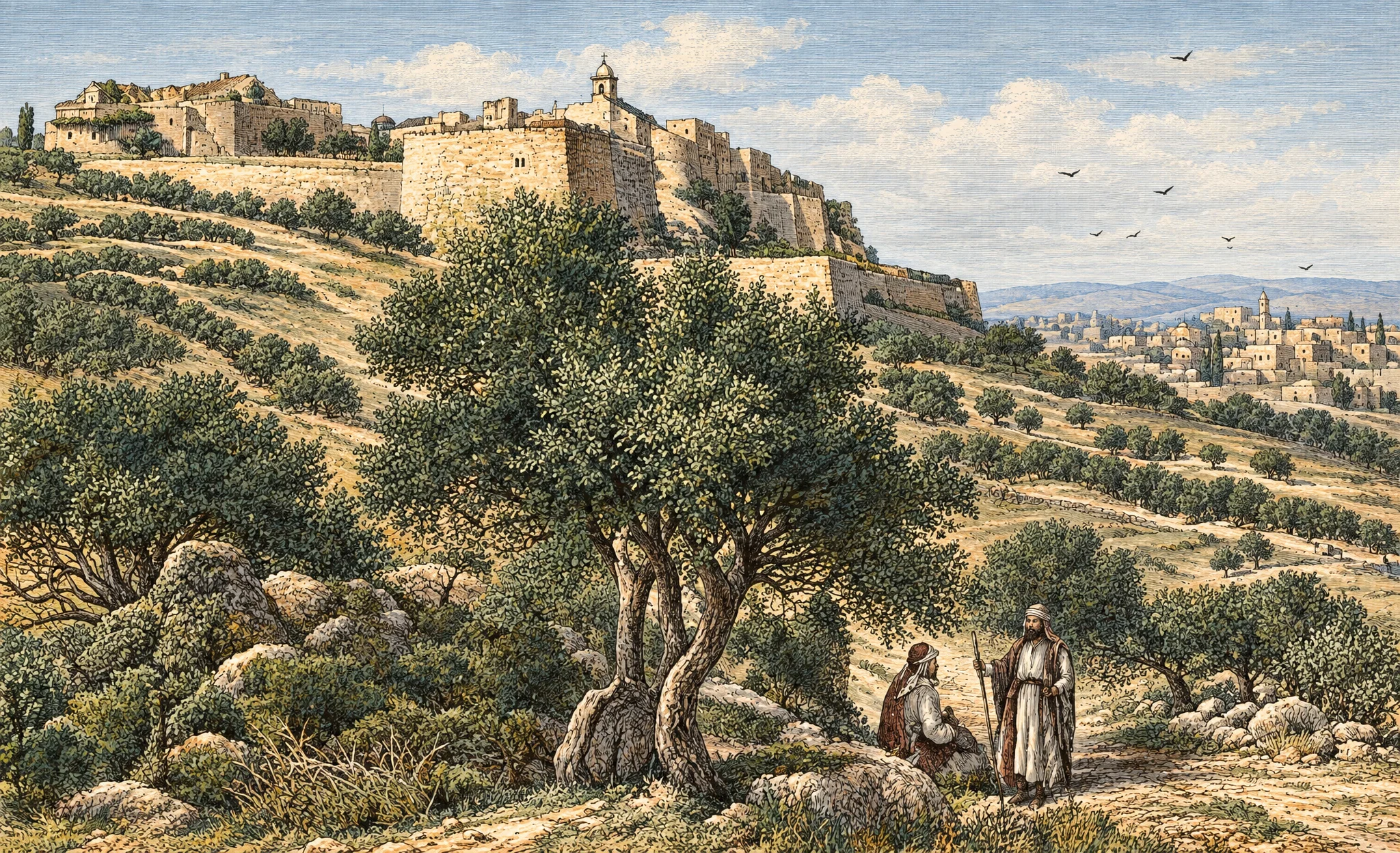
BETHLEHEM FROM THE EAST
The lonely shepherd was startled by the unexpected call of the messenger, who announced that the prophet had come to Bethlehem and had sent for him. With surprise he questioned why the prophet and judge of Israel should desire to see him; but without delay he obeyed the call. “Now he was ruddy, and withal of a beautiful countenance, and goodly to look to.” As Samuel beheld with pleasure the handsome, manly, modest shepherd boy, the voice of the Lord spoke to the prophet, saying, “Arise, anoint him; for this is he.” David had proved himself brave and faithful in the humble office of a shepherd, and now God had chosen him to be captain of his people. “Then Samuel took the horn of oil, and anointed him in the midst of [from among] his brethren; and the Spirit of the Lord came upon David from that day forward.” The prophet had accomplished his appointed work, and with a relieved heart he returned to Ramah.
Samuel had not made known his errand, even to the family of Jesse, and the ceremony of anointing David had been performed in secret. It was an intimation to the youth of the high destiny awaiting him, that amid all the varied experiences and perils of his coming years, this knowledge might inspire him to be true to the purpose of God to be accomplished by his life.
The great honor conferred upon David did not serve to elate him. Notwithstanding the high position which he was to occupy, he quietly continued his employment, content to await the development of the Lord’s plans in his own time and way. As humble and modest as before his anointing, the shepherd boy returned to the hills, and watched and guarded his flocks as tenderly as ever. But with new inspiration he composed his melodies, and played upon his harp. Before him spread a landscape of rich and varied beauty. The vines, with their clustering fruit, brightened in the sunshine. The forest trees, with their green foliage, swayed in the breeze. He beheld the sun flooding the heavens with light, coming forth as a bridegroom out of his chamber, and rejoicing as a strong man to run a race. There were the bold summits of the hills reaching toward the sky; in the far-away distance rose the barren cliffs of the mountain wall of Moab; above all spread the tender blue of the overarching heavens. And beyond was God. He could not see him, but his works were full of his praise. The light of day, gilding forest and mountain, meadow and stream, carried the mind up to behold the Father of lights, the Author of642every good and perfect gift. Daily revelations of the character and majesty of his Creator, filled the young poet’s heart with adoration and rejoicing. In contemplation of God and his works, the faculties of David’s mind and heart were developing and strengthening for the work of his after-life. He was daily coming into a more intimate communion with God. His mind was constantly penetrating into new depths, for fresh themes to inspire his song, and to wake the music of his harp. The rich melody of his voice poured out upon the air, echoed from the hills as if responsive to the rejoicing of the angels’ songs in heaven.
Who can measure the results of those years of toil and wandering among the lonely hills? The communion with nature and with God, the care of his flocks, the perils and deliverances, the griefs and joys, of his lowly lot, were not only to mould the character of David, and to influence his future life, but through the psalms of Israel’s sweet singer, they were, in all coming ages, to kindle love and faith in the hearts of God’s people, bringing them nearer to the ever-loving heart of Him in whom all his creatures live.
David, in the beauty and vigor of his young manhood, was preparing to take a high position with the noblest of the earth. His talents, as precious gifts from God, were employed to extol the glory of the divine Giver. His opportunities of contemplation and meditation served to enrich him with that wisdom and piety that made him beloved of God and angels. As he contemplated the perfections of his Creator, clearer conceptions of God opened before his soul. Obscure themes were illuminated, difficulties were made plain, perplexities were harmonized, and each ray of new light called forth fresh bursts of rapture, and sweeter anthems of devotion, to the glory of God and the Redeemer. The love that moved him, the sorrows that beset him, the triumphs that attended him, were all themes for his active thought; and as he beheld the love of God in all the providences of his life, his heart throbbed with more fervent adoration and gratitude, his voice rang out in a richer melody, his harp was swept with more exultant joy; and the shepherd boy proceeded from strength to strength, from knowledge to knowledge; for the Spirit of the Lord was upon him.