Library
Patriarchs and Prophets
Pacific Press Publishing Association · Mountain View, California; Portland, Oregon; Calgary, Alberta, Canada; Kansas City, Missouri; Cristobal, Canal Zone; Brookfield, Illinois · 1890
- Pages
- 744
- Illustrations
- 158
Contents
- PREFACExi
- INTRODUCTIONxiii
- IN THE BEGINNING31
- WHY WAS SIN PERMITTED?—133
- THE CREATION—244
- THE TEMPTATION AND FALL—352
- THE PLAN OF REDEMPTION—463
- APOSTASY70A
- CAIN AND ABEL TESTED—571
- SETH AND ENOCH—680
- THE FLOOD—790
- AFTER THE FLOOD - 8105
- THE LITERAL WEEK—9111
- THE TOWER OF BABEL—10117
- HEIRS OF FAITH9
- THE CALL OF ABRAHAM—11125
- ABRAHAM IN CANAAN—12132
- THE TEST OF FAITH—13145
- DESTRUCTION OF SODOM—14156
- THE MARRIAGE OF ISAAC—15171
- JACOB AND ESAU—16177
- JACOB’S FLIGHT AND EXILE—17183
- THE NIGHT OF WRESTLING—18195
- THE RETURN TO CANAAN—19204
- JOSEPH IN EGYPT—20213
- JOSEPH AND HIS BROTHERS—21224
- THE CHOSEN NATION240A
- MOSES — 22241
- THE PLAGUES OF EGYPT—23257
- THE PASSOVER—24273
- THE EXODUS—25281
- FROM THE RED SEA TO SINAI—26291
- THE LAW GIVEN TO ISRAEL—27303
- IDOLATRY AT SINAI—28315
- SATAN’S ENMITY AGAINST THE LAW—29331
- THE WILDERNESS-TRAINING342A
- THE TABERNACLE AND ITS SERVICES—30343
- THE SIN OF NADAB AND ABIHU—31359
- THE LAW AND THE COVENANTS—32363
- FROM SINAI TO KADESH—33374
- THE TWELVE SPIES—34387
- THE REBELLION OF KORAH—35395
- IN THE WILDERNESS—36406
- THE SMITTEN ROCK—37411
- THE JOURNEY AROUND EDOM—38422
- THE CONQUEST OF BASHAN—39433
- APOSTASY AT THE JORDAN—41453
- THE LAW REPEATED—42462
- THE DEATH OF MOSES—43469
- ESTABLISHMENT IN CANAAN480A
- CROSSING THE JORDAN—44481
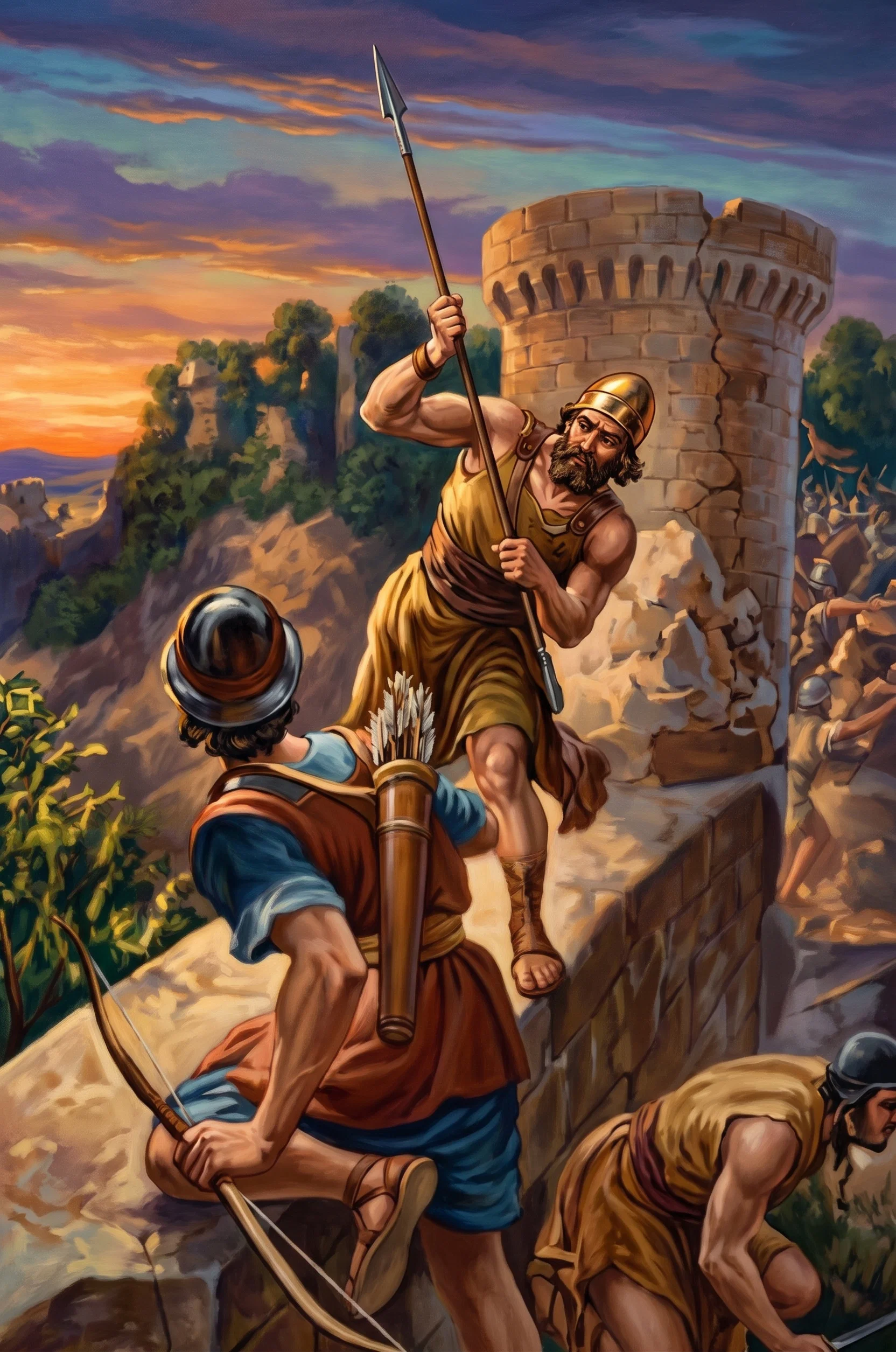
- THE FALL OF JERICHO—45487
- THE BLESSINGS AND THE CURSES—46499
- LEAGUE WITH THE GIBEONITES—47505
- THE DIVISION OF CANAAN—48510
- THE LAST WORDS OF JOSHUA—49521
- TITHES AND OFFERINGS—50525
- GOD’S CARE FOR THE POOR—51530
- THE ANNUAL FEASTS—52537
- UNDER THE JUDGES542A
- THE EARLIER JUDGES—53543
- SAMSON—54560
- THE CHILD SAMUEL—55569
- ELI AND HIS SONS—56575
- THE ARK TAKEN BY THE PHILISTINES—57581
- THE SCHOOLS OF THE PROPHETS—58592
- THE EARLIER KINGS602A
- THE FIRST KING OF ISRAEL—59603
- THE PRESUMPTION OF SAUL—60616
- SAUL REJECTED—61627
- THE ANOINTING OF DAVID—62637
- DAVID AND GOLIATH—63643
- DAVID A FUGITIVE—64649
- THE MAGNANIMITY OF DAVID—65660
- THE DEATH OF SAUL—66675
- ANCIENT AND MODERN SORCERY—67683
- DAVID AT ZIKLAG—68690
- DAVID CALLED TO THE THRONE—69697
- THE REIGN OF DAVID—70703
- DAVID’S SIN AND REPENTANCE—71717
- THE REBELLION OF ABSALOM—72727
- THE LAST YEARS OF DAVID—73746
- APPENDIX757
Illustrations
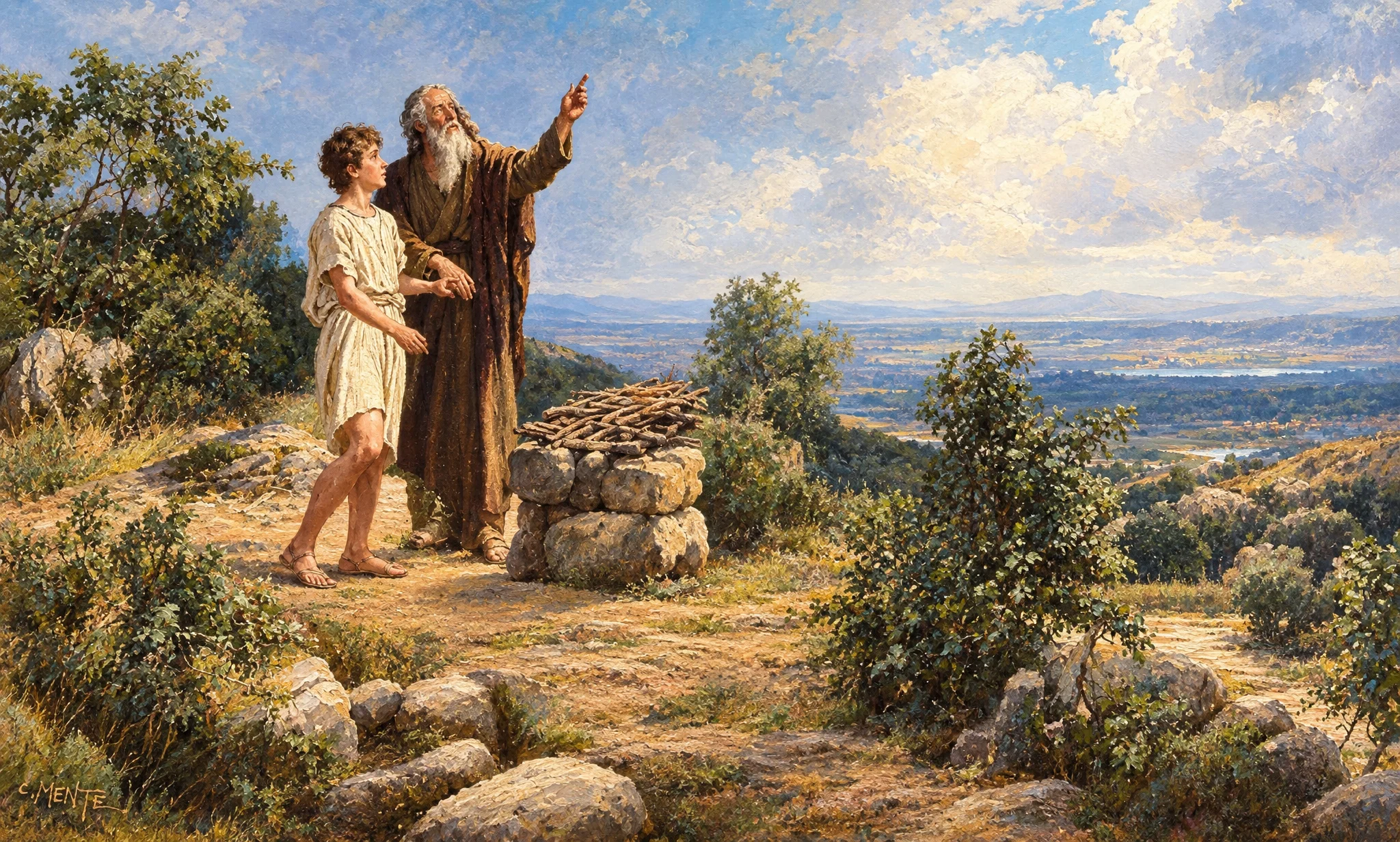 “My father, behold the wood and the fire, but where is the lamb for a burnt offering?” “My son, God will provide himself an offering.” — ABRAHAM AND ISAAC
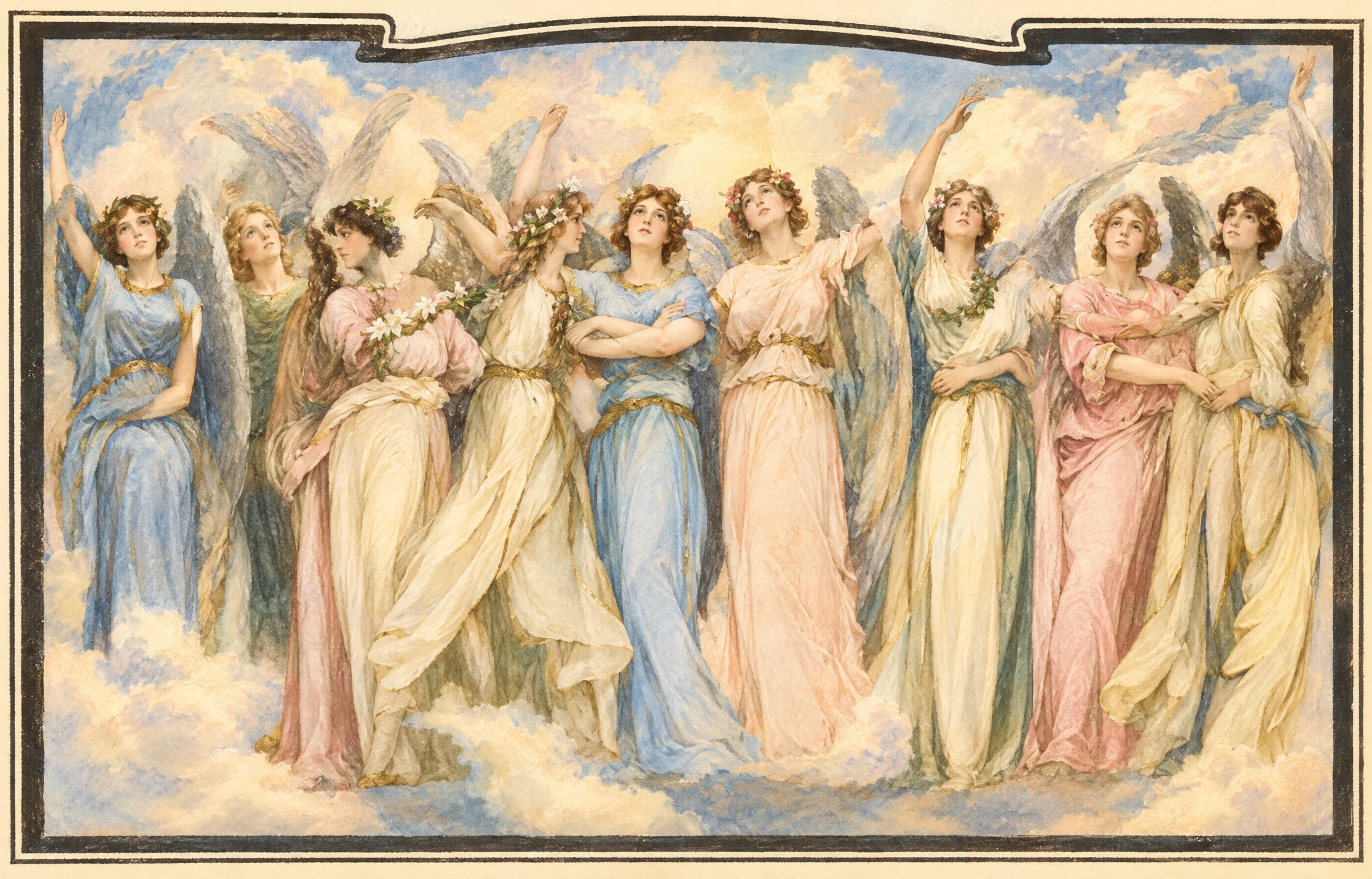 A group of robed human figures stands in a loose line across the scene, with several figures gathered closely together at the center and right. Some appear to face one another or gesture with raised and extended arms, while others stand quietly with their hands near their bodies. Their long, flowing garments reach the ground, and a few have darker, more defined faces and hair than the surrounding figures. Vague, cloudlike forms and shadowy shapes fill the background, suggesting a celestial or otherworldly setting; no animals, objects, or readable lettering are visible.
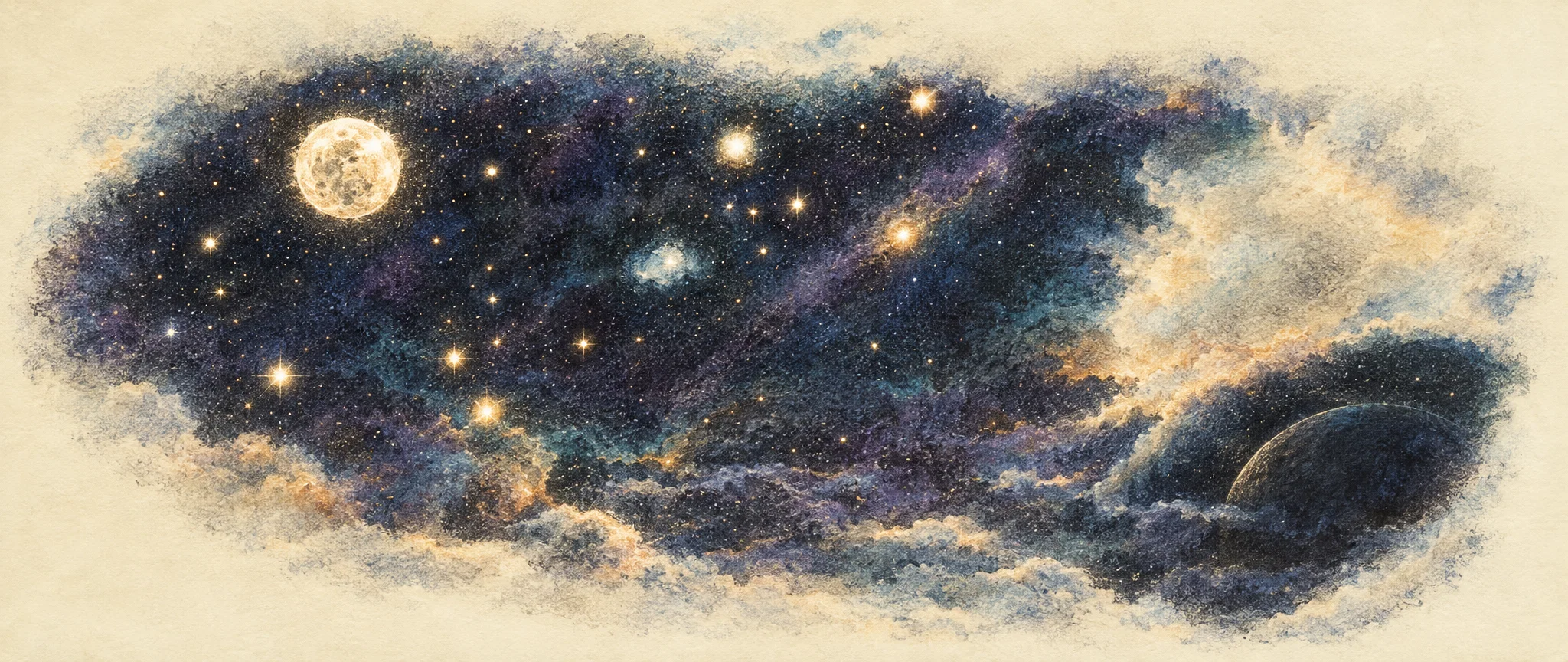 “By the Word of the Lord were the heavens made; and all the host of them by the breath of his mouth.”
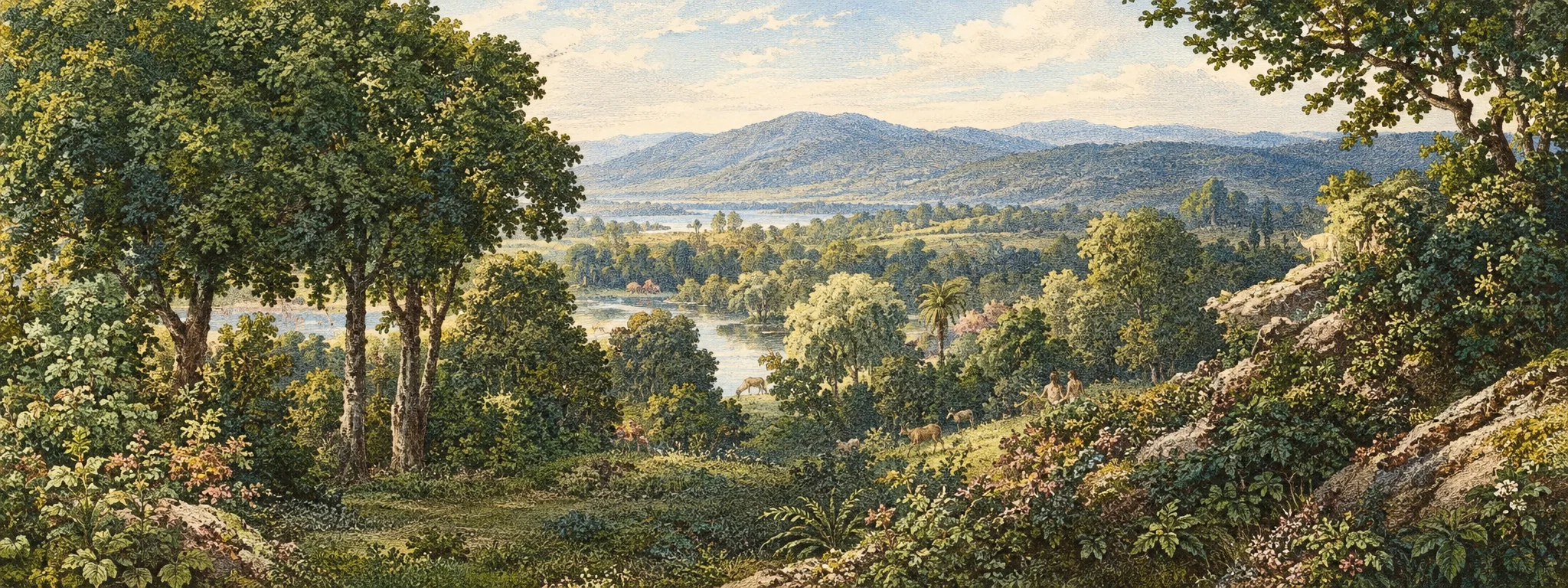 A broad, tranquil landscape stretches across the scene, with a low rolling horizon beneath a pale sky. Dense trees frame the view on both sides, especially a large leafy tree at the left and darker foliage at the right. In the middle distance, several small, pale animal forms—possibly grazing livestock—are scattered across open ground. A sloping, uneven foreground with shrubs and vegetation leads toward the central plain. No people, structures, or lettering are visible.
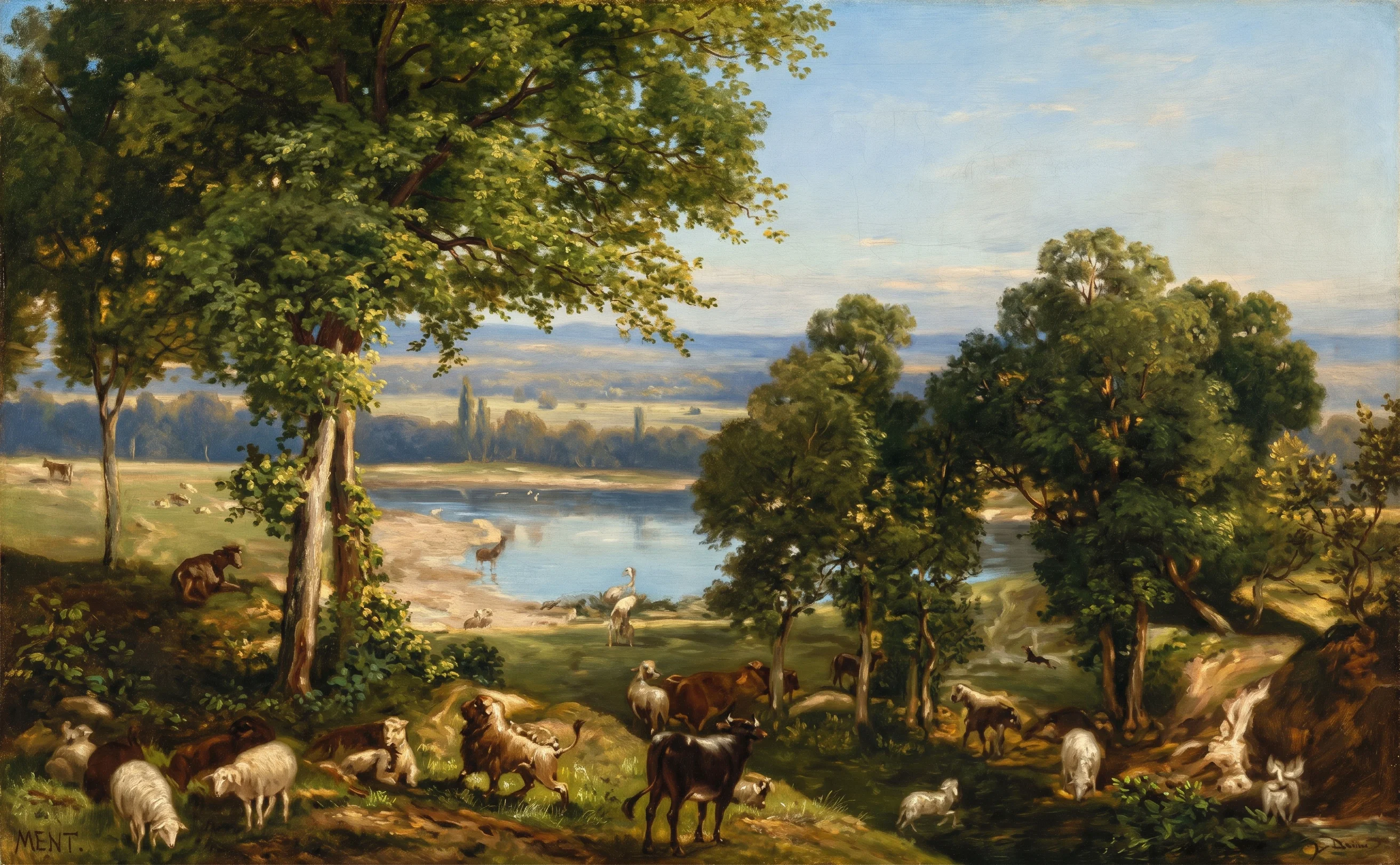 “No taint of sin, or shadow of death, marred the fair creation.”
 “All thy works shall praise thee.”
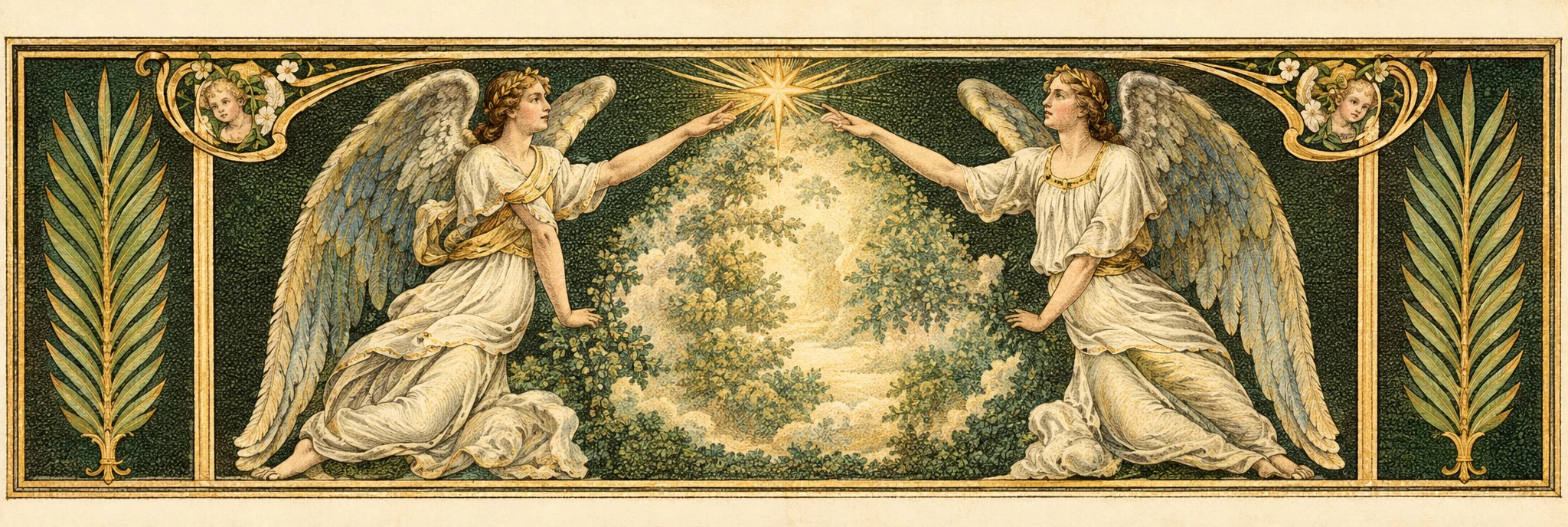 A narrow, symmetrical ornamental scene shows a large, cloudlike central form framed by two sweeping, wing-shaped masses. Small human figures appear near the upper left and upper right, each with arms raised or extended toward the center. Below them, the curved forms resemble rocky or leafy slopes, while the central area is softly shaded and indistinct. Tall palm fronds fill separate panels at the far left and right, bordered by slender vertical lines; curling floral motifs decorate the upper corners and top edge. No lettering is visible.
 A delicate black line drawing of a long, horizontally spreading botanical sprig, with a dense cluster of overlapping, deeply lobed leaves at the center and a slender stem extending outward to both sides. Smaller leaves and branching shoots alternate along the stem, some drooping downward and others reaching upward. Fine vein lines and irregular scalloped edges detail the foliage. The isolated plant fills most of the image against a plain background; no people, animals, or lettering are visible.
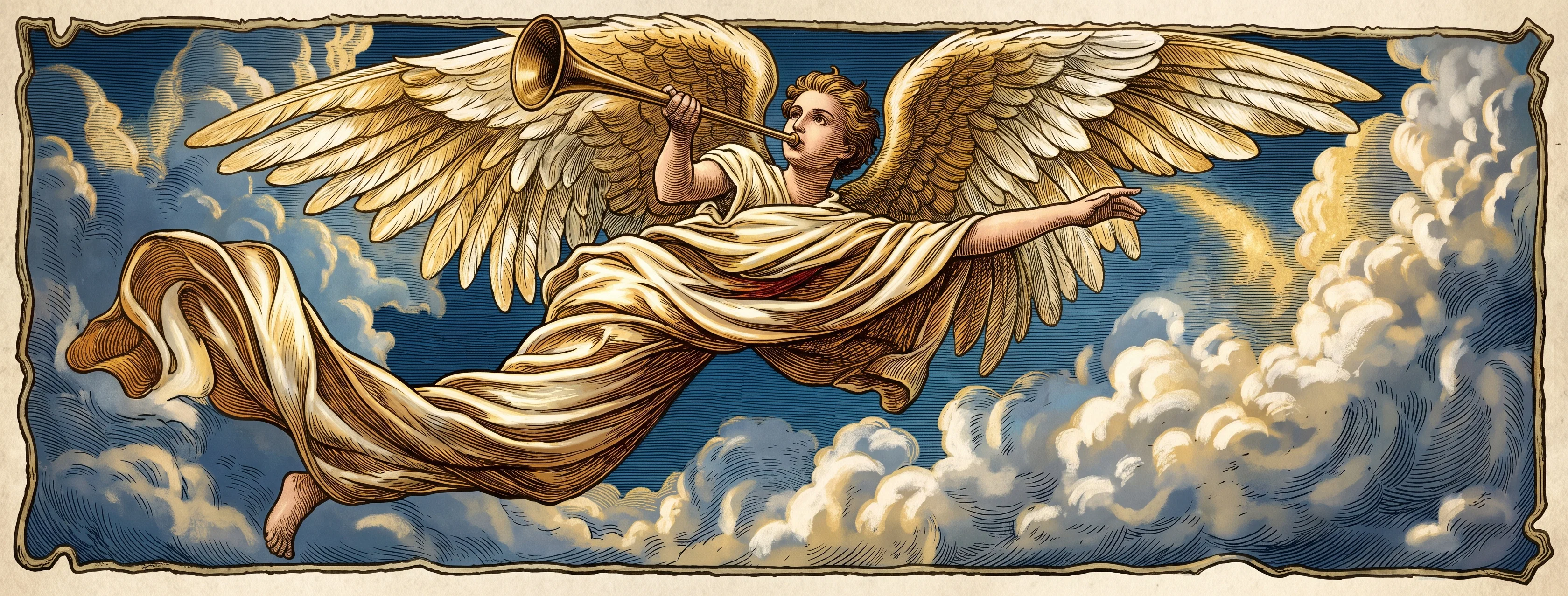 A dramatic heavenly scene unfolds among billowing clouds. Near the center, a youthful, robed figure sits or kneels with arms extended, while flowing fabric sweeps across the foreground. Large feathered wings spread broadly behind the figures, filling much of the upper half of the image. A second figure bends or kneels at the left, facing inward, and shadowy forms and clouds surround the group. The arrangement suggests a solemn gathering in heaven, with the central figure addressing or pleading before another celestial being.
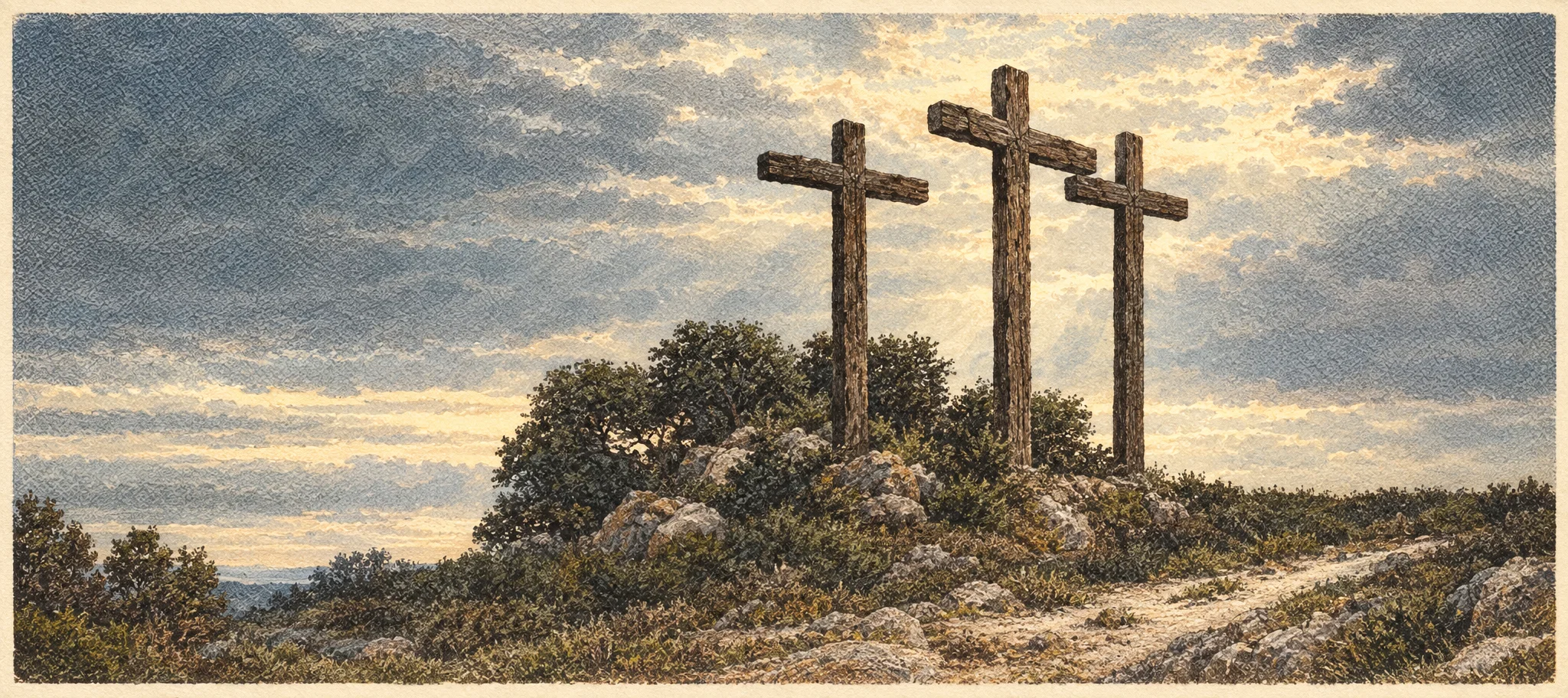 “It was the marvel of all the universe that Christ should humble himself to save fallen man.”
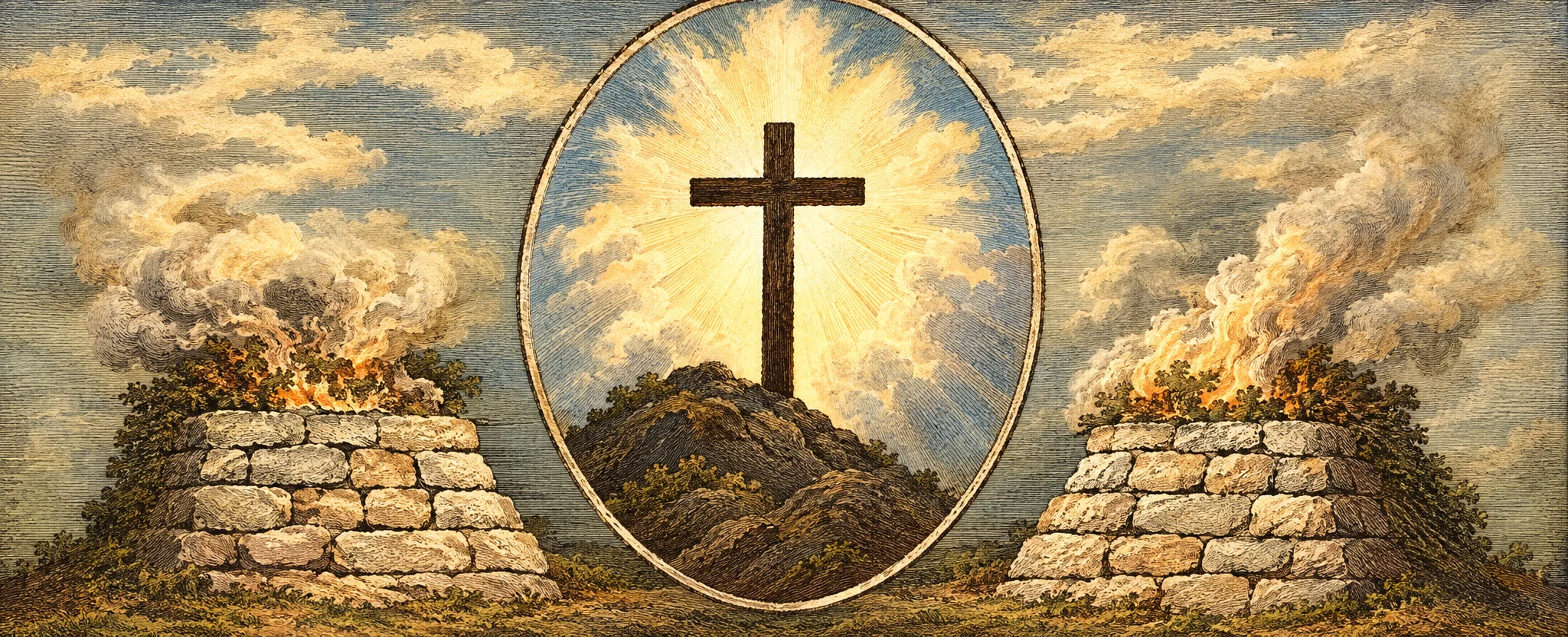 A monochrome religious scene shows two low stone altars set on either side of a central oval medallion. The altar at left and the one at right are piled with irregular blocks and appear to hold offerings, with pale smoke or clouds rising above them. Within the oval, a dark cross stands on a rounded hill against a bright, radiating sky, suggesting a spiritual or symbolic focus for the scene. The background is cloudy and indistinct, and no people, animals, or lettering are visible.
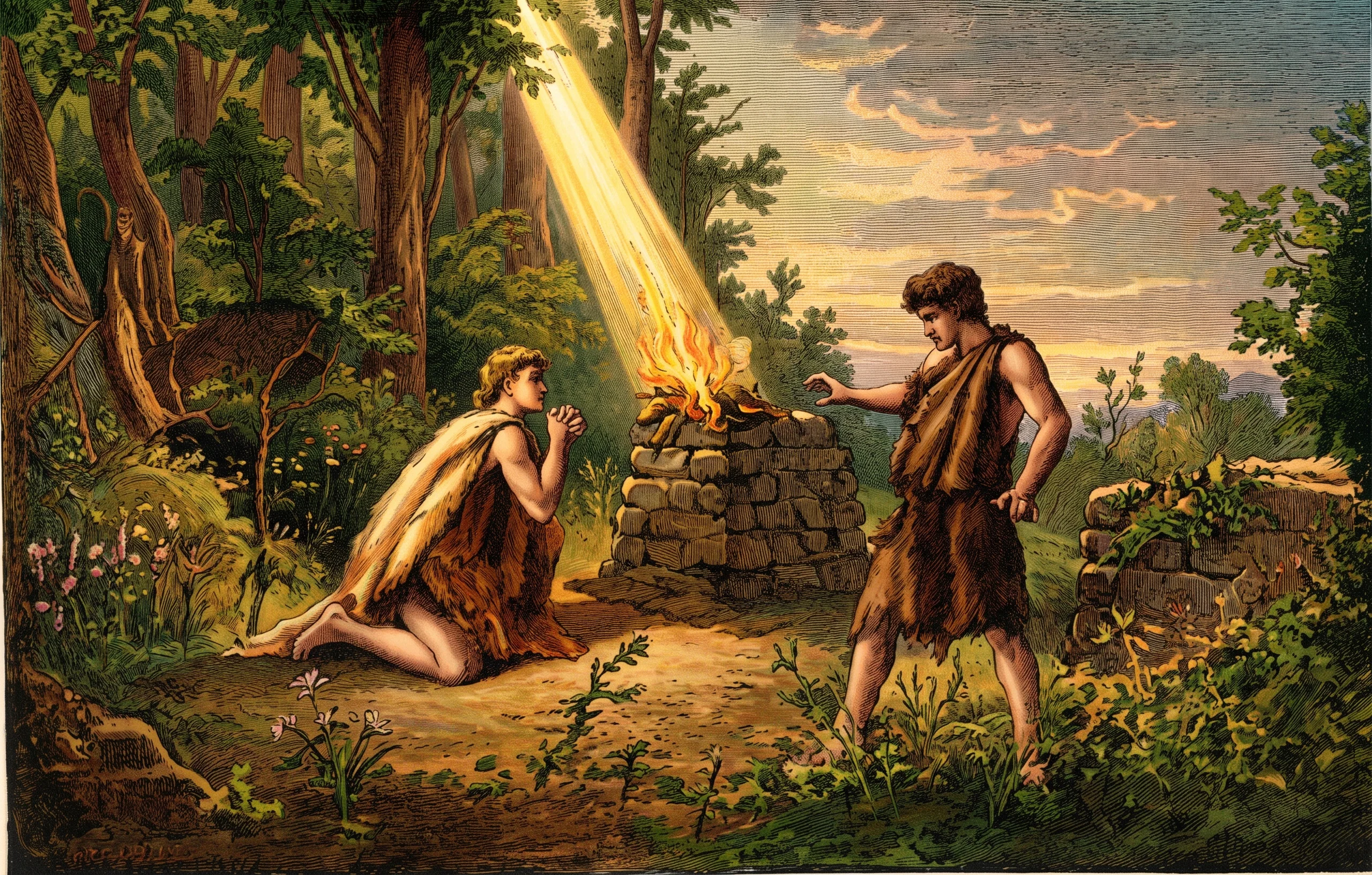 “When Cain saw that his offering was rejected, he was angry with the Lord and with Abel.”
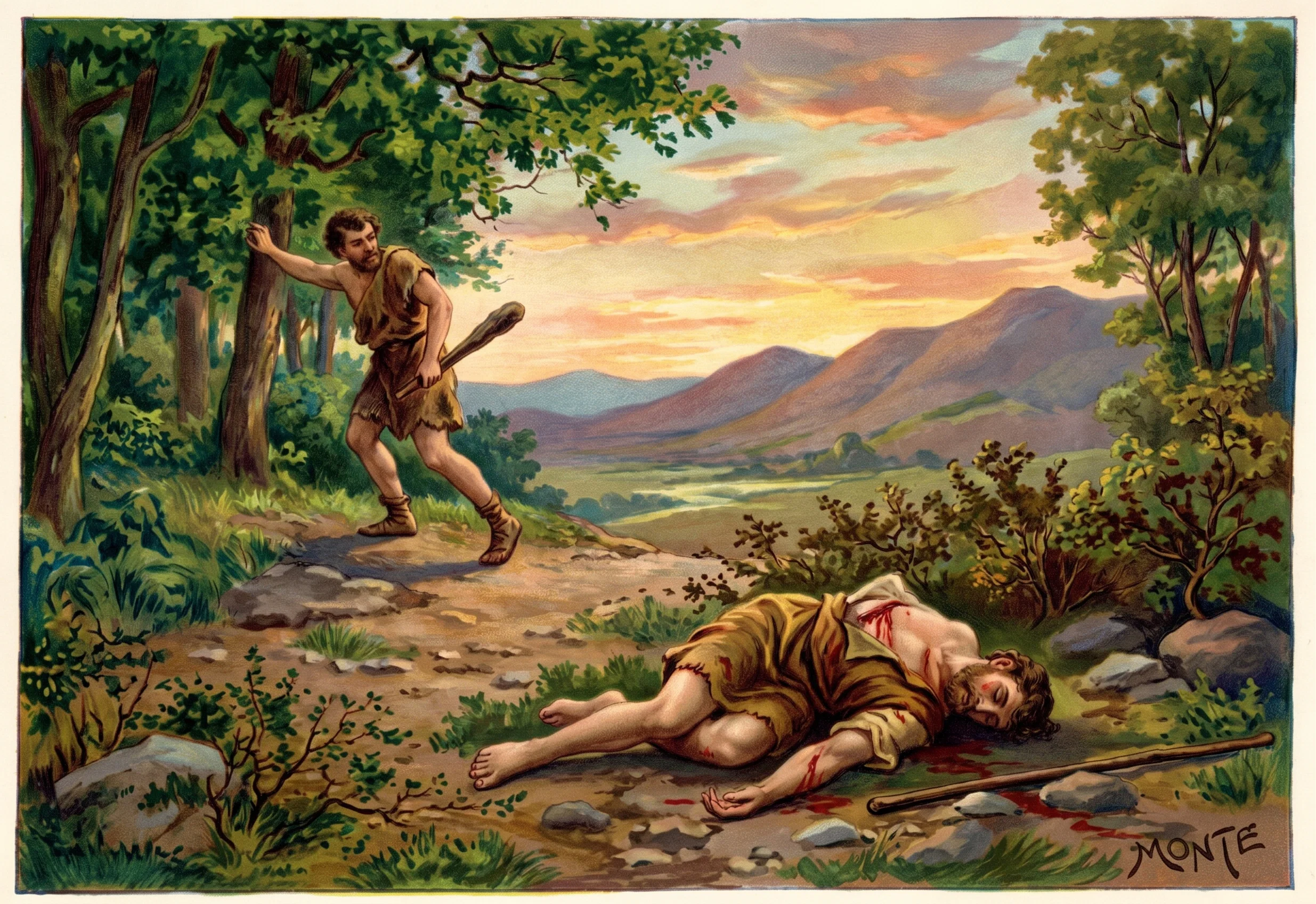 “The history of Cain shows . . . what man will become apart from Christ.”
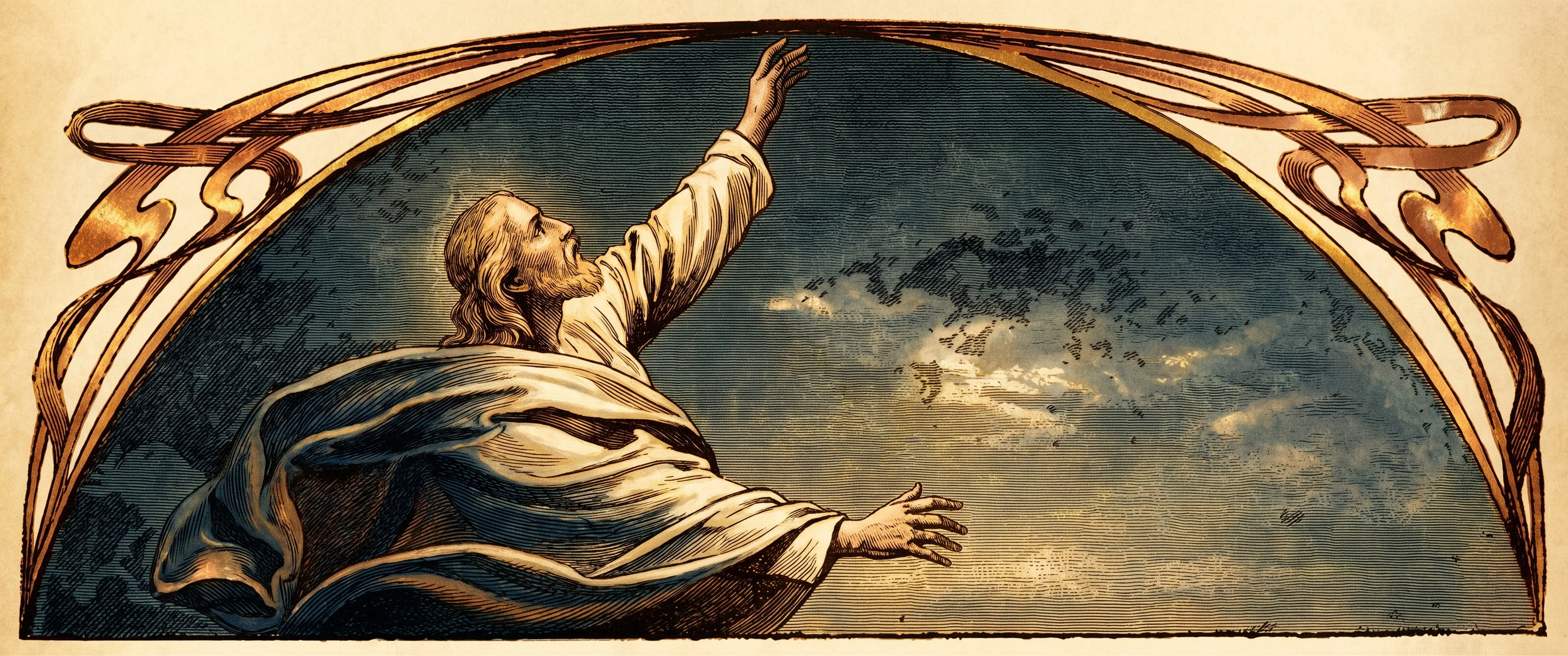 A large, rounded, dome-like form fills most of the image, enclosed by a curved ornamental border with curling, leaf-like decorations at both upper corners. Along the lower left edge, a human figure reclines horizontally, with the head and body partly obscured by the shaded foreground and one arm reaching toward the center-right, hand extended. Faint irregular shapes and marks appear across the broad domed area, but no lettering is visible.
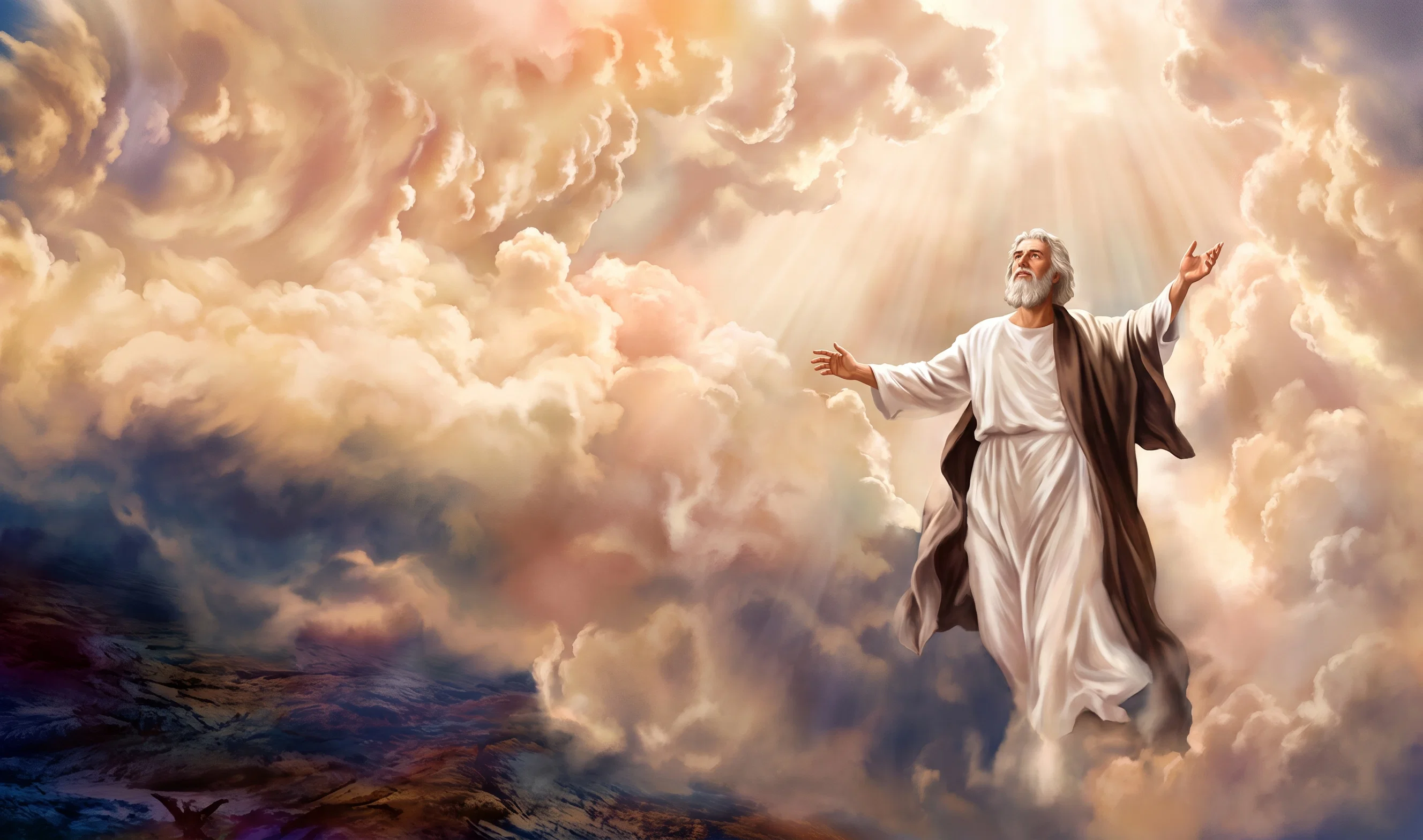 “By faith Enoch was translated that he should not see death.”
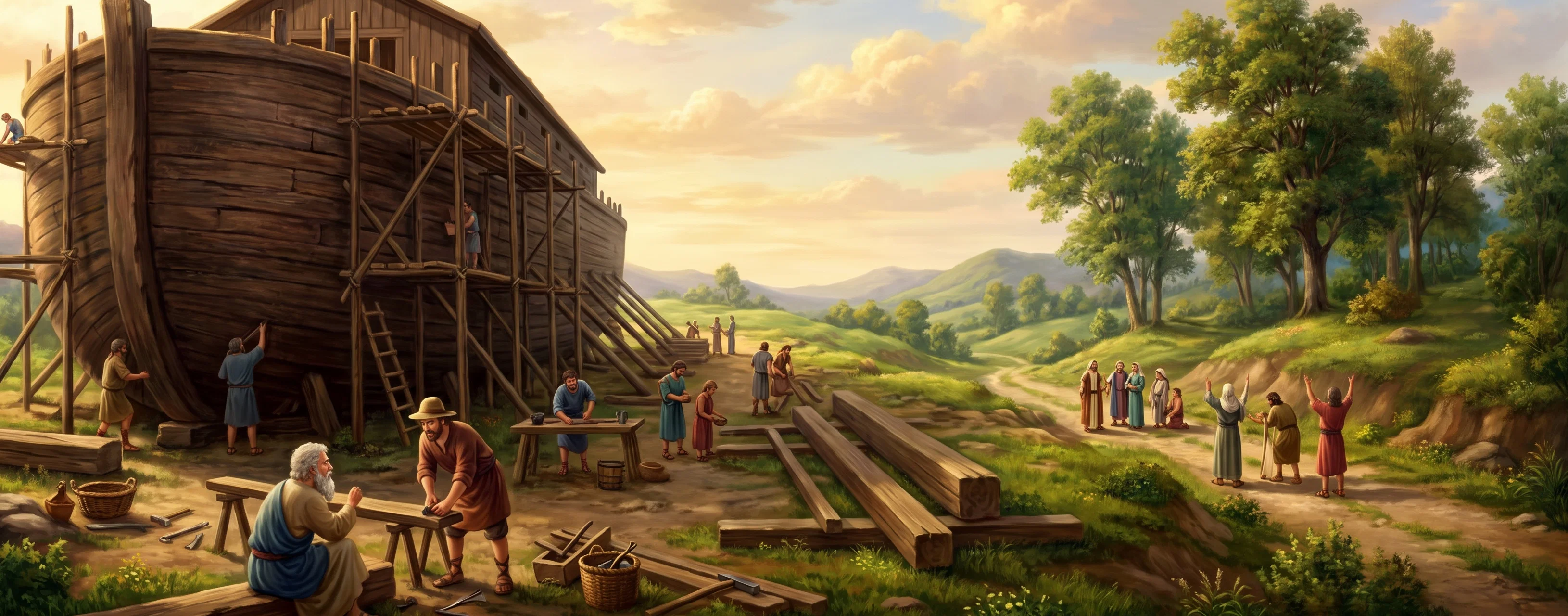 A broad landscape shows a huge wooden vessel under construction, its tall curved side filling the left of the scene. Closely spaced ribs and long bands run along the hull, with upright supports and scaffolding visible beside it. Several small figures stand and work near the base, while long logs or beams extend diagonally across the open ground toward the right. More workers appear farther away, with low hills and a cloudy sky in the background. The scale of the vessel dwarfs the people around it.
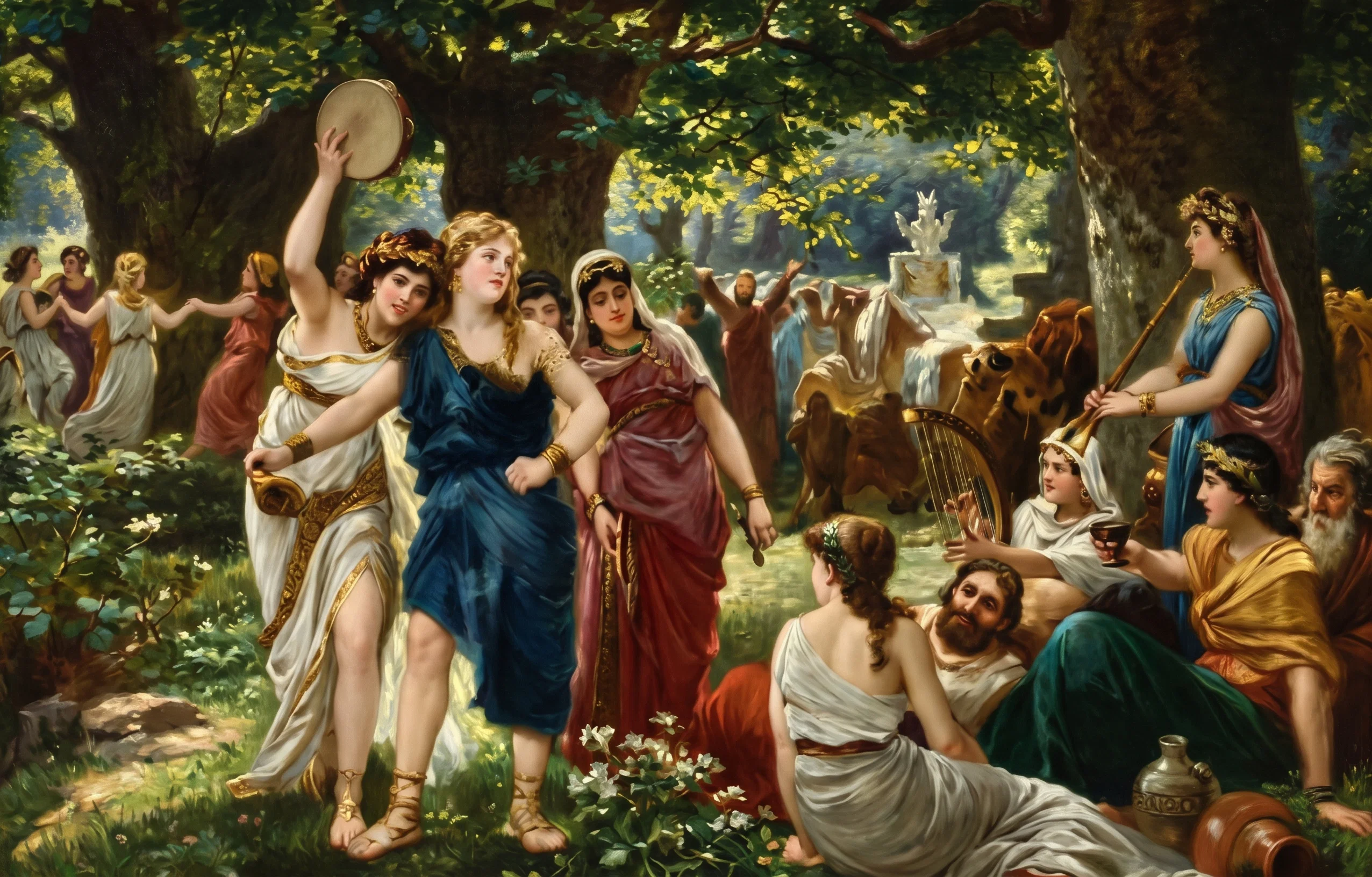 REVELRY BEFORE THE FLOOD
“Men put God out of their knowledge, and worshiped the creatures of their own imagination.”
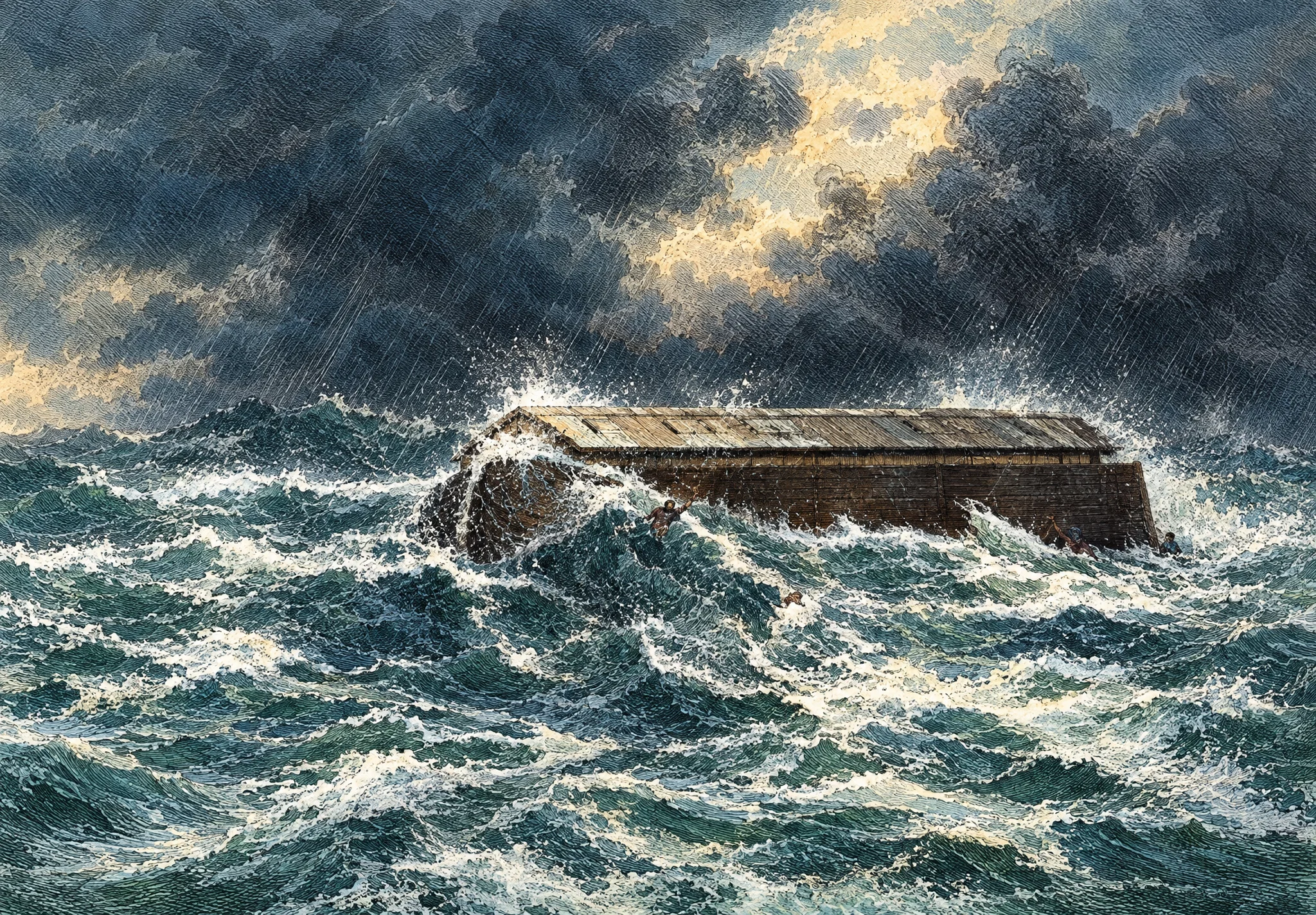 “The avenging waters swept over the last retreat, and the despisers of God perished in the black depths.”
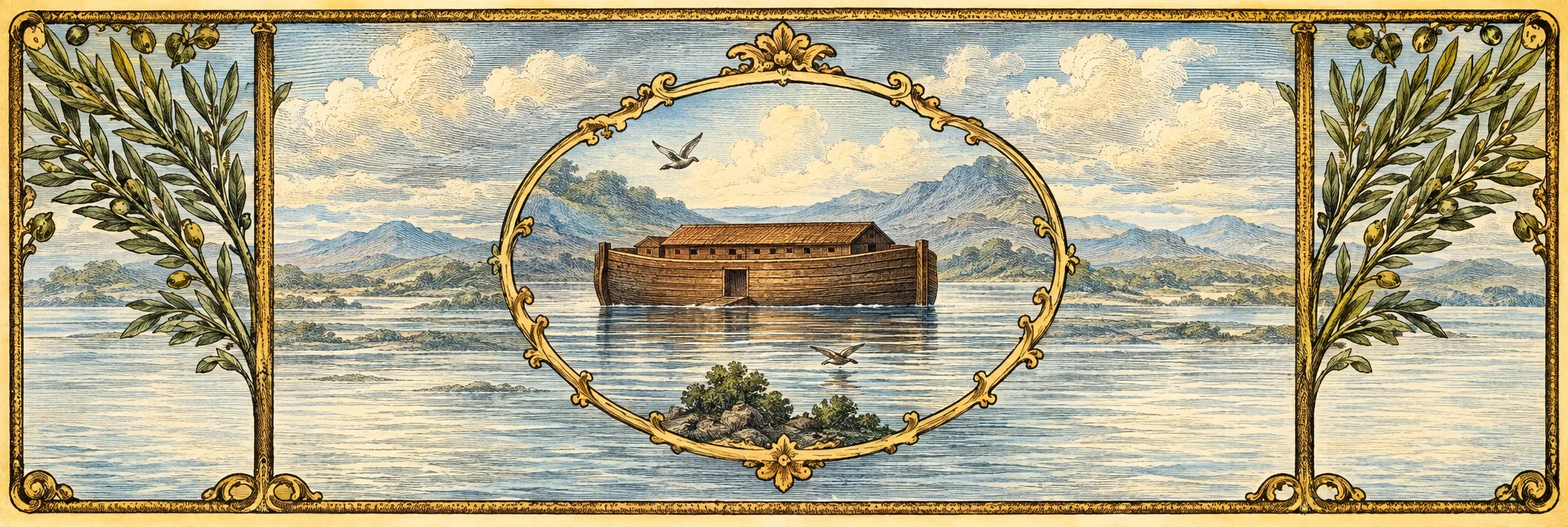 A small rectangular ark with a raised central cabin and dark openings floats on rippling water within an oval vignette. Dark, rugged mountain forms rise behind it on either side, while clouds fill the sky and a small bird flies above the water at upper left. The scene is framed by a narrow rectangular border, with tall, feathery branches sweeping inward from both sides and curling decorative details at the lower corners. No lettering is visible.
 A dense, roughly symmetrical black ornamental design fills the image. Curving, intertwined vines form a rounded frame, with branches spreading outward into clusters of dark leaves and small flowers. Near the top center, the vines curl around a circular open space containing several tiny decorative marks. The lower center features a dark, bowl- or vase-shaped form with fanlike foliage, framed by mirrored curling shapes and leafy sprigs. No readable text or distinct setting is visible.
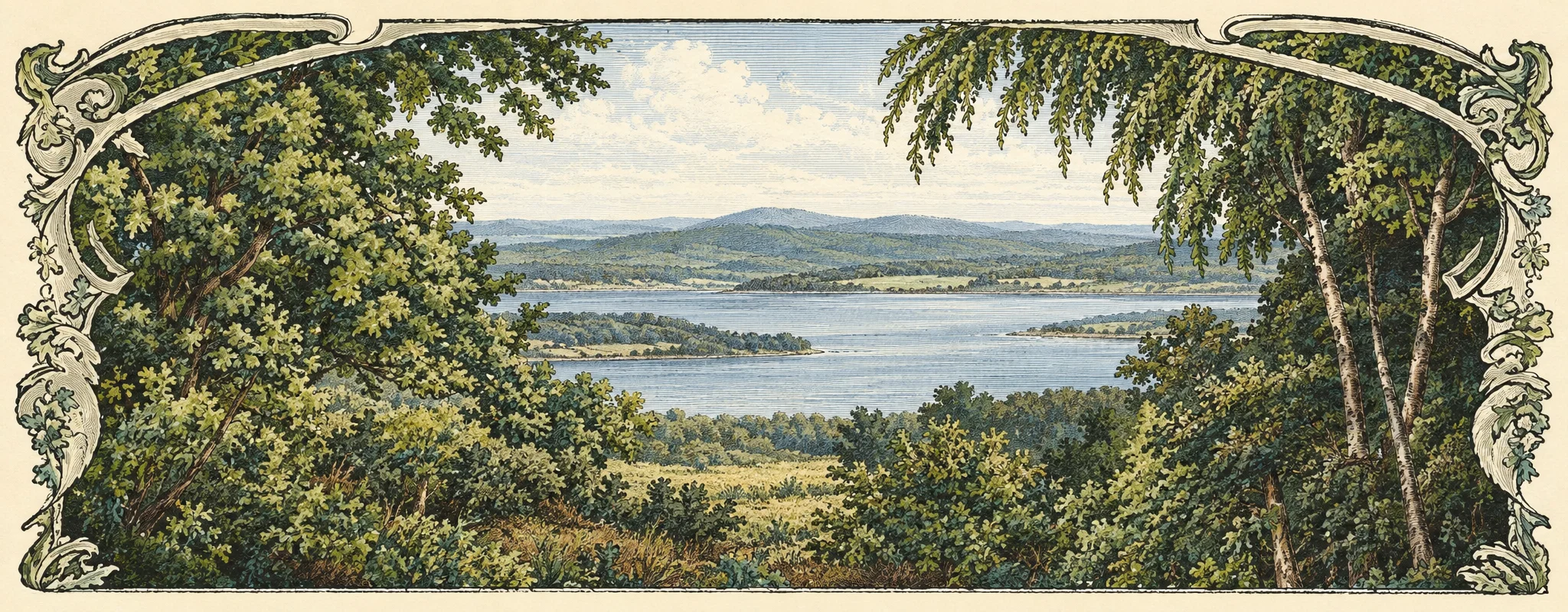 A wide, softly shaded landscape is framed by dense foliage and curling ornamental forms. Bushes and leafy trees fill the foreground on both sides, with drooping branches and a dark tree trunk prominent at the right. Beyond the vegetation, broad horizontal bands suggest open water or a distant plain beneath a cloudy, pale sky. The central horizon is open and quiet, with no clearly visible people, animals, buildings, or lettering.
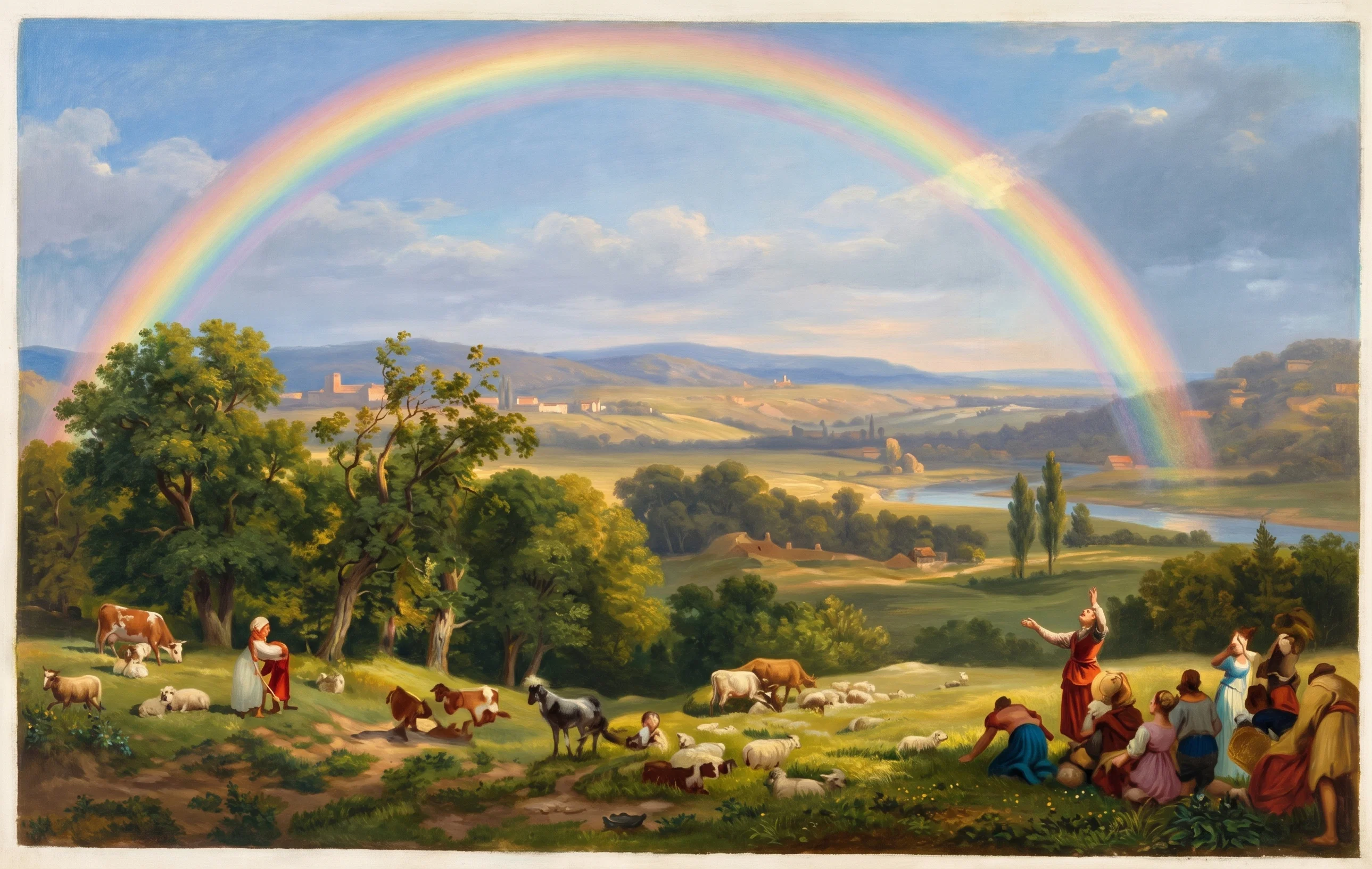 “I do set my bow in the cloud, . . . and I will look upon it, that I may remember the everlasting covenant between God and every living creature.”
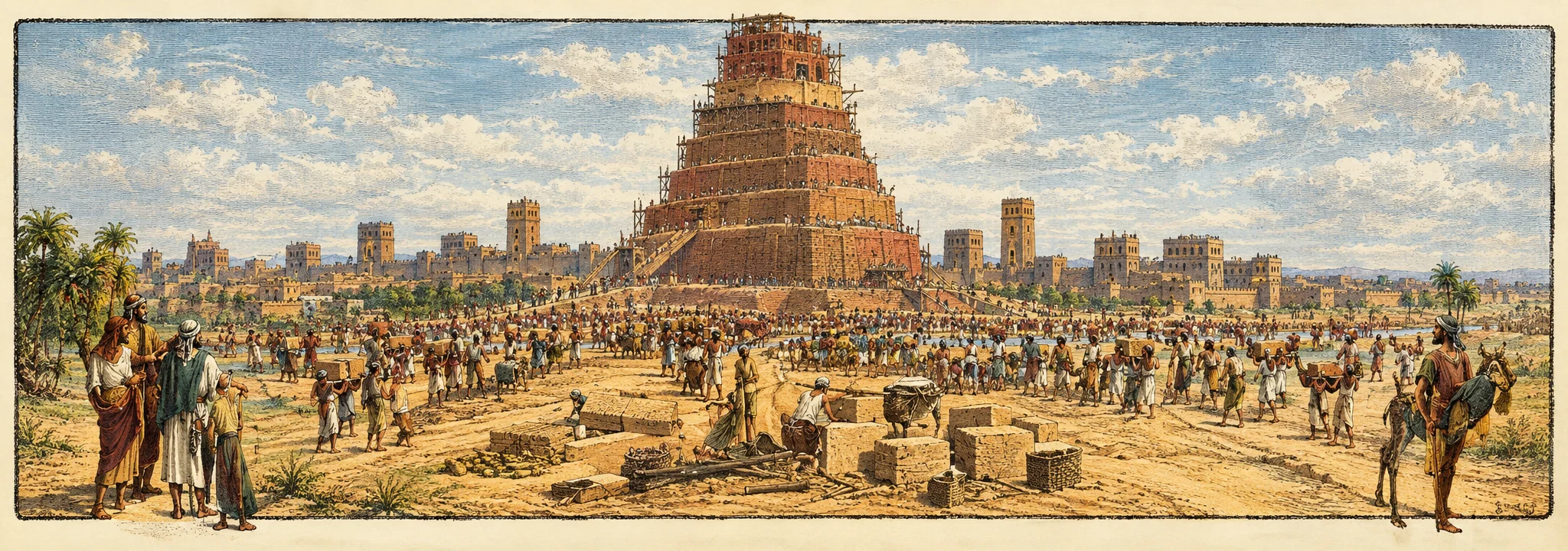 A wide ancient city scene centered on a massive, tiered tower rising above a low skyline. The tower has a broad stepped base and a dark, rounded structure at its summit, with a thin line or plume extending upward. Dense groups of small human figures gather around its base and across the middle distance. Scattered blocks, low structures, and other construction materials fill the open foreground. Larger figures and pack animals, apparently camels, frame the scene at the left and right edges; no readable lettering is visible.
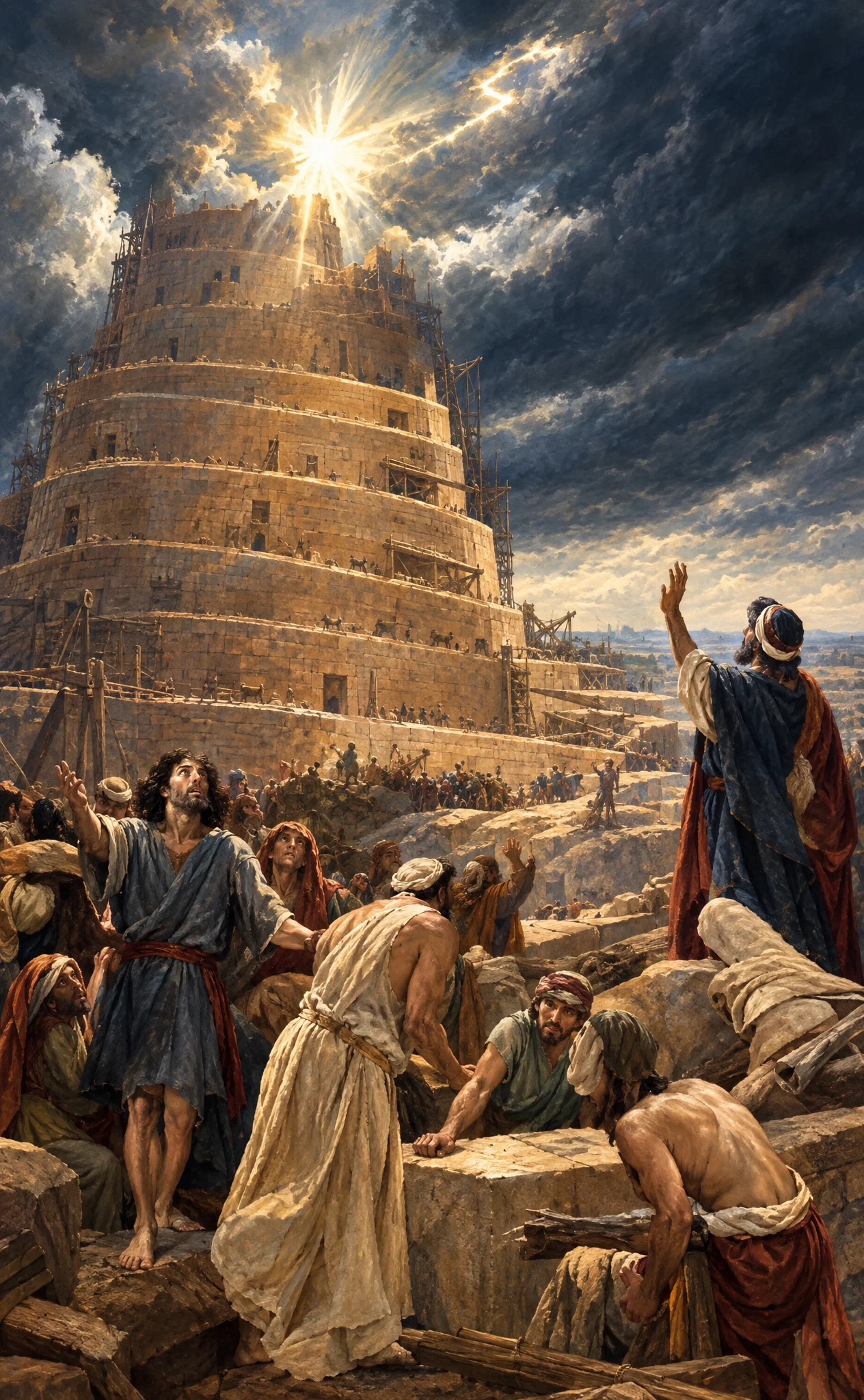 THE TOWER OF BABEL
“The schemes of the Babel-builders ended in shame and defeat.”
 A narrow, symmetrical ornamental flourish runs horizontally across the image. At its center, several fine curved strokes fan outward like stylized leaves or petals, with a small dark central form and tiny dots. Curling tendrils extend to either side, ending in compact, cross-like floral motifs and short horizontal strokes. No lettering or other identifiable objects are visible.
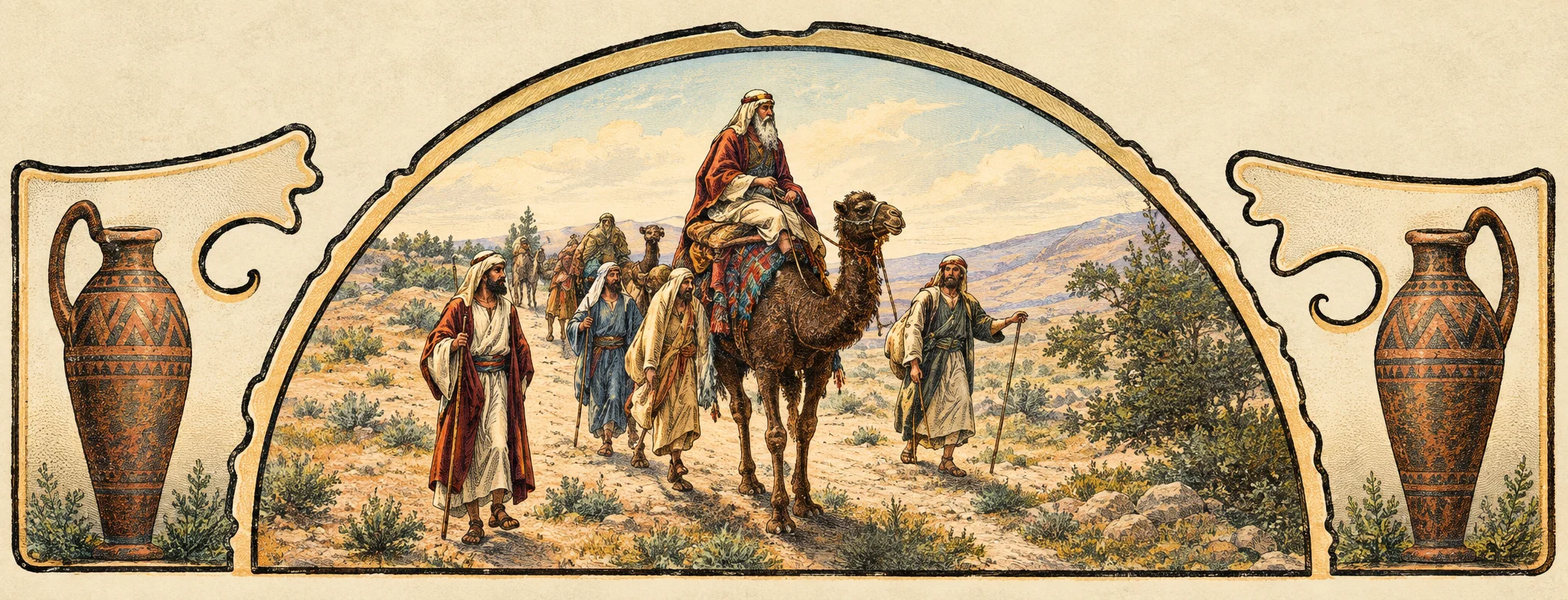 A monochrome scene shows a small group traveling through a sparse, rocky landscape beneath a broad rounded arch. At the center, a robed man sits atop a camel, accompanied by several figures on foot; one person at the right appears to gesture toward the way ahead. Low shrubs and uneven ground dot the background. Large handled vessels stand at the far left and right, framed by decorative scroll-like outlines that extend inward toward the arch. The composition presents the travelers as they move across the open terrain.
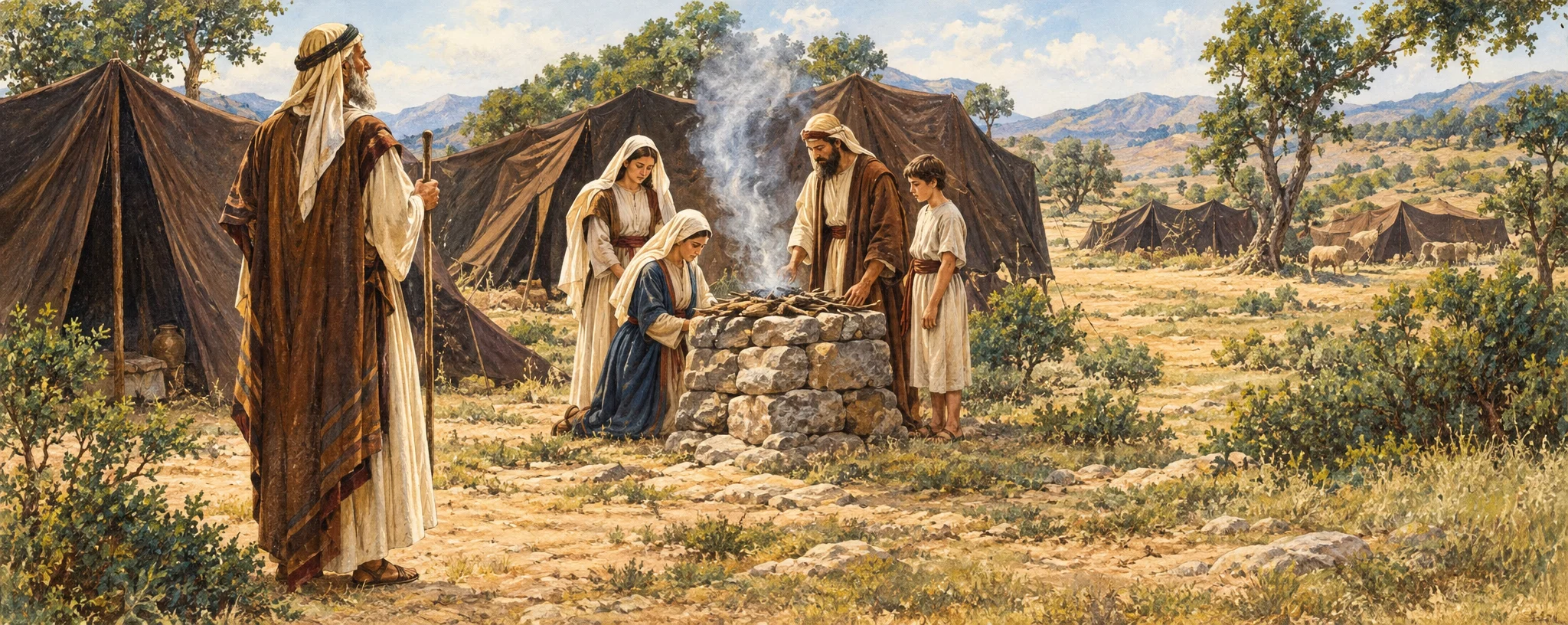 “Wherever he pitched his tent, close beside was set up his altar.”
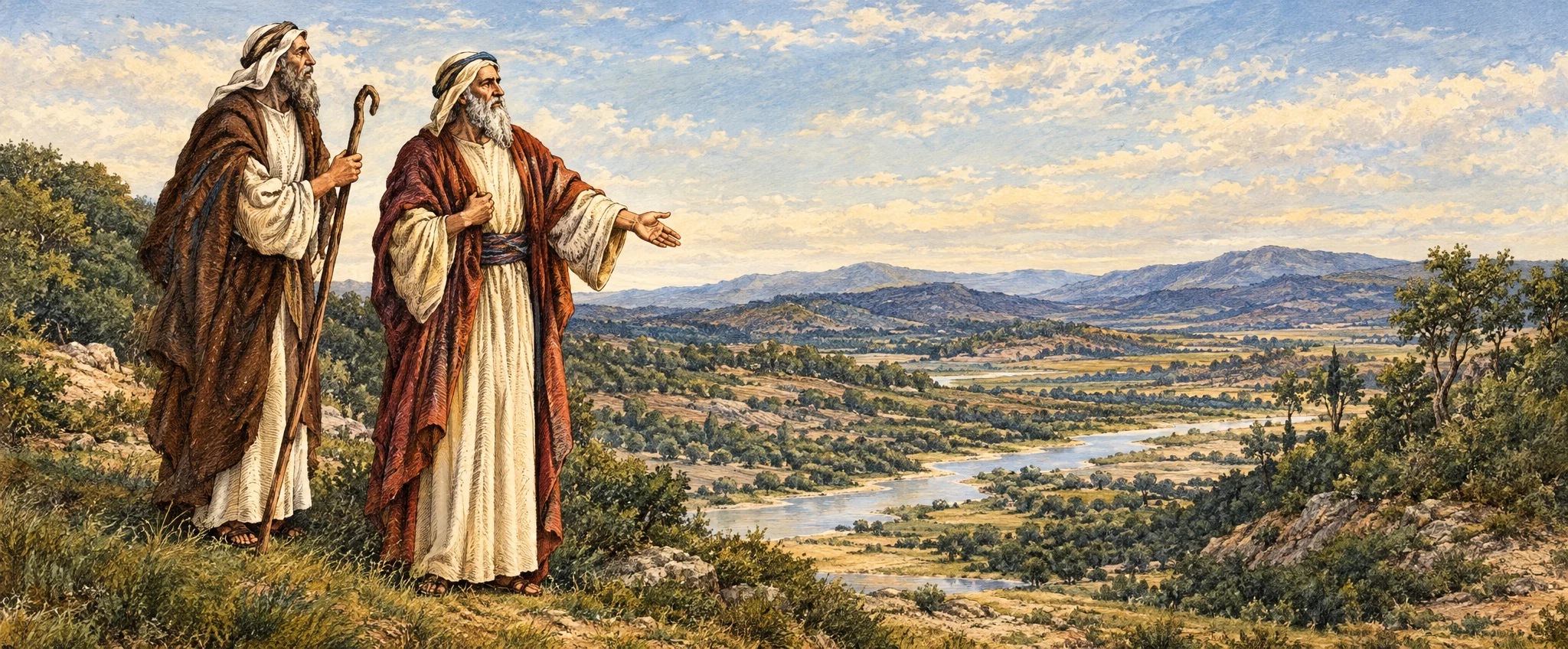 Two bearded men in long robes and head coverings stand at the left of a broad open landscape. The older-looking man in front extends one arm toward the distance, as if indicating a direction, while the man behind him holds a long staff upright and looks toward him. A winding pale track or shallow watercourse curves across the foreground into the plain, with low hills along the horizon and sparse trees and shrubs at the right. The composition places the figures prominently against the expansive countryside; no clear lettering is visible within the scene.
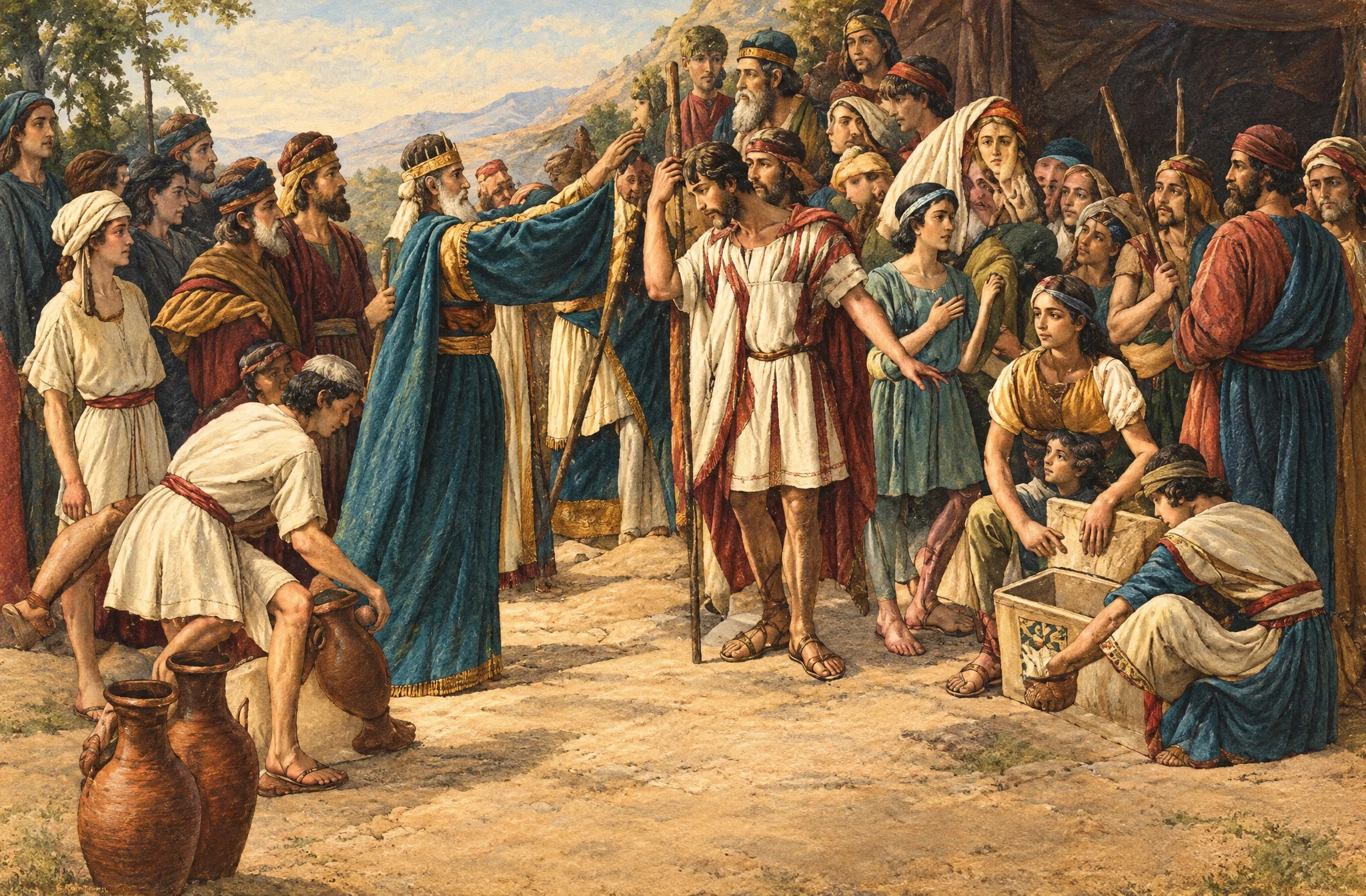 MELCHIZEDEK BLESSING ABRAHAM
“And Abram gave him tithes of all.”
 A small decorative flourish formed from flowing, symmetrical scrollwork. At the center is a rounded floral cluster with several circular and oval shapes, framed by curling leaves or tendrils. Long, slender curves sweep outward to both sides and loop around the flower, while a pair of interlocking, drooping curves extend below it. The ornament is rendered in dark, continuous outlines with open spaces inside; no people, animals, setting, or lettering are visible.
 A symmetrical, ornamental emblem is centered on a pale background. A dark, ornate crown with several rounded points and a taller central point sits above a broad blank area. On either side are large irregular masses of gray stippling, resembling clouds or foliage, with faint diagonal dotted bands extending inward and downward beneath the crown. Crossed, ribbon-like bars appear near the upper left and right corners, and smaller angled fragments sit near the lower edge. No people, animals, or lettering are visible.
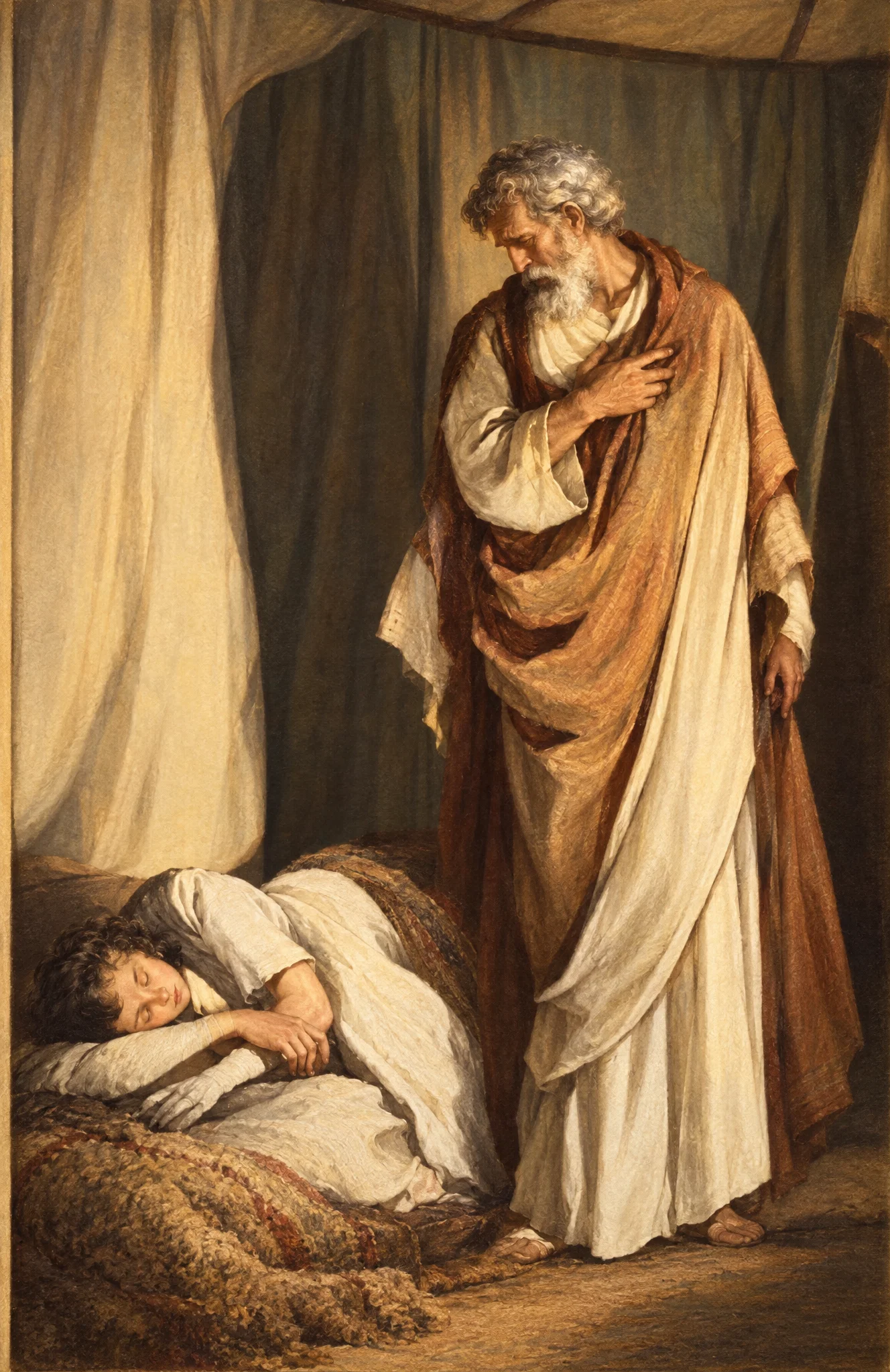 ABRAHAM VIEWING HIS SLEEPING SON
“For a moment the father looked upon the dear face of his son, then turned tremblingly away.”
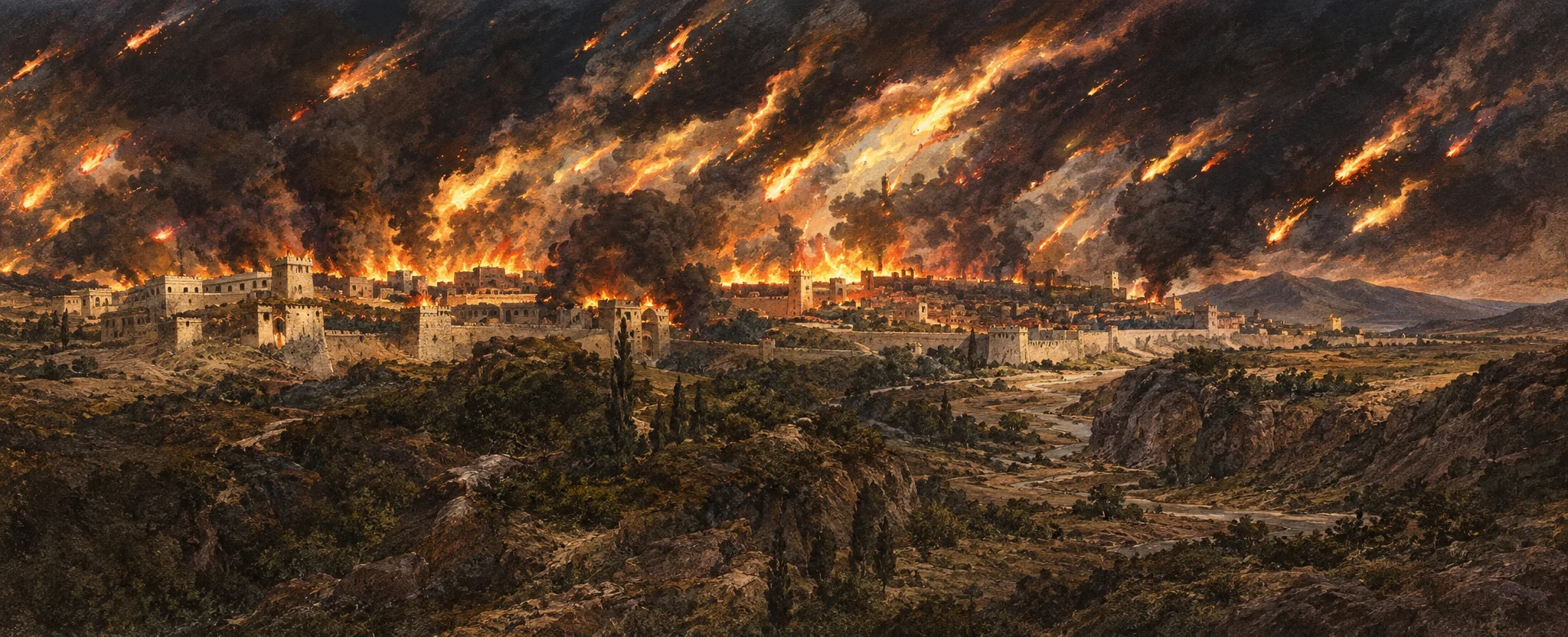 A broad, dark landscape shows the destruction of Sodom beneath a turbulent sky. Streaks of fire or burning debris appear to descend from the clouds across the scene, while smoke and flames engulf the settlement below. Low buildings and structures are visible along the middle distance, with indistinct figures and forms scattered in the foreground amid the devastation. The composition stretches horizontally, contrasting the luminous falling streaks against the nearly black sky and shadowed ground. No readable lettering is visible within the scene.
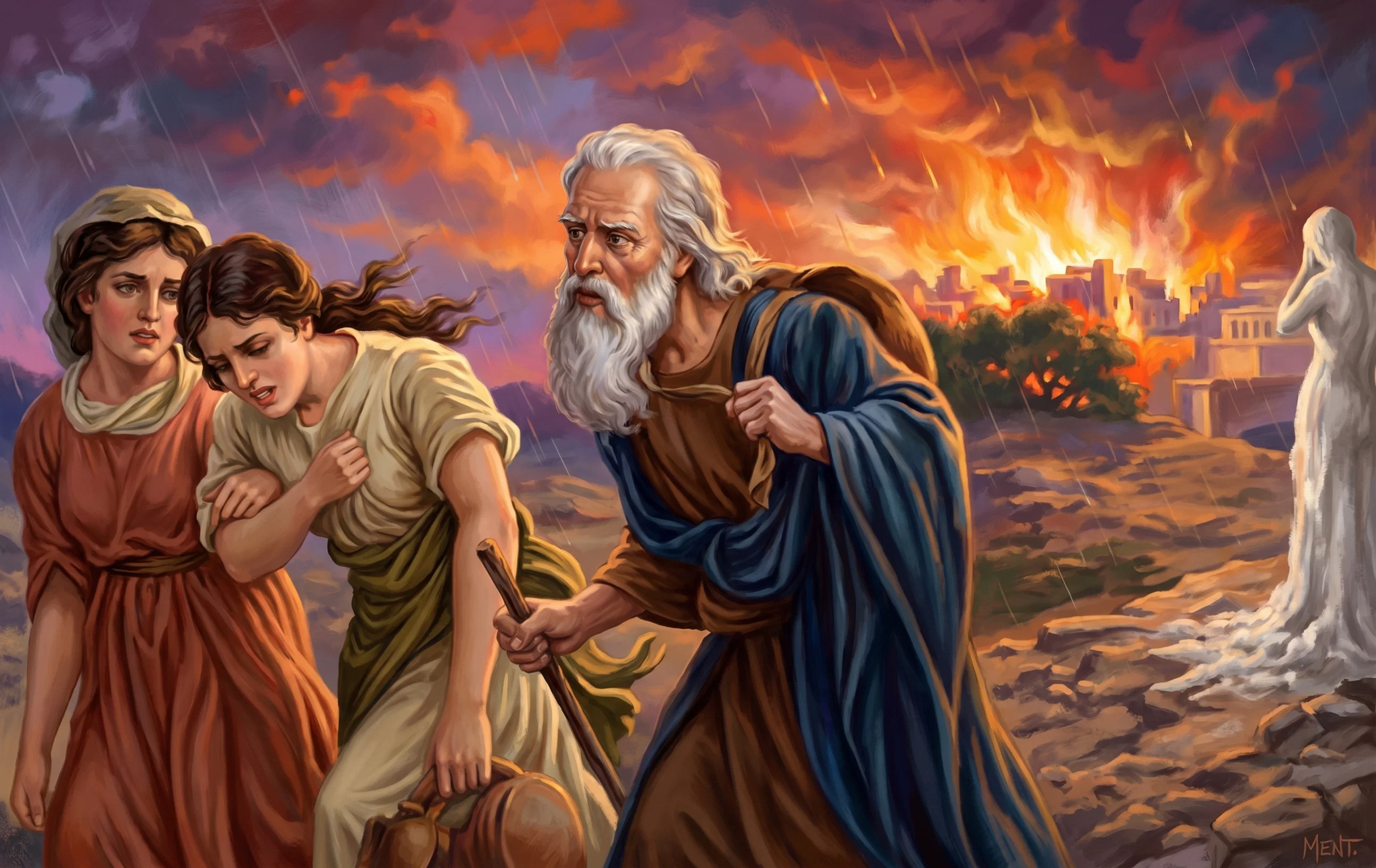 “To cast one lingering look upon the devoted city, to tarry for one moment . . . would have cost their life.”
 A small, symmetrical ornamental divider in dark ink on a pale background. Thin horizontal lines extend outward from a central flourish, with curled scroll-like details and pointed leaf or banner shapes hanging down on either side of the middle. There are no visible people, animals, setting, or legible words.
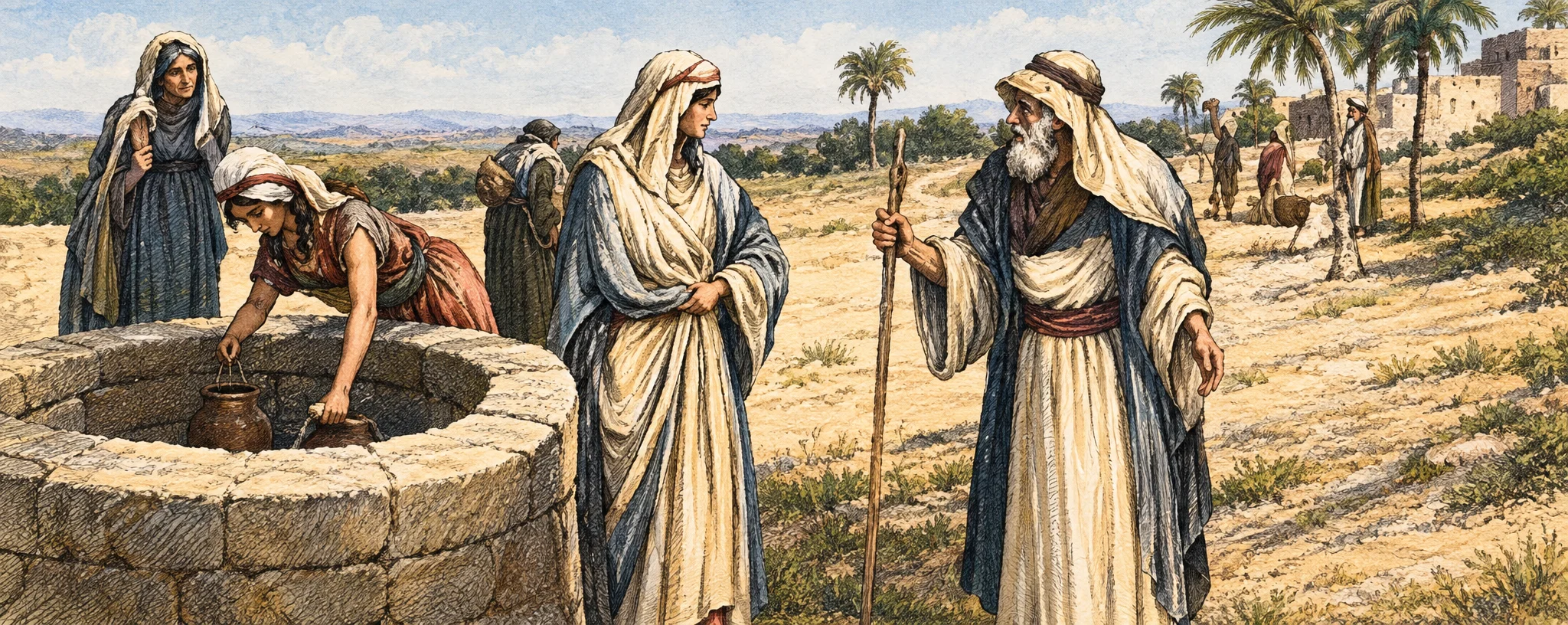 An ancient outdoor scene centers on a circular stone well at the left, where a woman bends over its rim as if drawing water; another figure stands behind her. A veiled woman stands near the middle, facing an older bearded man at the right, who holds a long staff and raises one hand in a speaking or questioning gesture. The man wears a head covering and a long robe. In the background, several small figures gather along a path near palm trees and simple buildings, suggesting a settlement beyond the well. No lettering is visible.
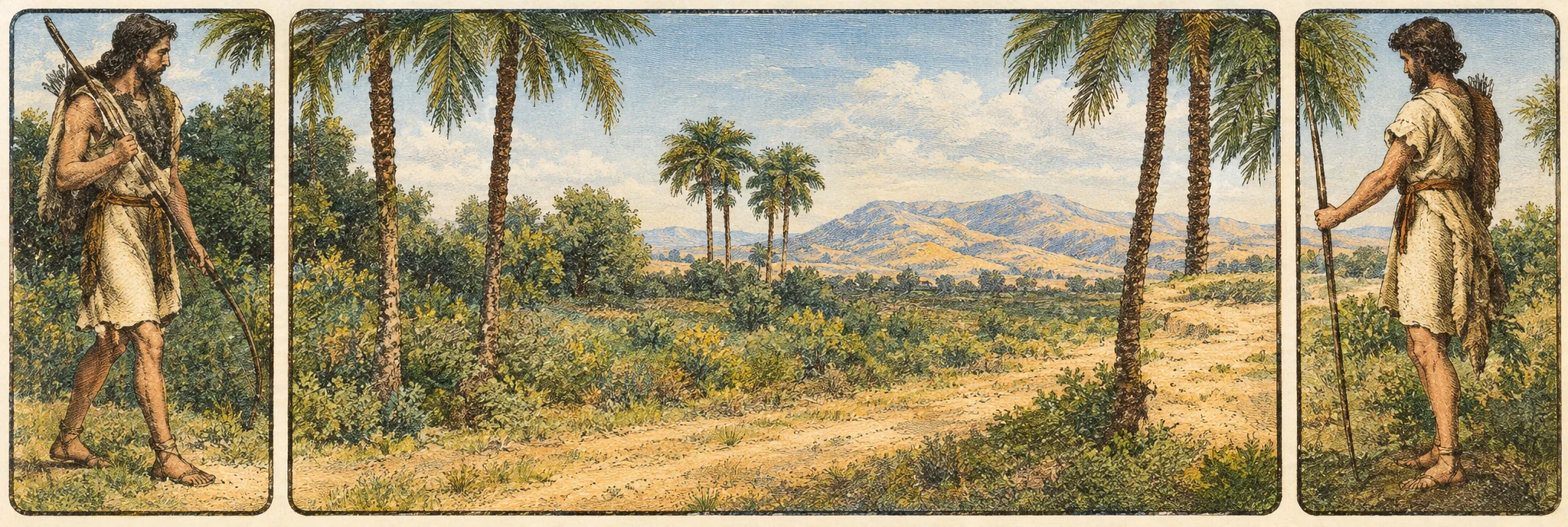 A wide pastoral landscape is framed by two narrow side panels showing a young man in simple ancient dress. In the left panel, he stands among trees with a long bow held diagonally across his body; in the right, he faces inward, holding the bow at his side. The central view opens onto a broad, gently rolling field, with scattered palms and other trees along the edges and distant low hills on the horizon. A small figure appears far off near the middle of the landscape, emphasizing the open space.
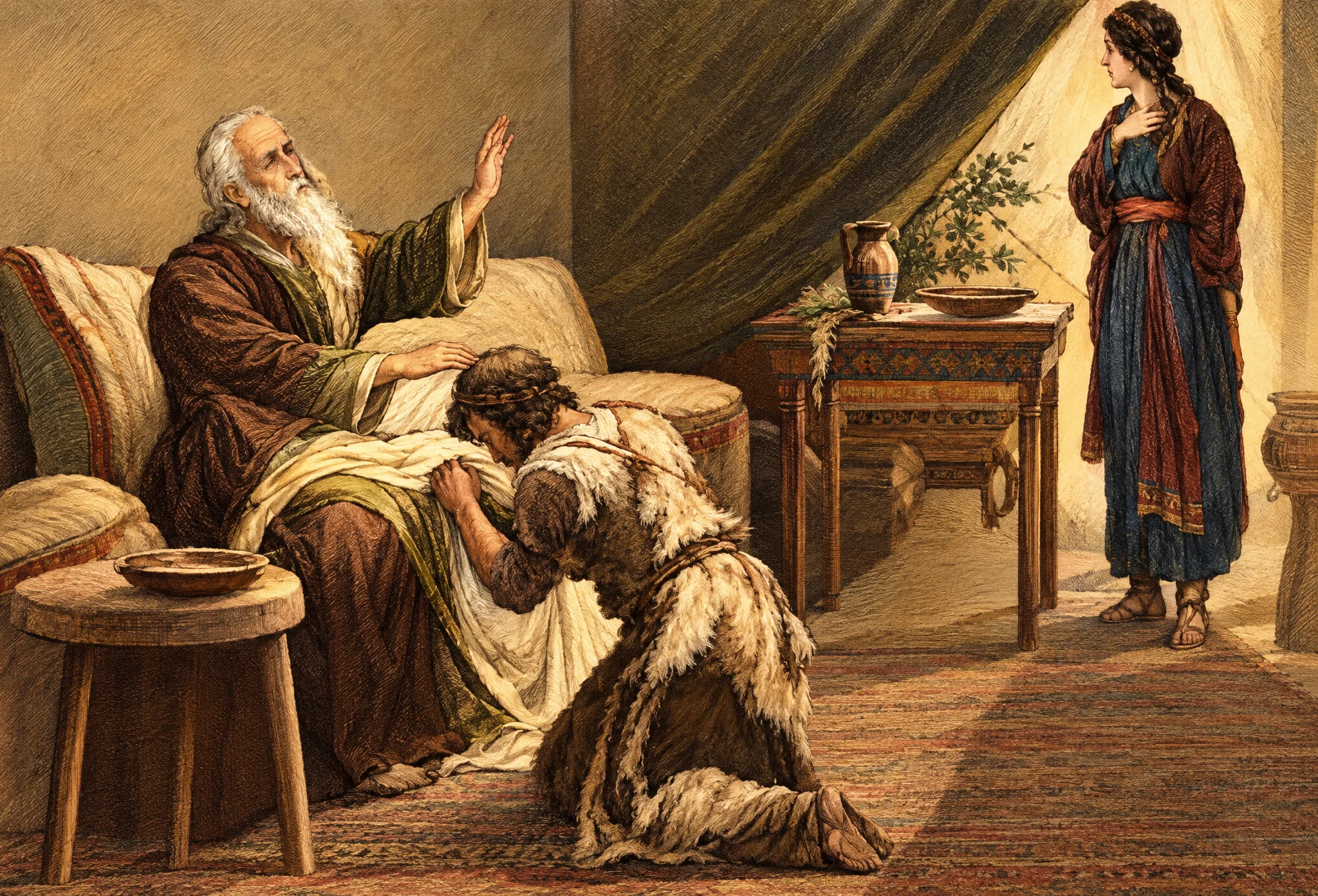 JACOB RECEIVING THE BLESSING
“Jacob and Rebekah succeeded in their purpose, but they gained only trouble and sorrow by their deception.”
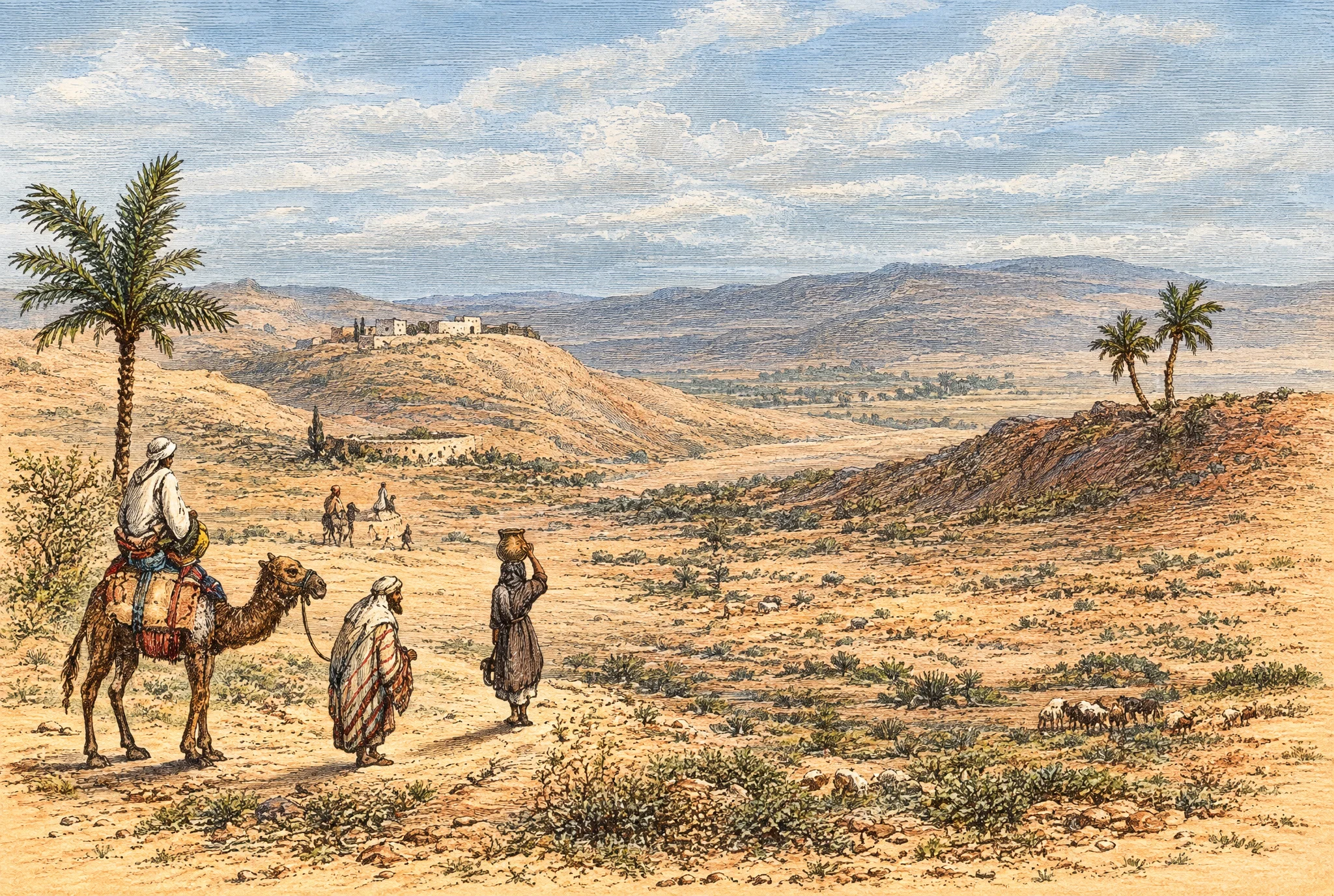 A small group of travelers crosses a broad, barren landscape. In the left foreground, a person rides a laden camel, while a second figure in a long draped garment walks beside it. Farther ahead, another traveler balances a rounded bundle or vessel on their head. Tiny figures and animals dot the middle distance, and low hills stretch across the horizon. A tall palm rises at the left edge, with a cluster of smaller palms on a rocky ridge to the right; patches of rough ground and a shallow-looking watercourse fill the foreground.
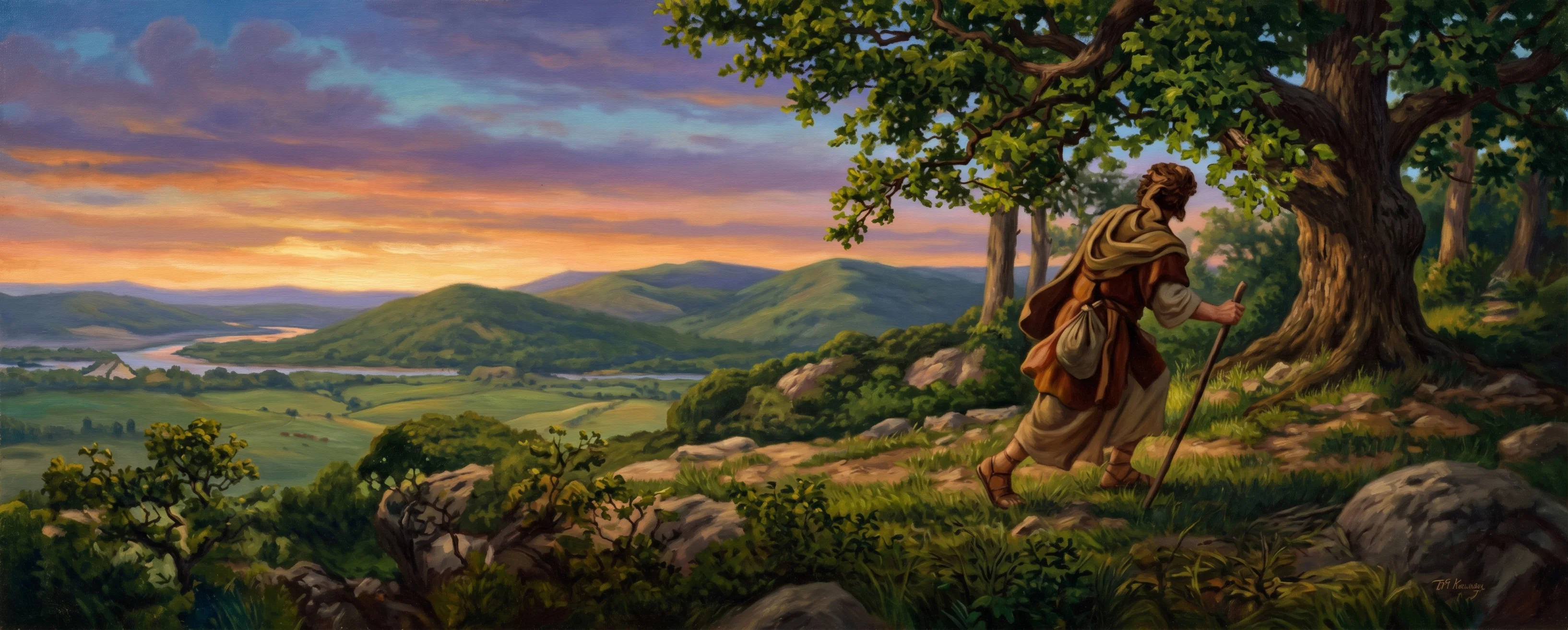 A solitary robed traveler rests on the ground beneath a large tree at the right side of the scene, his body bent or reclining beside a cluster of rocks, with one arm raised near his head. The tree’s heavy canopy spreads across the upper-right portion of the image, while the left opens onto a broad, quiet landscape of low hills and a distant valley. Uneven stones, shrubs, and patches of shadow fill the foreground, framing the resting figure against the more open expanse beyond. No lettering is visible.
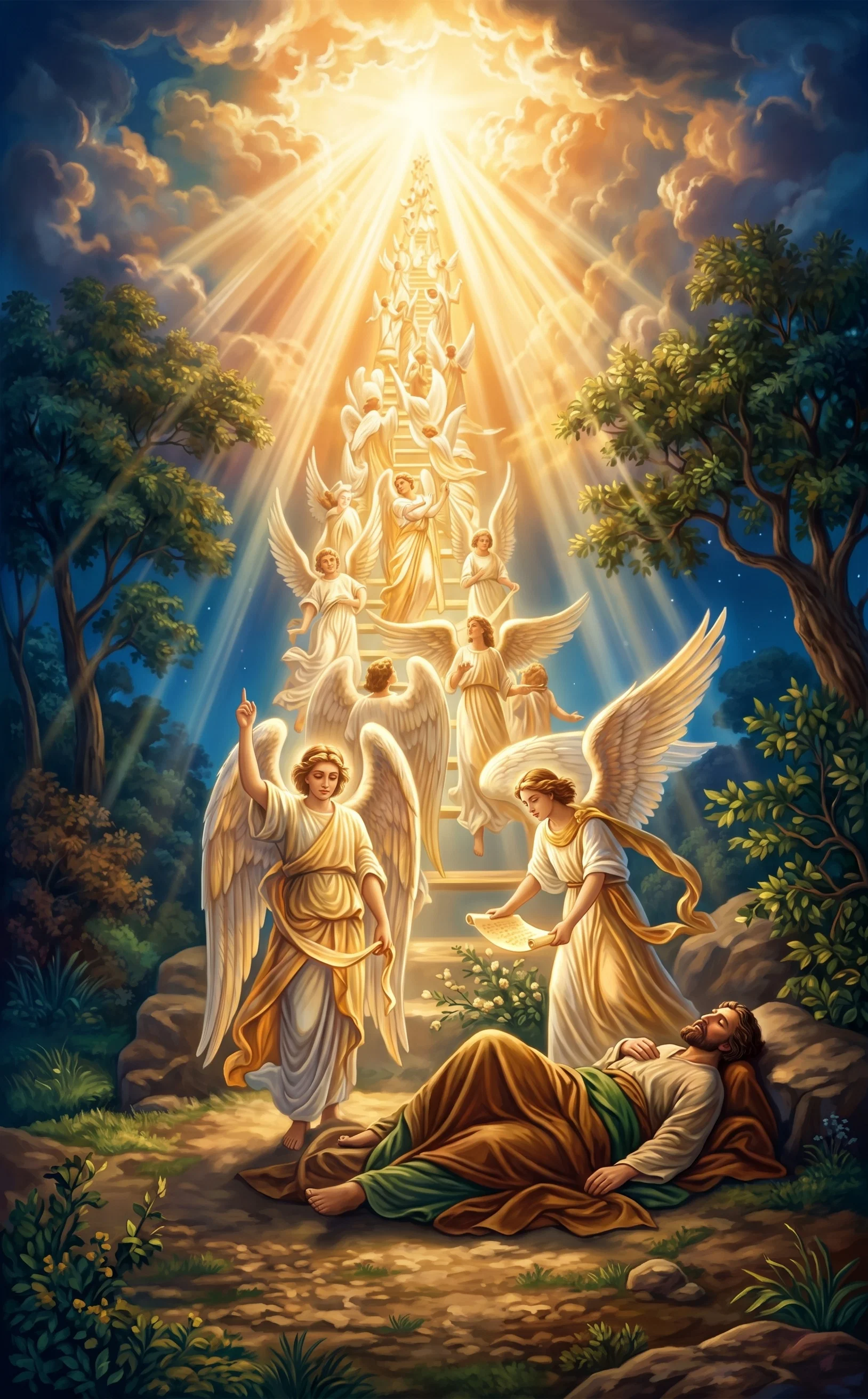 JACOB'S DREAM
“In this vision the plan of redemption was presented to Jacob.”
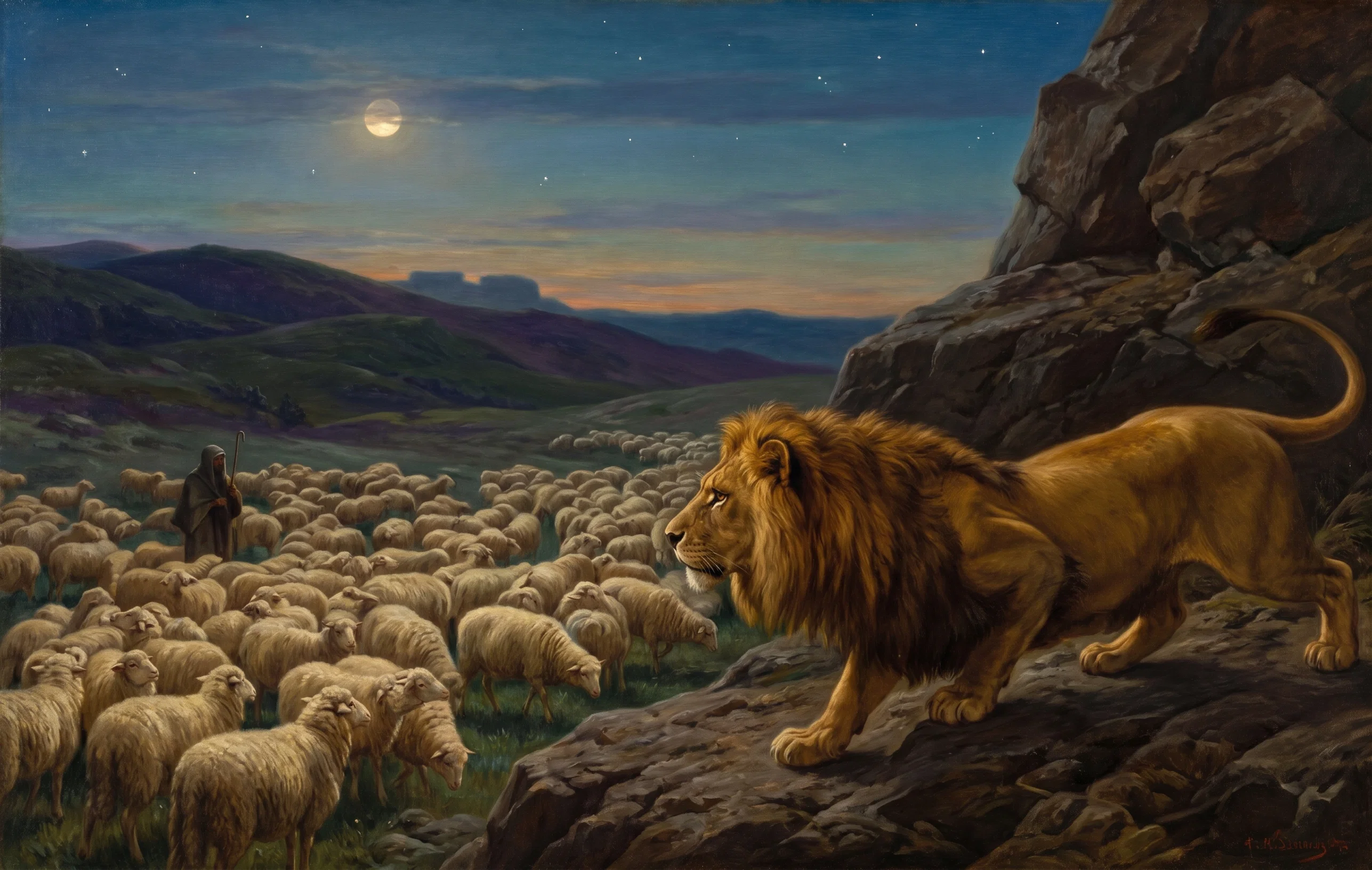 GUARDING THE FLOCK BY NIGHT
The Chief shepherd declares: “I will save my flock, and they shall no more be a prey”; “neither shall the beast of the land devour them.”
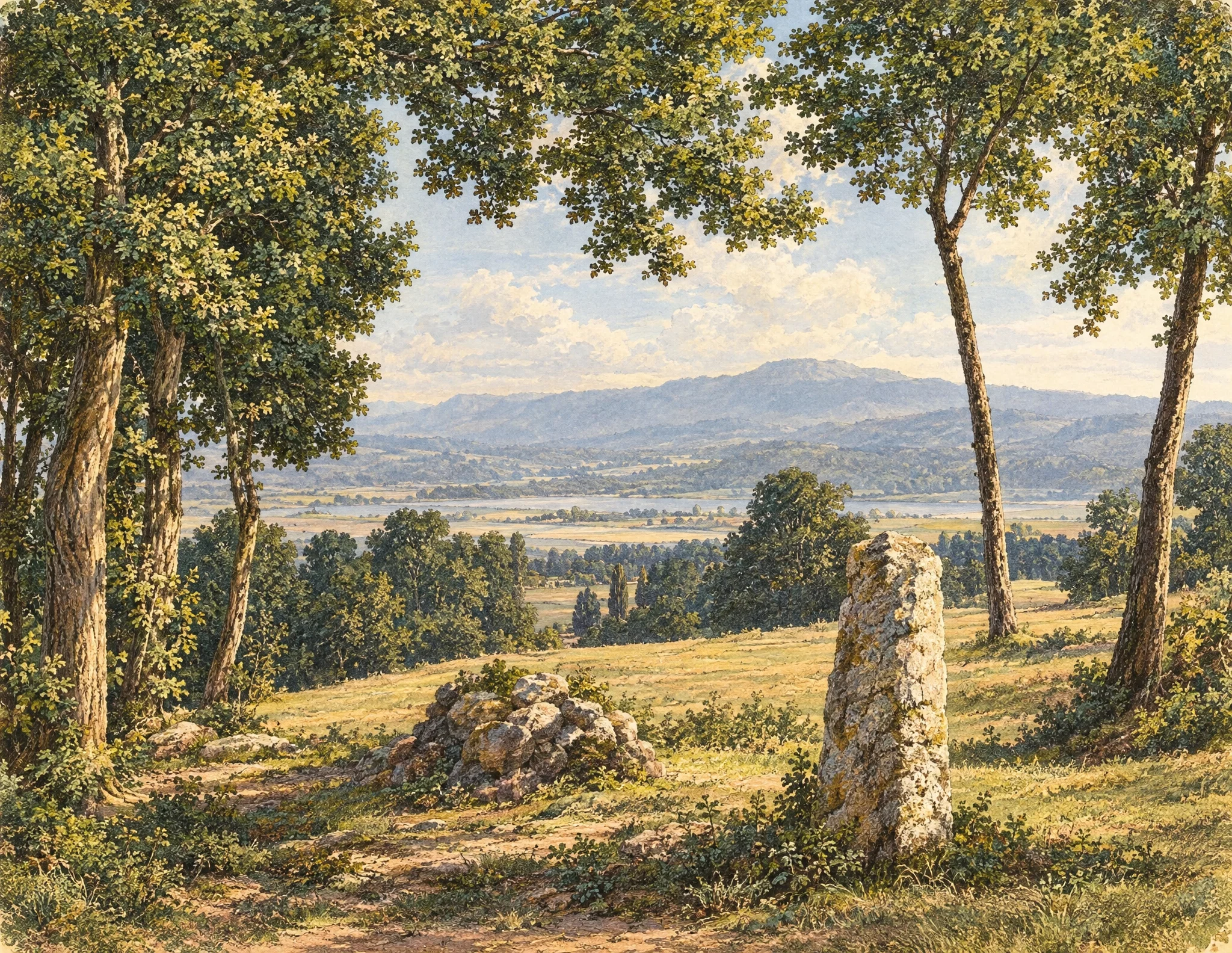 “This heap be witness, and this pillar be witness.”
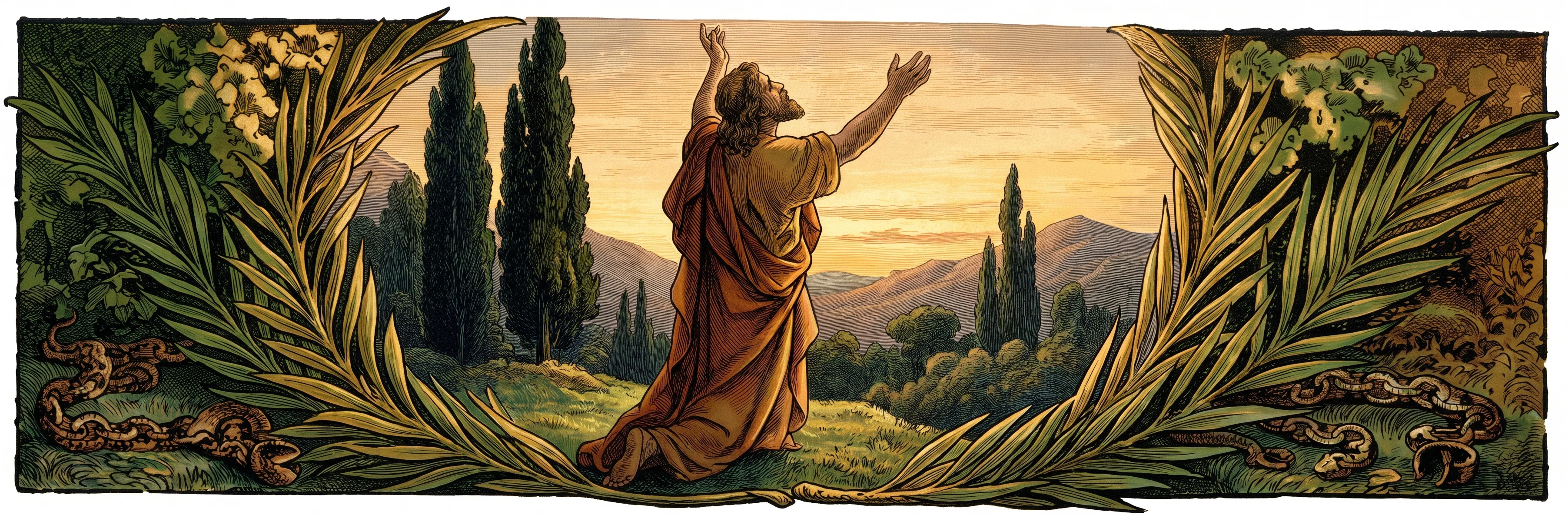 A dramatic nighttime scene shows two human figures locked together in a struggle at the center. One figure bends low while the other appears to grapple with him, their limbs overlapping against a dim, shadowy landscape. Tall, dark forms rise in the background beneath a cloudy sky. Sweeping palm-like fronds frame the scene on both sides, and decorative floral scrollwork runs along the lower edge, giving the composition a symmetrical, ornamental border.
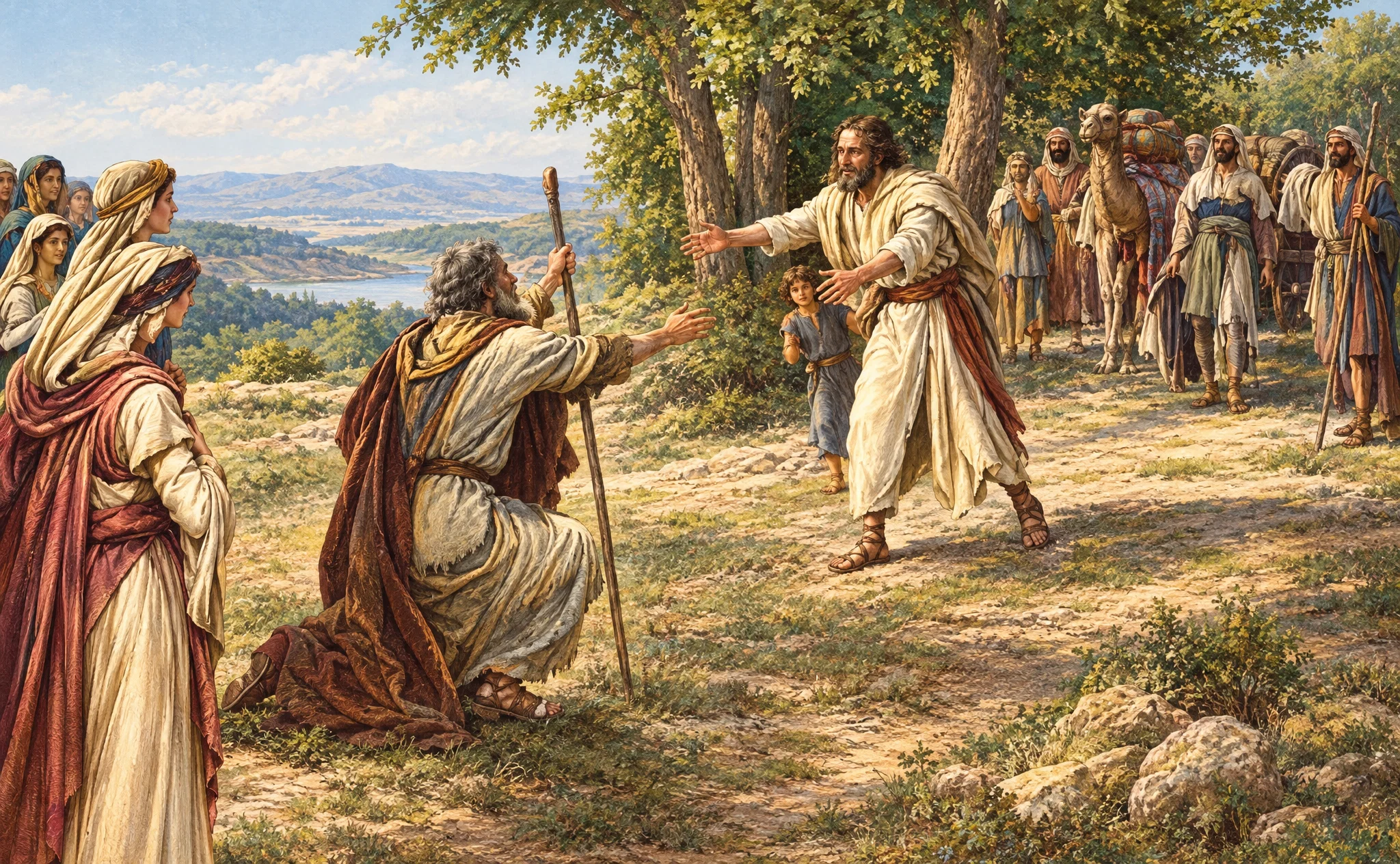 JACOB MEETING ESAU
“At sight of that crippled sufferer, Esau ran to meet him, and embraced him, and fell on his neck, and kissed him; and they wept.”
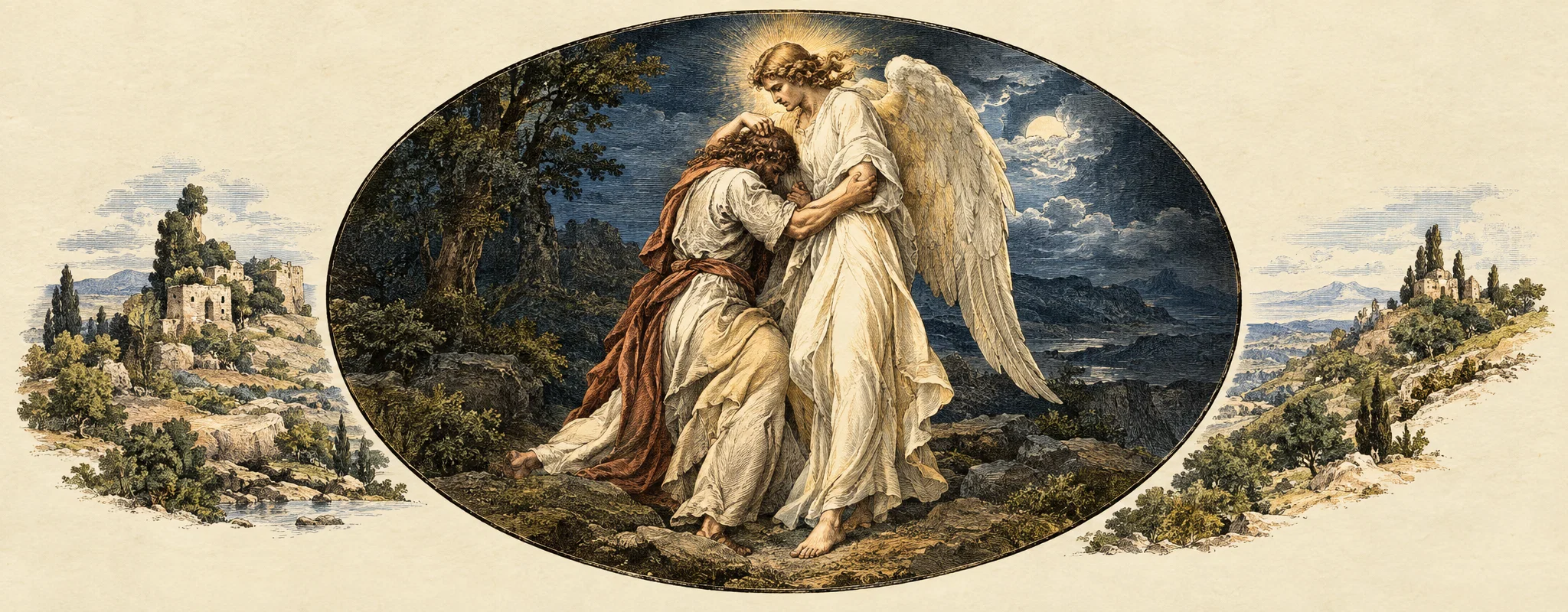 “All penitent and broken, he clung to the angel.”
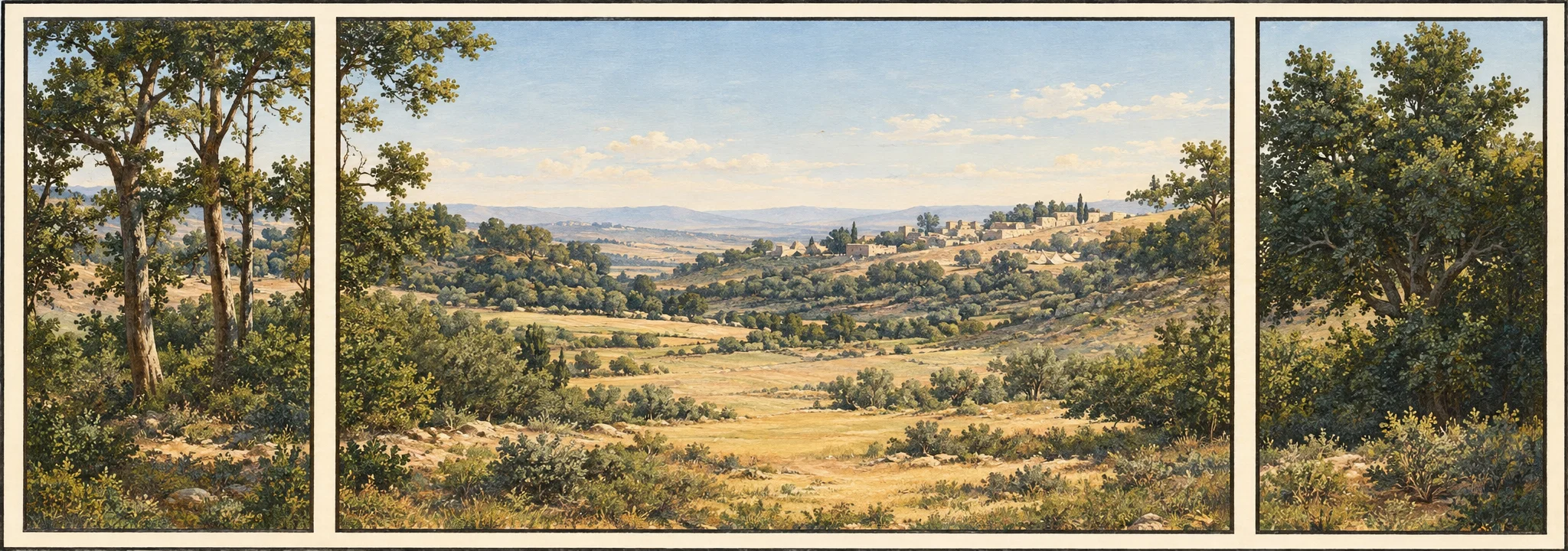 A broad, open landscape stretches across the center, with a low, uneven horizon and scattered trees and shrubs. The foreground is pale and sparsely vegetated, while darker bands of brush and grass cross the middle distance. Small figures and clustered forms near the horizon suggest a camp or settlement, with faint smoke-like shapes rising above it. Narrow wooded scenes frame the central view on both sides: tall, leafy trees stand in the left panel, and a dense, shadowed tree occupies the right. No lettering is visible within the image.
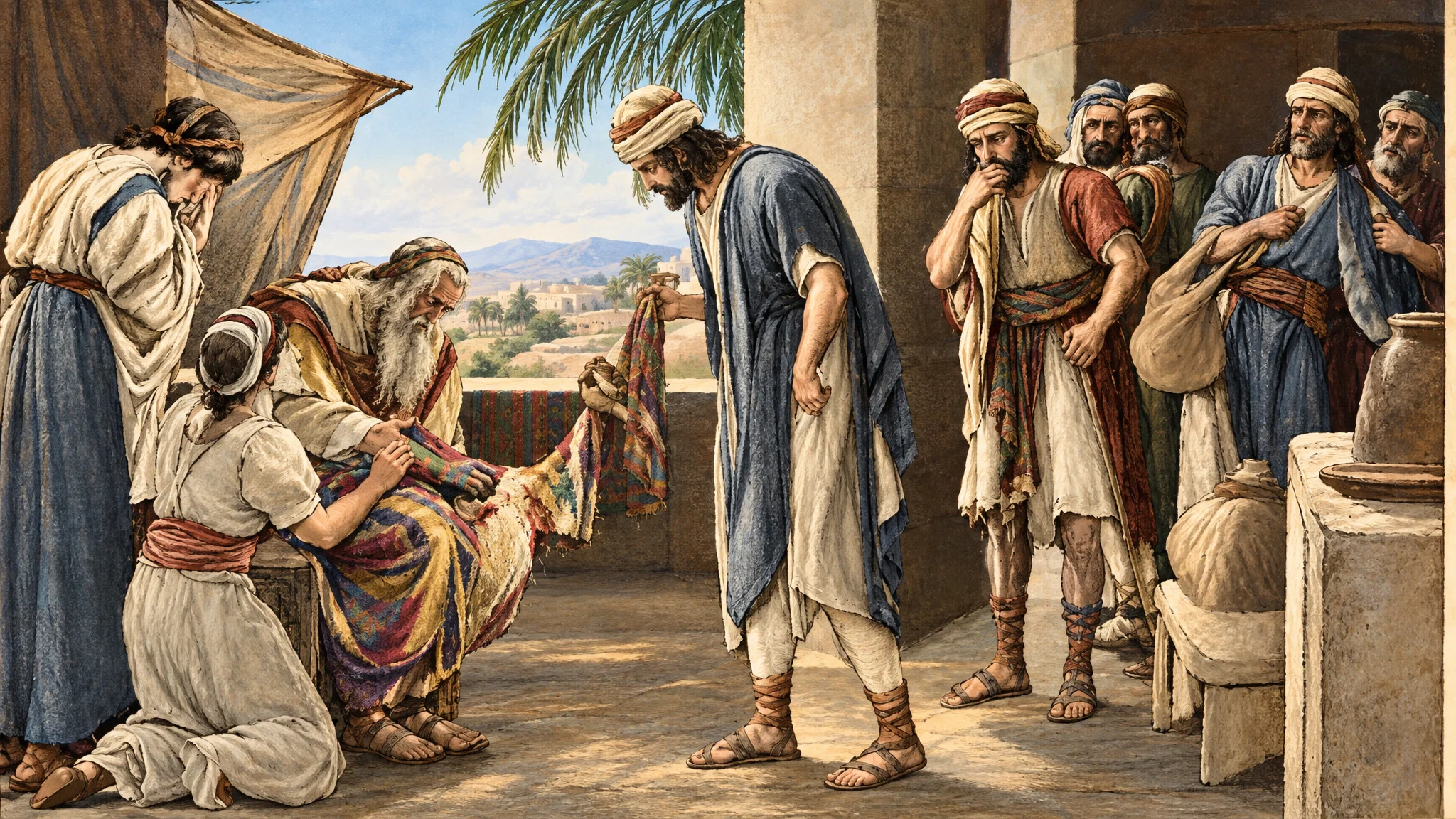 JOSEPH’S COAT IDENTIFIED
“It is my son’s coat; an evil beast hath devoured him. Joseph is without doubt rent in pieces.”
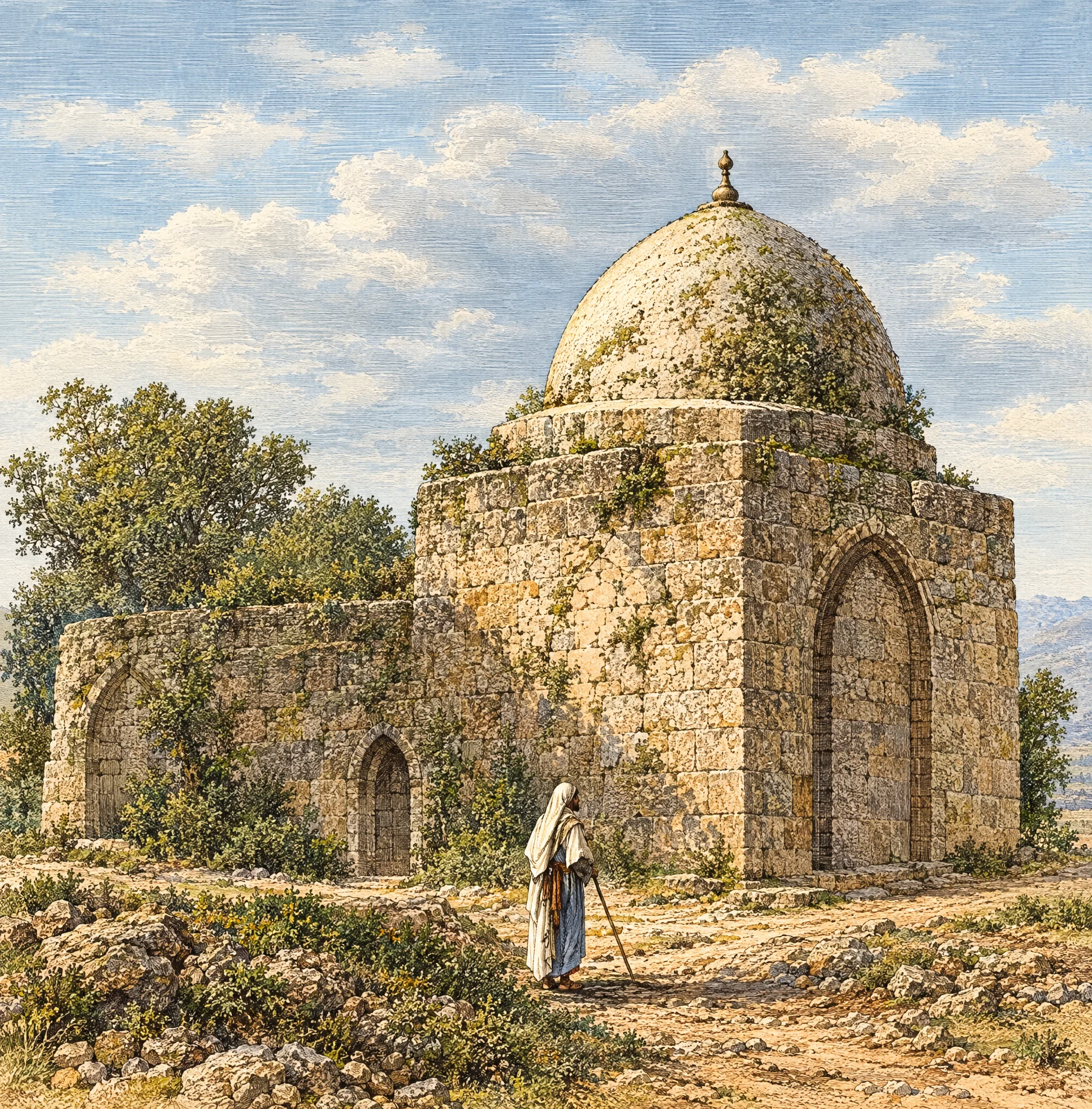 “Rachel was buried where she died, and a pillar was raised upon the spot to perpetuate her memory.”
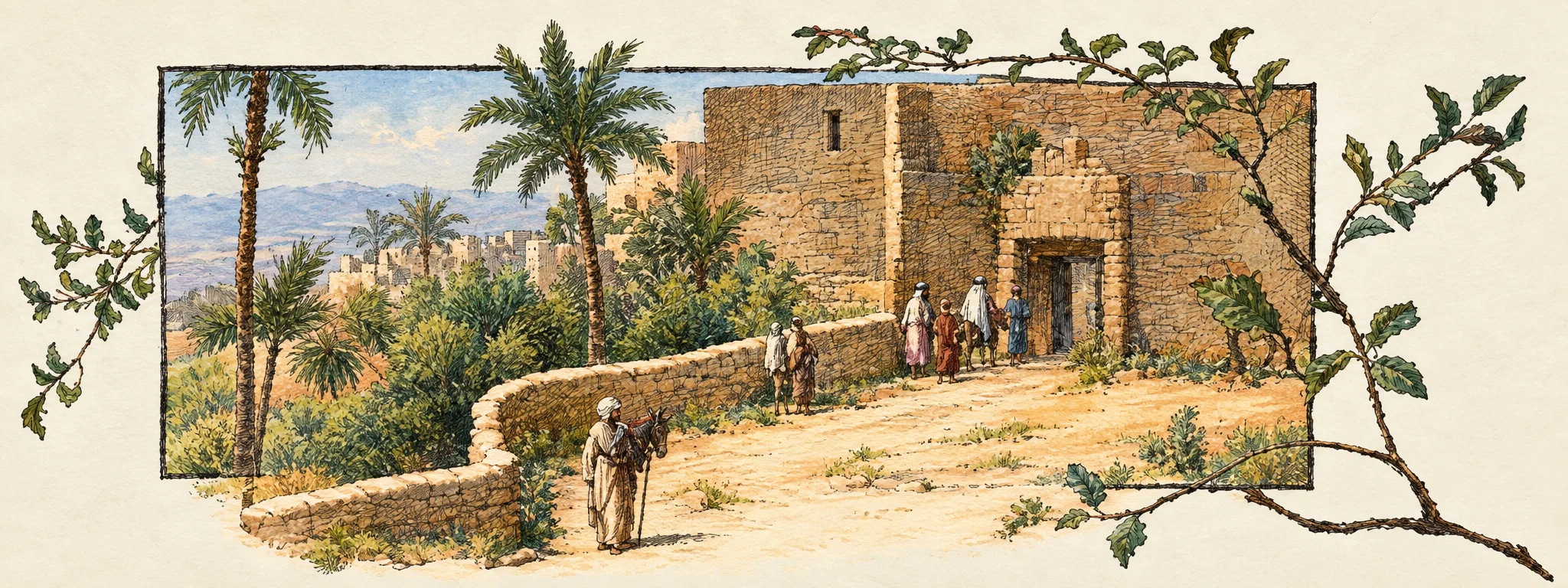 A young man stands in the foreground beside a low, winding wall or raised path, facing a distant walled settlement. Behind it, palm trees and dense vegetation rise against the buildings, while a tall arched entrance and a dark figure near the opening suggest a guarded town. A small pack animal and several people appear along the approach, evoking a caravan arriving at an Egyptian settlement. Branches with leaves frame the scene along the upper edge and both sides; no legible lettering is visible.
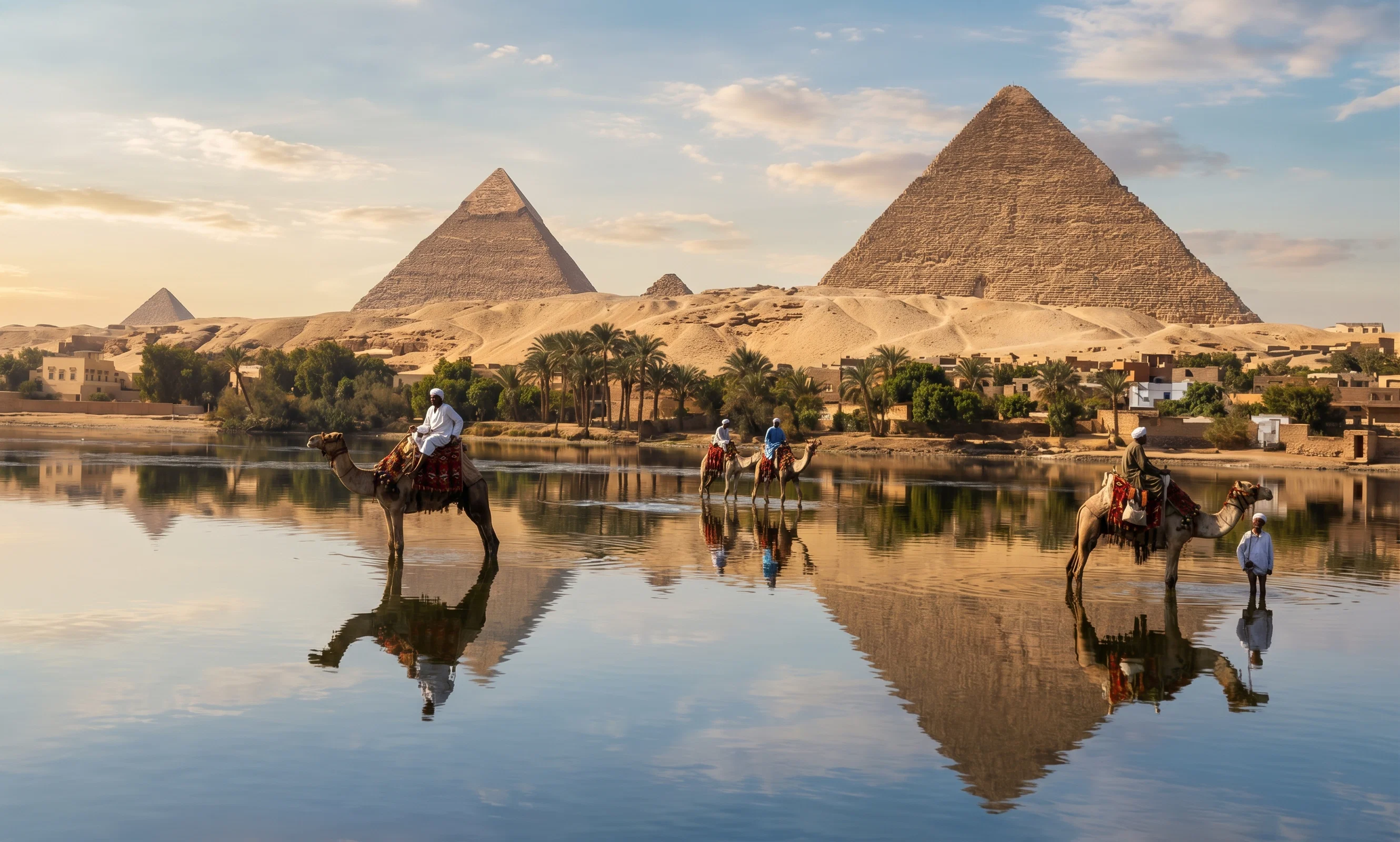 SCENE ON THE RIVER NILE
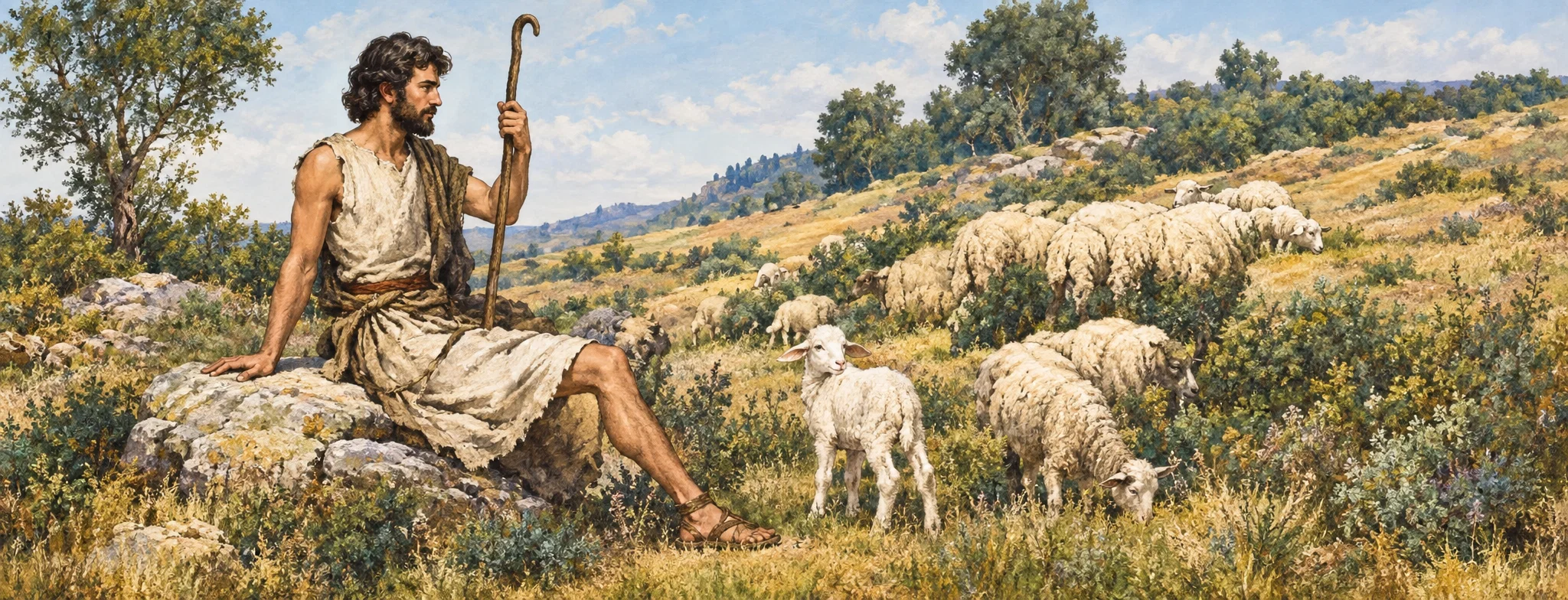 “Every shepherd was ‘an abomination unto the Egyptians.’”
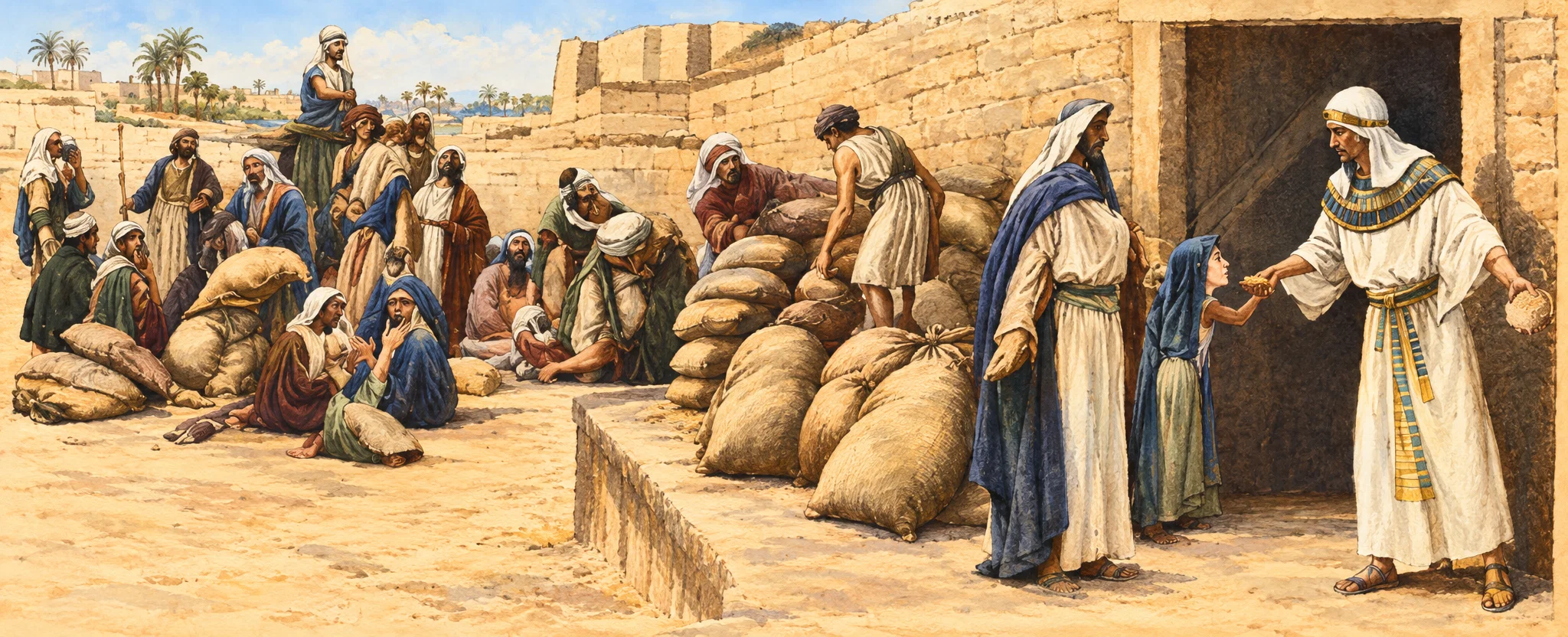 A crowded scene of people gathering at an Egyptian storehouse during a famine, with a large group of men in robes and head coverings waiting or kneeling across the left and center. Several bulky grain sacks lie piled around a low counter or platform in the foreground, while a standing attendant appears to handle the provisions. At the right, a robed official stands in a dark doorway, facing a petitioner who gestures toward him. Bare, monumental walls and a few distant figures form the background; no legible lettering is visible.
 A circular monochrome illustration shows a broad expanse of water beneath an open, lightly stippled sky. A straight, dark horizon divides the scene just below the center. The water fills the lower half, marked by layered horizontal strokes suggesting ripples or small waves, while scattered flecks across the sky may indicate distant birds or texture. The view contains no clearly discernible people, boats, buildings, or lettering.
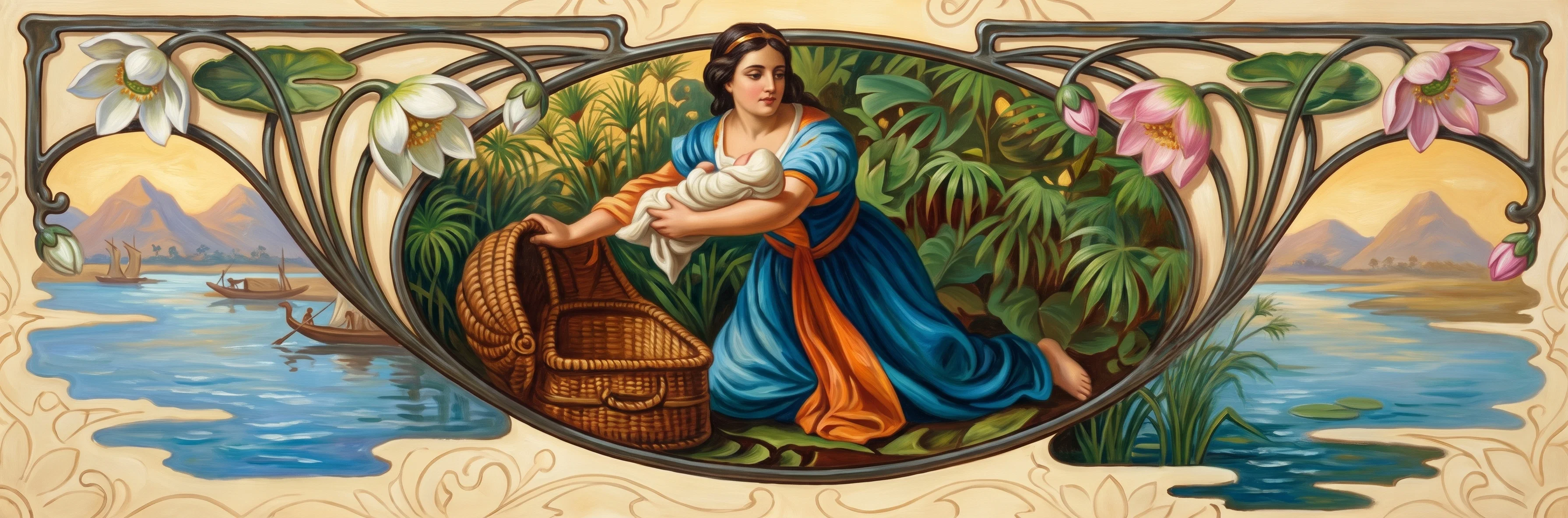 A wide, symmetrical ornamental illustration shows a reclining, draped figure at the center, surrounded by dense foliage and flowers. The figure rests within a deep, rounded bowl-like frame, with flowing garments and an arm extended toward a small rectangular object or ledge at the left. Curving stems rise on both sides into large blossoms, while the outer corners contain stylized hills, plants, and cloudlike forms. The image is rendered in dark, engraved lines, with no visible lettering.
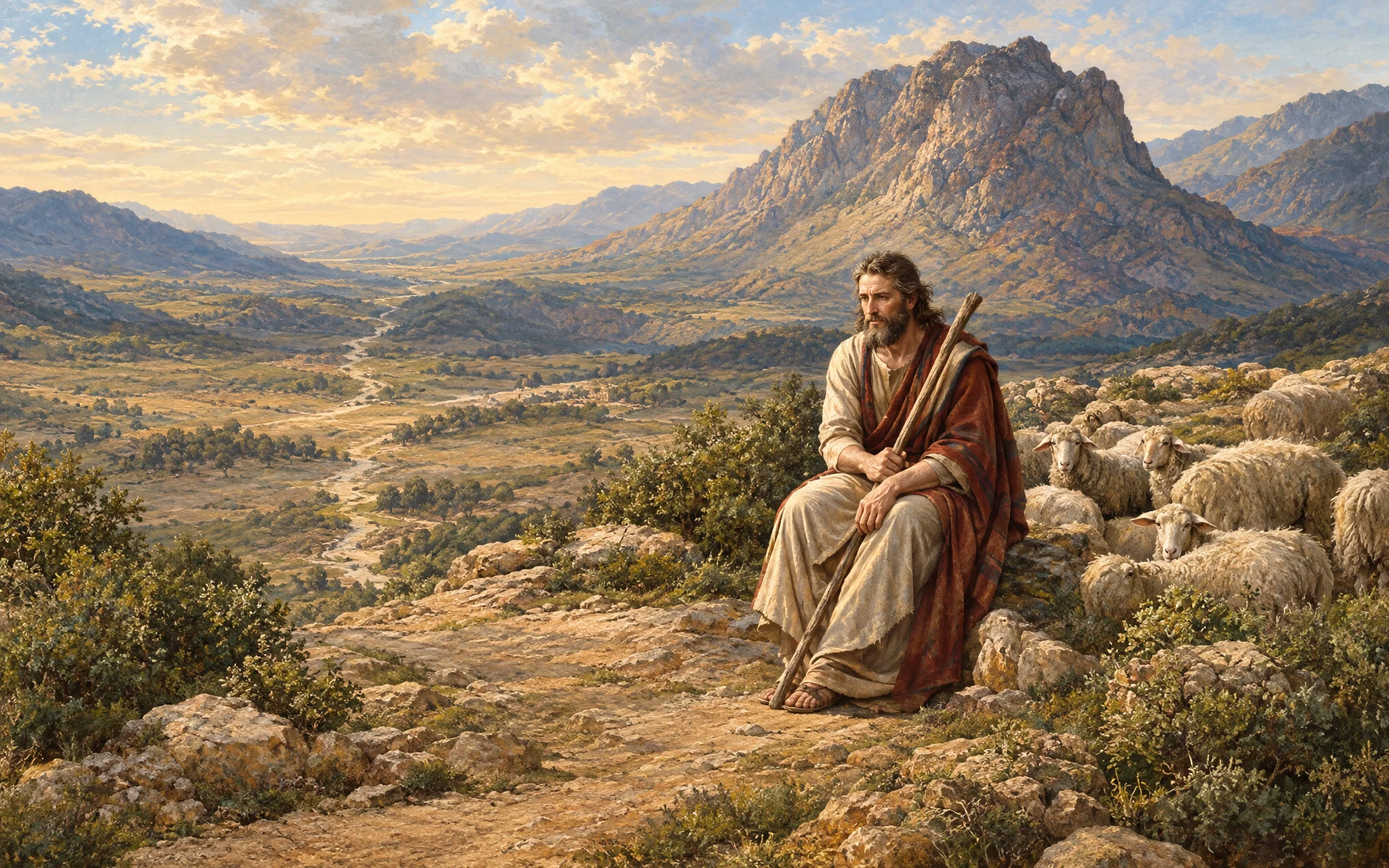 MOSES A SHEPHERD — “Shut in by the bulwarks of the mountains. Moses was alone with God.”
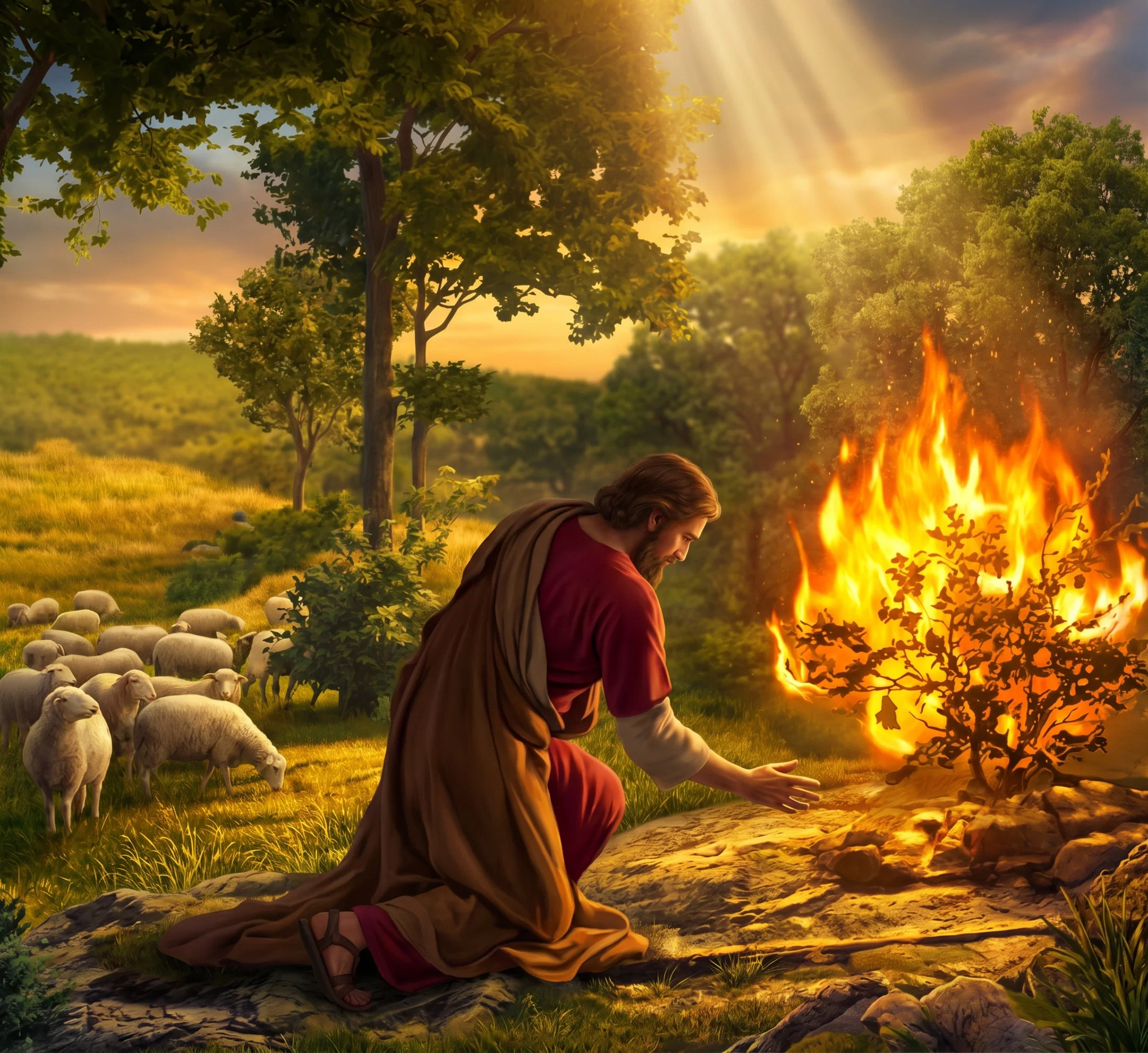 “He was warned not to approach irreverently.”
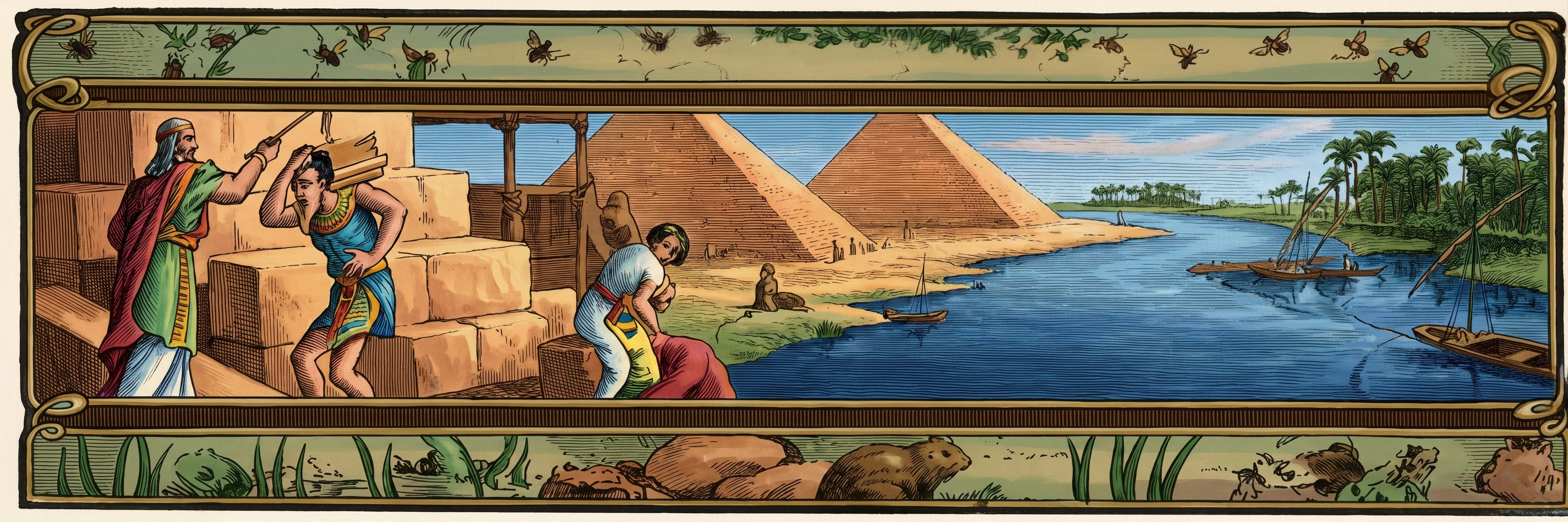 A narrow panoramic scene shows two robed men meeting at the left, one standing with an arm raised as if speaking or greeting the other, who bends toward him. They stand beside blocky structures and rugged, dark hills. The landscape opens across the center and right into a broad, pale stretch of ground or water, with a few distant trees and low forms along the far bank. A decorated border surrounds the scene, with small human and plant-like motifs along its lower strip; no lettering is visible.
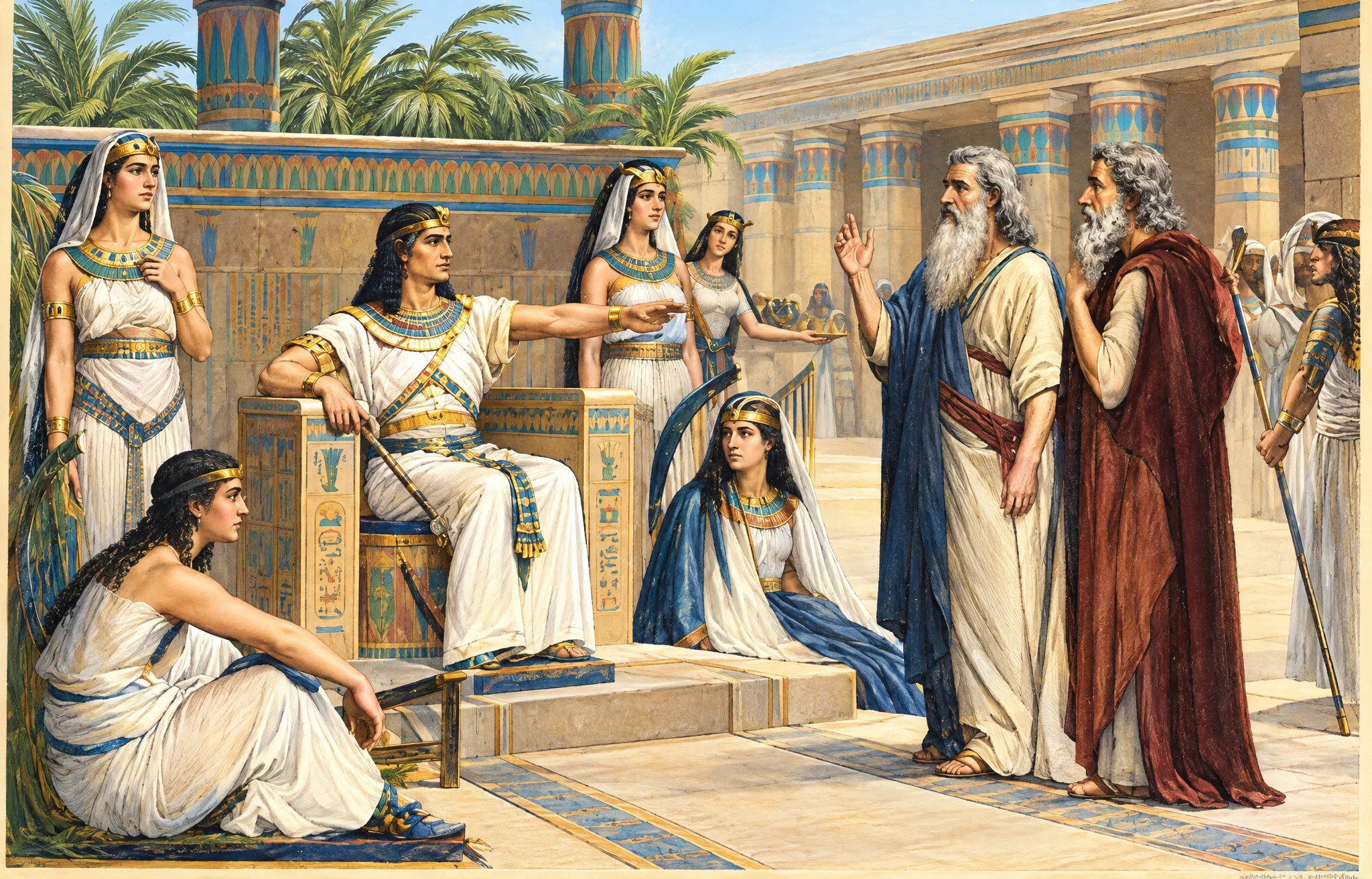 MOSES AND AARON BEFORE PHARAOH
“Wherefore do ye, Moses and Aaron, let the people from their works? Get
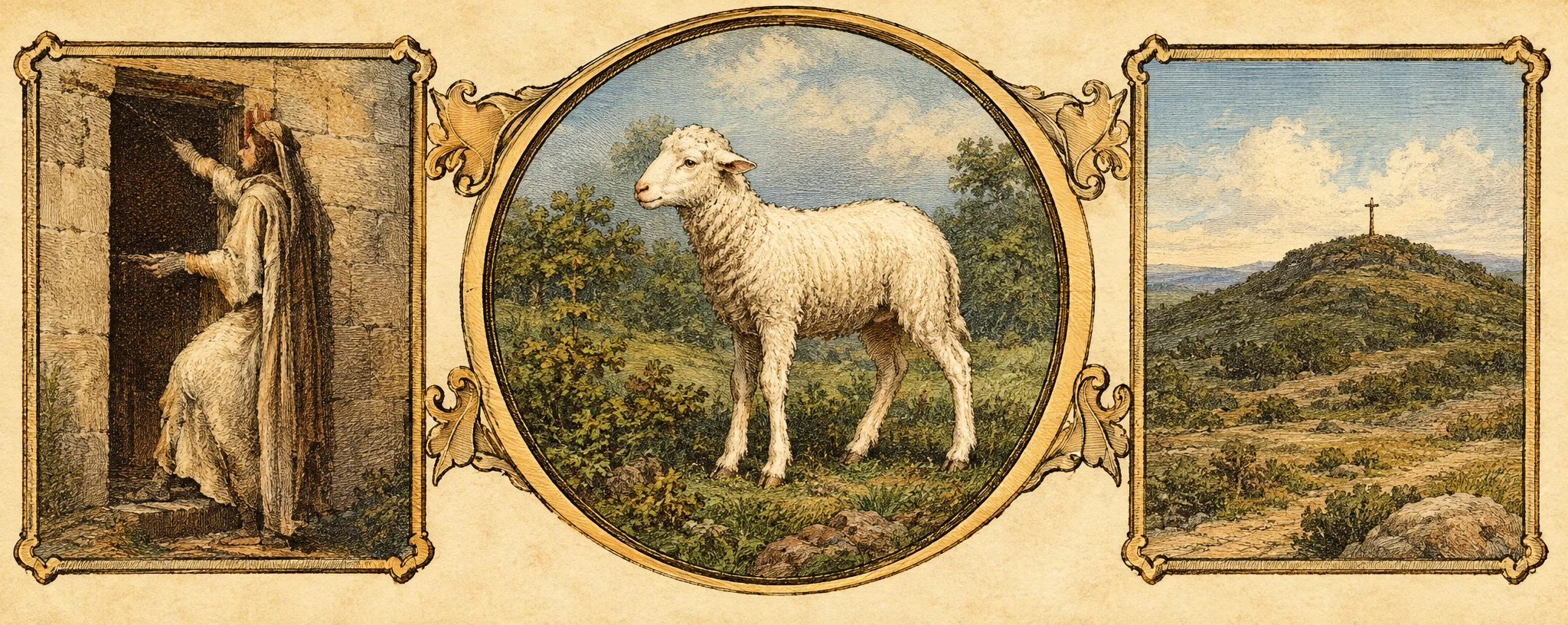 An ornamental three-part scene centers on a light-colored lamb or sheep standing in profile amid rough ground and foliage, enclosed within a large circular frame. In the narrow panel at left, a pale human figure appears beside a tall dark doorway or upright structure, with one arm raised toward it. The panel at right shows a low, uneven hill beneath an open sky, with a tiny upright post or cross-like shape on its crest. Decorative scrollwork links the panels, and no lettering is visible.
 Copyrighted.
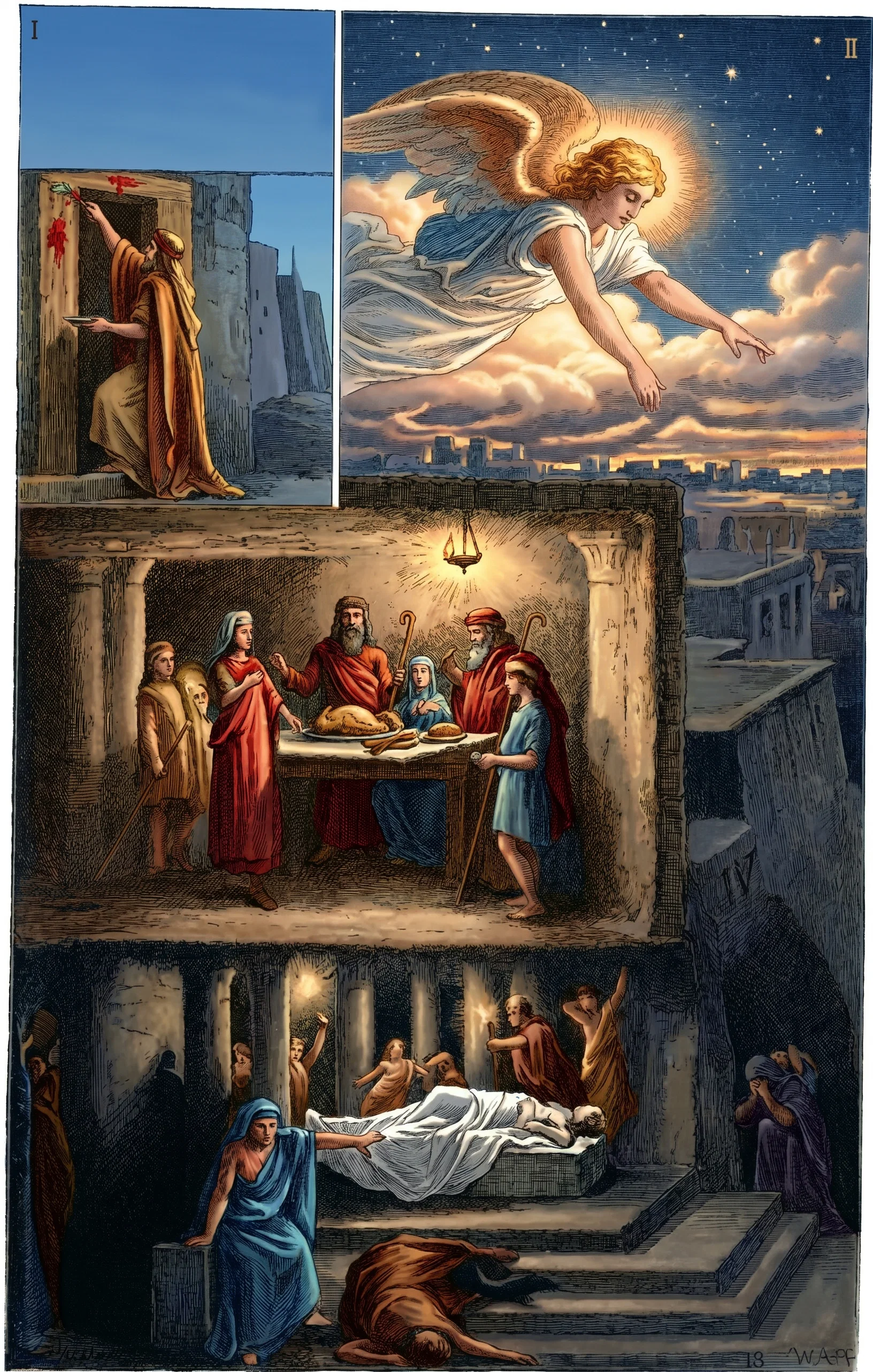
I. Sprinkling the Blood THE PASSOVER II. The Destroying Angel
III. The Passover Supper IV. The First-born Slain
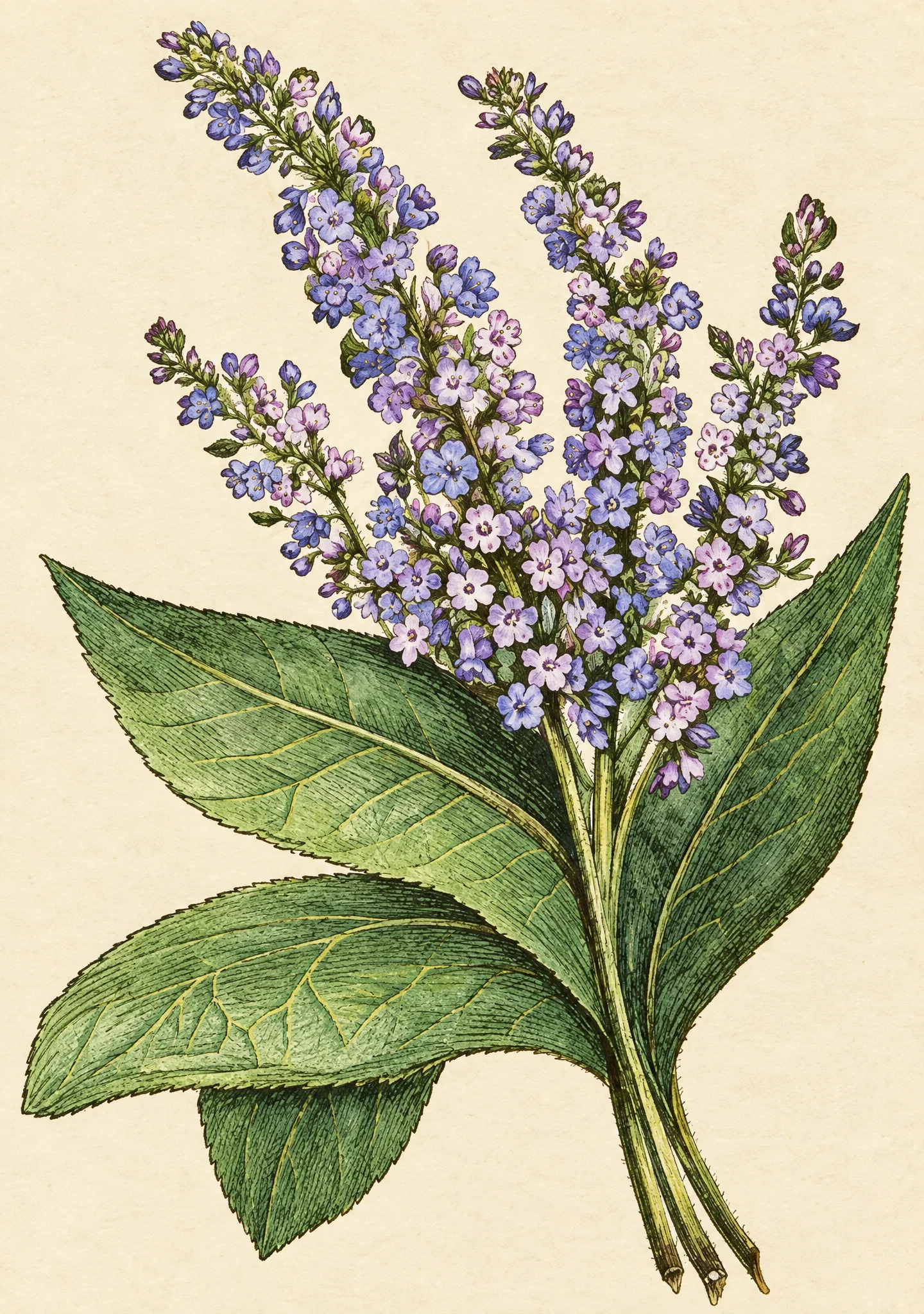 “The hyssop used in sprinkling the blood was the symbol of purification.”
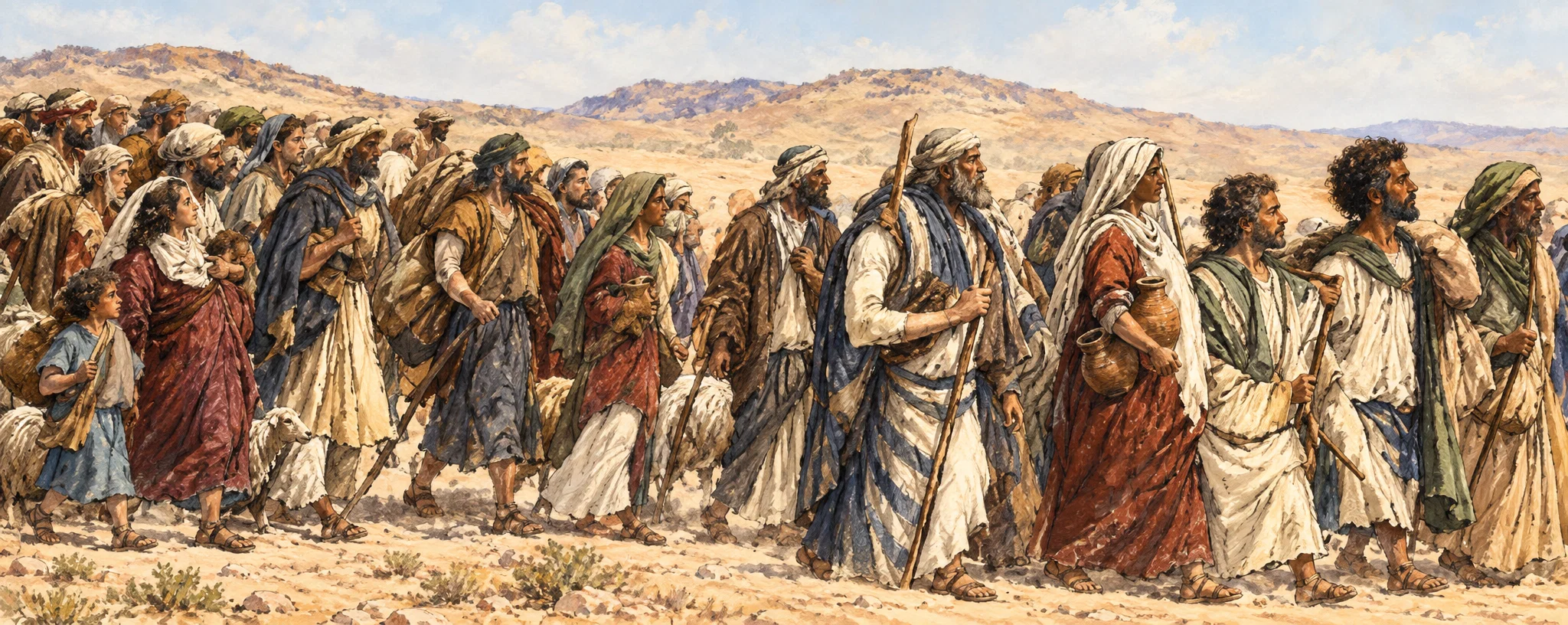 A long line of ancient, robed people moves from left to right across the foreground, suggesting Israelites setting out on their exodus from Egypt. Men and women carry staffs and bundles, and several figures wear head coverings; one prominent bearded man near the center holds a tall staff. The procession stretches across the width of the scene, with additional people and faint shapes behind them at the left. Low, hazy hills form the distant background, while the figures’ garments and staffs create a dense, continuous band of movement. No lettering or animals are visible.
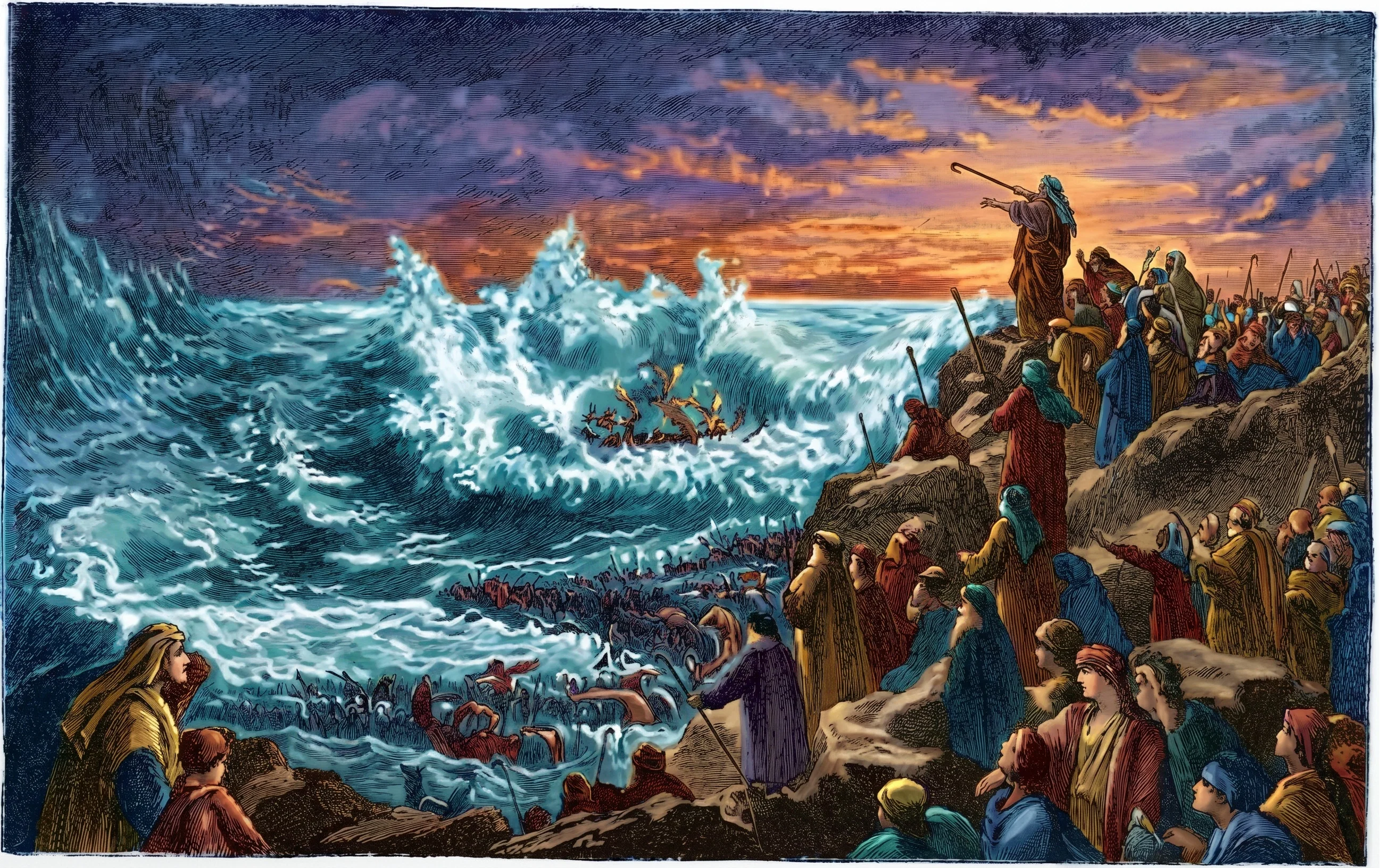 DELIVERANCE OF ISRAEL AT THE RED SEA
“The path where God leads the way may be through the desert or the sea, but it is a safe path.”
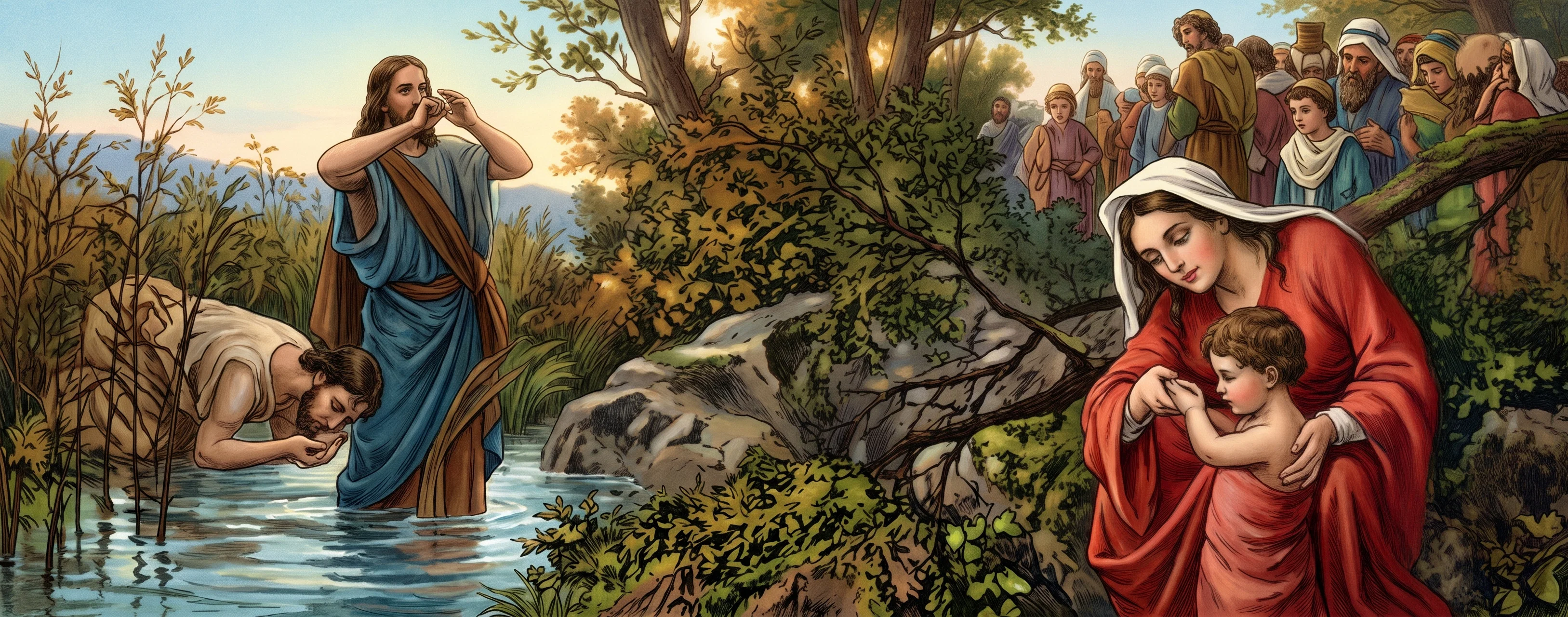 A group of Israelites gathers at a spring in a rugged, brush-covered wilderness. At the left, several figures crouch or lean beside the water, while a standing man near the center raises or holds a branch. On the right, a larger, bent figure reaches toward the spring, with another person close beside him. Low vegetation, rocks, and tangled trees fill the background, enclosing the people in a narrow, uneven landscape. The scene depicts Moses casting a tree into the bitter waters at Marah as the thirsty people gather nearby.
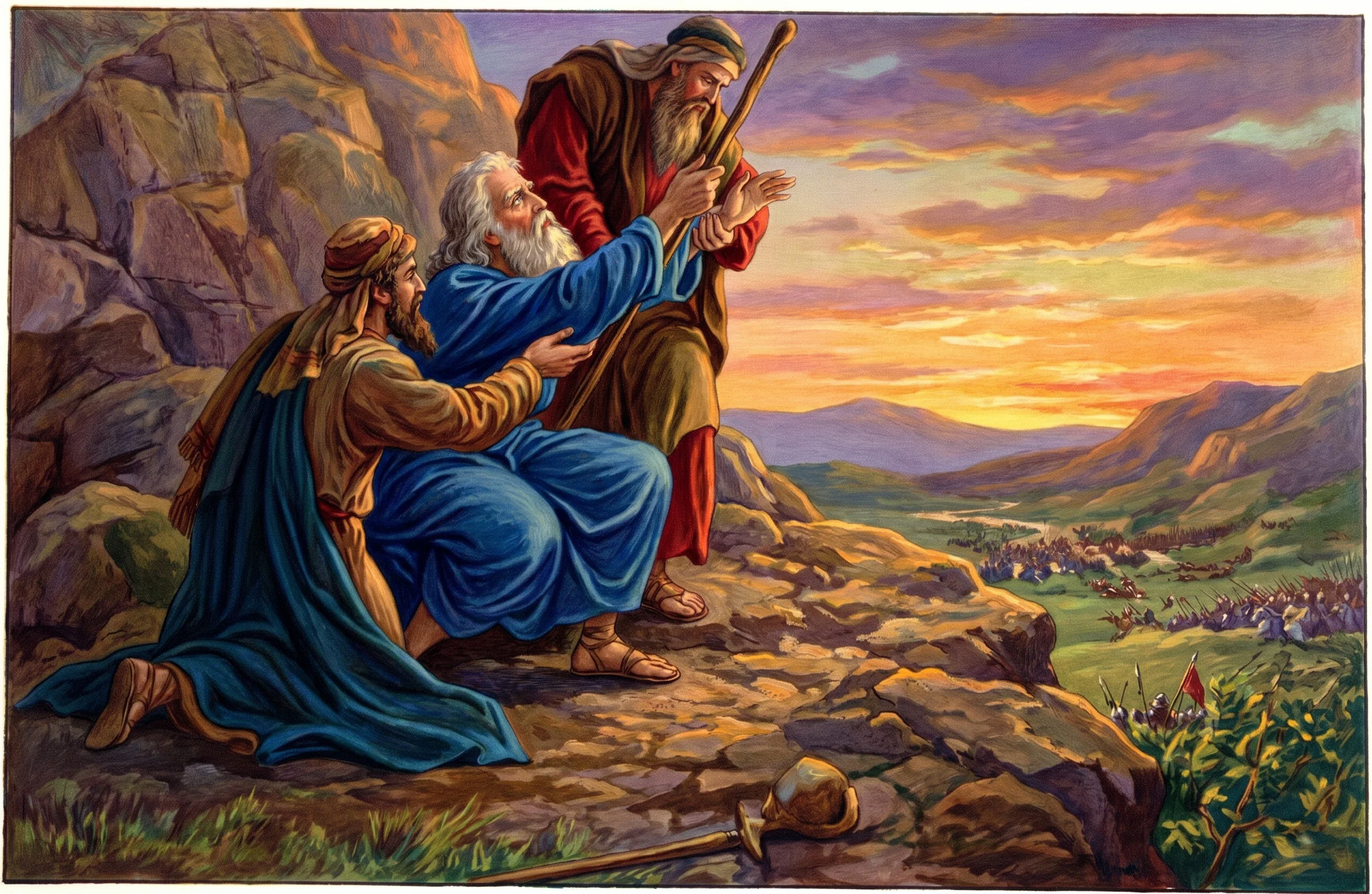 THE PRAYER OF MOSES
“As Moses became weary, Aaron and Hur stayed up his hands until the going down of the sun, when the enemy was put to flight.”
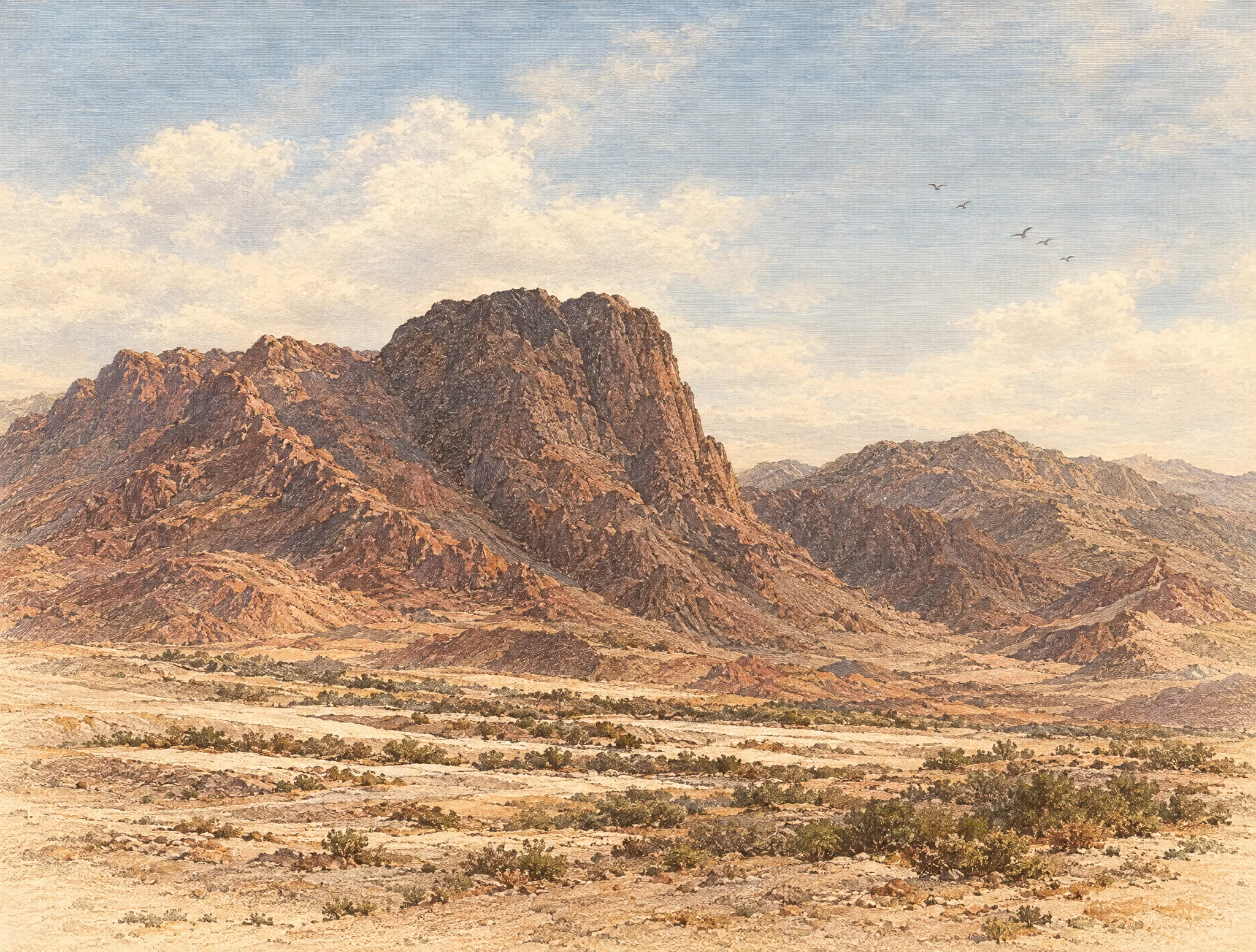 Mt. Sinai
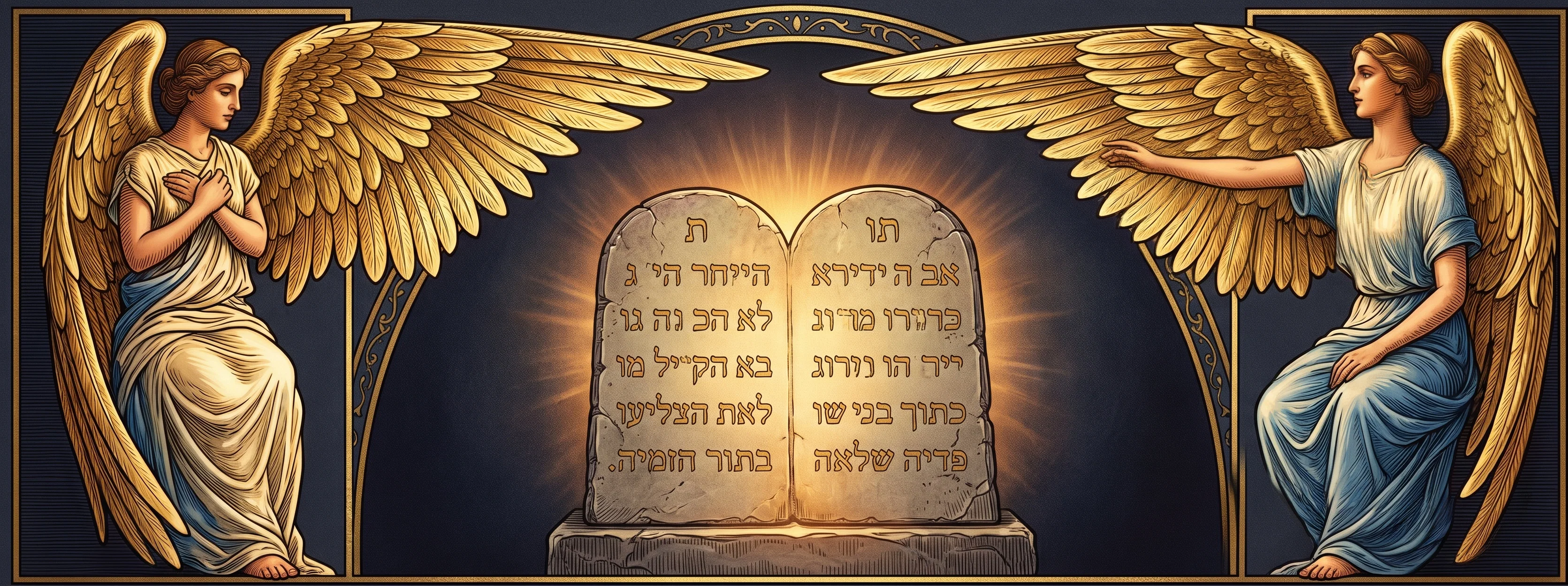 A large pair of outstretched, feathered wings arches across the image, sheltering a pale central space with faint, indistinct marks. At either side, a seated, draped human figure with wings faces inward toward the center; each holds one hand near the chest in a reverent or contemplative pose. Dark, roughly shaded areas behind the figures and beneath the wings frame the scene. The balanced, nearly symmetrical composition evokes the image of people being carried or protected beneath eagle-like wings.
 A symmetrical ornamental flourish in dark ink, centered around a squat, stepped rectangular form with a broad rounded top. Two rounded, eye-like shapes sit above it, framed by curling leaf forms that sweep outward into spirals. At both ends, large veined leaves curl upward and inward, while smaller tendrils and scrolls fill the space between them and the central motif. The design is purely decorative, with no people, animals, setting, or visible lettering.
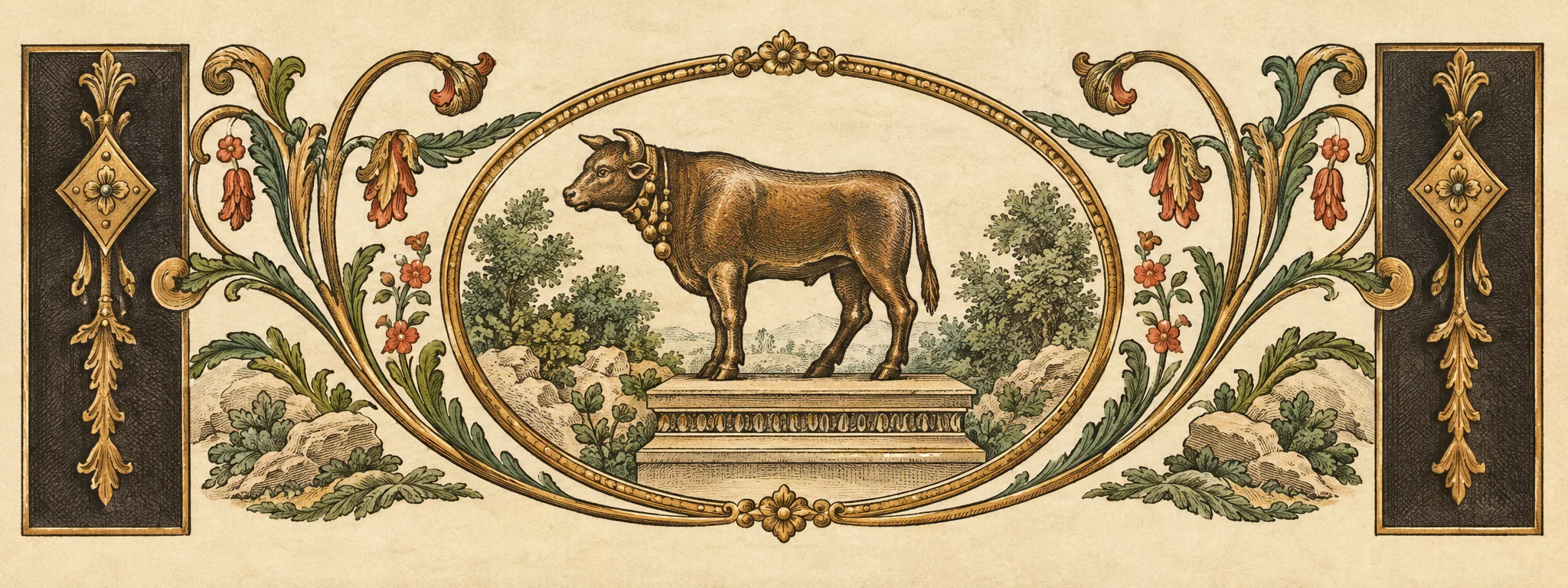 A horned bovine figure stands in profile facing left on a low stepped platform at the center of an oval scene. Small indistinct forms and patches of foliage or landscape surround it within the oval. Elaborate curling vines and symmetrical scrollwork frame the scene, sweeping outward toward dark rectangular panels at either side, each containing pale decorative shapes. The composition is centered on the animal, which is elevated prominently above the surrounding ground.
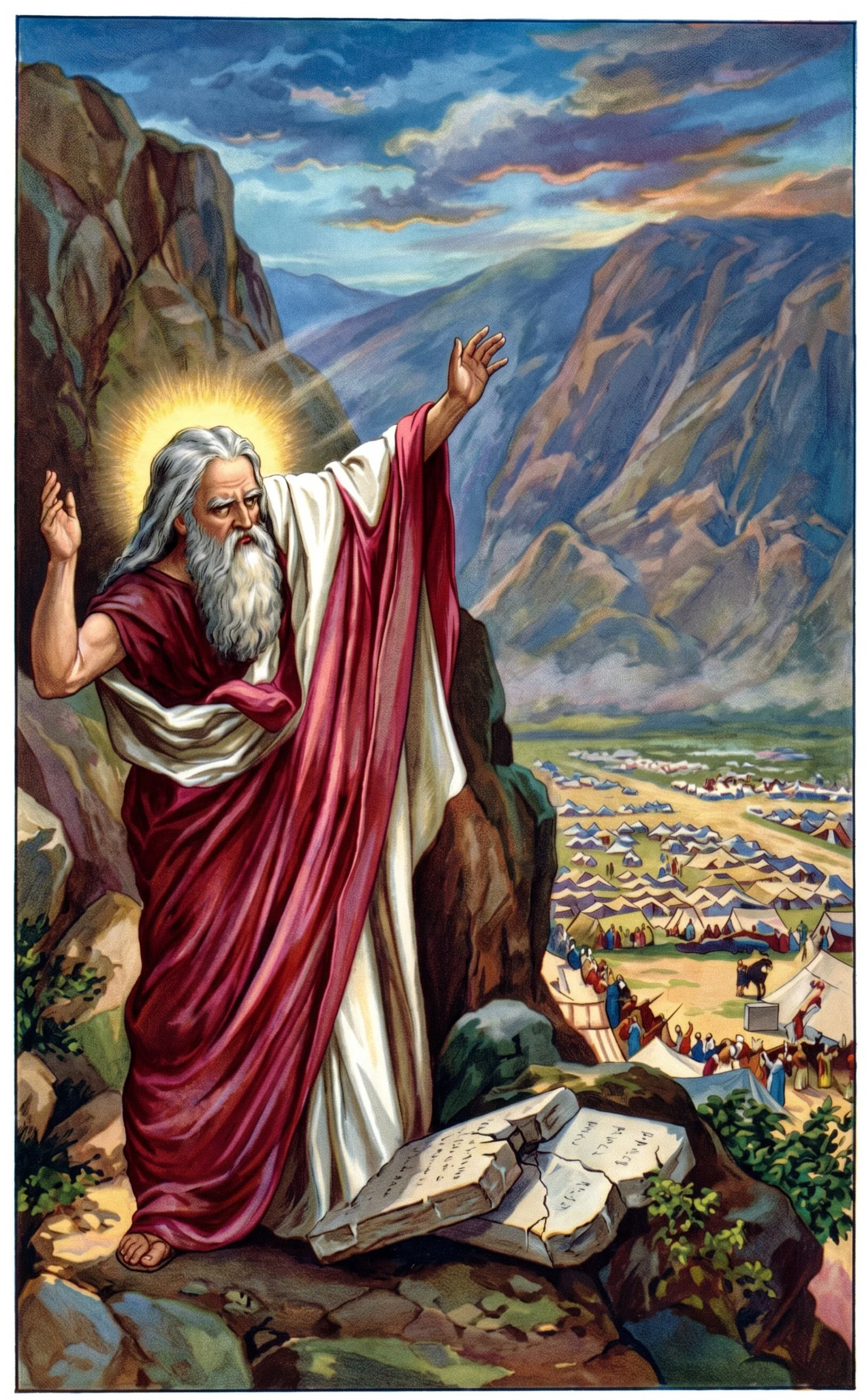 MOSES BREAKING THE TABLES
“To show his abhorrence of their crime, he threw down the tables of stone, and they were broken in the sight of all the people.”
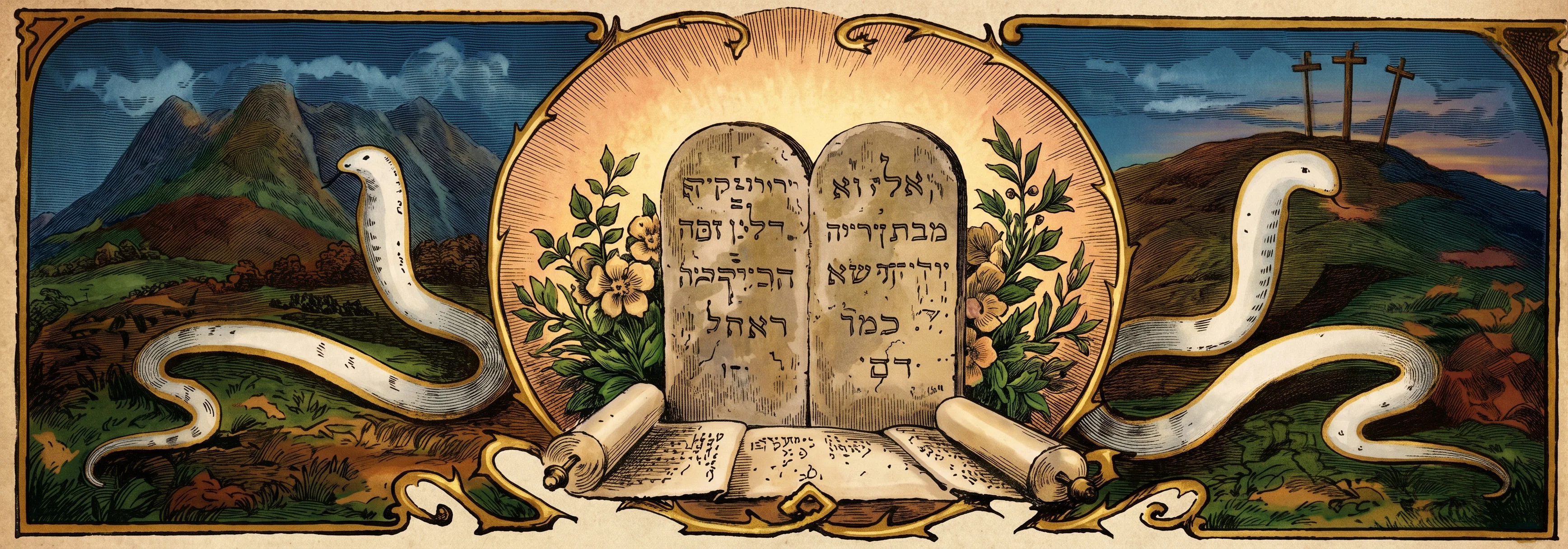 A pair of upright stone tablets with rounded tops stands at the center, their surfaces marked with faint, indistinct lines. They rise from a low, folded scroll or draped base, with small leafy sprigs beside them. Pale, winding bands extend from the tablets across a dark, clouded background, curling into loose loops on both sides. Three slender cross-shaped marks appear above the right-hand band. An ornate rectangular border with curled decorative corners encloses the symmetrical scene.
 “All that was lost by sin is restored.”
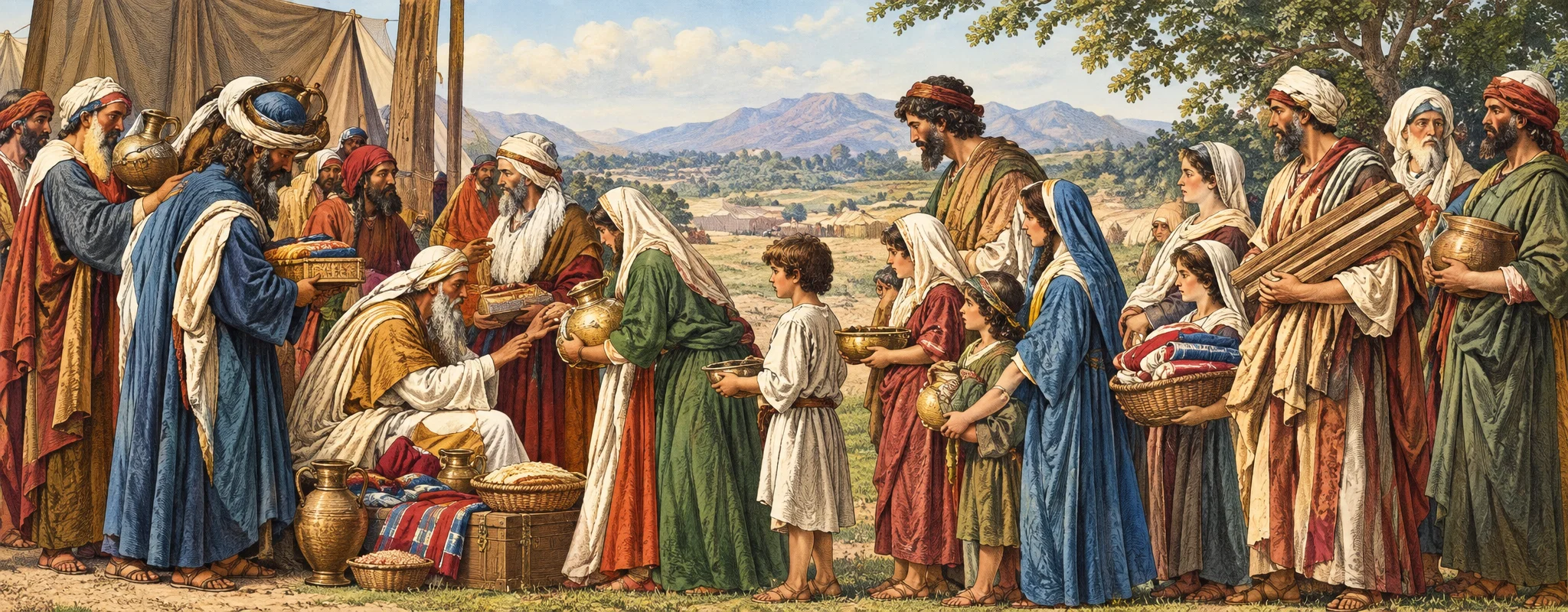 A group of people gathers around a low table or work surface in an outdoor setting. At the left, a seated figure in a head covering bends toward the table as another person leans over beside them; several figures stand close by, appearing to handle or examine objects on the surface. In the center, a man in a long robe gestures toward the activity, with a smaller figure beside him. On the right, more people watch in a cluster, including a seated or crouching child near the front. Trees and open landscape form the background; no lettering is visible.
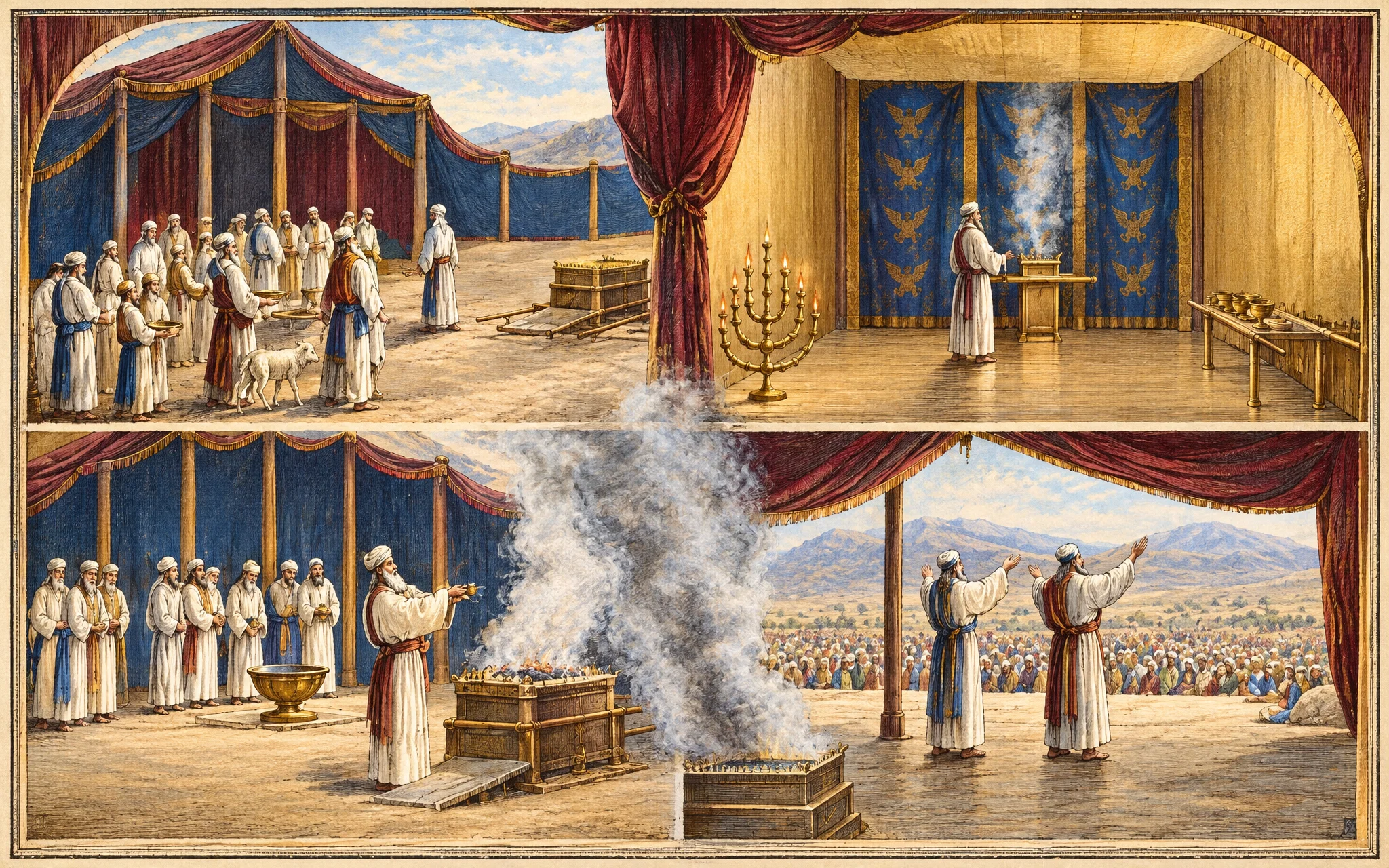 THE DAILY SACRIFICE
I. The Court of the Tabernacle
II. The Holy Place
III. The Offering of the Sacrifice
IV. Blessing the People
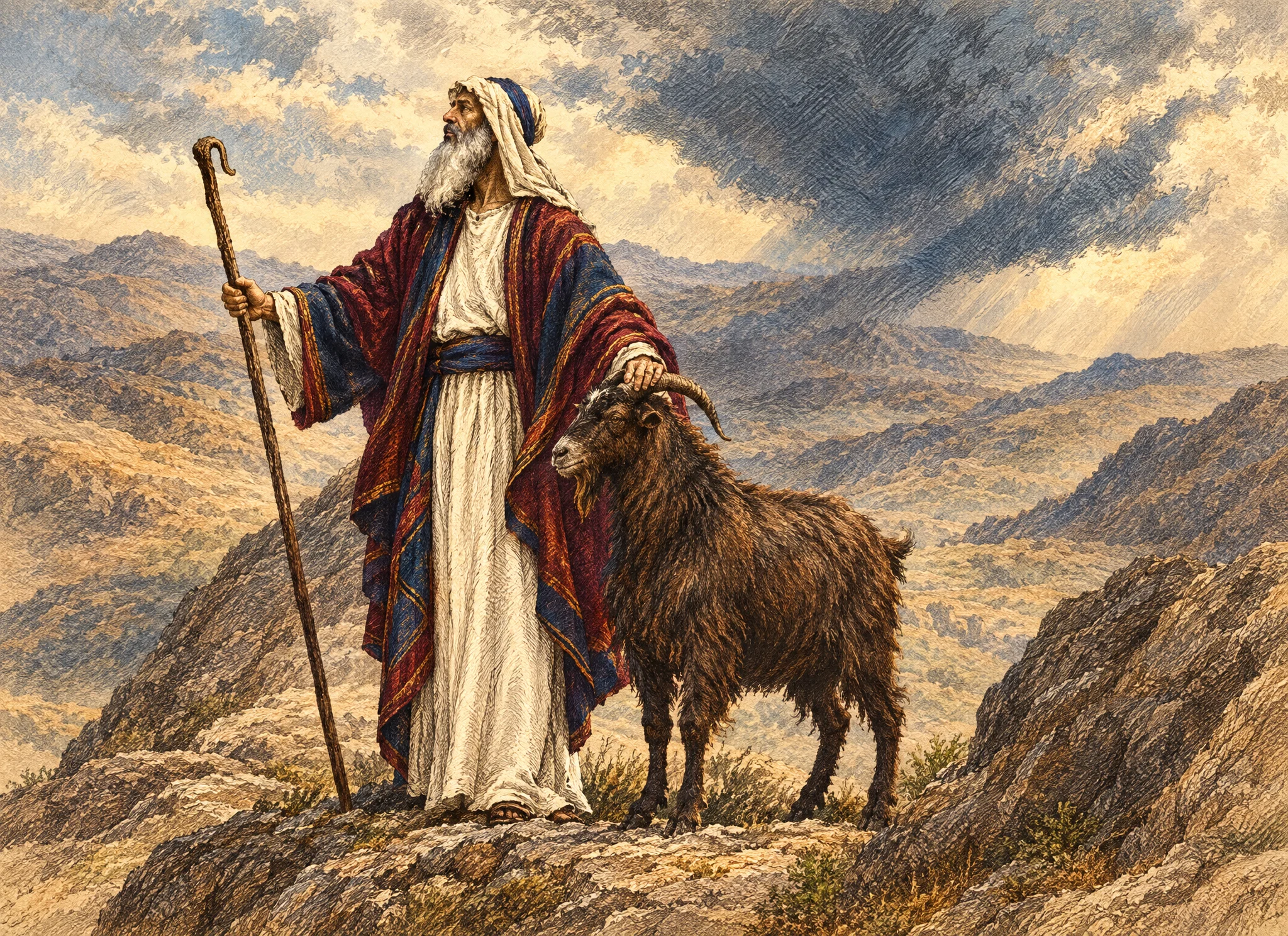 “As the goat bearing these sins was sent away, they were, with him, regarded as forever separated from the people.”
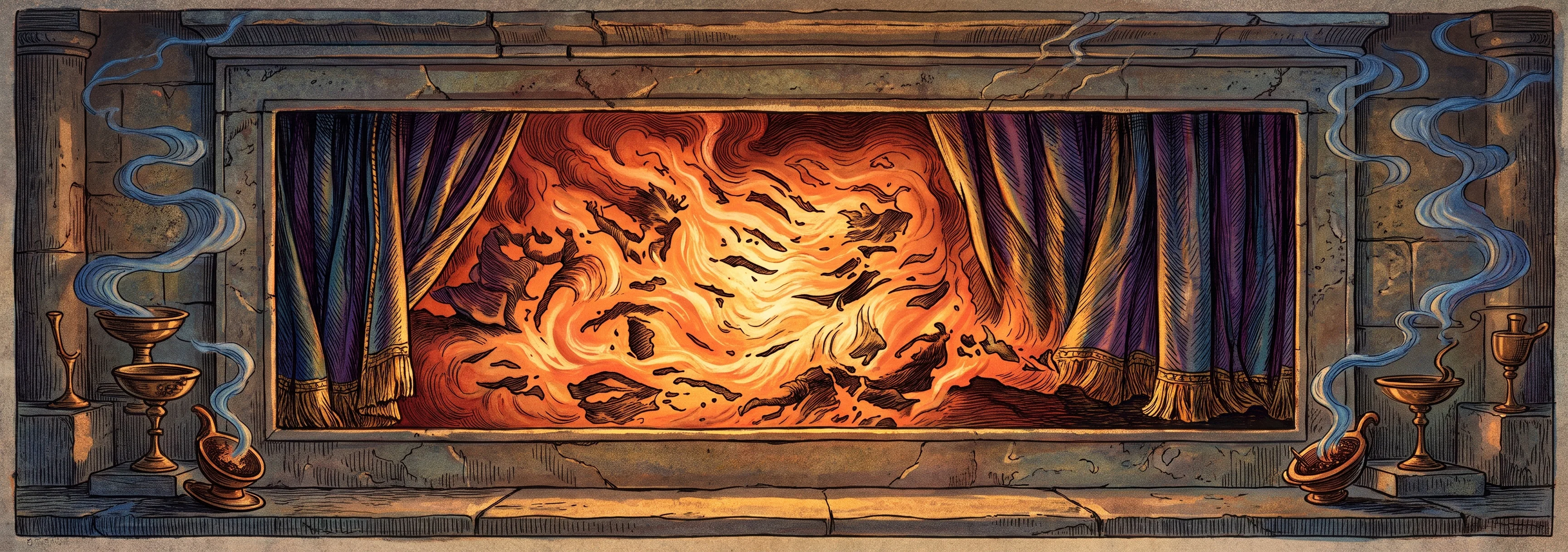 A wide, horizontal decorative scene framed by heavy curtains depicts a rocky landscape with a broad waterfall cascading down a cliff into a low, dark pool or stream. The falls occupy the center, surrounded by uneven rock formations and sparse vegetation; vertical folds of drapery hang along both sides and across the upper edge like a theatrical frame. Outside the framed scene, small ornamental vessels or lamps stand near the lower left and right, and curled supports or scroll-like ornaments sit at the base of the frame. No people, animals, or readable lettering are visible.
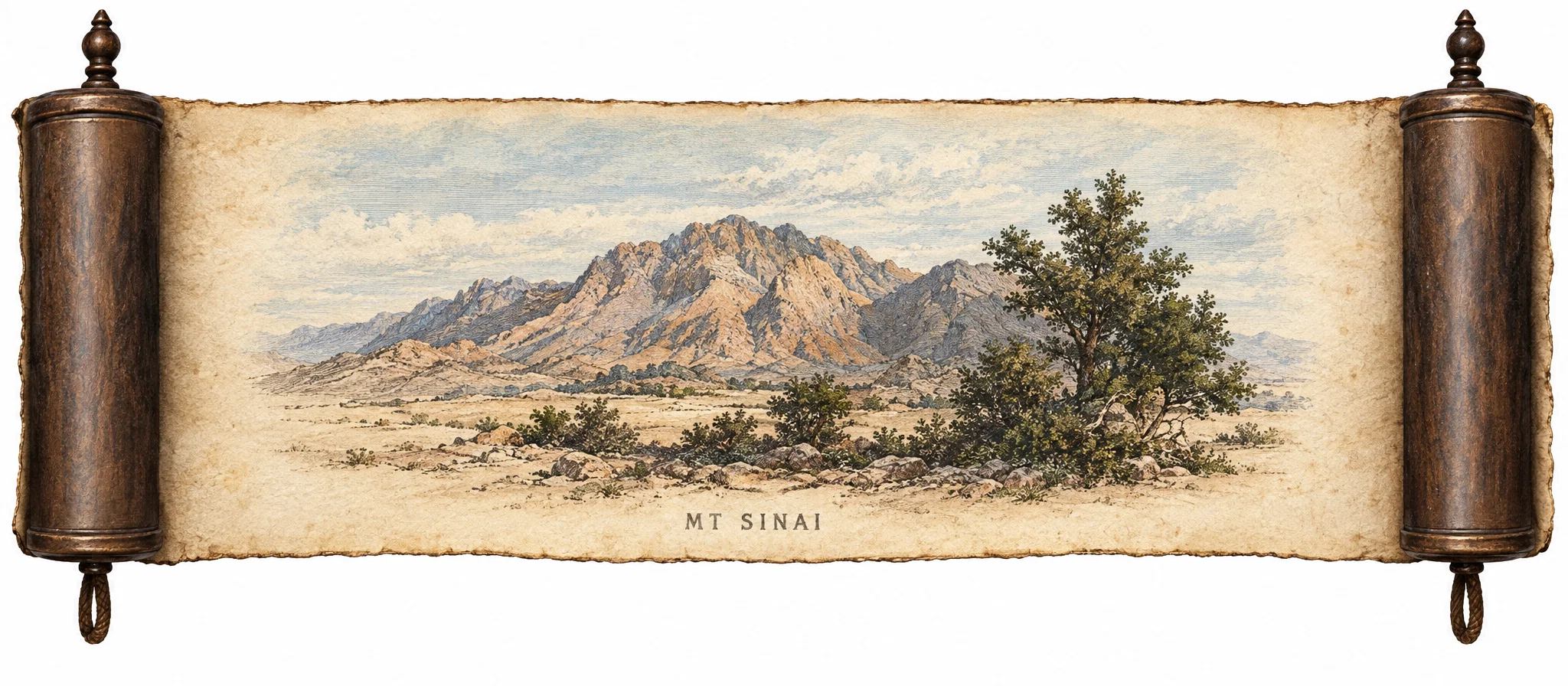 MT SINAI
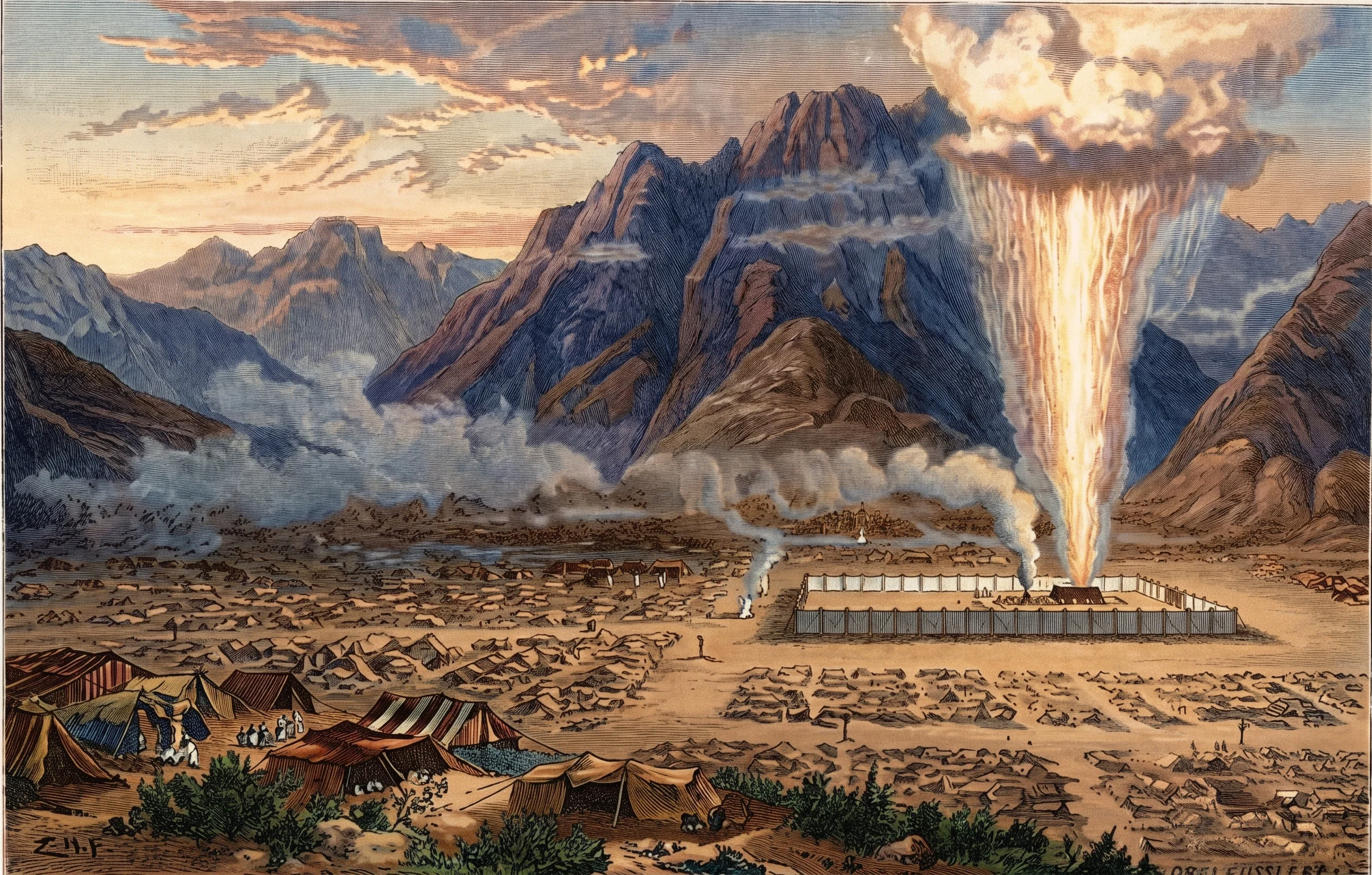 THE CAMP OF ISRAEL
“Never has Christ given to the sons of men more open manifestations of his power and glory than when he alone was acknowledged as Israel’s ruler, and gave the law to his people.”
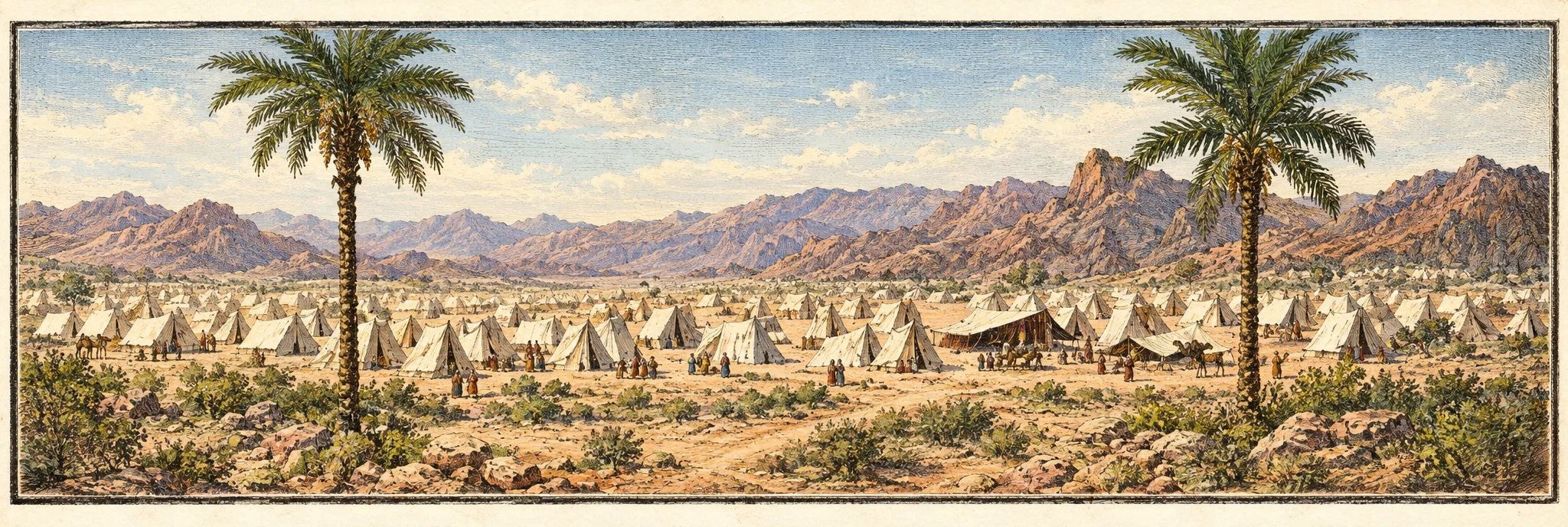 A wide panoramic scene shows an extensive camp spread across a dry, open landscape, with many small triangular tents clustered from the foreground into the distance. Scattered people and a few larger dark structures are visible among the tents, while low hills or rugged mountains form a hazy backdrop. Two tall palm trees stand prominently near the left and right sides of the view, their fronds spreading above the camp. Small birds appear in the pale sky, and a dark, uneven strip of ground and sparse vegetation frames the foreground.
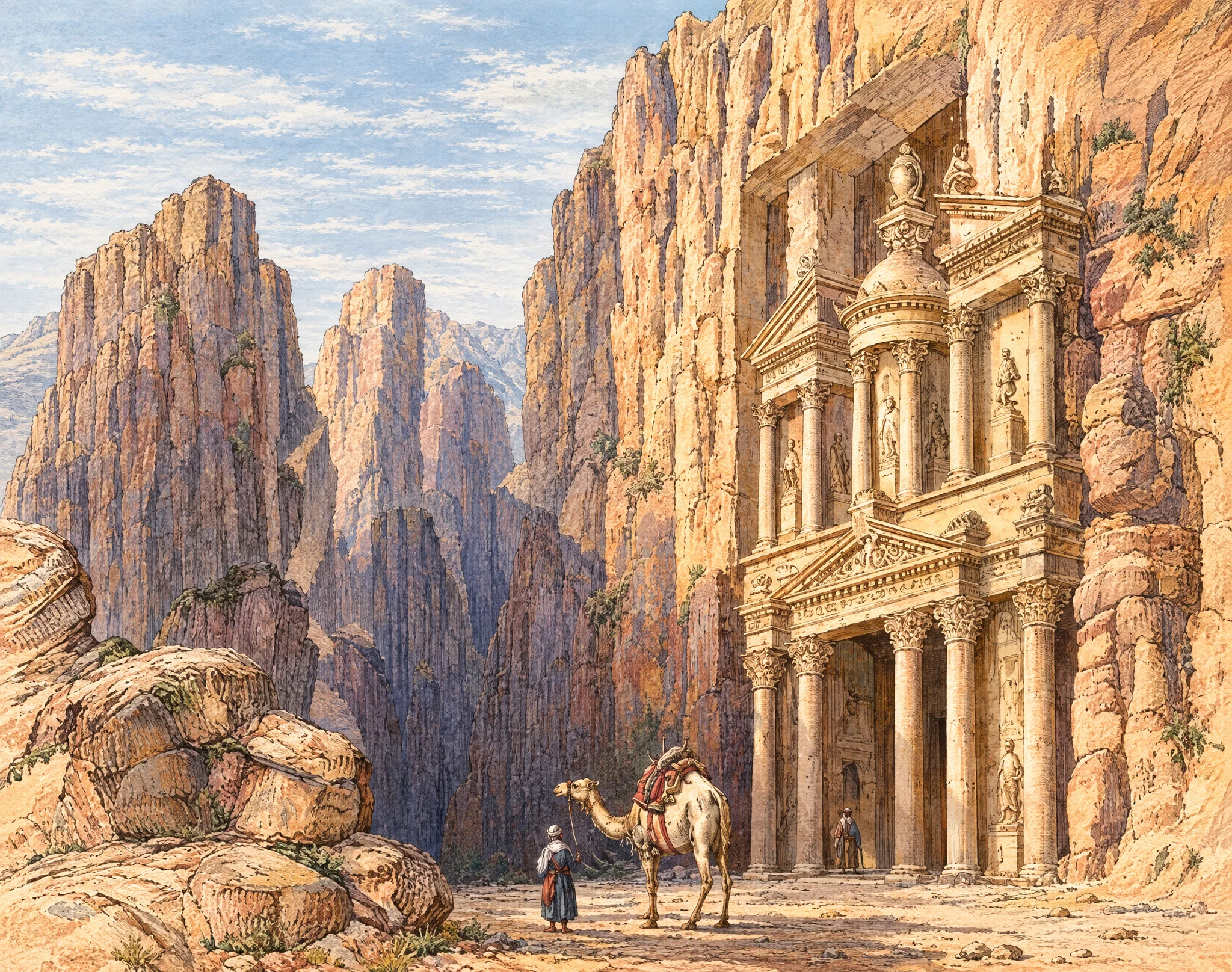 A small traveler and a camel stand on a rocky path before a monumental, classical façade carved into a sheer cliff. The camel faces left, its head lowered, while the robed figure beside it holds a staff or lead. The ornate rock-cut building rises along the right side, with columns, pediments, recessed doorways, and sculpted figures; tiny people near its entrance emphasize its scale. Jagged cliffs and narrow rock walls fill the background and left side, framing the approach to the ancient-looking structure. No readable lettering is visible.
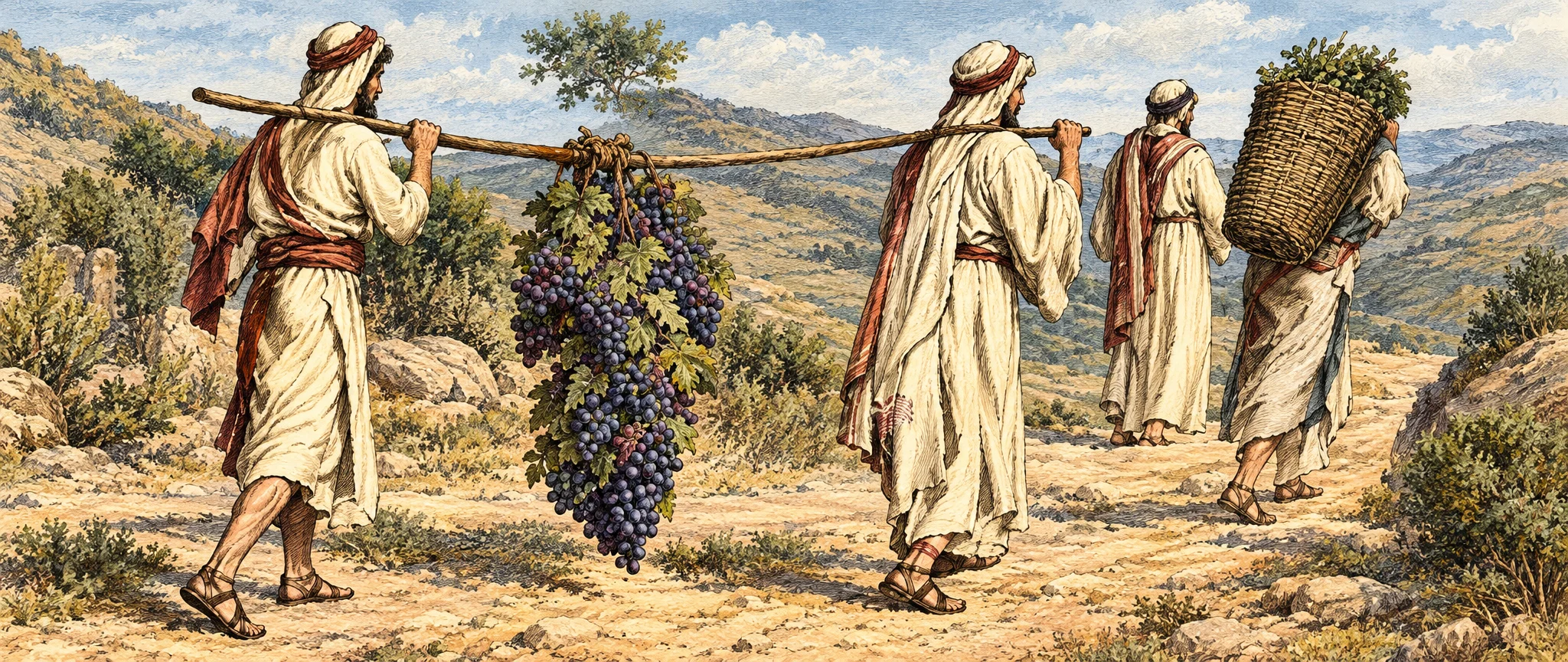 Several robed men make their way across a rugged, sparsely vegetated landscape, carrying samples from the land. In the foreground, two men support a long pole across their shoulders, from which an enormous cluster of grapes hangs nearly to the ground. Farther to the right, another figure carries a large rounded basket or bundle on his back, while a smaller figure walks nearby. Low shrubs and uneven ground fill the background, and the group’s movement is directed toward the right. No lettering is visible within the scene.
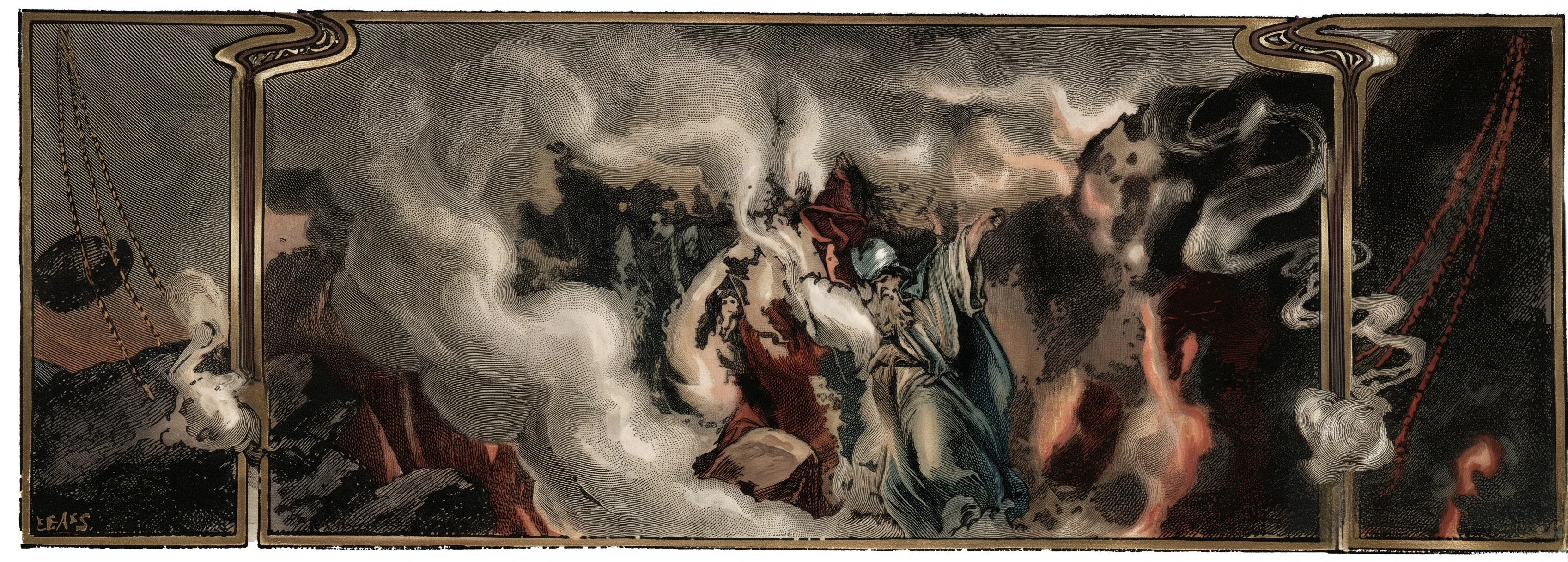 A dramatic biblical scene shows the Israelites’ rebellion against Moses and Aaron amid a wilderness encampment. In the foreground, a bearded man in a blue-green robe turns toward the commotion, while other figures in red and earth-toned garments gesture and gather nearby. Behind them, a crowd of people and tents stretches across the rocky landscape. Thick, curling clouds sweep through the scene, partly concealing a large, fiery-looking mass at the right and lending the gathering an ominous, supernatural atmosphere. The composition is enclosed by an ornate dark border; the artist’s small signature, “HEAS,” appears at the lower left.
 A narrow, symmetrical ornamental flourish stretches horizontally across the image. At its center is a compact cluster of small rounded floral or medallion-like forms, framed by curled leaves and scrollwork. Fine, tapering stems extend outward on both sides into long loops and pointed, feathery shapes, ending in small dots and curls. The design is evenly balanced around its midpoint, with no clearly readable lettering or recognizable figures.
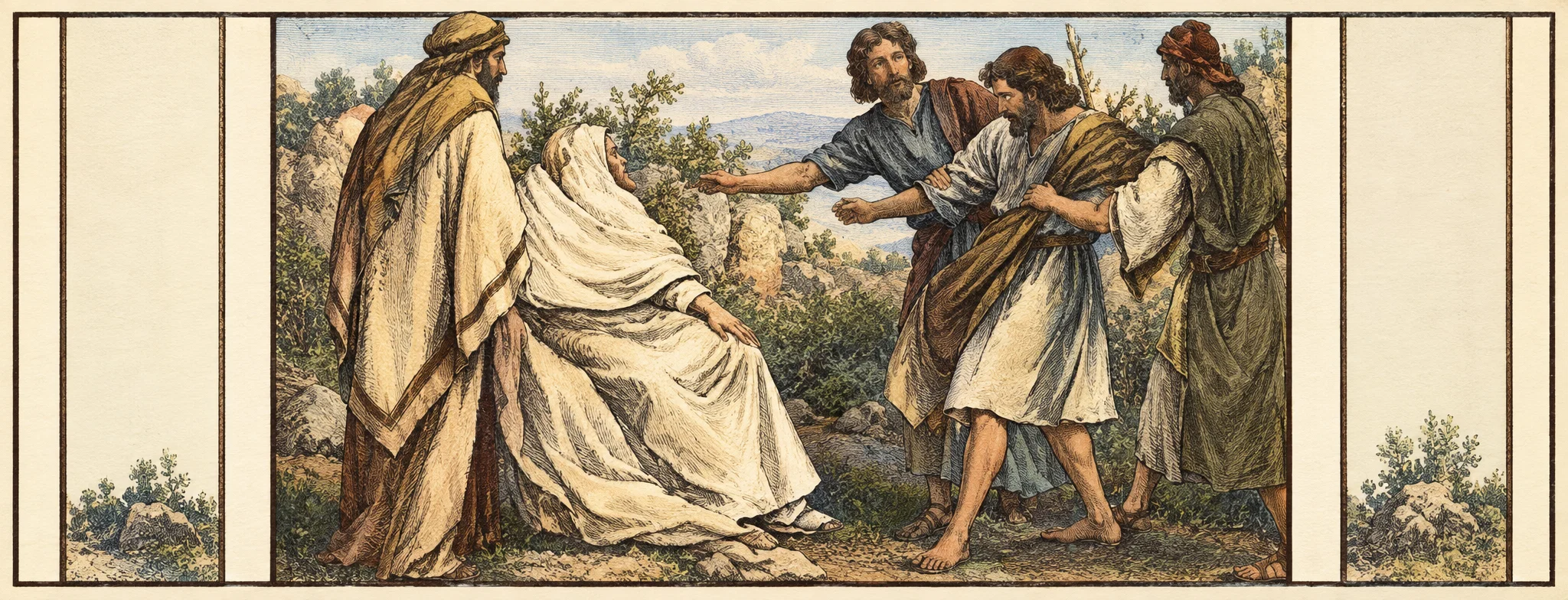 A group of robed figures gathers in a barren wilderness. In the foreground, a woman sits or kneels with her back partly toward the viewer, her long garment spread across the ground as she reaches toward the others. Several people stand close together at the right, including a central figure extending an arm toward her and another figure behind. Their gestures suggest an exchange or act of assistance, though no specific object is clearly visible. The background is indistinct and rocky, with sparse, scrubby vegetation near the edges; no lettering appears within the scene.
 A small, symmetrical ornamental flourish appears against a plain light background. At the center is a stylized floral motif with a rounded blossom and layered, curling petals or leaves. Long, flowing scrolls extend outward on both sides, formed from parallel curved lines and ending in tapered, wave-like tips. The delicate design is outlined in dark ink, with no people, animals, setting, or text visible.
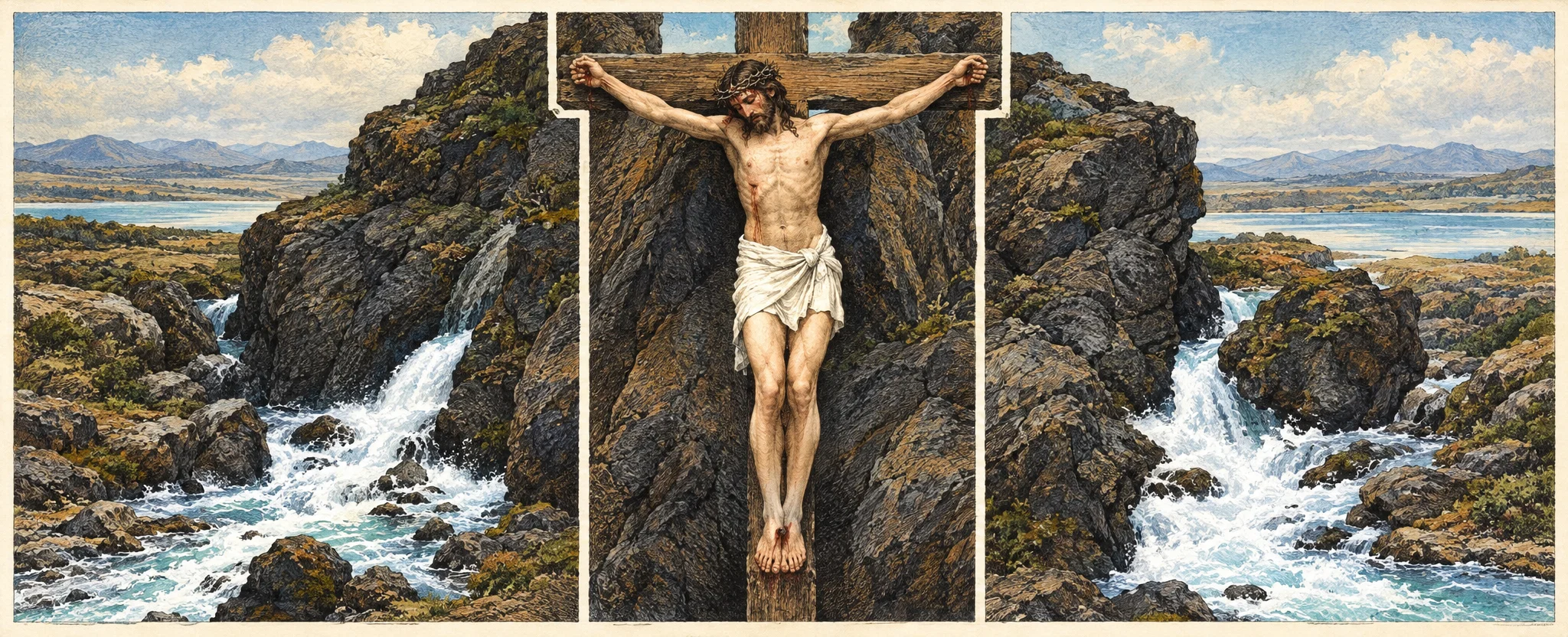 A three-part religious scene shows a bearded man representing Christ standing upright in the center, nearly unclothed except for a cloth around his waist, with his arms stretched wide and his feet together. Dark, towering rocks rise behind him. In the flanking panels, water gushes from rocky clefts and spreads in bright streams across a barren, uneven landscape, with scattered stones and low ridges. The composition links the central figure with the life-giving water flowing from the surrounding rock; no lettering is visible within the image.
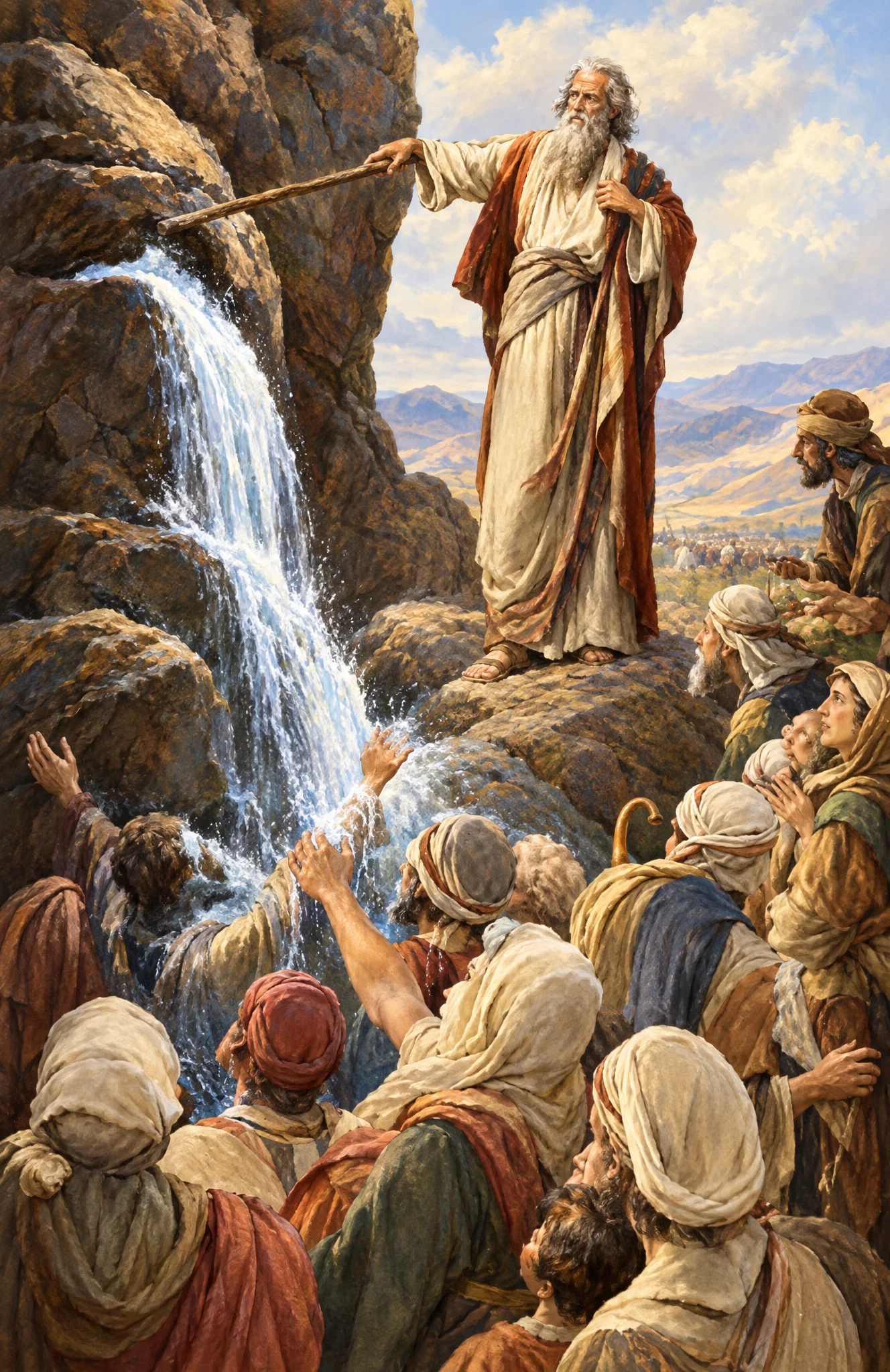 THE SMITTEN ROCK
“The water gushed forth in abundance to satisfy the host.”
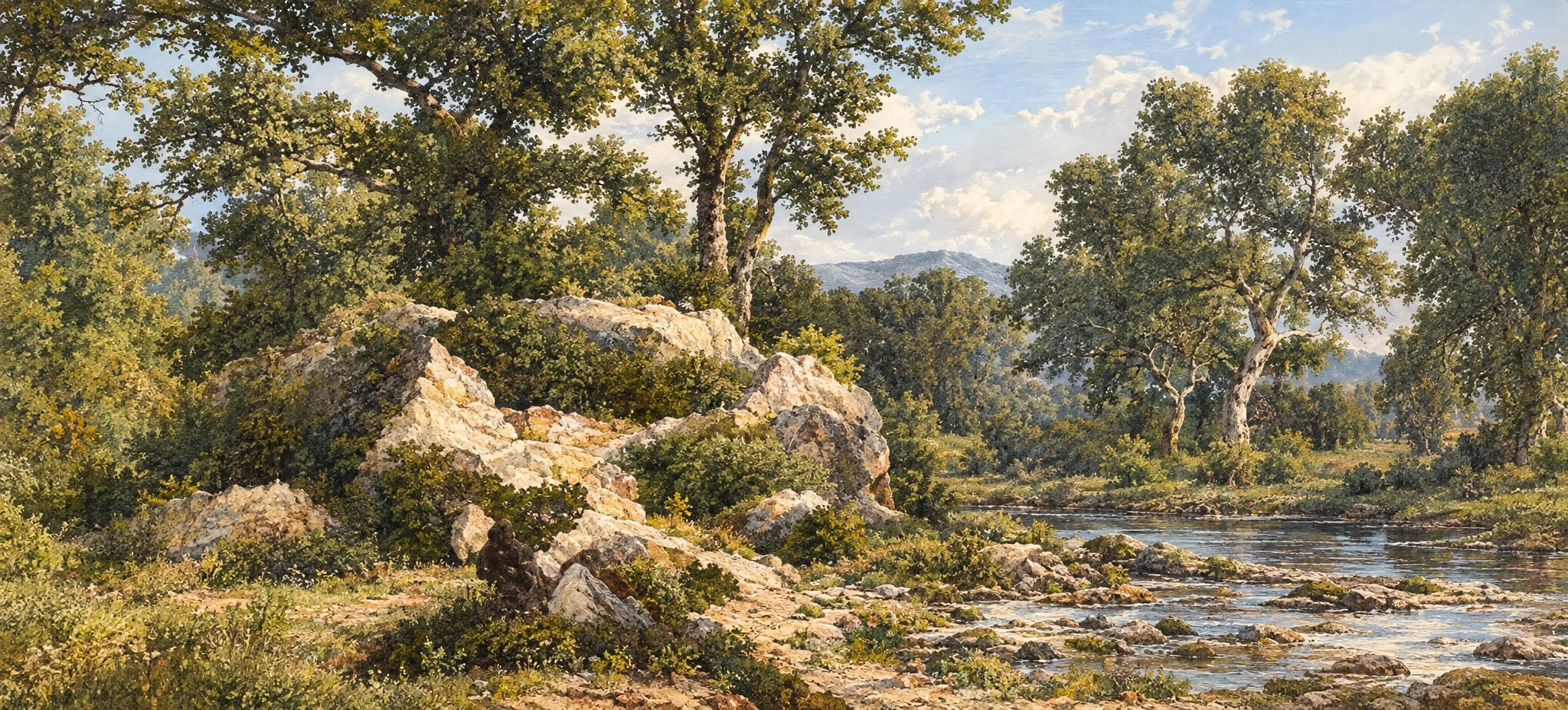 A small, dark figure lies or crouches in the foreground beside a broad, shallow stretch of water, with a pale, irregular shape rising behind it that may be spray or a rocky bank. The water extends across the lower right, marked by horizontal ripples and reflections. Trees and dense foliage fill the background, including a large branching tree near the center and lighter, slender trunks at the right. The scene is rendered in soft, indistinct tones, with no readable text or clearly identifiable animals.
 A narrow, ornamental black-and-white illustration centers on a tall staff or standard rising from a rocky, shaded foreground. Its top has a broad crossbar and a small upright projection, while a rounded form and winding, serpent-like shape appear lower on the shaft. The base is flanked by uneven ridges or stones. Elaborate curling foliage and scrollwork frame both sides and the upper edge, leaving a large, mostly open space behind the central object. No people, animals, or legible lettering are visible.
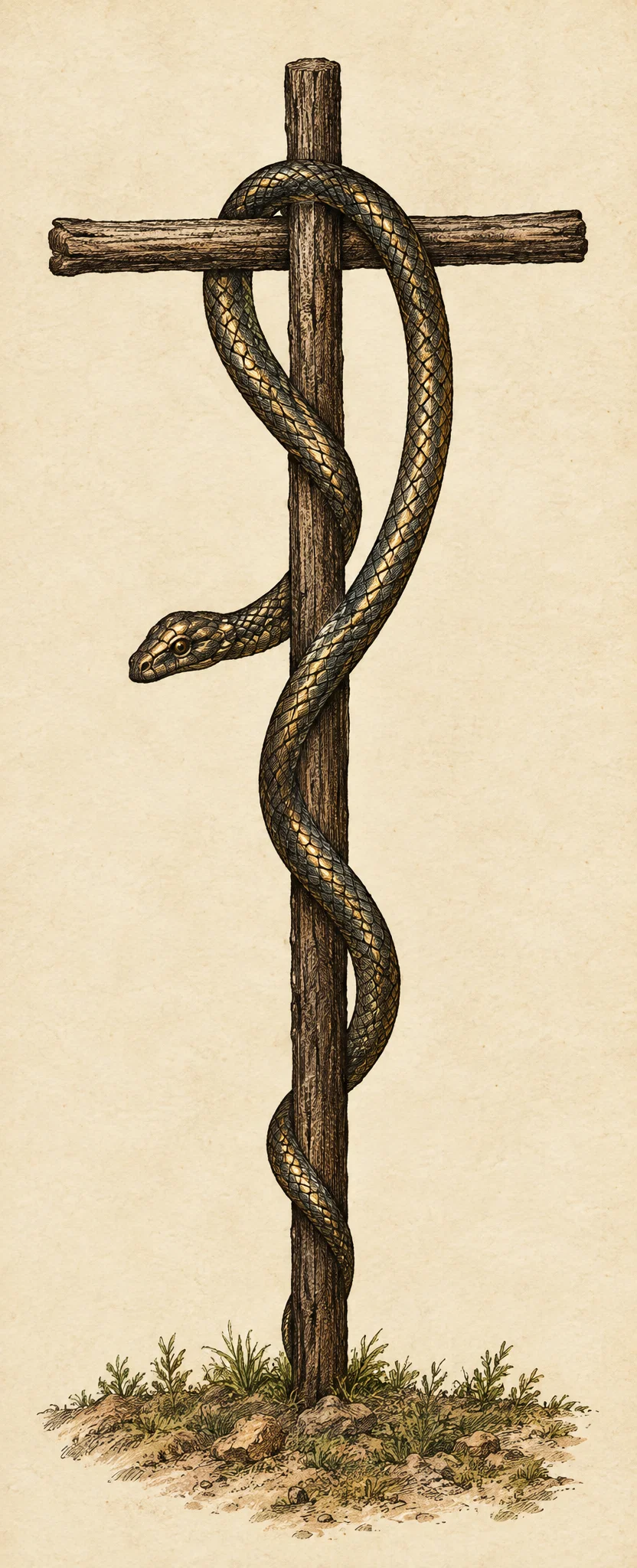 A simple dark line drawing shows a tall upright post set into a small patch of rough ground, with a short horizontal bar near its top forming a cross. A long serpent coils and twists around the post, looping over the crossbar and winding down its length; its body projects to the left midway down, while its head and tail are not clearly distinct. The cross and serpent stand alone against an otherwise blank background, with no people, animals, or lettering visible.
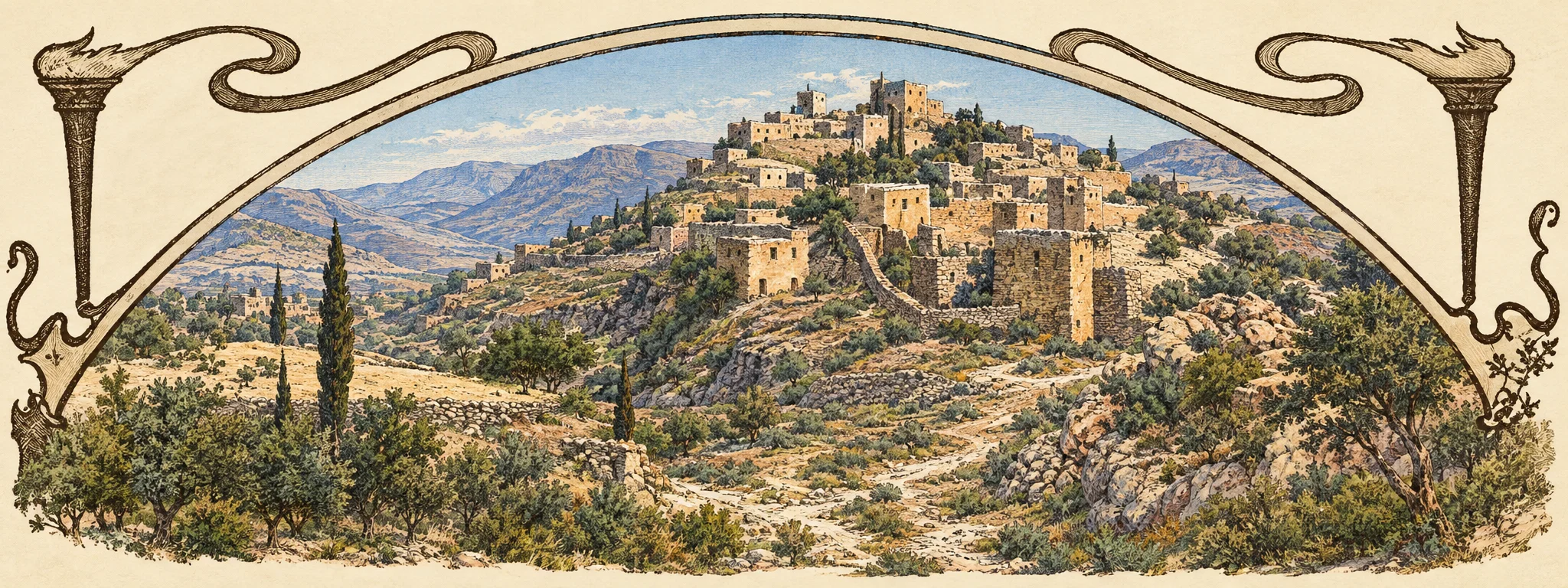 A broad, arched landscape shows a clustered settlement spread across hilly ground, with pale blocklike buildings and several taller, tower-shaped structures among darker trees and shrubs. A winding light-colored track or stream crosses the foreground toward the town, while rough vegetation fills the lower edge. The scene is enclosed by a decorative curved border that rises over the landscape and ends in symmetrical torch-like forms at both sides. No clearly discernible people, animals, or lettering appear.
 BALAAM—40
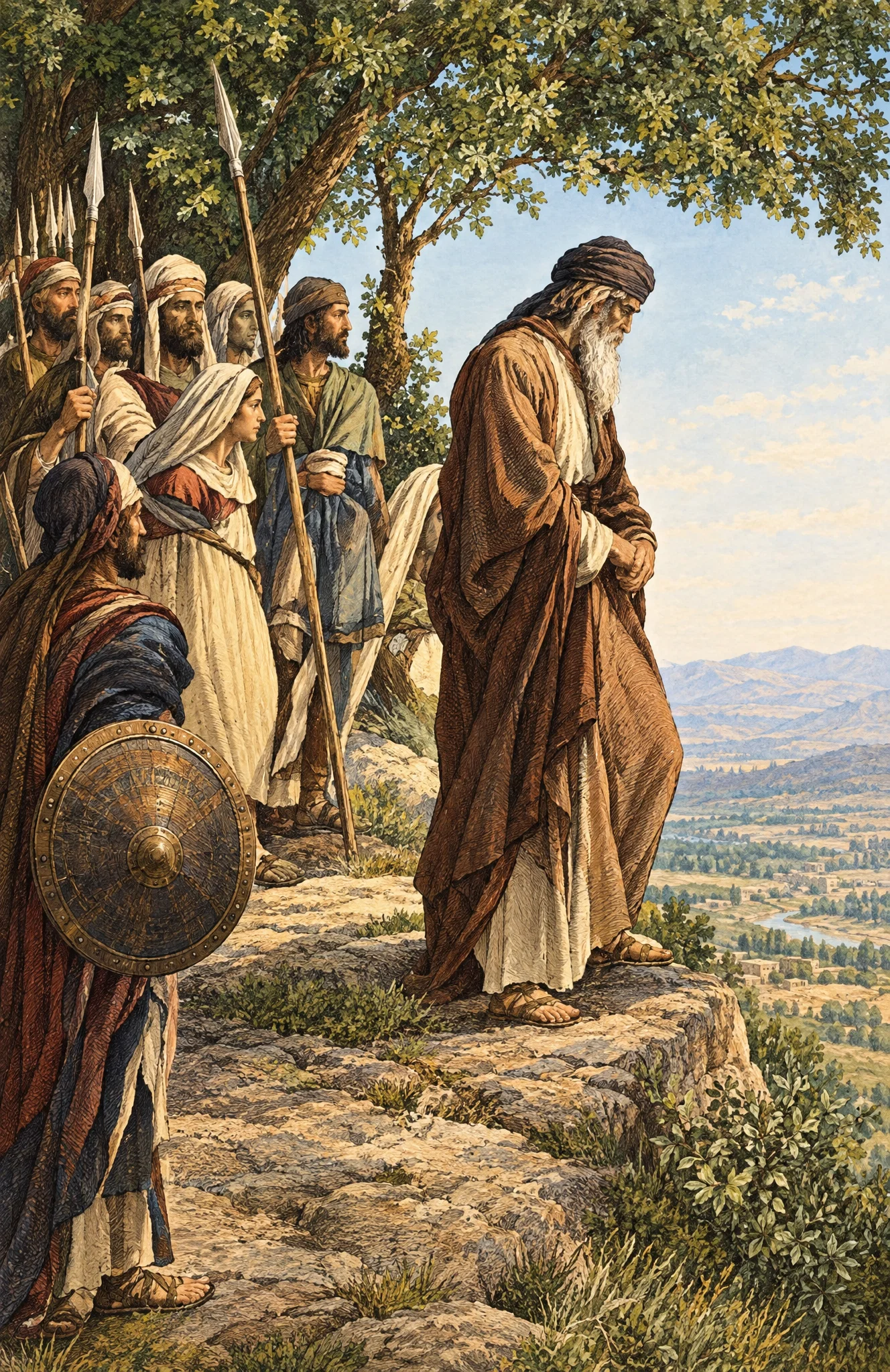 BALAAM BLESSING ISRAEL
“From the top of the rocks I see him,
And from the hills I behold him.
Lo, the people shall dwell alone,
And shall not be reckoned among the nations.”
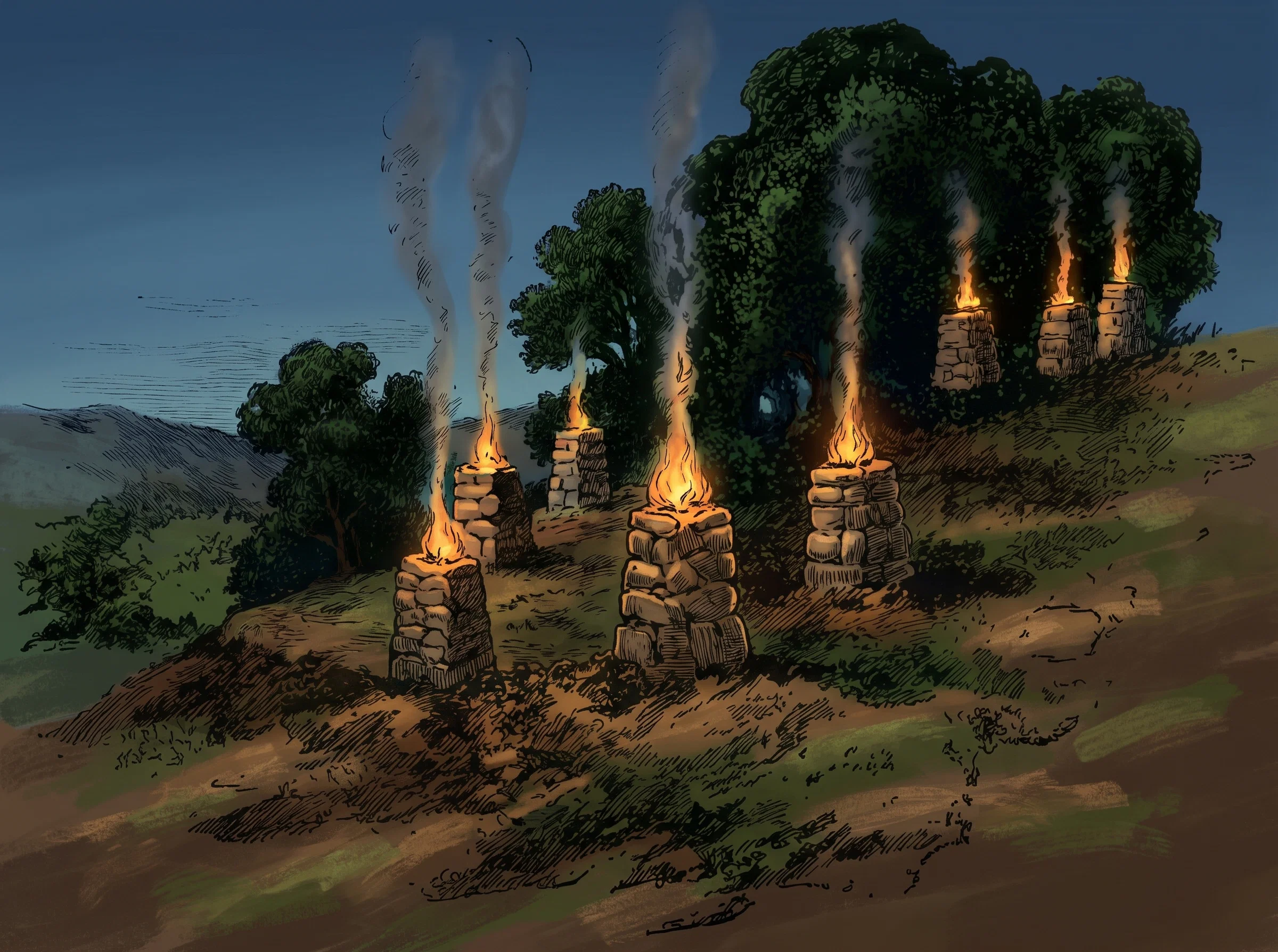 A sparse, shadowy landscape shows several pale, upright human figures gathered in the foreground and middle distance. Two figures stand close together near the center-left, while another small group is farther to the right; their forms are indistinct, with light robes or bodies contrasting against the dark ground. Behind them, a massive, dense, rounded mass of dark foliage or shadow fills the upper-right portion of the scene. Low, uneven terrain stretches across the foreground, with a few thin vertical shapes rising near the left-center and a faint, open horizon beyond. No lettering is visible.
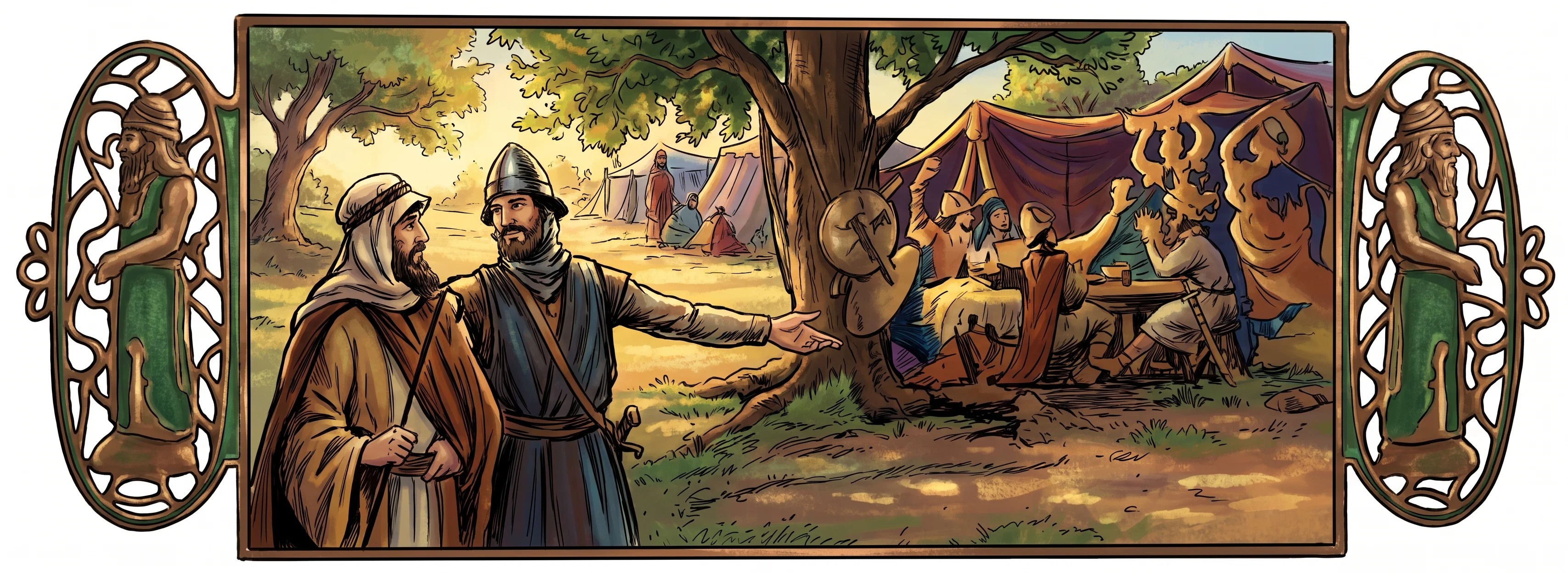 A narrow, framed scene shows several people gathered in a wooded landscape. At the left, a hooded, robed figure stands beside a second person wearing a pointed helmet or headpiece; the second figure stretches an arm toward the center of the scene. More figures appear on the right among dense trees and shadowy forms, including a prominent face-like shape. The ground opens into a pale clearing in the foreground, while foliage and trunks fill the background. Ornamental, curling forms flank the rectangular scene. No legible text appears within the artwork.
 A symmetrical ornamental flourish spans the image, formed from curling scrolls, leaf-like sprays, and a central mask-like motif. The outer ends rise into broad, jagged leaves, while smaller tendrils loop and coil inward on both sides. At the center, two rounded eye-shaped forms sit above a wide horizontal band and a shorter block-like shape, suggesting a stylized face or architectural ornament. The design is rendered in dark outlines with pale interiors, and contains no visible text.
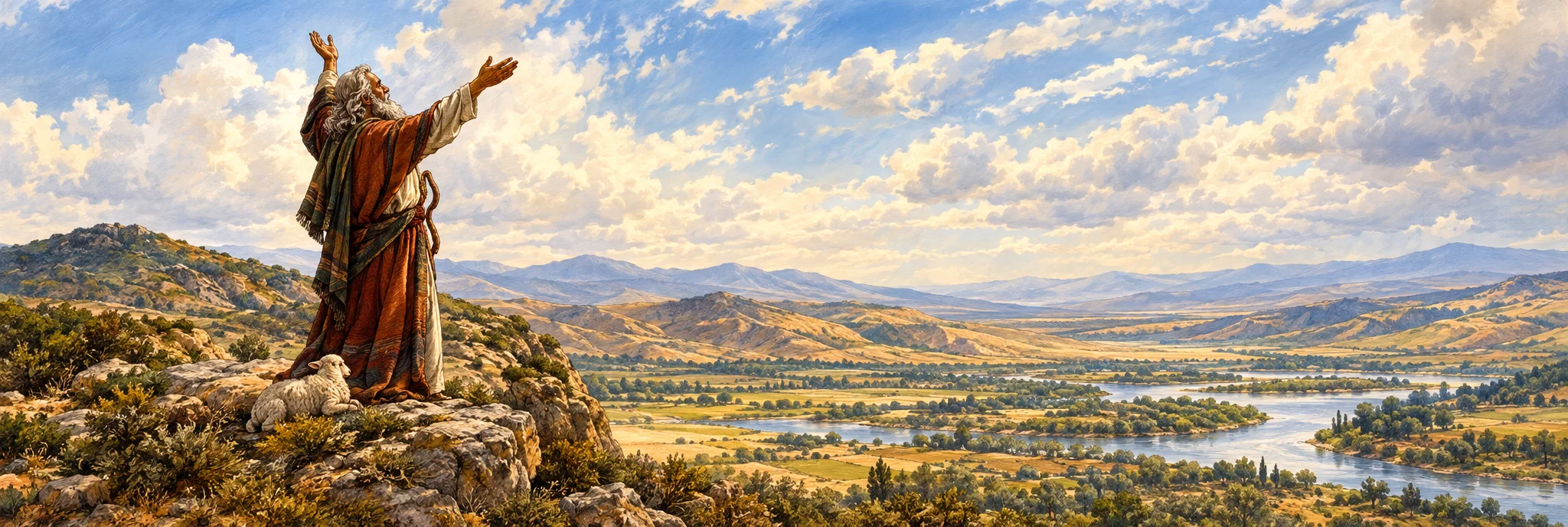 A solitary, bearded figure in a long robe stands on a rocky rise at the left of the scene, facing a broad, distant landscape. He raises one arm and extends the other toward the horizon, as if indicating the land below. A pale, curled form lies near his feet among the rocks. Low hills and uneven terrain stretch across the middle distance beneath a wide, cloud-filled sky, leaving much of the composition open around the figure.
 A small, dark oil lamp sits centered on a low surface, its rounded bowl decorated with a bright circular highlight and fitted with a short raised handle or knob on top. Two broad, curled arms extend outward from the bowl, each ending in a circular ring-like form; the left arm angles upward, while the right curls around a larger ring. A faint plume of smoke or vapor rises above the lamp, and scattered wisps and specks surround it against an otherwise plain background. No lettering is visible.
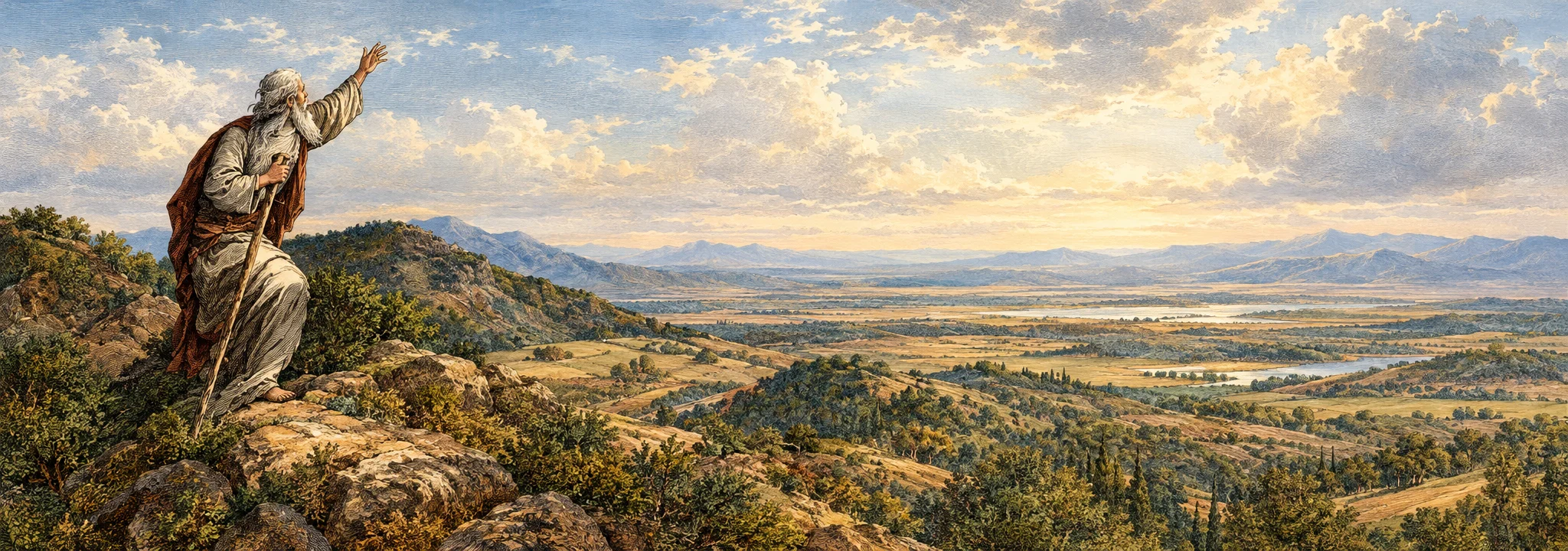 Moses stands on a high rocky overlook at the left of the image, his robed figure turned toward the vast landscape. He raises one arm and points into the distance, while holding a staff or rod in the other hand. Below him, rugged slopes descend into a broad valley with ridges, plains, and scattered patches of vegetation stretching toward a low horizon. The expansive, clouded sky fills much of the composition, emphasizing the distant view of the land before him. No other people, animals, or legible lettering are visible.
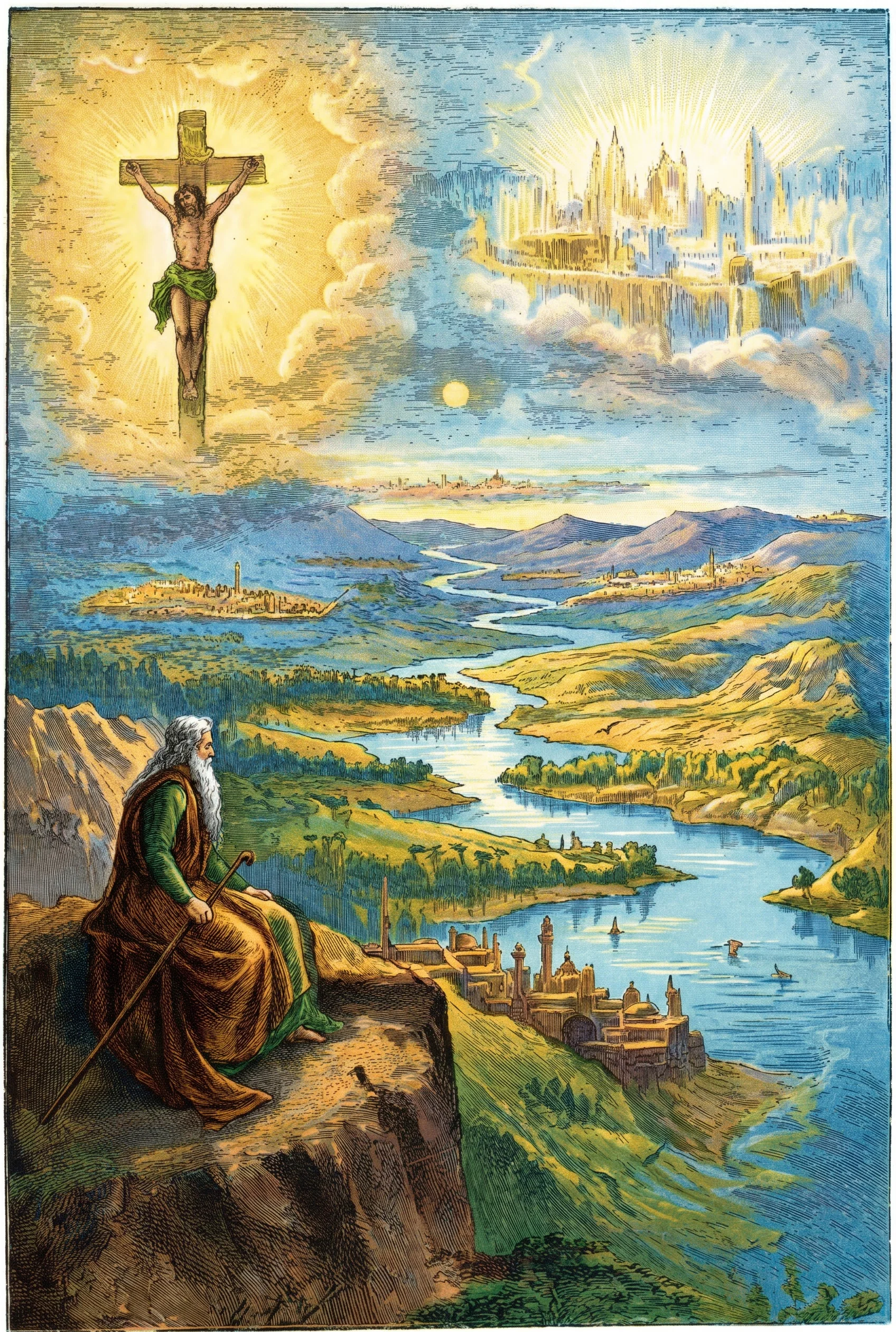 MOSES VIEWING THE LAND OF PROMISE
“A panoramic view of the land of promise was presented to him. . . . He seemed to be looking upon a second Eden.”
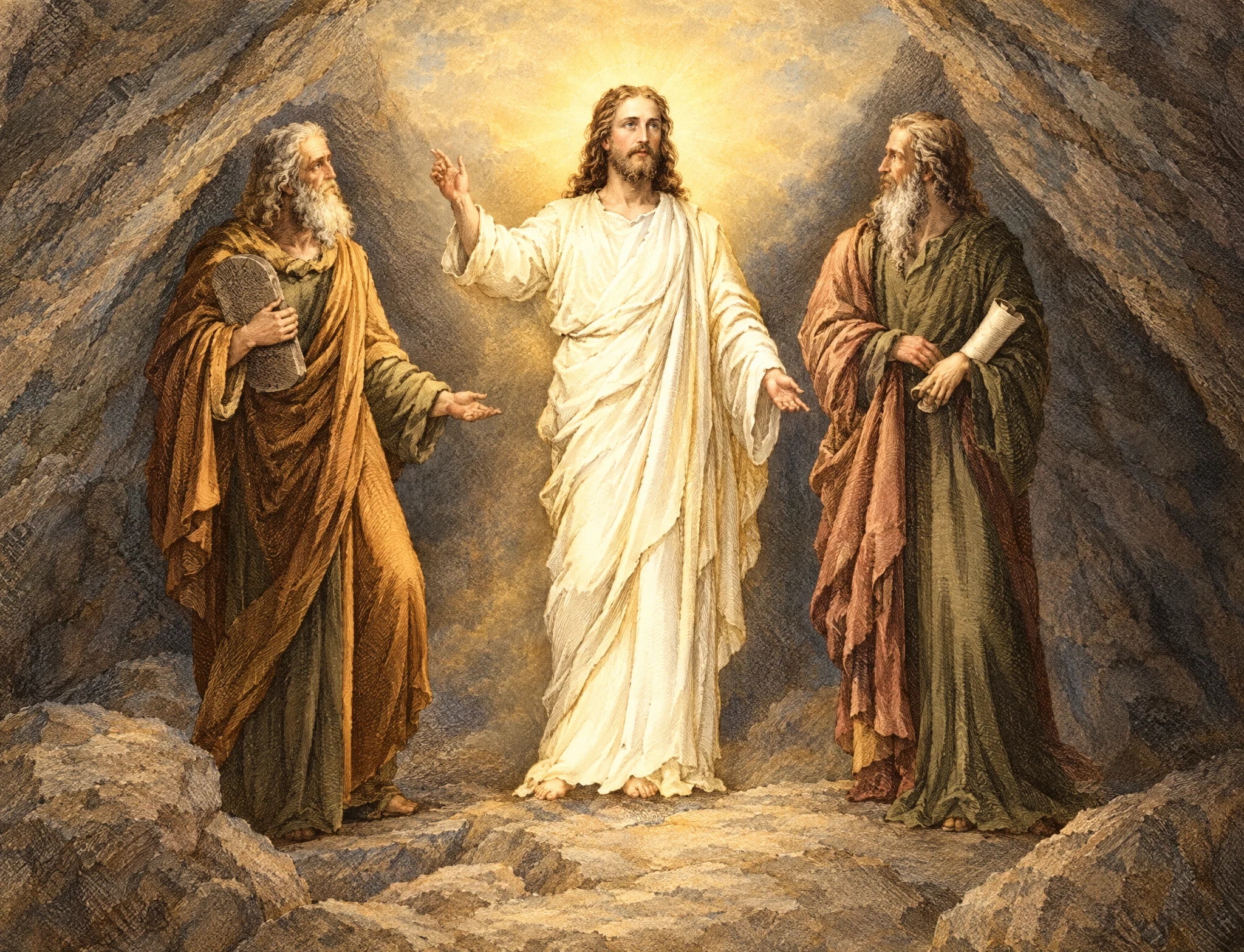 “The resurrection was forever made certain.”
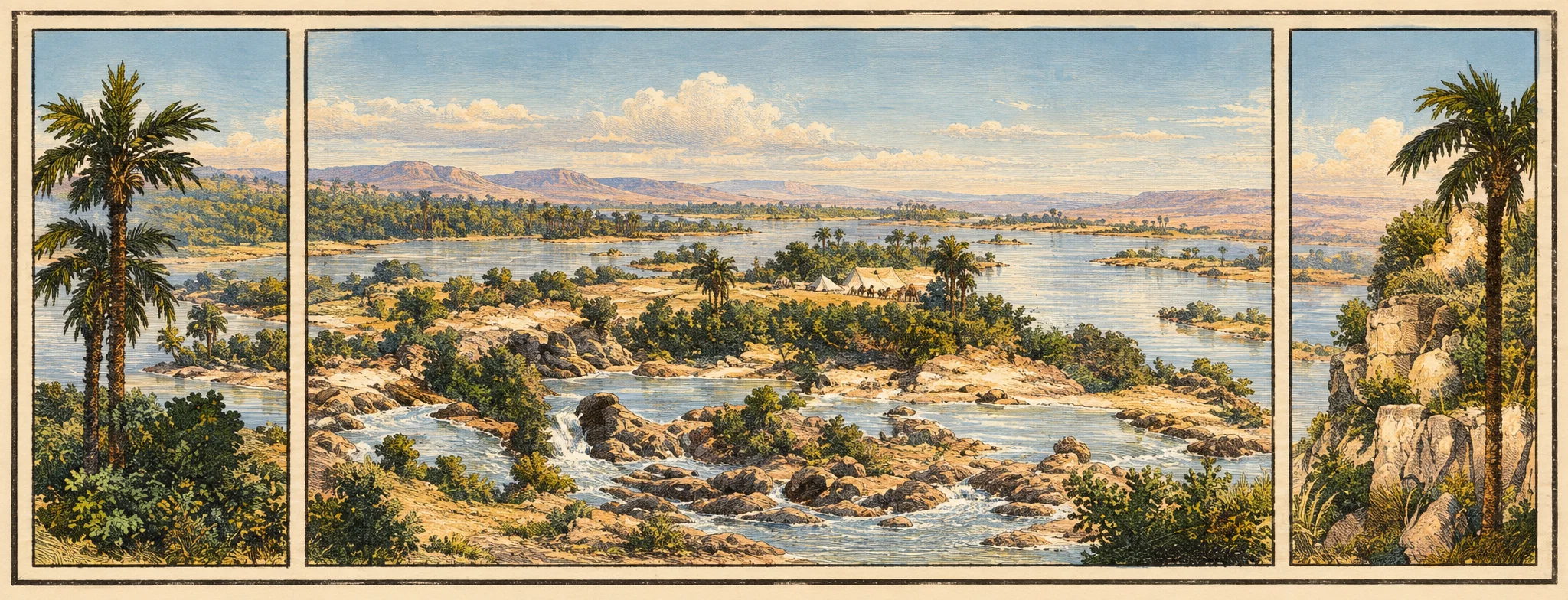 A monochrome landscape is arranged in three adjoining panels. The broad central panel shows a wide, churning river or body of water, with sweeping bands of foam and dark ripples in the foreground and low, irregular banks or vegetation along the far side beneath an open sky. Narrow panels at either side frame the scene: the left contains tall palm trees rising above dense scrub, while the right shows a palm beside a rocky, uneven bank. No distinct figures or lettering are visible.
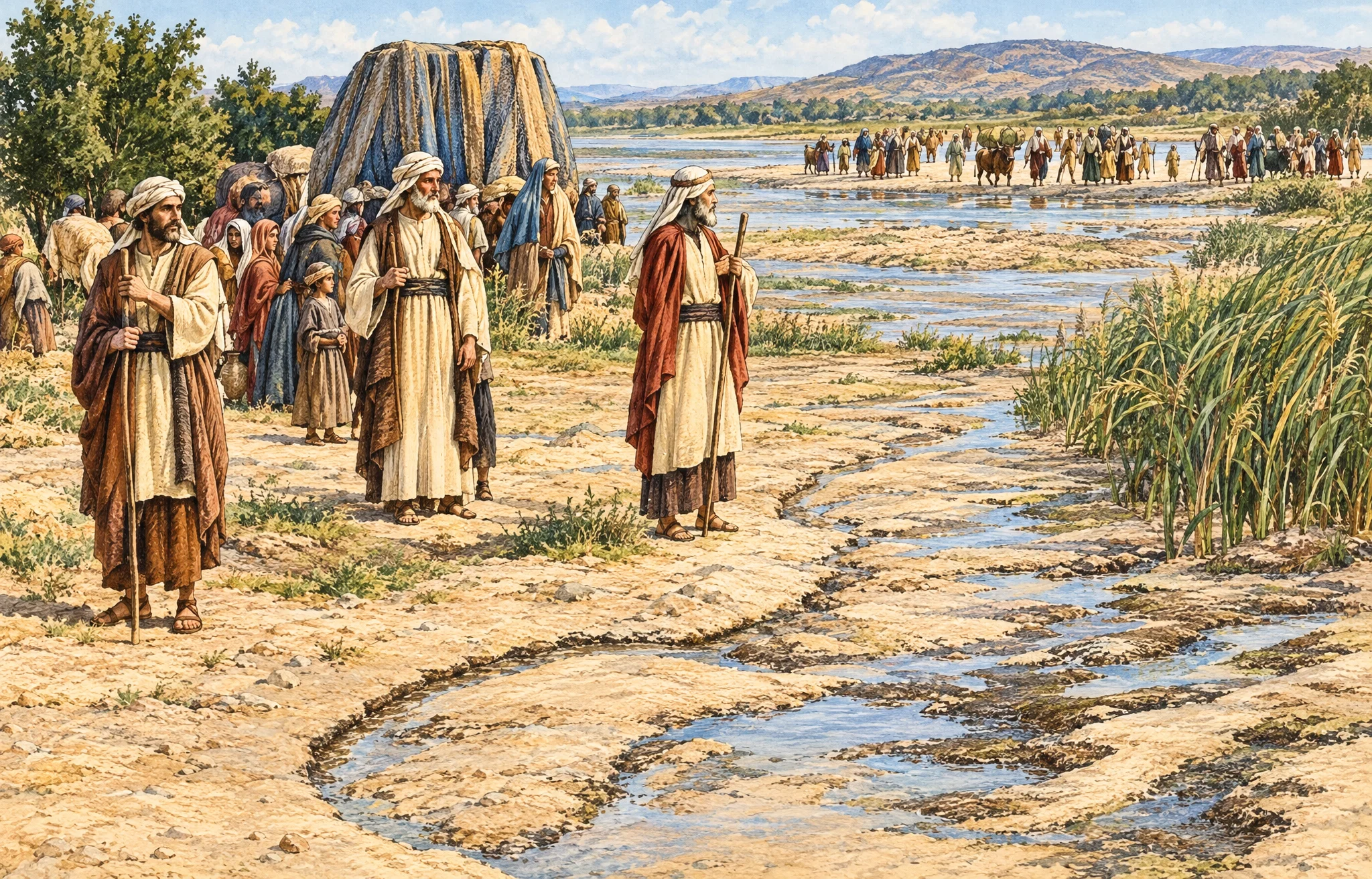 “God willed that the passage of Israel over Jordan should be miraculous.”
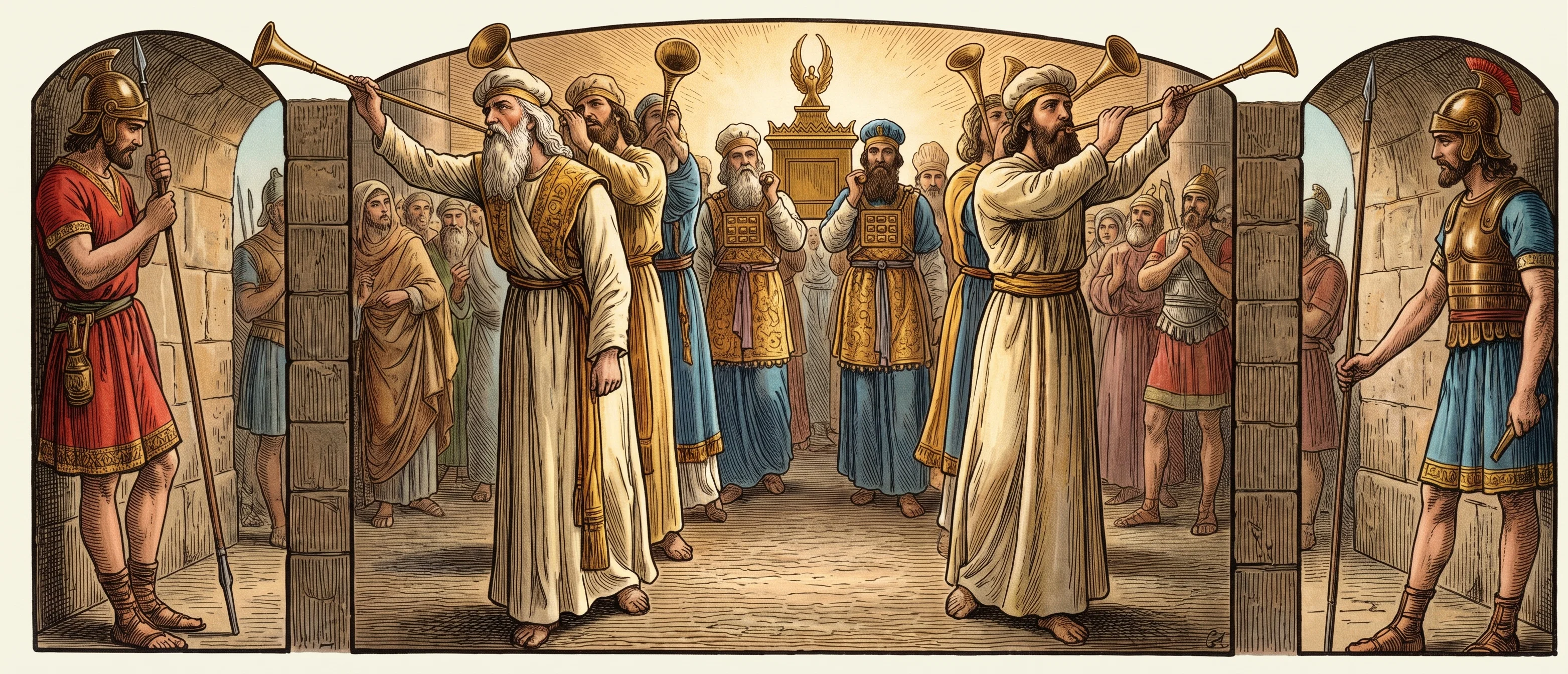 A solemn procession of robed figures advances through the central scene, arranged in rows around a tall, dark ceremonial object with a narrow upright form rising above it. Several figures raise long, curved horns or trumpets toward the sides, while others walk close beside the central object. The group is enclosed by a simple arched framework. Narrow panels at either side each show a lone figure in a short tunic holding a long staff or spear, standing within a rounded arch.
 THE FALL OF JERICHO
“The Mighty One of Israel had said, ‘I have given Jericho into thine hand.’ Against that word, human strength was powerless.”
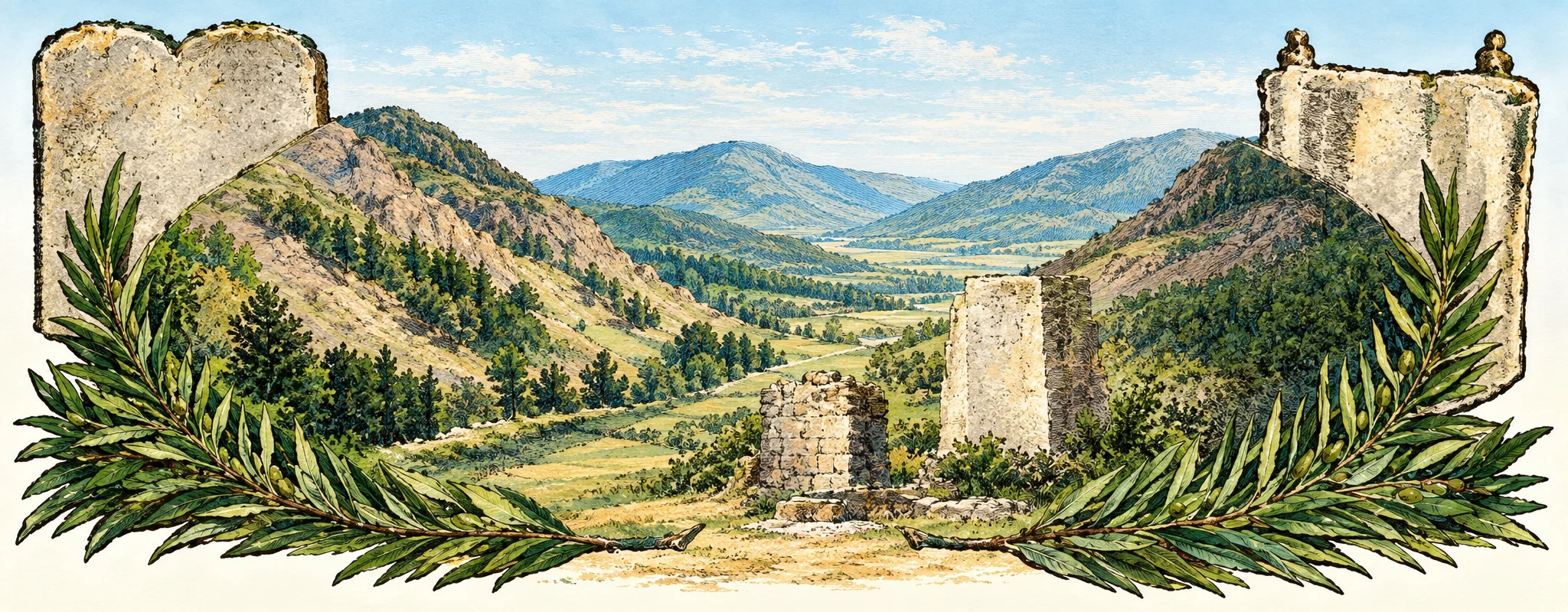 An engraved landscape shows a broad valley enclosed by rounded, rugged hills, with a small settlement or cluster of buildings near the center and a prominent pale, rectangular structure on the right side. Dark patches of trees and vegetation dot the slopes and valley floor. Tall stone-like forms rise behind the landscape at both ends, while leafy branches sweep inward across the lower foreground, framing the scene. No people, animals, or lettering are visible.
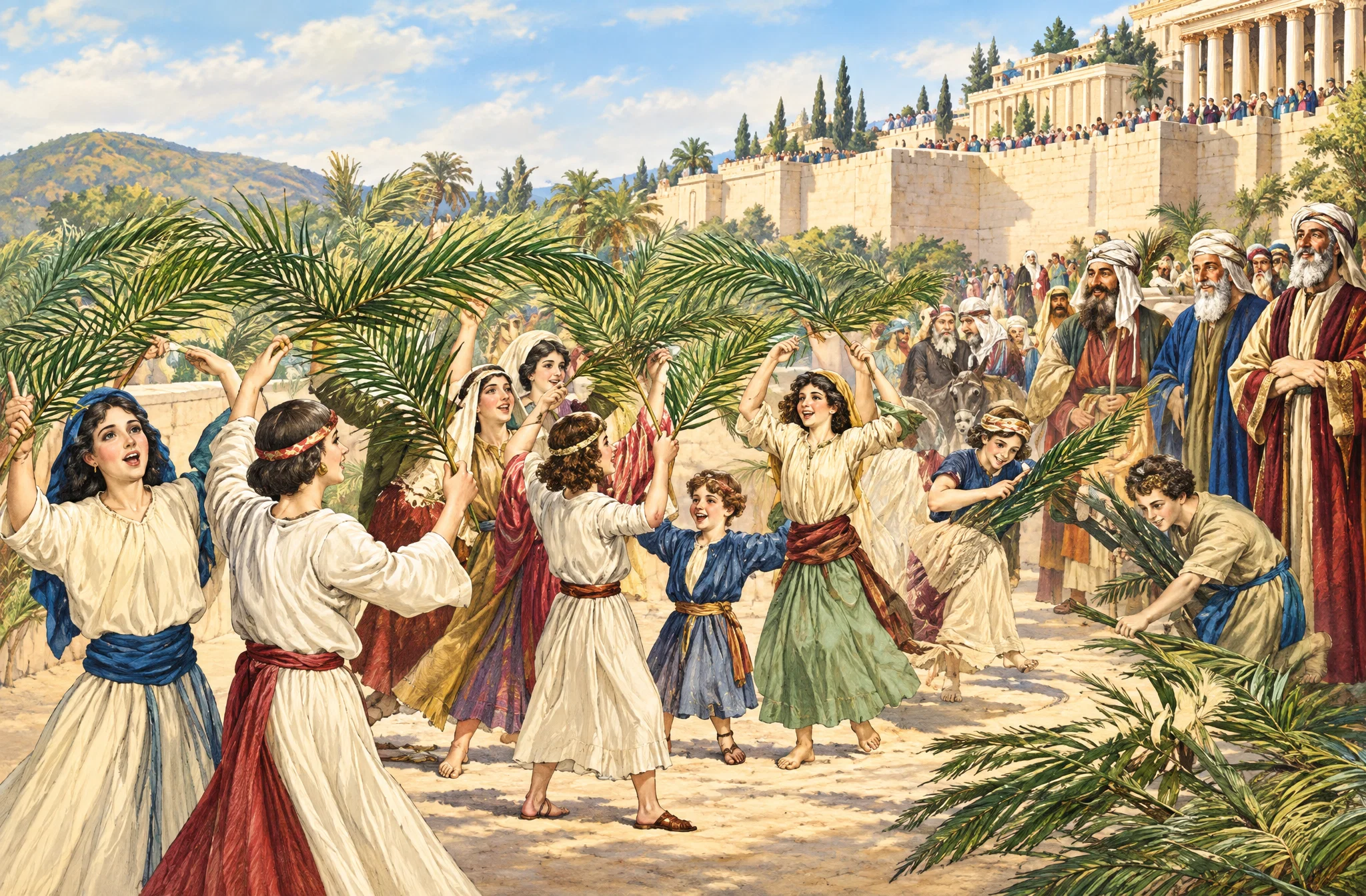 REJOICING AT THE FEAST
“The redeemed of the Lord shall return and come with singing unto Zion; ... they shall obtain gladness and joy; and sorrow and sighing shall flee away.”
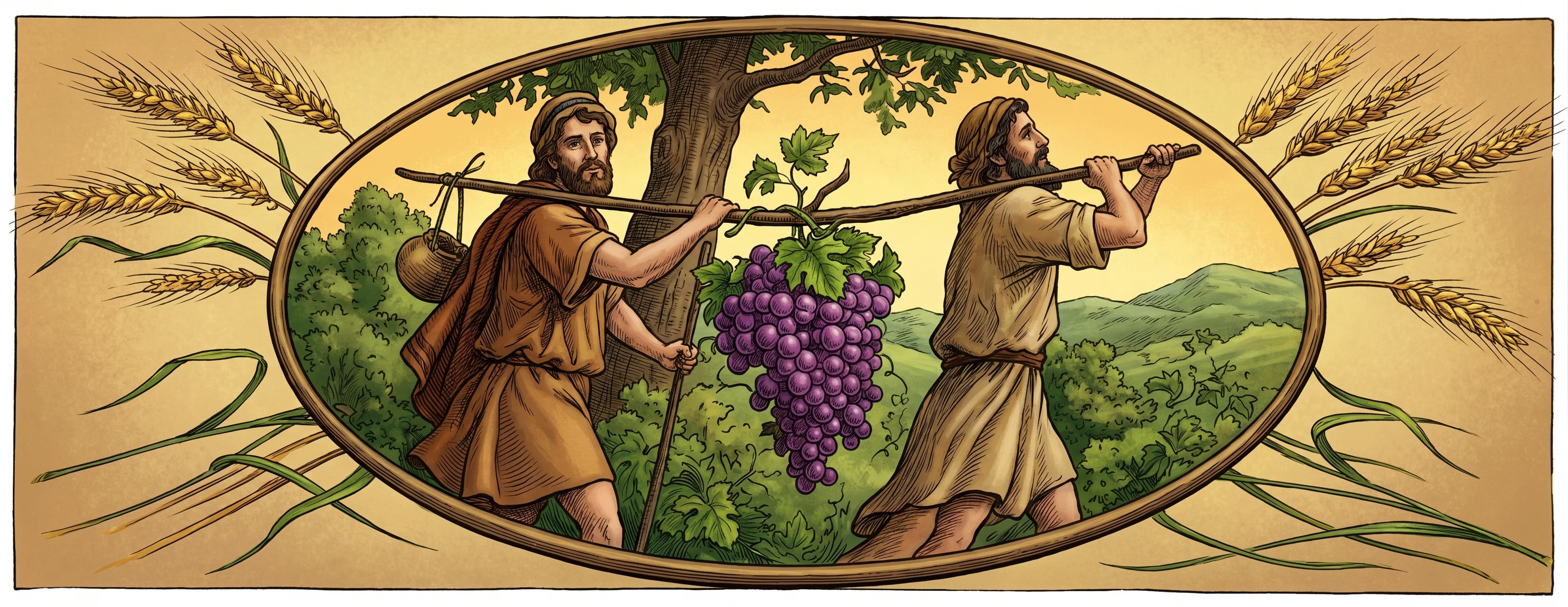 A horizontal oval frames a garden-like scene with two human figures standing on either side of a dense, leafy tree or vine. The figure at left has short hair and appears partly bare-chested, reaching toward the center; the figure at right wears a long, flowing garment and also extends an arm toward the branches. A long slender branch or stem crosses the scene between them, with clusters of leaves and fruit around it. Foliage and radiating, sketchy lines fill the space beyond the oval. No lettering is visible within the image.
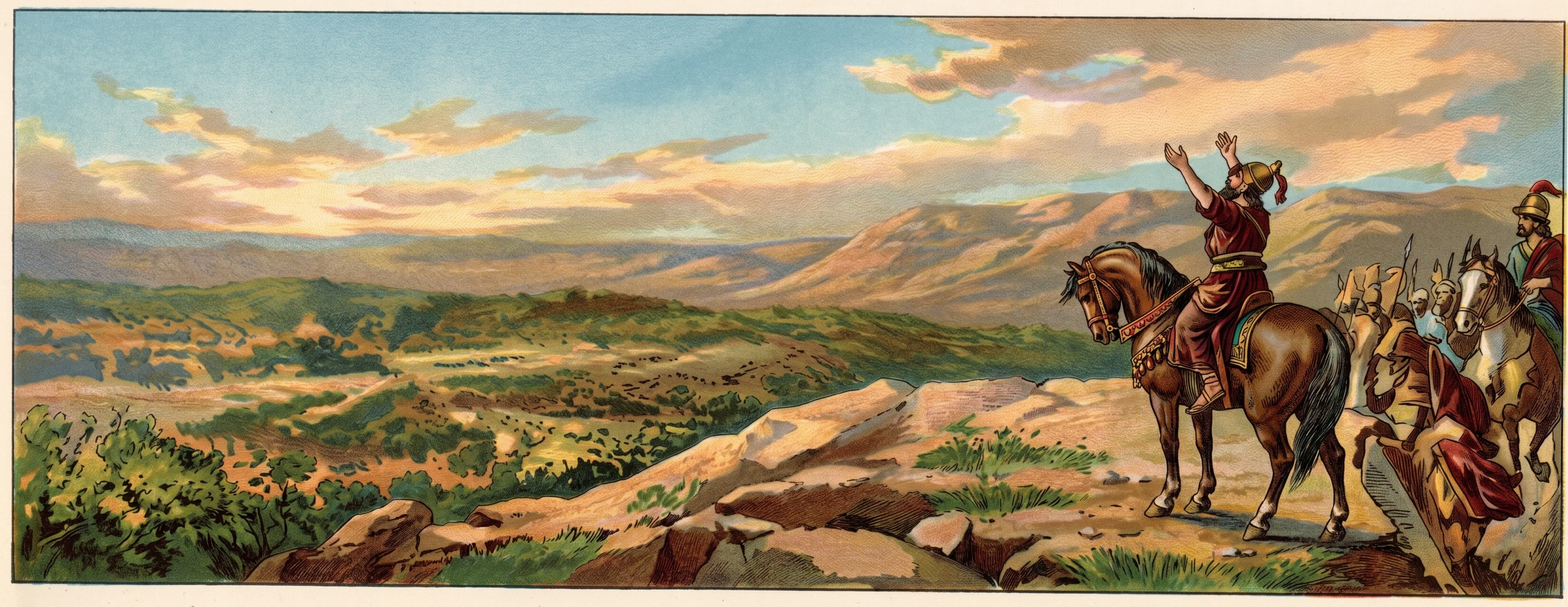 A small group of travelers gathers at the right side of a broad, open landscape. One prominent figure sits astride a horse and raises an arm, while several people and possibly additional horses or pack animals cluster behind and beside him. The uneven foreground appears rocky or lightly snow-covered, with low rolling hills stretching across the middle distance beneath a cloudy sky. The group is concentrated near the edge of the scene, leaving most of the view open to the landscape.
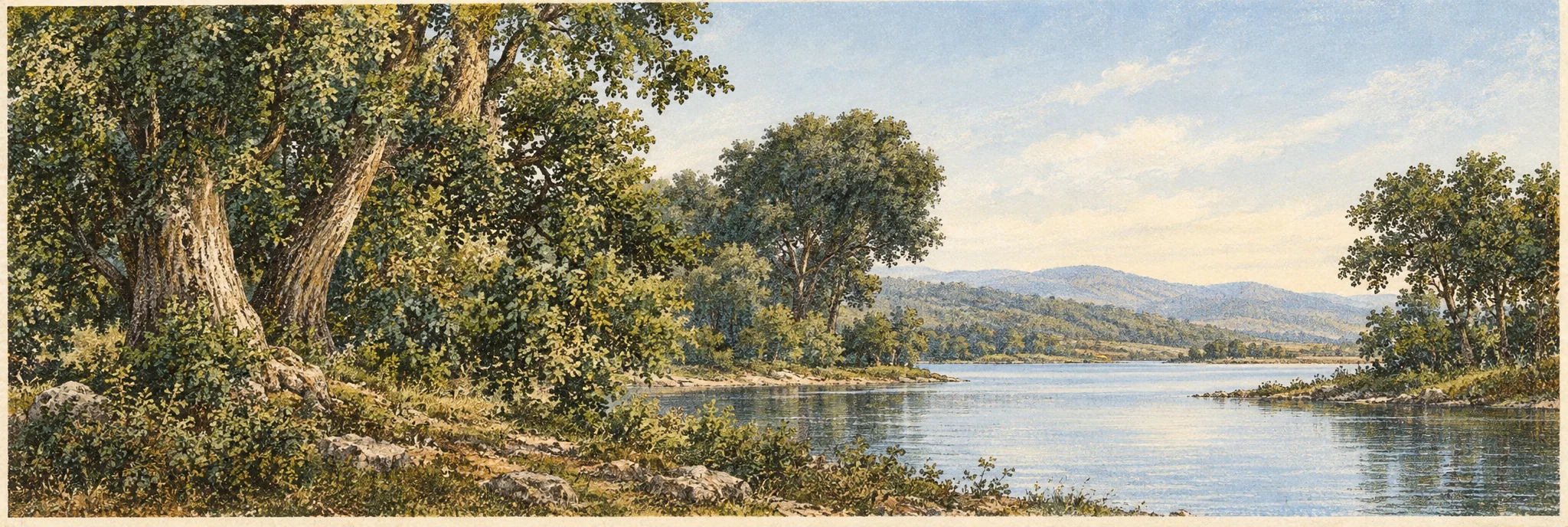 A quiet landscape of a broad body of water, likely the waters of Merom referenced in the surrounding text. The water stretches across the foreground and middle distance, with thin horizontal reflections and low banks along its edges. Dense trees and foliage frame the scene on the left, including a large foreground trunk and overhanging branches; a smaller cluster of trees stands at the far right. Beyond the water, a low wooded rise recedes into the distance beneath an open, pale sky. No people, animals, buildings, or lettering are visible.
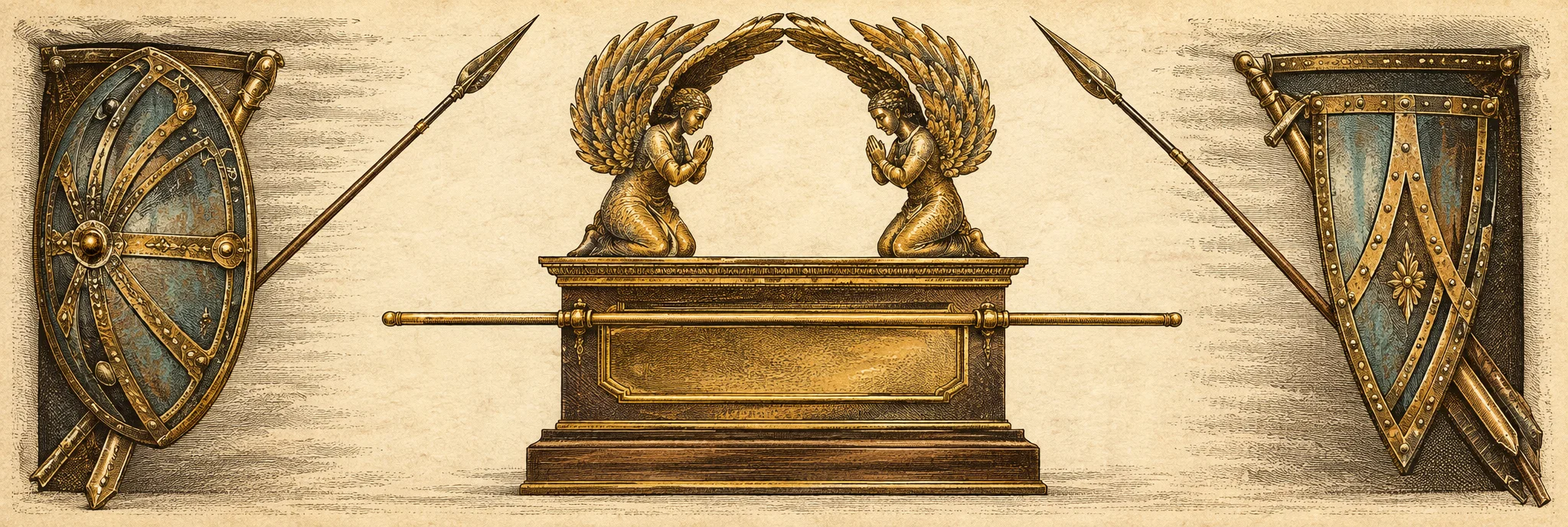 A narrow, symmetrical engraving centers on a rectangular chest or altar-like container with a lid and long carrying poles extending to either side. Two small winged figures face one another above it, their raised wings forming an arch overhead. The central object rests on a dark base, while large, elaborate shield-like forms and angled decorative elements fill the far left and right ends. Fine lines and ornamental framing run across the background; no clearly legible lettering appears within the image.
 October
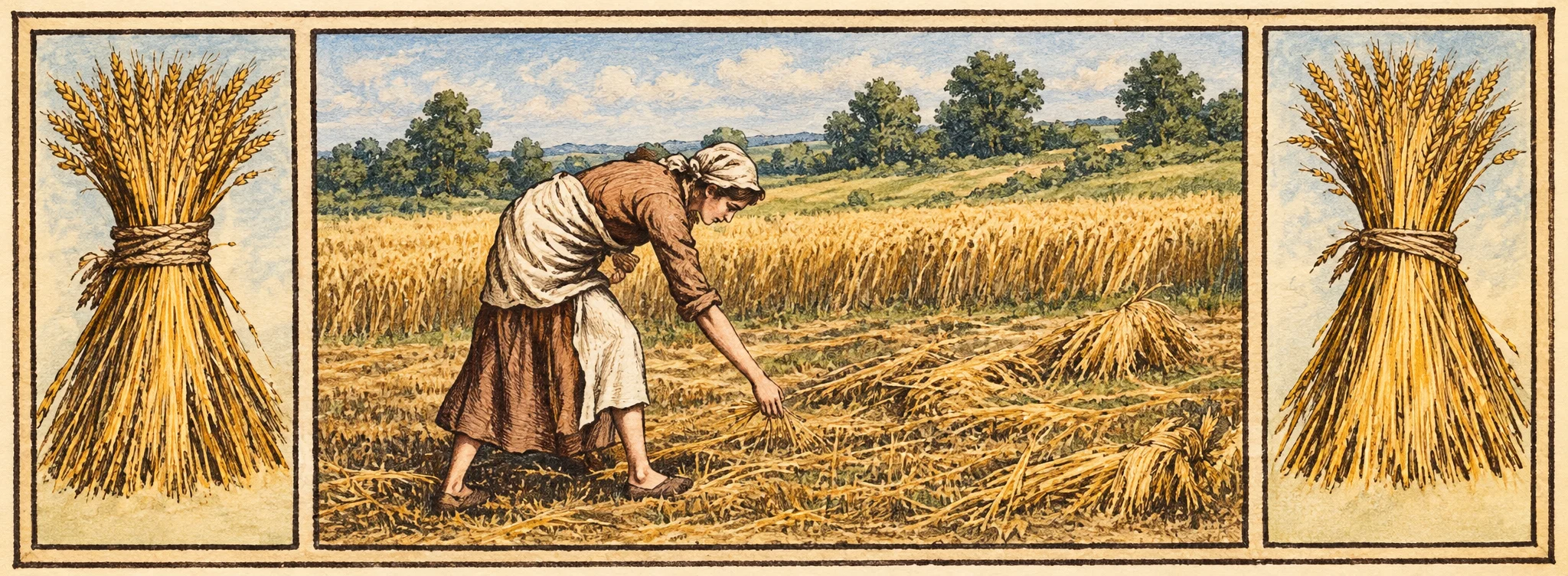 A woman bends forward in a harvested field, reaching down to gather grain or glean among the stubble. She wears a long skirt, apron, and head covering, with a bundle or basket carried behind her. Rows of cut stalks and scattered sheaves stretch across the field, while a small animal, possibly a dog, stands near the lower right. Low trees and distant figures or vegetation line the horizon beneath an open sky. Narrow framed panels on either side show upright bundles of harvested grain tied around the middle; there is no visible lettering.
 “The yield of this year was to be free for the stranger, the fatherless, and the widow, and even for the creatures of the field.”
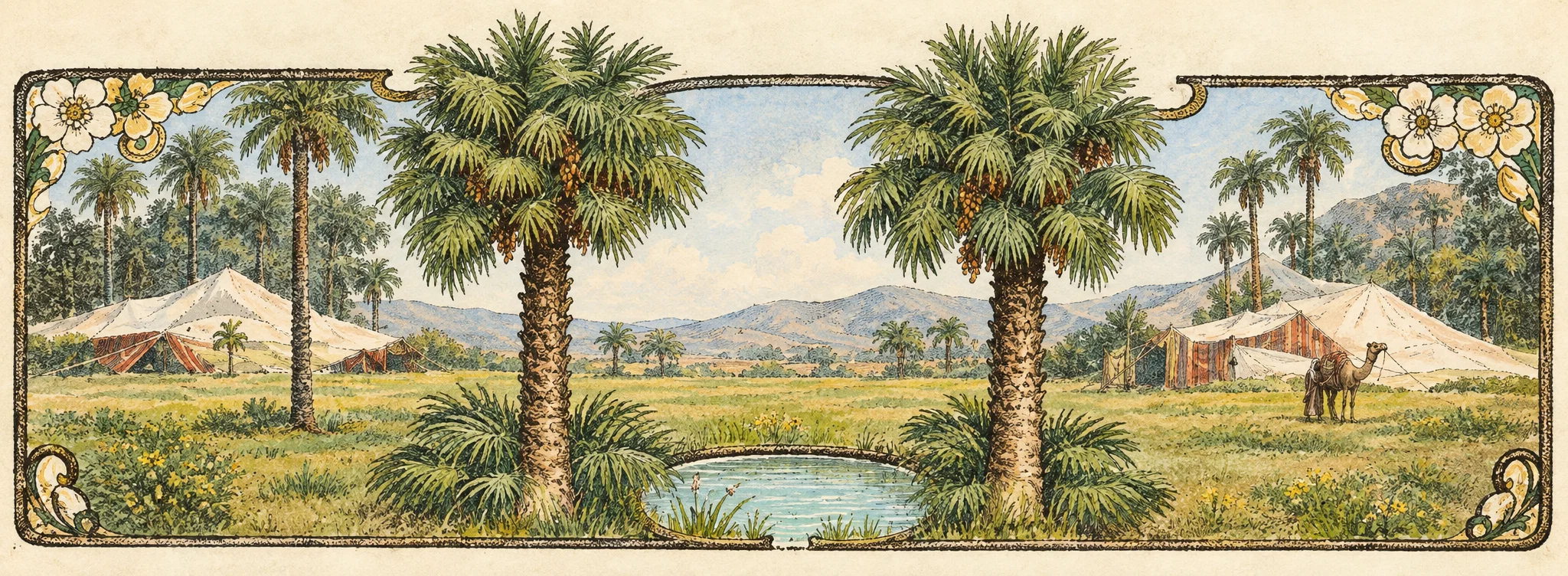 A wide, decorative landscape scene framed by an ornate border with floral motifs and curled corner ornaments. Two tall palm trees dominate the foreground, their spreading fronds reaching across the upper part of the image. Beyond them lies an open, gently rolling plain bordered by darker trees, with several low tent-like shelters scattered across the ground. A small figure appears to the right beside a dark animal, possibly a donkey or horse. A shallow oval pool or clearing sits near the bottom center, with small marks suggesting vegetation or stones. No lettering is visible.
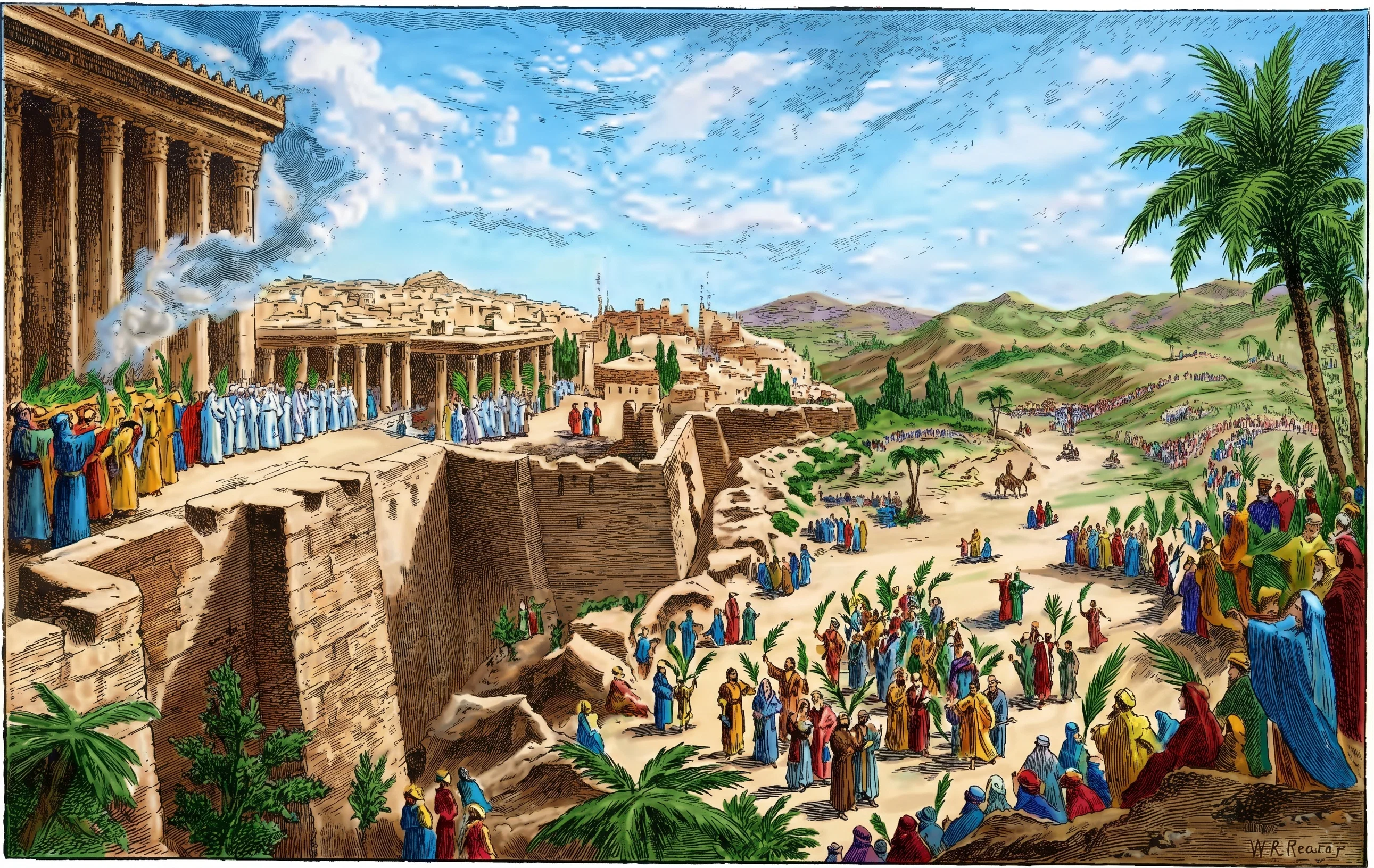 THE FEAST OF TABERNACLES
“I was glad when they said unto me, Let us go into the house of the Lord.”
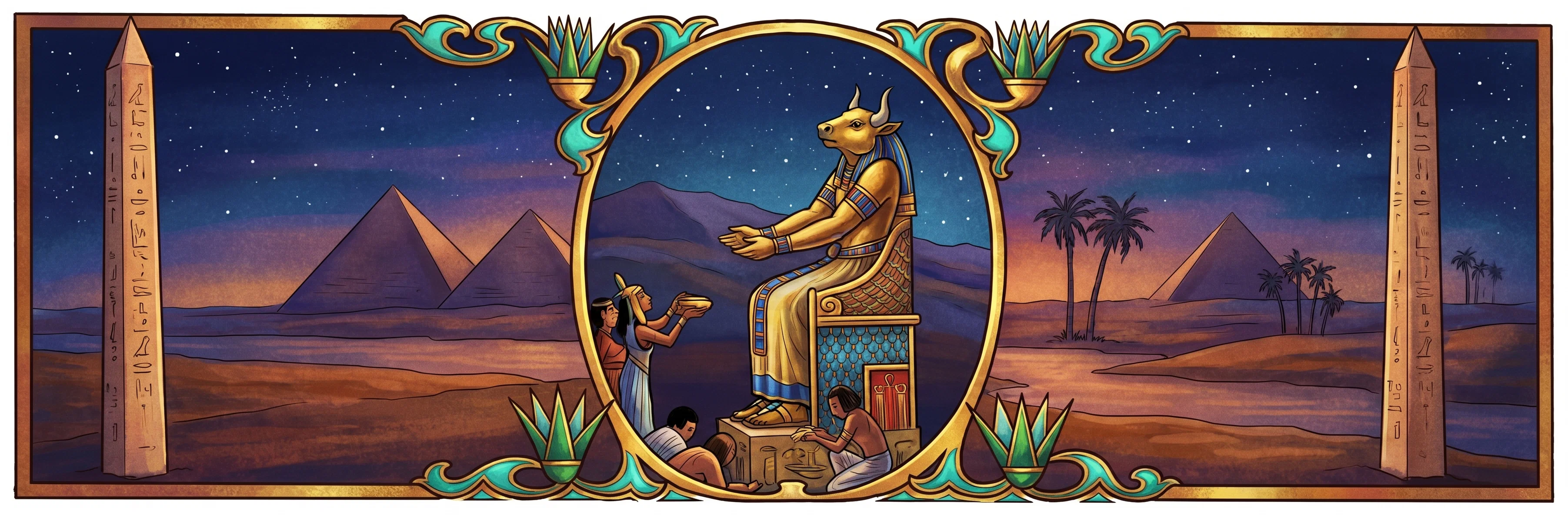 A decorative horizontal scene centers on a bearded man seated on a raised stone seat or platform, wearing a long robe and looking down toward a small animal near his feet. The central figure is enclosed in an ornate oval frame with curling floral and leaf-like flourishes above and below. Behind him, the landscape shows a cloudy sky, distant hills, and a palm tree, with a broad pale band crossing the scene. Tall, narrow stone pillars stand at the far left and right. No lettering is visible.
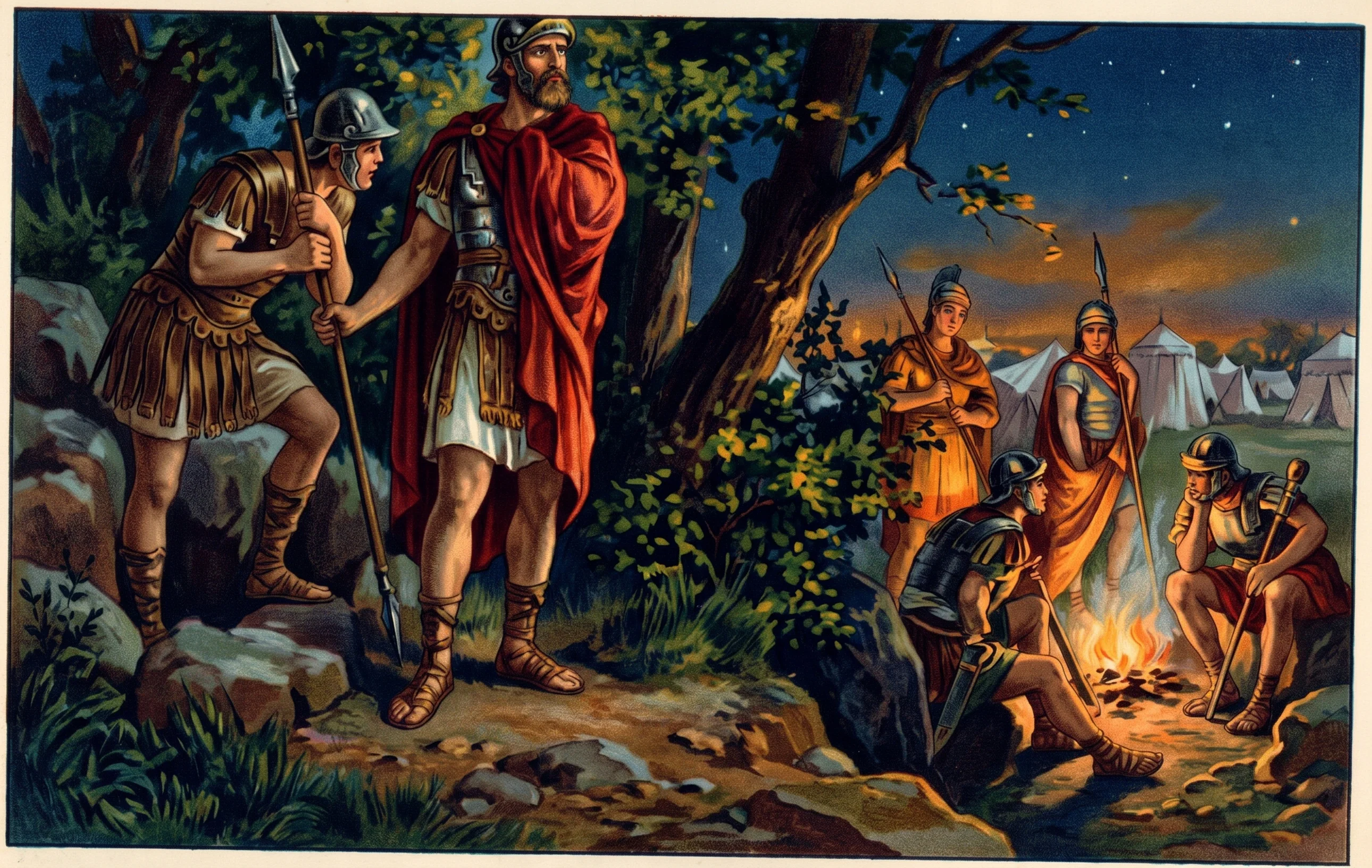 “Waiting in the darkness and silence, he heard a soldier relating a dream to his companion.”
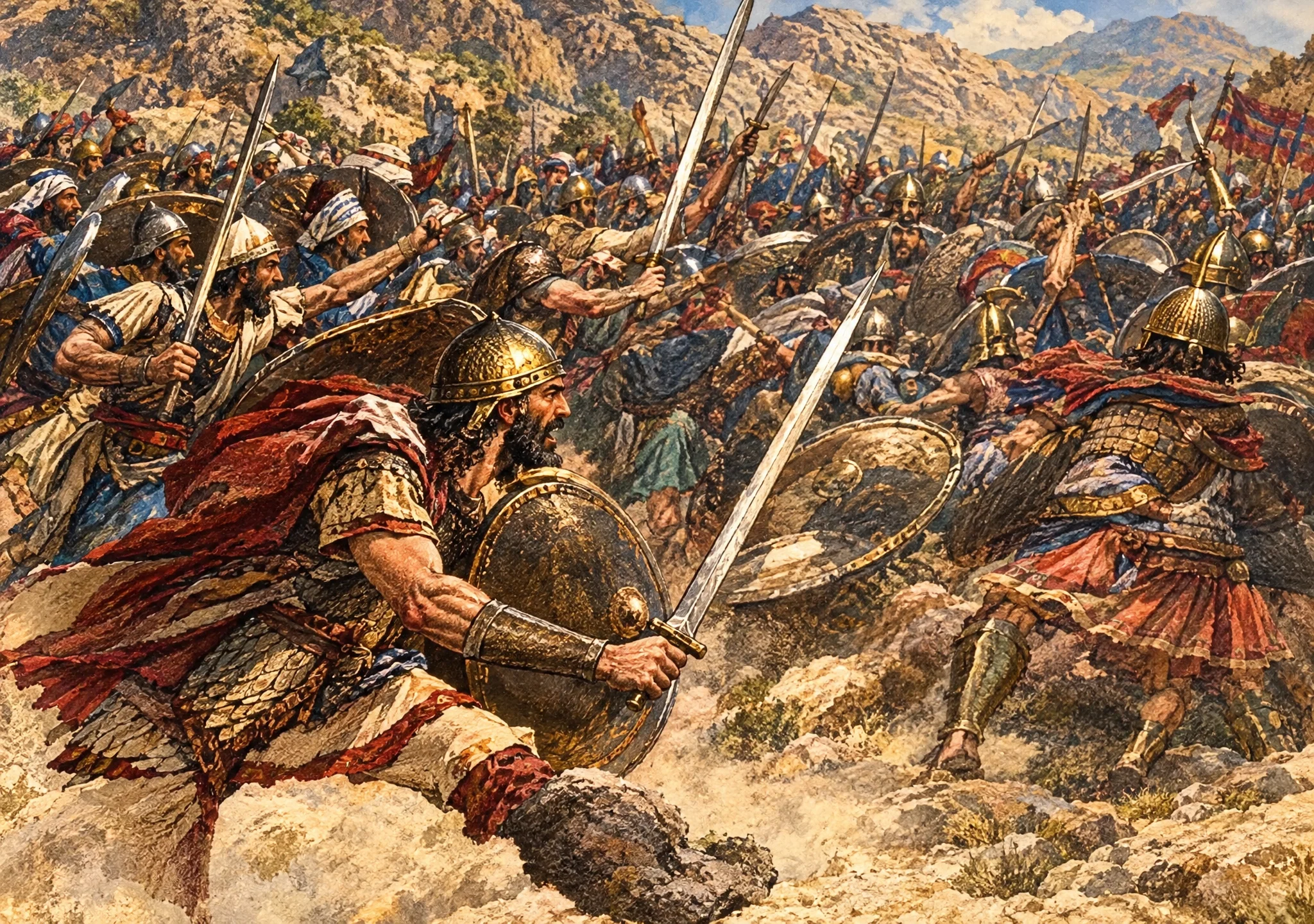 “They rushed upon the enemy with the terrible war-cry, ‘The sword of the Lord, and of Gideon.’”
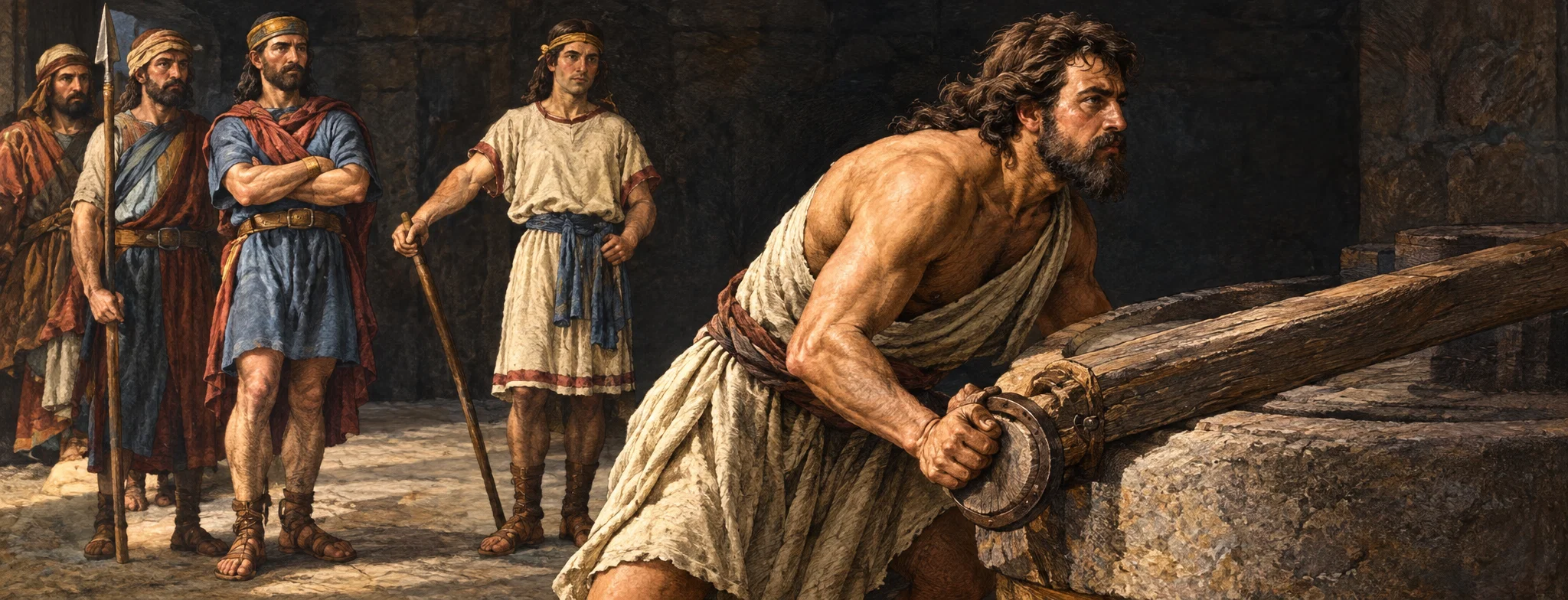 A dramatic biblical scene shows a muscular, bare-chested man in the foreground bending over a large horizontal object, gripping a rounded handle or end piece with both hands. His body leans toward the right, where a long, heavy beam-like form extends across the image. Several onlookers stand in the background at left, including a central figure with folded arms and another holding a staff; a partially visible figure appears at the far edge. The dim, crowded setting and the man’s strained posture suggest a moment of physical labor or action, with the observers watching.
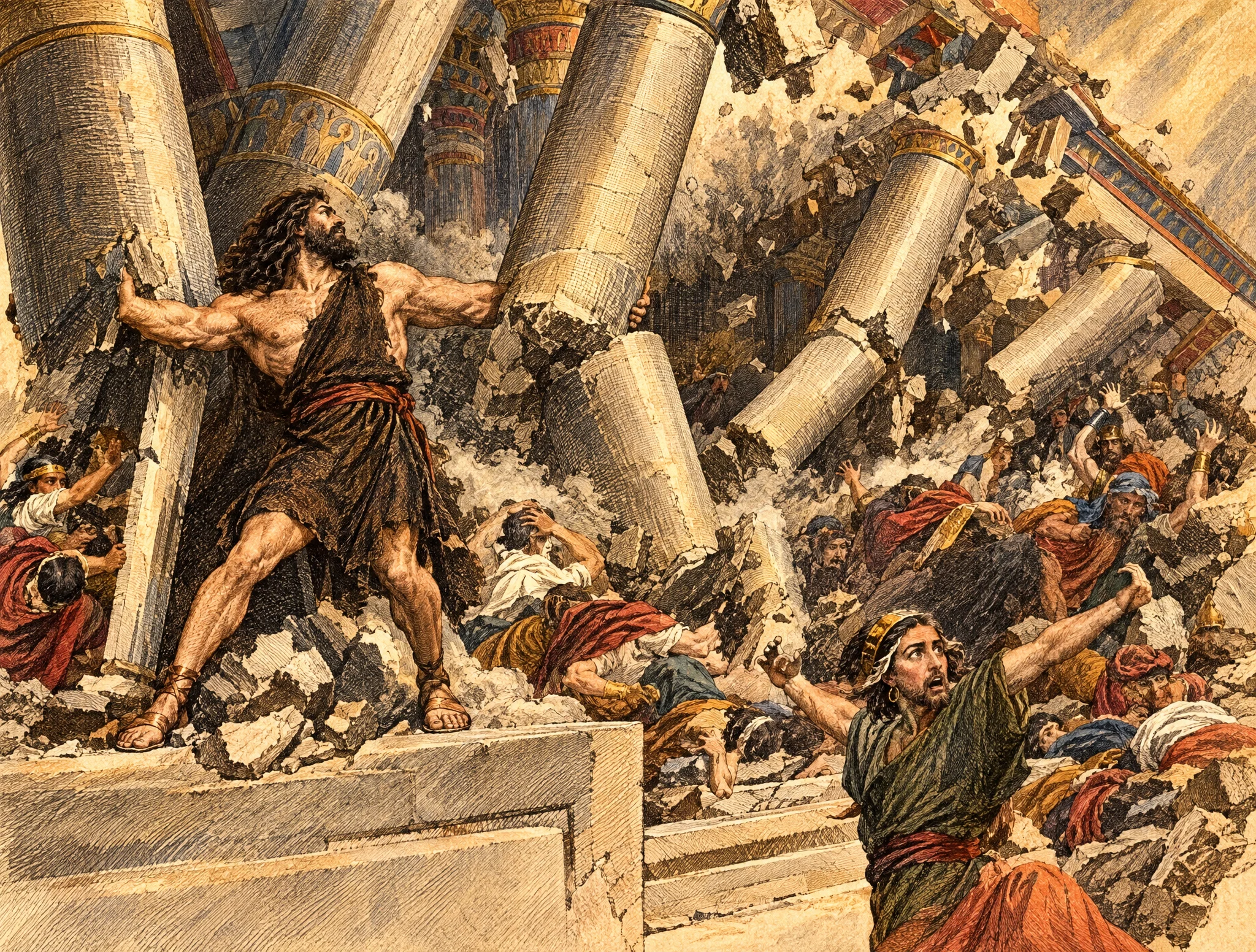 “Let me die with the Philistines.”
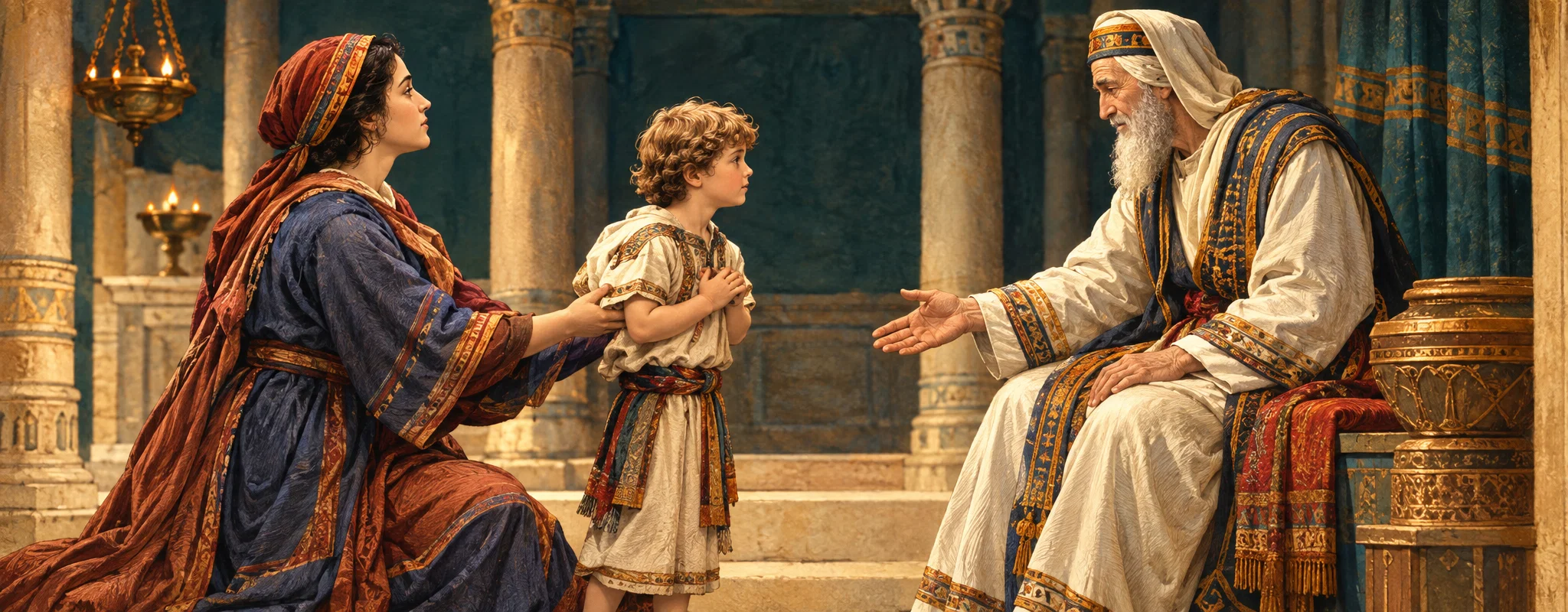 A dark, interior scene shows a seated woman at left holding a small child, while another woman sits opposite at right and gestures toward them with an outstretched hand. The first woman looks upward, her face tilted toward the ceiling, and the child leans close against her. The women wear long, draped garments and sit facing one another across the narrow space. Tall architectural columns and a shadowed wall fill the background, with a small framed or recessed image visible at the far left. The composition centers on the exchange between the two women and the child.
 A decorative line drawing of three small potted trees arranged in a row. Each tree has a slender, branching trunk and a broad canopy densely covered with small leaves and blossoms. The canopies overlap into a continuous, low band of foliage across the upper part of the image. Below, the trunks curve into rounded, patterned pots, with long, ribbon-like horizontal forms extending between and around the pots. No people, animals, or lettering are visible.
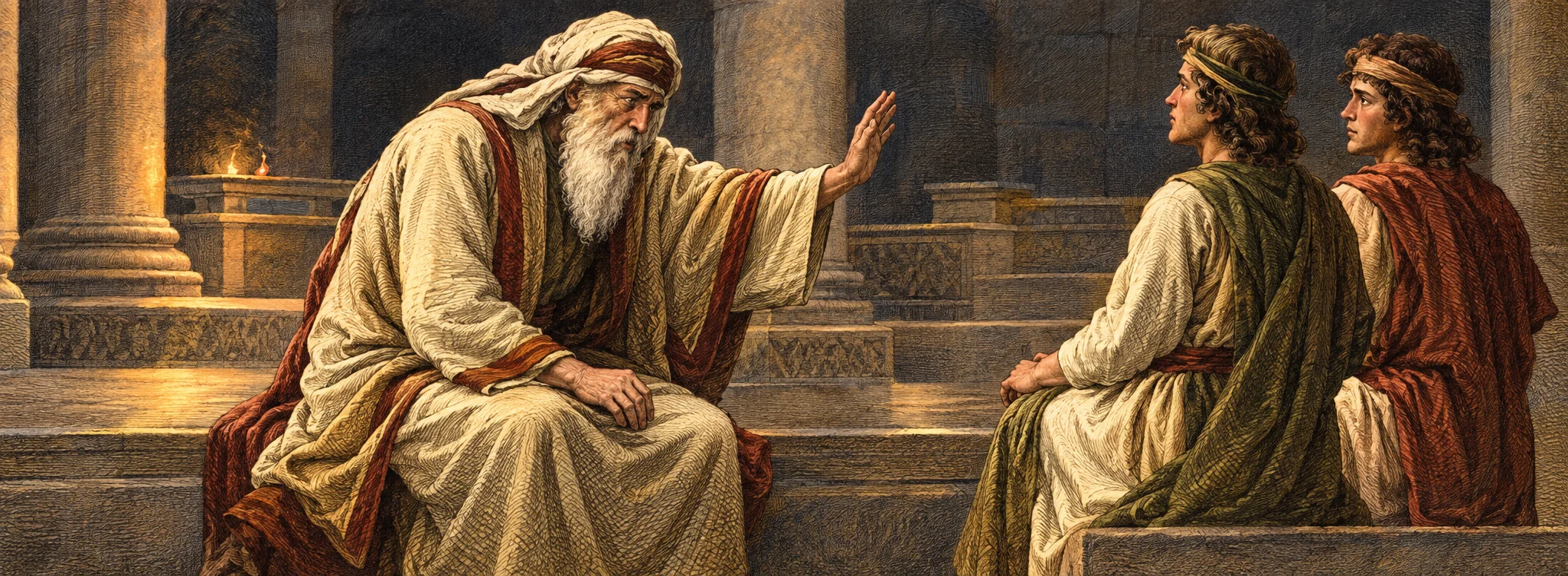 An older, bearded man in a long robe and head covering sits at the left, leaning forward and extending one arm toward two younger men standing at the right. The younger men face him in dark, flowing garments; one turns his head toward the seated figure while the other stands just behind him. They are gathered in a dim interior with broad stone steps or low platforms in the background and a large column near the center. The close grouping and the older man’s outstretched gesture suggest a tense exchange.
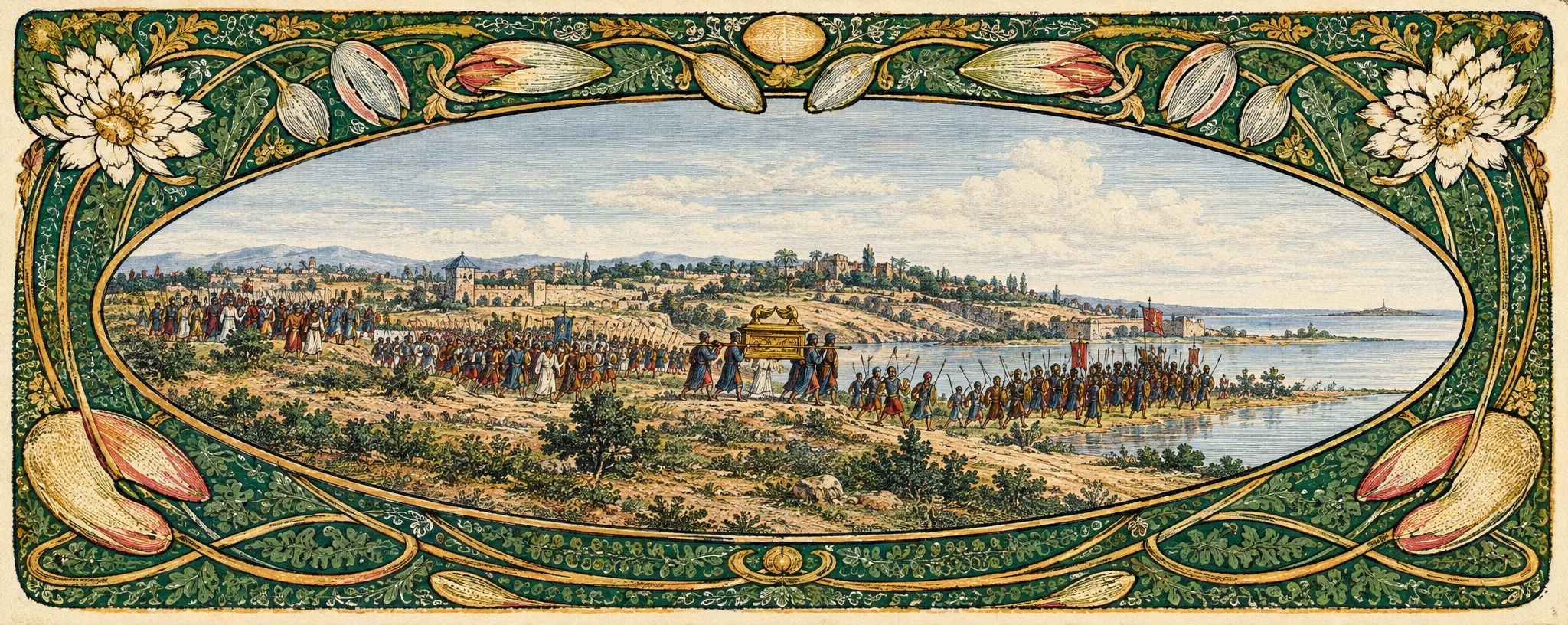 A long, hazy landscape is shown inside a large horizontal oval, with a low skyline of clustered buildings or structures stretching across the distance. Dark, uneven ground fills the foreground, and a broad, lighter strip or path angles toward the right side of the scene. The indistinct central forms suggest a settlement viewed from afar; no individual people, animals, or readable lettering are clearly visible. The oval is surrounded by an elaborate symmetrical border of curling vines, leaves, and large flowers, with a small decorative motif centered along the top and bottom.
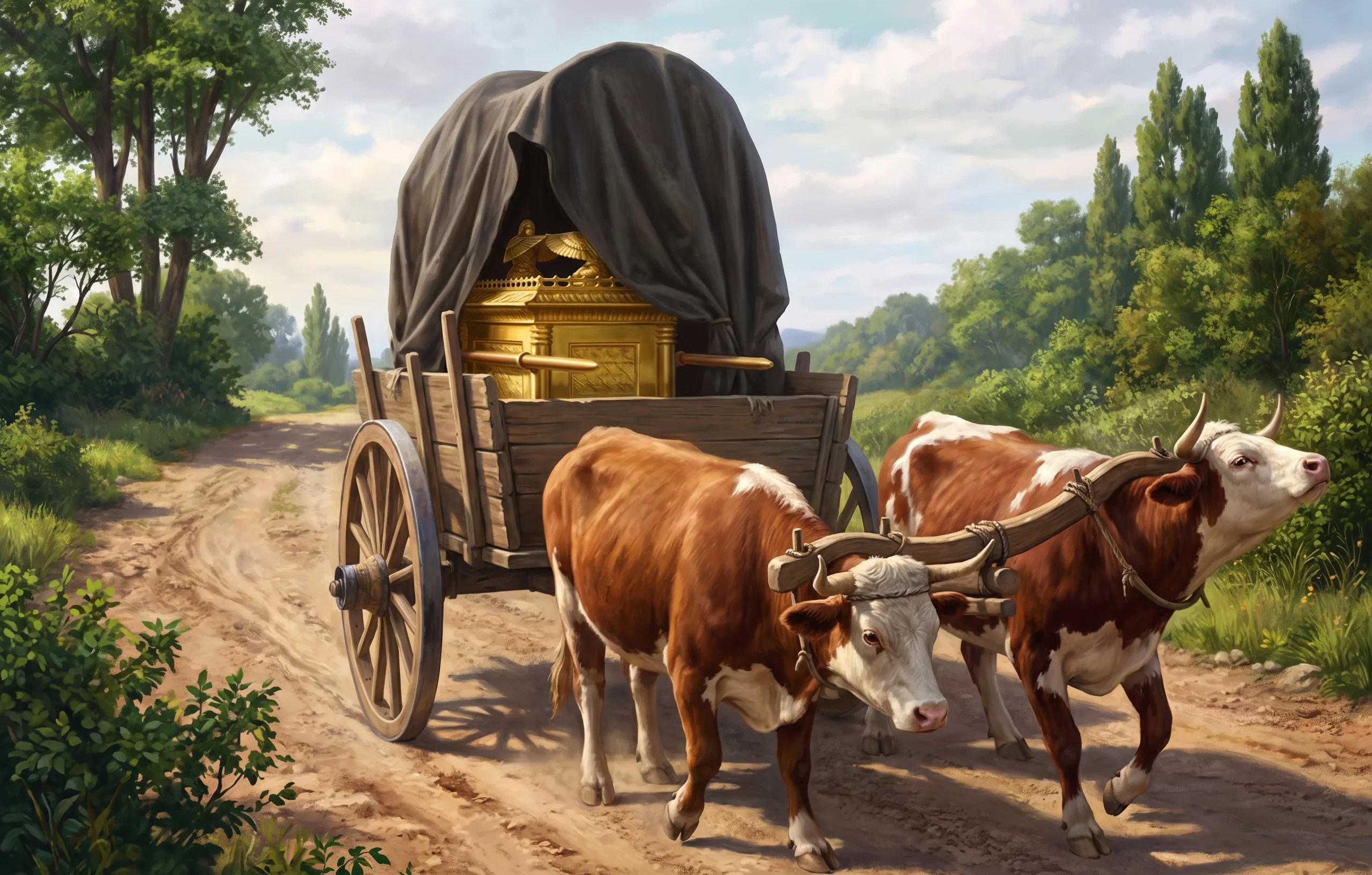 "Guided by no human hand, the patient animals kept on their way."
 A large open book fills the lower part of the image, its pale pages spread wide above a dark, narrow base. Behind it, a winged human figure rises centrally, leaning forward with both arms extended over the pages as if presenting or guarding the book. The figure has a small, indistinct face and broad, dark feathered wings that sweep outward and downward on both sides, framing the open volume. The background is plain, with no visible setting or lettering.
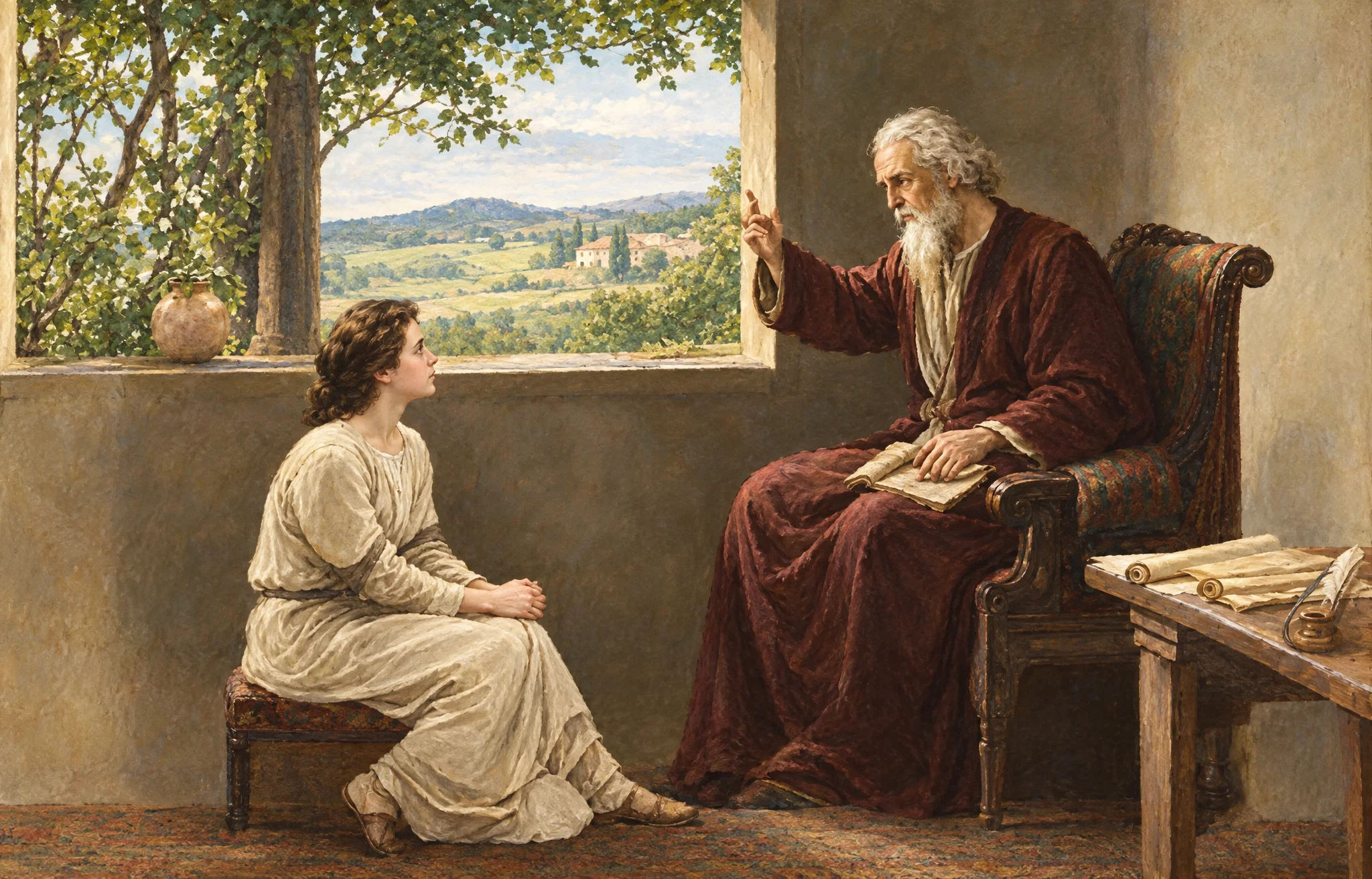 “The fear of the Lord is the beginning of wisdom”: and the knowledge of the Holy is understanding.
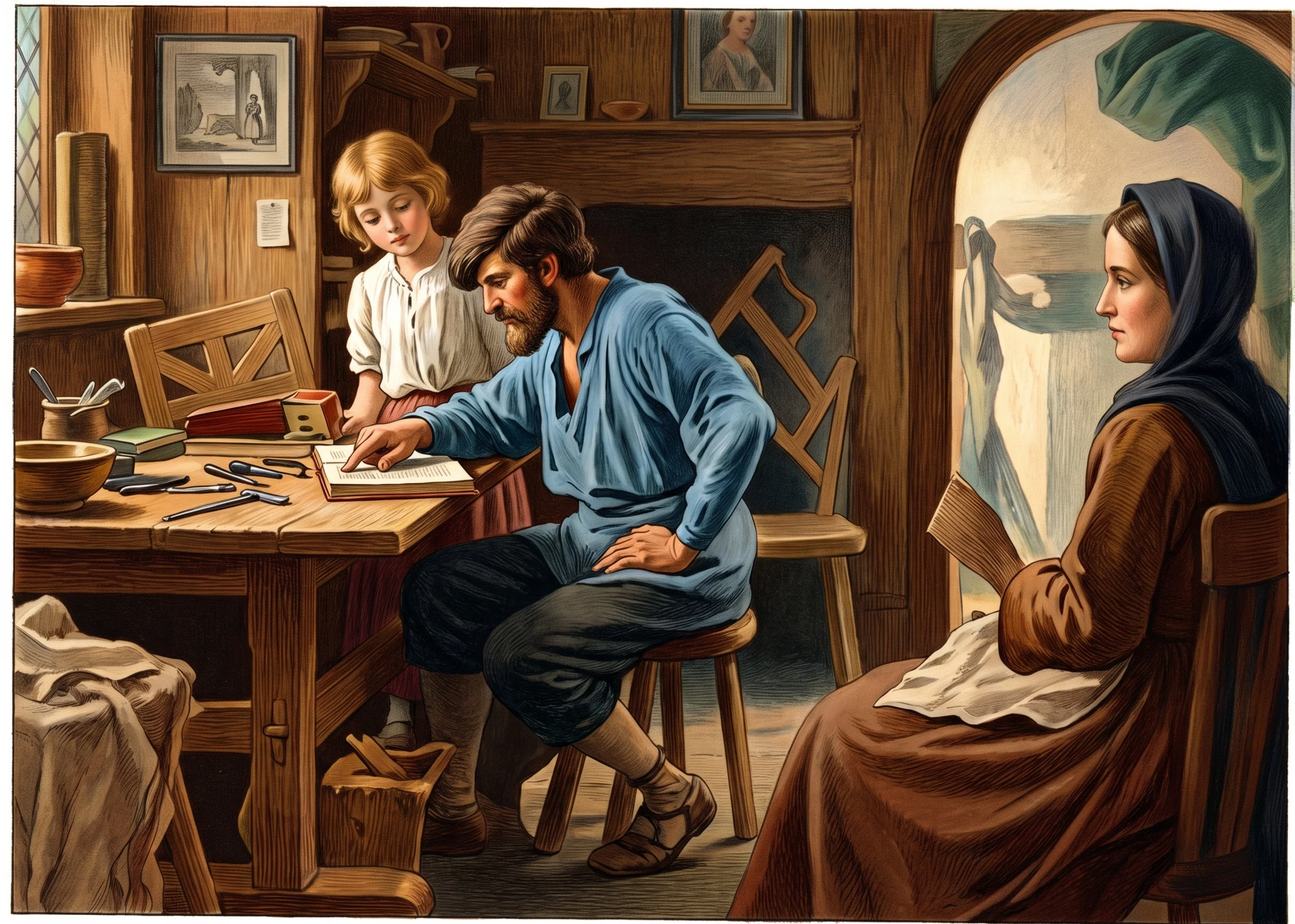 “Every youth should be instructed in the duties of practical life.”
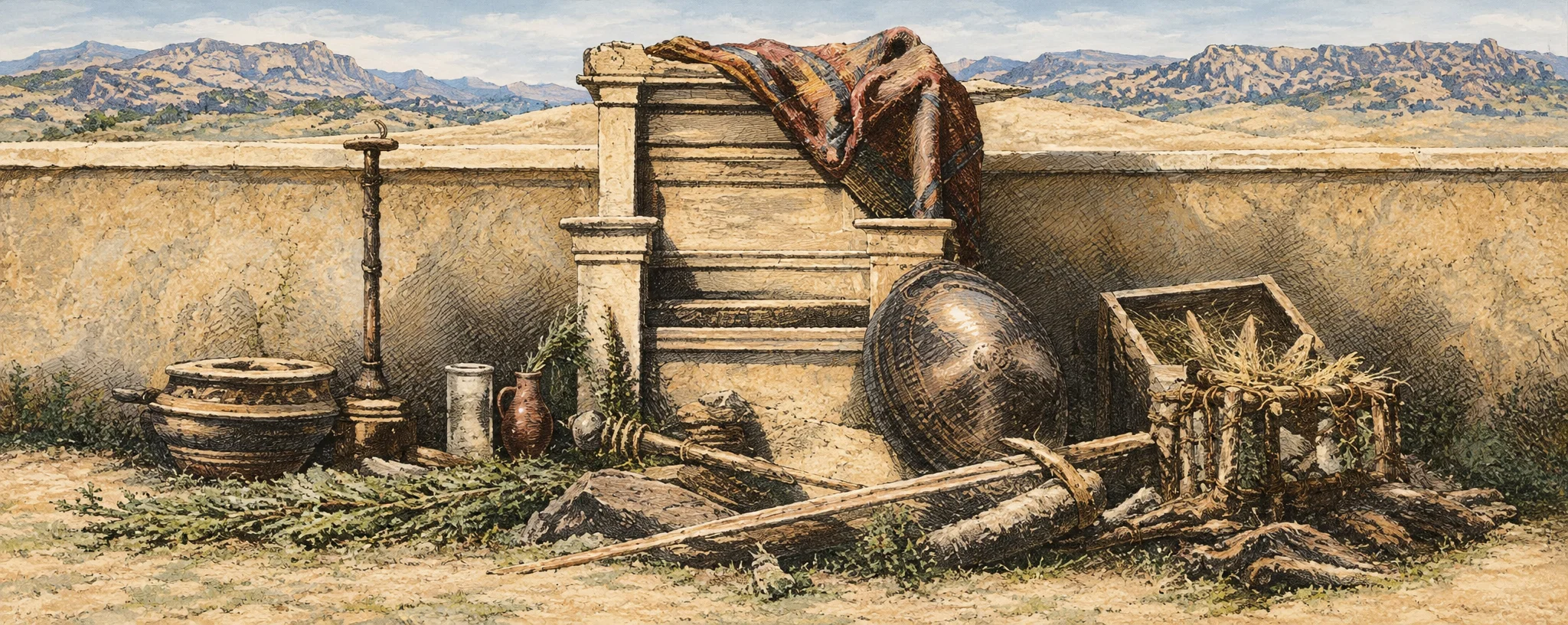 A monochrome engraved scene shows a cluttered outdoor area backed by a low wall and distant, uneven hills. A tall stack of wooden chests or slatted baggage fills the center, with a draped figure leaning over its top and another person partly visible beside it. Bundles, containers, and loose belongings are scattered around the pile; shallow vessels sit at the left, while a box-like object and more bundles occupy the right. Long sticks or tools lie diagonally across the rough foreground, giving the scene the appearance of a group searching among stored baggage.
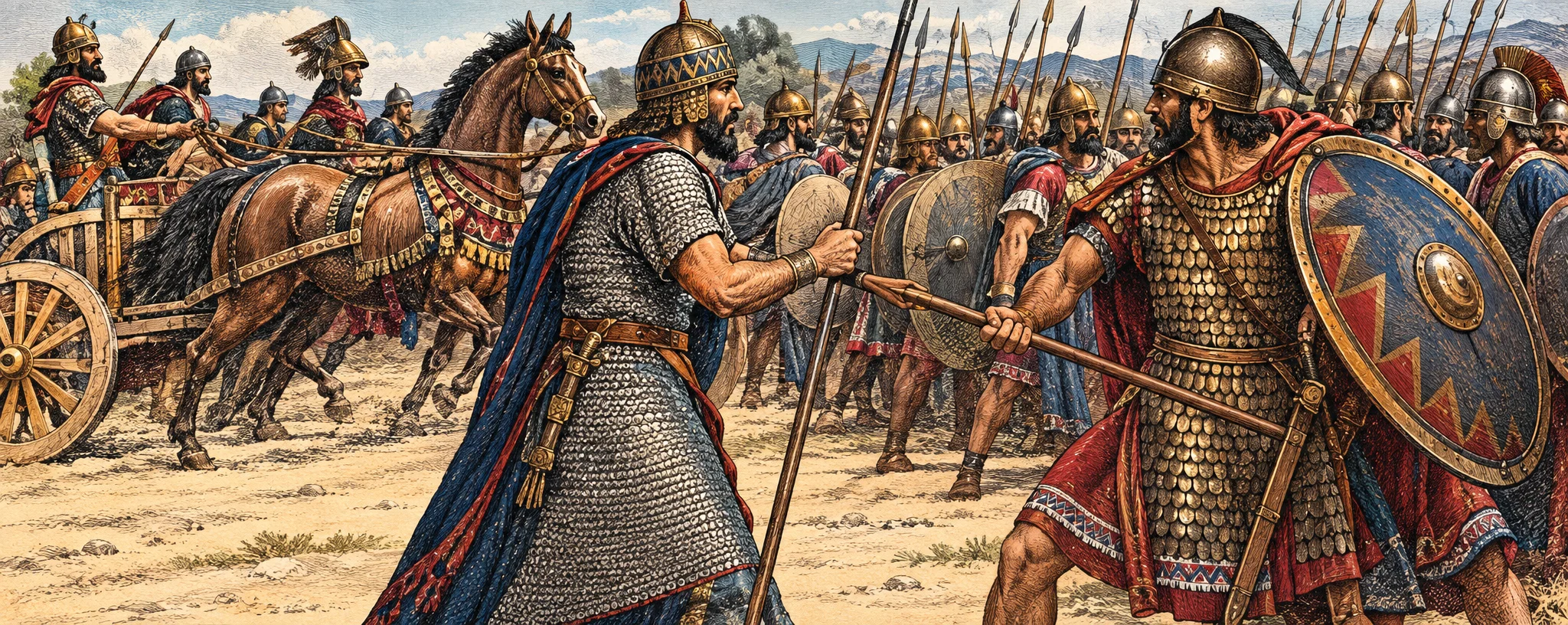 A monochrome scene of armed ancient warriors gathered in a crowded battlefield or encampment. In the foreground, two helmeted men in long garments and cloaks face one another: one raises an arm while the other grips a long spear or staff. A large round shield with a central boss fills the right edge, with another shield visible at the left. Behind them are overlapping figures, helmets, spears, and other weapons, while a horse and a partly visible chariot or cart appear in the background. The crowded composition emphasizes the contrast between the foreground warriors and the mass of troops and equipment behind them; no legible lettering appears within the image.
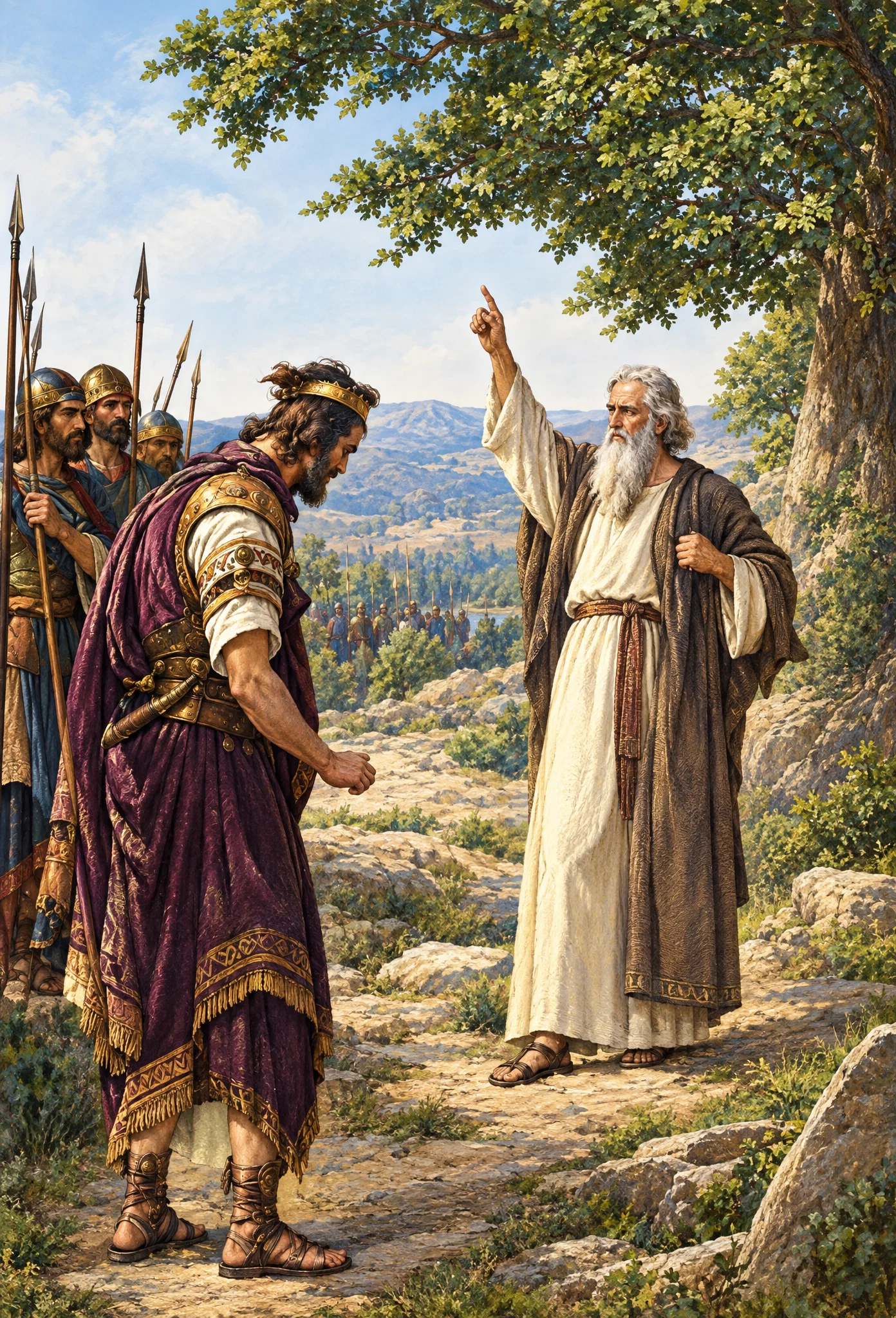 SAMUEL REPROVING SAUL
“Samuel’s countenance was full of anxiety and trouble. . . . Saul offered excuses for his presumptuous act.”
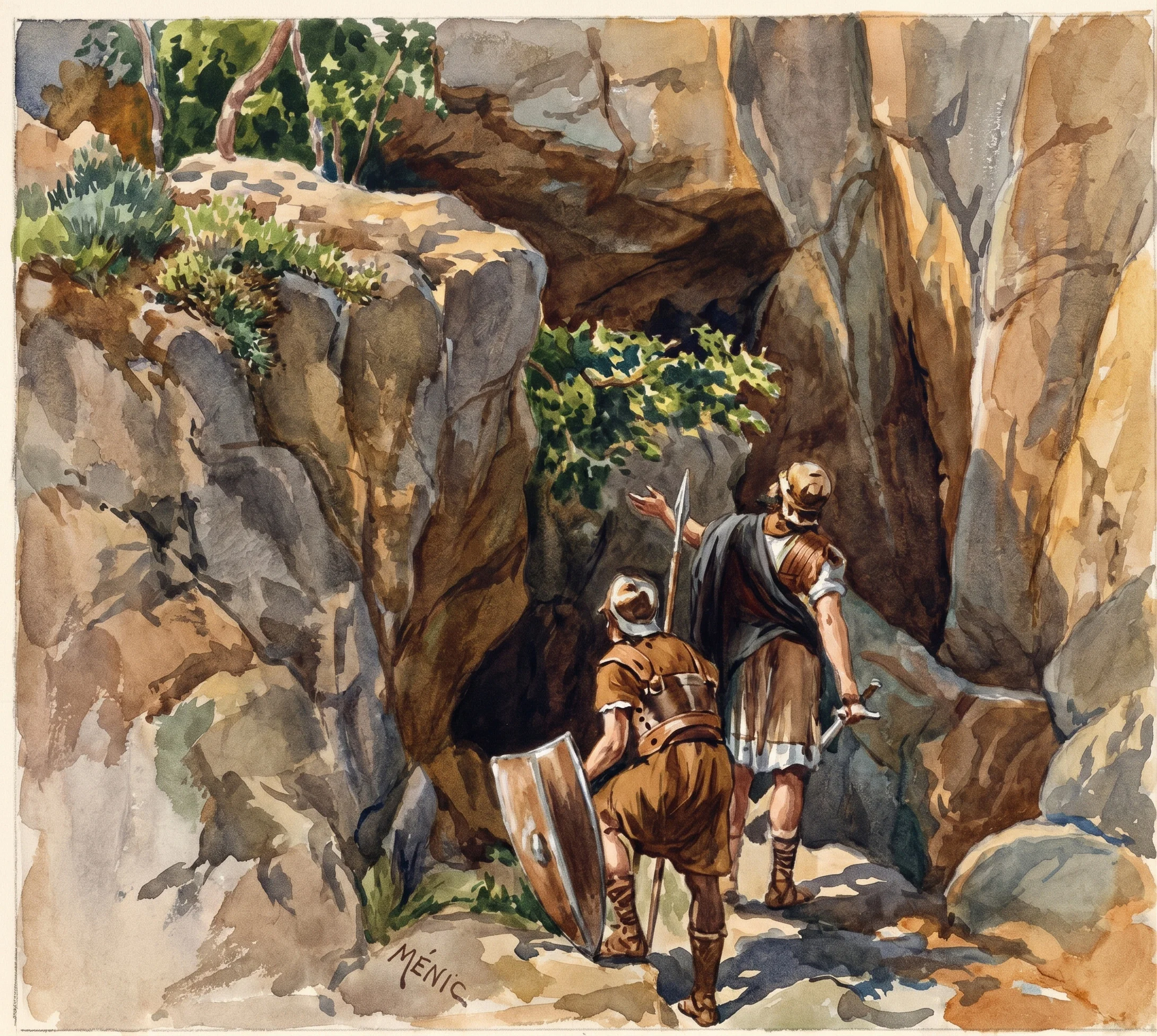 “Come up to us, and we will show you a thing.”
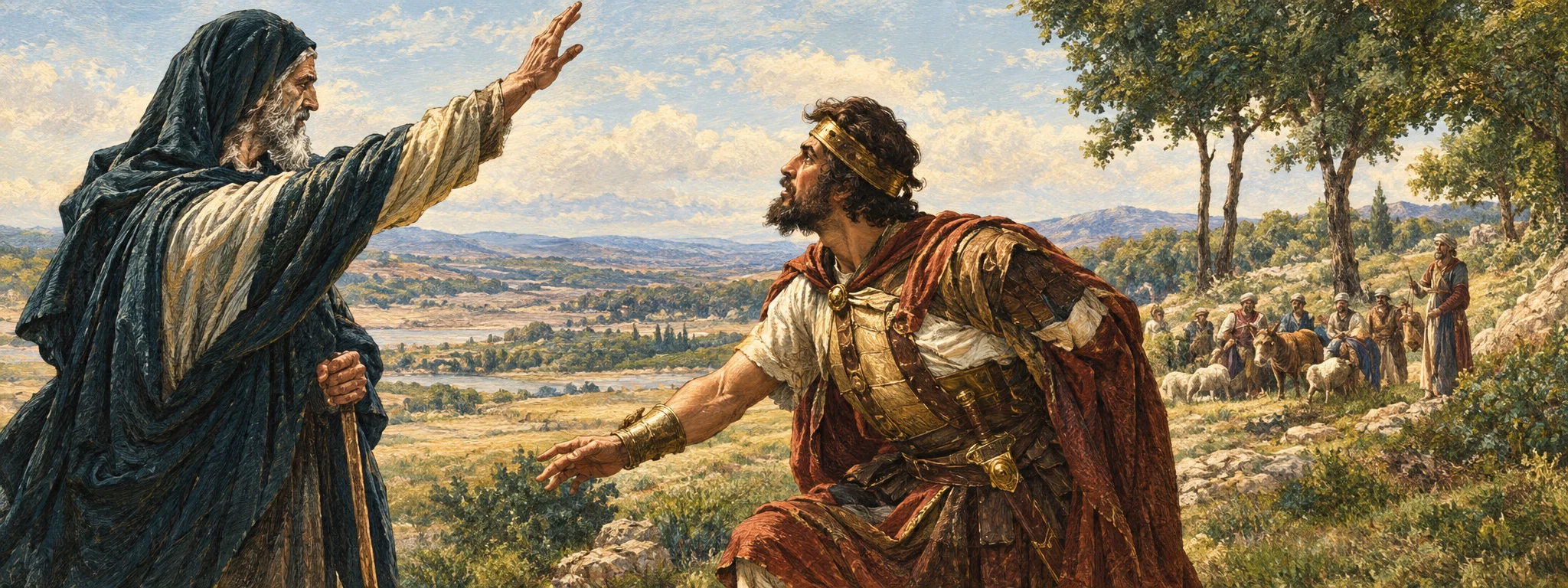 A long-haired, bearded man at the left raises one arm toward a second man kneeling or bending low in the foreground, whose head is bowed and one arm reaches toward the ground. The standing figure wears a flowing robe and appears to confront or address him. Behind them, several small figures and animals are visible across an open landscape, with low hills or a distant ridge and a cluster of trees at the right. The scene is rendered in dark, dramatic tones, with the two foreground men dominating the composition; no lettering is visible within the image.
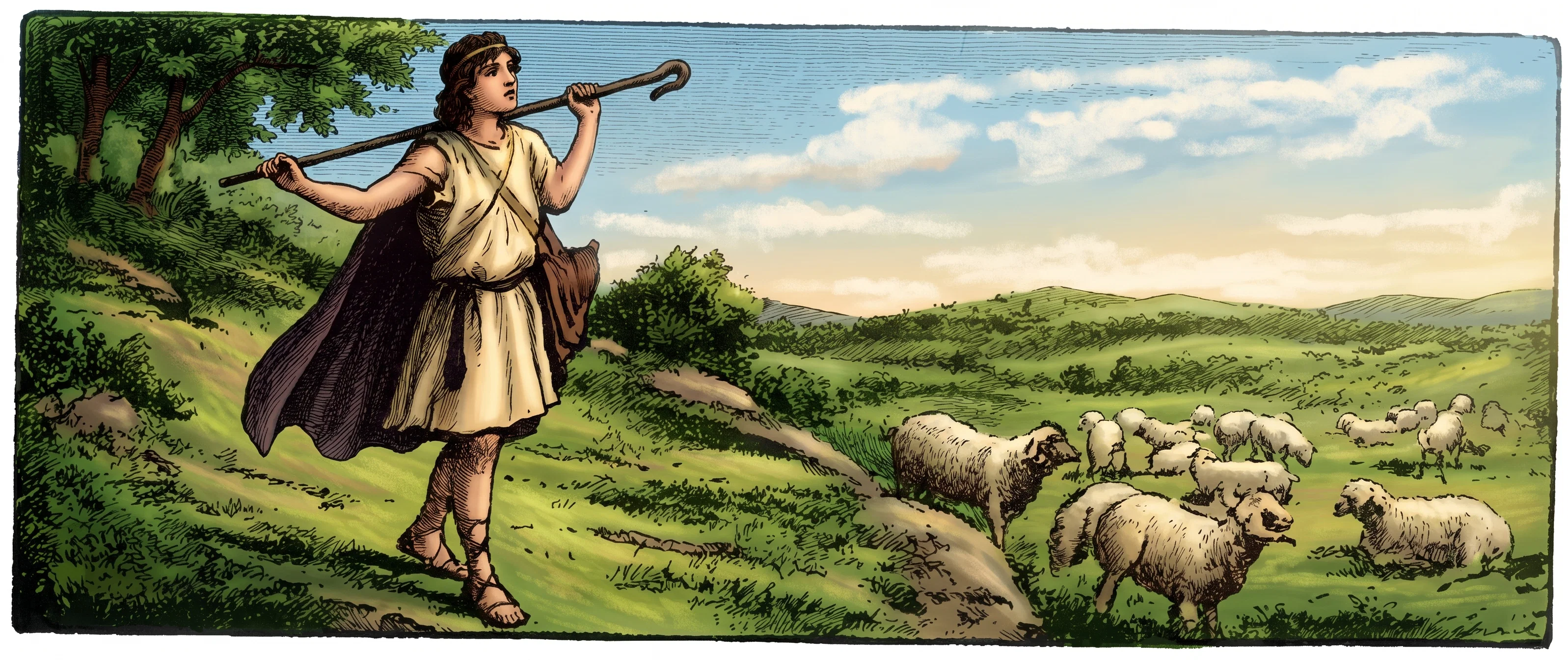 A young shepherd, identified by the surrounding account as David, stands on a sloping hillside at the left, turned toward his flock. He wears a simple knee-length tunic and cloak, with a staff held across or behind his shoulders; one arm reaches outward toward the sheep. Several sheep cluster and graze across the lower right, with more faintly visible farther back. The open pastoral landscape stretches toward low hills and scattered shrubs beneath a broad, cloudy sky. No lettering is visible within the scene.
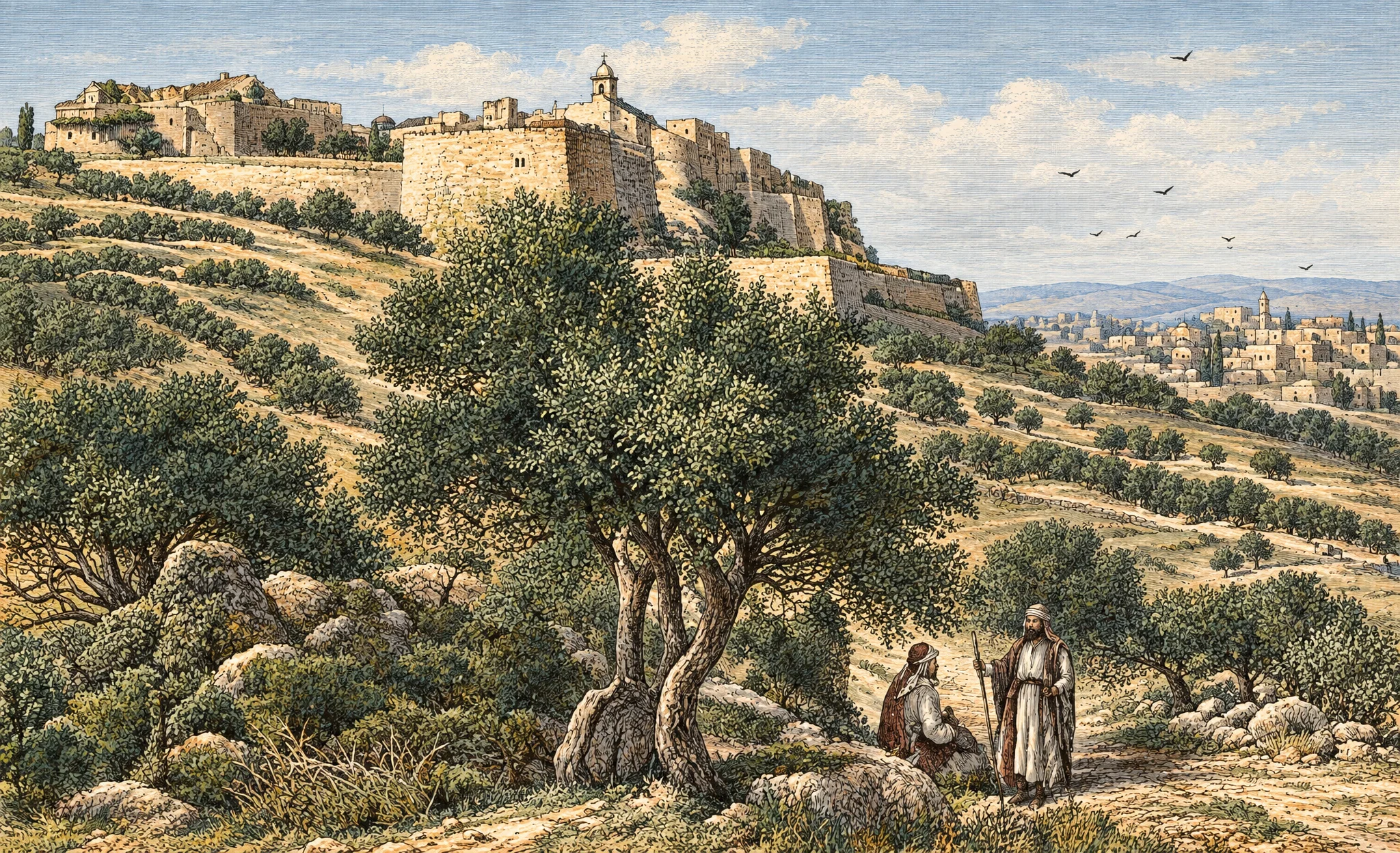 BETHLEHEM FROM THE EAST
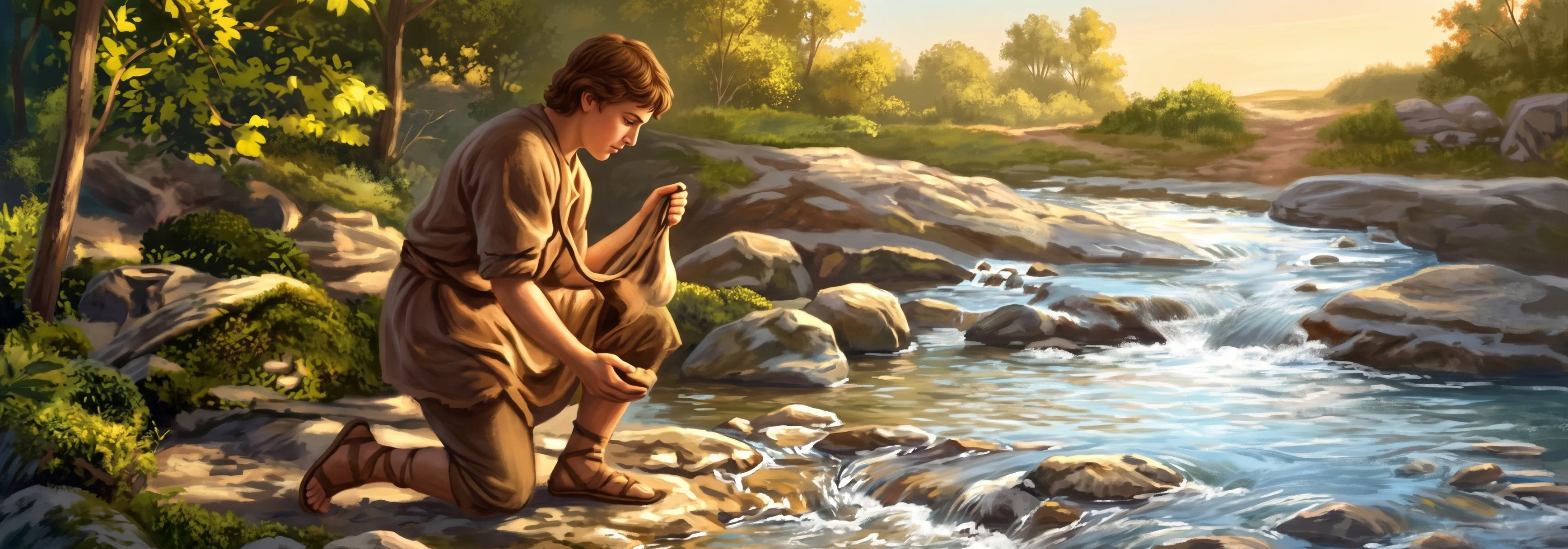 A lone young shepherd sits on the ground beside a tree at the edge of an open, rolling landscape. He holds a small stringed instrument, apparently a harp, close to his body, with his hands poised over it as if playing. His clothing is simple, and his head is inclined toward the instrument. The figure occupies the left side of the wide composition, while broad bands of hills and open ground extend across the background to the right; no other people, animals, or lettering are visible.
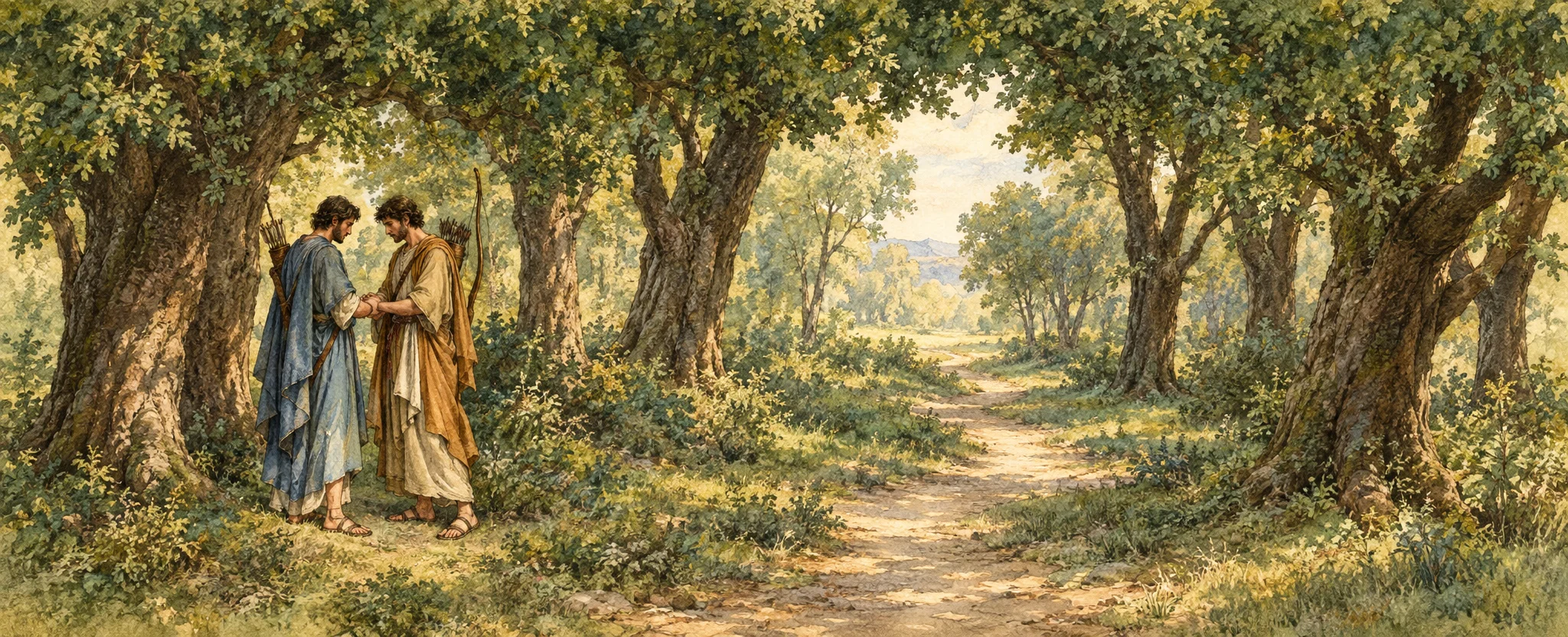 Two men stand together beneath a dense canopy of trees in a wooded clearing. The man at left wears a long, simple garment and faces his companion, who appears to be offering or showing him clothing and equipment; a long weapon or bow-like object is visible between them. Large tree trunks frame the foreground, while a winding path or stream runs from the clearing into the hazy distance at right. The figures are small within the broad landscape, and no lettering is visible.
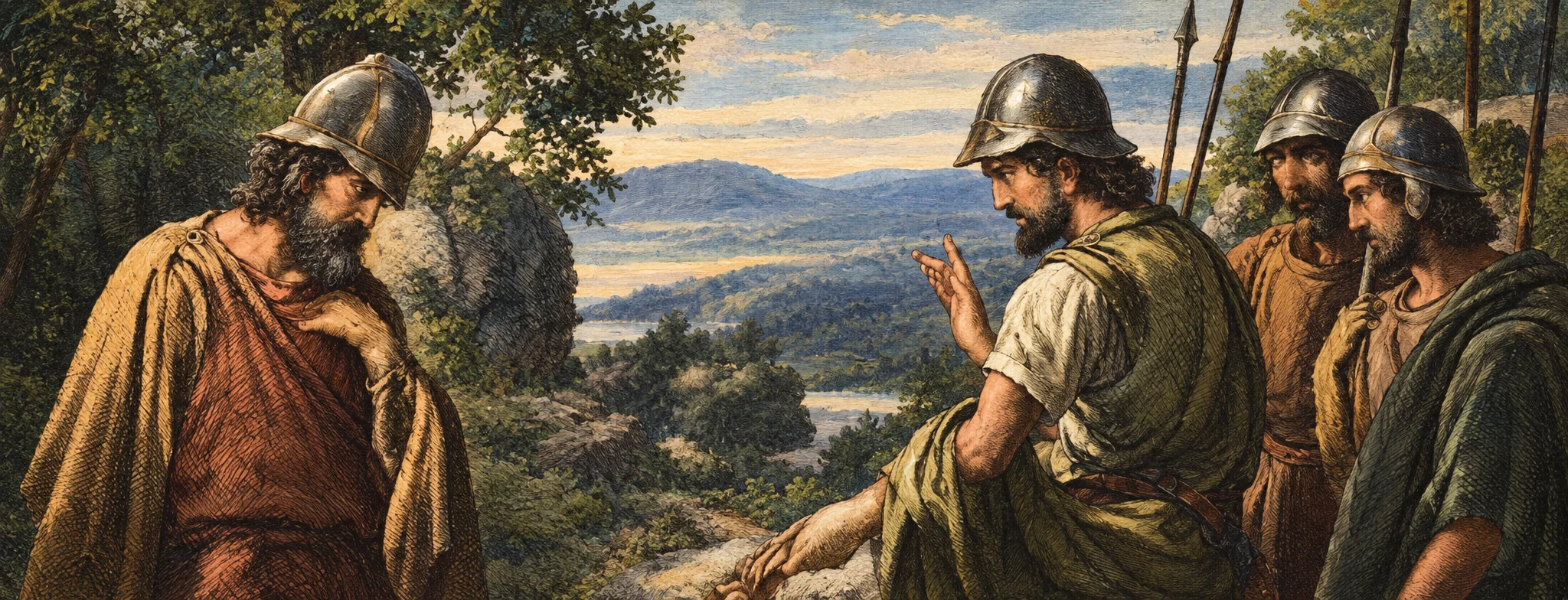 A helmeted man in a cloak sits or crouches at the left, facing a group of armed men gathered on the right. The central figure, also helmeted and wearing a tunic, leans toward him with one arm extended in a gesture of greeting or conversation. Several companions stand close behind, their helmets, shoulders, and upright spears visible against a hazy outdoor landscape. The figures fill the foreground, with a low, indistinct horizon and cloudy sky beyond them. No lettering or other text appears within the scene.
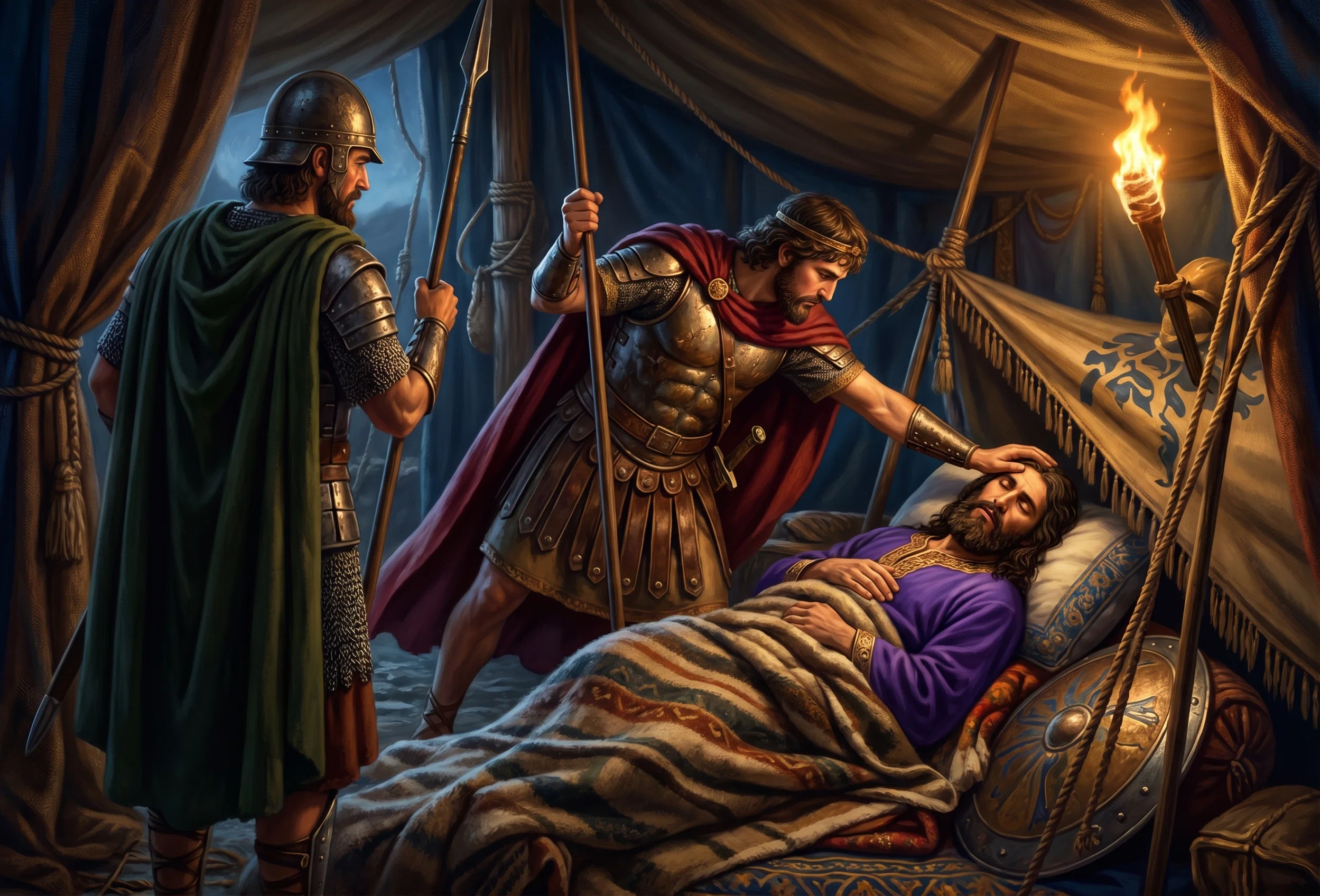 DAVID FINDS SAUL ASLEEP. “Destroy him not: for who can stretch forth his hand against the Lord’s anointed, and be guiltless?”
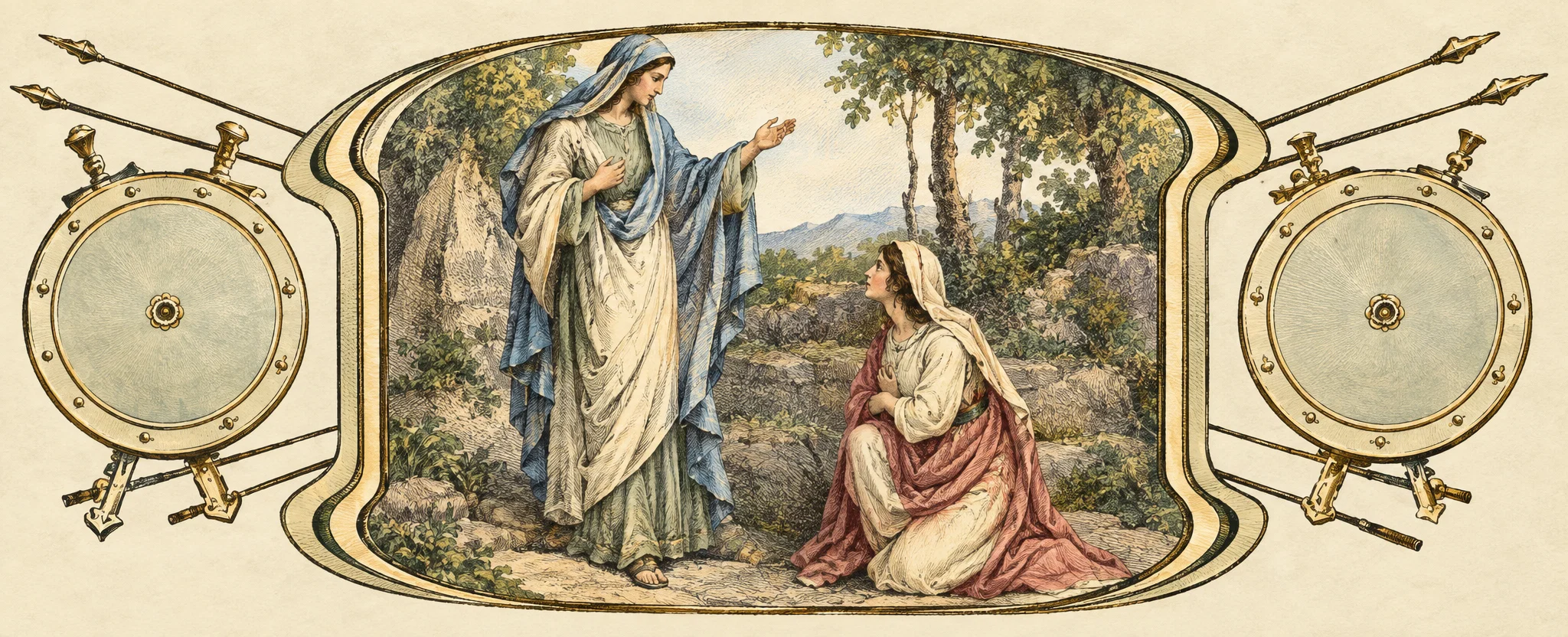 “The piety of Abigail, like the fragrance of a flower, breathed out all unconsciously in face and word and action.”
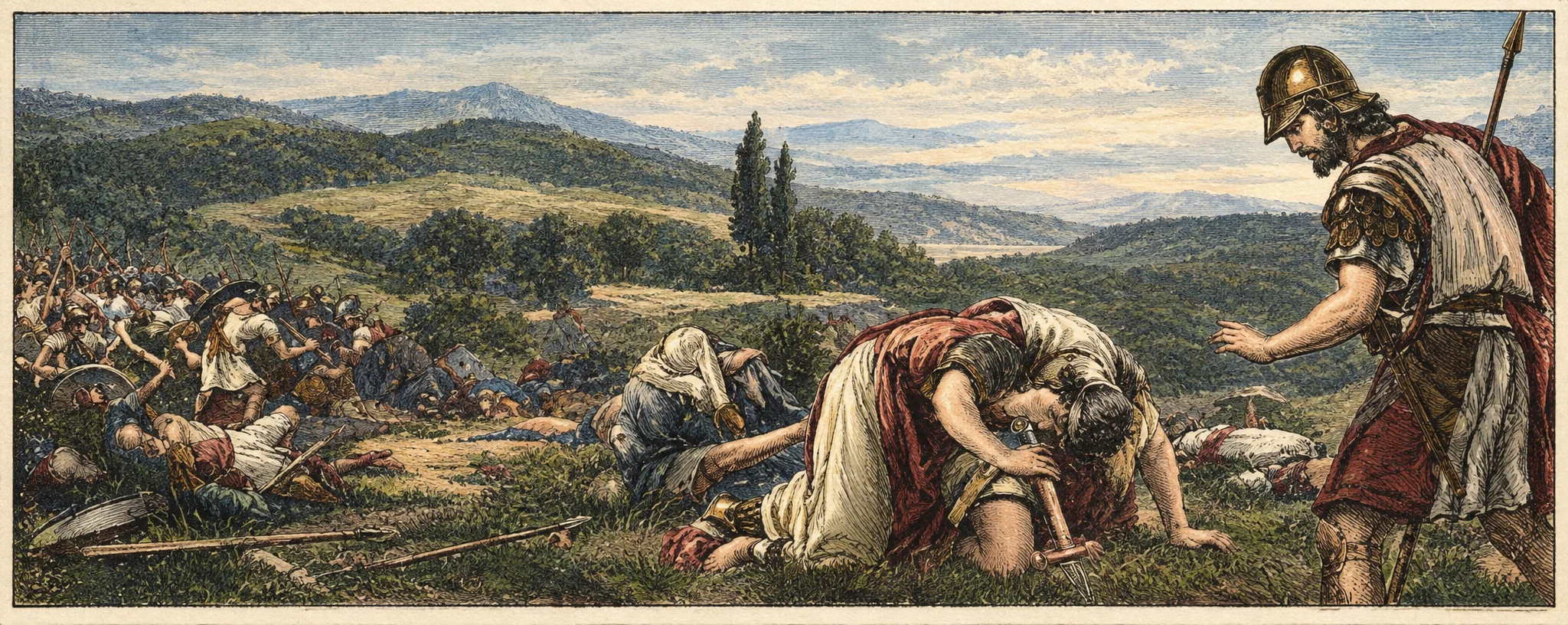 A dark, monochrome scene shows an ancient battlefield spread across a broad plain beneath distant hills and a cloudy sky. At the right, a large bearded man in a robe and head covering stands with a staff or spear behind him, extending one arm toward the fighting. In the foreground near center, a bent figure stoops over another person lying on the ground, while a further figure crouches behind them. A cluster of armed men and fallen bodies fills the left side, with scattered shields or weapons among them. The composition contrasts the prominent figures on the right with the crowded melee to the left; no lettering is visible.
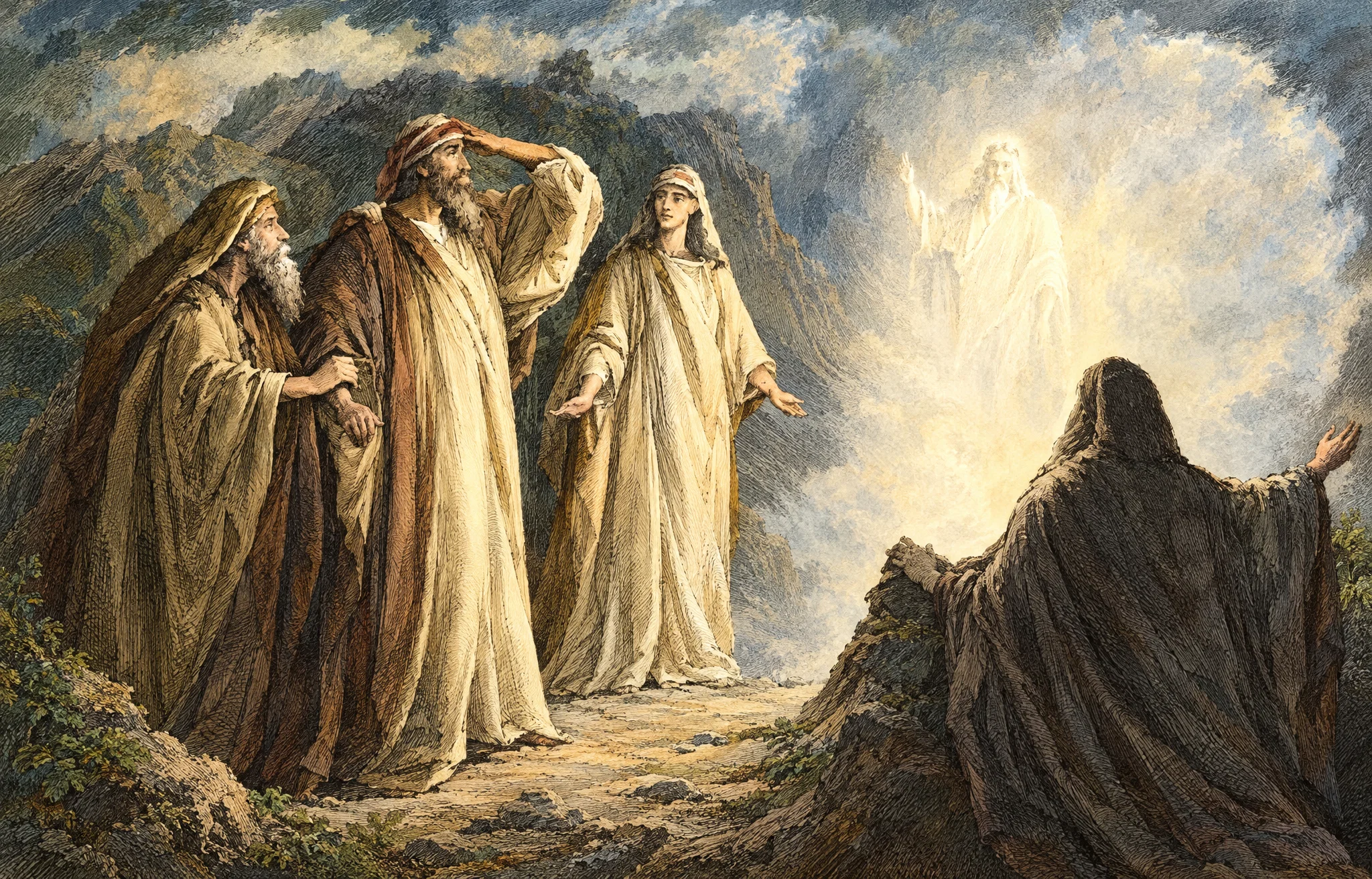 “Samuel was not present in that haunt of evil spirits. That supernatural appearance was produced solely by the power of Satan.”
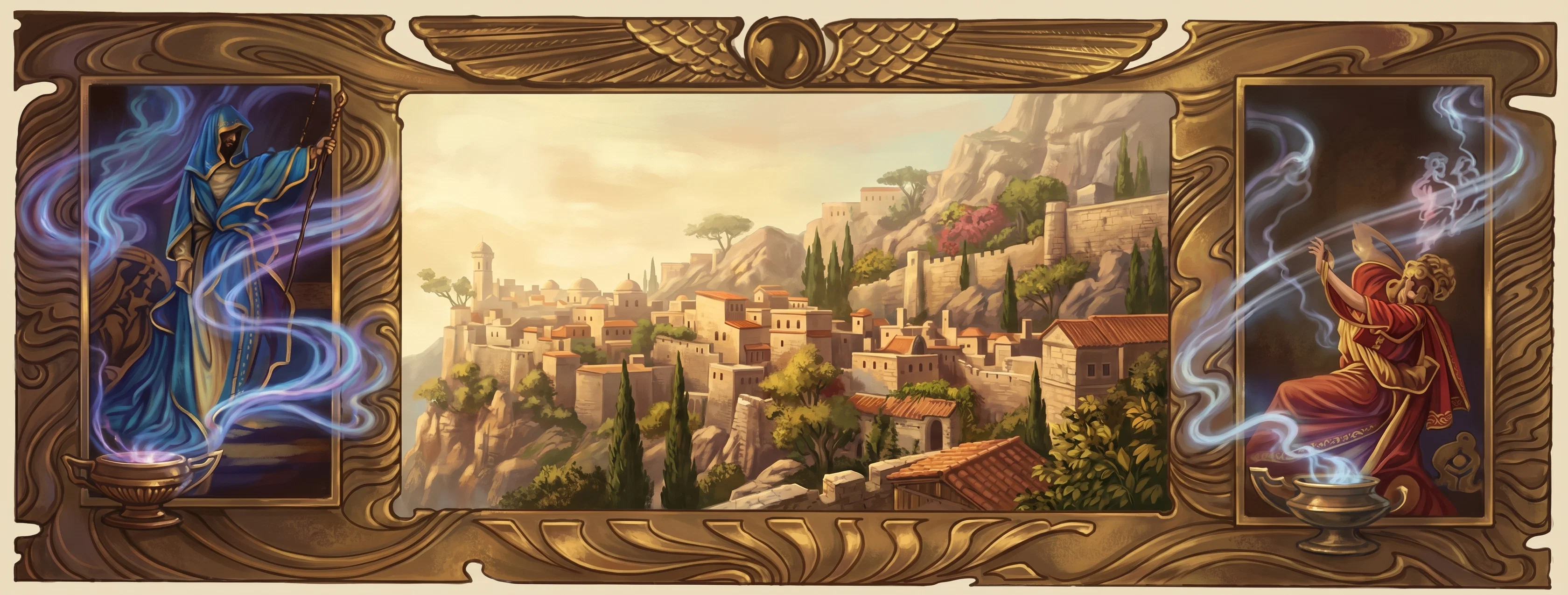 An ornate horizontal illustration shows a dim interior scene framed by decorative borders and two tall side panels. In the broad central space, a seated or standing man appears to face a woman, with several indistinct figures and furnishings around them; the scene suggests Saul consulting the woman of Endor. The left panel contains a robed figure amid sweeping, flame-like lines above a low vessel, while the right panel shows a draped woman seated beside a vessel, with curling lines around her. A small oval ornament sits at the top center, and no legible lettering is visible.
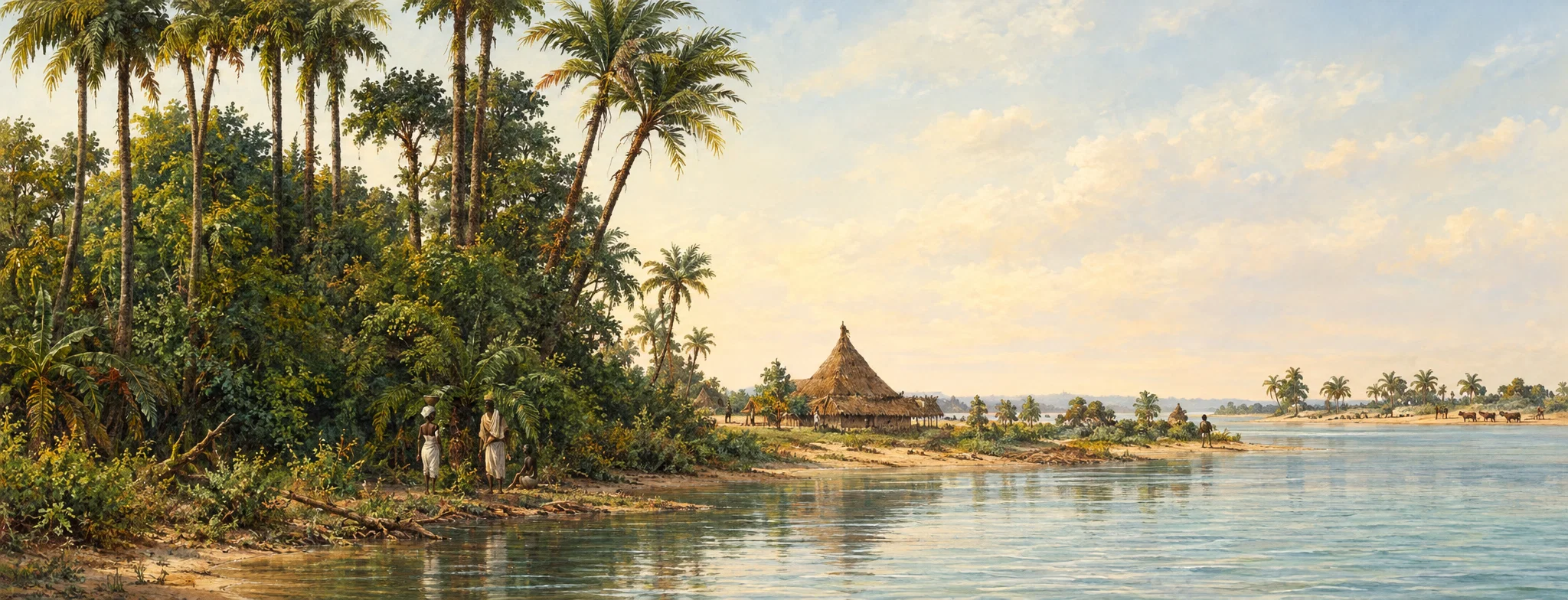 A broad, quiet landscape stretches from a densely wooded bank on the left to open, flat ground on the right. Tall palms and other trees rise above thick foliage, with two small human figures visible near the shaded edge of the bank. Across the middle distance are low, thatched-looking structures, including one with a prominent pointed roof, and scattered tiny silhouettes that appear to be people or animals. A pale expanse of water or wet ground fills the foreground beneath a wide, lightly clouded sky. No lettering is visible.
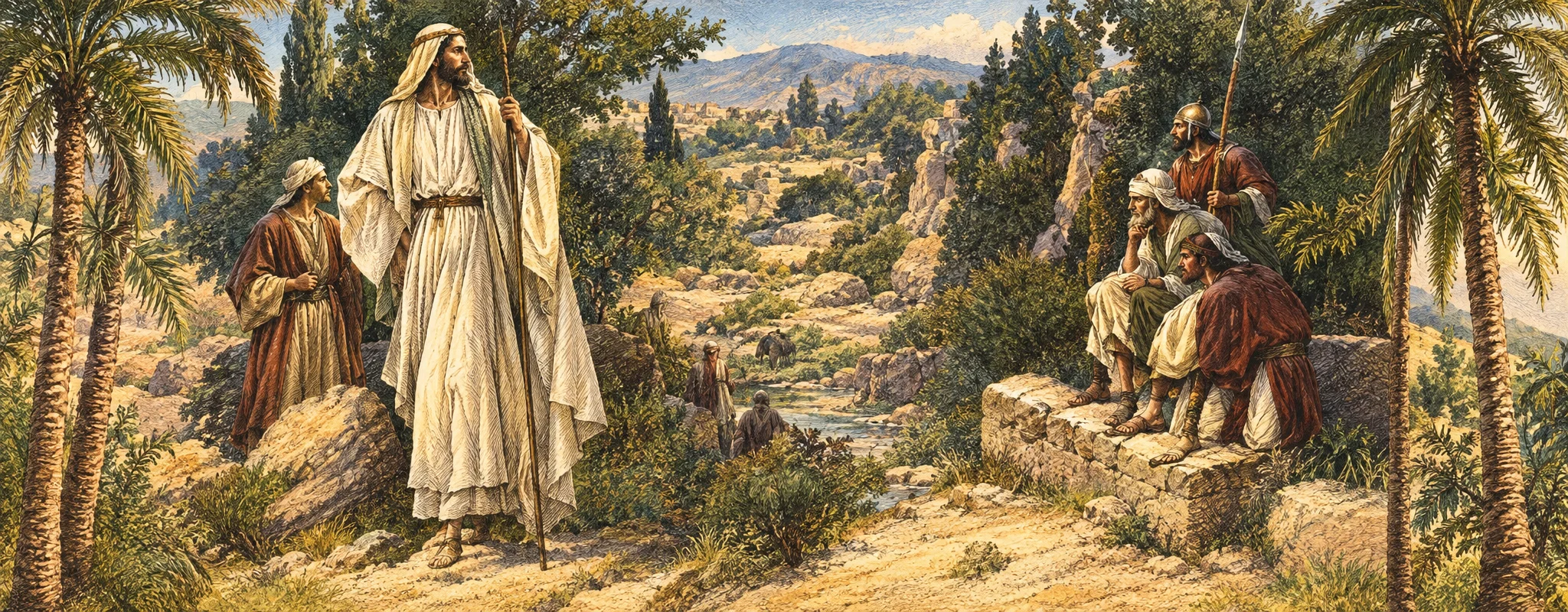 A dramatic nighttime scene shows David and his men at Ziklag, surrounded by a rugged landscape and palm trees. At left, a tall, robed figure stands with one arm extended, facing a seated or crouching group near a low stone structure at right. A small animal, possibly a sheep, is visible on the ground between them. Dark hills and shadowy forms fill the background, while the figures are arranged across an open, uneven foreground.
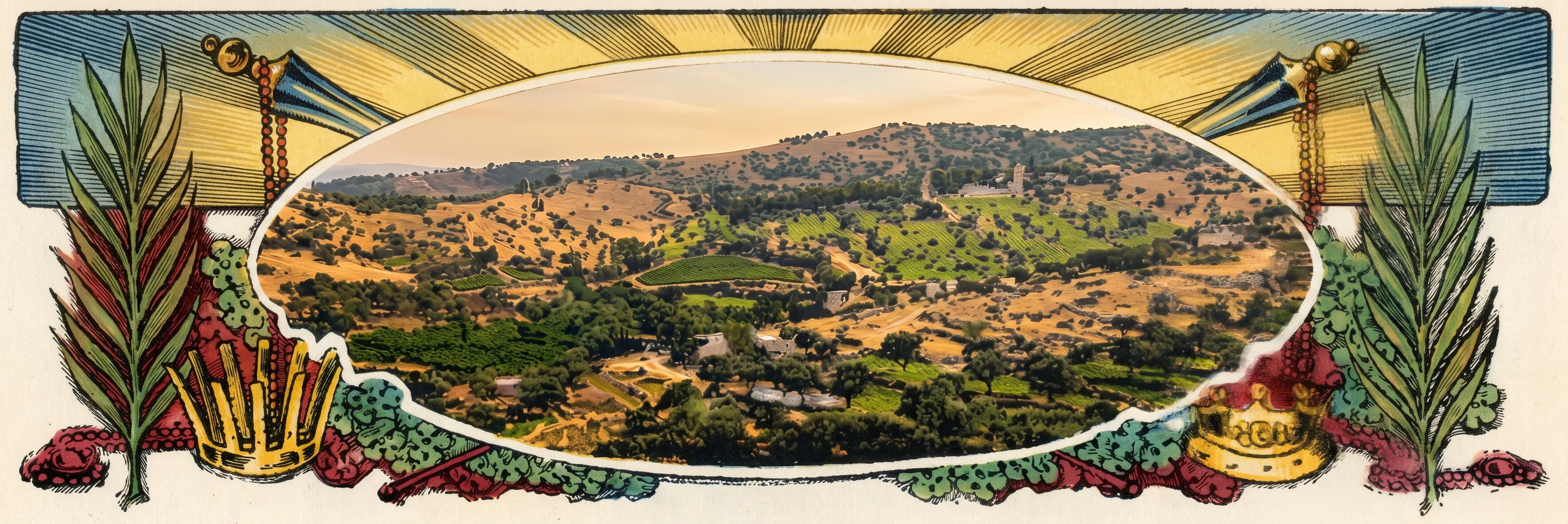 An ornate horizontal vignette frames a broad landscape of rolling, rugged hills and valleys, rendered with dense stippling and dark patches of vegetation or cultivated ground. The view sits inside a large elongated oval border, with patterned ornamental work beneath and curling decorative details at either end. Tall, feathery palm-like plants rise on both sides, and small finial-topped structures and striped drapery-like forms decorate the upper corners. No people, animals, or legible lettering are visible.
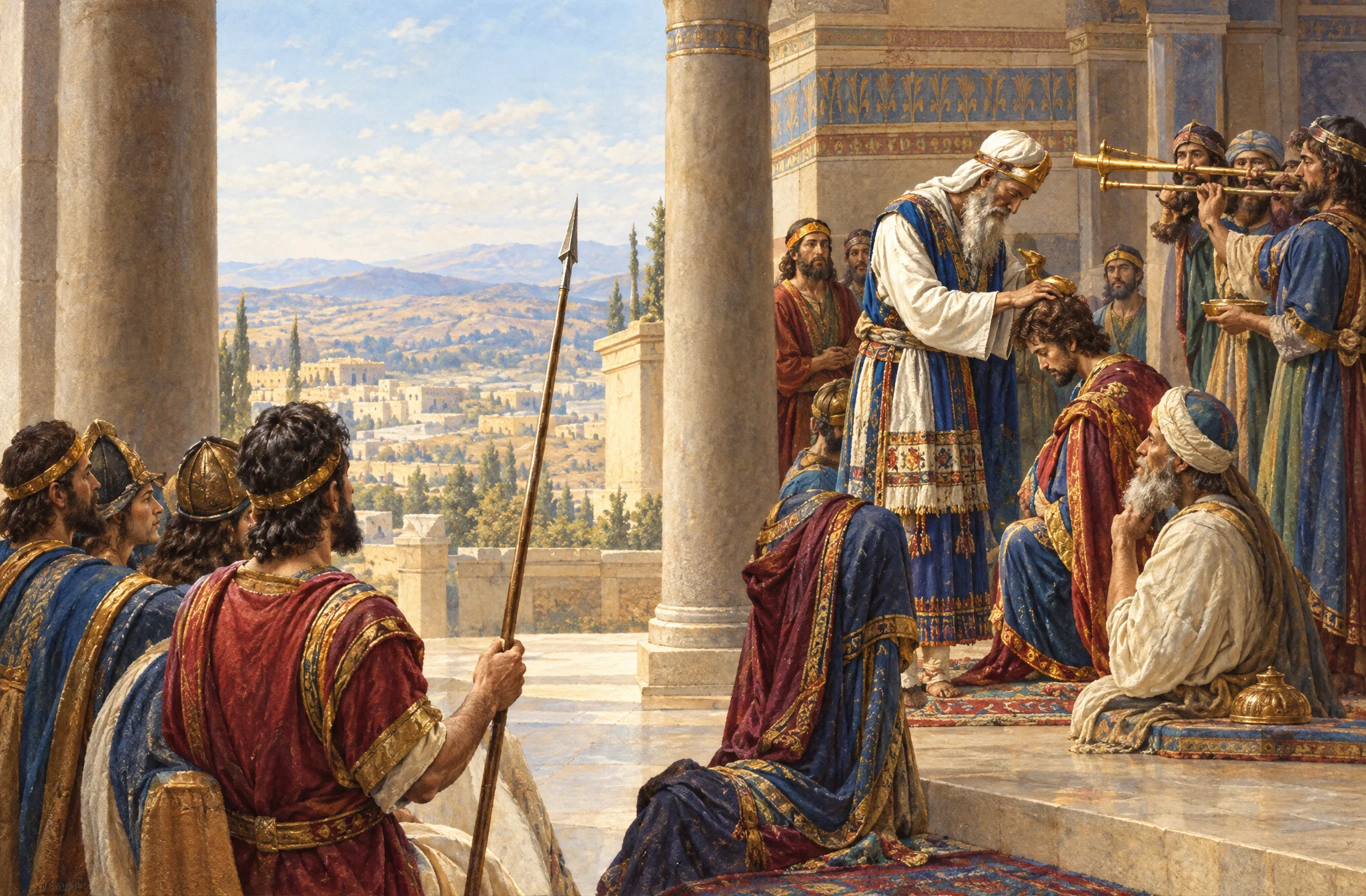 THE CORONATION OF DAVID
“The time had come, and David by solemn rite, was consecrated to his office as God’s vicegerent.”
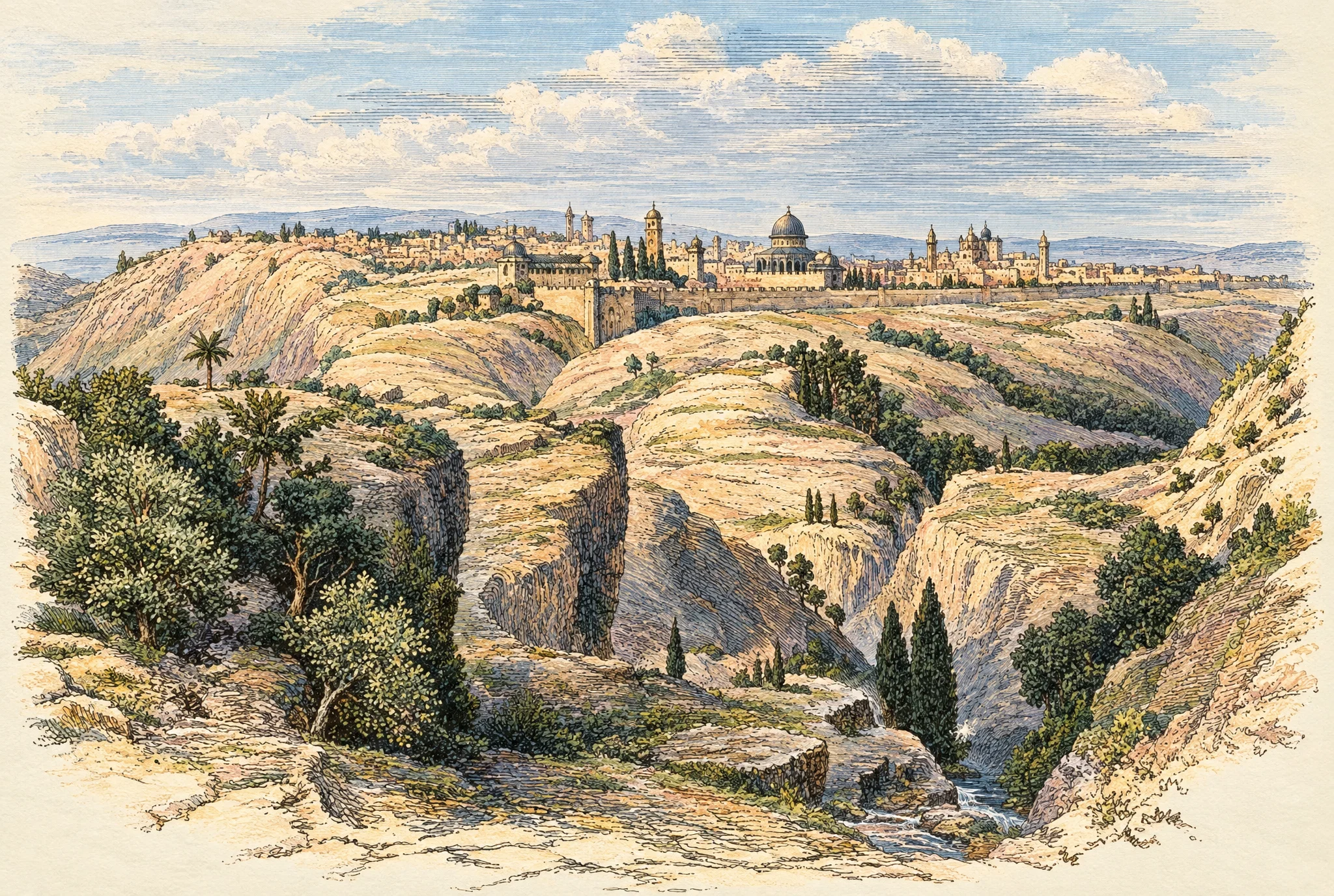 “As the mountains are round about Jerusalem, so the Lord is round about his people.”
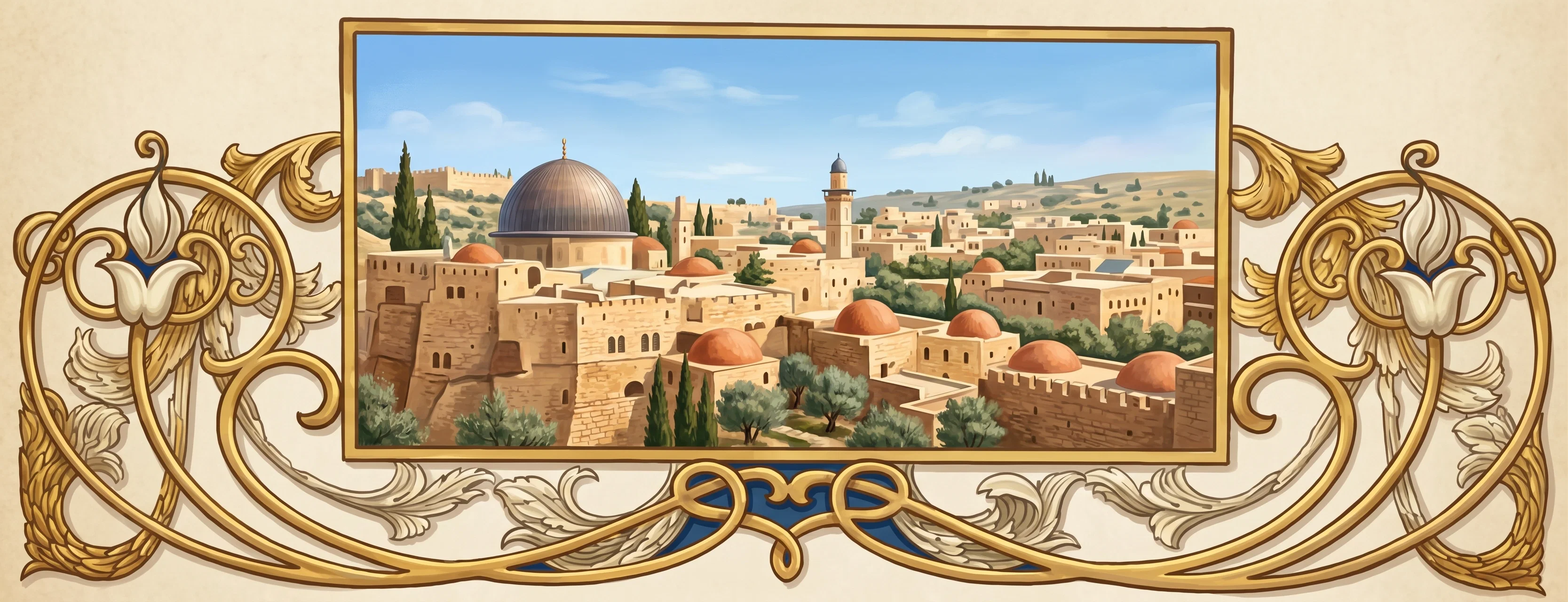 A wide panoramic view of Jerusalem and its surrounding hills, enclosed in a rectangular frame. Within the scene, a dense cluster of buildings spreads across the landscape, with larger structures and towers rising above the rooftops and open, uneven terrain in the foreground. Elaborate symmetrical ornament surrounds the framed view: curling vines, leaves, and large stylized flowers extend along both sides and across the lower edge. No people, animals, or legible lettering are visible.
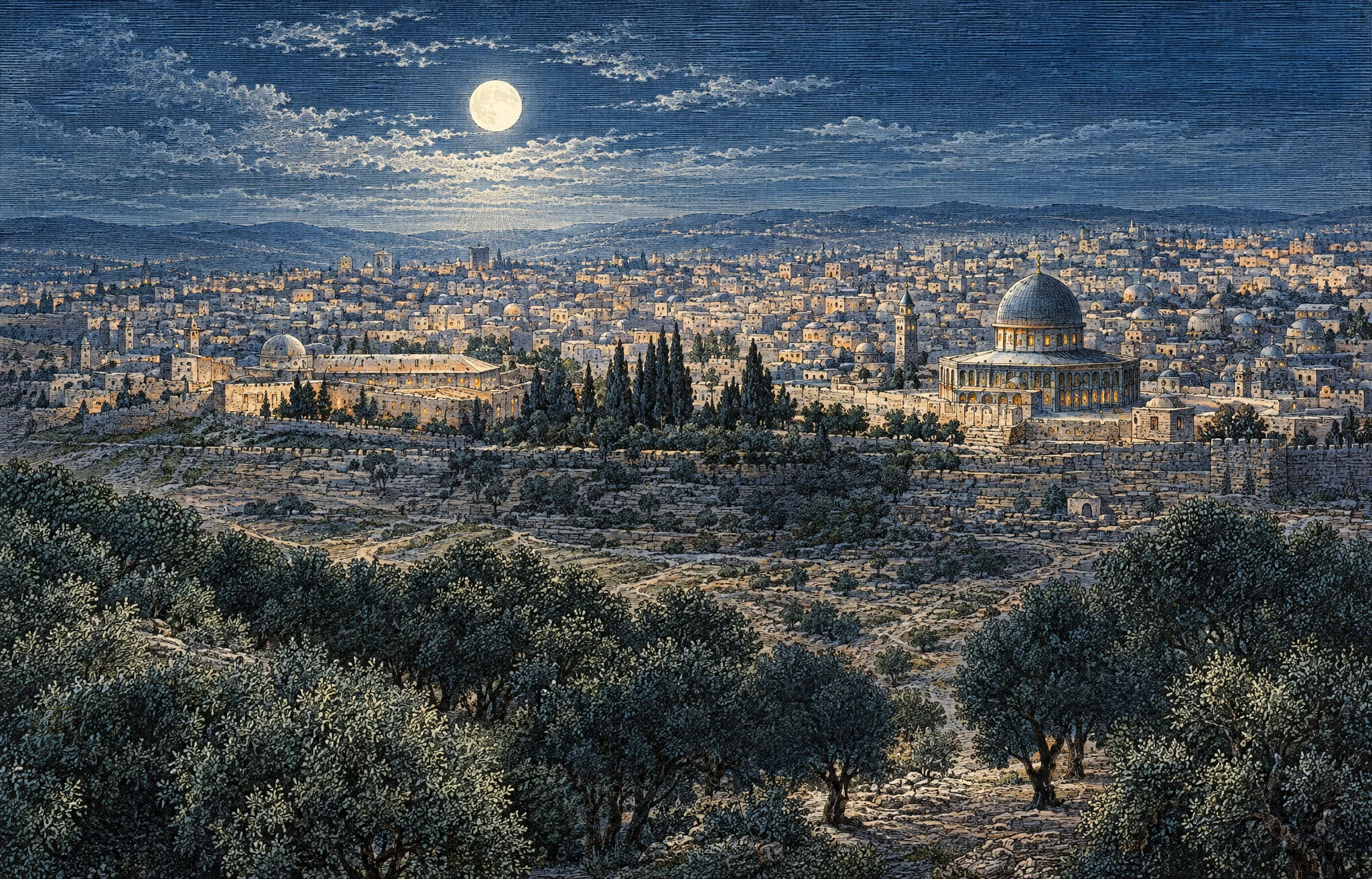 MODERN JERUSALEM BY MOONLIGHT
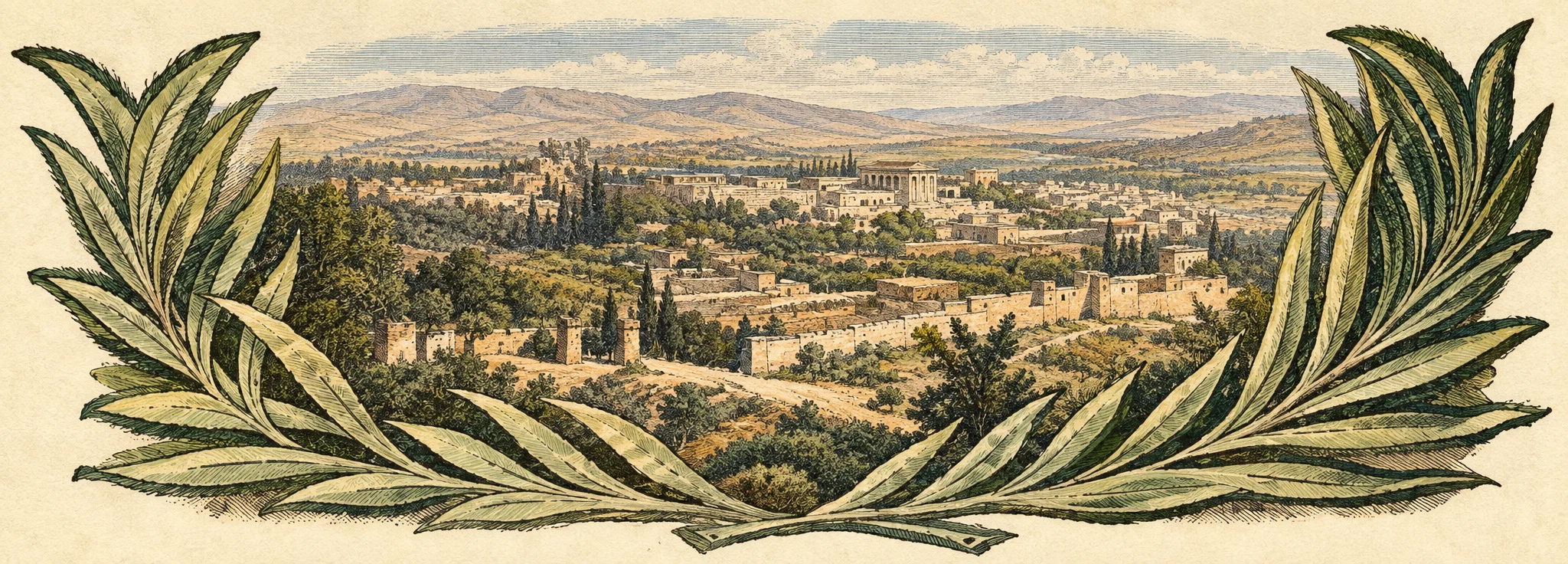 A broad, distant view of a densely built settlement spreads across the center, with clusters of low buildings and walls set among rolling, lightly wooded terrain. The scene is framed by large, finely drawn leafy branches that rise on both sides and curve along the lower edge like an ornamental wreath. The monochrome landscape contains no clearly visible people, animals, or readable lettering; the focus is the town and its surrounding countryside.
 A monochrome botanical illustration shows a long, slender branch stretching horizontally across the image, bearing several narrow, pointed leaves and a large, round dark fruit near the center. Smaller round fruits hang from the branch near both ends, with a few additional leaves rising and angling outward. Pale, scratch-like lines and highlights define the fruit and foliage against the dark silhouette. The arrangement is isolated on a plain, light background, with no visible lettering or other objects.
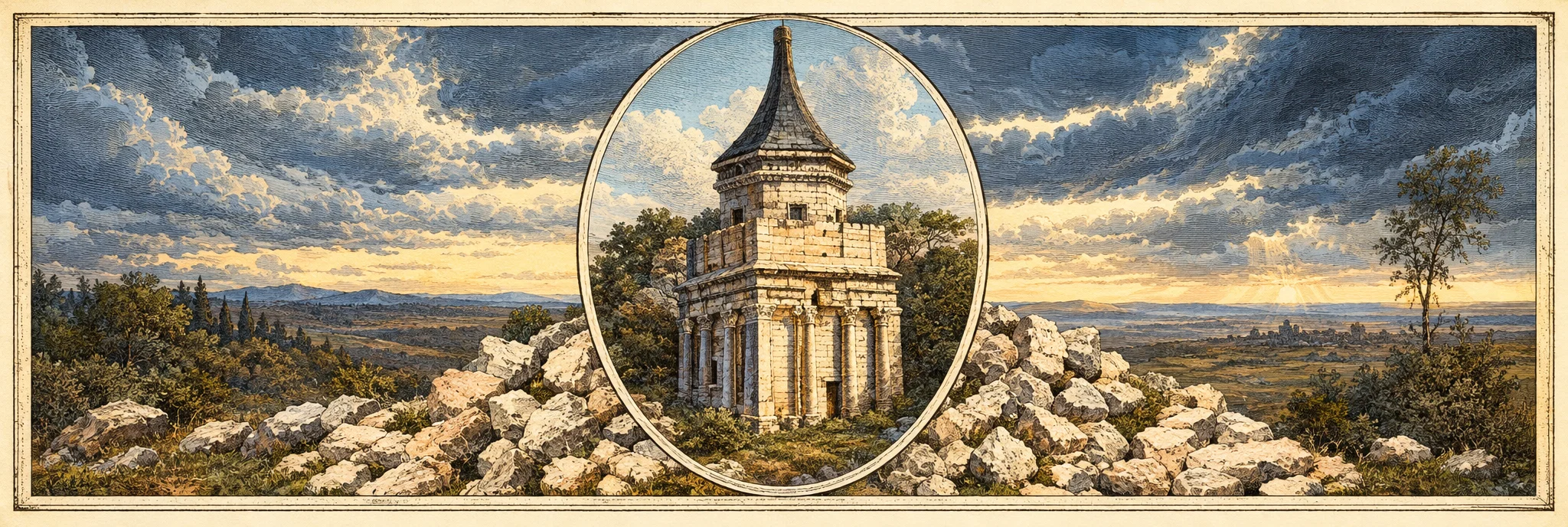 A small domed stone building with a tall pointed spire rises at the center of the scene, shown inside a large oval inset. Its rounded roof sits above a columned façade and dark openings. Around the inset, broken stones and rubble are scattered across the foreground, while a broad, bleak landscape stretches behind it beneath bands of heavy, clouded sky. A few thin, bare trees stand in the distance. No people, animals, or readable lettering are visible.
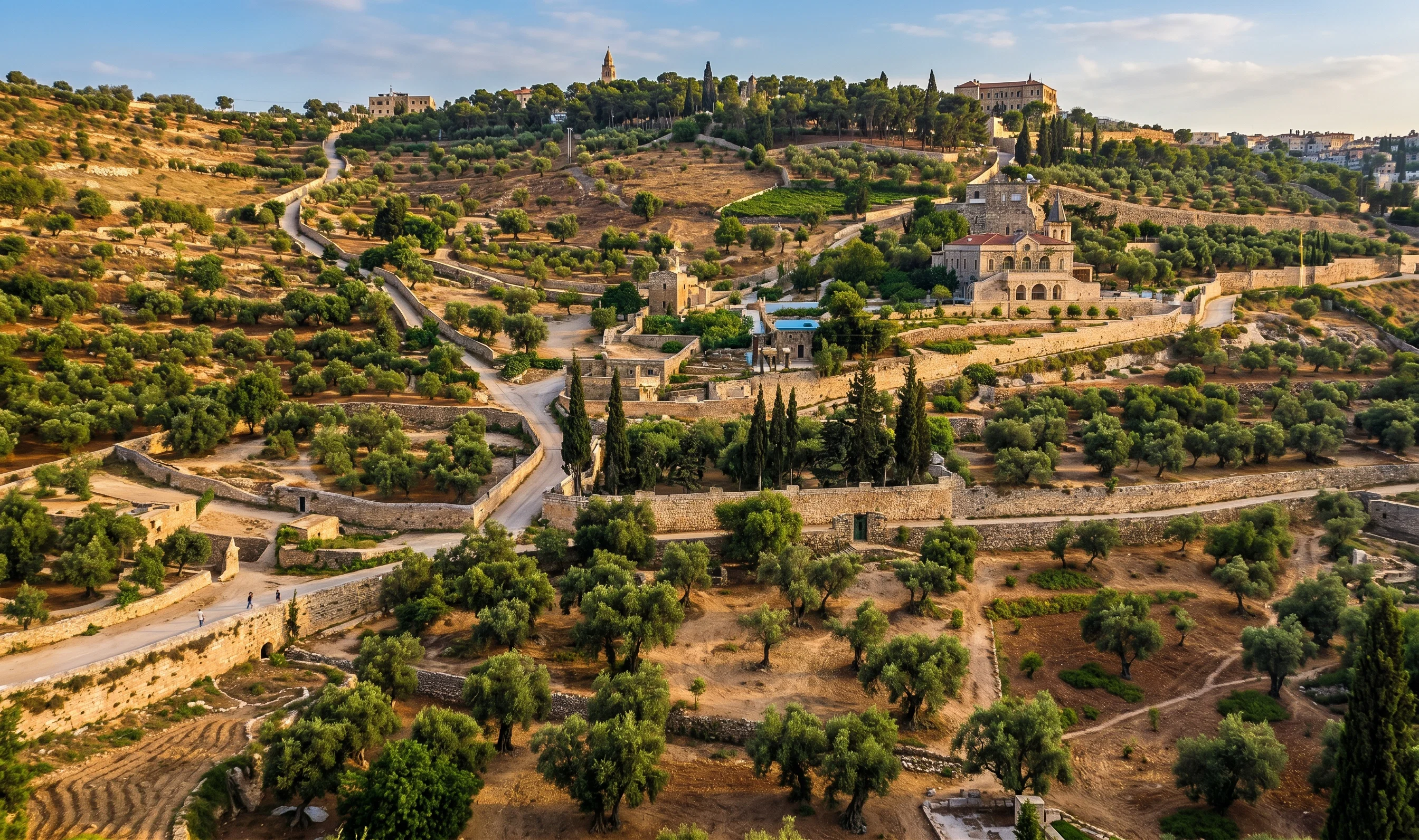 “David went up by the ascent of Olivet, and wept as he went up.”
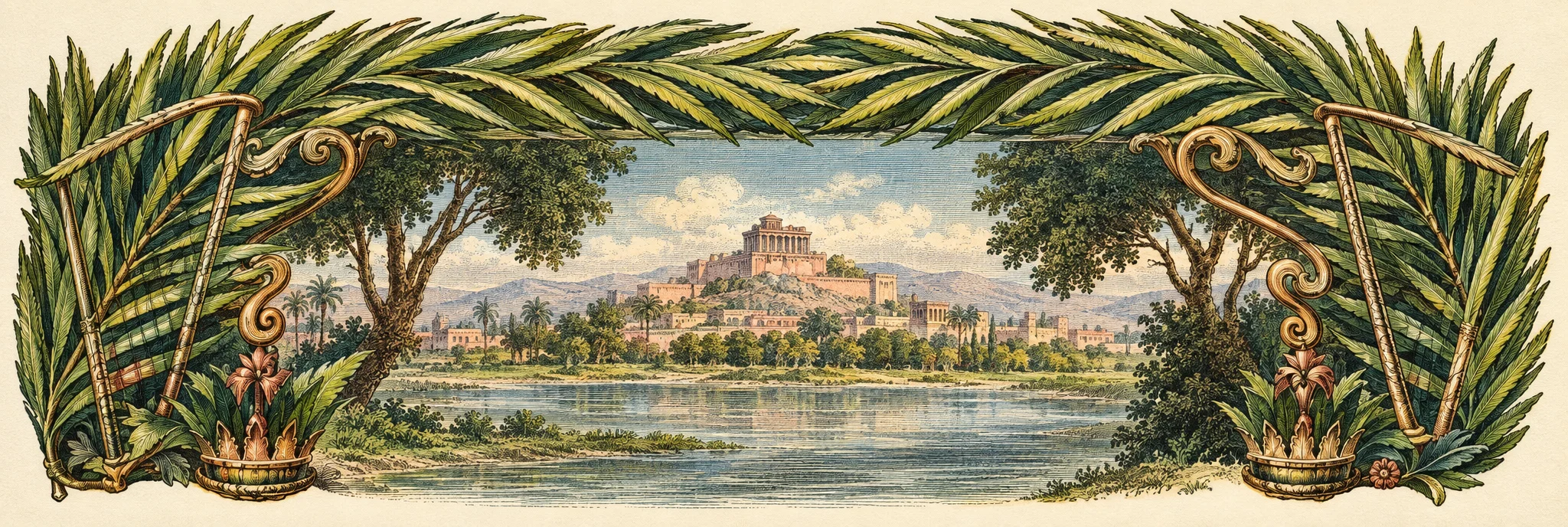 A wide ornamental black-and-white vignette frames a distant landscape. Dense palm fronds arch across the top and descend along both sides, intertwining with curling decorative scrolls and small architectural motifs near the lower corners. Inside the frame, a low horizon of trees and shrubs borders an open, lightly shaded foreground, with a small walled city or palace and clustered buildings centered in the distance. The scene contains no clearly visible people or animals, and there is no legible lettering within the artwork.
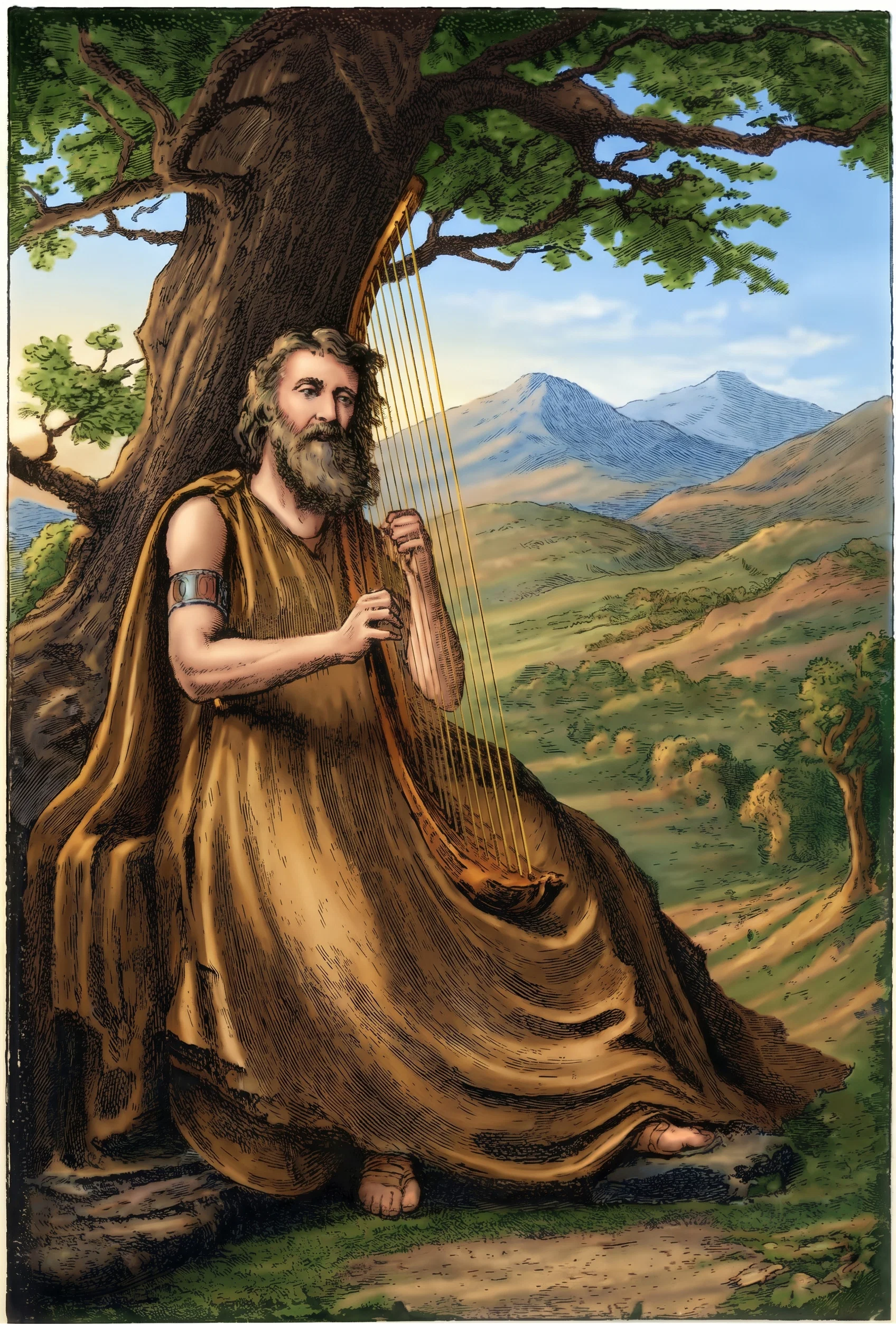 THE SWEET SINGER OF ISRAEL
“He shall be as the light of the morning, even a morning without clouds.”