David and his men had not taken part in the battle between Saul and the Philistines, though they had marched with the Philistines to the field of conflict. As the two armies prepared to join battle, the son of Jesse found himself in a situation of great perplexity. It was expected that he would fight for the Philistines. Should he in the engagement quit the post assigned him, and retire from the field, he would not only brand himself with cowardice, but with ingratitude and treachery to Achish, who had protected him and confided in him. Such an act would cover his name with infamy, and would expose him to the wrath of enemies more to be feared than Saul. Yet he could not for a moment consent to fight against Israel. Should he do this, he would become a traitor to his country,—the enemy of God and of his people. It would forever bar his way to the throne of Israel; and should Saul be slain in the engagement, his death would be charged upon David.
David was caused to feel that he had missed his path. Far better would it have been for him to find refuge in God’s strong fortresses of the mountains than with the avowed enemies of Jehovah and his people. But the Lord, in his great mercy, did not punish this error of his servant by leaving him to himself in his distress and perplexity; for though David, losing his grasp on divine power, had faltered, and turned aside from the path of strict integrity, it was still the purpose of his heart to be true to God. While Satan and his host were busy, helping the adversaries of God and of Israel to plan against a king who had forsaken God, the angels of the Lord were working to deliver David from the peril into which he had fallen. Heavenly messengers moved upon the Philistine princes to protest against the presence of David and his force with the army in the approaching conflict.
“What do these Hebrews here?” cried the Philistine lords, pressing about Achish. The latter, unwilling to part with so important an ally, answered, “Is not this David the servant of Saul the king of Israel, which hath been with me these days, or these years, and I have found no fault in him since he fell unto me unto this day?”
But the princes angrily persisted in their demand: “Make this fellow return, that he may go again to his place which thou hast appointed him, and let him not go down with us to battle, lest in the battle he be an adversary to us; for wherewith should he reconcile himself unto his master? should it not be with the heads of these men? Is not this David, of whom they sang one to another in dances, saying, Saul slew his thousands, and David his ten thousands?” The slaughter of their famed champion and the triumph of Israel upon that occasion were still fresh in the memory of the Philistine lords. They did not believe that David would fight against his own people; and should he, in the heat of battle, take sides with them, he could inflict greater harm on the Philistines than would the whole of Saul’s army.
Thus Achish was forced to yield, and calling David, said unto him, “Surely as Jehovah liveth, thou hast been upright, and thy going out and thy coming in with me in the host is good in my sight; for I have not found evil in thee since the day of thy coming unto me unto this day. Nevertheless the lords favor thee not. Wherefore now return, and go in peace, that thou displease not the lords of the Philistines.”
David, fearing to betray his real feelings, answered, “But what have I done? and what hast thou found in thy servant so long as I have been with thee unto this day, that I may not go fight against the enemies of my lord the king?”
The reply of Achish must have sent a thrill of shame and remorse through David’s heart, as he thought how unworthy of a servant of Jehovah were the deceptions to which he had stooped. “I know that thou art good in my sight, as an angel of God,” said the king; “notwithstanding the princes of the Philistines have said, He shall not go up with us to the battle. Wherefore now rise up early in the morning with thy master’s servants that are come with thee; and as soon as ye be up early in the morning, and have light, depart.” Thus the snare in which David had become entangled was broken, and he was set free.
After three days’ travel, David and his band of six hundred men reached Ziklag, their Philistine home. But a scene of desolation met their view. The Amalekites, taking advantage of David’s absence, with his force, had avenged themselves for his incursions into their territory. They had surprised the city while it was left unguarded, and having sacked and burned it, had departed, taking all the women and children as captives, with much spoil.
Dumb with horror and amazement, David and his men for a little time gazed in silence upon the blackened and smouldering ruins. Then as a sense of their terrible desolation burst upon them, those battle-scarred warriors “lifted up their voice and wept, until they had no more power to weep.”
Here, again, David was chastened for the lack of faith that had led him to place himself among the Philistines. He had opportunity to see how much safety could be found among the foes of God and his people. David’s followers turned upon him as the cause of their calamities. He had provoked the vengeance of the Amalekites by his attack upon them; yet, too confident of security in the midst of his enemies, he had left the city unguarded. Maddened with grief and rage, his soldiers were now ready for any desperate measures, and they threatened even to stone their leader.
David seemed to be cut off from every human support. All that he held dear on earth had been swept from him. Saul had driven him from his country; the Philistines had driven him from the camp; the Amalekites had plundered his city; his wives and children had been made prisoners; and his own familiar friends had banded against him, and threatened him even with death. In this hour of utmost extremity, David, instead of permitting his mind to dwell upon these painful circumstances, looked earnestly to God for help. He “encouraged himself in the Lord.” He reviewed his past eventful life. Wherein had the Lord ever forsaken him? His soul was refreshed in recalling the many evidences of God’s favor. The followers of David, by their discontent and impatience, made their affliction doubly grievous; but the man of God, having even greater cause for grief, bore himself with fortitude. “What time I am afraid, I will trust in Thee,” was the language of his heart. Though he himself could not discern a693way out of the difficulty, God could see it, and would teach him what to do.
Sending for Abiathar the priest, the son of Ahimelech, “David inquired of the Lord, saying, If I pursue after this troop, shall I overtake them?” The answer was, “Pursue; for thou shalt surely overtake them, and shalt without fail recover all.”
At these words the tumult of grief and passion ceased. David and his soldiers at once set out in pursuit of their fleeing foe. So rapid was their march, that upon reaching the brook Besor, which empties, near Gaza, into the Mediterranean Sea, two hundred of the band were compelled by exhaustion to remain behind. But David with the remaining four hundred pressed forward, nothing daunted.
Advancing, they came upon an Egyptian slave, apparently about to perish from weariness and hunger. Upon receiving food and drink, however, he revived, and they learned that he had been left to die, by his cruel master, an Amalekite belonging to the invading force. He told the story of the raid and pillage; and then, having exacted a promise that he should not be slain or delivered to his master, he consented to lead David’s company to the camp of their enemies.
As they came in sight of the encampment, a scene of revelry met their gaze. The victorious host were holding high festival. “They were spread abroad upon all the earth, eating, and drinking, and dancing, because of all the great spoil that they had taken out of the land of the Philistines, and out of the land of Judah.” An immediate attack was ordered, and the pursuers rushed fiercely upon their prey. The Amalekites were surprised and thrown into confusion. The battle was continued all that night and the following day, until nearly the entire host was slain. Only a band of four hundred men, mounted upon camels, succeeded in making their escape. The word of the Lord was fulfilled. “David recovered all that the Amalekites had carried away; and David rescued his two wives. And there was nothing lacking to them, neither small nor great, neither sons nor daughters, neither spoil, nor anything that they had taken to them; David recovered all.”
When David had invaded the territory of the Amalekites, he had put to the sword all the inhabitants that fell into his hands.694But for the restraining power of God, the Amalekites would have retaliated by destroying the people of Ziklag. They decided to spare the captives, desiring to heighten the honor of the triumph by leading home a large number of prisoners, and intending afterward to sell them as slaves. Thus, unwittingly, they fulfilled God’s purpose, keeping the prisoners unharmed, to be restored to their husbands and fathers.
All earthly powers are under the control of the Infinite One. To the mightiest ruler, to the most cruel oppressor, he says, “Hitherto shalt thou come, but no further.” God’s power is constantly exercised to counteract the agencies of evil: he is ever at work among men, not for their destruction, but for their correction and preservation.
With great rejoicing, the victors took up their homeward march. Upon reaching their companions who had remained behind, the more selfish and unruly of the four hundred urged that those who had had no part in the battle should not share the spoils; that it was enough for them to recover each his wife and children. But David would permit no such arrangement. “Ye shall not do so, my brethren,” he said, “with that which the Lord hath given us, . . . as his part is that goeth down to the battle, so shall his part be that tarrieth by the stuff; they shall part alike.” Thus the matter was settled, and it afterward became a statute in Israel that all who were honorably connected with a military campaign should share the spoils equally with those who engaged in actual combat.
Besides recovering all the spoil that had been taken from Ziklag, David and his band had captured extensive flocks and herds belonging to the Amalekites. These were called “David’s spoil;” and upon returning to Ziklag, he sent from this spoil presents to the elders of his own tribe of Judah. In this distribution, all those were remembered who had befriended him and his followers in the mountain fastnesses, when he had been forced to flee from place to place for his life. Their kindness and sympathy, so precious to the hunted fugitive, were thus gratefully acknowledged.
It was the third day since David and his warriors returned to Ziklag. As they labored to restore their ruined homes, they watched with anxious hearts for tidings of the battle which they695knew must have been fought between Israel and the Philistines. Suddenly a messenger entered the town, “with his clothes rent, and earth upon his head.” He was at once brought to David, before whom he bowed with reverence, expressing recognition of him as a powerful prince, whose favor he desired. David eagerly inquired how the battle had gone. The fugitive reported Saul’s defeat and death, and the death of Jonathan. But he went beyond a simple statement of facts. Evidently supposing that David must cherish enmity toward his relentless persecutor, the stranger hoped to secure honor to himself as the slayer of the king. With an air of boasting, the man went on to relate that during the battle he found the monarch of Israel wounded, and sore pressed by his foes, and that at his own request the messenger had slain him. The crown from his head and the golden bracelets from his arm he had brought to David. He confidently expected that these tidings would be hailed with joy, and that a rich reward would be his for the part that he had acted.
But “David took hold on his clothes, and rent them; and likewise all the men that were with him. And they mourned, and wept, and fasted, until even, for Saul, and for Jonathan his son, and for the people of the Lord, and for the house of Israel; because they were fallen by the sword.”
The first shock of the fearful tidings past, David’s thoughts returned to the stranger herald, and the crime of which, according to his own statement, he was guilty. The chief demanded of the young man, “Whence art thou?” And he answered, “I am the son of a stranger, an Amalekite.” And David said unto him, “How wast thou not afraid to stretch forth thine hand to destroy the Lord’s anointed?” Twice, David had had Saul in his power; but when urged to slay him, he had refused to lift his hand against him who had been consecrated by the command of God to rule over Israel. Yet the Amalekite feared not to boast that he had slain the king of Israel. He had accused himself of a crime worthy of death, and the penalty was inflicted at once. David said, “Thy blood be upon thy head; for thy mouth hath testified against thee, saying, I have slain the Lord’s anointed.”
David’s grief at the death of Saul was sincere and deep, evincing the generosity of a noble nature. He did not exult in the fall of his enemy. The obstacle that had barred his access to the696throne of Israel was removed, but at this he did not rejoice. Death had obliterated the remembrance of Saul’s distrust and cruelty, and now nothing in his history was thought of but that which was noble and kingly. The name of Saul was linked with that of Jonathan, whose friendship had been so true and so unselfish.
The song in which David gave utterance to the feelings of his heart, became a treasure to his nation, and to the people of God in all subsequent ages:—
“Thy glory, O Israel, is slain upon thy high places!
How are the mighty fallen!
Tell it not in Gath,
Publish it not in the streets of Askelon;
Lest the daughters of the Philistines rejoice,
Lest the daughters of the uncircumcised triumph.
Ye mountains of Gilboa,
Let there be no dew nor rain upon you, neither fields of offerings:
For there the shield of the mighty was vilely cast away,
The shield of Saul as of one not anointed with oil. . . .
Saul and Jonathan were lovely and pleasant in their lives,
And in their death they were not divided;
They were swifter than eagles.
They were stronger than lions.
Ye daughters of Israel, weep over Saul,
Who clothed you in scarlet delicately,
Who put ornaments of gold upon your apparel.
How are the mighty fallen in the midst of the battle!
Jonathan is slain upon thy high places.
I am distressed for thee, my brother Jonathan;
Very pleasant hast thou been unto me;
Thy love to me was wonderful,
Passing the love of women.
How are the mighty fallen,
And the weapons of war perished!”
DAVID CALLED TO THE THRONE—69
The death of Saul removed the dangers that had made David an exile. The way was now open for him to return to his own land. When the days of mourning for Saul and Jonathan were ended, “David inquired of the Lord, saying, Shall I go up into any of the cities of Judah? And the Lord said unto him, Go up. And David said, Whither shall I go up? And he said, Unto Hebron.”
Hebron was twenty miles north from Beersheba, and about midway between that city and the future site of Jerusalem. It was originally called Kirjath-arba, the city of Arba, the father of Anak. Later it was called Mamre, and here was the burial-place of the patriarchs, “the cave of Machpelah.” Hebron had been the possession of Caleb, and was now the chief city of Judah. It lies in a valley surrounded by fertile hill country and fruitful lands. The most beautiful vineyards of Palestine were on its borders, together with numerous plantations of olive and other fruit trees.
David and his followers immediately prepared to obey the instruction which they had received from God. The six hundred armed men, with their wives and children, their flocks and herds, were soon on the way to Hebron. As the caravan entered the city, the men of Judah were waiting to welcome David as the future king of Israel. Arrangements were at once made for his coronation. “And there they anointed David king over the house of Judah.” But no effort was made to establish his authority, by force, over the other tribes.
One of the first acts of the new-crowned monarch was to express his tender regard for the memory of Saul and Jonathan. Upon learning of the brave deed of the men of Jabesh-gilead in rescuing the bodies of the fallen leaders, and giving them honorable burial. David sent an embassy to Jabesh with the message,698“Blessed be ye of the Lord, that ye have showed this kindness unto your lord, even unto Saul, and have buried him. And now the Lord show kindness and truth unto you; and I also will requite you this kindness.” And he announced his own accession to the throne of Judah, and invited the allegiance of those who had proved themselves so true-hearted.
The Philistines did not oppose the action of Judah in making David king. They had befriended him in his exile, in order to harass and weaken the kingdom of Saul, and now they hoped that because of their former kindness to David the extension of his power would, in the end, work to their advantage. But David’s reign was not to be free from trouble. With his coronation began the dark record of conspiracy and rebellion. David did not sit upon a traitor’s throne; God had chosen him to be king of Israel, and there had been no occasion for distrust or opposition. Yet hardly had his authority been acknowledged by the men of Judah, when through the influence of Abner, Ishbosheth, the son of Saul, was proclaimed king, and set upon a rival throne in Israel.
Ishbosheth was but a weak and incompetent representative of the house of Saul, while David was pre-eminently qualified to bear the responsibilities of the kingdom. Abner, the chief agent in raising Ishbosheth to kingly power, had been commander-in-chief of Saul’s army, and was the most distinguished man in Israel. Abner knew that David had been appointed by the Lord to the throne of Israel, but having so long hunted and pursued him, he was not now willing that the son of Jesse should succeed to the kingdom over which Saul had reigned.
The circumstances under which Abner was placed, served to develop his real character, and showed him to be ambitious and unprincipled. He had been intimately associated with Saul, and had been influenced by the spirit of the king to despise the man whom God had chosen to reign over Israel. His hatred had been increased by the cutting rebuke that David had given him at the time when the cruse of water and the spear of the king had been taken from the side of Saul, as he slept in the camp. He remembered how David had cried in the hearing of the king and the people of Israel, “Art not thou a valiant man? And who is like to thee in Israel? Wherefore then hast thou not kept thy lord the king? . . . This thing is not good that thou hast done. As the Lord liveth, ye are worthy to die, because ye have not kept your master, the Lord’s anointed.”699This reproof had rankled in his breast, and he determined to carry out his revengeful purpose, and create division in Israel, whereby he himself might be exalted. He employed the representative of departed royalty to advance his own selfish ambitions and purposes. He knew that the people loved Jonathan. His memory was cherished, and Saul’s first successful campaigns had not been forgotten by the army. With determination worthy a better cause, this rebellious leader went forward to carry out his plans.
Mahanaim, on the farther side of Jordan, was chosen as the royal residence, since it offered the greatest security against attack, either from David or from the Philistines. Here the coronation of Ishbosheth took place. His reign was first accepted by the tribes east of Jordan, and was finally extended over all Israel except Judah. For two years the son of Saul enjoyed his honors in his secluded capital. But Abner, intent upon extending his power over all Israel, prepared for aggressive warfare. And “there was long war between the house of Saul and the house of David; but David waxed stronger and stronger, and the house of Saul waxed weaker and weaker.”
At last, treachery overthrew the throne that malice and ambition had established. Abner, becoming incensed against the weak and incompetent Ishbosheth, deserted to David, with the offer to bring over to him all the tribes of Israel. His proposals were accepted by the king, and he was dismissed with honor, to accomplish his purpose. But the favorable reception of so valiant and famed a warrior excited the jealousy of Joab, the commander-in-chief of David’s army. There was a blood-feud between Abner and Joab, the former having slain Asahel, Joab’s brother, during the war between Israel and Judah. Now Joab, seeing an opportunity to avenge his brother’s death, and rid himself of a prospective rival, basely took occasion to waylay and murder Abner.
David, upon hearing of this treacherous assault, exclaimed, “I and my kingdom are guiltless before the Lord forever from the blood of Abner the son of Ner; let it rest on the head of Joab, and on all his father’s house.” In view of the unsettled state of the kingdom, and the power and position of the murderers,—for Joab’s brother Abishai had been united with him,—David could not visit the crime with just retribution, yet he publicly manifested700his abhorrence of the bloody deed. The burial of Abner was attended with public honors. The army, with Joab at their head, were required to take part in the services of mourning, with rent garments and clothed in sackcloth. The king manifested his grief by keeping a fast upon the day of burial; he followed the bier as chief mourner; and at the grave he pronounced an elegy which was a cutting rebuke of the murderers. “The king lamented over Abner, and said:—
“Died Abner as a fool dieth?
Thy hands were not bound,
Nor thy feet put into fetters;
As a man falleth before wicked men,
So fellest thou.”
David’s magnanimous recognition of one who had been his bitter enemy, won the confidence and admiration of all Israel. “All the people took notice of it, and it pleased them, as whatsoever the king did pleased all the people. For all the people and all Israel understood that day that it was not of the king to slay Abner the son of Ner.” In the private circle of his trusted counselors and attendants, the king spoke of the crime, and recognizing his own inability to punish the murderers as he desired, he left them to the justice of God: “Know ye not that there is a prince and a great man fallen this day in Israel? And I am this day weak, though anointed king; and these men, the sons of Zeruiah, be too hard for me. The Lord shall reward the doer of evil according to his wickedness.”
Abner had been sincere in his offers and representations to David, yet his motives were base and selfish. He had persistently opposed the king of God’s appointment, in the expectation of securing honor to himself. It was resentment, wounded pride, and passion, that led him to forsake the cause he had so long served; and in deserting to David he hoped to receive the highest position of honor in his service. Had he succeeded in his purpose, his talents and ambition, his great influence and want of godliness, would have endangered the throne of David and the peace and prosperity of the nation.
“When Saul’s son heard that Abner was dead in Hebron, his hands were feeble, and all the Israelites were troubled.” It was evident that the kingdom could not long be maintained. Soon701another act of treachery completed the downfall of the waning power. Ishbosheth was foully murdered by two of his captains, who, cutting off his head, hastened with it to the king of Judah, hoping thus to ingratiate themselves in his favor.
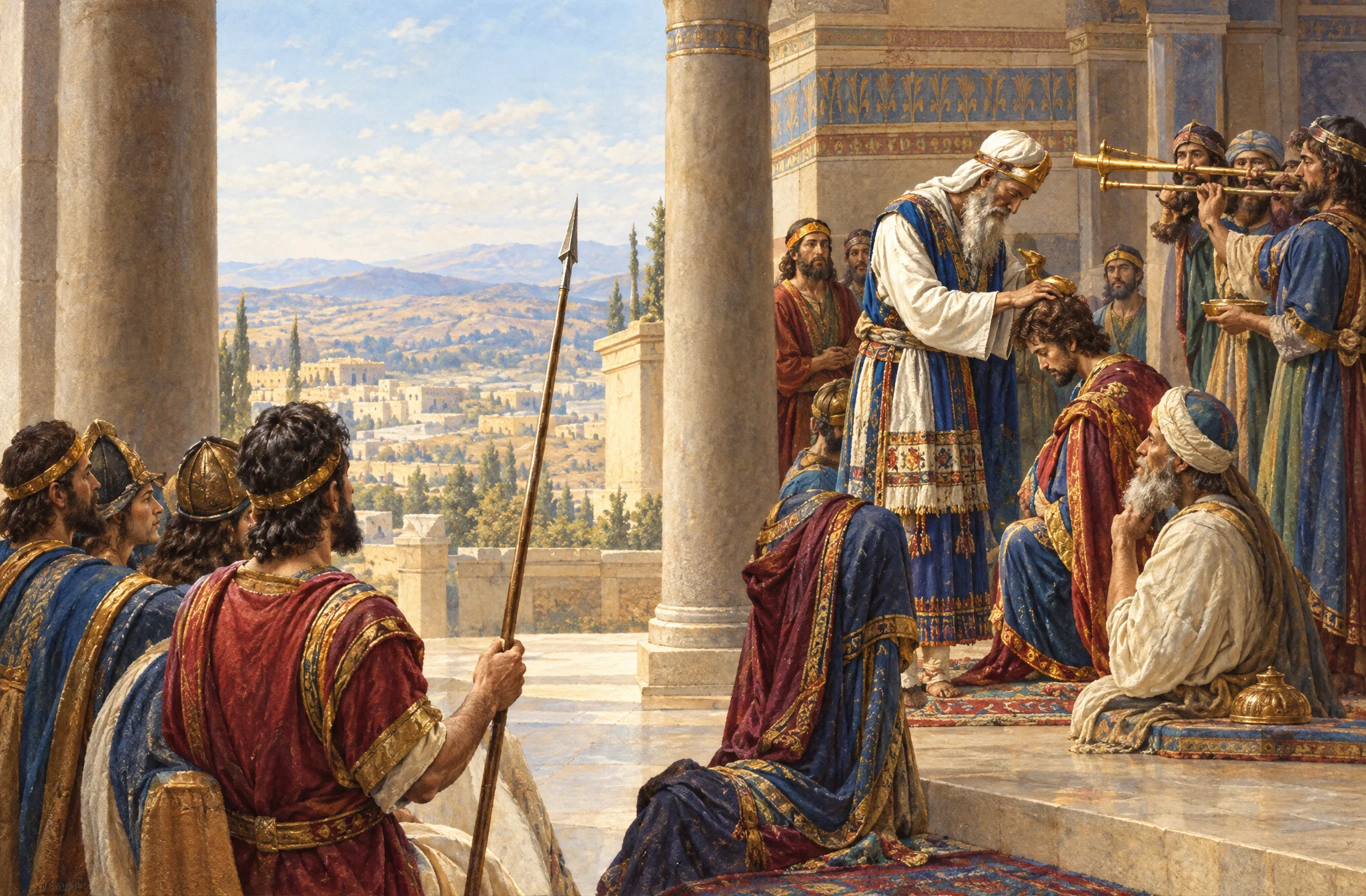
THE CORONATION OF DAVID
“The time had come, and David by solemn rite, was consecrated to his office as God’s vicegerent.”
They appeared before David with the gory witness to their crime, saying, “Behold the head of Ishbosheth the son of Saul thine enemy, which sought thy life; and the Lord hath avenged my lord the king this day of Saul, and of his seed.” But David, whose throne God himself had established, and whom God had delivered from his adversaries, did not desire the aid of treachery to establish his power. He told these murderers of the doom visited upon him who boasted of slaying Saul. “How much more,” he added, “when wicked men have slain a righteous person in his own house upon his bed? Shall I not therefore now require his blood of your hand, and take you away from the earth? And David commanded his young men, and they slew them. . . . But they took the head of Ishbosheth and buried it in the sepulcher of Abner in Hebron.”
After the death of Ishbosheth, there was a general desire among the leading men of Israel that David should become king of all the tribes. “Then came all the tribes of Israel to David unto Hebron, and spake, saying, Behold, we are thy bone and thy flesh.” They declared, “Thou wast he that leddest out and broughtest in Israel; and the Lord said to thee, Thou shalt feed my people Israel, and thou shalt be a captain over Israel. So all the elders of Israel came to the king to Hebron; and King David made a league with them in Hebron before the Lord.” Thus through the providence of God the way had been opened for him to come to the throne. He had no personal ambition to gratify, for he had not sought the honor to which he had been brought.
More than eight thousand of the descendants of Aaron, and of the Levites, waited upon David. The change in the sentiments of the people was marked and decisive. The revolution was quiet and dignified, befitting the great work they were doing. Nearly half a million souls, the former subjects of Saul, thronged Hebron and its environs. The very hills and valleys were alive with the multitudes. The hour for the coronation was appointed; the man who had been expelled from the court of Saul, who had702fled to the mountains and hills and to the caves of the earth to preserve his life, was about to receive the highest honor that can be conferred upon man by his fellow-man. Priests and elders clothed in the garments of their sacred office, officers and soldiers with glittering spear and helmet, and strangers from long distances, stood to witness the coronation of the chosen king. David was arrayed in the royal robe. The sacred oil was put upon his brow by the high priest; for the anointing by Samuel had been prophetic of what would take place at the inauguration of the king. The time had come, and David, by solemn rite, was consecrated to his office as God’s vicegerent. The scepter was placed in his hands. The covenant of his righteous sovereignty was written, and the people gave their pledges of loyalty. The diadem was placed upon his brow, and the coronation ceremony was over. Israel had a king by divine appointment. He who had waited patiently for the Lord, beheld the promise of God fulfilled. “And David went on, and grew great, and the Lord God of hosts was with him.”
“As the mountains are round about Jerusalem, so the Lord is round about his people.”