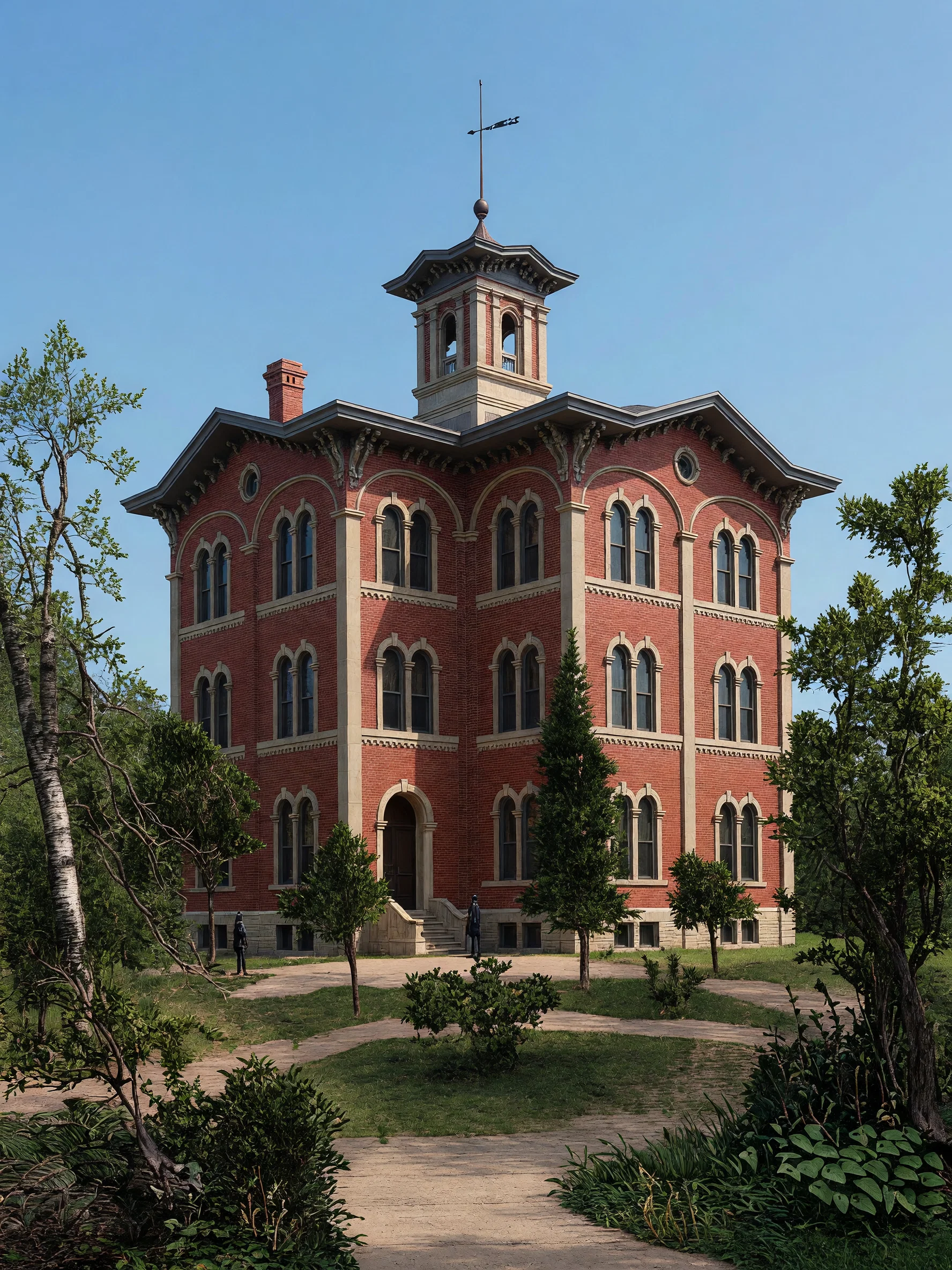
The subject of education, and the necessity of founding a denominational school, were brought before our people by Mrs. W. and the writer, in the early part of the year 1872, and several meetings were held at Battle Creek to consider these important matters. A committee was then chosen to take steps for the immediate establishment of a school, and to act in reference to the organization of an Educational Society at as early a date as it could be brought about. At a meeting held May 11, 1872, the matter was367placed in the hands of the General Conference Committee.
April 16, 1873, a committee was appointed to solicit means, and by its vigorous action a sum of over $54,000 was pledged, and a sufficient amount was paid to render the organization of a legal society possible. March, 1874, the society was organized under the statutes of the State of Michigan, with full charter to grant such literary honors as are usually granted by colleges, and to give suitable diplomas in testimony thereof.
In 1874 grounds were purchased in the city of Battle Creek at a cost of $16,278. The grounds originally consisted of twelve acres. Since the purchase, tiers of building lots have been separated by West College Street and South College Street. It is the most beautiful site for a school-building in this vicinity. The grounds are tastefully adorned with a large number of evergreen and other ornamental trees.
The College building, represented on page 368, was erected in the autumn of 1874, at a cost of $27,858.20. It is situated on the west side of Washington Street, which runs nearly north and south. The building is 175 feet from this street on the east, and the same distance from West College Street on the west. It is 300 feet from Manchester Street on the north, and 200 feet from South College Street on the south.
The building is 72 feet from east to west, and the same distance from north to south. But there are at each of the four corners indentures of 17 feet. The building is of brick, and has three stories besides the basement. The ceiling of the basement is 9 feet from the floor. The ceilings of the first and second stories are 14 feet each. The third story is 17 feet from ceiling to floor.368The College bell is the finest we have heard. It is of size and pitch to send forth a full and pleasant tone, delightful to the student’s ear. The building is heated by steam. A considerable portion of the basement is occupied by the philosophical and chemical laboratory and lecture-room. Here daily lectures are delivered on the subjects of philosophy, chemistry, and geology, during the terms when these sciences369are taught. The first and second stories are each divided into two spacious rooms, in which students are seated during school hours. The third story constitutes a fine, large lecture hall capable of seating 350 persons.
BLACK & MASON
From the observatory there is a most delightful view of the surrounding country for several miles. Wooded hillsides, winding rivers, and fertile fields, together with the shaded streets and pleasant cottages of the city, in the suburbs of which the College is located, combine to make a varied and inviting prospect. Besides this central building, nine dwellings have been erected on the west and south.
Like most religious denominations, Seventh-day Adventists early felt the need of a school in which to educate young men and women to labor in the various departments of missionary work. They also felt a rapidly increasing demand for an institution where our youth might receive a thorough mental training, united with a high order of moral discipline, to secure the best preparation possible for the duties of manhood and womanhood.
This need was manifest in the demand for the special preparation of young men for ministerial and missionary work, and in the reluctance on the part of many parents to send their children to schools where a constant contact with corrupt youth cannot be avoided. In these schools there is a growing laxity of morals and a corresponding increase of crime. There was a deep conviction upon the minds of the friends of education among our people that at such a school much better mental and moral discipline could be attained in a given time than in most of the schools and colleges in the land, and that a wise and effective discipline could be better maintained370and the interests of the youth be more assiduously cared for than would be done elsewhere.
In the spring of 1874, when the College was established, two departments of instruction were opened; one in the Arts and Sciences, the other in Theology. In the fall of 1876, a department was opened for the preparation of teachers. In the fall of 1877, a department of Hygiene was established for those who desire to become familiar with the facts and principles upon which health and temperance reforms are based. In the fall of 1879, a Commercial department was instituted, and a primary school opened.
The range of study in Battle Creek College through its different departments, includes those usually pursued in the very lowest grades and upward through all the branches of a full collegiate course. There are two courses of study, the Classical and the English, which, when completed, will entitle the graduate to a degree. The former consists of four years, the latter of three, each with a preparatory course of two years. There is also a Teachers’ course of four years, including professional instruction in school methods, designed to prepare teachers for their work.
Besides these there is a course of three years for students in Theology. This includes Biblical lectures, Ancient and Church History, Natural Sciences, English Language, and two years in Greek. There are minor courses in the other departments, for which diplomas are granted. There are Commercial courses of various lengths, a course of one year in the Hygienic department, and a course of three years preparatory to the Teachers’ course.
The College receives its students from almost371every State and Territory in the Union. From the fall of 1873, to June 15, 1880, 1375 persons have been enrolled as students of this institution.
In the spring of 1875, one hundred students were in attendance. So rapid has been the increase of attendance up to date, that the present enrollment for the College year ending June 15 is four hundred and eighty-nine.
The important considerations which parents usually take into account in sending their children to school, are the character of the instruction, the influence under which their children will be placed, and the expense incurred while pursuing their studies.
It has become a kind of mania among young people in our public and preparatory schools throughout the country to attach very great importance to the higher branches, while the common branches are looked upon as something to be passed over in a superficial manner. The teachers of Battle Creek College are endeavoring to correct this false view among its students. Great importance is attached to the common branches, which are regarded as constituting a foundation for a liberal education. Indeed, the thoroughness with which the youth are taught to perform their tasks, will in a great measure determine their success in after-life. The habit of doing work well may become as firmly established in the character as the habit of doing it in a careless and superficial manner. This is eminently true of the student. With this fact before them, the teachers at our College make the principle of thoroughness a leading feature in their labors, and endeavor to inculcate like principles in the characters and minds of the students.
The good influences which surround the students372at Battle Creek College, and the vigilance exercised by those in charge, warrant parents in intrusting their sons and daughters to the watch-care of the institution. Teachers and officers feel that the hearts and lives of those they seek to educate are in a peculiar sense consigned to their care. They recognize the responsibility thus devolving upon them. Students are not left to themselves without care or sympathy. A personal interest is taken in each one, and a strong moral and religious influence is thrown around each member of the school. The necessity of constant vigilance over the character and general deportment of the youth is fully realized, and a discipline is maintained which is firm, yet parental and effective. In our times, when serious and solid studies are becoming distasteful, when all kinds of inducements to waste and worse than idle away their time are forced upon our youth, and when morals are so lax, it is necessary that the character and general deportment of the student should be assiduously watched.
The necessary expenses of students attending Battle Creek College are probably less than at any similar institution in the land. The whole expense of board, room-rent, tuition, books, and incidentals, need not exceed one hundred and twenty dollars a year. The annual expense incurred by the majority is less than one hundred dollars for each. Club boarding is very popular among the students of this institution. This system enables them to economize, in this the greatest of college expenditures. As these students fully adopt the two-meal system, they assemble at the eating-house only twice each day, where order and sobriety are observed, becoming Christian gentlemen and ladies.
But the victories gained in adopting the restricted diet are of far more importance to young men and women who are preparing by study to bless others with their influence, than simply the sum of money saved. However important this may be to the poor student, dollars and cents can hardly compare with the moral value of practical lessons of self-control, and physical and mental culture. All scientific physicians in the land, who have not lost proper regard for truth and honesty, agree in testifying that a nutritious hygienic diet is the safest and best for the young student. Most of our students are conforming to hygienic rules of living, and, as a consequence, sickness is almost unknown among them, and they are able to make greater progress in their studies.
The true friends of the health reformation will be gratified to know that the experiment of the Hygienic Boarding Club system of our good school is proving a perfect success. Some may be ready to cry “starvation” when we state that restricted diet is adopted by these students. But the writer with pleasure looks back thirty-nine years, when, thirsting for education and grappling with poverty, he and his room-mate, now Judge Smith, lived three months on corn-meal pudding and raw apples. By way of variety we had flour-cakes for each Sunday morning. But these young gentlemen and ladies of the Hygienic Boarding Clubs of Battle Creek College feast twice each day on the best grains, fruits, and vegetables, at a cost of about one dollar a week. With them the keen relish of healthful appetite, secured by their restricted diet, far exceeds the gustatory enjoyment of the sweetened, spiced, salted, and buttered dishes of fashionable living. Thank God for health reform.374It is a mighty lever to lift up the student to physical, mental, and moral improvement.
The nervous dyspeptic, who is forever anxious about what he shall eat, deserves but little credit for restricting his diet to simple and healthful food. With him it is a necessity. He must restrict his appetite in point of quantity as well as quality, or suffer next to death. But when our youth, who know nothing of enfeebled digestion and its consequences, adopt an unfashionable and restricted diet from principle and choice, it is then that the friends of health reform may shout victory.
It is true that this school was brought into existence by S. D. Adventists, and that it is under the direction of the S. D. A. Educational Society; yet its doors are open to all worthy persons who choose to observe the rules deemed indispensable to good order and proper discipline. We welcome all such to the privileges which this institution offers. There is nothing in the regular course of study, or in the rules and practice of discipline, that is in the least sectarian. The Biblical lectures are before a class of only those who attend them from choice.
One of the principal objects of the College is the preparation of ministers and missionary workers. The results from the efforts already put forth are very encouraging. There are one hundred young men and almost as many young women laboring in the missionary field who received the impetus and preparation for their work at Battle Creek College. And of the many that have been students at our College, who made no profession of religion, not less than three-fourths have gone away hopefully converted. Hundreds of youth who have received their education at this institution, have been preserved375from the ruin into which they would have been led, had they attended school under circumstances less favorable to morality. These results are noticed particularly because they are largely peculiar to our school. The mental training of students at Battle Creek College, and their preparation for active life, are not mentioned, notwithstanding they are of a superior character.
The rapid increase of students in attendance during the past five years will doubtless continue. This will create a demand for more buildings and enlarged plans.
The means necessary to remove the debt now on the College, and to meet the demand for more room, should be raised as cheerfully and promptly by the many of our people who have taken no stock, as the sum of $54,000 has been raised by the few who have already taken stock.
There should be equality in our sacrifices and efforts to build up the College. Appeals should be made at all our camp-meetings in behalf of our beloved school. Those who have not taken stock, should be urgently invited to bear their part of this happy burden. And those who are able and willing to increase their stock, should have the privilege of so doing.
And there are hundreds of aged and feeble brethren and sisters, in the possession of considerable wealth, who are liable to drop into the grave at any time. These should remember the wants of our College in a liberal manner in their wills. And while they live they should appropriate their means with their own hands, as they can do it better than others can when they are dead. We recommend the judicious maxim of Dr. Franklin, that “if you wish to have a thing half done, employ a hand; but if you would have it done, then do it yourself.”
CHAPTER XIV.
CHRISTIAN TEMPERANCE.
The subject of Christian temperance was made very prominent in the lives and teachings of those who were first in the advocacy of the doctrines now held by S. D. Adventists. Elder Joseph Bates, of Fairhaven, Mass., was a thorough health and temperance reformer when we first met him in 1846.
That which makes his early history intensely interesting to his personal friends is the fact that he became a devoted follower of Christ, and a thorough practical reformer, and ripened into glorious manhood a true Christian gentleman, while exposed to the evils of sea-faring life, from the cabin-boy of 1807 to the wealthy retiring master of 1828, a period of twenty-one years.
Beauty and fragrance are expected of the rose, planted in the dry and well-cultivated soil, and tenderly reared under the watchful eye of the lover of the beautiful. But we pass over the expected glory of the rose to admire the living green, the pure white, and the delicate tint of the water-lily whose root reaches far down into the cold filth at the bottom of the obscure lake. And we revere that Power which causes this queen of flowers, uncultivated and obscure, to appropriate to itself all valuable qualities from its chilling surroundings, and to reject the evil.
So, to apply the figure, we reasonably expect excellence of character in those who are guarded against corrupting influences, and whose surroundings are the most favorable to healthy377mental and moral development. In our hearts are blessings for all such. But he who, in the absence of all apparent good, and in the perpetual presence of all that is uncultivated and vile, with no visible hand to guard and to guide, becomes pure and wise, and devotes his life to the service of God and the good of humanity, a Christian philanthropist, is a miracle of God’s love and power, the wonder of the age.
It was during his sea-faring life, while separated from the saving influences of the parental, Christian home, and exposed to the temptations of sailor life, that Elder Bates became thoroughly impressed with moral and religious principles, and gathered strength to trample intemperance and all other forms of vice beneath his feet, and to rise in the strength of God to the position of a thorough reformer, a devoted Christian, and an efficient minister of the gospel.
Among the most interesting, instructive, and valuable books for sale at our offices of publication, is the “Early Life, Later Experience and Labors of Elder Joseph Bates.” In this remarkable narrative, the reader may learn how Elder Bates resisted the temptations which pressed him on every side, and gained the victory over tobacco, alcoholic drinks, tea and coffee, and triumphed as a victor over morbid appetite. This book should be in every family library for the especial benefit of the young. God evidently chose this holy man to be the first in the work of laying the foundation of a denomination of health and temperance reformers.
The experiences and labors of Elders Bates, Andrews, Loughborough, and others, have done much in building up the cause of Christian temperance among S. D. Adventists.
As early as 1847, Mrs. W. bore decided testimony378of what the Lord revealed to her relative to the injurious effects of tobacco, tea, coffee, and highly seasoned food. Those who accepted her testimonies as the voice of the Lord through his humble instrument, laid those hurtful things aside, and soon reported favorably in point of physical and mental health. The work of reform in common habits of life has progressed until it can be truly said that we are a denomination of health and temperance reformers.
There are men in the ranks of S. D. Adventists who had used alcoholic drinks and tobacco to excess for fifty years, until the habit bound them as with fetters of steel. These are now rejoicing in the freedom they have gained over these injurious, debasing, and expensive indulgences. And there are women in the ranks who had for the same length of time used tea for the headache. These found it necessary to increase the amount of tea in proportion to the increasing headache and nervousness. But when they gave up their tea, the nervous headache went with it. These, also, now rejoice in the freedom they have gained, and are very happy in putting their tea money into the Lord’s treasury, just where their converted brethren put their tobacco money.
This work has progressed among us until the disgusting sight and scent of tobacco cannot be recognized at the places of worship, in the clothing, or at the homes of S. D. Adventists. Tea, coffee, and alcoholic stimulants were nearly put out of the camp, before the recent health and temperance movement was introduced by J. H. Kellogg, M. D., of the Sanitarium. With this re-enforcement, which represents the highest type of Christian temperance, it is ardently hoped that all such idols and harmful indulgences379will be purged from the denomination forever.
Here we introduce statements relative to Christian temperance, health reform, and the Sanitarium, prepared by the editor of Good Health:—
“The attention of S. D. Adventists was called to the subject of Christian temperance chiefly through the labors of Elder and Mrs. White. At the outset of their public labors they took a strong stand against the common use of tobacco and other narcotics, as well as against the use of alcoholic liquors. Elder Joseph Bates, who was one of the earliest temperance reformers in the country, having assisted in the organization of the first temperance society in America, was also associated with them in this work.
“In 1862, chiefly through the writings of Elder and Mrs. White, a more thorough-going reform was inaugurated. It was urged that a person’s moral nature is largely affected by his physical condition. It was therefore seen that success in appealing to man’s higher and spiritual nature is much more certain if he can be turned from wrong habits of life, which undermine the physical, and benumb the moral powers.
“At the present time the whole body of S. D. Adventists are abstainers from the use of alcoholic drinks of all kinds. Tobacco, in all its forms, is also discarded, none addicted to its use being received into church fellowship except upon the promise and expectation of its immediate abandonment. The result is, that, as a denomination, the sight and scent of tobacco are not found among this people. Pork, tea, and coffee are also little used. Rich and highly seasoned food is discarded. Grease and spices are seldom employed in cookery. Meat of any kind380is but rarely used. Two meals only a day are considered preferable for most people, those to be composed chiefly of grains, fruits, and vegetables, served up, however, in a great variety of palatable and wholesome forms.
“These reformatory ideas, with the exception of those respecting alcohol and tobacco, are not made tests of fellowship, but a strong effort is made to impress them upon the people, in such a manner as to secure attention to them. For the purpose of keeping them constantly before the members of the denomination, a society has been recently organized known as the ‘American Health and Temperance Association,’ which requires of its members to sign one of the following pledges:—
“TEETOTAL PLEDGE.—I do hereby solemnly affirm that with the help of God I will wholly abstain from the voluntary use, as a beverage, or in any equivalent manner, of alcohol, tea and coffee, and from the use of tobacco, opium, and all other narcotics and stimulants.
“Anti-Rum and Tobacco Pledge.—I do hereby solemnly affirm that with the help of God I will wholly abstain from the voluntary use of alcohol in any form, as a beverage, or in any equivalent manner, and from smoking, chewing, or snuffing tobacco, or using it in any other form, and from in any way encouraging the use of these poisons.
“ANTI-WHISKY PLEDGE.—I do hereby solemnly affirm that with the help of God I will totally abstain from the voluntary use, as a beverage, or in any equivalent manner, of all liquids or substances containing alcohol.”
“It is expected that every member of the denomination will sign the teetotal pledge. Those who do not at first, are soon willing to do so.381The Association has subsidiary State societies and local clubs in nearly all parts of the United States.
“For the purpose of inculcating the principles of this reform and for the introduction of improved methods of medical treatment, especially for chronic invalids, the ‘Health Reform Institute’ was founded Sept. 5, 1866. The institution was legally incorporated April 6, 1867.
Medical and Surgical Sanitarium.
Stock was sold to the amount of about $35,000, which by the earnings of the institution has been increased to more than double its original value.
Increasing patronage demanding more facilities, a large building 120x130 feet, four stories in height above the basement, was erected, and opened for patients April 10, 1878. It is provided with an elevator, and all modern improvements for the convenience and comfort of patients. It is heated with steam, and lighted with gas. There is about eight thousand square feet of floor space devoted to treatment rooms; cost, about $80,000. Besides this, the old main building and seven cottages are occupied by the institution, which now goes by the382name of the ‘Medical and Surgical Sanitarium.’
“Since the introduction of improved facilities and methods of treatment, the patronage of the institution has increased very greatly, being at least three times as great at present as formerly. Seven to eight hundred patients are now annually treated, and with a wonderful degree of success.
“The Sanitarium is not a money-making enterprise, as its organization is such that no individual can derive pecuniary advantage from it, the stockholders having assigned their dividends for the benefit of the institution and to create in time a fund for the benefit of the sick poor. Even at the present time several thousand dollars are annually donated to the poor. The Sanitarium is managed by a Board of Directors who are annually elected at a meeting of the stockholders.
“This institution, though founded and managed by S. D. Adventists, is not conducted on a denominational basis. Only a small proportion of its patrons are members of the denomination. Members of all denominations, and all respectable people, are made equally welcome. A high moral tone is preserved in the management of the institution, but sectarianism is carefully avoided.”
“A monthly magazine, formerly known as the Health Reformer, now called Good Health, was started in 1866. It is devoted to the consideration of all subjects pertaining to health, and to physical, mental, and moral culture. It is wholly undenominational in character, and has far the largest circulation of any health journal in the country.”
The changes that have taken place in this institution during the past six years are highly383gratifying. We have repeated it a hundred times, that it is a discredit to S. D. Adventists to do a second-class job at anything. Our publishing house, from a very small and humble beginning, has grown to great completeness and efficiency. Our College has arisen from a private school to an institution of learning of great importance to our people everywhere. The subject of Christian temperance at an early date worked its way into the minds and hearts of our people, until we became a denomination of health reformers. The need of an institution was felt, where the sick among us could be treated without being brought under the irreligious influences of existing health institutions, and where our feeble and worn ministers could find rest and relief from their arduous toils.
The greatest difficulty under which we have labored, has been to secure men and women of devotion to the work, and of sufficient breadth of character to act as physicians. Those who had charge of the work at the early and unfortunate period of our Health Institute, did better than could really be expected of them, judging by their failures since they have been superseded by those of efficiency and influence. Under their management, the institution suffered in its reputation, consequently it suffered financially.
We soon became satisfied that without thoroughly educated physicians, and men of superior financial ability, to stand at the head of our health institution, it could not arise to a position to meet the mind of God. But in our efforts to bring about these changes, we had to work against the narrow prejudices of those who held positions, and the discouragements of the stockholders and friends of the institution.
With but little sympathy and co-operation384from others, we have labored to bring about changes which are very gratifying. J. H. Kellogg, M. D., who now stands at the head of an able, refined and devoted faculty, has proved himself as true as steel, worthy of the confidence and respect of the medical and scientific men of our country, with whom he holds high rank. He has well earned the unwavering confidence and love of all our people.
The future of the Sanitarium is most hopeful. God has blessed the imperfect work of our health institution in the past to the physical and spiritual good of hundreds, and its mission and important work have only begun. If there were good reasons why brethren and sisters should take stock in it in the past, the reasons why all our people should now share in the work are doubly good. The debt should be lifted by our people. When this shall be accomplished, our feeble and weary ministers can share its benefits free of charge.
God has given us, as a people, the great subject of health reform, not that we should treat it in a manner to disgust the people, but that it may be a sort of John the Baptist to prepare the way for the greater light of the last message.
Among the inferior benefits of change from the common habits of life to those conducive to health and happiness, is money saved. The health journal makes its monthly visits to five thousand families. And we safely conclude that four thousand of these, at least, are true reformers. These four thousand families have left the use of tobacco, tea, and coffee, the annual expense of which, in cash paid out, would be from ten to fifty dollars a family. But we will put the average cost at twenty-five dollars to each family. The money saved, then, by four thousand385families of reformers, in abstaining from tobacco, tea, and coffee, alone, would be the sum of $100,000 a year.
But this is not all the money saved by those who carry out the principles of health reform. The amount annually paid out to the doctors by those who adhere to old habits, is nearly as large as that paid out for tobacco, tea, and coffee. Then add to this the sum paid out for patent medicines, and the total would not be less than twenty-five dollars to a family. This, too, is saved by true health reformers, amounting, in four thousand families, to not less than a second $100,000 annually.
And, again, this is not all that is saved by the reform. The vegetarian diet, consisting of the grains, vegetables, and fruits, which are indeed the fat of the land, is far less expensive than the food usually eaten, of flesh, butter, sweet-cake, and pies, lard, saleratus, pepper, vinegar, pickles, allspice, cinnamon, ginger, and nutmeg. When we first discarded these, and purchased for our family only such articles as flour, meal, vegetables, and fruits, we were surprised to see how little it cost to live. The change was so great that we really felt embarrassed over the fact that our grocery bills were almost next to nothing. In our own family, ranging from ten to fifteen persons, we have saved annually, by adopting the reform diet, not less than one hundred dollars. But we will put the average saving in the four thousand families of health reformers, in consequence of changing to a more healthful diet, at twenty-five dollars to each family, making the third sum of $100,000. The total amount saved, in money alone, by those who have fully adopted the reform among our people, is the very handsome sum of $300,000 a year. But suppose the annual386amount saved by discarding hurtful indulgences, and adopting healthful habits of living, is only one-half this sum. What a glorious offering to the Lord $150,000 would be to present before him each year for the benefit of the Battle Creek Sanitarium which has been established by his hand.
But the money saved by the health reform is hardly worthy to be compared with the physical, mental, moral, and spiritual benefits derived from correct habits of life. Health is man’s capital, the value of which cannot be computed in dollars and cents. And self-denial of hurtful indulgences strengthens and elevates the moral powers, while the mental and spiritual become clearer, with an improved physical condition.
The real health reformer, who is true to the principles he adopts, enjoys a comparative freedom from pain, a clearness of thought, a calmness of nerve and temper, a release from dark forebodings and the horrors of a diseased conscience, which freedom constitutes, in a very great degree, the pleasure of existence. His senses are clear and keen, and he enjoys the glories of nature wherever his eye meets them, and the delights of a restored taste in the proper use of healthful food. Such an one finds himself, as it were, in a second Eden, almost in the enjoyment of the blessings of the first, when “out of the ground made the Lord God to grow every tree that is pleasant to the sight, and good for food.”
True, we are not really in Paradise restored to its Eden glory; but having it in full prospect, soon to be given to the pure, we really do not see the need of passing an imaginary and self-made purgatory in reaching the heavenly plains. Thousands of health reformers know, by happy experience, the things of which we speak. To387those who do not, we would say, Change from your gross habits of life, wash up, and cheer up. God lives and reigns, and wills that you be well and happy, and make the best of the ills of this mortal life; and, if true to God and yourselves, he will, ere long, give you life eternal.
Health reform, with the money saved, and all its inestimable blessings, is a Godsend. We appeal especially to our friends who rejoice in the reform: What shall we render to the Lord for these benefits? Shall we covetously invest the money saved, in lands, houses, horses, carriages, furniture, fine clothing, and the like? Or, shall we consecrate it to the cause of health reform, as a thank-offering to God for the good we have received? Those who love self supremely will do the former. Those who love God and humanity will sacredly consecrate to the Battle Creek Sanitarium the money saved to them by adopting the health reform.