Your ShelfYour Projects

Last-Day Tokens

0%

Last-Day Tokens

John Norton Loughborough

Pacific Press Publishing Company · Oakland, Cal.; Twelfth and Castro Streets, Oakland, California · 1904

PREFACE.

MANY books have been written on the subject of prophecy, in which has been clearly shown from history the accurate fulfilment of the divine predictions. This book is not introduced to controvert any already in the field; but the writer takes up a line of comparison of prophecy with historical facts in a manner which he has not seen in print hitherto, trusting that a perusal of its pages may be of profit to the reader.
Many people have but a limited idea of the vastness of the great Second Advent Movement. In these pages your attention is called not only to the extent of that wide-spread message, which went forth from 1834 to 1844, but also to the accurate fulfilment of the specific signs of the coming of the great day of the Lord.
Here also it is shown that at every step in the delivery of the Advent Message, both the time and manner of giving it were in harmony with what the prophetic word has recorded concerning this great and important subject.
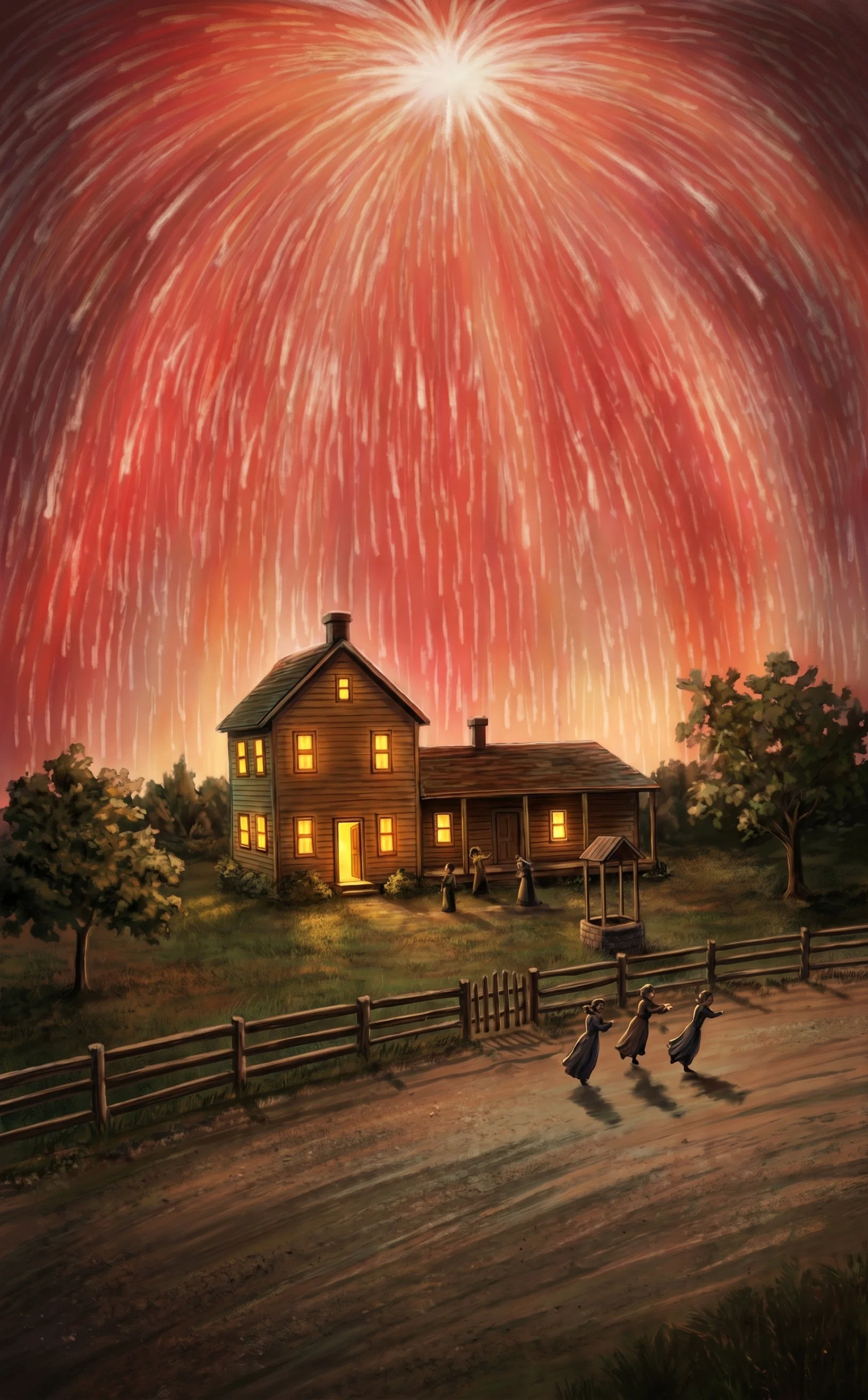
In presenting this third edition, the cuts of “wonders” seen are printed in their actual colors, which gives the reader a clearer sense of the sublime grandeur of the various phenomena. A number of new illustrations will be found in this book that were not in the two previous editions. We acknowledge with thanks those furnished by Pastors Wilcox and Shultz. J. N. LOUGHBOROUGH. Oakland, Cal., May 20, 1904.

INTRODUCTION.

PROPHECY has been defined as “history written in advance.” This being the case, and the prophecy proceeding from the divine mind—from One having power to foresee the future—the events of the real history would most surely fit the prophecy.
We may learn from the words of Christ to the apostles one object of the Lord in giving prophecy. Speaking of the things that would take place in the career of Judas, He said, “I tell you before it come, that, when it is come to pass, ye may believe that I am He.”
The Lord by the prophet Isaiah also says, “I am God, and there is none like Me, declaring the end from the beginning, and from ancient times the things that are not yet done, saying, My counsel shall stand, and I will do all My pleasure.”
Again, “I have declared the former things from the beginning; and they went forth out of My mouth, and I showed them; I did them suddenly, and they came to pass. . . . I have even from the beginning declared it to thee; before it came to pass I showed it thee; lest thou shouldest say, Mine idol hath done them, and my graven image, and my molten image, hath commanded them. Thou hast heard, see all this; and will not ye declare it? I have showed thee new things from this time, even hidden things, and thou didst not know them. They are created now, and not from the beginning; even before the daywhen thou heardest them not; lest thou shouldest say, Behold, I knew them.”
From the above language, the force of prophetic fulfilments as a proof of the divine origin of prophecy is seen, as well as its being a demonstration of the power of the Lord above all the gods of the heathen. It is also observed from these words that prophecy occupies a very important place in the Scriptures of truth. These facts being true, it is surpassingly strange that so many people give little or no attention to the study of the prophetic portions of the sacred Scriptures.
The uninformed say they are unlearned, and, therefore, can not understand the prophecies. On the other hand, many of the educated, and some of them even among the ministry, say: “The prophecies are sealed, and can not be understood. We all know that the book of Revelation is a sealed book.”
In the Revelation, the beloved John was told positively not to seal the book, and, also, in this book a blessing is pronounced upon those that “hear the words of this prophecy, and keep those things which are written therein.” How could the things contained in a sealed book be kept, which were not, and could not be, understood?
That the Lord designed the prophecies of Daniel to be understood is evident from His words to His disciples respecting the same: “When ye therefore shall see the abomination of desolation, spoken of by Daniel the prophet, stand in the holy place (whoso readeth,let him understand);” that virtually says, Understand Daniel the prophet.
A claim that prophecy could not be understood is also clearly delineated in these words: “The vision of all is become unto you as the words of a book that is sealed, which men deliver to one that is learned, saying, Read this, I pray thee; and he saith, I can not; for it is sealed; and the book is delivered to him that is not learned, saying, Read this, I pray thee; and he saith, I am not learned. Wherefore the Lord said, Forasmuch as this people draw near Me with their mouth, and with their lips do honor Me, but have removed their heart far from Me, and their fear toward Me is taught by the precept of men; therefore, behold, I will proceed to do a marvelous work among this people, even a marvelous work and a wonder; for the wisdom of their wise men shall perish, and the understanding of their prudent men shall be hid.”
Had the people to whom the prophet refers followed the sure word of prophecy, they need not have drifted away from God’s law, and substituted for His precepts the commandments of men.
It is not that prophecy has some deep, hidden, mysterious meaning that a failure is made in understanding it. The apostle Peter has said of it, and of understanding it, “Knowing this first, that no prophecy of the Scripture is of any private interpretation. For the prophecy came not in old time by the will of man; but holy men of God spake as they were moved by the Holy Ghost.”
It is plainly implied from the above language that what is most essential to an understanding of prophecy is the reception of the Spirit which spake through the prophets. Of that Spirit, promised to all who seek it, it is said, “He will guide you into all truth.”
In the study of prophecy, these facts should be impressed upon the mind; God, who is infallible, is the Author of prophecy; and when the time comes for the fulfilment of a prophecy, the very event predicted is there. Again, when the Lord’s time comes for His message of truth to go forth, the message, in His order, is unmistakably there every time. As expressed by another: “To the believer in prophecy, a false fulfilment in the time when the true one should come is an impossibility.”

CHAPTER I.

THE SECOND ADVENT.

The second coming of Christ is not only placed before us in the Scriptures as the hope of God’s people, but as the great and glorious event for which they will be found waiting and watching when it shall at last come. The apostle Paul, when speaking of this coming, said: “So Christ was once offered to bear the sins of many; and unto them that look for Him shall He appear the second time without sin unto salvation.”
When Christ is about to appear, His people are represented as responding to His declaration, “Surely I come quickly,” with the triumphant words, “Amen. Even so, come, Lord Jesus.” When He shall at last come, as expressed by the prophet Isaiah, His people will joyfully say, “Lo, this is our God; we have waited for Him, and He will save us; this is the Lord; we have waited for Him, we will be glad and rejoice in His salvation.”

NOT A FABLE.

Speaking of that event, the apostle Peter said: “We have not followed cunningly devised fables, when we made known unto you the power and coming of our Lord Jesus Christ, but were eye-witnesses of Hismajesty. For He received from God the Father honor and glory, when there came such a voice to Him from the excellent glory, This is My beloved Son, in whom I am well pleased. And this voice which came from heaven we heard, when we were with Him in the holy mount. We have also a more sure word of prophecy; whereunto ye do well that ye take heed, as unto a light that shineth in a dark place, until the day dawn, and the day-star arise in your hearts.”
In the above language the apostle refers to the transfiguration on the mount as a proof of the second coming of Christ. Previous to this scene, our Saviour had said to His apostles, “There be some standing here, which shall not taste of death, till they see the Son of man coming in His kingdom.” As recorded by Luke, He also said, “There be some standing here, which shall not taste of death, till they see the kingdom of God.”

VISION OF THE KINGDOM.

The record of the fulfilment of this promise is found in the account of the transfiguration. In this “vision” on the mount, they saw Jesus glorified, as He will appear when He comes in His kingdom. They saw Elias (Elijah), who was taken to heaven without tasting death, representing those who will be translated—changed—“in a moment, in the twinkling of an eye,” when the Lord comes. There also was Moses, one who had died, representing those who will be raised from the dead to meet the Lord. So, in this “vision”on the mount, they had a view of Christ coming in His kingdom, as He had promised them.
Though the apostles had seen this glorious sight on the mount of transfiguration, and had heard the voice of God’s approval, the apostle Peter says: “We have a more sure word of prophecy.” By this statement he is not discrediting what they saw and heard on that memorable occasion. Then they heard the voice of God only once, but in the great lines of prophecy, extending down to Christ’s second coming, we have the voice of God oft repeated. In fact, every definite prophetic prediction fulfilled, or recorded in history, is the voice of God to us. It must be in this sense that the word of prophecy is “more sure.” The Revised Version translates it “made sure.” The prophecy is made sure by every specification fulfilled. Each and every event predicted, when fulfilled, is an assurance that the remaining events will surely come.

LIGHT IN THE DARKNESS.

The apostle says we should give heed to prophecy as unto a light shining in a dark place. The purpose of a light is to dispel the darkness—when traveling in a dark place, to show the pathway—and to show the pathway clearly, that the traveler may be enabled, step by step, to see and choose the right way, the light should shine at his feet. “Thy word,” says the psalmist, “is a lamp unto my feet, and a light unto my path.” The wise man says: “The path of the just is as the shining light, that shineth more and more unto the perfect day.” Thus it is seen, inpassing down the stream of time, that the Word of God, especially in its prophetic fulfilments, will open more and yet more, making it clearer and clearer to the Bible student that he is surely in the pathway leading to the everlasting light and eternal day.
In giving heed unto the sure word of prophecy, as to a light that is to guide our steps, discovering to us the correct path through the darkness, it must be that we shall find the pathway down the stream of time to the second advent of Christ, marked out in the prophetic word. This being the case, those who follow closely the light of prophecy will not only recognize the signs and tokens that the great day is near, but will recognize also the work of the Lord as it steadily moves on in the messages of truth which are to prepare a people to meet Him in peace at His coming.

COMING AS A THIEF.

While the Scriptures declare that the day of the Lord will come upon the masses as “a thief in the night,” it also says of those standing in the counsel of God: “Ye, brethren, are not in darkness, that that day should overtake you as a thief. Ye are all the children of light, and the children of the day.”
From the foregoing quotation it may be expected that in the further investigation of this subject the pathway of the people of God down to the second advent of our blessed Lord and Saviour, will be clearly and accurately traced in succeeding chapters.

CHAPTER II.

THE DAY OF THE LORD COMETH.

IN the prophecy of Joel there are presented events which, in their fulfilment, betoken the near approach of the great day of the Lord. “Blow ye the trumpet in Zion, and sound an alarm in My holy mountain; let all the inhabitants of the land tremble; for the day of the Lord cometh, for it is nigh at hand.”
Among the events to transpire, as the great day approaches, the prophet speaks of that which he compares to the unrestrained march of a devastating army. This army the Lord designates as the locust, cankerworm, caterpillar, and the palmerworm. Before these destructive agencies come upon the land, He says, it “is as the Garden of Eden,” but “behind them a desolate wilderness.” This is undoubtedly in the time mentioned by the prophet Isaiah when he says: “The earth also is defiled under the inhabitants thereof; because they have transgressed the laws, changed the ordinance, broken the everlasting covenant. Therefore hath the curse devoured the earth.”
These visitations of the curse, as we approach the end, are the visible evidences that the earth and atmospheric heavens are waxing old as doth a garment, and that they are soon to be folded up and changed.
While the curse is thus resting more heavily upon the earth, the prophet shows that earthquakes will increase, and the signs appear which our Saviour said would show that His coming was even “at the door.” He says: “The earth shall quake before them; the heavens shall tremble; the sun and moon shall be dark, and the stars shall withdraw their shining; and the Lord shall utter His voice before His army; for His camp is very great; for He is strong that executeth His word; for the day of the Lord is great and very terrible; and who can abide it?”
In comparing the above with the language respecting the sixth seal, there is seen a striking similarity as to both the events introduced and the question raised. Here are the signs in the sun, moon, and stars; and then as the voice of God shakes the heavens and the earth, and rocks are flying in every direction, men call to the mountains and rocks, “Fall on us, and hide us from the face of Him that sitteth on the throne, and from the wrath of the Lamb; for the great day of His wrath is come; and who shall be able to stand?”
This “voice of God” before His army, which rends mountains, is in that time when the seventh and last plague is poured out, and Christ comes to a warned, yet unprepared, world as a thief in the night.
The prophet Joel proceeds to show the necessity of an earnest, humble seeking of God, a rending of the heart before Him, and that to such He will give the “latter rain” of His Spirit—the same that the apostle James declares the Lord is waiting to bestow uponHis people when “the coming of the Lord draweth nigh.” Having carried us past this “latter rain,” the prophet presents the final consummation in these words: “My people shall never be ashamed.”
The prophet then refers back to that prediction which the apostle Peter said began its fulfilment on the day of Pentecost, and carries us down to the “great day of the Lord” again. “And it shall come to pass afterward, that I will pour out My Spirit upon all flesh; and your sons and your daughters shall prophesy, your old men shall dream dreams, your young men shall see visions; and also upon the servants and upon the handmaids in those days will I pour out My Spirit. And I will show

WONDERS IN THE HEAVENS

and in the earth, blood, and fire, and pillars of smoke [Septuagint, “pillars of smoky vapor”]. The sun shall be turned into darkness, and the moon into blood, before the great and the terrible day of the Lord come.”
It appears from the order of events here introduced, that before the signs in the sun and moon, there were to be “wonders in the heavens,” and such, too, as would have the appearance of “blood, fire, and pillars of smoke.”
About the middle of the sixteenth century there appeared a wonder in the heavens that finally, in the forepart of the eighteenth century, assumed the exact appearance of that predicted by the prophet Joel. It is the aurora borealis, first seen in a fiery display in Great Britain in 1716, and in America for the first time, three years later, in 1719.From the middle of the sixteenth century there has been witnessed, from time to time, in increasing magnitude, “spears of white light in the heavens,” and “shooting stars;” but up to A. D. 1716 no fiery display is recorded.
As the first authority for these statements, a quotation is given from the Edinburg Encyclopedia, published about the year 1804. From that work we quote the following paragraphs:—
“The most unaccountable of all the circumstances respecting the aurora borealis is that it is not much more than a century since this phenomenon has been observed with any degree of frequency in our latitudes. We find, indeed, atmospheric phenomena recorded by the ancients, which may be regarded as examples of this meteor; but, with trifling exceptions, the whole of antiquity is absolutely silent on this subject.
“Dr. Halley, of London, England, informs us that he had begun to despair of witnessing this beautiful phenomenon, when the remarkable aurora of 1716 made its appearance. This philosopher has given us a historical detail of the several observations of this meteor, in which he says the first of it on record in an English work is a book entitled ‘A Description of Meteors,’ by W. F., D. D., reprinted at London, in 1654, which speaks of burning spears being seen Jan. 30, 1560. He says, in this book, that the next appearance of a like kind is recorded by Stow, and occurred on Oct. 7, 1564. In 1574, according to Stow and Camden, an aurora was seen for two successive nights,viz., the 14th and 15th of November. The same phenomenon was twice seen in Brabant, in 1575, on the 13th of February and the 28th of September, and the circumstances accompanying it were described by Cornelius Gemma, who compares them to spears, fortified cities, and armies fighting in the air. In 1580 and 1581, this phenomenon was repeatedly observed at Backrang, in the county of Wurtemberg, in Germany. But from this till 1621, we have no such phenomenon on record, when it was seen all over France on September 2, and is particularly described by Gassendi, in his ‘Physics,’ under the title of ‘Aurora Borealis.’
“In November, 1623, another was seen all over Germany, and is particularly described by Kepler. Since that time, for more than eighty years, we have no account of any such phenomenon being observed. In 1707, Mr. Neve observed one of short continuance in Ireland, and in the same year a similar appearance was seen by Roemer at Copenhagen, while during an interval of eighteen months, in the years 1707 and 1708, this sort of light had been seen no less than five times.
“The aurora of 1716, which Dr. Halley particularly describes, was remarkably brilliant. It was also visible over a prodigious tract of country, being seen from the west of Ireland to the confines of Prussia and the east of Poland, extending nearly thirty degrees of longitude [about 1,800 miles east and west] and from the fiftieth degree of north latitude, over almost all the north of Europe [about 800 miles north and south],and in all places, exhibiting, at the same time, appearances similar to those observed in London.
“It appears then to be certainly established that the aurora was of rare occurrence in our latitude till about a century ago; for it can not be supposed that so beautiful and striking a phenomenon would have passed unnoticed and unrecorded during the two preceding centuries, while men of science, and particularly astronomers, were so busily employed in examining every remarkable appearance of the heavens, or that the philosophers of Greece and Rome would have remained silent concerning so beautiful a meteor, had it been in any degree familiarly known to them. It is in vain to account for their silence by saying that they inhabited latitudes which are scarcely ever visited by these appearances, for the Romans not only visited, but long resided, in the north of Germany and Britain, where the aurora is now frequently seen in great splendor.”
The above details from the encyclopedia show that the aurora, especially in its crimson and fiery display, is of modern date.

INCREASE MATHER’S TESTIMONY.

Increase Mather, father of Cotton Mather (both eminent and learned divines of the Congregational Church, Boston, Mass.), in a book of five sermons on “Fearful Sights and Great Signs Shall There Be from Heaven,” published in 1680, made no reference in his sermons to any fiery display of aurora. He said he had searched all history, both ancient and modern.He referred to fiery comets, one of which was visible when he preached his fifth sermon. He had found in history accounts of several blazing stars, which he supposed had sufficiently the appearance at times of “blood and fire and pillars of smoke” in the heavens to be in fulfilment of the word of the Lord by the prophet Joel.
In a book published in London, about one hundred and fourteen years ago, entitled “Dictionary of Arts and Sciences,” is an account of the fiery aurora of 1716. This book states expressly that “the oldest inhabitants there, at that time, had never seen nor heard of the like before.”

J. B. FELT’S TESTIMONY.

In Dr. J. B. Felt’s history of Salem, Mass., is an account of the first appearance of the aurora in America: “The aurora borealis was seen for the first time in America, Dec. 17, 1719. It filled our country with great alarm. It was dreaded, as being the precursor of the judgment fires which were to consume the world. It had a similar effect on the people of England in 1716.”

TESTIMONY OF WILLARD’S HISTORY.

A description of the aurora borealis, on page 146 of “Willard’s Abridged History of the United States,” published in 1869, is as follows: “A phenomenon, singular at the time, and not yet satisfactorily explained, alarmed the people of New England in 1719. This was the ‘aurora borealis,’ first noticed in this country on the night of the 17th of December. Its appearance,according to the writings of the day, was more calculated to excite terror than later appearances of the same kind.”
A writer in the New York Evening Post, about the year 1864, speaking of the effect on the people of these wonderful sights in the heavens, says: “It prompts some to a more constant study of the heavens, others to a more reverent feeling of dependence upon Him by whose command all things were made that were made, and terrifying others by the threatening approach of those latter days—those times prophesied of by Joel—when wonders should be shown in the sky, and when, according to St. Luke, ‘Fearful sights and great signs’ from heaven should appear.”

AURORA IN 1789.

In a work called “Percy Anecdotes,” we have an account of the “aurora” as witnessed in Virginia in 1789: “On that day I stopped in Portsmouth to spend the evening at a house where there was a large party of both sexes. All at once our ears were assailed by loud murmurs outside. We rushed to the door, and were much astonished to find the whole population of the place in the street, the greater part of them on their knees, and uttering the loudest lamentations. Attracted by the brilliancy of the heavens, I raised my eyes upward, and observed a very vivid aurora borealis, casting its coruscations over more than one half of the hemisphere. On turning round I saw the whole company on their knees, and evidently in great trepidation. The scene was certainly awful.Toward midnight the aurora disappeared, as did the fears of the good people of Portsmouth. On crossing the ferry to Norfolk, I saw that the same species of alarm had also existed there to a considerable extent, and was happily extinguished.”
This record is of itself conclusive evidence that the aurora was a new sight to the people of Virginia in 1789.

AURORA OF JAN. 25, 1837.

In a work entitled “Modern Phenomena of the Heavens” are two accounts of the wonderful fiery aurora of Jan. 25, 1837. The first reads: “Another instance of this phenomenon was extensively witnessed in this country [America] early in the evening of Jan. 25, 1837, when, as described by many, the very heavens, for a short time, seemed to be on fire, and when the snow upon the ground much resembled blood and fire, which was so alarming in appearance as to cause the solemn inquiry with some who were out at the time, if the day of judgment had come, and also to cause the animals to tremble with fear. In one place, near a mountain, the people informed me that on the snow there was the appearance of ‘waves of fire rolling down the mountain.’”
The second statement from the above work is respecting the aurora of Jan. 25, 1837, as it appeared in the state of Massachusetts: “A clergyman of Massachusetts gave me the following account of the same phenomenon, as he and others witnessed it in one of the towns of Cape Cod, in that state. He was sittingwith another minister in the pulpit, who had just commenced a discourse on the subject of the final judgment to a crowded audience of a protracted meeting, when suddenly, through the windows, the whole house was filled with a most vivid and fiery light, so alarming in its appearance that several of the audience shrieked aloud. All was disorder and commotion. Many rushed for the doors, and all prospect for further worship, for the time, seemed to be lost, till one from without, perceiving the consternation within, forced his way through the astonished crowd, up to the desk, with an account of the aurora phenomenon, just witnessed by those out-of-doors. Then this clergyman, as he said, called attention, and informed the audience that they had ‘more cause for admiration than alarm, and that the appearance they had just witnessed was but a beautiful and unusually splendid exhibition of the aurora borealis, which the Lord had been giving them.’”
A friend has kindly furnished a picture of the house and snowy hillside in Victor, Ontario Co., N. Y., where both the friend and writer witnessed the fiery display just described.

AURORA IN LONDON, 1839.

A most graphic description of a display of the aurora, as it appeared in Great Britain, from 10 P. M., Sept. 11, to 4 A. M., Sept. 12, 1839. The account was written by an eye-witness, and published in a copy of the New York Christian Advocate and Journal, of the same year. The article was dated,London, Sept. 13, 1839, and reads: “Between the hours of ten on Tuesday night and three yesterday morning, in the heavens was observed one of the most magnificent specimens of those extraordinary phenomena—the falling stars and northern lights—witnessed for many years. The first indication of this singular phenomenon was about ten minutes before ten, when a crimson light, apparently vapor, rose from the northern portion of the hemisphere, and gradually extended to the center of the heavens, and by ten o’clock, or a quarter past, the whole heavens, from east to west, was one vast sheet of light. It had a most alarming appearance, and was exactly like that occasioned by a terrific fire. The light varied considerably; at one time it seemed to fall, and directly after rose with intense brightness. There were to be seen with it volumes of smoke, which rolled over and over, and every beholder seemed convinced that it was a tremendous conflagration.
“The consternation in the metropolis was very great. Thousands of persons were running in the direction of the supposed awful catastrophe. The engines belonging to the fire brigade stations in Baker Street, Waterloo Road, Watling Street, Farringdon Street, and likewise those belonging to the West London station,—in fact, every fire engine in London,—was horsed, and galloped after the supposed scene of destruction with more than ordinary energy, followed by carriages, horsemen, and vast mobs. Some of the engines proceeded as far as Highgate and Holloway before the error was discovered. The appearances lastedfor upward of two hours, and toward morning the spectacle became one of more grandeur.
“At two in the morning the phenomenon presented a most gorgeous scene, and one very difficult to describe. The whole of London was illuminated as light as noonday, and the atmosphere was remarkably clear. The southern hemisphere at the time mentioned, although unclouded, was very dark, but the stars, which were innumerable, shone beautifully. The opposite side of the heavens presented a singular but magnificent contrast. It was clear to extreme, and the light varied and was very vivid. There was a continual succession of meteors, which varied in splendor. They appeared in the center of the heavens and spread till they seemed to burst. The effect was electrical. Myriads of small stars shot out over the horizon, and darted with that swiftness toward the earth that the eye could scarcely follow the track. They seemed to burst also, and to throw a dark crimson vapor over the entire hemisphere. The colors were most magnificent. At half past two o’clock, the spectacle changed to darkness, which, in dispersing, displayed a luminous rainbow on the zenith of the heavens and round the ridge of darkness that overhung the southern portion of the country. Soon afterward columns of silvery light radiated from it. They increased wonderfully, intermingled among crimson vapor, which formed at the same time, and, when at full height, the spectacle was beyond all imagination. Stars were darting about in every direction, and continued until four o’clock, when all died away. During the time that they lasted, agreat many persons assembled on the bridge over the Thames, where they had a commanding view of the heavens, and watched the progress of the phenomenon attentively.”
Various indeed have been human speculations as to the cause of the aurora, or northern lights. After advancing different theories, all are obliged to admit “the cause is unknown.” In the face of this, the student of the prophetic word declares: “This phenomenon is produced by the direct power of the Lord in the fulfilment of His prediction made through the prophet Joel [Joel 2:30], and is a sure token that we are nearing ‘the great and terrible day of the Lord.’”

AURORA OF NOV. 14, 1837.

“Years of observation, covering many countries and embracing all zones and latitudes, give no record of any display of auroral glories equal in sublimity and magnificence and extent to the aurora borealis of Nov. 14, 1837. . . . So extensive was this magnificent celestial phenomenon that it exhibited its wonderful splendors contemporaneously to the inhabitants of Europe and America. . . . It was such a sight as fills the mind with wonder and awe; and in America, at least, was the most marvelous of the kind ever known.”—From “Our First Century.”

CHAPTER III.

THE JUDGMENT MESSAGE.

Under the symbol of three angels’ messages, there is introduced in the book of Revelation a threefold warning, which is followed by our Saviour’s coming to reap the “harvest of the earth.” In the public ministry of Christ, our Lord gave a parable in which he presented not only the seed sowing and the growth of the plants, but also the final “harvest.” In explaining this parable to His disciples, He told them distinctly that “the harvest is the end of the world,” thus showing that these three messages not only immediately precede the end of the world, but that they contain the truths which are to “ripen” the harvest of the earth,—the one class for the heavenly garner, and the other for the winepress of the wrath of God.
The first of these messages proclaims the “everlasting gospel.” It is not the work of literal angels visibly to preach the gospel to men, but to minister to those “who shall be heirs of salvation.” In the case of the devoted Cornelius, to whom a glorious angel appeared, it was not to communicate to him the simplest fact of the gospel even, but to tell him where one of God’s chosen ministers was, who could and would teach him the truth.
Our Saviour committed the preaching of the gospel to men, and to those faithful in their commission is still His assurance, “Lo, I am with you alway, even unto the end of the world.”
These angelic messengers of revelation are regarded as symbols of messages of truth to be proclaimed by men to this last generation. While the visible workers are men, angels, who “desire to look into” the truths of the gospel, camp about those who, in the fear of the Lord, proclaim His Word.
It is not a new gospel that is to be proclaimed to the last generation, but the same “everlasting gospel.” In the first of these three messages, however, there is, connected with the proclamation of the gospel, a new reason assigned why men should yield obedience to the Lord. It is found in these words: “For the hour of His judgment is come.” When the apostle Paul stood before Felix and “reasoned of righteousness, temperance, and judgment to come, Felix trembled!” His trembling, undoubtedly, would have been much greater had the message been: “The hour of His judgment is come.” This first angel’s message does not say the judgment is coming, but “the hour [period] of His judgment is come.”
Such an announcement could only be made at a time when the judgment is actually to begin. If men are to give such a message to their fellow men, the Scriptures must contain a line of prophetic truth, and a prophetic period leading down to the session of the judgment. Do the Scriptures contain such a period? —They do, or men could never, from the Scriptures, give such a message. That period of time is the 2,300 days, leading down to the cleansing of

THE SANCTUARY.

The work of mediation in the earthly sanctuarywas a representation, in figure, of the real work of Christ, the true High Priest, as He pleads before His Father, in the heavenly sanctuary, for those who, with truly contrite hearts, confess their sins to Him. First, as in the typical service, there is a pardon for the repentant believer; and in the closing of the service (cleansing of the sanctuary), a blotting out of sins, which blotting out is a final decision of the cases of the righteous. In the type, the sins blotted out one year were remembered again the next year, because the blood of beasts did not actually take away their sins. In the blotting out to be accomplished by Christ, the sins of His people will be remembered no more. So this final work of Christ, as the true High Priest, in blotting out the sins of God’s people—the cleansing of the heavenly sanctuary—must be the passing of judgment on their cases.
Continue reading: CLEANSING OF THE SANCTUARY.