Your ShelfYour Projects

Review and Herald, Vol. 86, No. 35.

Christ's Commission

Review and Herald

Sep 2, 1909

Review and Herald Publishing Association · Takoma Park Station, Washington, D. C. · Sep 2, 1909

Christ's Commission

The Spirit of the Lord Jehovah is upon Me; because Jehovah hath anointed Me to preach good tidings unto the meek; He hath sent Me to bind up the broken-hearted, to proclaim liberty to the captives, and the opening of the prison to them that are bound; to proclaim the year of Jehovah's favor, and the day of vengeance of our God; to comfort all that mourn; to appoint unto them that mourn in Zion, to give unto them a garland for ashes, the oil of joy for mourning, the garment of praise for the spirit of heaviness; that they may be called trees of righteousness, the planting of Jehovah, that He may be glorified.”— Isa. 61 : 1-3, A. R. V.

THE WORK — AND — THE WORKERS

THE Upper Columbia Tract Society recently sent in a list of 102 yearly subscriptions for Liberty.
THE Southern California Tract Society sends in an order for 1,000 copies of the September Life and Health.
THE missionary secretary of the Indiana Conference, R. C. Spohr, sends in a rush order for 1,000 copies of Liberty.
NORTHERN ILLINOIS sends its first order for 2,000 copies of the September number of Life and Health. This conference purposes to use 5,000 of the September issue.
B. C. HAAK, missionary secretary of North Dakota, says: “Heretofore our people had nothing prepared for them to do. Now we have work, and are learning how to do it, and the Lord is truly blessing us in our missionary efforts, and we feel thankful for a part in giving the message.”
A WORKER in New Zealand, in ordering the Protestant Magazine, has the following to say about the Sabbath School Worker: “I prize the Sabbath School Worker more and more each month. Its articles on general Sabbath-school work are helpful in conducting Sabbath-school, and are also useful in instructing our young people who are just beginning to assume responsibilities of offices in our Sabbath-schools. The thoughts expressed on the lessons from week to week are also much appreciated.” Thousands of others are expressing as strongly their appreciation of the Worker. All Sabbath-school workers and teachers should have it. It is a valuable help.
To any one who wants a good, serviceable Bible—as good as any other Bible, or better—we recommend the “Open Flat Bible,” handled by the Review and Herald Publishing Assn., Takoma Park, Washington, D. C. This Bible is of a desirable size, 5½ x 8 x ⅞ inches outside of cover. It opens perfectly flat and easily, on account of the way in which it is bound. It has the best India paper, large, bold-face minion type; chapters numbered by books; complete center references; chapters numbered consecutively throughout the entire book, making it as easy to find a certain chapter as it is to find a page of a book. It is self-pronouncing and silk-sewed. It weighs only eighteen ounces. It is cheaper than any Bible of a similar style. It is in every way desirable and durable. Handled in only three styles: A, $4; B, $5; C, $6. Liberal discounts to agents. Write for circulars and full description.
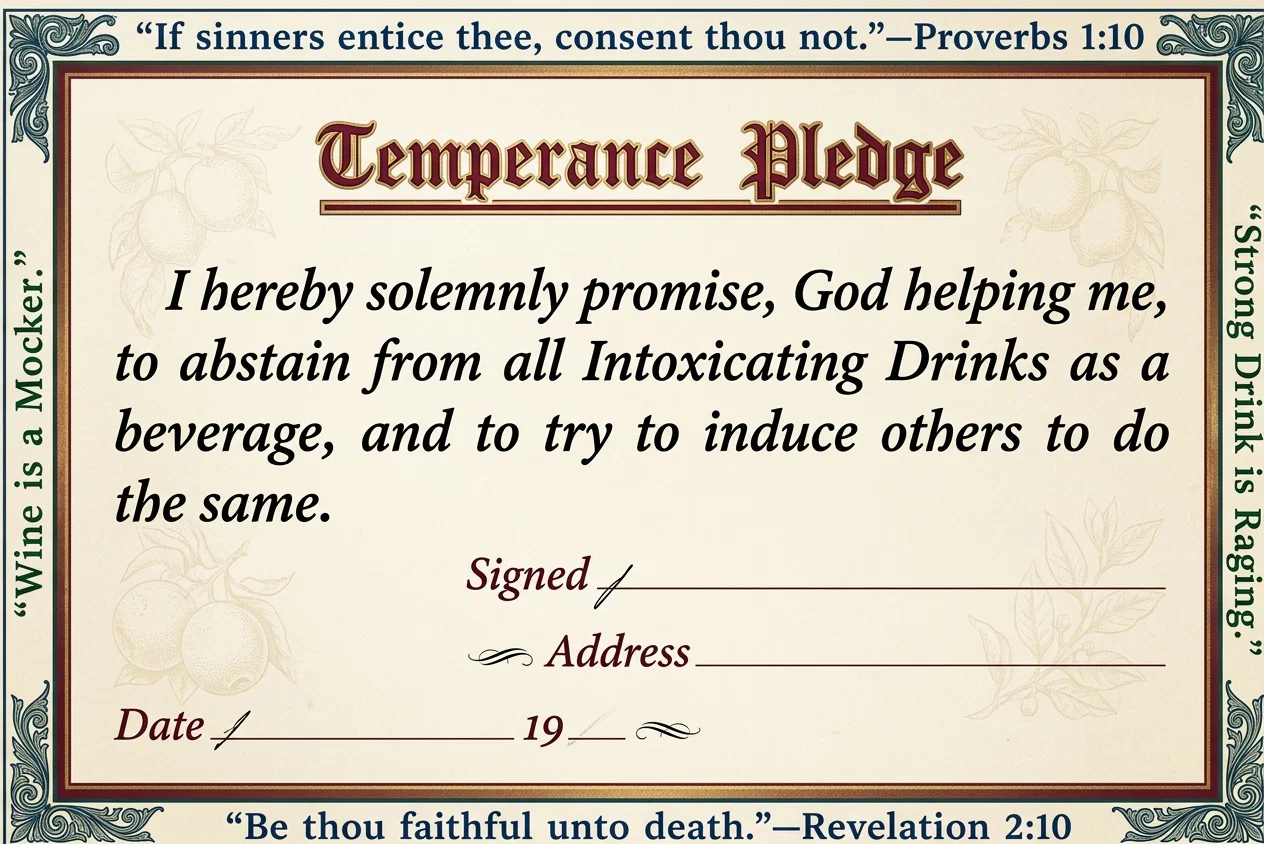
A facsimile of the Review and Herald Temperance Pledge card. Prices: 1 cent each, or 75 cents a hundred
T. D. GIBSON, missionary secretary of the Northern Union Conference, writes that the missionary work in his field is going away beyond the bounds of anything they have seen for some time.
A SISTER in Minnesota, who had never attempted to sell any of our papers, a few days ago went into the country. She called at sixteen houses, and sold ten copies of the Temperance number of the Youth’s Instructor. This is a splendid beginning—it is only a beginning for this sister, she having thus early and promptly decided to make paper selling a part of her regular business.
A LADY student attending the University of California sends two yearly subscriptions for the Protestant Magazine, and requests that she be allowed to act as agent for the same. She says: “A copy of your magazine came to me last week. I read every word of it, and know from my studies that its history is right, and its conclusions in regard to the present intentions of the Jesuit church are true. I am so much in accord with your work that I should like to be a worker. I enclose two subscriptions.” As a class, university students are quite generally opposed to the dogmatic claims and theology of the Roman Catholic Church. Wyclif, Huss, Jerome, Luther, and the other leading Protestant Reformers were all strongly supported by the student bodies of the English, Bohemian, and German universities. We suggest that our conference tract societies lay plans to enlist the co-operation of their churches in mailing a sample copy of this excellent magazine to every college and university student within their territory. The magazines may be ordered in quantities at the following rates: 5 to 20 copies, 5 cents each; 25 to 400 copies, 4 cents; 500 to 800 copies, 3½ cents; 1,000 or more, 3 cents. The postage will cost our missionary societies two cents a copy in addition to the above rates. If preferred, however, we will address and mail the magazine from this Office, to five or more separate addresses, at the rate of five cents a copy. The names and home addresses of the students will generally be found in the college or university calendars. The faculty of each institution should also be supplied with copies.
ALL are pleased with the beautiful photo-effect produced on our September cover. Have you seen the September Life and Health? In contents and appearance it is ahead of all previous numbers.
NUMEROUS pastors of Lutheran and other Protestant churches have hastened to send us their congratulations on the excellent appearance and timely contents of the Protestant Magazine.
Two lady agents visited the periodical department recently to secure a few “pointers” for selling Liberty. They will visit a number of the great cities of the East, selling the magazines. They ordered fifteen hundred copies of Liberty and Life and Health.
THE following letter is just received. We give it as a sample of many that come to us: “Find enclosed $1, for which please send me copies of the Protestant Magazine. I find that this magazine sells readily, is read with interest, and is greatly appreciated by the people.”
DAISY M. BUTKA, of Omaha, Neb., began work with Life and Health last May. She sold 500 of the May number, and 1,000 each of June, July, and August. Of her work, she says: “I have ordered of you, 3,500 copies of Life and Health since May 15. Of this number, 2,500 have been placed in the residences of Omaha, and the remainder in the business portion of the city. I believe much more good can be accomplished by placing them in the homes of the people than in any other way. I average about 60 sales a day in resident work, and 100 a day in the business portion of the city. The work from house to house is harder than work in the business portion of a town, but God has given me strength to work every day during this long, hot summer.” The sale of this large amount of good literature, with the average of $4.20 profit a day in selling our periodicals from door to door, is large enough to cause many of our people to think seriously of their privileges and opportunities to do a similar work.
IRA S. JONES, of Toronto, Canada, in sending in seventy-one subscriptions for the Protestant, says he finds that people in Canada subscribe readily for the Protestant Magazine; that the same dangers threaten true Protestantism there as in the United States; that not only does open opposition attack from without, but Higher Criticism in many places is insidiously honeycombing the structure of Protestantism. Its baneful seed has taken root, and a less sharper instrument than the Protestant Magazine would fail in uprooting the evil planted in the hearts of honest people. It is being steadily demonstrated that the Protestant Magazine is as much in demand in other countries as it is in the United States.

The Moravians and the Pirate

Prayer a Defense and a Weapon

A PARTY of Moravian missionaries was sailing toward St. Thomas, in the West Indies, by the ship “Britannia.” In those days the southern seas were infested with pirates. One day a pirate ship bore down upon the “Britannia.” Though poorly equipped for defense, all hands were called to prepare to resist. The Moravian missionaries, however, having no thought of bearing arms against an enemy, retired to the cabin and sought God to intervene to spare human life and to enable them to carry the gospel message to a dark and waiting land. The Moravian records show how God did interpose not only to deliver, but to bear such witness to at least one wicked man that it led to reformation of life:— The pirate ship approached till it came within gunshot of the “Britannia,” and then from the cannon ranged along its deck, began to pour out a heavy fire. They also got ready their grappling-irons, evidently intending to come on board to do their work of destruction. The moment the pirates threw their grappling-irons across toward the “Britannia,” their own ship was tossed violently by the waves, and the men who held the ropes were thrown headlong into the sea. Vexed with this disaster, the pirate captain sent others, who shared the same fate. Seeing he could not succeed in this manner, he fired his guns, but, strange to say, the balls missed the “Britannia” and fell harmlessly into the sea. The smoke of the frequent discharges was very dense, and hung about the vessels for some minutes, hiding them from each other’s view. At last a sudden gust of wind cleared it away, and, to the amazement of the pirate captain, the “Britannia” was seen at a distance, with all her sails set, and speeding swiftly away from the attack! The pirates gave up the chase as hopeless, feeling perfectly confounded with their want of success. The missionaries regarded this deliverance as a direct answer to prayer, but the sequel was even more remarkable than the incident itself.
Five years afterward, during which the missionaries had been faithfully preaching the gospel in St. Thomas, they and the other brethren on the island were assembled together to celebrate the anniversary of their escape from the pirates. As they sat together, word was brought that a stranger wished to speak to them, and, at their permission, a tall man entered, with fine, bold features and a pleasant expression of face. He inquired if they were the missionaries who came to the island in the “Britannia” five years before.
“We are,” replied the brother whom he more particularly addressed.
“And you were attacked upon the sea by pirates?” “Exactly; but why are these questions proposed?”
“Because,” answered the stranger, “I am the captain who commanded the pirate ship which attacked you, and the miraculous way in which your vessel escaped was the cause of my own salvation from the power of sin through faith in Christ.”
The stranger then proceeded to relate how, on making inquiry, he was led to the conclusion that it was through the prayers of the missionaries that the “Britannia” escaped, and was consequently induced to attend a place of worship, where he was converted from the error of his ways.
“And thus,” said he, in conclusion, “from a pirate captain I am become a poor sinner, justified by the grace and mercy of Christ, and my hope has been that I might some day be able to find you, and relate to you my miraculous conversion. This joy is granted to me to-day.”
Skeptics are inclined to scoff at such accounts, but those early Moravian missionaries, unemotional and grave, and simple in their lives, which they readily risked without thought of danger or of praise, were not the men to make up stories of missionary adventure.
W. A. S.

Interpreting Prophecy

A DOUBT has been cast over the certainty of any interpretation of prophecy by the reckless speculations of the visionary expounders of the prophetic utterances. Instead of studiously comparing scripture with scripture, and thus establishing a sound basis for the correct interpretation of symbolic prophecy, some of these versatile thinkers weave the whole fabric of exposition out of their own imagination, and, when the logic of events proves that they are mistaken, they simply substitute another pattern for the old one, and present a new combination of predictions to the public. And yet prophecy was given in order to disclose future events, not to hide them from our understanding; and the key to prophecy is to be found in the Bible itself, not in the human imagination. This will be more evident if we consider some of those prophecies the meaning of which is unfolded by inspiration. We will therefore note several leading ones.
The dream of the great image (Daniel 2) is clearly interpreted, and outlines the whole prophetic field. The only symbol not here explained (the stone) was already familiar (Gen. 49: 24; Isa. 28: 16; Ps. 118: 22), and could therefore be readily understood.
Nebuchadnezzar's dream of the tree (Daniel 4) is fully explained, and the application is fearlessly made. The same is true of the handwriting on the wall (Daniel 5), and the speedy fulfilment of the predicted overthrow of Babylon followed.
In Daniel's vision recorded in the seventh chapter of the same book, altogether new symbols are introduced, but their meaning is given, and the prophetic vocabulary is thus further increased. In the vision of the eighth chapter some new and some familiar symbols are employed, and there is a combination of literal and figurative language, but the interpretation of the vision immediately follows. Here, then, in this one book of Daniel are five prophecies given in symbols and afterward fully interpreted.
But this is not all. The “mystery of the seven stars” and of the “seven golden candlesticks” (Revelation 1) is just as clearly explained, and the woman seen sitting upon the scarlet-colored beast (Revelation 17) is declared to be “that great city, which reigneth over the kings of the earth.”
These seven prophecies with their authoritative interpretations furnish a basis for general prophetic interpretation, and supply the key for unlocking other important prophecies. The intelligent use of this key will result in opening portions of the Scriptures otherwise closed to us, and will prevent those fantastic expositions which have brought a reproach upon even the legitimate study of prophecy.
When we consider what a large proportion of the Bible consists of prophetic utterances of one kind or another, we can more fully appreciate the importance of rightly understanding these divine messages. In the words of T. R. Birks, the English writer:—
From the first promise in Eden, down to the last message of inspiration in the Isle of Patmos, the word of prophecy has been commended to the church for her devout and prayerful meditation. It has been a light shining in a dark place, until the day dawn, and the Day-star arise in the heart. . . . The words of St. Peter [2 Peter 1:21] show clearly the sin and danger of a contented ignorance of the divine prophecies. For then they must cease to fulfil their designed office; they are a beacon no longer. The very light which has been given to direct our hopes is obscure in darkness. Our indolence or pride will have made void one of God's most precious gifts to his church; and will expose us, like the Jews of old, to the danger of stumbling in darkness, or of fighting against the revealed purpose of the Most High. But these words also teach us the need of a connected and patient study, that we may attain a true knowledge of these prophetic revelations.
Many prophecies are finding their fulfilment in this generation, and it is therefore especially important that we should have a clear and correct understanding of them. This can be obtained by careful study, following the lines already established by divinely revealed interpretations.
W. W. P.

The Two Covenants

The Difference

How simple and direct are the Lord’s definitions! For instance, when he defines for us the essential difference between the old covenant and the new, he states it clearly in few words as follows:—
“Behold, the days come, saith the Lord, that I will make a new covenant with the house of Israel, and with the house of Judah: not according to the covenant that I made with their fathers . . . but this shall be the covenant, . . . I will put my law in their inward parts, and write it in their hearts.” Jeremiah 31.
A second time Inspiration repeats the distinction:—
“I will make a new covenant with the house of Israel and with the house of Judah: not according to the covenant that I made with their fathers. . . . For this is the covenant that I will make with the house of Israel after those days, saith the Lord; I will put my laws into their mind, and write them in their hearts.” Hebrews 8.
This is the Lord’s way of stating the difference. And it makes a vast difference to us, too, whether we have God’s law written only in the Bible or on tables of stone, or whether we have it written in the heart. Only the power of God can write it there. And only as the heart is surrendered in repentance and faith can the accompanying provision be realized: “I will forgive their iniquity, and I will remember their sin no more.”
W. A. S.

National Reformism Self-Expounded

A Warfare Against the Nation’s Fundamental Principles

Over and over again at this institute at Winona Lake, Ind., is heard the declaration, “We are as much opposed to a union of church and state as any one can possibly be;” but over and over the declaration is positively contradicted by the teaching of every speaker in the institute. The speakers give their own definition of a union of church and state, and then oppose the seeming substance of the mythical definition.
Said Dr. J. S. Martin, general superintendent of the National Reform Association: “While I am opposed to the union of church and state, I am just as much opposed to the actual divorcing of the state from religion. You can put the same principle into the two institutions without uniting the two institutions at all.” And for the people who listened to this declaration, that settled the matter. But the church is religion personified, religion in action. Religion is the church’s very life and breath. Take religion out of the church, and you take the soul out of the body. A church without religion is only a society, a club, a lyceum. Then to take that which is the breath, the life, the soul, of the church and unite it with the state is to unite the church and the state as truly as union can be formed between any two things; and this fact is made more apparent when we consider another fact, that which is this: When religion is united with the state, the church, which is the visible expression of organized religion, proceeds at once to dominate the state in all its functions; for who but the church can formulate the religious principles which are to be united with the state? The church considers itself in a position to give expert advice upon religious matters. The church, under such an arrangement, determines for the state what is religious and what is irreligious, and therefore what the state must do and what it must not do to have its acts harmonize with its religious profession. That puts every act of the state under the direct supervision of the church; and as the leaders of the church are the ministers, that gives us a government by the ministers for the church, instead of a government by the people for the people. That puts us back to the colonial days of Massachusetts and Virginia, with the church in the governmental saddle, riding roughshod over the rights and the consciences of the people. They did it in the New England theocracy and in Virginia and other colonies; and the closer the union between religion and the state, the lower sank the individual conscience and the individual’s rights in the eyes of the rulers, and the higher mounted the domineering oppression of that heaven-dishonoring political arrangement.
That the exponents of this method of governing the people are willing to act in the capacity of spiritual advisers and directors to the government is clearly shown in the following declaration of Dr. J. S. Martin:—
It is “up to us” to say what the religion of this country shall be. In a country where the majority of the people are Christians, it seems to me we must decide in favor of the Christian religion.
That is in perfect keeping with the declaration made by another National Reformer:—
Our remedy for all these malefic influences is to have the government simply set up the moral law, and recognize God’s authority behind it, and lay its hand on any religion that does not conform to it.—Rev. M. A. Gault.
This is the logical outcome of the other, and this is what they did under the theocratical governments of the American colonies. Every religion but theirs was out of harmony with the law of God, as they interpreted it; and they laid their hands on it most vigorously. It was “up to” them to say what the religion of the state should be, and they said it. The majority of their descendants are ashamed to-day of what those guardians of the state’s religion said, and of the manner in which they put it into force with the pains and penalties that always accompany such a régime. But the National Reform Association is reaching far back into American history and dragging out of its grave the skeleton of that fearful false theocratical system, clothing it again with flesh and blood, and seeking to breathe into it the breath of life, that it may go forth again to wither and blight and trample on and destroy the most sacred rights of human beings. It was buried when the national Constitution was adopted, but the National Reform Association does not propose to let it stay buried, nor to let the great Constitution which accomplished its death retain the vigorous and righteous principles which accomplished that result. Said Dr. J. S. McGaw at this institute:—
Our political creed is Christian, and the Constitution should express it.
If the political creed of this country is Christian, and the Constitution is so altered as to express that political Christian creed, what have we but the establishmentof the Christian religion as the religion of this nation? There can be no avoiding the issue; the result of the National Reform Association’s policy will be to unite church and state in this country, establish the Christian religion as the law of the land, throw to the winds the constitutional safeguards of the rights of conscience, and make a sacerdotal government the overlord of every man’s religious belief.
If it is, as Dr. Martin declares, “up to” them to say that the Christian religion shall be the national religion in this country, it is equally their prerogative to say what branch of the Christian religion shall be thus recognized and established. If the right be granted to establish religion, the right to define that religion can not be denied. Upon such a hypothesis, we find ourselves at once confronted with an established church and religion enforced by law. That is what threw the shadow of sorrow, oppression, and death over the Old World for twelve centuries; and it is to that we must attribute the religious despotism which held sway in America during the first years of her history.
They profess to see no danger in the program outlined. A Baptist in the audience at the forenoon session on August 17, when an invitation was given to all to ask questions, asked Dr. Martin this question: “Where are you going to put on the brakes in the matter of state religion?” Dr. Martin replied:—
I stated the other day that just as Christianity itself gives us the man who is most thoughtful and most considerate of the rights of his fellow men, so would the Christian state be most thoughtful and most considerate of the rights of the individual. If the state accepts the religion of Jesus Christ as its religion, and seeks to be governed by the will of God, you can safely trust that state. I have never found it necessary to put any brakes on the true Christian religion. I am free to admit that you will find some difficulty in administering the affairs of the nation upon that basis; but you will find difficulty in administering the affairs of any country. I think you will find less difficulty in administering on the Christian basis than on any other. I am not afraid of persecution or infringement upon the rights of individual citizens under a Christian administration.
The state would have to be the interpreter of the law of God as it applies to men, and it might make mistakes. They have been made in the past; but on the whole, I think that is the best we can do.
With such a position every student of history must disagree, and no lover of Christian liberty can accept such a premise. There is a vast difference between a Christian man living the principles of his religion among his neighbors, but powerless to enforce his principles upon them, and a state with an established religion interpreting “the law of God as it applies to men,” and then enforcing its interpretation of that law.
The professed Christian is not always as considerate as he ought to be of the rights of others in matters of religious faith and practise; and no state with an established church has ever shown a clean record in the matter of consideration for the rights of men in that regard. Find a state that is legally joined to religion (and it matters not which dominates the other, the church or the state), and you find a state that is utterly unable to look with impartial eyes upon all its subjects in matters of conscience. This unfair treatment of men has been a characteristic of every nation of the world that has made alliance with any religion in the world; and the better the religion, the more that mesalliance has crushed the consciences and seared the souls of men; for the nearer true the religion, the stronger the hold it obtains upon the consciences of individuals, and the more cruel becomes the work of the state in enforcing its religious requirements.
Every church that has thus been appropriated by the state, or that has thus appropriated the state, has declared itself to be the possessor of the true Christian religion. The fact that the organization thus clothed with authority was unchristian was quickly shown by its unchristian treatment of any and all who differed from the religio-political creed of the nation where such an arrangement obtained. Mr. Martin declares that a state which joins itself to religion would be “most thoughtful and most considerate of the rights of the individual.” Such a union was most perfectly consummated in the days of papal Rome; but thoughtfulness and consideration for the rights of the individual were never more completely lost sight of than during the period when that arrangement was most perfect.
They had such a union in its perfection in the days of the New England theocracy and in early Virginia, and in neither place was the happiness, the property, or even the life of the individual secure unless he was a member of the religious-state organization. “You can safely trust that state,” says Dr. Martin. You can trust it to do certain things, and one of those things is to prescribe the religious faith and practise of all its subjects, and to compel compliance with its prescription; but trust it with its subjects’ right of conscience,—never!
Dr. Martin has “never found it necessary to put any brakes on the true Christian religion.” But brakes are put upon the true Christian religion wherever that religion has been joined to the state and put under the restraint of a political creed. Wherever religion is made a matter of statutory law, a brake has been put upon it, for religion loses its very essence whenever it is legally enforced. The life is gone, and only the shell remains.
What the doctor meant, however, was that he had no fears that the true Christian religion united with the state would ever trespass upon the rights of any; and that, therefore, with such a combination there was no necessity of any restriction whatever. The voice of our brothers’ blood cries from the ground in warning protest against the adoption of any such dangerous practise. It is always the party in power under such a government that possesses the “true Christian religion.” You can prove it by them; and as they possess “the true Christian religion,” all who differ from them are in serious error, and ought to be corrected for the sake of their souls’ eternal welfare. Being the party in power, it becomes their bounden duty to make the needed correction in the heretical individuals, for there is no one else to do it. No religion in the world when united with any governing power in the world is a safe custodian for the consciences of men. In so far as religion and political power are united, religion becomes drunken with power, and politics parades in the garb of hypocrisy. Each trespasses upon the rights of the other, and both trespass upon the rights of individuals. As a result of this all-round trespass, religious ritualism runs its colors to the masthead, a premium is set upon hypocrisy, and the best men and women in the country are oppressed in conscience and despoiled of their rights. This is the invariable teaching and the inerasable record of all history. God holds each individual accountable for his own choice; and he who attempts to choose for another in religious concerns and enforces his choice upon that other, interferes with the whole plan and purpose of God’s government; and that is what is done wherever state and religion unite.
The theories propounded at this institute are diametrically opposed to every fundamental principle of the nation, revolutionary in purpose, and partaking in no degree whatever of that great balancing principle known as the golden rule. The leaders are willing that Seventh-day Adventists and Seventh-day Baptists “be allowed” to keep the seventh day; but offer no word of regret that Sabbath-keepers are compelled to lose one of the six working-days, and are thus deprived of one sixth of their earning capacity. They call that simply a “civil disability,” which we ought to endure willingly for conscience’ sake. There is with them no suggestion even of that apologetic half-way house of “exemption clauses.” Rest on Sunday, or take the consequences, is all they have to offer.
C. M. S.

The Great Commission

One of the last charges Christ gave his disciples before his ascension was, “Go ye into all the world, and preach the gospel to every creature.” To whom does this great commission apply? It has been accepted for ages that this charge to preach the gospel to every creature was intended for the church of Jesus Christ. It does not apply simply to the ministry, but the responsibility of giving the gospel to the world lies with the church militant.
In demonstration of this responsibility, when the day of Pentecost had fully come, the Holy Ghost, which descended upon the church, did not rest upon the disciples alone, but upon all those who were gathered together in the name of Christ. In commenting upon this outpouring of the Holy Spirit, the apostle said that it was in fulfilment of the prophecy of Joel, when he said: “And it shall come to pass in the last days, saith God, I will pour out of my Spirit upon all flesh: and your sons and your daughters shall prophesy, and your young men shall see visions, and your old men shall dream dreams: and on my servants and on my handmaidens I will pour out in those days of my Spirit; and they shall prophesy: and I will show wonders in heaven above, and signs in the earth beneath; blood, and fire, and vapor of smoke.”
From this prophecy, there would seem to be no distinction between the clergy and the laity. It is clearly specified that the Holy Ghost is to rest upon all flesh; that the sons and daughters shall prophesy; that young men shall see visions, old men shall dream dreams, and “on my servants and on my handmaidens,” saith the Lord, “I will pour out in those days of my Spirit; and they shall prophesy.” This means that the Holy Spirit was to equip the church for evangelistic work. When Christ said to his disciples, “Go ye into all the world, and preach the gospel to every creature,” it was a great commission given by God to his people to preach the gospel everywhere. If the church says that it can not go, that it has duties that will not permit it to go, and if it be true that only a few of those who have been set apart to the ministry are to go to all the world and preach the gospel, we may well ask, What means the prophecy of the Word and the history of the church?
Why should the young men and the young women be filled with the Holy Ghost if they are not to do service in the world for Christ? As a denomination, we profess to be giving a message to the world that will prepare a people to stand when Christ comes. We understand that this message is to go to every nation and kindred and tongue and people. If this interpretation of the message of Revelation 14 be true, there is a great and mighty work to be done before the close of probation.
The great mass of humanity lies in the great heathen nations of the world. Idolatry, ignorance, and superstition reign almost supreme among this people. If the message must go to all the nations of the world, it must reach many of these benighted souls. But how can the third angel’s message go to these heathen lands unless some of God’s children are willing to take it? If the hardships of the way, the poverty and ignorance of the people for whom we should work, are a barrier against our going, we inquire, Who will “go” to do our work?
When Christ would have his disciples preach the gospel, he said to them, “Tarry ye in the city of Jerusalem, until ye be endued with power from on high.” God has never sent men to work in his vineyard without first giving them the strength to work. When God commands the missionary to go into the field, it is God’s part to fill that messenger with the Holy Spirit, that he may accomplish the work to which he has been sent. We can not conceive that God would send any one to do a specific work for him without first giving both the wisdom and the strength for the accomplishment of his work.
When God called Moses from the sheepfold of Jethro, his father-in-law, to be his messenger to Pharaoh, king of Egypt, Moses said unto God, “O my Lord, I am not eloquent, neither heretofore, nor since thou hast spoken unto thy servant: but I am slow of speech, and of a slow tongue. And the Lord said unto him, Who hath made man’s mouth? or who maketh the dumb, or deaf, or the seeing, or the blind? have not I the Lord? Now therefore go, and I will be with thy mouth, and teach thee what thou shalt say.”
When men undertake to do God’s work in their own strength, they generally fail. Israel surrounded the city of Ai contrary to God’s command, and in their zeal determined to overthrow the city, but they were powerless to accomplish this task. When the men of Ai came out against them, Israel fell by the sword and were slain. But when in obedience to Jehovah’s command, Israel surrounded the city of Jericho, the walls of that city fell at the very shout of his people.
God supplies the wisdom and the strength for those whom he has called to his work, that they may receive from him grace and help in every time of need. Surely, with a message to go to all the world in this generation, there must of necessity be some one whom God has prepared for the fields already whitened for the harvest. Those whom God has called will have his blessing in their work, if they go in the name of Jehovah to do his bidding.
God sent the Macedonian cry from all the great nations of the world to this people during our last session of the General Conference. There was scarcely a heathen nation in the world that did not send in most earnest petitions for trained workers, for new recruits, and for financial help to establish schools and printing plants, and to supply the necessary facilities for the advancement of the third angel’s message. Surely this is the day of God’s preparation; this is the day when God calls his people to quicken their steps in giving this message to all the world, and there should not be one soul from one end of the land to the other that does not respond to the call of God and to the needs of this work. If we expect the baptism of the Holy Spirit, it must be received by our consecrating ourselves for service to God, and the power received be used for the advancement of God’s work in the earth.
It is time for God’s people to pray for the outpouring of the Holy Spirit; but when this prayer is fulfilled, it means that we must give of our lives in whatever capacity God may call us, in the great work of saving souls. The next four years should see hundreds of recruits sent into the foreign fields, and especially into the heathen lands.
I. H. EVANS.
Continue reading: The “Big Stick”