Among the numerous ills for which liquozone is an “unfailing cure,” is that common and distressing malady, “malaria.” But “unfortunately,” says Mr. Adams, “the writer of the liquozone pamphlet, and the experts who edited it, got a little mixed on their germs in the matter of malaria. ‘Liquozone is deadly to vegetable matter, but helpful to animals,’ declares the pamphlet. . . . ‘Germs are vegetables’—and that is the reason that liquozone kills them. But malaria, which liquozone is supposed to cure, is positively known to be due to animal organisms in the blood, not vegetable. Therefore, if the claims are genuine, liquozone, being ‘helpful to animals,’ will aid and abet the malaria organism in his nefarious work, and the Liquozone Company, as well-intentioned men, working in the interests of health, ought to warn all sufferers of this class from use of their animal-stimulator.”
In the later advertisements of liquozone ‘the old claim is repeated that nothing enters into the production of liquozone but gases, water, and a little harmless coloring matter, and that the process requires large apparatus and from eight to fourteen days’ time. I have seen the apparatus, consisting of huge wooden vats, and can testify to their impressive size. And I have the assurance of several gentlemen whose word (except in print) I am willing to take, that fourteen days’ time is employed in impregnating every output of liquid with the gas. The result, so far as can be determined chemically or medicinally, is precisely the same as could be achieved in fourteen seconds by mixing the acids with the water. The product is still sulphurous and sulphuric acid heavily diluted, that is all.”
The Subtle Poisons
There remains to be considered one other class of compounds of the patent-medicine variety,—the dangerous powders and other preparations which are sold in enormous quantities as cures for headache, catarrh, depression, etc., and operate through the presence of some dangerous drug, like acetanilid, opium, or cocain. These are the worst sort of patent medicines, the most deceptive in character and the most deadly in their effects.
Mr. Adams prefaces his observations on this class of nostrums by a death list of twenty-three persons who fell victims to patent medicines containing acetanilid, some “from an alleged overdose, others from the prescribed dose.” “This list of fatalities,” he states, “is made up from statements published in the newspapers. In every case the person who died had taken, to relieve a headache or as a bracer, a patent medicine containing acetanilid, without a doctor’s prescription. This list does not include the case of a dog in Altoona, Pa., which died immediately on eating some sample headache powders. The dog did not know any better.”
Two more paragraphs from Mr.12Adams will be all that space will permit in this article:—
“Ignorance and credulous hope make the market for most proprietary remedies. Intelligent people are not given largely to the use of the glaringly advertised cure-alls, such as liquozone or peruna. Nostrums there are, however, which reach the thinking classes as well as the readily gulled. Depending, as they do, for their success upon the lure of some subtle drug concealed under a trade-mark name, or some opiate not readily obtainable under its own label; these are the most dangerous of all quack medicines, not only in their immediate effect, but because they create enslaving appetites, sometimes obscure and difficult of treatment, most often tragically obvious. Of these concealed drugs the headache powders are the most widely used, and of the headache powders orangeine is the most conspicuous.
“Orangeine prints its formula. It is, therefore, its proprietors claim, not a secret remedy. But to all intents and purposes it is secret, because to the uninformed public the vitally important word ‘acetanilid’ in the formula means little or nothing. Worse than its secrecy is its policy of careful and dangerous deception. Orangeine, like practically all the headache powders, is simply a mixture of acetanilid with less potent drugs. Of course, there is no orange in it, except the orange hue of the boxes and wrappers which is its advertising symbol. But this is an unimportant deception. The wickedness of the fraud lies in this: That whereas the nostrum, by virtue of its acetanilid content, thins the blood, depresses the heart, and finally undermines the whole system, it claims to strengthen the heart and produce better blood. Thus far in the patent-medicine field I have not encountered so direct and specific an inversion of the true facts.”
(Concluded next week)
Open the Door!
Open the door, let in the air;
The winds are sweet, and the flowers are fair.
Joy is abroad in the world to-day;
If our door is wide, it may come this way.
Open the door!
Open the door, let in the sun;
He hath a smile for every one.
He hath made the raindrops gold and gems.
He may change our tears to diadems.
Open the door!
Open the door of the soul; let in
Strong, pure thoughts which shall banish sin.
They will grow and bloom with grace divine,
And their fruit shall be sweeter than that of the vine.
Open the door!
Open the door of the heart; let in
Sympathy sweet for stranger and kin.
It will make the halls of the heart so fair
That angels may enter unaware.
Open the door!
— British Weekly.
They Are Children
Don’t expect too much of them, for it has taken you forty years, it may be, to make you what you are, with all your lessons of experience, and we dare say you are a faulty being at best. Above all, don’t expect judgment in a child or patience under trial. Sympathize with the children in their mistakes and troubles; don’t ridicule them. Remember not to measure a child’s trial by your standard. “As one whom his mother comforteth,” says the inspired writer, and beautifully does he convey to us the deep, faithful love that ought to be found in every woman’s heart, the unfailing sympathy with all her children’s griefs. Let the memories of their childhood be as bright as you can make them. Grant them every innocent pleasure in your power. It has often roused our indignation to see how carelessly their little plans were thwarted by older persons, when a very little trouble on their part would have given the child pleasure, the memory of which would last a lifetime. Lastly, don’t think a child hopeless because it betrays some very bad habits. We have known children who seem to have been born thieves and liars, so early did they display these most undesirable traits of character, yet we have lived to see them become noble men and women, and ornaments in society. We must confess they had wise, affectionate parents. Whatever else you may be compelled, by your circumstances in life, to deny your child, give it what it most values, plenty of love.—Golden Rule.
A Successful Life
REAL success in life—not perhaps what the world would call success, yet which commands a tribute of honor from all classes—is within the reach of all. To be successful is to be useful, to be helpful to others. The comments called forth by the recent death of Mr. S. H. Hadley, in New York City, reveal the truth of this statement. We quote the following from the Washington Times:—
“S. H. Hadley was at one time a degenerate gambler and bum of the lowest type. He drifted into Jerry McAuley’s mission one night, and was converted. The submerged wreck of a noble manhood was rescued, a perverted spirit regenerated, a chilled heart warmed and thrilled.
“He gave his life to helping debased men and women. He never asked, ‘Are you worthy?’ Where help was needed, he gave it. The reformation came later. His sympathy and love gave him influence over men. It was not what he said, but what he was that made every distressed heart tired of life turn to Hadley for comfort.
“They buried him only a few days ago. The services were held in the dingy old mission. But it was one of the most notable funerals ever held in New York. The tenderloin was there in tears. But uninvited came,—John H. Huyler, the candy manufacturer; R. Fulton Cutting, head of the Citizens’ Union; William T. Wardell, of the Standard Oil Company; W. M. Smith, W. E. Lougee, M. Linn Bruce, S. W. Bowne, A. N. Ryerson, M. Hartley Dodge, C. F. Tietjen, and B. De F. Curtis, all men of wealth,—and they wept with the bums of the Bowery, for everybody seemed to love Sam Hadley.
“There is inspiration in the life of Hadley. And there is inspiration in the tears of the mourners; in the fact that it brought a lump into the throat of most men when they read it; in the fact that the press is philosophizing over it, and the pulpit moralizing; in the discovery that we all have hearts, and that deep down under our cloak of commercialism there is a spirit of admiration for goodness and cleanness and purity of life that almost amounts to covetousness.”
Counting for More Than One
A WOMAN whose home duties were insistent was bewailing her comparative uselessness when it came to church work, or indeed any work outside of her own home. “I go to church—when I can,” she said, rather ruefully. “Even then all I can do is to count for one. I can’t do anything.” The wise woman who was listening answered of her wisdom: “Nobody ever counts for just one; you count for everybody you can influence. One is a force and center of power in proportion to the number of people he can influence. Count for one, indeed! I happen to know that you counted for six people in church this very last Sabbath. It was rainy, you know, and we were all in slippers and easy-gowns, John and I and all three of the girls. ‘There!’ said I, as you passed the window, ‘if that woman can manage to get her work out of the way and go this rainy morning, I won’t listen to any excuses from the rest of you!’” “O, yes,” put in the other, blushingly, “I remember all about it! I had sixteen minds about going out in the wet, but Benny was at home with his lame knee,—you know he got hurt at football,—and he said, ‘Mother, you can go just as well as not. I’ll look after the babies.’ So I went, for I thought there would be a slim houseful such a rainy day, and I’d count for one anyway.” “Just so!” nodded her friend smiling. “And you counted for six instead! We made just a good seatful. It was funny to see the minister’s look of astonishment when we all filed in. I had the greatest mind to get up and say ’twas all your doing.”—Congregationalist.
The Great Eternal Will
“THERE is nothing we can not overcome;
Say not thy evil instinct is inherited,
Or that some trait inborn makes thy whole life forlorn,
And calls down punishment that is not merited.”
“Back of thy parents and grandparents lies
The great eternal Will. That, too, is thine
Inheritance, strong, beautiful, divine;
Sure lever of success for one who tries.”
Wholesome Food and Tuberculosis
The importance of wholesome food in combating tuberculosis is dwelt upon in The Dietetic and Hygienic Gazette (New York), in the following words: “Many people owe to . . . dyspepsia the lowered vitality which made possible the successful tubercular infection. While we plead for good tenements, while we strive to control the infection of air and dust, and demand the destruction of all sputum of all infected people in a community, let us bear in mind that people not yet infected, and people in whom infection has occurred but is held in check by present physical vigor, need from every etiological consideration of tuberculosis painstaking care of the digestive system; and for this purpose good cooks are better than druggists.”
Attitude of Rulers in China Toward the People
By H. W. Miller
H. W. MILLER
WHILE we have no reason to doubt the interest of the emperor and empress dowager in the citizens of their kingdom, still their interest is more than counteracted by the local ruler, whose desire is to make the people his servants, instead of his being the servant of the people. The tax required by the throne would not be at all unreasonable, and large sums of money are constantly dispensed for the public benefit; but the chief ruler is too far from the people.
Every city has a ruler who is an autocrat in himself. Of him the emperor requires a certain amount of money, depending on the size of the district he governs. The local ruler requires of the people more than twice this amount of taxes, and appropriates the larger half for himself, thus reducing the farmers to such a close margin that they scarcely live from one season to another. No one is ever consulted as to the right or wrong. What the mandarin does is always right, and the people know better than to ever refuse any of his demands.
Three years ago the emperor issued a decree throughout the empire that the mandarin in every city should provide a free school at the government's expense. A school was started in nearly every city, but the mandarin soon appropriated these funds for his own use, and the school ceased. The people know where the defect is, and take no interest in their government or country. It has become a matter of living with them. For this reason it would be difficult for China to raise up a loyal army. A revolutionary army could much easier be set in operation. The governments of China and Russia are very similar. It does me good to talk with the farmers, as they come in to buy medicine, and be able to tell them of the plan of God's government. They know what is right and just, and there is a chord in their hearts that responds to truth.
The rulers do not receive their position by merit, but by “cash” (Chinese money), and they expect to get their money back during their term of office. The entire nation is permeated with this principle. It is even so in the matter of the post-office. There was a man in this city who wanted to be postmaster, and was about to buy his position, when it was discovered, and our postmaster was retained.
The Christian denominations are trying to make this form of government help in preaching the gospel. They have secured a large donation from the empress for a Christian medical college. They have all combined, and are making an effort to get the chief rulers to recognize Sunday. The post-office department observes Sunday. If Christianity has to descend to the people through the decrees of the rulers, I do not have much faith in their evangelizing China very soon. This is Sunday, and the mail-carrier just brought me a letter from Dr. Selmon's14station. I asked him if he did not know that this was Sunday. “Yes,” he said, but the distance was so long he would rather take two days than one in which to walk it.
The latest decree that has come from the empress is that schools shall be established in every city, with a foreign instructor to teach Western learning. Well, the school started here with a Chinese teacher in charge who knows nothing about foreign countries except that there are such countries. It is not held on Sunday. There were two students here to-day. They said there was no school to-day. I asked why not. They said “Kuei-chi”—that's the custom. All the pupils, as well as the teacher, are heathen, the greater portion never having heard of the true God.
They use this day for gambling. Union of church with state is the same in any government. But perhaps in no government does it look so ridiculous as in China. Our Christian friends claim that these are great evidences of the evangelization of China; but it is the best method Satan could devise of dishonoring God, and of making it difficult for the servants of God to reveal the true light. It will not be long until China will be declared a Christian nation, on the ground that she observes Sunday. The government schools and post-offices already observe the day. But to us here in the interior, it is a great object-lesson to see the difference between man's ways and God's ways. When we see these things coming, should it not be an object-lesson to us all, and inspire us to put forth every effort possible to send workers to these needy fields? Time is growing short; the nations are going to close their doors quickly. Should we not begin in earnest, by God's help?
Honan.
The Work in India
By C. A. HANSEN
C. A. HANSEN
RAILWAY STATION, BOMBAY
IN the great city of Bombay we have represented nearly all classes of society. It is a great manufacturing center, having one hundred large factories. It is also the seaport of nearly all India. Here are the wealthy Parsees; there are about fifty thousand of them. They are the descendants of the ancient Persians, and are fire-worshipers. Among this influential class we have not at present one Sabbath-keeper. There are only six Parsee Christians in Bombay, and we are giving studies to one of them, who is much interested. Unfortunately, he is deaf, and it is with difficulty that he takes part in our meetings. When I give him studies, he reads the Scripture, and I write the explanation; on the whole this is not so difficult a task as one might think. When the Spirit of God is present, there is liberty. The Parsees make it very hard for any one who leaves their belief (it does not deserve the name of religion). I talked with another Parsee, who has had no work for fourteen months because he is a Christian. He seemed very glad to see me, and I gave him some tracts. He said he had been thinking about the second coming of Christ a great deal.
One poor Hindu who is taking readings from us was threatened with imprisonment by his own people when they learned of his reading the Christian Bible—all because he owed a few rupees, and was not ready just then to pay. He comes regularly seven miles to get his studies; last week he was very down hearted, and when I opened the Bible, he said: ‘O, I can’t study to-day; I have just come to bid you good-by. The police will wait for me till I return.’ So after we took in the situation, we told him that God could reverse things if he saw it was for his good, and after prayer for his deliverance he arose, saying his load seemed only one half as heavy; and when he returned home, he found that he was released. Thus we see how Satan hates to have the name of Christ spoken in this land of superstition, darkness, and suffering. Our hearts yearn for the time when we shall have hundreds of missionaries among this Indian people. What is needed is means to carry on this work of love for those who are so unfortunate as to have been rocked in an Indian cradle and dedicated to gods of fire and torture in place of to our loving Saviour.
We are glad for an opportunity of planting in Bombay the banner of the third angel’s message, remembering that a long eternity will well repay any sacrifice for the cause of God.
The Preaching of the Gospel
“How shall they hear without a preacher? and how shall they preach, except they be sent?” Rom. 10:14, 15.
“THE Lord hath anointed me to preach good tidings; . . . he hath sent me to bind up the broken-hearted, to proclaim liberty to the captives.” [Isa. 61:1.
The Meeting at Alexandrodar
By Ludwig R. Conradi
L. R. CONRADI
Immediately at the close of the services in Petersburg, Sunday, October 15, Elders Gaede and Wildgrube, and Brother Ising and myself, took the train for Alexandrodar, in the Caucasus, about fourteen hundred miles to the southeast. We had a nice tourist sleeper from the capital until we reached Moscow, where we arrived Monday evening. All seemed quiet here. The next day two of our party had the misfortune, while out buying supplies for the lunch basket, to get left behind, so I had to make the rest of the trip alone. In spite of the slowness of the trains, as they take not less than eighty-four hours to make this trip, our train was behindhand, so I reached Rostov several hours late, and barely had time to catch my train for the latter part of the journey. I found the cars overcrowded. It was my third night out, and I could get no good place to sleep until toward morning; so I fell soundly asleep, and when I awoke, it was daylight. I quickly packed my things. The train came to a standstill, and I inquired what station it was. I was informed that it was Boguslawskaja, the place where I wished to leave the car. It was a long train, and our car was near the rear, away from the station building, so I could not see the name. As I got out, the train pulled off. I then discovered that I had been misinformed, and that it was still fourteen miles to my destination. The station-master kindly allowed me to telephone to our brethren, so they would continue to wait for me at Boguslawskaja. Three hours later a freight-train came along, full of military reserves, but the last car, where the officers were, was third-class. The station-master told me to go back there, and try to get in to ride on to my destination.
As I entered the door, I found a sol- dier with planted bayonet, who asked what right I had to get into that car. I referred to the station-master's recommendation, and by the time the captain made his appearance, the train was already in motion, so it was too late for any remonstrance, and I must remain until the next stop. The captain and I entered into an animated conversation in French, and, as we were nearing Boguslawskaja, the captain told me that although it was against the law for any one to ride with a military train, yet he was glad to have met me. It was from him that I first learned that the entire Caucasian district had been placed under martial law, and that all the reserves had been called out, and even the married men had been suddenly marched off from farm and shop without even bidding good-by to their loved ones. As the men were not the best provided with food supplies, they demolished the restaurants in several stations, to get whisky.
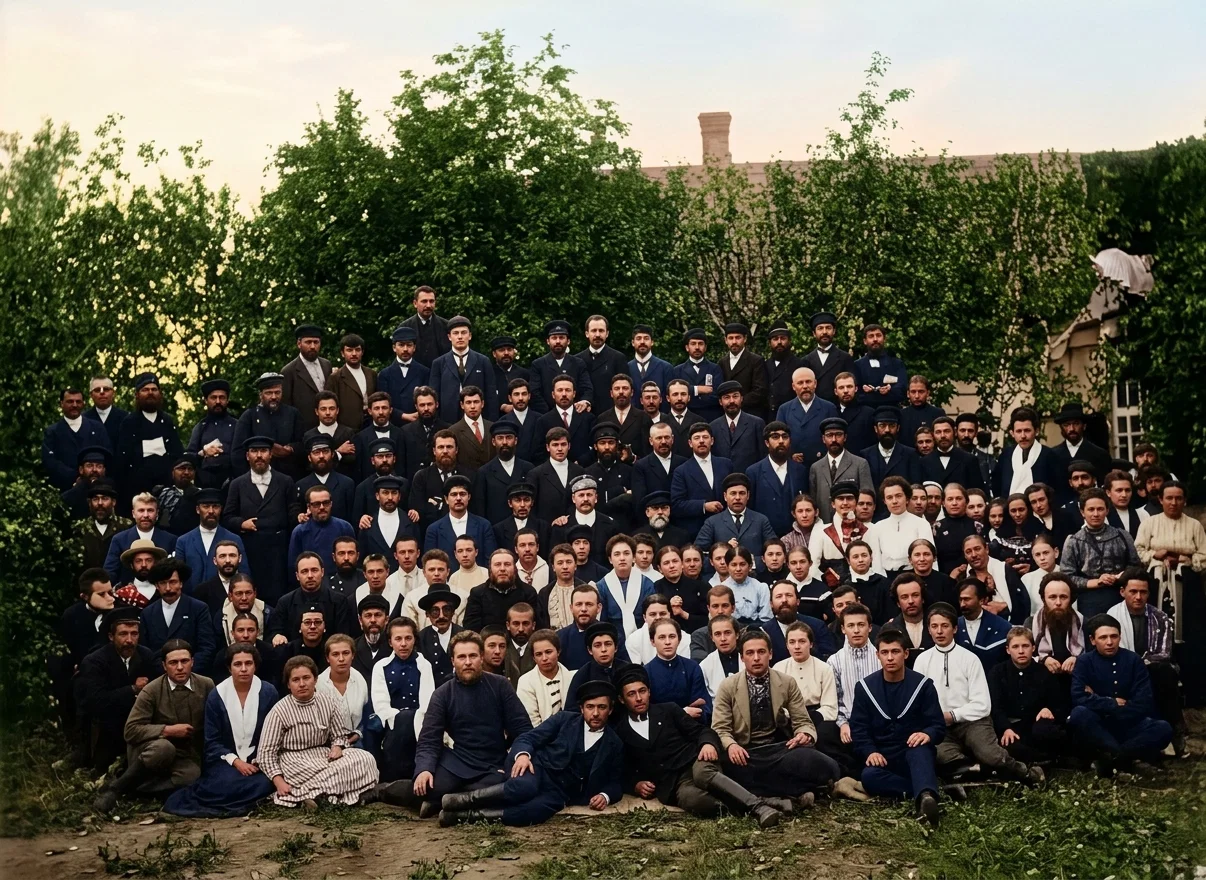
When I reached Alexandrodar, I found the meeting already in progress. The citizens of the two colonies had loaned lumber for the erection of a temporary booth, which comfortably seated the two hundred German and one hundred Russian delegates from the Volga and the Caucasian regions. (From the Azov region north of the Black Sea there was no delegation, as that part of the South Russian Conference was later to have its own local meeting, to form a new field—the South Russian Mission—to date from January, 1906.)
A GROUP AT THE ALEXANDRODAR MEETING
Among the Russian delegates there was a good representation of the native Russian churches in this field (the Russian members have heretofore belonged to the Middle Russian Mission). There were a few delegates from a Russian company of about twenty members, south of Baku, on the Caspian Sea, near the Persian border, in the territory belonging to the German Union District. There were also brethren present, sent by the German company at Suchum-Kale, a port on the Black Sea, south of the Caucasian Range.
The South Russian Conference to-day has about nine hundred and fifty members; the formation of the South Russian Mission from its territory will take from it about two hundred members; but it must not be forgotten that under the new arrangement the Russian Sabbath-keepers living within its borders will become members of the conference, so it will have practically the same membership after the division is made that it has now.
We had experienced considerable opposition among the Russian Sabbath-keepers in the Caucasus with regard to the tithing system. As for years the existing laws made it dangerous for the Germans to meet with the Russians, our ministers could visit the native brethren but very little, and they naturally kept aloof, and many of the Russians seemed opposed to uniting with the Germans in conference membership. Indeed, there was one man present in whose house an opposition meeting had been appointed, to be held a week after ours. As this was my first opportunity to meet openly and freely with our Russian believers, I gave them time for three meetings daily, Brethren Wildgrube and Perk acting as15interpreters. They had opportunity to state their objections, all of which I noted down. But instead of answering them in detail, we began to present to the people from the Bible the principles governing all these questions. As we set forth the tithing system, traced it back to Abraham's time, showing it to be a matter of faith and belonging to the Melchizedek priesthood, the Spirit sent conviction, and by Friday many began to make confessions, and others were glad to confess their mistake on Sabbath, during our experience meeting; and by Sunday morning, when the vote was taken, all the Russian delegates present desired to unite fully with the German Conference. I had also clearly set forth the principles of unity, as given in the epistle to the Ephesians.
We were pleased to have with us Elder D. Isaac, whom the brethren heartily welcomed to his new field in Russia. Elder H. J. Loebsack was again unanimously chosen president of the South Russian Conference. The other members of the committee are H. K. Loebsack, M. Fischer, J. Wuckart, and A. Gondar. At this meeting, we also passed resolutions of thanks to the Russian czar for the freedom which we now enjoy.
The evening meetings being visited by many of the German colonists, we conducted the services for the Russian brethren in a large room near by, and in this manner we accommodated about four hundred persons at these services. This was the largest and best meeting we ever had in Russia. Our collection for the German East African Mission on Sunday amounted to twenty-five dollars; the Sabbath-school collection was about fourteen dollars. Three were baptized at this meeting, among them one of the leading ladies in the colony.
The territory of the East Russian Conference, as the South Russian Conference will be called after Jan. 1, 1906, will extend north of the Caucasus, and up both sides of the Volga River as far as Orenburg, containing about fifteen million people. There will be two ordained ministers, two licentiates, a Bible worker, a nurse, and six canvassers in this district the coming year.
Our meeting closed the evening of the twenty-fourth. We then had but little idea that the trains had stopped running in all parts of Russia outside of the Caucasus district; the only peculiar thing we had noticed was that we did not receive any mail.
In our parting meeting every one praised God for the wonderful liberty enjoyed, and that for the first time Russians and Germans were permitted here to unite in full harmony, their voices praising the Lord.
Hamburg.
Adventist Work in Ecuador
By T. H. Davis
Ecuador
GUAYAQUIL.—Since Brother Casebeer's arrival, we have been conducting meetings in one of his rooms. The editor of one of the leading dailies has put in two notices of our meetings, without charge. He offers to help us in this way.
We are about to enter the rainy season, so we all expect to visit a cooler part of Ecuador, inside of a few weeks. Brother and Sister Casebeer are doing well with the language, and can now make themselves understood. After the rainy season, we expect to return, and follow up the interest begun.
We are in need of a small press, to print tracts, and perhaps a paper a little later. We have the donation started here, and are writing to our friends to help us. We are so far from the States and from Chile that it is very unhandy to get the desired reading-matter. Once a week we have a study on the prophecies with a few interested ones, who seem to take a great interest.
Yellow fever is prevalent here of late, and there are two or three deaths each day. Smallpox also takes off the same number daily. The Lord be praised for keeping us in good health.
At the last congress a bill was passed that all business must be closed on Sundays. So you see that freedom is having its limits here as elsewhere. May the Lord soon finish the work on the earth, is our prayer. T. H. DAVIS.
G. M. BROWN
By G. M. Brown
Mexico
TACUBAYA.—We had an excellent meeting yesterday, when we celebrated the ordinances with the little church here. Ten of the nineteen members are away from the city, having moved to different parts of the country to help establish the work, but those who are left are of good courage. Two Mexican sisters who have been coming to our Sabbath-school for some time, arose, and expressed their wish to unite with the church. So far as I know, no one had ever spoken to them about it, and it was a surprise to us all. We called a little after-meeting, and talked with the sister who has always been a Catholic, and she seemed to be ready for the step, according to the unanimous opinion of our church committee. I am going to her home to-day to talk with her two grandsons, who also desire baptism. They are quite young boys. The other lady is a Baptist, and has been a Protestant for some time.
We have sent Brother and Sister Godinez to San Luis Potosi to help Dr. Erkenbeck, who is opening up a medical mission at that place. Dr. Fattebert has changed his location in Celaya, and is now registered. Brother Caviness is still at Torreon. They have organized a Sabbath-school of thirteen members, and the number will soon be increased16to seventeen, as Brother and Sister Colunga are going to move there with their family. This brother took one hundred and four subscriptions for the paper last month, besides his other sales.
G. M. BROWN
The Groaning of the Prisoner
“He hath looked down from the height of his sanctuary; . . . to hear the groaning of the prisoner; to loose those that are appointed to death.” Ps. 102: 19, 20.
Central America
By H. C. Goodrich
BELIZE, BRITISH HONDURAS.—I am glad again to report a little progress. The influence of our good meetings at the time of the week of prayer still grows. The Belize church is engaging in mission work. Two at Manatee, where we went last month with the dory, have asked for baptism. Four persons about forty miles up Belize River have asked for baptism, and to have preaching in their town. To the Lord be the praise.
If I am not disappointed again, I expect to go to the Bay Islands, starting to-morrow. Yellow fever is still at Puerto Cortes, and along the railroad. H. C. GOODRICH.
Argentina
By J. W. Westphal
LOS TOCAS.—The work is moving forward here. New ones are accepting present truth, and new interests are springing up. Thank the Lord, every field of South America is being entered, although one of them only by a colporteur. The laborer in Paraguay has been ordained, and another young man will soon be with him to assist in the work. Elder McCarthy will make Uruguay his permanent field of labor. Then we shall have an ordained minister in every republic except Bolivia, and in several of them we shall have more than one. Good news comes from nearly all. In Paraguay, where only a few had begun to keep the Sabbath, nine began during the last few months. New provinces in the older fields are also being entered with encouraging results. We have every reason to look up and be encouraged. J. W. WESTPHAL.
Malay Straits
By G. F. Jones
SINGAPORE.— We are glad the work is making progress everywhere. We are reaching the goal; that is why the battle is becoming severe. Formerly the focusing was in other directions, but now there is a united focus on the message of the third angel. It is a wonderful privilege to have a part in bearing this message to the world, and to hold up the banner of truth. And it is a cause of rejoicing to know that by some wonderful way of the Lord the work will be finished in a little while.
One of the present wonders to me is how the Lord causes us to find the very ones who are looking for our message. We find first one, and then another, who have a willing mind and humble spirit. We are not moving rapidly, but growing firmly. We would like to see the work go faster here, but I am comforting myself that the Lord is giving us as many as we can faithfully attend to at present. More witnesses are needed in every district throughout the earth.
Our Australian brethren are becoming alive to the need, and even the little children have promised to support a church-school teacher in Singapore. So we expect more workers before long.
G. F. JONES.
Southwestern Union Conference
By George A. Irwin
As previously announced, the meeting of the Southwestern Union Conference was held at Keene, Tex., February 1-10. There was a large attendance both of delegates and of our lay brethren, and a good interest was manifested throughout the session. The meetings were held in the church which has recently been erected at Keene, although it was in an unfinished condition. The brethren had made an earnest effort to complete the church building before the conference convened, but owing to unavoidable delays, it was only enclosed.
The time each day was fully occupied with business meetings and Bible studies, and church services were held every evening. The reports from the various State conferences showed a healthy increase in the work during the past biennial period. This was especially noticeable in the reports from Arkansas. The official reports of the officers of the local conferences showed that the finances were in a good condition.
The membership of the entire Southwestern Union has now reached about four thousand. Separate days were devoted to each department of the work, thus giving ample time for the consideration of each branch.
The school at Keene gave every evidence of being in a prosperous condition. It was reported free from debt. It has a good attendance, the interest is excellent, and the future prospects for the school are very encouraging. Prof. C. B. Hughes was unanimously re-elected principal for the coming school year, and but few changes were made in the faculty.
The canvassing work and the circulation of our literature received quite careful consideration. Brethren Harrison and Ford were present to represent the Southern Publishing Association.
The medical missionary work also came in for a due share of consideration. Dr. Green, after giving a very interesting report of his work in Little Rock, Ark., made an earnest appeal for help to enlarge the sanitarium work in that city. Dr. Ross represented the medical work in Keene and Cleburne.
The last session of the conference was set apart as a memorial service in behalf of Elder Nelson, the former president of the union conference, and Elder Ryles, a colored minister. This was a very touching occasion. The tributes of appreciation rendered by the brethren in memory of Brother Nelson were many. He will long be remembered by those with whom he was associated, as a most faithful laborer in the Master's vineyard. A number spoke also in behalf of Elder Ryles, telling of his consistent Christian life, and of how sadly he is missed by the colored people.
The election of officers resulted in the choice of Elder C. Santee for president of17the union conference. The election was unanimous, and he will doubtless receive the support of the entire conference.
Elders Russell, Tait, and Haffner, Dr. Froom, and the writer were the laborers present from outside the Southwestern Union. Elders Russell, Tait, and Haffner rendered valuable assistance both in the preaching services and in counsel, and Dr. Froom gave some excellent talks in regard to the health work. Taken as a whole, the meeting was a success, and the brethren went away full of hope and courage. I believe that better days are in store for the Southwestern Union Conference. A spirit of loyalty to the General Conference and to the third angel's message in its entirety was manifested.
One thing impressed me very much at this meeting, and that was the interest taken in the work for the colored people in this union conference. This is the only mission field the conference has, and it is certainly a large one. We bespeak an interest in the prayers of all the brethren in behalf of this needy field.