ON our first page is a cartoon by an artist who for years has been connected with a great daily, and has furnished political cartoons, and cartoons portraying the times, which have been published and copied far and wide. This artist is a student of world-conditions from a religious outlook. He has been studying for a long time the church federation question and he has sent us, unsolicited, the cartoon on our cover-page. Cartoons generally exaggerate by making more prominent some already prominent feature; but in principle they are often strikingly true. Is this the case with Mr. Maybell's cartoon on church federation? It is a serious question; church federation is a living issue to-day.
Protestant Federation.
The great meeting held in New York City, Nov. 15 to 21, 1905, so fully reported in this journal, and the subsequent progress made in the general indorsement of that movement, demonstrate federation to be one of the great tendencies in the religious world of to-day. At that meeting was organized the National Federation of Churches, among the objects of which is the unifying of the efforts of the church in "all great movements" that make for righteousness. Among the things which make for righteousness are mentioned the question of saloons, marriage and divorce, Sunday desecration, the social evil, relation of labor to capital, moral and religious training of the young, and the concentration upon these of the united and concerted action of the church.
At that conference were represented twenty-eight of the great Protestant denominations of the country. President Roosevelt expressed "his highest sympathy with the movement;" and, showing that he considered it a movement toward national Christianity, he stated: "It is perfectly possible that the movement may have very considerable effect in the Christianizing of Japan, which I feel to be retarded by the divisions among ourselves, and by the failure to recognize the fact that the Christian church in Japan must of course assume essentially a Japanese national form." Enthusiastic leaders in the movement have rejected the word "evangelical" so as to include all the religious forces in the movement, and they look not simply for county and state and national federation, but to international federation. Over and over it was stated in the great conference that the object of the federation was to make the united church felt in civic and political matters; as Bishop Goodsell stated it: "A church of many votes is sure of respectful interest." It was stated again and again in that convention, and it has been manifested in local matters in various parts of the country, that to this federation Roman Catholics were welcomed. While there was decided objection to Unitarians uniting with the federation, there is no objection to Roman Catholics, as they are considered Trinitarians. The same tendency has also been shown in the steady drift of Protestants toward ritualism. It would have been tantamount to a dismissal from the ministry a few years ago for a Presbyterian pastor to seek and obtain the blessing of Cardinal Gibbons upon a cross presented to a pupil of the Presbyterian Sunday-school of Washington Heights, D. C. Cardinal Gibbons, of course, blessed the cross. Instances are on record of Protestants dedicating their churches to saints, praying to saints, setting apart some particular day in honor of the saint to whom the church is dedicated. The tendency in the Protestant church to the keeping of traditional holy days is also shown; and the demand for a union of church and state, which is a peculiarly Catholic custom, has been growing for years among Protestants, and centering around the Sunday question; and the Sunday question itself is becoming not simply a local matter, but a state-wide, nation-wide, world-wide affair and even cropped up at the Peace Conference at The Hague.
Catholic Federation.
The next year, July 29 to Aug. 1, 1906, was held another federation meeting. That was for the purpose of the federation of all the Catholic societies of America into one body. With the same identical purpose as that of the Protestant federation, of making the Catholic Church felt regarding social and political evils, marriage, divorce, corruption in politics, and the Sunday question. In their objects they declare that "religion is to be fostered and inculcated in every department of education from the lowest to the highest." "We wish to make Christian principles to rule everywhere in the state, in business, in labor unions, in all the civic, social, financial, and industrial relations of men."
The official communication of Cardinal Merry del Val, conveying the pope's blessing upon the convention, states, "Finally, to endeavor to renovate public and private life in conforming with the teachings of Jesus Christ." Of course this means the teachings of Jesus Christ as interpreted by the Roman Catholic Church. This Federation of Catholic Societies declares that it is not connected with any political party. On the other hand, they state, "Yet we can not, and shall not, keep away from politics." They will work for the common good, but where "Catholic interests, religious and civil, are greatly affected," the whole power of the federation will be used to promote those interests. The objects are identical in both federations.
President Roosevelt.
It was President Roosevelt who expressed his "highest sympathy with the movement" for Protestant federation of churches, and it was President Roosevelt who addressed the Catholic Convention at Detroit the same year in these words: "I believe most heartily in the work you are doing in your American Federation of Catholic Societies." The Catholic Union and Times of Aug. 2, 1906, stated: "Federation is a magnificent organization that is bound to root out prevailing and ruling national evils; a patriotic undertaking in which Catholic and non-Catholic may join hands." It was the Protestant federation in New York City who voiced their earnest and ardent desire to unite their combined forces with that of the Roman Catholic Church; all of which shows very clearly that the purposes of the two are identical.
Differences Between the Federation.
There is this difference, however: in the Protestant is the spirit of compromise. Just as soon as the Protestant ground is forsaken, of the Bible and the Bible alone as the norm of faith, Jesus Christ as the Head, the Holy Spirit as the power, compromise must necessarily follow. Having left the law of her very existence, the Protestant church becomes a shuttlecock between the two forces of tradition on the one side, and ritualism on the other. Whatever we may say regarding the Roman Catholic Church, it is consistent to its creed. It holds to the Bible, but it holds to the Bible as interpreted by Roman Catholic tradition, and they do not propose to depart from that. Protestants are solacing themselves that the Roman Catholic Church is changing; that her ultramontane doctrines are being discarded in this enlightened age; that she is no longer held by the decrees of popes and councils; but this claim does not come from Roman Catholics themselves. They declare that the church is unchangeable and that, in fact, she can not change.
Pope Leo XIII stated in his encyclical on Christian unity in 1896: "The fathers of the church are unanimous in considering as outside the Catholic communion any one who in the least degree deviates from even one point of the doctrine proposed by the authoritative magistratum of the church." And he declares in the same encyclical that "it is absolutely necessary that he [the pope] should have received real and sovereign authority which the whole community is bound to obey." In harmony with this, such stalwart Catholics, and so recognized by that church, as Father Phelan of the Western Watchman, the dean of Catholic editors, the ablest, perhaps, in the United States, declares that "Protestantism is dead." Here is one utterance in the Western Watchman of Jan. 30, 1908, in the sermon which Father Phelan gives for Sunday, the second of February. He declares:
"Heresies have devastated the Christian commonwealth. We list them."
It is thus he speaks of Protestantism:
"IT IS SURELY DYING; IT IS ALMOST DEAD; it lasted nearly 400 years. Protestantism was born in the sanctuary here; a priest started it; it lasted its allotted time; it was an effort of man to take from God's vicegerent his power to make the church of God a man's church; to bring the kings into the sanctuary; to bring the throne within the precincts of God's temple; it has lived its time, 400 years is a very short time; but it lived, and it made a tremendous amount of disturbance in its day. In the last 400 years Protestantism has caused the church a great deal of unhappiness. We hear more of its ravages than people who live in Catholic lands; but while in its day it has given a great deal of trouble, IT IS COMING TO AN END."
On the other hand we find Protestants continually championing the Roman Catholic Church, continually apologizing for it, continually defending it. Speaking of the Catholic Centenary, the Homiletic Review says: "The fanatical hatreds of the past have been outlived and forgotten." "This great church has evidently proved to be a salutary factor in American life." "It still numbers upward of thirteen millions, with its chief strength in the great cities where its good influences are needed most."
The Independent of April 30, on the same great Catholic centennial, declares: "We can not afford to do without the Catholic Church; it is Christian; it teaches positively the great Christian doctrines." "Archbishop Farley may well feel a holy pride in the growth of his church." "A chief bishop in the Vatican can still be accepted as well as one in Canterbury Cathedral, each leading, and neither enslaving, his followers." "The Catholic Church in this country has a worthy history, and we hope for it its full part in holding our country to the Christian faith."
We would like to have some of our readers find one single utterance in Roman Catholic journals expressing the same sentiments regarding Protestantism. The Outlook of May 9 has an editorial along the same line stating the same sentiments. It declares:
"But America to-day stands in peculiar need of that contribution which the Roman Catholic Church is peculiarly fitted to furnish. . . . One of the chief lessons Americans need to learn is REVERENCE FOR CONSTITUTED AUTHORITY, AND WILLING OBEDIENCE TO LAW. THIS LESSON THE ROMAN CATHOLIC CHURCH IS PECULIARLY FITTED TO TEACH."
And just recently we have a noted Protestant minister, Dr. Newman Smyth, writing a book on "Passing Protestantism and Coming Catholicism." Of course he thinks that there will be a great change in the Roman Catholic Church; it will grow more liberal; but all this dream is on the part of Protestants and not on the part of Roman Catholics. Looking upon it from this view-point, noting the position where each body stands, the one in a compromising, apologetic, vacillating attitude, the other in that of uncompromising loyalty to its principles; the one accepting of Catholicism as a part of the Christian faith; the other utterly condemning Protestantism as heresy; and yet Protestantism continually pleading for unity in church federation for political purposes in which the Roman Catholic Church is the tried teacher for centuries—we would like to ask our Christian friends and candid readers if Mr. Maybell's cartoon has not some basis for existence, and that, if there be union at all between the Protestant churches and the Roman Catholic Church in church federation, it will not be the yielding of Protestantism to Roman Catholicism.
The Beginning of the Inquisition in Portugal No. 3
[The following article in four parts is not from some ancient tome written by some prejudiced Protestant; it is from the Illustracao Portugueza of June 18, 1906, a popular magazine of Lisbon, Portugal. We do not print it because we have aught of enmity or ill-feeling against one single Roman Catholic in this world. We have warm friends among them; we pray for them all. Many of them are Christians, far better than their creed. We publish the article to show a logical outworking and legitimate fruitage of the union of church and state. The members of the Roman Catholic Church are like other men and women by nature—neither better nor worse. If that church had not assumed to legislate and execute for God and demand that the state should submit to her creed, she would not have authorized the Inquisition. The Inquisition was but the logic of the church's claim and demand for power to punish heresy. Let all men take heed. Let those "Protestants" who are seeking religious legislation in behalf of Sunday learn the lesson. The translation of the article is not finished English; it has too much of the idiom of the Portuguese, but it does not misrepresent the original.]
ONCE imprisoned, the penitent followed the various ways of the process. It was a long, tiresome and dolorous ceremonial. At times it lasted months and even years. The unfortunate one either died or killed himself without learning for what crime he was accused. Other times things passed summarily; after the denunciation came the information, after the information, the theological note of the qualifiers of the Holy Office.
Three sumptuous Dominicans examined the facts or faults of which the poor being was accused, and qualified them, in an increasing order of gravity, as suspects of heresy, by light suspect, vehement, most vehement, violent, or formal. On this subtle qualification of these theologians depended, in great part, the destiny of the one imprisoned,—fogeira, or as a culprit, who, confessing his faults, marches in the procession of the auto de fe to be gibbeted, confiscation of goods, perpetual imprisonment, or infamy. In great part, we say, that which truly decided the fate of a new Christian suspected of heresy was the confession or non-confession of his crime in the three audiences of judgment to which they subjected him. In these audiences of a gloomy, offensive ceremonial, in which presided either the inquisitor or his vicar, held in an oblong room with arched ceiling, where the words reechoed mournfully, and in whose inner wall an enormous crucifix opened its arms, the judges, qualifiers, and relators commenced by interrogating the culprit upon his genealogy, his personal antecedents, and at last about the note of unlawful suspicion that weighed upon him.
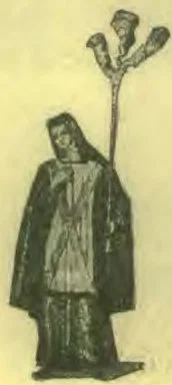
A Heretia Non in dress of penitent, reconciled.
The summary of the accusation was read to him, the inquisitor, according to the practise of the tribunal, mixing with the crimes of which the poor being was really accused various others more or less grave, or more or less scandalous, of plain fantasy of the ignorant and wordy relators of the Holy Office. It had this system for the end, not only to establish the confession of the penitent, already depressed in spirit, but to make clear the difference between the mode by which he denied the crimes that he did commit, and those he did not. If the denial of the crime of which they accused him was not so energetic or so quick as some other more shameful or revolting, which by artifice they mixed in the summary of the accusation, the holy inquisitors concluded that the culprit was negative, or confessed diminutive, that he refused to confess faults manifestly evident to the eyes of the Dominican theologians; so they proposed that the poor being might descend to the "Torture Room" without loss of time.
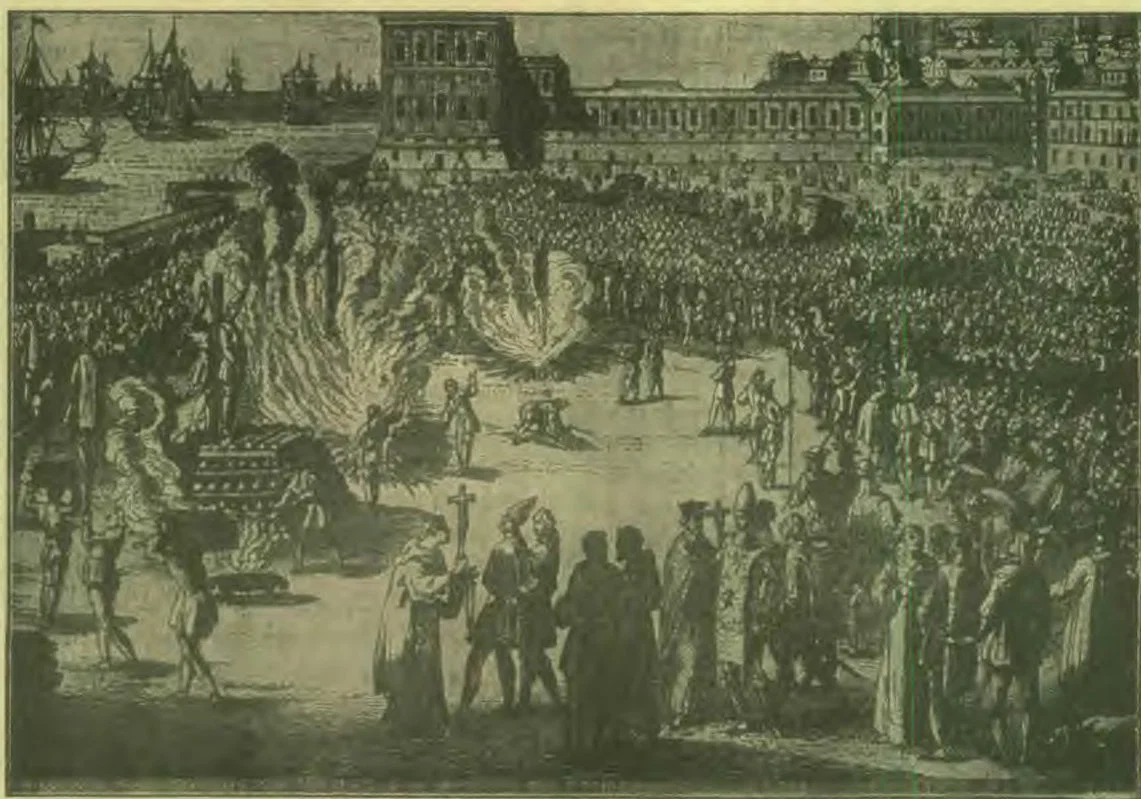
An 'Auto de fe' (burning at the stake) in the square of the Ribeira. From an engraving in copper of the time.
It was the second act of the inquisitorial tragedy. On recalling it, already two centuries distant, our brain seems to freeze, and an instinctive feeling of terror benumbs us.
In the palace of the Estaos, as in the Inquisition of Madrid, Burgos, Sevilla, and many others, the "Room of Torments" was situated in the deepest and most sultry part of the subterranean dungeon, in a point corresponding to the center of the building, surrounded by thick walls and low, massive, monastic ceiling,—everything wisely and carefully disposed, so that the cries of pain and cursing screams of the unfortunates in the torture might not be heard either in the palace or from without. The inquisitor here awaited them, mitered, upon a tapestried chair: the qualifiers, the consulters, the Dominican confessors, with cross upraised; two or three scriveners that reduced to writing, at times with how much falsity, the declarations of the accused; various personages with large mantles and hoods over the face; and, lastly, the physician of the Holy Office, destined to watch so that the violence of the torture might not be unto death.
Then followed the torments, gradually, solemnly, with all the placidness and method that the holy Dominicans put into all the inquisitorial acts. They began by extending the negative, or confessed diminutive, upon an X-shaped cross, and breaking methodically the fingers one by one. On the snapping of each bone and the cry of pain that broke from the lips of the sufferer, the pallid face of a monk showed itself to him from the dark, illuminated by a torch, surprising him into a confession, promising him life, suggesting the words that he must pronounce, and the imaginary crimes for which he ought to do penance. If this was not sufficient, if the sufferer persisted in denying with abhorrence and dignity the crimes that they attributed to him, they passed him to the suffering of the pole, or vertical rack. The hands of the culprit negative were violently tied behind the back by the end of a linen cord that passed thru a pulley attached to the ceiling; two attendants, garbed like monks, pulled at the other end, raising the prisoner to the top, then letting him fall halfway; the bones of the arms, wrenched with violence in the fall, snapped, unjointed and disarticulated themselves, and the poor being remained suspended in the air like a doll, writhing with pain, crying and screaming. When the person still resisted this torture with a courage sufficient to maintain himself in the first denial, they extended him anew upon the cross, subjecting him to the suffering of the water, breaking the spine, burning the feet slowly with red-hot pincers, carrying the torture to the highest7degree of severity; and if at the end of everything, the unfortunate persisted in that which the inquisition called the enchantment of taciturnity, they threw him like a rotten cloth into the darkness of the dungeon, bloody, crushed, writhing with pain, without force to scream, already without force to suffer, begging the death and the fogueira as the supreme relief and supreme mercy.
A Heretia going to die at the stake.
Then the holy inquisitor, mitered, solemn, indifferent, hardened in the continual intimacy of human suffering, dictated to the Dominican scrivener whose pen moved in the torchlight upon a large yellowed folio,
"FORMAL HERETIC. NEGATIVE. SILENT MALEFACTOR."
The Riches of Revelation.
By Joseph Parker
REVELATION enriches us with truths which reason never could have discovered, but which, being given, reason can accept without loss of dignity or remission of responsibility. To me the Bible is a divine revelation—a revelation of God, Providence, sin, atonement, faith, immortality. The Bible is not a book containing a revelation; it is a revelation. We assume an immense responsibility in claiming that any book is a final and authoritative standard in faith and morals. We place the book itself in an awful position. We separate it from all other books; we make skeptical criticism a profane offense, and devout obedience an essential element of spiritual character. The mind has simply to receive, the will has simply to obey, the heart has simply to trust. The book is to us verily as God Himself.
There is only one book in the world which can prove the inspiration of the Bible, and that is the Bible itself. Let the Bible speak for itself. When inquirers come with their questions, objections, and difficulties, insist, as a condition of conference, that the Book itself be read thru and thru from end to end until the inquirer is thoroly acquainted with its contents. That reading will do its own work. That reading has made me an unquestioning and grateful believer in the plenary inspiration, the divine authority, and the infinite sufficiency of Holy Scripture; and therefore I can the more earnestly and definitely encourage others to impose upon themselves the sacred task. I now know that the Bible is inspired. It addresses itself to every aspect and every necessity of my nature; it is my own biography.—Dr. Joseph Parker.
Our Bible Reading
God's Intercourse with Man.
When God first made man, He spoke to him face to face.
"God said unto them, Be fruitful, and multiply, and replenish the earth, and subdue it." Gen. 1: 28.
Sin brought a separation between God and man.
"They heard the voice of Jehovah God walking in the garden in the cool of the day: and the man and his wife hid themselves from the presence of Jehovah God amongst the trees of the garden." Gen. 3: 8.
"Your iniquities have separated between you and your God, and your sins have hid His face from you." Isa. 59: 2.
Then God manifested Himself to righteous men by visions and dreams.
"The word of the Lord came to Abram in a vision." Gen. 15: 1.
Jacob "dreamed, and, behold, a ladder set up on the earth, and the top of it reached to heaven. . . . And, behold, Jehovah stood above it." Gen. 28: 12, 13.
Later He sent messages to His people thru seers, or prophets.
"Beforetime in Israel, when a man went to inquire of God, thus he said, Come, and let us go to the seer; for he that is now called a prophet was beforetime called a seer." 1 Sam. 9: 9.
"If there be a prophet among you, I Jehovah will make Myself known unto him in a vision, I will speak with him in a dream." Num. 12: 6.
"No prophecy ever came by the will of man: but men spake from God, being moved by the Holy Spirit." 2 Peter 1: 21.
God designed that His people should be guided by His prophets.
"Believe in Jehovah your God, so shall ye be established; believe His prophets, so shall ye prosper." 2 Chron. 20: 20.
The word of prophecy is more sure than sight and hearing.
"We were eye witnesses of His majesty; . . . this voice which came from heaven we heard . . . We have also a more sure word of prophecy; whereunto ye do well that ye take heed." 2 Peter 1: 16-19.
There were prophets in the Patriarchal age.
"Enoch, the seventh from Adam, prophesied." Jude 14.
In the Jewish age there were many prophets.
Moses, Samuel, Deborah, Nathan, Isaiah, Jeremiah, John the Baptist (who was the last of that age), and many others witnessed for God in their times.
The early Christian church also had the gift of prophecy.
Jesus was the first; "The woman saith unto Him, Sir, I perceive that Thou art a prophet." John 4: 20. Paul, Philip's daughters, and John were others.
At the ascension, Jesus "gave gifts to men," among them the spirit of prophecy (Eph. 4:8).
"Now concerning spiritual gifts, brethren, I would not have you ignorant." "To one is given thru the Spirit the word of wisdom; . . . to another prophecy." 1 Cor. 12: 1, 8-10.
Prophecy is established in the church by God Himself.
"God hath set some in the church, first apostles, secondarily prophets." 1 Cor. 12: 28.
This gift is to continue to the end, the time of the "remnant" of God's people.
"The dragon was wroth with the woman, and went to make war with the remnant of her seed, which keep the commandments of God, and have the testimony of Jesus Christ." Rev. 12: 17. "The testimony of Jesus is the spirit of prophecy." Rev. 19: 10.
In the earth restored, God will once more dwell with His people, and speak to them face to face.
"He shall dwell with them, and they shall be His people, and God Himself shall be with them." Rev. 21: 3.
"There shall be no curse any more: and the throne of God and of the Lamb shall be therein: and His servants shall serve Him; and they shall see His face." Rev. 22: 3, 4.
"It shall come to pass that, before they call, I will answer; and while they are yet speaking, I will hear." Isa. 65: 24.
H.
Thoughts About Jesus.
By H. A. St. John
JESUS, the First-Begotten of our heavenly Father, chose to be born again that sinful man might have the right to choose to be born again. Jesus became a babe in the first Adam that men might become babes in Christ, the second Adam. Jesus was born from below that man might be born from above. By a birth Jesus became a partaker of our human nature that by a birth we might become partakers of His divine nature. Jesus became obedient unto the cross of death that we might become obedient unto the crown of life. Jesus was lifted up on the cross that we might be lifted up on His throne. Jesus' incarnation was His humiliation; man's incarnation is his exaltation. Jesus was obedient unto death that we might be obedient unto life. Jesus was reckoned as a sinner that we might be reckoned as saints. Jesus suffered the death that was ours that we might receive the life that was His. Jesus was treated as we deserve that we might be treated as He deserves.
From birth to perfect manhood, Jesus grew in stature, wisdom, and grace, that man might, from the time he is born from above, grow in stature, wisdom, and grace, even to the measure of Christ. From childhood Jesus acted independently of rabbinical laws; so man, when born again, may safely disregard the inventions of men. Jesus never transgressed physical law. It is as truly a sin to violate the laws of our being as to break the Ten Commandments. Hence man should understand and cheerfully obey physical law.
Jesus was wise to discern evil and strong to resist it. He can make us also wise and strong. Jesus exercised no power in His own behalf that is not freely offered to man. Jesus was an example of what God designed all humanity to be thru obedience to His laws. Jesus never possessed or cherished a single thought or feeling that responded to temptation. Jesus was, and still is, an ideal Man, divinity and humanity perfectly and harmoniously blended. We may become like Him, eventually see Him as He is, and sit with Him on His throne in the kingdom of glory, and evermore reign with Him.
H. A. ST. JOHN.
Charity Becomes Bribery
“Charity becomes bribery as soon as you use it as a bait.”
Life's Compass.
Four things a man must learn to do,
If he would make his record true:
To think without confusion clearly;
To love his fellow men sincerely;
To act from honest motive purely;
To trust in God and heaven securely.
—Henry Van Dyke.
“The Survival of the Fittest.”
LAWS for the protection of human rights are necessary; but class institutions, among which are all religious days and dogmas, must depend for their existence and promotion on their intrinsic worth and the loyalty, devotion, and zeal of their adherents.
If these institutions are worthy to live, if they are of benefit to mankind, if there is back of them real intrinsic value, if they are founded in truth, their worth will be recognized; and they will be perpetuated in the hearts and lives of their constant and multiplying constituency. But if these institutions can not thus be maintained, they deserve to die.
Above all classes, Christians should recognize the fact and indorse this sentiment. Jesus Christ declared: “Every plant, which My heavenly Father hath not planted, shall be rooted up.” Matt. 15:13. A practical and vital question before the world to-day is the Sunday question, and the demand that the day shall be protected by legislation. Men may bolster up the Sunday by tradition and false teaching; they may put behind it all the combined power of civil government the world over; but if it is not of God, it will surely perish, and will include in its destruction all those who have to the end identified themselves with it. But if it be of God, let its religious friends look to God with the calm faith of an Elijah.
The Rock, and all builded upon it, will endure. All the storms of infidelity and opposition may beat and break upon it, but the waves and winds will prove to be but harmless spray, which will whiten, harden, and polish its immovable strength.
We leave these queries with those of our readers who hold to the Sunday institution:
Is not the appeal to civil law a tacit confession that they know that the Sunday is not of Christ, that it is not of God’s planting?
Or, if they believe the Sunday to be of God, does not their appeal to civil law show that they have lost faith in the “all power” of the Gospel?
He Is Coming Again.
WHO?—The Son of God, our Lord Jesus Christ. He who was in glory supernal with the Father before the world was! He by whom the worlds were created! He who left that glory, took upon Himself “the form of a servant,” was “made in the likeness of men,” and became obedient unto death, even the death of the cross! He is coming again!
He “gave Himself” for you. Among the millions of earth’s needy ones He saw your need, your sin, your misery and wretchedness, your sure and certain death. He pitied you. He gave Himself to die upon the cross to save you. If you had been the only soul earth knew, He would have left glory to save you. All that Deity could do God did in giving His Son to bring you to Him. All that love could do it did when Jesus died upon the cross. He is coming again. Are you willing to meet Him who did so much for you?
If you are not saved, it is not His fault. He respects your selfhood, your individuality, the sanctity of your will, your choice. He longs that you shall choose the good, but Love can not compel, save by the compelling power of love. Why not yield to the plea of the Coming One?
Christian brother and sister, you know Him as a Friend and Saviour. How kindly, persistently, faithfully, He pointed out your sins and their sure consequence in order that you might be alarmed, and so induced to flee from the wrath to come. How tenderly yet heartily He welcomed your coming. “My son, thy sins are forgiven thee” fell as sweetest music upon the ears of your soul. The night of horrors fled; the day-spring of hope broke glad upon your darkened heart. How many times you have faltered and fallen, perhaps, and He has come not with harsh words of condemnation, but with words of infinite helpfulness and cheer. “If any man sin, we have an Advocate with the Father.” He is a Friend who “abideth,” “who ever liveth” to make intercession for us, who “sticketh closer than a brother.” That Friend is coming again. Such was His parting assurance when He left. Such is His repeated message to His church militant. Are you not glad that He is coming? If not, get ready, get ready.
Suggestive Notes.
A wonderfully interesting book is open before us in the next three weeks. The book of Job is thought by many scholars to be the oldest book in the Bible. It is conjectured to have been written by Moses when he was in the land of Midian. This, however, is not known. It is the oldest of all poetical books which have come down to us. It may be divided into four parts: (1) The prologue, chapters 1 and 2, written in prose; so also is the epilogue, or closing part of the book, chapter 42:7-17. (2) The debate between Job and his three friends on the subject of his afflictions (chapters 4 to 31) consists of three circles of speeches on the part of each. (3) The speeches of Elihu, chapters 32 to 37, and (4) the speeches of the Lord out of the storm-cloud.
The great subject of the book is the problem of human sufferings, and its relation to character. This has been a problem of wonderful interest throughout the ages. Job's friends contended that his affliction implied sin on his part, and God's disfavor, while prosperity implied God's favor and is a token of righteousness. While Job was led thru the severity of the condemnation of his friends and his intense sufferings to waver at times, yet his former experience with God holds him as an anchor in the storm of trouble thru which he is passing. He assures himself that he knows God, and that God knows him, and that he has witnesses on high; whatever darkness surrounds him now, he knows that his Redeemer lives and that he shall at last come forth to the light; but his longing now is that God should appear to him and tell him the reason of his afflictions. This God answers by revelations which Job had not before considered. The clear revelation makes him see that before he had only heard of God, but now he sees Him. Therefore he humbles himself before his Maker. God, knowing his heart, justifies him and forgives his friends because Job pleads in their behalf. Proving steadfast with God, his latter days were better than his first.
It is recorded of the eccentric old Scotchman, Thomas Carlyle, that he was asked to read at a friend's house in London at worship, that he opened to the book of Job and began to read, and read on and on and on for hours until he finished the book. The eminence of the man forbade his friends speaking to him while he was reading. He himself remarked, as he closed the book, that he never before had known of the wonderful wealth there was in Job.
Our readings in Matthew cover from chapter 10 to 17; of wonderful and marvelous interest are the stories of our Lord, the miracles which He wrought; His teachings in parables; the comfort of soul which He brought to the afflicted. To attempt to simplify or explain would be impossible in these limited notes. We will find almost every truth of Scripture either incidentally or objectively demonstrated in the Gospels of Christ.