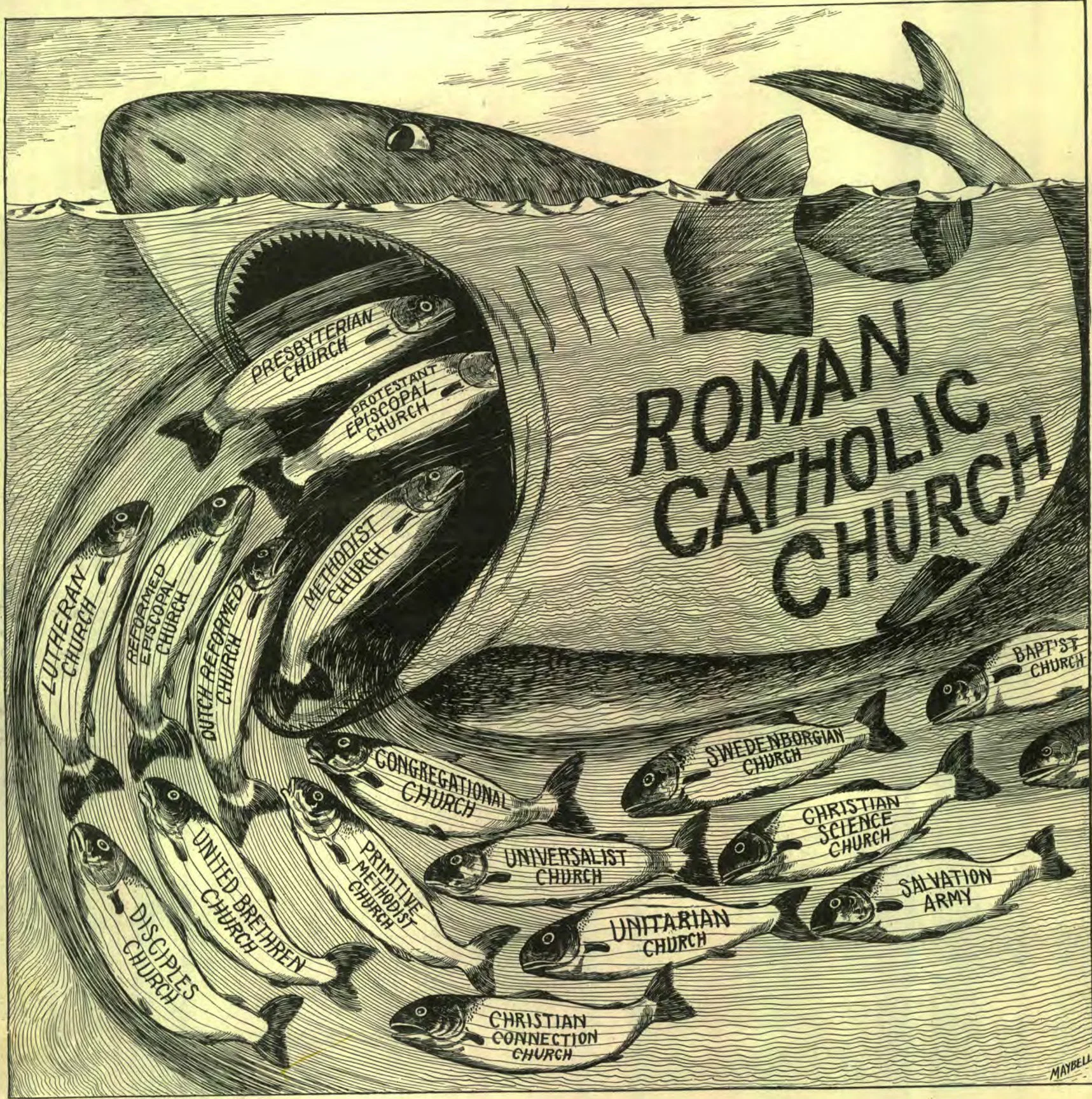
An Artist's Conception of How the Roman Catholic Church Will Join in Church Federation. See Pages 8 to 10.
With Our Inquirers
By Editor
"If ye will inquire, inquire ye."
This Inquirers' Department is conducted for the purpose of helping those who are studying the Bible. The answers are oftentimes only suggestive. They are never to be considered infallible, only as they agree with the infallible word. The writer who may answer them does not consider that his opinion is infallible. He will simply give the best that he has, and plead with the inquirer to search the word. Such questions only will be answered which, to the editors, seem to minister to the good of the readers and to the mission of the paper. We can not answer repeatedly in the same volume questions upon the same scripture. The name and address must accompany question, not for publication, but as an evidence of good faith, and that answer may be made by letter if deemed advisable. No letters are answered which do not contain the name of the writer. It is well always to enclose stamp for reply.
2550.—Laboring for Sinners.
Is it wrong to speak to sinners? For example, would it be wrong to go to a sinful woman, one who is accused of committing adultery, and not falsely, whose husband keeps a saloon? Would it be wrong to go to see her, show her good books, such as the Bible, and good papers?
Jesus Christ came into this world to save sinners. Men with their false or imperfect standards discriminate between sins. They set some sins down as far worse than others, they make many times social standards their moral standards. Of course, wisdom should be used in visiting at proper times in proper ways, places where the one who visits would be likely to be reproached or lose reputation because of it. But there is nothing in this world that should prevent a Christian woman from visiting a sinful woman and endeavoring to help her; nothing in this world to hinder a Christian man and woman visiting a sinful woman, and trying to help her. That is the business of Christians here, to help those who need help, to point to a better life those who are living a low life, to point to the One who is able to save to the utmost those who have found the sin that leads to destruction. In all this, wisdom should guide, and the Spirit of God and His heavenly messengers should go with the one who undertakes such mission for the Master.
2551.—A Matter of Probation.
In your answer to question No. 2489, it is not clear to me how the prolonged life of the resurrected wicked will demonstrate anything, unless they are on probation, that is, are actually having a chance with promises, Holy Spirit, and an encouragement to seek a change of life.
The term "probation" is not found in the Bible at all. The word really means "on trial."
There are some great truths which will help us to understand this question:
1. The mercy of God endureth forever. "I am the Lord, I change not." "With whom is no variableness, neither shadow of turning." God is just as merciful in one age of the world as He is in another, just as willing to extend mercy to His fallen creatures. Settle that one great truth forever.
2. He has also revealed to us that the only way in which we can be saved is thru Jesus Christ. "For there is none other name under heaven given among men, whereby we must be saved." Acts 4:12. Jesus has also told us that "no one cometh unto the Father but by Me." John 14:6. "No man can come to Me, except the Father which hath sent Me draw him." John 6:44. Yet the world-old contention is, and Satan taught it in the very beginning in the Garden of Eden, that man is divine, and can not die, but shall be as God. And that has been taught clear down to the present time, till religious evolutionists are teaching the "divine immanence," and Christian Science teaches "Christ in you the hope of glory," entirely apart from faith and from man's voluntary relationship to Jesus Christ. The whole New Thought cult is built upon the same idea, that man has the power within himself to lift himself above himself and develop character worthy of eternal life. Of course, God knows that this can not be, but the world does not know it nor do its people know it. We see very many of what are called good, moral people rejecting Christ all their life and dying without Him. There are those who teach that if many had a new probation they would do differently. If they had opportunity again to seek God, they would seek Him; that there is that within man, apart from any outward influence, that would lead him to do that which is right, if he had light enough. God is going to demonstrate to the universe that all His plans are right, and have been right. Men have rejected His Spirit and have died without it; have rejected Christ and died without Him. Now God is going to give every one of these the privilege in and of themselves alone, according to their own plan and view, in the fullest of light to demonstrate just what they will do. And they will do just what the Bible itself declares; show that there is nothing, absolutely nothing within humanity which, apart from God, will lead men to do that which is right. Those who are raised in the second resurrection will reveal their character by attempting to take the city of God, and if possible dethrone God Himself. Of course, at the end of that season they die the second death. And the lesson is for the universe and for all eternity.
Will you please explain Gal. 4:23-30? Does "Agar" represent the Ten Commandments? Verse 24 says, "These are the two covenants; the one from the Mount Sinai, which gendereth to bondage."
See the SIGNS OF THE TIMES of June 17 on Galatians 4. "Agar" represented man's way of doing God's will, doing it by his own works, on his own plan; that gendered to bondage, knew nothing but bondage, and could bring nothing but bondage. But the birth of Isaac, "the child of promise," represents God's way. The one covenant is man seeking to do of himself; in the other, the Lord does the work by writing His own law upon the hearts of His children. It is the same law in both cases. With one it is endeavoring to keep it without; with the other it is the outworking of the law written within the heart. In one it becomes a source of bondage and labor, and in the other a source of strength and power.
What is meant by being baptized with fire in Luke 3:16?
The context is very clear in the matter. The verse in question reads: "John answered, saying unto them all, I indeed baptize you with water; but there cometh He that is mightier than I, the latchet of whose shoes I am not worthy to unloose: He shall baptize you in the Holy Spirit and in fire: whose fan is in His hand, thoroly to cleanse His thrashing-floor, and to gather the wheat into His garner; but the chaff He will burn up with unquenchable fire." We quote from the American Revised Version. By referring to the first part of the chapter, it will be seen that John had two classes to whom he was talking. There were those who came to hear him, who were sincere, devoted; there were others whom he denominated "offspring of vipers." He told them that it was necessary for them to repent and bring forth fruits worthy of repentance; for the time was coming when the very tree that brought not forth good fruit would be hewn down and cast into the fire. It is said in Isa. 61:1, 2, prophetic of Christ, that He would come to "preach good tidings unto the meek," bind up the broken-hearted, "proclaim liberty to the captives," "the opening of the prison to them that are bound," "the year of Jehovah's favor," "the day of vengeance of our God." He was amply a Saviour of His people, but His rejection became destruction to those who would have nothing to do with Him. We must, therefore, conclude from the illustrations which are given that the fruitless trees cast into the fire, the chaff burned up with unquenchable fire, represented the baptism by fire into which the incorrigibly wicked will be cast and devoured in opposition to being baptized with the Spirit, fitted for the garner of God.
2554.—Keeping the Whole Law.
James 2:10 says, "Whosoever shall keep the whole law, and yet offend in one point, he is guilty of all." How could we offend if we kept the whole law?
James is speaking after the manner of men. When Jesus referred to the commandments in instructing the young man what to do, the young man remarked: "All these have I kept from my youth up." So we find people in general parlance speaking of keeping the whole law, observing all the commandments of God; they think that one little thing makes no particular difference if the whole in a general way is observed. The Lord thru the apostle is teaching us that the observance of God's commandments means everything that the commandments call for. A man may have kept the whole law so far as he sees, yet if he relaxes in any way, or transgresses any one of the commandments, how small soever it may seem, he becomes guilty of breaking the whole law.
Another point which the apostle teaches is the law's unity. It is all one law. It is not something which man has a right to divide or dissect, and say, I will choose this, and reject that. It is the one law given by the one Lawgiver, and he who rejects or transgresses any one commandment becomes guilty of sin against God as truly as tho he transgressed them all. Of course men may do this in ignorance, with motives to do right, and God regards this, but he who openly, knowingly, does it in the face of the light of the word of the Lord becomes a transgressor.
2555.—Lucifer.
If Satan, or Lucifer, was one of the cherubim, who was the other, and also, who has taken Lucifer's place?
This we do not know. Such questions might satisfy our curiosity, but the Lord has not revealed this. It is expressly stated in Ezekiel 28 that "thou art the anointed cherub that covereth, and I have set thee so," but it does not tell us who was with him, according to the pattern of the ark given to Moses.
Could there not have been a long space of time between Gen. 1:1 and Gen. 1:2? It seems as tho this planet earth was in existence when God breathed upon it, according to verse 2. When was "in the beginning"?
Yes, it seems very reasonable to conclude that there was a space of time between verse one and verse two. "In the beginning God created the heavens and the earth." How far back that carries us, we do not know. "In the beginning," we read in the first of John's Gospel, "was the Word, and the Word was with God, and the Word was God. The same was in the beginning with God." Of course there are those who believe that the first verse refers simply to the atmospheric heavens connected with this earth. It seems to us more reasonable to believe that it is one great comprehensive statement covering all God's creation, showing that in the beginning of everything was God, then in a part of that creation was the earth, waste and void, and swathed in darkness, and the Spirit of God brooded upon it, and out of that chaos of darkness and waste came the cosmos, as the result of the six days' work or making.
Yes, "create" and "make" come from two different words. "Create" seems to have reference to bringing into existence those things which never existed before; "making," the formation of things from other existing things. Altho the latter term may cover what is meant by the former, there can be no question as to the six literal days of Genesis 1 if language means anything.
That Imperial Story Again
By Emma Hildreth Adams
By Emma Hildreth Adams
READER, have seat once more. Take in hand that sovereign of all books, the Bible.
Open it at the first chapter of Judges, where begins the recital of a new period in the marvelously varied—we wish we could say kaleidoscopic—history of Israel, once bitterly enslaved, oppressed, but now free.
FREE to continue their national life on a higher plain; free to choose the right and to avoid the wrong; free to march on in the safe, prosperous pathway of obedience or to stagger, stumble, fall, in the perilous highway of self-will; free to build character and institutions soundly, grandly, vitally; free to shape their national history into blessed lessons for all the world to learn and to practise; yes, and free to waste, to dissipate, character and opportunity foolishly, wantonly, with certain death to freedom awaiting. Free to become, with Jehovah for Leader, the pinnacle nation of the earth, or to become a people scattered, reproached, oppressed, slaughtered, to the end of time.
Note, in the very first chapter, at this telling crisis in their life, the number of tribes which failed to obey the repeated, emphatic command of the Lord to ``drive out'' the evil inhabitants of the land from the territory allotted to those tribes.
What saddening sentences are those which tell of their forsaking, almost immediately, `the Lord God of their fathers;'' of their hasty turning to the gods of the peoples around them; of their refusing to harken to the counsel of their judges; of their quick infatuation for `Baalim and the groves''!
Then follows that startling sentence from the lips of Jehovah, the mighty Deliverer of their fathers: ``I also will not, henceforth, drive out any from before them of the nations which Joshua left when he died: that thru them I may prove Israel, whether they will keep the way of the Lord.''
Then, with but the turn of a leaf, we come upon that triumphant song of Deborah and Barak, wherein is rehearsed, exultantly, the strange part enacted by Jael, the wife of Heber, the Kenite, descendant of Hobab, Moses' father-in-law,—in the deliverance of Israel from the pitiless hand of Jabin, king of Canaan, after a grievous oppression of twenty years.
Thence follow the intensely interesting records of the life of the chosen people during the many long, testing years after the death of Joshua.
One of the most touching of these histories treats of seven years of fierce affliction under the Midianites, Israel's half-brethren—the children of Abraham, like themselves. So extreme, so bitter, was the cup these cruel kindred pressed to the lips of unstable Israel that for shelter and for safety the latter fled to the dens, caves, and strongholds of the mountains.
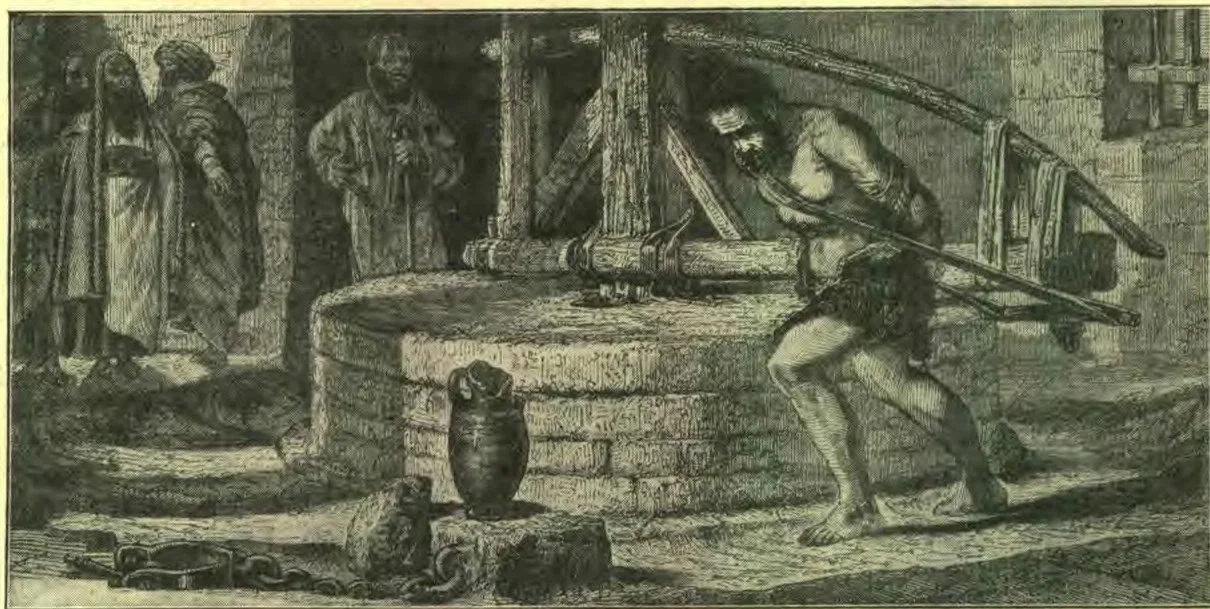
Samson, captive and blind, grinding at the Philistine mill, the sport and moors of people he had conquered when walking with God. What a type was he of backslidden Israel?
The invaders ``came upon the land with their tents and their cattle.'' They came as grasshoppers for multitude. Numberless were they and their camels. But God provided for the scattered fugitives a deliverance most impressive and characteristic. We are told in a style highly picturesque, yet very realistic, how this was accomplished.
Can any writer of fiction to-day paint from his imagination scenes more impressive, more pathetic, lighted up with coloring more exquisite, more vivid, than in that scene which the divine word presents in the interview between Christ and Gideon at the wine-press of Joash, in Ophrah? or one more purposeful, evincing finer zeal, than does that which portrays the destruction of the altar to Baal, set up by the father of Gideon, and of ``the grove which stood by it''?
Then there follows, during the test by the fleece, the comforting, encouraging picture of God's patience with Gideon, who felt too weak to attempt a task so Herculean without help omnipotent.
Next there flash out, into clearest light, the diversified, limitless, and powerfully effective, resources of God—concealed often in seemingly little things—for accomplishing His purposes. Of this we have an illustration in the peculiar yet simple means employed to expel and punish the greedy Midianites, who ``ran, and cried, and fled.'' Reader, put a study of fifteen minutes into that story. Gems of lessons flash in it.
In the eleventh chapter there stands out in fine relief another of the remarkable characters whose lofty deeds of self-denial enriched Israelitish history during that chaotic period when ``there was no king in Israel, and when every man did that which was right in his own eyes.''
We refer to Jephthah, the Gileadite, three phases of whose character elicit admiration: First, the readiness, the heartiness, with which he forgave his brethren their hard, selfish treatment of him under circumstances truly unwelcome, and for which he was in no degree responsible. Secondly, the noble man's just and lofty dealing with the king of the children of Ammon when he declared war against Israel to recover territory which, he claimed, Israel had taken from Ammon three hundred years before. Note his fine grasp of the history of the case, his telling summary of the points in Israel's favor. Read chapter 11:23-27. Could argument be clearer, more conclusive, than that with which he ends their parley before resort to arms?4
Lastly, his absolute, unfaltering fidelity to the striking pledge he made the Lord, that if He would deliver, without fail, the children of Ammon into his hand, whatsoever should come forth from his house to meet him, upon his return, ``should surely be the Lord's.''
That vow cost the conqueror of Ammon the most precious thing he possessed. It was a vow, which, expressed in his own pathetic words, ``brought him very low.'' It smote his very heart, but it brought him to the very summit of giving, to a surrender in the superlative degree. It was the giving up of an only child to perpetual celibacy, and so depriving his name forever of continued posterity.
Can we think the act was at all typical of the yielding up of another only Child, eleven hundred forty-three years later? It may, at least, remind us of that imperial scene on Calvary, which for two thousand years has held supreme interest in the minds of mankind, and must continue to draw wider and deeper attention until it shall be said: ``Behold, He cometh!''
Every chapter of the book of Judges portrays scenes of thrilling interest. Some teach lofty lessons in right-doing; others utter truths, which heeded, may save from endless death.
Christ the Heir to the Throne
By Charles Lindsay Taylor
By Charles Lindsay Taylor
As a part of God's great earth-plan, it was designed that Adam, the crowning glory of Creation, should be ruler over all the earth; under God, he was to occupy the throne of the world. Thus the Scriptures read: "One in a certain place testified, saying, What is man, that Thou art mindful of him? or the son of man, that Thou visitest him? Thou madest him a little lower than the angels: Thou crownedst him with glory and honor, and didst set him over the works of Thy hands: Thou hast put all things in subjection under his feet." Heb. 2:6-8. At the very beginning the word was, "Let them have dominion." Gen. 1:26.
But Adam failed. Sin entered, and sin meant subjection. "For of whom a man is overcome, of the same is he brought in bondage." 2 Peter 2:19. From Adam the dominion passed to another, even to Satan, the prince of fallen spirits, the ruler of the darkness of this world. And so we read (Heb. 2:8), "But now we see not yet all things put under Him."
But the entrance of sin could not thwart God's plan. The original purpose must be carried out. Man had been created and ordained to rule and, logically, only man could rule. The one man created to rule had become a sinner and so was incapacitated. A new Man, therefore, must be created, be put on trial, prove Himself master of the situation and, having done all that was required, take possession of the throne which had been abdicated by His predecessor and usurped by His bitterest enemy.
The Second Adam.
The Man chosen to restore man's rightful rule and under Jehovah to carry out His great and sovereign design was the "last Adam," "the Man Christ Jesus." After calling attention to the fact that at present man is no longer able to rule according to God's first appointment (See again Heb. 2:6-8), Inspiration states, "But we see Jesus, who was made a little lower than the angels." Verse 9. Yes, Jesus was the One; and please do not forget that like the first Adam, He, too, was made "lower than the angels." In order that the restoration might be accomplished in harmony with strictest justice, the second Adam placed Himself in the fallen Adam's position and condition. He would win back the throne not by force, but by love; and thus convince a watching universe that God's ways are right and wise, worthy of the loyal support of all. "For it became Him [Jesus], for whom are all things, and by whom are all things, in bringing many sons unto glory, to make the Captain of their salvation perfect thru sufferings." Heb. 2:10. By the way of suffering and death the throne of the world to come would be put in subjection to Him. Verse 5.
Thruout all the Bible, reference is made to the time when the kingdom of God shall be established upon earth, when the great Creation-idea shall be realized. Patriarch, prophet, and apostle all wrote of the glorious day when the kingdom should be given back and dominion restored to man. And, carefully studied, it will be seen that all testify to this one truth; namely, that humanity is to be exalted, that fallen man is to be lifted up and given the right to rule.
It was to David, perhaps, that this plan of God's choosing was first specifically and directly stated. To him the Lord's message was, "I will set up thy seed after thee, which shall proceed out of thy bowels, and I will establish his kingdom. He shall build an house for My name, and I will establish the throne of his kingdom forever." 2 Sam. 7:12, 13; Ps. 132:11. Read also Ps. 89:3, 4, 35, 36.
From the time that David received this wonderful promise and onward, the throne of the world to come, of the earth restored, is known as "the throne of David." Isaiah prophesied of the Son that should be born and who should sit "upon the throne of David." Isa. 9:6, 7. Jeremiah speaks likewise. Jer. 17:25. And when Gabriel announced to Mary the birth of the Child, whose name should be called Jesus, he added, "And the Lord God shall give unto Him the throne of His father David, and He shall reign over the house of Jacob forever; and of His kingdom there shall be no end." Luke 1:31-33.
There can be no doubt, then, that the "throne of David" is but the glory-throne of the second Adam, the Man Christ Jesus, who shall reign over the house of Israel forever; and that the place of that throne will be the same as that of the first Adam—the earthly Paradise restored.
A Brother-Born.
But the most wonderful feature of this wonderful plan of restoring to man his lost dominion is that Jesus Christ laid aside His glory and took upon Himself fallen human nature with all its liabilities and risks. He was therefore born "of the seed of David according to the flesh" (Rom. 1:3), staking His right to the throne of David, the throne of earth-dominion, upon His ability as a mere man of faith to gain the mastery over self. As man thru loss of self-control had lost the dominion of the world to the enemy, so, as man, He would regain self-control and win back all to God.
"It is evident that our Lord sprang out of Judah." Heb. 7:14. As "the Son of David" (Matt. 22:42) Jesus Christ was heir to the eternal throne. How utterly incomprehensible is this! But, as we have seen, it is only as the "Son of Man," taking the place of the man who fell, that He will rule. He became the Son of Man, and the Son of Man He will ever continue to be. As heir to the throne He is now a Man-Priest upon the throne of the Father. In that position He will continue until God's power has brought all enemies under. Acts 2:34, 35. That day is near at hand. And when it shall dawn, then the Son of Man will come in His glory, and will be seated upon "the throne of David," His own throne by right of inheritance and by right of conquest.
Thank God, brother, sister, for such a Son of Man. Let us elect Him our Ruler both for time and eternity. He who wills so to do can know His power, be made "more than conqueror" in the warfare against self, and so have an everlasting assurance of entering into the blessed rule of that kingdom which shall have no end.
Kindness and Generosity
GUARD within yourself that treasure, kindness. Know how to give without hesitation, how to lose without regret, how to acquire without meanness. Know how to replace in your heart, by the happiness of those you love, the happiness that may be wanting in yourself.—F. W. Faber.
The Christian Case for Abstinence
“I have two reasons for total abstinence: First, I believe it is best for me; and, secondly, even if I thought I was strong enough to withstand the temptations of drink, I am not willing that my example as a Christian should lead others astray.”—William J. Bryan.
Poetry and Reflections
But light shone bright e'er the darkness;
And truth, e'er the lie was known;
And the scepter of right stretches out thru the night,
From I Am, on His living throne.
FLORA E. WARREN.
REJOICE in hope! The day and night
Are one with God, and one with them
Who see by faith the cloudy hem
Of Judgment fringed with Mercy's light!
—Whittier.
MEN deal with life as children with their play,
Who first misuse, then cast their toys away.
—Cowper.