Your ShelfYour Projects

Signs of the Times, Vol. 33, No. 9.

Contained in this Issue

Signs of the Times

Feb 27, 1907

Pacific Press Publishing Company · Mountain View, California · Feb 27, 1907

Contained in this Issue.

CHRIST'S EXAMPLE IN PRAYER.
THE OBJECT OF CREATION.
BEARING THE SINS OF OTHERS.
CONSCIENCE AND ITS PLACE.
II. Cause of Unbelief.
DANIEL AND THE REVELATION.
THE GREAT SALVATION.
The World to Come.
LIVING SPRINGS.
THE SECOND COMING OF CHRIST.
What It Is.
WHY WE DO IT.
"COME UNTO ME."
QUESTIONS.
2006.—The Personal God; 2007.—An Unclean Spirit; 2008.—The Tower of Babel; 2009.—The Two Comings of Christ; 2010.—What City? 2011.—The Guidance of God.
PILLARS OF HEALTH.
II. Moderation in Eating.
CHINA.
Name, Territory, and General Features.
OUR LONDON LETTER.
PROHIBITION SENTIMENT.
SUNDAY IN EUROPE.
A SECULAR PAPER ON SUNDAY.
EARTHQUAKES AN EARTH DISEASE.
SUNDAY CONSTITUTIONAL AMENDMENT
POETRY.
Lighting the Way.
The Good Shepherd.
Confidence.
His Care.
Communion.
Shall Not God Avenge His Own?

"Sealskin"

It is not often that we select any one Bible and give it the prominence we are giving the one here shown, but our judgment on many years' experience in the Bible business is that it is worthy of it.
Actual Size 6 7/8 x 4 3/4 x 5/8.
It is printed on the celebrated Oxford India paper.
It is only 5/8 of an inch thick.
The type is clear-faced minion.
The chapter titles are in figures.
It contains references and twelve maps.
It is bound in genuine sealskin and is kid-lined.
It is sewn with silk and has silk head-bands and marker.
It is guaranteed to be absolutely perfect in every respect or your money will be promptly returned.
It is the lightest, thinnest, most beautiful, as well as the most durably-bound, Bible published.
In ordering, call for "Sealskin." It will be sent with charges prepaid, on receipt of $4.50.

California Tract Society,

Mountain View, - - - California

FROM THE OFFICE.

The 5,000 Copies of the Issue of January 23, Printed Extra, Have All Been Called for. The Issue Will Not Be Reprinted.
Every current issue, however, contains something of live interest on Religious Liberty.
This is what one reader says of the issue of January 30:
"I have just finished reading the SIGNS OF THE TIMES of January 30. It is just grand. It is so good I want 100 of these papers to sell. I must give Birmingham a little sprinkle of that paper. I wish I could put out more."
In renewing his subscription which had been let to lapse, another reader says:
"Altho this will be the sixteenth paper I am taking, I can not get along without the SIGNS OF THE TIMES any longer."

TRUE EDUCATION READERS.

An interesting letter from the Educational Secretary of the West Michigan Conference:
"I wish to say a few words in behalf of our new readers, and the placing of them in our schools just as soon as they can to be used in the class work already organized.
"I recently wrote a personal letter to each of our teachers regarding this series of readers; but, as it is the parents who have the books to purchase, I take this means of reaching as many of the latter class as possible.
"It would be far beyond the limit of this article to attempt to enumerate all the merits of this series of books. I will mention but a few. I consider the method employed the most rational of any devised—the phonetic system coupled with the word method. The books are carefully graded, but few new words being introduced in each succeeding lesson—a fact which will appeal to the most of our teachers. The subject matter has been most carefully chosen and nothing has been introduced but what is true and pure and ennobling. The matter has been chosen, also, especially in the lower grades, with a view of correlating with the reading, the elements of physiology, geography, nature study, and even number work to a certain extent, thus avoiding the necessity of organizing separate classes for these subjects in the lower grades. The books are printed upon an excellent quality of book paper, in very large, clear type, and substantially bound in buckram.
"The complete series consists of seven numbers—one for each grade. Numbers 1 and 2 are off the press, and orders for them may be sent to this office at any time. Price, 75 cents each, post-paid. Numbers 3 and 5 will soon be ready. The other numbers of the series will probably not be ready before next summer.
"Some may think the price is high; but when you consider the comparative size of the edition, and the fact that the phonics are made so prominent thru the entire set, including the marking of silent letters, all of which requires a special cutting of the type, the matter of the price is fully explained.
"I trust that all will see the importance of this matter of furnishing their children with uniform books, and thus cooperate with us in our work of endeavoring to secure uniformity and system in all our schools. CLIFFORD RUSSELL."

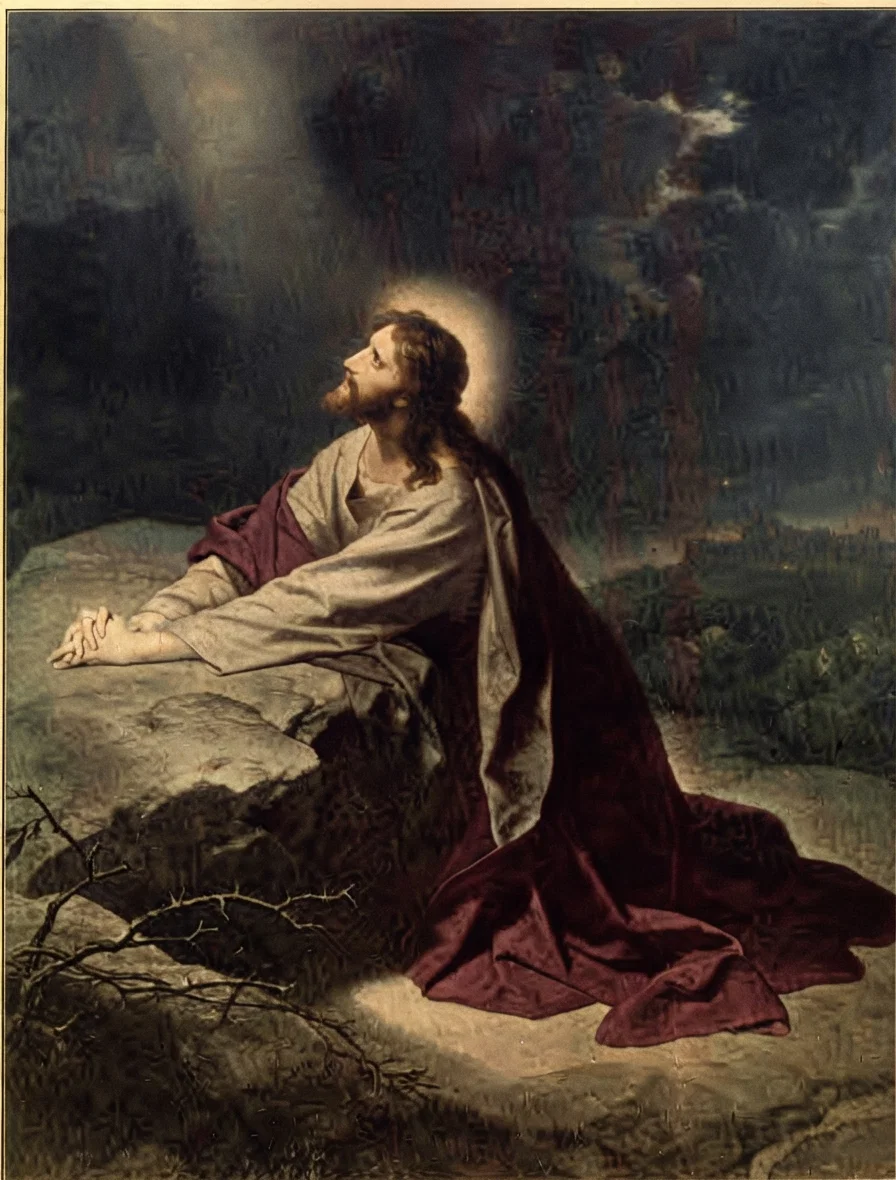
CHRIST'S EXAMPLE IN PRAYER

By Mrs. E. G. WHITE.
WHEN Christians complain of being in darkness, when they dwell upon their trials and discouragements, and murmur against God, they virtually say that they are not following the example of Christ in offering to God humble, fervent prayer for grace and strength that they may be fortified for trials and strengthened for duty. Christ's professed followers may be strong in the Lord if they avail themselves of the provisions made for them thru the merits of Jesus.
CHRIST IN GETHSEMANE.
God has not closed the heavens against the humble prayers of repenting, humble, believing souls. The humble, simple, earnest, persevering prayer of the faithful one will now penetrate heaven, as surely as did the prayer of Christ. Heaven opened to His prayer, and this shows us that we may be reconciled to God, and that communication is established between God and man thru the righteousness of our Lord and Saviour. Christ took upon Him humanity, and yet He was in close, intimate relationship with God. He linked humanity with His divine nature, making it possible for men also to become partakers of the divine nature, and thus escape the corruption that is in the world thru lust.
Christ is our example in all things. In response to His prayer to His Father, heaven was opened, and the Spirit descended like a dove and abode upon Him. The Holy Spirit of God is to communicate with man, and to abide in the hearts of the obedient and faithful. Light and strength will come to those who earnestly seek it in order that they may have wisdom to resist Satan, and to overcome in times of temptation. We are to overcome even as Christ overcame.
Jesus opened His public mission with fervent prayer, and His example makes manifest the fact that prayer is necessary in order to lead a successful Christian life. He was constantly in communion with His Father, and His life presents to us a perfect pattern which we are to imitate. He appreciated the privilege of prayer, and His work showed the results of communion with God. Examining the record of His life, we find that upon all important occasions He retired to the grove, or to the solitude of the mountains, and offered earnest, persevering prayer to God.
He frequently devoted the entire night to prayer just before He was called upon to work some mighty miracle. During these nightly seasons of prayer, after the labors of the day, He compassionately dismissed His disciples, that they might return to their homes for rest and sleep, while with strong crying and tears He poured forth earnest petitions to God in behalf of humanity.
Jesus was braced for duty and fortified for trial thru the grace of God that came to Him in answer to prayer. We are dependent upon God for success in living the Christian life, and Christ's example opens before us the path by which we may come to a never-failing source of strength, from which we may draw grace and power to resist the enemy and to come off victorious. On the banks of Jordan Christ offered prayer as the representative of humanity, and the opening heaven and the voice of approval assures us that God accepts humanity thru the merits of His Son.
Christ was the Son of the Most High God, yet thruout His life He did not seek to magnify or exalt Himself by any of Hisworks, but sought simply to proclaim the glory of the Father. For thirty years He seemed to be unhonored and unknown, and yet He lived a diligent, faithful life. As individuals we also are not to seek to glorify ourselves, but to keep our souls open to the cheering beams of the Sun of Righteousness, that we may show forth the praises of Him who hath called us out of darkness into His marvelous light. The injunction to each one of us is, "Set your affection on things above, not on things on the earth." The ardent desire of the apostles was to know God, and Jesus Christ, whom He hath sent. Jesus lives; He is before the Father in the heavenly courts, making intercession for those who are still upon the earth in the turmoil and strife of life; for the church militant is not yet the church triumphant.
By communion with God we may constantly have a cultivation in mind and heart and character that will elevate us and direct our thoughts heavenward, that we may become partakers of the divine nature. We are to be human agents that will cooperate with divine intelligences. We are to be quickened under the influence of divine power, that will not only strengthen us, but attract our minds from the dust and rubbish of earth, that will set us free from the polluting, deceiving influences of the world, so that we may contemplate heavenly things. Thru this influence our hearts are to be purified, our affections sanctified, and set not upon earthly things, but upon heavenly things. The treasure of earth will soon pass away, and "what shall it profit a man, if he shall gain the whole world, and lose his own soul? or what shall a man give in exchange for his soul?" The soul is capable of purification and sanctification, capable of attaining, thru the offering of Christ, the heavenly treasure, even the gift of life that shall measure with the life of Jehovah.

THE OBJECT OF CREATION.

"IN the beginning God created the heavens and the earth." He "created it not in vain," but "to be inhabited." The conditions of the earth at creation indicate that it was the design of the Creator to have it inhabited by sinless beings, willingly obedient to Him, dwelling in righteousness. While "the heavens are the heavens of Jehovah, the earth hath He given to the children of men." Ps. 115:16. "And God said, . . . Let them have dominion over the fish of the sea, and over the birds of the heavens, and over the cattle, and over all the earth, and over every creeping thing that creepeth upon the earth." Gen. 1:26.
That which God designed in the beginning, in the council of the ages, at the result of which "the morning stars sang together, and all the sons of God shouted for joy," has as yet never been realized. Adam lost his estate early in his career, and man has never enjoyed the dominion promised for sin came in and marred the perfect work of the Master Builder. Tho God "subjected all things unto him [man], He left nothing that is not subject to him, . . . we see not yet all things subjected to him." Heb. 2:5-8. Man himself is now the subject of another, having yielded himself to the power of the enemy, and "to whom ye present yourselves as servants unto obedience, his servants ye are whom ye obey." Rom. 6:16.
Man was indeed lost. All his marvelous knowledge and the capacity for learning and knowing, all his power over the living things and forces of the earth, his companionship with sinless beings, more than all, his association with God,—all were gone. He and his companion, driven from their Eden home, saw only final dissolution before them, a state they could not grasp or realize, for all creation before their transgression had been animated and filled with the pulsing life of God. Death reigned in the earth. Each fading flower and falling leaf told them that a similar fate awaited them. Painfully conscious of their own loss and nakedness before God, they wrapped about them the garments God had given them, and bent to the toil for existence. Strife came into the solitary family, and the sorrowing parents were called to view the dead form of a son, slain by his own brother's hand. Farther and farther mankind wandered in sin, away from God and His love, until the earth was filled with violence.
Not alone was man lost. Sin left its blight upon the animals, on the plants, on the ground itself, which brought forth thorns and thistles. Decay and disintegration added to the unhappy condition, the earth waxing old like a garment, reeling to and fro at the mercy of the elements and perverted internal forces; "for we know that the whole creation groaneth and travaileth in pain together until now." Rom. 8:22.
But sad as the condition was and is, a remedy was provided, "The Son of Man came to seek and to save that which was lost." Not alone fallen man, but the whole sin-cursed earth, the one lost sheep among the universe of God, the only one to go astray from the heavenly fold. He came to accomplish the "redemption of God's own possession." Eph. 1:14. The price has been paid. The love and power and justice of God are demonstrated to the world and to the universe. There remains but the completion of the great work of redemption, the gathering home of the saints, the dissolution of the earth, the making new again from the purified elements, the reestablishment of the faithful in their inheritance; for, "according to His promise, we look for new heavens and a new earth, wherein dwelleth righteousness." 2 Peter 3:13. Then "the righteous shall never be removed." Prov. 10:30. Then will the plan designed at creation be carried out, and the earth shall fill the place in the universe which it was made to fill. Then, "the ransomed of Jehovah shall return, and come with singing unto Zion; and everlasting joy shall be upon their heads; they shall obtain gladness and joy; and sorrow and sighing shall flee away." Isa. 51:11.
When will this be, this restoration? In connection with the destruction of the earth by dissolving fire, Peter speaks of "looking for and earnestly desiring the coming of the day of God." The only question remaining is, When is the day of God? The "sure word of prophecy" leaves no doubt in the matter. The events foretold by Daniel and John, the conditions described by James and Paul, the signs given by prophets and apostles, and by the Saviour Himself—all these indicate that the earth is in the last scenes of her dark history, soon to be shaken by the trump of God and illumined by His presence. From home and society, from State and nation, from land and sea, from earth and sky, comes the warning cry that sin has nearly run its course. Shall not they who read the signs take up the cry to welcome the coming King, and with Him enter upon the reign of peace?
MAX HILL.

LIGHTING THE WAY.

Up from the shades of oppression and gloom, Into His glorious day; Out where the sunbeams of mercy find room, Love is now lighting the way.
Out from the dungeon, and out from the cell; Up from sin's rust and decay; Out from the heart's deep'ning shadow of hell, Love is now lighting the way.
Sweet is the song that the little birds sing, Oft as the dawning of day; Glad are the praises my soul would now bring; Love is now lighting the way!
Out from the age-laden sorrows of night,— Far as transgression has known,— Love is now guiding us up to the Light, E'en to His own love-lit throne. FLORA E. YERGIN.

BEARING THE SINS OF OTHERS.

SPEAKING of the darkness at the crucifixion of Jesus, and the cry wrung from His heart, Alexander Maclaren truly says (Sunday School Times):
"For three long hours Jesus hung dying in the dark, and the darkness that wrapped the land was less dense than that which enshrouded His spirit. No eye saw what passed there in that obscurity; but one cry pierced the gloom, 'My God, My God, why hast Thou forsaken Me?' the only evidence that we have of the horror of great darkness thru which He struggled then. That is a cry the full meaning of which we can never reach, but which is utterly unintelligible, unless it was wrung from Him by the crushing weight with which the sin of the whole world pressed on Him. The darkness at once symbolized and hid from human eyes the atoning agonies of the great sacrifice. The voice that came from its midst at once rent and interpreted the darkness."

The Soul and the Sun of Righteousness

"As the flower turns to the sun, that the bright rays may touch it with tints of beauty, so will the soul turn to the Sun of Righteousness, that Heaven's light may beautify the countenance with the graces of the character of Christ."

The Flower That Follows the Sun

The flower that follows the sun does so even on cloudy days.—Sparks from the Anvil.

CONSCIENCE AND ITS PLACE

In Three Parts: “Conscience;” “Cause of Unbelief;” “Thinketh No Evil.”
By Prof. J. A. L. DERBY.

II. THE CAUSE OF UNBELIEF.

THERE is in Matt. 13:19 an apparently extraordinary statement. We have been accustomed to think that one can incur moral blame only by refusing to live up to what he understands to be right; that guilt is proportional to light, to information. But in this verse, taken from the parable of the sower, we seem to have the loss of eternal life as due to a failure to understand, as tho salvation depended upon the intellect instead of upon the heart. Says the Master: “When one heareth the word of the kingdom, and understandeth it not, then cometh the wicked one and catcheth away that which was sown in the heart.” This looks like hard doctrine, to condemn one for what he does not know. Let us examine the matter further. One text will make the difficulty clearer. It is Eph. 4:17, 18, “Gentiles walk in the vanity of their mind, having the understanding darkened, being alienated from the life of God thru the ignorance that is in them, because of the blindness [margin, “hardness”] of their heart.”
Now it is a matter of common observation that mere piety is a poor school in which to inform the intellect concerning anything in the whole range from A B C to metaphysics. Piety will not teach reading, grammar, mathematics, or philosophy. To be instant in prayer is not synonymous with being a giant of intellectual attainment. Nothing is more common than the utter severance of a pure heart from a profound intellect. No, all the collegiate training in the world will not make a person one whit the better morally. Neither can all the piety in the world solve conic sections, nor teach the correct use of English. A prophet may be a peasant.
What, therefore, is the meaning of the word “understanding” in the verse just quoted? It is poor business to interpret the Bible by a twentieth-century dictionary. “Consider what I say, and the Lord give thee understanding.” This is the Biblical rule, and from this it is plain that an understanding of the word of God must come from God; that is, the Scriptures must be permitted to explain themselves. What, then, is the Biblical definition of understanding? Job 28:28 gives the answer: “To depart from evil is understanding.” Again, Prov. 9:10: “The knowledge of the holy is understanding.”
These passages reveal the fact that what God means by understanding is not the intellectual apprehension of mathematical, grammatical, or physical relations, but rather moral discernment, a recognition and acceptance of conscience and reason. The essence of all morality is the determination to follow the behest of conscience, in living according to the best light that reason affords. Of course there is no power in man apart from God to do this. The seventh chapter of Romans makes that clear. But this binds reason to the necessity of diligently and unceasingly seeking material by which to be guided. The first and chief source of this is the Word of God.
Now since all men (except mental incapables) have conscience and reason, all men are responsible for not following them. Responsibility does not rest on educational facilities. Who, then, is ignorant of duty?—He with the hardened, obstinate, sin-loving heart; the man who prefers to indulge his propensities to evil rather than follow his aspirations toward what is right. The unbelieving wayside hearer of the parable, the one that does not understand, is the one that does not choose to understand. He is not looking for spiritual or moral truth, and therefore ignores it. He may have an intellectual perception of the meaning of an exhortation to surrender to God, to give up his sins, but he will not allow this perception to change the direction of his affections. There is such a thing as holding the truth in unrighteousness. Those that do “not like to retain [A.V., “to acknowledge,” margin, R.V., “to approve”] God in their knowledge, God gives them over to a mind void of judgment [A.V., margin].” Rom. 1:28.
What are some of the things that darken the power to discern right?—Love of sin, prejudice, bigotry, self-conceit, pride, worldly ambition, self-importance, love of money, desire for popularity, appetite, and what not. A copper penny can obscure the light of the sun. “I can’t see the elephant! O, I can’t see the elephant!” exclaimed the little girl putting her hands over her eyes, when she was first taken to view that huge creature. No, she could not; the sight was too unpleasant. There are no honest skeptics; or perhaps we should say that honest skepticism can not possibly become chronic. God has too much concern for “him that willeth to know His will” to allow him to wander forever in uncertainty. Depend upon it, man “is without excuse.” A dishonest heart; not an informed head, is the cause of unbelief.

DANIEL AND THE REVELATION.

ALL the books that comprise God’s sacred word to mankind are important. Each has its holy mission; each stands in its place like a faithful sentinel; not one is to be slighted. Yet it is an unmistakable fact that in this wonderful code there are two books that stand out most prominently from among the rest. Two books, like brilliant diamonds, like bright stars, shine out in all their marvelous splendor, enlightening, instructing, comforting, filling with awe, and astonishment, and assurance, and unspeakable joy and happiness, those who read.
Daniel and the Revelation! two of the most priceless treasures that a merciful heavenly Father has entrusted to His children of earth; two of the strongest beaconlights that cast their glowing rays on groping, erring man’s pathway.
Daniel and the Revelation! both written by men “greatly beloved” of Heaven; both appreciated in all their fulness by only those in whom this same love is the ruling, actuating power of life.
Both are books especially written for this generation. Given thousands of years ago, they are books designed for our time; books to be read and studied and pondered by men of this our faithless and doubting age. They are books for kings and rulers and mighty men of earth; books for the weak, the common, the lowly; books for the wise of this world, the wise men of modern Babylon (Dan. 2:12), “the magicians, and the astrologers, and the sorcerers, and the Chaldeans” of our day (Dan. 2:2), as well as books for the simple, the unlearned, the children.
Of the greatest historical value, of a most intensely spiritual character, these books deserve our most earnest study. The Book of Daniel! the best, the most concise, the most reliable “History of the World.” The Book of the Revelation! the most complete “History of the Church” on record, revealing as no other book has done the steady march of Christ’s loyal army to triumphant victory. A Revelation! Yes, repeat it, and emphasize it with the fullest confidence: A Revelation! the Revelation of Jesus Christ, showing us,in clear, unmistakable language, God and Satan, heaven and hell, Eden lost and Eden regained, the ending of sin and the eternal reign of righteousness—glory forever and ever.
God will aid and richly reward the diligent and prayerful student of these portions of His Word. Thru the prophet Daniel, the assurance is given: “The wise shall understand” (Dan. 12:10); and John the Revelator is bidden to write the promise: “Blessed is he that readeth.” Rev. 1:3. Let us obtain the blessing.
G. W. ERFURTH.
Mountain View, Cal.

THE GOOD SHEPHERD.

THE shepherd psalms and stories of the everlasting word Are a restful revelation of the goodness of the Lord; From the “Gates of Eden” onward to the “City without sun,” Like the burnished pearls of Orient, in their loveliness they run.
The gentle, patient shepherd, who is watchful over all; The sheep that follow freely at his leading and his call; The foolish ones that wander from his keeping and depart; The lambs upon his bosom, closely nestled by his heart.
The battles of the shepherd for his flock, both night and day; The hireling and the robber and the prowling beasts of prey; The pastures and the perils, the waters where they throng, Have each a place and record in the annals and the song.
Each point becomes a potency for human help, to move The souls of men to higher heights and deeper depths of love; Each parable a prophecy, freighted, divine, and broad, Of the kingdom of “The Shiloh” and the Fatherhood of God.
LLEWELLYN A. MORRISON. The Adrian, New York, Christmas, 1906.

THE GREAT SALVATION

“THE WORLD TO COME.”

(Concluded.)
READER, what will it require to fully satisfy the deepest, the most intense longings of your heart? Will a life running parallel with the existence of the eternal God, and this combined with all of the blessings and privileges that the universe can supply, and with the most delightful associations that heaven affords, suffice? The ever-blessed Father has all this “in store” for you if you love Him and cherish purity of heart. He says of those who set their love upon Him, that with long life will He satisfy them, and show them His salvation; and the psalmist, voicing the experience of all the redeemed, says, “I shall be satisfied, when I awake, with Thy likeness.”
When the children of the kingdom, now exiled from their Father’s house, are finally gathered home, it will be a source of intense delight for the Lord to anticipate and more than satisfy every legitimate longing of the heart. For He says, “Before they call I will answer them, and while they are yet speaking, I will hear.” Nothing will be omitted, in that blissful home, to make the happiness of every subject full and complete. Joy is usually of a very transitory nature here, but in the endless cycles of eternity “the ransomed of the Lord shall return, and come to Zion with

Songs and Everlasting Joy

upon their heads; they shall obtain joy and gladness, and sorrow and sighing shall flee away.”
Reader, please recall the most delightful and enjoyable associations that you have ever experienced in this life. Perhaps reflection upon some of these happy days has supplied food for your soul in the lonely hours as less blissful years have been your lot. The sum total of mortal happiness “is not worthy to be compared” with the joy ecstatic and never-ending, which will surely be the portion of those who gain the better world. Indulge your most vivid imagination of delight and happiness supreme,— “Take room; think vastly; meditate intensely; Reason profoundly; send conjecture forth;” and yet you can not comprehend the bliss that waits the child of God; for “eye hath not seen, nor ear heard, neither have entered into the heart of man, the things which God hath prepared for them that love Him.” The most happy associations in this life are abruptly terminated by the cruel hand of death, or some other calamity common to this pain-racked, hope-blighting world. Associations, sweet and pure companionship over there, will know no blight, no disappointment, and will never terminate in heartaches and bitter tears.

New Heavens and Earth.

It will be fitting to invite the One who bestows the gifts of His love upon the redeemed, to describe their glorious home and blissful estate. He sends these words to us, by the hand of the beloved apostle:
“And I saw a new heaven and a new earth; for the first heaven and the first earth were passed away; and there was no more sea. And I John saw the holy city, New Jerusalem, coming down from God out of heaven, prepared as a bride adorned for her husband. And I heard a great voice out of heaven saying, Behold, the tabernacle of God is with men, and He will dwell with them, and they shall be His people, and God Himself shall be with them, and be their God. And God shall wipe away all tears from their eyes; and there shall be no more death, neither sorrow, nor crying, neither shall there be any more pain; for the former things are passed away. And He that sat upon the throne said, Behold, I make all things new. And He said unto me, Write; for these words are true and faithful. . . . I will give unto him that is athirst of the fountain of the water of life freely. He that overcometh shall inherit all [these] things; and I will be his God, and he shall be My son. . . .
“And there came unto me one of the seven angels which had the seven vials full of the seven last plagues, and talked with me, saying, Come hither, I will show thee the bride, the Lamb’s wife. And he carried me away in the Spirit to a great and high mountain, and showed me that great city, the holy Jerusalem, descending out of heaven from God, having the glory of God; and her light was like unto a stone most precious, even like a jasper stone, clear as crystal; and had a wall great and high, and had twelve gates, and at the gates twelve angels, and names written thereon, which are the names of the twelve tribes of the children of Israel.”
“And the building of the wall of it was of jasper; and the city was pure gold, like unto clear glass. . . . And the twelve gates were twelve pearls; every several gate was of one pearl; and the street of the city was pure gold, as it were transparent glass.”
“And he showed me a pure river of water of life, clear as crystal, proceeding out of the throne of God and of the Lamb, in the midst of the street of it. And on either side of the river was there the tree of life, which bare twelve manner of fruits, and yielded her fruit every month; and the leaves of the tree were for the healing of the nations. And there shall be no more curse; but the throne of God and of the Lamb shall be in it; and His servants shall serve Him; and they shall see His face; and His name shall be in their foreheads.”
“Beautiful for situation,

The Joy of the Whole Earth

is Mount Zion, on the sides of the north, the city of the great King. God is known in her palaces for a refuge.” “Violence shall no more be heard in thy land, wasting nor destruction within thy borders; but thou shalt call thy walls Salvation, and thy gates Praise. The sun shall be no more thy light by day; neither for brightness shall the moon give light unto thee; but the Lord shall be unto thee an everlasting light, and thy God thy glory.”
“In that day shall this song be sung in the land of Judah: We have a strong city; salvation will God appoint for walls and bulwarks.” “And the inhabitants shall not say, I am sick; the people that dwell therein shall be forgiven their iniquity.”
“There, immortal minds will contemplate with never-failing delight the wonders of creative power, the mysteries of redeeming love. There is no cruel, deceiving foe to tempt to forgetfulness of God. Every faculty will be developed, every capacity increased. The acquirement of knowledge will not weary the mind or exhaust the energies. There the grandest enterprises may be carried forward, the loftiest aspirations reached, the highest ambitions realized; and still there will arise new heights to surmount, new wonders to admire, new truths to comprehend, fresh objects to call forth the powers of mind and soul and body. All the treasures of the universe will be open to the study of God’s redeemed.”
“No more fatigue, no more distress, No sin nor death can reach that place; No tears shall mingle with the songs That warble from immortal tongues. “No rude alarm of raging foes, No cares to break the long repose, No midnight shade, no clouded sun, But sacred, high, eternal noon. “O long-expected day, begin! Dawn on these realms of wo and sin; Fain would I leave this weary load, And go to meet my blessed Lord.”

CONFIDENCE.

“My strength is as the strength of ten Because my heart is pure;” I shall not fear the deeds of men, For my Defense is sure.
My innocence is surety,— Not law but saving grace; Grace of the Lord of purity Who doth my sin efface.
My tongue no song of boasting sings, Yet from no foe I flee, Nor fear, for “I can do all things Thru Christ who strengthens me.” Max Hill.

GIVING WHILE IN DEBT.

SOON after I was converted I was plunged into debt by becoming surety for another, and being obliged to pay. I found myself owing over a thousand dollars more than I possessed. I was also in bad health for twelve years. The question of giving soon came up for decision. The minister and other church expenses, the missionary cause, temperance, and other reform causes, the poor, the unfortunate, all these must be sustained by money. I was in debt deeply; my time belonged to my creditors. Could I justly use any of my earnings for benevolent causes? The Lord soon helped me to decide that His claim on me and my earnings was first, and other creditors next. So I gave to all causes which I considered to be the Lord’s, and the Lord worked wonderfully for me, and aided me to pay all my debts and to regain my health. Remember the Lord is first and all things in Him.—Selected.

LIVING SPRINGS.

"AND thou shalt be like a watered garden, and like a spring of water, whose waters fail not." This is God's assurance to His church if His church will yield to His way, His truth, His life.
LIKE almost every mountainous or hilly country, Palestine abounded with springs. Some of these were wet-weather fountains of water. After the abundant early and latter rains they flowed full and strong. The beasts of the field, the shepherds with their flocks, the weary traveler, all came to them to quench their thirst and to obtain water. After a few weeks' experience, the shepherds and flocks came to love some spring with its abundant flow, and when in its vicinity depended upon its waters. But the long drought of summer comes, verdure fades and dies. The hills become sere and brown. The dust lies thick in the highways. The thirsty, bleating flocks long for water. The dusty traveler and thirsty herdsman bethink them of the flowing spring from which they quaffed a few weeks before. They hasten to drink again from its cool, welling depths. They reach it, weary and worn, thirsty and fevered; but alas, its waters have failed, or as the margin intimates, lied; the spring is dry.
BUT there are other springs. The wet season affects their flow but little. They are not always the largest, most abundant fountains; but away down from the depths well up the cool waters, ever the same. They have tapped the fountains of far-off Lebanon, or, perhaps, the more distant snow-capped Hermon; and they never fail, never deceive.
WHAT likeness are these springs to two classes of religious professors! One class in time of fair weather, revival services, pleasing environments, make loud boastings. They seem to be fountains of water, having abundant supplies. But when the spiritual droughts come, when companions fall away, friends prove false, scoffers scoff and mockers mock, or some professed Christian disappoints them, or their own estimated ability is not recognized, they fail. Men come to them for help and life and cheer, but find nothing but drought and barrenness.
PRAISE God, there is another class. They make no boast; for they feel they have naught of which to boast. They feel that their ability is small, their talents few, their work of little importance. But they are constant. Go to them when we will, and they are ever faithful friends and honest counselors. Meet what trials they may, they are steadfast. The burning drought of summer licks up moisture, but they flow full. The burdened sinner is pointed to the Lamb of God who taketh away sins. The word of God is opened as the guide book and comforter. Jesus Christ is set before us as the fountain of life to all who believe. Said Jesus: "He that believeth on Me, as the scripture hath said, from within him shall flow rivers of living water." God would not flood with abundant life His children alone. They must use it for others, else they die. If they let flow thru themselves to others God's love and life and power and sweetness, their own heart enlarges, they demand larger draughts of life, and the great perennial Fountain sends forth larger supplies. Jesus said: "I am come that they might have life, and that they might have it more abundantly." The reception of the abundant life in Christ Jesus makes the "living fountains," the springs whose waters fail not.
Continue reading: THE SECOND COMING OF CHRIST