No sirup of poppies, no tincture of opium, no powders of morphine, can compare in sleep-inducing power with sunshine. Let sleepless people court the sun. The very worst soporific is laudanum, and the very best is sunshine. Therefore it is very plain that poor sleepers should pass as many hours of the day in sunshine, and as few in the shade, as possible. Many women are martyrs, and do not know it. They shut the sunshine out of their houses and hearts, they wear veils, they carry parasols, they do all that is possible to keep off the subtlest and yet most potent influence which is intended to give them strength, and beauty, and cheerfulness. Is it not time to change all this, and so get roses and color in your pale cheeks, strength in your backs, and courage in your timid souls? Women are pale and delicate; they may be blooming and strong, and the sunlight will be a potent influence in this transformation.—Dr. Hall.
Seventh-Day Adventists in India
By L. F. HANSEN
L. F. HANSEN
For a new work to get a start in a country is a slow process indeed. But as it is a fact that changes in commerce, education, transport, etc., all serve as levers to break up established tracks, the truth may take advantage of these; so in India the way of the Lord is being prepared. The advent of the gospel by Dr. Carey was the signal of the last warning. The righteous God can not proceed to judge his creatures till he has given them fair notice. The ultimate end of all true missionary work is a preparation to stand in the great day. Many missionaries do not see the truth as we do, and do not wish to see it, but desire to help in some line of reform. Whatever they sincerely do, they will be rewarded for. What they fail to do, some one else must do.
After one of our workers — Sister Burgess — had been for a while quietly studying the Bengali language, other workers came to India. At first the work went very slowly. Then God sent an earthquake. The laborers improved the opportunity, and read publicly the scripture showing that this was a sign of the end. To this day we find people who were then impressed for the first time in regard to the truth. Some decided in its favor, some have since done so, and others are still in the valley of decision; while some have decided against the counsel of God, by rejecting it.
The ministerial, the medical, the canvassing, and the educational work have been pressed into service, and inasmuch as there has been harmonious effort, the work has progressed.
The climate has been a drawback. To remove from a temperate zone to the tropics, subjects one's system to very great changes, which it is sometimes difficult to cope with successfully. But it was said in heaven, “They loved not their lives unto the death.” He that is mindful of us does not forget faithful service, nor its cost.
Opposition has not been wanting in India. There are always men and women who have time to oppose the truth. Extracts from books and writings in the home land have been multiplied here, with additions, both in India and Burma. But it is a remarkable fact that many of the voices heard, not long ago, opposing the truth, are to-day silent.
This year has been one of unusual stir in these parts. The terrible war has agitated the indefinite mind of the East. The earthquake in India this summer was of a most arousing nature. And the ravages of the plague here in Burma, where the vigilance was so great, have caused fear and dread. These things have led people to exclaim, “We must have reached the last days!” And the very Scriptural exposition has been invariably assented to as the only answer to all these terrible signs.
What is now needed in India is more direct attention to the native need of the gospel in the various languages. So far our work has been chiefly among Europeans and English-speaking peoples. But we are learning to address direct efforts to special classes. We have a school in Karmatar, where young people are trained, of whom we hope a great deal. The influence of our medical work is spreading among natives, and more attention should be given to this effort.
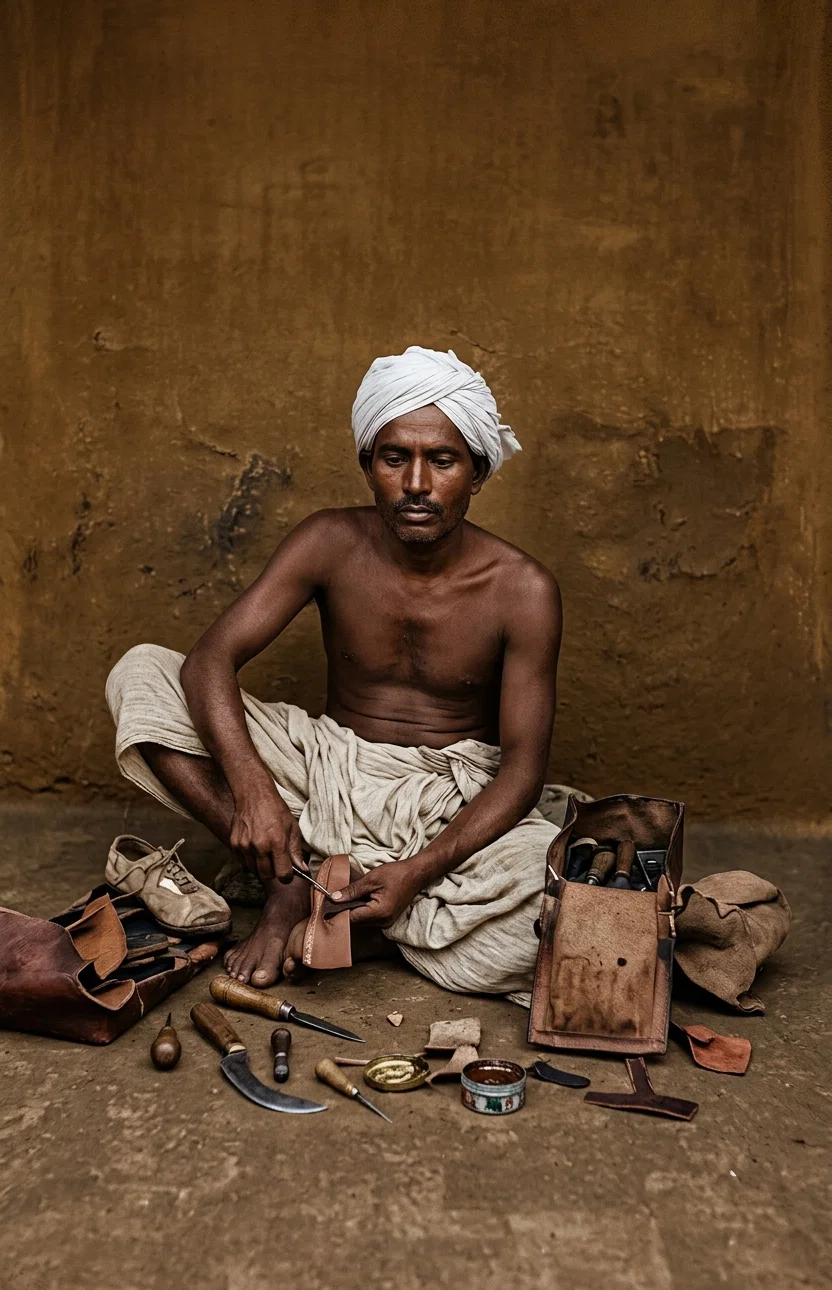
AN INDIAN SHOEMAKER
The printing-press is a powerful auxiliary; for it can work, though the missionary may be prostrated with heat and work or fever. Tracts are steadily flowing out in Bengali, Hindi, and Burmese. The latter are printed in Burma, however.
The English literature has always had a kind reception, but this last year we have met with some opposition, and the subscription list among the readers of our missionary paper has somewhat decreased. Our health paper — the London Good Health — is taking very well, and only the lack of canvassers keeps it from having a large circulation.
A brother in Calcutta who has been bedridden for twelve years has been stirred to solicit donations from his numerous friends, and is translating tracts on his own responsibility. In his last letter he said he had hopes of printing ten thousand copies a month. This effort is the most forcible experience of missionary enterprise, and it has encouraged us all greatly.
We need strong men to study the language and carry the message by training and working with native talent, in the several great languages of India. The effort among the Santals is very encouraging, and offers solution for others. In Burma, likewise, direct effort for the language and the people is very promising.
The General Meeting in St. Petersburg
By L. R. Conradi
L. R. CONRADI
For the first time in our experience as a people we have been able to hold our general meeting in St. Petersburg, the capital of the great Russian empire. The question had come up as to whether we should assemble in our usual place of worship (the spacious dwelling of Brother O. Wildgrube, on the third floor), or whether we should attempt to secure a public hall in the city. One of our brethren had asked a Russian general who owns a large assembly hall in St. Petersburg, about the matter, and this gentleman offered us his hall (which would seat about four hundred persons), free of rent, we being requested to pay only for the lighting and other service; but before we could accept this, we must secure the mayor’s permission to hold our meetings. Fearing that any demand upon him might hinder our coming together, we thought it best to be content with our old quarters. St. Petersburg was at the time under the dictatorship of General Trepoff, who had divided all Russia into special districts of dictatorship, had sent many thousands to prison through the “administrative process,” and for ten months had tried to suppress the freedom of the press. On the thirty-first of October the chief editors of St. Petersburg asked Mr. Witte to depose the dictator, and on the tenth of November he retired, and was then placed in military command of the palace.
This general meeting was for the North Russian Mission, which thus far has included the Baltic provinces, and Poland and Volhynia, with a population of twenty million. In the dwelling where we met there were three rooms opening into one another, one rather small. Our attendance during the day was about one hundred, and at night as many as one hundred and forty were present. The capacity of the house was crowded to its utmost. Delegates from most of the twenty-five churches and companies were able to be there, among whom were two Russians from churches in the government of Kief. By far the larger number of brethren are German-speaking, and live in Volhynia; but there are now also quite a number of our members who speak the Estonian or the Lettonian, and the work is just opening among the Poles and Jews. Under the circumstances, there had to be three translations: in one room from the German into the Russian, in another13into the Lettonian, and in a third into the Esthonian. In spite of this difficulty, the Spirit of God united our hearts, for, although the power of the word was somewhat lost through so many interpreters, yet we could see that God was present to add his blessing to the proclamation of the message. We freely sang and spoke, as the house is situated on a large open court, and does not face the noisy street. About forty families have windows opening onto that court, and there were many people going in and out who knew what was going on; but no one troubled us. In fact, the local police knew of the meeting. There were quite a number from the so-called better classes of society with us. I had a good conversation with a secretary of a legation, and his wife, as well as with a business man who owned a factory, and secured “Steps to Christ” in Russian for his employees.
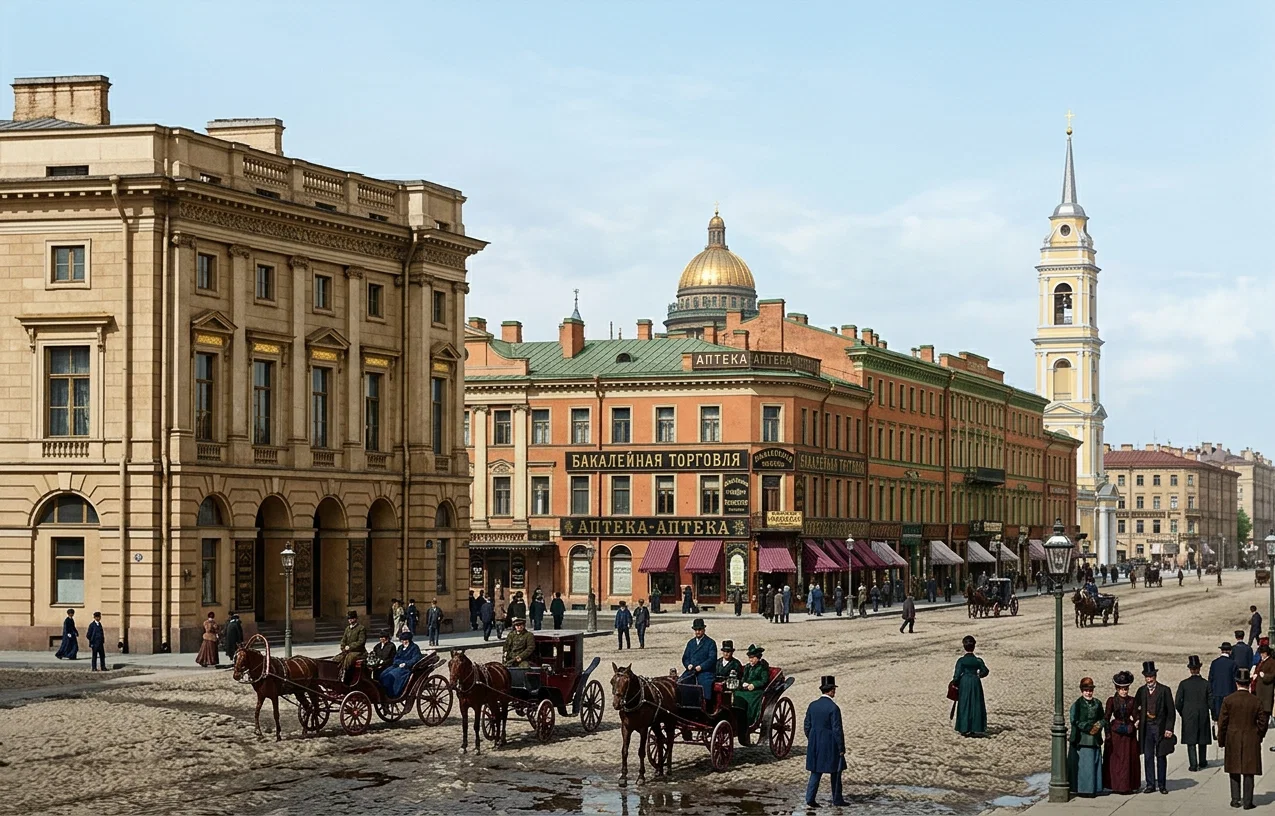
MAIN STREET, ST. PETERSBURG
In the resolutions passed, our brethren expressed their gratitude to the czar for the liberties granted them.
According to the new division, which takes effect Jan. 1, 1906, the city and the government of St. Petersburg will hereafter belong to the Middle Russian Mission instead of to the North Russian field. There is a German church in St. Petersburg, numbering about fifty, and a Russian church of about twenty members. The brethren in the capital city will prove a great strength to the work of the Middle Russian Mission, whose members will be mainly among the native Russians.
Considerable stress was laid upon the importance of faithful tithe paying, that this field, which contains already five hundred and twenty-eight members, might soon develop into a self-supporting conference. Brother D. P. Gaede was again unanimously accepted, in harmony with the suggestions of the union committee, as director for the coming year. Their laboring force for the immediate future will be two ordained ministers, three licentiates, one Bible worker, one nurse, and five colporteurs. We were glad to meet one of our Friedensau nurses at this meeting; she reported favorably of the work she has been able to do.
We hope for much greater prosperity in our canvassing work, now that we are getting more literature in the various languages. “Steps to Christ” has lately been translated into the Russian, the Esthonian, and the Lettonian. We are now getting out “His Glorious Appearing” in the Russian, and also publishing a number of tracts in that language.
During the four days of the meeting, I went down-stairs only once, when I was invited out to dinner. But the German Union secretary, who came here from Hamburg, saw a number of students parading with red flags through the streets of the city, the Cossacks watching from a distance that there might be no excesses. Everything seemed quiet, it was a lull before the fury of the oncoming storm.
Sabbath and Sunday we had most excellent meetings. Twenty stood up for prayer; several of these will soon unite with us. Sunday, as I spoke about our First-day offering system, and the mission work in German East Africa to which these donations are dedicated, much interest was awakened, and the collection for that mission amounted to about twenty dollars.
Brother Schankow will continue to labor as Bible worker in the city, which has about 1,440,000 inhabitants; but as there are about 120,000 Germans in St. Petersburg and its vicinity, we surely ought to supplement the Russian laborer by sending thither a good German city worker. Several German farmers from surrounding German colonies were also at the meeting, having lately embraced the truth. These colonies were settled by Germans in the time of Kathrine II, nearly two hundred years ago. This makes it all the more important that we have another German worker in this neighborhood soon, to continue the interest already awakened, as Elder Wildgrube, who had formerly been able to act in this capacity, now has charge of the great native Russian work, with about sixty millions of people in his territory.
Everybody praised the Lord for his wonderful care over us, and the great blessings we had all enjoyed during this, our first general meeting in the capital city of Russia.
News From Haran—7
By Z. G. Baharian
Z. G. BAHARIAN
Our seventh trial was on May 11. A letter was read which was written by Brother G. Simionyan, of Aksaray (Iconium), to Brother A. Buzugherian. It was a long letter, telling of his experience in preaching the message in the province of Angora (Galatia). It was interesting, and full of faith.
“Brother Simionyan has left Aksaray, and gone to Denegmaden, and has there distributed tracts and the ten commandments. Many have been interested. But a certain man of naughty heart has hated him, and delivered him to the police, lest this denomination should be established there.”
In reading this part of the letter, I saw that the word naughty had been changed to our wound. The Turkish of naughty is yaramaz, and that of our wound is yaramiz. The clerk read yaramiz, instead of yaramaz. At once I raised objection, and proposed a correction in the translation. I saw great disappointment on the face of the general attorney, because he had taken it as strongest proof against us that our letters contained political things. He had shaped the preceding words in the following manner: “Our wound is with heart. Let this also be not invented.” That is, “The Armenian nation was once wounded, and it is a deep wound. Let this also be not invented—not receive another wound.” But when the correction was made, and the words preceding and following were read, it was openly seen that this was a planned misconstruction.
I wanted to say more, but the president hindered me, and commanded that the letter should be read. The clerk continued his reading: “Brother Simionyan has been arrested, and sent to Angora, where, through a bail bond, he has been set free. There he has had talks with many, and has met with some sincere souls, calling them good timbers.” The general attorney had taken this, also, to prove that we use dark sentences to talk with each other of political things. The president asked Brother Buzugherian if he could show from the Bible that men are called timbers. He opened his Bible, and read 1 Cor. 3:9-17. Then he explained that the people of God are his building, Christ being the foundation-stone, and the individuals different timbers in the building. To this the president objected; but nothing availed. The clerk again continued:—“Brother G. Simionyan has come at last from Angora to Aksaray, but here also Satan has poured his anger, stirring14the government against him.” The president asked us what this meant, but without waiting for the answer, let the clerk read on. He did this purposely, to prove that we speak against the government. The reading of the letter showed how much our brethren of Aksaray have been troubled, but have stood fast in the faith.
The clerk then read another letter. It was written by Brother Hadji Kupelian, of Hadjin, to Brother A. Buzugherian. This, also, was very interesting. Brother Kupelian was describing his experience in preaching the message at Tekke. He is a tin maker, and went there to work and preach. For working on Sunday he had been attacked by a mob, and the police had intervened. Then he was sent to Hadjin. Brother Buzugherian was asked for some explanation, which he gave. This letter also showed that the government is acting against us, and what our brethren are enduring.
The president handed another letter to the clerk to read. This was from my wife to Brother Buzugherian, telling about my last imprisonment at Constantinople. The president asked me to give a full report of it. Then I gladly described the reason for my imprisonment. I said I was called by the minister of police, and requested to give bail not to preach. To this I did not consent. Then the minister of police wrote to the minister of interior. No fault was found in me; but to avoid more inconvenience, I was sent to Aintab. My description took a long time, at the end of which the president said: “Do you see? You have not been worthy to be left in Constantinople!” “Yes,” I said, “a day is coming when we shall not be considered worthy to be left in the world, also.” The president replied, “God knows it. God knows it,” and our trial was ended for that day.
THE past year has been spent chiefly in the study of the language, and caring for the sick. After spending several months among the Chinese, in Honan, China, and learning some of their customs, we decided that our little missionary party must scatter; for the field is large, and the laborers are few, and the time is short in which to give the third angel’s message to this great empire.
We have now four mission stations in the province of Honan. Miss Ericksen and I have our station in Sin-tsai Hsien. We have a dispensary, and a portion of each day is devoted to caring for the numerous sick people who come to us for help. The Lord has certainly blessed the treatments given, and many have been restored to health and strength.
At the present time we are caring for one little child who is paralyzed on one side, and has been in this condition two months. His mother walked many li on her crippled little feet to bring him to us. Wonderful results followed the few treatments given, and soon we hope to see the child restored. Last week a man came complaining of great pain in his side; we found he had a large growth on his side, which had been there for thirty years. After one week’s treatment he declared himself well; he thought it was wonderful, for he had been treated for years by the Chinese doctors.
Some time ago a child was brought to us, low with pneumonia. We treated her, and she soon recovered. Since then mother and child have attended our Sabbath meetings regularly. We find that the medical work opens the hearts of the people to the gospel, and this is what we are working for, not that we may get the praise, but that they may know that God is working through us, and that all praise is due him.
Our Chinese teacher, who is one of Brother Pliquist’s converts, holds meetings three times each Sabbath. The meetings are well attended, and we are praying that God’s Spirit may convert many hearts to his truth for this time.
Our work is largely among the women and girls. Surely this is one of the most important features of mission work, to reach the mothers of growing families; but here in China it is the mothers-in-law we aim to reach; for they have entire control, not only over their daughters-in-law, but also their children as well. Each week we hold two or three meetings with the women at their homes; they know when to expect us, and we usually find a large number of their friends and neighbors waiting for us. There are very few Chinese women who can read, and so it is no easy task to explain the Bible to them. We must take a very little at a time, and repeat it many times, to make sure they fully understand. We encourage them to visit us in our home; and when they come, we teach them hymns.
Some can learn one in a short time, by repeating it over after us. Some of the mothers bring their children, so they can learn also; for they say the little ones remember better than they, and can help them to sing the hymn after they get home.
Several boys also come to learn to sing the hymns. They are able to read a little, so in the evenings the boys and women meet at one of their homes to sing together. The boys are a real help to us; for they aid the women to learn more quickly than we could. Many have expressed a desire to learn to read, and we help them the best we can, and encourage the sons who can read a little to help their mothers and sisters. The Chinese women have few interests. Being unable to read, and scarcely ever going out, it is no wonder they become more and more ignorant and superstitious.
We are anxious to see them interested in the gospel, and we are praying that many may become faithful and earnest workers in the Master’s service.
CHARLOTTE SIMPSON.
England
By Editor
[In a personal letter from Prof. H. R. Salisbury we find so much which we think will be of general interest that we take the liberty to print the following notes of progress.—Ed.]
THE work in Great Britain is making excellent progress. Here in the South England Conference we are waging a vigorous campaign, and we have more laborers now than ever before since the field was divided.
Brother and Sister Jensen are working in North Kensington, where we have a company of over sixty.
We have just opened work in Hastings for the first time. It will be rather a hard place to work on account of its being a seaside resort, but things are starting out very nicely. Brother McCord and Sister Whitgrove are there.
Brother George Nickels, who took four years with us in the Duncombe Hall Training College, has charge of the church at Southsea and the church at East Cowes.
Brother Ritchie is at Plymouth, planning to start a new church in the suburb of Plympton, and at the same time to build up the church at Plymouth.
Brother Gautereau, who has been canvassing in Scotland since coming over from France, has just gone to Southampton this week to help the church there, and if possible to develop into a church the small company at Eastleigh which was raised up by our students this past summer.
In London nearly all the companies and churches are cared for by the teachers and the students of the Training College. We now have a church at Catford, and a company of over thirty at Edmonton, raised up by student labor.
Last week we also started Sabbath meetings in Ilford in charge of one of our students, and the children's department is being conducted by one of the15young ladies from the Training College.
Our tithe last year for the South England Conference was fourteen hundred pounds. At the present rate of increase we bid fair to have sixteen hundred pounds the coming year.
Our college goes on nicely. We have a most excellent class of young people with us again this year, and already, although this is but the middle of our fifth year, there are many workers scattered throughout Great Britain, and some in other lands, who have been educated here.
Mission Notes
THE work in Porto Rico is progressing slowly but surely, and the interest is deepening in the truth for this time. Already a number of native converts are reported, some of whom have enlisted to do active work for their fellow countrymen.
General Meeting in Mexico
FROM Mexico Brother G. M. Brown writes: “The general meeting now is past. We had a most excellent meeting. We raised $1,019.35 Mexican, or about $310 United States money, for the literature fund. One sister was baptized and received into the church.”
Indian Walk Church Dedication
At Indian Walk, Trinidad, Sunday, August 27, the brethren, who had finished their church building, dedicated it to the service of Jehovah, Pastor D. E. Wellman officiated, and a large and enthusiastic audience was reported. On Sabbath, the twenty-sixth, five souls followed their Lord in baptism at the same place.
Jamaica
By T. J. KENNEDY.
WARSOP.—We are glad to report the steady progress of our work here. Our school, which was started on the first of April with only eleven children, is increasing rapidly in numbers. The people of the district are gaining confidence in our work, and are sending their children. We now have an attendance of about thirty, with the prospect that others will come in soon. Our church work, also, is improving steadily. For the past three months we have been, with the aid of the members of our Young People's Society, conducting regular Sunday afternoon meetings and house-to-house Bible readings at two neighboring districts, about five miles distant. As a result, five have decided to obey, and many others are interested. We are continuing these meetings every Sunday afternoon, and are cheered as we watch the growing interest. We trust by God's help to see others take their stand soon. Truly, God's people are becoming willing in this the day of his power. Pray for us here at Warsop, that our feeble efforts may be blessed by the Lord, and that many may take their stand for the truth, and at last shine as the sun in the kingdom of our Father. T. J. KENNEDY.
South Africa
By M. C. STURDEVANT
BULUWAYO, RHODESIA.— The boys and I have finished our church, a neat little structure, forty-four by twenty-six feet, with iron roof. The cost in money, outside of the material that was already on the place, purchased over two years ago, will not exceed fifteen pounds. We have done all the work ourselves, laying stone and brick, and plastering, and have done this outside of school hours. Brethren Sparrow and Tarr helped us two days, putting on the roof. This is the first building I ever undertook alone, yet all tell me the work is first-class. We believe God taught our hands to do the work; so the glory is his. One of our neighbors remarked the other day, “The work alone, if hired, would cost no less than one hundred pounds.” We have worked beyond our strength, hurrying to finish for the planting season, which is right on us now, as trees are putting out their new leaves. A few days more, and the building will be ready for Elder Hyatt to dedicate on his arrival, which we hope will be soon.
GIRLS' HOME AND DINING-ROOM, BULUWAYO MISSION STATION
Our school is doing excellent work. The spiritual interest is good, and we see the children conforming to His likeness day by day. This gives us courage. Sabbath-school and meeting services are well attended.
The finance is the problem that keeps the heart heavy and the soul perplexed. For about six weeks we had quite a little trade in the store, while the natives were finding their taxes. Then almost everything stopped, so that now we hardly take in as much as we eat in the home. And though we have reserved grain enough to feed us this season, ways to meet expenses look dark. Yet we will press on, doing the best we can, calling for as little help as possible.
The good General Conference truly gave life and courage to us. Every report was read with deep interest. We can truly say, We are in this work to see it finished, or to die in the front ranks. I want grace and strength to overcome one day at a time. Truly, the trials and temptations here are great to me, but I never desired a closer walk with God more than at the present moment. M. C. STURDEVANT.
Portugal
By C. E. RENTFRO
CARCAVELLOS.—The past three days there has been a feast in honor of the patron saint of this village, “Our Lady of Remedies.” There has been music by a band, dancing in the evenings, and sending up of sky-rockets by the dozen. Sunday afternoon there was a procession, in which three images were carried.
Many times I see interesting items in the daily papers here. One paper, recording the death of a countess, gave her last will and testament. Among other things was the following: On the day of her death, thirty masses were to be said for her soul, and during eight days following, one hundred more were to be said. Besides these, she ordered to be said two hundred for her husband, two hundred for her parents, two hundred for her grandfather, three hundred for different uncles, others yet for the souls of cousins and aunts, and for other souls in purgatory—all amounting to more than three thousand masses, at a price, provided for, of five hundred reis, or more than fifty cents, a mass, the total being over sixteen hundred dollars.
The liberalists do a great deal toward holding in check the intolerant spirit of the Catholic Church in Portugal. In one paper, called Folha do Povo (The People’s Paper), the inconsistencies of the papacy are constantly held up before the readers. These things, with others, I believe tend to hold the enemy in check, so we can have a chance to give the third angel’s message. Pray for the work and workers in Portugal.
We are enabled to publish our first tract in Portugal, by the help of a gift from a good sister in California, for which we praise God. We wish to follow this with a health tract, entitled “Secret of Health.” It is now in the hands of our teacher, who is taking quite an interest in using her talent in order to help the people of this language. She gave us a donation to the publishing-work. C. E. RENTFRO.
Week of Prayer in the District of Columbia
By K. C. RUSSELL
THIS precious season was faithfully observed by our four churches in the District of Columbia, and excellent reports have been received from the leaders of all these meetings. At some of these services the enemy was present, as usual, to darken and discourage souls, but thanks be to God for the victories gained by all those who made a full surrender to the Saviour. Heartfelt confessions were made by souls who had been burdened with sin. Among the sins which were confessed were indulgence of appetite, impatience, a failure to read and study the Bible and to engage in earnest prayer, also the sin of robbing the Lord in tithes and offerings, and other evils which are becoming too common in these perilous times. It was gratifying indeed at some of these meetings to witness nearly the whole congregation consecrating themselves to God, and also to note the willingness with which many placed themselves upon the altar to be used by the Lord in his vineyard wherever in his providence they may be called to go.
It was a source of encouragement to note the active part which was taken in the services by the employees of our offices, and our young people in general. We feel sure that if the consecration which they made is maintained by them,16their lives will exert a winning influence upon those who are out of Christ.
During the Thursday evening service at the Memorial Church the writer called attention to an expression which was made in the first reading of the week of prayer, by Sister White. In speaking of effectual prayer, she said, “He [the Lord] can move upon the hearts of few statesmen,” and those present were exhorted to pray earnestly for the lawmakers who are assembled here at the capital of the nation, that they may be brought to a knowledge of the truth. It will be interesting to the reader to learn that after we sought the Lord in behalf of our statesmen, a congressman visited the hygienic cafe the very next evening, Friday, and seeing preparations being made to close for the Sabbath, made inquiry why it was, and was told that we observe the seventh-day Sabbath, which begins at sunset. An invitation was extended to him to attend our week-of-prayer service at the church, to which he responded. He came early and remained through the entire meeting, giving the most earnest attention, and manifesting an interest in all the exercises. It seems to me that this experience should encourage us to heed the exhortation of the apostle Paul to pray “for kings, and for all that are in authority; that we may lead a quiet and peaceable life in all godliness and honesty. For this is good and acceptable in the sight of God our Saviour, who will have all men to be saved, and to come unto the knowledge of the truth.”
While we are not able at this writing to announce definitely the amount of offerings received as the result of this week of prayer, as we have not yet received a report from one of the churches, and further donations are also expected, yet we are glad to report that the amount already received in cash and pledges aggregates upward of five hundred dollars. During the first two or three days of the meeting, we were favored with the assistance of Elders A. G. Daniells and G. A. Irwin, but, owing to the fact that they were called to Battle Creek during the week of prayer, they could not remain through the meetings. We were glad, however, to have with us during the entire period Elder W. C. White, who rendered most valuable assistance in the meetings. During the week of prayer he visited each of the churches in the District, and also the Washington Training College. We are glad to report that there has already been inaugurated a campaign along the line of Christian Help work, whereby the consecration made during this week of prayer can be put into action in systematic personal work for perishing souls.
K. C. RUSSELL.
Chairman Evangelical Com. of D. C.
India
By S. E. WHITEIS
BANGALORE.—I came to Bangalore for a month's rest and change, and am spending the time with Sisters Orr and Meyers. They are busy with their Bible work, and have some very interested readers. Sister Orr has been invited, at one place, to take the Bible studies during the minister's absence, and the company is growing each week, and is deeply interested. One blind man, who had felt very rebellious because of his affliction, received much help and comfort from one of the readings, and wished her to come to his house and give Bible studies. Thus far she has given only practical subjects, as faith and obedience, preparing the way for other truths. S. E. WHITEIS.
The Literature Campaign at the Lewis and Clark Exposition
By G. W. PETTIT.
Above the colonnade reaching from Festival Hall to the Administration Buildings at the main entrance of the Lewis and Clark Centennial Exposition and Oriental Fair the following appropriate quotation was to be seen: “Westward the course of empire takes its way.” Thousands of Eastern people who visited this exposition, saw, for the first time this great Western empire, to which the poet Bishop George Berkeley looked forward.
While it is true that the course of empire takes its way westward, it is also true that this message has gone by the hand of faithful pioneers from the rising of the sun in the same westerly direction. Where a few years ago were found a few weak churches, are now to be found strong conferences, dotted here and there with scores of churches and institutions standing for the one aim of closing the advent movement in this generation.
The various conferences on the Pacific Coast united in an effort to place our message-filled tracts and papers in the hands of the two-and-one-half million visitors at the fair. Thousands of pages were given away and sold. The chief points of distribution were the Portland Branch Pacific Press, the Portland Sanitarium, the Vegetarian Cafe, and the sanitarium quarters on the fair-grounds. Sister B. G. Booth was chosen to lead out in a campaign of literature distribution which was kept up during the entire season, and for a time after the closing of the fair. This was done by placing literature in racks in depots, and in appropriate places on the grounds, and by giving and selling to passers-by on the streets and near the main entrance to the fair. The average daily attendance at the fair was above nineteen thousand.
We are certain a good work has been accomplished. Our only regret is that a stronger effort was not made. Already the Lord has watered some seed sown. We are endeavoring all along the line to continue the good work of distributing our message-filled papers and tracts.