On May 21, at noon, two ocean liners moved from their moorings at New York and Brooklyn, and glided slowly out of the harbor, toward Sandy Hook. Here they parted company, the one having on board Elder W. J. Fitzgerald and family for England, and Brother and Sister Carl Hansen for Europe; the other, the steamship “Guiana,” bearing us to the West Indies.
Our voyage was pleasant; and, despite the heavy ground sea, the “Guiana,” being heavily freighted, behaved well, and there was little sickness. We arrived safely at St. Thomas in due time, and went ashore to visit our brethren. Elder H. C. J. Walleker was away at St. Johns, but his wife did her best to entertain us. Here we met Elder J. H. Matthews, who will soon move to St. Croix to spread the third angel’s message there.
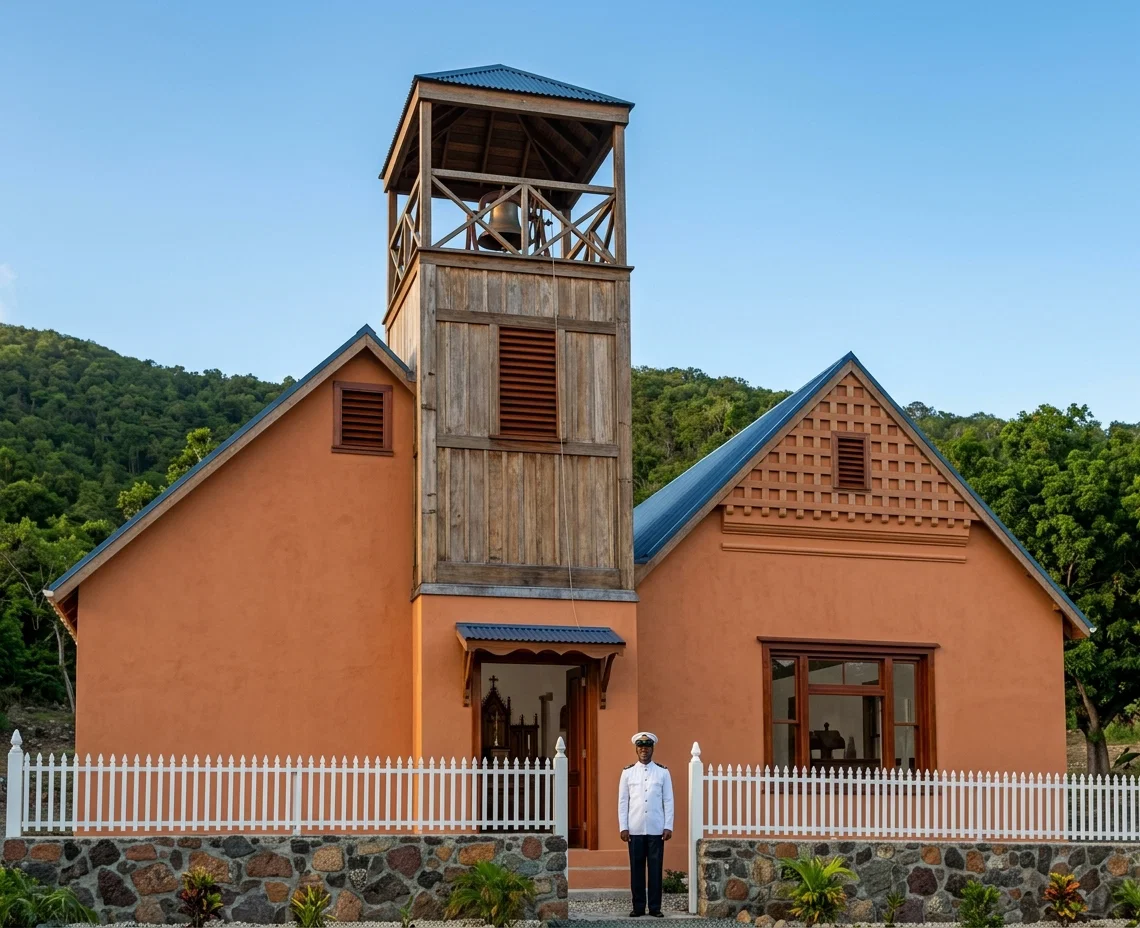
It was the time of the jubilee of the Catholic church in St. Thomas, which was celebrated by a parade and other high functions, the people bowing before the bishop. We were pleased to see that the new church building was nearly finished, for which funds are badly needed, as the plan is for a church-school as soon as the building is completed.
We next visited St. Croix, which is a very promising field. It has a population of twenty thousand and, like St. Thomas, is under Danish rule. St. Kitts was our next stop. This is a healthy and prospering island of about nineteen thousand inhabitants. The water-supply is good. Fruits and vegetables are cheap and plentiful. There is a small company here, but they have no worker. There is opportunity for an earnest consecrated man to locate here and give the message.
We next called at Guadeloupe. This is a large group of islands under the French rule. Much sugar is produced here. This is a very needy field. You can but faintly imagine the crying need as you look out on the scene of confusion as the ship drops anchor off this island, and you see the ill-clad crowd of men rush on the ship to discharge the cargo. It is the Sabbath, but all around is Babylon indeed. There is a call for a French-speaking brother here, to give this message to the thirty-two thousand people.
As the Sabbath began to close, we arrived at Dominica, and went ashore to visit Elder Philip Giddings. The company is of good courage, and pressing on. Dominica is the seat of the papacy for this group of islands. Here the bishop and his frocked priests landed, who had been passengers from St. Thomas. Thirty-seven priests are located at this place. You will realize how much our brethren here need an interest in our prayers. Our church building is being reared right under the towering shade of the Catholic cathedral. There are three hundred sixty-five rivers on this island, and it has the most perfect botanical gardens in this zone. But looking out on the scene, noting here and there smoking mountains, indicating the internal condition, we could but think of the day of God’s wrath, and of the multitude held in papal darkness.
At Antigua we went ashore to visit Elder F. G. Lane, but found he had gone to open up the work in Montserrat. The company is of good courage, and working in perfect accord.
Martinique was our next stop. There is no worker here. This priest-ridden island needs a consecrated French-speaking worker. We stood for a while in the cathedral during the celebration of high mass, and watched the continual stream of worshipers come in and bow at the shrines, depositing their coins in each box; and as we stood, we thought of the awful doom awaiting those who worship the beast and his image. As we viewed the devastation caused by the eruption of Mt. Pelee, we wondered why so few heed these calls.
NEW CHURCH BUILDING AND CHURCH-SCHOOL, ST. THOMAS, B. W. I. The new building at the left, with tower, is the addition recently made
At St. Lucia we met Elder W. D. Forde, who is pressing on, despite the fierce opposition from the papal church. At St. Vincent we saw Elder James D. Dasent, who gave us an encouraging report of his work among the thirty-two thousand inhabitants of this island.
Barbados was our last port of call. Here Elder L. E. Wellman was on the lookout for us. We appreciated a hygienic meal at his home at Two Mile Hill. Then we visited Dr. Cave, our acquaintance of past years, in his sanitarium at Hastings, where he is doing a creditable work. Here we learned the sad news of Brother R. L. Price’s death at Trinidad. It came as a great shock to us all; but we go forward in the strength of the Lord.
On June 5 we arrived at our destination, British Guiana, in time to spend an enjoyable Sabbath with our brethren13here. Everything looks very familiar. Sanitary conditions are much improved in Georgetown, and we ask an interest in your prayers that we may be preserved, and be instrumental in spreading this message in this very needy field.
Georgetown.
Song in the Night
SING, O sing! for the night is dark, and the dawning tarries long,
And the woe of the land of shadowing wing is stilled by the sound of song.
There is never a light on the land tonight; there is never a star in the sky;
Only the glance of the lightning’s lance, and the white waves leaping high.
The seabirds swing on tireless wing,
The waves, with rhythmic beat,
Forevermore along the shore
Their world-old song repeat;
And borne on winds afar,
The silver echoes fill
The vault of heaven from star to star,
The earth from hill to hill.
Sing, O sing! for the night is past, the sun shines over the sea,
And the heart of the world is a song of love and hope for the days to be;
The terror that flies through the midnight skies and the powers of the dark are gone;
Till the music fills the echoing hills,
heart of my heart, sing on!
— Longman’s Magazine.
Santa Catharina-Parana Conference
By J. W. WESTPHAL
J. W. WESTPHAL
ON April 14, in company with Elder F. W. Spies, the writer left Santa Maria, where the Rio Grande do Sul conference was held. We reached Bursque, the place of our next conference, May 1, just in time for its opening. The trip included a delay of ten days at Rio Grande, waiting for a steamer, and another two days at Florianopolis. This time was spent in writing and study.
The Santa Catharina-Parana conference was well attended, about one hundred and fifty being present. Several came from the state of Parana, and others had come a distance of from one to seven days, by mule or on foot. As many felt obliged to return soon, the meeting continued only four days. It was one of rich blessings. Harmony and love prevailed throughout. With the exception of Brother A. B. Stauffer, who was elected Sabbath-school secretary, the former officers were re-elected. Elder W. Ehlers has the confidence of the brethren, and his labors as president have been appreciated.
Since its organization two years ago, the Lord has greatly blessed this conference. Besides Elder Ehlers, there were but two young workers, yet more than one hundred persons have been baptized. The tithe has also increased, reaching the sum of $2,532 last year, and after settling with the laborers for 1907, there remained a surplus of $2,370 for the two years, which was all turned over to the South American Union Conference. Donations during the year had also been liberal. Fifty dollars was raised for a new press.
There are many calls for labor, especially among the Brazilians in the state of Parana, and some are now awaiting baptism. The brethren are anxiously looking forward to the arrival of Elder John Gaede, who will labor in Santa Catharina, probably locating in Florianopolis, the capital. Brother Frank Belz will unite with him in labor. Elder Ehlers will move to the state of Parana, spending most of his time there. Brother J. Lindermann will be united with him. Brethren Gustav Richter and Theodore Neumann were given colporteur's license. The latter has done a good work in starting and helping to develop the Union da Victoria church, and for some months will assist Brother Lindermann in developing interests near the above-mentioned place.
Buenos Aires, Argentina.
The Philippine Islands
By J. L. MCELHANEY
J. L. MCELHANEY
These islands were under the control of Spain up to nine years ago, and had been under her control for several centuries. Until that time it was a dangerous thing to think or act contrary to the mandates of the Catholic Church. Many cases can be cited of people who were put to death on false charges, when their only crime was thinking for themselves or speaking against the church.
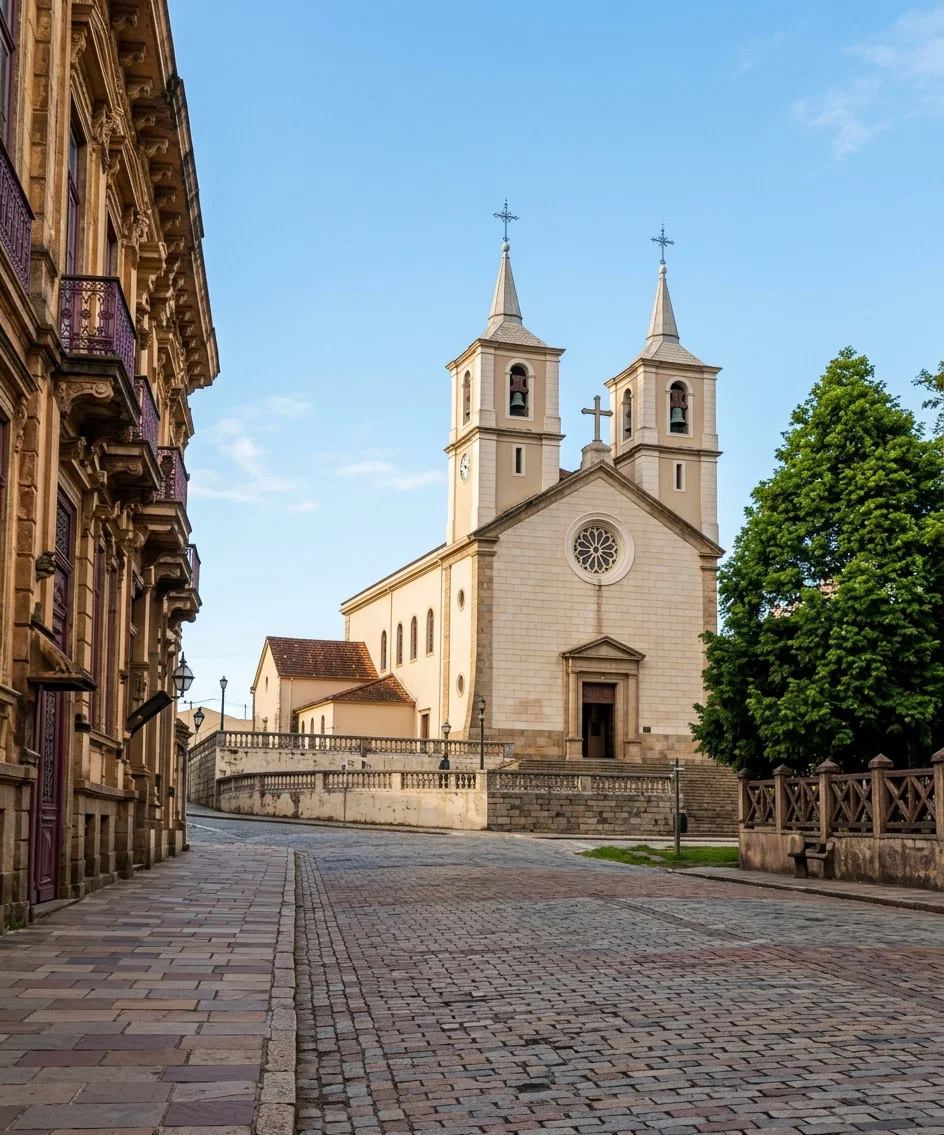
CATHEDRAL IN FLORIANOPOLIS
Dr. Jose Rizal was shot on the Luneta, just a short distance from where we live. By the Filipinos he is looked upon as their greatest patriot. He wrote a book in which he exposed the wickedness of the friars, and opposed them in other ways. We just read in a local paper an account of how the friars set up the type and printed a revolutionary document, and the nephew of the archbishop placed it in Rizal’s effects; and when he was searched, these papers were found, and he was shot in the back while hundreds of friars smoked their cigars and looked on with delight. Another man was banished to the island of Chafarina, in the Mediterranean, for owning and reading a Bible. These things give some idea of the condition of the people who were forcibly converted from heathenism to Catholicism several centuries ago. Ignorance and darkness have been the heritage of the Filipino people these many years.
The Filipinos are divided into many tribes and languages. They are not, as some suppose, a united people, with a common language. It is very difficult to ascertain the number of languages spoken in the group, but estimates place the number all the way from forty to eighty. These languages are very difficult to acquire. Very few of the people know anything of Spanish. Since American occupation, all the public schools have instructed in English. The language question is the most serious problem in missionary work among these people.
When we came to Manila, we began sending literature to the American school-teachers scattered among all the islands. We were able to do this only because many sent us literature of various kinds, and we heartily thank those who have helped us in this way. There are about eight hundred American school-teachers here at the present time. You can readily see that to reach such a number of people it would require a large supply of literature. We felt very anxious to make a systematic effort in setting the truth before these people, and we prayed earnestly that some way might be opened whereby this could be done.
We know you will rejoice with us when I tell you that we received a letter from Elder E. W. Farnsworth telling us that he had laid our need before the General Conference, and as a result five hundred copies weekly of the Special Series of the Signs of the Times are coming to us for use among these teachers. We had never told Elder Farnsworth anything about our needs, but the Lord impressed his mind to do this. This was a direct answer to our prayers. A few of these papers we are sending to Filipino teachers, and other kind friends are sending us clubs of American and Australasian Signs, and these we are using among Filipino teachers. There are a great many Filipino teachers; and as they are familiar with English, we are anxious to carry on a systematic work among them. These teachers belong to the different tribes, and so speak their native languages in addition to English. Does this not seem to you to be a wonderful opportunity to reach with the truth many speaking these languages? We believe that it is, and if we can reach some of these teachers through English literature, they, in turn, will become channels of light to their own people.
We feel deeply in earnest over these matters, they mean so much to the work here. We write these things to enlist your help and sympathy. We mail a letter to every person to whom we have sent literature, calling their attention to the papers and asking them to give them a careful reading. We have received a number of letters in reply expressing appreciation. These have been received from both American and Filipino teachers. One Filipino writes that he had translated some of the articles in the papers into his native language for the benefit of his family, and that they were very pleased at hearing such good articles. Praise the Lord for that! The Lord can carry the truth to those to whom we can not speak. This man wanted more literature, and we have sent it to him.
We are holding studies here in Manila with a young man, a Filipino, who is secretary to Archbishop Aglipay, the head of the Filipino Independent Church. This young man is an Ilocano, from the north of Luzon. He speaks two native languages, Spanish and English. We have a study almost every day, and he is becoming greatly interested in the truth. The teachings of his church are mostly from evolution and higher criticism, and very little from the Bible. As we have studied the truth, he can see that their teaching is error, and he told me that he could no longer teach their doctrines. We believe this young man will take his stand for the truth. It will mean much for him to cut loose from his present church connection, especially in a country like this. We want you to unite with us in special prayer for this young man. His name is Santiago Fonacier. He has already helped us in preparing a translation into Tagalog of matter on “The Second Coming of Christ.” He has started to translate the same into Ilocano. He wants us to take his sister into our home and train her. We would gladly do this if we had room for her. Rent is very high here, and we have only a small place; but I believe it will be necessary for us to have a place large enough to take young people into our home, and train them how to live physically as well as spiritually, and they in turn will become workers for their own people. We ask you to remember this field in prayer.
Manila.
A Forward Move in Florida
By R. W. PARMELEE
Just now we are struggling with a sanitarium proposition. For years there has been a strong demand for a sanitarium in Florida. Thousands of invalids and semi-invalids come to Florida in the fall to escape the rigors of the northern winters. Many of these people pay high prices for entertainment in hotels, and spend their time in seeking pleasure. Others own winter homes, which they close when spring comes.
There is no sanitarium for our people in active operation farther south than Graysville, Tenn. To reach there and return means an outlay of fifty dollars railroad fare. This almost prohibits our people from having the advantages of the sanitarium, and the permanent residents of Florida know but little of our sanitarium work. Why should we not provide for these? Should not the work that such an institution would do for the Northern people who come here to spend the winter inspire in the hearts of our Northern brethren a deep interest in such an enterprise?
We take the following circumstance as an indication that God has gone out before us in this matter: A leading physician in Orlando, a beautiful little city, centrally located in the State, organized a company of citizens, and they erected a small sanitarium on a plat of seventy-two acres of ground, containing two lovely lakes. They installed their own water and sewer systems, erected a number of cottages, and bought furnishings. The buildings are lighted with electricity. The property lies about one mile from the edge of the town, and right by a station on the main line of the principal railroad from Jacksonville to Tampa, in plain view of the passengers.
This property was built this last winter; and when completed, the physician projecting it accepted a position as surgeon in an institution in Jacksonville. Those interested sought us out, and offered it to us for $12,500, the exact cost to them. We asked them to offer it at $9,000, and said we would see what we could do in the matter. This they did not wish to do, but one of the leading stockholders said if we would make him a bona-fide offer of that amount, he would see if he could not buy the other stockholders out at a price that would enable him to sell it to us at that figure. This, of course, we could not do, as we did not have the money. But one of our good brethren, fearing we would lose the opportunity altogether, taking the risk entirely upon himself, voluntarily traded his own home for an equity in the sanitarium property, hoping to be able by this means to hold the bargain until we are prepared to secure it. Now, brethren, shall we not recognize such sacrifice and devotion to the cause, and come to the help of the Lord, relieving this brother, and securing this institution to the cause of truth?
You may ask, How can this be done? The Florida Conference Committee drafted a plan for financing the enterprise, and the Union Conference Committee afterward gave this plan their indorsement. We shall be glad to explain it to any who are interested. By it those of small means can have a part in this work, and those even without means can be of assistance. We would be glad to hear from any who find it in their hearts to help us in any way. The only medical work in operation in Florida at the present time is at Tampa, where Dr. Lydia Kynett-Parmele has an office connected with treatment rooms. Will not our medical workers, as well as those having means that should be placed in the Lord's cause, respond to this call? Address the undersigned at Route 1, Tampa, Fla.
R. W. PARMELEE,
Pres. Florida Conf.
India
By Della Burroway
OUR dispensary work in Karmatar calls us out to many villages, and brings us into close contact with the people. For some time we have been trying to close our eyes to their distress and poverty, excusing ourselves that we were doing what we could for the sick, and were not called upon to do more. The beggars who used to come to our door once a week now come about every day. To many of these also we have turned a deaf ear; as rice is expensive, and a rupee does not go very far.
Last week, while on the way to visit a patient, our cart was stopped by a little mud hut, where we found a man ill. He looked as if he were starving. We inquired what he was eating, and found that once a day he ate a little rice. His only relative was a boy who herded cows for a small allowance of food for himself, and this small allowance he divided with this man, who was his uncle.
As we were coming home that night, we inquired of the man who drove our cart about this man and others of his village. He was of another caste and village, so would have no object in misrepresenting their cases. He said, “Families live on one pow (half a pound) of rice a day. This they boil into mar (soup), the only meal of the day.” We asked him if the children did not cry from hunger. He said, “Yes, but what can they do?” They will not be able to get work until the rice season. Think of a family of eight or more living on half a pound of rice a day, not another thing with it, not even salt.
As we were about to come away from a village one night, a storm came up, and I offered a man two annas if he would drive us home, and leave the father of the sick child to remain at home. He fairly shouted, “Yes, memsahib!” As we started, we found both of the men going. They said, “We want to divide the two annas to buy rice.”
We have started a fund here in Karmatar to help these in need, and hope some of our brethren will add to this fund. These people will need help until they can get work putting down the rice. Many will need help until the rice is harvested. We realize that we15will have to be very cautious, or some may take advantage of our efforts to help. We have thought of charging perhaps a third or half the price of the rice to those who can get hold of a little money.
“Blessed is he that considereth the poor; the Lord will deliver him in time of trouble.”
DELLA BURROWAY.
New Sabbath-Keepers in Tabasco
Two new Sabbath-keepers are reported in Tabasco, Mexico. Mrs. G. W. Caviness has sent them some literature, and will send Bibles also. She says: “It seems the Lord is opening more ways than we can follow up.”
Fruitage of Early Work in India
AN item appearing in the Missionary Magazine of October, 1900, written by W. A. Spicer, while in India, says: “So far as seed-sowing is concerned, we have done quite a lot of work in India, but I really think that much of the fruit will wait until the last minute. . . . At present we have the company of believers in Calcutta, which is the only permanent one, save the friends in Karmatar. Brother Ellery Robinson is working in Bombay, and up at Mussoorie, a hill station, there are two families, but they may not remain long in that place.” We not only have permanent work established in all these places mentioned, Mussoorie being one of the strong, strategic points in the work now, but over in Burma a strong work is developing, as well as in southern India among the Tamil tribes. The early seed-sowing is surely bringing forth fruitage.
_Spain_
By Frank S. Bond
VALENCIA.—In a recent REVIEW I noticed that another Spanish-speaking field, Guatemala, has been definitely entered by our people. The ever-increasing velocity of this great forward movement is very apparent, and we are truly thankful for a part in it.
We are glad to report progress in Spain. It was in the latter part of March that we succeeded, after a number of weeks' searching, in finding a hall in which to conduct a series of meetings. This is the first public effort we have made in the city of Valencia. April 17 only my brother Walter, with his family, came to assist us. Our meetings began the evening of April 8; since then we have conducted five night meetings and one on Sabbath each week. The attendance has been good from the beginning, the average being about one hundred. It is true that many of those who attend come just to pass the time away, and a number of them are of the very unruly element; but there are also a goodly number who attend regularly, and listen with interest to the truths presented.
Thus far I think we are safe in counting on eight new adult members. Most of these have now kept two or three Sabbaths. There are several others who manifest much interest in the message, and may yet take their stand with God's remnant people. Two young ladies who are among those who have begun to keep the Sabbath, are meeting with opposition, but we trust they will remain steadfast. One of these works in a dressmaking establishment. Two weeks ago Sabbath morning she told her mother she was not going to work that day. The mother urged her, but she responded, “I am not going to work on the Sabbath, or drink wine.”
We are thankful to find now and then a little of the same kind of material that existed in Spain during the Reformation. The very flower of this nation was at that time martyred because of its fidelity to God's truth.
Thus far we have given two health and temperance lectures, which apparently were well received. We find that it is important in this country to vigorously exercise the “right arm” of the message. We are anxiously awaiting the day when additional help, in the way of preachers and Bible workers, may be sent into this field. It seems to us almost as difficult a problem really to make this truth known to twenty million Spaniards, who are steeped in the darkest superstition of Romanism, as it is to make it known to several times that number in China or India. Remember the work in Spain before the throne of grace. FRANK S. BOND.
The Rio Grande (Brazil) Conference
By John Lipke
The first conference ever held in a tent in Brazil convened at Santa Maria, Rio Grande do Sul, April 4-11. The tent was pitched in a prominent place near the center of this city of fourteen thousand souls. A cheap but good vegetarian diet, and comfortable sleeping-rooms, were provided in a hotel not far distant.
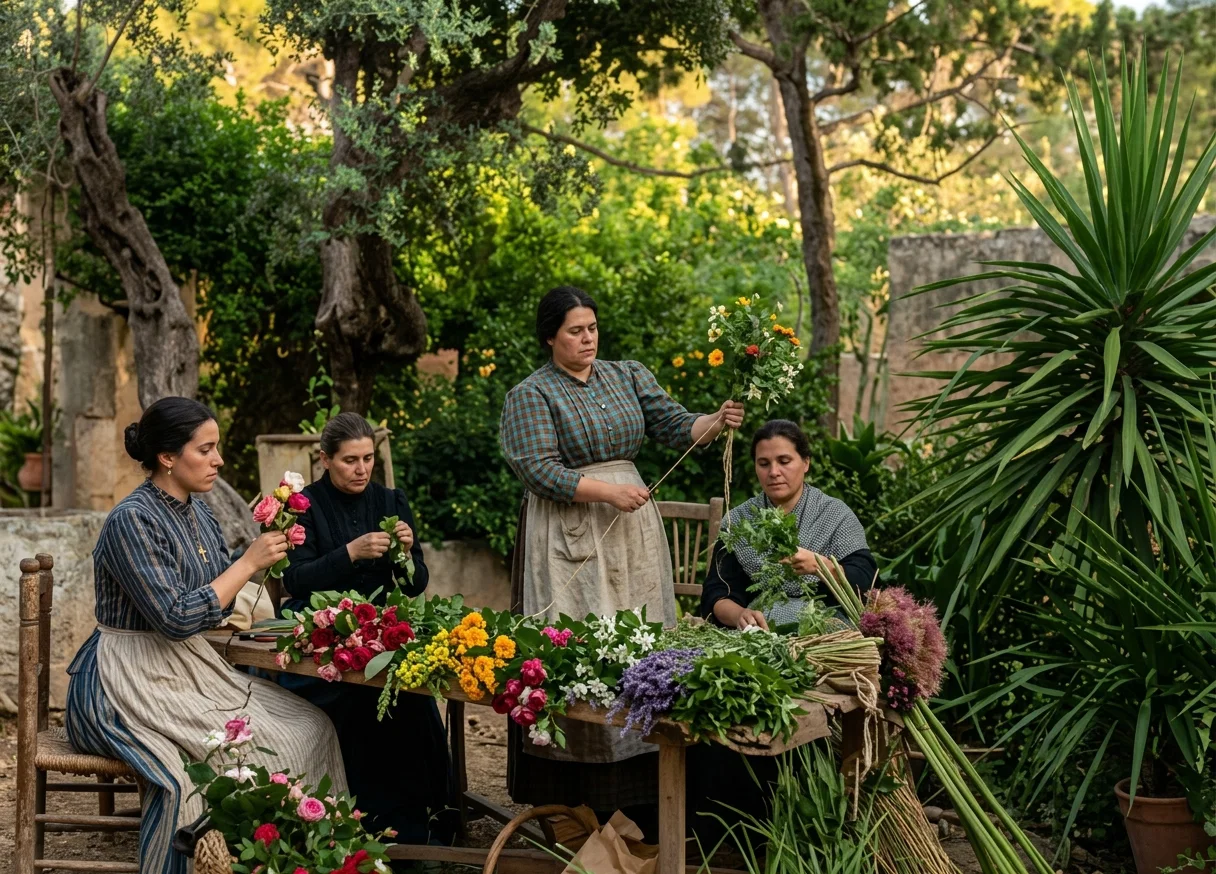
PREPARING BOUQUETS FOR MARKET IN VALENCIA
The meetings were seasons of blessing to our people. About sixty were present, Germans for the most part; but there were also a number who spoke only the Portuguese language. All but the evening sermons for the public, which were preached in the Portuguese, were translated. Instruction and counsel given by Elders J. W. Westphal and F. W. Spies were much appreciated, and contributed to make the conference a blessing to all.
There was a good attendance from the city evenings, and some seem to be interested. Many heard for the first time the great truths of the third angel's message. Brethren Gregory, Kumpel, Lindermann, and the writer remained to follow up the work.
Harmony prevailed in the business of the conference. The officers elected are: John Lipke, president; Dr. A. L. Gregory, vice-president; August Preuss, secretary and treasurer. There seems to be, among the brethren of our conference, a desire to work. Ten persons, most of them young men, offered themselves for the canvassing work. Brother August Brack was chosen canvassing agent. With the writer he will hold a short canvassers’ institute with these in May, and then they will be taken into the field. Means was raised to purchase a colporteur’s wagon, with which to canvass the prairies during the summer months. The plan is that this wagon, with a small tent, shall form the rallying point for a group of from four to six canvassers. It will be the means of transporting their books, as it is too difficult to carry them on the backs of mules. These workers will visit all the inhabitants to the distance of several leagues on each side of the wagon road by mule. As they canvass the smaller cities, the tent will afford a cheap lodging and boarding place. In this way they hope to economize effort and means, so that this branch of the message may become fully self-supporting, and minimize the discouragement of financial failure.
About one hundred fifty dollars was raised toward the new press to be purchased for the Brazil publishing work. Nearly enough means was raised to pay off the remaining indebtedness on our tents. In all, about three hundred dollars was donated to the work. Notwithstanding the depredations of the locusts, the last year has been a prosperous one financially. The increase of tithe over the previous year was about one thousand dollars. After settling with the laborers for the year, a neat sum remains in the treasury to carry forward the work. With courage, expecting to advance under our Captain, we enter upon the labors of another year with one minister, three licentiates, three Bible workers, and a number of canvassers.
JOHN LIPKE.
South Africa
By J. V. WILLSON
THE party of six missionaries who sailed from New York, April 16, arrived in Cape Town on May 25. The party consisted of Brother S. M. Konigmacher and wife, Brother J. R. Campbell and wife, and Brother H. C. Olmstead and wife, all young people assigned to labor in South Africa. They all arrived in good health after a favorable voyage.
We welcome this addition to our forces in this needy field. Brother and Sister Konigmacher go to labor in Nyassaland, at the Malamulo mission, in connection with Brother Joel Rogers and wife; Brother and Sister Campbell go to the Solusi mission, in Matabeleland, to assist Brother and Sister Sturdevant; and Brother and Sister Olmstead go to Barotseland, where Brother W. H. Anderson so sorely needs assistance.
This party are stopping a few days in the suburbs of Cape Town to recuperate after their long voyage, and will then proceed to their respective fields. There was a reception given them last evening at the chapel of the Claremont Union College to welcome them to South Africa. All were full of hope, courage, and love for the work to which they have given their lives.
The reports from the various missions in this field show a forward move all along the line. A recent letter from Elder J. C. Rogers, Nyassaland, reports seventeen converts baptized at the Malamulo mission, and twenty more are awaiting baptism there, at their central school. Their outstations are also making good progress. Brother Rogers has passed through the fever season without coming down with it, but Sister Rogers has had frequent attacks of the fever. We hope, now that the cooler weather has come, that they will not suffer any more from this terrible African scourge. They will have about fifteen hundred baskets of corn (mealies) this year.
At the Solusi mission the work is onward. Brother Victor Wilson is getting a good experience in teaching the mission school there. Their crops were cut short by the drouth this year. Brother and16Sister Sturdevant will soon take a much-needed rest of two months.
At the Somabula mission Brother A. Butterfield and his wife and little girl have all been sick with the fever. Brother and Sister Butterfield are recovering, but their daughter, their only child, has been taken from them and laid away to rest. Brother W. C. Walston had to nurse the sick night and day, teach the mission school, and attend to all the outside work; but the Lord gave his servant strength to bear up under all this heavy strain. Elder W. S. Hyatt is now there assisting him.
Brother W. H. Anderson is all alone at the Barotseland mission. He has been to visit his two outstations, and found them getting on well. On the way, as he was following on foot some distance behind the wagon, he heard a growl, and when he looked around, there was a great lion only ten feet from him, just in the act of springing upon him. He set the greyhound on the lion, fired his gun, and ran for the wagon. He reached the wagon first, the dog following, and the lion coming up last. The lion immediately sprang upon the oxen, got one separated from the team, and killed it. That night they set a trap gun, and shot the lion. The Lord mercifully saved his servant from the power of the lion as he did Daniel of old.
At Somabula mission Brother Armitage is just finishing their new building designed for a church and schoolhouse. It is built of stone, which they quarried out on the mission farm. The drouth has cut off all their crops this year; this makes it hard to carry their large mission family.
The company of new workers just arrived will relieve our missions, and we trust give a new impetus to the work.