Your ShelfYour Projects

Signs of the Times, Vol. 28, No. 22.

THE ROMAN PANTHEON

Signs of the Times

May 28, 1902

Pacific Press Publishing Company · Oakland, California · May 28, 1902

THE ROMAN PANTHEON.
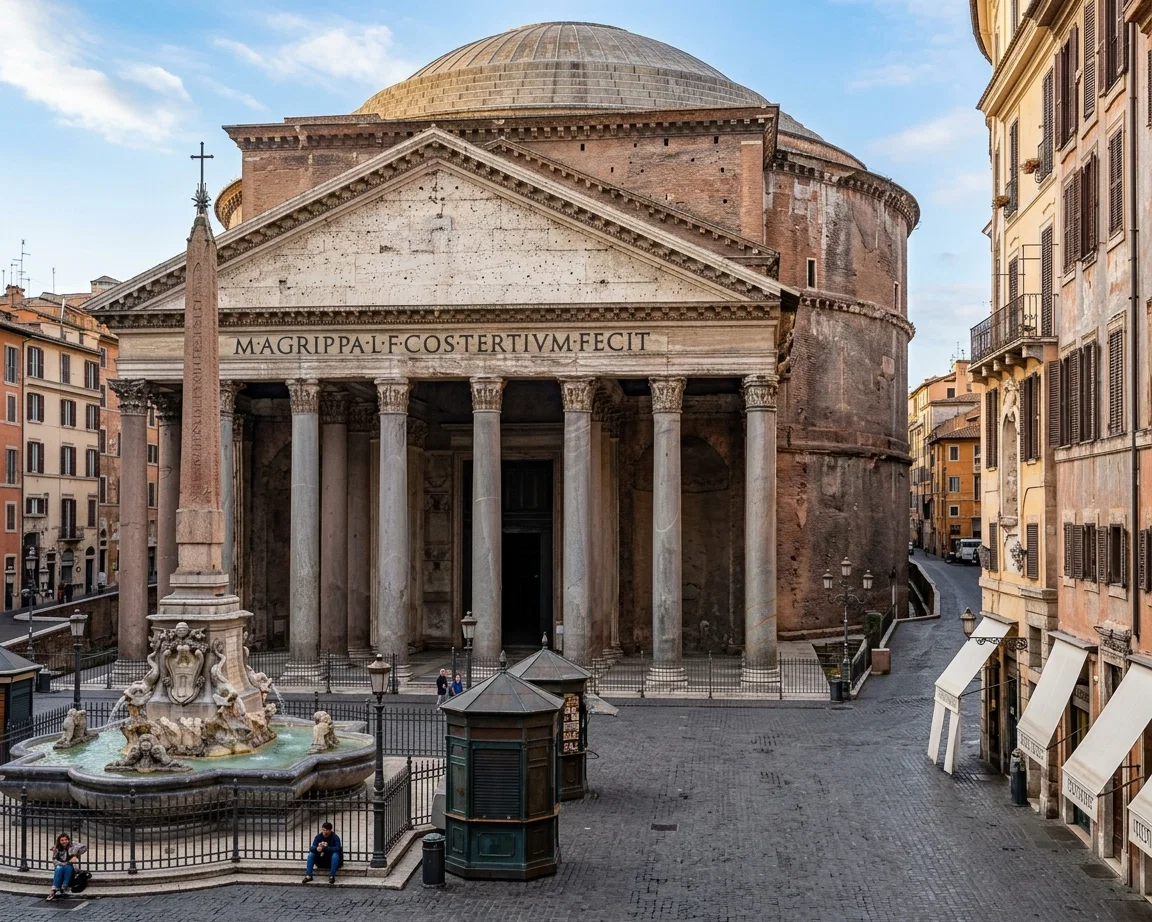
One of the most noted of surviving examples of the architecture of ancient times, is shown in the accompanying illustration. It stands on the Campus Martius in Rome, a cylindrical building one hundred forty-two and one half feet in interior diameter, surmounted by a hemispherical dome reaching to an equal height above the floor. Its name, the Pantheon, signifies the temple dedicated to all the gods. Before the door, upon a portico supported by eight columns, is an inscription which tells that the building was constructed by Marcus Aggrippa, a Roman Consul, and son-in-law to the Emperor Augustus, in the year 27 B.C. Another inscription in the building attests that it was restored by Severus and Caracalla, A.D. 202.
THE PANTHEON.
THE PANTHEON.
In the walls of the building within, which are about twenty feet in thickness, are alternating square and semicircular niches, seven in number, in which were placed the statues of Roman gods. These statues were long since removed, and even their names have not been preserved. In their places stand to-day altars dedicated to Roman Catholic “saints;” for the edifice is now used as a Roman Catholic place of worship. Pope Boniface IV., in the year A.D. 608, converted this heathen temple into a “Christian” church, by dedicating it to “the Virgin Mary and all the saints;” and this dedication to “all the saints” is a fact that remains conspicuous in the worship conducted within it at the present time. One may see there, we are informed, different services going on at different altars at the same time, with distinct congregations around them, according as inclination leads the people to the worship of one “saint” or another. As objects of worship, there is of course little to choose between “all the gods” and “all the saints;” so that the exchange of the one for the other did not affect the character of this temple in any essential way. It remained a place of pagan worship.
The Pantheon is noted as being the best preserved of any of the remaining structures of ancient Rome. But whatever purpose it may serve in modern Rome, it is as a relic of ancient Rome that it is most interesting to the beholder. It is from ancient Rome that it brings its message to the modern world; for it brings a message, one which, tho silent, is none the less plain and impressive. It speaks to us of a system of belief which has been weighed in the balances of time, and found wanting; a system which has filled the world with relics and crumbling ruins; a system which, tho professing to connect the soul with immortality, was itself destitute of inherent life; a system which by its whole history is plainly marked for extinction at the end of time. Such a system is paganism, which held sway over the great kingdoms of antiquity, and still dominates in its modern forms the greater portion of the human race. In striking contrast with such a religion is Christianity, the religion of life, springing from thedivine Fountain of life, and imparting life to all things. It is the life-giving power of Christianity that proclaims it to be the one divine religion, the revelation of the true God.
The true God is the God of life. His name, “I AM,” signifies the One that is self-existent. “As the Father hath life in Himself,” said Jesus, “so hath He given to the Son to have life in Himself.” John 5:26. Lofty temples, dazzling display, imposing forms and ceremonies, constitute no sign of the true religion. It is not these things that bring men to the knowledge of the true God. It is life, life alone, that testifies of Him who is the Life-giver. And so of Jesus, who came to reveal God to the world, it is written, “In Him was life; and the life was the light of men.” John 1:4. Jesus went about imparting life, spiritual and physical, to all the people. He came “that they [mankind] might have life, and that they might have it more abundantly.” To John, in prison, He sent the message, “The blind receive their sight, and the lame walk, the lepers are cleansed, and the deaf hear, the dead are raised up, and the poor have the Gospel preached to them.” This was the evidence of His Messiahship.
Would that men to-day might read, understand, and take to heart the lessons written upon the ruins of the once-proud temples of heathen worship. Would that men would be admonished by the experiences of the past, by the mistakes of those who have built their hopes upon a perishing foundation, and would cease to cling to that which has no life. Traditions, customs, forms and ceremonies, ritual and creed, abound in the worship of to-day, and are a false foundation for the hopes of multitudes who profess to be followers of Christ. These things are not Christianity; they can not connect the soul with the world to come. The soul is connected with God only through life,—the life that God imparts to the believer, who through faith becomes a channel for the outflowing of the river of life from God’s throne. Christianity is life itself, and the life is made manifest by activity in conveying the healing power of God to a death-stricken world. Christianity is “the power of an endless life.”
The worship of “all the gods” did not cease with the passing away of the Roman empire. The throne of the true God is still usurped by Mammon in the natural heart. There is an invisible pantheon, the counterpart of that reared amid the temples of ancient Rome; and the earth to-day is filled with the worshipers at this invisible shrine, in which there are gods many and lords many. Some of these gods are respectable; others are disreputable; but all belong together by virtue of their opposition to Him who commands, “Thou shalt have no other gods before Me.” The man who does not worship the one true God in His heavenly temple, goes naturally to this other temple of “all the gods,” where the truth of God is changed into a lie, and the creature is worshiped and served in place of the Creator. Here men cling to that in which there is no salvation,—to that which draws them only further away from life and nearer to the brink of final ruin. Here are those “whose god is their belly,” who eat and drink that which ministers disease and death, rather than life, to their mortal bodies. Here are those who worship Mammon, who wear out their lives in laying up treasure on the earth, dying as candidates for heaven’s poorhouse, if such an institution might be supposed. Here are those who worship “science,” placing human reason above revelation, and bringing the Word of God to the bar of their own finite judgment. Here are those who look to man in the place of God, who make void the commandments of God through human traditions, and allow the words of priest or pastor to serve as the guide of conscience. Here are all that vast number who make a god of self, who put some selfish interest uppermost in their hearts, where God has His rightful throne. Many are the gods, and legion are the worshipers, in this great world temple.
A message of reform is now going to all nations, pointing men to the true temple of God which “was opened in heaven,” to His testament seen therein, and which is calling them to worship Him who made heaven and earth, the sea, and the fountains of waters. May this work be hastened in the earth.
L. A. Smith.

“THE WILL OF GOD CONCERNING YOU.”

THIS is the will of God concerning you, even your sanctification.” Great possibilities, high and holy attainments, are within our reach. Sanctification means perfect love, perfect obedience, entire conformity to God’s will. It means an unreserved surrender to Him. It means to be pure and unselfish, without spot or blemish.
From eternity God has chosen us to be His obedient children. He gave His Son to die for us, that we might be sanctified through His grace. Continual progress in knowledge and virtue is His purpose for us. His law is the echo of His own voice, giving to all the invitation, “Come up higher. Be holy, holier still.” Every day we may advance in perfection of Christian character. For this Christ clothed His divinity with humanity. For this He came to the earth, and lived a life of suffering and privation.
But let no one think that it is possible for human beings in their own power to reach the ideal that God presents before them. Our hearts are evil, and we can not change them. “Who can bring a clean thing out of an unclean?—Not one.” “The carnal mind is enmity against God; for it is not subject to the law of God, neither indeed can be.” Education, culture, the exercise of the will, human effort, all have their proper sphere; but here they are powerless. They may produce an outward correctness of behavior, but they can not change the heart; they can not purify the soul. There must be a power working from within, a new life from above, before man can be changed from sin to holiness. That power is Christ. His grace alone can quicken the lifeless faculties of the soul, and attract it to God, to holiness.

He Saves to the Uttermost.

The one great lesson all must learn,—the poor sinner dead in trespasses and sins, and the professing Christian, who has known Christ, but has clung to his sins,—is that Christ will save to the uttermost all who come to Him. “Him that cometh to Me,” He says, “I will in no wise cast out.” The poor, the suffering, the sinful, may find in Christ all they need. As soon as they receive Jesus as their personal Saviour, the cries of distress and woe are changed to songs of praise and thanksgiving.
When the sinner feels his need of the Son of Righteousness, when he comes to Jesus, saying, “Lord, I am sinful, unworthy, hopeless, and helpless; save me, or I perish,” he is accepted in the Beloved. He learns what it means to sit in heavenly places in Christ Jesus. God says, “Let there be light,” and there is light. The heart once darkened by sin is irradiated by the presence of Him who is the light of life.
God is ever seeking to bring human minds into association with the divine. He offers us the privilege of co-operation with Christ in revealing His grace to the world, that we may receive an increased knowledge of heavenly things. Looking unto Jesus, we obtain brighter and more distinct views of God, and beholding, we become changed. Goodness, love for our fellow-men, becomes our natural instinct. We develop a character that is the counterpart of the divine character. Growing into His likeness, we enlarge our capacity for knowing God. More and more we enter into fellowship with the heavenly world, and we have continually increasing power to receive the riches of the knowledge and wisdom of eternity. “We all, with open face beholding as in a glass the glory of the Lord, are changed into the same image from glory to glory, even as by the Spirit of the Lord.”
MRS. E. G. WHITE.

THE BIBLE.

THE charge has been made by skeptics that the Bible will not stand investigation, and that in order to believe, the Gospel preachers must take a partisan and one-sided view. We deny any such absurd charge. The Bible is itself a book of investigation, and it challenges the investigation of the critics of the world, as it has done from the beginning. The proof of its truthfulness is sufficiently established by the fact that it has stood all tests. It stands to-day unshaken in spite of the fact that shrewd men have investigated it and criticized it in all ages. The Bible is the fairest book ever written. The cold, cruel truth is told, even about the Lord's elect. There is no attempt at concealment. Both sides of the story are told, nothing concealed, nothing extenuated. If there is one great, important lesson that this Book of God teaches, it is the lesson of fairness. It enjoins and encourages every man to get all the facts to be obtained, to give them intelligent consideration, weigh them in the scales of his judgment, and then draw his conclusions.—Richmond Times.

PRAYER

PRAYER is the rustling of the wings of the angels that are on their way bringing us the boons of heaven. Have you heard prayer in your heart? You shall see the angel in your house. When the chariots that bring us the blessings do rumble, their wheels do sound with prayer. We hear the prayer in our own spirits, and that prayer becomes the token of the coming blessings. Even as the cloud foreshadoweth the blessing; even as the green blade is the beginning of the harvest, so is prayer the prophecy of the blessing that is about to come.—Spurgeon.

THE WALL FINISHED, AND THE FULL TEMPLE SERVICE RESTORED.

At last the wall of Jerusalem was finished. So diligently had the work been pursued, that the wall was finished in fifty-two days from the day that Nehemiah began the work. However, the gates were not yet set up. But even tho the wall was finished, the “troublous times” did not cease; for says Nehemiah:—
“When Sanballat, and Tobiah, and Geshem the Arabian, and the rest of our enemies, heard that I had builded the wall, and that there was no breach left therein; . . . Sanballat and Geshem sent unto me, saying, Come, let us meet together in some one of the villages in the plain of Ono.”
This was a part of a plan of theirs and of the master adversary, to get Nehemiah into their power, and to slay him, and then cause to cease the work of building the city. But Nehemiah knew that the work in which he was engaged was one in which those men could have no part nor lot, nor any true interest, even to the extent of a parley; therefore he “sent messengers unto them, saying, I am doing a great work, so that I can not come down; why should the work cease, whilst I leave it, and come down to you?”
Yet they were so persistent that they sent unto Nehemiah “four times after this sort;” but every time he “answered them after the same manner.” And even yet they did not cease. In encouragements to the people in the work of the restoration of the city and cause of God, Nehemiah, with his faithful fellow-laborers, constantly cited the promises of God that the Messiah, the Son of David, the rightful King of Judah, would come. He assured them that the work which was then being done, and the time upon which they were entered, would end only in the coming of the Messiah, the rightful King. Rumors of this constantly reached the adversaries, the Samaritans. Their dull minds could frame only the conception of an earthly king; only Nehemiah himself could be such king; this could mean only rebellion as soon as the city should be finished; therefore Nehemiah could be working so diligently only for his own aggrandizement.
Accordingly Sanballat sent his servant even “the fifth time;” this time “with an open letter in his hand,” wherein was written:—
“It is reported among the heathen, and Gashmu saith it, that thou and the Jews think to rebel; for which cause thou buildest the wall, that thou mayest be their king, according to these words. And thou hast also appointed prophets to preach of thee at Jerusalem, saying, There is a king in Judah. And now shall it be reported to the king [of Persia] according to these words. Come now therefore, and let us take counsel together.”

The Worst Trouble of All.

Nehemiah answered truly, “There are no such things done as thou sayest, but thou feignest them out of thine own heart.” And of them he says, “For they all made us afraid, saying, Their hands shall be weakened from the work, that it be not done.” And against all he appealed to God, “Now therefore, O God, strengthen my hands.”
Yet the worst feature of the situation was not the scheming of Sanballat, and Tobiah, and Geshem; it was the traitorous fellowship of Jews in Jerusalem who in heart were united with Sanballat, and Tobiah, and Geshem, and constantly played into their hands and aided their schemes. When the trick of Sanballat, and Tobiah, and Geshem to get Nehemiah into their power, outside the city, had failed, these false brethren attempted to make that scheme effective inside the city. So as Nehemiah came one day to the house of Shemaiah, the son of Delaiah, the son of Mehetabeel, who was shut up, Shemaiah said to him, “Let us meet together in the house of God, within the temple, and let us shut the doors of the temple; for they will come to slay thee; yea, in the night will they come to slay thee.” But, said noble Nehemiah, “Should such a man as I flee? and who is there, that, being as I am, would go into the temple to save his life? I will not go in.”
Yet more, and the worst, was to come. Here is the record:—
“And, lo, I perceived that God had not sent him; but that he pronounced this prophecy against me; for Tobiah and Sanballat had hired him. Therefore was he hired, that I should be afraid, and do so, and sin, and that they might have matter for an evil report, that they might reproach me. My God, think Thou upon Tobiah and Sanballat according to these their works, and on the prophetess Noadiah, and the rest of the prophets, that would have put me in fear. . . . Moreover in those days the nobles of Judah sent many letters unto Tobiah, and the letters of Tobiah came unto them. For there were many in Judah sworn unto him, because he [Tobiah] was the son-in-law of Shechaniah the son of Arah; and his [Tobiah’s] son Johanan had taken the daughter of Meshullam the son of Berechiah. Also they reported his good deeds before me, and uttered my matters to him. And Tobiah sent letters to put me in fear.”
Yet, for all this, there was no halt in the work. The gates were set up, and thus the wall was finished in all its parts completely round the city. And “when all our enemies heard thereof, and all the heathen that were about us saw these things, they were much cast down in their own eyes; for they perceived that this work was wrought of our God.” As the danger from the enemies was still great, Nehemiah commanded, “Let not the gates of Jerusalem be opened until the sun be hot; and while they stand by, let them shut the doors, and bar them; and appoint watchers, of the inhabitants of Jerusalem, every one in his watch, and every one to be over against his house. Now the city was large and great; but the people were few therein, and the houses were not builded.”

Restoring the Worship.

Being able thus to dwell in comparative safety, the restoration of the worship of God according to the Scriptures was systematically entered upon. On the first day of the seventh month “all the people gathered themselves together as one man, into the street that was before the water gate,” and the people spake unto “Ezra the scribe to bring the book of the law of Moses, which the Lord commanded to Israel.” Ezra brought forth the book, and stood upon a pulpit of wood which they had made for the purpose, and “opened the book in the sight of all the people (for he was above all the people); and when he opened it, all the people stood up; and Ezra blessed the Lord, the great God. And all the people answered, Amen, Amen, with lifting up their hands; and they bowed their heads, and worshiped the Lord with their faces to the ground.”
Certain chosen ones “caused the people to understand the law; and the people stood in their place. So they read in the book in the law of God distinctly, and gave the sense, and caused them to understand the reading.” This was so especially necessary, because,—owing to the scattered condition of the people in the captivity, and especially owing to the mixed marriages in which the people had indulged since their return—the language of the people had so changed that many of them could not well understand the pure Hebrew in which the Scriptures were written, and now read by Ezra. And when they did understand the reading, as now distinctly presented to them in its plain sense, it presented before them a manner of life so distinct from that which they had been living, so much purer and more elevated and noble, that “all the people wept when they heard the words of the law.”
But Nehemiah and Ezra and the interpreters comforted all the people, saying, “This day is holy unto the Lord your God; mourn not, nor weep. . . . Go your way, eat the fat, and drink the sweet, and send portions unto them for whom nothing is prepared; for this day is holy unto our Lord. Neither be ye sorry; for the joy of the Lord is your strength. . . . Hold your peace, for the day is holy; neither be ye grieved. And all the people went their way to eat, and to drink, and to send portions, and to make great mirth, because they had understood the words that were declared unto them.”

The Feast of Tabernacles.

On the second day, as they were all gathered to the reading, it was also the second day of the seventh month, in the portion that was read was what is now Leviticus 23. In this they found that it was commanded “that the children of Israel should dwell in booths in the feast of the seventh month; and that they should publish and proclaim in all their cities, and in Jerusalem, saying, Go forth into the mount, and fetch olive branches, and pine branches, and myrtle branches, and palm branches, and branches of thick trees, to make booths, as it is written.” This had stood in the book all the ages since the children of Israel had been in the wilderness, after their coming out of Egypt; yet “since the days of Joshua the son of Nun unto that day had not the children of Israel done so.” Nevertheless as soon as it was now read, the people received it as it is the word of God, and promptly went forth, and brought the branches, “and made themselves booths, every one upon the roof of his house, and in their courts, and in the courts of the house of God, and in the street of the water gate, and in the street of the gate of Ephraim. And all the congregation of them that were come again out of the captivity made booths, and sat under the booths. . . . And there was very great gladness.”
When the booths were prepared, and the people dwelt in them, on the first day of the Feast of Tabernacles the reading of the Scriptures was taken up again, and was continued day by day throughout the whole seven days of the feast. And on the eighth day, the twenty-third day of the seventh month, “was a solemn assembly according to the manner.” And on the twenty-fourth day of this same month the people “assembled with fasting, and with sackclothes, and earth upon them. And the seed of Israel separated themselves from allstrangers, and stood and confessed their sins and the iniquities of their fathers. And they stood up in their place, and read in the book of the law of the Lord their God one-fourth part of the day; and another fourth part they confessed, and worshiped the Lord their God.”
One of these blessed and thorough confessions is recorded in full in Nehemiah 9, as an example for God’s people in all time. It is well worth a careful reading in detail by every one of God’s people to-day. There is not anywhere in it any suggestion that either they or their fathers had been infallibly right, and had done infallibly right, all the time, so that it should be accounted akin to sacrilege for anybody to think, and akin to blasphemy for anybody to say, that there was a better way. This confession was written out, and Nehemiah and eighty-three others of the princes, priests, and Levites signed it in behalf of themselves and all the people, who “clave to their brethren, their nobles, and entered into a curse, and into an oath, to walk in God’s law, which was given by Moses the servant of God; and to observe and do all the commandments of the Lord our Lord, and His judgments and His statutes; and that we would not give our daughters unto the people of the land, nor take their daughters for our sons; and if the people of the land bring ware or any victuals on the Sabbath day to sell, that we would not buy it of them on the Sabbath, or on the holy day; and that we would leave the seventh year, and the exaction of every debt.”
At the same time the ordinances, and the courses of the priests, Levites, porters, singers, etc., were restored, in the service of God in the temple.
[The next article is “The Wall Dedicated; the Rival Worship of Samaria Established.”]

CLEANSING POWER.

“And Jesus went into the temple of God, and cast out all them that sold and bought in the temple, and overthrew the tables of the money-changers, and the seats of them that sold doves, and said unto them, It is written, My house shall be called the house of prayer; but ye have made it a den of thieves.” There was the power of the royal priest, and that was an illustration of what Jesus still does when He makes His triumphal entry through the power of the cross. The Lord says, “I will send My Messenger, and He shall prepare the way before Me; and the Lord, whom ye seek, shall suddenly come to His temple, even the Messenger of the covenant, whom ye delight in; behold, He shall come, saith the Lord of hosts.” “And He shall sit as a refiner and purifier of silver; and He shall purify the sons of Levi, and purge them as gold and silver, that they may offer unto the Lord an offering in righteousness.” Mal. 3:1, 3.
Our bodies are the temple of God. 1 Cor. 3:16, 17; 6:19. The Lord is surely coming to His temple; but “who may abide the day of His coming?” The Jews would not accept His cleansing of the ancient temple, and so, instead of standing forever, it had to be destroyed; for “if a man defile the temple of God, him shall God destroy.” God would cleanse us by the coming of His Messenger; but if we refuse to be cleansed, then will He destroy us. But the power and glory of His coming to destroy, is the power of His coming to save. The fire that burns up the finally impenitent, is the fire that consumes the sins of those who have allowed themselves to be cleansed.
In cleansing us He heals. As soon as the temple was cleansed, “the blind and lame came to Him in the temple; and He healed them.” There was authority exhibited in the cleansing of the temple—power which caused the traders who defiled it to flee in terror; yet that was the power that healed the lame and the blind. Take notice that all the power of the Lord, even when it appears in awful majesty, striking terror to the hearts of the wicked and working destruction, is simply cleansing power, and is always working only to cleanse. The fire that burns up the wicked at the last, will be the fire sent to cleanse the earth from the curse. Shall we experience the blessedness of that cleansing power, or shall we resist it, and so be destroyed by it? We have our choice. If we yield, we feel the cleansing power; if we resist, we feel only the destruction, and the cleansing process leaves us as tho we had not been. Then let us say,—
“Every day, every hour, Let me feel Thy cleansing power.”
—E. J. Waggoner.

“I AND MY FATHER ARE ONE.”

In these days when a sentiment has sprung up placing a difference between Christ and God, this truth, “I and My Father are one,” is most timely, and should be emphasized. This oneness, of course, is not in person, but in purpose, in object, in action, in interest. It is a oneness like that which Christ prayed should be seen among His disciples: “That they may be one, even as we are one.” John 17:22. The unity Paul wished to see among his brethren was of this kind—unified consentience—that knew no divisions, no schisms,—“That ye all speak the same thing, and that there be no divisions among you; but that ye be perfectly joined together in the same mind and in the same judgment.” 1 Cor. 1:10.
There was always union of mind, of word, of deed, between the Father and the Son. Before the worlds were made, they were one. When the time came to call the worlds into existence and make man, they were one. Heb. 1:2. “And God said, Let us make man in our image, after our likeness.” Gen. 1:26.
In the plan of salvation relative to man’s fall, again they were one: “The counsel of peace” was “between them both.” Zech. 6:13.
However, there is an idea in the world to-day that God is a tyrant who needs to be restrained by Christ. This sentiment maligns His character, for “God is love.” It was God who “so loved the world, that He gave His only-begotten Son, that whosoever believeth in Him should not perish, but have everlasting life.” John 3:16. And being one with the Father, Christ came, willingly, to convey to man the Father’s good will, identified with His. “Lo, I come,” He said; “in the volume of the book it is written of Me, I delight to do Thy will, O My God.” Ps. 40:7, 8.
Christ’s coming here, then, expressed equally the love of the Father and of the Son. It was not God who needed to be reconciled to us; for He had only thoughts of peace and amity toward us. It was on our side that reconciliation was necessary, because we were at enmity against God. Rom. 8:7. And see the condescending love in the arrangement, “to wit, that God was in Christ, reconciling the world unto Himself.” 2 Cor. 5:19.

Satan’s Object.

But Satan, malicious and cunning, if he can not get us to slight both the Father and the Son will endeavor to cause us to slight one (he cares not which) while we attempt to regard the other. And so it was in the days gone by; he made the Jews imagine they loved God, while they hated His Christ unto death.
Paul says, “I verily thought with myself, that I ought to do many things contrary to the name of Jesus of Nazareth.” Acts 26:9–11. And all this because he “was zealous toward God” (Acts 22:3); and “in all good conscience,” too. Acts 23:1. But he was wrong, his “good conscience” notwithstanding. A person may be “in all good conscience” in a thing, and still be very wrong; for conscience in many things is the result of early training; and if our training has been erroneous, a conscience established thereby must be wrong, and should be rectified by the Scriptures, which “are profitable for doctrine”—right doctrine—and “for correction,” or amendment of doctrine not right. 2 Tim. 3:16.
In the Jewish days, Satan made those men slight Christ for God. To-day, finding that will not do, he reverses his tactics, and makes men slight God for Christ. A case in point: A gentleman said the other day, “You Adventists look to God, but we look to Christ.” Another remarked, “We have nothing to do with God now; we deal with Christ only. So we don’t look to God’s law, but to Christ.” But a man can have no dealing with Christ apart from a connection with God; for Christ says, “No man can come to Me, except the Father which hath sent Me draw him.” John 6:44. Nor could a man have any dealing with God apart from Christ, for the adequate reason that “no man cometh to the Father, but by Me.” John 14:6. It is so arranged that to avoid one—either of the two—is to avoid both; for “I and My Father are one.”

What Looking to Christ Includes.

But he who really looks to Christ, looks to the law of God; “for Christ is the end”—that is to say, the object—“of the law for righteousness to every one that believeth.” Rom. 10:4. Indeed, that is the only way to look at the law; elsewhere we see only its shadow, with which the Jews wearied themselves in vain. But to say a man can be a Christian,—have Christ in him as the hope of glory,—while he continues in wilful transgression, is to make Christ a partner of that sin! He who looks to Christ, looks to the law of God, not as the means to, but as the result of, salvation. Christ came to call sinners to repentance. Mark 2:17. Repentance of what?—Of sin surely; and “sin is the transgression of the law.” Therefore, all who answer to Christ’s call must, of necessity, come to repentance,—a sorrow for, and turning away from, their sin. In other words, they must cease their disobedience of the law of God.
Paul said, “I kept back nothing that was profitable unto you, . . . testifying both to the Jews, and also to the Greeks, repentance toward God, and faith toward our Lord Jesus Christ.” Acts 20:20, 21. Both go together—the law and the Gospel, God and Christ. Wherever we find the keeping of “the faith of Jesus,” there we also find the keeping of “the commandments of God.” See Rev. 14:12. For faith does not abolish, but establish, the law of God. Rom. 3:31. We affirm that keeping the commandments of God is the result of the faith in Jesus; the two are as inseparable as heat and sun.
But there is a class of religionists to-day, who, ignoring God or substituting Him for Christ, as the Jews ignored Christ for God, virtually crucify the law of the Father, as the Jews crucified Jesus. Said the Jews,—the chief priests, scribes, Pharisees, and the people,—“Away with this man!” “Crucify Him!” “Release unto us Barabbas.” “Now Barabbas was a robber.” These others cry out, “Away with the law of God! Away with the Saturday,—the seventh day,—the Sabbath of the Lord thy God! Release unto us the first day of the week, Sunday.” Now, Sunday was the pagans’ day! “And thus,” as Mr. Andrews, in his “History of the Sabbath,” aptly puts it, “the Mohammedans and the Romanists crucified the Sabbath, as the Jews and the Romans crucified the Lord of the Sabbath,—between two thieves, the sixth day and the first day of the week”—the Mohammedan Friday and the apostate Sunday.
“I and My Father are one.” “The Son can do nothing of Himself, but what He seeth the Father do; for what things soever He doeth, these also doeth the Son likewise.” John 5:19. “My doctrine is not Mine, but His that sent Me.” John 7:16. “For I have not spoken of Myself; but the Father which sent Me, He gave Me a commandment, what I should say, and what I should speak.” John 12:49. Can we then conceive of the Son’s teaching any doctrine contrary to that of the Father?
Is it not then true when Christ says: “Think not that I am come to destroy the law, or the prophets; I am not come to destroy, but to fulfil. For verily I say unto you, Till heaven and earth pass, one jot or one tittle shall in no wise pass from the law, till all be fulfilled”? Matt. 5:17, 18. And does it not become us seriously to take heed to the 19th verse, that cautions “whosoever”—that means anybody—“whosoever therefore shall break one of these least commandments, and shall teach men so, he shall be called the least in the kingdom of heaven”?
“The Son can do nothing of Himself, but what He seeth the Father do; for what things soever He doeth, these also doeth the Son likewise.” “I and My Father are one.”
PHILLIP GIDDINGS.
New Amsterdam, British Guiana.

FRUITION

We scatter seeds with careless hand, And dream we ne’er shall see them more; But for a thousand years Their fruit appears, In weeds that mar the land Or helpful store.
The deeds we do, the words we say, Into still air they seem to float; We count them ever past, But they shall last To the dread judgment day, And we shall meet.
I charge thee by the years gone by, For the love’s sake of brethren dear, Keep thou the one true way, In work and play, Lest in that world their cry Of woe thou hear.
—Keble.

HAVE YOU TIME?

Have you time to sit and read the newspaper for an hour or more every day, but no time to read your Bible? Have you time to attend the concert hall, the ball-room, or the lecture, but no time to attend the missionary meeting or the house of prayer? Have you time to talk about all the news of the day, both home and foreign, but no time to speak of Christ or His love to your fellow-men? Have you time to wash and scrub, to make your house clean, but no time to pray that God may make your heart clean? Have you time to spend days, and weeks, and months, and years in a business that will soon end, but no time to give to the business of salvation that will never end? Have you time to think and plan for the preparation of daily bread, but no time to give to the question of heavenly manna? Have you a whole life-energy to devote to the service of self and the world, but no time to spend in the service of God? “Choose ye this day whom ye will serve!”—Anon.
Continue reading: THE COUNCIL AT JERUSALEM