Your ShelfYour Projects

Review and Herald, Vol. 92, No. 21.

The Harvest of the Lord

Review and Herald

Apr 29, 1915

Review and Herald Publishing Association · Takoma Park Station, Washington, D. C. · Apr 29, 1915

The Harvest of the Lord

C. M. Snow
Sleep not, sleep not! He that sleepeth in the harvest is a son that causeth shame.
Sleep not, O sleep not now! Go forth to the field, for the harvest is great; Go forth, for the laborers are few. Pray the Lord of the harvest that He send forth men; Shrink not when He calls for you. 'Tis the souls of men He is harvesting now From the seed of the word long sown; And we must not shrink nor sorrowfully think We are reaping in the field alone.
Sleep not, sleep not! For the harvest soon is ended, and the summer will be past.
Sleep not, O sleep not now! The vintage is ripe, and the branch bendeth low With the load of the fruitful vine: Go down, get you down, for the press is full, The vats overflow with wine. 'Tis the eve of the day, and the night draws on, The wickedness of earth is great. There's a sickle bright that will flash ere night, For the harvest will not wait.
Reap now, reap now! Get you down unto the harvest, for their wickedness is great.
Reap now, O reap ye now! Go forth to the field, for the harvest is ripe, Thrust in thy sickle and reap; For the time has come for the reaping to be done— Thrust in thy sickle and reap. 'Tis the heavenly call to the reapers all; 'Tis the last in the waning day; And the angels reap while the slothful sleep, And they bear the ripened sheaves away.

COMPANION VOLUMES

“The Shadow of the Bottle”
A Book on Temperance
One of the most emphatic, impressive, and convincing books on the subject of temperance ever printed.
It will give the drunkard a view of himself as others see him, and show the “mild drinker” what is before him.
Attractive in appearance, and entertaining and instructive to every one, regardless of his position on the liquor question.
We expect to run our presses day and night to supply the demand for this book.

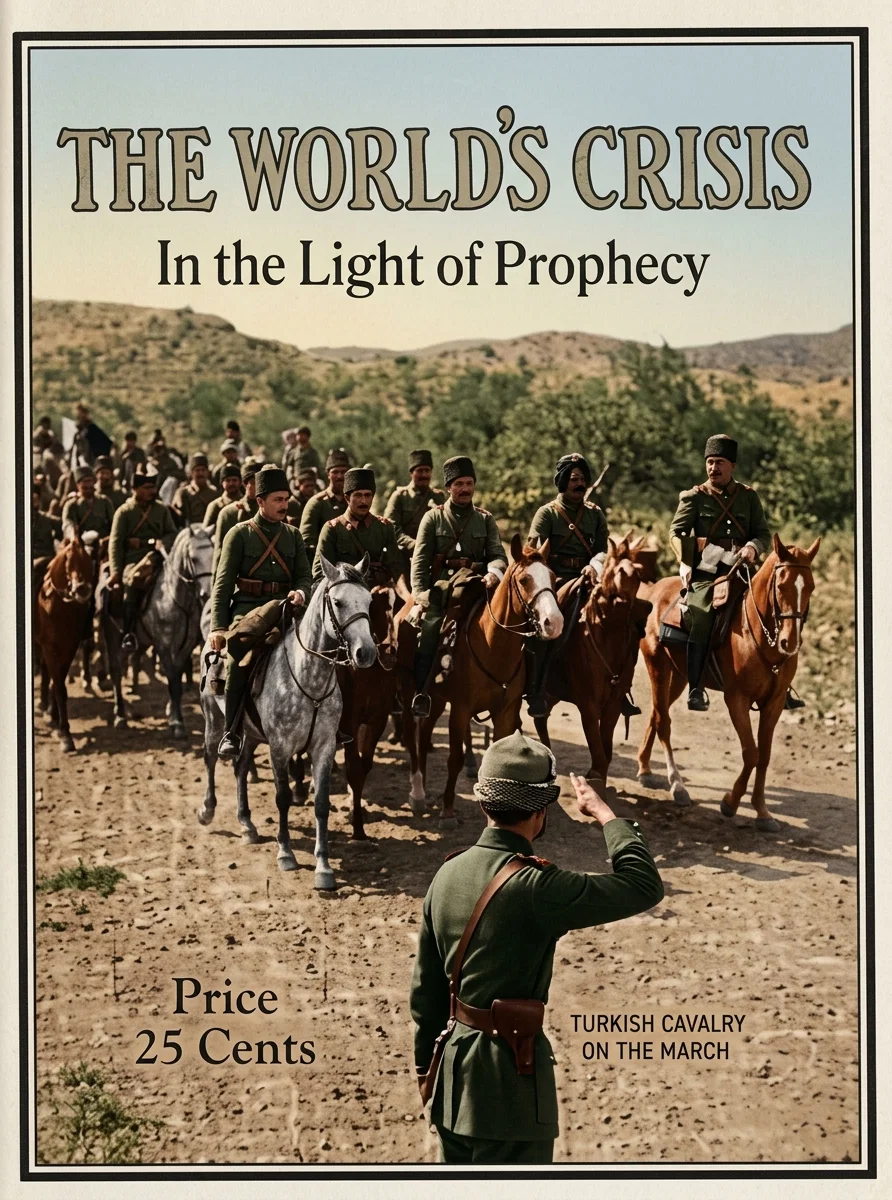
“The World’s Crisis”

(100,000 copies sold in two months)
THE SHADOW BOTTLE
THE SHADOW BOTTLE
This book outlines the cause of the present war, answers queries on the Eastern Question, and at the same time explains prophecies concerning modern nations, and teaches the coming of Christ and kindred truths.
Persons securing a copy for their own use, immediately order copies to give to their friends.
Those who purchase a few to sell, dispose of them easily, and afterwards order by the hundred. Nearly every mail brings a surprise in the sale of the “Crisis.”
Each book contains 128 pages, has a two-color paper cover, and is well illustrated. Price, 25 cents a copy.
Order of your tract society
REVIEW AND HERALD PUB. ASSN., WASHINGTON, D. C.
THE WORLD'S CRISIS
in the light of Prophecy
THE WORLD'S CRISIS in the light of Prophecy
THE SHADOW BOTTLE
THE SHADOW BOTTLE

TWO BOOKS OF ART

“Pen Pictures of the Face of Jesus”

THIS attractive and inspiring book, by Wm. P. Pearce, is meeting with universal approval. To say that it was written by the author of “The Lover’s Love,” and “The Master’s Greatest Monosyllables” is a sufficient testimonial to recommend it to the readers of those highly prized books.
It is well illustrated with reproductions of paintings of Hofmann, Raphael, and other famous artists, and has an art cover in three colors.

“Blessed Be Drudgery”

ONE of the most practical and helpful books for everyday life which we have ever printed. Every page is filled with helpful lessons, practical illustrations, and valuable suggestions.
The book indicates careful study and a wide range of knowledge on the part of the author, as well as a desire to improve the moral tone of the reader and benefit humanity. The purchaser of this book is sure to be pleased with it. Just the thing for a gift.
Both books are printed on heavy paper, each page having an art border. Bound in cloth; price, 50 cents a copy.
ORDER OF YOUR TRACT SOCIETY
REVIEW & HERALD PUB. ASSN., WASHINGTON, D. C.

Rise and Sing

H. I. MORSE-FARNUM
SILENTLY the vernal grasses Weave a velvet green, While the signals of the forest Wave their new-made sheen.
Birds and bees and blossoms praising Goodly works of God; Yet the noblest earth-made beauty Shrinks beneath the sod!
Earth, fair earth, with all its glory, All its love and light, Murmurs still pathetic story— Sin, decay, and blight.
Must the clouds of anguish hover, Weeping o’er and o’er, Or the dust its trophies cover, Sleeping evermore?
Silence and the lowly hiding Never answer make; Can the highest Love, abiding, E’er forget, forsake?—
Never! List to Voice from heaven, Breathing from the Word, Soothing souls by sorrow riven, Wafting hopes deferred.
Our dearest Friend will fully do All that sin delayed,— Perennial beauty bloom anew,— Earth an Eden made!
Not a single jewel wanting For the coming King! Pilgrims erst, but now awaiting, “Wake, arise, and sing!”
De Land, Fla.

The Passover Festival Revived

MRS. E. G. WHITE
The good beginning made at the time of the purification of the temple was followed by a broader movement, in which Israel as well as Judah participated. In his zeal to make the temple services a real blessing to the people, Hezekiah determined to revive the ancient custom of gathering the Israelites together for the celebration of the Passover feast.
For many years the Passover had not been observed as a national festival. The division of the kingdom after the close of Solomon's reign had made this seem impracticable. But the terrible judgments befalling the ten tribes were awakening in the hearts of some a desire for better things, and the stirring messages of the prophets were having their effect. The invitation to the Passover at Jerusalem was heralded far and wide, “from city to city through the country of Ephraim and Manasseh even unto Zebulun,” and the royal couriers found some who were ready to respond. The bearers of the gracious invitation were usually repulsed. The impenitent “laughed them to scorn, and mocked them. Nevertheless divers of Asher and Manasseh and of Zebulun,” eager to seek God for a clearer knowledge of his will, “humbled themselves, and came to Jerusalem.” 2 Chron. 30: 10, 11.
In the land of Judah the response was very general; for upon them was “the hand of God,” “to give them one heart to do the commandment of the king and of the princes” (verse 12),—a command in accord with the will of God as revealed through his prophets.
The occasion was one of the greatest profit to the multitudes assembled. The desecrated streets of the city were cleared of the idolatrous shrines placed there during the reign of Ahab. On the appointed day the Passover was observed; and the week was spent by the people in offering peace offerings, and in learning what God would have them do. Daily the Levites “taught the good knowledge of the Lord;” and those who had prepared their hearts to seek God, found pardon. A great gladness took possession of the worshiping multitude; “the Levites and the priests praised the Lord day by day, singing with loud instruments” (verses 22, 21); all were united in their desire to praise him who had proved so gracious and merciful.
The seven days usually allotted to the Passover feast passed all too quickly, and the worshipers determined to spend another seven days in learning more fully the way of the Lord. The teaching priests continued their work of instruction from the book of the law; daily the people assembled at the temple to offer their tribute of praise and thanksgiving; and as the great meeting drew to a close, it was evident that God had wrought marvelously in the conversion of backsliding Judah, and in stemming the tide of idolatry which threatened to sweep all before it. The solemn warnings of the prophets had not been uttered in vain. “There was great joy in Jerusalem; for since the time of Solomon the son of David king of Israel there was not the like in Jerusalem.” Verse 26.
The time had come for the return of the worshipers to their homes. “The priests the Levites arose and blessed the people: and their voice was heard, and their prayer came up to his holy dwelling place, even unto heaven.” Verse 27. God had accepted those who with broken hearts had confessed their sins, and with resolute purpose had turned to him for forgiveness and help.
There now remained an important work, in which those who were returning to their homes must take an active part; and the accomplishment of this work bore evidence to the genuineness of the reformation wrought. The record reads: “All Israel that were present went out to the cities of Judah, and brake the images in pieces, and cut down the groves, and threw down the high places and the altars out of all Judah and Benjamin, in Ephraim also and Manasseh, until they had utterly destroyed them all. Then all the children of Israel returned, every man to his possession, into their own cities.” 2 Chron. 31: 1.
Hezekiah and his associates instituted various reforms for the upbuilding of the spiritual and temporal interests of the kingdom. “Throughout all Judah” the king “wrought that which was good and right and truth before the Lord his God. And in every work that he began . . . he did it with all his heart, and prospered.” Verses 20, 21. “He trusted in the Lord God of Israel; . . . and departed not from following him, but kept his commandments, which the Lord commanded Moses. And the Lord was with him; and he prospered.” 2 Kings 18: 5-7.
The reign of Hezekiah was characterized by a series of remarkable providences, which revealed to the surrounding nations that the God of Israel was with his people. The success of the Assyrians in capturing Samaria and in scattering the shattered remnant of the ten tribes among the nations, during the earlier portion of his reign, was leading many to question the power of the God of the Hebrews. Emboldened by their successes, the Ninevites had long since set aside the message of Jonah, and had become defiant in their opposition to thepurposes of Heaven. A few years after the fall of Samaria, the victorious armies reappeared in Palestine, this time directing their forces against the fenced cities of Judah, with some measure of success, but they withdrew for a season because of difficulties arising in other portions of their realm. Not until some years later, toward the close of Hezekiah's reign, was it to be demonstrated before the nations of the world whether the gods of the heathen were finally to prevail.

God's Plan Demands Two Resurrections

The Age-to-Come Doctrine — No. 8

God's Plan Demands Two Resurrections

J. O. CORLISS
SENTENCE of death was passed upon the entire human race because Adam, its life fountain, became tainted with sin, and transmitted the blemish to his posterity. Had not sin entered to mar the gift of life, it would have continued to our first parents without intermission, and they, in turn, would have conferred it upon their offspring to be forever enjoyed. But sin having deprived Adam of such privileges, and in him, or through his failure, brought death to an innocent progeny, provision was made for him and these blameless ones to have the intended life through a second Adam—the Lord Jesus Christ. 1 Cor. 15:45. For this reason the complete death penalty was not then enforced, but Adam and his posterity were permitted a probationary period under suspended sentence. This was to give every one opportunity to choose whether he would seek the recovery of the lost treasure, or go down to final death in consequence of Adam's transgression.
That complete success might crown such a far-reaching plan, a foretaste of the eternal future was put within the reach of all. This consisted of a mysterious entry of life through an “everlasting Father” (Isa. 9:6), and a new birth. This second birth was not to be of the fleshly order, but an infusion of spirit life in response to a personal faith in Christ as an assured Life-giver. John 3:1-6; Rom. 5:10. But though having such a privilege, man, being the fleshly offspring of Adam, must be subject to death, the penalty of Adam's transgression; yet if in the end it is found that the life motives have been controlled by the Spirit of Christ, who undertook man's restoration, and in so doing conquered death, Christ will prevail over the temporary sleep, and call his redeemed ones forth to eternal life.
But this privilege of a resurrection to life is not an exclusive one. Every child of Adam must “stand up” to receive his due for the use made of his probationary privileges. Therefore the edict went forth that “as in Adam all die, even so in Christ shall all be made alive.” 1 Cor. 15:22. This is not only just, but reasonable; for since Christ took upon himself the responsibility of the mission in which Adam failed, and so tasted death for every unfortunate son of the great human father (Heb. 2:9), that each of these might recover life if he would, the original penalty was met, and this entitles the entire race to be brought from death's bondage to life.
But having been rescued from a death for which he was not responsible, each victim of Adam's fault must then answer for the things in his own life, for which he was personally responsible. This, too, is perfect equity, else merited recompense is ignored. So if in this examination of personal accounts he is adjudged guilty, without having repented, the “second death” is his due, from which no recovery can be granted, since Christ tasted death for the wiping out of the first death sentence, not the second. The development of these two classes is therefore absolutely necessary, yet it cannot be known to which class one is to be assigned unless a judgment decision has been rendered in his case; and this must be known before the resurrection of any of the dead. It was to this part of the program that the apostle directed attention when explaining the method. So after affirming that in Christ all the dead must be made to live, he thus classified the subjects of the resurrection: “But every man in his own order [or class]: Christ the first fruits; afterward they that are Christ's at his coming.”
This makes it clear that before the coming of the Master a complete arrangement has been scheduled by which to regulate recovery from the Adamic sentence of death upon the human race. Its system is most clearly enunciated in the following: “The Lord himself shall descend from heaven with a shout, with the voice of the Archangel, and with the trump of God: and the dead in Christ shall rise first: then we which are alive and remain shall be caught up together with them in the clouds, to meet the Lord in the air: and so [after this manner] shall we ever be with the Lord.” 1 Thess. 4:16, 17.
It is well to be reminded that this resurrection and change from mortality to eternal purity is effected in the “twinkling of an eye,” just at the moment when the resounding trump heralds the near approach of the Saviour to receive his own (1 Cor. 15:51, 52), and this fact reveals that the judgment decision placing on these the mark of immortality was rendered in heaven, prior to the Lord's return to this earth, as shown in the judgment scene of Dan. 7:9-14 and Rev. 20:11, 12.
Again: it must be evident to thoughtful minds that inasmuch as when Christ ascended to heaven he became high priest for sinful men (Heb. 8:1; 6:20), and that when returning to earth he comes as King of kings (Rev. 19:16), being seated on the throne of his glory, and attended by all the angels of heaven (Matt. 25:31), he must have exchanged his priestly garb and work for a kingly robe and scepter. But as his ministration for sinners could only be through his priestly office, when that station is exchanged for the kingly place, and he comes to earth in glory, probation for the human race has surely ended, and its latest findings must be manifest to the entire universe, that it may be seen that the Judge of all the earth has acted righteously. Phil. 2:9-11; Rom. 3:3, 4.
The fact that a certain class of probationers are segregated from all others as those “accounted worthy” to be raised immortal at the coming of Christ (Luke 20:35), is strong evidence that only these can ever reach that coveted position. Another well-fortified reason for such a conclusion is that, in the judgment examination, the “book of life” guides in the selection of names for final settlement. Rev. 20:12. This book is the record of names for all who have repented of sin and trusted Christ for salvation (Phil. 4:3; Luke 10:20), while all others are excluded. Rev. 21:27. It therefore follows that as none whose names are not in that volume can be eligible to salvation, the examination of candidates for eternal life must be confined to the records in the book of life. For this reason we are informed that judgment must first begin with the recorded family of God. 1 Peter 4:17. In that examination, if it is found that these have been complete overcomers, their names will be acknowledged by Christ before the Father, and so retained in the book of life. Rev. 3:5. By virtue of that retention, those who are represented by the names therein will be passed to eternal life at the coming of their Lord. Dan. 12:2.
These favored ones are therefore “caught up” to meet the Lord while on his way to earth. 1 Thess. 4:17. They are next seen in prophetic vision seated on thrones of judgment, not here on the earth, as some advocate, but in the courts of heaven, whence they were taken in their flight to meet their Lord in mid-air. Rev. 20:4. These are positively identified by the prophet as the same people who were changed to life when Christ appeared in the clouds of heaven; for he says they were composed of those who had died as witnesses for Christ, and others who had not, to the latest day, worshiped the beast or his image. All these the prophet saw alive and reigning with Christ for a thousand years. He also heard a great blessing pronounced on them because they were subjects of the “first resurrection.” This he saw entitled them to freedom from the “second death,” and made them ministers with Christ during the thousand years.
All the others who had died, that is, whose names had not been in the book of life, and so were not eligible to come up in the first resurrection, did not live again until these thousand years had sued their course. In fact, they could not, in harmony with the system followed with the other class, have a resurrection until a minute examination of their life work could be had, when they would be required to rise and face its findings. True, their positive failure to retain eternal life was decided when the names in the book of life were exhaustedat a previous examination. But the degree of their guilt yet remained to be determined, and this must be done by the redeemed saints. Ps. 149: 5-9. In harmony with this inspired reference that all the saints shall participate in that work, the great apostle calls upon the church to remember that they shall not only judge the world of wicked men, but fallen angels as well. 1 Cor. 6: 1-3.
This judgment work is brought to view by the seer of Patmos, as cited, in the chapter under consideration. The saints having completed the task assigned them, at the close of the thousand years the unfortunate dead arise to face their condemnation, when their former master—Satan—at once assumes control of them, for the purpose of opposing Christ in making permanent his kingdom. For that purpose they gather about the holy city, which has descended from heaven, and fire from God falls upon them to close their career, and blot their names from under heaven. Rev. 20: 7-9.
Far different is this view of the millennial period than that painted by the age-to-come theory. But the great thing in favor of this, and against Pastor Russell's teaching, is that this has the backing of plain statements of inspiration, while his views have no foundation in the tracings of inspired testimony.

Seeing as God Sees

A. E. PLACE
To see ourselves as others see us, might be quite an achievement—quite a revelation, in fact. But it is a far greater achievement to see ourselves as God sees us. This would also be a revelation which, if it did not kill us, would cause us to cry, “Woe is me! for I am undone,” and nothing but the “coal . . . from off the altar” would save us from despair.
Let us remember that what man sees or thinks he sees in us, or what he thinks of us, is of small moment compared with what God sees and thinks. Let us also remember that the more we see ourselves as God sees us, the more we shall see our brethren as God sees them; yea, the more we shall see the great sin-cursed world as God sees it; the more we shall be conscious that sinners are longing to be free from the power of the devil; and, thus, more and more, we can look upon their mistakes and sins through the eye of God’s merciful love, and we shall consider ourselves, lest we be tempted.
As soon as we begin to see men as God sees them, we begin to treat them as God treats them, and as he treats us. Have we not many times had cause for thankfulness that God did not deal with us after our sins, nor reward us according to our iniquities? But while failing and stumbling, should we ask God to express his thoughts toward us, we would hear the blessed assurance, “Like as a father pitieth his children, so the Lord pitieth them that fear him.” We would hear him through Jeremiah saying, “I know the thoughts that I think toward you, . . . thoughts of peace, and not of evil, to give you hope in your latter end.” O, to be like God! To be filled with the spirit of the world’s Redeemer! This is the cry of every true Christian.
San Jose, Cal.

Industrial Training

The Schools of the Prophets — No. 8

Industrial Training

M. E. CADY
Industrial training was a very prominent feature of the education given in the schools of the prophets. Just a glimpse of this industrial life is seen in connection with the removal of the school at Jericho to the River Jordan. The conditions surrounding this school were very perplexing, and on the advice and counsel of Elisha and others, it was removed to the banks of the Jordan. The record of the transfer as given in 2 Kings 6: 1-7, indicates plainly that the students and teachers cut the standing timber and erected the new buildings. Even Elisha the prophet was present and assisted in this building enterprise. He miraculously recovered the “borrowed” ax that slipped off the handle and fell into the river.
We have the industrial training course further enlarged upon by the spirit of prophecy:—
“The pupils of these schools sustained themselves by their own labor in tilling the soil, or in some mechanical employment. In Israel this was not thought strange or degrading; indeed, it was regarded as a sin to allow children to grow up in ignorance of useful labor. Every youth, whether his parents were rich or poor, was taught some trade. Even though he was to be educated for holy office, a knowledge of practical life was regarded as essential to the greatest usefulness. Many, also, of the teachers supported themselves by manual labor.”—“Education,” page 47.
“In God’s plan for Israel, every family had a home on the land, with sufficient ground for tilling. Thus were provided both the means and the incentive for a useful, industrious, and self-supporting life. . . .
“By the Israelites, industrial training was regarded as a duty. Every father was required to see that his sons learned some useful trade. The greatest men of Israel were trained to industrial pursuits.”—“Counsels to Teachers,” pages 275, 276.
When God created our first parents, he provided for their physical as well as their mental and spiritual development. He put them in a garden, and they were “to dress it and to keep it.” Gen. 2: 15. After our first parents sinned, physical labor was reassigned them, but to be carried on under adverse conditions. They must now contend against thorns and thistles, and in sorrow and toil earn their daily bread. Their children were not exempt from labor. “Cain was a tiller of the ground,” and “Abel was a keeper of sheep.” Gen. 3: 17-19; 4: 2.
Later, mechanical lines of work were followed. These were introduced by Cain and his descendants, who departed from God’s plan of pastoral living. Cain introduced carpentry, and built the first city, calling it Enoch, after the name of his first son. The later descendants of Cain who introduced mechanical lines of work were Jubal and Tubal-Cain. Jubal “was the father of all such as handle the harp and organ.” In other words, he was a maker of musical instruments. Tubal-Cain was “an instructor of every artificer in brass and iron,” or what is commonly called a metal worker. Gen. 4: 17-22.
“The education centering in the family was that which prevailed in the days of the patriarchs. For the schools thus established, God provided the conditions most favorable for the development of character. The people who were under his direction still pursued the plan of life that he had appointed in the beginning. Those who departed from God built for themselves cities, and, congregating in them, gloried in the splendor, the luxury, and the vice that make the cities of today the world’s pride and its curse. But the men [and women] who held fast God’s principles of life dwelt among the fields and hills. They were tillers of the soil, and keepers of flocks and herds; and in this free, independent life, with its opportunities for labor and study and meditation, they learned of God, and taught their children of his works and ways.”—“Education,” pages 33, 34.
Both Abraham and Lot started their family schools on the plan of industrial life that God had given, and God blessed them exceedingly; but Lot became tired of the monotony and dullness of the country life, and finally he and his whole family became residents of Sodom. Abraham faithfully adhered to God’s plan, dwelling in tents, keeping flocks and herds. How different the ending of these two divinely established schools! Lot’s school became discontented and disorganized, and finally, on the destruction of Sodom, its principal and his two daughters were the only survivors, and took up their residence in the mountains, living in a lonely cave. But Abraham’s school continued to increase in numbers, and finally became a great nation, dwelling in “a land that floweth with milk and honey.” The principal of this school became known as the father of the faithful, and through him and his school have all the families of the earth been blessed.
We find the same spirit of industrial education that prevailed in Abraham’s school, permeating the schools of the prophets. God’s plan of education, whether carried out in the home schools or in the schools of the prophets, developed strong, capable, industrial leaders of the people: Joseph, Moses, David, Solomon, Daniel, and Nehemiah are notable examples.
Not only were the young men of Israel educated and trained in industrial pursuits, but also the young women. Read the description given by Solomon of the ideal, virtuous, and industrious women who were constantly held up as an examplefor the daughters of Israel to follow. Prov. 31: 10-31.
“A knowledge of the duties pertaining to housewifery was considered essential for every woman; and skill in these duties was regarded as an honor to women of the highest station.
“Various industries were taught in the schools of the prophets, and many of the students sustained themselves by manual labor.”—“Counsels to Teachers,” page 276.
In the building of the tabernacle by Moses, and the temple by Solomon, we have the greatest exhibitions of artistic taste and mechanical skill. It was shown in spinning, weaving, embroidering, engraving, and mechanical construction with wood and stone. God gave to these two great architects the plans and specification of these buildings, and he imparted special wisdom and skill to those who willingly gave their hearts and hands to the work. Ex. 31: 1-6; 1 Chron. 28: 9-12, 19-21. The glory of these two buildings has never been paralleled, and it is probable that the workmanship, especially of the temple, has never been equalled. For the glory that enshrouded them was heavenly, and the skill that builded them was divine.
“Our Lord and Saviour Jesus Christ, who is one with the Father, the Commander in the heavenly courts, was the personal instructor and guide of the children of Israel, and among them it was required that every youth should learn how to work. All were to be educated in some business line, that they might possess a knowledge of practical life, and be not only self-sustaining but useful. This was the instruction which God gave to his people.”—“Special Testimonies on Education,” page 38.
“The Great Teacher, enshrouded in the pillar of cloud, gave directions to Israel that every youth should be taught some line of useful employment. Therefore it was the custom of the Jews, the wealthy as well as the poorer classes, to teach their sons and daughters some useful trade, so that should adverse circumstances arise, they would not be dependent upon others, but would be able to provide for their own necessities. They might be instructed in literary lines, but they must also be trained to some craft. This was deemed an indispensable part of their education.”—“Counsels to Teachers,” page 307.
When Christ came as a child, and grew up to manhood, he followed fully the divine plan in education which he had given more than two thousand years before his birth in the manger at Bethlehem. “And the child grew [physically], and waxed strong in spirit [spiritually], filled with wisdom [intellectually]; and the grace of God was upon him.” Luke 2: 40.
This Prince of students, during those years of preparation for his ministry, consecrated the pathway of toil and labor which all must tread who would become workmen “that needeth not to be ashamed, rightly dividing the word of truth.” 2 Tim. 2: 15.
“The path of toil appointed to the dwellers on earth may be hard and wearisome, but it is honored by the footprints of the Redeemer, and he is safe who follows in this sacred way. By precept and example, Christ has dignified useful labor. From his earliest years, he lived a life of toil. The greater part of his earthly life was spent in patient work in the carpenter’s shop at Nazareth. In the garb of a common laborer, the Lord of life trod the streets of the little town in which he lived, going to and returning from his humble toil; and ministering angels attended him as he walked side by side with peasants and laborers, unrecognized and unhonored.
“When he went forth to contribute to the support of the family by his daily toil, he possessed the same power as when on the shores of Galilee he fed five thousand hungry souls with five loaves and two fishes. But he did not employ his divine power to lessen his burdens or lighten his toil. He had taken upon himself the form of humanity, with all its attendant ills, and he did not flinch from its severest trials. He lived in a peasant’s home; he was clothed with coarse garments; he mingled with the lowly; he toiled daily with patient hands. His example shows us that it is man’s duty to be industrious, and that labor is honorable.”—Id., pages 276, 277.
“He did not use his physical powers recklessly, but gave them such exercise as would keep them in health, that he might do the best in every line. He was not willing to be defective even in the handling of tools. He was perfect as a workman as he was perfect in character.”—“Special Testimonies on Education,” page 39.
Continue reading: Worship in Song