FROM the many encouraging words received in every mail in behalf of the REVIEW we quote the following:—
“We have a small church; but every member has access to the REVIEW.”
“We are working to place the REVIEW in every Sabbath-keeping home.”
“To us the REVIEW is the very heart of all means of communication open to the children of God in our onward march to the everlasting kingdom. Each week it brings personal letters to us from those we know and love. We read with much interest all the plans for work, and co-operate as fully as we can, and adapt subscriptions to our resources and field of operation.”
“I don’t recall that the REVIEW has ever missed its weekly visit to our home for over forty years. Our prayers are that it may visit every Seventh-day Adventist home in the land, as no child of God can do without it.”
To illustrate the readiness with which Life and Health sells, we quote the following from a Colorado worker:—
“I received the sixty copies day before yesterday, and have sold them all except two,—sold most of them the first day. I could easily have sold the other two, and many more yesterday, but in the afternoon I could not work, as my health is poor. It is a splendid little journal, and is much appreciated.
“AMY RAWLINSON.”
A New Paper
By W. A. S.
THROUGH Brother G. Dail, secretary of the General European Conference, our Hungarian brethren ask our people in America to make their new paper known among the many Hungarians in this country. Brother Dail writes:—
“I ask you to call attention to the small thirty-two-page Hungarian paper, which we issue quarterly, and which contains the Sabbath-school lessons, and a great deal of other good literature in the Hungarian language. As there are many Hungarians in America, we feel that this little quarterly would be of great interest to these people, and that it would be possible to get quite a good list for this paper there. In the missionary campaign that you are beginning, why not think once in a while of the Hungarians you have in America? The price of the paper is only two kroner (Austrian kronen) per year, or about forty-one cents. The money-order should be made out for two Austrian kronen, payable to ‘Huenergardt, Janos F.,’ Hungary, Budapest, VII, ker., Rottenbiller-utca 4. b, II. em., 14. ajto. The name of the paper is Az Arato (The Reaper). I hope you will do what you can for it.”
1. évfolyam. Budapest, 1904. október 1-jén. 1. szám.
If any find it more convenient to do so, orders may be placed with the Treasurer of the General Conference, at forty-five cents per year. The accompanying cut is a reduction of the title-head of this new paper. There is an encouraging work going on in Hungary, scores accepting the truth; and no doubt many of this nationality who have come to America would be thankful indeed for religious literature from their home land. W. A. S.
Spreading the Message
By S. H. LANE
S. H. LANE
The ordained method of carrying the gospel to the world is by the living messenger, whom our Saviour commissions to preach the good news of salvation to all nations. All should become messengers, and in our work we should employ every lawful means to aid us in the dissemination of the truth.
All can not stand in the pulpit and proclaim the truth publicly, but nearly all can dispose of our reading-matter. We have reached the period of the year when the evenings are long, and people have leisure time in which to read; and as we are living in a reading age, people will read, and we should improve every opportunity to spread our good literature.
We should not depend on any one season of the year to sell our books, but should press their sale at all times; yet, should any one period be more favorable than another, we should be on the alert to take advantage of the circumstance, and press the sale of our books with a commendable zeal. Our books are not especially designed as holiday books, but they sell just as well for that purpose as other attractive books. The books, “Steps to Christ,” “Christ our Saviour,” “Mount of Blessing,” “Paradise Home,” “Glorious Appearing,” “Best Stories,” and “Little Folk’s Bible Nature” are excellent ones, and should be in the hands of the people. They sell readily. If these books have not been sold in your neighborhood, take one or more of them, and begin to sell them. The presentation editions of “Steps to Christ,” “Paradise Home,” and “Best Stories,” are attractive books, and sell almost at sight.
Write to your State agent or tract society about the matter, and obtain some suggestions as to how to begin the work, if you do not already know. Select your own book, and become fully familiar with the subject of which it treats, so you may explain the nature of the book intelligently and eloquently. We are in hopes that before the close of the winter thousands upon thousands of our books may be placed in the hands of the people. Who will aid in this good work?
Is It a New Thing?
By H. H. HALL
IN a letter just received from one of our brethren who has been helping the young people in their missionary effort, he says: “Many people wonder what the new thing is that makes young people so enthusiastic.”
These questioners probably forgot the young man Jonathan, who, with one helper, attacked the Philistine hordes and put them to rout; the young man David, who slew a lion and a bear when they threatened his father's flock, and Goliath when he threatened the armies of Israel. They forgot the spirit manifested by the young man Joseph in a corrupt king's court, and the enthusiasm for God's cause and house shown by the sixteen-year-old King Josiah.
No, the spirit of enthusiasm shown by our young people and others in this missionary campaign is not a new thing. It is as old as the gospel. Has it taken possession of you? H. H. HALL.
A Canvasser's Experiences in New Zealand
By D. A. OWEN
D. A. OWEN
Soon after going to New Zealand, where the sanitarium was being started, I engaged in selling Herald of Health, and was enabled, with God's help, to obtain over two thousand yearly subscriptions, besides selling several thousand single copies, and over one hundred copies of “Christ's Object Lessons.” Some will remember me as one of the pioneer canvassers in Canada. I am now past sixty years of age, and am glad to say that I have never lost interest in the work, nor regretted that I sold my farm when I did, leaving all for Christ's sake.
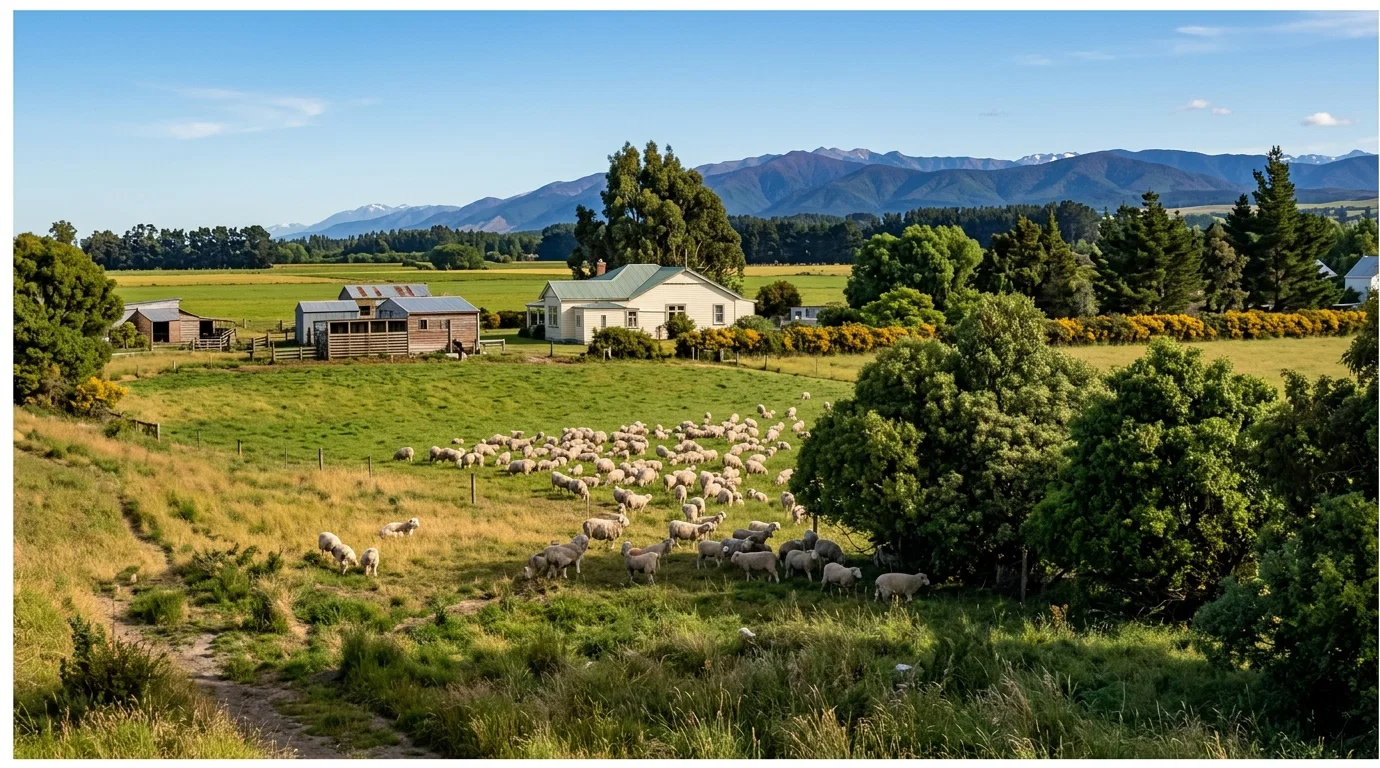
A NEW ZEALAND FARM
On one occasion after completing a canvassing tour along the foot of the southern Alps, I took the homeward-bound train. A freight-train, loaded with sheep, stood on the side-track, bound for the freezing works, where as many as five thousand are killed and frozen in a day. As the train moved along the Snow Cap mountain range, at my right as far as the eye could reach, were stretched out the Canterbury plains. Sparkling streams of cool water from the hills were conducted through the paddock, where thousands of sheep were grazing; the line fences of hedge full of yellow bloom appeared like threads of gold. Separated by a mile or two were clumps of eucalyptus, and pine-trees, showing where farmhouses were located. I was reminded of the time when Lot, lifting up his eyes, beheld all the plains of Jordan so well watered. But what gladdened my heart the most as I rode along was the thought that from farm to farm and from village to village, for fifty miles homeward, I had faithfully canvassed nearly every house. I had a copy of the ConferenceRecord, and read: “Satan uses every means in his power to lead the canvasser to take up some other line of work. But this order of things must be changed. God calls the canvasser back to his work. He calls for volunteers who will put all their energy and enlightenment into the work, who will go forth with love of Christ for those far and near, who will sacrifice ease and pleasure. The promise is, The Lord imparts a fitness for the work to every man and woman who will co-operate with divine power.”
As for difficulties by the way, when overcome they are like green oases strewn with roses. I will relate an incident. One day, cold and muddy, darkness coming on, I wished to find lodging, and was told that the only place in the neighborhood was the public house. I looked in. The strong odor of beer and tobacco seemed too revolting. So plodding on, I was made welcome with a kind Christian family. A rainy day followed, and I remained the third night, being treated as an honored guest. But, strange as it may seem, the third night the old gambling hotel was burned to the ground.
At another time I was working on an elevated section between the hills, near the village of Waikari. The houses being some distance apart, I crossed paddocks, lifting my wheel over the wire and hedge fences. One morning at a farmhouse, sausage, bread, and tea seemed about all they had to offer me; and at noon the kind-hearted woman had nothing more to offer than a plate of rabbit and potatoes, and tea. Eating a few potatoes, I found it was time to start for the train. This meant ten miles' ride on the bicycle, facing the rain, and wading one stream, carrying my wheel. I had hoped to keep my feet dry, but soon found the water filling my boots. I met a poor tramp on the road. He was carrying his bed on his back, and a billy in his hand—the way tramps travel in this country. I tried to cheer him with a kind word, but could get no response. His highest motive seemed to be to seek a little comfort and shelter from the storm; while joy was filling my heart as I thought of the glorious future when the faithful ones will be gathered home. I made three calls on my way to the train, receiving four orders. Although wet and shivering during the ride of fifty miles, I had a warm heart. A hot bath at the sanitarium set me all right.
I know our little trials by the way are scarcely worth mentioning: the Lord is so gracious and kind, far better than we deserve. Those who engage in canvassing for our health literature may not see immediate results, yet they are doing the work of John the Baptist in getting this reading-matter before the people, preparing the way for the gospel message, and eternity will reveal the results.
The Situation in Korea
By F. W. Field
F. W. FIELD
My previous report from Korea was written the day after I arrived at Chinampo. The next day we started to make the tour of the places where the truth had been presented. Brethren Lim Ki Pan and Kang Chang O accompanied us, as they had been with Brother Kuniya from the first. We remained over Sabbath at the village of Sondol, and organized a church of thirty-two members. Of these, eighteen had already received baptism, seven were baptized at the time, and the remaining seven were received subject to baptism. The organization was completed by the selection of a full complement of officers. Brother Lim Ki Pan was chosen as one of the elders.
The believers at Sondol were formerly members of the M. E. Church; but when present truth was brought to their village, nearly the whole church accepted the light, and began the observance of the true Sabbath. A few rejected the light; and the American missionary in charge declined to allow the Sabbath-keepers to use the little chapel for their meetings, although they had furnished about nine tenths of the means with which to build it. So our members peaceably relinquished all claim upon the church building. Then they selected a building committee, and started a building fund. We regarded it as a privilege to aid them in this effort; for, although the estimated cost was only seventy-five dollars gold, or one hundred and fifty Japanese yen, equal to three hundred Korean on, yet this amount in the depreciated currency of Korea would doubtless mean as much to these people in their poverty as three hundred dollars would to people in America. The little native chapels are14built much like their houses, with plain earth floor, mud walls, and thatch roof. In the little church at Sondol, a white curtain divides the room into two unequal parts; the larger, for the men, contains the pulpit, and the smaller is occupied by the women.
From Sondol we went to Kangdemuro, a small village on the Tadong River, about fifteen miles from Chinampo. Here we met with the believers, and the next day went up the river to Pyeng Yang, the former capital. We saw many interesting sights in this ancient city; also observed the dwellings, churches, schools, and hospitals belonging to the missions that have work centered there. We were informed that the native believers in Pyeng Yang number over four thousand. Our brethren met with a number of their friends, and presented the truth to them. Some opposed, but several became deeply interested.
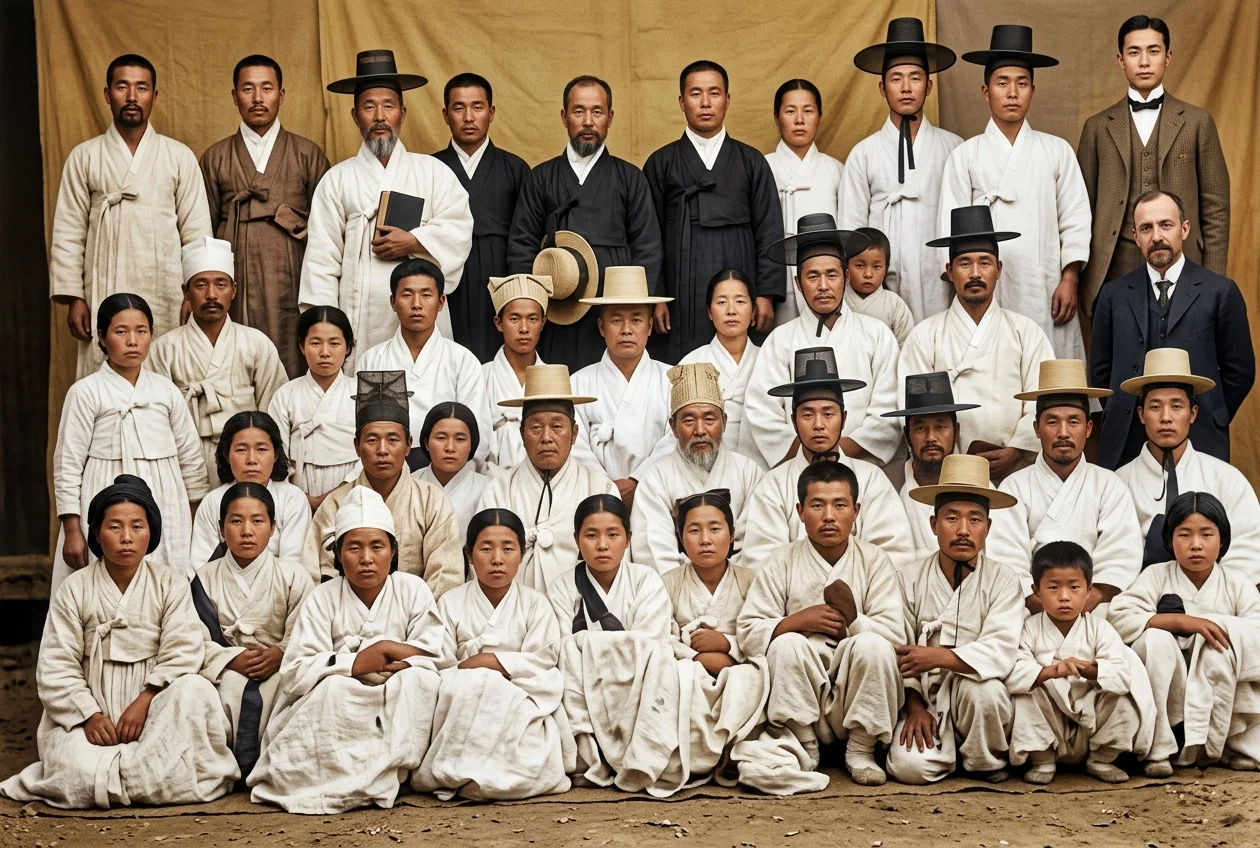
A GROUP OF KOREAN BELIEVERS
We remained at Pyeng Yang but one full day, and then returned to Kangdemuro. While here, we organized the little company of believers at this place. Two were baptized, and one other was received subject to baptism. This little church of twelve members chose an elder, a clerk, and a treasurer. The names of twelve others who have begun to observe the Sabbath were considered; but as all these live at some distance, no action was taken till their standing can be better known.
From Kangdemuro we returned toward Chinampo, and stayed over Sabbath at Rondon, which is not far from Sondol. At Rondon we organized a church of fourteen members, with one subject to baptism. Three others have begun to observe the Sabbath, and may be received later, when they have learned the truth more perfectly. A full complement of officers was chosen, a church building committee selected, and a fund started. Rondon is considerably larger than the other villages mentioned, and is a promising field of labor.
From Rondon we returned to Chinampo, where we had appointed a general meeting for Tuesday, September 27. We planned to celebrate the ordinances, to give further instruction, and to lay plans for the future of the work. Representatives were present from each of the three churches, also a number who had not yet been included in any organization. At 4 P. M. we held an ordinance meeting, at which over twenty were present. Our communion table was a foot square and five inches high. We made the wine from grapes brought all the way from Pyeng Yang. At the evening meeting over thirty were present.
We laid before them our plans for the work, all of which received their hearty approval. Brother Lim Ki Pan was left in charge of the work, the Japan Mission being responsible for his support until some other provision can be made. Brother Kang Chang O was chosen to act as a general treasurer, that the tithe from the churches may be brought together. He will also act as general secretary or clerk, and keep us informed concerning the progress of the work.
Next morning we held another ordinance meeting for the sake of the Sondol brethren who had been detained the day before. Then all assembled in front of the house where we were staying, and the picture accompanying this report was taken.
Among those who attended this general meeting were two men from the village of Pamegi, near Kangdemuro, but on the opposite side of the Tadong River. They brought word that the entire company of Christians in their village or vicinity; numbering over thirty persons, had learned about the true Sabbath and kindred truths; and then they put in an urgent request that we visit their village, instruct the people, and organize a church. We learned that these people had received their first knowledge of the truth from the believers at Kangdemuro, and from a young man living near, who had heard the truth near Chinampo. Thus the truth spreads.
Our boat was to leave Friday, and it was now Wednesday; but we decided to go. We started about noon, and it was after dark when we reached the village after a tramp of about fifteen miles. We held an inquiry meeting that evening in the little church, and it was midnight when the last had departed, and we lay down to rest. Very early next morning the people came again. As the truths of the message were presented, some were not so anxious to identify themselves with us as at first, though no opposition was shown. Eleven were accepted and baptized. The young brother who had brought the truth to them united with them to form a little church. The usual officers were elected. Then the names of twenty-five other persons were presented. These persons were members of the same church, and had all learned somewhat of present truth, were all favorable, and wished to learn more. But as they lived in neighboring villages, we had not time to see them; so the work had to be left to be finished up later by the native workers. We returned to Chinampo that afternoon; and the next day we bade farewell to the believers there, and took the boat for Kobe.
The preceding is a recital of the barest facts, many interesting experiences being left out for the sake of brevity. A summary of the apparent results may be of interest here. The whole number baptized from the time Brother Kuniya began the work was seventy-one; of these, sixty-three are included in the churches here mentioned; the remaining eight will probably unite at Chinampo when a church is formed there. Nine were received by the churches subject to baptism. And the names of fifty-five others were reported as having begun the observance of the Sabbath. Of these, at least five made their decision at Chinampo about the time of our general meeting. And since we left, the brethren have written that two more have decided to obey. From all this it appears that nearly one hundred and forty souls have accepted the light in Korea, as far as they understand it.
“The most needy fields” is a common phrase among our people. What do we really mean by it? I submit the following definition: The most needy field imaginable is one in which the opening providence of God has introduced present truth, leading people freely to accept it, but for which no provision of workers or of means has been made; and by way of illustration I may add,—Korea. The facts here given are more eloquent than15any rhetorical appeal I might write, and we have full confidence that Korea’s need will not long be left unsupplied. We have communicated full particulars to the Mission Board, and any desiring further information may address the secretary at Washington. We are hoping that laborers may be sent by the close of this coming winter, so as to reach their field by the opening of spring.
Sault Ste. Marie, Michigan
By M. C. GUILD.
A NEAT and substantial church building has been erected in Alpena, with a wing attached, designed for church-school purposes. The dedication took place November 12, 13. The meetings were well attended, and the Spirit of the Lord was present. The church company there is of good courage.
My family and I are now located at Sault Ste. Marie. But few of our people are left here, as a number have recently moved away. The famous locks of the Soo canal are located here, and during the season of lake navigation, large vessels are constantly passing to and fro. The largest tonnage of any canal in the world is carried through annually, thirty-one million tons having passed through this year. Thus there is a good opportunity to do missionary work both in the city and on passing vessels.
The week of prayer has been a blessed season to the church here. We have faith to believe that other precious souls will accept this glorious message in this place. Our courage is good. Pray for the work here. M. C. GUILD.
Panama
By I. G. Knight
Bocas del Toro.— We are glad to know that laborers have come to this field, and that others are on the way. Brother and Sister Peckover, from Kansas, are expected daily. I accompanied Brother Stuyvesant and family to St. Andrews Island. I remained only a short time on the island, but held some meetings with a growing interest. The second night, the building was full. There are a few faithful ones longing to see us, as Brother S. P. Smith had been away some time, and they had been without help. They were glad to know that the school work is to be revived. Brother Stuyvesant was nicely located, and expected to open school the next week after my departure. We are planning to visit this place again, after Brother Stuyvesant has had a chance to labor there a while. We intend to spend two or three months there and at Old Providence Island, which is not a great way from St. Andrews. The brethren think the prospects there are good. There are also a few believers at Corn Island.
I returned to Bocas, as there were five young people preparing to leave for the States, to enter our schools,—three young men going to the Huntsville (Ala.) Training School, and two young ladies to the Medical Missionary Training School at Nashville, Tenn. A very pleasant parting meeting was held. Not, however, without the shedding of some tears did parents dedicate sons and daughters to the Master's cause. The Methodist church-school teacher was present, and took part in the meeting, offering some very good advice on Christian education. We trust that these young people may become sharp tools in the Lord's hand in gathering in the sheaves. “If the iron be blunt, and he do not whet the edge, then must he put to more strength: but wisdom is profitable to direct.” Eccl. 10:10.
Mrs. Knight accompanied them to the States, and I have planned to follow them next week. On account of our somewhat failing health, we thought the best medicine for us would be a rest for about two months. Remember us at the throne of grace.
I. G. Knight.
India
By Mrs. W. O. James
SIMLA.—The Lord is blessing the work here in Simla. Day by day we can see his guiding hand in all that concerns us. We can also see that a power goes with his word which carries conviction to the honest in heart, and causes them to see their need of a closer walk with God.
Since our last report, three have numbered themselves with those who are keeping the commandments of God. One of those mentioned in my last report has been working for the Lord, and telling this precious truth to her friends; and as a result, another honest heart has begun keeping the Sabbath,16and is rejoicing in the truth. Each week she attends the Bible study, and her countenance reveals how precious this message is to her.
Another, after receiving the light on the Sabbath question, says, “I thank God for the light; let us kneel and thank him together.”
Mr. James has been having a good experience in his work, and we hope to see many brought to a knowledge of the truth through the printed page.
Altogether, two hundred and seventy-six subscriptions have been taken here for the paper, and we know the Lord can cause these silent messengers to do a great work for him, even though we may never see any results.
Recently while canvassing, Mr. James met another Sabbath-keeper who really thought that she was the only one in Simla. She seems very zealous in the truth, and was delighted to find others in the same faith.
MRS. W. O. JAMES.
_Mission Notes_
THE work is one — to show Jesus Christ to men. The field is one — the world for which Jesus Christ died. The glory is one — His who teaches our hands to work for him.
A LADY writing from Uganda says: “One can tell the Christian women almost at once in visiting a place, by their looks. They are much quieter in their manners, less quarrelsome, and have a superior look about them.”
IN a village near Hotsin, Shan-si, China, the village “elder” is a Christian. He has got the people unanimously to consent to his tearing down two heathen temples in order to build a Christian church out of the materials.
IN the Hankow district (China) the American Episcopal Mission has lately opened a training class for Bible women. One gets a sidelight on antipodal customs from one of the regulations: “Women who join this class must not expect to make their own shoes; they will not have time.”
THE warden of the prison at Siao-shi in Szechwan, China, is a Christian. So he holds morning and evening worship for such of the prisoners as wish to attend. Eighteen of the prisoners, some of them under sentence of death, attend these services regularly, and have and use Bibles and hymn-books. Whenever a native convert begins aggressive evangelistic work in this fashion, the deep and permanent quality of the change produced by the gospel is thrown into relief.
FRANCOIS WILLARD, the heroic missionary to whom the work of the mission on the Zambesi had been the one absorbing interest, naturally inserted a clause in his last testament to the following effect: “On the threshold of eternity and in the presence of my God, I solemnly bequeath to the Evangelical Church of France, my native land, the care of the work of the Lord in Barotseland; and in his holy name I adjure them never to abandon it — and thus to despise and renounce the rich harvest that is to be expected as the fruition of seed sown in suffering and tears.” These words from the heart of a great missionary, will not be unheeded, for the Paris Missionary Society has already announced its intention of vigorously continuing the work.—Selected.
Iceland
By DAVID OSTLUND
REYKJAVIK.—Since I returned home to Reykjavik from the tour to the Scandinavian and German yearly meetings last summer, I have worked mostly in Reykjavik. The people here are willing to listen to the proclamation of the truth. If we had a suitable hall, we could have a good attendance at our meetings. We hired two dwelling-rooms for our meetings, but of course that is not what is needed, but no hall can be had.
Our paper is still being published. Its edition is now three thousand copies. Next year we shall have to print three thousand five hundred, or perhaps more. The Lutheran theologians and priests here seem to be awake to what the distribution of our paper means. They have begun to talk and write against the truth that the paper sets forth, and warn the people against buying the paper. But I am sure they will not prosper in that work. The people here are not fanatical. It seems very hard to create an opposition against the truth. Many priests buy our paper.
A few days ago I made a trip to two villages, where I had the privilege of preaching in the Lutheran state churches. The attendance was good in both places. As a rule, I can speak in the churches on my journeys in Iceland wherever I wish, except in Reykjavik; here the priests and the bishop will not allow it.
One by one we see some begin to obey the Lord. We are very glad that his Spirit is working with us, in spite of all our unworthiness.
DAVID OSTLUND.
West Virginia
By S. G. Huntington
From the “Thirty-ninth Annual Report of the Executive Board of the Baptist General Association of West Virginia,” we glean the following facts concerning the attitude of the people of West Virginia toward religion:—
“Only a little over one fourth the population of the State are members of any Christian church. Allowing nearly one fourth more for children under church age, we have left more than one half our entire population outside the pale of the Christian church. This is appalling to think of. And this number is on the increase; for while we are making progress in Christian work, we are not keeping pace with the increase of population. One well posted recently said, ‘There is four times more need for mission work in West Virginia than when our Board was organized thirty-nine years ago.’ Another one, equally well posted, added, ‘Yes, ten times more we need.’ . . . We think there are at least forty towns in the State with over two hundred and fifty people in each without any kind of religious service by any one. Many of these places would welcome a missionary sent by any denomination. There are also large sections of thickly settled country districts without any religious privileges worthy of the name.”
West Virginia has an area of 24,780 square miles, with a population of over 1,000,000 people. According to the preceding report only 250,000 of these are members of any church, thus leaving 500,000, not counting the 258,000 children that make no profession of any religion whatever, while only a very few of all combined know anything about the third angel’s message.
Manifestly this is a needy field in every sense of the word. At present there are but a small handful of Seventh-day Adventists in the State. These are doing all they can to spread the truth, but much remains to be done. Missionaries in deed and in truth—men and women who are not looking for salaries, but souls—can find opportunity to work here. The canvasser in this State finds all the new territory he wants. Books sell readily in these new fields. Beginners do well, while some of our old canvassers take orders to the amount of fifty or seventy-five dollars a week. These workers have given themselves over fully to this line of work; hence are greatly blessed of the Lord. It is the consecrated worker that succeeds. The people are kind and hospitable, and when the truth is presented to them in the proper way, they are susceptible to it. Seemingly this is one, at least, of those fields where we ought to have “one hundred workers where we now have but one.” There is not an Adventist physician or graduated nurse in the State and yet it affords the grandest opportunity for both.
Our Baptist friends assert that there is from “four” to “ten” times more need of mission work in West Virginia than there was “thirty-nine years ago.” A most wonderful confession for a people who believe and teach that the world is getting better, indeed! Nevertheless, as every Seventh-day Adventist knows, it is the truth just as the Scriptures teach. But what do all these things mean? What do they suggest to us?—That probation is fast drawing to a close, and that there is a great work yet to be done by the people of God, and only a short time in which to do it, in giving the last message of mercy to the world before the Lord comes. We are, indeed, in solemn times. May the Lord keep us faithful.
S. G. Huntington.
The Work of the Nyassa Mission for the First Six Months of 1904
By T. H. BRANCH
Evangelical
We have no organized church, but at present we have nine baptized native believers at the station. Six of these were baptized during the time covered by this report. They receive instruction daily in the Bible, and from what we are able to judge, seem to be faithful, earnest believers, and manifest a desire for a more thorough knowledge of the truth of God. They take an active part in all the services, and we are hoping soon to be able to use them as teachers. Regular services are held each week at the church, also prayer and social meetings at the beginning and close of the Sabbath.
Every Sabbath afternoon the boys and I visit the different villages to hold services with the people. In this way quite a large number are reached; and we are praying that the Spirit of God will convict many of these souls of their need of a Saviour. Our Sabbath-school is one of our most interesting meetings. Our average attendance is about sixty. Mrs. Branch, with the help of four native teachers, has charge of this department.
School
In our school we have an enrolment of forty-five. Of this number, fifteen live at the mission home, and the remainder come in from the native villages about us. In the forenoon, from ten to twelve o'clock, we hold the school for the beginners, and in the afternoon, from two to half-past four, the school for the more advanced. We are teaching Bible, arithmetic, English, and Manganji. We are teaching English with the hope that our boys will soon be able to read our good books, which can not be translated into their language for a long time. We expect to do some translating next year, as we are greatly in need of literature.
Industrial Work
Under my supervision, the boys have their hours of labor on the farm, outside of their school work. At present there are only three girls living at the mission. They are under the care of Mrs. Branch, who is teaching them to sew and to do house work. This year we have cultivated, in all, about ninety acres. Eighty acres of this was in corn and garden, and ten acres in cotton. This is not a large amount; but when we consider that all our work has to be done by the native with his hoe, we see that ninety acres is a large piece of ground to dig and cultivate. During the early part of the year we employed from twenty-five to thirty men. These, with the aid of the schoolboys, did the work. At present we employ very few except carriers, who are delivering the maize we have sold.
In our garden we have grown some peanuts, potatoes, sweet potatoes, corn, pumpkins, beans, and other vegetables. These do very well at the mission, and we have an abundance of them. We are selling a few vegetables, but our market is fifty miles away, and our only means of conveyance is a basket on the head of a native. In this way we are able to receive a few shillings. Our maize crop did not turn out well, on account17of an overabundance of rain, yet we gathered about thirty-five tons. Owing to the high altitude and frosts, our cotton crop is a failure. Yet we praise the Lord that we have been able to raise enough food to supply our boys and have several tons to sell.
Finances
We have been able to make the proceeds of the farm support the school thus far, and believe they will continue to do so, with economy. The profits on our maize this year are about half those of last year. If we had a good market near the farm, it would also support the workers in part. We greatly need more stock, as we have a good place for them, and they would bring good returns.
Health
The health of all at the mission has been very good. While we have had many attacks of fever, and some of us have been prostrated, yet we have had no fatal results. I have had the most serious attacks, being unconscious for days; but by the mercy of God, and his loving care for his creatures, and good treatment, I have been able to rise above it each time. My wife and children have had many attacks, but are able, after short intervals, to attend to their duties. For all these things we are indeed grateful to our kind Heavenly Father, who has spared to us the lives of all who are at the mission. Our courage is good, and we are determined to do all we can to help fallen humanity to see Jesus the Saviour of the world.
We hope that our brethren will remember the work in Nyassaland, and with us seek our Heavenly Father's blessing upon the work here. We need wisdom from him to know how to do the work in that way that it may accomplish the most in the shortest time, and the “everlasting gospel of the kingdom” be preached in all the world, and Jesus come to take his faithful workers home. Our confidence is that “this generation” will not pass till all be accomplished.