BALTIMORE.—We are glad to report the manifold blessings of the Lord in this city, for we have seen his wonderful leading during the past winter and spring in a marked degree. It would take much time and space to tell the good things that the Lord has done for us, but a few experiences will show that he is with us, and we know he will be till the end.
We organized a Bible school, which met in the basement of the church every Monday night. We had about fifteen in the class, and they quickly understood the studies. From that school we have six who are awaiting baptism, and one who had been a member of the church for some time is now in the Bible work in another place. We are sure that they will do good work for the Master.
We shall relate a few incidents which have strengthened our confidence in the Lord. It was voted by the conference that we should pitch a tent in the city of Baltimore to strengthen the work for the colored people, and we began to search for a lot. None could be rented at any price, except one that we used four years ago, and it had a high billboard in front of it that shut off the view of the tent. The owners of the lot wanted thirty dollars a month for it, and we began to feel that no tent could be pitched this summer; but after much prayer, the lot was secured for half the price asked, and the bill-posting manager agreed to take down enough of the sign to give a good view of our tent from the street.
To give our work a good newspaper setting, the editor of one of the papers for the colored offered as much space as we needed to outline our work and doctrines. These providences assured us that the Lord was in the effort for this summer. And at the first service it was seen that a good interest was sure to be awakened. The first week has brought us exceptionally large crowds, and not only that, but the Lord has gone before and told the people of the Sabbath truth, and five already are arranging to obey the Word fully. Our tent has been up only one week.
We are encouraged to work this year as we have never worked before, and we ask the prayers of all for the success of our work. Our hopes are good for the doubling of the membership in this place.
GUSTAVUS P. RODGERS.
The Washington Tent Meetings
By I. A. FORD
THE tent meetings in Washington, D. C., conducted by Elder R. E. Harter, have now been in progress for about three weeks. From the first, the attendance has steadily increased. The tent is seated with six hundred folding chairs, most of which are filled every night. Sunday nights, although extra chairs are obtained from near-by neighbors, some, unable to find seats, stand around the tent. More than eight hundred persons were at the meeting Sunday night, July 12, to hear the subject of Spiritualism, which was presented by Prof. B. G. Wilkinson.
While the deciding tests have not yet been presented, several have seemed to anticipate them and have asked questions and had private Bible studies, so that already some have indicated their intention to unite with us in keeping all of God's commandments. Those attending the meetings are among the most substantial class, and the very best attention is given to every word spoken.
One important feature of the services is the music, under the direction of Brother Henry de Fluiter. From fifteen minutes to half an hour is devoted to music, both instrumental and vocal, at the beginning of each service. A large choir composed of members of the various churches in the District attends quite regularly. The Review and Herald orchestra is doing splendid service, and is much appreciated.
Altogether, the outlook is a most encouraging one. We trust our people everywhere will remember these meetings in their prayers, for the enemy, who worked so hard to prevent the brethren from securing the lot for the tent, will continue his efforts to keep honest souls from accepting the truth; but our God, whom we serve, is able to give the victory. It is expected the meetings will continue for several weeks.
We are glad to report that Brother de Fluiter's little boy, who was so seriously hurt by being run over by an automobile, is making a splendid recovery, and aside from a scar, will suffer no permanent injury.
I. A. FORD.
Our Need of the South
By M. BESSIE DEGRAW
Most Seventh-day Adventists are familiar with the needs of the South. They have had their attention called over and over again to the matter by the workers in this section, and the spirit of prophecy has emphasized the importance of the work in this field for many years. It is an accepted fact that this is a section of the mission field that needs work, that greatly needs it. It needs all the attention that we are able to give it.
But there is another phase of the subject I wish to bring to your attention, and that is the fact that we Seventh-day Adventists have great need of the South. I have lived in the South for the past ten years, and every year strengthens the conviction that we need the South even more than the South needs us.
We are now living in the last days of the world's history. Character must be developed rapidly. And it is strong character that is needed to put us in the kingdom of God. Of this last church it is written, “Here is the patience of the saints.” The question is asked, “When the Son of man cometh, shall he find faith on the earth?” The answer must be, Yes; for only those having the faith of the Saviour himself will be able to go through to the end. There must be faith to overcome every known sin; faith to step out at the call of God as did Abraham; faith to go through the plagues of the last days,—the greatest physical trouble the world will ever know,—and yet go through free from disease; faith in the daily resurrection of the body from sin and disease. Surely the Son of man must find faith on the earth when he comes to claim his own.
Patience and faith are two of the virtues that must characterize the people of God in the end of the world. And our God has a way to develop these virtues. The Bible tells us how he does it. It is recorded in the life history of that forefather of ours, Abraham, “the friend of God,” called so by his God because of the simple, trusting faith that he had developed in his Father's training school.
Abraham was living in Ur of the Chaldees; he was a member of a large church; he was surrounded by his relatives and friends; he was making money, and life looked bright to him. He was an honest man who wanted to do the right thing. And God, seeing this inclination in his heart, called him to leave that prosperous land to take up his home in a new and distant land, a land that did not produce so well as his home, a land where his natural surroundings would not be so pleasant, and where there were many people who knew nothing of the God of heaven.
The Lord had a twofold purpose in calling this family to this mission field: he wanted to carry the truth to the land of Canaan, and he also wanted to save the missionary and his family. Abraham's children, if brought up in Babylon, would not grow up in the truth; if the family could be planted on new soil under different conditions where there was constant necessity to work for others less fortunate than themselves, they would have a better chance to be saved themselves. God wanted Abraham and his children in the new earth, just as we believe he wants Adventists in the new earth, and this was his way of preparing them for that place.
It is dangerous for us to cling to the larger centers—to Ur of the Chaldees. He has told us not to cluster about the larger churches, but to scatter into the needy parts of the vineyard. There should be hundreds of schools and mission centers all through the South, and there are hundreds of Adventists who need the experience of starting these centers. Sanitariums and treatment rooms are called for in the cities and country places of the South, and there are hundreds of Adventists who are able to do a work of a simple nature as outlined by the spirit of prophecy if they were but awakened to the fact. And they need just the inspiration and the new life that will come with the effort.
One coming South may have his choice of work. There are the wealthy; there are the poor white people; there are the colored people; there are the highland people. He may choose for himself.
The workers in the South see some very encouraging things sometimes to cheer them on the way. As an illustration, a few weeks ago the Nashville Agricultural and Normal Institute, at Madison, Tenn., had the pleasure of a visit from a company of twenty-three California young people who were on their way to the site of the new school in the northern part of the State of Georgia.
One year ago Prof. W. S. Boynton, a member of the faculty of the San Fernando (Cal.) Academy, spent the summer in the Madison school studying with others the principles of Christian education and the South as a mission field. Brother Boynton returned to his school work in California with the settled conviction that the Lord wanted him in the South. As he studied the matter, the conviction deepened, and gradually the way opened, in what seemed a providential way, for him and a number of others to connect with a work opening up in Georgia.
Hundreds of families are called. In this case a few responded. We are yet to see many such scenes as were witnessed when the students of the Madison school and this company of new recruits in the Southern work studied together some of the problems of this field.
There are a multitude of equally interesting things in connection with this southern work. I wish the readers of the REVIEW might all attend the annual convention, to be held at Madison, October 9-13, which brings together the men and women working in this field. Particulars will be given to those who desire them.
M. BESSIE DEGRAW.
Korea
By C. L. BUTTERFIELD
A few months ago I began a monthly news-letter among our native workers. I had found that they each knew but very little about what the others were doing. When I suggested the monthly letter, they were all pleased. All the workers write to me during the month, and items are taken from these letters and sent to each worker. I also translate items from Sister White’s writings, which are of interest and profit to them. Following is one of the letters from Kim Na Chun, which may be of interest:—
“The Workers’ News-Letter, with items of interest from all parts of the field and admonition from Sister White, was gladly received a few days ago. Please translate some each month from the writings of Sister White, and send to us through the News-Letter.
“With regard to the work here in Ham Heung, I wish to say that it has been my mind to visit every house, distribute literature, and preach the gospel to all who will hear. I began this work by visiting the houses nearest the church, and then those farther away. During one week I sold twenty tracts and gave away three hundred pages of literature, and had many interesting experiences. As a result of this work, one whole family and one brother have turned from heathenism to worship the true God. They are now keeping the Sabbath. Others are much interested. I praise God for all this.
“Brother Pak Nong Hae is giving his full time to the sale of our magazine, Sei Chyensu eui Keunpyel, in this city and throughout this territory. Brother, pray much that the third angel’s message may quickly be preached in all this province.
“This province is far north; and the snow and heavy winds make it hard to do much traveling at this time of year. Please pray much for this weak person.”
Kim Na Chun’s letter is a fair sample of many that I receive. If I mistake not, our eighteen workers report an average of one family each a month. That is not many, but it is a continual growth. Aside from the workers already referred to, our teachers, canvassers, and missionary societies are also doing much to spread the truth.
During 1913 there were more than 36,000 copies of the magazine placed in the homes of the people. Including books and tracts, there were more than 1,500,000 pages of literature distributed, not including Bibles. Our sales amounted to $1,235.75 in this little country, where, only three or four years ago, it was said that we could not sell literature, for the people were too poor to buy. But God has wonderfully blessed, and to his name be all the praise. The message is going in all parts of the earth, and will soon triumph in the glorious appearing of our great God and Saviour, Jesus Christ.
C. L. BUTTERFIELD.
Field Notes
DURING the last biennial period 324 have been baptized in the Ohio Conference.
A CHURCH of thirty-two members has been organized at Shreveport, La., and definite plans have been laid for the erection of a new church building. On Sabbath, May 23, six were buried in baptism at Welsh.
ELDER K. C. RUSSELL reports an excellent opening for the tent meeting which he is conducting in Albany, N. Y. A substantial class of people filled the tent and manifested a deep interest in the word spoken. The Argus gave nearly a column report of the meeting, with a synopsis of Brother Russell’s discourse on the “Inspiration and Integrity of the Scriptures of Truth.”
The Temperance Campaign in Fullerton, Cal.
By D. D. FITCH
WHILE visiting in Orange recently, I heard Sister Mitchell relate how she had gone out almost single-handed distributing the Temperance Instructor in the homes of the people, and had received in return nearly enough to buy one thousand papers. As she talked with the people, she found a large number who were interested in temperance but had not registered. She kept track of these, and later took an authorized registrar around with her in her buggy. Thus our work was brought before the people and the different organizations in a favorable light.
At a meeting of the Dry Federation a Baptist minister told of having received one of the papers and of his interest in reading it, and proceeded to tell the W. C. T. U. that it was the best piece of literature they had ever gotten out. The officers of the organization of course had to inform him that it was not issued by them. This gave Sister Mitchell an opportunity to tell who was publishing the paper, and of their loyalty to the temperance movement if the Sunday law could be kept out of it.
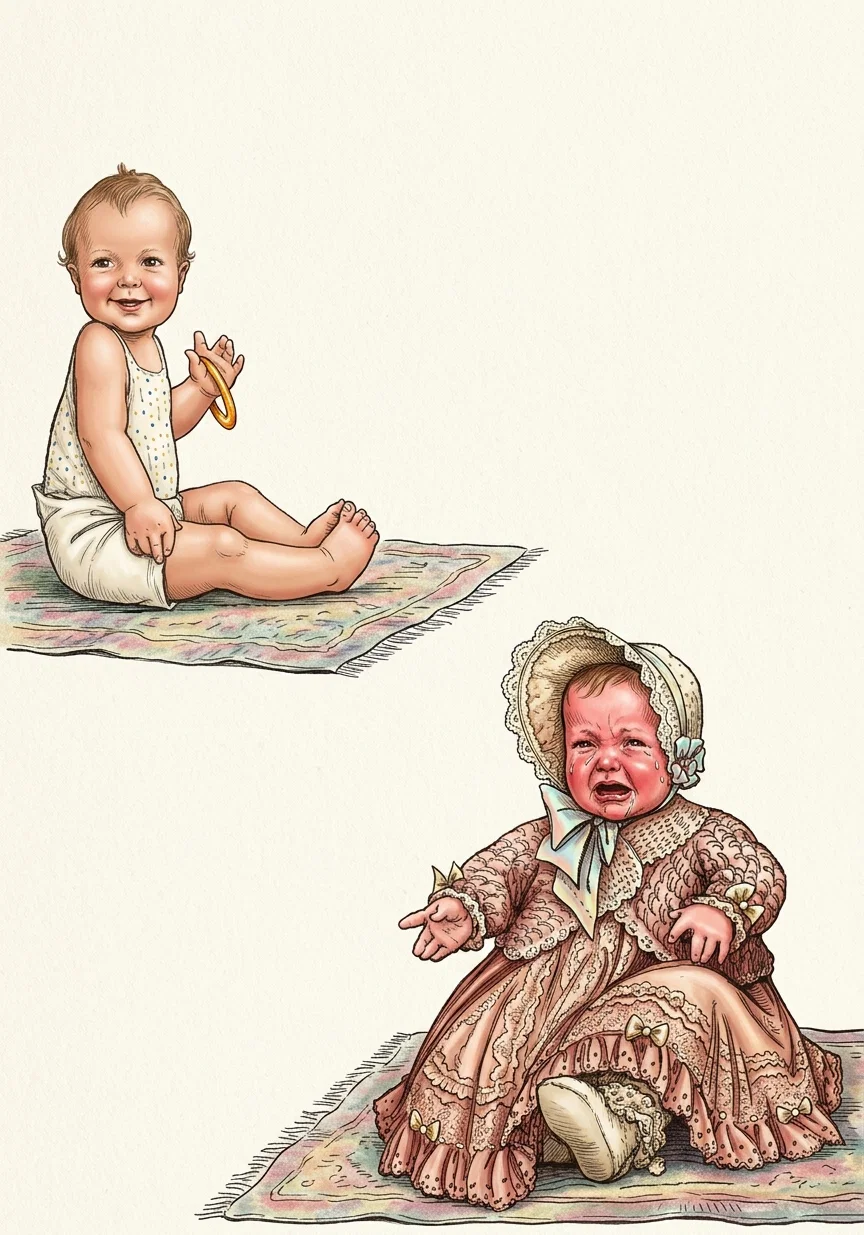
COMFORT vs LOOKS
IS YOUR BABY HAPPY IN HOT WEATHER?
If not—you’re to blame.
THIS LITTLE TOT IS
COMFORTABLE AND HAPPY
WHEN THE SUMMER DAYS ARE HOT
HE IS DRESSED RIGHT
TO STAND THE HEAT.
THIS UNHAPPY LITTLE CODGER
IS ALL FUSSED UP AND AS A
RESULT HE IS HOT
AND UNCOMFORTABLE
HE IS DRESSED WRONG
FOR HOT DAYS.
DON’T DRESS YOUR BABY TO
MAKE A GOOD SHOW OF
HIM—DRESS HIM TO
KEEP HIM COMFORTABLE
AND HAPPY.
Space will not permit me to tell more of her experience, but I will say this, that it gave me an inspiration to come back to Fullerton and see what could be done. I had already joined the W. C. T. U. After advising with them and the Dry Federation, I ordered a supply of the Temperance Instructor, and organized the workers in our company here for the campaign. The town was districted, and as the workers gave out the papers they also gave the people an opportunity to contribute toward the literature fund. In this way $7.94 was taken in. About eighty were found who were interested in temperance but had not registered, and the names of these were turned over to one of the ladies of the W. C. T. U. who had qualified as a registrar. The expense for the four hundred papers ordered amounted to $16.60. To make up the deficit I visited some of the business men, explained the work that had been done, and received enough in donations to make up the deficit and to purchase about 1,800 of our tracts, which are now being used as our workers call at the homes. The banker, who is also the vice president of the Dry Federation, said, as he handed me a five-dollar bill, that we not only have the best temperance literature but the best temperance workers.
Engaging in this work has not only given us as workers considerable satisfaction, but has also put our work before the people in a favorable light.
D. D. FITCH.
Medical Missionary Department
By G. H. Heald, M. D.
W. A. RUBLE, M. D. — General Secretary
L. A. BANSEN — Assistant Secretary
H. W. MILLER, M. D. — N. Am. Div. Secretary
Baby's Second Summer
DURING the hot spell, keep baby cool at all hazards, especially the weaned baby or the teething baby, and do not attempt experiments in its food. Above all, be sure that it gets good milk; and if there is the least suspicion, scald it.
The accompanying illustration, taken from the bulletin of the Chicago Department of Health, tells its own story. In hot weather a baby in a single garment may be fairly comfortable and retain its health, while another baby dressed in fussy clothes is sweltering, and finally is prostrated with the heat. Remember it is much easier to prevent prostration than it is to treat successfully a prostrated baby.
As far as possible, keep the little ones outside in the shade or on a cool porch. Cellars are insanitary places; but the deaths from summer heat are comparatively few in basements and cellars. The proportion of deaths increases as one ascends to the roof. The most frightful loss of infant life in summer is in the hot attics, which should never be used for human habitation.
Give the little one plenty of water to drink, and bathe it frequently. It will be grateful for several cool spongings on hot days, and it will be no inconvenience to give these provided the little one is properly dressed.
Going on the street, the little fellow needs a neat one-piece slip, but in the house during the hottest weather the only protection he needs is the napkin around his hips. But be careful not to allow him to be too much exposed if the air cools off in the afternoon, as it does in some localities. Do not allow him to become chilled.
In case baby shows signs of failing health, running off at the bowels, or disturbance of digestion, it is best to see a physician at once; for it is much easier to remedy such a trouble in its incipiency than to cure it after baby has been exhausted by the disease.
G. H. HEALD, M. D.,
Editor "Life and Health."
Summer Hints for the Older Members of the Family
By G. H. Heald, M. D.
REMEMBER that clothing is a nonconductor of heat, because of the layer of air it imprisons. It is the imprisoned air that serves as a nonconductor or retainer of heat. This imprisoned air interferes not only with the conduction of heat, but with the rapid evaporation of perspiration. Every layer of clothing increases this difficulty. To dispense with all but one, or at most two, light layers over the arms, chest, and trunk, makes for comfort and better health.
We talk about woman's slavery to fashion; but there is no slavery more abject than that which compels a man to wear a coat and waistcoat in hot weather. It is true the waistcoat is often left off, and not infrequently now the more daring leave off the coat. But the truth is that men—that is, the men who are not laborers—are more conservative and enslaved by custom than women, and will run fewer risks of what might be considered an impropriety. They will even submit to a stiff collar, and possibly stiff cuffs, on a hot day.
Perhaps the most sensible garment for men in summer would be a light woolen sweater. The wool has the property of taking up the perspiration readily without causing a feeling of dampness—a very important point. One light layer of wool would actually be more comfortable than two layers of cotton. The clammy cotton undergarments make one miserable in a humid atmosphere.
Very little need be said to the women about dressing for warm weather. They could teach the men several lessons in this respect.
Besides the regulation of clothing, there are other ways in which the warmth of summer may be mitigated. One should take comparatively little active exercise during the heat of the day. If it is necessary to do hard work, arise with the sun or earlier and get the work off your hands before the ordinary person is awake, and then rest during the heat of the day. This custom of doing the muscular work while it is cool is common in tropical countries, and should be more frequent here during the hot season.19
Another means of controlling the heat of the body is by regulating the diet. All sugars and starches are burned in the body with production of heat. Eat lightly, and let the dietary consist quite largely of fruits and the succulent vegetables, with a minimum of bread, grains, butter, etc. You will, of course, need some protein and fat, but be abstemious. Allow yourself to be just a little hungry, and above all, do not eat puddings, ice cream, and the like (which must all be burned up to your discomfiture), simply because they taste good.
There is undoubtedly a psychological side to hot weather. The person who watches the thermometer, who is constantly telling how hot and disagreeable it is, suffers much more than one who goes about his work, forgetting to look at the thermometer. If you think of the weather, you immediately perceive that you are uncomfortable. Forget it. Concentrate your mind on what you are doing, and it will not be hot—to you.
G. H. Heald, M. D.,
Editor “Life and Health.”
Temperance News Items
THE Iowa Liquor Dealers’ Association passed resolutions suggesting that manufacturers of moving picture films be requested not to make pictures showing barrooms and wine rooms with persons in stages of intoxication, and the attendant evil results.
Eighteen editors of Texas newspapers have formed the Texas Prohibition Press Association. Each member agrees to do all he can to further the cause of prohibition.
Nineteen saloons in Philadelphia have closed, making no application for renewal of license. The decline of the liquor business is given as the reason for this voluntary retirement.
Twenty-one saloons were put out of business recently at Madison, Wis., by councilmanic action.
A petition containing 112,101 names calling for the submission to the voters of the State of Washington at the November election of a State-wide prohibition law has been filed. Under the law thirty-two thousand signatures would have been sufficient.
There has been filed with the secretary of state in Colorado a petition for a constitutional amendment for State-wide prohibition to be voted for at the regular election in November. The petition contained almost thirty-two thousand signatures, about twelve hundred more than were necessary.
Petitions are being circulated in Virginia in behalf of a State-wide prohibition election in September. The prospects are said to be favorable in behalf of prohibition.
The friends of temperance are not the only ones to use the plan of writing letters to their Congressmen asking support. On May 6, a letter was mailed by the secretary of the National Wholesale Liquor Dealers’ Association of America to the bankers of the United States, calling attention to the Hobson amendment for nation-wide prohibition. It urges business relations and mutual financial interests as reasons for opposing the amendment, and closes thus: “We therefore urge you to wire and write to the Congressman of your district protesting against the Hobson resolution. Ask him to work and vote against the passage of this confiscatory and destructive measure. Quick action is necessary.”
Religious Liberty Department
By J. O. Corliss
C. S. LONGACRE - - N. Am. Div. Secretary
California Sunday Law Prospects
For a series of years there have come regularly to the front in the California Legislature, one or more bills for the enforcement of Sunday rest on all the people, barring some notable exemptions by which to give popularity to the movement. By well-directed efforts these measures have in each case been defeated, thus giving considerable uneasiness to the promoters of the desired legislation. Two measures, however, have in the meantime been enacted into law, which have given a degree of hope to these officious ones. The Initiative and Referendum Act passed, permitting the submission of any question of civil regulation to the vote of all the people, thus to be settled without reference to the legislature. In this event, any matter carried by the votes of the people must stand as law, since the legislature has no power even to amend that which the majority vote of the people has decided to be law for the people.
This done, the next thing was to put into the hands of women franchise privileges equal to those held by men. By this act it was thought to be an easy matter to carry through the desired Sunday law, on the supposition that women voters would mostly be in favor of such a measure. But so far they have not calculated accurately; for while the women are, as a rule, more generally devoted to religion than men, they are also good readers, and have freely read religious liberty literature, which has been scattered abroad, for some years, almost like the leaves of autumn.
Yet the leaders of the Sunday law movement have, notwithstanding, arranged what they deem a model statute, and are submitting it to the people, with petitions attached which ask that a quiet Sunday rest become the law of the State by initiative vote. It should here be understood that in order to get this measure on the ballot for a vote on the third day of next November, signatures must be secured to the petitions covering eight per cent of all the votes cast for governor at the last election. This means that nearly thirty-two thousand names of legally qualified voters must be personally attached to the petitions ninety days before the date of the general election in November. More than this, each solicitor of signatures must qualify for his work by appearing before the proper officer, and after proving that he is eligible to the position, receive a certificate of that fact.
This, of course, makes considerable trouble for busy people, and not so very many are anxious thus to qualify, especially as no salary attaches to the position. Some zealous ones, however, are found who attempt the job, but, as the State records show, with only small results so far. A few days ago, in company with the president of the Pacific Union Conference, I went to the office of the secretary of state in Sacramento to make inquiry regarding the progress made in gathering signatures for the initiative submission of the Sunday bill. The book recording these was brought for our inspection, and we found that from April 15 to May 27, of this year, only 7,755 legal signatures had been received from all parts of the State. None had been received later. But what at first seemed strange, it was noticed that 7,352 of these names were filed from Los Angeles, and only 403 from all other counties of the State. This was finally accounted for by the fact that Los Angeles County is the Mecca for thousands of people who came from Eastern States, where Sunday laws are the general rule.
Talking about this with the clerk in charge, he said: “You need not worry, gentlemen. These people will never file the required number of signatures to place this measure on the ballot, for these reasons: Those counties having already filed petitions are allowed only forty days in which to file supplementary petitions. The latest counties filing so far have now only until July 7 to file additional petitions. Besides, August 4 is the latest date when any initiative petitions can be legally filed for the November election.”
When asked how the dearth of names represented was accounted for, since four years ago those opposed to Sunday laws secured 68,150 names to their petitions in about four weeks, the clerk said that the people did not want a Sunday law, because there is a feeling now that such a law would be unjust, on the ground that it would curtail the liberties of the people, and many also feared what might grow out of such a measure.
The views expressed by this officer seemed a justification of the expense incurred of late for the education of the people through leaflets and papers. But one need not quickly conclude from what has been outlined, that the danger on this point has been safely passed; for when the legislature meets next January, it will doubtless be besieged by men in clerical garb, appealing for a bill to be passed which will give the laboring man one day in seven for associated rest with his family. But like the present initiative measure, while pretending love for the “unceasing toiler” as the sole reason for such a law, that one-day-in-seven rest will surely be made to fall on Sunday in every week. Besides, the general election ballot will have for its first proposition the call for a revision of the State constitution; and if that carries at the polls, there will soon after assemble the convention provided for, when a mighty effort will be made to incorporate a Sunday law within the new constitution itself, and so place it where it could not be amended without a great deal of trouble. The people of California have, therefore, a great crisis yet to meet on this20question, when genuine lovers of religious liberty will be called to labor in behalf of an educational campaign as great as any in which they have yet been engaged.
J. O. CORLISS.
Two Bakers Available
By L. A. H.
WE have the names of two health food bakers who for good reasons are available for employment. Both are well recommended. Particulars given on application to General Conference Medical Department, Takoma Park Station, Washington, D. C. L. A. H.
The “Signs” Weekly and the Takoma Park Church
By F. W. Paap
It was the writer’s privilege to take the regular Sabbath service July 18, at the Takoma Park church, Washington, D. C. It was a bright, beautiful morning, and the pews of this neat, well-ventilated monument to God’s name were well filled by the busy workers and families of this important center.
After singing some of the beautiful songs of Zion, we were led in prayer by Elder B. G. Wilkinson. All felt that Israel’s God was attentive, and blessings awaited us.
The writer presented some thoughts regarding God’s plan and purpose, taking for his text Isa. 43:9-13, emphasizing particularly the thought found in verse 13: God “shall work, and who shall let it ‘turn it back,’ margin?”
The messengers of God in these days, who are intrusted with the greatest message ever committed to mortals, must be possessed with courage and faith. They are to stand related to God as did John and Elijah. The message is to be in the spirit and power of Elijah. Luke 1:17. Before this can be, we must feel and know our utter helplessness and inability, but never for one moment doubt God’s great and mighty power.
In the Power and Spirit of Elijah
It was said of John, “he confessed, and denied not.” John 1:20. This must be our attitude. Simply a profession will not do. We must pray. Elijah prayed. He asked great things of God; but if we study carefully, we shall see that his asking was in the direction of the salvation of souls. He not only prayed, but he obeyed. Nothing short of this will do in our individual cases if we would be successful.
The result of Elijah’s prayers and obedience was that all Israel turned to God. Read 1 Kings 18:36-39. The providential workings of the Lord of hosts were marvelously displayed as Elijah sought carefully to follow all the counsels of God.
What God did back there, he purposes to do today, and so sends the Elijah message. It is preeminently a message of heart religion. Its acceptance means victory. It means that the recipient shall be a transformed being—that he shall possess the glory of Immanuel. All who know this experience must communicate it. When the love of God fills our hearts, there comes such a joy that we long to impart it to others.
In this great movement, God has made it possible for us, in whatever station of life we are, to work for others. We cannot be counted on the Lord’s side unless we are active in his service.
The writer then introduced the following resolution, asking all who would support it to rise to their feet:—
“Whereas, In our great missionary campaign beginning Oct. 1, 1914, the Signs of the Times weekly is to play an important part; and,—
“Whereas, The North American Division Conference at its spring council set the goal for this mighty soul-winning agency at at least two copies a member; and,—
“Whereas, The Takoma Park church wishes to lend its support to this great missionary movement; be it,—
“Resolved, That we place our order for a regular weekly supply of six hundred copies of this campaign series of the Signs of the Times weekly.”
Virtually the whole congregation voted in the affirmative, with the understanding that they would each be responsible for their share of the expense, as well as put forth every effort to win souls.
God’s blessing will surely rest upon such an effort, and we feel confident that many souls will be won to a knowledge of the Elijah message, God’s own setting of the gospel of the kingdom, his last call and effort for the lost.
As far as we have learned, the Takoma Park church is the first to place an order equal to the goal set by the North American Division Conference at the spring council, “At least two copies a member.”
We wish that all our churches would attend to this important matter at once. The campaign begins October 1, but we must place our orders early so as to be sure to get the first issue of this special six months’ series. Let every church take hold. We advise that the paper be sold as far as it is possible. If we plan to mail part of our club, would it not be a good idea to get a list of names in some section where the conference plans to send a tent later, and supply these persons with the Signs for a period of six months? I would suggest that we concentrate our efforts in this way.
Be sure to take one copy home and carefully read it yourself. Keep it clean, and then pass it on to your neighbor.
Now is the time to secure clubs. Let every church member take hold with real earnestness, praying God to guide and bless, and we shall see just such a harvest of souls as our 1914 goal sets before us, “At least one soul each for Christ.”
All will be pleased to know that the Pacific Press Publishing Association has devoted all the profits arising from the publishing of the Signs weekly to the mission fields. The same will pass through the hands of the different conferences according to the number of papers handled in each field. We surely shall be glad to hear of advancement from all parts of the division.
F. W. Paap.
Magazines
By E. M. Graham
This is a magazine-producing and magazine-reading age. Almost every place where people have to wait for any kind of conveyance has a stall with magazines on sale. Our publishing houses have seen the value of this interest in magazines, and are producing a number of high-class magazines to be placed in the hands of the public.
The production of these magazines is one step in the right direction, but there must be another before they can benefit the people; they must be taken to them.
We cannot depend upon the bookstalls to distribute them, for they supply only that which the world demands,—the magazines that deal with worldly things. For magazines that deal with higher things a demand must be created. Therefore the channel through which these magazines must go from the publishing houses to the public is our church members.
The most successful way of circulating magazines is selling them. Many of our people are doing this with excellent success. One sister reports selling 1,000 of the Signs Magazine a month last summer, which would give her $50 profit for each month's work, less the street car fares. One day, in six hours, she sold 300, which gave her $18. This is but one of many similar experiences.
While we have mentioned the profits this sister has made, to show that the Lord gives good wages, the secret of her success is that she is selling magazines to save souls. This is the motive that should induce an army of church members to sell magazines. By so doing, they will be placing in the hands of the people something that will, if followed, lead them into the truth.
These magazines should be sold in the residential section of every city and town, as well as in the business sections. In places where there is no Sunday law, the first day of the week is an excellent day to work. The man of the house is usually at home, and is more inclined to accept reading matter of a religious turn than when occupied with the cares of the working days. Some of the members of our churches should take a burden to see that such places are thoroughly canvassed.
Regular routes should be worked up where magazines can be delivered monthly by month. More should be abandoning worldly occupations and giving their entire time to selling magazines.
Magazines should be placed in all libraries and reading rooms. Back numbers may be placed in reading racks and distributed to benevolent institutions. The inmates have time to read, and are glad to get them. Our magazines are being used to save souls. God's appointed channel for reaching these perishing souls is his people, and he is depending on them to do the work. He wants you; do not disappoint him.
E. M. GRAHAM.
Little Pleasures
“If we noticed little pleasures
As we notice little pains;
If we quite forgot our losses,
And remembered all our gains;
If we looked for people’s virtues,
And their faults refused to see,—
What a comforting, delightful,
Cheering place this world would
be!”
Choosing Friends Carefully
BE not in overmuch haste about forming friendships. The tendency of impetuous youth is to declare lasting affection for the first comrade that pleases the fancy. Better wait. Time tests. The friend who, after a probation period, appeals to your reason as well as your heart, is the one to grip to your life with all the strong cords of affection and service.—The Sunday School Gem.