Your ShelfYour Projects

Signs of the Times, Vol. 28, No. 12.

THE RELEASE FROM CAPTIVITY

Signs of the Times

Mar 19, 1902

Pacific Press Publishing Company · Oakland, California · Mar 19, 1902
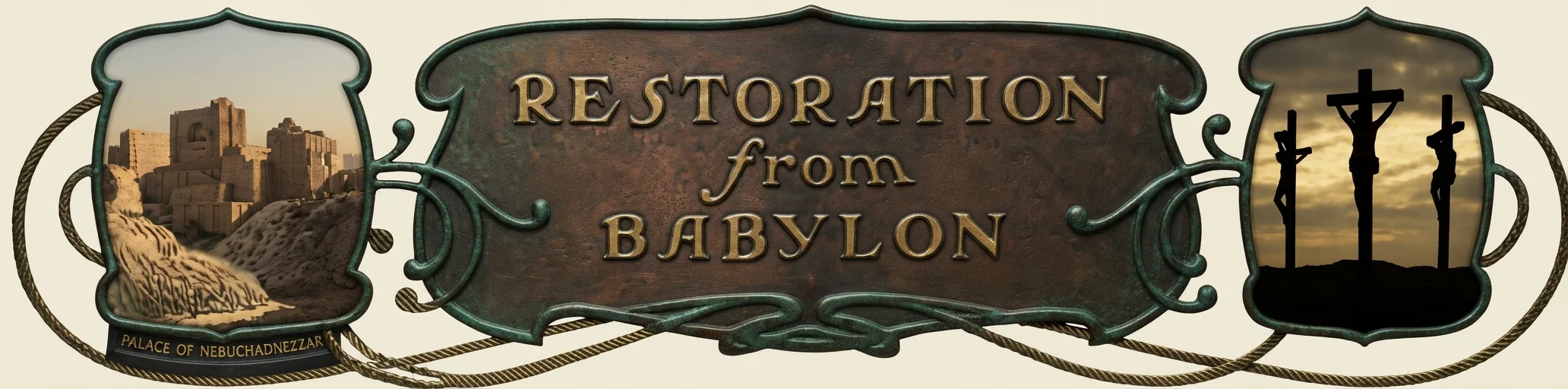
PALACE OF NEBUCHADNEZZAR

THE RELEASE FROM CAPTIVITY.

ISRAEL had frustrated God's purpose to enlighten all the nations by them in the land where He had planted them; yet He would fulfil His purpose and His promise to Abraham, and enlighten all the nations through them in the lands where He had scattered them.
By unbelief and iniquity Israel, when planted in their own land, had lost the power to arrest and command the attention of all the nations, that the nations might consider God and His wonderful works and ways with the children of men; but now, as they are scattered among the nations, God would use them to enlighten those who had acquired the power to arrest and command the attention of all the nations, and thus through them would still cause all nations to consider the wonderful works and ways of God with the children of men.
Through Daniel and his three brethren in captivity, God enlightened king Nebuchadnezzar who was ruler over all the nations; and by king Nebuchadnezzar twice distinctly proclaimed to all people, nations, and languages His wisdom, His justice, His power, His glory, and His kingdom and dominion. Dan. 3:29; 4:1-3, 34-37.
Nebuchadnezzar and his empire, and even the last vestige of his kingdom, passed away. Another kingdom and empire took the dominion of the world. "Darius the Median took the kingdom." Dan. 5:31. As the result of a conspiracy, Daniel was cast to the hungry lions in their den. But God shut the lions' mouths that they did him no hurt; because innocency was found in him, and because he believed in his God. This so fixed upon God as the only true and living God, the heart of king Darius the Mede, who was now king of all the nations, that he also "wrote unto all people, nations, and languages, that dwell in all the earth," proclaiming that "the God of Daniel" "is the living God, and steadfast forever, and His kingdom that which shall not
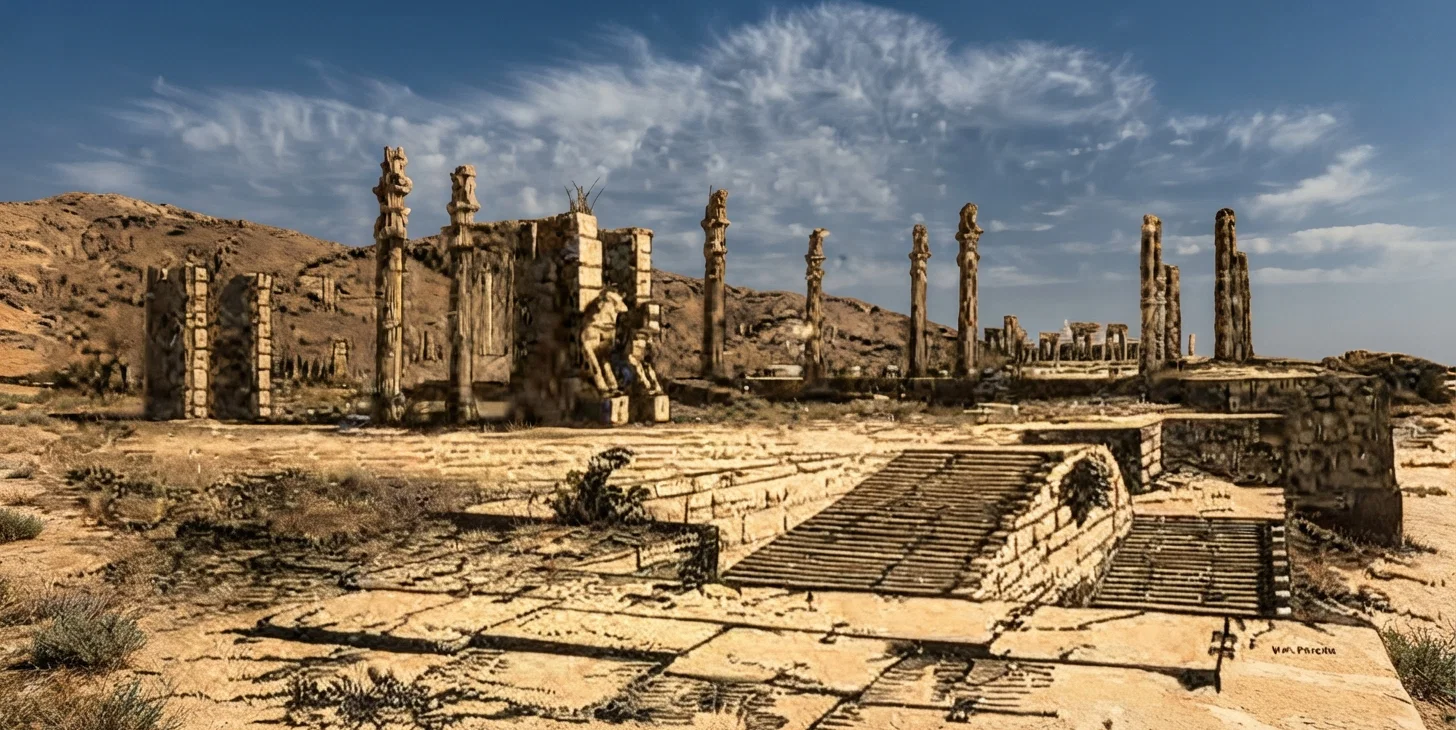
Ruins of Persepolis, second Capital of Persia, from the Top of the Great Stairs. From Fergusson.
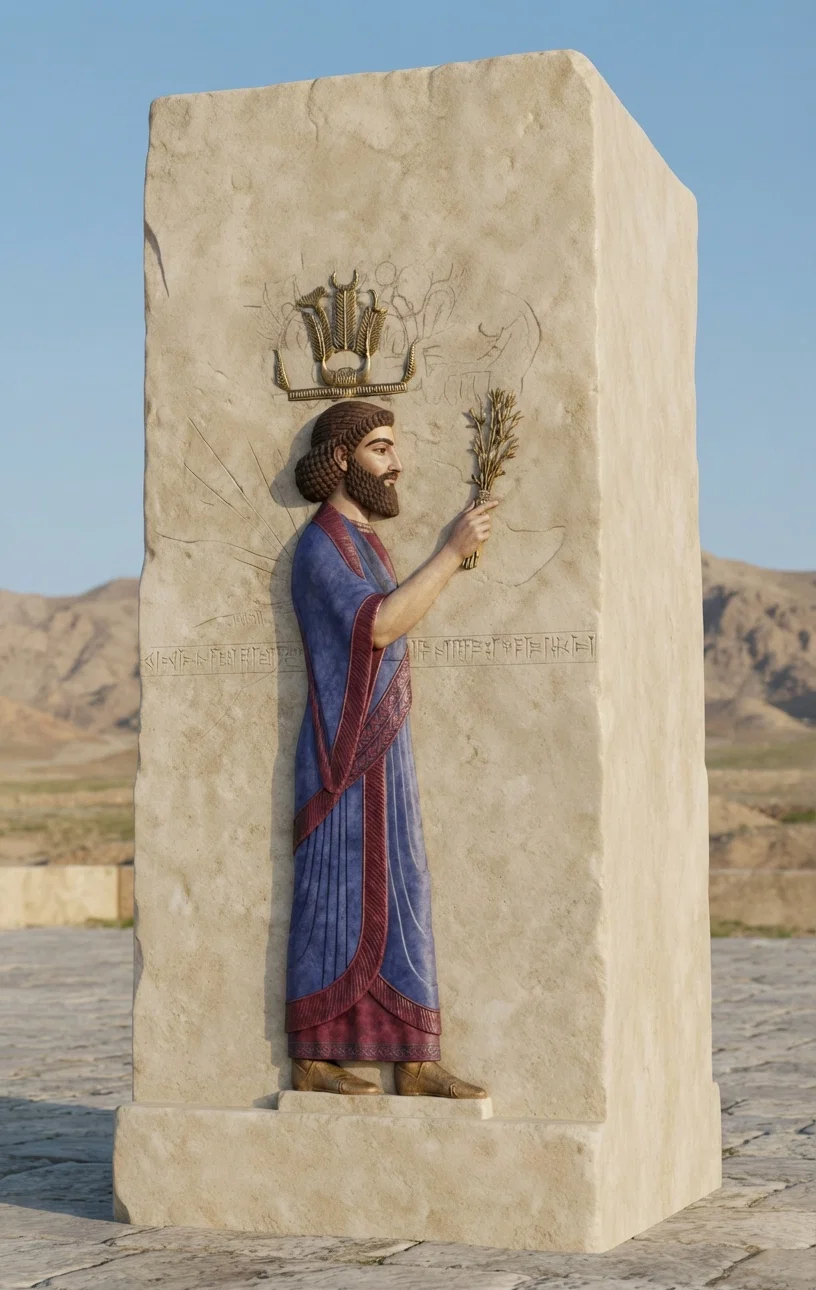
Portrait of Cyrus, about B. C. 538. The sculpture is at Pasagardae.
be destroyed, and His dominion shall be even unto the end. He delivereth and rescueth, and He worketh signs and wonders in heaven and in earth." Dan. 6:25-27.
"In the very first year of Darius the Mede, 538, Daniel turned his attention especially to the Scriptures upon the subject of the return from their captivity; and found and 'understood by books the number of the years, whereof the word of the Lord came to Jeremiah the prophet, that He would accomplish seventy years in the desolations of Jerusalem.' Dan. 9:1, 2." One thing that had caused Daniel to be most deeply interested in this subject was the word of Palmoni, the wonderful numberer in the vision of Daniel 8, given to him in the third year of Belshazzar, saying, "Unto two thousand and three hundred days; then shall the sanctuary be cleansed." Dan. 8:14.
This two thousand and three hundred days to the cleansing of the sanctuary caused Daniel great anxiety. He could not understand it. The temple at Jerusalem was a ruin, and had so lain for more than fifty years. Was it possible that it should so lie for yet two thousand and three hundred years, before the ruins should be cleared away and the temple restored? To this the book of Jeremiah answered, No: "After seventy years be accomplished at Babylon I will visit you, and perform My good word toward you, in causing you to return to this place." Jer. 29:10. Could it be possible, then, that they should return, and yet the temple be not restored for so long? To this the book of Isaiah answered, No: for therein God had declared to Jerusalem, "Thou shalt be built; and to the temple, Thy foundation shall be laid;" and that this should be in the time of Cyrus, and Cyrus was now living and sixty years old.
What, then, could mean that word, "Unto two thousand and three hundred days, then shall the sanctuary be cleansed"? Was there any connection between that and the return from captivity and the rebuilding of the city and temple? This problem was beyond solution by human thought. Therefore—
"I set my face unto the Lord God, to seek by prayer and supplications, with fasting, and sackcloth, and ashes: . . . [and] whiles I was speaking in prayer, even the man Gabriel, whom I had seen in the vision at the beginning [Dan. 8:16], being caused to fly swiftly, touched me about the time of the evening oblation." Dan. 9:3, 21.
"And he informed me, and talked with me, and said, O Daniel, I am now come forth to give thee skill and understanding. At the beginning of thy supplications the commandment came forth, and I am come to show thee; for thou art greatly beloved: therefore understand the matter, and consider the vision."
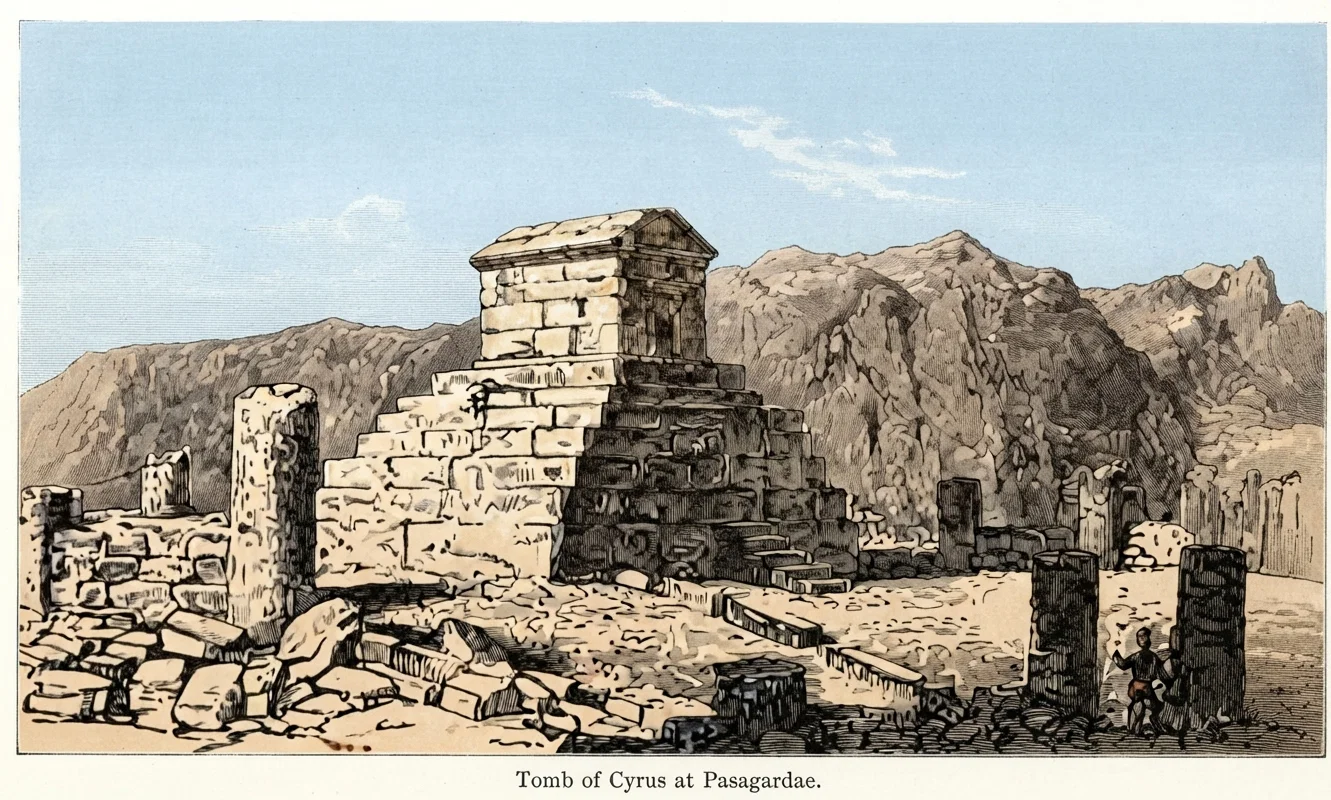
Tomb of Cyrus at Pasagardae.
Seventy weeks are determined upon thy people and upon thy holy city, to finish the transgression, and to make an end of sins, and to make reconciliation for iniquity, and to bring in everlasting righteousness, and to seal up the vision and prophecy, and to anoint the most Holy.
"Know therefore and understand, that from the going forth of the commandment to restore and to build Jerusalem unto the Messiah the Prince shall be seven weeks, and threescore and two weeks; thestreet shall be built again, and the wall, even in troublous times. And after threescore and two weeks shall Messiah be cut off, but not for Himself: and the people of the prince that shall come shall destroy the city and the sanctuary; and the end thereof shall be with a flood, and unto the end of the war desolations are determined: And He shall confirm the covenant with many for one week; and in the midst of the week He shall cause the sacrifice and the oblation to cease, and for the overspreading of abominations He shall make it desolate, even until the consummation, and that determined shall be poured upon the desolate." Dan. 9:22-27.
Within two years, in 536, died Darius the Mede, and was immediately succeeded by Cyrus the Persian, of the same united and universal kingdom of the Medes and Persians. Cyrus had been the commander of the Medo-Persian armies in the destruction of the empire and kingdom of Babylon. At that time he was an idolater. Yet long before that, even one hundred and fourteen years before he was born, the God of Israel had called him by name; and had recorded a message addressed to him personally. And this is the message: "Thus saith the Lord to His anointed, to Cyrus, whose right hand I have holden, to subdue nations before him; and I will loose the loins of kings, to open before him the two-leaved gates; and the gates shall not be shut; I will go before thee, and make the crooked places straight: I will break in pieces the gates of brass, and cut in sunder the bars of iron: and I will give thee the treasures of darkness, and hidden riches of secret places, that thou mayest know that I, the Lord, which call thee by thy name, am the God of Israel. For Jacob My servant's sake, and Israel Mine elect, I have even called thee by thy name: I have surnamed thee, tho thou hast not known Me." Isa. 45:1-4.
Thus the Lord revealed Himself to Cyrus as the God of Israel. But since Cyrus was an idolater, God must further reveal Himself to him as the only true and living God. This He did in the further word, "I am the Lord, and there is none else, there is no God beside Me. I girded thee, tho thou hast not known Me: that they may know from the rising of the sun, and from the west, that there is none beside Me. I am the Lord, and there is none else." Verses 5, 6.
God thus revealed Himself to Cyrus as the God of Israel, and as the only true God: it remained to reveal to Cyrus that He, the God of Israel, and the only true God, was distinct from and above the gods that Cyrus had worshiped. Therefore the Lord revealed Himself yet further, "I form the light, and create darkness; I make peace, and create evil." Verse 7. The point in this is—
1. The Persians, in their religious system, recognized two original principles—good and evil. Their conception of good and evil, however, did not rise to the height of moral and spiritual good and evil, or righteousness and sin, as is revealed by the Lord; rather as men naturally conceive of good and evil as manifested in prosperity and adversity, tranquillity and disturbance. Therefore when the Lord would show to Cyrus that He is over all, He said, "I make peace, and create evil." That is, "I make tranquillity and create disturbance; I give prosperity and send adversity."
2. The Persians held that their principle of good was represented in light; and the principle of evil in darkness. Therefore when the Lord would reveal to Cyrus the Persian that He is above all, He said, "I form the light, and create darkness."
The night that the city of Babylon was captured and Belshazzar slain, before the capture king Belshazzar had made Daniel the first man of the empire after the two kings, Belshazzar and his father. Then when the city was taken, Belshazzar slain, and his father a captive, this left Daniel the first man of the kingdom. Darius and Cyrus, the two rulers, found Daniel in his royal robe of scarlet with his insignia of office, the "chain of gold about his neck." They found him so intelligent in all the affairs of the vanished kingdom that they immediately took him into their council, and gave to him the chief place in the re-organization of the kingdom.
And when Cyrus thus met Daniel, Daniel showed to him the word of the Lord, written to him by Isaiah one hundred and seventy-four years before. The message was so direct and so personal, and the revelation so plain and indisputable, that Cyrus accepted and acknowledged God as "the Lord God of heaven," and declared, "He is the God."
There was also read to Cyrus the further word of the Lord by Isaiah to him, "That saith of Cyrus, He is My shepherd, and shall perform all My pleasure. . . . I have raised him up in righteousness, and I will direct all his ways: he shall build My city; and he shall let go My captives, not for price nor reward, saith the Lord of hosts." Isa. 44:28; 45:13. This message, too, Cyrus accepted from the Lord; and in 536, when Cyrus came to the throne of the empire, that very year expired the seventy years' captivity, and in that very year Cyrus issued the decree and proclamation throughout the whole empire, releasing from captivity all the people of Israel, and calling them to return to Jerusalem and rebuild the city, and especially the house of the Lord.
And here is a copy of that decree:—
"Thus saith Cyrus king of Persia, The Lord God of heaven hath given me all the kingdoms of the earth; and He hath charged me to build Him an house at Jerusalem, which is in Judah. Who is there among you of all His people? his God be with him, and let him go up to Jerusalem, which is in Judah, and build the house of the Lord God of Israel (He is the God), which is in Jerusalem. And whosoever remaineth in any place where he sojourneth, let the men of his place help him with silver, and with gold, and with goods, and with beasts, beside the free-will offering for the house of God that is in Jerusalem."
"Let the house be builded, the place where they offered sacrifices, and let the foundations thereof be strongly laid; the height thereof threescore cubits, and the breadth thereof threescore cubits; with three rows of great stones, and a row of new timber: and let the expenses be given out of the king's house; and also let the golden and silver vessels of the house of God, which Nebuchadnezzar took forth out of the temple which is at Jerusalem, and brought unto Babylon be restored, and brought again unto the temple which is at Jerusalem, every one to his place, and place them in the house of God." Ezra 1:1-4, 6:3-5.
That decree was published by "proclamation throughout all his kingdom," and was put "also in writing;" and was deposited among the archives of the kingdom in the palace at Ecbatana, the Median capital of the empire.
"Then rose up the chief of the fathers of Judah and Benjamin, and the priests, and the Levites, with all them whose spirit God had raised, to go up to build the house of the Lord which is in Jerusalem. And all they that were about them strengthened their hands with vessels of silver, with gold, with goods, and with beasts, and with precious things, beside all that was willingly offered."
"Also Cyrus the king brought forth the vessels of the house of the Lord, which Nebuchadnezzar had brought forth out of Jerusalem, and had put them in the house of his gods; even those did Cyrus king of Persia bring forth by the hand of Mithredath the treasurer, and numbered them unto Sheshbazzar, the prince of Judah. . . . All the vessels of gold and of silver were five thousand and four hundred. All these did Sheshbazzar bring up with them of the captivity that were brought up from Babylon unto Jerusalem." Ezra 1:5-11.
And of the people who returned to Jerusalem,—
"The whole congregation together was forty and two thousand three hundred and threescore, beside their servants and their maids, of whom there were seven thousand three hundred thirty and seven; and there were among them two hundred singing men and singing women. . . . And some of the chief of the fathers, when they came to the house of the Lord which is at Jerusalem, offered freely for the house of God to set it up in his place: they gave after their ability unto the treasure of the work threescore and one thousand drams of gold, and five thousand pound of silver, and one hundred priests' garments. So the priests, and the Levites, and some of the people, and the singers, and the porters, and the Nethinims, dwelt in their cities, and all Israel in their cities." Ezra 2:64-70.
The restoration of Israel had begun.

IN THE RACE FOR ETERNAL LIFE.

To illustrate the race of the Christian for the crown of life, Paul uses the races of the ancient Greeks. He says: "Know ye not that they which run in a race run all, but one receiveth the prize? So run, that ye may obtain. And every man that striveth for the mastery is temperate in all things. Now they do it to obtain a corruptible crown; but we an incorruptible."
To win the prize—a chaplet of perishable flowers, bestowed amid the applause of the multitude—was regarded as the highest honor by the Grecian runners. In the hope of gaining this prize they subjected themselves to the most severe training and to continual self-denial. They put aside every indulgence that would tend to weaken the physical powers. We are striving for an infinitely more valuable prize,—even the crown of everlasting life. How much more careful should be our striving! how much more willing our sacrifice and self-denial!
There is work—stern, earnest work—before those who win this prize that God holds out. They must "lay aside every weight, and the sin which doth so easily beset, . . . and . . . run with patience." One of the weights that they must lay aside is the indulgence of appetite. Intemperance has cursed the world almost from its birth. Noah's son was so debased by the use of wine that he lost all sense of propriety, and the curse that followed his sin has never been lifted from his descendants.
Nadab and Abihu were men in holy office; but their minds became so clouded by the use of wine that they could not distinguish between sacred and common things. They "offered strange fire before the Lord, which He commanded them not. And there went out fire from the Lord, and devoured them, and they died before the Lord."
Alexander found it much easier to subdue kingdoms than to rule his own spirit. After conquering nations, he fell through the indulgence of appetite,—the victim of intemperance.
Through appetite Satan controls the whole being. Thousands who might have lived to honor God and bless humanity have gone down to the grave, physical, mental, and moral wrecks because they sacrificed their powers to self-indulgence. Those who gain eternal life must bring every appetite under the control of the Spirit of God. Then will they have power to run the race set before them.
The Christian must lay aside all selfishness, living and working for the good of others. The only way to grow in grace is to do the workthat Christ has enjoined upon us, helping and blessing those who need the help we can give. Strength comes by exercise; action is the very condition of life. Those who endeavor to maintain Christian life by passively accepting the blessings that come through the means of grace, and doing nothing for Christ, are trying to live by eating without working. And in the spiritual as in the natural world, this always results in degeneration and decay. A man who would refuse to exercise his limbs would soon lose the power to use them. The Christian who will not exercise his God-given powers, not only fails of growing up into Christ, but he loses the strength that he already had.
The spirit of unselfish labor for others gives depth, stability, and Christlike loveliness to the character, and brings peace and happiness to its possessor. The aspirations are elevated. There is no room for sloth or selfishness. Those who thus exercise the Christian graces will grow and will become strong to work for God. They are most surely working out their own salvation.
The Christian must lay aside all self-seeking. The hypocrisy of the Pharisees was the product of self-seeking. The glorification of self was the object of their lives. It was this that led them to pervert and misapply the Scriptures, and blinded them to the purpose of Christ's mission. This subtle evil even the disciples were in danger of cherishing. It was this that prompted the strife as to who would be the greatest. It was this that came between them and Christ, making them so little in sympathy with His mission of self-sacrifice, so slow to comprehend the mystery of redemption.
As leaven, if left to complete its work, will cause corruption and decay, so does the spirit of self-seeking, cherished, work the defilement and ruin of the soul. Yet among the followers of our Lord to-day, as of old, how widespread is this subtle, deceptive sin! How often our service to Christ, our communion with one another, is marred by the secret desire to exalt self!
Only the power of God can banish self-seeking. This change is the sign of His work. When the faith we accept destroys self-seeking and pretense, when it leads us to seek God's glory and not our own, we may know that it is of the right order. "Father, glorify Thy name" was the key-note of Christ's life, and if we follow Him, this will be the key-note of our life.
The Christian must lay aside doubt. Not one that in penitence and faith has claimed His protection will Christ permit to pass under the enemy's power. The Saviour is by the side of His tempted ones. With Him there can be no such thing as failure, loss, impossibility, or defeat; we can do all things through Him who strengthens us. When temptations and trials come, do not wait to adjust all the difficulties, but look to Jesus, your Helper.
There are Christians who think and talk altogether too much about the power of Satan. They think of their adversary, they pray about him, they talk about him, and he looms up greater and greater in their imagination. It is true that Satan is a powerful being; but thank God, we have a mighty Saviour, who cast out the evil one from heaven. Satan is pleased when we magnify his power. Why not talk of Jesus? Why not magnify His power and love?
The rainbow of promise encircling the throne on high is an everlasting pledge of God's love for us. It testifies to the universe that God will never forsake His people in their struggles with evil. It is an assurance to us of strength and protection as long as the throne itself shall endure.
Envy, malice, evil-thinking, evil-speaking, covetousness,—these are weights that the Christian must lay aside if he runs successfully the race for immortality. "If thy hand cause thee to stumble, cut it off; it is good for thee to enter into life maimed, rather than having thy two hands to go into hell, into the unquenchable fire. And if thy foot cause thee to stumble, cut it off; it is good for thee to enter into life halt, rather than having thy two feet to be cast into hell."
Why this earnest language, than which none can be stronger?—Because "the Son of Man is come to save that which was lost." Shall the disciples of Christ show less regard for the souls of their fellow-men than the Majesty of heaven has shown? Every soul has cost an infinite price, and how terrible is the sin of turning one soul away from Christ, so that for him the Saviour's love and humiliation and agony shall have been in vain.
Any habit or practise that would lead into sin and bring dishonor upon Christ, would better be put away, whatever the sacrifice. That which dishonors God can not benefit the soul. The blessing of heaven can not attend any man in violating the eternal principles of right. And one sin cherished is sufficient to work the degradation of character and to mislead others. If the foot or the hand would be cut off, or even the eye would be plucked out, to save the body from death, how much more earnest should we be to put away sin, that brings death to the soul.
Every step that the Christian takes is a step of advance. The Lord draws near to him as he strives to reach the object set before him. Each temptation overcome marks a triumph. Each night of conflict and trial, bravely borne, hails the dawn of a better day. Laying aside all that would hinder his progress, forgetting the things that are behind, he presses toward the mark of the prize of his high calling.
MRS. E. G. WHITE.

HESPERIA, OR THE LAND OF THE WEST.—NO. 2.

An Allegory.

(Continued from last week.)
So Justus and his men strengthened themselves and encouraged one another, and became very strong. But when they attempted to make the people of the land obey them in the name of the Great King, the people would not hear them, but drove them out. So Justus and his men arose and fled across the seas to the land of the West, and dwelt there, as the Great King had commanded them; for Justus was subject to the Great King in all things, howbeit he erred in the matter of the kingdom.
Now Justus and his men waxed old, and were gathered unto their fathers. And another generation arose who had not passed through the trials of their fathers, nor had felt the oppressions of Prince Diabolus; and they waxed exceeding rich, and had houses, and cattle, and lands, and everything that their soul lusted after. And it came to pass, as if it had been a light thing that they should have horses, and cattle, and servants, to work for them, that they even laid hold on the elements of nature, the water, the fire, and the lightnings of the clouds, and made them come and go at their bidding. Such power did the Great King grant them. But they gave not Him the glory.
But when the people of the East, who lived under Prince Diabolus, had heard of what Justus and his men had done in the Land of Hesperia, they even arose with their wives and their children and came to this new land; for they said, "Behold, we be here looking at one another's misery, and waiting for death. Let us arise and flee to the West, where there is room enough and to spare, and there will we build every man his house and plant every man his vineyard, and we and our little ones shall live and not die."
So the people of Hesperia multiplied and waxed great above all that were before them. And all the people of the world knew that they prospered thus because they allowed every man to worship freely as he chose, and because the people obeyed the laws of the Great King, giving no heed to Prince Diabolus.
But when many years had passed, and the Great King or the Prince Imperial had not yet appeared to take possession of the country, the people again did what was not right; for they passed many laws which were contrary to the old laws. And all the people began to say that the Prince Imperial was not to come in person, but would only rule the world through the governments and the sons of the prophets. Also very many who had become engaged in the study of the things of nature, became so vain of their success that they said they were independent of the Great King, and that the land would get along very well without Him. Some even denied His existence. "Who has ever seen Him?" they said. Others said that if He existed, He certainly cared not what was done in the land of the West, nor would He ever disturb the established order of things.
So the people of Hesperia gave themselves up to every device of their own hearts, and forgot the Great King and His laws, and began to imitate the laws and customs of the prince of Babylon. And Prince Diabolus sent messengers to the people of the West, saying, "Let us not be any longer at enmity one with another, for we are brothers. Let my servants, I pray you, dwell in the Land of Hesperia, and get wealth, and I shall give them command that they observe the laws of the land." For very many of the prince's people had come from the East to Hesperia.
Now certain people dwelling in the isles in the Land of the Sunrising were subjects of the Prince Diabolus. And they rebelled against the governors whom the prince had appointed over them, because they used them very cruelly. Then certain people in the Land of Hesperia said one to another, "We do not well. Behold, these people are fighting for their liberties, and should we stand by and give them no aid?" So they sent officers and men and a great fleet to assist the people of the Sunrising, and they appointed John Ambitus as officer over them all. And when he was come into the land, he drove out the governors of Prince Diabolus, and claimed all the land in the name of the people of the West, for he even made it subject to the Land of Hesperia.
Now when Diabolus heard thereof he was sore displeased. Nevertheless he sent messengers to the people of the West to congratulate them on their victory, saying, "Behold the might and the wisdom of the people of the West! What my governors could not do in long years, behold ye have accomplished in a single day."
Moreover the other peoples of the East, when they heard thereof, said, "What new wonder is this? Hath the creature crawled out of his shell? Have they even crossed the seas and subdued the Land of the Sunrising? Take heed to yourselves, ye princes of the East, and stand to your arms." So the princes of the East made a covenant with Hesperia that day that there should be peace between them.Then John Ambitus returned when he had marched through all the Land of the Sunrising, and had subdued it. And the people of Hesperia made him a great man, and a prince; for they even made him ruler over them all, for before that the judges had ruled the land. So the people rejoiced, saying one to another, "Now have we a king like all the nations."
But John Ambitus said within himself, "Whom shall I have for my priest, seeing I have become the head of this great people? For no king ever yet ruled a great people as this is without the assistance of his priest." So he sought for a priest to minister before him.
Now there was a certain man of the sons of the prophets named Eleazar Capito. And he was a very learned man; for he had studied all the wisdom of the East as well as the new learning concerning the hidden things of nature, and he was a leader of those who taught that the Great King would never interfere with the established order of nature. He was, moreover, in great favor with the people; for they said, "Who can prophesy like Eleazar? Who is so learned and so great as he is?" Therefore was his name called Capito, which is, being interpreted, large-headed.
And John Ambitus sent unto him, saying, "Wilt thou be my priest?" and he answered, "Yea." So John Ambitus consecrated him priest before him that day; and again the people rejoiced, saying, "It is well."
But it sore displeased the priests of Diabolus who were in Hesperia; and they sent unto their master, saying, "Behold, John Ambitus hath chosen that youth, even Eleazar Capito, to minister before him, and to be the high priest of Hesperia. Why did he not choose one of us, who have had experience in affairs of state these many years?"
But Diabolus answered them saying, "Are ye so foolish? Do ye not yet see neither know that this Eleazar Capito is our brother? Has he not written books in our name, saying that the Great Book is mostly not authentic, that the old laws are even passed away altogether, and are quite unsuited to these more enlightened times, and that our laws should be adopted instead? Can we not bide our time?"
So they were forced to hold their peace, and they went their way.

MOMENT-BY-MOMENT POWER.

Look at this beautiful tree. How stable it appears, as if it had strength in itself to withstand the storm; yet, like the fig tree which Jesus cursed, if God's power were withdrawn it would go back to its elements, and be no more a tree.
We are apt to entertain the idea that God set the tree growing, but now it can grow and live itself. The evolutionist says, "The First Great Cause may have started the atoms into being; but now they develop themselves, according to circumstances and surroundings." This is a mistake.
We see a strong Christian, and say, "What a good man! How firm in the Christian life!" Or, "What a beautiful character; she is almost perfect. O that I were only as good!" As in the case of the tree, one, in looking at the result, many lose sight of the continuous upholding power of God. It is the evolutionary idea over again—the creation before the Creator. As the fig tree withered away when the moment-by-moment power was withdrawn, so the man's life would go back to its natural elements, if the divine life was intercepted. He does not stand an instant by acquired strength.
God upholds "all things by the word of His power." When a thing has to be upheld, it can not stand of itself.
This word gives the original elements of the wood the form of a living tree. There is nothing in the elements themselves to work out such a result. They are only dust and ashes, and the atoms of one tree are as powerless as those of another; but in this one the life may have freer course.
We need not look upon one person as better by nature than another; the original element, selfishness, is the same, only manifested in different forms. God takes these unpromising elements, and works a miracle in the man as well as in the tree.
It is hard to believe that the tree has no power or life in itself, because it has the appearance of strength; and it is difficult to understand that the man has no power in himself, because there is the appearance of stability. The moment-by-moment power alone holds the elements in proper relation to each other, and supplies a continuous flow of life.
"We have this treasure in earthen vessels, that the excellency of the power may be of God, and not of us." Cornelia Snow.
Cliff Island, Me., Feb. 17, 1902.

GROWING IN GRACE.

According to the Word of God there are several stages of progress in the spiritual life, as there are in the natural life. Some are little children, some are young men, and some are fathers. All believers are little children when they first enter into the kingdom of God by faith. One may be sixty years old, but he is only an infant in grace when he is first converted. He may be a great scholar, a great statesman, a man of powerful influence in the community and of wide experience in the things of this world; but if he has just given his heart to God, he is only a babe in Christ. His first experience of the spiritual life may be exceedingly delightful. His soul may be filled with holy rapture. He may not be able to understand how he can ever be happier or rise higher. But he is only a little child.
Between this stage and that described by the apostle in the epistle to the Ephesians there is a long stretch of progress. Yet it is the privilege of every one to rise "unto a perfect man, unto the measure of the stature of the fulness of Christ." One needs not to grow so slowly as the body grows. Great progress may be made in a very short space of time. Some grow in grace more in a day than others grow in many years. Too many never grow. They are little children still, tho they have been in the church for many years. Some are not so large and strong as they were at first. Theirs is a sad case of arrested development. Multitudes make little progress. The means of grace are at hand. Every facility has been provided, but yet the soul stands still, if, indeed, such a thing is possible.
A growing Christian is a happy Christian. He is distinctly conscious of improvement. He is not satisfied with himself nor with his attainments. He sees heights above to which he has not yet attained. But he also sees ground below which he has left behind. He is not what he wishes to be. He is not what he expects to be. But he is not what he once was. His strength is greater, his hope is brighter, his peace more constant, his love deeper, his doubts fewer, the fruits of his labors are more abundant.
No one can grow in grace who neglects the Bible. If the daily paper and other current literature occupy his mind to the exclusion of the Bible, his spiritual life will languish. To grow in grace it is necessary to keep the Sabbath holy, to attend upon the means of grace in the house of God. He does not grow in grace who does not spend some time each day in secret devotion. Too little time is given to communion with God in a secret place. To be alone with God one half hour each day is worth more than many hours spent in worldly pleasure. If Christian men and women would redeem the time, and give a small part of each day to silent, secret prayer and holy fellowship with God, the spiritual life of the church would advance rapidly. Because the world has so much of our time, and God so little, we are weak and sickly.—Christian Advocate.
Continue reading: WHICH?