NOTWITHSTANDING the South African war, which is engrossing the attention of the British people largely to the exclusion of other matters, some here and there are making a determined stand against the encroachments of the Ritualists. The recent successful effort to hinder the instalment of Canon Gore as bishop because of his ritualistic sympathies, is evidence that this anti-Rome movement has some following among the people. But it must be admitted that the vast majority are totally indifferent regarding these matters, while a very influential and powerful minority are openly in favor of ritualism.
The writer attended, on the fourth inst. a huge Protestant demonstration in the Royal Albert Hall. The Right Hon. Viscount Midleton presided, and made a vigorous introductory speech. He was supported by Prebendary Webb-Peploe, Pastor William Cuff, Rev. W. R. Mowle, the Right Hon. Lord Kinnaird, and other speakers of some prominence, both churchmen and dissenters.
Three resolutions were presented, and adopted with a great show of enthusiasm, and without opposition. This will be understood when it is explained that the enormous audience was a select one, each person being admitted by ticket. The resolutions read as follows:—
1. That the steady growth of the mass and the confessional within the Church of England, is mainly due to the abuse of patronage by the government and by the episcopate, and especially to the action of certain of the bishops who seek to substitute their own personal rulings for the ascertained and well-known law of the land, as laid down by the King's judges.
2. That loyalty to the free constitution of Great Britain renders it needful that the Sovereign should give a personal pledge of his rejection of the destructive errors of the Church of Rome. This meeting therefore pledges itself to resist any attempt to tamper with or in any way weaken the plain meaning of the Royal Declaration, recognizing, as it does, that the revolution of 1688, to which we owe the existing Declaration, was the natural sequel to the Reformation of the 16th century, and forms at once its complement and its safeguard.
3. That the inaction of successive governments in allowing the open violation of the law which expressly provides for the exclusion of monks and Jesuits from residing in this country, and in refusing to provide for the impartial inspection of nunneries, is unstatesmanlike, seeing that the experience of all civilized countries has shown that the existence in any country of such communities is pernicious to society and a danger to all good government.
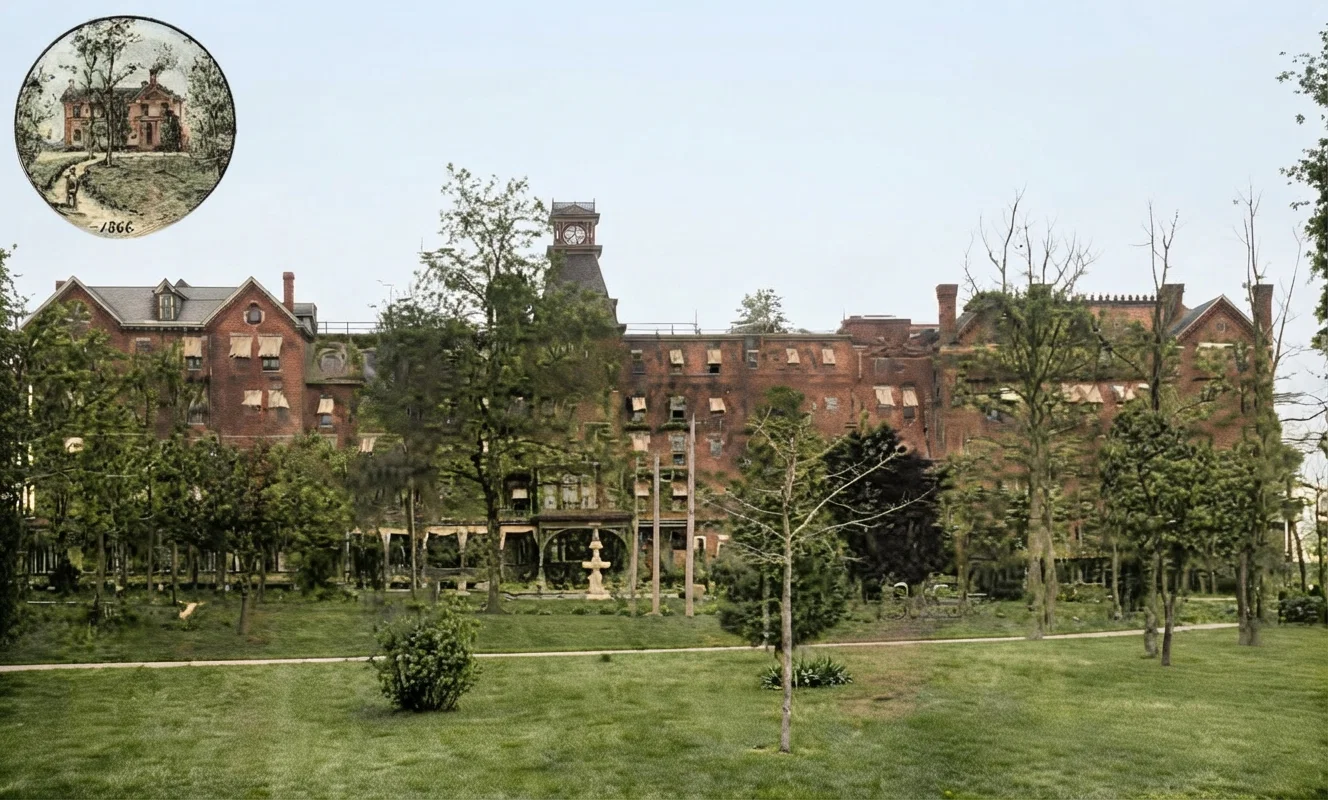
The main Sanitarium Building (Battle Creek, Mich.,) as it was before the fire. In the upper left-hand corner is a picture of the first Sanitarium building erected. It too was burned February 18; the hospital also, which stood on the opposite side of a narrow street at the left of the main building, was burned.
The general bearing of the first resolution will be understood in view of the fact that a considerable number of Church of England clergy are not only advocating the mass and auricular confession, but actually practising them in their churches in defiance of the general laws of the church.
Number two is aimed at any efforts to change the form of the king's oath, which, as it stands at present, makes him declare that he regards the mass and worship of Mary as idolatrous. This matter was discussed in last year's Parliament, and many prominent members expressed themselves in favor of altering the tone of the language, to make it less offensive to Catholics.
The flocking to England of the religious orders leaving France because of the restrictive legislation, is the immediate reason for the third resolution. It can not be denied that such orders are increasing very rapidly in this kingdom, and wielding a powerful influence in behalf of Romanist principles and doctrines.
Albert Hall was well filled with attentive listeners, and tho the meeting lasted some three hours, very few left before it closed. As a general rule, the speakers were moderate in their statements, but did not hesitate to express abhorrence for the doctrines of Rome and real concern over the ominous growth of papistical ideas in Britain. They rightly emphasized the importance of the Bible as the best weapon with which to fight error. "Urge your minister to preach the simple Gospel," they said. The condition of women in the convents, the general character and aims of the Jesuits, the fact that Rome has never changed, that she is still at heart a persecuting power—all these matters were fully set forth, and the audience cheered so loudly at times that the speaker's voice was entirely drowned.
Beholding the great sea of upturned faces and the general enthusiasm of both speakers and audience, one might be inclined to think that Ritualism was receiving its death-blow. But London, with its more than 6,000,000 human souls, has all sorts and conditions of people, and almost any party can make a pretty large showing. If Ritualists chose to do so, they might have just as imposing a demonstration, but they prefer to work underneath, and they will get what they seek all the sooner.
Such public gatherings as have just been described are being held in different parts of the country. But for the most part they are not very popular. The newspapers barely mentioned the demonstration in Albert Hall. And tho the program contained the names of over thirty members of Parliament said to be in sympathy with the objects of the meeting, it is significant that not one of these was present.
The general tendency in Britain, without a shadow of a doubt, is Romeward. The wind may play on the surface of the waters, making them move first one way and then another, but the stream flows on, slowly but steadily in one direction only.
London, Eng., Feb. 14, 1902. M. E. OLSEN.
EPIDEMIC OF CRIME.
By Editor
We wish that San Francisco stood alone in the epidemic of crime, but reports from other large cities are of the same import. Of the condition of San Francisco a daily paper of January 22 contains this list of unpunished crimes committed sixty days previous to the date named, and of which the perpetrator in no case had been apprehended:—
Murders.......................................... 8
Hold-ups....................................... 65
Robberies...................................... 15
Burglaries..................................... 26
Assaults to murder............................. 13
February 24, Mr. W. C. Morrow, a writer of note, and a special student of criminology, presents this list for the ninety days previous:—
Murders........................................ 10
Highway robberies.............................. 85
Other robberies................................ 10
Burglaries..................................... 36
Assaults to murder............................. 14
Not one of these criminals has been arrested. These crimes are known to the public. Mr. Morrow9says, "It is supposed that many others are known to the police, and that knowledge of them is withheld—'for prudential reasons.'"
Such pictures from daily facts, which the lime-light of an indefatigable and ubiquitous press ever and anon flash upon the screen continually before the public gaze, give the lie to the roseate drawings of a glorious future, painted according to the fancies of self-deluded dreamers. Some of these crimes are monstrous in the extreme. Some—like the murder of little Robbie Hyslop—seem to be utterly without motive, done from sheer madness or wantonness. Women are assaulted without number. One act is generally followed by many of the same character.
Such things reveal to the Bible student clear evidence that we are living in the last days. "But," says the objector, "have there not been other times and places when and where crime was prevalent?"—Doubtless. But all this comes in a period of the world's greatest enlightenment, in a country where education is most extended, in a land where the Bible is found in every house, or might be; and it comes as one of a great circle of cumulative evidences that the last days are here, that the only hope of the world is in the second coming of Christ. Some of the crimes which have been committed in San Francisco the last three months would have thrilled the whole nation a few years ago; but they now form a breakfast-table talk, and are forgotten in the mad rush for money, fame, or pleasure. "Out of sight, out of mind," is the almost universal rule as regards the great calamities, sufferings, and sins of the world. We would not have these things dwelt upon, but we would have them considered in the light of the Word of God. They mean something—these signs of the times,—and God wants us to read them in the light of that meaning. He who reads aright will be forewarned. He who fails so to read will be taken unawares. "Whoso readeth, let him understand."
Foreign and Domestic News
REPORTS from British Columbia state that work has begun on the British transpacific cable, which is to connect British Columbia with China by way of Yokohama and the Aleutian Islands.
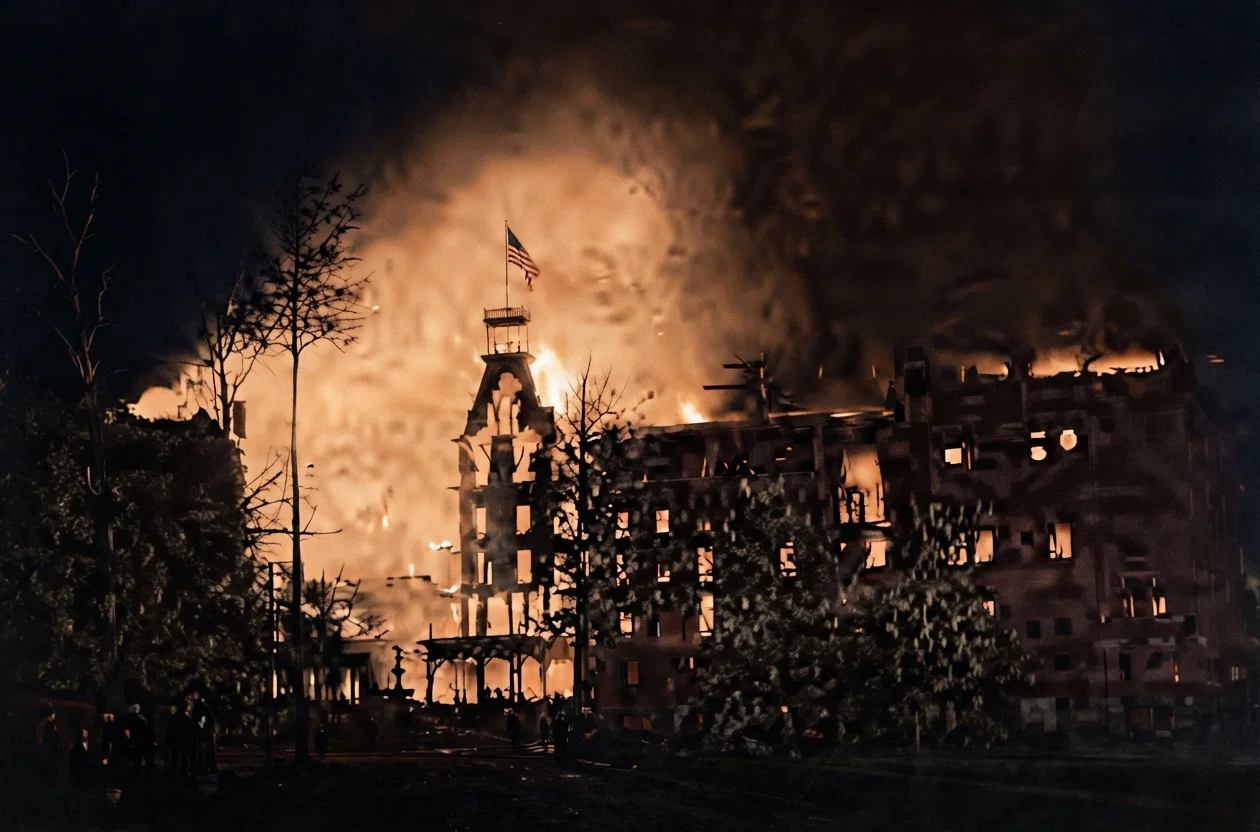
From a photograph of the fire by P. C. Peterson, of Battle Creek, Mich. Photographs of this striking scene may be obtained by addressing him.
ON March 7, the Boer general Delarey, with a force of about 1,500 men, attacked General Methuen, whose force consisted of 900 mounted men and 300 unmounted. The British were surrounded, their mules and cattle stampeded by the peculiar tactics of the Boers, and the whole force captured. It seems that the greater portion of the captured men were afterward released, but General Methuen was held, evidently as a hostage for some of the Boer officers in the hands of the British. By this feat the Boers prevented the union of two British forces, and added five pieces of artillery to their equipment. The British lost 41 men killed in the encounter. The Boer loss is not given.
EIGHT thousand freight handlers are now on strike in Boston, and other organizations which seem inclined to join the strike immediately will bring the number of striking men up to 16,000. The strike is against the Boston and Albany and the New York, New Haven, and Hartford railroads, and was started by the Team Drivers' Union, whose membership is said to number 6,000. The express drivers have joined the strike, and this is to be followed by a strike of the longshoremen and other organizations of working men. The railroad managers are seeking now to operate their roads with non-union workmen.
THE belief in Ireland that the United Irish League is about to be "proclaimed" by the government (brought under legal restrictions) is causing great excitement in vicinities where the members of the league are numerous. When the news of General Methuen's capture at the hands of the Boers was read in Parliament on March 10, there was much cheering from the Irish members till they were "shamed" down by other members of the House.
THE Cunard Line steamer Etruria, which lost her propeller and rudder several days ago, was towed by another vessel into one of the ports of the Azores on March 9. The loss of the propeller and rudder both, rendered the great steamer unable to help herself in any way.
The Fate of Crowned Heads
It is said that the fate of crowned heads has been minutely studied by a French statistician, who gives a list of the unfortunate rulers of the world. He reckons that up to the present time 2,540 emperors and kings have governed 64 nations. Of these sovereigns, 300 were driven from their thrones, 64 abdicated, 25 committed suicide, 12 became insane, 100 fell in battle, 123 were made prisoners, 25 died martyrs, 151 were assassinated, and 108 were legally condemned to death and executed. That is, the rule of a little more than one-third came to an unnatural end.
Papal Conciliation Mission to the Philippines
A REPORT from Rome states that the pope has instructed Monsignor Sbarretti, when he reaches the Philippines, to work with and seek to conciliate the Americans. This instruction is significant in view of the fact that many petitions have recently been received by the pope from the friars urging him to maintain their moral and material supremacy in the islands and prevent their removal. Several cardinals are said to consider that if Washington insists, the friars must ultimately be withdrawn.
German Railway Dispute in Brazil
A RAILWAY owned by Germans in Brazil, suspended operations some time ago, owing to the failure of one of the Brazilian states to pay the interest guaranteed to the company. The government thereupon cancelled the German concession because of the refusal of the company to operate its road. This has brought a protest from Germany, and it is now threatened that German warships will visit Brazil to bring the matter to a settlement satisfactory to the German company.
Secretary Long Resigns
SECRETARY of the Navy Long has resigned from the President's cabinet, and his place will be taken by William H. Moody, a member of the House from Massachusetts.
Yerkes Controls London Underground Railways
CHARLES T. YERKES, the Chicago millionaire, has now secured control of four of London's underground railways.
Fatal Railroad Accident in Texas
FIFTEEN persons lost their lives and more than twenty were injured in a railroad accident near Maxon Station, Texas, on March 7. The train, which was running at a high rate of speed to make up lost time, left the track on a sharp curve. The cars, which were smashed and piled upon one another, took fire almost immediately, and many of those imprisoned in the wreckage were burned to death.
Germany and Russia Pledge Open Commerce
GERMANY and Russia have both made fresh pledges to the United States in regard to conserving the commercial rights and privileges of other nations in the portions of Chinese territory over which their zone of influence extends. They declare that they have no intention of excluding the citizens of other nations from the privileges which they enjoy.
Revolutionary Movement Spreads Through Russia
A DESPATCH from St. Petersburg states that a revolutionary movement is now spreading rapidly through all parts of Russia. The unrest has reached many parts of Siberia. The governor of Tomsk has issued an order prohibiting meetings of citizens in the towns and villages throughout his province, and troubles are reported in many places.
America’s Religious Crisis
Dr. Geo. C. Lorimer, pastor of the Madison-avenue Baptist church of New York, in his sermon on March 9, upon America's religious crisis, declared that "we live for money by day and pleasure by night. I have no fear," he said, "in saying that, at the present rate at which we are living, in fifty years we shall have no Sabbath."
Powers Consider Conditions in European Turkey
A DESPATCH from Constantinople states that representatives of the powers will meet soon to consider the conditions in European Turkey, the anarchy in Albania, and the condition in Macedonia.
Railroads Abolish Pooling Arrangements
THE managers of the various railroads centering in Chicago voted on March 6 to abolish all pooling arrangements, and all associations organized for the purpose of carrying out pooling agreements. This action was due to the fact that the attorney-general has decided to prosecute all roads having pooling agreements, and which are thus violating the interstate commerce and Sherman acts.
Japan Plans International Industrial Exposition
JAPAN is planning a great international industrial exposition to be held in Osaka from March 1 to July 31, 1903. One building will be given over wholly to samples of all kinds of manufactured articles from all parts of the world. The purpose of this feature is to give Japanese manufacturers an opportunity to study the manufactures of other nations, and thus improve upon their own products.
Norfolk Strike Riot Requires Militia
ON March 4 a mob of about 500 strike-sympathizers held the streets of Norfolk, Virginia, despite the endeavors of the police to preserve order. The strikers cut several miles of trolley wire, smashed cars, and piled wagon loads of stones on the tracks of the street railroad. The militia had to be called out to preserve order and protect the property of the street railway.
Chinese Exclusion and the Philippines
The Committee on Foreign Affairs, which has charge of the Chinese Exclusion bill in the House, is reported to have come to the conclusion that there is no way of preventing the Chinese now in the Philippines from entering the United States. Governor Taft estimates that there are 300,000 Chinese in the islands, while others estimate them at more than a million.
Senate Debates Ship Subsidy Bill
The ship subsidy bill has been under discussion in the Senate during the week. Tho the general feeling seems to be in favor of the bill, strong opposition was developed on March 10, led by Senator Vest, who held that the bill was more in the interests of favored capitalists than in the building up of a merchant marine.
American-French Land Dispute at Tien-tsin
The American and French consuls at Tien-tsin, China, are now engaged in a dispute over the possession of a certain piece of land there which both claim as belonging to their respective legations. While the American flag is floating over this property, the French are collecting rents from its occupants.
Prince Henry’s American Tour
Prince Henry of Prussia has finished his American tour, and sailed for Germany on March 11, highly pleased with the reception which had been tendered him in this country. The prince's visit seems to have resulted in bringing about a spirit of greater cordiality between the people of the two countries.
Chinese Rebellion Spreads in Kwang Si
The rebellion in the Chinese province of Kwang Si is reported to be spreading rapidly, and signs of unrest are appearing at Kwelin and Nanking, the newly opened treaty ports. The Canton viceroy has despatched troops to the scene of the disorder.
A Tidal Wave
A TIDAL WAVE recently swept the coast of Central America between Acajutla and La Libertad, destroying the dwellings of the people along the shore, and causing a loss of life estimated at 100. Fifty-three bodies had been recovered and buried.
Government Sues Northern Securities
The government has entered suit in the United States Circuit Court for the district of Minnesota against the Northern Securities Company, to prevent the combining of the two railroads whose stocks have been merged into that company.
Boer War Supplies Found
A BOER magazine of war supplies has been found by the British in a cave in the Orange River Colony, containing large quantities of rifle ammunition, shells, fuses, powder, a Maxim gun, field telephones, and quantities of stores.
Indian Uprising Near Fort George
The Indians in the vicinity of Fort George, on the Fraser River, B. C., have risen and driven out the whites, who were forced to leave their stores in the hands of the Indians. Officers have been despatched to quell the uprising.
Russians Order Chinese Out of Port Arthur
A REPORT from Port Arthur, China, states that the Russians are ordering the Chinese out of that district. The Chinese state that this is because the Russians are making preparations there for war on Japan.
Porto Rico Seeks Coffee Bounty
Porto Rico, finding herself unable to compete with Brazilian coffee in the markets of the United States, has asked the government to pay a bounty to Porto Ricans on the production of coffee.
San Francisco Iron Workers’ Strike Ends
The great strike of iron workers in San Francisco, which began on May 20, 1901, has been declared at an end, and most of the strikers have returned to the shops after about ten months' idleness.
Russia Promises to Evacuate Manchuria
A REPORT from Peking states that Russia, yielding to China's persistence, will now undertake to evacuate Manchuria within eighteen months. China still insists upon a withdrawal within one year.
Russian General Dismissed for Chinese Massacre
The Russian general, Gribski, who is held responsible for the terrible massacre of Chinese at Blagovestchensk during the war against the Boxers, has been dismissed from the Russian army.
Rodrigues Alves Elected Brazil’s President
Dr. Rodrigues Alves has been elected to the presidency of Brazil, and will take office on November 15, the anniversary of the proclamation of Brazil's independence.
Appeal for Boer Families in Camps
The Boer representatives in the United States have made another appeal to Secretary Hay on behalf of the Boer families now suffering in concentration camps.
Colombian Insurgents Suffer Heavy Losses
COLOMBIAN insurgents are said to have lost 700 men in killed and wounded in an engagement at Agua Dulce on February 24.
SOME SUGGESTIONS REGARDING THE STUDY OF ASTRONOMY.
By Frederick Griggs
IN making suggestions with reference to the study of astronomy, the same as in the study of any other subject, the idea can not be too thoroughly inculcated that it is of great importance to discriminate between the use of an illustration or device in itself, and the child's ability to comprehend the meaning of the symbol, and to form a clear, definite concept of the real thing that is to be taught. A child may be able to go glibly through a certain form, explaining perhaps a diagram which will illustrate the various movements of the heavenly bodies, and yet not have the faintest glimmer of the great educational conception of force, time, or space. This is illustrated in the very vague ideas which children often have of time. They have very little idea of what is meant by an hour, and too often are punished because of a misunderstanding of this very point. They are often permitted to call on some of their little friends, or to do something that is a pleasure to them, involving a definite amount of time, and when they remain away, or engage in their pleasure for a longer time than that specified, they are punished for it; whereas the fault lies in the fact that they have very little idea of the flight of time. I might mention incidentally that children's falsehoods are sometimes brought about in the same way. They do not comprehend what is involved in what they are saying. So parents and teachers need to exercise great care in dealing with children in these matters, so that injustice shall in no way be done them. The very best way to make an unjust grown-up person is to deal with that person unjustly as a child.
The study of astronomy begins naturally in the study of the sun and the moon; for they are the two heavenly bodies which most immediately appeal to the mind of the child. A little babe, long before it can talk, will reach for the moon and derive much pleasure from the light of the sun. Very early in life children can be taught much concerning these bodies; but for parents or teachers to teach the children of them, they must themselves appreciate and be deeply interested in these two great heavenly bodies.
In the very first place I may say that in our search after the facts of astronomy, we must exercise faith in the Word of God, or else we are led into error; so many of the valuable facts which the astronomers give us concerning the celestial bodies are wrapped up in scientific and philosophical theories as to the origin of these bodies, directly contrary to the Word of God, which declares that He spoke the worlds into existence. When we exercise this faith in our talk with the little children concerning these great bodies, there will be developed not only a knowledge of the wonders of the heavens, but a love for God, and an understanding of His dealings with us. Let the parents or teachers possess themselves of all facts possible concerning these celestial spheres.
It will not be found necessary to give fixed lessons to little children concerning what you wish to teach them; for we have only to begin to talk with them about these subjects, when they will ask us an abundance of questions which will keep us continually in search for more facts. Every home should have a globe. One can be purchased for a few cents from any school-supply house or at a department store. It is then very easy to illustrate with the lamp the two movements of the earth, and the causes for day and night and the seasons. It may require a little study to be able to explain concerning the changes which every child will so quickly notice in the moon; but the facts concerning any of these questions can be found in any encyclopedia, to be obtained in every town library if one has not the books at hand.
Professor Jackman makes some most excellent suggestions in his "Nature Study" for the home study of astronomy, which I quote:—
"If an open space on the floor, a few feet square, is available, a spot in the middle should be selected to represent the position of the sun, and ellipses drawn around it with light lines of paint to represent the orbits of the planets.
"The surface of a table may be used if floor-room can not be obtained. Representing the distance of the earth from the sun by 1, the distance of the planets may approximately be represented as follows: Mercury, 1-3; Venus, 2-3; Earth, 1; Mars, 5-3; Jupiter, 5; Saturn 9; Uranus, 20; Neptune, 30. For the purpose of illustration in the following lessons it will be more convenient to represent the earth's distance on a larger scale than that on which it would be practicable to represent the whole solar system. The varying length of shadow should be observed throughout the year. To do this, take a strip of wood two feet long and two inches in width, and to one end nail an upright strip of same width and four inches high. At noon place the long strip in a horizontal position on a north and south line with the upright toward the south. With a pencil and ruler draw a line across the horizontal strip marking the limit of the shadow cast by the upright. Note the date each time such a measurement is made.
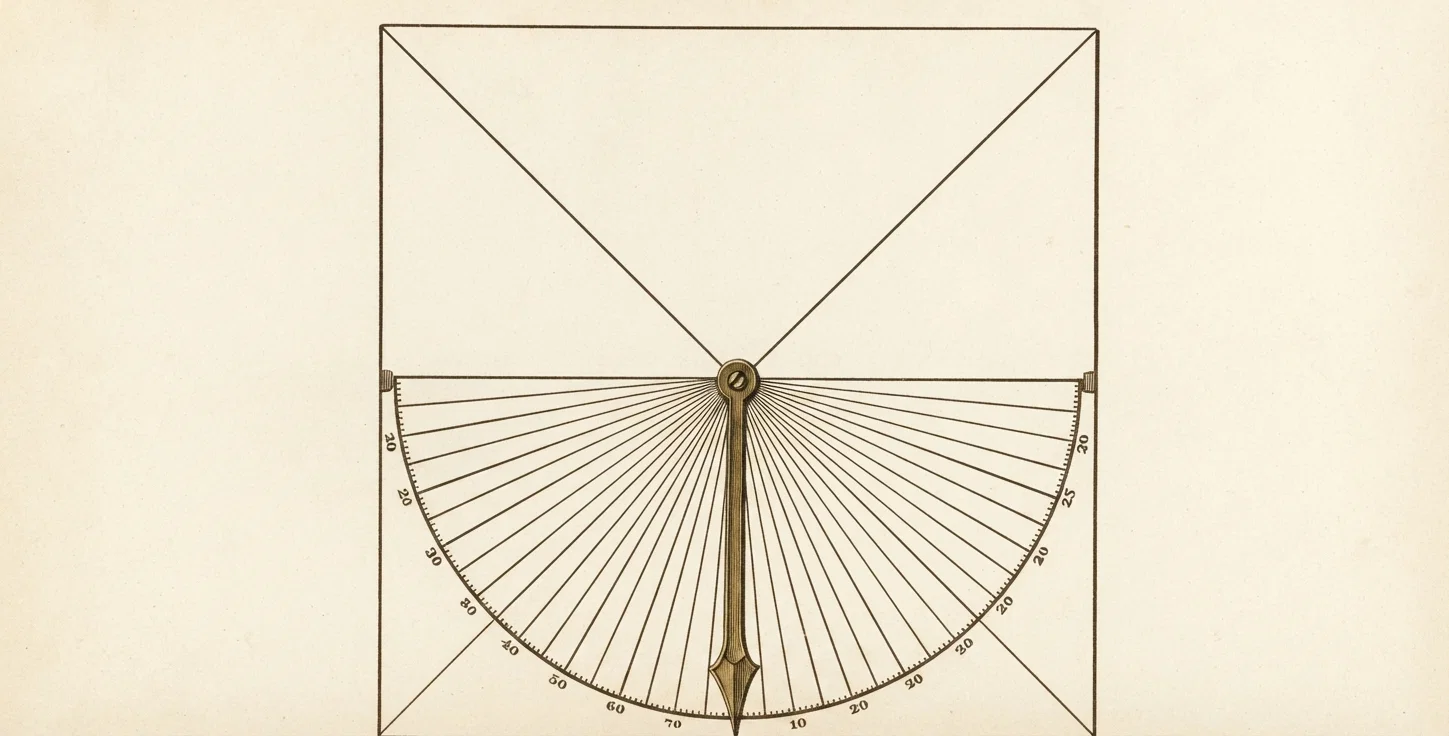
"The angle made by the sun's rays may be found thus: Take a stiff piece of cardboard six inches square, describe upon it a semicircle, and if a protractor be at hand lay off the semicircumference in degrees. Tack or paste this to a piece of wood of same size as the cardboard and one-half inch thick; along the edge of this, which is opposite to the diameter of the semicircle and parallel with it, tack a straight strip of wood half an inch square and one foot long. Cut from a piece of tin or thin brass a pointer three inches long, and swing it upon an axis or pivot fastened at the center of the circle. The pointer will always hang down when the dial is upright. To number the degrees on the dial, place it so that the stick which is fastened to the base will be horizontal, with the dial uppermost. The pointer will then be vertical, and zero degree may be marked at this point. As either end of the stick is raised, the pointer will still remain vertical, and indicate the number of degrees it is raised from the horizontal. To get the angle of the sun's rays, place one end of the stick at the extreme edge of the shadow, and allow the other to rest on the top of the upright which casts it. The pointer will give the number of degrees the sun is above the horizon.
"The most important conception for the children to get in this study is that of time, and a conception of space is next. When necessary, daily practise should be given the children in telling the exact time of day by clock or watch, until they can do so without hesitation. Of course, merely telling the time of day will not in itself give a conception of time, and such exercises as will enable them to grasp brief periods must be given in connection with it. As for example, let them find out how long it takes them to walk home; or, the length of the recitation period, or of the morning and afternoon sessions of school, the recess and noon periods, etc., and they will soon fix in their minds a stock of time units which will be of great service.
I wish again to call attention to the suggestions which I have previously made regarding the use of records. If the child is old enough to write, they will be found very valuable in connection with this study; and not only so, but the habit which every earnest student has of making notes of his observations is thus established.
So. Lancaster, Mass. FREDERICK GRIGGS.
NOT MRS. NATION, BUT—
"I AM not Mrs. Nation; I have no hatchet; I am not crazy." These words came from the lips of a Lewes woman, as she met her husband face to face in a hotel barroom the other evening, says the Lewes Pilot. They were directed to the bartender and the loungers, as the former handed the woman's husband a glass of whisky. She continued: "That man has not done a day's work this winter, and I am worn out trying to support him and the rest of the family. I want to know if something can not be done to keep him from destroying his own life and starving his family." The woman was thin and pale. Her lips quivered as she spoke. Her frail body could hardly stand the strain of the unfamiliar environment. As she finished, the little girl by her side burst into tears. The bartender took back the whisky. The abashed husband stood with bowed head. One by one the loungers left the room. Presently the bartender, gazing at the poor woman, solemnly vowed that the man should not drink at his bar again. It was a pathetic scene; it was the last resort of a desperate woman.
Thousands upon thousands to-day are putting the same11kind of a plea into the mouths of the families which every instinct of manhood demands that they support, and the plea falls upon deaf ears and unfeeling hearts, because men have permitted themselves to be bound hand and foot and sold to the greatest and most unfeeling slave-driver in the world—Drink. It is the worst slavery, too; for it buys the manhood as well as the man, and compels the victim, while serving it, to live on the earnings—nay, the very life-blood—of those he had sworn to support.
THE PATH THROUGH THE SEA.
By Meta E. B. Thorne
[Meta E. B. Thorne, in Christian Advocate.]
THEY journeyed on through the wilderness
With the mountains on either side;
Behind them the foeman was pressing sore,
Before lay the turbulent tide.
Then they cried to the Lord in their stress and fear
In that great and terrible day;
And lo, they were saved, and their foes o'erthrown,
For the Lord, He opened the way.
O, many and many's the time I, too,
As I traveled earth's deserts o'er,
Have entered the path that is mountain-walled,
With the raging seas before;
But I cried to the Lord in my fear and stress,
In my dark and sorrowful day,
And He came Himself to my soul's relief,
And quick He opened the way.
O soul, hast thou come to the narrow path
Shut in by the mountain steeps,
With the wild sea tossing across thy way,
While the foe behind thee creeps?
And O, is thy inmost soul dismayed
In this fearful, terrible day?
Cry unto thy God with all thy heart,
And He will open the way.
We all must come to th' brink of the sea,
With the mountains on either hand;
We all are led on some strange, dark path
That we do not understand.
But O, 'tis so sweet on our pilgrimage
In confident love to say,
"I will cry unto God and trust in Him,
And He will open the way."
"ALAS! MY POOR BROTHER."
By G. W. Reaser
A SUGGESTIVE advertisement, frequently displayed in sightly places, is a picture of a rough, muscular-looking ox. The huge bovine has, apparently, a kindly disposition, but a perplexed look upon his countenance, as he gazes intently at a bottle of "beef extract." He is represented as saying, "Alas! my poor brother." Doubtless the thought intended to be conveyed by the advertiser, is the great strength of the preparation contained in the bottle. The same picture will frequently suggest widely diverging ideas to different individuals. The pathetic picture impressed the writer with this thought: How can presumably humane men and women sit down and deliberately devour the body of the "poor brother" of the kindly ox, which so patiently and faithfully bears the yoke and draws the plow or the wagon for his master, till his days of usefulness are past?
Question: Shall we destroy the lives of God's creatures to sustain our lives, when we can get more healthful and nourishing diet directly from the fruits, grains, and nuts, which, by divine instruction, constituted the original food of the human family?