JULY 26 we again turned our faces toward the Far East. Five years have we awaited the slow process of physical repair, and now, assured by our examining physician that we are physically able to return, our hearts are indeed glad.
We had arranged to stop over between boats in Honolulu to visit relatives for a period of three weeks, but it was not without a feeling of regret that we said good-by to Elders T. H. Okohira and C. L. Butterfield, with whom we had traveled thus far; however, the pleasure of meeting our relatives and the brethren here has amply repaid us. We were not a little surprised to see here Brother Bartholomew and family, whom we had so favorably known in the city of Washington. They are doing a good work at the treatment-rooms, which they have established, in reaching the higher classes here. We also found Miss Young, whom we knew in Kobe, Japan, doing a like work.
The first Wednesday evening here, I attended the church prayer-meeting in the city and found an earnest little company of believers seeking God for his blessing, that others may be led to accept the special message for this time. Present truth has long been known here, but our work has not progressed as in other fields. One reason is that the worker has so many nationalities with which to deal. It matters not what language is used in the public service, there are always those to whom the message is veiled by a strange tongue. At this prayer-meeting we had three distinct races and five nationalities represented. However, in the social service which followed the study of the Word, all bore testimony to the goodness of God and expressed their appreciation for a knowledge of present truth.
Having met with this church on two Sabbaths, I will give you the program of one, that you may know how the Sabbath is observed in the mid-Pacific:—
At half past nine in the morning, teachers’ meeting was held for the various departments of the Sabbath-school. At eleven o’clock I spoke to the church. In the congregation could be seen natives, Americans, Englishmen, Portuguese, Russians, Chinese, and Koreans,—seven nationalities in all,—and all equally anxious to hear the word of truth. It seemed like a return to Pentecost, when all heard the message with gladness of heart.
I was especially glad to meet our Russian brother who lived fourteen years in Manchuria, and received the truth through reading literature sent him by one of his Sabbath-keeping friends in Riga. Although he does not understand one word of the service, save when his little son interprets, still he is faithful in attendance at all our meetings, and also brings others of his countrymen to hear, who are benefited only by reading the texts used in the service, which are found for them by our brother’s son.
Not a few of the congregation are Chinese, the result of Brother Ching’s earnest work in behalf of his countrymen. Brother Ching is a dentist who accepted the third angel’s message about six years ago under Elder Williams’s labors. Brother Ching’s first work was to lead his wife to Christ, and since that time, they have unitedly labored with success to bring their relatives to an intelligent knowledge of the truth.
At three o’clock in the afternoon, Brother and Sister McKeague, who are at present in charge of the work here, took us to the Territorial Penitentiary, where services have been conducted for the prisoners every Sabbath afternoon for eight years. We met under the spreading branches of a beautifully blooming tree. A native male quartet composed of prisoners furnished acceptable music, after which earnest words of admonition were spoken in the English and native tongues. Nor have these services been without good results. At least one native has heard and accepted the message here. He was a member of the legislature, and was arrested on a political charge. Hearing the truth in prison, he readily accepted it, and has been a faithful member ever since. Being possessed of more than average abilities, he has been a great help to the church here.
At five o’clock in the evening, we again assembled in the church building for the Missionary Volunteer meeting. About thirty were present, and nearly all had some work to report. It was gratifying to hear their responses to the roll-call. Without hesitation, each one arose, repeated a Morning Watch text, and then told of the work God had helped him to perform. It appealed to me that many of our home societies would be edified by attending one of the meetings of this little band.
While assisting in the services at the Adventist church, it has also been my privilege to preach in the local Congregational church. It was the first time many of the congregation had heard a sermon by an Adventist, and I prayed God that the impressions made might tell on the side of right and lead some to an investigation of the message which has made us a people. About twice the usual number were in attendance at the service and gave close attention to the word spoken.
Last Sabbath was a good day for the little church. In addition to the regular forenoon and afternoon services, at which I spoke, it was my privilege to bury one believer by baptism. The candidate, an English woman, is a governess in the home of the English consul at this place, who chanced to travel on the same steamship with Miss Scharffenberg, of Korea. Against Miss Scharffenberg she had been warned by some missionaries on board the same vessel, they claiming that Miss Scharffenberg seemed to be a putter forth of a strange doctrine. This aroused the curiosity of the governess, and she demanded of Miss Scharffenberg a reason for her faith, with the result already stated. Thus are the precious ones of earth being garnered for the kingdom. A word in faithfulness spoken may decide the destiny of some honest soul.
Three weeks have passed, and the “Shinyo Maru” nears port with fourteen recruits for China. We shall join them here, and together, for Prince Immanuel, invade the land of Sinim. As we go, we ask an interest in your prayers that God’s Spirit may go before us and his angels surround us.
MRS. G. F. JONES
By Mrs. G. F. Jones; George Keough
Our Mohammedan Sisters—No. 4
MRS. G. F. JONES
Although something has already been attempted for the Mohammedan women by woman missionaries, naturally there are many difficulties to surmount. One of these missionaries say: “While polygamy and divorce exist and there is no standard of purity equally applicable to both sexes, more freedom than woman now possesses cannot with safety be granted her. I fail to see any remedy but in the doctrine and practise of Christianity. The fact known to be true of a school in Syria, points out the solution of the problem. Of the pupils of a Protestant school conducted there for many years and largely attended by Moslem girls, it is stated that a case has never been known where a pupil who had passed through their hands had been divorced, or obliged to accept a second wife into her home. These women have learned lessons of duty, of personal responsibility to God, of self-respect, self-control, kindness, and love, which cause the hearts of their husbands safely to trust in them.”
Another says she believes from experience that there is little doubt that a medical missionary can find access to their homes, and get nearest to them. A missionary in south India, where work has been extensively carried on for Moslem women, says that there divorce is rare, and it is seldom that a woman is married in succession to half a dozen husbands. Another says: “In a recent tour I was a welcome guest in several Turkish homes, and warm approval was13expressed by the women of their Protestant neighbors. Only one failing was regretted, they ate pork. But still they begged me to come again and read to them from our Great Teacher’s Book.”
Speaking of unclean foods, which is a very strong point with them, I might mention here my husband’s experience with Mohammedans while traveling in Sumatra. At first they did not care to have much to do with him, but no sooner did they discover that he did not eat swine’s flesh than all prejudice was at once removed. Their interest was aroused, and they would follow him and listen to whatever he had to tell them, and when any others met them on the way, they were informed that “this Christian is not unclean like other Christians.” Since that time some of these men have become Christians.
To illustrate their feeling toward Christians in general: A woman medical worker could gain access to a patient only by entering through the stable door, as the main entrance was “too near a so-called saint’s place.” In another instance she was asked to treat a very sick person in the open street, “to avoid standing on their holy ground and defiling the spot.”
Speaking from my own experience in working for Mohammedan women, I can say that when they are converted, they are not a whit behind their white and more fortunate sisters. In Singapore, a Mohammedan servant, whose mistress was having Bible studies, would sit on the stairs to listen and pick up the crumbs of the gospel, as it were. On learning of this, I at once began giving her studies, adapting them to her case. A more receptive, appreciative, and joyful reader I never had, and her mistress told me that every day she would count the days till the meni would come to teach her the gospel story. At times she would laugh aloud for joy, and say, “O, how good it is!” Another woman whom my husband recently baptized in Java, had been divorced from several husbands, like the majority of these women, and was living with one who was not her husband, like the woman of Samaria, and, like her, became converted. The man also became an earnest Christian, and they were both most anxious to be baptized after being married. However, this latter was by no means an easy matter, for it was found on investigation that their former lives were so involved and complicated with other marriages and divorces, that it took much time and patience, with many prayers, to unravel the difficulties, so as to have a legal marriage in the eyes of God and man. At times it looked like an utter impossibility; but finally, with the help of the Lord, it was done, and they were able to be baptized, to their great joy. The woman was brimful of love to her Saviour for what he had done for her, and never failed to give a heartfelt testimony whenever opportunity offered. A more devout, humble, and joyful Christian it has never been my privilege to meet.
But there must be scores, even hundreds, of others among all the millions of these benighted, downtrodden souls who are longing for light and liberty, if only we would go and tell them. What opportunities! What a wide field to be entered by our humble, Spirit-filled sisters who have the love of God shed abroad in their own hearts, to go as teachers, medical missionaries, Bible workers! And who can gain the confidence of these women better than Seventh-day Adventists, who have not the great obstacle of unclean food to surmount, as other Christians have.
“Who then is willing to consecrate his [her] service this day unto the Lord,” and say, “Here am I; send me”?
Egypt
GEORGE KEOUGH
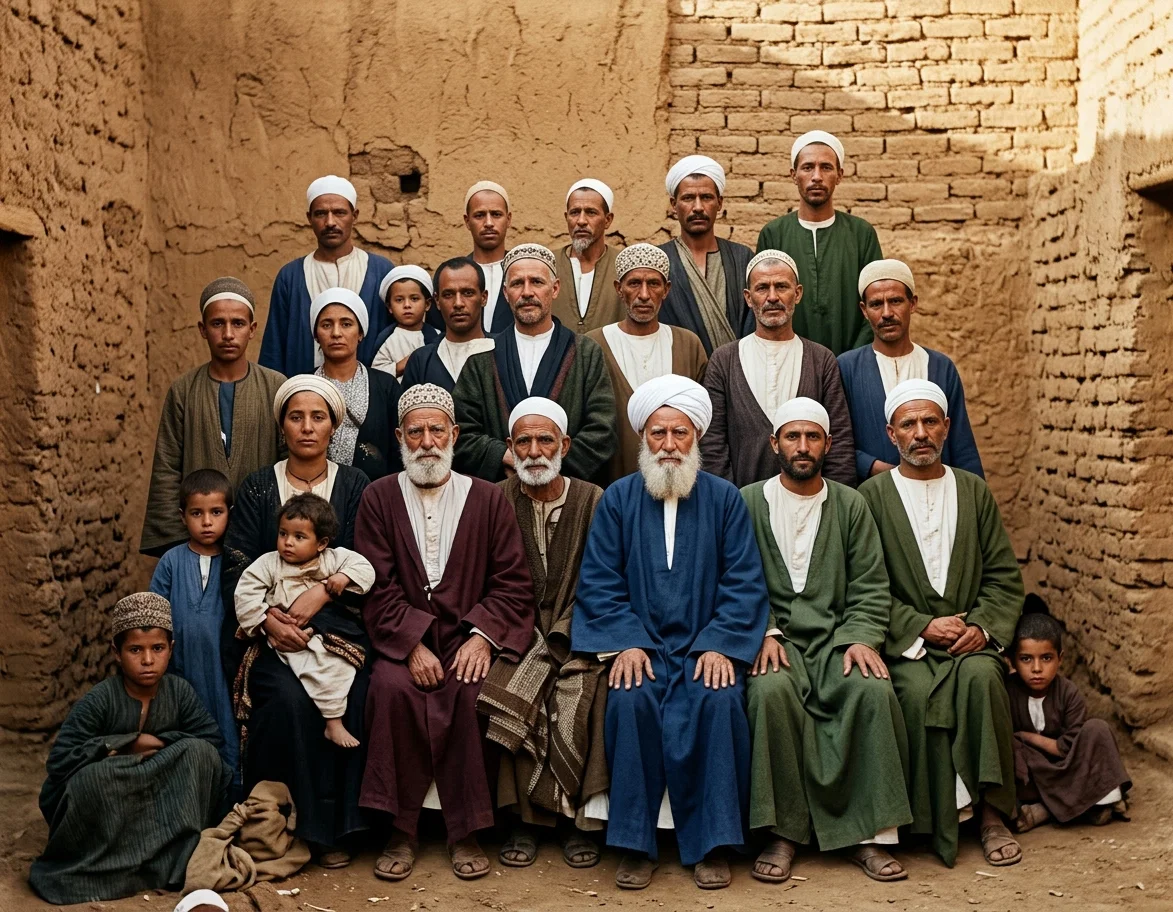
COMPANY OF BELIEVERS BAPTIZED AT BENI ADDI, EGYPT
BENI ADDI is situated on the west side of the Nile valley, at the foot of the hills that separate the green fields from the Libyan desert. The town is built almost entirely of sun-dried bricks, and, plastered with mud mixed with finely chopped straw. Very few of the houses are whitened, either inside or out. There is, I believe, not a pane of glass in the whole town, and the houses generally are only partly roofed over. However, surrounded as it is by palm-trees, and having the sandy hills for a background, it is a pleasant sight to travelers. Caravans sometimes gather here, for there is a path between the hills leading to the Inner Oasis.
The inhabitants number over eighteen thousand, and are chiefly peasants, weavers, and traders; and, being some six miles from the railway, they are not so civilized as in the towns on the railway. Of the eighteen thousand inhabitants, three fourths are Moslems and one fourth Christians. There are three Coptic churches and two Presbyterian places of worship.
The people live very simply. Bread is the staff of life in the fullest sense. They eat bread which is made of a native corn, called dura, at every meal, dipping it in something to give it relish. Two eggs cooked with a little butter, with plenty of bread, make dinner enough for four persons. One does not realize how much the use of knives, forks, and spoons adds to the cost of living until he sees how cheaply these people live.
To this town we were invited by letter in June of last year. One man had been keeping the Sabbath, in a way, for over five years. He preached everywhere and was a source of great trouble to the religious powers that be. He had convinced another, and they two thought they were the only Sabbath-keepers in Egypt, when they accidentally heard of us. The same day they heard of us they wrote inviting us to visit them. We went, and feeling that the Lord had opened a door before us, decided to come here to work. Accordingly, last November we came and took up residence among the people of Beni Addi.
The Lord has been with us, and on May 3 we were able to baptize twenty-four persons who had decided to obey their Lord in all things. There were many difficulties to be overcome, and much opposition to contend with, but thanks be to God who gives us the victory through Christ Jesus. The accompanying illustration shows those who have taken their stand for the Master. Two others have begun to keep the commandments since the baptism. We are sure that the readers of the REVIEW have been praying for the work in Egypt, and will be glad to hear that the Lord has answered so fully. Continue to pray, for the Lord has great things in store for us.
Into the Harvest
By Joel C. Rogers
JOEL C. ROGERS
AFTER furlough the worker who has experienced his call into the harvest-fields abroad, welcomes the time of his return. The winter has found little to attract his attention from his chosen work while sojourning in America. He has learned “to love his country and people none the less, but his work for souls the more.” He has appreciated and been thankful for the kindly greetings and hospitality of many friends and brethren. He is grateful for the liberal provision made by the General Conference for his rest. And now he is most happy to be off again to greet his waiting native friends and brethren. He feels sure of a warm welcome back among them.
We found comfortable accommodation on the “Oceanic,” leaving New York June 28. By this boat we were able to connect with the East African mail-boat at Southampton, transferring all baggage without the expense of crossing England. Then we could have a week14in London while the steamer made the passage around the Mediterranean to Naples, where we embarked July 19. The trip overland to Naples from London occupies only two days direct.
In London we were able to secure a few supplies not found in Central Africa, such as a nice little tent, 8 x 8 feet, for traveling. Two natives can easily carry it, including poles and a water-proof canvas floor-cloth. It can be set up in a few minutes, and easily made mosquito-proof. Its cost was $32. We purchased also a small camp cooking outfit, camp-chairs, a supply of simple medicine, lead- and slate-pencils for native school, linoleum for blackboards, and little items of personal supplies. All these were packed in a large hamper and put on the steamer, which called at London July 9. After all business was finished, we had the Sabbath for rest, attending the North London church service. On Sunday Brother Bacon was on hand as usual at Victoria Station. This is the third time he has seen us off to Africa, the first time being almost twenty years ago. We very much appreciated his attention to our business affairs in London.
While crossing to Naples, our time did not permit us to visit any of our people, but we enjoyed seeing Elder Tieche and his son at the customs house on the border of Italy. We were hoping to have the pleasure of his company to Genoa, but train arrangements prevented even this.
To break our long journey and save expense, we stopped for a night each in Lyons and Marseilles. One is obliged to pay first-class fare to get a chance to sleep on these trains, which would be about double ordinary fare. In Rome we had only four hours, but in Naples nearly two days, our boat being a half-day late. We availed ourselves of this opportunity to see the ruins of Pompeii, and I to ascend to the Vesuvius crater. It is an awe-inspiring scene to stand on the hot, steaming lava at the brink of that mighty hole in the top of the mountain, large enough to make a lake that could float several big ships; to see steam and smoke issuing from the small crater which fills the greater crater, the steam and smoke rolling from side to side and forming a cloud over its top; then to push off a ledge of crumbling lava, and listen as it rolls down, down, a thousand feet into space, with echoing sounds! My heart was lifted in prayer for God's lingering mercy to spare the people of Italy until they hear the message that is able to save them from the coming destruction of all the world.
We are now in the Red Sea, midway from Suez to Aden. We are both in good health and looking forward anxiously to the day of our arrival at our destination, still six weeks or more ahead of us. A missionary of the London Missionary Society, located near Lake Tanganyika, where we intend going, tells us that sugar, flour, and oatmeal each costs thirty-two cents a pound at the nearest store. So they get all their supplies from London, which comes out one fourth less!
Where Shall We Glean?
By M. E. Yergin
M. E. YERGIN
BROAD are the fields of God,
Swinging heavy with tares and wheat.
Yellow to harvest the wheat-heads sway.
Workers with God, earth's autumn day
Are we faring forth in the field's broad way
Where the large wheat grows?
Narrow the roadside is.
How are the reapers disposing strength?
Out in the corners? the roadside strays?
Bending all effort and time of the days
Gleaning the scantness from these byways,
When the fields are full?
Shall we neglect a head?
Never! not one must be passed by.
When sinks earth's sun in the darkening west
And reapers for heaven go home to rest,
Pathways in valley, on mountain crest,
Will have been close gleaned.
Precious is God's stray wheat;
But shall fields that are full be passed?
Shall we neglect the strays or the field?—
Neither! In heaven, the gladsome yield
Will come from byway, will come from field,—
From a well-gleaned both.
Lost in Her Song
By J. S. Washburn
J. S. WASHBURN
’Twas a night in June in the year 1896. I stood in the topmost gallery of Royal Albert Hall, the finest concert-hall in England, and looked down upon the many thousands in the vast auditorium. What rare attraction had so filled the great hall that late-comers found only standing room?
Madame Adelina Patti, the most noted living singer and in some respects the most wonderful singer of modern times, was to sing that night. She has sung before all the royal families of Europe, and after nearly a half-century of public singing still draws the crowds as no other singer. What can be the secret of her marvelous success in her chosen life-work?
The singers are so far from me that I cannot without a glass distinguish Madame Patti from the other singers in her concert company. Now she sings difficult Italian music, and her voice is wonderfully flexible and bird-like, clear and marvelously penetrating. But this is not the secret. Listen! I hear the opening bars of “Home, Sweet Home;” the piano is faint, so far is it away, but a deathlike silence has fallen upon the vast throng. I fear I shall not hear singer; I strain my ears, intently listening. Ah, yes, I can hear, so slow and soft, like a spirit voice,—
“’Mid pleasures and palaces, though we
may roam,—
Be it ever so humble——”
The hall fades from sight, the brilliant lights vanish. I see no more the great fashionable crowd. I forget that I am listening to the greatest singer in the world. Only a dream whisper, silver clear, yet faint and sweet and far away: “Home, home, sweet, sweet home.” I am borne swiftly across the wide sea that has for years separated me from the land of my birth. The years of manhood vanish. I am a child again. I see once more the dear old home—the old brown farmhouse in Iowa. The old orchard is here. I am swinging careless and free with my dear little brother under the old oak-tree. I hear the sweet voices of my sisters; I see my father, so true and good; and O, I see my mother’s dear face, full of tenderest, sweetest love! She is singing, and her voice comes to me as an angel’s. Scarcely had I dared hope to see my home again. Yet now truly I see it all clear and bright,—the blessed innocence of childhood, the sweet, free country air; yes, I hear the sweet music of gentle breezes whispering through the trees and over the waving grain—the dreamy hum of nature. Ah! it is too sweet to last. Almost with a shock I awake. I hear the last echoes of the piano notes. The singer is retiring, and the crowd, awakening from the wondrous spell, is beginning to applaud.
The vision was mine, yet not mine alone. There are tears in the eyes of many whose faces were weary and hardened. They, too, have seen the dear old home, and lived over again the dear dead days of childhood; and to many has come the longing for the Heavenly Father’s home.
Truly Madame Patti is a great singer. Now I know the secret of her magic power. What is it?—She went out of sight and hearing, behind her great art, her subject. Though born and through the early days of childhood living in poverty, she had been brought before the great, yea, even the crowned heads of the world through her wondrous talent of song. Truly she has roamed “’mid pleasures and palaces,” yet tonight her true heart returns in memory to early days. Forgetful of the years of fame, the tender visions of her childhood’s home (“be it ever so humble”) bring tears to her own eyes—eyes that see not the great throng of the wealthy and noble before her. Her heart sings, she sees her15own childhood’s humble home. We therefore behold our own, and forget the singer and all else. Our heart hears not the singer, but the song; we see not Madame Patti, but home, dear, sweet home.
This is true art. This is inspiration. This is divine talent. Keep self out of sight. Let your glorious work, your calling, however humble, appear; be unconscious of self and of selfish desire to be seen, to be applauded, to grasp, to seize for self, and you will succeed. Die to self. Let God be seen in you. Live to love, for the good you may do, the blessing you may be, and you shall have a home, a “sweet” and everlasting home, in the Father’s house of many mansions.
FREDERICK M. ROSSITER, M. D
By Frederick M. Rossiter
The Gospel of Health—No. 1
FREDERICK M. ROSSITER, M. D
The gospel, Paul tells us in Rom. 1:16, is the power of God unto salvation. It represents all that is necessary to make the perfect man. The perfect man is one who has developed the three phases of his nature; namely, the spiritual, the mental, and the physical. In the study of the development of life we observe that the physical is the first that matures in man.
At twenty-five a man or woman has fully matured physically and should be in the prime of physical health and vigor. Not so, however, with the mental and spiritual powers. They have made only a beginning. It is not necessary that a man should be stronger physically at fifty than he is at twenty-five, but it is necessary that the health be preserved and guarded carefully in order to develop the mental and spiritual powers to the highest degree of efficiency not only at fifty but for later years of service. The world is only too full of men and women who stop growing mentally at twenty-five, and the spiritual life has hardly made a beginning. At fifty very few men and women can endure what they could at twenty-five, but at fifty a man or woman should be in the very prime for mental and spiritual endurance. Only too often, however, this is not the case, and for various reasons; it is principally due to sickness or loss of physical power.
Poor health and physical debility not only rob one of the active desire for mental and spiritual progress, but actually produce the obstacles making such progress laborious and difficult. From this it does not follow that the strongest men and women have the greatest minds and the deepest spirituality, but there must be a proper poise between the three.
If a person with a weak and sickly body has great mentality and spirituality, as we sometimes observe, what might he be if he had abounding health? It must be apparent to all that good health is the very foundation to a successful life, whatever the calling may be.
In 3 John 2 we read, “Beloved, I wish above all things that thou mayest prosper and be in health, even as thy soul prospereth.” Not only is our Heavenly Father concerned about our health and wishes us prosperity, but he has given us abundant light and knowledge so that we actually may have good health if we desire to have it.
Never in the history of the race have men had such knowledge pertaining to health and the prevention of disease as they have today. There is a reason for this. More is expected from this generation of Christians than of any preceding age or people. I do not believe that this is the only reason why there is so much light on the subject of health. The middle-aged portion of the race are dying off faster than ever before, and all chronic diseases are rapidly on the increase. The individual as a unit has less disease-resisting powers. Then, we are living in a world of compensations. A hundred years ago wheat stood up long enough after it was ripe so that men could cut it all with a cradle, now it falls to the ground so soon after being ripe that self-binders are necessary to save the crop. A few hundred years ago human beings were carried off by the millions because of insanitary conditions, and of those that survived these conditions, there were more persons out of every hundred that lived to an advanced age than at the present time.
In the days of Moses God gave to Israel definite knowledge concerning the laws of sanitation and the preservation of health, but in the closing days of the gospel message the light of truth shines much brighter. Light causes growth. Can we show progress commensurate with the light given? Vegetation will grow in prolonged darkness, but it is not a healthy growth. One reason why we have not made more progress in healthful living is because each one has tried to apply the principles to his neighbor instead of making an intelligent personal application of it.
Soul prosperity is an individual matter. There are outside means by which spiritual growth can be assisted, but after all it is the personal application of the Bible truths that gives the results. So health is an individual matter. All the Biblical and scientific knowledge in the world on the subject of health will not give us abounding health unless it is made personal and adopted into the life as a practical matter.
“As thy soul prospereth,” the apostle says. If the physical health of most people were no better than their soul prosperity, what a state this present generation would be in, and among professed Christians, too! But even the physical condition of the nations today is the cause of considerable alarm among scientists; yet in the church and in the world the physical health is better than the spiritual conditions. When the individual health of the soul and body is put on a higher plane, we shall witness a power and efficiency in the message that we have not yet seen.
When Israel was on the border of the promised land and ready to go over, we are told that there was not a sick nor feeble person among that great host. Through a period of forty years, under testing trials and adverse circumstances, they had learned obedience to the statutes and commandments of the Lord. These statutes covered the physical as well as the spiritual. With the giving of obedience was the promise that no sickness should come upon them. But you will notice from the record that most of this great host died prematurely because of sin. What a terrible mortality there must have been in the camps of Israel during that forty years in the “great and terrible wilderness,” and all because of sin. Sin affects the physical life and cuts short our usefulness, even though we repent of the sins.
Does the Lord expect less of the people in the last days who are being prepared for the promised land? These things were written for us, for our admonition and learning. As the gospel dispensation is greater than the former one, and as the latter rain will be more abundant than the Pentecostal showers, so the work of the closing message is greater than that of any former period. It has far more searching requirements and is more far-reaching in its final results. For these reasons the gospel of health and the practical application of the principles of right living have a very important bearing at the present time. Health is an asset of the message that we cannot afford to jeopardize with the liabilities of sickness and premature decay.
Men and women need physical vigor and vitality in order to cope with the tests of endurance to which the body is often subjected in carrying this message to a successful issue. This is true in temporal matters; it is more true in spiritual things.
The Lord’s declaration to Zerubbabel (Zech. 4: 6, 7) is equally his declaration to this people: “Then he [the angel] answered and spake unto me, saying, This is the word of the Lord unto Zerubbabel, saying, Not by might, nor by power, but by my Spirit, saith the Lord of hosts. Who art thou, O great mountain? before Zerubbabel thou shalt become a plain.” It is an easy matter for the Lord to make a plain out of the great mountains of difficulties? to make plains it is to let the Lord smooth out some of our mountains of difficulties? to make plains out of our mountains of worries and troubles, many of which never happened? If we should, we should have more energy and clearer minds to devote to successful missionary work. The success of the work depends upon the power and spirit of the Lord. We need to pray more. If we did this, we should save physical force and have more energy of body and mind with which to meet the issues, and we should have more joy and gladness in it all. If we prayed more, we should have fewer doubts, less worry and fear, and hence more physical and spiritual vitality. Luther said that to know how to pray well was the better half of work. We have been told that “prayer is the most holy exercise of the soul,” and anything that exercises the soul, the very highest of all the mental forces, imparts health and vigor to the body. This is a well-recognized law of psychology.
Kentucky Camp-Meeting
By S. E. WRIGHT
THE Kentucky camp-meeting and the sixth annual session of the Kentucky Conference were held at Nicholasville, Ky., August 14-24. This gathering was the largest of its kind ever held in this State. Some of the people came several days before the opening of the meeting and remained until its close. Much interest was manifested in every meeting held on the ground. All departments of the work made a good substantial growth during the last year. One feature which impressed the observer was the earnestness with which the people studied methods of work. The Louisville church is a good example of what is being done in many places in this field. The church, numbering about eighty members, has a standing order for one thousand magazines each month. In this way they are paying for their new church building and getting converts to the faith. The result of the circulation of this literature is seen in the many additions to the church.
The live workers in this conference brought into the meeting a spirit of work and enthusiasm that made it one of the best ever held in Kentucky. Plans were laid to develop other centers of influence like that of Louisville, and several volunteered their services.
This conference has a bright, intelligent, and enthusiastic class of young people fitting themselves for active service in this cause. Territory was assigned to eighteen colporteurs; nine of these were given colporteur's credentials. One hundred members were added to the conference during the past year; two churches were organized and admitted. The tithe increased $685.44 over the previous year. The Sabbath-school offerings increased $280.26. There has been an increase of $500 in the sale of books. The brethren were mindful of the great world-wide work, and voted to pay twenty cents a week per capita to support the constantly increasing army of workers throughout the world and to liquidate the debts of our institutions. More than $800 was given in cash and pledges for home and foreign missions.
Elders G. B. Thompson and W. W. Eastman gave some valuable instruction, which was much appreciated by all in attendance. Many were heard to say, “We have received some helpful ideas which we can put into practise when we get home, and we intend to do so.”
Elder B. W. Brown was reelected president of the conference. Very few changes were made in the other departments of the work. On the last day of the session nine were baptized. Elder Brown had been holding meetings in the city of Nicholasville previous to the camp-meeting and will continue them. The prospect for a church in this place is good. During the last Sunday-night meeting eighteen arose signifying their intention to keep the commandments of God. That same day one of the ministers in the city undertook to smooth over the Sabbath doctrine, and in this way created a great interest to hear the truth as it is given by Seventh-day Adventists.
By previous arrangement, Monday morning, August 25, while en route from Nicholasville to attend the Tennessee River Conference camp-meeting, the writer had the privilege of a consultation with Elder J. H. Lawrence in Louisville, Ky., regarding the Negro work. The day before the writer's visit at Louisville, Elder Lawrence baptized fourteen who united with the church in that city. The future of the work in Kentucky among both colored and white never looked brighter than it does at the present time. S. E. WRIGHT.