FRIDAY, July 24, the sultan of Turkey granted a constitution to the empire, and called for the election of a parliament. The constitution is of the sultan’s own framing. It consists of one hundred nineteen articles, embodying in the main the following principles: Perfect freedom and equality alike to all Ottoman subjects, whether Christian or Moslem; freedom of the press throughout the empire; the right of the peoples of any religion to worship peacefully without molestation from the authorities; immunity from imprisonment or confiscation of property without due process of law; abolishment of all modes of torturing criminals or political offenders; the right of any individual to enter complaint against any official of the empire; an equalizing of taxation throughout the empire, levied upon, and according to, property valuation; every man the absolute master of his own property; the protection of all educational institutions in the empire, of whatever religion; and Constantinople, the capital, to be placed on a level with, and to enjoy no privileges above, any other city of the empire. The constitution provides for a parliament consisting of one member to every fifty thousand voters. The only test of a candidate for parliament is that he be able to discourse in the Turkish language, the official language of the country.
And all in one day! Only one on the ground can at all realize what stepping out of oppression into liberty in one day means to the millions of Turkey. Freedom, liberty, and justice—words long forbidden to be used in the press—fill the pages of the Constantinople papers of all languages since Friday. Especially do the Armenians feel the lifting of the terrible load. Turkish despotism has been most absolute. Thousands have lain in prison who have never been guilty of any crime. Now all such are set free. Newspapers now write freely of internal and international affairs, even commenting upon the rights of the sultan himself. It is simply a moving by a single leap from absolute monarchy to liberal constitutional government.
The sultan signed the irade granting the foregoing just before going to Selamlik (attending the Friday prayers in the imperial mosque) last Friday. Sunday the palace and grounds were surrounded by great crowds of people for hours, cheering and shouting to see the monarch. At last the sultan appeared, addressed them briefly from the palace, and cried, “Peace! Justice! Rest!” The sublime porte was surrounded by fifty thousand people shouting to see the grand vizier (prime minister), who finally appeared, and took oath in the presence of foreign ambassadors, and before the mass of people, as to the integrity of the sultan’s proclamation.
These Constantinople demonstrations come reported to the writer, who is not at Constantinople during these days, but at Bactehedjik, an Armenian town of ten thousand population, where is situated the largest Seventh-day Adventist church in the Levant Union mission field. The demonstration reached a high mark here yesterday, when hundreds of citizens formed in procession, waving banners and Turkish flags, and singing old Armenian national airs, for years forbidden by the imperial government. Our own dear brethren, who with the rest of the Armenians have felt the burden of Turkish bondage, with tears in their eyes likened the day to the deliverance of Israel from Egypt. Throughout the country, Moslems and Christians are falling on each other’s necks and calling each other brother.
AN OLD FORTRESS AT MYTILENE POINT, OF WHICH ENGLISH WAR-SHIPS LAY IN 1877, DURING THE RUSSO-TURKISH WAR
This is what appears to-day. But what does it all mean to the student of prophecy? A striking parallel presents itself. Though this is more than has ever been granted before, it is not Turkey’s first attempt at constitutional government. A constitution was granted in 1876, and the first Turkish parliament in history assembled March 12, 1877. But that constitution and parliament were but the prologue to the Russian-Turkish war, which followed in the same year, ending in the treaty of San Stephano, March 3, 1878. San Stephano is just outside the walls of Constantinople, and marks the extent of the advance of the Russian forces at that time. But God’s hand was on the helm of the destiny of nations, and the four angels of the seventh chapter of Revelation held back the winds of strife. England, which had been bitter toward Russia since the Crimean war (1853-55), would not consent to the stipulations of the San Stephano treaty, which took practically all of Macedonia from the Turk. A council of the powers was held at Berlin, and there, largely through the efforts of England, in the person of Lord Beaconsfield, the Bulgarian kingdom was born, and Macedonia was “thrust again under the heel of the Turk.” From that day to this the “sick man of the East” has been the target of all Europe.
Now what do we have? Last summer was held the second great peace conference at The Hague. (Remember that the first peace conference was followed by the Russo-Japanese war). Then followed the various ententes between various European powers. But all the time these same great powers have been, and are still, vying with each other in building new ironclads, and it seems, as a German cartoonist illustrates it, that “John Bull, Uncle Sam, Japan, and Germany are all inflating their armaments with what breath they have. The question is, Who will first be out of breath?”
Since that conference, Persia has attempted constitutional government, with the result that the shah disbanded his parliament by bombarding with shells for several hours the building in which it was assembled. Europe has been looking upon the scene of Persian revolution without lifting a finger to stop it. The bloodshed and general chaos have not particularly aroused that peculiar type of political humanitarianism in Europe which similar conditions in Macedonia would arouse to fever heat. The king of England and the czar came to an understanding about Persia; England’s sphere of influence being the south of Persia, Russia’s the north, with a neutral zone in the center. But no solution of the Macedonian question has been reached.
During the last two years the Macedonian question has been taking on great proportions. Month after month we read of the terrible atrocities in Macedonia. No force that the sultan has been able to put into the field has been able to bring about peace. There have been constant encounters between Greek and Bulgarian bands. During all this there has arisen a new movement in Turkey, known as the Young Turk movement. The Young Turks have had to work more or less secretly, but they have become a vast army. Just before the proclamation which has prompted the writing of this article, the Young Turks began to number among their members large companies of the army in Macedonia. I can do no better here than to quote from the London Daily Times of July 21 a despatch from the special correspondent of the Neue Freie Presse at Monastir:—“The Young Turk movement dominates the whole of the third and part of the second army corps districts. Its center is in the vilayet of Monastir, where the Young Turk’s Committee, in places,25already assumed executive power. The ordinary authorities are powerless, and can undertake no serious action against the mutineers, because the corps of officers and the troops without exception show solidarity with each other. A deputation of officers yesterday handed to the consuls here a memorandum with the request that in their reports to the great powers they would support the just cause of the Young Turks. The agricultural population is almost entirely won over by emissaries of the movement. The Albanians grant free conduct to the emissaries, who induce the Mussulmans to swear fidelity upon the Koran. The Christians obey willy-nilly. The important question, How will the Macedonian bands behave? is still undecided; but it is probable that the Bulgars, who are best organized in the district, will join the movement openly, and that the Greeks and Kutzo-Vlachs will slowly follow suit. . . .
“The Young Turks’ Committee has successfully begun to collect taxes everywhere. The statement from Constantinople that the mutineers are remorsefully returning to their duty ignores the fact that many fugitives are returning because in the company of their comrades they no longer fear the authorities. A proof of this is the attempt upon the life of the General Osman Hidayet Pasha, who was reading out in the barracks a new telegram from the sultan, which began with threats of the severest punishment, and ended, as usual, with promises of favors and promotion. Before the general had read to the end, four revolver shots wounded him severely, but not mortally, in the head, the neck, and the arm. The man who fired left the barracks quietly and unmolested. Two warning shots were also fired yesterday at the assistants of the director of police.”
It is also reported that Osman Hidayet was shot in the presence of two thousand troops.
(To be concluded)
Riversdale (Jamaica) Training-School
By H. H. Cobban
I FEEL sure our brethren and sisters throughout the field will be glad to learn something about our training-school. Our first term of school, since moving to this property, opened the first week in March, and since that time earnest work has been going on. This term can be considered in one sense our first term since the establishment of the school; for the work previously done has been very much broken up, owing to unsettled conditions and our having to move from Willowdene to Riversdale.
Our school property consists of five hundred seven acres of land, and is located about one mile from the Riversdale railway station. Most of our land is wooded, but we have about eighty acres in pasture and about twenty in cultivation. Work is being constantly carried on in enlarging both pastures and cultivations. There is quite a good deal of logwood on the property, and we hope to realize something each year from this. We now have about fifty cattle, including some calves and young heifers. These are all doing well, and we hope to increase the number, as these will probably be our chief source of support for the school.
Our school is blessed with a good water-supply. Just across the road from our property is an unfailing spring. Near this we have a windmill, with a pump, which forces the water up to the main building nearly a third of a mile away. We feel very grateful for this blessing.
Since moving to Riversdale in September two new buildings have been erected,—a dwelling in which Professor Hughes and his family live, and a business office of two rooms, the larger one of which is now occupied by the writer and his wife. The first mentioned building is of wood, and contains six rooms, including bath-room and kitchen, and the business office is built of concrete. In addition to these two buildings the cottage formerly used by the head man has been somewhat enlarged, and is occupied by Brother and Sister E. C. Cushman and their little boy.
Our students have been very much crowded this year. The boys have been especially crowded, as our quarters were small, and not adapted to dormitory purposes. Each time we would learn that another boy was coming, we would at once ask the question, Where shall we put him? However, we look forward to better things. We expect to begin the erection of a new dormitory about the first of September. We plan to accommodate in this building thirty-five boys. There will also be two rooms for the preceptor and his wife, besides bath-rooms and closets, and an assembly room.
Gradually our school is adding to its equipment. Within the last month we have installed twenty-four double seats and desks. At the present time we have placed only nineteen of these in our chapel, but will put the others in as soon as some changes are made in our building. These desks were imported from America, and students as well as teachers are much pleased with them. Our Sabbath services are held in this room, and by putting in a few chairs we can easily seat fifty persons. We have just received a shipment of metal beds from England, and are now able to give each student a good single bed.
We are now nearing the end of this school term, and we are thankful to God for the watch-care he has had over our work since the term began. The health of the family, with one or two exceptions, has been good. Most of our students will remain during the coming vacation, working for credit to carry them through the next term. Thirty-five students have been enrolled during the term just closing, and six teachers have been engaged in the work.
H. H. COBBAN.
The Indiana Camp-Meeting
By K. C. Russell
This meeting was held at LaFayette, August 6-16, on a plot of ground in the vicinity of the Purdue University. There was a good attendance of our people on the first Sunday of the meeting, and a temperance rally was held, which proved to be a decided success. The speakers from the city of LaFayette who joined us in the rally were a Baptist minister, the secretary of the Y. M. C. A., and a leading professor in the Purdue University. There were a large number present, who frequently showed their approval when points were made by the speakers against the evils of intemperance. The attendance of the citizens from the city during the evening services was an evidence that the influence of the rally had an effect.
The preaching at the evening services was largely confined to doctrinal features, besides striking addresses on the world-wide mission field. The first Sabbath of the meeting was the occasion of the second Sabbath reading; and those in charge did not side-track this important exercise, but held it at the time of the regular forenoon preaching services.
A most enthusiastic meeting was held during the camp-meeting in the interests of the missionary campaign. Brother Jasper Wayne, of Iowa, was present, and related his experience in soliciting funds for mission work with other papers. Nearly all present voted to take hold of this work heartily with the special Mission number of the REVIEW; which is to be used in the work of soliciting funds for our missions during Thanksgiving week. There was also a hearty response to our appeal for all to adopt the ten-cent-a-week plan. Contributions and pledges were also taken for missions.
Special prominence was given at this meeting to the medical work and the Wabash Valley Sanitarium. Dr. D. H. Kress, superintendent of the Washington Sanitarium, and Elder H. R. Johnson, of Wisconsin, also gave some interesting and profitable talks upon health topics.26
During the meeting nearly the entire camp visited the Wabash Valley Sanitarium. All seemed to enjoy the occasion, and were pleased with the location of the sanitarium and the substantial and commodious building where the sick can be cared for, and the blessed third angel's message can be taught.
After looking over the building, the brethren and sisters gathered on the campus in front of the sanitarium, which gives a beautiful view of the Wabash River, and listened to appropriate addresses by Drs. Kress and Marsh.
Those in attendance at the camp-meeting outside of the regular laborers of the conference were Elders W. A. Spicer, Allen Moon, and C. P. Bollman; Profs. H. R. Salisbury and Frederick Griggs; and the writer.
The people manifested a lively interest in the religious liberty work, and pledged to put forth special efforts, between now and the opening of Congress in December, in circulating the petitions against the Johnston Sunday bill, etc.
There was at this meeting an earnest desire to seek the Lord in a special way whenever opportunity afforded, and we shall hope and pray that great good may result from it.
K. C. RUSSELL.
Mission Notes
Brother Ernesto Schwantes, who recently returned to Brazil from Portugal, states that June 6 he had the privilege of burying three dear souls with their Lord in baptism, and that four others will soon go forward in this ordinance.
In the report of the recent Southern California camp-meeting, held at Los Angeles, August 6-16, it is stated that thirty-three nationalities were represented, and out of all these different tongues were those present who bore the heavenly credentials of having been converted by the truths of the third angel's message. This is a powerful testimony as to what wonderful opportunities are presented in the United States for doing very acceptable “foreign missionary work” within the borders of the home land.
Winter Canvassing
By R. W. Parmele
IN some of our Northern States, it is difficult for the canvasser to prosecute his work successfully during the winter. Many such would find it profitable both to the cause of God and to themselves financially to spend the winter canvassing in “the sunny South.” To such the Florida Conference extends a hearty invitation.
To supply other lines of work it will be necessary for us to draft some six or seven from the ranks of our canvassers this fall. This makes us look with some concern on the future of our canvassing work. With our small constituency it is not an easy matter to secure recruits.
The winter is our best time for canvassing. The weather is delightful, and the return of the tourists livens up business, and puts thousands of dollars into circulation. We have an abundance of excellent territory, and would like to hear from any who are interested. See the announcement in another column of this paper concerning our canvassers’ institute to be held this fall. Those interested will please address our State agent, C. V. Achenback, Orlando, Fla., or the writer.
R. W. PARMELE.
The Oklahoma Camp-Meeting
By G. B. Thompson
THE annual conference and camp-meeting for Oklahoma was held in Enid, August 20-30. The camp was located in a park several miles from the city. The site was good in many ways. Having an excellent street-car service, the attendance from the city during many of the meetings was good, and many expressed themselves as deeply interested in the special truths of the message presented.
The attendance of our people was very good, about fourteen hundred being camped on the ground. New arrivals continued to come during the meeting, until every available tent and building was uncomfortably filled. A large number of our German brethren and sisters were present. There seemed to be the largest number of young people on the ground of any camp-meeting I have ever attended. There were almost as many at the German young people's meeting, as the English. Surely many workers should be developed from so large a number of consecrated youth. A German assistant was associated with Elder E. L. Neff to work for the young people during the year.
The reports showed a good degree of prosperity during the past year in the various lines of work. Seven new churches were voted into the conference at this meeting. A good spirit characterized the business deliberations. Elder Andrew Nelms was re-elected president of the conference, with but few changes in the other officers. Steps were taken to change the territorial lines of the conference to some extent, which, when carried into effect, will release some territory on the west which has formerly been a part of the conference, to the West Texas mission field, which will make it possible to organize that field into a conference at an early date.
A deep interest was taken in the growth and development of our work in the foreign field. The conference unanimously voted four thousand dollars of surplus tithe to the General Conference. The last day of the meeting a collection was taken for our foreign mission work and the Oakwood School, and about eighty-seven hundred dollars was received. Over one thousand dollars of this was cash; the rest was in pledges which will be paid as soon as possible. Such a liberal donation was a source of much encouragement to all. But the time has come when large donations must be given by those who are entrusted by the Lord with a liberal amount of means. The growth of the message calls for a corresponding increase in giving.
The Sabbath-school donations were quite liberal, aggregating about four hundred sixty-two dollars for the two Sabbaths. In addition to the amount given to missions, considerable was given for various local interests such as the One Hundred Fifty Thousand Dollar Fund, the purchase of new tents, to endow a bed in the Wichita (Kan.) Sanitarium, etc.
The laborers from outside the conference who shared with the local workers the burdens of the meeting were Elders A. G. Daniells, C. Santee, C. J. Kunkel, G. F. Haffner, L. W. Terry, and W. W. Eastman, and Dr. F. Braucht, Professor Grauer, and the writer.
The visit of Elder Daniells was greatly appreciated, this being the first time he has been able to attend a camp-meeting in the State. His recital of the growth of the work in home and foreign fields from a very small and humble beginning to its present proportions, greatly stirred and cheered the hearts of all. He spoke the last Sabbath of the meeting on consecration, after which several hundred came forward to seek God for victory over sin, and a deeper consecration to the work. Several revival efforts were held during the meeting, and a number were converted. Eighty-seven were baptized.
A good corps of workers was sent out from the conference to labor. The last Sabbath of the meeting Brother Claud McDonald was ordained to the work of the gospel ministry.
We believe our brethren and sisters left this good meeting with renewed courage and determination, and with a broader view than ever before of the magnitude of the work committed to us. Our prayer is that great prosperity may attend the work in this conference the coming year. G. B. Thompson.
North Brazil Mission
By F. W. Spies
The last of a series of general meetings held in Brazil for 1908 was held at the Serro Pellado meeting-house in the province of Espirito Santo, June 13-17, and was fairly well attended, over one hundred being present at the services on the Sabbath day.
For some time past the spiritual progress of the above-named church, and also the onward march of the truth, had been hindered by the wrong course of some of its members. But at this meeting not only this church, but also all the churches and members in the province, took their stand squarely upon right principles, and a disfellowshipping of the unruly element was begun, which we hope will reveal to all that the Lord’s people in this field intend to stand by the truth, and be loyal to it.
To those whose hearts were open, we feel the meeting was a great blessing; and in general, plans were considered which look to a more thorough establishing of the work in this important field. One thing that greatly encouraged the brethren was that they had a worker in that field. As reported previously, the Rio Grande do Sul Conference, although a needy field, saw and felt the still greater need of the province of Espirito Santo, and so consented that the union conference might take one of their few laborers, and send him to Espirito Santo. Accordingly Brother José Lindermann and his family came to this field, and our prayer is that the Lord may greatly bless his labors both to the strengthening of the brethren in the respective churches, and also to the gathering into the truth of many more souls.
It makes us glad to see in our young conferences this spirit of sacrifice and readiness to help on the work in the sister fields, by sharing with them the limited supply of workers they have. Surely the Lord will bless his people as they thus sacrifice and send witnesses for27the truth into new and needy fields; and once the little lights are kindled in all parts, and the Lord’s people as a whole are ready, then the Lord can turn on the current,—pour out his Spirit,—and in a little while the light of truth will have illumined the whole earth. May the Lord’s people ever seek for that consecration that will fit them for the outpouring of the Spirit in its fulness.
F. W. SPIES.
Openings in South Carolina
By H. B. GALLION
At the present time South Carolina is offering exceptional opportunities to those engaged in the sale of our literature. Times are not so hard as in many other places. The cotton crop is good. The inauguration of new industries and the extension of old ones are the order of the day. The people are kind and hospitable. One scarcely ever has the door closed in one's face. There is a reaching out after our books by the people that surprises even old canvassers.
“Great Controversy” and “Daniel and the Revelation” are excellent sellers. Our smaller books are sold with but little effort. I have recently received a report from one of our canvassers showing forty-two hours’ work and over one hundred eighteen dollars in orders and sales as a result. Let me hear from you. My address is Anderson, S. C.
H. B. GALLION, State Agent.
The Montana Camp-Meeting
By R. D. QUINN
THIS camp-meeting was held at Victor, in the western part of the State, and was well attended by our own people, and also by the people of the village and surrounding country.
There were about one hundred sixty of our people encamped on the ground. Elders W. B. White and George E. Langdon were with us throughout the meeting, and their labors were much appreciated. Brother O. K. Buttler, representing the field missionary work of the North Pacific Union Conference, was also present, and rendered valuable assistance in this special line of work and also in the work for our young people.
Prof. M. E. Cady arrived on the last Friday, and remained till the close. His excellent talks and studies on Christian education resulted in a revival of interest in the education of the young people of this conference.
The leading feature of this meeting was the deep spiritual work that was carried on from the very opening until the close. The burden of the message borne was absolute surrender to God, deliverance from the bondage of Satan, complete and constant cleansing from sin, and the reception of the Holy Spirit by faith as the only power sufficient to complete the work of bearing the gospel message to all the world in this generation. The power and intensity of the meeting increased from day to day, as our people walked out in the light and separated from those things that had been hindering their Christian growth. The last Sabbath of the meeting was attended by a mighty outpouring of the latter rain. Fully half of those on the grounds came forward and surrendered anew to God. Many others for whom we had prayed gave themselves to God and his work for the first time. In the afternoon a baptismal service was held on the banks of the beautiful Bitter Root River, thirty-one candidates going forward in the ordinance. In all we had a profitable meeting, and our brethren returned to their homes full of joy and peace.
R. D. QUINN.
The Oakwood Manual-Training School, and the October Collection
By W. J. Blake
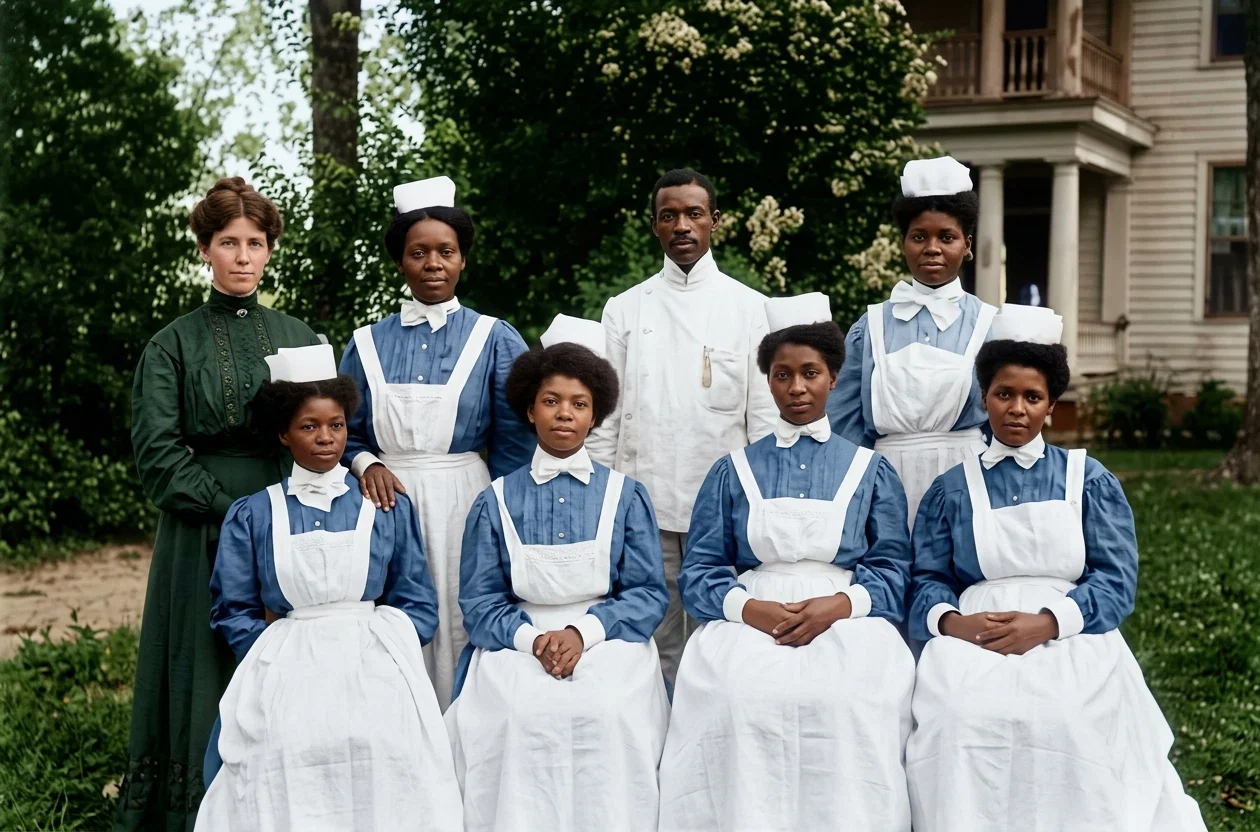
NURSES’ CLASS OF OAKWOOD MANUAL TRAINING-SCHOOL
As the date (October 3) for a general collection among our people for the colored work is rapidly approaching; and inasmuch as the Oakwood Manual Training-school is to be one of the beneficiaries of this donation, a few facts pertaining to this school may be interesting.
Our people are generally acquainted with the fact that we have only one training-school for the colored people in America, and that is located at Huntsville, Ala., on a farm of three hundred fifty-eight acres, well suited for the work. This school has a very broad field of usefulness before it, and one conversant with the conditions now existing in the South must conclude that its work must be done quickly.
Soon the white teachers now conducting the work of the school will be obliged to abandon the field because of race prejudice, and laws which will make their work impossible. The Testimonies inform us that such a time will come, and even now there are indications that such conditions will soon confront us. How important, then, in view of the present situation, that this training-school be thoroughly equipped to do a speedy work. We are counseled by the spirit of prophecy thus: “The Huntsville School must be finished, and students from that place fitted to take hold of the work of educating their own people.”
We are encouraged with the degree of success which has attended the school the past two years. Two new buildings have been erected; the literary work has been strengthened by the addition of new courses; a nurses’ training department has been added (see illustration for 1909 class); many other smaller improvements have been made; and, best of all, a number of intelligent, consecrated workers have gone from the school into the field. But even this progress seems very inadequate in view of the great work before us. Nearly nine million colored people in the South must hear of the soon coming Saviour, and only a beginning has been made in this great work.
One of the best ways to give the message to this people is to establish small schools in many places. These schools must be conducted by colored teachers, and thus a great demand for competent workers is at once created. We can at present scarcely find teachers suitably qualified to carry on the schools now in operation, and yet many more should be immediately opened.
Our eyes are turned toward our training-school for these workers. Then, clearly, if this school meets its demands in training these teachers, besides many more ministers, canvassers, and Bible workers, it must have the united support of our people.
The sanitarium, already begun, must be immediately finished; a new dining-room and kitchen should be erected; for, to meet the mind of the Lord, we must have accommodations for at least one hundred students; the water system should be perfected; and a substantial fund should be raised with which to pay the faithful teachers now giving their lives to this work.
Just now seems to be the opportune time to renew our diligence in this work, and to push it with greater determination than ever before. The Lord is holding in check many evil influences and wicked agencies. A mighty temperance wave is sweeping over the South. Questions of great import are now engaging the minds of Southern statesmen. ‘Now, just now, is our time to proclaim the third angel’s message to the millions living in the Southern States, who know not that the Saviour’s coming is near at hand.’
We can not afford to miss the golden opportunity now presented to us. May we not expect that the October collection will mark the beginning of a great revival in our Southern work? To this end we believe that our brethren and sisters will contribute liberally, that the work may go forward in God’s way.
W. J. BLAKE, Principal.
Field Notes
THERE will be five tent efforts carried forward in Indiana during the remaining portion of the tent season.
THERE will be five tent companies this fall in the West Michigan Conference. Meetings will be held at Eaton Rapids, Kalamazoo, Grand Rapids, Fremont, and Cedar Springs.28
THE Workers' Bulletin containing a report of the tent-meetings in Des Moines, Iowa, says that on August 15 three persons were baptized, and that others are expecting to be baptized soon.
SIX persons have begun to keep the Sabbath as a result of the tent-meetings at White Plains, N. Y. Two of these are young ladies of a deep Christian experience, who are desirous of preparing themselves for the work of the Lord.
SISTER FLORENCE M. ALLISON, reporting the work at Darlington, S. C., says: “On the last night of the meeting there were no less than three hundred fifty present; and from this number, twenty manifested their willingness to walk in all the light that had been presented to them.”
Alabama
By D. E. BLAKE
BIRMINGHAM.— We are glad to report that the work is steadily progressing in this part of the Lord's great harvest-field. Since our tent-meetings, three persons have taken their stand with us, and are now rejoicing in the blessed truth. With each of these it was a hard struggle to step out, as many obstacles confronted them.
We have just closed a series of tent-meetings in Gadsden, fifty-eight miles from this place. The effort for four weeks resulted in twelve persons accepting the truth, six of whom have already been baptized, and the remainder are now preparing for baptism at an early date. It was indeed encouraging to see the interest that was manifested by the white people, many coming in wagons from a distance to attend the meetings.
We believe that some of these will accept the truth, if they have not already done so. The company there is ready for organization; an effort is also being made to have a church building as soon as possible, one brother pledging fifty dollars toward buying a lot. Truly the harvest is ripe; honest hearts are ready and waiting for the blessed truth everywhere.
May we all awake to our great responsibility and glorious privilege to give this last message and thus hasten “His glorious appearing.”
D. E. BLAKE.