Your ShelfYour Projects

Review and Herald, Vol. 90, No. 45.

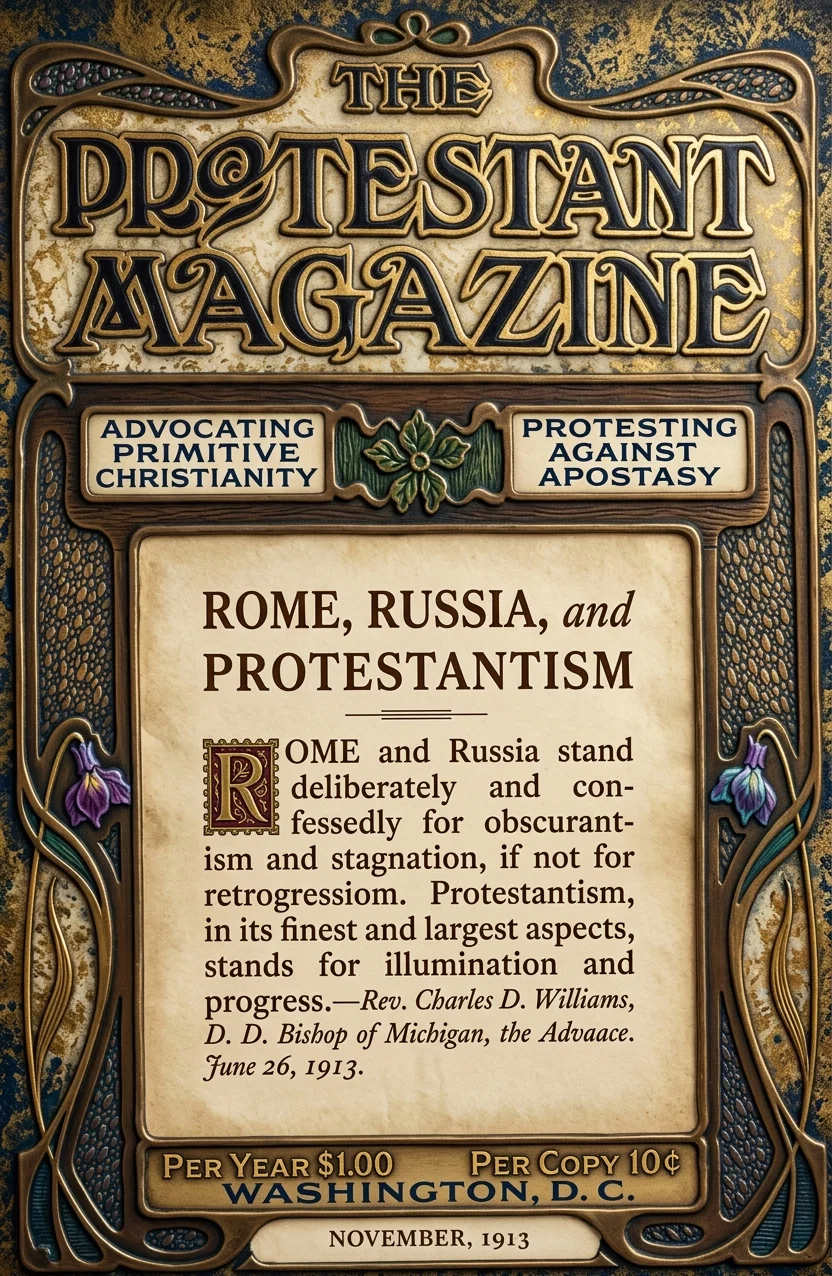
“Vaticanism Vs. America” and “Free Speech” Number

Review and Herald

Nov 6, 1913

Review and Herald Publishing Association · Takoma Park Station, Washington, D. C. · Nov 6, 1913

“Vaticanism Vs. America” and “Free Speech” Number

Three Striking Cartoons and a Double-page Picture of the “American Federation of Catholic Societies” Convention
DON’T MISS THE ARTICLES TELLING OF THE MOBBING OF JEREMIAH J. CROWLEY AND OTHER PROTESTANT LECTURERS, AND THE BOYCOTTING OF THE WASHINGTON “POST.”

PARTIAL NOVEMBER CONTENTS

Four-page Frontispiece — Nast Cartoons — “Uncle Sam’s Appeal to Rome,” “Vaticanism in Germany and the U. S.,” and Other Pictures.
Attitude of Roman Catholics Toward Freedom of Speech
Papal Boycott Against Washington “Post,” for Printing the Truth.
Archbishop Ireland Vs. the Popes (parallel quotations)
Bible to Be Understood by All
Papacy Foretold in Prophecy, No. 3 — Prof. Gaussen on Daniel 7
Vaticanism in Germany and the United States, No. 2 — Warning of Republican Congressional Committee.
Fourteen Other Articles and Items
LIBERAL TERMS TO AGENTS. Write for particulars. Send 10 cents in stamps for sample copy.
TO TEN FRIENDS. You can send $3.00 for 10 six months’ (or 5 yearly) subscriptions, in behalf of friends. Five or more copies, mailed by publishers to one or to five addresses, each, 5 cents.

ORDER THROUGH OUR NEAREST AGENCY

(If you do not know the address of our Agency, ask “Protestant Magazine,” Washington, D. C.)

RELIGIOUS LIBERTY POST-CARDS, ASSORTED COLORS

Principles of Religious Liberty Illustrated

Cartoons and illustrations are often studied when the principles represented by them would be overlooked if set in type. The cartoon in the daily paper first attracts the attention, and often makes a more lasting impression than the editorial or news item.
Cartoon post-cards are especially appropriate in these days of the post-card fad, and are carrying their message to many who might otherwise never receive it.
We print herewith the titles of these cards: — Turning to Cæsar Religious Legislation Darkens the World Religious Bondage Religious Despotism A Reign of Terror The Modern Church Sunday “Sabbath” Observance The Object of Sunday Legislation Territory of Religious Affairs Sapping the Foundations
Single set ........................$ .10 Five or more sets, each ............ .05

THE STRUGGLE FOR RELIGIOUS LIBERTY IN VIRGINIA

A Documentary Volume of Great Value

“The Struggle for Religious Liberty in Virginia” is a timely book containing much valuable information. It considers religious liberty as “the natural right of every soul to worship God according to the dictates of his own conscience. It does not make it a matter of indifference what a man believes or how he acts, but it places all on the same footing before God, the only Lord of the conscience, and makes us responsible to him alone for our faith and practise.” This kind of religious liberty is what our forefathers fought to preserve, yet their followers of the present generation, through lack of knowledge, are fast losing a proper conception of its sacredness.
This book traces the struggle for religious liberty through three periods: Before the Revolution; During the Revolution; After the Revolution. It cites the important part taken in this great movement by the leading characters of the times.
It is a thrilling work of a practical nature. 227 pages, plain cloth binding, $1.25, post-paid.
REVIEW AND HERALD PUBLISHING ASSOCIATION, Washington, D. C.
Order of Your Tract Society

“In the Spirit and Power of Elias”

MRS. E. G. WHITE
Through the long centuries that have passed since Elijah’s time, the record of his life-work has brought inspiration and courage to those who have been called to stand for the right in the midst of apostasy. And for us, “upon whom the ends of the world are come,” it has special significance. History is being repeated. The world today has its Ahabs and its Jezebels. The present age is one of idolatry as verily as was that in which Elijah lived. No outward shrines may be visible, there may be no image for the eye to rest upon, yet thousands are following after the gods of this world,—after riches, fame, pleasure, and the pleasing fables that permit man to follow the inclinations of the unregenerate heart. Multitudes have a wrong conception of God and of his attributes, and are as truly serving a false god as were the worshipers of Baal. Many, even of those who claim to be Christians, have allied themselves with influences that are unalterably opposed to God and his truth. Thus they are led to turn away from the divine and exalt the human.
The prevailing spirit of our time is one of infidelity and apostasy,—a spirit of avowed illumination because of a knowledge of truth, but in reality of the blindest presumption. Human theories are exalted, and placed where God and his law should be. Satan tempts men and women to disobey, with the promise that in disobedience they will find liberty and freedom that will make them as gods. There is seen a spirit of opposition to the plain word of God, of idolatrous exaltation of human wisdom above divine revelation. Men have allowed their minds to become so darkened and confused by conformity to worldly customs and worldly influences that they seem to have lost all power to discriminate between light and darkness, truth and error. So far have they departed from the right way that they hold the opinions of a few philosophers, so called, to be more trustworthy than the truths of the Bible. The entreaties and promises of God’s Word, its threatenings against disobedience and idolatry,—all are powerless to melt their hearts. A faith such as actuated Paul, Peter, and John, they regard as old-fashioned, mystical, and unworthy of the intelligence of modern thinkers.
In the beginning God gave his law to mankind as a means of attaining happiness and eternal life. Satan’s only hope of thwarting the purpose of God is to lead men and women to disobey this law; and his constant effort has been to misrepresent its teachings and belittle its importance. His master-stroke has been an attempt to change the law itself, so as to lead men to violate its precepts while professing to obey it.
One writer has likened the attempt to change the law of God to an ancient mischievous practise of turning in a wrong direction a sign-post erected at an important junction where two roads met. The perplexity and misery which this practise often caused were great.
A sign-post was erected by God for those journeying through this world. One arm of this sign-post pointed out willing obedience to the Creator as the road to felicity and life, while the other arm indicated disobedience as the path to misery and death. The way to happiness was as clearly defined as was the way to the city of refuge under the Jewish dispensation. But in an evil hour for our race, the great enemy of all good turned the sign-post round, so that ever since multitudes have mistaken the way.
Through Moses the Lord instructed the Israelites: “Verily my Sabbaths ye shall keep: for it is a sign between me and you throughout your generations; that ye may know that I am the Lord that doth sanctify you. Ye shall keep the Sabbath therefore; for it is holy unto you: every one that defileth it shall surely be put to death: for whosoever doeth any work therein, that soul shall be cut off from among his people. Six days may work be done; but in the seventh is the Sabbath of rest, holy to the Lord: whosoever doeth any work in the Sabbath day, he shall surely be put to death. Wherefore the children of Israel shall keep the Sabbath, to observe the Sabbath throughout their generations, for a perpetual covenant. It is a sign between me and the children of Israel forever: for in six days the Lord made heaven and earth, and on the seventh day he rested, and was refreshed.” Ex. 31:13-17.
In these words the Lord clearly defined obedience as the way to the city of God; but the man of sin has changed the sign-post, making it point in the wrong direction. He has set up a false sabbath, and has caused men and women to think that by resting on it they were obeying the command of the Creator.
God has declared that the seventh day is the Sabbath of the Lord. When “the heavens and the earth were finished, and all the host of them,” he exalted this day as a memorial of his creative work. Resting on the seventh day “from all his work which he had made,” “God blessed the seventh day, and sanctified it.”
At the time of the exodus from Egypt, the Sabbath institution was brought prominently before the people of God. While they were still in bondage, their taskmasters had attempted to force them to labor on the Sabbath by increasing the amount of work required each week. And again and again the conditions of labor had been made harder and more exacting. But the Israelites were delivered from bondage, and brought to a place where they might observe unmolested all the precepts of Jehovah. At Sinai the law was given, and a copy of it, on two tables of stone, “written with the finger of God,” was delivered to Moses. And through nearly forty years of wandering, the Israelites were constantly reminded of God’s appointed rest day, by the withholding of the manna every seventh day and the miraculous preservation of the double portion that fell on the preparation day.
Before entering the promised land, the Israelites were admonished by Moses to “keep the Sabbath day to sanctify it.” Deut. 5:12. The Lord designed that by a faithful observance of the Sabbathcommand, Israel should keep in mind their accountability to him as their Creator and their Redeemer. While they kept the Sabbath in the proper spirit, there could exist no idolatry. But should the claims of this precept be set aside as no longer binding, the Creator would be forgotten, and men would worship other gods.
“I gave them my Sabbaths,” God declared, “to be a sign between me and them, that they might know that I am the Lord that sanctify them.” But “they despised my judgments, and walked not in my statutes, but polluted my Sabbaths: for their heart went after their idols.” Eze. 20:12, 16. And in his appeal to them to return to him, he called their attention anew to the importance of keeping the Sabbath holy. “I am the Lord your God,” he said; “walk in my statutes, and keep my judgments, and do them; and hallow my Sabbaths; and they shall be a sign between me and you, that ye may know that I am the Lord your God.” Verses 19, 20.
In his terrible arraignment of Judah for her continual apostasy, the Lord declared, “Thou . . . hast profaned my Sabbaths.” The priests, he said, “have hid their eyes from my Sabbaths.” “Therefore have I poured out mine indignation upon them; I have consumed them with the fire of my wrath: their own way have I recompensed upon their heads.” Eze. 22:8, 26, 31.
At the restoration of Jerusalem, in the days of Nehemiah, Sabbath-breaking was met with the stern inquiry, “Did not your fathers thus, and did not our God bring all this evil upon us, and upon this city? yet ye bring more wrath upon Israel by profaning the Sabbath.” Neh. 13:18.
Christ during his ministry on this earth emphasized the binding claims of the Sabbath, in all his teaching showing reverence for the institution he himself had given. In the days of Christ, the Sabbath had become so perverted that its observance reflected the character of selfish and arbitrary men, rather than the character of God. Christ set aside the false teaching by which those who claimed to know God had misrepresented him. Although the rabbis followed him with merciless hostility, he did not even appear to conform to their requirements, but went straight forward keeping the Sabbath according to the law of God.
In unmistakable language he testified to his regard for this law. “Think not that I am come to destroy the law, or the prophets,” he said; “I am not come to destroy, but to fulfil. For verily I say unto you, Till heaven and earth pass, one jot or one tittle shall in no wise pass from the law, till all be fulfilled. Whosoever therefore shall break one of these least commandments, and shall teach men so, he shall be called the least in the kingdom of heaven: but whosoever shall do and teach them, the same shall be called great in the kingdom of heaven.” Matt. 5:17-19.
(To be concluded)

Proper Incentive in Giving

Gospel Finance—No. 15

Proper Incentive in Giving

E. K. SLADE
Our financial responsibilities in furnishing funds for forwarding the Lord’s work in the earth should be recognized as a privilege rather than a burden. The arrangement constitutes a part of the gospel plan. The practise of giving for the salvation of others is to serve as a means of grace or as an agency to accomplish a transformation in our own characters. It is therefore of great importance that we shall be moved by right motives in the part that we are to perform in the work committed to us.
“God so loved the world, that he gave.” His nature would not permit the withholding of any gift that would be necessary for man’s salvation. He “hath given unto us all things that pertain unto life and godliness.” 2 Peter 1:3. He has given us the opportunity to court and cultivate the divine love by acts of benevolence and by making sacrifices by giving for the salvation of lost men and women. The gift that will count most for our own good is that which is prompted by love and which calls for a sacrifice on our part. It is not a matter of sentiment, and we are not to wait to be moved by the stirring of our emotions; for this love is more than an emotion. It is a love that sees and responds to conditions of need. Such giving is not merely to perform a Christian duty or to conform to certain standards in the church, nor is it to make one’s own salvation more certain, but it is prompted by an incentive that is purer and nobler.
It is possible for us to be governed largely by selfishness in our gifts. Some may give liberally that they may be held in high esteem by their brethren. To give that we may have the approval of the church, or that our own salvation may be more certain, is coming short of our privileges and of God’s purpose in the plan. There is a vast difference between giving cheerfully and giving grudgingly. The cheerful giver is the one who enters into it not merely as a duty or a necessity, but who gives from principle as he sees the value of lost souls. The giver thus prompted is profited. The selfish giver is not being profited through the cultivation and acquirement of the love that leads God to give. No matter how great his gift, the experience does not rebuke covetousness and revive the spark of divine love as long as the incentive is wrong. “Though I bestow all my goods to feed the poor, and though I give my body to be burned, and have not charity, it profiteth me nothing.”
It is perfectly proper for us to labor for large results in raising funds for financing the work. It is commendable to manifest so great an interest in the church and conference quotas. Doubtless a much larger per cent of our earnings will be given to missions in the future. The purpose of this article is to emphasize the point made prominent in the text quoted above. Unless love for lost humanity prompts the gift, it is of no profit whatever to the giver. It is a love for the cause and a deep-seated desire to see God’s work prosper and speedily triumph that should cause our mission funds ever to increase, for the more we give the more fully will selfishness and covetousness be subdued, and the more completely shall we come into the spirit of benevolence. The transfer of our affections from temporal to eternal things will be accomplished more by this means than by any other if our gifts are properly incited.
At times gospel work has been cheapened and weakened by questionable methods of soliciting funds. It was my privilege to see a great money getter raise a sum of money at the dedication of a large popular church in one of our cities. He worked upon the emotions, the pride and the fun-loving propensities, of his congregation throughout the whole effort. Much of the time his hearers were convulsed with laughter from the many mirth-provoking stories of which he had a large supply. His effort was pronounced a success. The less we have of such methods in our work the better. How much better it is to hold up before the people the great and needy fields, the value God places upon a soul, and the glories of the triumphant finishing of the plan of salvation. This will beget incentives of the right character, and will lead to a permanency and a continuity in giving that will provide a larger and more lasting stream of funds.
“God designs that the exercise of benevolence shall be purely voluntary, not having recourse even to eloquent appeals to excite sympathy. ‘The Lord loveth a cheerful giver.’ He is not pleased to have his treasury replenished with forced supplies. . . . The plan of redemption was entirely voluntary on the part of our Redeemer, and it is the purpose of Christ that all our benevolence should be free-will offerings.”—“Testimonies for the Church,” Vol. III, page 413.
These words indicate that God purposes that our gifts shall be prompted by the same motive that led to providing the plan of redemption in the beginning.
Mount Vernon, Ohio.

A Short Sermon

Peace

H. A. ST. JOHN
“Great peace have they which love thy law: and nothing shall offend them.” Ps. 119:165. “Blessed are the peacemakers: for they shall be called the children of God.” Matt. 5:9.
In order to be peacemakers, we must know the peace of God for ourselves. Christ is the Prince of Peace. He was unquestionably the greatest peacemaker that ever moved among men. He is still occupied in the same glorious work of making peace, and giving peace, true peace, that peace which passeth knowledge. “Being justified by faith, we have peace with God through our Lord Jesus Christ.” Anything else called peace can hardly deserve the name.
There are those who cry, Peace, peace,when there is no peace. True peace to the soul follows repentance, pardon, and conversion. Such will have the carnal mind, which is not subject to the law of God, removed, and the spiritual mind, which delights in the law of God after the inner man, will be substituted. Then the soul will love God and love his law; and that love will be revealed in fulfilling his law, for love is the fulfilling of the law. To such will be given that great peace mentioned in our text. To the wicked there is no peace.
The kingdom of God is righteousness, peace, and joy in the Holy Ghost. Our peace will be like a river. As the river grows broader and deeper continually as it flows onward toward the sea, so the peace of the Christian grows broader and deeper as it flows onward to the great sea of Christ’s kingdom of glory; and it is said, “Of his kingdom and peace there shall be no end.”
Jesus said, “My peace I give unto you.” It is a peace that the world can neither give nor take away. In the world we may have and will have tribulation, but at the same time in Christ we may have sweet peace in our souls. But in the kingdom of glory to come it will be peace internal, external, and eternal.
Sanitarium, Cal.

DAVID PAULSON, M. D

The Relation of Health and Medical Evangelistic Work to the Closing Work of the Third Angel’s Message

DAVID PAULSON, M. D

The original gospel commission included healing as well as preaching. See Luke 10:9. After the early church had backslidden from this ideal, the Reformation of the sixteenth century brought about a partial restoration; but “before the coming of the great and dreadful day of the Lord” (Mal. 4:5), the spirit and power of Elijah is to return to the earth to “prepare a perfect people for the Lord.” Luke 1:17, Syriac translation.

Early Health Reformers

John Wesley not only proclaimed mightily the sixteenth-century Reformation truths, but he was also a health reformer and medical evangelist.
A generation later God raised up a Presbyterian clergyman, Sylvester Graham, and gave him a mighty reformatory message, and there was such a revival of health reform in this country as had never been witnessed before. The people everywhere were stirred to the very depths to abandon defiling habits.
In 1830 a company of consecrated New England Congregationalist families was led to Oberlin, Ohio, by Rev. Shipherd, who in answer to prayer and fasting, was shown the exact spot to found a notable missionary training-school in what was then the wilderness.
They established a manual training missionary school which stood stiffly not only for educational reform, but also dress reform, temperance reform, and the disuse of tobacco, tea, coffee, and flesh-meats.
God in a wonderful manner led students to this humble “school of the prophets” in the wilderness. He sent C. G. Finney, the greatest evangelist of that generation, who was himself a health reformer, to be president of the school. The attendance soon exceeded a thousand. Hundreds of students went out, Spirit-filled, zealous to propagate the gospel and reform; but the Congregational Church would not receive them. They refused to grant them license to preach. They met with prejudice and persecution on every hand.

A Universal Backsliding

On this point Dr. Jennings, who joined the movement in those early days, wrote: “For a while the community did run well, but it is not surprising that Oberlin should shrink back under the weight of opprobrium that the arch-deceiver succeeded in raising against her, and retire to a more secure and sheltered position. She had pushed her reformatory operations farther into the heart of the seducer’s kingdom than had ever been done before, and of course was assailed with fiercer and more malign opposition than had fallen to the lot of any other community. It was impracticable for Oberlin to remain where she first dropped anchor; she must either go forward or go backward.”
Sad to say, the devil soon succeeded in introducing a general backsliding on reforms, and then Oberlin College and her students became popular; and as Jennings said later, “She now enjoys the common repose of the churches generally. She soon lived down popular prejudice and obtained wide-spread pleasant congratulations for herself among the great ones of the earth, and has accomplished much inferior good.”
God evidently sent these reformatory truths to the Methodist, Presbyterian, and Congregational Churches to prepare them for the movement of 1844. Had they accepted those truths, they would have received more light; but when they repudiated them, then God raised up Joseph Bates, who proclaimed not only all the previous reformatory truths, including temperance and health reform, but also the long down-trodden Sabbath truth.

A “Called-Out” People

Light was given that this called-out people had a special mission to proclaim health and healing truths to the world. This was clearly stated in the following words: “To make plain natural law, and urge the obedience of it, is the work that accompanies the third angel’s message, to prepare a people for the coming of the Lord.”—“Testimonies for the Church,” Vol. III, page 161. See Luke 1:17.
The pioneers in this movement were reformers and healers. The first health book among them was not written by a doctor but by a minister,—Elder J. N. Loughborough. When any one in the community was sick, he generally called and for some Seventh-day Adventist to come and give him simple treatments. Finally God led out in the establishment of a central health institution.

Why Our Sanitariums Differ From Hospitals

The Methodist foreign missions represent genuine spiritual conquests, while their hospitals at home have no particular reputation in that line. The reason for this no doubt is that the Methodists received their mission idea from the Bible, but their hospital idea they borrowed from the world.
In a vision given Sister White in 1865, a year before the Health Institute was opened, she was shown “that the health reform was a great enterprise closely connected with the present truth, and that Seventh-day Adventists should have a home for the sick, where they could be treated for their diseases, and also learn how to take care of themselves so as to prevent sickness. See ‘Testimonies for the Church,’ Vol. I, page 553.”
It was further stated: “It should ever be kept prominent that the great object to be attained through this channel is not only health, but perfection and the spirit of holiness, which cannot be attained with diseased bodies and minds. This object cannot be secured by working merely from the worldling’s standpoint.”—Id., page 554.

Spiritual Service Rather Than Miracles

This thought was included in this original instruction: “Let no one obtain the idea that the institute is the place for them to come to be raised up by the prayer of faith. That is the place to find relief from disease by treatment and right habits of living, and to learn how to avoid sickness. But if there is one place under the heavens more than another where soothing, sympathizing prayer should be offered by men and women of devotion and faith, it is at such an institute. Those who treat the sick should move forward in their important work with strong reliance upon God for his blessing to attend the means which he has graciously provided, and to which he has in mercy called our attention as a people, such as pure air, cleanliness, healthful diet, proper periods of labor and repose, and the use of water.”—Id., page 561.
The “work cure” that is now attracting such remarkable attention in the world, and which we have not properly developed in our sanitarium work even at this late day, was a part of this original program. “I saw the beneficial influence of outdoor labor upon those of feeble vitality and depressed circulation. . . . Instead of amusements to keep these persons indoors, care should be taken to provide outdoor attractions.”—Id., page 562.
It was specified that connected with sanitarium work there should be a definite educational propaganda so that nature could continue the cure after the patient had left the institution. “The object of the health reform and the Health Institute is not, like a dose of‘Pain Killer’ or ‘Instant Relief,’ to quiet the pains of today. No, indeed! Its great object is to teach the people how to live so as to give nature a chance to remove and resist disease.”—*Id., page 643.

Transferring Responsibility From the Many to the Few

As a certain class of workers among us became experts in promulgating the health reform principles and the care of the sick, the great body of our people began to relinquish their personal responsibility in this respect, and those who became experts had constantly before them the temptation to become professional, and then commercial.
Christian healing is a sacred work, and not a business proposition. When we present these health truths from the popular instead of the spiritual standpoint, then it is far better for the cause and better for our own souls to leave the promulgation of health truths to worldly instructors.
We shall be tempted to unduly exalt certain health ideas which happen for the time to be tickling the popular fancy because they require no special self-denial while at the same time they ignore the more unpopular “weightier matters of the law.” The wine-cup is a thousand times more important consideration, both for here and hereafter, than the common drinking-cup. The securing of a physician’s health certificate before marriage is a commendatory measure, but it is not nearly so important as the ability to prepare wholesome food after marriage.
It is much easier to enlist people in a fly-swatting campaign than it is to enlist them in an anticigarette crusade, although the cigarette and tobacco evil is responsible for ten thousand times more sorrow, misery, sickness, and even death. We should spend our time and energy establishing those health reformatory truths that the devil is especially leading the people to trample underfoot, and at the same time we should not belittle these other minor truths.
It is preeminently our mission to propagate reformatory principles rather than health ideas, for we have been instructed “not to catch hold of isolated ideas, and make them a test, criticizing the others whose practise may not agree with your own opinion; but study the subject broadly and deeply.”—“Christian Temperance,” page 119.
“As we near the close of time, we must rise higher and still higher upon the question of health reform and Christian temperance, presenting it in a more positive and decided manner.”—“Testimonies for the Church,” Vol. VI, page 112.
We are not merely to talk temperance, but to secure pledges. “We should present to the people the principles of true temperance, and call for signers to the temperance pledge.” And the following instruction is given us regarding our duty toward other temperance workers: “In other churches there are Christians who are standing in defense of the principles of temperance. We should seek to come near to these workers, and make a way for them to stand shoulder to shoulder with us.”—Id., page 110.
“Wherever the truth is presented, the people are to be taught how to prepare food in a simple, yet appetizing way. They are to be shown that a nourishing diet can be provided without the use of flesh food.” “Cooking-schools should be established, and house-to-house instruction should be given in the art of cooking wholesome food.”—Id., Vol. IX, page 161.

Training Courses for the Laity

“There is a message regarding health reform to be borne in every church. . . . The Lord does not now work to bring many souls into the truth, because of the church-members who have never been converted, and those who were once converted but who have backslidden.”—Id., Vol. VI, pages 370, 371.
“Every church should be a training-school for Christian workers. Its members should be taught how to give Bible readings, how to conduct and teach Sabbath-school classes, how best to help the poor and to care for the sick, how to work for the unconverted. There should be schools of health, cooking-schools, and classes of various lines of Christian Help work. There should not only be teaching, but actual work under experienced instructors.”—“Ministry of Healing,” page 149.

Counterfeit Healing

We must be prepared to take advance ground, for the world is already permeated with the ordinary health ideas, and Christian Science is bringing to the people a counterfeit spiritual healing. Our workers must be prepared to meet this satanic delusion with divine truth and a ripe experience, ever remembering that “it is labor lost to teach people to look to God as a healer of their infirmities, unless they are taught also to lay aside unhealthful practises.”—Id., page 227. “He that turneth away his ear from hearing the law, even his prayer shall be abomination.” Prov. 28:9.
We must cooperate with God to prepare a perfect people to stand in the near future without a Mediator in the heavenly sanctuary. This will require the whole message.
Hinsdale, Ill.

G. B. THOMPSON

Singing

G. B. THOMPSON

A WRITER, speaking of the manner in which the psalms were sometimes sung, said, “They are so far from doing justice to David that methinks they revile him worse than Shimei.” Rather a severe criticism this on those who were professing to sing to the glory of God; but his soul was no doubt vexed within him listening to the singing and trying to ascertain which psalm they were supposed to be singing, but was utterly unable to do so.
David is not the only poet whose beautiful productions are destroyed in the hands of those who profess to express in song the product of their pens, the sentiment being wholly obscured because rendered in unrecognizable vernacular.
John A. Kern, in his work entitled “The Ministry to the Congregation,” says: “But solo singing, like choir singing, as we often hear it, not coming from one who is himself worshiping, is far from being helpful to the worshiper. There must be truth and feeling; and, I may be permitted to add, distinct enunciation. The sentiment of the hymn cannot be interpreted and communicated unless it is sung not only in the spirit, but also in recognizable English words. Gounod, the brilliant composer, has even taught that pure diction is the first law of song.”
“Distinct enunciation,” “recognizable English words,” “pure diction,”—this is the cry from the pews. Who has not heard sacred songs and solos sung, supposedly to the worship of God, when the keenest ear was unable to understand but few words at the most. Such singing is not worship; it is a performance. But the church is the place for worshipers, not performers. Some may be intellectually entertained by listening to tones, but no heart is touched and drawn to Christ. Such persons sing professionally rather than devotionally, that the beautiful tones they are able to produce may be admired, and the compass of the voice be a subject of favorable comment. Like the Pharisees who prayed that they might be seen of men, they have their reward.
Singing is worship. To have a mere performer, whose heart God has not touched, singing flippantly, is but little less incongruous than to hear such persons pray. Many songs are prayers. Think of singing for musical display, but without devotional fervor or a touch of truth and reality, such words as the following:—
“When I survey the wondrous cross On which the Prince of glory died, My richest gain I count but loss, And pour contempt on all my pride.”
“O wondrous cross where Jesus died, And for my sins was crucified! My longing eyes I turn to thee Thou blessed Lamb of Calvary!”
It is a great thing to be a gifted singer. Music is a tremendous power in the conversion of souls. Whose heart has not glowed with holy joy and formed anew vows of consecration to God as he has listened to the clear, well-enunciated words of a song sung by one whose heart went out in the words of the hymn, who sang to the heart as well as to the ear?
In behalf of a large number whose souls unfortunately are unable to revel in beautiful and enchanting tones, in behalf of the saintly worshipers who sit in the pews who would most reverently enter into the spirit of holy song if they could but know what is being sung, I plead for simplicity in singing, and that it be at all times in a language recognizable to the congregation.
Takoma Park, D. C.
Continue reading: Wrong Standards