If you sit down at set of sun,
And count the acts that you have done,
And counting, find
One self-denying act, one word
That eased the heart of him who heard,
One glance most kind
That fell like sunshine where it went,
Then you may count that hour well
spent.
But if, through all the livelong day,
You've cheered no heart by yea or nay;
If through it all
You've nothing done which you can trace
That brought the sunshine to one face;
No act most small
That helped some soul, and nothing cost,
Then count that day as worse than lost!
When we have done the best we can
To help uplift our fellow man,
To ease his load of care and sin,
Yet all in vain, we may begin
All human nature to deplore—
But not before!
— Katrina Trask.
The Bicycle and the Heart
DR. BEYER’S investigation of the influence of bicycling on the heart has convinced him that the bicycle has a specifically injurious action on that organ. The heart in the young is particularly subject to this deleterious influence on account of the unfavorable conditions of the blood pressure in youth. Hypertrophy of the heart and nervous heart disturbances are the typical bicycler’s affections.
It has been found in Germany that the number of cases of acute articular rheumatism among the recruits has materially diminished of late years, while the number of heart affections has tripled. In one army corps, out of two hundred and thirty-three recruits with various heart affections, forty-one had been bicyclers, as also nine of the eighteen patients with hypertrophy of the heart, and eight out of the thirty-seven patients with nervous irregularity in the heart action. In another corps the proportion was 37.5 per cent in two hundred and ninety-three cases of heart affections, with twenty-three out of the fifty-two cases of hypertrophy and nine out of the twenty-two of nervous irregularity. He found further that among these recruits those who had previously led a sedentary life formed the largest contingent of heart affections among bicyclers. On Sundays and holidays they took long bicycle trips, with overexertion of the heart. Next in number were the workmen who rode the bicycle to and from work. The exertion after the fatigue of the day’s work caused overexertion of the heart. The recruiting officers attribute the increase in heart disease among the young men to the lesser hardiness of youth in our day and to the epidemic of influenza. Beyer suggests that unwise or immoderate bicycle riding is a third and no less important factor.— N. Y. Christian Advocate.
British West Africa
By D. C. BABCOCK
D. C. BABCOCK
The colonies and protectorates in west Africa belonging to Great Britain are Gambia, Sierra Leone, Gold Coast, Lagos, and Northern and Southern Nigeria, and are found within the area of five to fourteen degrees north latitude and fourteen degrees east longitude to seventeen degrees west longitude.
Gambia
Gambia, the smallest of these colonies, derives its name from a large west African river, which empties into the Atlantic Ocean at a point fourteen degrees north latitude and seventeen degrees west longitude.
The colony and protectorate consist of the island of St. Mary, British Kombo, Albreda, The Ceded Mile, and McCathy's Island, situated between the falls Barraconda, and Bathurst, the capital, a distance of one hundred and fifty-three miles. The protectorate, however, extends up the river two hundred and eighty miles from the mouth.
While all these colonies are considered extremely unhealthful, yet it is remarkable to note the vast difference in their climate and temperature. Gambia lies about four hundred and fifty miles to the northwest of Sierra Leone. The temperature ranges from fifty-eight to one hundred degrees Fahrenheit, while in Sierra Leone it varies from sixty-seven to ninety-six degrees. The rainfall in Gambia is from July to October, and averages fifty-seven inches, while in Sierra Leone the rainfall is from one hundred and fifty to two hundred inches annually.
It is said that in Bathurst, the capital of Gambia, the temperature often varies thirty degrees in twelve hours. The rainy season in Gambia is considered very unhealthful, hence our work in that colony must be carried on from November till June.
April is regarded as the most pleasant and healthful month of the year. Gambia, though small, is a good trading point, and I am informed that there is plenty of money in circulation. We are anxious to send a good canvasser there as soon as one can be found. As the colony is almost surrounded by French territory, it will be necessary to handle some French books with our English.
Sierra Leone
This colony lies between six and ten degrees north latitude and ten and fourteen degrees west longitude, about four hundred and fifty miles to the southeast of Gambia. Sierra Leone has a coast line of two hundred and ten miles, and extends into the interior about three hundred miles. For many miles from the coast, back into the interior, the country is quite mountainous, often rising to a height of two thousand five hundred feet above sea-level.
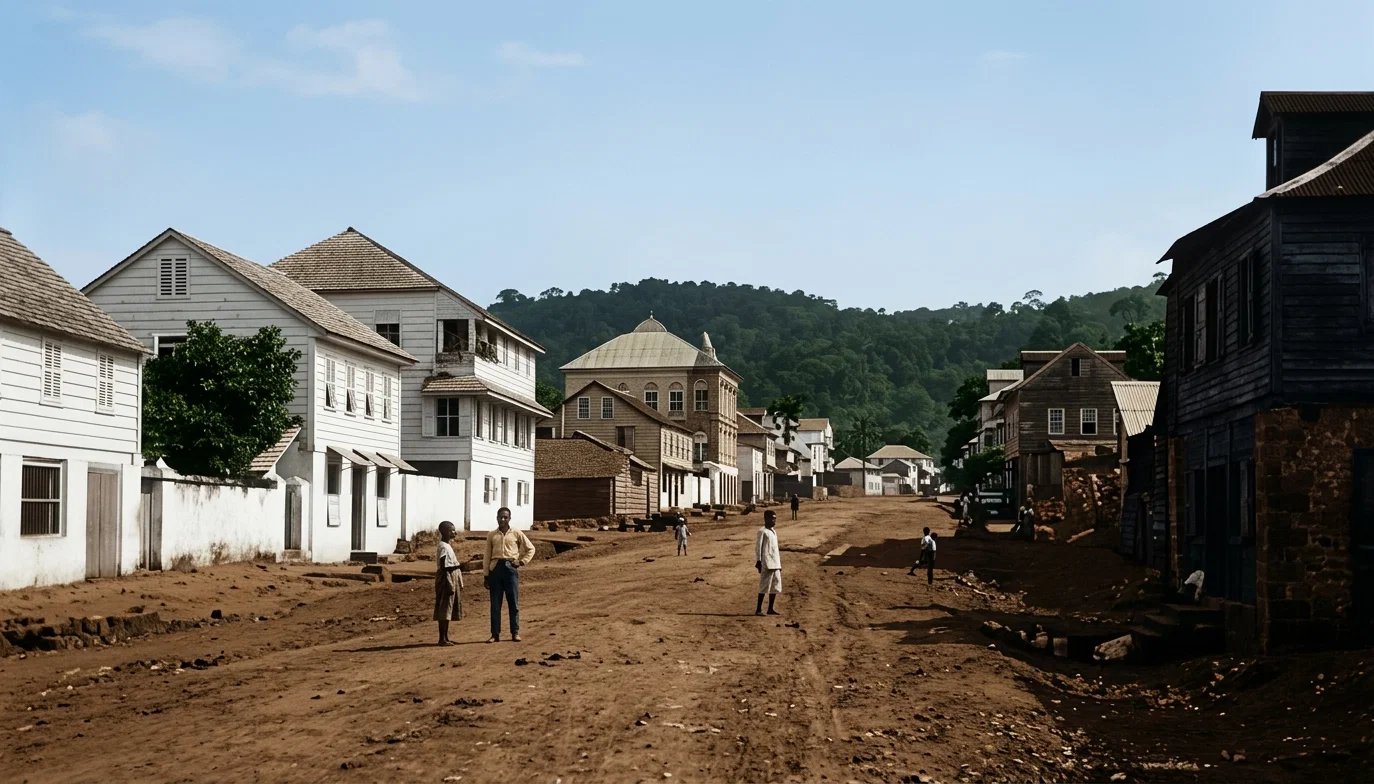
Freetown is the capital, and is situated at the foot of the mountain four miles from the mouth of the Sierra Leone River. It has the best harbor in west Africa, and presents a good appearance on entering. Miss Kingsly, however, says, “It makes the best appearance when one is leaving Sierra Leone.” There have been many decided changes since Miss Kingsly wrote her “Travels in West Africa,” and in many respects Freetown is far in advance of what it was at that time. There are many other towns and villages in the colony, among which we might mention Waterloo, with three thousand inhabitants, and Banthe on the island of Sherbro.
WILBERFORCE STREET, FREETOWN, SIERRA LEONE
I was much surprised to find the English language more generally spoken in Waterloo than in Freetown. There are some who speak very good English, and many who speak what is called “trade English.”
Sierra Leone has been occupied by the British for more than one hundred years, and the city of Freetown derived its name from the use of it by the British as a point to liberate the slaves, while the slave trade was being suppressed along the west coast of Africa. The government also brought to this colony many of the colored people from Nova Scotia, about the year 1792, and a Methodist church was soon after organized. Now religion of almost every form may be found in Sierra Leone. Of this we will say but little at this time, but Mohammedanism, Catholicism, Protestantism, and heathenism in many forms exist.
I was never more forcibly reminded of Paul's visit to Athens, recorded in Acts 17, than I have been since reaching this colony. Never had I felt so much the need of that power found only in Christ as I now feel. In America or other professed Christian lands, we may talk about the message, and mentally convince the people of this truth, but here in this dark continent we must know a present Saviour, his abiding Spirit, his love for perishing humanity, or our efforts will avail nothing. The city of Freetown has a population of about sixty thousand, and probably not more than twenty per cent of these profess Christianity.
From our mission house we can look across the Sierra Leone River, and see a country where no missionary society has been successful in bringing souls to Christ, although missions have been long established in this colony.
If I did not realize to some extent the power there is attending this message, I would ask the Mission Board to return us to our home land at once. If I did not fully believe that this work will finish with this generation, and not be continued in future generations, I would surely ask to be permitted to step aside, and not bear the heavy weight of this great work; but believing that God has providentially brought us to this needy field, that the work must be completed in this generation, that our God has every necessary means to carry forward this great work, and that he has entrusted that means to his dear people, we are sure there will be no lack as we begin to rear the banner of truth in this distant land.
As I take a view of the Great Sudan in west Africa, reaching from the Sahara Desert on the north to the Gulf of Guinea on the south, from the Atlantic Ocean on the west to Lake Chad on the east, not even halfway across the continent, and when I think of the millions in this densely populated region, containing more than half the area of the United States, and so few workers, my soul cries out, “Who is sufficient for these things?” The Lord has promised, “I am with you alway, even unto the end of the world.”
In a small way, we are opening up the work in Sierra Leone. We believe the Lord has directed in this, and we are much encouraged already, and can see the hand of the Lord going out before us. Efforts have been made in the past by Brethren Sanford and Hale, and others, but the climate has caused them to return home, and thus the work was greatly retarded.
I felt very sad as I read one letter from Brother Hale, in which he made reference to his earnest desire to see the work in west Africa go forward, and how he felt his health might have been spared if he could have had money to erect a comfortable mission house in which to live. The help was too late, but his life was mercifully spared.
We have every reason to believe that Sierra Leone will be the healthiest and most convenient place in west Africa to14start our work, that God will direct our steps in every undertaking to establish it, and that the Lord will open the hearts of our dear brethren and sisters in behalf of the work in this great field.
We have no time to waste; something must be done for this vast field, and the sooner we establish our work permanently, the better it will be. We have rented a suitable building for our present demands, in the very heart of the city, and on one of the best streets. The location is all we could wish for city work, but rents are very high. Our plan of work is to start at once a Bible training-school for young men and women, suitable for our field work. It is evident to me that our only hope in reaching this vast field is to prepare native young men and women to go into the interior, and bear the glad tidings to their own people.
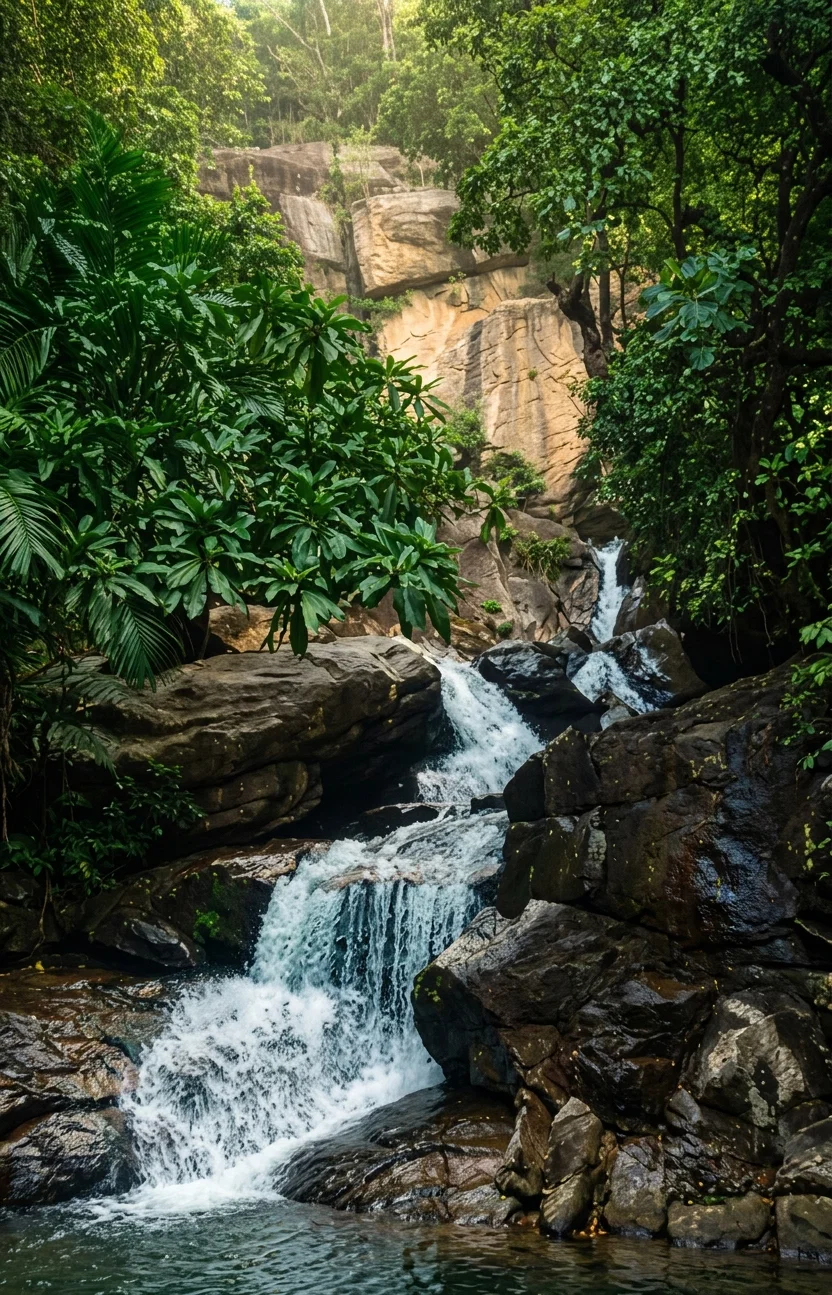
WATERFALL, FREETOWN, SIERRA LEONE
There are many reasons for this conclusion. The efforts our people have made in the past, in west Africa, proves that few from the United States or Europe can endure the climate of this coast, and the cost of transportation of laborers is high.
My prayer is that the work of training native laborers may not be retarded before the few foreign workers in the field are compelled to return on account of failing health. At the present our health is good, and we are deeply impressed that we should begin the training of workers at once.
Although we must begin in a very small way, by renting, as we have already done, we shall soon need increased facilities in the way of land in the country, and a suitable building for our work, so that expenses may be kept down and advantages gained in training workers outside of the city. The land will cost us very little, but building material is high. Pitch-pine lumber in the rough costs fifty-five dollars a thousand feet.
There are properties that can be secured, suitable for our work, out of the city. It seems to me that if we can get a place where we can begin work soon, at a reasonable cost, it will be better than to wear our lives out under a tropical sun and in such a climate as this by trying to build.
A property just outside the city has been offered by a woman who began building two years ago. She put up the walls of a large stone building, got the roof on, and for lack of means was compelled to stop. A property like this could soon be fitted up, and we could get to work. This is probably one of the unhealthiest fields in the world, and while our workers are enjoying health, no time should be lost in making proper provisions to raise the standard of truth, and at the same time preserve our present vitality.
I feared for Brother Hyatt when I first met him here. He looked as if his health was much impaired, but it has improved a great deal since we arrived, two months ago. Sister Hyatt's health is quite good. For this we are very thankful.
We greatly need the prayers of our dear people, that the health of the workers be preserved, and that the message may go with power in this dark field. In our next we will consider Gold Coast, Lagos, Northern and Southern Nigeria, and Liberia, which joins Sierra Leone on the south.
Freetown, Sierra Leone, W. A.
News From Haran—I
By Z. G. BAHARIAN
Z. G. BAHARIAN
HARAN is the country at the east of the Euphrates River, where our father Abraham dwelt for some time, and where Jacob served Laban about twenty years. To this historical land the Lord brought us, that the principles of Christianity and those of the world might fight a decisive battle before all the world. It was fought as completely as a battle could possibly be fought, and the victory was on the side of our message, for the glory of God. On June 8, near sunset, the doors of the jail were opened, and we were set free, glorifying the God of the promises. We were four in number—three workers and one lay member.
I shall try to give a brief but full story of our experience, to strengthen the hands of my fellow workers and of our people. The controversy began with Brother E. Ayvazian's going to Ourfa (Haran) in the summer of 1903. As soon as he reached there, young people began to call on him to hear the word of God, and soon a young man began to keep the Sabbath. The Armenian bishop sent a priest to him, to bring him back into the fold, but he was not convinced. Then the bishop's anger was kindled against Brother Ayvazian, and he betrayed him to the government, as an insurgent. He was immediately arrested, his room was searched carefully, and then he was presented to Montassariff, the ruler of that district, who proposed to him that he quit preaching the gospel. On his refusal, the ruler committed him to the general attorney, who tried him, to find some political fault in him. Though finding nothing, he accused him as an insurgent, for the following reasons:— 1. He himself is saying that he is going about preaching Sabbatarianism; surely his real purpose is to create insurrection against the government. 2. Their president—Brother Baharian—also has been arrested in Constantinople, while preaching to the people. 3. He is corresponding with Brother Baharian, through the British post-office. 4. He is corresponding with some at Hadjin, a source of insurrection.
The general attorney sent his accusation to Aleppo's council of accusation, to be approved, which was easily done, and returned to Ourfa in four months and a half. Then began Brother Ayvazian's trial before the legal court, which is composed of a president judge, two Moslem members, and two non-Moslem members. After a few trials, it was seen that the accusation was false, and Brother Ayvazian was to be justified. Just at this point the general attorney proposed that the trial be postponed, because Alexan Buzugherian and Garabed Bakalian had been arrested at Adana, and were on their way to Ourfa, and their books and written matter had already arrived, in which something might be found against him also. The cause of the arrest of these brethren was their writing to Brother Ayvazian letters of comfort, which were read by the general attorney, who accused them also of insurrection, and who, counseling with the general attorney at Aleppo, commanded their arrest and conveyance to Ourfa, together with their books and written matter to be found at their homes. As Brother Ayvazian's trial was about to close, these books and letters reached Ourfa, and his trial was postponed. The brethren also soon arrived, and were put into the same jail.
But this was not all. I also had written a letter to Brother Ayvazian, from Constantinople, when I heard about his imprisonment. This letter also was read first by the general attorney at Ourfa. He accused me as the head of these insurgents, and planned my arrest also. But by the good providence of God, I had already been arrested, and sent to Aintab. Four months after my arrival at that place, before my family started to come to me, I was arrested there, and sent to Ourfa. When my family arrived at Aintab, they found that I had been sent to Ourfa. Now we were four—Brethren Ayvazian, Buzugherian, Bakalian, and myself. I learned that Brethren Buzugherian and Bakalian had already been there five months. During this time, some English papers found with Brother Buzugherian had been sent to Aleppo, to be translated into Turkish, and returned. Then the general attorney sent his accusation against them to Aleppo's council of accusation, just a few days before my arrival at Ourfa.15As soon as I reached that place, the same charge was made against me. We waited there five months and a half for the return of our accusation from Aleppo. At last it was returned, Jan. 2, 1905, being fully approved by the council.
A Bible School
While awaiting the return of our accusations, we held a Bible school in jail. God had permitted us to have our Bibles. Brother Buzugherian also had an English New Testament, an English grammar, and an English dictionary. At once we began our course of studies. Our daily program was two studies from the Bible, and two in the English language. God was with us, and blessed us. For many years we had been planning such a school, but never had succeeded. We thanked God that he gave us such a school in the jail. We studied the letters to the Galatians, and Hebrews, the first epistle of Peter, the books of Daniel and Revelation, the four books of Kings, and the books of Ezra, Nehemiah, and Esther, and others. We studied the principles of church and state. So we were made ready for our trial. We also prepared several lessons, which we sent to the churches.
Aintab, Turkey.
Japan and Korea
By F. W. FIELD
THE work continues to prosper in these fields. A few weeks ago Brethren Burden and Okahira visited the little church at Wakamatsu. At this time five were baptized, and plans for the advancement of the work were considered.
Of late we have planned a sort of Bible institute here in Tokyo for some of our younger workers and interested believers. Daily classes in Bible and English are held; also in Japanese language study for the benefit of the Korean brethren present. We have had two of our young men from Wakamatsu come to attend this institute for a month or so. We believe that this effort will be an encouragement and help to all concerned.
During the past summer we have made a beginning in the work of doing our own printing. A good hand press has been secured, and a good beginning made in equipping an office with type. We are not attempting to print our monthly paper yet, but are printing the Sabbath-school lessons, and shall be able to publish various tracts. One of our Korean brethren has translated two of our tracts into Korean, and we expect soon to publish these from our own press. This will add another language to the list of tongues in which present truth is being published to the world.
On the eighth of October our new force of workers arrived at Yokohama. These are Dr. Emma A. Perrine and Sister Bessie Young for the work in Kobe, and Elder W. R. Smith and his wife for Korea. While we welcome these workers to a share in our labors, we ask the prayers of our brethren that their efforts may be richly blessed of the Lord.
F. W. FIELD.
The Work in Fiji
By J. E. FULTON
FIJI, with its eighty inhabited islands, presents an interesting field for missionary effort. Not only for Fijians is it an important center, but as there are so many Polynesians here, it is sure to become an important training center. The Lord has signally helped in getting the work established among the natives of this group, and we believe that God will choose young men from among our natives, who can be entrusted with the work in the regions beyond Fiji. It has been decided that we should have a good training-school in Fiji to work toward this end. We hope to enlist the sympathy of our brethren who are far away, in behalf of our work here.
Not far west are many millions in terrible darkness. Some are in abject heathenism, and we must carry the gospel of Christ to them, and warn them of the events just before us in the closing of16earth's history: We all feel anxious to see the work here advance, and we hope that some whose interest is aroused will aid us.
J. E. FULTON.
Virginia
By H. J. FARMAN
NARUNA AND DANVILLE.—October 13-20 it was my privilege to be at Naruna to visit and hold meetings with the believers, and to organize a church of nine members. An elder, deacon, clerk, and treasurer were elected. Probably all remember Elder C. B. Rule's experience at this place a little more than a year ago, when he had to flee as described in Matt. 10:23. Since then the brethren and sisters have quietly gone about their own business, working the six days and resting the seventh. As a result, their enemies have become ashamed. Now the brethren are planning to build a church, and we believe that before long others will be added to their number.
The interest which has resulted in the organization of this church was awakened by a brother and his wife who moved out of the city onto a farm, living the truth, and making a home for ministers to come and hold meetings with them.
At Danville I visited our colored church, and held meetings with them October 20-24, much to their pleasure and profit as well as to my own. I found them very ready to receive the message. They have had some apostasies in the past, but those who remain seem to be growing in grace, and manifest a commendable spirit, although in need of more instruction.
At both of these places subscriptions were taken for the REVIEW, Signs, Life and Health, Gleaner, and Signs Leaflets. While only a small beginning was made, we hope for a large work.
H. J. FARMAN.
In New Mexico and Arizona
By Walter Harper
I LEFT Kansas City, Mo., October 8, with my aged and invalid father, bound for California. We stopped at the city of Albuquerque, N. M., where he will stay a few months in that high, dry, bracing air, and mild, sunny climate, till I can do some work that I had planned in New Mexico and Arizona, which I had begun in August. The Lord is blessing my work in a wonderful way. In the first week our dear Father above gave success to the extent of about ninety orders for books, helps, etc., besides many orders for small books, or about $250 in value. One day in a town in New Mexico in less than three hours I was favored with twelve orders for “Christ’s Object Lessons” in addition to other orders. Many of my orders are for that good, heaven-sent book, “Patriarchs and Prophets,” also “Christ’s Object Lessons.” It is wonderful how, in answer to prayer, the Lord opens the way to place these most important works in the homes of the people. “He never disappoints those who come to him or trust in him.”
The spirit of prophecy tells us that the three special books the Lord wants sold now are “Patriarchs and Prophets,” “Great Controversy,” and “Daniel and the Revelation.” Light, power, and blessings are found in obeying this word. The work is to make advancement, for it will soon be cut short in righteousness.
WALTER HARPER.
Mission Notes
THE twenty-four German missionary societies have about 1,000 missionaries in 615 stations; 2,500 schools, with 120,000 scholars; and about 460,000 professed Christians, of whom about 20,000 were baptized in 1904.
THE Japanese Educational Department is calling on the Y. M. C. A. to supply English teachers for the middle schools of the empire. This shows that Japan has tested one more Christian institution, and found it good.
THE American Board of Commissioners of Foreign Missions has recently received a legacy of twenty-seven thousand dollars from the estate of a Mr. Aslan Sahagian, an Armenian gentleman of Yonkers, N. Y. Mr. Sahagian was born in eastern Turkey, almost seventy years ago, coming to America when about thirty years of age. Although never openly allied with the Christian church in Turkey, he recognized the blessings which he himself and his people had received from the labors of missionaries in his native land, and gave a large proportion of his property for this purpose.
THE British government has lately issued a “Blue Book” on the condition of the native races in South Africa. The book contains the details of a study of these races in all the provinces of South Africa by a commission of hard-headed laymen appointed by the government. It recommends among other things recognition of the utility of the work of the churches which have undertaken the duty of evangelizing the heathen, declaring that the weight of evidence shows improved morality among the Christian section of the native population.
The East Caribbean Conference
By GEORGE F. ENOCH
The third annual session of the East Caribbean Conference was held in Georgetown, British Guiana, South America, July 19-26. This conference covers such an extent of territory, and is so cut up by the great salt sea, that it is impossible for all the churches to send delegates to the annual sessions. We, therefore, have to hold our sessions in the leading cities, and transact our conference business largely with the local believers and conference laborers.
At the present time there are six American missionaries and ten native laborers on the conference pay-roll. Several canvassers are also doing faithful work. Elders Haysmer and Babcock were withdrawn from our field at the last General Conference, and we missed them from our counsels and in laying our plans for the coming year. It seemed impossible for us to meet the demands of the situation with our present force.
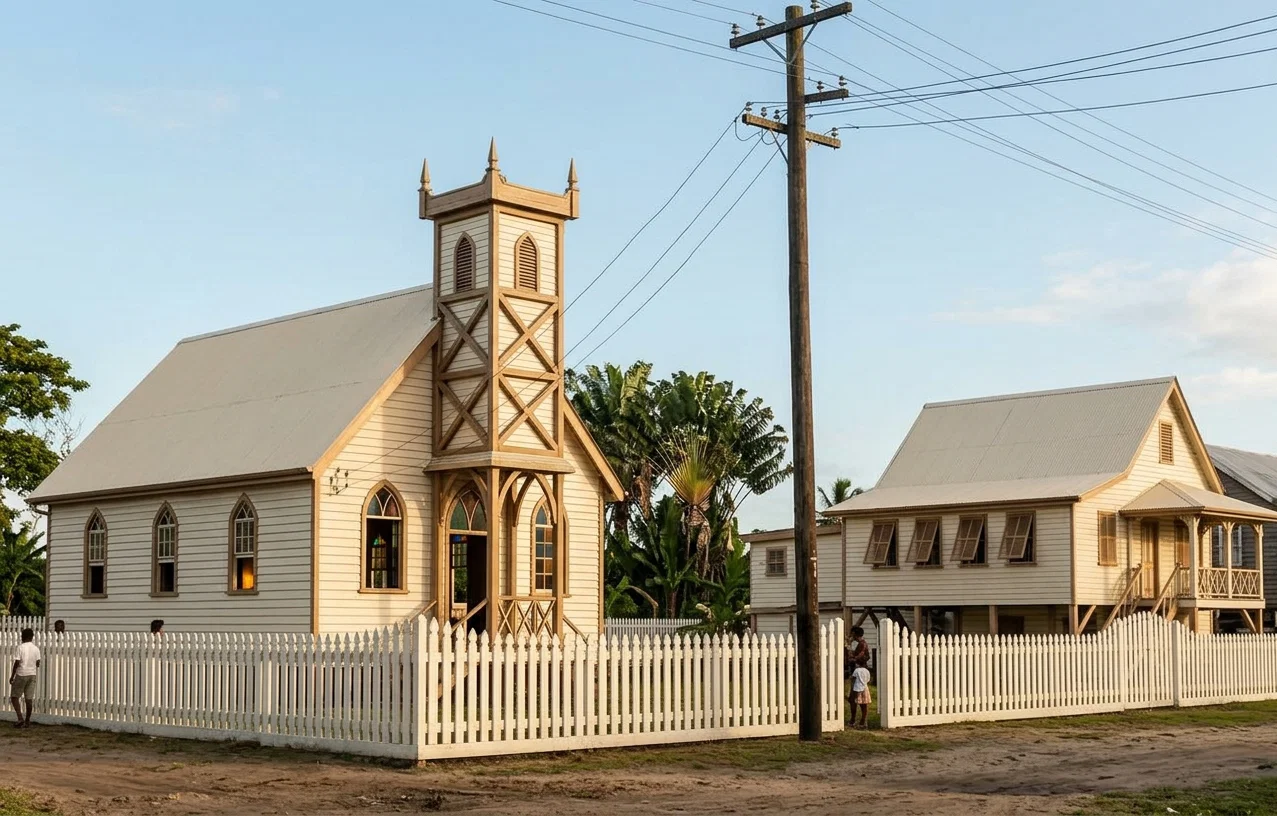
GEORGETOWN CHURCH AND MISSION HOUSE
The reports of the laborers from the different fields were full of courage and hope, and all spoke of progress. One hundred and fifteen were baptized during the year. Thirty-six Sabbath-schools were reported, with a membership of over nine hundred. The Arima, Trinidad, church was voted into the conference organization. Not only was this church organized during the year, by Elder W. A. Sweany and his wife, but a church building was also erected and dedicated.
Elder Sweany brought a good report of the work there. It is difficult for those in temperate climes to realize the almost absolute necessity of a meeting-house of some kind in connection with our churches and companies in the tropics. We can scarcely obtain any halls, schoolhouses are unavailable, ordinary houses are usually either too small and of a temporary character, or are so expensive as to be beyond our reach. The consequence is, our people are usually left without any suitable place of meetings until something can be erected. As wages are very low, and our people as a rule are poor, the building of a meeting-house is a great proposition for them. The usual cost is not more than four or five hundred dollars, yet but few of our companies can raise more than half that amount. How necessary it is for some one to step in and lift a little with these companies, so that the work may be made permanent, and not ravel out. There are many of our people in the North who could cut down a little in their expenses, dispense with extra trimmings, or buy less expensive furniture, and donate to the church-building fund for the mission fields, and thus assist the overburdened toilers in the pioneer fields, give stability to the work, and at the last have a share in the sheaves brought in at the harvest home.
We now have twenty-one churches and meeting-houses in our conference, and six more are needed at once. Who will help us to lift the burden?
The report of the publishing work was truly encouraging. We are still issuing seven thousand copies a month of the Caribbean Watchman, and our people are selling them from door to door. We have also issued five thousand copies of The Family Bible Teacher, as well as other tracts and conference printing work. Our new outfit, consisting of a small job-press and the necessary type, borders, and other accessories, costing eight hundred and fifty dollars, has been purchased, and only a little more than one hundred dollars remains to be raised. One of the most enthusiastic and encouraging meetings of the conference was the one in which the matter of raising this money was considered. One after another came forward and laid down his offering on the table, until almost all present had given, several giving all they had with them. We now need a cylinder press, and hope that the Lord will open the way soon that this addition to our outfit may be secured.
Plans were laid which will set our young people to studying, a regular course of study being provided which will partly fill the need of a training-school. We are literally empty handed, as far as facilities are concerned, and our hundreds of young people without any educational privileges whatever appeal to this denomination. We are confident that the problem of carrying this last message to tropical Africa will be solved in the West Indies. Other denominations have learned this; why should we not work to this end?
There are good openings for the medical missionary work. We appeal to our medical workers to consider the calls coming from the West Indies. We trust that a start will be made in the medical work ere another year rolls round.
The conference business was transacted with unanimity and dispatch, not a discordant note being sounded during the entire session. The following officers were elected for the ensuing year: President, D. E. Wellman; Vice-President, W. G. Kneeland; Secretary and Treasurer, Geo. F. Enoch; Sabbath-school Secretary, Mrs. D. E. Wellman; Secretary of Young People's work, S. A. Wellman; Editor Caribbean Watchman, Geo. F. Enoch; Associate Editor, S. A. Wellman; Editorial Contributor, W. G. Kneeland.
A special evangelistic effort was made in the city during the conference. A tent was pitched on the Bourda Green, and large, interested audiences listened to the presentation of the message from night to night. The Lord blessed the speakers, and the word was preached with freedom and power.
One sad feature that emphasizes one of the difficulties of our field and climate, was the sickness of several of the laborers. Elder W. A. Sweany had a most serious attack of malarial fever, from which he has not yet recovered. The workers in the tropics, facing an overwhelming amount of work, surrounded by peculiar and trying conditions, need the prayers of God's people.
It was decided at this conference to issue a monthly conference paper to be called the East Caribbean Gleaner; subscription price, twenty-five cents a year. Why are there not hundreds of our people in other lands who will be glad to subscribe for the Caribbean Watchman and the East Caribbean Gleaner? The two will come to you for an entire year for only seventy-five cents. You will help the cause in a needy field, and get in return value received. Send subscriptions to S. A. Wellman, Port-of-Spain, Trinidad, by post-office order.
The workers returned to their fields full of zeal and courage for the year to come.