ABRAHAM had become an old man, and expected soon to die; yet one act remained for him to do, in securing the fulfilment of the promise to his posterity. Isaac was the one divinely appointed to succeed him as the keeper of the law of God and the father of the chosen people; but he was still unmarried. The inhabitants of Canaan were given to idolatry, and God had forbidden intermarriage between his people and them, knowing that such marriages would lead to apostasy. The patriarch feared the effect of the corrupting influences surrounding his son. Abraham's habitual faith in God and submission to His will reflected in the character of Isaac; but the young man's affections were strong, and he was gentle and yielding in disposition. If united with one who did not fear God, he would be in danger of sacrificing principle for the sake of harmony. In the mind of Abraham, the choice of a wife for his son was a matter of grave importance; he was anxious to have him marry one who would not lead him from God.
In ancient times, marriage engagements were usually made by the parents; and this was the custom among those who worshiped God. None were required to marry those whom they could not love; but in the bestowal of their affections, the youth were guided by the judgment of their experienced, God-fearing parents. It was regarded as a dishonor to parents, and even a crime, to pursue a course contrary to this.
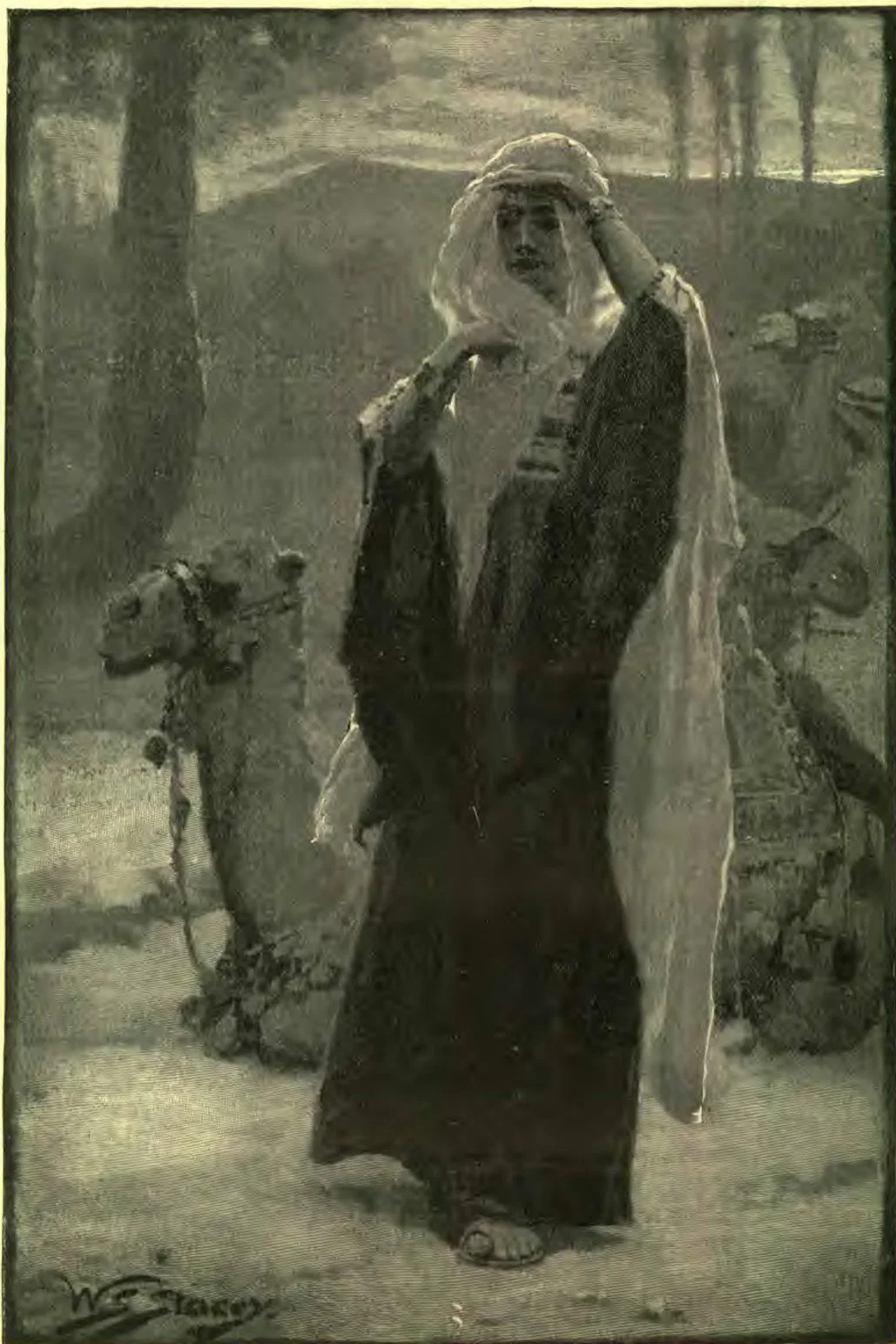
Isaac, trusting to his father's wisdom and affection, was satisfied to commit the matter to him, believing also that God Himself would direct in the choice made. The patriarch's thoughts turned to his father's kindred in the land of Mesopotamia. Tho not [[FIGURE]] free from idolatry, they cherished the knowledge and the worship of the true God. Isaac must not leave Canaan to go to them; but it might be that among them might be found one who would leave her home and unite with him in maintaining the true worship of the living God. Abraham committed the important matter to "his eldest servant," a man of piety, experience, and sound judgment, who had rendered him long and faithful service. He required this servant to make a solemn oath before the Lord, that he would not take a wife of the Canaanites, but would choose a maiden from the family of Nahor in Mesopotamia. He charged him not to take Isaac thither. If a damsel could not be found who would leave her kindred, then the messenger would be released from his oath. The patriarch encouraged him in his difficult and delicate undertaking with the assurance that God would crown his mission with success. "The Lord God of heaven," he said, "which took me from my father's house, and from the land of my kindred, . . . He shall send His angel before thee."
The messenger set out without delay. Taking with him ten camels for the use of his own company and the bridal party that might return with him, provided also with gifts for the intended wife and her friends, he made the long journey beyond Damascus, and onward to the rich plains that border on the great river of the east. Arrived at Haran, "the city of Nahor," he halted outside the walls, near the well to which the women of the place came at evening for water. It was a time of anxious thought with him;2important results, not only to his master's household, but to future generations, might follow from the choice he made; and how was he to choose wisely among entire strangers? Remembering the words of Abraham, that God would send His angel with him, he prayed earnestly for positive guidance. In the family of his master he was accustomed to the constant exercise of kindness and hospitality, and he now asked that an act of courtesy might indicate the maiden whom God had chosen.
Hardly was the prayer uttered before the answer was given. Among the women who were gathered at the well, the courteous manner of one attracted his attention. As she came from the well, the stranger went to meet her, asking for some water from the pitcher upon her shoulder. The request received a kindly answer, with an offer to draw water for the camels also, a service which it was customary for the daughters even of princes to perform for their flocks and herds. Thus the desired sign was given. The maiden was "very fair to look upon," and her ready courtesy gave evidence of a kind heart, and an active, energetic nature. Thus far the divine hand had been with him. After acknowledging her kindness by rich gifts, the messenger asked her parentage, and learning that she was the daughter of Bethuel, Abraham's nephew, "he bowed down his head, and worshiped the Lord."
The man had asked for entertainment at her father's house, and in his expression of thanksgiving had revealed the fact of his connection with Abraham. Returning home, the maiden told what had happened, and Laban, her brother, at once hastened to bring the stranger and his attendants to share their hospitality.
Eliezer would not partake of food until he had told his errand and of his prayer at the well, with all the circumstances attending it. Then he said, "And now if ye will deal kindly and truly with my master, tell me; and if not, tell me; that I may turn to the right hand, or to the left." The answer was, "The thing proceedeth from the Lord; we can not speak unto thee bad or good. Behold, Rebekah is before thee, take her and go, and let her be thy master's son's wife, as the Lord hath spoken."
After the consent of the family had been obtained, Rebekah herself was consulted as to whether she would go so great a distance from her father's house, to marry the son of Abraham. She believed, from what had taken place, that God had selected her to be Isaac's wife, and she said, "I will go."
The servant, anticipating his master's joy at the success of his mission, was impatient to be gone; and with the morning they set out on their homeward journey. Abraham dwelt at Beersheba, and Isaac, who had been attending to the flocks in the adjoining country, had returned to his father's tent to await the arrival of the messenger from Haran. "And Isaac went out to meditate in the field at eventide; and he lifted up his eyes, and saw, and, behold, the camels were coming. And Rebekah lifted up her eyes, and when she saw Isaac, she lighted off the camel. For she had said unto the servant, What man is this that walketh in the field to meet us? And the servant had said, It is my master; therefore she took a veil, and covered herself. And the servant told Isaac all things that he had done. And Isaac brought her into his mother Sarah's tent, and took Rebekah, and she became his wife; and he loved her: and Isaac was comforted after his mother's death."
Isaac was highly honored by God, in being made the inheritor of the promises through which the world was to be blessed; yet when he was forty years of age, he submitted to his father's judgment in appointing his experienced, God-fearing servant to choose a wife for him. And the result of that marriage, as presented in the Scriptures, is a tender and beautiful picture of domestic happiness: "Isaac brought her unto his mother Sarah's tent, and took Rebekah, and she became his wife; and he loved her: and Isaac was comforted after his mother's death."
What a contrast between the course of Isaac and that pursued by the youth of our time, even among professed Christians! Young people too often feel that the bestowal of their affections is a matter in which self alone should be consulted,—a matter that neither God nor their parents should in any wise control. Long before they have reached manhood or womanhood, they think themselves competent to make their own choice, without the aid of their parents. A few years of married life are usually sufficient to show them their error, but often too late to prevent its baleful results. For the same lack of wisdom and self-control that dictated the hasty choice is permitted to aggravate the evil, until the marriage relation becomes a galling yoke. Many have thus wrecked their happiness in this life and their hope of the life to come.
Parents should never lose sight of their own responsibility for the happiness of their children. Isaac's reference to his father's judgment was the result of training that had taught him to love a life of obedience. While Abraham required his children to respect parental authority, his daily life testified that that authority was not a selfish or arbitrary control, but was founded in love, and had their welfare and happiness in view.
True love is a high and holy principle, altogether different in character from that love which is awakened by impulse, and which suddenly dies when severely tested. It is by faithfulness to duty in the parental home that the youth are to prepare themselves for homes of their own. Let them here practise self-denial, and manifest kindness, courtesy, and Christian sympathy. Thus love will be kept warm in the heart, and he who goes out from such a household to stand at the head of a family of his own, will know how to promote the happiness of her whom he has chosen as a companion for life. Marriage, instead of being the end of love, will be only its beginning.
REBEKAH.
The Second Commandment
By J. O. Corliss
By J. O. Corliss
IN our study of the first commandment of the Decalogue, we saw that God proclaimed Himself to the house of Israel as the Lord and as their God who had delivered them from slavery. Not only was attention directed to the power displayed in effecting that deliverance, but Jehovah, the mighty One, presented Himself to them as theirs, virtually saying to them, With Myself as yours, all the enormous power you have seen attending Me is at your service. The only condition stated in that first utterance necessary to secure the companionship of this new-found Friend was to hold Him supreme in their affections. No other god was to displace Him in their worship or in their dependence for help.
"Thou shalt have no other gods before Me," is a brief sentence; how much does it mean? How may one know when he is trenching on ground here forbidden? In short, since the God of our deliverance has not bodily appeared to sight, and we are not acquainted with His form, by what standard shall the difference between Him and other gods be measured? These would have been pertinent questions to those people at Sinai's base, who had been reared among the gods of Egypt, some of which were very crude and even indelicate in form. True, they had now come to believe that the Egyptian gods were of an inferior caste, from the fact that the God who was now speaking to them had been able to deliver them from the power of Egypt and its gods, upon which the king of that country relied. More than that, from Jehovah's unseen presence on the mountain, an immense flood of unspeakable glory had appeared, and His audible voice had shaken the ground beneath their feet, until they were ready to flee for safety. But while being so different from the gods of Egypt in these ways, how does His form differ from theirs? May He not have a similar form to those bright lights of heaven from whence He came, since His presence here is amid fire and smoke, and the thunders of heaven accompany Him? May we not build some form like these to look upon in worship, when our God has returned to heaven and left us without this physical display of His grandeur that we now see? If not, how shall we always keep Him uppermost in thought, and so prevent other gods from having the place in our minds that belongs to Him?
How natural such questions from men and women of nature, those who had never known aught of faith, but had always depended upon physical sight to determine what course to pursue. How many of the same class may be found without great effort even in this boasted age of civilization and Christian teaching!3So many now continue to walk wholly by sight, that various figures and images of supposed heavenly saints must be employed to draw their thoughts into spiritual channels. Yet we pity the poor Israelites, just separated from their heathen associations, who seemed so dense in perception as to be unable to separate God from things of physical sight. If they needed such minute direction in positive commandment to keep them in the way, who will say that the same instruction is not now needed to guide our feet in the way of the Lord?
No Other Gods before Him.
The first commandment was clearly enough stated for the comprehension of the most benighted, so far as preferring some being before Jehovah. But he who had first deceived man regarding God's attributes knows well enough that if men can be induced to bow before some image or likeness of a heavenly Power, it is only a question of time until they will forget the real, the true, yet invisible God, through habitual genuflection before some supposed image of Him. But further than this, the very suggestion of placing some created substance between a worshiper and the Creator to be worshiped is, at least, to plant an inferior thing before the mind, through which to give an impression of the Creator. To bow down thus before the product of one's own hands, which, being only the work of a faulty maker, must of necessity be very imperfect, and to expect by viewing it to receive exalted views of the infinite One, is, to look upon the matter in the most favorable light, to be-little God, even in one's own eyes, as the infinitely great and glorious Being, taking away the glory to which His power as Creator entitles Him.
This does not fall far short of putting another god in the place of Jehovah. Satan could see beforehand the result of making images to bow before in worship, and so God, being aware of Satan's master mind in diplomacy, forewarned the seed of Abraham at Sinai not to enter this stage of a journey which would land them in absolute idolatry, and so place them beyond the pale of salvation unto eternal life. In that memorable prayer offered by the Saviour in behalf of His followers, He reminded Jehovah of the power awarded to Himself as Son of God, to bestow eternal life on as many people as God should give Him. As tho He would reveal His knowledge of what this power included, and to what it was limited, He reverently said: "And this is life eternal, that they might know Thee the only true God, and Jesus Christ whom Thou hast sent." John 17:3.
No Image to Worship.
It may be well at this point to place the second commandment before us, in order to mark how carefully it enters into detail to guard the sanctity of the commandment by which it is preceded. This is the way it reads:
"Thou shalt not make unto thee any graven image, or any likeness of anything that is in heaven above, or that is in the earth beneath, or that is in the water under the earth: thou shalt not bow down thyself to them, nor serve them: for I the Lord thy God am a jealous God, visiting the iniquity of the fathers upon the children unto the third and fourth generation of them that hate Me; and showing mercy unto thousands of them that love Me, and keep My commandments."
It will be noticed that in this commandment, after forbidding the making of any supposed likeness of earthly or heavenly things for the purpose of bowing before it, an attribute of God's character is added which was not before mentioned, as tho the Lord would have men know the consequence of disregarding His injunction. He says that He is a jealous God, visiting the iniquity of parents upon their children. This word "jealous" does not have the sense of enraged suspicion of rivalry, but rather stands for what is now expressed by the word "zealous." In other words, the Lord is zealous in the right, which engages Him justly to hold the wicked accountable for their wickedness, as well as to show mercy unto all who love Him and keep His commandments.
The Law Binds All.
The Judge of all the earth must do right. If those who receive the law into their "inward parts," and have it "written in their hearts," so that "out of the abundance of the heart" the mouth speaks only things in harmony with God, are accounted worthy to live forever with Him, should not those who refuse thus to grow into His image find their place at last among those who are haters of God? Is not the fate of one class as just as that of the other, especially since each individual chooses for himself which class he prefers?
In the zeal of God to be just in dealing with the two classes of men, must He not have the same exact rule by which to deal out justice to those of every age? Or to put the question in Scripture form: "Is He the God of the Jews only? is He not also of the Gentiles?" The apostle answers this question very definitely: "Yes, of the Gentiles also." Rom. 3:29. Satisfied that his answer is correct, the apostle draws this conclusion, "seeing it is one God, which shall justify the circumcision by faith, and uncircumcision through faith. Do we then make void the law through faith? God forbid; yea, we establish the law."
Circumcision was established in Abraham, as a seal of the righteousness of faith which he had before circumcision. This seal of righteousness by faith, both with and without circumcision, was conferred upon Abraham in order to constitute him the father of all believers, whether circumcised or uncircumcised. Rom. 4:11. The Israelites were Abraham's descendants, who became circumcised and received the oracles of God at Sinai to hand down to us who are not lineally descended from Abraham, and who are uncircumcised, but who choose to join ourselves to the household of God. Acts 7:37, 38. From the curse of the law spoken of in the second commandment, we, as Gentiles and idolaters, have been delivered by the death of Christ, in order that the blessing of Abraham, also spoken of in the law of ten commandments (Ex. 20:12), might come on us through faith in the Son of God. Gal. 3:14.
And why should it not be so? Mercy was promised to those beggared Israelites, who had become not only supreme idolaters, but who had also lost all knowledge of the very import of circumcision through their ignorance of the God of their father Abraham. The first lesson to them in righteousness by faith, God attempted to give through a revelation of Himself, that the people might learn to distinguish between Him and every false god. So He began: "I am the Lord thy God, which have brought thee out of the land of Egypt. . . . Thou shalt have no other gods before Me." And further, Thou shalt not make anything to represent Me. Faith in Me as creator must prove your loyalty under all circumstances. 2 Peter 4:19. With the apostle we are quite ready to ask at this juncture: "Do we then make void the law through faith? God forbid; yea, we establish the law."
A Failure (?)
HE kept his soul unspotted
As he went upon his way,
And he tried to do some service
For God's people day by day;
He had time to cheer the doubter
Who complained that hope was dead;
He had time to help the cripple
When the way was rough ahead;
He had time to guard the orphan, and
one day, well satisfied
With the talents God had given him, he
closed his eyes and died.
He had time to see the beauty
That the Lord spread all around;
He had time to hear the music
In the shells the children found;
He had time to keep repeating
As he bravely worked away:
"It is splendid to be livingIn the splendid world to-day!"
But the crowds—the crowds that hurry
After golden prizes—said
That he never had succeeded,
When the clods lay o'er his head—
He had dreamed—"He was a failure,"
they compassionately sighed,
For the man had little money in his
pockets when he died.
—Unknown.
Science of Prayer.
By Mrs. J. W. Bassett
PRAYER should be characterized by a faith that will not shrink or turn, and a determination to choose the things that please God. The house of prayer should be a joyful place of meeting. The silent hour of prayer should be a delightful communion with God.
The science of prayer would signify an orderly arranged prayer, and especially exact, just the true facts in the case presented before the throne of God. Such a prayer will include much in brief form, and it will be conformable to reason, wise and prudent, manifesting forethought and sense. Prayer should be marked by no selfish desire, but by a desire to receive the knowledge and blessings of God in order to impart to others.
MRS. J. W. BASSETT.
The Man Jesus.
By Felix Blachowski
By Felix Blachowski.
WHAT human being that ever lived on this earth could be compared with Jesus? His saving influence, His spiritual power, is simply beyond estimation. Even unbelievers acknowledge this fact. As Napoleon I said, "To-day there are thousands of human beings who would cheerfully lay down their lives for Jesus." Think of it: who would lay down his life for a dead Caesar or Homer?
What nation then would not be supremely proud and happy, even from this worldly point of view, that such a Saviour of men was born among them? The influence of Jesus is stamped on the whole civilized world—stamped with His name and not with His Spirit, it is true, but there it is! Time is reckoned from His birth. The greatest festivals are celebrated to commemorate some event of His life, and laws and usages are molded according to the letter (if not the Spirit) of His teachings. His blessed influence enters into men's hearts; thousands, yes millions of human beings begin and end their prayers with that holy name. It is on the lips of the holiest saint as well as in the depths of the soul of the vilest and remorse-stricken sinner. Loving mothers teach their prattling babes that blessed name as one of the first words. It is the sweetest name to soothe the pain of declining age, and thousands of sinking lives have whispered with the last breath that holiest name. No name on earth is so sweet to the pure in heart and the sin-crushed soul!
The Polish nation feels proud of such men as Kopernikus and Kosciusko; every nation feels proud of its great men. But what man, from the beginning of the world, could for an instant compare with that majestic Spirit, that moral grandeur—Jesus Christ?
And yet, what is the attitude of the orthodox Jew toward that incomparable Man—a Jew? How infinitely sad, how strange, sounds the following letter from a Jewish mother to the son of her heart, who became a meek follower of Jesus. I take the letter from the Good Tidings of the Messiah. It does not begin with the affectionate "My darling son," of a natural mother, but:—
"Max, you are no longer my son; we have buried you in effigy; we mourn you as one dead. And now may the God of Abraham, Isaac, and Jacob strike you blind, deaf, and dumb, and damn your soul forever. You have left your father's religion and the synagog for that of Jesus, the impostor; and now take your mother's curse. Clara."
How sad, how strange and inexplicable from the point of any natural law! And yet, my dear reader, this is only the mystery of sin. It belongs to the same strange spiritual power that is striving for supremacy in my heart and in your heart. Instead of arousing indignation in our souls, this strange behavior of the poor, blinded Jews should only inspire us with pity and love for their salvation. The least hatred and dislike for them, if cherished in our hearts, leads to the same depths of infamous hatred and spiritual insanity that we find in so many of the orthodox Jews.
And it is only by the power of this same Jesus that you and I can conquer this unreasonable and inhuman foe. Rom. 8:6, 7. Acts 4:12.
The Sabbath of the New Covenant.
By A. Delos Westcott
By A. Delos Westcott.
"Moreover also I gave them My Sabbaths, to be a sign between Me and them, that they might know that I am the Lord that sanctify them." Eze. 20: 12.
IT is by the Holy Spirit and the blood of Christ that Christians are sanctified. This was true in the old dispensation as well as in the new.
"God hath from the beginning chosen you to salvation through sanctification of the Spirit and belief of the truth." 2 Thess. 2: 13. "But ye are washed, but ye are sanctified, but ye are justified in the name of the Lord Jesus, and by the Spirit of our God." 1 Cor. 6: 11. "Through sanctification of the Spirit, unto obedience and sprinkling of the blood of Jesus Christ." 1 Peter 1: 2. See also Eze. 11: 19, 20 and 36: 26, 27; Heb. 10: 28, 29.
As the Sabbath is the sign of sanctification, and as it is the Holy Spirit and the blood of Christ that sanctify, it is therefore plain that the Sabbath is the sign by which Christians are to know that God sanctifies them by the Holy Spirit and the blood of Jesus Christ. In other words, the observance of the Sabbath is the sign that men accept the Holy Spirit and the blood of Christ for their salvation.
It is only by virtue of the new covenant that the Holy Spirit and the blood of Christ are available for man. That the term "new covenant" means "renewed covenant" is demonstrated by the fact that it existed in the days of Abraham; and is, in short, identical with God's "everlasting covenant." See Gal. 3: 13-18; 4: 22-27; Heb. 13: 20, 21. Christ died on the cross, "that the blessing of Abraham might come on the Gentiles through Jesus Christ; that we might receive the promise of the Spirit through faith." And the purpose of Christ's death was to carry out the provisions of the renewed, or everlasting, covenant. See Heb. 9: 15; 10: 29; 13: 20; Matt. 26: 27, 28.
Therefore, since the Holy Spirit and the blood of Christ are available only by virtue of the everlasting covenant, it is demonstrated that the observance of the seventh-day Sabbath is the sign of the acceptance of the renewed, or everlasting, covenant.
The only fancied objection that can be brought against these plain Bible statements is the fact that in the past many persons who did not keep the seventh day have been blessed with the Holy Spirit. But God blesses people, not because of their entire freedom from error, but because of their sincerity, and because of their willingness to accept and obey all the truth that He has sent them.
Sixty years ago very few people had ever had their attention called to the fact that the majority of Christians were keeping the papal, instead of the Bible Sabbath. Now the light on the Sabbath question is shining everywhere. "The times of this ignorance God winked at; but now commandeth all men everywhere to repent." Acts 17: 30. Said Christ, "If I had not come and spoken unto them, they had not had sin: but now they have no cloak for their sin." That which was once a sin of ignorance, now becomes a sin of presumption. When the Jews rejected the light, Jesus said, "Behold, your house is left unto you desolate."
Reader, have you not noticed that since the proclamation of this Sabbath message began, there has been more and more a dearth of the Holy Spirit in the religious bodies that have rejected the message? "Walk while ye have the light, lest darkness come upon you." "For if we sin wilfully after that we have received the knowledge of the truth, there remaineth no more sacrifice for sins." John 3: 19-21; 12: 35; Heb. 10: 26, 27.
Rays of Light.
By George E. Tack
(On Keuka Lake, N. Y.)
By George E. Tack.
OUT of the world-night, bitter, drear,
Shineth a star,
Flashing its ruddy beams of cheer
Anear and far.
Down through corridors, vasty, cold,
Where each planet swings,
A ray of love from the throne of old,
Its glad course wings.
Before me gleams the starry vast
House of the Lord,
The many mansions, that at last
Shall peace afford.
There where the seraphs lowly bend
Before the throne;
And sweet their holy anthems blend
Love's praise to own.
There shall my eager eyes behold
The walls that gleam,
The glorious highway, paved with gold,
And crystal stream.
Never again to tread alone
Streets of despair;
Never to go in fear, or moan
Or sorrow bear.
Never a farewell tear to know,
Or parting sigh,
But joy supreme, unknown below,
But pledged on high.
But dearest to my soul shall be
The wondrous sight,
The Martyr-king who died for me
Reigning in light.
Mission Study and Foreign Missions
CAREY, the cobbler, with a map of the world hanging on his shop wall, was the forerunner of Carey, the missionary statesman, laying the foundations of the kingdom of God in India. Once at a meeting of student volunteers, a young man declared with great earnestness, "Wo is me if I preach not the Gospel to the heathen." His friend exclaimed, "I know why he feels so. Over his bed hangs a chart with black squares representing 856,000,000 heathen. Any man sleeping with such a chart at the head of his bed must decide to be a foreign missionary or have a nightmare every night." His decision was the outgrowth of mission study. — S. J. Porter.
The Unpardonable Sin.
By C. M. Hicks
By C. M. Hicks.
WHAT is the unpardonable sin? When and how is it committed? These questions have often been asked, and demand a Scriptural answer.
It is very evident that there is an unpardonable sin, for in 1 John 5:16 we read, "There is a sin unto death." And also we read in Matt. 12:31 of a sin against the Holy Ghost. Christ visits His people in the form of the Holy Ghost. John 14:16; 16:7, 13.
The unpardonable sin is not a specific sin, for do we not read in 1 John 1:9, "If we confess our sins, He is faithful and just to forgive us our sins, and to cleanse us from all unrighteousness"? In this we do not see any limitations to God's forgiveness, but that it may appear stronger; in Isa. 1:18 the Lord says, "Come now, let us reason together, saith the Lord: tho your sins be as scarlet, they shall be as white as snow; tho they be red like crimson, they shall be as wool." And we are promised in Zeph. 2:3, "Seek ye the Lord, all ye meek of the earth; . . . it may be ye shall be hid in the day of the Lord's anger." Also we read in Eze. 33:13-16 that repentance brings forgiveness.
But God will not admit of any half-hearted work. "Ye shall seek Me, and find Me, when ye search for Me with all your heart." Jer. 29:13.
It may seem to some that in these texts we have a direct contradiction, but in the light of God's word we hold to the text, "Ye shall know the truth," and believe it still rests with man whether he will be saved or not, for God is still stretching out His hand to Israel. Rom. 10:21.
Christ has said, "Ye will not come to Me, that ye might have life." John 5:40. And His pleading voice is still heard, "How often would I have gathered thy children together, even as a hen gathereth her chickens under her wings, and ye would not!" Matt. 23:37. Also please read Luke 14:16-24.
God's commission to all is: "Whosoever will, let him take of the water of life freely." Rev. 22:17. Let us heed the admonition of Paul in Phil. 2:5, "Let this mind be in you, which was also in Christ Jesus." But how can we let this mind be in us?
In the state of Nevada the great irrigation system is used. After returning to the house one morning, my little daughter asked me where I had been. I told her, "To let the water into the ditch," and explained to her how, by raising the flood-gate, I let the water flow in. Just so we let the mind of Christ flow into our hearts.
What is the flood-gate that is keeping Him out? — Sin. Isa. 59:1, 2, "The Lord's hand is not shortened that it can not save; neither His ear heavy, that it can not hear: but your iniquities have separated between you and your God, and your sins have hid His face from you, that He will not hear."
Therefore with all the heart let us heed the injunction of Isa. 55:6, 7, "Seek ye the Lord while He may be found, call ye upon Him while He is near: let the wicked forsake his way, and the unrighteous man his thoughts: and let him return unto the Lord, and He will have mercy upon him; and to our God, for He will abundantly pardon."
Thus we believe that the unpardonable sin is the final and lasting rejection of the Holy Spirit; the final, "I will not" that the individual gives to God's pleadings.
Why Should Children Be Encouraged to Work?
By D. H. Kress, M.D.
By D. H. Kress, M.D.
AMONG the ancient Hebrews every child was expected to learn a trade so as not to be a dependent in after life. This developed a practical class of men and women. The physical toil proved a blessing also in mental culture.
Institutions of learning are beginning to see the need of having physical exercise as an aid to mental development. They have encouraged foot-ball, bicycle riding, the gymnasium, etc. I have no hesitancy in saying that the harm that has resulted from these overbalances in many instances the good derived from them. The greatest danger in the various games, the gymnasium, and the bicycle, is in overexertion. Lifting heavy weights and swinging on bars or rings, tax the muscles so severely that they may be injured beyond repair.
The constant or excessive use of any one muscle or set of muscles to the exclusion of others results in injury. The muscles thus used, instead of being strengthened, are weakened, and will soon wear out. The crooked legs and hard, contracted muscles of the stage horse demonstrate this.
If the brain is confined to close thought or study, and the physical powers are allowed to remain inactive, the muscles become weak, while the brain wears out. There are many extremists, one-idea men, or monomaniacs. This is due to the concentration of the mind upon one subject. A certain portion of the brain is overworked, while the rest is permitted to be inactive. In order to have health in its fulness, all the faculties of mind and body must be cultivated.
Labor the Best Exercise.
No mode of exercise can take the place of useful labor or walking in the open air. The farmer and the gardener have exercises which are the most beneficial, all the muscles being brought into use. But work must not be looked upon as drudgery. It must be taken up with cheerfulness, just as boys engage in the playing of ball.
When the muscles are inactive, the blood does not circulate freely. The impurities or wastes are not expelled. The accumulation of impurities in the system not only causes feelings of physical feebleness and is responsible for physical diseases, but it also causes a depraved condition of the brain, leading to impure thoughts and acts. This was the cause of the licentious condition of Sodom. "Fulness of bread and abundance of idleness was in her and in her daughters."
The girls found walking the streets of our large cities, trying to gain a livelihood without working, are girls who have been reared in idleness in nearly every case. They are girls who have no aim in life beyond dress and appearance. By tracing back the history of these poor unfortunates, we find that in their homes pride was encouraged, and they were allowed to eat and drink as they pleased, controlled by appetite instead of principle. Doing a little fancy work or playing the piano was all they were expected to do, while mother did the cooking, the housework, and so-called drudgery. This is the surest way for mothers to ruin their daughters. Hard work and some definite aim in life, simple foods, and God's blessing are the surest protectors against a life of immorality. The only way to save children from lives of shame and crime is by avoiding the causes which lead to such a life. Women who have not been taught to work, when thrown on their own resources, find themselves helpless as babes.
Teach Children Trades.
The question then arises, "What shall I do?" There may be no disposition to work, or there may be a desire without the ability, or the know-how to. Never should a girl be compelled to go out into the world in this way. Every girl should master some one thing at least by which she may earn an honest living, in addition to a thorö knowledge of general housekeeping.
Sometimes we hear some unfortunate young woman say, "If I were only a man" — but if they were men, and faced the world as poorly equipped for practical life, the result would be the same. The power to work is one of God's special gifts to mankind, and this power was given alike to men and women. Workers are in demand everywhere, — idlers nowhere. It is the duty of parents to make the work attractive and to encourage children from earliest infancy to take pleasure in doing things about the house, little tho the tasks may be. The time thus spent by the mother will never be regretted.
Air in motion purifies itself. It is the standing pool that becomes filled with filth, germs, and slime. The water of a flowing stream keeps free from impurities. The inactive horse soon becomes short-winded and worthless. Perfect health depends on perfect circulation, and perfect circulation of the blood is impossible without exercise.
None are so happy and healthful as those who are always busy, cheerfully going about their daily work, not scheming to do as little as possible, but seeing how much they can do to lighten the burdens of others. Labor performed in this way "doeth good like a medicine."