Your ShelfYour Projects

Signs of the Times, Vol. 25, No. 30.

ROGER WILLIAMS—AMERICA'S LUTHER. No. 2.

Signs of the Times

Jul 26, 1899

Pacific Press Publishing Company · Oakland, California · Jul 26, 1899

ROGER WILLIAMS—AMERICA'S LUTHER. No. 2.
AFTER a voyage of sixty-six days, which had been tempestuous all the way, the ship Lyon dropped anchor in the calm waters of Boston Bay. This was on Feb. 5, 1631. Among her passengers was one who is quaintly described as being "godly and zealous, having precious gifts." This was no other than Roger Williams, whose quiet and unostentatious appearing presaged such momentous events for the New World. It was not long before he was made to realize the truth of the words of the most eminent non-conformist of his time, that "new presbyter is but old priest writ large."
The people of Boston, altho their religious practises were diametrically opposed to those of the Church of England, were still legally and technically members of that communion. They had never separated from the established church of their native land. This appears to have been largely a mere matter of policy. They had not openly avowed their separation for fear that to do so might bring persecution upon them.
But with Williams separation from the Church of England had been a sincere matter of conscience. With him it was no form, but deep heart work. It must ever be remembered that the religion of Williams was of that high, simply pure, and spiritual nature, so rare then and so rare now. When he left the Church of England his sensitive soul had been wrenched and torn. To him the detachment had been painful, and he had only taken the step because he believed that the blessing of the Father of Lights could not be with him if he did not. Once he had regarded the Church of England as the fold of Christ. With sadness he awoke to the belief that she was not, and with bleeding spirit he tore himself from her bosom.
The attitude of the Puritans of Boston was to him, therefore, hypocritical. He dwelt in an atmosphere of spirituality far above them.
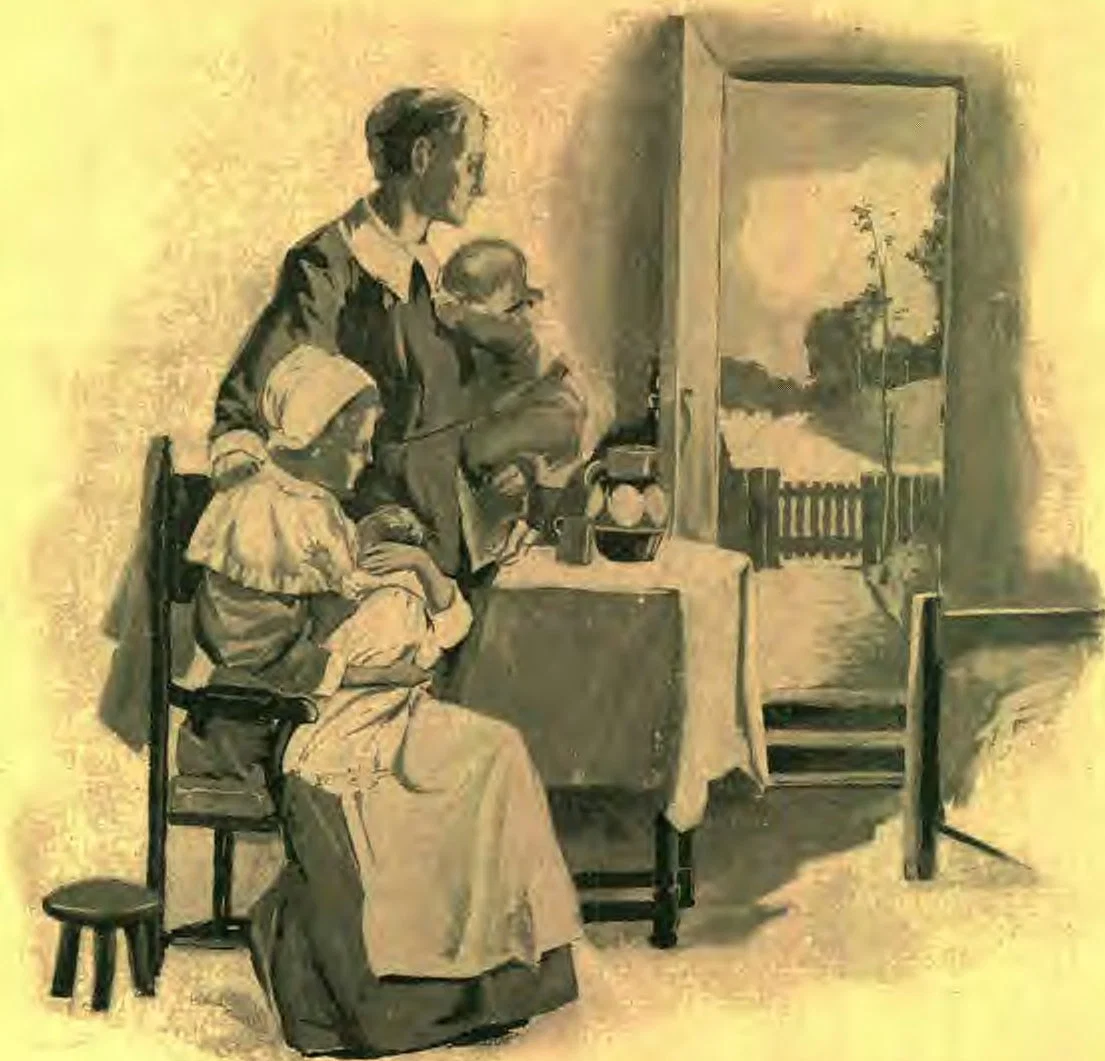
ROGER WILLIAMS LEAVING HIS FAMILY FOR A HOME IN THE WILDERNESS.
They could not understand his view of things. Like the Pharisees of old, they thought only of a carnal or temporal kingdom of the Lord Jesus. This will be more and more evident as the story proceeds.
The Puritans of Massachusetts Bay had indeed fled from Old England because they had been persecuted for their faith. Verily they came to New England in order that they might have liberty to worship God according to the dictates of conscience. But they never entertained any idea of setting up a State wherein men of all faiths, or of no faith at all, might do as they pleased in matters spiritual—in things pertaining to the soul. This thought was farthest from their mind.
Their intention, when they left the Old World, was to establish a theocracy modeled after that of ancient Israel. Clearly they forgot, or never knew, that God Himself had said of that fabric and form of government: "I will overturn, overturn, overturn, it; and it shall be no more, until He come whose right it is; and I will give it Him." To the Puritans, England represented Egypt; the Atlantic, the Red Sea; New England was the land of Canaan, and the Indians were the Amalekites, Amorites, and Philistines, who were worthy only of death.
The exact view which they held of the proper relation of Church and State was ably set forth by John Cotton, who for nineteen years was the "unmitered pope" of the Massachusetts Bay Colony, and in whose honor the city now called Boston received that name. Here are his own words:—
"It is better that the commonwealth be fashioned according to the setting forth of God's house, which is His church, than to accommodate the church frame to the civil State."
It was not a union of the two—Church and State—which the Puritans desired, "for that signified some equality at least of authority; but it was a church dominating the State, and using it to carry out its will."
These Puritans were intensely religious men. They earnestly desired that sin might be banished from the community. They were not naturally either heartless or cruel. Their atrocious persecutions sprang not from incarnate wickedness, but from their system. The more closely they adhered to that system themore unbearable did they make things for all within their jurisdiction, whose religious views did not wholly accord with their own.
Thus, the State was the servant, the tool, of the church. And the clergy ruled the church; for no one could be proposed for membership therein unless allowed by the elders. So says Hutchinson: "This must needs render the influence of the clergy very great under the Old Constitution. Nobody could be proposed for a member unless the minister allowed it. Nobody could be admitted a freeman unless he was a member of the church."
It follows from this that any one to become a freeman, that is a member of the body politic, must first be a member of the church. "By this means the clergy administered the temporal power and held fast thereto until the charter was wrested from their grasp in 1684."
The Puritans further believed that the Bible should be the statute-book of the State. The Ten Commandments were the supreme law of the land, and the corner-stone of their whole governmental edifice. Disobedience to parents, adultery, the worship of false gods, and covetousness, were all alike capital crimes punishable with death.
These things brought Roger Williams into immediate conflict with the authorities of Massachusetts Bay. He denied fearlessly, resolutely, and uncompromisingly that the civil magistrate had any jurisdiction over things religious, proclaiming instead, that in soul-matters "soul weapons" could only of right be used. He said that the civil ruler had a right to restrain crime, but no right to control opinion. Guilt should be punished, but inward freedom should never be infringed. The sacredness of the conscience was the almighty tenet which from first to last he so bravely defended.
This noble principle was exactly opposite to every theory of government which the Puritans held. It would wipe every religious statute from off the statute-book; it would extinguish the fires which had so long been burning on the altars of persecution, and repeal every act compelling attendance on public worship, and give equal protection to every class of creed and form of faith. His was a ringing annunciation of that grand old truth spoken by the Master Himself: "Render therefore unto Cæsar the things which are Cæsar's; and unto God the things that are God's." It virtually said to the oppressed of every land and clime: "Beneath my shadow and within my domain, find rest to your souls. Whether you be Jews or Christians, Roman Catholics or Mohammedans, you may worship your god in your own way, so long as you do not commit breaches of the civil peace."
How different is all this from the position taken by John Cotton, who in a draft of laws for the colony of Massachusetts said:—
Whosoever shall profane the Lord's day by doing unnecessary work, by unnecessary traveling, or by sports and recreations, he or they who so transgress shall forfeit forty shillings or be publicly whipped; but if it shall appear to have been done presumptuously, such person or persons shall be put to death, or otherwise severely punished at the discretion of the court.
No one shall run on the Sabbath day, or walk in his garden or elsewhere, except reverently to and from meeting.
No one shall travel, cook victuals, make beds, sweep house, cut hair, or shave on the Sabbath day.
In what, then, did the government of New England differ from that of Old England? The English threw off the tyranny of the pope and substituted for it that of the bishops. In Massachusetts they threw off the tyranny of the bishops and established that of the brethren. This was tersely put by William Blackstone in the parting shot which he threw at the New England clergy: "I fled from England to get rid of the lord's bishops; and now I flee from New England to get rid of the lord's brethren." Of real religious liberty there was none in the Puritan system. All that had been accomplished was the substitution of many little local popes in place of one big pope centrally located at Rome.
Williams maintained that the people were the origin of all free power in government; but that they were not invested by Christ Jesus with power to rule in His church; that they could give no such power to the magistrate, and that to "introduce the civil sword" into the kingdom of Christ, "was to confound heaven and earth, and lay all upon heaps of confusion." He maintained the then novel doctrine that the ecclesiastical should be totally separated from the civil power; and boldly demanded that the church and the magistracy should each act within its appropriate sphere.
There was clearly no place for Williams in Boston, but the church at Salem needed a minister and called Roger Williams to the charge. This greatly displeased the people at Boston, who remonstrated with their brethren at Salem for not consulting them in the matter. They made things so unpleasant for him that he finally left Salem and went to Plymouth, where he remained for two years, supporting himself by manual labor, and teaching in the church among the Pilgrim Fathers.

“BE YE THEREFORE PERFECT.”

“Be ye therefore perfect, even as your Father which is in heaven is perfect.” Man is to be perfect in his sphere, even as God is perfect in His sphere. How can such a lofty standard be reached? The required perfection is based on the perfection of Christ, “who of God is made unto us wisdom, and righteousness, and sanctification, and redemption.” He gave the command requiring perfection, He who was by birth a human being, though allied to divinity. He has passed over the road we are to tread, and He says, “Without Me ye can do nothing.” But with Him we can do everything. Thus a perfect character can be obtained. God never issues a command without furnishing the grace sufficient for its fulfilment. Ample provision has been made that man shall be a partaker of the divine nature.
“Be ye therefore perfect, even as your Father which is in heaven is perfect.” This is the standard God holds before His children. It is a standard of Christlikeness. Christianity means entire surrender to the will of God. Then it can be said of us, “Ye are complete in Him.”
When such possibilities are presented to us; when we see that it is our privilege to attain Christian perfection, should we not strive to reach the standard? Should not our one purpose be to appreciate and understand the high honor conferred upon us? Christ has shown us how the heavenly universe values the beings for whom He made so great a sacrifice. Men and women are God's by creation and by redemption, and those who receive Christ He invests with His strength. They are bound up with Him, and are fully capable of reaching the highest elevation of character.
It is the Lord's will that we should cherish a solemn sense of our accountability to Him, as the owner of the talents He has lent us. He desires us to appreciate His entrusted gifts, doing all in our power to reach the standard He has set before us.
In the varied lines of Christ's work, each part depends on every other part, and the perfection of the work depends on the co-operation of each part. God has made provision for the reciprocal action and the mutual relation of all animated beings. He has arranged that all shall be connected together, and the whole to God. No one can be dropped out of the Lord's plan without affecting the whole. Nothing is independent of the rest.
In creating man, God designed that each human being should be a part of the web of humanity. He pledged Himself to make every provision for the happiness of men and women by making it possible for them to be like Him. It is His purpose that nothing shall be wanting to their happiness if they remain loyal to His commandments. They are the objects of His special love and care, and He would make them consecrated channels through which blessings from His abundant resources shall flow to the world. How important then that each act his part with fidelity, striving with all his power to fulfil God's purpose for him.
Speaking of Christ, John says: “That was the true Light, which lighteth every man that cometh into the world. He was in the world, and the world was made by Him, and the world knew Him not. He came unto His own, and His own received Him not. But as many as received Him, to them gave He power to become the sons of God, even to them that believe on His name; which were born, not of blood, nor of the will of the flesh, nor of the will of man, but of God. And the Word was made flesh, and dwelt among us (and we beheld His glory, the glory as of the only begotten of the Father), full of grace and truth. . . And of His fulness have all we received, and grace for grace.”
Here we are shown what we may become by looking unto Jesus, the Author and Finisher of our faith. If humanity will co-operate with divinity, He who made so great a sacrifice in behalf of the human race will complete that which He has begun. Of Himself man cannot obtain completeness, but every gift of heaven is granted to those who will co-operate with Christ, striving day by day for the mastery over the deceptive temptations of the enemy. By searching, we cannot find out God, but Christ has declared Him. “Show us the Father,” Philip said, and Jesus answered: “Have I been so long time with you, and yet hast thou not known Me, Philip? He that hath seen Me hath seen the Father.”
Christ came to clothe His people with His righteousness. But they would not receive Him, and with pale and quivering lips and broken utterance He exclaimed, “If thou hadst known, even thou at least in this thy day, the things which belong unto thy peace!” Then came a pause, for the Saviour was reluctant to pronounce the irrevocable sentence—“but now they are hid from thine eyes.” It was with a burst of agony that Christ spoke these words. He was bearing a great burden for the people of His care, but they knew not the time of their visitation. The superhuman agony of the Son of God was keenly felt in the heavenly courts, but those for whom He shed bitter tears knew not their day of grace.This is the great sin of which men and women are guilty to-day. They appreciate not the blessings and privileges within their reach. “In this thy day.” The day is nearing its close. We are living amid the last scenes of this earth's history. Can it be that we shall be among the number that Christ mentioned with so much sorrow as He halted on the crest of Olivet? O, that all would know in this their day the things that belong to their peace. Shall Christ say to any one of us, “But now they are hid from thine eyes”? He will be obliged to do so if we fail to show our appreciation of His mercy by doing all in our power to co-operate with Him.
When Christ said, “Be ye therefore perfect, even as your Father which is in heaven is perfect,” He had in view purity of purpose and action. It is essential for every soul who desires increased knowledge, to possess this purity. There is great need of purity as well as of knowledge.
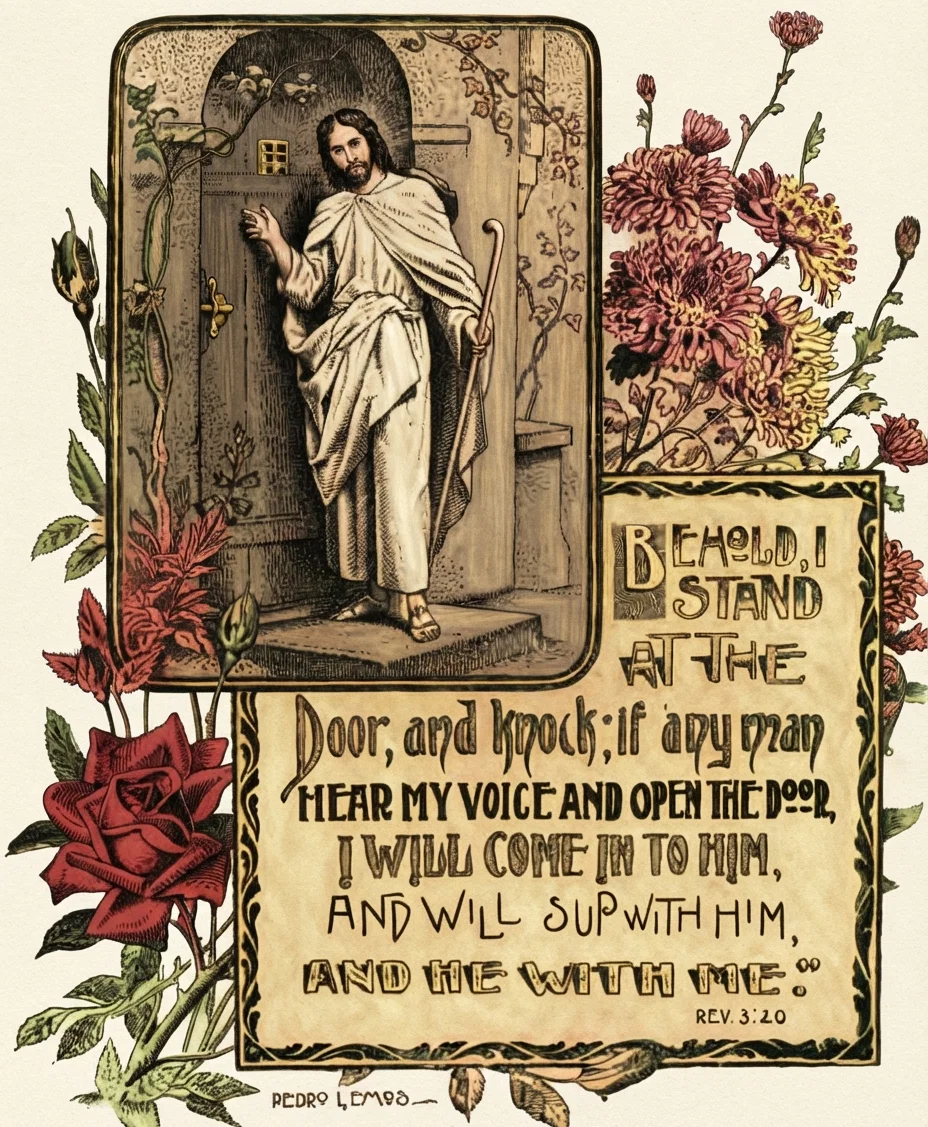
Perfection can be attained only through the grace given by God. He will be the efficiency of every soul who strives for clear, far-seeing moral faculties. But He requires the co-operation of the human agent. Temperance must be practised in all things, in eating, in drinking, in all the habits of life. Christ said to His disciples, “If any man will come after Me, let him deny himself, and take up his cross, and follow Me.” He would have us follow Him as tho wholly in earnest. He would have us cultivate a whole-souled earnestness. Some may call this enthusiasm; but if there is any subject in the world worthy of enthusiasm, it is the subject of redemption. We must be heartily enthusiastic over the wonderful work of our salvation. Each one may be so inspired by the life-work of Christ that he will become full of an earnest desire to be a true-hearted Christian. But those who think it will be just as well to be half for Christ and half for the world are under a great deception. They are neither cold nor hot. They are neither successful worldlings nor successful Christians, and Christ says of them: “Because thou sayest, I am rich, and increased with goods, and have need of nothing; and knowest not that thou art wretched, and miserable, and poor, and blind, and naked; I counsel thee to buy of Me gold tried in the fire, that thou mayest be rich, and white raiment, that thou mayest be clothed, and that the shame of thy nakedness do not appear; and anoint thine eyes with eye-salve, that thou mayest see. As many as I love, I rebuke and chasten; be zealous therefore, and repent. Behold, I stand at the door, and knock. If any man hear My voice, and open the door, I will come in to him, and will sup with him, and he with Me.”
The Lord calls for sincere, earnest work. Half-heartedness spoils us for both worlds. When weighed in the balances of the sanctuary, those who have done surface work will be found wanting. Without life in Christ there can be no spiritual growth, no real development. We each need to grow in grace and in the knowledge of the truth. We turn our blessings into a curse both to our own souls and to the souls of others when we do not do this.
Mrs. E. G. WHITE.

IN ANY EVENT, WORK ON.

AND should the twilight darken into night, And sorrow grow to anguish, be thou strong; Thou art in God, and nothing can go wrong Which a fresh life-pulse can not set aright. That thou dost know the darkness, proves the light. Weep if thou wilt, but weep not all too long, Or weep and work, for work will lead to song. —Geo. McDonald.

BAPTISM WITH THE HOLY GHOST.

God tells us that those who believe on Christ should receive the Holy Ghost.
At Pentecost 3,000 were converted and baptized, and when Peter had preached the second time, the number of converts (Acts 4:4) was about 5,000 men. When Peter and John were released they went to their own company of believers; "and when they had prayed, the place was shaken where they were assembled together; and they were all filled with the Holy Ghost, and they spake the Word of God with boldness. And the multitude of them that believed were of one heart and of one soul." Acts 4:31, 32.
If those who were converted under the fire of pentecostal preaching needed also to be baptized with the Holy Ghost, do not we need it?
Paul was converted on his way to Damascus, and three days later was baptized with the Holy Ghost. Acts 9:17. If Paul, who was so miraculously converted, needed also to be baptized with the Holy Ghost, do not all preachers need it?
If those who were converted under the preaching of the Spirit-baptized Philip, needed also to be baptized with the Holy Ghost, do not those converted under modern preachers need it? What can we possibly have more than Philip had?
Need I say more? The apostles preached, first repentance and baptism, and afterwards the baptism with the Holy Ghost, which, as a rule, was sought and obtained in the public assembly, and on this basis was the church of Christ firmly established.
Do you not often feel that something is wanting in your breast? Do you not recognize that vacuum which the Spirit alone can fill? Do you not sometimes feel when you pray, that all is not right in your heart, and do you not yearn for that peace which passeth understanding? That is the Spirit of God knocking for admittance. Rev. 3:20.
How long will we, who profess the name of Christ, urge sinners to repent, while we ourselves reject the plain command, "Be filled with the Spirit"? Eph. 5:18.
How long shall we continue to give a mental assent to the baptism with the Holy Ghost, and deny it before the world by our lives? How long?
If you want this baptism, read Matt. 5:6; Rom. 12:1, 2; Acts 15:8, 9; Luke 11:13, and seek it by prayer and faith.
D. B. STROUSE. Salem, Va.

"I THIRST."

[Dr. Alexander MacLaren in S. S. Times.]
THE second of the words on the cross which we owe to John is that pathetic expression, "I thirst." Most significant is the insight into our Lord's consciousness which John, here as elsewhere, ventures to give. Not till He knew "that all things were accomplished" did He give heed to the pangs of thirst, which made so terrible a part of the torture of crucifixion. The strong will kept back the bodily cravings so long as any unfulfilled duty remained. Now Jesus had nothing to do but to die, and before He died He let flesh have one little alleviation. He had refused the stupefying draught which would have lessened suffering by dulling consciousness, but He asked for the draught which would momentarily slake the agony of parched lips and burning throat.
The words of verse 28 (John 19) are not to be taken as meaning that Jesus said, "I thirst," with the mere intention of fulfilling the scripture. His utterance was the plaint of a real need, not a performance to fill a part. But it is John who sees in that wholly natural cry the fulfilment of the psalm. Psa. 69:21. All Christ's bodily sufferings may be said to be summed up in this one word, the only one in which they found utterance. The same lips that said, "If any man thirst, let him come unto Me, and drink," said this. Infinitely pathetic in itself, that cry becomes almost awful in its appeal to us when we remember who uttered it, and why He bore these pangs. The very Fountain of living water knew the pang of thirst, that every one that thirsteth might come to the waters, and might drink, not water only, but "wine and milk," without money or price.

Sunday Laws Cannot Promote Sabbath Keeping

The Sunday-closing people want everybody and everything, good and bad—the irreligious, the atheistic, the saloon, the theater and the gambling house—to keep the sabbath. God wants nobody to try to keep the Sabbath before he is converted; and wants no evil thing to pretend to do homage to His day. There is no call for such places to be closed on the seventh day.
The Sabbath, to be kept at all, must be kept holy, and as no human law can command holiness, no such law can promote or protect Sabbath-keeping. Hence, even were Sunday the Sabbath, a Sunday law could be no barrier to Sabbath-breaking.—Keene (Texas) Weekly Record.

THE LESSON IN THE "FATHER OF THE FAITHFUL."

WHEN God said to Abraham; "Get thee out of thy country, and from thy kindred, and from thy father's house, unto a land that I will show thee," Abraham "went out, not knowing whither he went."
God had not yet showed him the land or country into which he was to go, and which was to be his. So far, the Lord had only promised to show it to him.
There were three things, however, which Abraham must do before he could fairly expect God to show him the country which He had promised, and which was to be his. First, he was to get out of his country; secondly, from his kindred; thirdly, from his father's house.
He left his country; but when he did so his father and his kindred went with him to Haran, and dwelt there. There his father died; and now, separated from his father's house, he went on to the land of Canaan.
But there accompanied him yet one of his kindred—Lot, his brother's son. While Lot was with him, and he was thus not separated from his kindred, though separated from his country and his father's house, the time could not come for God to show him the land, nor the country which He would give him.
But there came a day when Lot should be separated from him. Lot chose all the plain of the Jordan, and journeyed east, and "they separated thus, one from the other."
And just then it was that God showed Abraham the land which He had promised to show him, the country which should be his.
"And the Lord said unto Abraham, after that Lot was separated from him, Lift up now thine eyes, and look from the place where thou art northward, and southward, and eastward, and westward; for all the land which thou seest, to thee will I give it, and to thy seed forever." Gen. 13:14, 15.
And the country which the Lord then showed to Abraham, and which He there promised him should be his for an everlasting possession—that country embraced the world; for "the promise, that he should be the heir of the world, was not to Abraham, or to his seed, through the law, but through the righteousness of faith." Rom. 4:13.
Therefore, when at the word of the Lord Abraham lifted up his eyes to see what the Lord would show him, he saw "the world to come," which is to be the everlasting possession of all them which be of faith. For "if ye be Christ's, then are ye Abraham's seed, and heirs according to the promise." Gal. 3:29.
And from that day forward Abraham "sojourned in the land of promise as in a strange country;" looking for "a better country, that is, an heavenly;" and looking "for a city which hath foundations, whose builder and maker is God." Heb. 11:9, 16, 8. For tho God promised that He would give to Abraham that land, and to his seed after him, yet as long as he was in this world God really "gave him none inheritance in it, no, not so much as to set his foot on." Acts 7:5.
Now note: God had called Abraham out of his original country, and thus had separated him from that. Then He gave him not even so much as to set his foot on in any other country in this world.
Abraham at that time represented the religion of God. The Lord in His dealing thus with Abraham and in recording it, has shown, for all time and to all people, that it is His will that there should be an absolute separation of His religion from any State. And in thus showing the complete separation of His religion from any State, He shows that this separation consists in the separation of the individual believer of His religion from any State. Are you walking in the steps of that faith of our father Abraham, the friend of God?
Abraham, representing at that time the church of Christ, being thus totally separated by the Lord from every State and country on the earth, there is thus shown to all people, as an original truth of the Gospel of Christ, that there should be total separation of Church and State, and that the church of Christ can never have any country in the world. And in thus showing that the church of Christ can never have any country in this world, He shows that the individual members of the church of Christ can never have any country in this world. For that which composes the church of Christ is the individual membership.
So also dwelt Isaac and Jacob, heirs with Abraham of the same promise, accepting with Abraham separation from every earthly State and country, confessing "that they were strangers and pilgrims on the earth," looking for the country which God had prepared for them, and the city which hath foundations, whose builder and maker is God.
And that they accepted this freely of their own choice, by faith in God, is shown by the fact, as recorded: "Truly, if they had been mindful of that country from whence they came out, they might have had opportunity to have returned. But now they desire a better country, that is, an heavenly; wherefore God is not ashamed to be called their God, for He hath prepared for them a city." Heb. 11:15, 16.
This dealing of God with Abraham, and the record of it, were for the instruction of all the people who would believe God, from that time to the world's end. For Abraham was the called, the chosen, the friend of God, the father of all them that believe. And all they which be of faith are blessed with faithful Abraham. And not the least element of instruction in this account of God's dealings with Abraham, is the great lesson it teaches that the religion of God means separation of religion and the State. Are you walking in the steps of that faith of our father Abraham—have you gotten out of your country? Or have you still a country in this world? Is there in you a union of religion and the State?
Further, "Now to Abraham and his seed were the promises made. He saith not, And to seeds, as of many; but as of one, And to thy Seed, which is Christ." Gal. 3:16. Therefore the promises recorded and referred to in the scripture, "To Abraham and his seed," are always to Abraham and Christ, and to Abraham in Christ. And therefore, "If ye be Christ's, then are ye Abraham's seed, and heirs according to the promise."
And when Christ, that promised Seed, came into the world a man amongst men, then in Him, as formerly in Abraham, there was represented the religion of God and the church of Christ. And as such He ever maintained the same principle of separation of religion and the State which He Himself had set before the world in the life and record of Abraham.
He refused to recognize, even by a sign, the wish of the people to make Him king. John 6:15. He refused, when requested, to act the part of a judge or a divider over men as to the rights of property. Luke 12:13-15. He refused to recognize the national lines of distinction, the wall of partition, which Israel in their exclusiveness had built up between themselves and other nations. He refused to judge, or to allow any others to judge, any one for not believing on Him. John 12:47, 48. He distinctly declared that tho He is a king, yet His kingdom is not of this world, and that it is not in any way connected with this world. John 18:36. He distinctly declared the separation of His religion from the State. "Render to Caesar the things that are Caesar's, and to God the things that are God's." Mark 12:17. And when He sent forth His disciples with His heavenly commission to preach the Gospel of His kingdom, He sent them not to one particular nation, but to "teach all nations, baptizing them in the name of the Father and the Son and the Holy Ghost." He sent them to preach the Gospel; not to one particular, favored, exclusive people, but "to every creature."
Thus it is seen again that in every phase of the fundamental principle of the religion of God and the church of Christ, from the beginning to the end of the world, there is required the absolute separation of religion and the State—the total disconnection of His church from every State and country in the world, and from the world itself.
And this total disconnection of His church from every State and country in this world, and from the world itself, is, and can be, accomplished only by the total disconnection of the individual members of His church from every State and country in the world, and from the world itself. "Ye are not of the world; for I have chosen you out of the world." "They are not of the world, even as I am not of the world." John 15:19; 17:16. Are you?
Continue reading: DOCTRINE OF ETERNAL MISERY