IN an article calculated to show that war is doomed, Alexander Sutherland, writing in the Nineteenth Century magazine, declares that the "brutal and unsympathetic strains" of human nature are being worked out, thus "leaving the earth to be possessed by the sympathetic."
This seems to be a new version of the "peace and safety" cry, and we notice his argument with interest as showing the lack of accuracy in the "working hypothesis" usually employed by such reasoners.
"If," he says, "the unkind and unsympathetic parent loses more of his children than the average parent, then here again we have a culling process. . . . As with individuals so with races. . . . A vast process of elimination is therefore going on, by means of which the world is given, more and more, into the possession of the sympathetic type. . . . On the whole, the kindly dispositions tend ever more and more, to prevail over the cruel. And therefore, czar or no czar, wars are eventually doomed, and peace must come in its own good time."
Mr. Sutherland also refers to the cruelty of pagan warfare as contrasted with the more "humane" wars of to-day.
Now as to the death of children of unsympathetic parents, Dr. Brewer, one of Chicago's leading physicians, said in a recent lecture: "The percentage of criminals has increased so rapidly in the United States that we now have one habitual or hereditary criminal in every thousand people. Criminals also propagate, marry and multiply unrestrained, and unless we change our laws, will continue to increase at the same ratio they have in the past, until it is appalling to contemplate the result." Much more might be given to show that the unsympathetic side of human nature is fast gaining an overpowering ascendancy over the sympathetic.
But let us turn to the question of "humane warfare." The Nation (April 20) says: "This war [Anglo-Philippine] is the most savage war which was ever known in the history of our republic. . . . The war of 1898, 'for the cause of humanity,' has degenerated into a war of conquest, characterized by rapine and cruelty worthy of savages. . . . The fact is now fully established that in many cases the rule has been that our troops take no prisoners."
Do they let them go free?—Alas, no.
Chas. Brenner (of Minneapolis, Kansas) writes: "Company I had taken a few prisoners and stopped. The colonel ordered them into line time after time, and finally sent Captain Bishop back to start them. Then occurred the hardest sight I ever saw. They had taken four prisoners and didn't know what to do with them. They asked Captain Bishop what to do, and he said, 'You know the orders,' and four natives fell dead."
Leonard F. Adams (of the Washington regiment) writes: "I don't know how many men, women, and children the Tennessee boys did kill. They would not take any prisoners. One company of the Tennessee boys was sent into headquarters with thirty prisoners, and got there with about a hundred chickens and no prisoners."
F. B. Hinchman (Company A., U. S. engineers) says: "I met one of the company, who told me that the 14th and Washingtons were driving all before them, and taking no prisoners. This is now our rule of procedure."
These letters and hundreds like them tell a story that makes our hearts burn with horror and indignation. O, why, when the earth is filled with violence and inhuman deeds, will men declare that the world is growing better? But, more than this, "evil men and seducers shall wax worse and worse, deceiving and being deceived," till "sudden destruction cometh upon them, . . . and they shall not escape."
THEN AND NOW.
By T.
THE beginning of the sixteenth century marked a very dark spot in the world's history. But at the same time the people of the world, to a large extent, were professors of Christianity. The whole land was full of churches, and monasteries, and convents. The outwardly pious might be seen everywhere saying their prayers, and going through all the forms and ceremonies of what was termed Christianity. If a man was asked about his faith, his invariable reply was that he believed in and belonged to the church of Christ. But every one knows that those times were full of superstitions of every form and type. There were also the grossest vices and the darkest crimes and evils. And this, too, notwithstanding the great pretensions to Christianity that were so apparent everywhere. God did not recognize nor own the pretended Christianity of that time, but sent the Reformation to bring to light the real Christianity and thereby expose the spurious that was everywhere vaunting itself. If the world had9not received the uplifting influence of the Reformation at that time it would soon have gone to destruction. There could have been no way to avert it.
We are living in times to-day that are no less marked by Christian pretension. There is a vast throng that claim to be followers of Christ. Yet it is a notable fact that only a few of this great number are, in reality, Christians. There are no manifest marks of distinction to-day between the professed churches of Christianity and the world at large. It was not so in the days of the apostles. And it is true to-day and always has been true that the real follower of Christ presents a marked contrast to the unbelieving world.
We can look back upon the sixteenth century and very plainly see how much a reformation was needed in that time. And if our eyes are truly open, we can see that even a far mightier reformation is needed now.
God is sending His Word, with all of its sanctifying and purifying truth, into the world to save it now. He is doing this in even a more marked and marvelous manner than He did in the sixteenth century. Will we heed that Word and be Christians indeed, and consequently reformers? or will we go heedlessly on and be lost in the great destruction that is now so imminent? T.
THE TRUSTS.
By T.
GREAT BRITAIN is rapidly following the example of the United States in the formation of trusts.
Trusts formed there recently have absorbed the sewing-cotton business, Scotch cotton yarn dyeing, flannel and blanket manufacturing, worsted yarn and slubbing yarn dyeing, velvet dyeing, card dyeing, rubber manufacturing, the Lancashire coal business, wallpaper making, armor-plate making, etc.
England is a free-trade country, and it has been argued by many that the trusts could not flourish except under a protective tariff; but it should be manifest to any unprejudiced observer that neither tariff nor free-trade is the germ of the trust disease. The foundation of this evil lies in the grasping covetousness that is in the human heart. We may seek anywhere else for the evil, but we will never find it. We may see something else that we think is the cause of it; but sooner or later we will be compelled to acknowledge our error. Just so long as men find it in their hearts to desire to pile up wealth, regardless of the rights of others, just so long will they find a way to do it, and tariff or free-trade or any and all forms of legislation will either be evaded or made to serve their ends.
A very ancient writing tells with unmistakable plainness both the cause and significance of this trust evil. It says: "This know also, that in the last days perilous times shall come. For men shall be lovers of their own selves, covetous." 2 Tim. 3: 1, 2.
In this self-love and covetousness is the foundation for the trusts. And observe that the text says that this is to be in the "last days," and that it will also make these days "perilous."
What greater evil threatens the world to-day than the conflict between capital and labor? This is one of the recognized perils of these times. And this very condition of things is one of the means by which we may know that the last days are here. Why not recognize this perfectly plain truth that God has revealed to us in His Word? T.
Peace and Prospect
By Editor
Peace and Prospect.
Peace and Prospect.—The world is resounding with the voices that are telling of an era of peace just before us. But our artist gives us the correct view of the situation. The person is blind who does not see that the world is entering an unprecedented era of war, and not an era of peace. We have had the spectacle of a Peace Congress in session at The Hague since May 18, but what can be shown as the result? Right while the congress is in session, Russia, the power that called the meeting, is urging the United States to form an alliance with them, and not draw any closer to England; she is also pushing her interests in China, and Great Britain is all stirred up over it. Reports from London say that the rank and file of the Englishmen have no faith in Russia, and urge that no dependence be placed in any of her overtures or propositions. France is still in a feverish ferment over the Dreyfus affair. Germany is all activity over her military matters. King Leopold has called M. Beernaert from the congress at The Hague to assist in quelling the riots in Brussels. King Humbert has a riot on his hands, and so the world goes. The outlook is not that of peace. We are standing face to face with the great battle of Armageddon. Let all the world know it, and let every one understand what it means.
Storms and Floods
By Editor
THERE have always been occasional floods and storms. But the country along the rivers expects, now-a-days, to be visited by a flood at least once a year. And it is no uncommon thing to read that these floods are the greatest that have ever been known. The floods in Texas and portions of Kansas during the past few days have spread ruin and disaster everywhere. These things would not be so remarkable if they stood alone. But they are only a part of the general turbulent manifestations that surround us on every hand. And let it ever be borne in mind that the storms and floods that we have had so far, are as nothing when compared with what is coming. Read the prophecies and see what is predicted for these times. God has told us beforehand so that we might have confidence in His Word and seek the secure shelter.
The Storm Brewing
A FEW days ago one of New York’s great capitalists received a letter warning him that his life was in danger, and advising him to be on the lookout. This is but one of many circumstances that are so characteristic of these times. There is a storm brewing. The pent-up feelings of those who are aggrieved at the rich are beginning to break loose. Of course it is not right for one man to thus seek to destroy another. But the men of wealth are pursuing a wrong course, and where men do not submit to the grace of God, to be held for the right, it may be expected that they will combine for vigorous and violent action against the oppressions of capitalists.
The first part of the fifth chapter of James places the situation before us in its true light.
The Lust of War
“The Lust of War.”—Prof. Goldwin Smith, LL. D., in an article in a recent Independent, combats the idea that a national character suffers by prolonged peace, and deplores the war spirit which incites even among women the fierce passions of revenge. He truly says: “To a nation war in a bad cause is moral poison. The idea that the violent passions which the war calls into play will kill the meaner passions, such as the lust of gain, it must be said once more is utterly baseless. War is the very harvest-time of the stockjobber and the appointed season of ‘embalmed beef.’”
Farther on he remarks: “There seems to have suddenly come over us a sort of satiety of civilization. Not only is there a revival of the lust of war, but barbarous practises, such as dueling, now recognized in every European country except England, and barbarous sports, such as prize-fighting, are coming again into vogue. It seems that bull-fighting, hitherto deemed the disgrace of Spain, is about to be imported into France [and America also]. When I was young prize-fighting was deemed disreputable; now prize-fights are reported at length in first-class journals, and women are beginning to attend the ring. In the press, and not in its lowest organs, we read avowals of respect for brute force and contempt of moral restraint, which in the last generation would scarcely have proceeded from the most cynical of writers or public men. The Declaration of Independence, to whatever criticism it may be liable, is at all events a charter of humanity; a charter of inhumanity appears now to be taking its place.”
And this “lust of war,” this contempt of moral restraint, in this generation are the fulfilment of what God has over and over predicted in His Word as the state of things to precede His second advent. The cause is rejection of the Word and Law of God.
THE CLAMOR FOR REFORMS.
THE remarkable unrest and discontent of these times is very strikingly shown by the numerous advocates for reform. Nearly every one acknowledges that the world is greatly in need of reforming. All affirm that the times are sadly out of joint, and that problems confront us that portend a world-wide revolution.
To solve these problems there are hundreds of reform societies in the field. The Social and Political Conference that was convened in New York on June 28, was called for the purpose of combining these reform elements with a view to create an influence that would work a reformation. And while some have thought that much was accomplished, yet it is manifest that but very little was done more than to emphasize the fact that there are crying evils in the land,—and evils, too, that must be corrected soon if disaster is to be averted.
There is just one sure reform for all of these evils. And that reform is their destruction at the second coming of Christ. All the events of these times show that the second coming of Christ is right at hand, and toward that time every true reformer should turn his eyes, and furthermore, his whole heart and soul should be cast into the work of telling the world that the Lord is coming, and the exhortation should be heralded with fervor, “Watch ye therefore; for ye know not when the Master of the house cometh, at even, or at midnight, or at the cockcrowing, or in the morning; lest coming suddenly He find you sleeping. And what I say unto you I say unto all, Watch.” Mark 13: 35-37.
A Prophecy.
By Editor
Who can not see that the present tendency to combine, associate, confederate, is the effort on the part of men to save themselves from impending calamity? And what student of prophecy is there who can not see its futility as set forth in the “more sure Word”? So men will write against the truth of God and principles of right. Here is a prophecy which applies to that very thing: “Associate yourselves, O ye people, and ye shall be broken in pieces; and give ear, all ye of far countries; gird yourselves, and ye shall be broken in pieces; gird yourselves and ye shall be broken in pieces. Take counsel together, and it shall come to naught; speak the word, and it shall not stand; for God is with us,”
For the Lord spake thus to me with a strong hand, and instructed me that I should not walk in the way of this people, saying: Say ye not, A confederacy, to all them to whom this people shall say, A confederacy; neither fear ye their fear, nor be afraid.” When calamity impends, do not cry as the refuge, “A confederacy.” But what shall we do?—“Sanctify the Lord of hosts Himself [in your hearts, 1 Peter 3:15]; and let Him be your fear, and let Him be your dread. And He shall be for a sanctuary.” See Isa. 8: 9-14.
Of One
Of One.—Says a Catholic writer, in speaking of the cruelty of fashion in corsets, hats, and shoes: “If these disciplines were for religious mortification there would be some sense in their adoption; but, in point of fact, they are pitiful tributes to the unspiritual god ‘fashion,’ and are therefore vicious instead of meritorious.”
But there is no sense in the mortification of the flesh in religion. In fashion it is pride, in religion it is fear that regulates such senseless observances. The God of heaven does not require such. Such practices are the worship of a false god, one with fashion—carnal.
SOUTH AMERICA.
By F. H. Westphal
Paraguay.
PARAGUAY is a small inland republic in the south central part of South America, and has an area of 91,970 square miles and a population of 648,299. The chief industry is stock-raising. This country is appropriately called "the garden of South America." It is connected with the sea only by the rivers Paraguay, Parana, and La Plata, at Montevideo, a thousand miles directly south.
Before the war of 1864 to 1870 the population was 1,337,430, but at the close it was reduced to 221,080, and two-thirds of these were women and children. This war was fought with Brazil, Uruguay, and Argentina on one side and Paraguay alone on the other. Immigration has greatly increased the population of late years.
The capital city has a population of forty thousand. San Pedro, Villa Rica, and Concepcion are the only other towns that have more than ten thousand inhabitants. There are eight others that have more than four thousand. There are several colonies, and among these are three German and German-Swiss, and one small English-Australian colony. The resources of the country are only beginning to be developed. The climate is healthful, and the government offers free passage to immigrants from Buenos Ayres.
The chief products are yerba-mate, or Paraguayan tea, corn, rice, coffee, manioc, tobacco, oranges, and bananas. There is much good land for pasture. The language of the interior is the Guarani, and the only portion of the Bible translated into it is the Sermon on the Mount. The differences in the dialect make it of no practical value.
From 1608 to 1767 the Jesuit missionaries labored successfully among the Guarani Indians, and for more than a century and a half they had absolute control over Paraguay and Missiones. All that marks their sojourn are the ruins of houses that they built and the orange groves they planted. The Indians were not benefited spiritually, morally, or intellectually. There are none that can read. The Spanish language is the legal language, but religious and civil liberty is enjoyed there by all classes. The financial system is defective. One dollar of gold is worth six of the national paper, which is also fluctuating. The country is open for immigrants, and therefore they are welcome.
Uruguay.
This republic is the smallest of all the South American countries. Its area is 72,110 square miles, and it has a population of 648,299. In point of development, industry, and products, this country is much on a par with the province of Buenos Ayres. It supports some 5,250,000 head of cattle and 13,000,000 sheep. The soil is rich and fertile, producing in abundance every kind of grain or fruit known in temperate and sub-tropical climes.
There are numerous settlements of Canary Islanders in the departments Canelones and San Jose, who raise large quantities of grain, chiefly wheat, and keep 100 steam and water mills constantly busy.
The country is divided into nineteen departments. It has a republican form of administration, and liberty of worship is granted. Brother Vuilleumier is now laboring in the colony of the Vaudois of Piemonte, which was founded by 55 families in 1857, and now numbers 2,200 souls. These speak the French language as well as the Spanish. The Nueva Helvacia, or German-Swiss colony, is bordering on it, and there is where the Nueva Helvacia Seventh-day Adventist Church is located.
Montevideo is the capital city of Uruguay, and has about 175,000 inhabitants. It has a very attractive appearance, whether seen from a vessel entering port or on the land side. It stands on a tongue of land between the bay and the Atlantic. Its streets are enlivened by the cool sea-breezes and showers of rain. The climate is exceedingly pleasant. It is the best-built city in South America. The commerce is most remarkable. In geographical position it exceeds any other city in South America.
The people of Uruguay are generally kind. Revolutions have often shaken them up, and it should not be hard to show them that greater interests should be sought than this world can offer. The country being so small, such revolutions could not help but affect the peace of families. For an example, the revolution of 1896-7 was a party strife, and therefore son fought against father, brother against brother, and too often sister against sister. O, the cruelty of this world! When will it learn the way of peace and life and happiness? The Gospel of love and peace ought to be proclaimed by thousands of voices everywhere.
Argentina.
Aside from Brazil the Argentine Republic is the largest and most important country in South America. The area is 1,125,086 square miles, or a little over one-third as large as all of the United States. The population is 4,086,492. The increase is 400 per cent. every 42 years, and since immigration is increasing still more rapidly, the population is much greater than the statistics show.
The country is divided into fourteen provinces and nine territories, after the model of the United States. It lies nearly all in the temperate zone, and has a good climate, varying according to latitude and elevation.
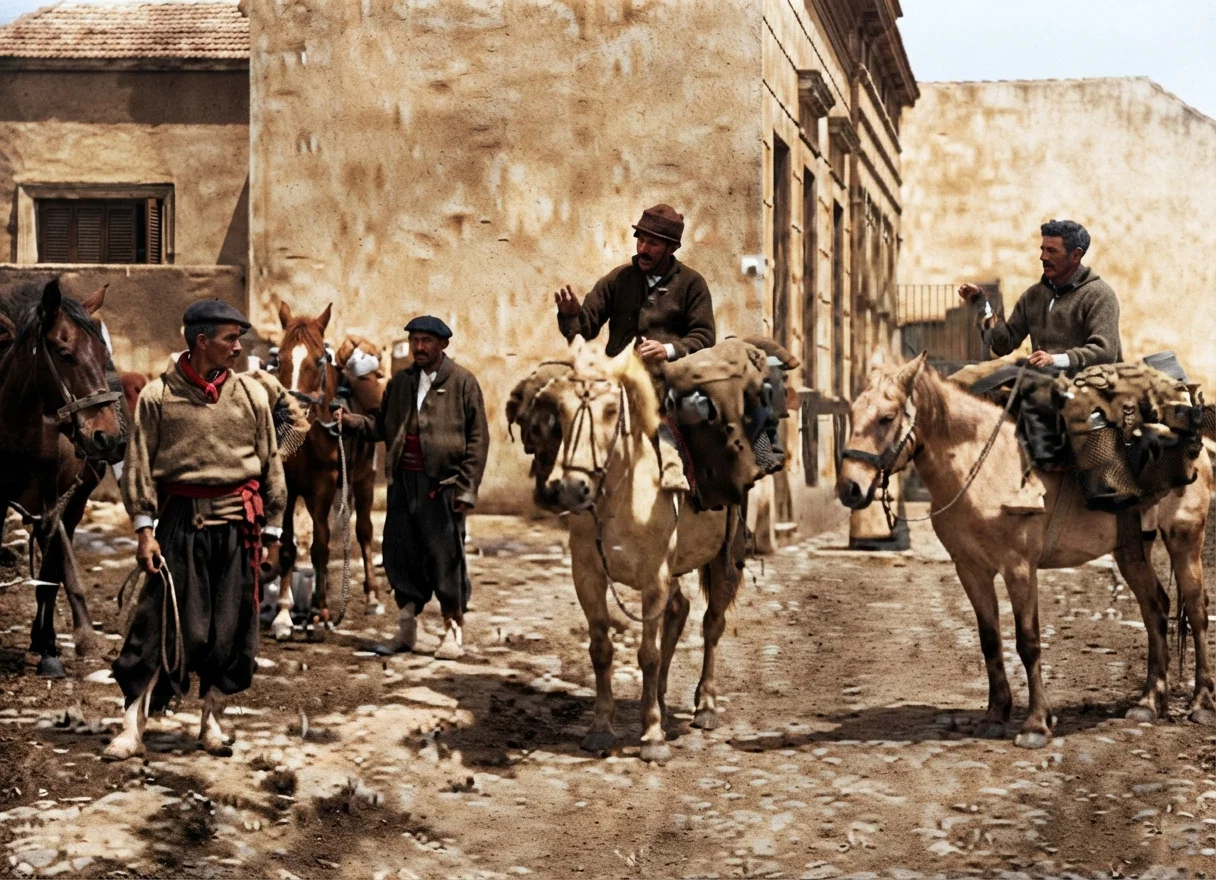
Milkmen of Buenos Ayres.
The exports during the year 1897 amounted to over 62,000,000 dollars, gold. The immigration during the same time was over 100,000 Europeans. Many nations are largely represented, and some of the principal ones as follows: Italians, 492,636; Spaniards, 198,685; French, 94,098; Germans, 17,143; Austrians, 12,803; German and Jewish Russians, 15,047; German, French, and Italian Swiss, 14,789; North Americans, 1,381; and English, 22,000.
Buenos Ayres, the capital, is the largest and most important city of South America, and has a population of over 700,000. It is the center of Spanish influence in South America. The government is taking an interest in educating the children. It has established schools, and there are 365,841 scholars. For every student the government spends $11, which will amount to a tax of 75 cents for each individual. The United States spends $16.50 for every student. The number of children of school age are 720,000 in Argentina, and thus it will be seen that not one-half yet attend school in spite of what the government has done to provide primary education. There is not school11room enough to accommodate all the children, not even in the city of Buenos Ayres.
There is an extensive railroad system and many boat lines, so that not only all the principal parts of the country can easily be reached, but other countries as well. Electric trainways and lights have been introduced. Modern warships have been secured and soldiers are being trained. In agriculture the modern machinery is employed. Beautiful scenery, mineral springs, and rich soil for cultivation are abundant. Much to promote happiness and prosperity is provided both by nature and the government.
Religious toleration is granted to all denominations alike. Generally the Argentinian people are friendly and hospitable. The people are vivacious in conversation, talking with the head, shoulders, feet, and hands. This may be the result of the influence of priesthood for so many years—that their gestures have fixed themselves on the people. Argentina, with Paraguay and Uruguay, offers an extensive field for families to come and live the Gospel truth among the people.
Immigrants are boarded five days in Buenos Ayres on government expense, provided they come second or third class on the steamers. They are then transferred to the place they choose to live in, and at the end of the journey, if necessary, boarded ten days at the expense of the government.
The work of the Lord is also progressing in this country. About four hundred have united with us in church fellowship. The tithe and donations of the past year amounted to about two thousand dollars. We have four ordained ministers and one Bible worker in the field, and two colporters. A colporter school has been conducted and four or five trained. The crops have been better, and we expect to see the colporter's work prosper. One young man has entered the work, and is preaching the truth at his own expense. Twelve souls have been converted under his labors. The workers are all of good courage and good cheer, and we hope to see many souls in the kingdom of God from Argentina.
The work has nevertheless but just begun, as some of the provinces have as yet not been visited by our workers. Much of the field is just as much unworked as Paraguay.
F. H. WESTPHAL.
MISSIONS
FOR ME.
UNDER an Eastern sky,
Amid a rabble's cry,
A Man went forth to die
For me.
Thorn-crowned His blessed head;
Blood-stained His every tread;
Cross-laden, on He sped
For me.
Pierced were His hands and feet;
Three hours did o'er Him beat
Fierce rays of noontide heat,
For me.
Thus wert Thou made all mine;
Lord, make me wholly Thine;
Grant grace and strength divine
To me,
In thought, and word, and deed
Thy will to do. Oh, lead
My soul, e'en though it bleed,
To Thee.
—Anon.
"CAST THY BREAD UPON THE WATERS; FOR THOU SHALT FIND IT AFTER MANY DAYS."
By C. SORENSON
A FAMILY of Christian people were very much concerned about the salvation of one of their unbelieving neighbors. They were receiving much help from the SIGNS OF THE TIMES, and, after they had read the papers, they gave them to this neighbor. There seemed, however, to be but little hope of his receiving any benefit from them, for, in place of reading them, he used them to cover the bare walls of his little cabin.
This man was an inveterate smoker, and during the long winter evenings would sit in front of the fireplace and smoke pipeful after pipeful of the weed. As the SIGNS on the walls became ragged and torn he would tear strips from them, and use them to light his pipe.
One evening, after lighting his pipe in the usual manner, as he took the strip of paper between his fingers to pinch off the charred portion, something on the paper attracted his attention. He read it very attentively, and then wanted to read the remainder of the article. As it happened, the paper containing this was pasted on the wall upside down. The Spirit of God had impressed the few words he had read upon his mind with such a force that he did not rest until he had carefully removed the paper from the wall and read the entire article. The seed sown now began to grow. Paper after paper was read, and to-day the man is rejoicing in the full light of the "third angel's message."
Columbia, Okla.
C. SORENSON.
OUR WORK AND WORKERS.
By Editor
EIGHT converts are reported by Brother A. Weeks at Turner, Mich.
A SABBATH-SCHOOL of fourteen members has been organized at Howland, Mo.
AT Genoa, Ohio, seven candidates were baptized by Brother G. H. Smith, June 17.
A CHURCH of eight members was organized at Monticello, Texas, on the 25th ult.
AT the last quarterly meeting of the church in Pleasant Hill, Mo., two members were added.
THREE candidates were baptized at Crafton, Texas, on the occasion of the last quarterly meeting.
BROTHER E. J. Van Horn reports the baptism of two candidates at Lake View, Ohio, and one at Mendon.
JUNE 3 and 4 twelve persons were baptized in Fish Creek, near Vienna, N. Y., by Brother S. B. Whitney.
TENT meetings in Baltimore, Md., are said to be increasing in interest, so that calls are made for meetings in other parts of the city.
BROTHER C. N. MARTIN reports that twelve members have been added to the church at Stockton, Cal., since the recent camp-meeting.
TWO MORE converts are reported at Port Antonio, Jamaica, and Brother F. I. Richardson notes the baptism of thirty candidates at Kingston.
A YOUNG Japanese student, going home from Liverpool recently, carried a large quantity of our literature for distribution among his friends.
JUNE 25, four young persons were added to the church at St. Paul, Minn., by baptism. The ordinance was administered at the Minneapolis church by Brother H. F. Phelps.
AT the recent session of the Minnesota Conference, the following officers were elected: President, C. W. Flaiz; vice-president, C. M. Everest; secretary and treasurer, H. F. Phelps; executive committee—C. W. Flaiz, C. M. Everest, Andrew Mead, Fred Johnson, and C. L. Emmerson.
ONE effect of the recent floods in Texas is told in the Reporter: "Brethren R. M. Kilgore and C. McReynolds were in Cleburne last Friday, making an effort to get to the Sealy camp-meeting; but as it was impossible on account of the flood to get through, Brother Kilgore spent Sabbath with the Keene church and Brother McReynolds turned back to his home in Oklahoma." Sealy is in the midst of the flooded district, and no word could be received in regard to the meeting, as all communication was cut off.
AS A result of the camp-meeting and subsequent work at Claremore, Indian Territory, thirty persons have embraced the faith. Meetings are being conducted by Brethren M. H. Gregory and I. G. Knight. Previous to the camp-meeting there was not a Sabbath-keeper in the vicinity.
A NEW tent effort was inaugurated in New York City on the 18th ult., with a new tent capable of seating 1,200. A correspondent of the News says: "The first night I attended every seat was filled, and there were more than 100 outside. About fifty families can hear from their homes." Brother E. E. Franke is conducting the meetings.
AT the camp-meeting held in London, Ontario, June 9-18, the province was set apart as an independent conference, and the organization duly effected, with Brother F. D. Starr as president. There are in the new conference seven churches and eight unorganized companies, some of which are ready for organization. Brethren E. J. Dryer and W. W. Simpson were ordained to the Gospel ministry. On the last day of the meeting fourteen persons were baptized. Three tent companies will operate in different parts of the conference during the season.
OF the tent work in Wheeling, W. Va., Brother S. M. Cobb reports to the Monitor that they "labor under difficulties," and adds: "When we came to this city to commence labor, last spring, the union men on the street-car lines were on a strike, and have held out until yesterday, and during this time no one dared ride on the cars, tho they ran regularly every day, but ran empty, as they have for three months. The city is about seven miles long, but all must walk or ride in a wagon. Should a business man ride on a car, all the city would boycott him, and so with us. Had we ridden, not a soul would have come to our meetings. A sister from Battle Creek came to this city, and, not knowing the condition of things, rode to our tent meeting one evening. The cry of 'black sheep' was started at once, and such bleating as was set up and continued for some time was disgraceful to hear, and some would come no more."
BROTHER J. H. KRAFT reports to Echoes from the Field an interesting visit to Evans Mill, near Catskill, N. M. He says: "Here I met Brother Cassel working in his blacksmith shop. Immediately after my arrival he took me to his home near by, where I was comfortably provided for. I soon learned that he had purchased a house for meeting purposes, and on the same day we went to the newly-bought house and took out the partitioning, making a dozen benches that would seat comfortably about sixty persons. At night the house was fairly well filled with interested listeners. The day following, a Sabbath-school of twenty-two members was organized, with a good working force. A Sunday-school was organized the next day, the same lessons being used as in the Sabbath-school. As this is a saw-mill camp the people are not often privileged to hear preaching, and showed their appreciation of the few meetings held."
A "HEAVEN-BLEST RECUPERATING STATION."
SUCH is the name given to the medical and surgical sanitarium, of St. Helena, Cal., by the associate editor of the Pacific Ensign, the W. C. T. U. organ of California, in the issue of that paper of June 14, 1899. And here is an item of experience there, from her happy pen, in the same issue:—
"That rainy day a week or two aback found the far-famed sanitarium at St. Helena, like many another place about that time, illy prepared for such a wetting. Breakfast was very late that morning, and we all hung around the door growling for one another: 'Of all the mornings in all the year, this was the worst one to keep sick folks waiting.' After breakfast, which was an exceedingly palatable one—for if there is a finer cook in this oblate spheroid of a world than he who presides over manifest destiny at St. Helena, he is a most unnecessary commodity, and ought to go to Venus—after breakfast one of us oiled herself and slipped into the kitchen. When she came out her head hung low with shame, and her eyes were wide open with wonder that we had had any breakfast at all, to say nothing of a late one. It was hard to tell which was thicker, carpenters or pools of water. A fine addition is being built to the sanitarium, and, incidentally, many changes made in the kitchen. There were open places in the roof, big enough to eat on, if they had been tables, one of them directly over the range, before which stood a noble-looking colored brother, who gently remarked to his uninvited guest, 'I feel worse than all of you put together when things go contrary.'"
Unawares
By Editor
"YE DID IT UNTO ME."
"And He said, 'The sin is pardoned,
But the blessing is lost to thee,
For failing to comfort the least of Mine,
You have failed to comfort Me.'"
Such is the closing verse of one of the two poems found in No. 54 of the Apples of Gold Library under the above title. They are very touching and very good. Price, 50c per 100.
PACIFIC PRESS PUBLISHING CO.
New York City Oakland, Cal. Kansas City, Mo.