Your ShelfYour Projects

Signs of the Times, Vol. 37, No. 12.

Christ Is Risen

Signs of the Times

Mar 22, 1910

Pacific Press Publishing Association · Mountain View, California · Mar 22, 1910

Christ Is Risen

Christ is risen! Tell the tidings! Tell it to His own who wait In Tradition's darksome guidings, By the tomb disconsolate.
Tell it to the sinner, sunken In the depths of sin and crime; To the pleasure-seeker, drunken, Killing self while killing time.
Tell them there is life and blessing, Power o'er vice and death and sin; Life for each His name confessing, Righteousness and peace within.
Christ is risen! Tell the story To the multitudes that go, Hoping still to find the glory, In the paths of long ago.
Tell them paths of old tradition, Leading to the holy grave, Can not bring the sin's remission, From the self it can not save.
Christ is risen! lo, He goeth Ever, ever on before; Truth and light He ever soweth, As He sowed in days of yore.
For His Word can fail thee never; Follow Him; His truth makes free; From His love naught can thee sever, In His service thou shalt see Him, the Christ of Galilee. M. C. W.

3080.—Our Lord and the Repentant Thief. Luke 23: 43

Please explain Luke 23:43. Did the thief go to Paradise on that day? B.
The scripture reads as follows: “And Jesus said unto him, Verily I say unto thee to-day shalt thou be with Me in Paradise.” First of all note the request of the thief, “Lord, remember me when Thou comest into Thy kingdom;” not when You die, not when You ascend to the Father, but “when Thou comest into Thy kingdom.” The wild, roving robber had doubtless been in the crowds where Jesus had preached, and where He had preached of His coming kingdom in this earth. See Luke 19, for instance, and other discourses of our Lord. His heart had doubtless been touched on those occasions, and he had longed for the time to come when the oppressor would no more be found among God’s children, and when there would be peace and happiness; and now when he saw how Jesus had met patiently in His mock trial all the contumely, buffeting, and cruelty, the repentant robber was convinced that Jesus was indeed the Christ, the Saviour of men; that He was there dying for men, and that He would come again to take His kingdom. Hence his prayer, “Lord, remember me when Thou comest into Thy kingdom.” Did Jesus answer that question?—He certainly did. His answer was, “Verily I say unto thee to-day,”—this day, when My own nation have rejected Me and are putting Me to death through the hated Roman power; this day, when to all seeming purposes I Myself have no power at all; this day, when I am dying as a malefactor upon the cross; this day of seemingly utter defeat, I promise thee that thou shalt be with Me in Paradise.
What lends this more force is the fact that the thief in all probability did not die that day. It was common for criminals to linger upon the cross two or three days; and when the soldiers came near at the set of sun to take the thieves down, lest they might escape, their legs were broken, and they were left to suffer and die, crushed and bruised in that way.
Jesus Himself died,—the spear thrust proved that,—but He did not then ascend into heaven. We read in John 20:17 that when Mary came to worship Him He told her to touch Him not, for He had not yet ascended unto God. Shortly after this evidently He ascended to the Father, because He allowed His disciples to embrace Him. He must first ascend, after His resurrection, to the Throne of Heaven, and be accepted of the Father in behalf of the work that He had done for fallen man.
Inasmuch as He had not ascended to His Father, He certainly had not ascended to Paradise, because Paradise is in the third heaven, where God dwells. See 2 Cor. 12:2-4; Rev. 2:7; 22:1, 2, by which texts it will be seen that the Tree of Life is in the midst of the Paradise of God, and hard by the Tree of Life is God’s throne. Consequently Jesus did not go to Paradise on that day. Therefore the only conclusion we can draw from His words is that He said to the thief that day, that that repentant soul would in the future, when He came into His kingdom, be with Him in Paradise. Sometimes this is objected to by the form of the expression “shalt thou be with Me in Paradise.” It is simply an old form of placing a part of the verb before its subject, but just as truly in the indicative mode as “thou shalt be with Me in Paradise.” It is simply an old English form of which there are many in the Scriptures. The text could just as well read, “Verily I say unto thee to-day, thou shalt be with Me in Paradise.” Rotherham renders: “Verily I say unto thee this day: With Me shalt thou be, in Paradise.” The Syriac, “Thou shalt be with Me in Paradise.” “With Me thou shalt be in the Paradise” is the literal word-for-word rendering.

3081.—Who Are the Twelve Tribes?

Will you kindly explain as to the twelve tribes; what is meant by the two lost tribes, and who are they; and what is meant by the other ten tribes, and who were they? And are these tribes mentioned in James 1:1?
The twelve tribes are the twelve divisions of the children of Israel as set forth over and over in the books of Moses. Jacob had twelve sons, and each of the twelve sons became the head of a tribe. When these tribes were settled in the promised land, after the death of Solomon, there came a division. Two of the tribes, Judah and Benjamin, held the kingship. Rehoboam the son of Solomon reigned over them. Ten of the tribes revolted and formed a kingdom of their own under Jeroboam the son of Nebat. Those ten tribes went on into idolatry worse and worse, God sending them prophets and warnings; but these were unheeded until at last, according to the 17th chapter of 2 Kings, the larger part of them were carried away into captivity, and people from other lands were brought in and settled in the territory formerly occupied by the ten tribes. From that time forward there was no kingdom among them. These ten tribes are called the lost tribes; not the two lost tribes. The Bible does not give them that name. Jesus speaks of “the lost sheep of the house of Israel.” By that He evidently means the wandering ones and those who are away from the fold of God.
These tribes were not lost, because the record tells us just where they were taken and how they were scattered. Many of them never went back; some of them came back and joined with Judah. When the children of Israel went back from the Babylonian captivity under the proclamation of Cyrus, which proclamation included all of the tribes of Israel (see Ezra 1:1-3), we find the twelve tribes represented in the building of the temple. See Ezra 2:70; 6:16, 17, which passages show that the twelve tribes were recognized among those who returned. We learn by Rom. 11:1-5 that it isn’t the wandering, apostate ones whom God recognizes as His children, but it is the remnant who abide with Him, however small that remnant may be. They constitute His children. God also has a record of these tribes in heaven. He remembers them there; consequently the true Israel before God is the Israel by faith, those who are grafted in by faith. See Rom. 9:7, 8; 11:17-24.
So these same tribes are represented in the twelve gates of the city (Revelation 21 and 22), and all who enter those gates come in under some one of the tribes of Israel, spiritual tribes, and in God’s reckoning there are none lost; all are complete in Him.

Please Be Definite

Please Be Definite.—For instance, a question comes to us asking us to be so kind as to explain the meaning of the latter part of “the 28th verse of Hebrews.” But the question is not definite enough so that we may know what chapter is referred to. There are five chapters in Hebrews which have 28 verses or more: chapter 7, chapter 9, chapter 10, chapter 11, chapter 12. If our correspondent will tell us what chapter is referred to we will be glad to answer the question if we can.

3079.—Church of the First-Born. Heb. 12: 23

What do you understand by the church of the first-born? B. G. B.
The term "first-born" is not always used as regards time. Esau was the first-born, but Jacob is called the first-born. Ephraim is called the Lord's first-born, altho Manasseh was older than Ephraim. It sometimes means preeminence, as well as priority in time. Jesus Christ is the First-Born preeminently. God's children are the first-born; that is, they are God's first-born, those who are preeminently His. There may be thousands in the world who profess to be His children; some that are nominally so, like Israel of old, according to the flesh. Such ones have not been really born again. They have not that birth which is preeminent, and which comes from God on high. Consequently those who are born from above, tho they may be born later as regards time, yet are preeminently the Lord's, and are therefore counted His first-born; and so the church of the first-born are those who are preeminently the Lord's—the entire church of Christ. No, we do not understand that the name of the Lord's church is "The Church of the First-born," but we do understand that all true members of the church of Christ are the church of the first-born; all whose names are written in heaven. The term "first-born" does not apply to Christ because in His very beginning He was born or created. Of that we know nothing. We read of Him before He came to this earth that His "goings forth have been from of old, from everlasting [or "from the days of eternity"]." Micah 5:2, margin. It is very much easier to understand the term "first-born" as it is used in the Bible referring to preeminence rather than priority.

3082.—Lead Us Not into Temptation

Please explain the expression in the Lord’s prayer, “Lead us not into temptation.”
It isn’t the meaning of the text, “Leave us not into temptation,” as some would wish to read it. The Greek word eisphero rendered “lead into” means to carry inward, and is rendered “bring,” “lead into.” See Luke 5:18, 19, where it is rendered “bring;” and in Acts 17:20, “bringest.” All the versions so far as we know render, “Bring us not into temptation,” or “Lead us not into temptation.” God is said to do sometimes what He permits to be done. There are those who court temptation. God can not keep such. The true spirit is, “Do not suffer me to be tempted, for I am weak.” The prayer is an expression of the disposition we ought to cherish. It is the right expression of the human soul. It shows distrust in human strength. Great dangers lie before the man who courts temptation and feels anxious to meet it. Sooner or later his strength will be found weakness, his wisdom folly, and his self-sufficiency a broken reed. The Lord’s prayer inculcates humility.

3083.—The Spirit at Death

Will you please tell us what becomes of the spirit when one dies? Does it still live, or does it go direct to God? B.
To this question Eccl. 12:7 furnishes a good reply: “Then shall the dust return to the earth as it was; and the spirit shall return unto God who gave it.” The real trouble regarding spirit or soul is a wrong conception of what spirit is. “Spirit” used in this sense simply means life and only life. It came from God life, it goes back to Him life, just as the body came from the dust and goes back to dust again. It does not go back a living, breathing body in the dust; it simply disintegrates and goes back to dust. The spirit is the life-giving power of God in that body, the breath of life which God breathed into it. Gen. 2:7. When the body dies, God takes that life back to Himself, and holds it there until the resurrection. The idea that man is dual, that he consists of two parts, one of which can exist separately from the other, is entirely unscriptural. It comes down wholly through paganism from the author of that first falsehood, “Ye shall not surely die.”

3084.—A Lesson Incident

I would like an explanation of Ex. 4: 24-26. I can not understand why such a complete change of subject is introduced there, or what lesson it is designed to teach.
L. R.
The lesson is that Moses had neglected a duty. God had revealed this duty to His children, and evidently Moses understood just what his duty was respecting his son, but he was going on his mission regardless of his duty. He seems to have failed to do this on account of the objection on the part of his wife; but when it is found to be necessary, and that his very life is endangered by it, she herself does what she had seemingly prevented her husband from doing. Read “Patriarchs and Prophets” upon the subject.

The Triumph of the Ages

"Christ Is Risen;" "Christ Is Risen Indeed"
It is God's message of light and cheer to the captives of sin and death. By its inspiring, vitalizing, death-destroying truth souls are set free, blind eyes are opened, deaf ears are unstopped, the dead are raised. It is an absolutely vital essential of the Gospel. For "if Christ hath not been raised," declares His great apostle, "then is our preaching vain, your faith also is vain. Yea, and we are found false witnesses of God; because we witnessed of God that He raised up Christ." 1 Cor. 15:14, 15.
How the old story needs repeating! How the living truth needs ever to be renewed in life and character! For the resurrection of Christ Jesus is not a mere historical event. It is not a mere wonderful incident among many others, belief in which may be set aside as non-essential in character-making. It is not a mere dogma of a creed; for all the cold, dead declarations of the ages can not save a soul. The story of Christ's resurrection is a life-story. "Christ-is-risen" is a warm, living, vitalizing truth to him who receives it.
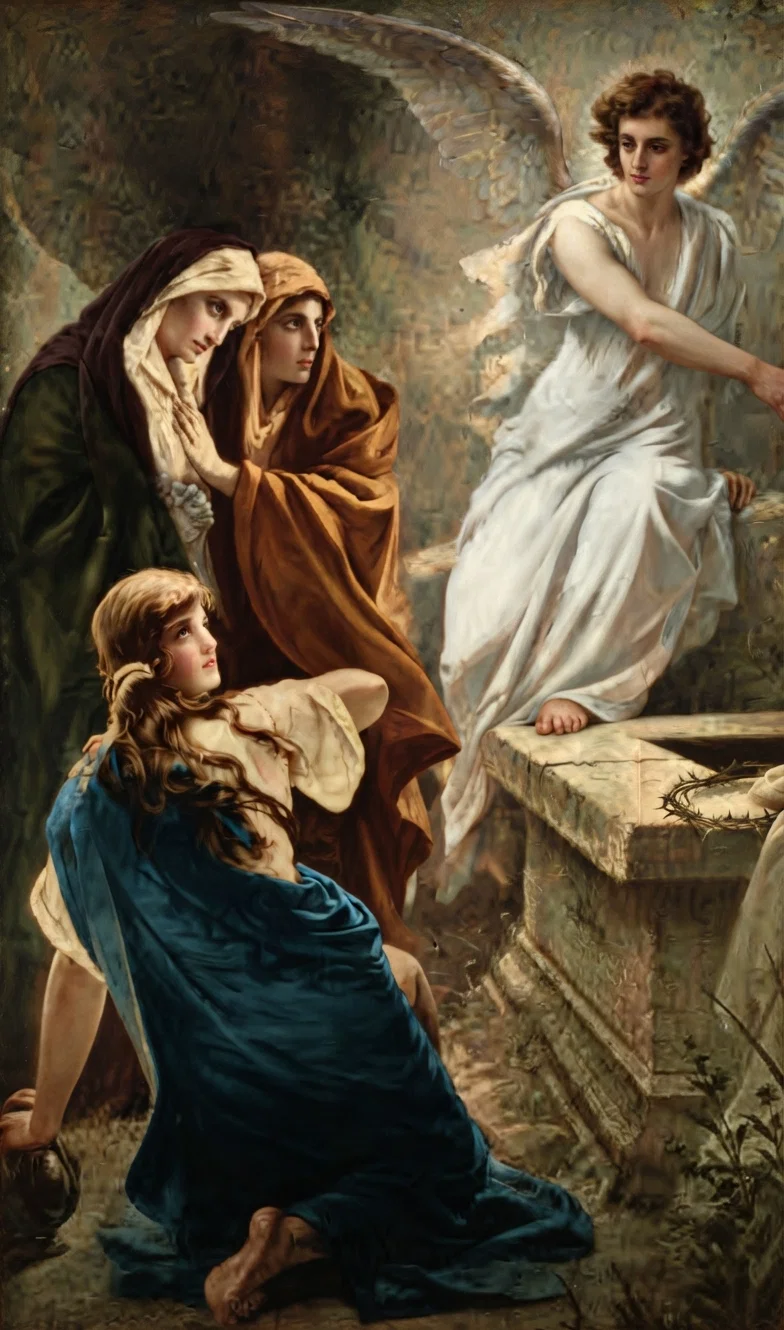
With sad and grief-filled hearts came the holy women to Joseph's lent sepulcher nearly nineteen centuries ago. They expected to find it closed. They did not know that the chief priests, under the evil principle that "the end justifies the means," had stretched their tradition-bound consciences enough to ask Pilate to seal the sepulcher and guard the place where reposed the Christ. They did not know that the strongest power on earth had stamped the closed tomb with the seal of authority. Neither did they know that the omnipotency of righteousness had prostrated Roman guards, broken Roman seal, opened the grave, and called to life Him who died for all. They did not appreciate the encouragement of the psalm predicting the triumph of God, which they had so often heard chanted by the great choir in the temple:
"He that sitteth in the heavens will laugh: The Lord will have them in derision."
Eternal character could not long abide the darkness of death; "it was not possible that He should be holden of it."
As His devout disciples drew near to the rock-hewn tomb, closed with the ponderous stone, they asked themselves, "Who shall roll us away the stone?" They would perform the completing task of embalming Him before He was shut from their sight forever. Therefore they sought Him in the tomb. Other disciples also sought Him there. Hence the reproof of the angel: "Why seek ye Him that liveth among the dead? He is not here, but is risen."
“He is risen; He is not here.”
Let it be history no longer. Let it be a living message for the needful NOW, just as God designed it should be in every age. If "historical Christianity" had learned this truth, all the empty traditionalisms of the past would have perished forever. We should not have had the sevenfold surges of two centuries of crusades beating against the Moslem borders for the recovery of a traditional spot concerning which the heavenly messenger had forever said, "HE IS NOT HERE." The vast amounts of money lost in costly shrines, the vast cost of pilgrimages and the maintenance of armies of priests by the traditional churches, the yearly spectacles of fighting sects, held in check only by Mohammedan soldiers, would have been spared us. "The Holy Sepulcher," they call it, and "The Church of the Holy Sepulcher;" but above all their mad worship and fierce zeal, the child of faith hears the cry of Christ's messenger,
"HE IS NOT HERE."
But God pities these blind worshipers, as He pitied the disciples of old. A great void is in their hearts, which formalism can never satisfy. To many of these, as to them, He commissions His servants to say, "He is not here." He is not in the old, rock tomb, worn smooth, mayhap, with touches of devotion. He is not in the cast-off cerements of traditionalism. He is not in narrow, worn-out methods of work, tho once He blessed them; He is not in human creeds and human plans and human organizations, tho He may have blessed honest heart and honest work in them. He is not in the dead past ever. Matters it not that He was there or has been here; where is the Saviour, the Master, the Leader, now?
Thank God, He leaves us not with negations. The negative is to disabuse our minds; but the great positive, living truth is to fill them, fill them to the full, and flow out and on into other lives and hearts.
"He is risen from the dead; and lo, He goeth before you into Galilee; there shall ye see Him: lo, I have told you."
There is life in the Word. The grave could not hold Him. He died for the sinner. He lives to justify, to save. Tell it, soul. Say to all that Christ is risen. Let yournew life in Christ Jesus tell it. Let your loyalty and faithfulness tell it. Tell it to the sinner. There is hope for him. Go out into "Galilee of the nations;" say to the blind, wandering seeker for light, for pleasure, for happiness, for gladness of heart, for rest of soul, for power over sin — say to them all, "Christ is risen;" "Christ is risen indeed," and there is hope and strength and life for all in Him.

The Sabbath Through the Ages

XIV. The Seal of God

"After these things I saw four angels standing on the four corners of the earth, holding the four winds of the earth, that the wind should not blow on the earth, nor on the sea, nor on any tree. And I saw another angel ascending from the east, having the seal of the living God; and he cried with a loud voice to the four angels, to whom it was given to hurt the earth and the sea, saying, Hurt not the earth, neither the sea, nor the trees, till we have sealed the servants of our God in their foreheads." Rev. 7: 1-3.
This scripture brings to view a most important time in earth's history. Great troubles are impending. The "four winds" of commotion, strife, and bloodshed are about to be let loose; and the day spoken of in the prophecies — the day of angry nations, the day of wrath, the day of judgment — is soon to dawn. But ere that day comes, whose coming pronounces the end of time and the close of probation's hour, messengers are hastened from the throne of the Infinite with the burning command to hold everything in abeyance until the seal of God has been placed upon the foreheads of His children.

A Finishing Work of Character

The work of sealing is therefore equally important as the time. It is one which puts upon the people of God the finishing touches of character preparatory to their being ushered into the presence of the Almighty, to receive the glorious gift of immortality. Evidently it is the last part of Heaven's great Gospel work for man, which immediately precedes the second coming of Christ and the end of the world.
Without going into many interesting and easily furnished details of Scripture proof, let it be said here that the sealing of God's servants, which takes place in the closing hours of time, is identical with the great message of Sabbath reformation brought to view in the previous article. The Sabbath of Jehovah is His "seal;" and faithful observance of the Sabbath in the times of stress and trial and persecution and death which come just before our Lord's return, will place upon men the stamp of perfection and holiness — "the Father's name" — which will fit them to enter into glory.

An Opposing Work

It may not have occurred to you, dear reader, that coincident with this sealing of God's people, there is to be carried forward on earth a tremendous world-wide work of opposition. At the very time that Heaven is placing its seal upon the hearts of men, another power is forcing upon them its mark. Says the Scripture, "He causeth all, both small and great, rich and poor, free and bond, to receive a mark in their right hand, or in their foreheads: and that no man might buy or sell, save he that had the mark, or the name of the beast, or the number of his name." Rev. 13: 16, 17. And God specially warns men, under pain of suffering His unmixed wrath, not to receive this mark. Rev. 14: 9-11.
Before turning to a further study of God's "seal," note that "the beast" is the power which enforces the "mark." That "beast" is the Papacy. In the last days, therefore, the papal power is to be restored; and when it shall have succeeded in regaining its lost prestige, it will, according to the prophecy, take its final stand against God's law of truth. Did it not in earlier days, through apostasy and wanton attack, set itself against God and above God in changing His law and substituting the Sunday for the Sabbath? Does it not now boastfully claim that it alone made that change? Is it not true that it points to the change which was made, as evidence of its supremacy over the Word of God and His commands?
Just as apostasy once brought the Sunday to the front in opposition to the authority of the fourth commandment, so it will do again. Even now we are upon the eve of that accomplishment. Papal influence and teaching are leading men backward; and everywhere, the world over, the Sunday rest day is crowded to the front, and both Protestant and Romanist are joining in the cry for laws to enforce its observance. To-day, as never before, the papal sun-day is pitted against the Sabbath of the Lord. And when an international federation of Protestant churches in league with a like federation of Catholic societies sets about the task of securing from earthly governments a universal recognition of sun-day sacredness, it requires no stretch of imagination or hair-spun theological reasoning to see that success will one day crown the effort.
But when the world does enforce the claims of Rome in respect of the sun-day, it will be doing exactly what the prophecy states; namely, compelling men by law to homage to the power which first gave the day its usurped place, — requiring men to worship the beast, the Papacy.
The Sunday-sabbath is the mark of papal authority. She points to it as evidence of her right to "command men under sin." And when, in the soon-to-come final conflict, Sunday is placed before the world as a compulsory rest day, in opposition to God's claim for the Sabbath of His law, its keeping will mark one as being opposed to the commandments of God, and as standing for the authority of the beast. To keep Sunday, as enforced by law at that time, will be to receive the "mark" of the Papacy, against which God has warned.

God's Sign

Now all through the Scriptures God's Sabbath has been set forth as His sign, His mark of authority. "It is a sign," said He, "between Me and the children of Israel forever." Ex. 31: 17. Again, "I gave them My Sabbaths, to be a sign between Me and them, that they might know that I am the Lord that sanctify them." Eze. 20: 12, 20. And as we have seen in former articles, God made that Sabbath-sign the one all-important test of loyalty to His law. See Ex. 16: 4, 27, 28. The history of Israel was a demonstration of the fact, that to disregard the sign, the memorial, of God's creative power invariably meant to lapse into idolatry.
The words "seal" and "sign" are used interchangeably in the Bible. Of Abraham it is said, "He received the sign of circumcision, a seal of the righteousness of the faith which he had." Rom. 4: 11. The Sabbath is God's "sign," or "seal." It is the sign of His creative power, and the seal of the law of which it is a part.
As brought to view in the Bible, the seal was always used in connection with law and exercise of authority. When Joseph was given the king's signet (sign) ring, he became ruler. Gen. 41: 42. When the king's seal (the impress of his signet ring) was placed upon Haman's decree for the destruction of God's people, it then became law which no man could reverse. Esther 8: 8. See also Esther 3: 10, 12; 1 Kings 21: 8; and other scriptures. The seal, or sign, of the earthly ruler, placed the stamp of authority upon the legal documents of which it was made a part. In the same sense does the seal of God give authority to His law.

Seal the Law

Direct reference to this truth is found in a message of the prophet Isaiah. Speaking to His servants living in the last days, when they are looking for the Lord's return, God says, "Bind up the testimony, seal the law among My disciples." Isa. 8: 16. God's law is to be sealed, or, in other words, have its seal restored. And this restoring of the seal is to be "among My disciples." If the Sabbath be the seal, as has been stated, then this is a direct command to restore theSabbath in the experience of God's people, and thus put the seal of God upon their foreheads. The Sabbath, torn from the law by the high-handed blasphemy of papal assumption, is again to be seen in the law of God and in the life of the people.
Any complete seal showed "the name, the authority, and the realm of the law-giver, thus: 'Edward, king of Great Britain and Ireland.' The name is Edward; the authority, king; the realm, Great Britain and Ireland. God's law, the only document He has ever spoken or written to men, is found in Ex. 20: 1-17, in ten different precepts. In six of these precepts, the first, sixth, seventh, eighth, ninth, and tenth, not one of the necessary features of the seal is given. In the second, third, and fifth, only the name and authority are given,—'Jehovah thy God.' But in the fourth commandment we have every characteristic of the seal,—the name, Jehovah; the authority, 'thy God;' the extent of authority and right to command, 'the Creator of the heavens and the earth.'"
"Seal the law among My disciples," is God's command. Why?—Because even the law of Jehovah, without its seal, is void. Take the Sabbath commandment from the Decalogue, and it ceases to be a heavenly statute. It is through the fourth commandment alone that the heathen, who know not the true God, the Creator, can be introduced to Him.
But when the Papacy changed the day of the Sabbath, and put its false substitute into the place of the true, it did exactly what Inspiration says,—it took away the seal of Jehovah's statutes. It robbed God's people of their greatest bulwark against the ever-increasing flood of idolatry and worldliness. Hence, when the great conflict is about to close, and the church faces the period of her greatest need and sorest danger, the Lord thunders forth to the world the command to restore the seal, and give the true Sabbath its place among His waiting people.

The Great Issue

The issue is on. God's Sabbath-seal is right now being heralded to the world. Into all lands the message has gone. Persecution has come and will come to some, calumny and reproach to others; but nothing can prove a bar to the great onward work. Sunday is being shown up in its true light, and men and women are turning from its falsity to the Sabbath truth.
On the other hand, men are showing greater determination to force the claims of the papal Sunday-mark. Laws are sought to make it obligatory upon all the people of earth. Those laws will finally materialize, and those who refuse to bow down to the decree will be ostracized and disfranchised. Earth will afford no place of refuge for those who do not, at least in form, submit to earthly papal dictation.
The day of supreme test in this matter is not far away. Now is the time to lay strong and deep our foundations for life. The mighty question of whether we shall receive the seal of God or the mark of the Papacy, is being determined by present decisions.
By right relation to truth, we may now settle all in favor of God's complete law, and thus have it said of us, "Here are they that keep the commandments of God." Rev. 14:12. And when the final victory is won, and character for heaven has become fixed and unalterable, we, having our Father's name written in our foreheads (Rev. 14:1), shall, with those who have gotten the victory over the beast and his mark, stand upon the sea of glass before the throne of God. Rev. 15:2.

As We Go

LET us walk in simple kindness, 'Mid earth's darkness and its blindness; O, so carefully, so gently, let us go. Be it ours to bless and brighten, Be it ours to cheer and lighten, Toiling faithfully within a world of wo.
With a patient, calm endurance, With an earnest, strong assurance, Let us lift the weak and weary as we go, Till our happy eyes, beholding God's eternal plan unfolding, All the beauty of His mysteries shall know. CARRIE PHELPS. Rock Creek, Ohio.

The Sign of Loyalty

By Mrs. E. G. White
In the issue of the great contest between the forces of good and of evil, two parties are to be developed,—those who "worship the beast and his image, and receive his mark," and those who receive "the seal of the living God," and have "the Father's name written in their foreheads."
In the fourth commandment is found the seal of God's law. This only, of all the ten, brings to view the name and the title of the Lawgiver. It declares Him to be the Creator of the heavens and the earth, and thus shows His claim to reverence and worship above all others. Aside from this precept, there is nothing in the Decalogue to show by whose authority the law was given.
The Sabbath enjoined by the fourth commandment was instituted to commemorate the work of creation. Had the seventh day always been kept, there would never have been an idolater, an atheist, or an infidel. The sacred observance of God's holy day would have directed the minds of men to their Creator, the true and living God. Everything in nature also would have brought Him to their remembrance; and would have borne witness to His power and love.

The Seal of God

The Sabbath of the fourth commandment is the seal of the living God. It points to God as the Creator, and is the sign of His rightful authority over the beings He has made. Those who obey this law will bear the seal of God, for He has set apart this day as a sign of loyalty between Himself and His people. To Moses on Mount Sinai He said, "Speak thou also unto the children of Israel, saying, Verily My Sabbaths ye shall keep; for it is a sign between Me and you throughout your generations; that ye may know that I am the Lord that doth sanctify you."
The mark of the beast is the opposite of this,—the observance of the first day of the week as the sabbath enforced by human law. This mark distinguishes those who acknowledge the supremacy of the papal authority from those who acknowledge the authority of God.

Claimed as Her Mark

As the sign of the authority of the Catholic Church, papist writers cite "the very act of changing the Sabbath into Sunday, which Protestants allow of, . . . because by keeping Sunday strictly they acknowledge the church's power to ordain feasts, and to command them under sin."
The Roman church thus declares that by observing the first day of the week as the sabbath, Protestants are recognizing her power to legislate in divine things. And it is true that those who, understanding the claims of the fourth commandment, choose to observe a false sabbath in the place of the true, are thereby paying homage to that power by which alone it is commanded.
The Roman church has not relinquished her claim to supremacy; and when the world and the Protestant churches accept a sabbath of her creating, while they reject the Bible Sabbath, they virtually admit this assumption. They may claim the authority of tradition and of the Fathers for the change; but in so doing they ignore the very principle which separates them from Rome,—that "the Bible, and the Bible only, is the religion of Protestants." The papist can see that they are deceiving themselves, willingly closing their eyes to the facts in the case. As the movement for Sunday enforcement gains favor, he rejoices, feeling assured that it will eventually bring the whole Protestant world under the banner of Rome.
With rapid steps we are approaching this period. When the Protestant churches shall unite with the secular power to sustain a false religion, for opposing which their ancestors endured the fiercest persecution; when the state shall use its power to enforce the decrees and sustain the institutions of the church,—then will Protestant America have formed an image to the Papacy, and there will be a national apostasy which will end only in national ruin.

God Rather than Man

The laws of nations should be respected as long as they do not conflict with the laws of God; but when there is collision betweenthem, every true disciple of Christ will say, as did Peter when commanded to speak no more in the name of Jesus, "We ought to obey God rather than men."
Paul wrote to the Romans, "If it be possible, as much as lieth in you, live peaceably with all men." But there is a point beyond which it is impossible to maintain union and harmony without the sacrifice of principle. Separation then becomes an absolute duty.
Christ never purchased peace and friendship by compromise with evil. The life of Jesus, the suffering which He endured from a perverse nation, demonstrate to His followers that there must be no sacrifice of principle. Peace is too dearly obtained if purchased by the smallest concession to Satan's agencies. The least surrender of principle entangles us in the snares of Satan.
The Sabbath question is to be the issue in the great final conflict, in which all the world will act a part. Men have honored Satan's principles above the principles that rule in the heavens. They have accepted the spurious sabbath, which Satan has exalted as the sign of his authority. But God has set His seal upon His royal requirement. Each Sabbath institution, both true and false, bears the name of its author, an ineffaceable mark that shows the authority of each.
The great decision now to be made by every one is, whether he will receive the mark of the beast and his image, or the seal of the living and true God. And now, when we are on the very borders of the eternal world, what can be of so much value to us as to be found loyal and true to the God of heaven? What is there that we should prize above His truth and His law? What is so necessary as a knowledge of "what saith the Scripture?"

"If Any Man Will"

No SLAVES in the kingdom of glory,— The home of the free and the pure; Love reigns, and His servants serve gladly; Love's throne will forever, forever endure.

CHORUS

My heart does rejoice as I hear the sweet voice Of the Master o'er mountain and sea: "If any man will," is the message, "Let him come, let him come unto Me."
And Jesus, the Friend of the sinner, Gave freely a ransom — His life, That every heart longing may seek Him, And conquer Sin's bondage, its folly and strife.
The voice of Jehovah is calling: "America, land of the free! Seek not to force men to do homage — If any man will, let him come unto Me." FLORA E. WARREN.
Continue reading: Christ Is Risen