Your ShelfYour Projects

Review and Herald, Vol. 90, No. 39.

Our Tower of Refuge
Earlier text: Christ Our Pattern

Hitherto the Lord Hath Helped Us

HITHERTO the Lord hath helped us Through the passing years the same; All-sufficient we have proved him— Praise and glory to his name. Ever mindful of his children We can set our seal anew To his never-failing mercy And his love so tried and true.
Hitherto the Lord hath helped us. Then whate'er the future brings Through its boundless, trackless mazes, He will keep us 'neath his wing. We can trust him for tomorrow, For he says, "Be not afraid, I will certainly be with you; Fear not, neither be dismayed." —Selected.

FREDERICK M. ROSSITER, M. D

The Gospel of Health—No. 2

FREDERICK M. ROSSITER, M. D

WHEN Christ was severely tempted to satisfy the needs of the physical body, he said, “Man shall not live by bread alone, but by every word that proceedeth out of the mouth of God.” Food is no doubt the principal physical means of imparting energy to the body, but from the Scriptures we learn that God has other means of imparting energy to the body and of promoting life. I believe that we are warranted in assuming from the teaching of the Bible that the man who is filled with the Spirit of God has a source of power for imparting energy to the body that the unconverted does not have. The scripture with which Christ met the devil gives that idea. “Man shall not live by bread alone, but by every word that proceedeth out of the mouth of God.” Christ had been fasting forty days, and though emaciated, yet he was strengthened by the Holy Spirit, with which he had been baptized.
An angel of the Lord prepared two meals for the prophet Elijah, and he “went in the strength of that meat [food] forty days and forty nights,” while making a journey on foot in a rugged country. 1 Kings 19. Moses was in the mount with God forty days and forty nights twice, and the record says, “He did neither eat bread, nor drink water.” Ex. 34:28. Many have fasted forty days or more, but with marked emaciation and loss of strength. But no one was ever able to go a third of that time without water and live. Yet Moses hastened down the mountain, and seemed to be in his usual strength and vigor. When the Spirit of the Lord came upon Samson, he was able to do wonderful feats of strength.
These are all special instances, yet they show that God has other means than physical food for maintaining the forces of the body, and of promoting its endurance. Note the statement, “Man shall not live by bread alone.” “Shall not;” it does not say that he does not. The great majority of men are living by bread alone, but this is contrary to the plan of God. Every “Shall not” we are told contains a promise. Are we availing ourselves of the promised blessing in this instance? I am sure that there is a great blessing in this truth for us.
From this, however, we are not to take the position that the Lord will sustain us, and abstain from food for a week, or a month, or longer, and thus save a food bill and avoid loss of time. That is not the point. The Lord has given us food to eat, and we should eat it, and be thankful, too. Christ was filled with the Holy Spirit when he went into the wilderness. Moses was filled with the Spirit of God when he went up into the mount. Elijah was filled with the Spirit of God, even though he was running away for his life, for the record is, “He arose, and went for his life.”
It is the privilege of every converted man, woman, and child to be filled with the Spirit of God. It awaits our demand and reception. Every blessing, says the spirit of prophecy, will follow in its train. This being so, then health and endurance must go with it; for these are certainly great blessings, and necessary to the carrying of this message.
We are told that sickness could not exist in the presence of Christ, for a great healing power went with him. When the apostles were filled with the Spirit on the day of Pentecost, this mighty healing power went with them also, and it is not unreasonable to suppose that that same power imparted new vigor and life to their own bodies.
Paul, in writing to the Romans, says: “He that raised up Christ from the dead shall also quicken your mortal bodies by his Spirit that dwelleth in you.” Rom. 8:11. These bodies that we dwell in are mortal bodies, dying, subject to disease, yet the Word says that the Spirit dwelling in the believer shall quicken his body, or impart life to it. Is not this a blessed thought? Because of this should we not have more abundant life right now, and so be able to present better lives and our “bodies a living sacrifice, holy, acceptable unto God”?
Again, in 2 Cor. 4:11, we read: “For we which live are alway delivered unto death for Jesus’ sake, that the life also of Jesus might be made manifest in our mortal flesh.” Christ worked hard. He was weary and footsore. He labored “in season, out of season.” He spent whole nights in prayer and came forth, we are told, braced and invigorated for the day. If, then, the life of Jesus is made manifest in our mortal bodies with the impartation of spiritual and mental vigor, there must of necessity be physical blessings also. It is possible that we may so spiritualize some of the promises of the Lord that we shall fail to obtain the blessings of health, and for this reason even fall short in the spiritual blessings. The Spirit of Christ dwelling in us will lead to obedience in matters pertaining to health.
In Isa. 40:28-31 we have promised blessings that are not very often applied to the body, and yet I believe are intended to be thus applied: “Hast thou not known? hast thou not heard, that the everlasting God, the Lord, the Creator of the ends of the earth, fainteth not, neither is weary? there is no searching of his understanding. He giveth power to the faint; and to them that have no might he increaseth strength. Even the youths shall faint and be weary, and the young men shall utterly fall: but they that wait upon the Lord shall renew their strength; they shall mount up with wings as eagles; they shall run, and not be weary; and they shall walk, and not faint.”
The gospel is to restore the complete man, spiritually, mentally, and physically. “He giveth power to the faint.” It may be by taking food, or by resting, or by prayer. “Man shall not live by bread alone.” Is it not time that we were recognizing the beauty, power, and force of these words in a practical way for every-day use?
“They that wait upon the Lord shall renew their strength.” If we are living in sin, the Lord cannot bless us with spiritual power even though we wait upon him. Is this not just as true physically? I see no reason why it is not. The Lord cannot bless us with health when we are doing things that injure the health and produce physical disease. So then those who are living in harmony with the laws of health can expect that the promise, “They that wait upon the Lord shall renew their strength,” will be fulfilled to them.
Often those who are physically weary are wonderfully refreshed by attending a prayer-meeting, or by a Bible study, or by secret communion with God.
One time during the ministry of Christ, he and the disciples had made a long journey by foot, and about noon they came to Samaria, to Jacob’s well, where Jesus sat down. The record says he was “wearied with his journey.” At this place the Lord preached one of the most wonderful sermons in all the Bible, and to one person. While he was resting at this well, his disciples returned and “prayed him, saying, Master, eat. But he said unto them, I have meat to eat that ye know not of. Therefore said the disciples one to another, Hath any man brought him aught to eat? Jesus saith unto them, My meat is to do the will of him that sent me, and to finish his work.”
In the breaking of the bread of heaven to the poor, lone woman of Samaria, Christ was physically refreshed. He did not live by bread alone. The disciples thought that others had brought him food during their absence. In the giving of the gospel message he received new strength and vigor. It was food to him. Listen to these words, “My meat is to do the will of him that sent me, and to finish his work.” Surely there is a lesson in this for us, and a blessing. In “Desire of Ages” we read, “He saw her drinking of the water of life, and his own hunger and thirst were satisfied. The accomplishment of the mission which he had left heaven to perform,strengthened the Saviour for his labor, and lifted him above the necessities of humanity. To minister to a soul hungering and thirsting for the truth was more grateful to him than eating and drinking. It was a comfort, a refreshment, to him. Benevolence was the life of his soul.”
The fact is if people would eat less food and eat better what they do eat, there would be more of a disposition to trust in the power of God for sustaining strength and for spiritual endurance. Christ did not abstain from eating and drinking, and we should not, because food is a means to an end. But too much food is a hindrance, and while the body may be able to adjust itself to the extra burden for a period of years, the higher powers of the mind suffer at once; and whatever affects the mind immediately and directly acts upon the spiritual sensibilities. As many small blows will eventually break a great rock, so many slight influences that dull the spiritual senses may result in the loss of a soul eventually. We cannot afford to take any chances. At the very time that the “still small voice” may be anxious to speak to us, we may not be in a state of keen spiritual sensibility. So I say that we cannot afford to take any chances. We must at all times be just like the wireless receiving-stations, always ready to receive a message from the courts above. How much more terrible would have been the results of the “Titanic” disaster if the wireless operator on the “Carpathia” had not had the receiver to his ear, heard the call for help, and so saved hundreds of lives. If we are in a spiritually receptive condition at all hours of the day or night, we may be able to rescue many a human being who otherwise would be shipwrecked. The only way we can be in this condition is to study and practise intelligently and sensibly the gospel of health.

The Sin of Sensitiveness

"BLESSED are the poor in spirit."—Jesus.
"The thirst for applause, if the last infirmity of noble minds, is also the first infirmity of weak ones."—Ruskin.
If we examine sensitiveness under the microscope, we shall find it to be no more nor less than a variety of egotism. The sensitive nature is simply one that is too much occupied with self. That way madness lies, ever.
I suppose no more exquisite torture has been devised by the evil one, at least in this world, than the endowing of a highly organized, keenly perceptive person with a too large self-consciousness. In Galsworthy's "Fraternity" such a character is drawn with wonderful accuracy by that master, in Bianca Dallison. Here are a few of his touches: "It was Bianca's fortune to be gifted to excess with that quality which, of all others, most obscures the real significance of human issues.
"Her pride had kept her back from her husband, till she felt herself a failure, and her pride had so revolted at this that it led the way to utter estrangement. Her pride even prevented him from really knowing what had spoiled their lives—her ungovernable itch to be appreciated. This was the tragedy of a woman who wanted to be loved, slowly killing in the man the power of loving her."
Of all the unlit and tortuous places in this world the human heart is darkest and farthest past finding out; and the heart of an intelligent, cultured egoist with delicately strung feeling is worst of all. The only remedy is the persistent effort toward disinterestedness. We approach peace only as we leave ourselves and come to humanity. No self-forgetful person is ever sensitive. No self-forgetful person is habitually unhappy.
This sin of sensitiveness—and we ought to face it as a distinct sin, a thing never to be boasted of, always to be ashamed of—takes many forms. Some of them are of that most dangerous kind, the kind that resembles virtues. For instance, self-examination. There is a sort of luxury in probing one's own heart and handling one's faults, like the pleasure of pressing upon a sore tooth.
Conscience may descend to be a species of moral indigestion. Copy-book philosophy and teachers of moral platitudes commend this self-scrutiny. But as a rule it is vicious. As with our bodies so with our spirits, the healthiest are those that are the least tampered with and worried over. The noblest soul is the one that is unconscious either of nobility or ignobility. The righteousness that knows itself and the sin that knows itself are akin—both bad. Another and common form of this protean soul disease is self-depreciation. Wordsworth hits it off:—
"There is a luxury in self-dispraise; And inward self-disparagement affords To meditative spleen a grateful feast."
I wonder if the housewife knows how uncomfortable she makes the guest feel when she precludes her dinner with apologies? And does the young lady know what an egregious, conceited minx she seems to all simple and normal souls when she will not begin to play the piano or to sing until she has rehearsed her limitations?
And there are those women who are forever slandering their own appearance, and men forever decrying their own ability. This is not humility. The one blazing beauty of humility, genuine, is that it forgets itself, that the one being it will neither blame nor praise is self. And worst of all phases of sensitiveness, perhaps, is self-pity. Worst, because of it is born a deal of plain wickedness. The man who is sorry for himself is not far from smashing law and conscience for his own dear sake! Of all sloughs into which a manly man or a womanly woman ought not to fall, the maudlin kindness for one's own poor soul is the most disgusting.
I am sure if we stop to reflect that the whole troop of degenerates, the murderers and thieves, the sneaks and unclean, are uniformly sorry for themselves, we should hesitate about allowing ourselves to drift into such company. Sensitiveness, and all egoisms, are not forms of self-respect; they are the opposite of self-respect. They are self-defiling, self-condemning, self-destroying. The only religious, sensible thing to do with this precious me is to forget him.—Frank Crane, in "Lame and Lovely."

The Benefits of a System

EVERY young housekeeper who sits down and seriously studies out the subject will find herself a different being if she manages her affairs with system, or if she lets them manage her without it. It is true that before she is married all her study on the subject will be theoretical, and possibly somewhat impractical, and something like the house one builds and is enchanted with till coming to live in it. For there are things that only experience can teach, and matters where the experience of nobody else can be of any material service.
If her mother was a woman of system, the young housekeeper already has much of what she wants bred in her bone, as one may say. But if her mother was an invalid, was shiftless and thriftless, or was overwhelmed with troubles and babies, then the daughter has to strike out a path for herself. The sooner then she remembers that there are but seven days in the week, and that that period of time constitutes one revolution of the household, the sooner she will come into her kingdom and reign unmolested and undisturbed.—The Presbyterian Examiner.

The Christian Home

LOVE is the foundation of the home. But our own age has too much forgotten that on the parents' part it is love set in authority. The true home requires much more than a providing and acquiescent affection. It needs a love which guides and teaches and controls; and such controlling love is a blessing to those who are under its authority. Parental love which refuses this responsibility is but a form of selfishness. There are too many homes in America where the easy-going temper, which would be amazed if denied the name of love, is doing its worst to ruin the lives of the children. At the other extreme, of course, and equally to be avoided, is the love which wears a mask of severity and fails to reveal itself as love. But that is an infrequent danger nowadays beside the other. We must show what Christ can do in the home, or we shall be forced to apologize for our Christianity. This we can do only by making him our life companion. There is no need of preaching if our life is true to its own ideals of service.
— Congregationalist.

Doing Simple Things Well

“He who would do a great thing well must have done the simplest thing perfectly.”

The South Carolina Camp-Meeting

THIS meeting was held at Laurens, S. C., August 14-24. The camp was pitched in a quiet place near the edge of the town. There were about one hundred Sabbath-keepers encamped on the grounds. It was not a very large meeting, but the Lord certainly came near to us, and we enjoyed a precious season together.
The attendance from the outside was not so good as we desired, and yet some interest was manifested. The evening services were devoted principally to sermons on the leading doctrines of the message, for the benefit of the public. During the day the preaching was of a more practical nature, calculated to encourage and strengthen our people in the Christian life. An excellent spirit pervaded the meeting from the beginning to the close.
The conference business was carried on in a very harmonious way, and as the several departments gave in their reports substantial gains were seen. During the year eight tent efforts were conducted, and as a result about seventy-five began the observance of the Sabbath. The tithe for the year amounted to $3,236.35.
Elder C. V. Achenbach was reelected president of the conference for the coming year. The other officers of the conference were as follows: secretary and treasurer, J. L. McConneghoy; young people's, Sabbath-school, and educational secretary, Mrs. C. V. Achenbach; religious liberty secretary, A. H. Evers; field missionary agent, Archie Underwood. Aside from the regular laborers of the conference, there were present at the meeting, Elders O. Montgomery and C. B. Haynes of the Southeastern Union Conference; Elder T. H. Jeys, of Huntsville, Ala.; Brethren V. O. Cole, L. D. Randall, R. Hook, Jr., representing the book and publishing work; Prof. G. R. Fattic of the Southern Training-school; and the writer.
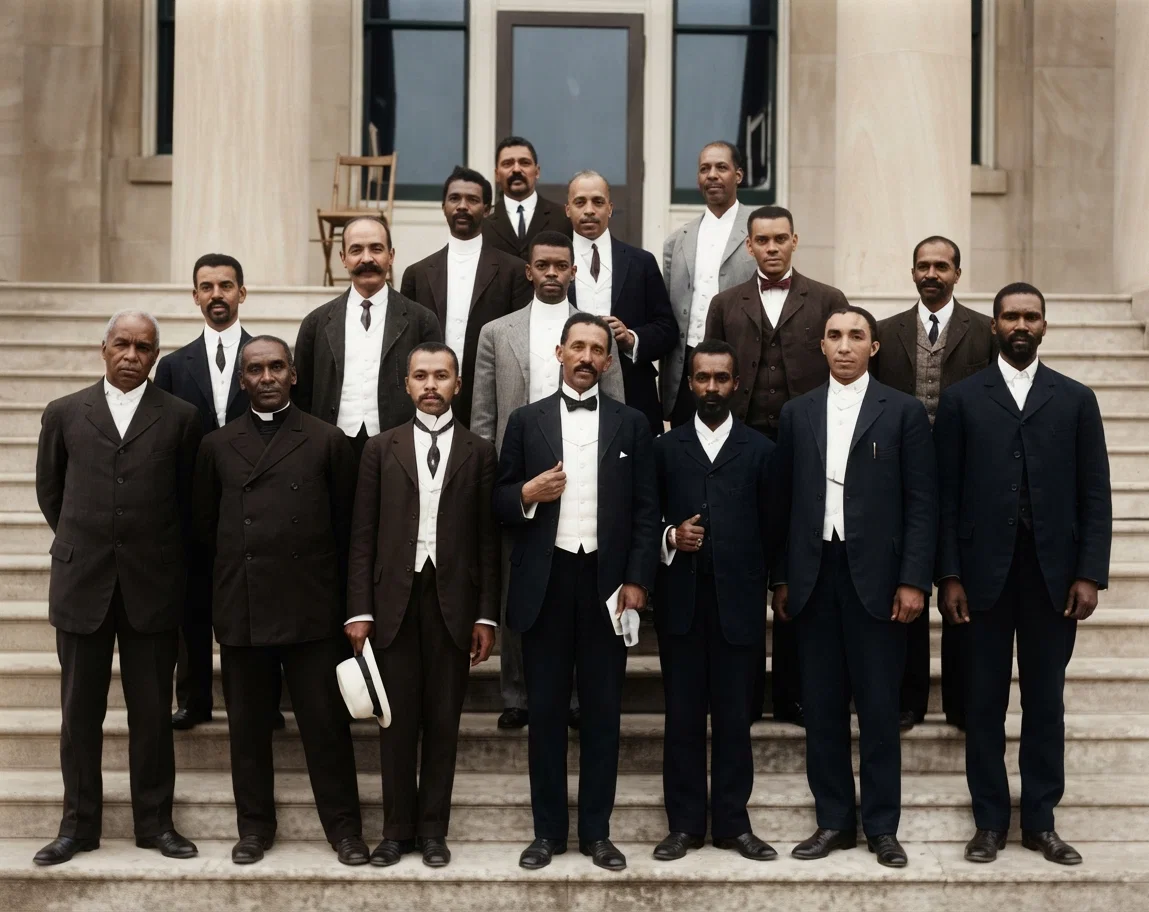
SOME OF THE FAITHFUL WORKERS IN THE NORTH AMERICAN NEGRO DEPARTMENT This picture was taken at the recent General Conference.
There was a hearty and unanimous response to a resolution adopting the twenty-cent-a-week plan of raising money for missionary purposes. And to further show its interest in mission work, when the call was made for foreign missions, the conference pledged itself to give one thousand dollars during the coming year. This means self-sacrifice on the part of some, but we know God loves a cheerful giver; and we predict that the South Carolina Conference will not lose anything by its liberality.
The last days of the conference, as is usually the case, were the best. The last Sabbath especially was a day long to be remembered. All the campers consecrated their lives anew to God's service. Backsliders were reclaimed, and a number gave their hearts to God for the first time, and were baptized. We all felt greatly refreshed and strengthened, and left the camp with brighter hopes and stronger determinations to fight on till the victory is won.
G. G. LOWRY.

A Cheering Word

ON BOARD S. S. "CEDRIC," Sept. 3, 1913. To Our Many Friends in America.
WE are now six days from New York, and with the exception of a little seasickness on the part of two of our company we are all well. We have had a very quiet sea, though the weather is cold and rainy today. Our courage is the best, and we are glad to be entrusted with the gospel to be carried to the heathen. We long to be fully in the harness once more. We feel very grateful to God that Brother and Sister Jewell and their son, Eugene, can go with us. We much enjoy their company. Their courage is good, and already they are putting their minds to the study of the native language with us.
Brethren, we affirm that "God is good," and in his strength we are well able to go up and possess the land. Never did I feel more like pressing the battle to the very gates, and we confide still in the prayers and support of our loved ones in the home land. The battle is yours, brethren, and we are only your servants for Jesus' sake. Let us be faithful and work as never before, for soon the work will be finished, and we can go home and rest with Jesus. Pray for us.
M. C. AND M. J. STURDEVANT.

Newspaper Work in Albany, N. Y.

A FEW weeks ago we reported through the REVIEW from this place relative to the favorable notice we were receiving from the newspapers in regard to our tent-meetings. Since that report a numberof very interesting things have happened in our work here. The leading daily paper of Albany continued to publish the sermons until after the Sabbath question was dealt with, then political matters became so intense in this State, and especially in this city, that the papers printed scarcely anything but politics. However, the sermons that appeared every day for over a month in this large daily, published our work everywhere in the city. People of all classes were attracted to the meetings. At the close of six weeks' meetings upward of twenty-five men and women had taken their stand for the Sabbath.
Among those who had been attracted to the tent by the extensive advertising are some very promising individuals, who finally accepted the truth. One man who holds an excellent position with the American Express Company, took his stand at once, as did also his wife. He is able to retain his position and keep the Sabbath and also to do work on Sunday in the general offices here. Another man who, with his wife, accepted the truth holds a good position on the D. & H. R. R. as train despatcher. They were spiritually minded people, and when the Sabbath truth came to them they at once saw its importance and its claims upon them. At the first opportunity they signed the covenant. The same week this man took his stand for the truth he received a promotion and a large increase in salary. Then the great test came to him; it seemed impossible for him to keep his new position and keep the Sabbath. He had spent his life in the service, coming up to the very promotion that now came to him. Indeed it was a great struggle for them to decide whether they would keep the Sabbath and very possibly lose this good position. We thank God that in that struggle Jesus was very near, and in prayer the battle was fought and won. In a few days he made arrangement to have a private talk with the superintendent. We all prayed very earnestly before he went to have the interview, for many others were in the balance, scarcely having faith enough to believe that God would look after their work and feed them. In about an hour this brother returned with a smiling face, and said, "The Lord was there before me and had it all fixed up." So he continues his work and keeps the Sabbath.
This experience has proved a great blessing to others, as many have heard of this victory.
The climax of our work in the tent came about two weeks ago, when we began a series of lectures on "Will Rome Rule America?" At the first lecture about four hundred people came out, among them Lieutenant-Governor Glynn's secretary (Mr. Glynn is a Catholic and a Knight of Columbus), a number of reporters, a Catholic priest, and many other Catholics. The Times-Union, Mr. Glynn's Albany evening paper, sent a man who took down the sermon verbatim. This lecture caused a great stir in the city, and a certain strong Catholic paper demanded of the sheriff that the tent be closed forthwith. In its editorials such statements as this were made, "The man who attacks another man's religion has no right in this free country." We were on county property, and although we had a lease on the ground our tent was forcibly closed. We began meetings the following night in our own new church building, which is located near the center of the city and will seat nearly four hundred people.
This attack upon the lectures by this paper and by a public official has stirred the deep-thinking people of this city, and people from every direction, as individuals and organizations, have thrown their interests with us and attend the meetings and distribute literature. Among these are the Guardians of Liberty, etc. This week two pastors of large churches sent me word that they are interested in the issue and are going to attend the lectures during the week.
Our church committee has published a tract setting forth the facts in the case in the forcible closing of the tent, and a part of the sermon on Sunday night, August 31. The interested public gave the money with which to print this leaflet. We feel that the opportunity is here for us to make a great strike for the truth, not only in this capital city, but through the entire State. Pray for the work here that God may lead in the crisis we are now going through. Any one wishing to get a copy of the tract above referred to may obtain the same by addressing the writer and enclosing a two-cent stamp. E. L. CARDEY. 29 Second St., Albany, N. Y.
THE FIELD WORK
THE FIELD WORK

New Jersey Conference

THE annual session of the New Jersey Conference was held according to appointment in Trenton, August 28 to September 1. This meeting was one of profit and pleasure to all who attended. The spirit of union and harmony was present from the very beginning and continued through to the close of the meeting.
The reports from the different departments showed a marked gain over the previous year. The net increase in membership was about double what it was for 1911. The tithe increase was over $1,600, and the Sabbath-school offerings for missions about $700 more than last year.
The guiding hand of God was manifested in all the business of the conference, which passed off quickly. The following officers were elected: A. R. Sandborn, president; W. B. Walters, secretary and treasurer; H. A. May, secretary of Sabbath-school and young people's departments; and Elder W. C. Moffett, educational secretary. There was only one change made in the committee.
Elder W. A. Spicer was with us and rendered valuable assistance by his timely sermons and counsel. Taking it all in all, this conference was considered one of the best that has been held here, and the people went home with courage for the outlook of the work in New Jersey, yet impressed with the magnitude of the field that we have, as it had been revealed that we are working for ten different nationalities and getting ready to work for two more. Surely God is good and is leading out very rapidly, and our prayer is that we may be able and willing to follow where he leads.
A. R. SANDBORN.

Maryland

BALTIMORE.—Immediately after the close of the General Conference the writer, with Brother L. A. Froom, began a search for a suitable place on which to pitch a tent for the season's work. We sought God earnestly to guide in the matter, and as a result we were soon in touch with the right spot.
This city, like most others, has a number of rather arbitrary requirements to be complied with before permission can be secured to pitch a tent for religious meetings. One of these is that the signatures of all living in the immediate vicinity must be secured. So, after writing a short preamble to our application paper, we lost no time in getting the signatures, all of which were freely granted. We paid the rent for the ground, and two days after passing in our application, we received permission to go ahead.
Early Monday morning, July 7, we were on the ground with our tent and outfit. Just as the last rope was being tied, the city building inspector arrived and informed us that strong objections were being made against our pitching the tent. After a few moments' conversation we learned that the objectors were six of the Protestant ministers, and many of their congregations. Soon after we had made our application they lodged a protest. Their objections were based on the contention that we did not preach the gospel. The inspector asked us to wait until Thursday and see what would develop. We told him this was out of the question, as we had received word from the city authorities "to go ahead," and our meetings were advertised to open Friday night. He left us after getting a short, straight talk on the principles of religious liberty.
We went right ahead with our work of preparation, and on Thursday we made application for the electric lights to be put in and connected, but this was withheld on account of the protest. The enemy was determined to prevent us, but we took the matter to God in prayer. Early Friday morning we were impressed to get advice from a lawyer here in the city who has been attending our meetings and is very much interested in our work. As soon as we told him the situation, he said, "It will be all right, Mr. Paap. I know the inspector personally." He kindly offered to go with us to see the city solicitor, and after a few words and another opportunity of presenting a few of the principles of religious liberty to the city authority, we had the whole things arranged, and the evening papers came out with heavy head-lines: "The Seventh-Day Adventists Win Out in Spite of the Protests of the Protestant Ministers." This all worked out for our good, causing a deeper interest and giving us larger congregations. To God be the glory. Satan is a defeated foe. He is wroth with the church, but his wrath and opposition have helped rather than hindered.
During our eight weeks of steady meetings in the tent, and our visits from house to house, the angels of God have gone before us. The interest and attendance have been good from the first.
Sunday, September 7, nine went forward in the solemn ordinance of baptism, in Gwynn Oak Park. This gave us an excellent opportunity to come in touch with a large number. The united electric railways placed cards announcing the baptism, on the front of the cars for two days, and we also advertised in the papers, and as a result about four thousand persons gathered at the park. The manager of the park erected a platform out in the water about fifty feet from the shore, and decorated it with green branches. Brother Froom and wife, Miss Sheirich, our organist, Brother Barrat with his oboe, and Mrs. Paap and I rowed out in small boats to the platform. After singing several special songs and also several good old familiar gospel hymns, I addressed the people for about twenty minutes on the subject of baptism. It was indeed a beautiful sight to see the people as they joined in the singing. There was perfect order and respect shown on the part of all assembled.
Quite a number that have begun keeping the Sabbath are satisfied with their former baptism. We are not urging them to be rebaptized, for we have always found that those who embrace this truth become dissatisfied, in a short time, with their former baptism and desire to begin again the new life in Christ. Ten will be ready for baptism at the close of the camp-meeting, and possibly others who are now halting will be ready by that time. These mentioned, however, represent but a tithe of those who have shown a deepening interest and are convinced that this is God's message for the hour.
At the close of the series of meetings we asked for an expression from those that were convinced of the truth and were determined to be on the winning side and go through with God's remnant people. Fully three hundred stood up, besides our own people who were present. If all would be loyal and true to their convictions, we should indeed have a good harvest of souls. We regard them as very good material with which to work, and our Bible workers are kept busy visiting and studying with them in their homes.
At the baptismal service thousands of tracts, with the address of our new church stamped on them, were placed in the hands of those in attendance. We are glad we have a church to which to invite the people. The church is located about nine blocks from where we had the tent pitched. We have made a special effort to reach the people, thousands of whom are unable to get to the tent. On our four-page weekly circular (6½ by 9½ inches) we have had one whole page devoted to a synopsis of the previous week's subjects. This has been read by many, who have thus picked up a few fragments of truth.
We are of good courage. Our confidence was never greater in the ultimate triumph of this great message, and by the Lord's grace we mean to triumph with it. With a church to which to invite the people, and with regular meetings and house-to-house work, we hope by God's help to win many of the interested ones to the truth. Pray for the work and workers in the city of Baltimore.
F. W. PAAP.
Continue reading: The Publishing Work and the Loud Cry