Your ShelfYour Projects

Signs of the Times, Vol. 37, No. 19.

Question Corner

Signs of the Times

May 17, 1910

Pacific Press Publishing Association · Mountain View, California · May 17, 1910

Question Corner

"IF YE WILL INQUIRE, INQUIRE YE."
This Inquirers' Department is conducted for the purpose of helping those who are studying the Bible. The answers are oftentimes only suggestive. They are never to be considered infallible, only as they agree with the infallible Word. The writer who may answer them does not consider that his opinion is infallible. He will simply give the best that he has, and plead with the inquirer to search the Word. Such questions only will be answered as, to the editors, seem to minister to the good of the readers and to the mission of the paper. We can not answer repeatedly in the same volume questions upon the same scripture. The name and address must accompany question, not for publication, but as an evidence of good faith, and that answer may be made by letter if deemed advisable. No letters are answered which do not contain the name of the writer. It is well always to enclose stamp for reply.

3126.—Various Questions on Observance of Days

Will you please explain the following passages? Mark 2:23-28; Luke 6:1-11; Matt. 12:1-8; Matt. 23:16-25; Rom. 14:1-6; Acts 20:7. (1) Do not the first four condemn our making a hobby of the letter of the law? (2) Does not Rom. 14:1-6 justify the keeping of any day of the week sacred? (3) Does not Acts 20:7 make it certain that the disciples held their meetings on the first day of the week, that they came together for the very purpose? N. W. M.
1. Mark 2:23-28 is not setting the spirit against the letter, but the truth against tradition. The disciples were not breaking God's law; they were simply breaking Jewish tradition. Note the parallel scripture in Matt. 12:1-12, in which Jesus says, “It is lawFUL to do well on the Sabbath day.” That which is lawful is in perfect harmony with law. In all our Lord's work He never broke the Sabbath law. He did only that which was lawful. He interpreted the law. The trouble was that He did not follow Jewish tradition; and this is true also of the two passages which follow in Luke 6 and Matthew 12. The same may be said of Matt. 23:16-25. It was Jewish tradition still against God's law. It was straining out a gnat and swallowing a camel. It was demanding that men should follow their traditional punctilios regardless of their character. Our Lord rightly divides regarding these things in the 23rd verse. While we ought not to leave undone the smallest things in the way of duty, yet we must not omit the weightier matters of the law—judgment and mercy and faith. These are the first things; all these other things should follow in harmony with these great principles.
2. Rom. 14:1-6 is not given as a code of morals which we should follow at all. That is not the object of the chapter. The object of that chapter is to show that no man is judge of his brother. The apostle has before told us in this very epistle—which was not divided up when he gave it, but consisted of one letter—that we do not make void the law through faith, but we establish it (Rom. 3:31), and that those who are in Christ Jesus fulfil in themselves the righteousness or requirement of the law (Rom. 8:4). Consequently they do not break it; they love the law. It is a part of their being; yet there would be found brethren who differed in minor things. There would be some who would hold to old traditions, to ceremonial sabbaths, to yearly feasts. Some could eat in one way, and some could not.
The one thing, the one great central thought of Romans 14, is that man is not the judge of his brother. It is God alone who is to judge us. So he that regards the day—any day that he may be observing, such as the feasts of the Jews—regards it to the Lord. He that regards not the day, to the Lord he does not regard it, and doesn't see any necessity for keeping it. There is no license in the text. Let the one who thinks there is license in the chapter, take home to his heart verses 12, 13, 21, 22. “Hast thou faith? have it to thyself before God.” The Sabbath is founded not on man's conception or imagination, but by the Word of God.
3. Regarding Acts 20:7, evidently the disciples did come together on that first day of the week, in part to break bread. Paul had been holding meetings with them. He must use the light part of that very Sunday in going on his journey; he could only have one more meeting with them; therefore he calls them together on that first day of the week in the evening preceding the day; does it in order that he may give them farewell instruction and may celebrate with them the Lord's Supper before he leaves. The occasion is special all the way through. The first day of the week began with Jewish time in the evening, and the apostle shows how he regards the day, by going on his journey as soon as it is light, spending the rest of the day in travel while the disciples were going round the promontory with ship.
But if we should reckon according to Roman time, the breaking of bread did not occur on that first day of the week, because it was not until after midnight that they broke bread; for we read that Paul talked till midnight; Eutychus fell out of the window and was taken up for dead; Paul brought him to life; talked a long while and broke bread and departed. The incident would not have been recorded at all probably if it had not been for the notable miracle wrought on that day. It is utterly unscriptural and illogical to build on an account of one meeting a lifetime custom, regardless of any precept, and especially when we have the great eternal law of God observed and ratified by our Lord Jesus Christ as a rule of conduct.

3127.—The Sabbath

Have you absolute proof that the record of time has been correctly kept since Christ was on earth? and are you sure that Saturday is the original Sabbath of Christ's time? What books could I get that would give me information on the subject? G. A. B.
First, there is no question whatever over any change in the days of the week between our Lord's time and this time. This is shown by the records of all nations,—nations separate from each other; nations connected with each other. It is shown by a record of eclipses which goes back to hundreds of years before Christ. There is absolutely no question among scholars as to this. Again, the Jews scattered in every nation on the face of the earth have kept the seventh day from that time to this, and there is no question among them as to the correct day. These things show clearly that the week is the same as it was in the days of our Lord. Of course the Sabbath and Saturday are not synchronous. The Sabbath begins at sunset Friday night and closes at sunset Saturday night, while Saturday begins at midnight Friday night and closes at midnight Saturday night. Consequently one is not a synonym for the other in actual point of time.
Secondly, regarding books, see the “History of the Sabbath,” “The Lord's Day the Test of the Ages.” The latter little pamphlet, costing but ten cents, shows clearly that the original Sabbath has been preserved all the way through. Before us as we write this note, hangs a chart of the week. That chart of the week has the days of the week in 107 Eastern languages and dialects, and the name of the week and of the days of the week in 53 European languages and dialects. In all these languages there is perfect agreement as to the week and the order of the days of the week, and in 108 of the 160 languages the seventh day is known by the name of the Sabbath or by its equivalent.

3128.—Wearing Long Hair

Please give me some light on the following scriptures: Num. 6:1-13; 1 Cor. 11:4; Acts 18:18. R. N. S.
The first scripture refers to a special ordinance concerning vows among a class called Nazarites, those who wanted to especially separate themselves to the Lord for a time or for life. The wearing of long hair would have a twofold purpose. It would keep one in remembrance of his own vow; it would also show to others that he was performing some sacred pledge to the Lord, and lead the good to sympathize with and help him. It was no custom that the Lord demanded of His people however. It was purely voluntary. One could take the vow or not.
Acts 18:18 seems to refer to a different vow from that of the Nazarite. Alford says that Josephus gives a description of a somewhat similar vow where the hair was shaved thirty days before the sacrifice. We have but this one scripture referring to that and the similar rite by Josephus.
1 Cor. 11:14 clearly indicates that it is not the business of men to wear long hair in the way that women do. The glory of woman is her hair. Not so with men. Even Absalom, with his wonderful abundance of hair, cut it at least once a year.
The expression in the last text, however, refers to hair which is dressed and arranged in a way natural to women, and therefore does not have application to long hair in general. We have nothing in the Scripture which is binding upon any man as to whether he should wear his hair long or short. Common ordinary usage, however, and that which would make for good common sense, it seems to us, would be to wear his hair in the ordinary way as men do. It at least would be much more comfortable and cleanly. In all probability in ancient times men did not cut their hair so frequently as they do in these days. Whether our Lord wore long hair or not as under a perpetual Nazarite vow, we do not know; and inasmuch as it is not essential, it is not needful that we should know, or the Lord would have revealed it.

3129.—The Birthright

Will you please explain what Jacob and Esau represented, and also what the birthright was in Genesis 27? J. W. R.
First, Esau and Jacob were types of two different classes. Esau was the type of a purely worldly man who lived simply to gratify his own flesh, so much so that he was willing to sell his birthright for a mess of pottage. Jacob represented what might be called an unconverted man, and yet one who was longing to know God's will and to do it, and who in a great measure appreciated what the birthright meant. When he became converted his name Jacob was changed to that of Israel. The birthright held generally these three things: the double portion—that is, to the one who possessed the birthright the double portion of property was given—double that of any other child; (2) the rulership in the family; and (3) the priesthood. It also included in this case the one through whom Christ was to come, and consequently the salvation of the race in a measure. Jacob appreciated all these. Esau was willing to barter them away for mere temporary advantage and indulgence.

3130.—The Evening of the First Day

Please explain how Christ could have met the disciples on the evening of the first day of the week, according to John 20:19, if that evening came the first part of the day. W. H. S.
There is no trouble in understanding this at all if we will but consider the simple fact that there were two evenings recognized in the Scriptures. See Ex. 12:6, margin, “between the evenings”; the first evening beginning with the declining of the sun at what we would call 3 o'clock in the afternoon; the second evening beginning at sunset, when the evening or night part of the day began.
The disciples met together evidently before the day closed, or between the evenings. When our Lord reached them, that first day may have been passed and the next day may have begun. In all probability that was the case.

Rewards of Service

By Mrs. E. G. White
“WHEN thou makest a dinner or a supper,” Christ said, “call not thy friends, nor thy brethren, neither thy kinsmen, nor thy rich neighbors; lest they also bid thee again, and a recompense be made thee. But when thou makest a feast, call the poor, the maimed, the lame, the blind: and thou shalt be blessed; for they can not recompense thee: for thou shalt be recompensed at the resurrection of the just.”
To every worker for God this thought should be a stimulus and an encouragement. In this life, our work for God often seems to be almost fruitless. Our efforts to do good may be earnest and persevering, yet we may not be permitted to witness their results. To us the effort may seem to be lost. But the Saviour assures us that our work is noted in heaven, and that the recompense can not fail. The apostle Paul, writing by the Holy Spirit, says, “Let us not be weary in well doing: for in due season we shall reap, if we faint not.” And in the words of the psalmist we read, “He that goeth forth and weepeth, bearing precious seed, shall doubtless come again with rejoicing, bringing his sheaves with him.”

A Reward in the Doing

And while the great final reward is given at Christ’s coming, true-hearted service for God brings a reward even in this life. Obstacles, opposition, and bitter heart-breaking discouragement, the worker will have to meet. He may not see the fruit of his toil. But in face of all this he finds in his labor a blessed recompense. All who surrender themselves to God in unselfish service for humanity, are in cooperation with the Lord of glory. This thought sweetens all toil; it braces the will; it nerves the spirit for whatever may befall. Working with unselfish heart, ennobled by being partakers of Christ’s sufferings, sharing His sympathies, they help to swell the tide of His joy, and bring honor and praise to His exalted name. In fellowship with God, with Christ, and with holy angels, they are surrounded with a heavenly atmosphere, an atmosphere that brings health to the body, vigor to the intellect, and joy to the soul.
All who consecrate body, soul, and spirit to God’s service will be constantly receiving a new endowment of physical, mental, and spiritual power. The inexhaustible supplies of heaven are at their command. Christ gives them the breath of His own Spirit: the life of His own life. The Holy Spirit puts forth its highest energies to work in heart and mind.
Many are God’s promises to those who minister to His afflicted ones. He says: “Blessed is he that considereth the poor: the Lord will deliver him in time of trouble. The Lord will preserve him, and keep him alive; and he shall be blessed upon the earth: and Thou wilt not deliver him unto the will of his enemies. The Lord will strengthen him upon the bed of languishing; Thou wilt make all his bed in his sickness.” “Trust in the Lord, and do good; so shalt thou dwell in the land, and verily thou shalt be fed.” “Honor the Lord with thy substance, and with the first-fruits of all thine increase; so shall thy barns be filled with plenty, and thy presses shall burst out with new wine.” “There is that scattereth, and yet increaseth; and there is that withholdeth more than is meet, but it tendeth to poverty.” “He that hath pity upon the poor lendeth unto the Lord; and that which he hath given will He pay him again.” “The liberal soul shall be made fat: and he that watereth shall be watered also himself.”

Ultimate Success

And while much of the fruit of their labor is not apparent in this life, God’s workers have His sure promise of ultimate success. As the world’s Redeemer, Christ was constantly confronted with apparent failure. He seemed to do little of the work which He longed to do in uplifting and saving. Satanic agencies were constantly working to obstruct His way. But He would not be discouraged. Ever before Him He saw the result of His mission. He knew that truth would finally triumph in the contest with evil, and to His disciples He said: “These things I have spoken unto you, that in Me ye might have peace. In the world ye shall have tribulation; but be of good cheer; I have overcome the world.” The life of Christ’s disciples is to be like His, a series of uninterrupted victories, not seen to be such here, but recognized as such in the great hereafter.
Those who labor for the good of others are working in union with the heavenly angels. They have their constant companionship, their unceasing ministry. Angels of light and power are ever near, to protect, to comfort, to heal, to instruct, to inspire. The highest education, the truest culture, the most exalted service possible to human beings in this world, are theirs.
Often our merciful Father encourages His children and strengthens their faith by permitting them here to see evidence of the power of His grace upon the hearts and lives of those for whom they labor. “My thoughts are not your thoughts, neither are your ways My ways, saith the Lord. For as the heavens are higher than the earth, so are My ways higher than your ways, and My thoughts than your thoughts. For as the rain cometh down, and the snow from heaven, and returneth notthither, but watereth the earth, and maketh it bring forth and bud, that it may give seed to the sower, and bread to the eater; so shall My Word be that goeth forth out of My mouth; it shall not return unto Me void, but . . . it shall prosper in the thing whereto I sent it. For ye shall go out with joy, and be led forth with peace: the mountains and the hills shall break forth before you into singing, and all the trees of the field shall clap their hands. Instead of the thorn shall come up the fir-tree, and instead of the brier shall come up the myrtle-tree: and it shall be to the Lord for a name, for an everlasting sign that shall not be cut off.”
In the transformation of character, the casting out of evil passions, the development of the sweet graces of God’s Holy Spirit, we see the fulfilment of the promise, “Instead of the thorn shall come up the fir-tree, and instead of the brier shall come up the myrtle.” We behold life’s desert “rejoice, and blossom as the rose.”

The Transforming Power of His Grace

Christ delights to take apparently hopeless material, those whom Satan has debased and through whom he has worked, and make them the subjects of His grace. He rejoices to deliver them from suffering, and from the wrath that is to fall upon the disobedient. He makes His children His agents in the accomplishment of this work; and in its success, even in this life, they find a precious reward.
But what is this compared with the joy that will be theirs in the great day of final reckoning? There will be a blessed commendation, a holy benediction, on the faithful winner of souls; for they will join the rejoicing ones in heaven, who shout the harvest home. How great will be the joy when the redeemed shall all meet, gathered into the mansions prepared for them that love Him! What rejoicing for all who have been impartial, unselfish laborers together with God in winning souls to Christ! What satisfaction will every reaper have when the clear, musical voice of Jesus shall be heard saying, “Come, ye blessed of My Father, inherit the kingdom prepared for you from the foundation of the world.” “Enter thou into the joy of thy Lord.”
The Redeemer is glorified because He has not died in vain. Those who have been laborers together with God, see, as does Christ, the travail of their souls for perishing, dying sinners, and they are satisfied. The anxious hours they have spent, the perplexing circumstances they have had to meet, the sorrow of heart because some refuse to see and to receive the things that make for their peace,—all are forgotten. As they look upon the souls they sought to win to Christ, and see them saved, eternally saved, monuments of God’s mercy and of a Redeemer’s love, there ring through the arches of heaven shouts of praise and thanksgiving.
“And they sung a new song, saying, Thou art worthy to take the book, and to open the seals thereof: for Thou wast slain, and hast redeemed us to God by Thy blood out of every kindred, and tongue, and people, and nation; and hast made us unto our God kings and priests. . . . Worthy is the Lamb that was slain to receive power, and riches, and wisdom, and strength, and honor, and glory, and blessing.”
“They that be wise shall shine as the brightness of the firmament, and they that turn many to righteousness as the stars for ever and ever.”

Rock Creek, Ohio

Waiting

By Carrie Phelps
WE are waiting, waiting, waiting, For the coming of the King; We are waiting for the music Of the song the angels sing; We are waiting for the coming Of that glad reunion day, When sin and death and sorrow Have forever passed away.
Let’s forget the chains that bind us, And the weights that hold us low. Let us rise and claim the promise That our Father doth bestow. Let us carry palms of victory, And songs of triumph sing, While we walk the royal highway To the city of the King.
Shall we faint and sink and falter ’Neath the burden of our load, While we have a princely Helper All along this royal road? While we have a light to guide us, And a resting-place most sweet, A sure and happy refuge, At our blessed Master’s feet?
We are waiting, waiting, waiting, For the coming of the Lord; We are clinging to the comfort Of the promise of His Word. While we kneel in meek submission, And bow humbly to His will, We are waiting for His glory When His Word He shall fulfil.

Rock Creek, Ohio

V. Need of Personal Reception of the Spirit

By John Orr Corliss
The personal reception of the Holy Spirit is a matter of the greatest importance, if we may believe that any one who has it not, is not acknowledged by Christ as His own. Rom. 8:9. To possess the Spirit of Christ is to be controlled by it,—to “walk” in it. To “walk in the Spirit,” is to be out of the flesh; that is, to be where one will not “fulfil the lust of the flesh.” Gal. 5:16; Rom. 8:9. Placed thus, the members of one’s body are no longer instruments of unrighteousness, to be reigned over by sin; but as a living body, its members are passive instruments under God’s direction, to do only things that are right. Rom. 6:12, 13.
Thus the entire man undergoes a change. “If any man be in Christ, he is a new creature;” that is, a new creation. This is necessary in order that the body may become the “temple of the Holy Spirit,” and so a “member of Christ.” 1 Cor. 6:19, 15. But Christ, being “alive forevermore,” could not possibly make a dead body a member of Himself. He therefore takes a mortal body, “dead in trespasses and sins,” and, through the same power by which His own body was raised from death to life, quickens, or makes alive that body, so that the man, through the indwelling of the Spirit, may destroy the “deeds of the body.” Rom. 8:11-13.
As did the disciples upon hearing a certain statement of the Saviour’s, concerning the same subject, so some may say upon reading the foregoing, “This is a hard saying; who can hear it?” John 6:60. But as the question was then put to His doubting, halting disciples, so may the question now be properly asked of shrinking ones, “Will you also go away,” when the Scriptures so clearly state what the Spirit can and will do for yearning souls, that they may be sanctified for the Master’s use? Do we not remember that Christ “gave Himself for us, that He might redeem us from all iniquity, and purify unto Himself a peculiar people”? Have we forgotten that the glory of His work is that “when He shall appear, we shall be like Him”? Is it not true that He says also that every man that “hath this hope in him purifieth himself, even as He is pure”? Titus 2:14; 1 John 3:2, 3.

What It Is to Be Like Christ

To be made like Christ, is to be restored to God’s image as was the first man fresh from the hand of his Creator. This is to be “complete in Him,” who is the “head of all principality and power.” Col. 2:10. Why object to this conclusion, saying such a state is impossible? True, “with men this is impossible; but with God all things are possible.” Matt. 19:26. Did He not fashion the world as He pleased, by His Spirit? May He not, then, fashion man’s body according to His will, after the same manner?
The fulness of God dwells in His Son Jesus. Col. 2:9. If this same Jesus dwells in a man, does he not receive a measure of that fulness? John 1:16. The prayer of the great apostle was that we might, “according to the riches of God’s glory,” be strengthened with might by His Spirit in the inner man,” that we might be able to comprehend “the breadth, and length, and depth, and height,” and so to “know the love of Christ, which passeth knowledge,” and “be filled with all the fulness of God.” Eph. 3:16-19.
The fulness of God is none else than LOVE. We have all received of that fulness in the gift of Christ. But to be filled with all His fulness, one must first be freed from lustful desires, in order to receive the divine nature (2 Peter 1:4), and so be enabled to love the world as God loved it, so far as the capacity of a human being will permit. This condition of things is comprehended in those immortal words of Christ, as He stood on that last great day of a Jewish feast, and cried out: “If any man thirst, let him come unto Me, and drink. He that believeth on Me, as the Scripture hath said, from within him shall flow rivers of living water.” John 7:37, 38. In saying this, He spoke of the action of the Spirit which was to be given to those believing on Him. This was to be rivers of “living water” flowing out from men’s bodies to water the lives of others. Men receiving the living Spirit of Christ would thus be but channels for its distribution in acts of love, as representatives of Him from whom the supply issued.

Drinking at the Fountain

The abundance of this provision is well attested by those who have drunk at the fountain. Thus the psalmist declares, “They shall be abundantly satisfied [margin, Hebrew, “watered”] with the fatness of Thy house; and Thou shalt make them drink of the river of Thy pleasures.” Ps. 36:8. The house of the Lord is full of fatness; all,—every one who desires,—may drink and be satisfied, even tho he partakes constantly, and forever, simply because he quaffs at the river of God’s pleasure, the fountain of which is eternal life. The sweet satisfaction of all will consist in being guided of God continually, so that one will be like a “watered garden” which, amid the severest drought, provides nourishment for all in need. Isa. 58:11. Foolish indeed is he who refuses or neglects such a privilege;for the time is at hand when every one will be ashamed who forsakes “the Lord, the fountain of living waters.” Jer. 17:13.
Great as is the privilege of being thus nourished direct from heaven, money is not required with which to purchase it. The invitation is, “Ho, every one that thirsteth, come ye to the waters, and he that hath no money: come ye, buy, and eat; . . . without money and without price.” Isa. 55:1. Not only may one “come to the waters” as they flow in the stream, but He that proclaims Himself “Alpha and Omega, the beginning and the end,” says, “I will give unto him that is athirst of the fountain of the water of life freely.” Rev. 21:6.
By partaking of this promise, one is brought directly to the very fountain of the stream, and that without restraint, for privilege is freely given. Why, then, cling to the unsatisfying, disappointing things of the world, when one may so boldly come to the “throne of grace,” out from which flows the water of life, and there obtain the eternally gratifying support of Him who so pleadingly asks the world to come and partake of His bounty? “O, taste and see that the Lord is good.” He “will give grace and glory.”

Out of Babylon to Zion

By Prof. Lucas A. Reed
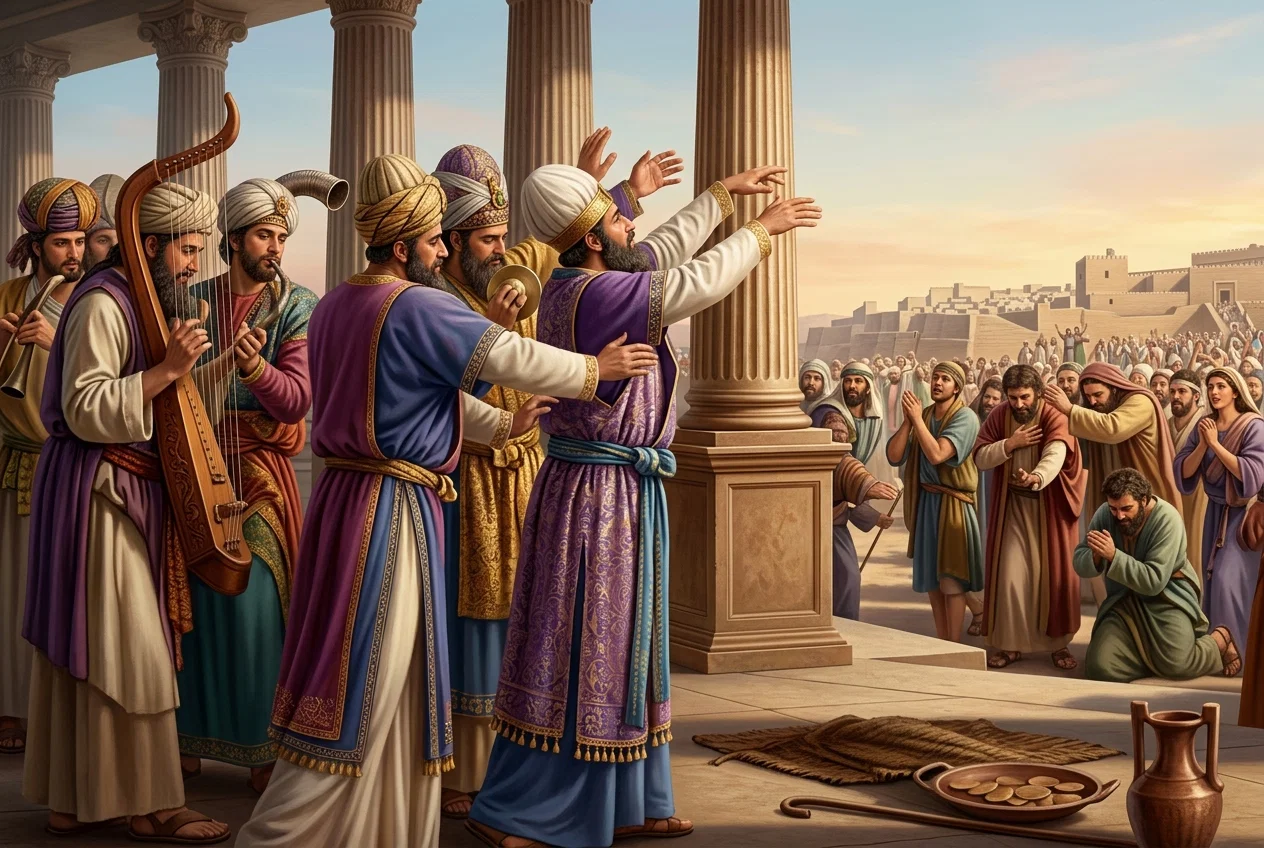
Rejoicing of the Israelites upon the Building of the Temple

VI. Dedication of the Temple

THERE seems to have been a thorough organization of the work of rebuilding the temple, for we find that by the second year of their coming into Jerusalem there was such an arrangement of workers as to “set forward” the work of the house of the Lord. Persons were appointed to oversee and direct the work, for we read that “then stood Jeshua with his sons and his brethren, Kadmiel and his sons, the sons of Judah, together, to set forward the workmen in the house of God: the sons of Henadad, with their sons and their brethren the Levites.” Ezra 3:9.
At last the wreck and rubbish of the years of captivity have been cleared away and the foundation-stones of the new temple have been laid. Then in gratitude to God for His wonderful mercy to His people in bringing them back to their old home and in opening the way for a new city and temple, and to dedicate that which they were about to establish, God’s people gathered in one grand dedication service. The priests in their glorious apparel with the trumpets, and then the Levites with the cymbals, praised the Lord in accordance with the ordinance of David king of Israel.
“And they sang together by course in praising and giving thanks unto the Lord; because He is good, for His mercy endureth forever toward Israel. And all the people shouted with a great shout, when they praised the Lord, because the foundation of the house of the Lord was laid.” Ezra 3:11.

Songs of Praise

One division of those who were to take part in the sacred song sang the first strain of the 136th psalm, “O give thanks unto the Lord; for He is good;” and the second division answered with the second strain, “For His mercy endureth forever.” Then the first division would again take up the opening strain of the second verse of that wonderful psalm, “O give thanks unto the God of gods;” and the second division answered, “For His mercy endureth forever.” Thus they rendered that wonderful psalm which records God’s goodness and His wonderful work toward the Jewish nation. And as the singers praised and thanked God for His goodness and for His mercy, all the people shouted with a great shout.
In the midst of that gratitude and that wonderful singing and praise, magnifying the goodness of God, there came in another element. There were those in that company, gray-haired men, that had seen the first house, that glorious temple covered with gold, one of the grandest buildings that was ever erected, and counted in its time as one of the wonders of the world. They could not forget; and as now they saw the small beginning of the new temple, the contrast between the former glory and this more humble edifice was something that saddened their hearts. We read that when the foundation of this house was laid before their eyes, they wept with a loud voice. While many shouted aloud for joy, these who remembered the old days wept. “So that the people could not discern the noise of the shout of joy from the noise of the weeping of the people: for the people shouted with a loud shout, and the noise was heard afar off.” We are very glad that the Inspired Word can say that the shout of joy drowned out the voice of weeping, and that the enemies of God outside the borders of Jerusalem could not discern any difference between the shout of joy and the shout of weeping. It was one loud, glad acclaim for the providence of God.

Such Changed Conditions

And yet we are not surprised at the feeling of these gray-haired men. How different was the condition of the Jews now from that splendid time when their king ruled from the Euphrates to the Mediterranean with no one to say nay. At that time the ports of the Red Sea poured in the treasures of India and Africa; the great caravans now passed far beyond the borders of Jerusalem. True, the merchants of Tyre were glad now to exchange their timbers and stone and furnish artisans, for the corn, wine, and oil of Palestine. But how different was all that wealth of treasure that passed between Hiram and Solomon in the days of old. Altho a large amount of gold and silver had been carried by the Jews from Babylon for the restoration of the work, notwithstanding its liberality, there is no question that it would raise a melancholy remembrance in contrast with the almost incalculable treasures which formerly sheeted Solomon’s temple with gold. Altho Cyrus and the wealthy people of Babylon, and the willing-hearted Jews, had gotten together a large store of treasures, it was as little compared with the unbounded treasures accumulated by David and his son through two generations and more; and where, too, were now the ark and the prophetic Urim and Thummim and the Shekinah, or divine presence, and the celestial fire upon the altar? The builders had dug down until they had found the original foundation-stones of Solomon’s great and glorious temple; but the very fact had reminded these gray-haired men of Israel, of that wonderful work of the former time, and their hearts broke in remembrance of the sufferings and humiliations of God’s erring people, and their tears of sorrow fell, while the loud shouts of joy made their sobs of grief inconspicuous amidst the noise that was heard even afar off.
(To be continued)

Watch and Be Ready

THERE is one thing we are told to be ready for and watch for; and that is for the return of our Lord. Over and over again He tells His disciples to be on guard, to be watchful. “Take ye heed, watch and pray: for ye know not when the time is. For the Son of Man is as a man taking a far journey, who left his house, and gave authority to his servants, and to every man his work, and commanded the porter to watch. Watch ye therefore: for ye know not when the master of the house cometh, at even, or at midnight, or at the cockcrowing, or in the morning. . . . And what I say unto you I say unto all, Watch.” Mark 13:33. And do you know He seldom speaks of His return without adding this word, “Watch”? Many have ceased to expect Him, much less to desire His return; yet we are told three times in these few verses to “watch.” It is always safe to do what God tells us. If He should say, “Run,” run; if He tells you to “stand still,” stand still; and if He says, “Watch,” then watch. That is the true attitude of every Christian.
— D. L. Moody.

Prayer Is an Arrow

PRAYER is an arrow; if it be drawn up but a little it goes not far, but if it be pulled up to the head it flies strongly and pierces deep; but if it be but dribbled forth of careless lips, it falls down at our feet; the strength of our ejaculation sends it up into heaven and fetches down a blessing.— Bishop Hall.
Continue reading: Higher Criticism