THE “Washington Post” of Aug. 19, 1909, contained the following: an account of an employee of the Y. M. C. A. of St. Louis being discharged for being down at the river and rescuing three men from drowning in the Mississippi River on Sunday, August 15; a report of the efforts of representatives of the Lord’s Day Alliance in New Jersey to close things up on Sunday in Atlantic City, and the refusal of Governor Fort to “call out the militia” to enforce the law, as he had previously said he would do should it be necessary; an editorial commenting on this matter, stating that the effort of these “reformers,” “law-enforcers,” and believers in “blue Sundays” to “invoke the law” “smacks of the ‘blue-law’ spirit;” and also an editorial intended evidently as a comment on the recent trial of a number of conscientious observers of the seventh day at Greenville, S. C., for picking strawberries on Sunday. All this in one paper! which shows how the persecuting, Sunday-enforcement spirit is rising throughout the country.
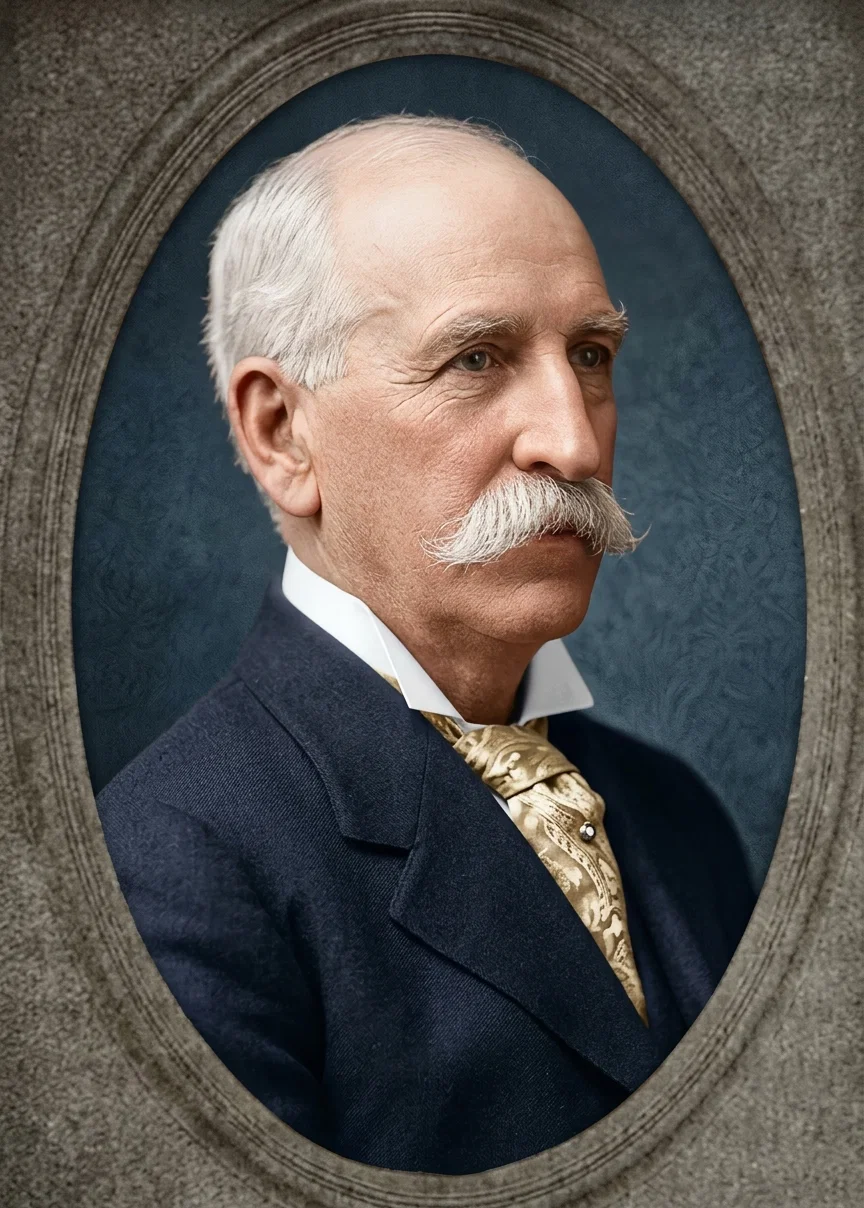
Magistrate Samuel Stradley
The editorial last referred to reads as follows:
A Matter of Conscience
“A few days ago a thoroly orthodox Christian in one of the Southern States found five members of the Adventist faith working in the field a Sunday. Deeply imbued with the gloomy faith of a John Balfour of Burley, this excellent and exemplary man, just from the sanctuary, where he worshiped in the name of Him who sat at meat with publicans and sinners and plucked green corn a Sunday—this child of orthodoxy and cruelty swore out a warrant and had the five arrested for breaking the Sabbath.
“The jury was composed of enlightened men, and the accused were acquitted on the plea that they kept one day of the week holy—a Saturday. And such is orthodoxy, that argues by the stake, the fagot, and the torch. This paper is not a sectarian, tho it is a Christian, and as an observer of men, things, and events it is ready to say that as few criminals, male and female, are recruited from the Adventists as from any other sect, numbers computed.
“They work Sundays, but they keep Saturdays, and that fulfils the law of God as it should of man. These folk are earnest, sincere, Christian men, women, and children. They may be wrong in faith, desperately wrong. That is a matter of conscience; but their consciences are about as likely to be right as yours or ours.
“‘Leave thought unfettered every creed to scan.’
“And take care of your own conscience. That will keep you busy without meddling with the consciences of other people.”
This is the third testimonial of this kind the “Washington Post” has given concerning this same people within the past eighteen months. In its issue of Feb. 11, 1908, in an editorial commenting on their “Memorial to Congress,” and headed “A Reasonable Petition,” this paper said:
“As for the Adventists—no other sect can show a better citizenship. They are industrious, frugal, and peaceable. If all other men were no more prone to evil than they, the grand jury would have little to do, and courts, civil as well as criminal, could take a vacation of at least six days in the week and have little to do the seventh.”
May 27, 1909, learning of the arrest of a member of this faith in Tennessee for chopping a few sticks of wood on Sunday, this paper, under the caption “A Tyranny,” spoke again as follows:
“It is a fact that nobody who knows them will attempt to controvert that the members of the religious sect that is designated as Seventh-day Adventists make up a good citizenship. Their cardinal idea is to harm no man, and as a class they are honest, sober, diligent, and frugal.
“It requires a skilful polemic to confound their faith, a religion that savors more of the pastoral than any other. As their teachers preach it we find that their doctrine is that good is immortal and bad is doomed to perish, and where will one find a better faith? When Cain slew his brother the war between truth and evil began, and in the end truth must survive and evil die.
“The persecution of the Adventist people in one of the Southern States, Tennessee, is a reminder of barbaric ages, when fanaticism ruled in councils of state and set up the gibbet and the stake at every crossroad to vindicate the Gospel of Jesus Christ, through tyranny, pain, malice, and murder, and all approved with a text.
“It is the law of Tennessee that the day known as Sunday is the Sabbath and that only Sunday shall be observed as the Sabbath by any citizen of that state. Even Sir John Falstaff would not give a reason on compulsion, the reasons were as plenty as blackberries. And does the best thought of Tennessee suppose men can be made virtuous and religious by law? And this is the twentieth century, too!
“The worst man you can have in the community is the zealot, who would regulate your morals and religion by his narrow standard of right and wrong.
“Orthodoxy is well enough till it goes on the war-path.”
These unsolicited testimonials from a leading newspaper published at the capital of the nation, and more widely quoted, perhaps, than any other paper in the country, are indeed noteworthy. Rising above all sectarian prejudice, creedal distinctions, and narrow reasonings, they must have been inspired by a love of right principles, a high sense of justice, and an abhorrence of all persecution and oppression. It is a pity that all men and all newspapers are not thus broad-minded and unprejudiced.
Moreover, if these testimonials speak the truth, they bear favorable witness to the practical value of a faith which is summed up in the keeping of the commandments of God and the faith of Jesus. W. A. COLCORD.
Electric Light from Sunlight
For considerable time scientists have been desirous of using the sun for power, and by some strong processes to use it for light at night. Now at last “The Technical World” announces in the June number that Mr. G. S. Cove has invented a mechanism to catch the light of the sun, bottle it up, so to speak, and have it on tap to be turned on at will in dark places. Not only can he store the sun’s rays to be transformed into light, but they can be used for energy as well.
For ages inventors have worked from time to time on schemes for economizing the heat of the sun’s rays as a source of power, but all these devices have come to naught. This new mechanism, as described by the author of the article just mentioned, Mr. Winthrop Packard, consists of what might be called the primary cell of the solar electric generator and is a three-inch-long rod or plug of metal composed of several common metals, on one end of which the sun shines in a glass-enclosed space, the other end being in the shadow, in cool, free air. This rod is part of a circuit wired as is customary to a good storage battery. The sun shining upon one end of this rod produces a difference in temperature between it and the other end; and differences in other conditions are also caused, not yet fully understood. These differences set up an electrical action which is passed along to the storage battery, and there held in reserve power to be turned on as light, heat, or power, whenever desired. Of course the amount of energy trapped and thus stored by one rod in a day is small, but it is a simple matter to arrange any number of these rods in batteries and thus make their individual work cumulative. In the space of an ordinary window sash five feet square, a thousand rods may be placed side by side, and the electric force thus generated is a thing to be reckoned with.
The electrical energy seems to be generated in equal quantity under slanting rays as under those which fall perpendicular. Even in its present somewhat crude and experimental state, given two days’ sunshine, it will store sufficient electrical energy to light an ordinary house for a week. The inventor has proved this now for months in his own establishment, so that in portions of the country where even one day in three is sunny, a single machine five feet square and holding less than a thousand plugs is sufficient for the ordinary lighting of a house. As the author says: “The possibilities of the amount of power which might be obtained in the future by batteries of these simple devices working without expense and with a minimum of attention are simply staggering.”
The present cost of such a machine need not be much over a hundred dollars, and it is as indestructible as a kitchen range. The current being handled automatically, when it is once properly secured and wired upon the roof or any other spot where it gets the day’s sun unimpeded, it needs no further attention.
Thus knowledge which has been sought for ages along this particular line seems now realized.
Clericalism Alienating the People
The Bishop of Hereford, whose see is one of the richest in England, declares that the masses of England were not attending church because “clericalism was choking the church, and alienating it from the people.” In other words, the very ministers that ought to bring people to the church and bring the church close to the people, were alienating the people from the church.
The Big Canadian Wheat Crop
LAWRENCE GALT, writing from Rosthern, Saskatchewan, Canada, August 28, declares that the wheat crop of Western Canada will amount to 130,000,000 bushels. He refers to a procession of ten passenger trains on the Canadian Pacific Railway, from 18 to 20 coaches in length, piled full of a composite mixture of all sorts of harvest hands, to the number of 6,000, leaving Montreal and pulling into the great wheat center. Rosthern, for instance, has elevator capacity of 270,000 bushels of wheat at one time; and more than a million bushels of hard wheat have been shipped from that station in a year. It is estimated that this year she will ship 900,000 bushels, and the price is estimated at a dollar a bushel to the producers. Saskatchewan will contribute more than half of Canada’s great wheat crop. New railways are entering the country, and people are settling through the great wheat section. What a field for true missionary work.
The Vegetarian Cook Book
By E. G. Fulton
By E. G. FULTON
THE author has had years of experience in vegetarian cookery and in the management of vegetarian cafes, and cafeterias. With its aid the chef, cook, or housewife is able to prepare appetizing, healthful meals without the use of any flesh food.
This book contains 226 pages, including a handy and well-arranged index of all the recipes given.
Tastily bound in cloth, price, post-paid, 75 cents
Pacific Press Publishing Assn.
Mountain View, California
Portland, Ore. Regina, Sask., Can. Kansas City, Mo.
San Francisco’s Question
So far, the graft prosecution in San Francisco has failed to reach any “man higher up.” Only two out of twelve jurors were convinced that bribery in the trolley matter had been traced to Patrick Calhoun, president of the United Railways.
Calhoun is a man of much consequence. He personifies an investment of eighty million dollars. He could not, like the inconsequential bribe-taking supervisors, be ruined with impunity. His indictment and trial were bitterly resented by men of his own class.
Whereupon the San Francisco Good Government League propounds this question: “Does the prosecution of wealthy persons charged with civic crimes injure business, or does it improve the financial standing of the city in the eyes of outside investors?”
So far as we are aware no categorical answer is possible. An event that occurred long ago is described as follows: “And He went into the temple and began to cast out them that sold therein and them that bought.” Obviously, the immediate effect must have been to injure business, but the event is not judged on that ground nowadays. Will it be to my financial advantage to steal this man’s watch? Possibly; but should I, therefore, do it?
Who can doubt that inasmuch as San Francisco has tried to punish civic crime, even at material cost, she has gained, and inasmuch as she has not tried, she has lost?—Saturday Evening Post.
Wine and Wine.
The editor of the Western Watchman (Roman Catholic) confesses in his issue of August 19 that he, as well as the greater part of Catholics in the United States, has been deceived over the wine used for sacramental purposes. Dr. Wylie, the Government chemist, shows that only the first pressing of the grape is true wine; that the second pressing is water and sugar, flavored by the mixture of the red pulp, and to give it strength, a little alcohol is added; and that in white wine there is very great deception. The Watchman declares that they have been using the second pressing of wine for years, supposing that to be the true article, and now the editor finds that he has been saying mass with “sugar, water, a dash of alcohol, and a flavor of beer. The thought staggers us.” We should think it would, and we should think it wouldn’t. If it is wine that he is using as a symbol of the pure offering of our blessed Lord, we should think it would stagger him. If he has the power to change that wine into the very blood of Christ, we do not see why he should be staggered at all. It would certainly look as if he were in some doubt of the re-creation or the transmutation. If he were using the pure juice of the grape, unfermented, uncorrupted, as the Christian religion ought to be, there would be no difficulty at all. That is always easily obtained, and one may know that it is pure.
Darwinism and Moses
Mr. Wm. T. Stead declares that in England Darwinism is almost everywhere tacitly accepted, and in most of the churches openly admitted; that as a witness to the marvel and miracle of the creative work, Darwin is more convincing than the unknown author of the simple but sublime cosmogony of the Pentateuch. In other words, Darwin is preferred to Moses. One can but smile in thinking of the matter. Moses has stood for nearly four thousand years. God’s revelations through him have transformed and helped to transform the governments of the world. Darwinism, breeding infidelity, is upon anything but a certain basis. Four hundred years from now Darwinism will be forever buried in the wreck and consumption of every false religion, while Moses, “the man of God,” and the souls that have been saved through his sublime revelation, will shine on through the eternal centuries.
Life and Health
A PRACTICAL health journal, published with a view of meeting hygienic needs in every home; teaching how to care for the health and how to preserve life; prescribing simple home treatments to assist nature in throwing off diseases rather than adding more poison by using drugs or unnatural stimulants as remedies: teaching how to avoid disease as far as possible, how to manage in the home when sickness does come, and how to combat the disease by simple remedies which nature provides.
Send for sample copy and special rates to agents. Price 10 cents per copy or $1.00 per year.
Address, LIFE & HEALTH, Takoma Park, D. C.
Bibles
Bibles.—Remember that we are headquarters for anything in the Bible line. We shall be pleased to send you our catalog of Bible selections on application. Pacific Press, Mountain View, Cal.
California Dried Fruits
Shipped direct from ranch to families, schools, restaurants, and sanitariums. Larger variety, better facilities, prompt shipment.
Write for circular “S,” giving full information. St. Helena Home Fruit Co., Sanitarium, Napa Co., Cal.
True Enjoyment
“Enclosed find money-order for $6.00 in payment for 150 September Signs Magazines. I sold them in the time that I have formerly sold only 100, and enjoyed every moment of the time devoted to it,” writes one of our workers who usually gets some happiness each month in passing on the message in the Signs. You, too, may enjoy a few hours’ work with the message-filled September number.
Don’t Put It Off Order to-day
Partial Table of Contents
General Under the heading, “Thou Shalt Not Steal,” appears a Wall Street Journal Editorial which is a splendid selling feature with business and thinking people.
Bible “Our Reasonable Service,” by Mrs. E. G. White, setting forth the reasonableness of a well-ordered and temperate life; “The Sabbath to Be Restored,” by Eld. C. L. Taylor.
Temperance and Health “Tendency of Highly Seasoned and Other Improper Foods to Produce Intemperance,” by D. H. Kress, M.D.; “The Effects of Alcohol on the System from the Standpoint of the Scientist,” by H. F. Rand, M.D.; “Effects of Tobacco on the System, and How It Strengthens the Drink Habit,” by A. J. Sanderson, M.D.; “The Heritage of Intemperance,” by L. A. Reed; “How May We Gain the Victory?” by the Editor.
Home Story, and illustrations in harmony.
Twenty-five copies cost $1.00; they sell for $2.50. 100 cost $4.00. You sell them for $10.00. Order of your Tract Society. Ask for the SIGNS WORKER which contains selling points and suggestive canvasses.
Signs of the Times
MOUNTAIN VIEW, CALIFORNIA
Education — Opportunity
The Standard Dictionary defines education to be:
“The systematic development and cultivation of the mind and other natural powers in the directions of the feelings, the tastes, the manners, by inculcation, example, experience, and impression.
“Education has for its aim the development of the powers of man, (1) by exercising each along its peculiar line, (2) by properly coordinating and subordinating them, (3) by taking advantage of the law of habit, (4) by appealing to human interest and enthusiasm.”
The word “education” comes from the Latin educatio, from educare, to rear, nourish, bring up; from educere, to lead out; from e, out, and ducere, to lead.
The International Encyclopedia defines education thus:
“In a general sense, the development of the whole nature of man, physical, intellectual, and moral, through interaction with every phase of his environment.”
As good a definition as either of these, perhaps better, is, “The harmonious development of the physical, the mental, the spiritual powers.” Webster gives us this short definition: “To cultivate and discipline the various powers of the mind,” altho this is altogether too limited.
Not always does “interaction” with environment develop all of the human faculties and powers. Sometimes counteraction is as necessary as interaction. But it must be patent to every one who stops to consider what man is and what the full man ought to be, that education must include the very highest development of all his powers in harmonious cooperation. The physical training of the child ought to begin from his earliest moment of existence. The moral and the mental training follows; for the truest kind of education must take hold upon character, and character pertains to morals. The truly developed man must be a moral man, and the moral man must have that high sense of morals which only true spirituality gives and which must affect all his relationship to his God and to his fellow men.
Front and End View of the Main Building
The editor of the SIGNS OF THE TIMES believes in education. He is interested not simply in education in California. The principles which are involved in true education here are just as applicable elsewhere. The people whom this paper represents believe in that kind of education which develops the whole man.
It has not been an easy matter in these days to work out such a system as that, especially in constant rivalry with the excellent education given in the various institutions of the world. Generally, education has been considered to be mental culture and has had much to do with that phase alone, without regard to the future work of the individual.
We value a machine by the product which it will turn out, and the economy of its operations. Why should not the human machine be valued in the same way? Why is not that education altogether the best which will obtain the very best results from the one educated? which will make him a man, not simply cultured and refined, but one who is wise in counsel, who has a knowledge of the practical things of life in which he is engaged, and will turn out the very best product possible — environment and other circumstances considered? Why should not the very acme of that education be considered the acquirement of the very highest possible conception of knowledge; namely, acquaintance with God and with the great principles of His government? More than that, why should not that education begin with the very thought of God? Why should not its basis rest in the principle expressed by the wisest man who ever lived, “The fear of the Lord is the beginning of knowledge”?
Such education as this can not be given in the city. A school giving such education can not be carried on and the best results developed in our large towns. The country with its great widening, broadening influences, is demanded.
Back and End of Main Building
A New Locality
By M. C. W.
For years the headquarters of education among Seventh-day Adventists in California was Healdsburg. For reasons which we need not name here it was thought best to remove the school from there. A good site was supposed to have been found near Sonoma, but as clear title could not be secured, this was abandoned. Since that, the committee in charge have made diligent search, and only quite recently has a property been found which indeed offers advantages far above the ordinary. The writer, having heard of this, felt that it was a privilege as well as a duty to visit the property and report to the readers of this paper.
This immense ranch, consisting of 1,600 acres, is located on the top of Howell Mountain. It has great springs in abundance. It might be called “The Ranch of a Hundred Springs,” with a hundred more perhaps which could be developed. There are five hydraulic rams on the place, and it seemed to us that sufficient power could be developed to run an electric plant. A large alfalfa field is irrigated, and much water runs to waste.
There are 100 acres or more in good cultivation, some of this very rich valley land, with a soil from ten to twenty feet in depth. There are pears, peaches, prunes, quinces, apples, berries, grapes in abundance, with plenty of opportunity for enlarging the fruit section.
There are other parts of the great mountain ranch which consist of equally good soil if it were cleared.
It has a fine horse barn, 64 x 76 feet, a large cow barn, 70 x 90 feet, and a fairly good storage barn, 40 x 40 feet. There are something like ten or twelve buildings on the ranch, all of them in excellent condition; the main building costing over $20,000. It has twenty-nine rooms, besides parlor, halls, kitchen, laundry, etc. There is a large amusement hall which can very easily be converted into chapel and recitation rooms.
One of the fine attractions of the place is a large swimming tank, or swimming bath, connected with which are regular tub baths. The size of the tank alone is 40 x 100 feet. All of the water which is used for the baths is not wasted, but can be used for irrigation purposes, and all the spring and other water on the great ranch is wonderfully soft and sweet, with the exception of one spring which contains more or less mineral. One of the spring reservoirs is 14 x 70 feet, a large flowing spring of unknown depth, the water clear, sweet, and pure.
There are nineteen horses upon the ranch; about twenty cows; twelve to fourteen vehicles of different kinds, including a large water-wagon for sprinkling purposes. The buildings are under a fine system of sewerage. Traps for toilets, sinks, etc., are modern. There is a gas plant for 150 lights.
There is an abundance of standing timber upon the place, of good quality, consisting of pine, fir, and redwood. This is estimated all the way from three millions to ten millions of feet. The last estimate is by an old mill man who has had much practical experience in timber. There is a vast amount of wood besides the standing timber, estimated at from three hundred thousand to one million cords.
We did not have time to visit the larger13part of the outlying acres, but within ten minutes’ walk of the ranch we found large pines four and five feet through; one white oak measured sixteen feet three inches in circumference, and a walnut-tree grown from a single nut planted in 1890 measured six feet and one inch in circumference. These are characteristic of the place in general and speak wonderfully for the fertility of the soil. The amount paid for the place was $60,000. The buildings and piping must have cost all that was paid for the great ranch. It has been for years a mountain resort and summer hotel.
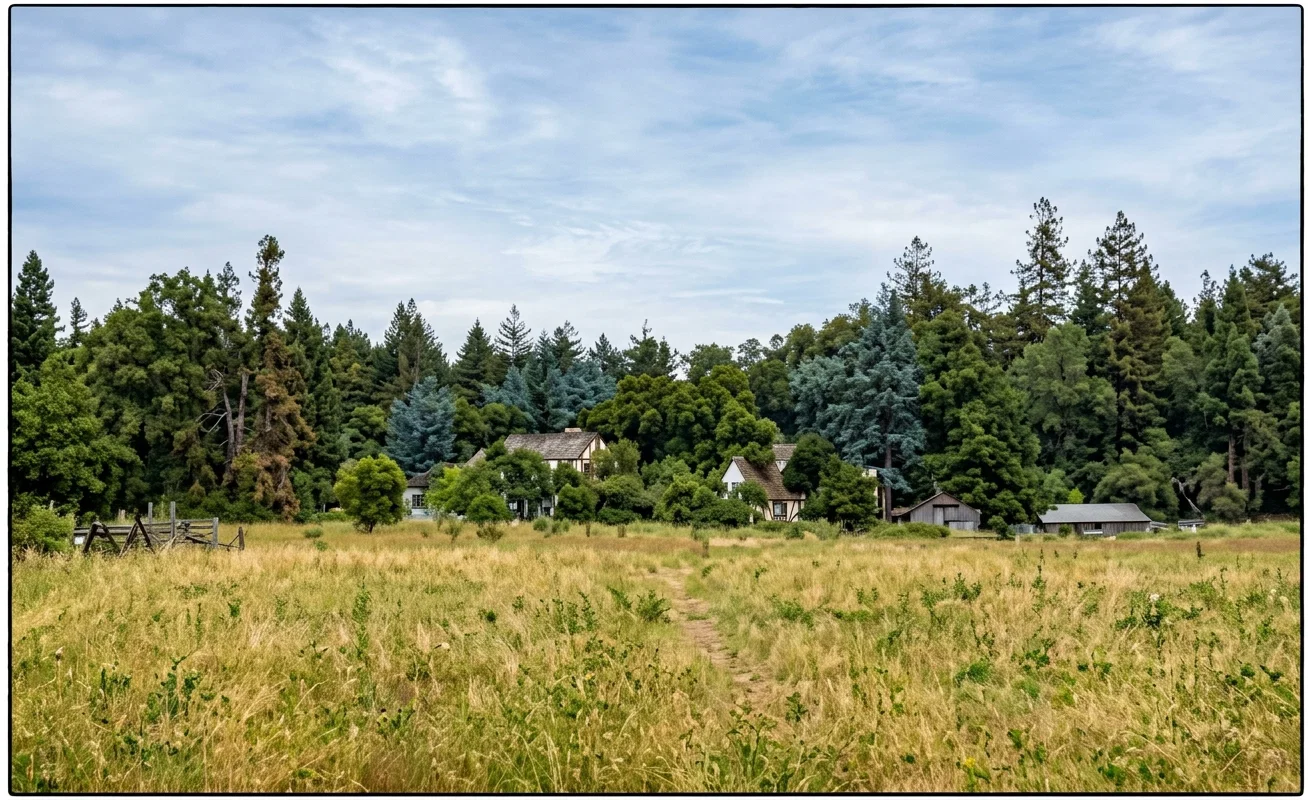
A General View Across the Field to Cottages Nestling Among the Trees
The estimable gentleman, Mr. Angwin, who has kept it for years, is himself a mechanic, one of the old-fashioned kind, who believed in keeping everything in first-class shape; but years have crept upon him; and he feels that he must retire, and for his children’s sake get out into the towns. His own heart is upon the ranch, because there his life-work has been. The resort is well known throughout California. “Angwin’s” is not only the name of the hotel, but of the post-office as well. The amount of standing timber and wood upon the place is in itself more than an ordinary endowment.
The healthful surroundings, the beauty of nature, the work that can be furnished the students in manual labor, together with a good strong faculty in all different departments of college education, furnish one of the grandest opportunities that has ever come under the observation of the writer. We almost wish that we were young again, to throw ourselves into the work of the school; not only in obtaining an education in the sciences and in letters, but in the practical way of doing things which would make one’s work more effective for all future life.
The present board of control consists of Elder H. W. Cottrell, Prof. C. W. Irwin, Elder W. T. Knox, Elder S. N. Haskell, and Elder A. O. Tait. The faculty thus far chosen is made up as follows: Prof. C. W. Irwin, Prof. George W. Rine, Elder A. O. Tait, Miss Hattie Andre, and Mrs. Irwin; and by this time probably others.
Accommodations can be furnished for more than 100 students now without further building. There are five cottages besides the main building. The main building will furnish rooms for the young ladies’ dormitory; and the cottages outside, for young men.
It seems to us that the location itself, the surroundings, the board of control, the faculty, the grand opportunity for an all-around education, ought to appeal to every parent and to every young person of school age in California.
The first student on the ground, it is worthy of note, is Mr. Elbert Ashbaugh, and the second prospective student on the ground as soon as he is old enough, was the son of the editor.
The accompanying illustrations will give somewhat of a faint idea of the premises.
M. C. W.
Angwin Estate as an Educational Investment
By H. G. Childs
SEPTEMBER 6 I visited the Angwin estate and examined the improved portions of the property. I found the place well equipped, well improved, and consider the property an excellent business investment.
Across the Alfalfa Meadow Toward the Buildings and Forest
Having such a splendid equipment to start with, California can by wise management and the perpetual maintenance of a good strong faculty, have one of the best educational institutions in the denomination.
H. G. CHILDS,Treasurer Pacific Press Pub. Assn.
Good Missionary Work.
By Editor
THE following letter breathes forth such a spirit of missionary zeal and devotion that any comment from us seems unnecessary. We will simply pass it on for your encouragement, and with the hope that it may inspire you to “do good” in a similar way.
“Kankakee, Ill., Aug. 15, 1909.
“Gentlemen:
“I am inclosing herewith money-order for $10.50 to pay for yearly subscriptions to the SIGNS OF THE TIMES, which I wish to send to some of my friends who are not acquainted with this wonderful truth.
“I know that your regular subscription price is $1.50 per year, but as I am sending the money at once, and paying for all of them myself, I hope you will be kind enough to send eight yearly subscriptions for the $10.50. If you will I shall be very, very thankful, as I am anxious for all of these dear people to have the paper, but can not afford to pay more than $10.50 for this part of my missionary work. I am a stenographer, and am self-supporting.
“Thanking you in advance for your kindness, I remain,
“Yours sincerely,
“——.”
We were pleased to quote our missionary rate of $1.00 per copy per year on five or more new yearly subscriptions from one person. You may take advantage of this also.