Your ShelfYour Projects

Review and Herald, Vol. 84, No. 33.

Publishers' Page

Review and Herald

Aug 15, 1907

Review and Herald Publishing Association · Takoma Park Station, Washington, D. C. · Aug 15, 1907

Publishers' Page

Conducted by the Department of Circulation of the Review and Herald Publishing Association

The Special Temperance Number of Life and Health

The September number of Life and Health has been enlarged to 40 pages, and filled with the best matter that could be secured on temperance.
It will be a good selling number.
It will be heartily received by the best classes of people in every community.
It will break down prejudice.
It will convince thousands of their personal responsibility in suppressing the liquor traffic.
It will reveal the many unsuspected avenues through which the liquor habit is acquired.
It will condemn many of the evils of the various intemperate practises.
It will expose the inconsistency of the government in licensing the liquor traffic, and then providing instruction in the public schools against the use of intoxicants.
It will demonstrate the baleful effects of liquor upon the morals of men and women.
It will impress the importance of home temperance.
It will help the public in discovering the causes of alcoholism.
It will bring the worker a liberal remuneration for his services.

Prices

The retail price of this special Temperance number will be ten cents a copy. Agents may secure copies at the following rates: 2 to 10 copies to one address, one order, 5 cents a copy; 10 to 24 copies, 4 cents; 25 or more copies, 3 cents, all post-paid.

Home and Health

From every quarter come the questions, “What about ‘Home and Health’?” “What does it teach?” We are glad to explain that “Home and Health” is a large health subscription book of 592 pages, thoroughly illustrated, and designed especially for home reference in the treating of the many details pertaining to the home and the care of the body.
It reveals some of the most practical means by which we may make our homes visible types of the invisible home above.
It gives God’s message of health, which is due just now in all the world.
It tells us how to live a plain, simple life.
It imparts information that will prove to be practical in the mechanical construction of homes.
It enables the reader to apply many of the remedies of nature in the treatment of common diseases.
It will lighten the labors of many an overburdened housekeeper, through helpful suggestions on the practical features of housekeeping.
It will prove to be an all-round, valuable counselor in every feature of home life.
In truth, it is a book of real merit and practical value.
It is a book that appeals to the people—a book that they will buy and never regret.
The Review and Herald Publishing Association has just completed its first edition of this new book, and is now prepared to fill orders for the different bindings without delay. Agents are wanted to sell this valuable work. Any one with a little preparation can sell it. Write to State tract societies or the Review and Herald for further information.
The book, bound in cloth, marbled edges, is $2.50; full law sheep, $3.50; full leather, $4.50.

Foreign Publications

THE New York Office of the Review and Herald Publishing Association has in stock at the present time books and tracts in the following languages: German, Danish, Holland, Swedish, French, Spanish, Portuguese, and Italian. Below is given the list of Italian works with prices:—

Italian Literature

“Steps to Christ,” cloth, 50 cents; “Steps to Christ,” paper, 25 cents; “His Glorious Appearing,” 25 cents; “Sufferings of Christ,” 6 cents; “Sabbath of the Bible,” 4 cents; “Day after Death,” 2 cents; “Signs of the Times,” 2 cents; “Catholic Doctrine,” 2 cents.

Future Supplies

In addition to the above stock, the New York Branch will soon be supplied with such literature as is issued in Russian, Slavonic, Polish, Bohemian, Servian, Hungarian, Bulgarian, Rumanian, and Chinese languages. All orders for the above-mentioned publications should be sent to the Review and Herald Publishing Assn., 32 Union Square E., New York, N. Y.

Report of the Sabbath-School and Young People’s Convention

ORDERS are beginning to come in for the “Report of the Sabbath-school and Young People’s Convention” recently held at Mount Vernon, Ohio. This Report will prove to be very valuable to all who are interested in Sabbath-school and young people’s work.
This meeting, of which full report is given, was attended by over 200 delegates from all parts of the United States, who spent the entire time upon the definite work of the Sabbath-school and young people’s organizations. The meeting has been considered, by all who attended, one of the best that has ever been held. It was, in fact, the first general meeting ever called to consider the special work of these two departments. The result of the convention will surely be to give a new impetus to the work, for the note that rang through all the meeting and was echoed by all the papers and discussions was the finishing of this work.
The Report will contain the convention sermon by C. C. Lewis, and also the morning lessons on biographical sketches of Bible characters, which are in themselves worth more than the price of the pamphlet.
The report is one that can be used for reference for a long time by those engaged in Sabbath-school and young people’s work, and for this reason a thorough index has been added for convenience. Those who secure this report will doubtless find it better than any other report ever issued at the price named. It will be much appreciated, and those who desire it should order early while it can be supplied. The pamphlet that contains this report ought by rights to sell for 25 cents, but in order that our people may have the benefits of the proceedings, the very low price of 10 cents has been made.

The Spirit of Prophecy

THE new pamphlet entitled “The Spirit of Prophecy,” by G. A. Irwin, is being very much appreciated throughout the field. The first large binding order has now been ordered out, and a new order has been placed for another supply.
This new and important work on the subject of the spirit of prophecy, its relation to the law of God, and its place in the plan of salvation, contains 56 pages of important matter that has been prepared from a series of studies upon the spirit of prophecy in the remnant church, and the relation it sustains to the law of God, and his people and work in all ages.
It has been the aim of the writer to treat the subject from a standpoint somewhat different from that in which it has heretofore been treated, and to enter a field not yet covered by any other writer, so that this treatise will be a benefit and aid to other writers upon this subject, rather than a rival to them. Its mission is more fully to establish believers upon the law of God and the testimonies of his Spirit.
All who have examined the pamphlet are highly pleased with it, and give it their hearty recommendation. We commend it to all the REVIEW readers, and every member who desires to know more of the place of the spirit of prophecy in connection with the giving of the third angel’s message. Price, 5 cents, post-paid.

The Seer of Patmos

THIS thrilling book contains a story on the prophecies of Revelation, written in simple narrative form, and contains a new setting of the important messages recorded in John’s prophecy in the book of Revelation. It will be found to be interesting, instructive, and essential to all Bible students. It is illustrated with original engravings especially prepared for the book. Being written in story form, it is especially attractive to the young; no better book could be placed in the hands of a young man or young woman than the story of “The Seer of Patmos.” Price, $1, post-paid.
Orders for any publication mentioned on this page may be sent to any conference tract society, or to Review and Herald Publishing Association, Takoma Park Station, Washington, D. C., or Battle Creek, Mich.
Also Pacific Press Publishing Company, Mountain View, Cal.; Portland, Ore.; Kansas City, Mo.; Southern Publishing Association, Nashville, Tenn., and Fort Worth, Tex.

Christ in All the Bible

Editorial

Christ in All the Bible

THE theme of the whole Bible is Christ and his salvation. He who does not find this theme in every book of the Bible needs to anoint his eyes with eye-salve that he may see. When Jesus walked with the two disciples to Emmaus and “expounded unto them in all the Scriptures the things concerning himself,” they then saw Christ in all the Scriptures. When afterward he met the other disciples and opened their understanding “that they might understand the Scriptures,” they saw that all the things which were written “in the law of Moses, and in the prophets, and in the psalms,” were intended to constitute a revelation of Christ crucified. If looked at from the right standpoint, every page of the Bible will show the face of the crucified One. Those who read the Bible in this way will find it the bread of life, the living Word of God.

The Faith That Triumphs

FAITH in Christ is not a mere aimless sentiment. Christ is a living Saviour who is doing a definite work for us, and to believe on him is to accept him in the work he is doing for us. To believe on him in this generation is to accept him in the work he is now doing for us as our High Priest in the most holy place of the heavenly sanctuary. To preach Christ is to present him in the work he is doing for us, in order that faith may be exercised in him in that work. Hence the need of saying with a loud voice to all the world, “Fear God, and give glory to him; for the hour of his judgment is come.” Christ is now doing his last work in behalf of sinners in cleansing the sanctuary, in this hour of judgment, and it is necessary that all who will receive the benefit of his mediation should enter in with him by faith into the most holy place of the heavenly sanctuary. Those who hear the message for this time and believe on the Christ of this message, will be looking for his soon coming, and will stand complete in him when he “shall come in his glory, and all the holy angels with him.” It is such a faith in such a Christ which means salvation to the people of this generation.

The Message Which Will Deliver from Babylon

The last call before the final triumph of the gospel is recorded in the eighteenth chapter of the book of Revelation. After the complete fall of Babylon had been announced, “with a strong voice,” the prophet “heard another voice from heaven, saying, Come out of her, my people, that ye be not partakers of her sins, and that ye receive not of her plagues. For her sins have reached unto heaven, and God hath remembered her iniquities.” When this summons has been given and either accepted or rejected, comes the treading of the wine-press of the fierceness and wrath of Almighty God, the invitation to the supper of the great God, and the casting of the beast and the false prophet into the lake of fire burning with brimstone. The offer of mercy closes with the call to come out of Babylon, and those who are not delivered by this call will perish in the destruction of Babylon. It is therefore of the greatest importance to understand the nature of that message which is designed to accomplish this final deliverance from Babylon.
Babylon of Chaldea was utterly overthrown many centuries ago, and it is perfectly clear that this is not a call out of ancient Babylon; but ancient Babylon is a type of modern Babylon, and the experiences of the people of God in connection with ancient Babylon, when properly interpreted, will help us to understand the experiences of the people of God in connection with modern Babylon. This is the reason why so much has been written in the Old Testament about ancient Babylon, and why we should regard the record not simply as history, but as prophetic history. Let us therefore study some of the scriptures which deal with Babylon of old and the deliverance from it.
The prophets who prophesied just before, during, and immediately after the Babylonish captivity dealt quite fully with this terrible crisis in the national history of the Jews. The spirit of Christ which was in them, knowing that this experience was in itself a prophecy, so presented it that it should serve as an object-lesson for the last days, so that the true Israel of God might have a light by which to find their way out of spiritual Babylon. Their prophecies are therefore of special value at this time. So let us note what one of them, Habakkuk, has said concerning the experience with Babylon:—
“O Lord, how long shall I cry, and thou wilt not hear! even cry out unto thee of violence, and thou wilt not save! Why dost thou show me iniquity, and cause me to behold grievance? for spoiling and violence are before me: and there are that raise up strife and contention. Therefore the law is slacked, and judgment doth never go forth: for the wicked doth compass about the righteous; therefore wrong judgment proceedeth.”
Scenes of violence, strife, and contention were kept before the prophet’s mind, and he inquired the meaning of such representations. Then the Lord made answer thus:—
“Behold ye among the heathen, and regard, and wonder marvelously: for I will work a work in your days, which ye will not believe, though it be told you. For, lo, I raise up the Chaldeans, that bitter and hasty nation, which shall march through the breadth of the land, to possess dwelling-places that are not theirs. They are terrible and dreadful: their judgment and their dignity shall proceed of themselves. Their horses also are swifter than the leopards, and are more fierce than the evening wolves: and their horsemen shall spread themselves, and their horsemen shall come from far; they shall fly as the eagle that hasteth to eat. They shall come all for violence: their faces shall sup up as the east wind, and they shall gather the captivity as the sand. And they shall scoff at the kings, and the princes shall be a scorn unto them: they shall deride every stronghold; for they shall heap dust,and take it. Then shall his mind change, and he shall pass over, and offend, imputing this his power unto his god.”
The significance of the visions which Habakkuk had seen is here explained. “The Chaldeans . . . terrible and dreadful . . . shall come all for violence.” That “marvelous work and a wonder” which had been foretold through the prophet Isaiah, but without stating the time for it, is now declared to be just at hand; and all those evils which had been threatened against Jerusalem unless the people turned to the Lord in repentance, were now about to come. The prophet was familiar with the messages which the Lord had already sent to his people, and knew full well that they meant a harvest of death and destruction, but in the midst of such calamities his hope was in God, and he said:—
“Art thou not from everlasting, O Lord my God, mine Holy One? we shall not die. O Lord, thou hast ordained them for judgment; and, O mighty God, thou hast established them for correction. Thou art of purer eyes than to behold evil, and canst not look on iniquity: wherefore lookest thou upon them that deal treacherously, and holdest thy tongue when the wicked devourest the man that is more righteous than he? And makest men as the fishes of the sea, as the creeping things, that have no ruler over them? They take up all of them with the angle, they catch them in their net, and gather them in their drag: therefore they rejoice and are glad. Therefore they sacrifice unto their net, and burn incense unto their drag; because by them their portion is fat, and their meat plenteous. Shall they therefore empty their net, and not spare continually to slay the nations?”
All things material may go to destruction, and it may look as if the end of all things had come, but those who are in fellowship with the eternal God will survive. The Chaldeans will be permitted to triumph over God’s people, even though they are an idolatrous nation, not because the Lord looks with approval upon their conduct, but because he will use them as the instrument for correcting his people when they refuse to listen to his warnings; but will that nation that ascribes its success to its instruments of warfare, and sacrifices to its net, and burns incense unto its drag, destroy continually? Habakkuk waits for an answer:—
“I will stand upon my watch, and set me upon the tower, and will watch to see what he will say unto me, and what I shall answer when I am reproved. And the Lord answered me, and said, Write the vision, and make it plain upon tables, that he may run that readeth it. For the vision is yet for an appointed time, but at the end it shall speak, and not lie: though it tarry, wait for it; because it will surely come, it will not tarry. Behold, his soul which is lifted up is not upright in him: but the just shall live by his faith.”
The answer is now made plain. The sin which will bring the fall of Babylon is pointed out, and the character which will survive that fall is revealed. That pride of heart which refuses to acknowledge the kingship of God, and that his kingdom ruleth over all, will cause the utter destruction of Babylon, but those who believe in God and share with him his righteousness will also share with him that life which measures with the life of God. “Pride goeth before destruction, and an haughty spirit before a fall.” “He that believeth on the Son hath everlasting life.” “His righteousness endureth forever.”
In order that we may the better understand the answer made to Habakkuk, let us study some things in the experience of Babylon. This city had its origin in unbelief and rebellion. There was the purpose to build a tower “whose top may reach unto heaven,” and to make a name in the world. The meaning of such a course is clear: there had been a flood which had reached above the tops of the highest mountains, and had destroyed all except those who had believed God for salvation from it. These builders in the plain of Shinar were planning a way of escape from any such calamity in the future. By building a tower up to heaven they would be able to investigate the cause of the flood, assign a satisfactory scientific explanation for it as a natural phenomenon, and provide a place of safety in case it should happen again. But God had said, “The waters shall no more become a flood to destroy all flesh,” and so their course showed that they did not believe the flood to be a judgment from God, but rather the result of natural causes which could be discovered by investigation and guarded against by proper provision on their own part. They set aside revelation as untrustworthy, preferring the results of their own investigations, and proposed to make their own provision for preserving themselves alive. Thus were pride and unbelief stamped upon every brick of the tower, which was in itself a monument of self-salvation—righteousness by works.
This first attempt to found Babylon ended in confusion, and “they left off to build the city,” but a little later, in open rebellion against God’s purpose, Nimrod made Babylon “the beginning of his kingdom.” This was the kingdom of the world as opposed to the kingdom of God, the pride of self-exaltation as opposed to the humility which exalts God alone, righteousness by works as opposed to righteousness by faith. Such was ancient Babylon, the type, and such is modern Babylon, the antitype.

4 Mighty Movement—A Strong Purpose

The second and last mass-meeting of the American Federation of Catholic Societies was held in Tomlinson Hall, Indianapolis, Tuesday evening, July 16, at 8 P. M.
The chief features of the evening were the address of Rev. J. T. Roch, of Nebraska, on “Making History,” and the address of Rt. Rev. Jas. A. McFaul, Bishop of Trenton, on “Federation.” Both men were forceful speakers, and the audience being almost wholly Catholic, the meeting was certainly an enthusiastic one.
The address of the first speaker was devoted largely to a setting forth of the weakness of the Catholic Church in America upon the point of daily and weekly papers. He deplored the fact that there were so few purely Catholic dailies in this country in proportion to the number of Catholics; and set before the convention the necessity of immediately remedying that condition. He declared emphatically that “the church [Catholic] can have no influence, no power, until it has a press that is powerful and influential.” He hoped the time would speedily come when in this country there would be as many Catholic dailies in proportion to the population as there now are in Germany. In that country there are one hundred and thirty Catholic dailies; in this country only twelve.
He laid the blame for Catholic weakness in this particular upon the Catholic laity, because they do not make it a point to advertise in Catholic papers and patronize those who do. By general patronage of those who advertise in Catholic papers, he would make Catholic papers of greater value to the advertiser, and so strengthen them financially and increase their power and influence.
Concerning the situation in Germany and the reason for the strong Catholic press of that country, he said: “The Center [Catholic] Party insist upon this, that those who call themselves representative Catholics must subscribe for Catholic papers, and that Catholics who have a business to advertise shall advertise it in the Catholic papers.” This, in principle, amounts to a systematic boycott carried on by a church for her political advantage.
They who know the conditions in this country as regards the public press and its domination by the Catholic power, can but wonder what more that body could desire. A few years ago there came to San Francisco, Cal., one whodesired to deliver a lecture upon Catholicism. Only one paper published that lecturer’s advertisement, and that paper published the following morning a profuse editorial apology for having inserted the advertisement. With a daily press thus practically subsidized, and operated without expense or burden to that church, we can but wonder what more even the Catholic Church could desire in the matter of a Catholic press in this country. Nevertheless, with all the power that the Catholic Church wields in this regard, that power is counted as nothing by the Catholic clergy in comparison to the power they intend to wield when they have the powerful and influential press for which they are now working. It is evident from the plans laid that it is not “the power of the Spirit” they are seeking, but political power, the power to compel men to yield to their demands in those things that they consider to be for the benefit of the church.
The address of Bishop McFaul on Federation dealt with the importance of a united Catholic body in this country. Though the Catholic Church in America considers itself fortunate in being in a country of light and liberty, she is still far from satisfied, and there are many things of a temporal nature she desires which she knows the majority are not willing to grant. The right of the majority to rule, even in civil affairs, she is not content to recognize, however, and because she wants a thing, she will have it, majority or no majority.
Referring to “false accusations” made against Catholic federation by its enemies, the speaker said:—
This shows the necessity of Catholics taking hold of the secular and religious press of the country. We shall never exert our due influence in America if we do not support and employ the press in the work of spreading the light of religion and the true solution of the great problems which are confronting our age. And the forming of public opinion by the press and by Catholic congresses, such as this national convention of federation, can not be accomplished, unless we have the stalwart Catholics of every nationality banded together in behalf of the social, civil, and religious interests of Catholics.
The bishop announced the motto of the Federation to be, “In union there is strength;” and it is the purpose of the Federation to use the strength accumulated by the union of numbers to compel the rest of the country to accede to their demands. This setting forth of their purposes, and this trusting in the arms of flesh to force compliance with their wishes, this confederacy of human forces to crush opposition, brought to the writer’s mind the scripture:—
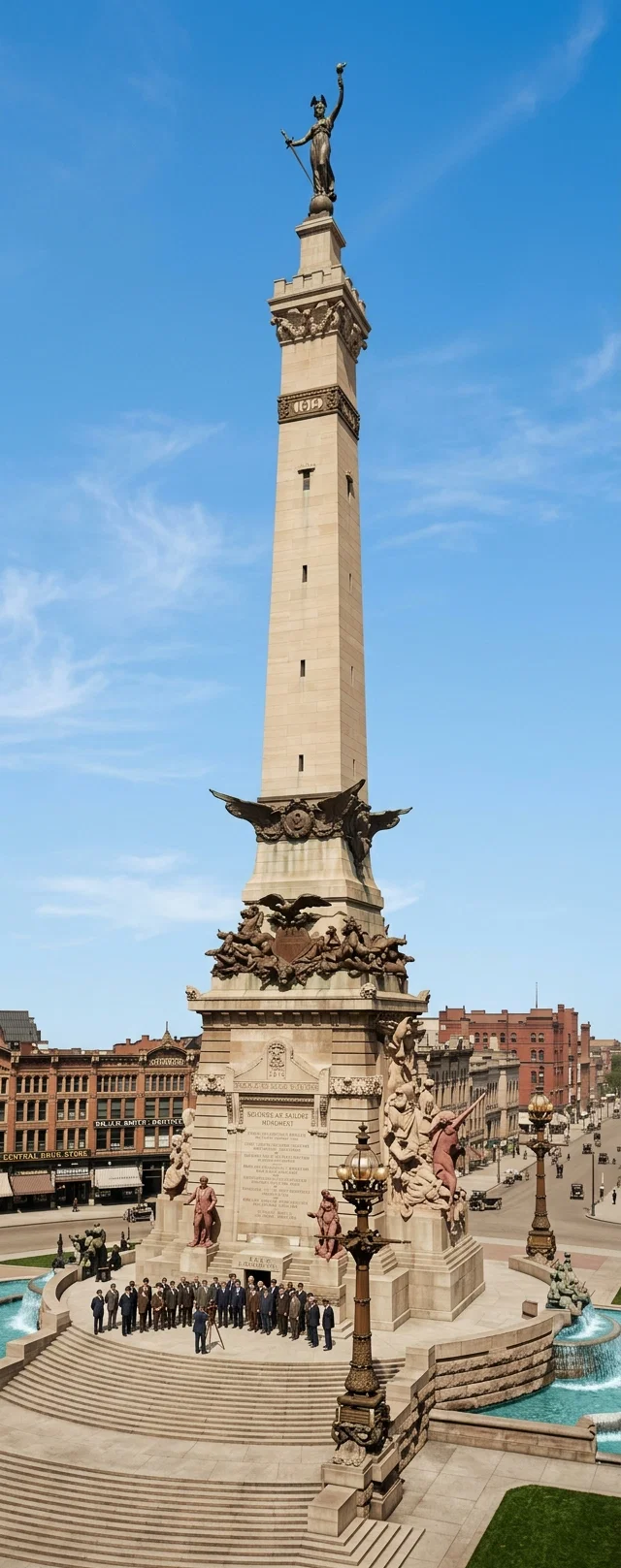
INDIANAPOLIS WAR MONUMENT, WHERE FEDERATION DELEGATES WERE PHOTOGRAPHED
“Associate yourselves, O ye people, and ye shall be broken in pieces; and give ear, all ye of far countries: gird yourselves, and ye shall be broken in pieces; gird yourselves, and ye shall be broken in pieces. Take counsel together, and it shall come to naught; speak the word, and it shall not stand: for God is with us. For the Lord spake thus to me with a strong hand, and instructed me that I should not walk in the way of this people, saying, Say ye not, A confederacy, to all them to whom this people shall say, A confederacy; neither fear ye their fear, nor be afraid. Sanctify the Lord of hosts himself; and let him be your fear, and let him be your dread.” Isa. 8:9-13.
This speaker also highly lauded the work of the German Catholics in using the strength of numbers to force from unwilling politicians compliance with their demands. Upon this point he said:—
They, in their combined strength, established a press that made the fatherland ring with the injustice of Bismarck, with the wrongs done liberty of conscience by the Kulturkampf; and behold, although the “iron chancellor” had loudly proclaimed, “I will never go to Canossa,” every one knows he was glad to make peace with Catholics. Before his death the lightning from heaven struck him.
It is this same “lightning from heaven” that the American Federation of Catholic Societies purpose to employ in this country against all who refuse their demands and object to taking a trip to “Canossa.” The power of the American Federation of Catholic Societies to accomplish such results was seen recently in the matter of the treatment of the friars in the Philippines. The flood of gold poured into the lap of that order by this government was the result of the stand taken by the Federation against the first expressed purpose of this nation, according to the statement of the archbishop. He said, “We gave notice to our enemies that there was no power beneath the flag that could expel the friars. You know the result. Our government listened to the voice of federation, and the friars received a reasonable compensation for their lands. What we have done thus far has attracted the attention of other countries, and similar bodies have been formed in Australia, Italy, and notably in England, where the bishops to a man have raised the banner of union on the identical lines of the American Federation.”
One of the chief lines of activity to be taken up by this Federation in the immediate future is the revision and transformation of the school system of this country. The demand for such a work occupied a prominent place in the annual report of the national secretary. It also occupied a prominent place in the address of Bishop McFaul. Their proposition is that the state pay for the secular instruction given in their parochialschools. This they declare to be one of their rights; and as the Federation is created to secure and protect their rights, it will use the combined power of its nearly two million members to force a recognition of those rights.
Their reason for expecting compliance with this demand lies in what they have already accomplished, notably in estopping the United States Senate when it purposed to interfere in the Kongo matter. Woe betide the unwitting politician who dares to oppose the designs of that church in this matter. The Federation will see to it that he “goes to Canossa,” or goes no more to the legislature.
That it is just such work as this that the Federation has cut out for itself was shown by a declaration made by the bishop. He said some feared that if their organization kept on, it might get into politics and then politics might get into their religion. He saw no danger of their getting into politics, and declared that, “If the politicians meddle with our religion, we’ll tend to them.” This declaration brought a storm of applause. It indicated also that the organization’s promoters do not consider they have anything to fear from recalcitrant politicians. In fact, the address closed with the declaration that it was the purpose of the American Federation of Catholic Societies to “make America the youngest and fairest daughter of the holy Catholic Church.”
At the last business meeting of the Federation the election of officers took place, resulting in the re-election of the officers who have served for the past year, and the election of three additional vice-presidents.
C. M. S.

The Good Witness of John James

In the year 1661, John James went to the gallows-tree at Tyburn for the Sabbath of the Lord. A little pamphlet, “A Narrative,” published anonymously in London, in 1662, gives the story of his trial and execution, “faithfully collected from such as were Eye and Ear Witnesses.”
He was arrested on the Sabbath, while preaching in a chapel in Bullstake Alley, off the Whitechapel Road. The little alley remains to this day, amid all the changes in the crowded East End of London. The warrant on which he was committed to trial is as follows:—
To the Keeper of the Goale of Newgate, or his Deputy:
MIDDLESEX.—These are in the King’s Majesties Name to require you to receive into your Custody the body of John James, whom we send you herewith, being taken this present day at a Conventicl or private meeting, in the Parish of Whitechapel, and there speaking in the audience of the people present, treasonable words against His Majesties Royal Person; you shall therefore keep him Close Prisoner until further order, and this shall be your Warrant. Given under our hands this 10th day of October, 1661.
JOHN ROBINSON, Lieut. of the Tower, THOMAS BIDE, EDWARD CHARD, THOMAS SWALLOW.
The witnesses, on whose testimony John James was convicted of treason, were shown to be unreliable. But with the prejudices of the times against aggressive dissent from the state religion, he was sentenced to be hanged and quartered.
He was but human, and life and loved ones were dear to him. Of the night before his execution, the narrative says:—
About three of the clock in the morning he had a sharp combat with the King of Terrors for about an hour and half’s time, but spake no word, only had an inward wrestling that put him into a sweat; a friend that watched with him read a portion of Scripture to him, which was the 11th of the Hebrews, and therein the Lord discovered, to the refreshing of his soul, how that the way that he was to travel that day had been travelled through by the Lord’s worthies in the days of old, and by faith they endured both stonings and sawings asunder, and accepted not of deliverance upon man’s terms, because they looked for a better resurrection; and afterwards that friend sought the Lord. And then John James declared that the Comforter was come to him again, and had refreshed his soul; and then he made himself ready, and in a joyful frame took his Bible and read James 1:12.
It is a touching testimony to the power of the Word of grace to sustain and comfort in deepest trial. These men of God who bore the martyr’s witness in old time were of common flesh and blood; but God’s truth was precious to them, more precious than life.
On the scaffold John James was allowed to speak and pray. To the commandment-keeping believers he left this word:—
I have one word to say to the people of God, and that is this: I would entreat you not to think ever the worse of the ways of God, because you see such a poor worm as I brought hither to suffer upon that account, let not the assembling of yourselves together be any way a burden to you; know that word, Forsake not the assembling of yourselves together, as the manner of some is, but be instructing one another so much the more as you see the day approaching. Heb. 10:25. And let not any of the wages of God, any of the ordinances of God, any of the commandments of God be ever the worse in your eyes, because a poor worm that has professed them, and has in some poor measure tasted in them of the love of God, is brought hither; do not think the words and commandments of God are the worse for that.
Then, kneeling, the martyr prayed for king and country, for the executioner, and for the triumph of the truth of God. As a little child, he cast himself upon his Father in heaven, for comfort and grace in the final trial:—
And keep now the soul of thy servant upright with thee this little moment that he has to live in this world. And dear Father, O give thy poor worm strength enough to encounter the King of Terrors; blessed be God that thou hast been so kind to thy poor worm all the way from Newgate hither. . . . Indeed and in truth let thy poor worm know what it is to be a child, what it is to be an heir, what it is to be a co-heir with Jesus Christ. . . . Blessed be God, blessed be God, thy poor worm knows he is thine, thy poor worm knows he is thine. And now dear and tender Father, think upon thy poor worm, think upon the tryal that at present is upon him; and as tryals and tribulations abound for Christ, so let all grace and consolation abound by Christ. And dear God, in the very passage be thou pleased to sweeten to my soul the very passage; let not the instruments of cruelty that are provided to destroy thy poor worm any way scare him.
Thus John James overcame by the blood of the Lamb and the word of his testimony, sealing his witness with his blood on the morning of Nov. 26, 1661. He and others kept the light of Sabbath truth from dying out in those dark times. They suffered to pass on the torch of truth to us in these last days. Now this same Sabbath truth, in the setting of the third angel’s message, has become the great testing truth in the final gospel warning. Whenever we are tempted to be careless in appreciation of the light given us, let us remember at what cost servants of God have followed the Lord through all the ages. It is no time now to draw back.
W. A. S.

Note and Comment

The following report from a representative of the American Tract Society in West China is interesting because of the changing conditions which it brings to view in that country:—
Two things are apparent. Education is more highly prized than ever, and the Chinese mind is receptive to Western knowledge as never before. When one hears of Chinese (non-Christian) newspapers saying, “Down with the idols! the Christian religion is the best,” one feels like exclaiming, “What next!”
One phase of this movement has hardly been given due weight. This Western learning has been a great factor for enlightenment. It has swept away dozens of superstitions which were more or less bound up with Buddhism, Taoism, etc., and thus has made these religions lose their hold on the popular mind.
These facts are not only causing the old religions to totter, but they loudly call for a hearing to be given to the “foreign” religion.
Another encouraging feature is the fact that more interest is being taken in the education of girls, and that such education as there is is almost entirely Christian. Mission schools for girls are overflowing, and many have to be turned away for lack of accommodation.
Continue reading: One Hundred and Fifty Thousand Dollar Fund