Sometimes while sitting in a pleasant dreaming,
Faith sees the city that shall soon appear,—
Its jasper walls and pearly portals gleaming,
Grandly descending to our lower sphere.
The tree of life, the glorious “many mansions,”
The bowers of Eden, and the throne of God,—
Faith sees it all, through the glad soul’s expansion,
That home where mortal feet have never trod.
The lame shall leap, the dumb shall shout with gladness,
And all the woes of earth be left behind;
The heart shall thrill, once breaking in its sadness,
And brightly beam the eyes that once were blind.
All life’s perplexing problems have their meaning,
And faith looks up to scenes beyond the sky;
And hope is bright, on God’s sure promise leaning.
Knowing that rest is coming by and by.
All, all, will soon be seen by human vision,—
The joys no mortal tongue can ever tell,
The holy city and the land Elysian,
That home of righteousness where all is well.
Moline, Ill.
Manner of Keeping the Sabbath
By M. E. STEWARD
M. E. STEWARD
THE observance of the Sabbath began in Eden, continues through time, and “all flesh” will honor it on the new earth. Isa. 66: 23.
The Sabbath a definite time; the profanation of the Sabbath forbidden:—
1. Every moment of the Sabbath is consecrated time; it is “sanctified,” or set apart to a holy use, by God, who made the day, and to whom it belongs. Three scriptures give us the definite hours of the Sabbath day; these hours are the same as those of any other day. The record of the making of the days is found in the first chapter of Genesis; evening signifies night, and morning the light part. Thirty-five hundred years later the Lord directed, “From even unto even, shall ye celebrate your Sabbath.” Lev. 23: 32. In the days of Christ, even is defined as sundown. Mark 1: 32. Hence, God’s Sabbath day is from sundown to sundown.
2. We are forbidden to trample on the Sabbath. The “foot” is on the Sabbath in pursuing worldly avocations, in conversing or reading on worldly subjects, in cooking, etc. Work, except works of mercy, and that connected with the worship of God, is not right.
3. All selfish pleasure of an earthly nature is prohibited.7
Three things to be done:—
1. “Call the Sabbath a delight.”
2. “The holy of the Lord.”
3. “Honorable.” One is far from calling the Sabbath holy and honorable when he makes it the most laborious time, the cleaning-up day of all the seven.
Three ways of honoring God:—
1. “Not doing thine own ways.”
2. “Nor finding thine own pleasure.”
3. “Nor speaking thine own words.”
All this may be very proper for any other day of the week. It is very consistent with the object of the Sabbath to walk abroad (or to ride if one can not walk), and view the works of nature on the memorial day of creation.
The threefold blessing:—
1. “Then shalt thou delight thyself in the Lord.” If one delights in the Sabbath, he will delight in the Lord; and if a person loves the Lord, he must love the Sabbath also. Here is a test of true conversion; that is, after one has had the light on the Sabbath.
2. “I will cause thee to ride upon the high places of the earth,”—sitting in “heavenly places in Christ Jesus” (Eph. 2: 6),—always “above” and not “beneath.” Deut. 28: 13. One is above others in different ways; namely, in understanding (Ps. 119: 99); in temporal prosperity (Isa. 56: 1-6); in eternal salvation. Rev. 22: 14.
3. “I will . . . feed thee with the heritage of Jacob thy father.” The heritage of Jacob was forgiveness of sins, deliverance in the time of trouble, and all the privileges of the first-born, which would include all the blessings belonging to one in whose line the Messiah was to come, and the promises that would be received through him. “The mouth of the Lord hath spoken it.” The word of our Creator is the highest authority, the strongest assurance, in the universe. Isa. 58: 14.
Sanitarium, Cal.
A Challenge to Prayer
By G. B. THOMPSON
G. B. THOMPSON
THE Missionary Review of January, 1910, says: “We risk successful challenge from any quarter of the statement now deliberately made after a half-century of the study of modern missions:
“From the day of Pentecost, there has been not one great spiritual awakening in any land which has not begun in a union of prayer, though only among two or three; no such outward, upward movement has continued after such prayer-meetings have declined; and it is in exact proportion to the maintenance of such joint and believing supplication and intercession that the Word of the Lord in any land or locality has had free course and been glorified.”
We believe this challenge is the truth. The progress of our message will be in proportion to our earnest prayers and supplications as a people. If we neglect to pray, we shall be shaken out, and some one else, who will pray, will come into the ranks to take our place.
Prayer is the lever which moves the world. The fulcrum upon which it rests is the unfailing promise of an unchangeable God. In response to the earnest prayers of his people, the Holy Spirit will be sent; and that power which moved the hearts of men at pentecost will again be manifest.
The work of carrying the warning message to the world is pre-eminently “our Father’s business.” It must be carried forward under his guidance and supervision. The work is his; the power is his; the final triumph and victory will be his, and the glory throughout all eternity. But the work is carried forward in the world through consecrated human instrumentalities.
The statement of an eminent pioneer servant of God in mission fields, that “we advance upon our knees,” is as true of our work as of any message sent to the world since the fall of man.
In considering the needs of our mission fields, we usually consider men and means. To these would it not be well to add that of prayer? A revival of prayer is needed. A mighty revival of special, earnest supplication and prayer in every church will, we believe, advance the work at home and abroad as nothing else will or can. Nothing can hinder the work if we pray. An omnipotent God will remove all barriers, and open closed doors everywhere, in answer to the prayers of his people. Money and laborers will come to the front in answer to their humble supplications. The powers of hell can not block the way before the prayers of those who in faith importune the throne of an all-powerful God. Millions of angels will be sent to overturn walls, and bring light and hope to those who sit in darkness and the shadow of death.
What we need is a great spiritual revival, an awakening to prayer in every church. We need a Pentecostal blessing more than anything else. Without this institutions and machinery are of no avail. Let there be a revival of prayer everywhere.
Honolulu, H. I.
The Real Basis of Health Reform
By G. H. HEALD, M. D.
G. H. HEALD, M. D.
“God . . . giveth to all life, and breath, and all things.” Acts 17:24, 25.
Of all God’s blessings to man, none is equal to life; for without life none of the other things would be possible. God also gave life to the animals; but to man he gave the cardinal promise of eternal life, and the power to distinguish between right and wrong.
The life God has given, man has used for various ends; so we have “beastly” lives (a slander on the beast, by the way, for beasts never misuse themselves as man does); sordid, or covetous, lives; butterfly, or pleasure-seeking, lives; ambitious lives; and useful, purposeful lives.
Every one has tendencies, perhaps, that draw him to these various forms of life; but the Christian, if he follows his Master, leads the purposeful, useful life, without ambition, without pleasure-seeking, without covetousness, and without “beastliness.”
But in all these forms of life one thing is needful to make it a success,—using the word “success” in the sense of attaining the end sought,—and that is health. Even the beastly man can get more out of life if he has comparatively good health; and some of the men who regularly live such lives go to sanitariums, baths, physical trainers, etc., to get straightened up. They need a certain amount of health in order to enjoy the life they have chosen as their ideal.
Even the sordid man needs health in order to be happy. A Rockefeller offers a million dollars to any one who can give him a new stomach, (vain offer!) and a Harriman dies in the prime of life, and in the midst of the greatest of his gigantic moves. The highest skill of America and Europe could not save him. Many others go down in failure, or do not meet with the success they might have, because of ill health.
The man of ambition, the grasper of power, political or financial, the man of affairs, the captain of industry, is at his best when he has good health. The most-talked-of man the world has ever known, our ex-president, is a man of superb health. In his most busy times he lets not a day pass without some physical exercise, on horseback, on the tennis-court, or in some other diversion. Yet at the end of the seven years’ extreme activity and anxiety and turmoil, he felt the need of a year’s vacation, and took it in the African wilds, away from reporters, office-seekers, and curiosity-mongers.
If for all these forms of life, health is needed, how about the Christian? Go to any employer of men,—in clerking, shipping, bookkeeping, digging trenches, engineering,—and, other things being equal, the employer will chose men of sound health. Think you the Ruler of the universe desires less in his service?
Some have adopted what may be called a ceremonial hygiene, as distinguished from a hygiene based on physiology. It is a system of prohibitions, such as the Saviour met in the Pharisees. When they complained because the disciples ate with unwashed hands, the Saviour laid down the principle that man is not defiled by what enters his mouth, but by what comes out. Matt. 15:11. Not that man may not be harmed in health by what he eats,—that was not his contention,—but that, so far as the gospel is8concerned, there is no such thing as ceremonial defilement. Such defilement is a part of the heathen religions, such as the Hindu, in which a man is defiled if he touches a flesh-eater or even if the shadow of a flesh-eater falls upon him.
God did not establish diet as a test of religion. “The kingdom of God is not meat and drink; but righteousness.” Rom. 14:17. In Rom. 14:1-4 God expressly forbids any to quarrel over and to criticize one another’s diet.
So, then, neither the indifferent attitude nor the disposition to make of diet a test, is right. God’s way for his followers is that each one, for himself, conscientiously adopt that mode of living which, according to the best light he has, will make him an efficient, healthy workman. What you have found to hurt you, let alone, once and forever. A headache or “a bad stomach” is apparently over in a few hours, but probably the body is never quite as sound afterward as it would have been but for the autointoxication. Never indulge in some pet dietetic sin “just for this once.” Give respectful attention to what the Lord has said about certain foods being harmful; and make sure you have a good reason for disregarding any of the directions given regarding diet.
“Whether therefore ye eat, or drink, or whatsoever ye do, do all to the glory of God.”
Takoma Park, D. C.
The Cry of the Mothers
By Lizzie Clark Hardy
My life is so narrow, so narrow, environed by four square walls;
And ever across my threshold the shadow of duty falls.
My eyes wander oft to the hilltops, but ever my heart stoops down
In a passion of love to the babies that helplessly cling to my gown.
In the light of a new day dawning I see an evangel stand;
And to fields that are ripe for the harvest, I am called by a beckoning hand.
But I have no place with the reapers, no part in the soul-stirring strife;
I must hover my babes on the hearth-stone, and teach them the lessons of life.
I must answer their eager questions with God-given words of truth;
I must guide them in ways of wisdom through childhood and early youth;
I must nourish their souls and their bodies with infinite, watchful care;
Take thought of the loaves and the fishes, and the raiment that they must wear.
But at night, when the lessons are over, and I cuddle each sleepy head,
When the questions are asked and answered, and the last little prayer is said,
When the fruitless unrest has vanished that fretted my heart through the day,
Then I kneel in the midst of my children, and humbly and thankfully pray:—
“Dear Lord, when I stand with the reapers before thee at set of the sun,
When the sheaves of the harvest are garnered, and life and its labor are done,
I shall lay at thy feet these, my children; to my heart and my garments they cling.
I may not go forth with the reapers, but these are the sheaves I shall bring.”
— Lizzie Clark Hardy.
Character and Perfection
CHARACTER, in a word, is not what a man seems, but what he is. Characters are divisible into the two classes, good and bad; but there are many varying degrees in which the good are good, and it should be the earnest endeavor of all who love and seek the right to be in their habitual living, or character-carving, not only passable but perfect. God demands perfection. Nothing less than the best is good enough for a child of God. Get character; for without that, nothing is worth having. Get all the character you can; for you will have need of every moment of moral energy, experience of redemptive love, accretion of ennobling knowledge, and exercise of the power which comes of a matured manhood, which you can possibly secure. Seek for a reputation which will be above reproach in the sight of men; but, with that, and better than that, strive to be “all beautiful within,” and see that, as the years go by, the cedar of the temple of the soul is cut and carved to a perfect heavenly pattern.
— New York Observer.
The Child in School
If we knew more about our children’s bodies, we might pay more attention to the advice and warnings of men wise in physiology in regard to their education. This fact impressed itself so strongly on John Mason Tyler, professor of biology in Amherst College, that he has written a book called “Growth and Education” to tell us why we are wrong in carelessly accepting much that is really harmful to our children in the present school system.
In the first place, he dwells upon the reason why mothers and fathers must give so much more attention and thought to their children’s health and education than our grandmothers did. The passing of farm life, and the crowding of people into cities and towns, have made the hygienic and moral conditions of our life detrimental rather than helpful.
Life on the farm in the old days was in itself an education for the child. It created in him, naturally, strength, vigor, ingenuity, resource, perseverance, industry, patience, fortitude, courage, skilled use of eye and hand, and many other qualities that now have to be cultivated deliberately by other methods. Learning was revered, and the doses of school which came in a child’s way were only large enough to make him clamor for more. To go to school was a privilege, not a disagreeable duty. A new book9was the greatest and rarest of joys.
A child’s health and education under the new dispensation need care that would once have been quite unnecessary. We can no more bring our children up by traditional precepts, or with no precepts at all, than we can turn our knowledge of kerosene lamps to the regulating of electric lights.
Growth is a very expensive process. The body of a child has not only to perform the normal functions of assimilation, rejection, and renewal; but it has also to provide a larger and more complicated equipment; it actually has to make bodily tissue.
Growth is periodic rather than constant; in both mind and body there are periods of ebb and flow, of rest and acceleration, of systole and diastole. In the pauses the child should be establishing a sinking fund for future expenses; instead of that, he is all the time called upon, so to speak, for his last cent, with the result that when nature makes her heaviest demands upon him, he goes bankrupt. . . . In assigning a child’s work, our question should always be, “What and how much will best promote growth?” Not, “How much can he endure?”
We have attained a much more acute understanding of child nature than those who came before us, as no one who reads old biographies can question; but there is still an enormous amount for us to learn. . . . Nothing, for instance, is more difficult for the grown-up mind to realize than that the frequent interruption and change which spoil adult work, are exactly what the child requires. Our present school system is the product of grown-up minds, made in accordance with their knowledge of their own needs. The hours are too long; the air of the crowded schoolrooms is poison to a growing child, whose need of oxygen is even more vital than our own; sufficient exercise is not provided for. . . .
When it comes to study, we show ourselves equally ignorant or careless of our children’s real needs. How many of us know that the brain in its physical structure is not born as fully developed as the tongue? That a child is positively incapable of profiting by certain kinds of intellectual work, not having the necessary physical organism? It is only when the sensory centers of the brain are full-grown that its higher uses become possible. . . .
We should have far smaller classes, and teachers of greater resource and ingenuity; and every child should go ahead as fast as he can without pushing, and with studying only a few hours a day. Three or four would be enough until he is eleven or twelve. When he studies, he should be incited, even made, to study with all the force that is in him. Nothing hurts a child more, mentally or morally, than a sinecure. He is sure to deteriorate in a class in which the lessons are too easy, or in which the teacher does not know how to make him put forth the utmost of his powers for his age.—Good Housekeeping.
Truth Telling
By Mrs. Cecelia Farrell
“I CAN NOT UNDERSTAND,” said a young mother who was calling upon us one afternoon, “why Francis tells me such stories. He is only five, you know, and he simply will not tell the truth. Only last night I had to punish him severely, and I sent him to bed without his supper, too, but nothing seems to do any good.”
Just then little Marion, three years old, leaning against her mother’s knee, said, “Musser, I’se tired. I want to go home.”
“Now, Marion,” said her mother, “we are not going home yet. Mrs. Holmes has a big dog shut up in that room yonder, and he catches little girls. She will open the door and let him out if you are not a good little girl.”
Marion glanced at the door indicated and then at me, pleading, fear, and apprehension in her face. Then she sat down obediently, clinging close to her mother’s skirt.
I saw my sister draw her arms a little more tightly about her four months’ babe, and my own heart beat hard with indignation. I rose, and held out my hand to the child.
“Come here, Marion,” I said, gently.
She came to me willingly; but when I turned toward the closed door, she held back.
“Come,” I said, “I am going with you.”
As I opened the door, she caught hold of my skirt, and clung behind me. Her mother, who had gone on talking about the delinquencies of Francis, and had apparently forgotten her own remark to the child, stopped a moment to say, impatiently, “Go on, Marion. Don’t be naughty. Mrs. Holmes does not like naughty little girls.”
I entered the room, and closed the door behind me. It was my own bedroom. In it were my treasures. A child’s rocking-chair stood on one side of the room, and in it sat a blue-eyed, flaxen-haired dollie that had been loved by a little girl just Marion’s age. She had left it there one day a few months ago when she had come to me with flushed face and hot little hands, and said: “Mover, me wants you to take se baby. Me hurts.”
The measles, unquarantined in our little town, had taken all that I had, my only one.
Marion stopped just inside the door, and her eyes swept the room. They fell upon the dollie, and after the manner of children she forgot everything else. Her lips framed a delighted “O!” as she went down on the floor beside it.
I watched her for a minute, and then went back into the other room, leaving the door open.
“Mrs. Weston,” I said, “there is no dog in the other room. Look at Marion.”
She glanced toward the child, and exclaimed: “O, what a lovely doll! Marion,” she called, sharply, “be careful! If you break the dollie, Mrs. Holmes will punish you!”
In sheer desperation I got up and shut the door. My sister half frowned and half smiled, as she shook her head at me. But I would not be warned.
“Mrs. Weston,” I said, sitting down near her, “you say that Francis tells you untruths. Do you know that you have twice told Marion untruths in the last five minutes?”
She flushed, whether with anger or shame I could not tell. I refused to hear my sister’s rebuking, “Why Ruth!” and went on my self-appointed task, determined that if word of mine might make it possible, Francis and Marion should have a chance to grow up truthful children. She defended herself weakly, with: “O, well, it is such a nuisance to have them always bothering me so!”
“Mrs. Weston,” I said, “I would give all of the years of peace and quiet that I expect to have if my own little girl could ‘bother’ me again. But I would rather have her where she is now than to have her grow up to tell untruths—lies—that I had taught her.”
“You sent Francis to bed without his supper,” I went on, feeling that now it was win or lose, “when after a day of play and exercise he needed the physical nourishment, and his little body was made to suffer because of a wrong-doing for which you were responsible. Just now you not only told Marion an untruth, but you put into her heart a sense of fear, which should be a thing absolutely unknown in a child of her age. Her quick response to the suggestion proves that this is not the first time she has been quieted in that way, and you have probably already had trouble with her in the way of nervousness and crying at night when she awakens in the dark. When she gets a little older, she will find that the black dogs and the bears are not where you have said; she will realize that you have told her untruths in order to gain your own end, and the perfectly logical conclusion that the telling of untruths is not wrong will affect her whole life and character. Or perhaps the result will be one that will make great sorrow for you; she will realize the wrong, and will put her mother down on the wrong side of the scale. More than that, you have overdeveloped the instinct of fear, and the effect will remain with her. Often when I see a child timid, and perhaps in consequence made unhappy under the taunt of a comrade who, in the ignorance and scorn of childhood, calls, ‘Coward! coward!’ I think, ‘That child’s mother told him lies.’”
We talked long and earnestly. Marion was happy with the doll, and my sister had slipped away to lay her babe on the bed for its afternoon nap, when Mrs. Weston rose, and said: “I am very grateful to you, Mrs. Holmes. My children shall not learn to lie from me.”—Mrs. Cecelia Farrell, in American Motherhood.
The Pleasant Way to Live
“If we noticed little pleasures,
As we notice little pains;
If we quite forgot our losses
And remembered all our gains;
If we looked for people's virtues,
And their faults refused to see,
What a pleasant, cheerful,
Happy place this world would be!”
Selling Our Literature in Bolivia
By F. A. STAHL
F. A. STAHL
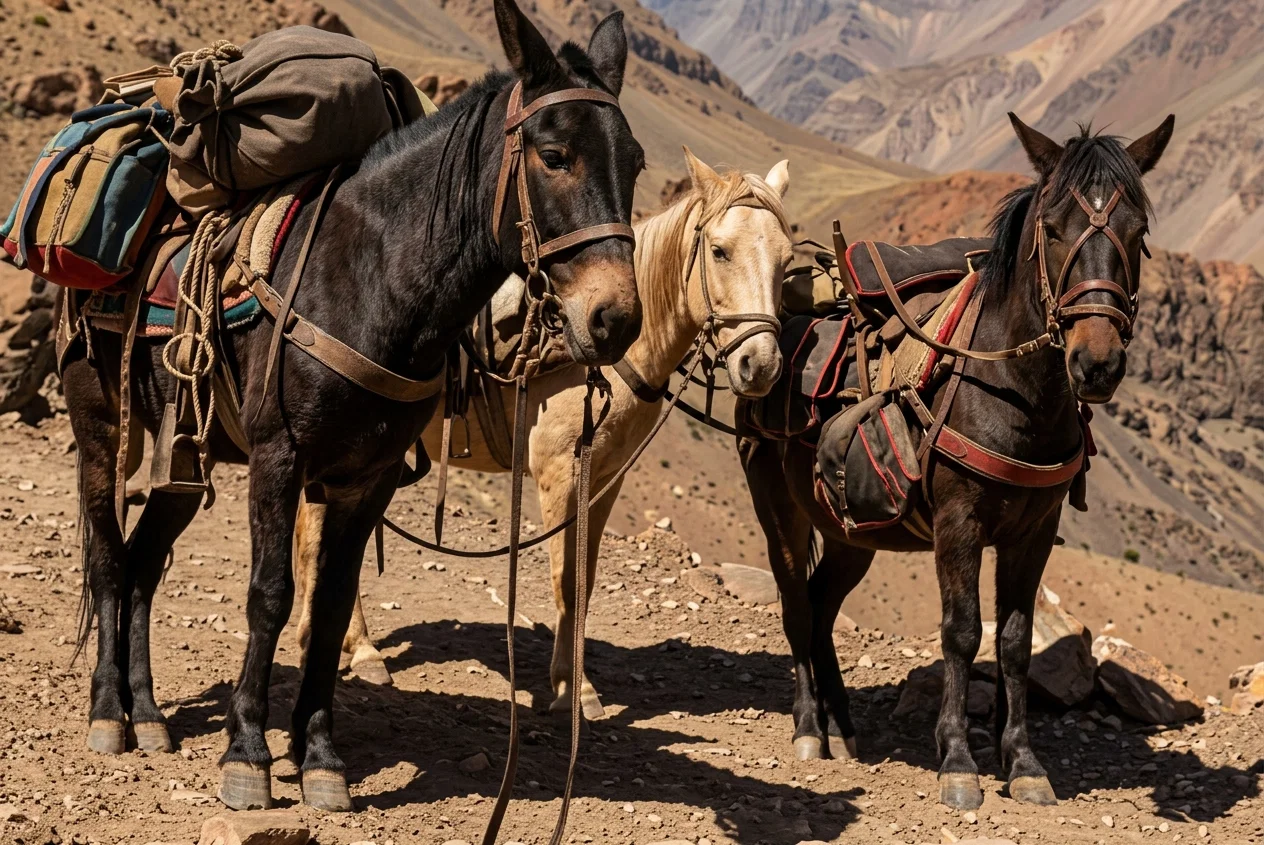
Two o'clock on the morning of May 31, with one mule and two horses well loaded with our literature, I started for the Yungas, the tropics of Bolivia. People said that it was dangerous to take this trip alone; but as I had received word that Brother Otto Schulz would not come to Bolivia for some time, on account of illness, and this trip, if made at all, must be made before the rainy season set in, I felt it my duty to make the start, trusting the Lord for all the results.
Before reaching the first town, I had to travel three days in the tropical heat, fording rivers, going over roads that seemed impassable, up mountain steeps, along narrow ledges, through swamps, and down places so steep that the horses would slide. One place was very steep and narrow, with a wall of solid rock on one side, and a ravine hundreds of feet deep on the other. As we were struggling up this road, I noticed just ahead of us a place about three feet high that was perfectly straight up, as if a large stone had been taken out. This the horses would have to jump in order to continue up the trail.
MY OUTFIT
For a second I was dismayed. It was impossible to turn back, as the road was too narrow. We must go on. With a loud call to the leader, I urged the horses on. He succeeded in making the leap, as did also the second horse; but the third animal failed, and slipped back; tried again, and failed; and was beginning to fall over backward when it seemed as if he received assistance from an unseen source, and with a leap cleared this awful place. When I told people in the next town about the narrow escape, they said, “We know the place. Providence was with you.” I told them I believed it.
At night I stayed with the Indians, but could get very little to eat either for the horses or for myself. I reached Coroico, a town with a reading population of about one thousand, at four o'clock on Friday afternoon, and succeeded in getting a place to stay at the house of the schoolmaster. As there was no feed for the horses in town, they were taken by an Indian to a pasture some miles down the mountain. I made arrangements to stay three days, and was indeed glad that the Sabbath was at hand.
One of the first men I was introduced to was the priest of the town. He asked me what I intended to do. I told him I had good books to sell, and showed him the Salud y Vida [our Spanish health journal], asking him to subscribe. He took a year's subscription. I did not try to sell him our other books, but talked on health subjects, and he appeared much interested.
With the priest's name at the head of the list, I started out Monday in a heavy rain, and sold two hundred Salud y Vida, took some subscriptions, and sold a few copies of “Coming King.” I left early next morning for Coripati, arriving there in the evening. When I asked for a place to stay, the people said there was none. I had just about made up my mind to camp in the street, when an old man approached me, and said the doctor wished to speak with me. The “doctor” proved to be a senator from La Paz, who was spending the winter with his family in the tropics. I had given treatment to some of his friends in La Paz. He invited me to stay at his home, sent a servant to care for the horses, and tried in every way to make me comfortable. I found that I could do very little in this town, as the people thought I had Bibles, which the priests warn them not to buy. One priest was very surly, and would not talk to me, but kept watch of me most of the time. I gave some treatments, and after a short stay left for Chulumani, my kind host providing a guide for me as far as the river. He also gave me a letter to a man in the next town, with whom I could stay. The guide proved a blessing, as the road was very hard to see on account of the thick underbrush. He left me on the bank of a wide, swift river, and told me the road was somewhere on the other side. I had my doubts about finding the road on10the other side; and as I was hesitating, a man came out of the forest on a mule, and told me to follow him. This I gladly did. It seemed at times that we would be swept down the river by the strong current. The man proved to be a good guide all that day. I did thank the Lord in thus providing the help I so much needed. I arrived at Chulumani that night, presented my letter to the man I was directed to by the senator, and was received very kindly.
Next day I took some subscriptions for the Salud y Vida, and sold thirty copies of “Steps to Christ.” That evening, as I was about to retire, some people came and wanted the money back for books sold them, saying that the priests had bidden them to do so. Early the next morning I settled with my host, and got the horses ready to leave. I then noticed people gathering in the square watching me, but no one molested me. After two days' travel I reached La Paz, almost exhausted from the hardships of the way.
I am glad to say that I met with some who were interested in the coming King, and surely God will richly bless the seed sown. We must go to all, for all must hear. We hope you will often remember the work in Bolivia at the throne of grace.
La Paz.
Lima, Peru
By A. N. ALLEN
A. N. ALLEN
Four hundred seventy-seven years ago on August 29, Pizarro and his men strangled Atahualpa, the Inca emperor. This was the death-blow, struck in foul injustice and treachery, to the most powerful empire in the western hemisphere. Atahualpa ruled absolutely from Panama to Chile, and from the Pacific Ocean to the uninhabited jungles of the Amazon valley. Cuzco, the capital, with its temples and palaces covered and lined with gold and silver, and reflecting the light of the tropical sun, the god of the Incas, sat as a queen over this vast empire. And an appropriate throne it was for those who worshiped the sun; for it is eleven thousand feet above the sea, and is thus nearer the sun than any other city of its size in the world.
From Cuzco radiated well-kept public roads to all parts of the empire. Dr. Tschudi, the famous Australian archeologist, speaking of these roads, said: “Even in the existing state of our knowledge, and with modern instruments of labor, they would be deemed worthy of the most civilized nation now on the globe.” “Of all the ancient monuments whose ruins invite our attention, there are none which, by their astonishing character, their immense extent, and the seemingly impossible labor which their construction demanded, impress us more profoundly than the royal roads which traversed the entire empire from north to south.”
The irrigation system was another of the public works which merits notice. The ditches are yet to be seen, and many of them are still in use. Mountainsides so steep that a goat can scarcely scale them are made to blossom as the rose by the magic touch of water brought to them by ditches carved along the side, often sustained by masonry, sometimes passing through tunnels, and, like the veins and arteries of the body, carrying the life-giving fluid to every part. In some places the water was carried underground for long distances through tunnels dug for the purpose. Thus the land was made to support a much larger population than now exists in the same territory.
Between the capital and the remotest corner of the empire a perfect system of communication existed. Runners were continually going to and from established posts on all the royal roads. Running as swiftly as possible from one post to another, one runner took a message, and carried it to the nearest post, then another carried it to the next post, where it was taken by another runner, and so on till the capital was reached.
The method of recording facts and dates was by knots tied in rows of short strings, or cords. There was a large cord, with perhaps fifty smaller ones fastened to it by one end, thus giving the appearance of a fringe. The art of reading this writing, if such it can be called, has been lost. If we could read it, we might know much more than we do about the history of the Incas.
From the time the Spaniards landed in Peru, the country has been repeatedly involved in war. The public interests have been sacrificed to the interests of the few. The Indians became the instruments in the hands of the Spaniards with which to make war. Countless numbers were sacrificed in wars in which the Indian had no interest. Thousands more were sacrificed to the god of gold and silver in the mines. One of the sports of the Spaniards was to hunt the defenseless Indians with dogs, as the hare is hunted in England. Even today the Indians on many farms are practically slaves. They are kept continually in debt to their masters, and can not leave till they have paid the utmost farthing. Not being able to read or write, they are easily deceived, and usually die before the debt is paid.
Three fifths of the inhabitants of Peru are Indians, few of whom speak any but the Kechua language. This has many dialects, so those learning to speak the dialect of one city are almost helpless in another. The Aymara language is also spoken by a large number. Many of the younger generation are now learning to read and speak the Spanish language. Ecuador, Peru, and Bolivia are each doing much to educate the Indians. Many new schools are established each year.
There are perhaps two blessings which Spain gave to South America,—the overthrowing, at least in name, of sun- worship; and the giving of one language to a country where before there were perhaps hundreds. In ancient times whole nations were destroyed for their adhesion to sun-worship; but a remnant was spared to hear the gospel.
To try to give the gospel to the Indians in their own languages is not practical. As the only ones who can read in those languages can also read Spanish, nothing is gained by printing in the many dialects. The sale of books in the native tongues would also be so limited as to make it unwise to go to so much expense. Those who teach the gospel among these people will, of course, speak the language; but the younger generation are being prepared to receive the gospel through the Spanish language, and they can teach it to the older ones.
The seed which has been sown during the past few years is beginning to bear fruit. Last year ten were baptized, and the number of believers was nearly doubled. This year we hope to reach those who have been waiting so long, instruct them more, and baptize them. Let us pray and give for the work where we have brothers who are ignorant of Christ.