Signs of the Times, Vol. 42, No. 24.

A Strange Breath in the World

Signs of the Times

Jun 15, 1915

Pacific Press Publishing Association · Mountain View, California · Jun 15, 1915

A Strange Breath in the World

The Titanic Struggle of the Nations—What This War Will Leave Behind It
A Night of Anguish and a Morning of Joy
By E. E. Andross
Underwood & Underwood
King and Crown Prince of Italy
Underwood & Underwood King and Crown Prince of Italy
Underwood & Underwood
Queen of Italy and Three of Her Children
Underwood & Underwood Queen of Italy and Three of Her Children
“Woe unto us! for the day goeth away, for the shadows of the evening are stretched out.” Jer. 6:4. Though more than twenty-five hundred years have come and gone since the holy seer uttered these words, how like a description of our times they are! Surely the shadows are lengthening, the sun is fast approaching the horizon, and earth’s dark night is coming.

STANDING AT ARMAGEDDON

“Europe stands to-day at Armageddon. On every hand, its proud peoples are rising in their virile strength, and are rushing with earth-shaking tread to that frightful holocaust which may check our civilization—giants grappling to the death in a modern ‘twilight of the gods.’”
Thus wrote George Harvey, editor of the North American Review, in its September issue, 1914. And again, further on in the same editorial, he says:
© Underwood & Underwood, N. Y.

THE REVOLUTION AND ANARCHY INVOLVED

“Consider also the momentous social possibilities involved in the great war. The existing social order may break down utterly beneath the frightful strain; the governments, with shattered armies and empty treasuries, may crumble in a combined military and financial bankruptcy before the sudden attack of a desperate, hunger-stricken proletariat already fired by the syndicalist gospel of violent social revolution, and the old Europe may disappear in a welter of anarchy. On the other hand, bloodshed and battle may intensify the national consciousness of the European peoples, deepen the hatreds between raceand race, plunge the world into a whole cycle of wars—a new iron age, in which the finer flowers of our civilization would be ruthlessly trampled under foot, and the present era of free thought and individual liberty be replaced by the hand of military despotism.
“Again, consider the possible reactions of this European conflagration upon the world at large. Up to a month ago, the white race was master of this planet. Africa was absolutely beneath European sway; while in Asia, only the island empire of Japan had made good its position, and this only by the grace of European disunion and the alliance of the European British Empire. But in these last ten years, a strange breath has passed over the Asiatic world. The victories of Japan have awakened the dormant spirit of the East; and the countless millions of the Orient, once so passive, to-day chafe sullenly at the European yoke. India is seething with unrest at the British ‘raj’; ‘unchanging’ China is changing at last; and their teeming populations are beating fiercely against the white man’s own frontier, and answering his exclusion laws with threats and menaces which may portend still mightier race struggles in the years to come—struggles beside which even the present battle of the nations might seem tame indeed. Also the recent movements in Turkey, Egypt, and Persia prove that in the Mohammedan world as well a new spirit is abroad. Islam is not dead. Its fires of fanaticism are banked, but are not cold; and its two hundred millions of adherents extend from Morocco to China, from Siberia to the Kongo and the Celebes. Should these new spirits continue to walk abroad, what would be the situation of a Europe bled to the point of death by a modern ‘Peloponnesian War?’”
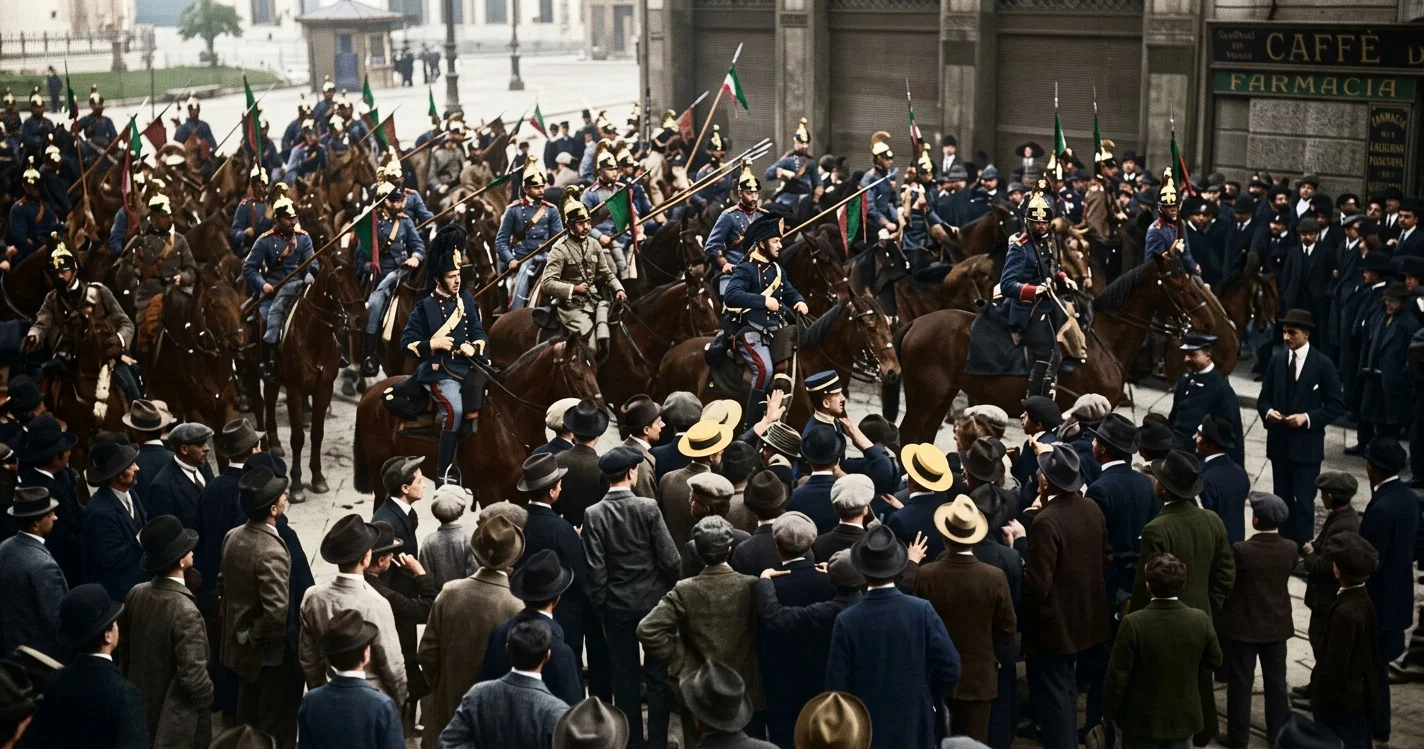
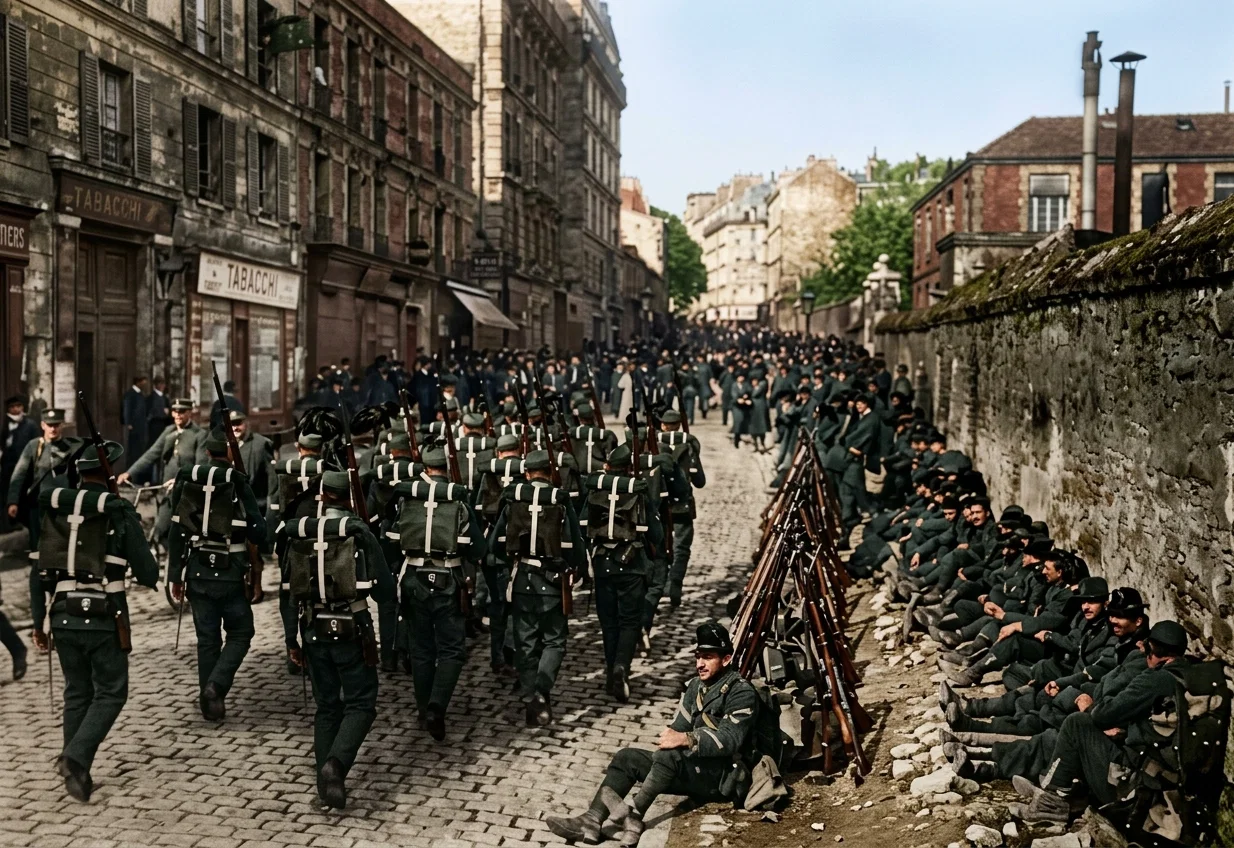
ITALIAN TROOPS PREPARING TO MARCH TO THE FRONT
Surely the dark picture of world conditions thus clearly portrayed points unmistakably to the lengthening shadows that tell us night is coming.

MILLIONS OF WIDOWS AND ORPHANS

From a computation of the cost of war, by Hamilton Holt, editor of the Independent, which appeared in an editorial in the Los Angeles Tribune, March 31, 1915, I take the following:
“It is estimated that by the earliest day that peace possibly can come, there will be in Europe more than two and a half million war-made widows, and more than six million seven hundred thousand fatherless children.
“It is impossible to compute statistically the grief, misery, and want necessarily involved in these amazing totals. Hunger and suffering do not lend themselves to the processes of arithmetic. Blasted homes are not to be expressed in algebraic symbols, and stunted lives are not to be interpreted by mathematics.”
The shades of night are falling fast; but, O, how we long for the morning that will bring eternal deliverance from strife and conflict, from war and bloodshed, from sickness, sorrow, pain, and death, to break over this dark, dark world! As sure as God sits upon the throne of the universe, and is “a God of truth and without iniquity,” so surely will that glorious morning dawn sometime; and we believe that the prophetic Word clearly reveals the fact that it will break soon—yea, more, that its gleams may, with the eye of faith, already be seen piercing the darkness.
After man’s fall in the Garden of Eden, the promise of a Saviour was given. The period intervening between the giving of that promise and the moment when our great High Priest will cease His work as man’s intercessor, is called “the day of salvation.” 2 Cor. 6:2.
Before the Saviour comes in power and glory, He will lay aside His priestly garments, and will put on the royal robes. “On His vesture and on His thigh a name [will be] written, King of kings, and Lord of lords.” On His head will be “a golden crown, and in His hand a sharp sickle.” An “angel came out of the temple, crying with a loud voice to Him that sat on the cloud, Thrust in Thy sickle, and reap: for the time is come for Thee to reap; for the harvest of the earth is ripe.” Rev. 19:16; 14:14, 15.
Following the close of our Lord’s work as High Priest and Advocate, the decree will go forth: “He that is unjust, let him be unjust still: and he which is filthy, let him be filthy still: and he that is righteous, let him be righteous still: and he that is holy, let him be holy still. And, behold, I come quickly; and My reward is with Me, to give every man according as his work shall be.” Rev. 22:11, 12. With the going forth of this decree, the day of salvation will close, and the night of trouble and anguish for the wicked will begin. Jesus said, “The night cometh, when no man can work.” John 9:4. “At that time shall Michael [Christ] stand up [begin His reign], the great Prince which standeth for the children of thy people: and there shall be a time of trouble, such as never was since there was a nation even to that same time.” Dan. 12:1.

THESE MIGHTY CONFLICTS FORETOLD

The prophet Jeremiah speaks of the time of trouble as follows: “Behold, a whirlwind of the Lord is gone forth in fury, even a grievous whirlwind: it shall fall grievously upon the head of the wicked. The anger of the Lord shall not return, until He have executed, and till He have performed the thoughts of His heart: in the latter days ye shall consider [‘understand,’ R. V.] it perfectly.” Jer. 23:19, 20.
The prophet speaks further of this time of trouble, this night of anguish to the wicked, graphically describing its results: “The Lord shall roar from on high, and utter His voice from His holy habitation; He shall mightily roar upon His habitation; He shall give a shout, as they that tread the grapes, against all the inhabitants of the earth. A noise shall come even to the ends of the earth; for the Lord hath a controversy with the nations, He will plead with all flesh; He will give them that are wicked to the sword, saith the Lord. Thus saith the Lord of hosts, Behold, evil shall go forth from nation to nation, and a great whirlwind shall be raised up from the coasts of the earth. And the slain of the Lord shall be at that day from one end of the earth even unto the other end of the earth: they shall not be lamented, neither gathered, nor buried.” Jer. 25:30–32.
One of the most prominent signs of the coming of the world’s night will be the driving of the Turk from Europe, and the final establishment of his capital in Jerusalem. When he shall have made the holy city his capital, the next event in the order of the prophecy will be the beginning of the reign of Christ, to be followed by the time of trouble. Dan. 11:45; 12:1.

BOTH NIGHT AND MORNING

But the prophet of God declares, “The morning cometh, and also the night.” Isa. 21:12. While the coming of Christ will bring the night of death to the wicked (2 Thess. 1:7–9; Rev. 6:14–17), it will bring the morning of deliverance to the righteous.
“At that time shall Michael stand up, the great Prince which standeth for the children of thy people: and there shall be a time of trouble, such as never was since there was a nation even to that same time: and at that time thy people shall be delivered, every one that shall be found written in the book. And many of them that sleep in the dust of the earth shall awake, some to everlasting life.” Dan. 12:1, 2.

“WE WILL BE GLAD AND REJOICE”

Though the wicked cry for the mountains and the rocks to fall on them and hide them “from the face of Him that sitteth on the throne, and from the wrath of the Lamb” (Rev. 6:16), with holy joy the righteous cry: “Lo, this is our God; we have waited for Him, and He will save us; this is the Lord; we have waited for Him, we will be glad and rejoice in His salvation.” Isa. 25:9. To the righteous dead, the coming of Jesus will be the morning of their eternal deliverance from the bondage of death. To the living righteous, it will be the ineffably glorious morning, when, with the entire family of the redeemed, delivered from the bondage of corruption, they enter upon their eternal reward.
“Soon, and forever, the breaking of day Shall chase all the night clouds of sorrow away. Soon, and forever, we’ll see as we’re seen, And know the day’s meaning of things that have been. Where fightings without and conflicts within Shall weary no more in the warfare with sin, Where tears and where fears and where death shall be never, Christians with Christ shall be soon, and forever.
“Soon, and forever—such promise our trust, Though ashes to ashes, and dust be to dust. Soon, and forever, and union shall be Made perfect, our glorious Redeemer, in Thee. When the cares and the sorrows of time shall be o’er, Its pangs and its partings remembered no more, Where life cannot fail, and where death cannot sever, Christians with Christ shall be soon, and forever.
“Soon, and forever, the work shall be done, The warfare accomplished, the victory won; Soon, and forever, the soldier lay down The sword for a harp, the cross for a crown. Then droop not in sorrow, despond not in fear. A glorious to-morrow is brightening and near, When—blessed reward for each faithful endeavor— Christians with Christ shall be soon, and forever.”
—Monsell.

MRS. E. G. WHITE

God gives man nine tenths, while He has claimed one tenth for sacred purposes, as He has given man six days for his own work, and has reserved and set apart the seventh day to Himself. For, like the Sabbath, a tenth of the increase is sacred. God has reserved it for Himself. He will carry forward His work upon the earth with the increase of means He has intrusted to man.

MRS. E. G. WHITE

NOT ROBED FOR THE WEDDING

Invited by the Great King—A Wedding Garment Provided—The Invitation Slighted—A Guest Became Speechless
By Mrs. E. G. White
In the parable of the wedding garment, as in that of the great supper, are illustrated the gospel invitation, its rejection by the Jewish people, and the call of mercy to the gentiles. But on the part of those who reject the invitation, this parable brings to view a deeper insult and a more dreadful punishment.
The call to the feast is a king’s invitation. It proceeds from one who is vested with power to command. It confers high honor. Yet the honor is unappreciated. The king’s authority is despised. While the householder’s invitation was regarded with indifference, the king’s is met with insult and murder. They treated his servants with scorn, despitefully using them and slaying them.

THE INVITATION SLIGHTED

The householder, on seeing his invitation slighted, declared that none of the men who were bidden should taste of his supper. But for those who had done despite to the king, more than exclusion from his presence and his table is decreed. “He sent forth his armies, and destroyed those murderers, and burned up their city.” Matt. 22: 7.
In both parables, the feast is provided with guests; but the second shows that there is a preparation to be made by all who attend the feast. Those who neglect this preparation are cast out. “The king came in to see the guests,” and “saw there a man which had not on a wedding garment: and he saith unto him, Friend, how camest thou in hither not having a wedding garment? And he was speechless. Then said the king to the servants, Bind him hand and foot, and take him away, and cast him into outer darkness; there shall be weeping and gnashing of teeth.” Verses 11-13.
The third call to the feast represents the giving of the gospel to the gentiles. The king said: “The wedding is ready, but they which were bidden were not worthy. Go ye therefore into the highways, and as many as ye shall find, bid to the marriage.” Verses 8, 9.
The king’s servants who went out into the highways “gathered together all as many as they found, both bad and good.” Verse 10. It was a mixed company. Some of them had no more real regard for the giver of the feast than had the ones who rejected the call. The class first bidden could not afford, they thought, to sacrifice any worldly advantage for the sake of attending the king’s banquet. And of those who accepted the invitation, there were some who thought only of benefiting themselves. They came to share the provisions of the feast, but had no desire to honor the king.
When the king came in to view the guests, the real character of all was revealed. For every guest at the feast there had been provided a wedding garment. This garment was a gift from the king. By wearing it, the guests showed their respect for the giver of the feast. But one man was clothed in his common citizen dress. He had refused to make the preparation required by the king. The garment provided for him at great cost, he disdained to wear. Thus he insulted his lord. To the king’s demand, “How camest thou in hither not having a wedding garment?” he could answer nothing. He was self-condemned. Then the king said, “Bind him hand and foot, and take him away, and cast him into outer darkness.”
By the king’s examination of the guests at the feast is represented a work of judgment. The guests at the gospel feast are those who profess to serve God, those whose names are written in the book of life. But not all who profess to be Christians are true disciples. Before the final reward is given, it must be decided who are fitted to share the inheritance of the righteous.

JUDGED WHILE STILL LIVING

It is while men are still dwelling upon the earth that the work of investigative judgment takes place in the courts of heaven. The lives of all His professed followers pass in review before God. All are examined according to the record of the books of heaven, and according to his deeds the destiny of each is forever fixed.
By the wedding garment is represented the pure, spotless character which Christ’s true followers will possess. To the church it is given “that she should be arrayed in fine linen, clean and white,” “not having spot, or wrinkle, or any such thing.” The fine linen, says the Scripture, “is the righteousness of saints.” Rev. 19: 8; Eph. 5: 27. It is the righteousness of Christ, His own unblemished character, that through faith is imparted to all who receive Him as their personal Saviour.
Only the covering which Christ Himself has provided, can make us meet to appear in God’s presence. This covering, the robe of His own righteousness, Christ will put upon every repenting, believing soul. “I counsel thee,” He says, “to buy of Me . . . white raiment, that thou mayest be clothed, and that the shame of thy nakedness do not appear.” Rev. 3: 18.
The guests at the marriage feast were inspected by the king. Only those were accepted who had obeyed his requirements and put on the wedding garment. So it is with the guests at the gospel feast. All must pass the scrutiny of the great King, and only those are received who have put on therobe of Christ’s righteousness. Righteousness is right doing, and it is by their deeds that all will be judged. Our characters are revealed by what we do. The works show whether the faith is genuine.

MERE BELIEF NOT ENOUGH

It is not enough for us to believe that Jesus is not an impostor, and that the religion of the Bible is no cunningly devised fable. We may believe that the name of Jesus is the only name under heaven whereby man may be saved, and yet we may not through faith make Him our personal Saviour.
The truth is to be planted in the heart. It is to control the mind and regulate the affections. The whole character must be stamped with the divine utterances. Every jot and tittle of the word of God is to be brought into the daily practice.
The man who came to the feast without a wedding garment represents the condition of many in our world to-day. They profess to be Christians, and lay claim to the blessings and privileges of the gospel; yet they feel no need of a transformation of character. They have never felt true repentance for sin. They do not realize their need of Christ or exercise faith in Him. They have not overcome their hereditary or cultivated tendencies to wrongdoing. Yet they think that they are good enough in themselves, and they rest upon their own merits instead of trusting in Christ. Hearers of the Word, they come to the banquet, but they have not put on the robe of Christ’s righteousness.

THEY DECEIVED THEMSELVES

These expect to be saved by Christ’s death, while they refuse to live His self-sacrificing life. They extol the riches of free grace, and attempt to cover themselves with an appearance of righteousness, hoping to screen their defects of character; but their efforts will be of no avail in the day of God.
The righteousness of Christ will not cover one cherished sin. A man may be a law-breaker in heart; yet if he commits no outward act of transgression, he may be regarded by the world as possessing great integrity. But God’s law looks into the secrets of the heart. Every act is judged by the motives that prompt it. Only that which is in accord with the principles of God’s law will stand in the Judgment.
Those who reject the gift of Christ’s righteousness are rejecting the attributes of character which would constitute them the sons and daughters of God. They are rejecting that which alone could give them a fitness for a place at the marriage feast.

THE MAN WAS SPEECHLESS

In the parable, when the king inquired, “How camest thou in hither not having a wedding garment?” the man was speechless. So it will be in the great Judgment day. The spiritual banquet is set before us in rich abundance. The wedding garment, provided at infinite cost, is freely offered to every soul. By the messengers of God are presented to us the righteousness of Christ, justification by faith, the exceeding great and precious promises of God’s word, free access to the Father by Christ, the comfort of the Spirit, the well grounded assurance of eternal life in the kingdom of God. What could God do for us that He has not done in providing the great supper, the heavenly banquet?

HOW THE ANGELS HELPED

In heaven it is said by the ministering angels: The ministry which we have been commissioned to perform we have done. We pressed back the army of evil angels. We sent brightness and light into the souls of men, quickening their memory of the love of God expressed in Jesus. We attracted their eyes to the cross of Christ. Their hearts were deeply moved by a sense of the sin that crucified the Son of God. They were convicted. They saw the steps to be taken in conversion. They felt the power of the gospel. Their hearts were made tender as they saw the sweetness of the love of God. They beheld the beauty of the character of Christ. But with the many it was all in vain. They would not surrender their own habits and character. They would not put off the garments of earth in order to be clothed with the robe of heaven.

THEIR WEALTH NOT VALUED THEN

Sad will be the retrospect in that day when men stand face to face with eternity. The whole life will present itself just as it has been. The world’s pleasures, riches, and honors will not then seem so important. Men will then see that the righteousness they despised is alone of value.
The days of our probation are fast closing. The end is near. To us the warning is given, “Take heed to yourselves, lest at any time your hearts be overcharged with surfeiting, and drunkenness, and cares of this life, and so that day come upon you unawares.” Luke 21: 34. Beware lest it find you unready. Take heed lest you be found at the King’s feast without a wedding garment.

There Is Nothing Too Hard for Thee

By MRS. L. D. AVERY-STUTTLE
There are whirling stars in depth of space, And worlds that rush in headlong race, And comets bright, with trails of light, And calm, cold moons, with silvery face. There are dismal voids and darksome deeps, Where endless night her vigil keeps, And suns that bathe the Milky Way In one translucent, glorious day.
These, all of these, a swift-winged fleet, March on and on, with tireless feet; For Thou, my God, hast set their pace, And sent them spinning into space; And by Thy mighty stretched out arm, Thou guardest them from wreck and harm.
Fair Pleiades, with influence sweet, And Arcturus, with racing feet, Orion, with her bands of light, And gleaming Sirius, far and bright— Their utmost bound Thine eye doth see, And nothing is too hard for Thee.
The peacock, with her goodly wings, The grain of sand, the bird that sings— All, all are subjects of Thy care, For Thou art present everywhere.
The nations great, and nations small— Dust in the balance counted, all! In vain, in vain the impious boasts Of Satan and his mighty hosts. Though all the strength of hell is stirred, Thou, Thou alone canst speak the word— That word which calmed the raging sea— And death and hell shall cease to be; For nothing is too hard for Thee.
Then, O my soul, be not afraid! Thy sin is purged, thy debt is paid. Then shout and sing till welkins ring: “I'm trusting Thee, O Christ, my King! How vast the love of Calvary— And nothing is too hard for Thee.”

Theirs Is the Kingdom

Enduring False Accusations—Learn to “Count It All Joy”
By Rufus A. Underwood
“BLESSED are they which are persecuted for righteousness’ sake: for theirs is the kingdom of heaven. Blessed are ye, when men shall revile you, and persecute you, and shall say all manner of evil against you falsely, for My sake. Rejoice, and be exceeding glad: for great is your reward in heaven: for so persecuted they the prophets which were before you. Ye are the salt of the earth. . . . Ye are the light of the world. A city that is set on an hill cannot be hid.” Matt. 5:10-14.

WOE TO THE OFFENDER

The reverse of these blessings is true, and Heaven’s curse is upon those who falsify and malign the innocent. Christ said to the disciples: “It is impossible but that offenses will come: but woe unto him, through whom they come! It were better for him that a millstone were hanged about his neck, and he cast into the sea, than that he should offend one of these little ones.” Luke 17:1, 2.
Evil and slanderous reports against God’s servants have always been one of the strong weapons Satan has used to break down the message they are bidden to bear to the world. In the time of Jeremiah, evil men said: “Come, and let us devise devices against Jeremiah; for the law shall not perish from the priest, nor counsel from the wise, nor the word from the prophet. Come, and let us smite him with the tongue, and let us not give heed to any of his words.” Jer. 18:18.

THE ACCUSER OF THE BRETHREN

Not until the last hour of probation has come will Satan cease this method of attack. “And I heard a loud voice saying in heaven, Now is come salvation, and strength, and the kingdom of our God, and the power of His Christ: for the accuser of our brethren is cast down, which accused them before our God day and night.” Rev. 12:10. The “accuser of the brethren” knows well that to the extent to which he can weaken or destroy the influence of the servant of God, he has thereby made his message of no effect.
The opening verses of the Psalms say: “Blessed is the man that walketh not in the counsel of the ungodly, nor standeth in the way of sinners, nor sitteth in the seat of the scornful. But his delight is in the law of the Lord; and in His law doth he meditate day and night.” Ps. 1:1, 2.

SATAN WOULD DISSOLVE UNITY

Sometimes those who would shudder at the thought of being classed with the scornful and scoffers (2 Peter 3:3), put themselves among those who stand “in the way of sinners,” by becoming agents of the accuser of the brethren.
The following from the pen of Mrs. E. C. White is to the point: “Let all who read these lines take heed. Satan has made his boast of what he can do. He thinks to dissolve the unity which Christ prayed might exist in His church. He says, I will go forth a lying spirit to deceive those that I can entice to criticize and condemn and falsify. . . . Even in our day there have been, and will continue to be, entire families who have once rejoiced in the truth, but who will lose faith because of calumnies and falsehoods brought to them in regard to those whom they have loved, and with whom they have had sweet counsel.” Such things would never exist if the words of the apostle Paul were heeded, “Speak evil of no man.” Titus 3:2.

THE TEST OF CHARACTER

The test of Christian character comes in the manner in which we bear up in the spirit of meekness under reproach, and rejoice in God, and “count it all joy,” even though we are misrepresented; “knowing this, that the trying of your faith worketh patience. But let patience have her perfect work, that ye may be perfect and entire, wanting nothing.” James 1:3, 4. “Ye are the salt of the earth. . . . Ye are the light of the world.”
We may ask for the antecedent of “ye,” called “the salt of the earth” and “the light of the world.” To find this, we must go back from the thirteenth and fourteenth verses of this chapter to its beginning, and trace the steps taken by those who have entered the school of Christ, and follow them as they have been led to sense their need of salvation; to repent and accept pardon; to become teachable; to press forward to higher attainments, even the fullness of God and His Spirit; to possess the merciful spirit of their Master; to have purity of heart; to bathe in the river of peace; and then to count it all joy when maligned and misrepresented.
Christ says of such, “Ye are the salt of the earth” and “the light of the world.” Such are those who preserve the world from utter ruin, and are a living translation of the moral law of light into human flesh, amid the darkness of this world of sin.

Personal Influence

EVERY man, woman, and youth is constantly exerting an influence for either good or ill. The world or some part of it has been made better or worse by the life of every individual who has lived on this earth. It is impossible for one to have an existence and not in some way or particular be instrumental in influencing others.
And our influence does not stop with the individuals who have personally come in contact with us. Persons who have been influenced by us, in turn influence other persons. And thus each personal influence, for either good or ill, has its effect on, and on, as long as time continues.
The above statements being true, who can estimate the good or ill that any one life may be instrumental in accomplishing? And in view of these facts, how can one fully sense his responsibility in this matter and not resolve that the evil in his charactershall be eradicated, that only good may come from his influence?
Considering the influence that every person is unavoidably wielding, what a serious and even solemn thing it is to live! It has been truly said that it is a solemn thing to die. But in the light of personal influence, it is certainly a much more solemn thing to live.
To live in such a way that our life shall be a constant uplift to all who come under our influence is reasonably required of every soul. Every intelligent person is more or less responsible for the acts of others. We should consider ourselves mutually responsible for one another. In the Judgment, we will find that our influence in this world has been taken into account. J. W. LOWE.
Continue reading: What Becomes of the Sinner