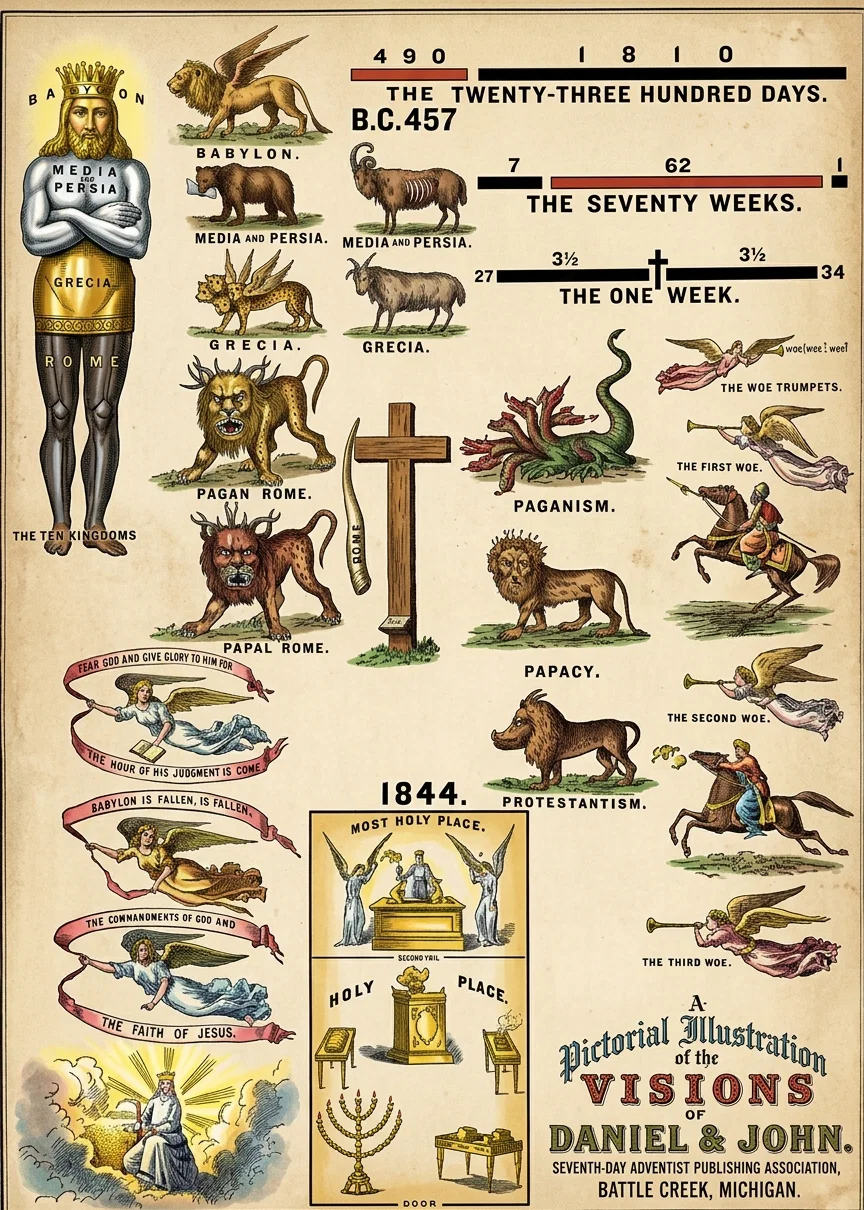
The accompanying illustration is a miniature representation of our chart, upon which are delineated the principal symbols of the Bible. This method of instruction is peculiar to the volume of divine inspiration. It alone occupies this field. As if possessed of an exclusive right, it monopolizes this channel of information. And the method is worthy of the book, and the book the appropriate place for the method; for in no other way can knowledge be imparted in so condensed and vivid a form. The eye thus becomes the handmaid of the mind in the reception of ideas, and a single glance takes in that which many pages of history would be required to describe.
A Pictorial Illustration of the Visions of Daniel & John.
The chart is an attempt to illustrate with the pencil what Daniel and John have delineated with the pen, so that the mind may more easily conceive of the pictures which they describe.
Some would-be wiseacres, while looking at these symbols and seeing united in the same beast the horns of ruminating animals and the teeth and claws of carnivorous ones, have archly imagined they had detected the prophet in a blunder, as such teeth and horns do not belong together; not thinking far enough to consider that inspiration to properly represent the wicked governments of earth had to depart from nature, and combine in one species of animal all those instruments of defense or destruction which in nature are possessed by many. Candidly considered and carefully studied, there will be found a fitness between the symbol and the thing symbolized, which is at once appropriate and instructive.
The symbols of the chart may be in brief described as follows:—
THE GREAT IMAGE.
The image in the upper left hand portion is introduced and partially interpreted in the second chapter of Daniel. It is composed of four different metals, gold, silver, brass, and iron, and represents the succession of earthly governments from the kingdom of Babylon under Nebuchadnezzar till the close of time. Daniel told Nebuchadnezzar plainly, “Thou art this head of gold.” Dan. 2: 38. Or, Thy kingdom is this head of gold. This kingdom was introduced into prophecy at the capture of Manasseh, king of Judah, by the Assyrians, B. C. 677.
After him was to arise another kingdom, the breast and arms of silver, Medo-Persia, which held the position of power from the overthrow of Babylon by Cyrus, B. C. 538, to the defeat of Darius Codomannus, by Alexander the Great, at the battle of Arbela, B. C. 331, having continued 207 years.
A third kingdom was to follow, represented by the sides of brass. This was the Macedonian or Grecian kingdom, the period of its supremacy dating from B. C. 331 to the conquest of Macedonia by the Romans B. C. 168.
And a fourth kingdom, the Roman, is represented by the legs of iron. The ten toes on the feet of this image signify the ten kingdoms into which the old Roman Empire was broken up by the incursions of the Northern barbarians between the years 356 and 483 A. D. This kingdom dates from the famous Jewish league B. C. 161, and continued to its fully divided state 483 A. D., the long period of 644 years. This divided state still continues, and, according to the prophecy, was to continue till the God of Heaven sets up his kingdom on the ruin and overthrow of all earthly governments. This event next follows, and is the one for which we consequently next look, in this line of prophecy.
SYMBOLS OF DAN. VII.
The next line of symbols at the right covers the same ground with additional particulars, described in Daniel, chapter 7. The lion represents Babylon; the bear, Medo-Persia; the leopard, Grecia (the wings denoting rapidity of conquest, and the four heads the division of the empire into four parts after Alexander's death); the fourth, nondescript beast, Rome. The ten horns on the head of this beast are plainly said by the angel to Daniel to be ten kingdoms that would arise out of this fourth or Roman Empire. Verse 24. These correspond to the ten toes of the image, and the kingdoms they represent were the Huns, Ostrogoths, Visigoths, Franks, Vandals, Suevi, Burgundians, Heruli, Anglo-Saxons and Lombards. See Machiavel, Dr. Hales, Bishop Newton, Faber, and Lloyd.
THE PAPACY.
This beast presents a second phase. Another horn arises among the ten, diverse from them all, having eyes like the eyes of a man, and a mouth speaking great things. Such a kingdom was the papacy, which so long held spiritual dominion over the nations of Europe. It was diverse from the others, being a spiritual kingdom. It had eyes like the eyes of man, in the far-seeing sagacity and cunning of the Roman bishops. It had a mouth speaking great things in assuming as it did the titles of the Deity, and in the blasphemous pretensions it has put forth. Respecting this horn, the time of its continu- ance is given: a time, times, and a half; elsewhere spoken of as forty-two months, and 1260 days (years). See Rev. 12: 6, 14; 13: 5. This period dates from the time when Justinian's decree, making the pope the corrector of heretics and the head of all the churches, was carried into effect by the expulsion of the Goths from Rome by Belisarius, A. D. 538. The three kingdoms subdued to make way for this elevation of the papacy were the Vandals, the Heruli, and the Goths. This papal supremacy continued for just 1260 years, to 1798, when the papacy was temporarily overthrown by the French. See Baronius, Croly on the Apocalypse, Bower's History of the Popes, &c. Shortly after this, Daniel saw this power given to the burning flame, which Paul says, 2 Thess. 2: 8, will be accomplished by the brightness of the second coming of Christ, the event which is consequently next to transpire in this line of prophecy.
SYMBOLS OF DAN. VIII.
The third line of symbols is explained in Daniel, chapter 8. It gives the same succession of kingdoms from the time of Persia onward. The angel told Daniel that the ram represented Persia, and the goat, Grecia. Dan. 8: 20, 21. In the little horn arising afterward appears Rome again, as in the other lines of prophecy. In connection with these symbols is given a prophetic period of 2300 days (years, Eze. 4: 6; Num. 14: 34). This is the longest prophetic period given in the Bible, and reaches down to the latest point. Data to establish the commencement of this period are found in Dan. 9: 25, and Ezra 7: 1, 8. The commandment to restore and build Jerusalem, composed of the decrees of Cyrus, Darius, and Artaxerxes, Ezra 6: 14, was completed by the decree of Artaxerxes Longimanus, B. C. 457. Ezra 7: 1, 8. The 2300 days commencing at that point consequently terminated in A. D. 1844. Hence, we are past all prophetic periods, and therefore can set no time for the Lord to come. It is a cardinal point with Seventh-day Adventists in the interpretation of the prophecies that no prophetic period reaches to the coming of Christ, and that it is therefore impossible to set the time for that event, there being no data for any such calculation. This is one difference which we wish to be clearly understood between Seventh-day Ad- ventists and First-day Adventists.
THE SANCTUARY.
By the period of the 2300 days we are brought to the cleansing of the sanctuary, Dan. 8: 14, represented in the lower central portion of the chart. The sanctuary of the Bible consists, first, of the tabernacle erected by Moses (Ex. 25, and onward), and, secondly, of the greater and more perfect tabernacle or temple in Heaven, of which the former was a type, figure, or pattern. Ex. 25: 9; Heb. 8: 1, 2, 5; 9: 1-9, 23, 24. The cleansing of the sanctuary was a brief service performed by the high priest in the most holy place of the sanctuary before the ark, which contained the tables of the ten commandments, to conclude a complete round of service therein. Lev. 16. If the 2300 days above referred to terminated in 1844, of which there can be no doubt, the position of our Lord since that time has been in the most holy place of the heavenly sanctuary, before the ark of the ten commandments, finishing his work as priest and mediator, at the conclusion of which he will take his throne as king, and appear in the clouds of heaven in power and glory. Then he will gather to himself all those members of the human family who, during his priesthood, secured by repentance and faith the forgiveness of their sins, and thus proved themselves worthy to be the subjects of his everlasting kingdom. John 14: 3. For this purpose he will, at his second coming, raise from their graves the righteous dead, and change to immortality the righteous living. 1 Cor. 15: 51-53; 1 Thess. 4: 15-17. Referring to the ancient types, it is reasoned that this period of the cleansing of the sanctuary must be a comparatively very brief, though indefinite, space of time; and as thirty-one years of it have already elapsed, reasoning from analogy, it must very soon terminate; and, therefore, the second advent of Christ must be very near.
SYMBOLS OF REV. XII AND XIII.
The fourth line of symbols on the chart, commencing with the great red dragon, is described in Revelation, chapters 12 and 13. John, living under the sixth, the imperial, form of the Roman government, the seven different forms being indicated by the seven heads of the dragon, and those of the following beast, looks forward simply from his own time.
The dragon symbolizes pagan Rome; Rev. 12: 3-5; the leopard beast, Rev. 13: 1-10, the papacy; and the third symbol, a beast with two horns like a lamb, our own government. Rev. 13: 11-16.
There is the most clear and ample ground for applying this symbol to the United States. This nation, in its location, the time and manner of its rise, its character, mild and lamblike, its6marvelous progress and development during the last century, most strikingly exhibits the phenomena, religious and scientific, here indicated. The power fulfills the prophecy of the false prophet, Rev. 13: 14; 19: 20, which will be accomplished by means of modern spiritualism, which originated, and has so rapidly developed, in this country. It meets the same fate as the papal power, already referred to. And the fact that it is to be cast alive into the lake of fire, shows that it will never give place to any other government, but will be in the height of its power when the second advent shall occur. Nothing remains to be fulfilled but that which can in a very brief space be accomplished. It must, therefore, be near the end of its career; and the conclusion recurs again, that the coming of Christ must be at hand.
THE WOE TRUMPETS.
The last line of symbols at the right of the chart represents the last three of the series of seven trumpets of Rev., chapters 8 and 9. There is, perhaps, no point upon which commentators are more generally agreed than upon the view that the fifth and sixth of these trumpets, as described in Rev. 9, were fulfilled in the rise and progress of Mohammedanism under the Saracens and Turks. The prophetic periods of verses 10 and 15 reach from the invasion of Nicomedia by Othman, July 27, 1299, to the virtual surrender of his dominion by the Sultan of Turkey into the hands of the Christian powers of Europe, Aug. 11, 1840. Shortly after this the seventh trumpet was to sound, and the “kingdoms of this world become the kingdom of our Lord, and of his Christ.” Rev. 11: 14, 15.
THE THREE MESSAGES.
The three angels in the lower left hand portion of the chart represent the three messages of Rev. 14: 6-14, followed by one like unto the Son of man seated upon a white cloud, representing the second advent. These messages are the prophecy of a special proclamation and warning, to go to the world just before the coming of Christ, and in reference to that event. There has been no movement in the gospel dispensation to fulfill this prophecy except the proclamation which has gone forth in our own generation in reference to the soon coming of Christ. It commenced with the movement of 1840-44 and culminates in the work in which Seventh-day Adventists are now engaged. This involves a reform on the commandments of God, as brought to view in verse 12, or a change from the first day of the week, as the Sabbath, to the seventh, the day which the fourth commandment enjoins.
This movement fulfills the prophecy, by filling full every specification presented. God does not fulfill his word twice; and a false fulfillment never precedes a true. After a prophecy is uttered, the first time we find the specifications fully met, then and there we find the fulfillment of the prophecy. The present Advent movement thus answers to the three messages of Rev. 14. When mankind shall have been sufficiently warned and tested by this message, and this must soon be accomplished, the Son of man will appear.
Thus it will be seen that in all this prophetic field, every line of prophecy, so far as represented by the symbols, is either already wholly fulfilled, or in the very last outlines of fulfillment. And they take us to the close of this dispensation. Therefore the end of all things, the second coming of Christ, and the Judgment, events the magnitude and importance of which language is tame and powerless to describe, are now at our very doors. U. S.
THE FAST IN BATTLE CREEK.
By Uriah Smith
New Year's day was a good day for the church in this place. The attendance at our place of worship was very full. In the forenoon Bro. S. H. Lane spoke on the responsibilities of those to whom has been given the light of present truth. After a brief intermission of less than one hour, the house was again well filled for the afternoon service. The Address from the General Conference Committee was read, followed by a spirited social meeting at which some most excellent testimonies were borne. The congregation took occasion by a unanimous rising vote to express their appreciation of the Address, to receive its admonitions, profit by its warnings, draw nearer to God, and live out the truth in all its parts better for the year to come.
At the conclusion of the afternoon service, Bro. Morin, a French brother, who has recently come to this country, and from Roman Catholicism has embraced the present truth, was baptized and united with the Battle Creek church. More than six hours of the light part of the day were spent in religious exercises; and if the church do not in coming days have to look upon their vows as “promises made but never kept,” they will, for the year to come, make better progress in spiritual things than heretofore. U. S.
THE SANCTUARY.
By Uriah Smith
First Paper—The Subject Introduced.
THE Sanctuary—what is it? when is it? where is it? What are its uses, and why? What its relations, and how extensive? What part does it act in the great scheme of human redemption? What prominence is given to it on the inspired pages of the book of God's revelation to men? What bearing has it upon the interpretation of the prophecies? How is its past history calculated to interest, or its present work concern us? What claims has it upon our attention? In what way are our dearest interests connected with it?
The traveler who visits those marked spots where nature has displayed her most marvelous works or her profoundest mysteries, avails himself of the aid of a guide, who has explored each perilous path, knows the way to wonders and beauties hidden from a stranger's eye, and understands what dangers beset the steps of the unwary. We have to some extent explored this remarkable subject, and would be glad to point out to him who has not made it his study some of the beauties we have discovered, though we may have been able to explore but a small proportion of the whole. Those who have acquainted themselves with what the Bible teaches upon this question, will understand the correctness of the following statements. To those who have not, we will offer abundant proof of their truthfulness, if they will go with us in this investigation.
Let us then say by way of anticipation that the sanctuary is a great central object in the plan of salvation. Next to our Lord himself and his work, it claims our attention, as the place where the wonderful process of a world's redemption is carried forward. There is no one subject which so fully as this unites together all parts of revelation into one harmonious whole. The spokes of a wheel considered by themselves and apart, may be symmetrical and beautiful; but their uses are made apparent and their utility demonstrated only when fixed together by a central hub and exterior fellies, they appear as component parts of a perfect wheel. In the great wheel of truth, the sanctuary occupies this central position. In it the great truths of revelation find their focal point. From it, in every direction, they radiate. It unites the two great dispensations, the Mosaic and the Christian, and shows their relation to each other. It divides with no other subject the high honor of explaining the position and work of our Lord Jesus Christ. Like a brilliant lamp introduced into a darkened room, it illuminates the whole Mosaic economy. In the light of this subject, the books of Moses, with their detail of offerings and sacrifices, their minutiae of rites and ceremonies, usually considered so void of interest and use, if not of meaning also, become animated with life and radiant with consistency and beauty.
It is a key to the interpretation of the most important prophecies which are having their fulfillment at the present time. We confidently assert, that no person who either ignores this subject, or misapprehends it, can rightly interpret the prophecies for this time. While with this subject understood, it is almost as difficult to come to wrong conclusions, as it is otherwise impossible to reach correct ones. These may seem like bold and rash assertions; but they are uttered only under the firmest conviction that they can be made good to the mind of every intelligent and candid reader.
Strange that a subject occupying so important a position in the divine economy should have been so long overlooked. Strange that so few even now are found to give it in any degree their attention, still less their study. In one movement only is it made a prominent feature. By one people only is it made a special subject, discussed in full, and dwelt upon with delight.
It has come up of necessity in the study of the prophecies. In one line it is the objective point to which the prophecy looks. When that point is reached, it thenceforth becomes, in that line, the principal object. To give it that place is to furnish presumptive proof that the prophecy is understood and correctly handled. To leave it out, is to nullify the prophecy, and confess one's self lost and bewildered in its interpretation. That Seventh-day Adventists give it this place, not only in that line of prophecy where it so prominently appears, but in all others connected more or less remotely therewith, we offer as proof that they are the ones who now believe and teach in accordance with the true light of prophetic development.
Another important purpose which this subject serves, in connection with a great question before the world at the present time, may receive a passing remark at this point. The present generation has seen a religious movement such as no other generation ever witnessed: a world-wide agitation of the question of Christ's immediate second coming. Time has continued; and under the name of Millerism it now receives the flippant sneer of the careless multitude. But the fact nevertheless remains; and its significance cannot be lost.
It must have been a mighty influence of some kind, which was sufficient to impress men simultaneously in almost every quarter of the globe, to go forth and proclaim to their fellow-men, the approaching advent of the Messiah. It must have been no small accumulation of evidence, which could lead men of the best minds and highest culture, to give the assent of their judgment to the validity of the proof, and the truthfulness of the position. The concurrent testimony of all the Scriptures, and the corroborative evidence of the signs of the times, formed a fortress of truth of impregnable strength. The Advent body were a unit, and their testimony shook the world.
Suddenly their power was broken, their strength scattered, their ranks divided and their testimony paralyzed. They passed the point of their expectation, and realized not their hope. That a mistake had been made somewhere, none could deny. From that point the history of the majority of that once happy, united, people, has been marked by discord, division, confusion, speculation, new mistakes, fresh disappointments, disintegration and apostasy. The world, without careful scrutiny, looks complacently upon this result, and relieved of its anxiety respecting the Lord's coming, is wont to regard all classes of Adventists as only the remnants of an exploded delusion.
But there is a remedy for this state of things, an explanation why a movement so evidently led at first by a divine agency, has fallen into such misfortunes, and weakness.
The sanctuary is the one subject which brings order out of all this chaos, points out the mistake, shows where and how it was made, reveals the rock on which so many have foundered, vindicates the past movement, and points out the path to further truth and final triumph.
To him, therefore, who feels any interest in the past advent movement, this subject must be one of exceeding interest. And to him who feels nothing more than a curiosity to investigate the phenomena of one of the most remarkable religious movements of this or any other age, we believe it has features which will well repay the examination of at least a leisure hour.
We therefore call the attention of all to the subject of the sanctuary. It is one of great importance on account of the position it holds in the divine plan. It is one of interest, so intimately is it connected with the work of our redemption. Received, it will affect the life, to elevate and sanctify, and so be found at last to be one of infinite profit. U. S.
IN THE REAR.
By Uriah Smith
The Christian Standard of Cincinnati, O., has not yet got beyond Justin Edward's Sabbath Manual on the Sabbath question. In a late issue, in answer to a correspondent who asks for historical facts in reference to the change of the Sabbath to Sunday, it rehashes all the old historical frauds concerning the testimony of Ignatius, Theophilus, Irenæus, Dionysius, Clement, Tertullian, Justin Martyr, Eusebius and Theodoret, and then advises the reader to get “The Sabbath Manual” published by the American Tract Society, for a summary of the leading testimonies of the early centuries on this subject.
In reply we have only to refer the reader to Bro. Andrews' Complete History of the Sabbath, in which all these testimonies are thoroughly examined, disproved, exposed, exploded, overthrown, torn down, demolished, wiped out, like the chaff of a summer threshing-floor blown away, and then buried beyond the possibility of a resurrection. Get the Sabbath History. Keep the agitation agoing. Let the light shine. The fog is very dense, and the minds of many on this question are very obtuse; but the fire and the hammer of truth, perseveringly applied, will light up dark places and break into hard ones. U. S.
TO CONSUME AND DESTROY.
The prophet declared that the dominion of the papacy should be taken away, to be consumed and destroyed unto the end. The Home Journal, a Roman Catholic paper published in Detroit, Mich., in its issue of Dec. 25, 1875, gives the following encouraging and cheering account of how this prophecy is being fulfilled:—
“The following statistics concerning the spoliations of the monastic establishments are very remarkable. Since 1825, 154,000,000 francs’ worth of church property has been confiscated in Piedmont alone; in the province of Geneva, 316 houses have been closed since 1858, and property to the amount of 5,250,000 francs sold. In Lombardy, since 1859, 2,900 houses have been closed, and 275,000,000 francs’ worth of property sold; in Venetia, 715 houses closed, and 930,000,000 francs’ worth of property sold; in the Marches, 699 houses, and 28,000,000 francs; in the Abruzzi, 2,508 houses and 19,000,000; in the Puglia, 1,247 houses, and 28,000,000 francs; in Calabria, 547 houses and 95,000,000; in Sardinia, 158 houses and 4,000,000; in Tuscany, 252 houses and 142,000,000; in Rome, 475 houses, and 63,000,000 francs’ worth of property sold; in all, 18,453 ecclesiastical houses have been suppressed, and $220,000,000 worth of property confiscated.”
1876: A Year of Important Events
By R. F. Cotterill
1876.
This year will be crowded with important events. This can hardly be doubted by the observer of the present attitude of the nations of the world. It is a year of thrilling interest to the people of the United States, as it completes the hundredth year of our republican government. Many and complicated are the issues which are to be tried in the near future. And so it is almost everywhere. How things will turn with the governments of the earth, cannot be solved by human wisdom. But some of the events, at least, have been accurately pointed out by divine prescience.
* It is a time of deep interest to the people of God. The devout student of prophecy sees, by the aid of revelation, thrilling times ahead. The last conflict between truth and error is imminent. Fearful trials are before the servants of God, and the great question is, Who will prepare for the battle, and come off victorious? Seek ye the Lord, all ye meek of the earth; seek righteousness, seek meekness, it may be ye shall be hid in the day of the Lord’s anger. That great day is near and hasteth greatly. Oh! that all might have a due sense of it.
It is truly time for the people of God to humble themselves and draw near to God by fasting and prayer, that they may have the needed help to pass the perils that are before us. The Spirit has expressly said that in the last days, perilous times shall come. When God advertises us of danger, it certainly means something. Oh! that we might realize it.
It is time to arise. God is warning the people as the angels did Lot: Up! for the Lord will destroy this place. We, my brethren, have started, as did the family of Lot; and the voice of Jesus to us is, Remember Lot’s wife. Spare thy people, Lord! R. F. COTTERILL.
THE YOUTH'S INSTRUCTOR.
By M. Wood
Perceiving upon the margin of my Instructor for December the blue cross, as a reminder that my subscription has expired, I take this the earliest opportunity of renewing my subscription, not for one year, but for five years. We think the Instructor, even for adults, is next to the Review, and for children it has no equal. We love it for the pure principles it inculcates, and the instruction it affords to our children in those things which pertain to their eternal welfare. And as I read Eld. Canright's plea for our periodicals, published in the Review, I felt to indorse every word. I would as soon think of going without my meals as of depriving myself and family of our periodicals, the Review, Reformer, and Instructor, which are offered for the trifling sum of $3.50 per year. I know that the times are hard and money is scarce, but by exercising a little economy and self-denial, we may all of us receive the weekly and monthly visits of our silent preachers, to encourage us on in the good way. M. Wood.
“How to Convert Companions to the Truth.”
By R. F. Cottrell
I can indorse every word of the article under this heading in REVIEW of Dec. 23, 1875. Nothing can have the power to convert people to the truth like acting as though we believe it, and feel bound to obey it at any sacrifice. But one thought I wish to add, though implied in the article by Bro. Canright. And that is, Let your decision and firmness be tempered with mildness. Be affectionate, forbearing, long-suffering; striving to please in everything not conflicting with duty to God. In a word, have and manifest the spirit of Christ.
R. F. Cottrell.
Gratiot Co., Mich.
By Dudley Marvin Canright
Ithaca.
Thursday, Dec. 9, I began meetings at Ithaca. This is the place where Eld. Van Horn and myself began our first preaching in the tent twelve years ago next spring. This fact has always given me a peculiar interest in this church. I had not been back here for ten years. I found a large, and in some respects a strong, church. There are about sixty Sabbath-keepers here, and nearly fifty members of the church. They have a large meeting-house free from debt. They have kept up their Systematic Benevolence and taken part in the tract work and other enterprises fully as well as the average of our churches. They have had some trials, but nothing serious. Some have gone out from them, but many more have come in.
Their elder, Bro. Franklin Squire, has been a devoted and zealous worker. He has spared neither money, nor time, nor effort, in forwarding the cause here; and his labors have not been in vain. God has given him several of his own relatives to go with him in the truth; besides four whole families of intelligent people have lately come into the truth by his efforts. I am more and more impressed with the fact that the prosperity of a church depends very largely upon the elder. This is not always the case, but generally it is. A good, devoted, self-sacrificing elder will infuse his spirit into a whole church; while a cold, selfish, slack elder will beget the same spirit in his church.
Our meetings were well attended, their large house being well filled nearly every time, though the roads were terribly rough, and the weather very cold. We found our brethren ready to turn out promptly and do all they could for the meetings. They needed stirring up some in their social meetings. They bought liberally of our books, subscribed for all our papers, and raised the S. B. fund from $148.00 to $327.00. By a rising vote they vowed to enter into the Bible plan of laying apart the first one-tenth received, till their S. B. was paid. This is the only way to pay Systematic Benevolence.
On Sunday, about thirty came forward. Most all of them were grown persons and young men and women. Twenty-three united with the church before the meetings closed. A course of lectures is needed here. There is also a good opening in Washington township, where several have come out by reading. A two weeks’ meeting would be almost certain to raise up enough for a good church. I spent one day in Fulton. There is a small church here of eleven members, but it is in a very poor condition. Systematic Benevolence was re-organized, raising it from $35.00 to $45.00. The cause will never amount to anything here as things are at present.
Alma.
Friday, Dec. 17, we went to Alma, ten miles north of Ithaca. Bro. and Sr. Gargett made us welcome at their house while there. Our meetings were held in the Baptist church, as we have none of our own. There ought to have been a house built here years ago, and might have been if all had stood in the counsel of God. We hope it will not be long before this may be accomplished. The weather was exceedingly cold during these meetings, so that the outside attendance was very small—the smallest it has been at any place; but our own people turned out well, and a large number came down from Ithaca, so that Sabbath and Sunday the house was filled. We spoke upon the Signs of the Times, Spiritual Gifts, the Progress of the Cause, the Sabbath, and practical duties. The friends of the cause appeared to be a good deal stirred and revived.
On Sunday, we gave an opportunity for those to come forward who wished to become Christians, or who had backslidden partially or wholly, but wished to make a new start. Much more feeling was manifested than we expected. About twenty-five in all thus manifested their desire to engage in the work. Many of these spoke with much feeling and rejoiced our hearts by the good position they took. Quite a number from Ithaca wished baptism, and also some from Alma, so after meeting we baptized seventeen, all of whom are good, reliable persons, and we think they will be a great help to the cause.
For some reason, the Alma church has always been a weak church; not for lack of numbers, for there are between fifty and sixty Sabbath-keepers here; but many of the members have not seemed to realize the sacredness and purity of the Christian religion, and of our special message in particular. Some have been low in their ideas, and slack and untidy in their habits. Several things have occurred which have reproached the cause. But it does look as though a change for the better has now begun to take place. Six were expelled from the church, and as many more will be soon unless they change their course radically. This is the only way to save the cause here. Bro. Nelson, their leader, has worked faithfully and zealously to save the cause. We hope he may yet have the great joy of seeing a strong and good church here. He has now quite a number of faithful and reliable brethren and sisters to help him; we expect they will stand by him in carrying out the discipline of the church, and we recommend him to be thorough in this. Five united with the church at this time. Three or four took their stand with us to keep the Sabbath, and the whole church appeared to be encouraged and much stirred up to duty. Bro. and Sr. Gargett took a good stand with us again. They can be a great help to the cause here if they will consecrate themselves to God, which we hope they will do.
After presenting the subject of Systematic Benevolence, all heartily and liberally made their pledges for the coming year, raising their figures from $44.00 to $50.00 per year. This is none too high now. They solemnly vowed to God to take out the first tenth of every dollar received until these pledges were paid. This Systematic Benevolence pledged to God and then used for something else till the last of the year, is not Systematic Benevolence at all, nor the Bible plan of giving. God requires the first fruits. Those who carry out this plan always find it easy to pay S. B., and they find the blessing of God in doing it.
As so many are just making a start here, and our meetings with them were so short, I thought it best to leave Bro. Fisher a week or two to follow up the work with visiting, prayer-meetings, and exhortations. The good of the cause here seems to absolutely demand that I should come back in a few weeks to finish the work begun, though I see not how to spare the time.
I was sorry to find quite a number in this county who had gone back to the filthy habit of tobacco-using. I preached a sermon upon it, and some five or six publicly and solemnly vowed to quit it forever, live or die. There is no harmony between the pure religion of the Bible and this filthy habit. I think there ought to be more said upon it by our ministers, and greater caution exercised in taking members into our churches. Once take a person into the church while he is using tobacco, and he will be about sure to use it forever. We must not do this in any case, if we expect to keep our churches pure from this unholy practice. If the person cannot give it up, let him remain outside till he can.
St. Johns.
We closed our meetings at Alma, Monday afternoon. Tuesday Bro. Phippeny’s team brought us about thirty miles to St. Johns, where the Greenbush church now meet. The Free Methodist house had been engaged for a three days’ meeting during the week, and our meetings were well advertised; but some members of the church were so opposed to our having the house that they went inside and barred the doors at meeting time, thus shutting us out. I am satisfied that in this they have done more harm to themselves than to us. We went to a private house, where we spoke to about forty. Next day our brethren assembled, and we talked over quite a number of business matters, re-organized S. B., raising it from $60.00 to $120.00 per year.
We found this church at present in a good condition—all in harmony, and working well. I found three good souls here keeping the Sabbath and strong in the truth, who embraced the Sabbath at our Flint camp-meeting. This was the first they had ever heard on the Sabbath. Let our brethren remember these things, and induce as many as possible to attend our camp-meetings.
The roads being now exceedingly bad, and our brethren a good way off, we held no more meetings. D. M. Canright.
St. Johns, Mich.
Farlinville, Kansas.
By J. N. Ayers
Since Conference, I have spent some time visiting the different churches; have been at Belvoir, Richland, Canola, Elk Falls, Independence, Labette, Union Town, Rock Creek, and Centerville. One united with the Canola church, one with the Elk Falls church, and two with the Labette church; all of these persons are young men of promise. May the Lord help them to press forward, taking Jesus for their pattern and not some of the church members. Oh, that we could get out of the way! May the Lord help us to get into such a position that we can be a help to the young, those that have just started, instead of being stumbling-blocks. They look to us. We should be living epistles of the truths we profess. J. N. Ayers.