Your ShelfYour Projects

Signs of the Times, Vol. 22, No. 46.

HEAR THE WORD

Signs of the Times

Nov 19, 1896

Pacific Press Publishing Company · Oakland, California · Nov 19, 1896

HEAR THE WORD.
SINCE the religion of Jesus Christ has to do with the heart, the inner life and thought of men, and not merely with outward acts, it is evident that it must deal with individuals, and not with masses. The following texts of scripture plainly show this:—
"Ho, every one that thirsteth, come ye to the waters, and he that hath no money; come ye, buy, and eat." Isa. 55 : 1.
"We see Jesus, . . . crowned with glory and honor; that he by the grace of God should taste death for every man." Heb. 2 : 9.
"For the Son of man is as a man taking a far journey, who left his house, and gave authority to his servants, and to every man his work." Mark 13 : 34.
CONSEQUENTLY the Lord says: "Behold, I come quickly; and my reward is with me, to give every man according as his work shall be." Rev. 22 : 12.
IN order that we may properly carry on the work assigned, "unto every one of us is given grace according to the measure of the gift of Christ." Eph. 4 : 7. The Spirit distributes gifts for the work, "dividing to every man severally as he will." 1 Cor. 12 : 11.
FOR the manner in which men perform the work left them by the Lord, every man is responsible to God alone. "Who art thou that judgest another man's servant? to his own master he standeth or falleth. Yea, he shall be holden up; for God is able to make him stand." Rom. 14 : 4.
THE same principle applies also in matters of faith. "Let every man be fully persuaded in his own mind." "Hast thou faith? have it to thyself before God." Rom. 14 : 5, 22. Jesus said, "If any man hear my words, and believe not, I judge him not." John 12 : 47. "Every one of us shall give account of himself to God." Rom. 14 : 12.
SINCE no man can answer for another in the judgment day, but each one must give account of himself, it is evident that no one can believe for another, or prescribe another's belief. Each man stands accountable to God for himself, independently of priest or minister.
IT is further evident, also, that no man can be justified before God for believing something just because some other person does, even though that thing be true. "With the heart man believeth unto righteousness." Rom. 10 : 10. Faith is the appropriation of the living presence and power of Christ, in his word. Accepting a theory merely, and that, too, on the authority of some other person, is no more like real faith than taking food at another person's hands and putting it in a safe place in the cupboard is like eating.
SOME one will ask, "How about hearing the church, if each one is to decide his own faith and practice for himself? Is each individual to set himself and his ideas in opposition to the church?" By no means. And this brings up a principle that is too often lost sight of. A few words may suffice to set it forth.
FIRST, let it be understood that "the church" is not a law-making body. "There is one lawgiver," and that is God. The church is composed of members who, altho they have different offices and different work, are in their relation to God absolutely equal. The greatest minister, even tho he was called pope, has no more authority to lay down rules for faith and practice than the poorest and most ignorant child. And a thousand men assembled in council, have no more authority in matters of faith than each man has individually. Truth rests on God's word, and not in numbers or influence.
THAT which is committed to the church is the word of God. This, and this alone, is to be spoken. This we are to hear. The fact that a number of men are agreed on a certain point, is no evidence that the thing is true. In a matter of faith, one hundred men are as likely to be wrong as one man is, and they are all sure to be wrong if they say anything aside from the word of God. Therefore if "the church" does not speak the word of God, it is no more to be listened to than is any individual.
THE "right of private interpretation" is not involved in this question. It is not a matter of interpretation, but of loyalty to the plain word of God. For one man to accept an interpretation of scripture simply because another man says that it is correct, is to accept that other man as pope; but for each man to set his own judgment and authority against everybody else, and to interpret scripture according to his own judgment, is to make himself a pope, and that is no better. What then shall we do?—Accept the Holy Spirit, the divinely-appointed guide. The gift of the Holy Spirit is to every man, to guide him individually into all the truth, which is the pure word of God.
THE Spirit will not lead a man to set himself in opposition to his brethren. He will take the word of God just as it reads, and humbly rest upon it. If all in the church do the same, there will be perfect unanimity because the word says the same thing to every man. But if his brethren do not the same, he will not fight them, nor create a rebellion. The child of God will never resist authority. He will hold to the truth, and if the "authority," whether it be the church or the state, condemns him, he will submit to the condemnation and punishment, yet not compromising the truth. In this way he will be a true follower of the Master, "who, when he was reviled, reviled not again; when he suffered, he threatened not; but committed himself to Him that judgeth righteously;" yet who never swerved in his steadfast witness to the truth.

The Word of the Lord Endures Forever

"For all flesh is as grass, and all the glory of man as the flower of grass. The grass withereth, and the flower thereof falleth away; but the word of the Lord endureth forever." 1 Peter 1:24, 25.

The First Head

THE CONTROVERSY OF THE AGES. NO. 7.

The Beast—Abnormal Satanic System of Government.

In our last was shown the nature of church and state governments, symbolized in the word of God by cruel wild beasts.
The beast of Rev. 13: 1, 2, is a symbol of this abnormal, monstrous system of government among the nations of earth, corrupting the truth of God, guided and controlled by Satan as far as Higher Power permits, warring against God, his Christ, and his church, until the culmination of righteous indignation sweeps it from the earth at the coming of the Son of man.

The First Head.

The heads represent the seven great and prominent phases of this same system during its existence, through which Satan has especially worked against the truth of God, beginning with Babylon. Retrospectively, the prophecy begins with the empire of Babylon and the captivity of the church of God, represented by the travailing woman of the last chapter. Before her Babylonian captivity, she was practically independent of earthly powers. Her travail and pain, her longing for her King, the Man-child, began about 600 B.C. Satan then began his waiting for the birth of the Man-child, endeavoring to destroy the mother and thus destroy her Seed. This first head was Babylon, and while it existed, the beast was a Babylonian beast; for it is the head, the seat of the intellect, mind, and will, which gives character to the whole. Satan, through Babylon, endeavored to destroy the people of God at their captivity, and doubtless would have followed the proposed burning of the three Hebrews in the fiery furnace by the destruction of all the faithful, had not God interposed. In the light of the prophecy it was the empire of Babylon under Satanic control; and therefore the fallen Lucifer is called, "The king of Babylon." (See Isa. 14: 4-14.)

The Second and Third Heads.

Babylon was succeeded by the next great world-power, Medo-Persia. Satan perverted that government to his own ends. Darius was persuaded to put himself in the place of God (Daniel 6), and under him the prophet of God was cast into the den of lions, because he would not submit to the beast-power, the wicked system of Satanic government. Later, through Haman, in the reign of Ahasuerus, Satan thought to destroy all the people of God, the woman through whom the Man-child should come (see Esther, chapters 3-9); but God again frustrated his purpose.
Medo-Persia was succeeded by Grecia, the third head of the beast. During Grecia's rule the beast was Grecian, even as under the two previous heads it had been successively Babylonian and Medo-Persian. Alexander, the great king, would probably have destroyed Jerusalem if God had not interposed by a dream. (See Josephus' "Antiquities," book 11, chapter 8, secs. 4, 5.) Later, through Antiochus Epiphanes, Satan attempted the same thing, and many were slaughtered and the temple profaned, but God again wrought for the daughter of Jerusalem. (See the first six chapters of 1 Esdras, Josephus' "Wars," book 1, chapter 1, secs. 1, 2; "Antiquities," book 12, chapter 7, secs. 1, 2.)

The Fourth Head.

The fourth head of the beast system of government controlled by Satan, was Pagan Rome (which succeeded Grecia, so far as God's people are concerned, in B.C. 161). Still the dragon was watching and waiting for the Man-child, that he might destroy it. This certainly must refer to Satan, for Pagan Rome did not know that a Man-child was to be born. Satan, however, knew it, and Satan watched for the event, and Satan stirred up Pagan Rome under Herod and Pilate to do his will, and to destroy the Hope of the race. But he failed, as we have seen in previous articles.

The Rise of the Fifth Head.

Satan then endeavored to use the same head to persecute the church; but paganism was dying. Its zeal was waxing cold. It could even admit Jesus Christ as one of its gods. Its rulers thought too much of ease, and wealth, and luxury to become stirred to any great extent against the religion of Christ. Satan must have a stronger, more virile, more zealous, agent for evil. And when began the decay of Pagan Rome, he began to corrupt the religion of Jesus Christ, the mystery of God, into a paganized religion—the "mystery of iniquity." So successful was he in this, so rapidly did apostasy develop, that in A.D. 325 the creed power of men, assisted by a pagan emperor, had established the Roman Catholic Church by law. This took place at the Council of Nice under the pagan Constantine. Satan was enlarging and developing the Papacy as the Fifth Head of his infernal system of perverted government, his masterpiece of the ages, infused with the perverted life and law of the highest form of religion the world had ever known. It is right at this time that the chronology of Rev. 13: 1, 2, belongs. It was at this time that another head was relegated to the past by the master mind of iniquity, and a more powerful took the place of earthly empire, clothed with Satanic power, placed on Satan's throne in subverted earthly rule, and given authority exceeding that given to any other head.
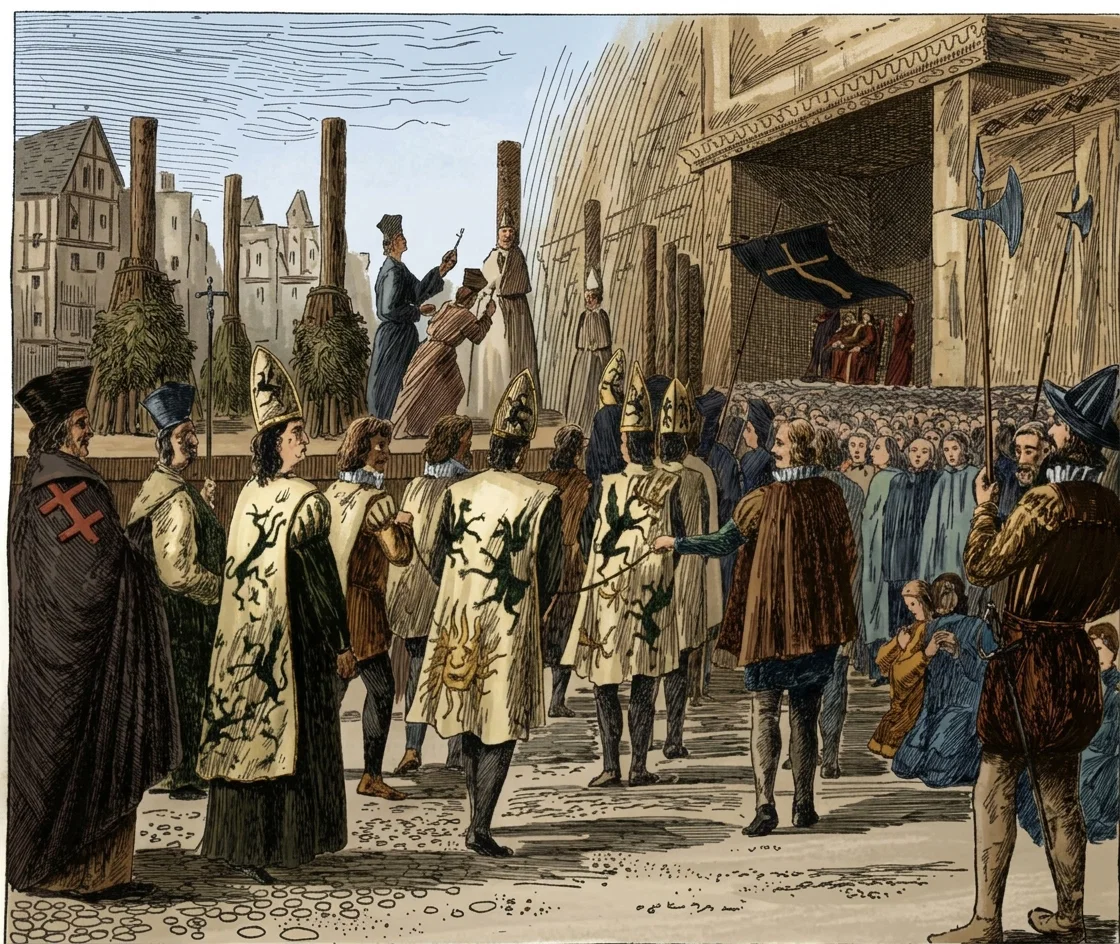
AN AUTO DA FE'.
AN AUTO DA FE'.
This greater authority from Satan was manifest in the greater prominence given to the religious element of the monster. Previous to this, under the other heads with their varying gods and forms of worship and blasphemies, the state had been dominant. The state had controlled the church and religion, more than religion had controlled the church. Given then an honorable ruler, who cared little or nothing for the state religion, and he became a good ruler. But under the fifth head, the Papacy, religion—the church—was dominant. The state must be governed by her for her good, and not the church governedby the state for the state's good. Here is the highest form of church and state government. In a defense of the Inquisition a Catholic writer says:—
Moreover, since all statesmen and public officers were at the same time Catholics, it is most easy to understand that they enacted laws and punishments in keeping with their religious convictions. To put it briefly, in those middle ages, there was the greatest union of church and state.—James I. Conway, in Catholic Mirror of August 29, 1896.
This being the nature of the system, the hunting and persecution of heretics became a logical sequence. Says the same article:—
Consequently, it is evident that one who was a heretic then, was by that very fact in opposition to the spirit of the laws and customs of his country—in other words, a disturber of the public peace and an underminer of civil society.
And then, says the same writer, the agencies of the church "diligently sifted out and indicted heretics of every description."
This is the character of the fifth head of the beast, and during the time of the existence of that head the beast became the papal beast. But the days of its persecution, the period of its spiritual domination, were limited. It is thus stated by the prophet:—
"And there was given to him a mouth speaking great things and blasphemies; and there was given to him authority to continue forty and two months. And he opened his mouth for blasphemies against God, to blaspheme his name, and his tabernacle, even them that dwell in the heaven. And it was given unto him to make war with the saints, and to overcome them; and there was given to him authority over every tribe and people and tongue and nation." (Rev. 13: 5-7, R. V.)
Note the following prophetic specifications concerning this power:—
a. A mouth speaking great things and blasphemies against God and his name. (Verse 5.) It is therefore a religious power, which blasphemes God.
b. It should continue forty and two months. (Verse 5.) The same period is elsewhere called "a time, times and a half," "a thousand two hundred and threescore days." (See Dan. 7: 25; Rev. 11: 2, 3; 12: 6, 14.) As short-lived beasts are used to symbolize long existing dynasties, kingdoms, or systems of government, so, to be consistent, short periods of time are used to symbolize longer periods. A year is a "time." (See Dan. 4: 16; 11: 13, margin.) According to the Bible mode of reckoning time there are thirty days in a month (compare Gen. 7: 11; 8: 4, 3), and twelve months in a year, making 360 days in a year. A "time," one year, "times," the dual number, two years; and a "half time," three and one half years, equal to forty-two months, 1,260 days. This, according to symbolic time "a day for a year" (Eze. 4: 6), symbolizes a period of spiritual domination for this head of 1,260 years.
c. It is a power which works against the very truth of God, God' name or character, his dwelling-place, and his angels. (Verse 6.)
d. It makes war with the saints, and overcomes them, killing them with the sword. (Verses 7, 10.)
e. He had power over all nations, tongues, etc.
f. All those who are not Christ's will yield to his worship.
g. He will finally receive a death stroke, and by violence his power shall be taken away. (Verses 10, 3.)
h. Yet shall the death stroke be cured, and the beast in that form shall live again. Still other specifications are given of the same power in Dan. 7: 8, 20-26. There is but one power or system to which these specifications in toto apply, during this period, and that is to that system of church and state government known as the Papacy. These we will consider in our next.

A Misunderstanding

No. 435. A Misunderstanding.

A CORRESPONDENT writes us from Pueblo, Cal., with reference to the article entitled “The Sabbath and the Sunday, No. 6,” in the SIGNS of October 22. Our friend enters into an argument to prove that the Sabbath, the seventh day (Saturday), as he expresses it, is still obligatory; that it is still the Sabbath of the Lord. And to all this we agree, and the article taught nothing else. The expression, “the Sabbath was crushed out,” did not apply to the Sabbath as a part of God’s truth, but the keeping of the Sabbath by the Church of Rome. When Israel of old departed from the Lord they forsook his Sabbath and persecuted those who kept it. When the professed Christian church departed from the Lord, she did the same,—forsook the Sabbath, elevated the Sunday in its stead, and persecuted Sabbath-keepers. And yet God had outside of the Roman Church faithful souls who kept the Sabbath all through the centuries. And this is what the article was designed to teach.

No. 436. Isa. 65 : 20, 23 Again.

PLEASE explain Isa. 65 : 20, 23. Does verse 20 apply to the new earth? If so, how can it be harmonized with Rev. 21:4? Will there be children born in the new earth? C. J. M.
Isa. 65 : 17-25 refers in general terms to the new earth state, with reference to the judgments which usher them in. “There will be no more thence an infant of days,” and the reason is given; the execution of the final judgment at the end of the thousand years has settled it. The last part of verse 20 probably refers to this time, in which all the wicked, young and old, will be destroyed. See Rev. 20 : 12-15, 9. Verse 23 is a contrast to this life. Here the bringing forth of children to sin and die are among the saddest of all earth’s miseries. In the new earth this will not be known.

No. 437. God’s Great Northern Army.

WHO are those referred to in Joel 2 : 4, 9, etc? E. A. B.
They evidently refer to the myriads of swarms of destructive insects which will in increasing measure in the last days sweep over the face of the earth, devouring everything in their path. The various grasshopper devastations in the prairie states are illustrations of this. In its fulness the prophecy may take in all the various destructive agencies of the last days.

No. 438. Who Are Israel?

DOES Hosea 3 : 5 indicate a turning of the Jews to God at this time? If not, when fulfilled? E. A. B.
The casting off of the ten tribes as a nation is recorded in 2 Kings 17. But this did not cast them off as individuals; for many from some if not all of the tribes became connected with the worship of God at Jerusalem. See 2 Chron. 11 : 16; 30 : 1, 5-11, 18, 21; 34 : 9; 35 : 18; also Ezra 1 : 5; 2 : 70; 6 : 17. But there were doubtless many more of the so-called “lost tribes” who accepted the Lord through the preaching of the word by the apostles. The true Israel, however, who will eventually be gathered and saved, the only Israel which will be saved, is the Israel of God by faith. See Rom. 9 : 6-8, 24, and onward, where the apostle quotes from Hosea and Isaiah to prove that the Israel who will be saved is the Israel by faith, the prevailer with God. Then will Israel truly return, and Christ, the Son of David, will be King.

How Ritualism Denies Faith

SEEING THE INVISIBLE. NO. 2.

How Ritualism Denies Faith.

LAST week we studied scriptures showing that if men are to see the things of God they must use the instruments which God has provided for seeing the invisible.
We have read that "the Comforter," "the Spirit of truth," "which is the Holy Ghost," the world can not receive "because it seeth him not, neither knoweth him." And further, on this it is written that "we receive the promise of the Spirit through faith." Gal. 3:14. That is to say, therefore, not only that the world can not receive the Spirit of God because it seeth him not, but that the world sees him not because it does not believe. Instead of believing in order that it may see, the world wants to see in order that it may believe. But to those who believe and therefore do receive him, Jesus says, "Ye know him, for he dwelleth with you and shall be in you;" and, "Ye see me;" and, "I will manifest myself to him." So that it is literally true that by faith we know God and the things of God, and see the invisible things of God.

By Faith We See.

It was "by faith" that Moses endured "as seeing him who is invisible." Heb. 11:27. It is written that "the pure in heart shall see God;" and he purifies the heart, "by faith" (Acts 15:9); and therefore it is by faith that men see him who is "the invisible God" (Col. 1:15). And in order that all men may see "the invisible things of him," and "him who is invisible," "God hath dealt to every man the measure of faith." Rom. 12:3. Faith is "the gift of God." Eph. 2:8.
It is not the gift of God in the sense that the natural faculties, as reason, sight, hearing, etc., are the gifts of God, so that it should be of ourselves. It is the gift of God in the sense that it is from above and beyond ourselves, a supernatural faculty bestowed since sin entered, and acting only at the free choice of the individual himself. "For by grace are ye saved, through faith; and that not of yourselves: it is the gift of God." "Faith cometh by hearing, and hearing by the word of God" (Rom. 10:17); and the word of God is able to make things to be seen which before did not appear, and which indeed were not; so that faith, acting through the word of God, sees in very truth, and sees clearly, the invisible things of God.

How True Faith Acts.

True faith, of which Christ is the Author, the faith of which the word of God is the channel—this faith hears the word of God and depends upon the divine power of that word itself to accomplish the thing which that word says. For when the centurion came to Jesus asking that his servant should be healed, he said to the Lord, "Speak the word only, and my servant shall be healed." Thus he expected the word of the Lord itself to accomplish that which it said when the Lord should but speak the word. And this the Lord pronounced not only "faith," but "great faith;" even such as he had not found in Israel. And this, too, in the face of the fact that the scripture, upon the knowledge of which Israel was greatly priding itself, had long before plainly stated this very thing, in these words: "As the rain cometh down, and the snow from heaven, and returneth not thither, but watereth the earth, and maketh it bring forth and bud, that it may give seed to the sower, and bread to the eater; so shall my word be that goeth forth out of my mouth; it shall not return unto me void, but it shall accomplish that which I please." Isa. 55:10, 11.
To expect the word of God to do the thing which that word says, and to depend wholly upon that word itself to do it, this the Lord Jesus pronounces faith. This is true faith. This is the faith by which men can see the invisible things of God as certainly and as easily as by the telescope and the microscope they can see the invisible things of the natural order. This is the faith which works by love and purifies the heart, so that he who is thus "pure in heart shall see God," invisible tho he be. For this is the faith by which he who exercises it sees the invisible. This is the faith which, working through the word of God, accomplishes the new birth (1 Peter 1:23) by which a man is enabled to see the kingdom of God, which "except a man be born again he can not see" at all.
This is why it is that "whatsoever is not of faith is sin." Faith is of God, and whatsoever it works is the work of God; while whatsoever is not of faith is not of God, but is of the world. And all that is in the world is not of the Father, but is of the world. 1 John 2:16. Whatsoever is not of faithis of the world, is of the nature of the world, and is of the way of the world, and perverts the way of God to the ways of the world, and demands that God shall accommodate himself to the world and accept a worship that is altogether of the nature and spirit of this world.

Catholicism Demands the Visible.

No stronger proof, therefore, could possibly be given of the absolute falsity, the sheer worldliness, and the utter naturalness, of any system of religion, than that it must needs avail itself of visible representations of the object of its worship. And of all the systems of religion that are in the world, there is no one which insists more upon the visible and upon seeing the visible than does the Roman Catholic system. It is essential to that system that it shall have "a visible head." It must have a visible kingdom. It must have a visible sacrifice. Professing to worship the Crucified One, the Roman Catholic Church must have a visible "crucifix" by which to do it. Professing to glory in the cross of Christ, she must have a multitude of visible crosses of her own by which to do it. There must be a visible interpreter of the scripture. And for all the worshipers according to that system, there must be visible representations of the object worshiped, in the shape of images and pictures. Throughout the whole system the one chief essential is the seeing of the visible.
In an encyclical of Leo XIII., "On the Rosary of the Blessed Virgin," describing the purpose of the rosary, that is, of the beads which are used by Catholics in their prayers, he says: "The rosary is arranged not for the consideration of dogmas of faith and questions of doctrine, but rather for putting forth facts to be perceived by the eyes and treasured up in the memory." Even tho it be recognized that the invisible exists and is to be worshiped, yet it can be comprehended and worshiped only through, and by the aid of, the visible. This is the characteristic of all heathenism and of all idolatry. And this is only to say that by this characteristic the Catholic system of religion is demonstrated to be essentially heathenish and idolatrous.

What Ritualism Signifies.

We know full well of the plea that is made in defense of the use of images, pictures, etc., in the worship of the Roman Catholic Church; that is, that "the honor which is given them is referred to the originals which they represent, so that by the images which we kiss, and before which we uncover our heads or kneel, we adore Christ and venerate his saints, whose likeness they represent;" and "the bowing before an image outside of us is no more to be reprehended than the worshiping before an internal image in our own minds; for the external image does but serve the purpose of expressing visibly that which is internal."—Faith of Our Fathers. But if they only saw him whom they profess to worship, they would not need any image of him, either external or internal, nor any representation of him, either visible or otherwise. They could then be true worshipers, worshiping him who is invisible, in spirit and in truth.
This plea that is made in justification of the use of images and of the visibles, is in itself the greatest condemnation of the use of images and of the whole system of Roman Catholicism; for it is a confession of inability to see the invisible, and therefore a confession that the whole system is destitute of true faith, and a stranger to the new birth, and altogether without God.
The Catholic system being confessedly unable to see the invisible, is clearly not of faith. And as whatsoever is not of faith is sin, it is perfectly clear that the whole Catholic system is a system of sin. And the professed Protestantism that panders to it, that compromises with it, that courts it, and that is "wheeling into line with it," is simply like unto it. The one is "the man of sin," "the son of perdition," "the mystery of iniquity," "the beast;" and the other is "the image" of it.

THE LORD'S PRAYER IN ACROSTIC.

[THE acrostic reads, "My boast is in the glorious cross of Christ." The words in italics, read from top to bottom—left—and from bottom to top—right—form the Lord's prayer. By experts this is thought to be one of the most remarkable compositions on record.]
Make known thy Gospel truths, our Father King; Yield us thy grace, dear Father, from above; Bless us with hearts which feelingly can sing, "Our life thou art forever, God of love." Assuage our grief in love for Christ, we pray, Since the bright Prince of heaven and glory died, Took all our sins and hallowed the display; Infant being, first a man and then was crucified. Stupendous God! thy grace and power made known, In Jesus' name let all the world rejoice, New labor in thy heavenly kingdom own: That blessed kingdom for thy saints the choice. How vile to come to thee is all our cry, Enemies to thyself and all that's thine, Graceless our will, we live for vanity, Loathing thy very being, evil in design. O God, thy will be done from earth to heaven; Reclining on the Gospel, let us live In earth from sin deliver and forgiven. O! as thyself but teach us to forgive, Unless its power temptation doth destroy, Sure is our fall into the depths of wo. Carnal in mind we've not a glimpse of joy Raised against heaven; in us hope bestow, O! give us grace and lead us on thy way, Shine on us with thy love and give us peace, Self and this sin that rise against us stay. O! grant each day our trespasses may cease, Forgive our evil deeds that oft we do, Convince us daily of them to our shame, Help us with heavenly bread, forgive us, too, Recurrent lusts, "and we" will bless thy name. In thy forgiveness we as saints can die, Since for us and our trespasses so high, Thy Son, our Saviour—bled on Calvary.
—Selected.
Continue reading: THE LOVE OF GOD