“I WONDER if beer is very bad for people to drink. It looks pretty; but it smells queer, and I know it costs money. Papa does not drink it, neither does mama; but other men and women do, who look just as nice as our folks. Some folks say it is good, and some say it is bad. How is a boy to know?”
He was walking just ahead of me, telling his difficulties to his friend, and you could easily read between the lines that a battle was on. The temptation to drink beer had come to him. He wanted to find an excuse to yield to it; and yet he was not ready to yield just then.
“Why, George, you know it’s the alcohol in the beer that makes it bad; just as any kind of poison in anything will make it bad.”
“But everybody doesn’t put alcohol into beer; they just drink it as it is.”
“Good; that’s just it—‘as it is.’ It is bad, and it is bad because the alcohol is in it. Nobody puts it there when he drinks it; but it forms in the beer while it is being made. You know it is made from grain, most always barley. The barley is malted and ground. Say, George, come over to the house. We have some pictures of the whole business, and father knows all about it. If he is at home, he’ll tell us. But I know it pretty well.”
What a difference! Two boys from Christian homes—one had been fortified, and one had been left defenseless.
It is important that our children learn their lessons for the day-school, yes, and for the Sabbath-school. But who will give them the knowledge they must have in order to meet the world as they find it? These temptations are here; and better, far better, spend a few hours now teaching them how to meet them and overcome, than to spend months and years in grieving over their fall.
Not one child in one hundred will want alcoholic liquors after he has been taught that alcohol is the product of decay, of rottenness, or, as one German chemist states it, “The excrement of the yeast fungus.” Nothing appetizing in that, is there?
The luscious fruits, the toothsome grains—these are inviting; but who desires decay?
Let us not neglect the school or the Sabbath-school; but let us give in our homes the truth that will unmask the tempter, and set our darlings free. Many things we can afford to leave undone, but not this. Now that temperance forces are gaining ground, the liquor dealers are studying every wicked art to entrap the boys and girls; but since truth is stronger than error, we need not fear, if we do our part.
San Francisco, Cal.
How Children Are Killed
CHILDREN are killed by the manner in which they are dressed, and by the food that is given them, as much as by any other causes. Infants of the most tender age, in our changeable climate, are left with bare arms and legs and with low-necked dresses. The mothers, in the same dress, would shiver and suffer with cold, and expect a fit of sickness. And yet the mother could endure such treatment with far less danger to health and life than the tender infant.
What is the effect of this mode of dressing on the child? The moment the cold air strikes the bare arms and legs of the child, the blood is driven from the extremities to the internal and more vital organs of the body. The result is congestion, to a greater or less extent, of these organs. In warm weather the effect will be congestion of the bowels, causing diarrhœa, dysentery, or cholera infantum. In colder weather, congestion and inflammation of the lungs, congestion and inflammation of the brain, convulsions, etc., will result. At all seasons, congestion, more or less, is caused, the definite effects depending upon the constitution of the child, the weather, and various circumstances.
It is painful to see children thus decked to gratify the pride of foolish mothers. Our most earnest advice to all mothers is to dress the legs and arms of the children warmly at all events. It would be infinitely less dangerous to life and health to leave their bodies uncovered than to leave their arms and legs bare.—Selected.
Curing the Apple Thief
By Emma Penno
“I THINK I can cure those boys of that bad habit,” said Grandfather Gooderham to himself, with a very mischievous twinkle in his eyes for one of his sober years.
“To be sure, I think there must be something wrong about a boy’s bringing up when he persists in appropriating his neighbor’s goods, such as cherries, plums, pears, and early apples. He certainly has not yet learned to square his life by the golden rule, however well he may have learned to repeat it. But I think I can cure him. I’ll try a few coals of fire,” and the old gentleman almost laughed aloud.
There was some mysterious work going on in grandfather’s orchard the next day. There was a man hired to dig a hole beside the picket fence—a hole several feet deep, and nearly as big around as a well. What he was digging for the man did not know.
“The old gentleman is getting childish,” he said to himself, and went on with the digging. By six o’clock the hole was deep enough to suit grandfather, and the hired man went home. After he was gone, grandfather leveled down the heap of loose earth a little, spread a few branches over the top of the hole, and strewed some grass over them.
About nine o’clock, when it was getting pretty dark, grandfather went out to the orchard and sat under a tree near the fence, a few yards away from the hole. He had not been waiting long when along came two brave boys in search of early apples.
“Where’s that loose picket?” said one, groping along the fence.
“Here it is,” said the other, and removing it, boldly stepped into the orchard and right into the hole.
“Oh, oh!” he cried aloud, thoroughly frightened; “help me out.” But his comrade had run off at the first sound of trouble.
“Charlie!” called the prisoner, but Charlie did not answer.
Presently grandfather came hurrying up. “Well, well! What have we here? How did you get in there?” he asked.
“Come, let me help you out,” said grandfather, kindly, and he reached down and drew the boy up.
“What were you doing here?” he asked, still holding the boy’s hand.
“I came with another fellow to get some apples,” he said, hardly able to keep back the tears.
“Apples? Why, to be sure; but why didn’t you come and ask me for them? Why, bless you, you may have all you want. Come to the house.” And the boy had to, for grandfather still held his hand.
At the house they got a sack, and then went to the orchard again. They visited all the best trees. The boy climbed up and shook down the fruit, and the old gentleman filled up his sack.13
“There, take those home with you, now, and don’t forget to share with ‘Charlie.’”
As the boy staggered off under his heavy load, grandfather rubbed his hands together gleefully, and chuckled to himself, “Those coals will burn all right. I guess that’ll cure them.”—Emma Penno.
Talks to Girls
By Mrs. J. Ellington M'Gee
I WANT to tell you of a conversation I overheard on the street-car the other day. I was standing directly in front of three bright-faced girls who were telling each other something of their home life. One of them said:—
“Mama never cooks a meal at our house. It has been so long since she did any cooking that she has forgotten how.”
“How funny!” replied the other girl, with much silent wonder expressed in her eyes. “Is she an invalid?”
“An invalid! Well, I guess not!” replied the friend. “We don’t want mama to cook. Sister and I take charge of everything. At first we did not do very well, and mama protested, but now we are quite proficient.”
“That is really funny. I do not lay my hand to a thing in the house. Grandma does all the cooking, and mama does the housework. It would never be done if I had to do it.”
By this time it had begun raining, and the girl who never did a thing at home continued her chatter by saying:—
“Dear me! It is raining! Mama told me to take an umbrella, but she tells me so many things I don’t pay attention to half of them. I wonder if she will have sense enough to meet me at the car with an umbrella. If she doesn’t, I shall ruin this new hat.”
“You may have my umbrella,” said the other girl, who had already excited my admiration. “I wore my old clothes to-day, and it wouldn’t hurt them if they do get wet.”
You can readily see that very small things indicate character, and I am sure that you will not be surprised when I tell you that the girl so thoughtless of her mother did not attract me, nor will she attract any one. And there is just a little secret here. A girl can not be selfish and thoughtless at home and make herself really lovable to the outside circle of friends, for the real character will reveal itself. It can not be hidden.
Unselfishness and sacrifice in the home for mother, brother, or sister, is a great beautifier, more potent than all the concoctions sold by druggists at exorbitant prices.
I believe that many girls forget mother, not because they are inherently selfish, but because they are thoughtless; but if this thoughtlessness continues, and dear mother’s face ages, and the heavy lines come into her brow, while the girl frolics night and day, the thoughtlessness becomes a sin.
I have a young friend who is now seventeen. She is a stout, healthy girl. Her mother is never well, but still, with you, no help, she looks after a nine-room house.
When vacation came, this young girl said to me: “Mama says I must learn to work this vacation. I learned how to make a bed to-day.”
The first time this buxom girl of seventeen had made a bed! Do you wonder the overworked mother was never well?
I will tell you of two other girls I know. These girls have lived in affluence, but when their father died, they found there was no money left. They began at once to fit themselves for self-support. One secured a fine position as stenographer, while the other, a very fragile girl, secured a position as kindergarten teacher. These two girls were determined that their mother, now past sixty, should be spared all possible hardship. They therefore arose earlier in the morning, donned their big aprons, and attended to the necessary housework before going out to office and school.
I am so glad there are so many noble, self-sacrificing girls. I have in mind another young woman, a school-teacher, commanding a salary that would enable her to board away from home if she chose, but after her mother’s death, she took charge of the home for her father and brother.
At first she had a woman to superintend the housework, but she found her so wasteful that she decided to undertake it herself, and now she has everything systematically arranged, and the home is always in order. This girl is in charge of the mission study classes of a large city district, and also holds office in the Young People’s Society of her church. I don’t believe she has any time to be selfish.
The girl who appears at church dressed like a fashion-plate, while her mother is shabbily dressed, advertises herself as plainly as though she wrote in large letters: “I do not care for anybody but myself.”
I hope that all girls will build on the broad plan of noble living, because they will be happier, their loved ones will be happier, and their living will make the world better and brighter. It is true, as Phillips Brooks has said, “No man or woman of the humblest sort can really be strong, gentle, pure, loving, and good, without the whole world being better for it; without somebody being helped and comforted by the very existence of that goodness.”—Mrs. J. Ellington M’Gee.
Disposal of Kitchen Waste
DURING the hot months, the garbage from the kitchen should not be allowed near the house, as it makes an ideal breeding-place for flies and other insects. One has but to observe the countless swarms of flies hovering over such a spot to realize what a menace it is to the health of the family. The most approved method of disposing of this refuse matter is by burning. If this can not be accomplished, a good way to do is to bury all perishable stuffs, and cart away anything that can neither be buried nor burned, depositing it in some place far from the house. Aside from the unsightliness of a back yard strewn with rubbish and rotting garbage, the gases arising from the decomposition of organic matter are very injurious to health, and, in epidemics of filth-diseases, a positive menace. If no other way, keep a garbage can in which every refuse thing is deposited, and empty it every day, in some place remote from the house.—Selected.
Forming the Baby’s Character
By Dr. Mariana Wheeler
ONE would hardly expect to find marked traits of character in a very young infant; nevertheless, they are there, and show themselves very strongly, often when the infant is not more than twenty-four hours old. This, then, is the time to begin your training. Begin the molding process right now.
Infants are helpless, consequently they require our care, and it is a matter of duty that this should be our intelligent best. Do not depend on guessing in this important matter; it is not safe. Children require love, sympathy, companionship, and amusement just as much as the adult, probably more; but remember that a surfeit of good things has the same effect upon the young as it does upon an older person. It seems rather ridiculous, does it not, to think of a child, and a very young one at that, becoming blasé—tired of the good things offered? But it is true. We do not have to look very far to see children, even infants, turn away their heads with a shriek of disapprobation when well-meant, but constant demonstrations of affection are thrust upon them. This open rebellion goes to show how distasteful it is to the child. Occasionally children of not overrobust constitutions become so wearied and weak with handling, hugging, and kissing, that, like a sensitive plant, they wilt, and with pathetic patience submit to the inevitable because they are too weak to resist.
A selfish, nervous, unhappy child is invariably the result of overindulgence on the part of the parent, and not infrequently the parent reaps a bitter reward in utterly failing to hold the respect, love, and obedience which are due the parent from the child. Children who are overindulged lack self-control, and self-control taught at a very early age soon ceases to be self-control. It becomes a habit of trust in the mother—confidence in her discretion, love, and judgment. If this early training is delayed, almost before the mother realizes it, she finds a wilful and stubborn child; then if she tries to correct the faults she has nourished, she will realize that the remodeling process is a far more difficult task than the molding would have been in the beginning. If you begin to humor the child early in life by walking, rocking, or other form of entertainment, he will have a right to expect to be humored in other things, and he usually is humored until he becomes the autocrat who holds sway over every one with whom he comes in contact.—Dr. Mariana Wheeler, in Harper’s Bazar.
In New Haytian Fields
By W. J. TANNER
W. J. TANNER
On my recent trip to the conference in Jamaica, I had an opportunity to visit many of the chief towns of Hayti. Twenty-two days were consumed in making the trip, besides the time spent in Kingston. This was caused by the fact that the steamers which run on this route stop at nearly all the Haytian ports to discharge and to take on cargo, and also on account of the different lines not connecting well.
From the standpoint of our work, we found many things to encourage us. The same readiness that we see to hear the message in the north exists to a greater or less extent in the southern portions of the republic. In Port au Prince, the capital, where we stayed nine days, we found an aged native Haytian, who has been keeping the Sabbath for nearly seven years. Brother C. M. Moulton first found this Sabbath-keeper about three years ago, when on his way to Porto Rico. But as he could not speak French, he had very little opportunity to instruct the brother; and so it was not until our visit that this man had this privilege, which he and his family seemed thoroughly to enjoy.
The manner in which he and his family found the truth is interesting, and illustrative of how the Lord sometimes works to bring the light to honest-hearted people in these countries of few spiritual privileges. The father was raised a Roman Catholic; but, a Bible falling into his hands, he read it, and was led to forsake the superstitions of Rome, and to join the Wesleyan denomination. After a time, the perusal of the Word called his attention to the truth on baptism. When he mentioned his convictions to his brethren of the Wesleyan faith, they at once sought to relieve him of his views, but to no purpose. Finally some one said to him: “There is no need of being so conscientious over the question of baptism, because of the fact that the Bible is silent on sprinkling and commands immersion; for the Bible is also silent in regard to keeping Sunday, while it does mention the Jewish Sabbath, which we Gentiles never keep.”
The brother replied that he would have to investigate the latter question also, and if he could be as sure that the seventh day is as binding on Christians as baptism, he would observe it, too. He at once began to read the Bible through for the purpose of learning the truth in the matter, with the result that he began the observance of the Sabbath four years before he heard that others were keeping it. Recently he has been made happy by seeing his wife and married daughters join him, in yielding obedience to the commandments of God.
The Sabbath I was with them their little company was further augmented by a schoolmaster, who cast in his lot with the people of God. These all showed, by their willingness to accept the light on health reform and tithing, that the work already begun in them is genuine.
This brother also informed me of a young man at St. Marc, who, through his instrumentality, is keeping the Sabbath. When our steamer reached this latter place, I inquired for the young man, but found that he had left the day before for Gonaives, to find work. When we reached that place, I succeeded in finding him, and was encouraged to note how well he seemed to understand the principal points of our faith, although he had never seen any of our literature until I handed him an assortment of our tracts and pamphlets, which he received with avidity. The fact that this young man carries a thumb-worn Bible in his pocket, is the only explanation we have to give of his knowledge of the truths that are so dear to us as a people.
On my arrival home, I found Brother E. Fawer, a young Swiss worker, awaiting me, having arrived from Europe just one month before my return. With his help we hope better to instruct our people in all the principles of the message, and to carry our firing line still farther into the enemy's country.
Freetown, Sierra Leone, West Africa
By D. C. BABCOCK
D. C. BABCOCK
Since our last report, we have taken our tent down, and moved it to the mission farm, and continue our meetings there four times each week.
School Work
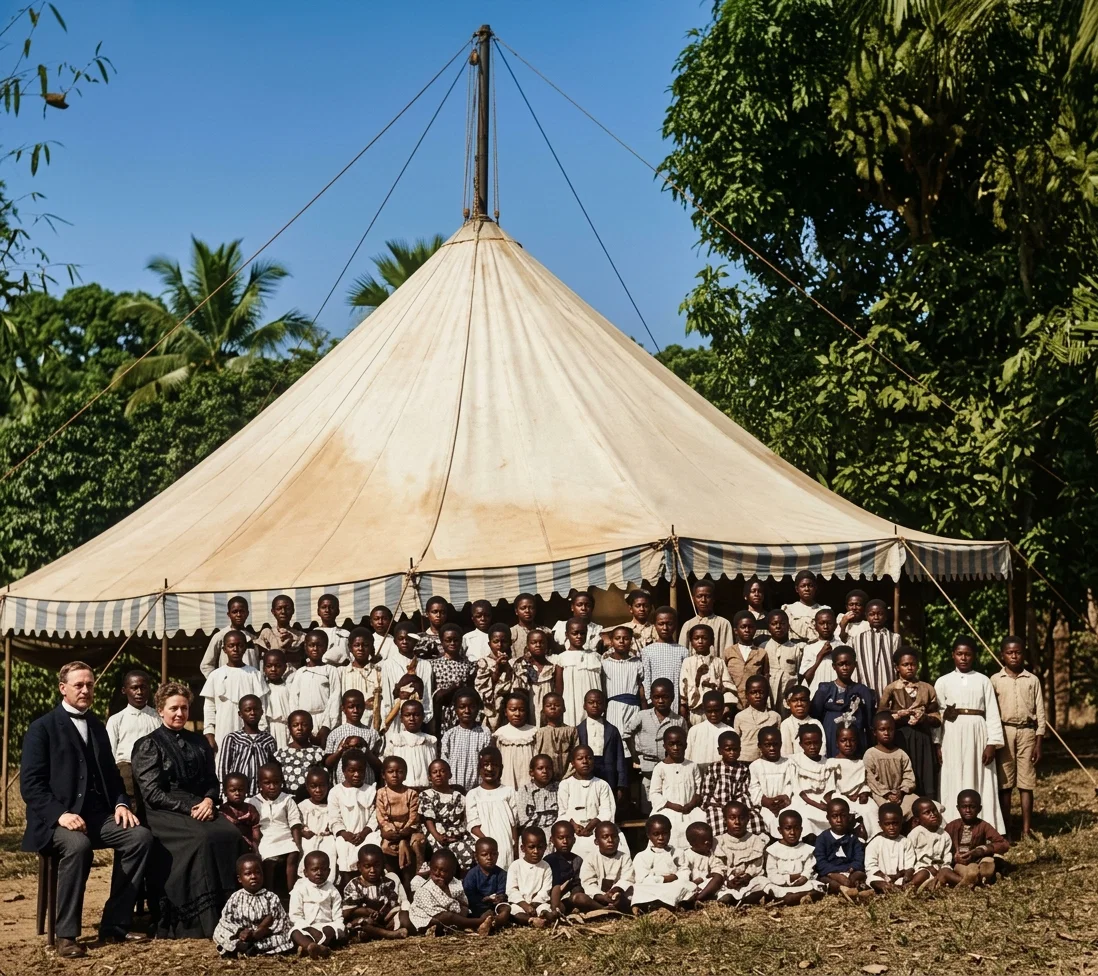
It was expected, two weeks before we took our tent down, that we would pitch it on the other side of the city, and hold another series of meetings before the rainy season set in, but our school work developed so fast that we were compelled to pitch the tent and use it for our school work, until we could arrange a temporary school building. Before we pitched the tent for the school, we had to hold our school in the mission house. Our veranda is six by forty-four feet, and on it we seated seventy-five children. Our parlor is also filled with the larger students, so that we hardly have living-room. If this interest continues during the rainy season, we shall be compelled to put up a larger school building.
Brother Kwamina, who sailed from America in January, arrived here on Thursday, February 21. On the following Monday, he took charge of the school, and thus gave relief to Mrs. Babcock, whose health was failing fast on account of overwork. We hope that this school may develop into a real training-school, in which laborers may be prepared for the West African field. The urgent demand for such a school as this, in this field, can be realized when we consider the large amount of money that has been spent by the General Conference in starting the work in this unhealthful climate. Several laborers have been sent to this field from America, and some have been compelled to return on account of failing health; others have laid down their lives for the cause.
The necessity of raising up native laborers can be clearly seen. Experience has taught us that it is far better to train workers in the field than it is to send them to some other land to be trained; and the cost is far less.
For this work we need a teacher who has had a thorough training in the principles of this message and the presentation of the same, as well as a proper fitting up as a thorough teacher. Anything less than this will not meet our urgent needs. We do pray earnestly that one of our schools shall favorably consider this question at once, and send us such help under the direction of the Mission Board. [This call is already answered in the person of L. W. Browne, of Emmanuel Missionary College, who has gone to assist in the work in West Africa.—Ed.]
The Tent Effort
As announced in a former article, our tent was pitched in this city on the eighth of January, and the first meeting was held on the evening of the tenth, with fully six hundred in attendance. For six weeks the congregation was never less than this number. On Sunday nights there were from ten hundred to fifteen hundred present. The best of order prevailed from first to last. At no meeting was there the least disturbance. The book sales by our workers during the meetings amounted to more than one hundred and fifty dollars. We distributed among the people many thousand pages of leaflets. On each Sunday night from ten hundred to fifteen hundred leaflets were distributed.
It is difficult to tell just what the result may be. Our present attendance at the Sabbath meetings is about thirty-five. These meetings are held at the mission farm, fully one mile and a half from the center of the city. The meeting last Sabbath will long be remembered by those present. It was a refreshing from the Lord. The general testimony was, “How the truth reached me.”
It is wonderful to witness the decided transformations that take place in the lives of men and women. One brother said, “I went into the tent the first night through curiosity, and came out a changed man.” The whole city is greatly stirred over the truth, the majority in its favor, but some in opposition.
Last Sunday a minister in one of the large churches, in a special meeting, was15warning his congregation against attending our meetings, and advising them not even to refer to them, nor to speak my name, when a voice cried out, “Why don’t you preach the truth to us as we hear it at the tent? We will go to hear that man.” Then all the congregation cried out against the minister, and it seemed for a time that the people would do him violence. One of his class leaders and another gentleman came at once to our mission, and purchased “Bible Readings” and “The Desire of Ages.”
Urgent calls are made from every quarter for us to come and hold meetings, but we lack the men and means to fill them. We are preparing workers as fast as we can.
THE TENT WHICH IS SERVING TEMPORARILY FOR A SCHOOL BUILDING AT FREETOWN, SIERRA LEONE, WEST AFRICA
A bright young man and his wife have accepted the truth, and he is studying faithfully while he is out canvassing for our books. He was formerly a minister in one of the denominations here, and has had charge of a mission in the interior. He took thirty dollars’ worth of books and went to Conakry, a French port north of Sierra Leone. Word has reached us through his wife, that he has sold nearly all his books and wants more. His wife has had experience as a teacher, and will help us in our school work.
A Church Building
Before we had held meetings in the tent a week, there was a call for a church building. At first it seemed to me out of the question for us to do anything in that line at this season of the year, as the rains will soon be upon us. But while I was out visiting one day, I met the city inspector of buildings, and he said we must not let the rains come on us until we had a temporary building so the meetings could be continued. He said he would be responsible for the roof, and for me to see what else could be done. I went to another gentleman who believes and obeys the truth,—a dentist,—and he told me to buy a suitable lot, and he would pay seventy-five dollars on it. I soon found a good lot, just where we wanted it, at the price of $112.29. We purchased it, and last Wednesday the money was all raised, and the lot paid for. Some materials are now on the ground, and we hope to begin work next Wednesday. While we have a good start, and have some money on hand to push the work, yet it is very expensive building in this place, and any help will be greatly appreciated. We hope to get the roof on the building within the next thirty days.
Baptism
Our first baptismal service took place on Thursday, February 28, when seven precious souls were buried with their Lord by baptism. We were freely granted the use of the baptistery by the Church of God before a large congregation. The service was opened with a hymn, after which the pastor of the Baptist church offered prayer. Brother Kwamina then gave a short discourse on the importance of the ordinance, after which the baptism took place. A deep impression was made upon the entire congregation. Many remarked that it was the most solemn experience in their lives. Others will go forward later.
To our dear people who have so liberally assisted in sounding the message in this part of dark Africa, we send the cheering word that light is breaking. The truth has a sure foothold here. Pray that the fire kindled, may burn brighter and brighter.
Our First Church in Burma
By G. B. Thompson
G. B. THOMPSON
Soon after the close of the general meeting in Calcutta, I went with Elders Shaw and Miller, and Brother and Sister Burgess to northern India to assist in finding a location for a mission station in the hills of the Himalaya Mountains, to which our missionaries can go from the burning heat of the plains for a needed period of rest. We visited Dagshai, Simla, Solon, Kasauli, and Mussoori. We spent nearly three weeks in this trip. The weather was very cool in the hills, and heavy underclothing and overcoats were necessary. There was considerable ice and snow, the tops of all the mountains being covered. (Himalaya means the “abode of snow.”) The air was very invigorating, and it seemed that a person could regain his health as well here in these hills as in any other place.
The establishing of hill stations in hot and unhealthful countries I believe to be a wise step, as it will do much to advance mission work in such countries by providing a suitable place where the workers may go to regain their health and secure needed rest, without leaving the country. To carry on work effectively in India, as well as in other countries, those who come to labor must plan to learn a language and to remain permanently in the field. By changing to these hill stations from time to time this can be done. In large countries, like India, it will be necessary, perhaps, to plan for more than one such place, on account of the long distances of travel. The matter of locating the hill station was not permanently settled when I left, but negotiations were in progress.
On my return to Calcutta I held some meetings with the sanitarium family, studying the relation of our medical work to this message, and the important place the medical missionary can fill in this work. Dr. Menkel and wife are getting hold of the work nicely, and a good spirit pervades the institution. The patronage when I left was encouraging.
March 9 I bade the workers in Calcutta good-by, and sailed on the “Tara” of the British India Line for Burma. After a very pleasant voyage of three days across the Bay of Bengal, I reached Rangoon, and found Elder Votaw and wife and the other workers here well and of good courage.
I remained in Burma over two Sabbaths, holding meetings and visiting those who are interested in the truth. This is the land where Judson spent so many years of his life, and gave to the Burmese an excellent translation of the Bible, thus preparing the way for the last message. And it is encouraging to see how the message is taking hold here. A number of earnest, devoted souls have begun to keep the Sabbath, and others are deeply interested. Three who have embraced the truth here are already in the field laboring in the Burmese language. Most of those who have accepted the truth live in Rangoon and Maulmein, but we hear of some far to16the north, and of others to the south of this place.
On Sabbath, March 23, in the hall in Rangoon our first church in Burma was organized by Elder Votaw and the writer. Twenty-three persons were included in this organization. On Sunday nine persons were baptized by Brother Votaw amid the beautiful surroundings of the Royal Lakes near the city. Some of these baptized were not included in the organization of the church, but expect to unite, and will increase the membership to about twenty-six. The following-named persons were chosen as officers: Elder, H. H. Votaw; deacons, Brethren Maung Maung and David Hpo Hla; clerk, Anna Speer; treasurer, Carolyn Votaw. Following the organization the ordinances of the Lord’s house were celebrated, in which all took part. The Lord seemed especially near on this occasion.
This church is composed of an excellent class of converts. The message works the same in the hearts of the people in all lands. Tobacco using, chewing betel, wearing jewelry, etc., are prevalent among the Burmese, but they laid these things all aside in order to follow the Lord. If they continue to grow in grace, they will indeed be a real light in this dark land. The members of this church are fully instructed on all points of the message, and seemed to be as faithful in the payment of tithes as any church I have met.
Burma, I believe, is a fruitful field for the work of this message, and we should plan aggressive work here at once. This is a land of great resources. The people are of Mongolian type, and quite intelligent. They are liberal and willing to give of their means. Unlike India, Burma has no caste, and the women are as free as the women of any land. In this respect it is a much easier field than the peninsula of India. The land is filled with the gilded temples and shrines of Buddhism. Some of these have been erected at great expense. The number of images of Buddha is astonishing.
Including the Shan States to the north, Burma contains about 236,738 square miles, or about the same as the territory of the Lake Union Conference, and has a population of about ten million. Rangoon, the capital, is situated on the Rangoon River, one of the rivers which compose the mouth of the Irrawaddy River. About fifty years ago it was described as “a collection of mud huts in a swamp,” but it is now the third shipping port of the Indian empire, and contains a population of about three hundred thousand. The town is well laid out, has a good supply of water, electric lights, and a good line of electric street-cars.
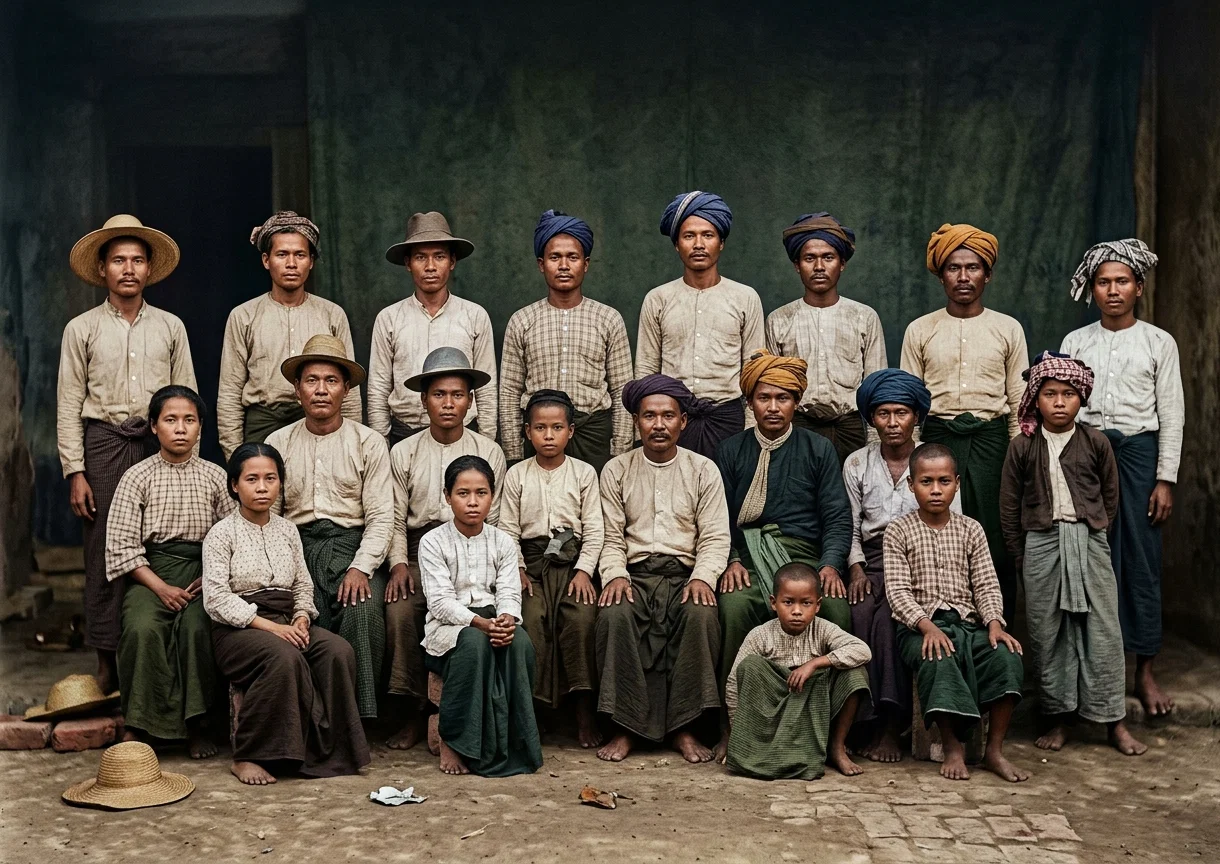
GROUP OF LABORERS FROM BURMA IN ATTENDANCE AT THE GENERAL MEETING IN CALCUTTA
Here, as elsewhere, more workers are needed. We have here at the present time Elder Votaw and wife, Dr. Ollie Oberholtzer, Sisters Bertha King and Daisy Jewett (who are canvassing at present), Sister Ruoff (who is giving treatments), and Brother Maung Maung, his sister Mah May, and David Hpo Hla, our three Burmese workers. These are all of good courage, and are planning to stay by the work. Some of those who have come to this field to work are making encouraging progress in the study of the language. But what are these among so many? While the climate is very hot, it is not, as a rule, unhealthful. We need workers to study the languages and prepare to carry the message in the native language to these millions who are waiting for it. This field is ripe for the message. The Karens, who form an important part of the population of this field, are calling for workers to come and teach them the message. The Karens, I am told, have a tradition that they once had the true light, but because of their sins it was removed from them. For this reason many of them are looking for light, and are ready to receive it. The language is different from that of the Burmese, and we should have a worker for this people without delay. India and Burma afford an excellent field for labor for our consecrated young people who are graduated from our various schools.
I am booked to sail March 28, on the “Cheshire” of the Bibby Line, via Ceylon, for Egypt. I have enjoyed much of the blessing of God during my visit to these fields, and have been impressed as never before with the great needs of India. To carry the gospel to three hundred million, shackled and benighted in heathenism, is no ordinary task. It can be done only through the bestowal of the Holy Spirit and apostolic power. God is greatly blessing the work in this land, and is preparing to do a quick work. Let the continual cry of all who love this message be, “Here am I, Lord; send me.”
Mission Notes
EVERY inch of advance in mission work has been contested by the arch-enemy, from the very day the founder of modern missions—William Carey—was accepted as a missionary to India, down to every point of attack upon heathenism at the present time. Why this bitter opposition? It is evidence sure and certain that the devil counts on this well-planned attack upon his strongholds as something worthy his steel, hence blocks every line of advance with all his power. And nowhere does he succeed so well as in the home land, in cutting off supplies for Christ’s ambassadors and warriors in the forefront of the battle. Brother, sister, at home, think about this. Has he not attempted to belittle in your mind the work of missions, by seeking to belittle your offering? Did he ever succeed in his attempt?
SOMETIMES very useful people, even men and women whom God is using to accomplish most noble service, are not noted for their attractiveness, and may even be classed as the very opposite in point of winsomeness. It may be of encouragement to some tried worker whom God loves, when he feels almost alone in the world, so far as human companionship is concerned, to think that some very noted men must have had hours when these same feelings stole over them. It is written of Robert Morrison, that man of valor who succeeded in translating the Bible into Chinese, that socially he would pass for a failure. “Robert Morrison took himself seriously. Sprightliness was no more to be looked for from him than from one of the Puritan fathers. His letters are as grave as ‘Pilgrim’s Progress,’ though less interesting. . . . His manners, though always respectful, were not winning. Small talk he never condescended to, perhaps from inaptness. Beyond the weather, this self-contained man had few topics in common with others. The very intensity and unusualness of his aims made him solitary. Take him all in all, he was one to respect and admire, rather than to love.”