The delegation to the General Conference from South America
Editorial Correspondence
By M. C. W.
(From the General Conference)
FROM sea to sea; from the broad Pacific to the turbulent Atlantic; from the land of perpetual summer-time to the summer days of the winter land; from the Golden-gated metropolis by the western sea to the metropolis of the Western Continent by the eastern sea; from the land of the orange to the land of the apple; from the slope of the Sierras westward to the sunrise slope of the Appalachians;—so might we go on for a page more; for the striking differences are numerous, and disparaging to neither. In some of the blessed things of life one abounds and the other superabounds. Both are blessed, neither is perfect, yet the smiles of God are upon them both, and upon both falls His sunshine and rain.
Island Mission representatives at the General Conference
There were thirty-six of us when we all got on board at the city of Los Angeles, and there were about twenty of these at San Francisco and Mountain View that boarded the first car on the afternoon of May 6, 1913, for the S. D. A. General Conference at Washington, listed for May 15 to June 7. Seventy or more left California for the transcontinental trip and the conference, some in small parties and singles going before, others taking other lines. Of these we write not.
We chronicle only the two exclusive car-loads from the two great Western cities, San Francisco and Los Angeles, to Washington, leaving the first city May 6, 4 P.M., and reaching the last May 12, 10:40 A.M. In charge of our party were Mr. Mason and Mr. Lape, the former to El Paso, the latter throughout the trip. Being acquainted with the route, these gentlemen not only interested the party, but informed them.
Altho the writer had been over the route twice before, he found interesting incidents recalled, and obtained new information regarding various places along the way.
It is always a ride of interest to the open-eyed and observing. The fertile grain fields and prolific fruit orchards of California are inspiring pictures, altho the dry year has affected grain crops, and the cold of last winter froze the oranges. But what is an off year in California with the normal yearly fruits and the normal California spirit!
The coast line from San Francisco to Los Angeles is the pleasant route in warm weather, with its century of miles of surf, its cooling sea air, and its interesting towns of San Jose, Paso Robles, San Luis Obispo, and Santa Barbara. Tracks and service between San Francisco and San Jose and the smaller towns of the peninsula are excellent; and the scenery through the Santa Clara Valley, with its orchards of prune, peach, and apricot, is always of interest. Its ranches sell from $500 to $3,000 an acre. Fine old missions are left behind as our train speeds on to Los Angeles.
Will the city ever stop growing? Its growth is certainly phenomenal. There always seems to be a boom on, which does not seem to collapse. And Pasadena and Long Beach and other Southern California towns are in the same progressive family. Again and again Los Angeles stretches out beyond its border line, and lays down new frontiers far beyond, but soon the new spaces are filled, and the city border is ready for another “trek.”
(Continued on page 12)5
Editorial Correspondence
(Continued from page 4)
Fifteen million boxes of oranges and lemons distribute the gold of Southern California to the world every year,— 45,000 carloads, which means about $35,000,000 annually in these products alone.
Into Los Angeles will soon be pouring a tide of crystal-clear mountain water through immense water channels 240 miles long, finding their source in the base of Mount Whitney, of the Sierras.
Leaving California, we strike the desert regions, stretching to a great extent from the sinking to the Salton Sea to undefined regions in Texas.
Salton Sea was at one time doubtless a part of the Gulf of California, but some local upheaval cut it off from the rest of the gulf, thus forming a small, salt inland sea. When we first passed over the road, a few years ago, the track dipped to nearly 300 feet below sea-level; but since the recent breaking in of the Colorado River, the track has receded up the valley till it is now but 243 feet below sea-level. The old salt depot is submerged. There would have been a great sea formed had it not been for the herculean efforts of Southern Pacific engineers, who undertook the work after the Federal engineers had given it up as hopeless. The waters now are gradually diminishing through evaporation, but it will be some time before the low normal level of years ago is reached.
But the desert is not all desert. There are beautiful oases sprinkled all along the way. A surface river has been dammed, underground streams have been reached by the well borer, the fountains rising in the far Sierras or the Rockies have been tapped, and the thirsty, willing land grows green and fertile in response, as witness Palm Springs, Indio, Coachella, Mecca, Imperial Valley—a transformed waste of more than 600,000 acres, where in ten years have grown five towns, where have come 25,000 people, where the acres in cotton rise into the thousands. At Yuma 186,000 acres will spring into life from the great Laguna Dam on the Colorado. The Roosevelt Dam at Phoenix holds in its life waters 250,000 acres, and changes the Salt River Valley into a region of beauty and prosperity.
Our train speeds on through Arizona and New Mexico, and we hear of new talked-of or projected dams, and see in vision new fields of greenness and harvest. At one point in the desert we traveled for miles in the sight of a beautiful lake lying next to the mountains on the north, in which were scattered many islands, their various shaped tops reflected in the depths of the cool water. And yet its islands were but the foot-hills of the mountain range beyond, and its water, with its wavelets, but the mirage of the superheated air of the desert dancing over its shimmering sands. So real it looked, and we had but the word of our guide and the geography of the region to undeceive us. Yes, there were also the little whirling clouds of sand which would occasionally sweep over its surface.
Yet, as we looked upon that seeming sheet of water, we felt that it was a prayer of nature for the need of that region, the cry for water, water, from the trillion thirsty throatlets of the soil, and a promise of abundance in the desert, demonstrated again and again by the fruitful oases. And we thought what a greater blessing it would be to humanity if the millions of gold which are wrought into the great steel battleships could be used to make the deserts of the Rockies and Sierras blossom like the rose! O, the misdirected energy and waste of this old world!
Interesting and quaint historical incidents dot the way. At Langtry, Texas, for instance, is a diminutive frame building bearing this legend: “Judge Roy Bean, Justice of the Peace. Law West of the Pecos.” The old judge with his one law book has, we believe, crossed the border line of the land of death. Very accommodating he was to the thirsty plainsman. He would adjourn court to serve drinks. He had an eye to the profits. A “tenderfoot” thought to add to his fame by stopping to drink with Judge Bean, but found the court in session. The judge adjourned it to serve his customer, who, to prolong the interview, handed out a twenty dollar gold piece for the quarter’s worth of drink. The judge pocketed the coin and took his seat on the bench. The customer waited for his change till the conductor called “All aboard,” when our “tenderfoot” plucked up courage to ask for his change. Interrupted, the court recalled what he had failed to note,—that the customer was fined $19.75 for disturbing the court. He departed a sadder if not a wiser man. It is related, too, how the old judge held inquest over a man who fell from the bridge into the Pecos River and was killed. He confiscated the dead man’s gun and fined him ten dollars, the amount found on his person, for carrying concealed weapons. These and other incidents were related by Mr. Lape, our guide, to relieve the monotonous miles of the desert crossing.
There is an interesting spider-web bridge 2,184 feet long across the Pecos River, with the water flowing 321 feet below. Yet the bridge, world noted, is considered perfectly safe.
At San Antonio, Texas, a city of 100,000, some of our company looked upon the old Alamo, in which in March, 1836, 182 brave Texans waged unequal fight for eleven days with 5,000 Mexicans under Santa Ana. Here fell Travis, Colonel Bowie, and David Crockett. One woman with a little child and a Negro were all that were left to tell the tale. Texas inscribed on her monument to her heroes: “Thermopyle had her messenger of defeat; the Alamo had none.” “Remember the Alamo” became the Texan slogan against Mexico.
In our occasional stops across the desert the native mixed breed Spanish brought eatables to the train, and it was of more than passing interest to see the strict sanitarians at home purchase the delectable cones of ice-cream swarming with germs, purveyed by dirty children. But we will not tell the names of these sanitarians—not one. They were too many, but we remember.
Old Mexico, in sight for many miles, was at peace on its visible border.
At New Orleans, many of our party who had never visited the quaint old Southern city, having an individuality all its own, took sight-seeing automobiles, with accompanying lecturers, and obtained a fairly good view of the city by electric light.
We pass, between the cities of San Antonio and New Orleans, the rice lands of Texas and Louisiana. Corn, sorghum, and millet appear. Capital is erecting mills for cleaning and polishing the rice kernels; but let us tell our readers, on the side, that the unpolished is better and cheaper. Sometimes the rice is drilled into the soil, sometimes the land is plowed in water and the rice sown and harrowed in wet. Water is kept on the growing rice for about seventy days, and then drawn off, and the harvest after a while follows.
Then there rise before us, as we swiftly pass, the sugar-cane plantations and the mills. You can taste the flavor of black New Orleans molasses and the old brown sugar. America as yet produces only about one sixth of the sugar she uses.
The forests in this region, with the long pendant mosses, remind you of Longfellow’s oaks of Evangeline, “bearded with moss like druids of old.” The weird, creeping tales of the swamps in old slave days are recalled by the swiftly passing scenery.
In New Orleans the governor’s house, the cabildo, in the old French days prior to 1803, when the treaty of the Louisiana purchase was signed, is still standing. But there are few of the French creoles to-day, and many Italian. The city is now well drained and sewered at a cost of $25,000,000, whereas it used to be a pest-house of yellow fever. The silt of the father of waters is building up banks for the river out into the Gulf until it now extends 110 miles from the city. The well-known Lake Pontchartrain, a feature of the city, and Lake Borgne, are arms of the Gulf of Mexico extending into the land.
But we must not pause here. The old South is changing, as tokens many indicate, all the way from New Orleans to Washington. We made a short stop at Montgomery, the first capital of the Confederacy, and some of us took a little run out into the business portions of this thriving city.
Occasionally we pass one of the old plantations of the days “befo’ de wah,” with its hospitable mansion, and the “quarters” of the slaves. But these are rapidly going to ruin. We pass through Chehaw in Alabama, five miles from which is the school of Booker T. Washington, at Tuskegee. At Auburn is the largest polytechnic institute and agricultural college in the South.
Our stop at Atlanta permitted some hustling ones to see the business city, the beginning of Sherman’s three hundred mile march to the sea. Atlanta has a population of 160,000, one of the commercial centers and the publishing center of the South.
At Gainesville, Georgia, is the largest cotton-mill in the South, the employees living in a village by themselves.
Through a corner of the “Palmetto State,” South Carolina, across the “Tarheel State,” North Carolina, through the “Old Dominion,” famous for its great apostles of civil and religious freedom—Washington, Jefferson, Madison, Henry, and others—on to Washington, the capital of the nation, the end of our journey. We can not speak too highly (not solicited) of the railway and its service. It was all that could be asked, in general and particular.
The Conference
Your scribe was in the hospital for several days after arrival, and is not normal physically as yet. Hence this delay.
The conference opened with about 3,5006people in attendance. There are 356 delegates present from all parts of the world, about 30 more than four years ago. It is a remarkable thing that of the delegates elected, only two failed from any cause to reach here. Besides the delegates at large and from America, we have Canada, Australasia, Great Britain, several conferences from all parts of Europe. Far Siberia, Syria, Africa throughout, South America, China, Japan, Korea, India, the Philippines, and islands of the sea, all sent delegates.
Dr. John Fox, of the American Bible Society, thought it the most remarkable gathering he had ever visited.
One of the blessed things manifest in these early days of the conference is the splendid spirit of unity and fellowship. The reports thus far given from the fields are especially encouraging, and show progress in “the regions beyond.”
From every land, all reached the conference in safety, and as so many of them expressed it, “with return tickets.” They were not sorry they had gone; it was their life-work and life field. The opening meeting was largely filled by short speeches from leading men and old pioneers, like Elder J. N. Loughborough. Some of the old faces were wanting which were here four years ago; and one war-worn soldier, Elder G. A. Irwin, fell asleep at this conference, at the age of sixty-nine. Hardships through which he passed during his experience in the Civil War, especially in Andersonville and Libby prisons, had much to do with this.
The gain of recorded Sabbath-keepers during the last four years was 16,627, the present enrolment recording 114,206. The increase in tithe during the period of 1908 to 1912 was $552,228.07; the amount paid in 1912, $1,653,654.54. Offerings to foreign missions in 1908 amounted to $308,045.68; in 1912, $595,004.76. This shows that the love of God and His work is not diminishing.
M. C. W.
Treasures Laid Up in Heaven
“THE size of your mansion in heaven will be in proportion to the material you send on in advance.”
THE WITNESSING OF GOD
By Editor
THE BASIS OF OUR CONFIDENCE
By the Editor
VII. God’s Word Twice Written in Precept and Character
When Jesus Christ walked this earth, there were all kinds of questioning concerning Him and His mission. Whence His authority? He had never graduated—in fact, had never been taught in the great schools of the rabbis, they said. How does He know? Jesus answered these inquiries by declaring, “My teaching is not Mine, but His that sent Me;” and then He gave an infallible test by which they and we might know its truth:
“If any man willeth to do His [God’s] will, he shall know of the teaching, whether it is of God, or whether I speak from Myself.” John 1:16, 17.
These are the words of the perfect Teacher, in whom dwelt the fulness of wisdom and knowledge. In His utterance we find again the twofold witness:
First, His—the Father’s—will;
Second, the witness of that will in the life.
What is the Father’s will?—It is His holy law. Said the Anointed of God, through the psalmist David (Ps. 40:8), “I delight to do Thy will, O my God; yea, Thy law is within my heart.”
The same thought is expressed in our Lord’s great sermon, where it is taught that the one who enters God’s kingdom will be “he that doeth the will of My Father who is in heaven;” and this character is set in contrast with those who profess great works, but of whom He says, “I never knew you: depart from Me, ye that work iniquity [lawlessness].” Matt. 7:21–23.
As the doing of God’s will is set against lawlessness, His will must be His law.
That perfect law is summarized, as regards its great principles, in the Decalogue, preeminently distinguished and honored by the great facts that there were special preparations for its giving, that God spoke it from heaven with His own voice, amid such grandeur as earth never saw, and engraved it alone with His own finger on tables of enduring stone, “and He added no more.” Deut. 5:22; Ex. 32:16. This is expressly called the law of God in both Old and New Testament. Ex. 24:12; Rom. 7:7; James 2:8–12.
There is the clearest and best of evidence that the law was known in its positive form to Adam, and subsequently throughout the pre- and post-diluvian ages. Genesis is not a book of law, but a record of God’s providential care of the holy seed. While it therefore records, in its fifty short chapters, no law in its brief sketch of 2,500 years, yet it shows that every precept was recognized either in its observation or in its transgression.
Of that law the “preacher” declares: “Let us hear the conclusion of the whole matter: Fear God, and keep His commandments: for this is the whole duty of man. For God shall bring every work into judgment, with every secret thing, whether it be good, or whether it be evil.” Eccl. 12:13, 14.
James calls this code of commandments the “royal law,” and the “law of liberty,” and names two of its precepts, the sixth and the seventh, and teaches that it will be God’s rule of judgment, as it is man’s standard of duty. James 2:8–12. That law as given in the 20th chapter of Exodus, verses 2–17, is as follows:
1. “I am Jehovah thy God, who brought thee out of the land of Egypt, out of the house of bondage. Thou shalt have no other gods before Me.”
2. “Thou shalt not make unto thee a graven image, nor any likeness of anything that is in heaven above, or that is in the earth beneath, or that is in the water under the earth: thou shalt not bow down thyself unto them, nor serve them; for I Jehovah thy God am a jealous God, visiting the iniquity of the fathers upon the children, upon the third and upon the fourth generation of them that hate Me, and showing loving-kindness unto thousands of them that love Me and keep My commandments.”
3. “Thou shalt not take the name of Jehovah thy God in vain; for Jehovah will not hold him guiltless that taketh His name in vain.”
4. “Remember the Sabbath day, to keep it holy. Six days shalt thou labor, and do all thy work; but the seventh day is a Sabbath unto Jehovah thy God: in it thou shalt not do any work, thou, nor thy son, nor thy daughter, thy man servant, nor thy maid servant, nor thy cattle, nor thy stranger that is within thy gates: for in six days Jehovah made heaven and earth, the sea, and all that in them is, and rested the seventh day: wherefore Jehovah blessed the Sabbath day, and hallowed it.”
5. “Honor thy father and thy mother, that thy days may be long in the land which Jehovah thy God giveth thee.”
6. “Thou shalt not kill.”
7. “Thou shalt not commit adultery.”
8. “Thou shalt not steal.”
9. “Thou shalt not bear false witness against thy neighbor.”
10. “Thou shalt not covet thy neighbor’s house, thou shalt not covet thy neighbor’s wife, nor his man servant, nor his maid servant, nor his ox, nor his ass, nor anything that is thy neighbor’s.”
This law is witness number 1. It is not of man, was not given by man; it did not grow out of the civilization of its time. Outside of the elect people, it had no existence in other nations. All the superior laws which existed in Egypt or Babylon were but perversions, or variations, or traditions, of this primal law. No law like it meets every duty of man toward God and his fellows. It is wholly of God. All morality is summarized in the wonderful code, and all other moral precepts of the Book are but enlargements or developments of the principles which are found in the Decalogue, and to which the prophet refers in God’s giving of the law to Israel: “I wrote for him the ten thousand things of My law.” Hosea 8:12.
Witness Number 2
But God wishes to bring His law into closer relationship to men than its writing upon tables of stone. He designed that that6should remain with His people. A chest, or ark, of imperishable material was made to preserve it. It was to remain there as the great regulator of conduct, by which sin was to be measured. But having that law in the midst of Israel did not keep Israel from sin. Reading it day by day would not keep Israel from sin. It must come into closer relationship than that. It must enter into the very soul itself; and so through the mind which sees its beauty and perfection it comes into the heart and is written there by the Spirit of God. This is the work of the new covenant, as recorded in Hebrews, the eighth chapter, the tenth to the twelfth verses:
“For this is the covenant that I will make with the house of Israel after those days, saith the Lord; I will put My laws into their mind, and on their heart also will I write them: and I will be to them a God, and they shall be to Me a people; and they shall not teach every man his fellow citizen, and every man his brother, saying, Know the Lord: for all shall know Me, from the least to the greatest of them. For I will be merciful to their iniquities, and their sins will I remember no more.”
Now from this scripture we must not get the idea that the new covenant was not in force until New Testament times, because it was in force from the very beginning, operative from the very beginning. Enoch knew it, Noah knew it, Abraham knew it, Moses knew it. All these eminent servants of God are representatives of many others who had God’s law within their minds and written upon their hearts, through all the ages of the past. What the language of Hebrews implies is this,—that those shall not be called the nation of Israel who simply have God’s law in a golden ark, but who are continually transgressing that law and following their own way; but that shall be the Israel of God whose heart enshrines the holy law.
Under the old covenant, the strength of performance was no greater than the weakest promise of the covenanters, and that was the promise of man; and so man failed, and the law only condemned. Thus it was with Israel, thus it was not with Moses. Israel did not know God, and consequently asked that God should not speak to them any more. Moses knew God, he had the twofold witness in God’s law and in his heart and life, and therefore he could plead, “Show me Thy glory.” Moses had willed to do God’s will; and willing to do God’s will, God’s Spirit could write the law in his heart. So also with the author of the 119th Psalm. He could say, “Thy word have I hid in mine heart, that I might not sin against Thee.” Under sin men are under the condemnation of the law. In the new covenant they are with the law, the law is written within.
So again the author of that psalm,—“O how love I Thy law! it is my meditation all the day.” The same thought is echoed in the New Testament in the words of the beloved disciple: “For this is the love of God, that we keep His commandments; and His commandments are not grievous.” Why?—Because they are enshrined in the affections. The heart would rather keep them than not. There is no restraint in the law in the heart. It is indeed a law of liberty. Having God’s law within the heart is having God’s character there. It is knowing God in a sense in which he who holds the law without can not know Him. He only knows of God, and sees only in that law that which condemns; but the man who has the law of God within, knows God’s character and power in his own life, he finds his life witnessing to that law that is written on stone; and the twofold witness abides. It is not a matter of feeling with him, or a matter of fear with him; it is a testimony of God’s twice-written law which abides with him just as long as his heart is submitted to the will of the Father.
There is much more to say on this subject, which will be brought out more clearly in the twofold witness to and in the believer.
[The next article in this series is “God’s Twofold Witness to and in Jesus Christ.”]
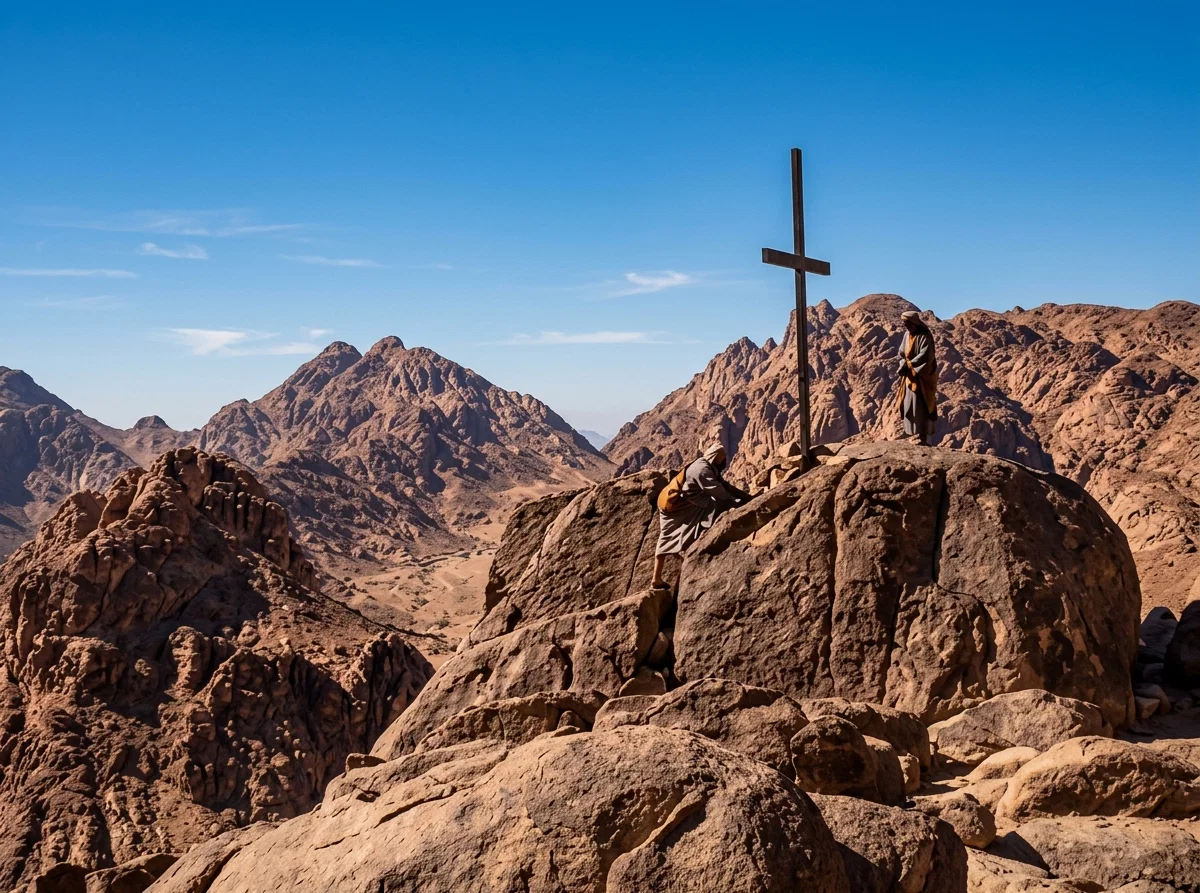
The cross in the above picture marks the spot on the huge rock where Moses is supposed to have stood when he read the commandments and the book of the law in the hearing of all Israel. The place surrounding this stone rostrum is a natural amphitheater where the great multitude could have stood to give audience.