CIVIL government has but one excuse for existence, and that is protection of the natural rights of man; but it has been sadly perverted to the idea of self-aggrandizement. It was with this idea—a view to turning every human attribute into that one channel—that religion was added to the functions of the State; hence the anomaly of Church-and-State union. The true idea of civil government was nearer to consummation when the United States Constitution, based on the Declaration of Independence, was put in operation than ever before. These principles, following up the Reformation, gave us the principle of the separation of Church and State. When the later amendments were added, it was about as near perfection as could be expected of government in the hands of sinful men. But in practical administration of a wide and diversified field, there is no doubt that in the matter of that which is popularly called "civilization," the government of Great Britain wields a greater influence than any other.
While the principle of republican government is the ideal civil government, it is not practicable for one universal government, or for one government to control or different grand divisions of the earth. The moment a republic undertakes any kind of foreign rule, it ceases to a certain extent to be a republic—at least in so far as its domination over the foreign possessions is concerned. This has been shown by the experience of the United States in the endeavor to administer the affairs of her new and remote possessions. It has been demonstrated that it is impracticable to hold the Philippines under the principles of the Declaration of Independence and the Constitution; altho an independent republican government would be practicable for those islands—if the people understand what it means. As it is now, however, the people of the United States are not willing that the Filipinos shall be granted equal privileges with themselves, not even to have an ordinary territorial government; and the Filipinos, excepting a very small minority, are not willing to be annexed at all. So that, a true republican government of the Philippines by the United States is an impossibility.
The leading idea of imperial government is the aggrandizement of the government, while the primary idea of a republic is the welfare of the people. But the government of Great Britain, being a constitutional monarchy, combines both ideas. Therefore, if there is to be a single central government operating in separate geographical divisions, with provinces remote from each other, the British Government is the best so far devised. To illustrate: It would be not only impossible, but impracticable if possible, to annex the Transvaal Republic to the United States, as has been suggested, on account of its surroundings and remoteness; but it would be a great benefit to Great Britain, and no doubt a benefit to a majority of the inhabitants of the republic, to have the Transvaal added to the British possessions.
This much has been said that what follows may not be deemed an adverse criticism of the British Government as compared with others. The object is to show the way of the world, the character of human government as administered by the best specimens now extant. Under the British flag there has been a wider extent of Christian mission work than under any other, and Great Britain is reckoned as the foremost of the "Christian" nations. This being the case, it looks strange that $625,000 is the measure of the government's donation to over 60,000,000 starving subjects in India, while $750,000,000 is scarcely up to the amount spent in less time for war in South Africa against less than half of 1,000,000 people. The war is said to be costing $1,500,000 per day, to say nothing of the thousands of lives that have been sacrificed, and the aftermath of cripples, destitute widows and orphans, and pensions.
Civil government carried on for government aggrandizement always means enormous outlay for military purposes. It always means war to a greater or less extent, with its sorrow, suffering, and destitution, because of the waste of means that otherwise might provide at least the necessaries of life for all at all times.
We here present a most significant comparison, which those who talk glibly of "Christian" civil governments would do well to consider. The Christian Herald, in its appeal for funds to aid the famine sufferers in India, says:—
"Every time the clock strikes the hour it tolls the death-knell of at least five hundred victims in India who have died for the want of a crust. The cable operates quickly, and your contribution to-day may save scores, hundreds, yes, thousands of lives to-morrow.
"How many lives will you save?
"Two cents a day will support one life.
"One dollar will save a life for two months.
"Two dollars will save a life until the harvest.
"Five dollars will save a man, wife, and child until the next crop is gathered.
"Ten dollars will save a whole family from death.
"Twenty dollars will save ten lives for four months.
"Twenty-five dollars will save them and afford them the comfort of blankets during the rainy and cold season.
"Fifty dollars would save five families.
"One hundred dollars would save a small community."
The North American presents this statement in another way, which is a little more striking view of the principle involved. Here is the estimate:—
"One pair of cavalry boots will save a man, wife, and child until the next crop is gathered.
"One minute's discharge of a Maxim gun will save a whole family from death.
"The cost of the war for one second will save ten lives for four months.
"Two rifles will save them and afford them the comfort of blankets during the rainy and cold season.
"The cost of firing one shot from a six-inch gun would save five families.
"One scrub baggage-train horse would save a small community.
"One-fifth of the cost of attempting to conquer the Boers would save the entire fifty millions of England's starving subjects in India.
"The rescue of these lives is simply a matter of money. There is food enough in India. All that is necessary is the means of buying it."
The foregoing throws the X-ray upon the popular idea of civil government's expenditure of the people's money, even when that government is popularly recognized as "Christian." Contrast it with the real mission of Christ, as expressed in His own words, "The Son of man is not come to destroy men's lives, but to save them," also with the words of the prophet Isaiah, "Wherefore do ye spend your money for that which is not bread? and your labor for that which satisfies not?" Surely the very best view of the very best specimens of civil government yet devised, or that it is possible to devise, can only add to the importance of the prayer: "Thy kingdom come. Thy will be done in earth, as it is in heaven."
G.
A NON-CHRISTIAN LIFE OF CHRIST.
A NEW Life of Christ, in Japanese, has just been published in Tokyo. It is one of a series of historical studies. The first was on Buddha, the next on Confucius, and now comes the third, on Jesus Christ. Since it is not written by a Christian, the young men of Japan are far readier to read it. The writer gives the leading facts in our Lord's life, often using the very language of the Gospel. The miraculous events he puts down without apology or criticism. He concludes thus: "These are the facts that are believed and accepted by the vast majority of the people of the West concerning Jesus Christ. I have put them down here with no desire to propagate Christianity, but simply to make them familiar to my countrymen. I close with the language of a Jewish teacher concerning Christianity, uttered under circumstances somewhat similar to those now existing in Japan: 'Ye men of Israel, take heed to yourselves as touching these men, what ye are about to do, . . . for if this counsel or this work be of men, it will be overthrown; but if it is of God, ye will not be able to overthrow it, lest, haply, ye be found to be fighting even against God.'"—Examiner.
SENATOR HALE, of Maine, in speaking in the Senate on May 23, in reference to the postal frauds in Cuba, gave utterance to the following forcible statements: "It is a natural result. There never has been an instance of the setting up of a supreme government in a colony or dependency that has not been attended with practically the same things that we have seen in Cuba. The Congress is as much at fault as the administration. The administration has selected men who are believed to be good men. We went into it with utter confidence, believing that it was an easy thing. I voted against the peace treaty because I believed colonial dependencies would result in precisely what has occurred." Being asked if he had any doubt that this government would keep its pledge and evacuate Cuba, Senator Hale replied: "I have very grave suspicions. I think that the time will never come, unless something drastic is done by Congress, that the last soldier of the United States will be withdrawn from Cuban soil. I have discovered very powerful influences, commercial, mercantile, and political, that are opposed to our ever withdrawing from Cuba." Much of the time of the Senate during the week has been taken up in discussing matters pertaining to Cuba and the Philippines.
THE Western Federation of Miners, in session at Denver, Colo., May 23, passed the following resolution:—
"We denounce the spirit of imperialism and commercialism which induced our representatives in the Paris convention to acquire the Spanish right in the Philippine Islands for a money consideration. We deplore the futile efforts put forth by this government to make good the questionable title at that time acquired. The sacrifice of human life and treasure involved in that effort we regard as a distinct loss to humanity, and worthy the denunciation of all civilized people.
"The cause of human liberty is the most exalted sentiment in the mind of men, and as an organization, actuated by this sentiment, we denounce as unjust and criminal the war now being prosecuted for the subjugation of the islands. The avarice and commercial greed which have been inflicted upon our people through the unfortunate war in the Philippines we believe to be the dominant influence in our modern civilization, and responsible for the unequal contests now being waged in foreign lands. This federation of workingmen also extends its heart-felt sympathy to all people struggling for rights of self-government."
WITHIN the last fifty years the number of Methodists in the United States has grown from 662,315 to 2,893,883 (in 1898), and in the same length of time the ministers of that denomination increased in numbers from 9,138 to 12,112. A few comparisons made by Bishop McCabe in the Christian Advocate show that the total increase in the fifty years is nearly enough to equal the entire membership of the Baptist Church North, is more than twice the membership of the Presbyterian Church North, more than three times the Protestant Episcopal membership, three times that of Congregationalists, and twice that of the Disciples, or Campbellites. More than half of this gain was made during the past fifteen years, and the whole showing is to be compared with the growth of other denominations that have been in the field a hundred years longer than Methodists. But it is worth while to inquire, Have the 2,893,883 Methodists the power for moral good, for soul-cleansing, for soul-uplifting, that the 662,315 Methodists had fifty years ago? It is well for all to remember—Methodist or otherwise—that it is not numbers nor wealth nor "influence" which counts with God, but character. And that will be measured, not by human estimation, but by God's moral law.
A DESPATCH from Shanghai states that Russian troops have occupied Wasampho, in Korea, and will allow no other foreigners to enter this territory. A rebellion has broken out in Korea, for which Russian agents are held responsible, it being Russia's intention to offer troops for the suppression of the rebellion, and then continue to keep them in the territory. Her occupation of Wasampho has been accomplished in spite of the direct opposition of Japan, who did not wish a Russian stronghold so near her borders. With a practical lease of an island between Korea and Japan, and with the military occupation of this part of Korean territory, Russia is certainly pushing her advantage to the utmost, and it will not be long before Korea is under Russian dominance, unless she should receive a sharp set-back at the hands of Japan. How a conflict between these two powers would terminate none can definitely foretell. A plan for the defense of Manchuria has been drawn up, and six fortified posts are to be erected by the Russian Government to forestall a Japanese invasion in this territory so recently under exclusive Chinese control.
THE firm of Price, McCormick & Co., New York cotton brokers, failed on May 24, the liabilities of the stranded house being placed at $13,000,000.
By the provisions of a bill now pending in the United States Senate, the President is to be the sole ruling power in the Philippine Islands from the time that the "rebellion" is suppressed, until such time as Congress may see fit to provide for rule in the islands in some other way. Thus, virtually, tho not in name, if the bill passes, the President will be emperor of the Philippines after the close of the Philippine war for a certain period of time, how long it is not possible to state. The President's rule in the Philippines now is a military rule, he being the head of the army and navy. The provisions of this bill would make him the civil ruler there when the war is finished. It would not be a rule of the people nor by the people, but a rule essentially opposed to the foundation principles of the republic. Eminent men of both parties see this, and wonder what the outcome will be of this retrogression from the principles of liberty. The fact that such a provision could be discussed in an American Congress is one of the most striking signs of the dissolution of the republic.
THE Transvaal Government has declared that it has not considered and does not intend to consider unconditional surrender. Johannesburg is to be fortified and defended. The exodus from the Transvaal to Portuguese territory continues, and hasty preparations are being made for the defense of Pretoria, the capital. Lord Roberts' army continues to advance and will soon be in Transvaal territory, altho temporarily impeded by the swollen Vaal River. General Buller's army is still at Laing's Nek repairing railways, preparatory to an attempt to cross the mountains. The rumors that the Transvaal Government has been negotiating for peace have been denied by President Kruger. At Vryburg, on May 2, 800 Boers surrendered. All opposition is at an end along the road to Mafeking.
THE strike situation in St. Louis and Kansas City, Mo., remains practically unchanged. Riots of more or less importance are of frequent occurrence, and several lives have been lost. Since the beginning of the strike many have been wounded by bullets, stones, or in street fights. The St. Louis postmaster has been compelled to notify the government that the running of the mails has been interfered with, in spite of the federal injunctions recently issued. This has led the governor of Missouri to announce his intention of calling out the militia to suppress the disturbance.
THE House committee to which had been referred the Anti-canteen Bill has reported it favorably, notwithstanding the fact that the War Department had submitted much matter in opposition to the measure. This is the bill which the Secretary of War personally opposed, as reported last week, declaring that the Anti-canteen Bill was inimical to the temperance, morality, and discipline of the soldiers. The minority of the committee are expected to bring in a report favoring the continuance of the canteen.
WITH imposing ceremonies, and in the presence of 60,000 spectators, two new saints were canonized at Rome on May 24. Pope Leo, in officiating at this function, was attired in his gorgeous state robes and surrounded by his sword-bearing body-guard, a sad commentary on the departure of a church from the simplicity of the One whom they claim to follow. The new saints are Jean Baptiste de la Salle, founder of the Order of Christian Brothers, and Rita de Cascia, a nun of the Augustinian order.
SMALL engagements have been reported during the week between the Colombian troops and the rebels, both parties claiming the victory. The revolutionists claim that the government forces are in full retreat, and that the revolution is spreading over the whole country. The disaffection seems to have spread across the border into Ecuador, the malcontents having been dispersed at Tulcan by Ecuadorian troops.
A REPORT from Durban, South Africa, states that an East Indian has died there of the bubonic plague. Extraordinary precautions are being taken to prevent an outbreak of the pestilence among the troops. Should such an outbreak occur, the mortality among the two armies from this cause would probably exceed that directly due to the conflict.
By the decision of New York Attorney-General Davis, rendered on May 24, the American Ice Company, of New York State, is declared an illegal corporation, doing business in restraint of trade and in violation of law. Proceedings will be begun at once to prohibit it doing business in that State.
THE STATE Department at Washington continues its pressure on the sultan of Turkey for the speedy settlement of the missionary indemnity claims. New instructions have been issued to the United States Charge d'Affairs at Constantinople, but the nature of these has not been made public.
FRENCH troops have begun work in the hinterland of Algeria, and have captured a native Algerian stronghold. There have been rumors of a holy war in this region and in Algeria, and France is profiting by the unsettled condition of affairs, and expanding her territory.
A BROKEN lamp caused an explosion in a coal mine at Cumnock, N. C., on May 22, in which twenty-two miners lost their lives.
LAUNCHING OF A NEW PARTY.
THE first national assembly of the Christian Political Union, the result of a conference held in Chicago in December, convened in Rock Island, Ill., May 1. As a preliminary to deciding whether to organize a political party, the convention discussed the theme, "The Principles of Christ; Shall We Apply Them in Concrete Form to State and National Government through a Christian Political Union or Party?" The convention answered the question in the affirmative by unanimous vote. The name "United Christian Party" was adopted in place of "Christian Political Union."
Dr. Silas C. Swallow, of Harrisburg, Pa., and John G. Hooley, of Chicago, were nominated as candidates for President and Vice-president of the United States. The platform adopted declares for—
The abolition of laws which require a desecration of the Sabbath, authorize unscriptural marriage and divorce, and encourage the sale of liquors as a beverage.
Equal rights for men and women.
Arbitration as against war.
Government ownership of public utilities.
Election of President and Vice-president and United States Senators by direct vote of the people. —Union Signal.
SHOULD THERE BE WAR WITH TURKEY?
By Editor
AFTER five years' dallying, the Sublime Porte had admitted the claims of damage to the property of American missions to the extent of $90,000, but Turkey does not pay. There is talk of war, and, sad to say, professed Christians are urging it. To all such we commend the words of a secular paper, the Springfield Republican, and also the remarks of President Angell, quoted by the Republican.—
"While the foreign missionaries may rightly claim their full privileges as citizens in such matters, it is just as well for the cause of missionary work and for the peace of the world that our American missionary societies stop short of actual war in pressing for indemnification for their losses. If President Angell, of the University of Michigan, may be accepted as their mouthpiece, no resort to war against the Turk would be likely to occur under any circumstances. In his address the other evening before the ecumenical council in New York, Dr. Angell wisely recognized the fact that missionaries of the Christian religion really possess attributes not characteristic of other men. War in behalf of missionaries would not only be inconsistent with the Gospel of peace and love, it would surely be interpreted by the people of the foreign nation concerned as used for the propagation of an alien religion that had failed to win its way by gentler means. Therefore, Dr. Angell was led to say:—
'So far as the missionary interests are concerned, we could not desire a war to be waged avowedly in defense of them alone. Not only would it seem to us all out of keeping with the spirit of Christianity, but it might destroy all prospect of subsequently disseminating Christianity among the people with whom we should be at war. If our missionaries can remain in a foreign country only on condition that we extort from the government of that country permission for them to remain by covering them with a battery of artillery so far as they alone are concerned, then we might better obey the injunction of our Lord to His disciples to shake the dust from their feet at the gates of hostile cities, and move on.'"
THE PARAGUAYAN REPUBLIC.
By Juan McCarthy
PARAGUAY is truly denominated the garden of South America. All the tropical flowers and plants grow luxuriantly in this beautiful country. The banana, orange, fig, citron, lemon, peach, and pomegranate are found everywhere in abundance. Picturesque in the extreme, this republic seems to have been especially favored by God, since the artistic hand of the divine Architect seems to have exercised special care to embellish it with all the empyreal adornments possible.
Paraguay has but a short history, very little being known of it before the year 1700. The Jesuits had previously established large colonies throughout the country, until, little by little, nearly the whole territory fell into the hands of this powerful Catholic society. As they grew in power, they became more intolerant, since they held both the governmental and political reins of the kingdom. This state of things existed until 1820, when Don Jose Gaspar de Francia became dictator.
Jealous of power, he soon destroyed the authority of the Jesuits, thus transforming, in one act, himself into the head of the civil and ecclesiastical governments. The Roman Catholic Church watched with discontented eye this proceeding, and immediately began to form plots and conspiracies to deprive President Francia of his self-assumed power. However, with tyrannic hand he was able to keep them in subjection.
Up till the year 1865 the Paraguayan Republic held no diplomatic or commercial relations with the other nations of the earth. For many years previous, the Platine Republics and the empire of Brazil had sought to inaugurate commercial treaties with her, till at last, exasperated beyond restraint, the three countries simultaneously declared war against her. How she fought single-handed, for seven years, against the three combined powers, is already known to all students of history. How the Paraguayan mothers sacrificed their husbands and their children, inspired by a spirit of patriotism, seldom if ever equaled, is shown by the diminished male population of the country. More than 500,000 perished during this war, and the inhabitants of the republic were reduced to only 300,000 souls.
According to a great South American historian, at the termination of the war, only women could be found throughout the territory of the republic. Not a single family was there that did not have to mourn the loss of fathers, brothers, etc., etc. Paraguay was in truth converted into a vale of tears. Still the war produced good results, for from 1870 dates the initiation of foreign commercial relations. Just laws were legislated, such as were unknown before. The rights of foreigners were respected, and all religions were placed upon equal terms.
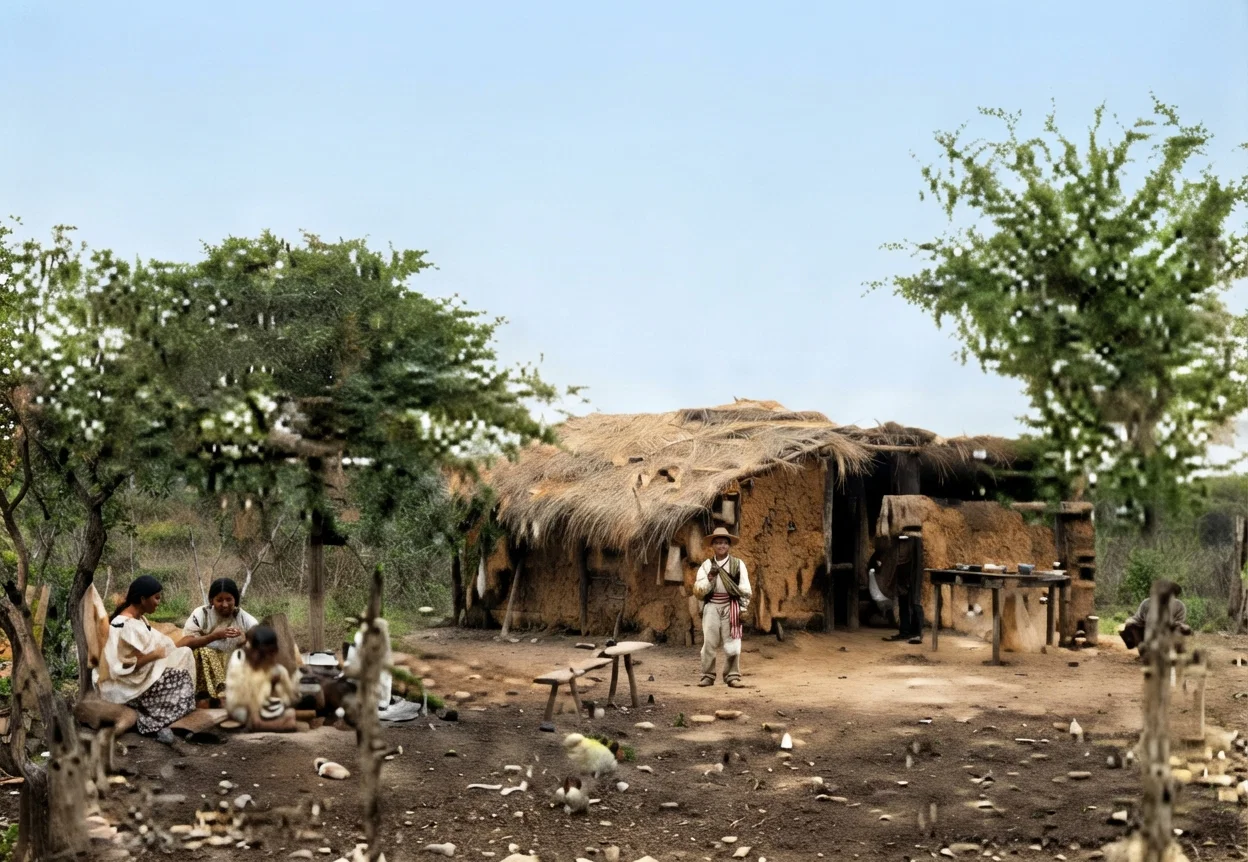
Marvelous changes have taken place during the short space of thirty years, and it is recognized to-day by all intelligent people that Paraguay is now traveling the royal road that leads to national prosperity. The products of the country are principally fruits and yerba, or Paraguayan tea. Ships loaded with these products are to be seen navigating the river Plata every day in the week. One of our illustrations shows an orange merchant loading his bullock cart with oranges, which he sells to the steamboats or sailing ships at the rate of a gold dollar the thousand.
The Paraguayans are, in the majority of cases, extremely poor, knowing little of the luxuries or comforts of life. Our second picture will give you an idea of how 90 per cent. of the real Paraguayans live. They reside in small ranchos, often so low that one has to stoop considerably to enter the doors, to prevent knocking his head.
Of recent years different Protestant missions have inaugurated their work in Asuncion, the capital, and other cities. So far they have met with good success, and several churches have been raised up in different parts.
Now is the time to enter this important field, since the liberals, or anti-clerical party, are in authority. The government is encouraging immigration by every means in its power, offering special inducements to all who go thither. Should we permit the present occasion to pass by, and disregard the calls from Paraguay now, the day will come when we shall regret having delayed entering so favorable a territory.
The official language of Paraguay is the same as in all the other South American countries, excepting Brazil, viz., the Spanish, altho the vast majority of the uneducated speak only the Guarani. This language is spoken throughout the whole of Paraguay, and in the Argentine province of Corrientes, and also in the Misiones.
The New Testament is already translated into the Guarani, and already thousands of copies have been sold and distributed through the length and breadth of the land.
Shall the 600,000 inhabitants of Paraguay call in vain for those who can explain the prophecies of the Bible? Shall we, who call ourselves Gospel light-bearers, refuse to carry the lamp of truth to those poor people who are sitting in darkness? Shall that naturally heroic and courageous people be left to perish upon the rocks and reefs of sin? Or shall we, with hearts overflowing with the love of Jesus, go forth to gather the golden grain into the heavenly garner?
The harvest truly is great, but the laborers are few.
JUAN MCCARTHY.
Argentine Republic.
"OUR FATHER."
By G. C. Tenney
ON a recent visit to Buderim Mountain, Queensland, where quite a number of South Sea islanders have congregated, a lady, who has bestowed much kindness upon them, related the following incident in her experience:—
"Jim" was a victim of consumption, and for some time came to Mrs. Burnett's veranda for his meals. But he became too weak to do this, and then the lady carried his food to him. He continued to grow weaker, until one day,11when she entered his "humpy" (hut), he with great effort raised himself upon his elbow, and said slowly: "Lady, you very kind. You bring rice and milk and many things. You now bring no more any rice, I eat no more." Poor fellow, he realized that his end was near.
He continued slowly: "Lady, you know our Father, what missionary in island tell about?"
"Yes, Jim, I know Him."
"You tell me?"
"Yes, I will tell you." And Mrs. Burnett began. "Our Father which art in heaven"—the black man interrupted her:—
"What's that word 'our'?"
"That means your Father and my Father."
"You fine white lady: me pore, good-f'nothin', black fellow: all along same Father?"
"Yes, Jim, the same Father."
"O, O! All along in heaven?"
"Yes."
"All along in island?"
"Yes, everywhere the same."
"This Father love poor Jim?"
"Yes, He loves you, Jim."
"He takes me home to heaven along with Heself?"
"Yes, He will."
"Lady, you very good, you very kind to black South Seas. You bring us many things. You no tell me about 'our Father.' Why?"
Then he added: "When South Sea come to your house, you no give him bread, you no give him rice, you no give him milk any more, you tell him about 'our Father.' Lady, you tell South Seas 'our Father'?"
"Yes, Jim, I will."
At this moment a message came that Mrs. Burnett was needed at home, and she answered the call. Five minutes later the children followed, with the word that Jim was dead, and the last words he spoke were, "Our Father."
CONSUMMATION.
By C. M. Snow
Speed on Thy truth, eternal One,
Thy holy law proclaim,
Till every land beneath the sun
Has heard Jehovah's name.
We own, O Lord, Thy sov'reign power,
And bow before Thy throne,
To sing Thy glories in this hour,
Immortal God alone.
Thy truth shall stand, unchanging God,
Long as the ages roll,
Tho trampled oft where sin has trod
And error chained the soul.
Arise and shine, ye chosen band,
Ye people, scattered, few;
No work so high, so deep, so grand,
Has e'er been given you.
We near that hour of calm surcease
From sorrow, death, and sin,
That brings the weary one release
And ushers heaven in.
Awake, arise, arise and shine,
Proclaim His truth abroad;
It is thy Saviour's work and thine,
Thou messenger of God.
We sing Thy praise, eternal Lord,
Thy glorious truth proclaim.
Thy mandate is a shield and sword;
Thy word, a living flame.
Long as the years of earth shall roll—
Long as eternity—
We'll bow to Thy benign control,
And worship only Thee.
C. M. Snow.
SEEING AND SERVING.
By N. Y. Observer
JESUS communed with His Father in prayer on many a midnight mountain that He might go down and work for man in the valley. Indifference in Christian service is due to ignorance and opaqueness of vision. Nowhere are we so near men and man's need as when we are near God's heart. Here we touch all humanity, and can love the distant and degraded races of earth as much as the needy at our own door. Conviction is born of knowledge, knowledge of actual sight. A suffering child before our eyes stirs us more than the starving and dying millions of India. It is because the child is near. But when we are near the heart-beat of God, no needy soul is far away, and indifference is impossible.
A good watchword for the Christian would be: See in order to serve. See man as God sees him, his sin, his need, his peril. Passion for service is born only in sight of the cross. Missionaries and martyrs get their inspiration from Him whose sacrifice reveals and measures the world's need. Luthers catch their zeal from Him. Wesley, Whitefield, Spurgeon, Moody had visions of Calvary before they could proclaim the power of God's redeeming love. They who have been with Christ on the mount are they who can cast out evil spirits at the foot of the mount.—N. Y. Observer.
WASTE OF EMOTION.
IN California, where so much of the land requires irrigation, says Dr. Louis Banks, there is a serious effort being made to devise some scheme by which the water that goes to waste in times of flood can be stored up and used in times of drought. It has long been known that enough flood water flows back to the sea in the rainy season to more than multiply the State's resource for irrigation. Therefore, it is felt that if some system is workable whereby flood waters can be impounded and saved from waste, hundreds of thousands of acres of now useless lands would be made fruitful.
What a wonderful thing it would be if some such scheme could be devised in the higher realm of human emotion! There is enough real heart benevolence stirred up to fill the land with kindness, and bring about human brotherhood everywhere. But it often goes to waste without producing any practical result. Many people are moved to tears by a novel or the story of some suffering fellow-being, and for a time there is a flood of charitable feeling that surges through the soul; but it runs to waste, and when opportunity for real helpfulness comes, the emotion has passed away.
"The Impending Conflict—Its Causes"
Such is the title of Chapter 36 of that wonderful volume
The Great Controversy Between Christ and Satan
In regard to this conflict the book says:—
"The last great conflict between truth and error is but the final struggle of the long-standing controversy concerning the law of God. Upon this battle we are now entering,—a battle between the laws of men and the precepts of Jehovah; between the religion of the Bible and the religion of fable and tradition."
Again we quote, this time from the author's preface:—
"In the great final conflict, Satan will employ the same policy, manifest the same spirit, and work for the same end, as in all preceding ages. That which has been, will be, except that the coming struggle will be marked with a terrible intensity, such as the world has never witnessed."
Therefore the author has selected such events in the history of the past struggles of the Church as foreshadow the conflict just before it, and grouped them so that their meaning can not be misunderstood.
In addition to these historical sketches and conclusions, the book contains the following chapters which speak in a prophetic way of what is just before us:—
Character and Aims of the Papacy
The Time of Trouble
God's People Delivered
Desolation of the Earth
The Controversy Ended
This book contains 704 large pages, is printed on good paper, is illustrated, and bound as follows:—
Cloth, marbled edges - - - $2 25
Cloth, gilt edges - - - - 2 75
Library, marbled edges - - 3 00
Half Morocco, gilt edges - - 3 50
Full Morocco, gilt edges - - 4 50
Also published in Danish, Swedish
German and French
Sold by Agents
Pacific Press Publishing Co.
OAKLAND, CAL.
39 Bond St., New York City
18 W. 5th St., Kansas City, Mo.
The Ecumenical Conference on Foreign Missions is over, and is pronounced on every hand the greatest missionary assembly that has ever been held. It now remains to make its work permanent. That will depend to a very great degree on the report of the conference, its character, the extent to which it is circulated, and the manner in which it is used. As to the report itself, it is now in the hands of a special committee, who have had large experience, and who will employ trained men. The editorial end in view is to omit nothing essential, to admit nothing non-essential. The plan includes three parts: (1) The story of the conference; its inception, organization, and conduct, and its place in the history of missions. (2) The contribution of the conference, the papers, addresses, and discussions. (3) Appendices, including the complete program, the organization and roll, a list of missionary societies, a summary of missionary statistics, a carefully-prepared bibliography of the best missionary books, and an index. The report will be published in two volumes, of about five hundred pages each. Paper, printing, and binding of the best. Originally, the price for the two volumes was fixed at $2.50, advance subscribers to receive it for $2.00. The funds of the conference, however, will cover the cost of putting it on the press, and will thus enable the committee to reduce the price from $2.50 to $1.50, and to advance subscribers from $2.00 to $1.00 for the two volumes. They will be ready for delivery early in the fall. Subscriptions, accompanied by the money, may be sent to the Publication Committee Ecumenical Conference, 156 Fifth Avenue, New York. Checks should be made payable to Edwin M. Bliss, chairman.
MAXIMS.
By H. E. S. Hopkins
"Owe no man anything."
"Honesty is the best policy."
"Life is made up of little things."
"Little acts are the elements of true greatness."
"Happiness is in us, not in things."
"Moments are the golden sands of time."
"Nothing is impossible to him who wills."
"I can't, never accomplished anything."
"Anger will come, but resist it strongly."
"A good temper is like a sunny day, it sheds its brightness on everything."
"A contented mind is the greatest blessing a man can enjoy in this world."
"The timid and hesitating find everything impossible, chiefly because it seems so."
"Always have a good stock of patience laid by, and be sure to put it where you can find it."
"No one can tell who the heroes are, and who the cowards, until some crisis comes to put us to the test."
"God's people frequently lodge their petition in the court of heaven, and there let it lie. They do not press their suit. They should employ other means beyond the presenting of it."
H. E. S. HOPKINS.
Battle Creek, Mich.