Your ShelfYour Projects

Signs of the Times, Vol. 26, No. 24.

KUBBET ES-SAKHARA

Signs of the Times

Jun 13, 1900

Pacific Press Publishing Company · OAKLAND, CALIFORNIA · Jun 13, 1900

"KUBBET ES-SAKHARA."
MOUNTAINS are always and everywhere of interest; how much more so the mountains of Sacred Story, connected as they are with the wonderful works of God among the children of men! Hermon and Gilboa, Ebal and Gerizim, Lebanon and Carmel, Nebo and Pisgah, Hor and Horeb, Sinai and Seir, Calvary and Olivet, and still others, what a multitude of thoughts and incidents surge into the mind! What curses and blessings, what defeats and victories, what suffering and triumph, what majesty and glory and love are revealed through the ministry of the mountains! It was in the mountains where God revealed Himself to His children. Sinai will ever stand as the symbol of the glory and majesty of law, and Calvary as the symbol of sacrifice and love.
AMONG the interesting highlands of Scripture is Mount Moriah. "Chosen of God" the name means. It was there that Abraham was about to offer Isaac, the very spot revealed to him of God, showing the great truth that the spirit of sacrifice has to do with the where and how as well as the what. We may not sacrifice some substitute of our own in the Lord's way, nor the sacrifice which the Lord demands in our way or in the place we shall choose. The true spirit of submission is anything, any way, anywhen, anywhere, as Infinite Wisdom and love may direct. And thus was the mountain chosen of God hallowed; and Abraham's faith was perfected. He yielded all to Him who gave all, and received all in return.
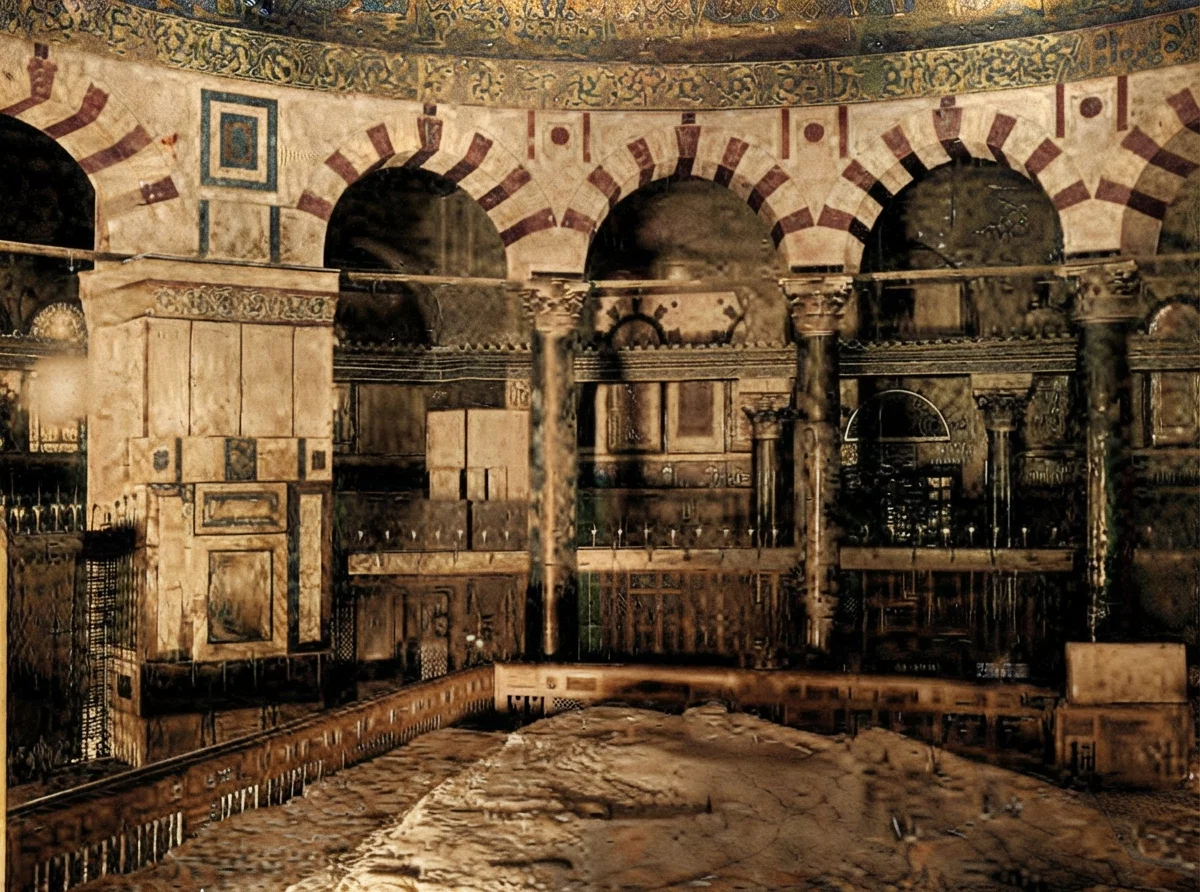
THE DOME OF THE ROCK—IN THE MOSQUE OF OMAR.
WHAT more fitting place could there be for the temple of the Most High than sacrifice-crowned Moriah? And so when the temple was builded it was not the highest mount within the city that was chosen, for Mount Zion—not the most elevated height in Jerusalem—towers above it one hundred and ten feet; but one of the lowlier ones, Mount Moriah, in the southeast part of the city, overlooking the Valley of Kedron and facing Olivet.
JERUSALEM of to-day is builded on her own heap, as the prophet declared. Jer. 30:18. Not less than seventeen times between the days of Joshua and Titus was the city besieged. Twice was she razed to the ground; twice were her walls destroyed; and now the ancient city of David and Solomon lies buried beneath twenty to eighty feet of the ruin and rubbish of centuries. The city is a fitting type of the truth committed to her people; they haveburied it yards deep under the traditions of men.
HOW LARGE Jerusalem was when Melchizedek reigned as king we do not know. From the time of the entrance into the promised land till the days of David, the Jebusites held it. On Mount Moriah "Araunah the Jebusite" had his threshing-floor. 2 Sam. 24:18. Here David built an altar and offered sacrifices, the expression of his own repentance, and the plague was stayed. And here was the temple builded. This was destroyed under Nebuchadnezzar, rebuilded under Zerubbabel, enlarged and beautified by Herod. When Rome conquered the city, the temple was destroyed, and on its site was erected Ælia Capitolina, a temple to Jupiter. In A.D. 614 the city was taken by Chosroes the Persian; in 637, by Caliph Omar; in 1099 it was captured by the Crusaders; the Mohammedans again obtained possession under Saladin in 1187; thence afterward it was in Christian possession; but 1517 found it in the hands of the Osmans, and it has been controlled by the Mohammedans ever since. Fitful indeed and unsatisfactory has been the history of the city which was not established in righteousness.
NOW ON MOUNT Moriah, the chosen of God, is an inclosure of between thirty and forty acres, called Haram ash-Sheref. Within this and on the very site of the temple is the Mosque of Omar, said to be "perhaps the very noblest specimen of building work in Asia." It is the most prominent and beautiful building in the whole city. It is the second mosque of Islam, inferior only to that of Mecca.
WITHIN THE MOSQUE IS Kubbet es-Sakhara, the "Dome of the Rock," the top of Moriah, fifty-seven feet long, forty-three feet wide, and from one to five feet above the mosaic marble pavement. It is inclosed by a strong fence, and the ground is considered sacred. It is here, the only place in the city, that the tourist feels that he is in direct contact with the things of old. It is well, perhaps, that the temple site is in Mohammedan hands; if the "Christians" were in control, as in other places, it would be a constant scene of strife and disgrace.
WHAT lies beneath the Dome of the Rock in its caverns, which we are told are there, we know not. This is the lesson: Only those places are truly holy where God's living presence abides. If His presence once possessed is lost, the curse is sure to follow. Mount Moriah is no longer the "Chosen of Jehovah." The High and Lofty One desires to dwell, nay, does dwell, in the heart of the humble and contrite (Isa. 57:15; Ps. 51:17), where in living fingers of light He writes His own holy law. "Know ye not that your body is the temple of the Holy Ghost." Blessed privilege of every soul! What matter, then, if our eyes never look upon the once hallowed spots of the past? We may say with the poet:—
"Henceforth my heart shall sigh no more For olden time and holier shore; God's love and blessing flow and there Are now and here and everywhere."

MIRACLES OF HEALING.

[This is article three of this series.]
WHY should it be thought a thing incredible with you that God should raise the dead?" was the pointed, pleading question which Paul, the apostle, addressed to Agrippa, the king. Agrippa believed the prophets. Why should you believe the prophets and discredit the resurrection? was the real import of Paul's searching question.
This question was followed by Paul's testimony concerning the miracle of his own conversion, and then the miracle of the resurrection of Christ in fulfilment of the promises of the prophets.
Why should it be thought a thing incredible with you that God should heal the sick? is another pointed question that pleads to-day for answer from those who profess to accept the testimony of Scripture.
The Gospel of salvation is nothing if not a miracle. It is the "mystery of God," the working of a miraculous power, the effects of which can be seen and heard, but its processes are unexplained. John 3:8. It is easy for one who has experienced the miraculous transformation of life called in the Scripture the new birth, to credit the miracle of the resurrection of the body. And he who really believes in the resurrection of the body can readily believe in the healing of the body, which is only a kind of first-fruits, or part payment on the promised "redemption of the body."
The atonement embraces the whole man, spirit, soul, and body. "I pray God your whole spirit and soul and body be preserved blameless unto the coming of our Lord Jesus Christ." 1 Thess. 5:23. Notice how the promises of bodily healing are united with those of soul healing in the following scriptures:—
"Bless the Lord, O my soul; . . . Who forgiveth all thine iniquities; Who healeth all thy diseases." Ps. 103:2, 3.
"He cast out the spirits with His word, and healed all that were sick; that it might be fulfilled which was spoken by Esaias the prophet, saying, Himself took our infirmities, and bare our sicknesses." Matt. 8:16, 17.
Let us place this scripture concerning our infirmities and sicknesses alongside of another concerning our sins:—
"Who His own self bare our sins in His own body on the tree?" 1 Peter 2:24. "Himself took our infirmities, and bare our sicknesses." Matt. 8:17.
Why did He bear our sins? Answer—"That we, being dead to sins, should live unto righteousness." 1 Peter 2:24. "How shall we, that are dead to sin, live any longer therein?" Rom. 6:2. "He hath made Him to be sin for us, who knew no sin; that we might be made the righteousness of God in Him." 2 Cor. 5:21. "Thou shalt call His name Jesus; for He shall save His people from their sins." Matt. 1:21. "He was manifested to take away our sins."
Thus do the Scriptures teach that He bore our sins that we might not bear them. He bore them for us that He might bear them away from us, that we should bear them no longer. This is the blessed truth which we teach the sinner when he comes to us seeking salvation from sin.
Why did He take our infirmities and bear our sicknesses? Let the Scripture answer, while we watch for the taking away of the "infirmities" and "sicknesses" from the infirm and sick:—
"And, behold, there was a woman which had a spirit of infirmity eighteen years, and was bowed together, and could in nowise lift up herself. And when Jesus saw her, He called her to Him, and said unto her, Woman, thou art loosed from thine infirmity. And He laid His hands on her, and immediately she was made straight, and glorified God." Luke 13:11-13.
"Then they went out to see what was done; and came to Jesus, and found the man, out of whom the devils were departed, sitting at the feet of Jesus, clothed, and in his right mind." Luke 8:35.
"And as soon as He had spoken, immediately the leprosy departed from him, and he was cleansed." Mark 1:42.
"And a certain man was there which had an infirmity thirty and eight years." "Jesus saith unto him, Rise, take up thy bed, and walk. And immediately the man was made whole, and took up his bed, and walked." John 5:5, 8, 9.
"Great multitudes came together to hear, and to be healed by Him of their infirmities." Luke 5:15.
"And Jesus went about all the cities and villages, teaching in their synagogs, and preaching the Gospel of the kingdom, and healing every sickness and every disease among the people." Matt. 9:35.
"And He touched her hand, and the fever left her; and she arose, and ministered unto them. When theeven was come, they brought unto Him many that were possessed with devils; and He cast out the spirits with His word, and healed all that were sick; that it might be fulfilled which was spoken by Esaias the prophet, saying, Himself took our infirmities, and bare our sicknesses." Matt. 8:14-17.
From all these scriptures it is clear that our Lord took our infirmities and bare our sicknesses that we might not have to bear them,—that we might be loosed from them,—that they might depart from us. Jesus bore them, therefore, that He might bear them away from us, that we might bear them no more.
All this proves that the Gospel includes salvation from sickness as well as salvation from sin. At this point we will be tempted to measure this truth by our limited experience. We are in danger of denying the inevitable conclusion to which the Scriptures have brought us, because we have never seen such mighty miracles of healing as are promised in the Gospel, and which appear in the preaching and practise of that Gospel at the hands of the apostolic church. But, instead of cutting and trimming this tremendous truth to fit our experience, let us accept it in its fulness, however impossible it may seem to us, and commence immediately to enlarge our faith and experience until they shall measure up to apostolic precept and practise.
But why should any one who believes in the miracle of conversion, ever question the miracle of healing? "Whether is it easier to say to the sick of the palsy, Thy sins be forgiven thee; or to say, Arise, and take up thy bed, and walk?" Mark 2:9. Reader, answer this question which the Lord asks you. Do not answer it from the standpoint of your limited experience, but from the standpoint of what the Lord promises, and from the interpretation of these promises, as they appear in the practise of the apostolic church.
Why is it that a reported healing creates so much amazement among the people? If the Lord should to-day give sight to one born blind, it would cause a sensation throughout all Christendom. We would expect the world to wonder, but why should the church stand in amazement? If conversion is in reality a miracle, it is the greatest of all miracles. Why should there not be as much amazement manifested in the presence of this miracle? Does not the surprise manifested over miracles of healing show a lack of appreciation of the miracle of the new birth, and a disposition to transpose it from the realm of the miraculous to the sphere of the natural?
No one will ever be able to appreciate the miracle which follows the command, "Arise, and take up thy bed, and walk," until that one appreciates the miracle which follows the words, "Son, thy sins be forgiven thee."
In this I am not penning theory but personal experience. The time was when I had no real faith in miracles of healing. I had not experienced God's miraculous saving power. But when this miracle appeared in my life, immediately there followed a faith in God's power to heal the sick. I reasoned thus: God has wrought a mighty miracle in my life, in delivering me from besetting sins which have enslaved me all my life. It will require no greater miracle to heal the sick than He is manifesting in my life in keeping me from falling into my old sins. Thus arose my faith in God's healing power for the body. And as I received it, so must I walk in it. If there comes a shadow of a failure in my personal experience touching my salvation from sinning, there is a corresponding failure in my faith and practise concerning the healing of the sick.
There are conditions, of course, which must be met in order to realize salvation both from sin and sickness, which will be presented later; but we must not await the conditions before accepting the scriptural truth that the Gospel includes health for the body as well as for the soul. To those who believe the Scripture, I repeat the question, Why should it be thought a thing incredible with you that God should heal the sick?
A. F. BALLENGER.
[The next article in the series will be "The Gifts of the Spirit."]

THE MIGHTY HEALER.

THERE bursts a bright and morning Star Upon the sight of those who pray, Spreading His news of love afar: "There's power in Christ to heal to-day." He's "God with us," the Spirit says, "Eternal Father, Prince of Peace;" He's born to men, for them to praise, For them to love and never cease. We all triumphant must arise, From every doubt and sin made free, Believe the Saviour's promises: "I am the Lord, that healeth thee." The sacred page reveals His will In Jesus' work in Galilee, How, when He taught, He healed the ill, And made the evil spirits flee. Or of Capernaum's nobleman, Who came imploring for his son; When doubtings fled, and faith began, How he was told, "The deed is done." Or of that kind centurion, Whose slave was fast approaching death, How he believed, his heart was won, How answered was his prayer of faith! Or of beloved Lazarus, How he was called from silent tomb, Free from disease, and vigorous, God's love and mercy to illume. Such deeds of love the suffering prized; They knew that One could make them whole. With eager steps they sought the Christ, The great Physician of the soul. When Christ, the mighty Healer, died, He left no mortal comfortless; Through servants here He still supplied Rich streams of life and happiness. Through Peter's faith, Æneas found The Living Rock that Moses knew; These all have heard the gladsome sound, "I am the Lord, that healeth you." As Paul and John in different lands Performed a faithful ministry, The Prince of God, at their commands, Relieved disease and agony. There's still a God in Israel, Whose heart is touched with all our grief; There's still a King Immanuel, Whose presence brings us sweet relief. Thou changest not, Thou Lamb of God; Thy power and love are still the same As when the suffering, painless stood, And praised Thee at Jerusalem. Thou changest not; through servants still Thy streams of life unebbing flow, To calm each pain, to cure each ill, To raise each suffering saint below. Thou changest not, Thou Morning Star; For all Thy glorious beams display This precious truth, both near and far, "There's power in Christ to heal to-day." Battle Creek, Mich. HARRY G. LUCAS.

Those Who Spread Joy

THERE are souls in the world who have the gift of finding joy everywhere, and leaving it behind them when they go. Their influence is an inevitable gladdening of the heart. They give light without meaning to shine. Their bright hearts have a great work to do for God.—Faber.

CHRIST'S SACRIFICE FOR MAN.

Man's Responsibility.

WE can not know God and Jesus Christ until we search the Scriptures. In this Word we find out why it was necessary for Christ to leave His high command in heaven, to separate Himself from the angelic family, laying off His royal robe and kingly crown, and clothing His divinity with humanity. For our sake He became poor, that by His poverty He might make many rich, securing for them eternal riches. That He might work in our behalf, He came to live among fallen humanity, in a world marred by sin and misery.
Adam listened to the temptation of Satan. He believed a lie, and thus greatly dishonored God. He had not a semblance of excuse for transgressing; and his disobedience changed his relation to God. The law can in no case pardon the transgressor. It can only condemn the guilty. Adam had to meet God over His broken law. His fatal disobedience brings out with clear prominence that of which the apostle writes, "For as by one man's disobedience many were made sinners, so by the obedience of one shall many be made righteous."
Man's happiness must always be guarded by the law of God. In obedience only can he find true happiness. The law is the hedge which God has placed about His vineyard. By it those who obey are protected from evil. In transgression Adam became a law to himself. By disobedience he was brought under bondage. Thus a discordant element, born of selfishness, entered man's life. Man's will and God's will no longer harmonized. Adam had united with the disloyal forces, and self-will took the field.
By Christ the true standard is presented. He made it possible for man to be once more united with God. He came to take the sentence of death for the transgressor. Not one precept of the law could be altered to meet man in his fallen condition; therefore Christ gave His life in man's behalf, to suffer in his stead the penalty of disobedience. This was the only way in which man could be saved, the only way in which it could be demonstrated that it is possible for man to keep the law. Christ came to this earth and stood where Adam stood, overcoming where Adam failed to overcome. He is made unto us wisdom and righteousness and sanctification and redemption.
But while the death of the Son of God saves all who repent, it speaks death to those who will not receive Christ as a personal Saviour. That which is life to the believer is death to the impenitent transgressor. The new and living way is seen and followed by those who receive Christ as their Redeemer. But upon those who refuse to accept His sacrifice, is passed the sentence of eternal death.
"Therefore being justified by faith, we have peace with God through our Lord Jesus Christ; by whom also we have access by faith into this grace wherein we stand, and rejoice in hope of the glory of God. . . . Wherefore, as by one man sin entered into the world, and death by sin; and so death passed upon all men, for that all have sinned. . . . Even so by the righteousness of One the free gift came upon all men unto justification of life." Adam's fall in the Garden of Eden caused all to sin; but in the Garden of Gethsemane Christ drank the bitter cup of suffering and death, that whosoever believes in Him may not perish, but have everlasting life.
Before the foundation of the world, Christ pledged His word that He would give His life as a ransom if man turned from his allegiance to God. He revealed His love by humbling Himself, stooping from heaven to work among fallen, disorderly, lawless human beings. Of himself man could not possibly cope with the enemy. Christ offers Himself and all He has, His glory, His character, to the service of those who return to their loyalty and keep the law of God. This is their only hope. Christ says definitely, "I came not to destroy the law." It is a transcript of God's character, and I came to carry out its every specification. I came to vindicate it by living it in human nature, giving an example of perfect obedience.
As Christ took upon Him this work, He saw all it would bring,—His betrayal (because of envy, pride, and love of money) by a professed follower, His trial in the judgment-hall, the scourging, the cruel death. He had led the children of Israel from Egyptian bondage into the land of Canaan. He had now come to lead them from spiritual bondage into the city of God. But they rejected Him, and delivered Him up to death. He came to His vineyard to receive the fruit thereof, but those who should have welcomed Him, said, "This is the Heir; come, let us kill Him, and let us seize on His inheritance."
Looking down the future, Christ saw the return that would be made for His love. He saw Himself condemned to suffer the punishment only inflicted on those most deeply sunken in crime. He saw Himself, in His humiliation, hanging on the cross, while priests and rulers looked on with exultation, saying in mockery: "He saved others; Himself He can not save. If He be the King of Israel, let Him now come down from the cross, and we will believe Him."
Christ looked down through the ages, and saw His humiliation carried into every successive generation. He heard the false testimony that He died to abrogate the law. He saw that to multitudes this error would be more palatable than the truth. The carnal mind "is not subject to the law of God, neither indeed can be." He saw the natural mind, true to the enmity of its character, daily enacting afresh the scenes of Calvary, even down to the close of this earth's history. He saw that some would show indifference and contempt to the law of God, while others would go to greater lengths in their hatred of it, tearing down its precepts by their falsehoods and ingenious arguments.He saw that the law would be trampled upon and dishonored until God would arise to punish the inhabitants of the earth.
Knowing all this, Christ bore the penalty of transgression. He was crucified and buried, but He broke the fetters of the tomb, and over the rent sepulcher of Joseph He proclaimed, "I am the resurrection, and the life." He was in possession of the great gift of eternal life, and He gave gifts unto men. He sent His message of mercy and pardon to all who would receive Him as the world's Redeemer. "As many as received Him, to them gave He power to become the sons of God, even to them that believe on His name." He has paid the price for every son and daughter of Adam, and He is abundantly able to save all who accept Him as the Sin-bearer.
MRS. E. G. WHITE.

THOUGHTS FOR REFLECTION.

SOME murmur when their sky is clear, And wholly bright to view, If one small speck of dark appear In their great heaven of blue. And some with thankful love are filled, If but one streak of light, One ray of God's good mercy, gild The darkness of their night.
In palaces are hearts that ask, In discontent and pride, Why life is such a dreary task, And all good things denied. And hearts in poorest huts admire How love has in their aid (Love that not ever seems to tire) Such rich provision made. —Archbishop Trench.

THE LAW AND THE GOSPEL.

"WHERE no law is, there is no transgression." Rom. 4:15. Many persons, in order to shirk the responsibility of observing the seventh-day Sabbath "according to the commandment," maintain that the law of God was abolished. If that were true, then there would be no sin; for "sin is the transgression of the law." 1 John 3:4. That the law of God is meant here, is shown by Paul when he says, "I had not known sin, but by the law; for I had not known lust, except the law had said, Thou shalt not covet." It is the law of God that says, "Thou shalt not covet;" therefore that is the law by which Paul knew what sin is.
And this same law—the Ten Commandments—was declared by Christ to be in full force in His day, and was to be continued as long as heaven and earth should stand. He said, "Think not that I am come to destroy the law, or the prophets; I am not come to destroy, but to fulfil." Matt. 5:17. And to forestall any idea that there might be even the slightest change in the law, He adds this positive assurance: "Verily I say unto you, Till heaven and earth pass, one jot or one tittle shall in nowise pass from the law, till all be fulfilled."
In furtherance of the doctrine that the law has been abolished, we are told that Christ fulfilled it, and then it passed away, the Gospel taking its place. But Christ spoke also of the "prophets," or prophecies; not a jot or tittle of the law could fail till all these were fulfilled; and it will require eternity to fulfil them. However, Paul makes clear the Lord's idea of fulfilling all the law. He tells us that God sent His Son in the likeness of sinful flesh, to condemn sin in the flesh, "that the righteousness of the law might be fulfilled in us, who walk not after the flesh, but after the Spirit." This was not fully accomplished while Christ was on earth, not even in the twelve apostles; therefore not one jot or tittle of the law could have been abolished.
It should also be remembered that if the law be abolished, there is no further use for the Gospel. The Gospel is the good news of salvation from sin (the transgression of the law); and if there is no law, there is no transgression, and the Gospel is a superfluity. Why offer pardon to a people who have committed no sin? But "there is none righteous, no, not one" (Rom. 3:10); "all have sinned, and come short of the glory of God" (verse 23); yet sin is not imputed when there is no law (chapter 5:13).
Another evidence that sin is rife in the world, and therefore the law must still exist in all its force, without even the change of a letter or part of a letter, is the fact that death reigns everywhere. There is a continual funeral procession en route to the habitations of the dead, and a perpetual night-watch over the couches of the dying. Why this ever-increasing death roll?—Simply this, "The wages of sin is death." Rom. 6:23. And this is why the Gospel is of force only because of the continued operation of the law. It is the only proclamation of a remedy for the transgression of the law; and this is its only purpose. The natural man "is not subject to the law of God, neither indeed can be." Rom. 8:7. He is born in sin, and naturally doomed to death; but the Gospel says, "The gift of God is eternal life through Jesus Christ our Lord." Chapter 6:23. "He that believeth on the Son hath everlasting life; and he that believeth not the Son shall not see life; but the wrath of God abideth on him." John 3:36. Jesus Christ has "brought life and immortality to light through the Gospel." 2 Tim. 1:10.
The basis of this Gospel remedy is not the removal of the law that sin may be impossible; it is based in the love of God, who gave His Son as a sacrifice by whose blood the sin might be removed, and the sinner be brought into harmony with the law. "There is therefore now no condemnation to them which are in Christ Jesus, who walk not after the flesh, but after the Spirit." Rom. 8:1. It is the law that condemns the sinner; otherwise he would go uncondemned—he would not be a sinner. So if there is "no condemnation to them that are in Christ," it is because the sin has been pardoned. The law no longer condemns one who has been pardoned, for the reason that the guilt is removed and he is in harmony with, and becomes subject to, the law. He may remain in this condition by walking after the Spirit, that is, walking by faith. "The law is spiritual" (chapter 7:14); and can not condemn the spiritual person, for he does not violate its provisions. If he again becomes carnal, walking after the lusts of the flesh, the law will again condemn him. Paul says of himself, before he found Christ, "I am carnal, sold under sin."—Ib. He was then "under the law;" but when he accepted Christ, and his sins were forgiven, he was no longer "under the law, but under grace" (chapter 6:14); for sin had no more dominion over him. He then became, by the Spirit of Christ, a doer of the law, walking by faith. The law can not justify the sinner, but it does justify the one who obeys it. See chapter 3:19, 20; 2:13.
The one who has accepted the Gospel call comes under the grace or favor of God. "Being justified by faith, we have peace with God through our Lord Jesus Christ." Chapter 5:1. Peace with God means doing His will. Jesus said, "My meat is to do the will of Him that sent Me." John 4:34. The Father's will is His law. Ps. 40:7, 8. God has a government; government implies order, and order implies law. There can be no government without law; absence of order means chaos; absence of law means anarchy. To abolish God's law would disrupt His government and annul His authority. This is what Satan would like to see; therefore he would have men believe that the law is abolished, especially the fourth commandment, which alone designates the authorship of the law and His special memorial, the Sabbath.
We have said that the basis of the Gospel is God's love. The complement of this love, that which completes the design, making it effectual to the individual, is faith. The grace of God to the sinner can only become permanent through faith. "By grace are ye saved through faith." Eph. 2:8. Then the Gospel is of force to the benefit of the sinner only through faith, and that brings him right into friendly, peaceful contact with the law. So says Paul: "Do we then make void the law through faith? God forbid; yea, we establish the law." Rom. 3:31.

The Heart Must Be Captured

It is not the length of a man's pocket-book, nor the kind of house he lives in, nor the grammatical expression which he gives to his tongue, that tells the kind of man he is. It is the mastery over mind and heart. If a man has given his inner nature over to appetite, and lust, and passion, then he is a brutal man, whether he lives in a palace or a hovel, whether he sits in the major's chair or rules over a prize-ring. Out of the heart come the issues of life, and if a man is to be saved, the heart must be captured for Christ.—Homiletic Review.

HUMAN CREEDS VS. DIVINE.

THE Presbyterian Church is again being agitated over the question of revising their creed. The New York Times recently said:—
The recent revival in the Presbyterian Church of the not very manly sport of heresy hunting, has had consequences that could not have been anticipated by the hunters. It is likely to be they who are to become the hunted. Dr. Parkhurst, of this city, and a number of other Presbyterian ministers of similar standing, have not only made known their sympathy with the particular quarry of the hunters, but have said plainly that it is time that the creed of the Presbyterian Church should be revised, and that the Westminster Confession should be put in its proper place as a historical document, reflecting the state of mind of some more earnest than enlightened men of the sixteenth century, and not as a confession of faith binding forever upon the Christian church or the Presbyterian branch of it.
That the creed needs revising we have no doubt. It is only a human document at best, and of course is subject to human limitations. The fact is it should never have been made. To formulate what John Calvin, or any other man, believed into a creed and set it forth as the faith of a church, shuts off all further scriptural investigation.
It reminds me of my experience when a boy. My father purchased a farm in Illinois, and, while working it, before any fences were built, in order to pasture our horses, we had to tether them with a long rope. Having driven the stake to which the rope was fastened securely into the ground, we left them tied till morning. During the night they would eat and tread down every blade of grass to the utmost limit of the rope. Round and round they would walk and strive to reach the beautiful, tender grass almost within reach, but the rope was inexorable, and, no matter how much they turned, they could only secure the residue, fouled beneath their feet.
Thus it is with a creed. Once we are tethered to that, no matter how many gems of truth may be presented to us from God's Word, we can not accept them unless they are in the creed. The woman at the well appealed to "our father Jacob," and so we appeal to the creed as the end of all controversy. The precious light of God's Word appears good and inviting, and our souls hunger for this heavenly manna; but, O, the creed!
What is the matter with the Bible? Why not adopt that as our creed? It is able to thoroughly furnish us unto every good work, and is not subject, like the faith of men, to human limitations. With this for our creed, whatever comes to us from its sacred pages we can receive, and do not need to hesitate before doing so till some church council shall alter or revise the creed. G. B. THOMPSON.
Rome, N. Y.
Continue reading: A STRIKING FULFILMENT