[Condensed from Prof. H. M. Hamill, D.D., in the Epworth Herald.]
VALENTINE BURKE was his name. He was an old-time burglar, with kit and gun always ready for use. His picture adorned many a rogues' gallery; for Burke was a real burglar, and none of your cheap amateurs. He had a courage born of many desperate "jobs." Twenty years of his life Burke had spent in prison, here and there. He was a big, strong fellow, with a hard face, and a terrible tongue for swearing, especially at sheriffs and jailers, who were his natural-born enemies. There must have been a streak of manhood or a tender spot somewhere about him, you will say, or this story could hardly have happened. I for one have yet to find the man who is wholly gone to the bad, and is beyond the reach of man or God. If you have, skip this story, for it is a true one, just as Mr. Moody told it to me in October up in Brattleboro, Vt. And now that dear Moody is dead, I remember how the big tears fell from his eyes as he told it.
It was twenty-five years or more ago that it happened. Moody was young then, and not long in his ministry. He came down to St. Louis, to lead a union revival meeting, and the Globe-Democrat announced that it was going to print every word he said, sermon, prayer, and exhortation. Moody said it made him quake inwardly when he read this, but he made up his mind that he "would weave in a lot of Scripture for the Globe-Democrat to print, and that might count, if his own poor words should fail." He did it, and his printed sermons from day to day were sprinkled with Bible texts. The reporters tried their cunning at putting big, blazing head-lines at the top of the columns. Everybody was either hearing or reading the sermons.
Burke was in the St. Louis jail waiting trial for some piece of daring. Solitary confinement was wearing on him, and he put in his time railing at the guards, or damning the sheriff on his daily rounds. It was meat and drink to Burke to curse a sheriff. Somebody threw a Globe-Democrat into his cell, and the first thing that caught his eye was a big head-line like this: "How the Jailer at Philippi Got Caught." It was just what Burke wanted, and he sat down with a chuckle to read the story of the jailer's discomfiture.
"Philippi!" he said, "that's up in Illinois. I've been in that town."
Somehow the reading had a strange look, out of the usual newspaper way. It was Moody's sermon of the night before. "What rot is this?" asked Burke. "Paul and Silas—A Great Earthquake—What Must I Do to be Saved?" Has the Globe-Democrat got to printing such stuff?" He looked at the date. Yes, it was Friday morning's paper, fresh from the press. Burke threw it down with an oath, and walked about his cell like a caged lion.
By and by he took up the paper, and read the sermon through. The restless fit grew on him. Again and again he picked up the paper, and read its strange story. It was then that a something, from whence he did not then know, came into the burglar's heart, and cut its way to the quick. "What does it mean?" he began asking. "Twenty years and more I've been burglar and jail-bird, but I never felt like this. What is it to be saved, anyway? I've lived a dog's life, and I'm getting tired of it. If there is such a God as that preacher is telling about, I believe I'll find it out if it kills me to do it."
He found it out. Away toward midnight, after hours of bitter remorse over his wasted life, and lonely and broken prayers, the first time since he was a child at his mother's knee, Burke learned that there is a God who is able and willing to blot out the darkest and bloodiest record at a single stroke. Then he waited for day, a new creature, crying and laughing by turns.
Next morning, when the guard came round, Burke had a pleasant word for him, and the guard eyed him in wonder. When the sheriff came, Burke greeted him as a friend, and told him how he had found God, after reading Moody's sermon. "Jim," said the sheriff to the guard, "you better keep an eye on Burke. He's playing the pious dodge, and, first chance he gets, he will be out of here."
In a few weeks Burke came to trial, but the case, through some legal entanglement, failed, and he was released. Friendless, in a big city, an ex-burglar, known only as a daring criminal, he had a hard time for months of shame and sorrow. Men looked at his face when he asked for work, and upon its evidence turned him away. But poor Burke was as brave as a Christian as he had been as a burglar, and struggled on.
Moody told how the poor fellow, seeing that his sin-blurred features were making against him, asked the Lord in prayer "to make him a better-looking man, so that he could get an honest job." You will smile at this, I know, but something or somebody really answered the prayer, for Moody said a year from that time, when he met Burke in Chicago, he was as fine a looking man as he knew. I can not help thinking it was the Lord who did it for him in answer to his child-like faith. Shifting to and fro, wanting much to find steady work, Burke went to New York, hoping far from his old haunts to find peace and honest labor. He did not succeed, and, after six months, came back to St. Louis, much discouraged, but still holding fast to the God he had found in his prison cell. One day there came a message from the sheriff that he was wanted at the court-house, and Burke obeyed with a heavy heart.
"Some old case they've got against me," he said; "but if I'm guilty I'll tell them so. I've done lying."
The sheriff greeted him kindly. "Where have you been, Burke?" "In New York." "What have you been doing there?" "Trying to find a decent job," said Burke. "Have you kept a good grip on the religion you told me about?" inquired the sheriff. "Yes," answered Burke, looking him steadily in the eye. "I've had a hard time, sheriff, but I haven't lost my religion."
It was then the tide began to turn. "Burke," said the sheriff, "I have had you shadowed every day you were in New York. I suspected that your religion was a fraud. But I want to say to you that I know you've lived an honest Christian life, and I have sent for you to offer you a deputyship under me. You can begin at once."
He began. He set his face like a flint. Steadily, and with dogged faithfulness, the old burglar went about his duties until men high in business began to tip their hats to him and to talk of him at their clubs. Moody was passing through the city, and stopped off an hour to meet Burke, who loved nobody as he did the man who converted him. Moody told how he found him in a close room upstairs in the courthouse, serving as trusted guard over a bag of diamonds. Burke sat with a sack of the gems in his lap and a gun on the table. There were $60,000 worth of diamonds in the sack. "Moody," he said, "see what the grace of God can do for a burglar. Look at this. The sheriff picked me out of his force to guard it."
Then he cried like a child as he held up the glittering stones for Moody to see.
Years afterward the churches of St. Louis had made ready, and were waiting for the coming of an evangelist who was to lead the meeting, but something happened, and he did not come. The pastors were in sore trouble, until one of them suggested that they send for Valentine Burke to lead the meetings for them. Burke led night after night, and many hard men of the city came to see him, and many hearts were turned, as Burke's had been, from13lives of crime and shame to clean Christian living. There is no more beautiful or pathetic story than that of Burke's gentle and faithful life and service in the city where he had been chief of sinners. How long he lived I do not recall, but Moody told me of his funeral, and how the rich and the poor, the saints and the sinners came to it, and how the big men of the city could not say enough over the coffin of Valentine Burke. And to this day there are not a few in that city whose hearts soften with a strange tenderness when the name of the burglar is recalled.
When I was a boy, an old black "mammy" that I greatly loved used to sing for me a song with words like these:—
"Through all depths of sin and loss
Sinks the plummet of Thy cross."
AMEN.
By Expositor
A RUSTLE of robes as the anthem
Soared gently away on the air—
The Sabbath morn's service was over,
And briskly I stepped down the stair;
When close in a half-lighted corner,
Where the tall pulpit stairway came down,
Asleep crouched a tender, wee maiden,
With hair like a shadowy crown.
Quite puzzled was I by the vision,
But gently to wake her I spoke;
When, at the first word, the small damsel,
With one little gasp, straight awoke.
"What brought you here, fair little angel?"
She answered, with voice like a bell,
"I tum, 'cos I've dot a sick mama,
And want 'oo to p'ease pray her well."
"Who told you?" began I—she stopped me;
"Don't nobody told me at all;
And papa can't see 'cos he's cryin',
And, 'sides, sir, I isn't so small,
I'se been here before with my mama;
We tummed when you ringed the big bell;
And every time I's heard you prayin'
For lots o' sick folks to dit well."
Together we knelt on the stairway,
As humbly I asked the Great Power
To give back health to the mother,
And banish bereavement's dark hour.
I finished the simple petition,
And paused for a moment—and then
A sweet little voice at my elbow
Lisped softly and gently, "Amen."
Hand in hand we turned our steps homeward,
The little maid's tongue knew no rest;
She prattled and mimicked and caroled—
The shadow was gone from her breast;
And, lo! when we reached the fair dwelling—
The nest of my golden-haired waif—
We found that the dearly-loved mother
Was past the dread crisis—and safe.
They listened, amazed at my story,
And wept o'er their darling's strange quest,
While the arms of the pale, loving mother
Drew the brave little head to her breast.
With eyes that were brimming and grateful,
They thanked me again and again—
Yet I know in my heart that the blessing
Was won by that gentle, "Amen."
—Expositor.
A PLACE FOR VACATIONS.
By Editor
AMONG the most beautiful parts of beautiful California is that section traversed by the California Northwestern Railway. This includes the counties of Marin, Sonoma, Lake, and Mendocino, just north of San Francisco Bay. The main line begins at San Francisco, crossing the bay in fine large ferry steamers, and extending to Ukiah, 113 miles north, on the fringe of the great redwoods in the midst of the Coast Range. Branches tap the beautiful sections of Sonoma Valley, both east and west, while stage routes thread fertile valley, mountain canyon, riverside, and lake shore in every direction.
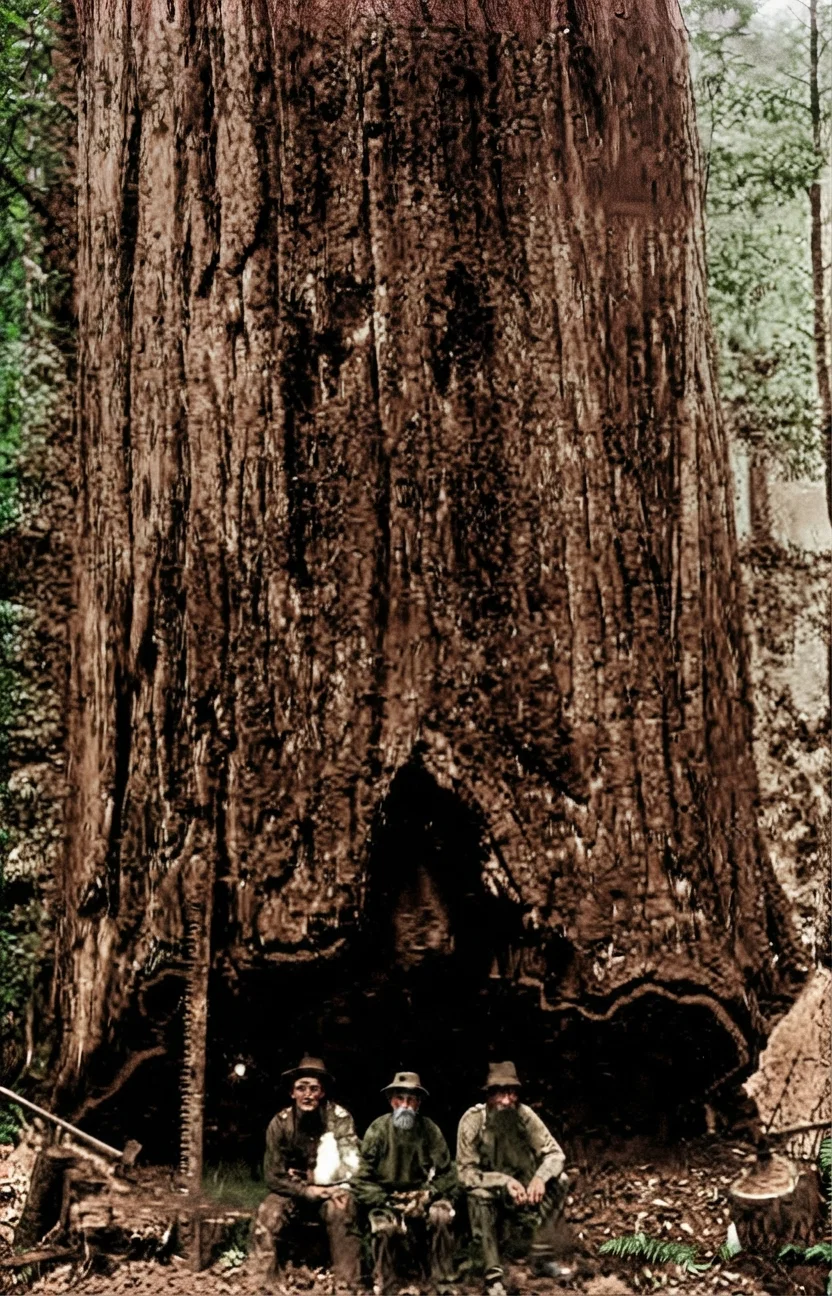
The scenery includes lake and river, hill and dale, mountain and valley, forest and sea; and the abundant vegetation is everywhere in evidence, from the tiny grass blade or the rushes in the tules to the giant redwoods, from 20 to 60 feet in circumference and 200 to 400 feet in height. There is not one dull, dry, dusty, or uninteresting mile from the teeming city on the bay to the thriving town of Ukiah, standing on the skirts of the redwoods in the North. Marin, Sonoma, and Russian River Valleys are all beautiful and fertile.
The entire route revels in flowers. Fruits of all kinds—apples, pears, grapes, oranges, lemons, prunes, apricots, olives, plums, cherries, berries of all sorts and kinds, etc.—abound. There are five large canneries on the route. Of prunes alone, 25,000 tons of dried were shipped last season. Corn, wheat, barley, oats, and hay grow in abundance without irrigation. Many hops are raised.
A Typical Redwood.
Fine horses and cattle are found in plenty. Marin is the dairy county of the State. In one small section of Sonoma County a half million dollars worth of eggs and poultry are sold annually.
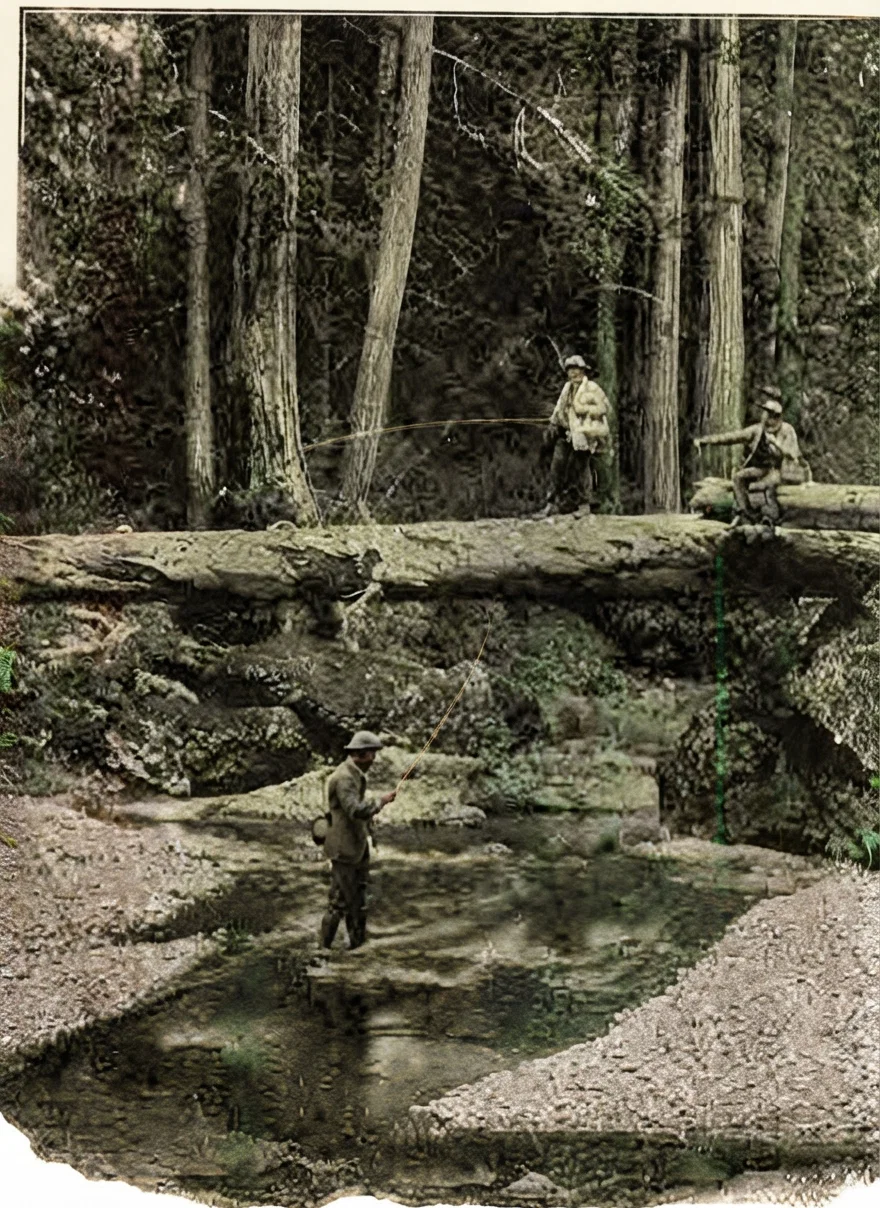
In the four counties named above are over three hundred streams, furnishing 6,000 miles of water length. The largest of these are the Russian and Eel Rivers. A number of lakes are in evidence. These streams abound in fish, especially trout. The railway maintains a fine fish hatchery at Ukiah, stocking the streams with trout.
While fresh-water springs are plentiful, there are numerous and various mineral springs, some of them made effervescent in the laboratory of nature, and heated in her steam pipes. Springs and groups of springs are advertised as health resorts to the number of not less than fourteen. At Hopland, on a recent trip, we saw two six-horse stages waiting for passengers. What a ride one gets up the mountains! Hotels and homes are open along the way to the traveler to the number of 200. There are also plenty of fine camping-places to be had.
Devil's Canyon at the Geysers, Near Cloverdale.
There is no section in this unparalleled State equal to that through which passes the California Northwestern Railway. The company are constantly putting forth efforts to make it more interesting and profitable to the tourist and vacation idler. And the genial and obliging conductors, Messrs. M. McDonough, J. K. Smith, A. Crawford, J. Johnson, on the main line trains, and T. L. Crane, R. Brown, H. Fritz, and J. L. Hammond on the branches, will do all in their power to make it pleasant.
Are you going for a vacation? Are you going camping? Try the California Northwestern Railway and that section of country, unexcelled in natural beauty and productiveness.
On the Russian River.
Write to Mr. R. X. Ryan, general passenger and freight agent, for circulars, terms, etc., corner California and Sansome Streets.
GEYSERS OF YELLOWSTONE.
WE are soon to lose the celebrated geysers of the Yellowstone Park, reports the New York Herald. These marvels of nature, which for many generations have excited the wonder of visitors and formed one of the extraordinary natural phenomena of the United States, are rapidly becoming extinct. The Roaring Mountain geyser, altho still emitting steam, has ceased to spout; the Black Growler is showing only the feeblest signs of life, and the renowned Fountain geyser, in the lower basin of the Yellowstone, and the Splendid and the Beehive, in the upper basin, are at the present time practically extinct. Thus five of the world's renowned geysers of the Yellowstone have gone out of business without any new hot springs appearing. The other geysers in the neighborhood, including the magnificent Old Faithful, the Devil's Inkpot, and the Minute geyser, all show that their power is rapidly diminishing and that their days are numbered. The celebrated European scientific paper entitled Ciel et Terre, in considering these facts, predicts that the geysers of the Yellowstone will exist for only a few more years, during which their activity will steadily diminish. Thus the Yellowstone Park, which has attracted visitors from all parts of the world, must needs be visited during the next few seasons if the most uncommon features of that wonderland, among the most celebrated geysers of the world, are to be seen at work.
LOST GEMS.
By Homiletic Review
THE Manufacturing Jeweler, a magazine devoted to jewelry, declares that more than two million dollars' worth of jewels are lost every season at American summer resorts. That so much more jewelry is lost in the summer than during the winter, is due to the foolish display which is made of such valuables on hotel piazzas, the sands, and even in the ocean itself. The bathers at the fashionable resorts often indulge in a caprice of appearing in the water wearing several thousand dollars' worth of diamonds. The chances of losing these trinkets while exercising, or while lying about on the beach, are, of course, very great. It is a notable fact that more people lose the priceless jewels of character in their hours of amusement and recreation than while engaged in the serious work of life. There is no time when a man or a woman should be so careful of the consistency of conduct as in the hours of relaxation.
1 "JUDGE not, that ye be not judged. For with what judgment ye judge, ye shall be judged; and with what measure ye 2 mete, it shall be measured unto you. And why beholdest thou 3 the mote that is in thy brother's eye, but considerest not the 4 beam that is in thine own eye? Or how wilt thou say to thy 5 brother, Let me cast out the mote out of thine eye; and lo, the beam is in thine own eye? Thou hypocrite, cast out first the beam out of thine own eye; and then shalt thou see clearly to cast out the mote out of thy brother's eye.
6 "Give not that which is holy unto the dogs, neither cast your pearls before the swine, lest haply they trample them under their feet, and turn and rend you.
7 "Ask, and it shall be given you; seek, and ye shall find;
8 knock, and it shall be opened unto you; for every one that asketh receiveth; and he that seeketh findeth; and to him that 9 knocketh it shall be opened. Or what man is there of you, who, if his son shall ask him for a loaf, will give him a stone; 10 or if he shall ask for a fish, will give him a serpent? If ye 11 then, being evil, know how to give good gifts unto your children, how much more shall your Father which is in heaven 12 give good things to them that ask Him? All things therefore whatsoever ye would that men should do unto you, even so do ye also unto them; for this is the law and the prophets.
13 "Enter ye in by the narrow gate; for wide is the gate, and broad is the way, that leadeth to destruction, and many be 14 they that enter in thereby. For narrow is the gate, and straitened the way, that leadeth unto life, and few be they that find it."
[The best help on this lesson is "Thoughts from the Mount of Blessing."]
SUGGESTIVE QUESTIONS.
NOTE.—The texts inclosed in marks of parentheses, while not essential to the lesson study, will be found to throw much light upon the lesson, and are suggested for those who wish to study further.
What admonition does our Lord give us as to judging or condemning? Verse 1.
What questions does He ask which teach us our own fallibility? Verses 3, 4. Note 1.
What positive injunction does He give? Verse 5.
What prudence should we show in the dissemination of God's blessings? Verse 6. Note 2. (Prov. 9:7, 8; 23:9.)
How are God's blessings to be obtained? Verse 7.
What assurance does He give? Verse 8. Note 3.
What appeal does Jesus make to mere earthly affection? Verses 9, 10.
What comparison does He make? Verse 11. (Luke 11:9-13.)
What disposition should we cherish toward all? By what is this injunction enforced? Verse 12. Note 4. (Lev. 19:18.)
What way are we enjoined to take? Verse 13, first clause. (Luke 13:24.)
Why should we take the straight gate and narrow way? Verse 14.
Why should we shun the broad way and gate? Verse 13.
What is said of the number that enter each gate? Verses 13, 14.
NOTES.
1. BEHOLDING, gazing at a fault in others, turns the attention of others to the thing looked at. It leads to judging, condemning. "Mote," a chip, a splinter, in contrast with a great beam. How can a man with a beam of wood in his eye take from another eye a mere splinter of wood? The sin of sitting in judgment on others is one of the greatest of sins. This judging does not refer to proper church discipline, where the Spirit guides. 1 Corinthians 5. But be sure in such case that it is in reality done in Christ's name and Spirit.
2. THE figures are those of casting the flesh of the sacrifice unto dogs, and precious seed pearls, resembling grain, to hogs, which, undeceived, trample them underfoot and rend you. Do not cast the precious truth of God before those who have no desire to hear it. They must be reached in some other way.
3. HE who asks to receive, must not ask amiss. James 4:3. It must be to God's glory. He who seeks to find, must seek with all his heart. Jer. 29:13. And he who knocks successfully, will have his whole soul in the knocking. He must long for admittance. Note that this asking must refer not only to ourselves, but we should ask for those whom we would naturally condemn.
4. THE sum of the right treatment of all men is
SPENCERIAN
ARE THE BEST
Sold by STATIONERS Everywhere
Samples for trial of the leading numbers for correspondents and accountants, will be sent on receipt of return postage.
SPENCERIAN PEN CO., 349 Broadway,
New York, N. Y.
embodied in the Golden Rule. How would we have the Chinese, the Spaniard, the Filipino, the opposed to us in religion, our rivals in race or nation, treat us if our circumstances were reversed? That is the way for us to treat them. If the Golden Rule had always been carried out, there never would have been a union of Church and State, religious prosecution or persecution, or compulsory religious laws. All labor troubles would be settled by its practical application. All animosity of union men towards non-union would be banished before it. All neighborhood and family troubles would be no more. What is to hinder Christians from reducing it to practice? Note also that all this instruction in Christ's sermon is the magnifying of the law.
LESSON IV.—The Centurion's Servant Healed. Luke 7:1-10. Golden Text: "Like as a father pitieth His children, so the Lord pitieth them that fear Him." Ps. 103:13.
LESSON V.—Jesus and John the Baptist. Luke 7:18-28. Golden Text: "He hath done all things well." Mark 7:37.
LESSON VI.—Jesus Warning and Inviting. Matt. 11:20-30. Golden Text: "Come unto Me, all ye that labor and are heavy laden, and I will give you rest." Matt. 11:28.
LESSON VII.—Jesus at the Pharisee's House. Luke 7:36-50. Golden Text: "Thy faith hath saved thee." Luke 7:50.
LESSON IX.—Parables of the Kingdom. Matt. 13:24-33. Golden Text: "The field is the world." Matt. 13:38.
LESSON X.—The Twelve Sent Forth. Matt. 9:35 to 10:8. Golden Text: "It is not ye that speak, but the Spirit of your Father which speaketh in you." Matt. 10:20.
LESSON XI.—Death of John the Baptist. Mark 6:14-29. Golden Text: "Be not drunk with wine, wherein is excess; but be filled with the Spirit." Eph. 5:18.
LESSON XII.—The Feeding of Five Thousand. John 6:5-14. Golden Text: "Give us this day our daily bread." Matt. 6:11.
THE TALENTS. By M. C. Wilcox. A brief essay on "The Parable of the Talents," showing that the talents represent the various gifts of the Spirit which God bestows as he will upon those who are consecrated to him, with the duties and blessed privileges involved therein. Bible Students' Library, No. 77; 16 pp., price 2 cents.
50,000 Copies
By Editor
Heralds of His Coming
A. G. Library No. 51
HAVE BEEN SOLD
It is designed to take the place of the following tracts, all of which have been discontinued:—
Signs of the Times
Is the End Near
The Second Advent
Can We Know
It will be sent post-paid for
# 98 Cents per 100, Net
by your STATE TRACT SOCIETY, or
PACIFIC PRESS PUBLISHING CO.
OAKLAND, CAL.
39 Bond Street, New York City
18 W. 5th St., Kansas City, Mo.
$70 per SECOND
"During every month of that 27 years [from 1870 to 1897] our nation created $18,000,000 more wealth than it consumed. In other words, our national wealth increased at the rate of $250,000 an hour."
The above are sample sentences from the new tract by Prof. George W. Rine, B. L., of Healdsburg College, entitled
Labor and the
Money Power
The tract contains 32 pages
Several Illustrations
Sells for $2.00 per 100
PACIFIC PRESS PUBLISHING CO.
OAKLAND, CAL.
39 Bond Street, New York City
18 W. 5th Street, Kansas City, Mo.
A GORGEOUSLY BOUND
Work of art has just been issued in New York, at an outlay of over $100,000, for which the publishers desire a manager in this county, also a good solicitor. Good pay to right party. Nearly 100 full-page engravings, sumptuous paper, illuminated covers and bindings; over 200 golden lilies in the morocco bindings; nearly 100 golden roses in the cloth bindings. Sells at sight; presses running day and night so great is the sale. Christian men and women making fortunes taking orders. Rapid promotions. One Christian woman made clear $500 in four weeks, taking orders among her church acquaintances and friends. Write us. It may lead to a permanent paying position to manage our business and look after our large correspondence, which you can attend to right at your home. Address H. A. Sherman, General Secretary, 12 East Fifteenth Street, bet. Broadway and Fifth Avenue, New York.
Wanted: Christian man or woman to qualify for permanent position of trust in your home county. $850 yearly. Inclose self-addressed stamped envelope to R. S. Wallace, General Secretary, Corcoran Building, Washington, D. C., opposite Treasury Department.
Wanted: Every salesman and agent to write us and get description of the greatest labor-saving devise on earth. Merchants, bankers, and lawyers all buy. National Supply & Mfg. Co., Dayton, Ohio.
ANNUAL MEETING.
The third annual meeting of the California Medical Missionary and Benevolent Association will be held at Crystal Springs, near St. Helena, California, Wednesday, June 20, 1900, at the hour of 12 o'clock M., for the election of members of the board of directors, and the transaction of any other business which may properly come before the meeting. J. A. BURDEN, President.
E. E. PARLIN, Secretary.
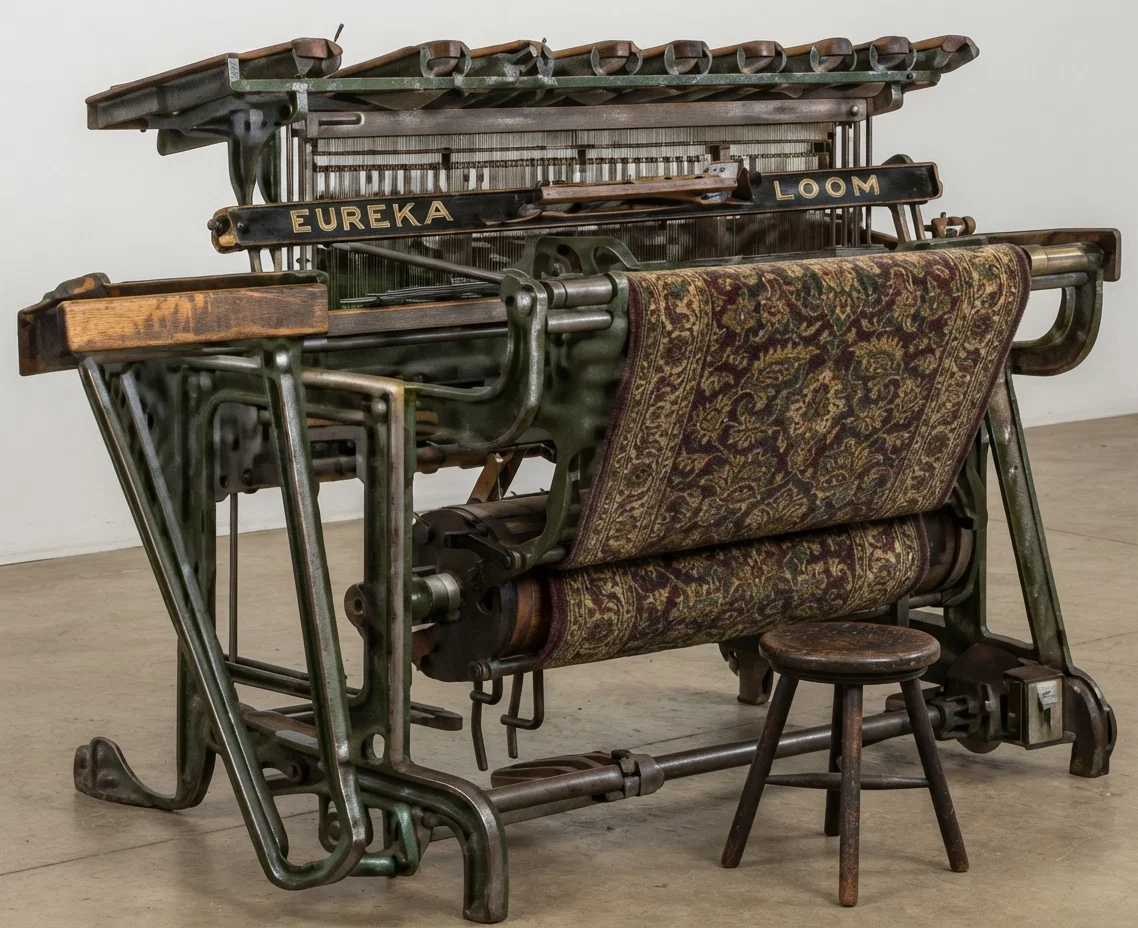
FLY SHUTTLE CARPET LOOM
The best, handiest, easiest running, cheapest, and most durable
FLY SHUTTLE CARPET LOOM
In the world,—100 yards a day. Catalogue free.
EUREKA LOOM CO.
5018 Main St., Battle Creek, Mich.
The Winning of Margaret
When you write, please mention the SIGNS OF THE TIMES.
The Winning of Margaret
How Margaret and her skeptical friend Ralph were converted. A well-told story. Price, $1.00 per 100.
PACIFIC PRESS PUBLISHING CO.
New York City Oakland, Cal. Kansas City, Mo.
You Have Been Wanting a College Education
By Editor
Do You Want One Still?
Then Read Our Offer
We will give you a free scholarship of one year, including board, room, and tuition, in any one of the following colleges or academies:—
Battle Creek College, Battle Creek, Mich.
Union College, Lincoln, Neb.
Walla Walla College, College Place, Wash.
Healdsburg College, Healdsburg, Cal.
South Lancaster Academy, S. Lancaster, Mass.
Mt. Vernon Academy, Mt. Vernon, Ohio
Keene Industrial Academy, Keene, Texas
Southern Industrial School, Graysville, Tenn.
Upon the condition that you secure for us a certain number of yearly subscriptions for THE SIGNS OF THE TIMES, at one dollar ($1.00) each.
The number of subscriptions required to entitle you to a scholarship in Battle Creek College, Union College, Healdsburg College, Walla Walla College, South Lancaster Academy, Mt. Vernon Academy, and Keene Industrial Academy, is 140. One hundred subscriptions will entitle you to a scholarship in the Southern Industrial School, at Graysville, Tennessee. These subscriptions must be accompanied by the cash, $1.00 for each subscription, and must be sent to us direct.
If you are interested in securing an education without financial expense to yourself, write us for particulars and instructions. We are making you an offer of great intrinsic value,—an offer whose acceptance will mean much in your future usefulness, whatever your field of labor. Send to the schools named above for catalogs, and write us at once, in order that you may begin work without delay.
ADDRESS
SIGNS OF THE TIMES
Subscription Department
Oakland, Cal.
Instructions for Ordering.
By Editor
1. REMIT by P. O. Money Order, Express Order, or Bank Draft on New York, Chicago, or San Francisco.
2. If paper money or silver is sent, register the letter.
3. Orders and Drafts should be made payable to the PACIFIC PRESS PUBLISHING Co., or to SIGNS OF THE TIMES.
Postage-stamps.—Please do not send postage-stamps, as they are liable to stick together, and are useless in this condition.
Foreign Money.—Do not send any.
Receipt.—No formal receipt is sent unless by special request. The address label on your paper will indicate the time to which your subscription is paid. In case of non-receipt of papers, or any other irregularity, please notify us immediately.
Expiration of Subscription.—All papers are discontinued at the expiration of the time paid for. Notification will be sent several weeks before date of expiration, thus enabling you to renew in ample time to secure unbroken files. Please be prompt, as we can not always furnish back numbers.
Change of Address.—When ordering change of address, please give both the old and the new address.
Important.—Use a separate sheet for SIGNS orders, separate for other papers, separate for books, for tracts, etc., and if you address the editor, use a separate sheet. All can be sent in one envelope, and the money all sent in one order, but write each kind of business on a separate sheet. In this way each order can be handed to the proper clerk and filled at once.
TO CONTRIBUTORS.
THE SIGNS OF THE TIMES is a purely missionary enterprise. For this reason it has felt free to ask for contributions from its friends. It pays nothing for contributions, either prose or poetry, unless solicited by the editor, and then the fact is stated when the articles are asked for. This is a plan rarely followed, but sometimes deemed expedient.
Articles Desired.—Those which set forth in the Spirit of Christ the great saving truths of God, short and to the point. It is better to treat one important truth clearly, in a short article, than many points vaguely in a long one. We desire no caustic, critical productions, which might minister to personal pride or pleasure, but can not save souls.
How Prepared.—Write plainly, with typewriter or ink, with wide space between the lines, to freely admit of editing, writing of subheads, etc. Write on one side of the sheet only. Sign the name to the manuscript, as it becomes oftentimes separated from accompanying letter. Anonymous contributions are not used, whatever their merit. If the writer does not wish his name to appear, let him furnish a pseudonym for the public. But we wish the name.
Manuscript Returned.—We will return all unused manuscript desired if stamp and directions are inclosed. We are forced sometimes to return good manuscript mainly for three reasons: (a) Sometimes the articles are too long; (b) sometimes we have a number on the same subject; (c) sometimes our plans are such that an article can not be used till it is out of date. We therefore hope that no offense will be taken by those who have freely contributed their best thought if their productions are returned. When we receive so much matter, we can not use all.
NOTE.—We wish those who ask questions to take particular notice: (1) Only such questions will be answered here as we believe to be of general interest and information. (2) We can not undertake to explain from four to a dozen scriptures, as in one sentence we are often requested to do. (3) Do not ask to "explain" a certain text or passage. State clearly the point in question. (4) Give full name and address, not for publication unless desired, but as evidence of good faith, and to give us the privilege of replying by letter if deemed best. (5) Unsigned communications of any kind find the quickest way to the waste-basket. (6) It is always well to inclose stamp. (7) "Foolish and unlearned questions avoid," also those that minister to mere curiosity. (8) Study the Scriptures yourselves.
VIRGINIA HOMES.
You learn all about Virginia lands, soil, water, climate, resources, products, fruits, berries, mode of cultivation, prices, etc., by reading the Virginia Farmer. Send 10 cents, for three months' subscription, to FARMER CO., Emporia, Va.