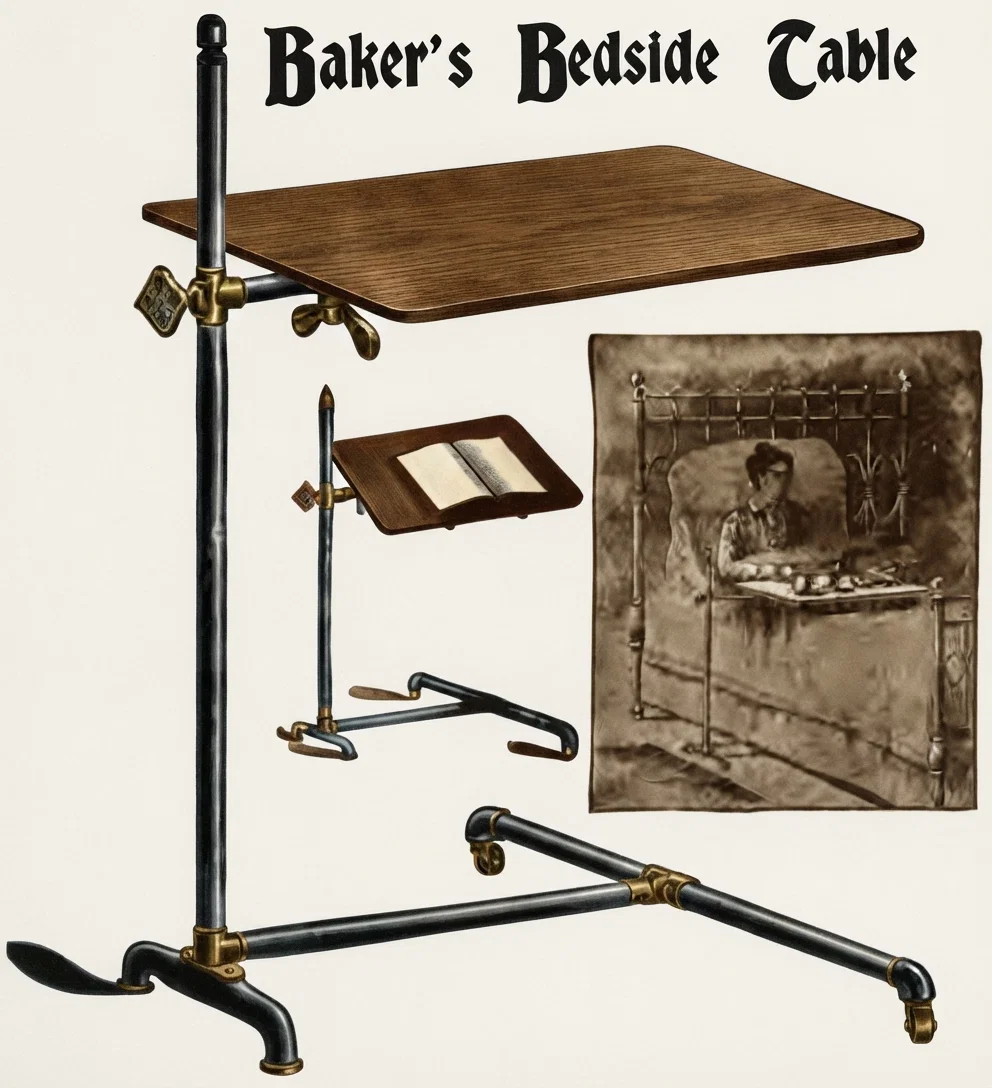
DURABLE
Made of steel tubing of great strength and first quality oak
CONVENIENT
Moved about with ease, one end being fitted with suitable casters
ADJUSTABLE
Any height from 8 to 38 inches
Sidewise any angle from horizontal to vertical
LIGHT . . .
Weight, 15 pounds
Baker's Bedside Table
An Ornament to the Home
A Benefit to the Office
A thought will suggest how various the uses to which it is adapted—A bedside table, book holder, writing stand, book shelf, flower vase holder etc.
A frame for holding a book at the proper angle is conveniently attached to the under side of the table, out of the way when not in use.
This is the IDEAL PRESENT
Always useful
Once used always
appreciated
Black enamel finish, regular price $4 50, with "SIGNS," one year $4 25
Nickel plate finish, regular price $6 75, with "SIGNS," one year 6 00
BLACK ENAMEL FINISH TABLE GIVEN for ten new yearly subscriptions at $1.00
NICKEL PLATE FINISH TABLE GIVEN for fifteen new yearly subscriptions at $1.00
Weight in box, 25 pounds. Freight from Kendallville, Ind., or from Oakland, Cal., paid by the receiver
Send for illustrated descriptive circulars
Address, SIGNS OF THE TIMES, Oakland, Cal.
THE SIGNS OF THE TIMES
By Editor
THE SIGNS OF THE TIMES has had but little to say of itself. It often tells of the good things it proposes to lay before its readers, but it here wishes to make a plea for itself; and we are sure its friends will hear it.
The SIGNS was founded not as a money-making affair, but as a missionary paper to spread far and wide the everlasting Gospel. In 1874 it was started at $2.00 a year. At a later period it was reduced to $1.50 a year. In May, 1895, at the urgent requests of its friends, the price was reduced to $1.00.
This was a serious mistake. Every paper, nearly, which has reduced its price to obtain larger circulation, has been forced to succumb, or has had to raise its subscription price, or has barely lived along, at a "poor dying rate." Many religious papers throughout the country have died. Many more merely exist.
The SIGNS has lost every year since it reduced its price. It has, during these six years, lost in the aggregate over $15,000, about the loss which the Northern Christian Advocate (M. E.) of Syracuse, N. Y., sustained the last four years.
The cause of this loss is threefold:—
1. The paper has been constantly improved. In 1895 it was published on cheaper paper, and, very rarely, with illustrations. But a demand from our agents and friends came for illustrations. These the publishers furnished, but they added to the cost of production not only in the cost of the illustrations, but the illustrations demanded a better quality of paper, costing more.
2. Club rates have been made lower, and many papers are taken in this way in large churches and by missionary agents. Papers have also been furnished to agents who sell and solicit subscriptions far below cost price.
3. During the last two years the price of paper, owing to water famine in the East, and the combination of paper mills, has increased from 25 to 50 per cent. This, of course, has materially added to the expense of the publication of the paper.
The SIGNS has not lived on at a "poor dying rate." It has not diminished its size, or its frequency, or its value. It has not succumbed, nor will it. It is published to do a specific work; it will not cease publication till that work is done.
But its publishers do not consider it to be good business methods nor good missionary methods to publish the paper at a continual loss. They do not regret one cent of all they have put into the paper; but they do believe, and they believe that all the friends of the SIGNS will believe, that the paper ought to be put upon a paying basis.
Of course it could publish more advertisements. But its conductors do not wish to compromise truth and Christian dignity in printing many advertisements published in religious and popular papers of the day. Using the greatest care, it is difficult at all times to discriminate. An apparently good article has behind it a disreputable seller, or where article and firm are both good, the advertisement in its style and setting is sensational, ludicrous, and illy befitting to the dignity and purity of a Christian paper. We expect to use more diligent care in the future; but income from this source, with the severe censorship of the SIGNS, is not extensively remunerative, the helping to some extent.
In view of all these things, the publishers feel that they do wisely to raise the subscription price of the SIGNS both to regular subscribers and in clubs; and we are sure that all our friends will stand with us in this.
After October 1 the subscription rates of the SIGNS will be as follows:—
Single subscription for one year . . . . $1 50
Single subscription for six months . . . . 75
Single subscription for three months . . . . 40
Single subscription to foreign countries . . 1 75
But we do not wish to take advantage of our subscribers. In fact, we wish to do for them the best we can, and we, therefore, make this proposition. We will receive subscriptions for from one to five years at one dollar a year until October 1. All regular subscriptions received after that date will be $1.50 a year; but if you renew or subscribe previous to that date, it will be one dollar a year. If you are now taking the paper and wish to extend your subscription, you will be credited one year for each dollar you send. But if you wait till Oct. 1, 1900, the paper will cost $1.50 a year
Now how many will subscribe for two, three, or more years? You will get a better paper now than you obtained for $2.00 once.
Friends, we wish your help, not to make a profit on the SIGNS, but to extend its circulation. Last year its average weekly circulation was 49,181. Shall it not exceed that greatly in the year to come?
Rates to agents, as well as new club rates, upon which there is a slight increase, go into effect July 1. These may be had on application. We are sure that agents who solicit subscriptions will find their work more remunerative than in the past.
We have laid the matter before our readers and friends. We wish their prayers and co-operation.
CONTAINED IN THIS NUMBER.
Poetry.
The Mighty Healer, HARRY G. LUCAS . . . . . . . . . . 2
Thoughts for Reflection . . . . . . . . . . 3
Consummation, C. M. SNOW . . . . . . . . . . 10
Amen. . . . . . . . . . . . . . . . . 12
General.
"Kubbet es-Sakhara" . . . . . . . . . . 1
Miracles of Healing, A. F. BALLENGER . . . . . . . . . . 2
Christ's Sacrifice for Man, MRS. E. G. WHITE . . . . . . . . . . 3
The Law and the Gospel . . . . . . . . . . 4
Human Creeds vs. Divine, G. B. THOMPSON . . . . . . . . . . 4
A Striking Fulfilment, H. C. GILES . . . . . . . . . . 5
"Who Art Thou That Judgest Another Man's Servant?" T. E. BOWEN . . . . . . . . . . 5
An Open Letter, S. D. HEADY . . . . . . . . . . 6
Connection between Theosophy and Spiritism, J. O. CORLISS . . . . . . . . . . 7
Outlook.—The Liquor and Opium Traffic and Foreign Missions—Civil Government as Administered—Launching of a New Party—Should There Be War with Turkey?—A Non-Christian Life of Christ . . . . . . . . . . 8, 9
Missions.—The Paraguayan Republic, JUAN McCARTHY—"Our Father," G. C. TENNEY—Maxims, H. E. S. HOPKINS 10, 11
The Home.—Burke the Burglar, and Moody the Evangelist . . . . . . . . . . 12, 13
International Sabbath-school and Sunday-school Lessons . . . . . . . . . . 14
Publishers . . . . . . . . . . 15
Glad Tidings and Glad Service
"The joy of the Lord is your strength." The Gospel is glad tidings. The Lord wants you to receive it gladly and to render glad service in return.
The Gifts of the Spirit
"The Gifts of the Spirit" is the title of Mr. Ballenger's next article. It should be read by all. God wishes that His church "shall come behind in no gift." Are you ready for the Lord to bestow some gift upon you? If not, why not?
Correction in Article Order
We discover, too late to remedy, that the article entitled "A Striking Fulfilment," in the series "Origin of Evil and the Change of the Sabbath," is out of order. It should have been preceded by the one which will appear next week, entitled "Remarkable Prophecies." We regret the mistake, but ask our readers to read the two in reverse order of their appearance.
An Open Letter.
By Editor
On page 6 will be found an open letter to ministers and religious teachers generally of the Protestant churches, from an unconverted railway conductor. It will speak for itself. We give it place because it represents the minds of many. At the same time we are moved to say that the fact that others do not do right should not hinder those doing it who know it.
Longings
Next week we publish another song, "Longings." The words first appeared in the SIGNS, contributed by Gertrude E. M. Spiking. A stranger, but a reader of the SIGNS, was so struck with their sentiment that he set them to sweet, simple music, just such as the home folks can sing, and contributed it to the SIGNS, for which I know that he will have the thanks of our singing readers.
In V
they de
SIGNS
we an
in this
After
SIGNS
Sing
Sing
Sing
Sing
New S. S. Lessons
New S. S. Lessons.—In our issue of June 27 we begin a new series of Sabbath-school lessons, on the book of Galatians. You will wish to study them, or the Gospel in them. But you will appreciate, far beyond its cost, No. 162 Bible Students’ Library, “The Glad Tidings,” by Dr. E. J. Waggoner. The price in pamphlet form is 25 cents; in cloth, 60 cents. It is a complete study of the Gospel of Christ, as set forth in Galatians, in connection with Acts 15 and related passages in Romans. We hope that every family among our readers may have this truly wonderful book of Gospel teaching.
THE
By Editor
Christian Patriotism
By Editor
Have you read “Christian Patriotism”? If not, you should. We know of no work which so lucidly, scripturally, concisely sets forth the relation of the Christian to civil governments. Its 16 chapters and 104 pages are filled with Gospel truth which no Christian in these days of peril can afford to ignore. Bible Students' Library, No. 159. Price, 25 cents.
Power Is Not Measured by Noise
Power is not measured by noise or display. The blare of a trumpet or the blast of thunder would not lift a stone that is thrust up by the growing plant; neither would it split the rock which the little wedge of wood and the little water rend apart.