Signs of the Times, Vol. 43, No. 3.

Aboriginal Tribes of South Africa

Signs of the Times

Jan 18, 1916

Pacific Press Publishing Association · Mountain View, California · Jan 18, 1916

Aboriginal Tribes of South Africa

The Hottentots as Masters and Warriors — The Bushmen as Sculptors and Painters Aptitude in Learning — Hottentot Hearts Touched by the Gospel

By WILLIAM A. SPICER
This is the third of the dozen articles furnished by W. A. Spicer on the interesting peoples and work in South Africa. Elder Spicer recently spent some time in Africa; and what he writes, is from the standpoint of personal experience and observation, as well as reading and study. His next article will tell what he saw and heard in Kafir-land.
WHEN Europeans discovered South Africa, they found the Hottentots in possession of the coast line, with a fringe of Bushmen disputing their lordship. But back in the interior, along the river valleys, the Bushmen hunters still lived their wild life.
The Bushmen were the early dwellers in the whole southern country, evidently, though none of these tribes appear to have been very numerous. Then the Hottentots came down from the north, pushed out of the lake country of east central Africa by the southward pressure of the more powerful Bantu races from the Nile valley.
The Hottentots were better armed, and a larger, stronger people than the Bushmen. They took the coast line, and tried to reduce the Bushmen to slavery. But these men of the wilds were not of the kind to yield their freedom of life.
"They never thought of submitting and becoming the slaves of the invaders," says Theall; "but like the lions and leopards whose habits they knew so well, when brought to bay, they did all the harm they could to their opponents, and died breathing defiance."

THE BUSHMEN HAVE VANISHED

When Europeans came and instituted slavery, the Hottentots were brought under subjection; and though not very numerous, they continue to this day. But the Bushmen resisted, and have all but disappeared. Of the Bushman type, Theall says:
"They were pigmies in size, yellowish brown in color, hollow-backed, and with skins so loose that in times of famine their bodies were covered with wrinkles and flaps.
On their heads were rows of little tufts of wiry hair hardly larger than peppercorns, and leaving the greater portion of the surface bald. Their faces were broad in a line with the eyes, their cheeks were hollow, and they had flat noses, thick lips, and receding chins. They anointed their bodies with grease when any was obtainable, and then painted themselves with soot or colored clay. The clothing of the males was the skin of an animal hung loosely over the shoulders, and often cast aside; that of the females was little more than a small leathern apron. To the eye of a European, no people in any part of the world were more unattractive."
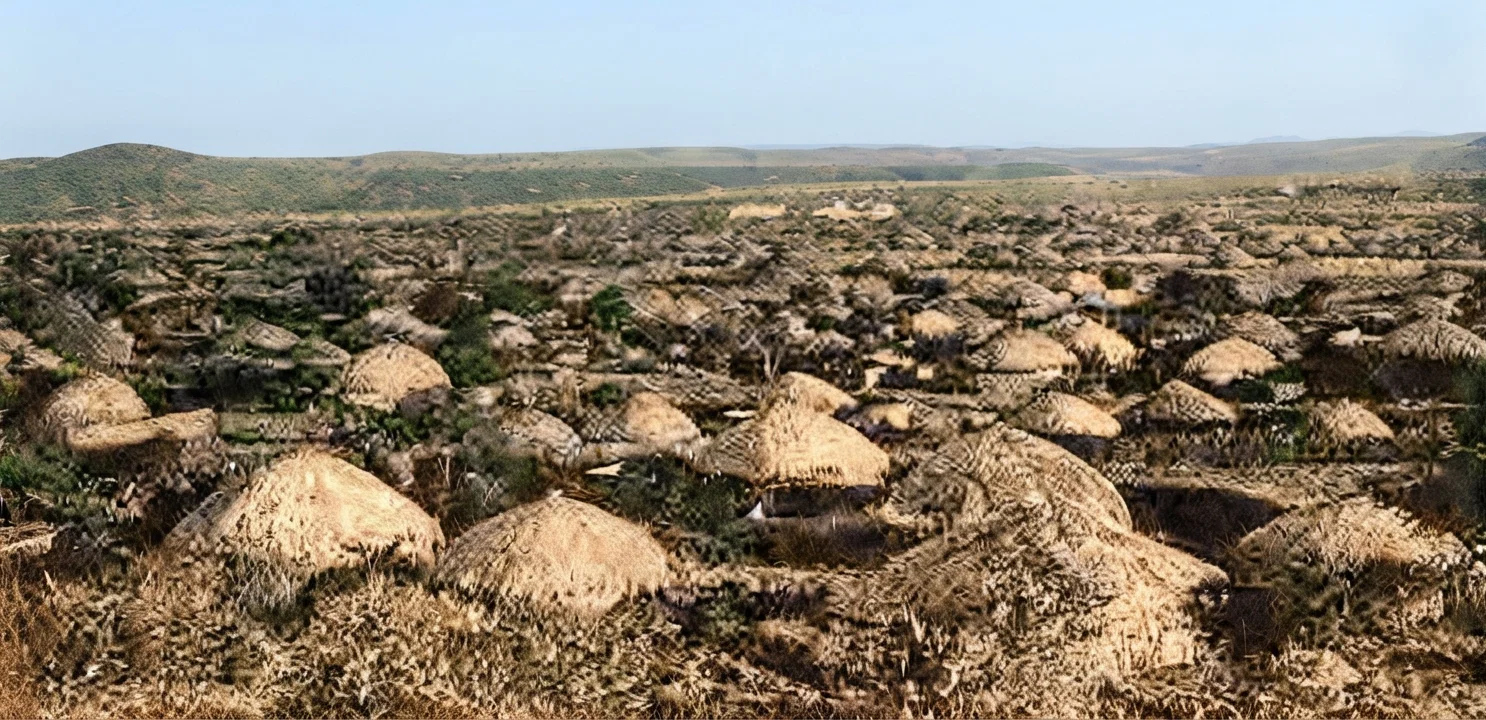
The Hottentots built pole huts, plastered with mud, and covered with rush mats. They tilled a bit of land, kept cattle, and called themselves khoikhoi (men of men), as distinguished from the inferior hunter Bushmen, whose homes were scooped out of the sand alongside overhanging rocks or bushes, or more permanently fixed in caves from which they had perhaps driven wild beasts.

THE INTELLIGENCE OF THE BUSHMEN

Yet the Bushmen was not without intellect. He has so often been represented as such, that it is worth while to say more of him. Driven into the deserts and the wilds with the beasts as he was, and with the lowest mental capacity, we are told, yet in many ways he showed keen intelligence. Bleek, the author of "Bushman Folklore," says, "The rapidity with which a Bushman learned to speak Dutch or English . . . was regarded as almost marvelous in the early days of the Cape Colony."
Of another side of Bushman culture, arguing as high an origin as any tribe, Stow, in his "Native Races," says, "The Bushmen in their undisturbed state might have been

Aboriginal Tribes of South Africa

(Continued from page 1)
termed the most musical people in South Africa, as in both the number of their tunes for dances, and the variety of their musical instruments, they were unsurpassed by any other native races."

HOSPITALITY OF THE BUSHMEN

Let this suffice; though really Ellenberger's word should be added in tribute to a vanished race. After speaking of their cunning and vindictiveness, he says:
"On the other hand, they were hospitable and generous. They had an idea of justice and benevolence and devotion, as well as a passionate love of liberty. They were also very loyal to their chiefs. They showed the greatest devotion and bravery in their attempts to rescue their fellows from slavery—a state which they held in greater horror than death itself. . . . They would always share their food with others, even when it was scarce."—"History of the Basutos," page 7.
A HOTTENTOT KRAAL OR VILLAGE
All this in behalf of the lowest of the South African tribes. The origin of the Bushmen is one of the mysteries of tribal history. There were two distinct branches, the sculptor tribes and the painter tribes. The former came from the eastern Sudan region, plainly enough, for they left their mark in the rock carvings all the way down.

THE BUSHMEN PAINTERS

But the painters, whose works of art adorn the rocks, in colors that are everlasting apparently, had a tradition that their ancestors came over the water in big baskets—boats; and while their paintings are all over eastern South Africa south of the Zambezi, there are none north of that stream.
Some believe they were brought down as slaves, in the ancient days, Canaanites or Sudanese, to work the mines of Mashonaland, which may have been one source of the gold that flowed into the treasuries of Hiram of Tyre, and of Solomon, whose ships sailed down from the Red Sea into the Indian Ocean, in search for gold. Here in Africa is gold, and the remains of prehistoric mines show that some foreign people ages ago worked the rock veins for the precious metal.
One old Bantu name for these painter Bushmen meant the abandoned, the cast-aways. So it is surmised that the tradition of their forefathers' coming by boats is true, and that they were brought as workmen in the mines, thousands doubtless having been employed. Then when connections were broken, and the mines were no longer worked by the far-away operators, these people were left—abandoned, cast away—to be pushed ever southward as the succeeding waves of tribal migration came down from central Africa.

THEIR INDELIBLE PAINTINGS STILL ON THE ROCKS
However that may be, they have left their paintings on the rocks and lining the caves from Southern Rhodesia to the cape. The strangely formed boulder heaps of Mashonaland are often decorated with them. While at our Solusi Mission, in Matabeleland, I found Bushmen paintings, well preserved, on the rocks of a kopie near the mission house. "We used to think God made them," said one of our now Christian teachers. "We stood in awe of them, and felt they ought to be worshiped."
Is it because I have only just been over these old Bushmen trails that I am interested in this aboriginal tribe? And am I taking too much for granted in thinking that readers far away will follow their story with interest? I believe not; for their story is somewhat parallel to that of our own nearly vanished Indian race. One really seems to get a glimpse of the Africa that once was, in looking at these caverns or shelters of overhanging rock, with their curious and often skillful tracings of animals and men. A South African poet, W. C. Scully, in "The Bushman's Cave," gives a graphic picture of the aboriginal home in the rocks:
" 'Tis here the vanished Bushman dwelt — He with his brood, long years ago — Beneath this ledge, and deftly spelt, In pictures that still freshly glow; The wildwood creatures not more wild Than he, who, hiding thus apart, His idle days and hours beguiled At his strange, harmless, limning art. "There in yon cleft is still the mark Of bygone fires, whose flames are dead As those who lit them — life's strange spark And glowing ember both have sped. Through fancy's glass, I see around The shades of long dead forms arisen. "There lies an antelope, fresh killed, By hungry stomachs close surrounded; And there's a wicker basket, filled With luscious locusts, freshly pounded; And look! The glowing coals upon, A scaly snake is quickly toasting, Whilst on that ledge, there in the sun, The hunters of their deeds are boasting. " 'Tis gone; 'twas but a glimpse, a flash, That for an instant lit the past; I see now but the water dash In quivering spray sheets downward cast, And on the rocks, in deathless hue, The records of a perished race That from this land of ours withdrew In silence, leaving scarce a trace."
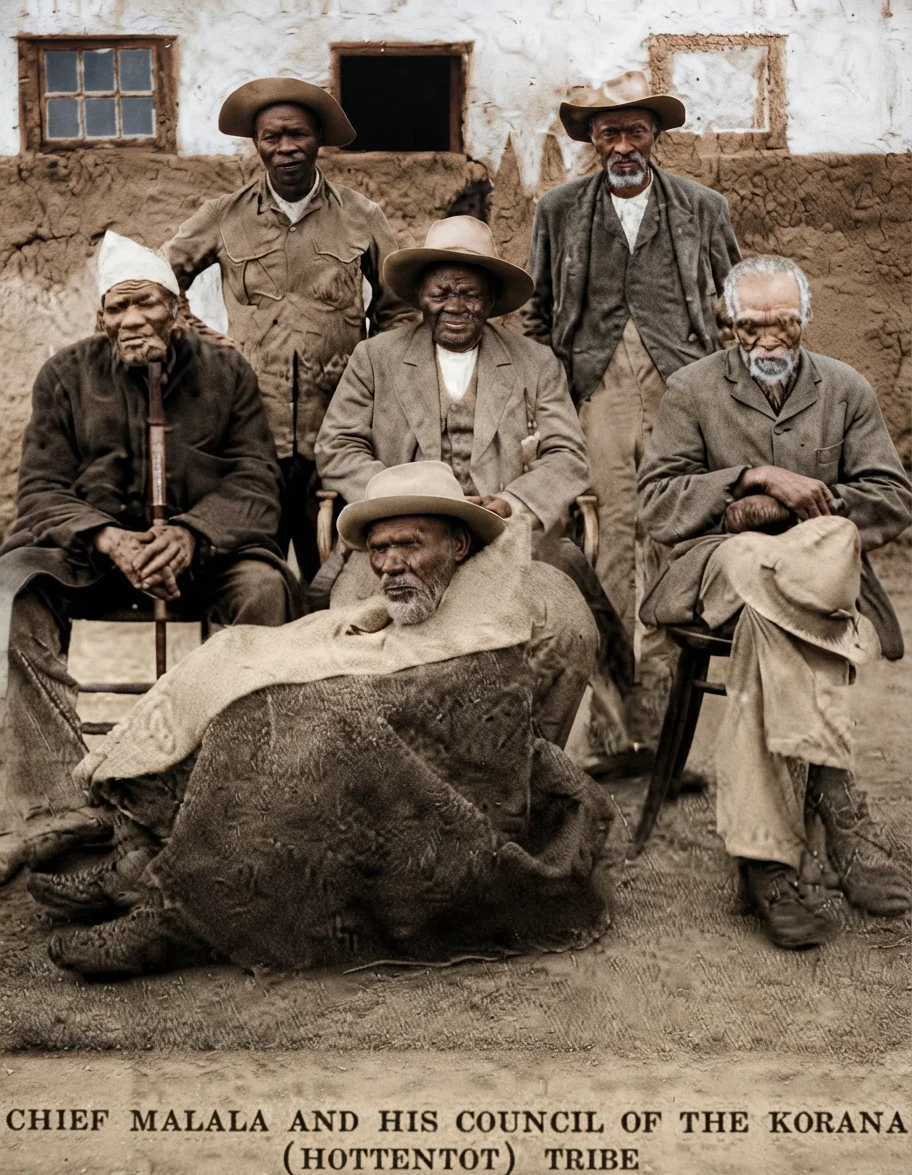
CHIEF MALALA AND HIS COUNCIL OF THE KORANA (HOTTENTOT) TRIBE
I was not able to learn that our work has touched any heart among the few Bushmen still surviving. In fact, I could learn of no converts from among this people in any missions, though surely some must have heard and heeded the gospel call. Yet there are
few missions operating in the interior desert regions of the southwest, where the scattered remnants of the Bushman race are found.

REACHING HOTTENTOT HEARTS

But among the Hottentots, this message has found its way. The Koranas, of whom there are about one hundred thousand in the southwestern part of the Cape Province, are a Hottentot tribe. Our first fruits among the Hottentots was a Korana, recently baptized by Pastor H. J. Edmed, president of the Cape Conference. He told me the story as follows:
"One of our members, Brother van der Westhuizen, saw in our papers the call for every member to seek to win one soul to Christ during the year. He had a servant, a heathen Korana, and somehow it came to him that here was a soul to win to Christ.
"The Korana was a wicked sinner, using profane language, and sometimes getting drunk. He could not read. But our brother began to pray and work for his conversion.
" 'Every day,' Brother van der Westhuizen told me, 'I sat down with that boy to read the Bible; and, strange to say, in a few weeks, he got so he could read the Bible himself. In a few weeks more, he stopped drinking. Later he threw his tobacco away. Then one day, to my surprise, he came into our meeting and prayed; and breaking down, he wept, and said he wanted to be a Christian.'
"So the good work of Brother van der Westhuizen went on until a time when a day of fasting and prayer in the churches had been appointed, to seek God together for the blessing of greater earnestness and power in the work of saving souls, in view of the solemn times. The war had broken out, and special issues of our paper were being brought out for wide circulation. On this day of fasting and prayer, Peter, the Korana, stood up in the meeting, and said, 'I want to belong to the remnant church, that keeps the commandments of God, and the faith of Jesus.' Brother van der Westhuizen came to me, when I visited that region, telling me the story, and adding, 'Now, pastor, will you baptize my Korana boy?'"
This brother had won a Hottentot to Christ; and Peter, redeemed from vices and from the heathen worship of the moon and the snake, is praying that many more of his people may be reached by the closing gospel message.
At that same meeting, a father and a mother came to Pastor Edmed, saying: "When we saw the call to win one soul this year to Christ, the first thing we tried to do was to bring our own children into the kingdom. God has blessed us, and here they are. Will you baptize them?"
Thus everywhere, and among all people, the gracious work of God is being wrought.

They Enter the Eternal Kingdom

The Resurrection Precedes — They All Go in Together

By TYLER E. BOWEN
"MANY shall come from the east and west, and shall sit down with Abraham, and Isaac, and Jacob, in the kingdom of heaven." Matt. 8: 11.
This is a perfectly familiar scene, real and natural. Jesus is here speaking of His own kingdom when it shall be established. Abraham, Isaac, and Jacob will be there. Others will come and sit down with them, to hear of their experience, to become personally acquainted with them, as we now go to the home of some friend and sit down and visit with him.
But Abraham and Isaac and Jacob are now sleeping in their tombs. Yes; but what difference does this make as to that future scene? Our God is able to make them live. Whether they have been asleep a few or many years, does not matter with the infinite Creator. He is able to bring them out of their tombs, and give each of them a body, which both they and their friends will recognize.

A RESURRECTION IMPERATIVE

The resurrection becomes a very important part of our heavenly Father’s plan in setting up for His Son the fifth universal kingdom upon this earth. The subjects of that kingdom will not be ghosts, phantoms, nor spirits of people who once lived upon the earth. They are to be real individuals — as real as are the subjects of earthly kingdoms now. There is no place in God’s universe where only phantoms float about. God has made worlds, and created beings after the order of men to live upon them, intending that they should be obedient to Him, and lead happy lives. The soul-without-a-body theory is all a myth of Satan’s to lead such as do not believe God, off into the miasmal swamps of darkness and death. God deals in actual men and women, and surrounds them with conditions that can be seen and understood and known.

ALL ENTER THE HEAVENLY CITY TOGETHER

No one goes to heaven, the Bible tells us, to enjoy the bliss of that city Jesus went to prepare for us, until all the nations of the saved go in together. This includes Abraham, Isaac, Jacob, David, and all the rest of God’s sleeping saints.
"I would not have you to be ignorant, brethren," wrote the apostle Paul, "concerning them which are asleep, that ye sorrow not, even as others which have no hope. For if we believe that Jesus died and rose again, even so them also which sleep in Jesus will God bring with Him. . . . We which are alive and remain [alive until His appearing] shall be caught up together with them in the clouds, to meet the Lord in the air: and so shall we ever be with the Lord." 1 Thess. 4: 13-17.
That is when the King of the next universal kingdom is making up His subjects for that kingdom. They are all taken out of the earth together. The living ones have no preeminence over those who have passed into their graves, neither have they who have died any preeminence over those who live. Neither class have gone to heaven. None of them have gone through the gates into the city prepared for them. No; God has something better for the dead, and that is that they shall wait until all are ready to go home together.
"They were stoned," wrote the apostle to his Hebrew brethren, "they were sawn asunder, were tempted, were slain with the sword: they wandered about in sheepskins and goatskins; being destitute, afflicted, tormented; (of whom the world was not worthy:) they wandered in deserts, and in mountains, and in dens and caves of the earth. And these all, having obtained a good report through faith, received not the promise [of going into that city — see verse 10]: God having provided some better thing for us [who live], that they [the dead] without us should not be made perfect." Heb. 11: 37-40.

WITH WHAT BODY DO THEY COME?

"But," says one, "I cannot understand how a man who may have been dead two or three thousand years can be put together again so as to be the same person, so much so that he shall recognize that he is the same man who once lived, and the friends who lived at that time shall likewise recognize him."
Paul, as he went from city to city in his gospel work, preaching the resurrection from the dead through Christ, met this identical question.
"But some man will say, How are the dead raised up? and with what body do they come?" 1 Cor. 15: 35.
Paul meets the question by saying: "Thou foolish one, that which thou thyself sowest is not quickened except it die: and that which thou sowest, thou sowest not the body that shall be, but a bare grain, it may chance of wheat, or of some other kind: but God giveth it a body even as it pleased Him, and to each seed a body of its own." Verses 36-38, A. R. V.
A man sows wheat. Kernels are produced later, that he could not distinguish from the one planted, could he by any possibility regain possession of that original kernel.
In the process of living, our whole body is gradually changed, broken down tissue cells being replaced by new ones. But did you or your friends ever experience any trouble in distinguishing yourself in a crowd?

GOD’S RECORDS IDENTIFY MEN

Again, did you ever read that remarkable text of Scripture which tells us that every minute tissue and organ of our bodies is noted in a book by God’s record keepers in the archives of heaven? Suppose we turn and read it: "My substance was not hid from Thee, when I was made in secret, and curiously wrought in the lowest parts of the earth. Thine eyes did see my substance, yet being unperfect; and in Thy book all my members were written, which in continuance were fashioned, when as yet there was none of them." "Such knowledge is too wonderful for me; it is high, I cannot attain unto it." Ps. 139: 15, 16, 6.
Here God gives us the key to the secret of the resurrection. The One who formed man, keeping a record of every fiber and member that went into that organism, unlike all others in its fashioning — for He has made us different in our personality, our individuality — and who has in books up there the exact history of that life from its beginning to the grave, with all the thoughts recorded, all the words written, every act put down just as it occurred, whether done openly or in secret, is abundantly able to reproduce that marvelous organism, even though it may have moldered to dust hundreds of years ago. He will give back to Abraham, Isaac, and Jacob, bodies the exact counterpart of the ones they lost through Adam’s disobedience. Their features will be as when known by their friends living in their day. Such knowledge is truly too wonderful for us, but not too wonderful for our God, nor too wonderful for us to believe of Him.
And so it is written of all the saints of God, whether alive or sleeping: "The ransomed of the Lord shall return, and come to Zion with songs and everlasting joy upon their heads: they shall obtain joy and gladness, and sorrow and sighing shall flee away." Isa. 35: 10.

A PRAYER OF JESUS’ ANSWERED

When the King of kings comes, and the nations that know not the Lord are smitten before Him, as revealed to Nebuchadnezzar, being in that day all broken together, the glorified ones of earth, from the east, the west, the north, and the south, shall be taken out of the world, away from the earth, to spend a thousand years with God in heaven. The King, Christ Jesus, will in that day have His own with Him — actually be in possession of the subjects of His kingdom.
"I will that they also, whom Thou hast given Me, be with Me where I am; that they may behold My glory." This is what Jesus prayed just before He died. When He comes from heaven and gets His people, this prayer will be answered. By His own blood, He has bought them, redeemed them from the power of the enemy; and they, on their part, through Him, will in that day have attained immortality. And while the territory of their kingdom is made a prison house for Satan and his associate host of fallen angels for a time, they must only wait a thousand years, when it too will be restored to them. Then will the promise be fulfilled, "Blessed are the meek: for they shall inherit the earth."

JOB’S HOPE OF SEEING GOD WITH HIS OWN EYES

Then shall Job’s desire be satisfied, and that also of all the saved: "For I know that my Redeemer liveth, and that He shall stand at the latter day upon the earth: and though after my skin worms destroy this body, yet in my flesh shall I see God." Job 19: 25, 26.
Reader, do you not see, in all these assurances of God’s word, sufficient evidence upon which you may lay hold by faith, so that the heavenly country, the kingdom you have so long looked forward to, becomes a living reality, and appeals to you? What more could the Lord do than He has done to convince you that His promised home is a real one, and worthy your best and highest endeavors to obtain?
A few more changes in the kaleidoscope of earthly nations, as foretold in the Word, and then comes the ushering in of that glorious kingdom of our Lord Jesus Christ. It will not be by clash of arms, but "as the lightning, that lighteneth out of the one part under heaven, shineth unto the other part under heaven; so shall also the Son of man be in His day." "Behold, He cometh with clouds; and every eye shall see Him, . . . and all kindreds of the earth shall wail because of Him." "Then shall He send His angels, and shall gather together His elect from the four winds, from the uttermost part of the earth to the uttermost part of heaven." Then is answered the prayer so long prayed by His followers, "Thy kingdom come." "Even so, come, Lord Jesus."

Living for Christ

IT is far easier to die for Christ than to live for Him. The great test of discipleship is the ability to meet the little nagging difficulties of each day without losing one’s mental and spiritual equilibrium.
Peter was ready to go with his Lord “into prison and to death”; but when his sword was taken from him, and his will was crossed, immediately he fell, and followed “afar off.” C. L. TAYLOR.

The Unlearned Lesson

By EDITH STARBUCK
The Unlearned Lesson
ON high, in the blue of heaven, Shedding its warmth and light, The sun in its path discloses The tale of the Saviour's might. Written on every flower Is the beauty of Christ above; And shed in each gentle shower, The knowledge of Jesus' love.
When night spreads abroad her curtains, In jewels of light appears The story of earth's creation, Traced out by the rolling spheres, In gold and crimson and purple, In far-flung streamer and bar, The glory of earth's Redeemer, Proclaimed by each brilliant star.
With every seedtime and harvest Doth the myst'ry anew unfold, That from one tiny grain is garnered Such wealth of kernels of gold; But man will accept as of custom This miracle ever new, Nor render to his Creator The gratitude that is due.
As children, thumbing the pages Of some great volume fair, Gazing perhaps at the pictures, But missing the meaning rare, So we to God's book of nature Too often give little heed, Turning its pages idly. Alas that we cannot read!

The Dignity and Blessing of Labor

God a Constant Worker — Importance of Everyday Duties — Value of Agricultural Training — Work for the Unemployed
By the late MRS. E. G. WHITE
AT the creation, labor was appointed as a blessing. It meant development, power, happiness. The changed condition of the earth through the curse of sin has brought a change in the conditions of labor; yet though now attended with anxiety, weariness, and pain, it is still a source of happiness and development. And it is a safeguard against temptation. Its discipline places a check on self-indulgence, and promotes industry, purity, and firmness. Thus it becomes a part of God's great plan for our recovery from the fall.

GOD A CONSTANT WORKER

The youth should be led to see the true dignity of labor. Show them that God is a constant worker. All things in nature do their allotted work. Action pervades the whole creation; and in order to fulfill our mission, we too must be active.
Show that, while God has created and constantly controls all things, He has endowed us with a power not wholly unlike His. To us has been given a degree of control over the forces of nature. As God called forth the earth in its beauty out of chaos, so we can bring order and beauty out of confusion. And though all things are now marred with evil, yet in our completed work, we feel a joy akin to His when, looking on the fair earth, He pronounced it "very good."

MOST BENEFICIAL EXERCISE

As a rule, the exercise most beneficial to the youth will be found in useful employment. The little child finds both diversion and development in play; and his sports should be such as to promote not only physical but mental and spiritual growth. As he gains strength and intelligence, the best recreation will be found in some line of effort that is useful. That which trains the hand to helpfulness, and teaches the young to bear their share of life's burdens, is most effective in promoting the growth of mind and character.
The youth need to be taught that life means earnest work, responsibility, caretaking. They need a training that will make them practical,—men and women who can cope with emergencies. They should be taught that the discipline of systematic, well regulated labor is essential, not only as a safeguard against the vicissitudes of life, but as an aid to all-round development.

EVERYDAY DUTIES ESSENTIAL

Many of the branches of study that consume the student's time are not essential to usefulness or happiness; but it is essential for every youth to have a thorough acquaintance with everyday duties. If need be, a young woman can dispense with a knowledge of French and algebra, or even of the piano; but it is indispensable that she learn to make good bread, to fashion neatly fitting garments, and to perform efficiently the many duties that pertain to home making.
To the health and happiness of the whole family nothing is more vital than skill and intelligence on the part of the cook. By ill prepared, unwholesome food, she may hinder and even ruin both the adult's usefulness and the child's development. Or by providing food adapted to the needs of the body, and at the same time inviting and palatable, she can accomplish as much in the right as otherwise she accomplishes in the wrong direction. So, in many ways, life's happiness is bound up with faithfulness in common duties.
Let the children and youth learn from the Bible how God has honored the work of the everyday toiler. Let them read of the "sons of the prophets," students at school, who were building a house for themselves, and for whom a miracle was wrought to save from loss the ax that was borrowed. Let them read of Jesus the carpenter, and Paul the tentmaker, who with the toil of the craftsman linked the highest ministry, human and divine. Let them read of the lad whose five loaves were used by the Saviour in that wonderful miracle for the feeding of the multitude; of Dorcas the seamstress, called back from death, that she might continue to make garments for the poor.
The work should have a definite aim, and should be thorough. While every person needs some knowledge of different handicrafts, it is indispensable that he become proficient in at least one. Every youth, on leaving school, should have acquired a knowledge of some trade or occupation by which, if need be, he may earn a livelihood.
The objection most often urged against industrial training in the schools is the large outlay involved. But the object to be gained is worthy of its cost. No other work committed to us is so important as the training of the youth, and every outlay demanded for its right accomplishment is means well spent.
Even from the viewpoint of financial results, the outlay required for manual training would prove the truest economy. Multitudes of our boys would thus be kept from the street corner and the groggery; the expenditure for gardens, workshops, and baths would be more than met by the saving on hospitals and reformatories. And the youth themselves, trained to habits of industry, and skilled in lines of useful and productive labor,—who can estimate their value to society and to the nation?

AGRICULTURE HEADS THE LIST

No line of manual training is of more value than agriculture. A greater effort should be made to create and to encourage an interest in agricultural pursuits. Let the teacher call attention to what the Bible says about agriculture: that it was God's plan for man to till the earth; that the first man, the ruler of the whole world, was given a garden to cultivate; and that many of the world's greatest men, its real nobility, have been tillers of the soil. Show the opportunities in such a life. And in these days of mammoth trusts and business competition, there are few who enjoy so real an independence and so great certainty of fair return for their labor as does the tiller of the soil.
In the study of agriculture, let pupils be given not only theory, but practice. While they learn what science can teach in regard to the nature and preparation, of the soil, the value of different crops, and the best methods of production, let them put their knowledge to use. Let teachers share the work with the students, and show what results can be achieved through skillful, intelligent effort. Thus may be awakened a genuine interest, an ambition to do the work in the best possible manner. Such an ambition, together with the invigorating effect of exercise, sunshine, and pure air, will create a love for agricultural labor that with many youth will determine their choice of an occupation. Thus might be set on foot influences that would go far in turning the tide of migration which now sets so strongly toward the great cities.

WORK FOR THE UNEMPLOYED

Thus also our schools could aid effectively in the disposition of the unemployed masses. Thousands of helpless and starving beings, whose numbers are daily swelling the ranks of the criminal classes, might achieve self-support in a happy, healthy, independent life, if they could be directed in skillful, diligent labor in the tilling of the soil.

SHOULD NOT SEEK TO ESCAPE LIFE'S TASKS

Let the youth be impressed with the thought that education is not to teach them how to escape life's disagreeable tasks and heavy burdens; that its purpose is to lighten the work by teaching better methods and higher aims. Teach them that life's true aim is not to secure the greatest possible gain for themselves, but to honor their Maker in doing their part of the world's work, and lending a helpful hand to those weaker or more ignorant.

Divine Possibilities in Every Life

THERE is no human life so poor and small as not to hold many a divine possibility.—James Martineau.
Continue reading: The Triumphant Deliverance