The People Who Stand True in the Face of Great Dangers and Difficulties
God Shows the Outcome to Nerve for the Conflict
By A. R. BELL
This eighth article of A. R. Bell's continues his studies in the book of Revelation. In previous articles, he has presented the prophecy of the twelfth chapter of Revelation, which outlined the history of the church during the dark and trying hours of the Middle Ages. He gave three studies on the thirteenth chapter of Revelation, presenting the predictions of the prophet concerning the papal power, the deadly wound it was to receive, and how this deadly wound would be healed, and the influences of the Protestant image that, according to the prophet, is to enter so strongly into the work of restoring the papal hierarchy.
He gave three studies on the fourteenth chapter of Revelation, in the which he presented the messages that announce the hour of God's Judgment, the great apostasy in the church when that Judgment hour was pending, and the mighty message that God announces to the world against that apostasy.
His study next week will be on the subject of the seven last plagues as presented in the sixteenth chapter of Revelation. Editor.
SEVERAL of the prophecies in the book of Revelation reach to a certain point, then turn back into previous ages, and other circumstances and events are presented.
WHEN THE HEAVENS DEPART AS A SCROLL
In the vision of the seven seals, the work under the sixth seal is shown; and that work continues to the time when men shall flee from the surpassing glory of the King of kings, calling upon the rocks and the mountains to hide them from His face. Rev. 6: 12-17. Then chapter 7 goes back to the beginning of a work which has its time and place under the sixth seal, and which must be done before the heavens depart "as a scroll when it is rolled together," as brought to view in Rev. 6: 14.
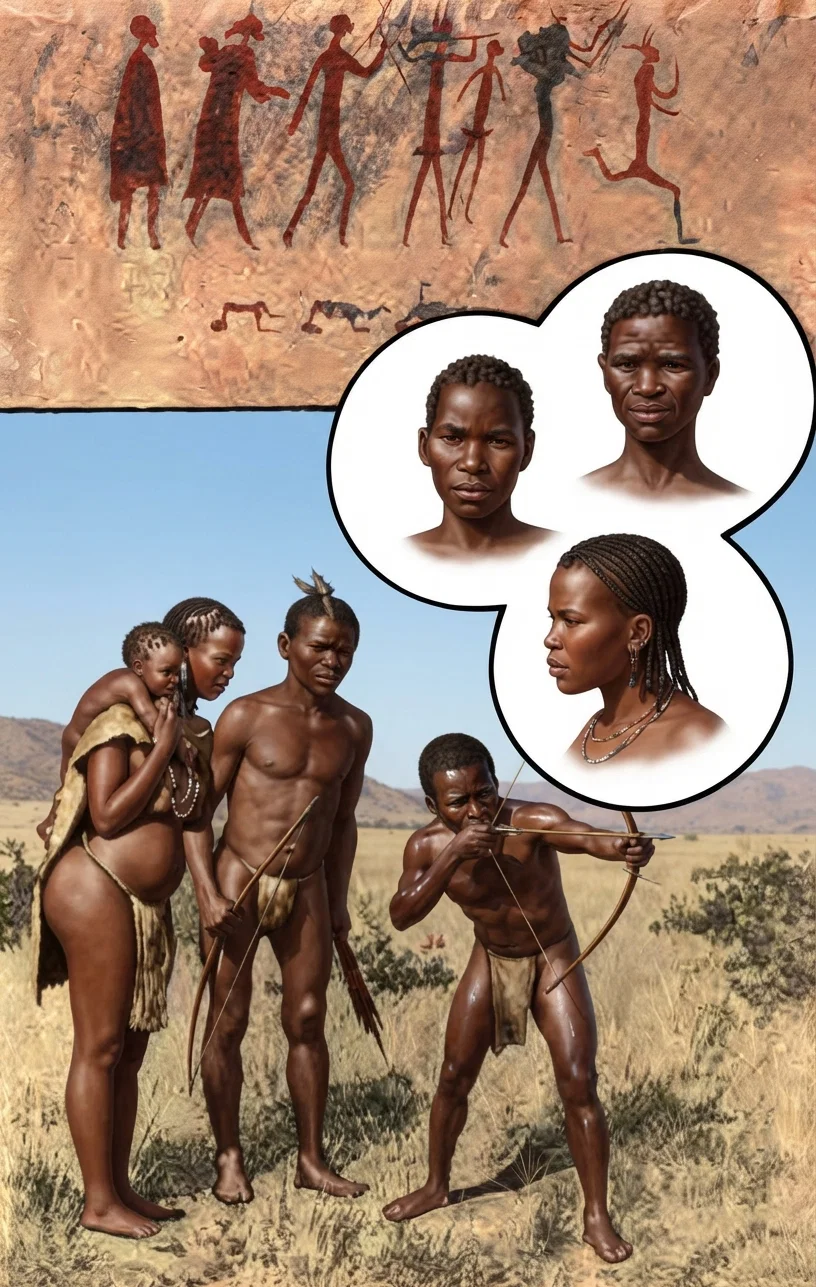
BUSHMEN 1. Bushmen drawings on the rocks. 2. Types: of man, boy, woman. 3. A family group.
Also chapter 12 gives the history of the church of Christ from the birth of the Saviour to A. D. 1798, the end of the 1,260 days of papal supremacy. Verses 1-6. Then, there being other particulars to bring out, we are taken back, in verse 7, to the beginning of Christ's ministry, and from that time down again to and through the 1,260 days, and to the development of God's remnant people.
The vision of Revelation 14, beginning with verse 6, reaches from the time when the proclamation of the threefold message began, to the time of the faithful, waiting church, "that keep the commandments of God, and the faith of Jesus" (verse 12); and still further to the glorious appearing of Jesus Christ, and the reaping of the "harvest of the earth"—God's elect; and from that point forward to the final and complete destruction of the impenitent, a thousand years later.
THE ANGELS THAT POUR OUT THE SEVEN LAST PLAGUES
Then begins the story of chapter 15, where we see the "seven angels having the seven last plagues," in which "is filled up the wrath of God"; and we are brought onward until we view God's people delivered, and glorifying God upon the "sea of glass." Verses 1-4.
The work of the pouring out of these plagues has its fulfillment before Jesus comes, and therefore finds its place in the prophecy of Revelation 14, after the threefold message has accomplished its work, and probation is over, just before the Lord is revealed in glory.
In Rev. 15: 5-8, the seven angels are shown, to whom are given the "seven golden vials full of the wrath of God"; and "the temple of the tabernacle of the testimony in heaven" is seen, "filled with smoke from the glory of God, and from His power; and no man ["no one," R. V.] was able to enter the temple, till the seven plagues of the seven angels were fulfilled."
THE REMNANT CHURCH PASS THROUGH IT
Through that awful experience — the pouring out of these terrible judgments — God's remnant people are to pass. It would seem as though the Lord were anxious that His people should know that in every trying ordeal, He watches over His own; and as though He were giving them a glimpse, in verses 2-4, of their final victory and deliverance; that when His people shall have reached the fulfillment of the prophecy and are passing through that fearful hour, they may take courage.
Leaving for another study the pouring out of the plagues, we shall review the experiences through which the people of God pass at that time.
TRIUMPHANT ON THE SEA OF GLASS
The prophet John sees "as it were a sea of glass." In Rev. 4: 6, he locates this "sea of glass" as being "before the throne." He sees a company who have "gotten the victory over the beast, and over his image, and over his mark, and over the number of his name," stand on this "sea of glass, having the harps of God." Rev. 15: 2.
Here is brought to view a redeemed people, a people who would not yield obedience to the claims and commands of the papacy, nor of unfaithful Protestantism, which endeavor to force upon them, by the decrees of the powers of earth, "the mark of the beast." They face the crisis even to the last extreme, when the fiat has gone forth that "as many as would not worship the image of the beast should be killed." Rev. 13: 15.6
SATAN HAS DONE HIS WORST AND FAILED
At the time here represented, Satan will have done his utmost, and failed. He will have vented his wrath upon God's remnant church, in one last supreme, world-wide effort to force them from their allegiance to God; and failing in this, he will seek their destruction. The world, in its rejection of God, will have become a veritable cesspool of iniquity. A church world-wide, and with a profession as high as the very heavens, will have made all nations drunk with her deceptions and false doctrines, and joined in an unholy alliance with the world-wide state. The greatest apostasy in a world's history then rules supreme. Religious bigotry, in its fullest measure, will control the day. Man's individual liberty, civil and religious, will be denied him; and the eternal principle that a man's relation to his God is above human legislation, and his right of conscience inalienable, will be trampled underfoot. Probation will be closed. The Spirit of God will have been withdrawn from the earth, and every evil tendency will be doing its work without the restraint of Heaven.
STAND TRUE IN THE FACE OF DIFFICULTIES
Against the wickedness of the world, God's remnant people stand proof. In the midst of the hollow mockery of religious cant, they will remain pure. Against every pressure to compel them to yield their conscientious scruples in the matter of their service and worship to God, they will successfully resist. And though, in a last great effort to force upon them "the mark of the beast"—the observance of Sunday—they will face the extreme penalty of the law, yet they will not flinch; but with an abiding faith in God, and an obedience that meets the approval of Heaven, they will calmly await the outcome. Kept by the power of God, they will render to Him the "full measure of devotion," and God will not fail them.
Under the inspiration of the evil one, Rome and apostate Protestantism will seek to put out of the way God's faithful commandment keepers. God's remnant are to them, as was Elijah to the apostate Ahab, the troubler in Israel. 1 Kings 18: 17. But as Ahab, and not the fearless and faithful prophet, was the transgressor, having "forsaken the commandments of the Lord," so in this experience, the professed church, in her apostasy, raises her hand in rebellion against God, to smite His faithful remnant.
The hour comes for them to do their terrible deed; but God mercifully draws the curtain. He hides, even from these violators of His law, and destroyers of His people, the awful depravity they have reached, in seeking to stain their hands with innocent blood; and then, as the curtain is again pulled aside, the scene is given us of His people singing upon the sea of glass before the throne of God.
THE SONG OF DELIVERANCE IS SUNG
The song they sing is "the song of Moses the servant of God, and the song of the Lamb." Rev. 15: 3, 4. That song of Moses was a song of deliverance. See Exodus 15. The deliverance of Moses and the children of Israel was from the hands of wicked men—Pharaoh and his army, bent on their destruction. The song was the song of their experience.
The song of the Lamb is the song of victory. This was the experience of the Lamb of God. Not victory over wicked men, for they took Him and put Him to death. His was victory over sin. Born of sinful human flesh, and in sinful human flesh, He overcame sin, that you and I, by His indwelling in our sinful human flesh, might overcome sin.
He became a sacrifice for sin, but He "knew no sin." 2 Cor. 5: 21. He "did no sin, neither was guile found in His mouth." 1 Peter 2: 22. Touched though He was with all the weaknesses of the flesh, like the rest of us, and "in all points tempted like as we are" (Heb. 4: 15), yet He gained victory over sin; and in that victory was the assurance that poor, erring, wayward humanity would not fail.
God's remnant people will sing "the song of Moses . . . and the song of the Lamb." This is the song of their experience. They will be delivered; and that, too, from the hands of wicked men—religious zealots, who in willful sin do despite to the Spirit of grace, and seek their destruction. And they will have "victory over the beast, and over his image, and over his mark." They will in fact, in the very experience through which they pass, gain the victory over all sin. They will pass the test of the Judgment; and as of the victory of Christ over sin we read, "Neither was guile found in His mouth" (1 Peter 2: 22), so we read of God's faithful remnant, "And in their mouth was found no guile: for they are without fault before the throne of God" (Rev. 14: 5).
This is the song of the one hundred forty-four thousand, God's delivered, victorious, translated children. It is the song of that company who are seen on Mount Zion with the Lamb, and who have "His Father's name written in their foreheads." Rev. 14: 1. It is their song only. Verse 3. They will be sealed "in their foreheads" with "the seal of the living God." Rev. 7: 1-4. Under the proclamation of God's last message of mercy, the threefold message of Revelation 14, they turn from the traditions of men to the word of the living God, and from the commandments of men to the commandments of God. The Sabbath of the fourth commandment—the seventh day of the week—the seal of the living God, is to them, as God has declared it, "the sign between Me and you, that ye may know that I am the Lord your God." Ezek. 20: 20.
God will signally honor these faithful servants. He will make them His "first fruits." Rev. 14: 4. He will deliver them from the destruction of men; and in our study, we see them as His translated ones, "redeemed from among men," before the throne, a glorified company.
It would be well for you and me to be numbered among that triumphant, happy throng. In the solemn messages we have been studying together, is the invitation to this glorious realization. The call of the Infinite One is to you and me. The call of faith is to the keeping of the commandments of God. The call of God to eternal life is by the pathway of obedience. His law is the test of character in the Judgment, now almost over. Character alone is what saves. He whose character is formed upon the eternal principles of God's holy law, and in whose life the principles of that law are seen—he alone can stand the shock of sin. "They shall be Mine, saith the Lord of hosts, in that day when I make up My special treasure; and I will spare them, as a man spareth his own son that serveth him." Mal. 3: 17, margin.
They were loyal and obedient. They honored God's Sabbath. They "loved not their lives unto the death," and God will crown them with honor and glory.
They gave their hearts and their all in absolute surrender to God; and in submission to the will of God, they overcame. And the promise in glad fulfillment to them is: "He that overcometh shall inherit all things; and I will be his God, and he shall be My son." Rev. 21: 7.
May you, dear reader, through surrender, share with this "remnant" people these glorious things.
We Cannot Turn Ourselves Alone
By Mrs. Iva F. Cady
MANY good resolutions are made, and then broken because of self-confidence. Trusting in self, we are sure to fail. Are we not told that it is just as impossible for one accustomed to do evil to turn and do good, as it is for the Ethiopian to change his skin, or a leopard his spots?
Yet it is necessary that "the wicked forsake his way" if he would be saved, and it is possible for us to reform our habits of life. The Lord is able to keep us from falling, and to turn us into the right way. So, instead of relying upon self, let us make this our daily prayer to Him: "Turn Thou me, and I shall be turned; for Thou art the Lord my God." Jer. 31: 18.
MRS. IVA F. CADY.
God’s Work Begins in Grace
"God's work will not end in His glory unless it is begun in His grace."
Sin Allowed to Run Its Course
By WALTER E. GILLIS
Why Was It Permitted? — The Twofold Nature of God's Law — Mercy Mingled with Sacrifice — The Ministration That Exceeds in Glory
By WALTER E. GILLIS
THE most serious difficulty attending the attainment of a true knowledge of the great moral controversy now in progress in this world is not in its abstruseness, but in the superficial attention that is almost universally given to the subject. The subject is not only reasonable, but is susceptible of the minutest investigation.
SIMPLICITY OF SALVATION'S PLAN
To the earnest student of the Word, prophetic history furnishes a foundation upon which he may build his faith with utmost assurance. The plan of salvation is so simply and thoroughly developed that a man, though a fool, need not err therein. It meets the needs of all classes so satisfyingly that it bears testimony to its divine authorship.
On the other hand, sin bears evidence of its own destructive character. Who that has broken the commandments of God, and given thought to the matter, does not acknowledge that he has done a destructive thing — that he has done something that has weakened his moral timber, and would make him ashamed in the presence of purity and righteousness? There is no place or excuse for sin in the economy of God.
REASON FOR ALLOWING SIN TO RUN ITS COURSE
However, notwithstanding the repulsive character of the sin that is prevalent in the earth, there is good reason for a just and merciful God to permit its existence for a time. It is suffered in order that intelligent beings of various orders of creation may see its course, and for themselves determine its worthlessness, and satisfy themselves of God's justice in finally destroying Satan, its author, one who, before his rebellion, stood first in the ranks of the heavenly host.
Again, the entrance of sin called into action latent phases of the law of God, which, to be understood and approved, required time for development. These qualities, unknown to the sinless ones, have been denominated "ministration of condemnation" and "ministration of righteousness" by the great apostle Paul — two phrases designating the two dispensations through whose centuries God has worked for the reconciliation of man.
When human life entered this planet, certain statements of fact were made by the Creator to His new subjects. Adam and Eve were made acquainted with the law of universal dominion — the Ten Commandments. They were told that in the day when they transgressed its principles, dying they should die, not because they had crossed the will of a despot, but as an inevitable consequence of conflict with the law. Living in harmony with it, the abundant life then coursing through their veins would be perpetuated.39
AFFIRMATIVE AND NEGATIVE NATURES OF THE LAW
Tangible, concrete evidences of the dual nature of the divine law were placed before them in their garden home. These evidences were the tree of life and the tree of knowledge. Of the affirmative benefits of the law, they were put in immediate possession. Continued obedience entitled them to partake of the fruit forever. With the negative principle in the law, they were told not to meddle. Their times and seasons were in the hand of their Creator; and He, in the course of perfecting their education as subjects of the universal and eternal kingdom of God, would put them in possession of everything that was necessary and just.
It was not only the prerogative of the Creator to exact unfailing obedience to His laws, but it was both sensible and just. These newly created creatures, with the right of choice, were relatively in the place of the child in the home. By prohibition, education, and test, the child becomes a man or woman of firm, symmetrical character, in harmony with all right laws and customs. Where law is absolute and accurate, as that of God's vast domain, how natural and right that the new citizen should be tested and tried before being admitted to permanent citizenship!
THEY COLLIDE WITH LUCIFER
The parents of our race were thus auspiciously launched on the ocean of life. But in a short time, they collided with the fallen cherub Lucifer, the enemy of God, and made wreck of their fair prospects. An attribute of God until then undiscerned by them saved them from immediate destruction. The commandment says, "Showing mercy unto thousands [of generations] of them that love Me, and keep My commandments." Adam and Eve had been decoyed into transgressing the law. In consequence, the mercy of God comes into action, and supplies a Substitute who will bear the penalty, in order that they may have an opportunity to redeem their failure.
DEVELOPMENT OF CHARACTER THE PURPOSE
Let us not forget the original purpose of God; namely, the development of a character, in these new subjects of the kingdom, that would perpetually guarantee their being in harmony with the laws of God. Although the situation is now reversed, the requirement continues the same. In the Garden of Eden, they had in possession the benefits of the affirmative phase of the law of God, and were required to take by faith the negative attributes, represented in the tree of knowledge. But they forfeited that which they had, and reversed their relation to the law. Henceforth they would have in possession the negative qualities in the law, and take by faith the abounding life in the law as represented in the tree of life. "The just shall live by his faith" then as now.
TYPICAL CEREMONIES INAUGURATED
In order that man should fully appreciate and bear in remembrance his changed relations with the law, God inaugurated a system of typical ceremonies that presented to the observers, in object lessons, the negative qualities in the divine law, and the only avenue of escape from their condign consequences. It revealed to them that law is inflexible — transgression means death. Ezek. 18: 24; Rom. 6: 23. The substitute typified the exalted character of the only Substitute that the law could accept — the Lamb of God.
In this system, all the avenues of approach to God were barred until a bleeding victim opened the way. A substitute must die for the suppliant. Truly this was rightly named the "ministration of condemnation." Only thus could the law be exalted, and the sinner brought to realize the awful nature of disobedience. For four thousand years, this sanguinary ministration of the law continued.
MERCY MINGLED IN THE SACRIFICE
But remember that with the smoke of the sacrifices there ascended the sweet incense, symbolizing the mercy to be found in the Substitute that the law could accept. The formalist saw only the ceremony and the bleeding sacrifice; and for him it was written: "I desired mercy, and not sacrifice; and the knowledge of God more than burnt offerings. But they like Adam have transgressed the covenant." Hosea 6: 6, 7, margin. The sincere child of God saw by faith a merciful Saviour bruised for his iniquities, and raised to ascend as sweet incense to the throne of God, an eternal guarantee for those who trust in His mercy.
So, while the dispensation was designed to teach to men and to angels the condemnation that is found in the transgression of God's holy law, yet there was ever present that which pointed to the efficacy of the Substitute as a propitiation for the sinner who claimed by faith the life proffered in Him.
THE SUBSTITUTE APPEARS IN PERSON
Now a change has taken place. The Substitute Himself has come, and yielded up His life on Calvary's cross, as a satisfaction of the penalty that must otherwise have been visited upon every transgressor of the law of God. The legacy of life written in that promise recorded in Gen. 3: 15, has now been confirmed by the death of the Testator. Restoration of the sinner no longer rests upon a promise, but upon an accomplished fact. The justice in the law can no longer exalt itself against mercy. "The ministration of condemnation" must cease, for "mercy and truth ["Thy law is the truth"] have met together; righteousness [right doing, the demand of the law] and peace have kissed each other." Ps. 85: 10.
The glorious dispensation of temple ceremonial and Shekinah, of proclamation of the law and the theocracy, is now to give place to the more glorious one of righteousness ministered by a divine-human High Priest in a temple not built with hands, eternal in the heavens. "For Christ is not entered into the holy places made with hands, which are the figures of the true; but into heaven itself, now to appear in the presence of God for us." Heb. 9: 24. Jesus, as our Substitute in satisfaction of the claims of the broken law, becomes to us the way of life. To Him whom to know is eternal life (John 17: 3), we have direct access.
"Seeing then that we have a great High Priest, that is passed into the heavens, Jesus the Son of God, let us hold fast our profession. For we have not an high priest which cannot be touched with the feeling of our infirmities; but was in all points tempted like as we are, yet without sin. Let us therefore come boldly unto the throne of grace, that we may obtain mercy, and find grace to help in time of need." Heb. 4: 14-16.
A VICARIOUS SALVATION
The "ministration of righteousness" does not only contemplate a temple and a High Priest in the heavens. The vicarious punishment suffered for the transgressed law involved a vicarious salvation for the one delivered. Paul the apostle has written distinctly about this new relationship: "I am crucified with Christ: nevertheless I live; yet not I, but Christ liveth in me: and the life which I now live in the flesh I live by the faith of the Son of God, who loved me, and gave Himself for me." Gal. 2: 20.
And again: "For God, who commanded the light to shine out of darkness, hath shined in our hearts, to give the light of the knowledge of the glory of God in the face of Jesus Christ." 2 Cor. 4: 6. And as another has said: "We dwell too near the lowlands of earth. Let us raise our eyes to the open door of the sanctuary above, where the light of the glory of God shines in the face of Jesus, who is able to save them to the uttermost that come unto God by Him."
THE LAW ON THE HEART
Christ said, "I am the way, the truth, and the life" (John 14: 6); and the psalmist wrote, "Thy law is the truth" (Ps. 119: 142). So we would naturally expect to find a close relationship between these two divine forces in the redemption of man. And it is so. The new covenant, which is in reality the foundation of "the ministration of righteousness," provides, "I will put My law in their inward parts, and write it in their hearts; and will be their God, and they shall be My people." Jer. 31: 31-33.
Jesus declared the secret of this new covenant relationship to His disciples: "He that hath My commandments, and keepeth them, he it is that loveth Me: and he that loveth Me shall be loved of My Father, and I will love him, and will manifest Myself to him. . . . If a man love Me, he will keep My words: and My Father will love him, and We will come unto him, and make Our abode with him." John 14: 21, 23.
DIFFERENT EXPRESSIONS OF THE TRUTH
To accomplish this union, God has sent His Holy Spirit. In John 15: 26, it is denominated "the Spirit of truth." Thus we have the law "the truth," Jesus "the truth," and the Holy Spirit "the Spirit of truth." And that heavenly Presence brooding over the chaos that transgression of the law has wrought, will finally bring the redeemed to Zion, where they will again have a right to the tree of life; for they have washed away their transgression in the blood of the divine Substitute for a broken law. Rev. 22: 14.
Peace
By E. W. Catlin
"SEEK peace, and pursue it." Ps. 34: 14. Man may find peace with his God; "for He is our peace, who hath made both one, and hath broken down the middle wall of partition between us; having abolished in His flesh the enmity." Eph. 2: 14, 15.
He may find peace with his fellow men; for "when a man's ways please the Lord, He maketh even his enemies to be at peace with him." Prov. 16: 7.
He may find peace with himself — peace of conscience; because "the fruit of the Spirit is love, joy, peace." Gal. 5: 22.
Jesus said, "Peace I leave with you, My peace I give unto you." John 14: 27. The peace of Christ, which brings peace with God, with man, and with self, cannot be found bursting forth from the mouth of the howitzer rumbling at our neighbor's door. It cannot be found in the superdreadnaught that majestically sits guarding the way. It is not found in the submarine stealthily coursing through the ocean depths, seeking its unsuspecting prey. Neither is it found in the wings of the bomb-laden dirigible hovering over land and sea.
Peace is found in Him who is "the way, the truth, and the life." Oh, then seek Him while He may be found, and thus find peace and pursue it; for "when they shall say, Peace and safety," and the siren note sounds loudest, "then sudden destruction cometh upon them, . . . and they shall not escape." 1 Thess. 5: 3. "But the meek shall inherit the earth; and shall delight themselves in the abundance of peace." Ps. 37: 11.
E. W. CATLIN.
THE TREE OF LIFE
By J. O. C.
Removed from Earth to Heaven—If Left on Earth for Man's Use, Would Have Immortalized Sin—The True Vine and the Living Word That Impart Life Now
THIS tree is first mentioned in the second chapter of Genesis, and is said to have been located in the midst of the Garden of Eden, the home of our first parents while they were yet in the image of their Creator. Indeed, it was intended to be the means of the perpetual existence of man as a "son of God." Luke 3: 38. But when, through disobedience, man lost God's image, access to the tree of life was denied him, lest he should eat thereof, and thus eternally perpetuate a life of sorrow and misery. Gen. 3: 22-24. While man, shut away from the tree of life, must weaken and die, the tree of life could not die. But to continue as a tree of life, it must of necessity perform the functions for which it was created. It could not do this by remaining on earth, since earth sojourners were shut away from it on account of sin. It was therefore removed to a holier atmosphere, and knowledge of it became so clouded that no direct reference to it is discovered until after the life-giving Christ came down to earth. By the touch of His life power, the very lowest in moral corruption will be permitted to eat of the tree of life, which is in the midst of heaven's pleasure ground, the Paradise of God. Rev. 2: 7.41
NOW BY THE RIVER OF LIFE
From another beautiful reference to this tree of life, one knows that it now occupies a position on either side of the river of life, which proceeds out of the throne of God, and its leaves are for the "healing," or restoration, of the nations.
Faith easily grasps the thought of a redeemed people being privileged to partake of life's tree in the long hereafter; but the text conveys the idea that somehow its leaves have to do with the healing of the malady of sin in this present world. Then, too, by its close association with the river of God's pleasures (Ps. 36: 8), the water of life so freely offered to all, even in this stage of being (John 7: 37; Rev. 21: 6), one is led to think that some property of the leaves of the tree of life is available for the restoration of man's original right to Eden.
THE TREE THAT FAILED
The house of Israel was planted as a "choice vine" and a "pleasant plant." Isa. 5: 1-7. Later the Lord called it a "green olive tree," which was not only "fair," or beautiful, but bore "goodly fruit." Jer. 11: 16. This would seem to indicate that it was at first patterned after the Edenic tree; but failing to continue in goodly bearing, its branches were broken, thus making way for other branches to fill the vacancy. Rom. 11: 17-24.
But the newly grafted branches that are to take the places of those cast-off parts of the tree, can find their places only through faith in Him who is the way, the truth, and the life. Not only so, but the faith thus exercised must make the connection by which they become branches of the "true Vine." John 15: 1-5.
Thus united, the branches bear "much fruit." But of what nature will be the fruit of such connection? — It must be of the sort for which the tree can be responsible. Then since Christ, who is the life of believers in every nation, proclaims Himself the real Vine, from which the believing branches receive their life and productiveness, it follows that the fruit they bear must also be for the healing benefit of all nations.
But the leaves of this tree, with their healing power, may be compared to the word of God. It is by this Word that men are born into the kingdom of God. 1 Peter 1: 23. When this living Word is present in the citadel of man's affections, no request preferred at the throne of heaven will be denied. John 15: 7. It is therefore the only source of permanent satisfaction. This fact is clearly established by reference to its influence upon former heathen.
Dr. S. Reynolds Turner, writing of a converted heathen of Amoy, China, says: "We were standing on a hillside overlooking the sea, which at that part of the coast is dotted over with islands, and I was reveling in the beauty of the scene under a bright sun and clear skies. Suddenly he turned to me and said, 'Isn't it beautiful!' I agreed heartily, but added that I thought Chinamen did not, as a rule, pay attention to such things. 'Ah,' he said, 'I never saw anything about me, or thought anything beautiful or worth looking at, until I became a Christian. But since then, the world gets daily more beautiful; and the more I see of it, the more I comprehend our dear Father in heaven.'"
It would be the height of folly to declare that this man's heathen darkness had not been dispelled, and that his soul had not been under the healing process of the divine Word. But there is yet a more cheering view of this healing work, and that is the permanency of its operations.
SUPERSTITION GIVES WAY IN AFRICAN CONVERT
A single incident may be cited to illustrate this point. Bishop Tugwell, in an address in London, referred to a case in West Africa. After a certain service, He said to the Christian converts, "Now I want you all to come and preach in the open air." They followed him to the market place, where was assembled an unusually large congregation. The two classes, Christians and heathen, stood in separate groups. The contrast between these classes was remarkable. The Christians were bright, clean, cheerful, and happy, while the heathen looked degraded and miserable. Seven years before, all were alike heathen. A Christian woman was called on to speak. Stepping forward with her Yoruba Bible held aloft, she said:
"I want to tell you that if you once taste what is written in that Book, you will never forsake it. I will give you two illustrations. You remember that when the white man came and told you to collect rubber from the trees, you refused to do so, and said, 'If it falls on our skin, we shall have leprosy.' But when you saw other people collecting it, and found that they did not get leprosy, but that they got money, then you lost your fear, and now you are all rushing for rubber. Is not that so?" They said "Yes." She then said: "Can any one drive you from it now? — No. Why not? — Because you have found it a good thing. Now if once you taste the word of God, you will never let any one drive you away from it."
Following this argument, she said: "When the white man came and offered you silver, you said you did not want pan [that is, tin]. You said, 'We want cowrie shells' [their old-time currency]. But now, if any one offers you silver, will you throw it away?" — "No." "Why? — Because you have learned the value of silver money. So it is with the word of God; once taste it, and you will never let any one drive you away from it."
Who can deny that upon such people the "beauty of the Lord our God" abides? Are not such cases true examples of the healing power of the word of the living God? J. O. C.
DEVOTION OF THE FILIPINOS
By A. G. Daniells
The Earnestness with Which the Native Converts Enter the Work
What May Be Done with Such a People
THE grace of God is working marvelous changes in the hearts of men and women in non-Christian and non-Protestant lands. The converts to Christianity in these lands of darkness seem to make very rapid progress in Christian life and experience.
APPEALING FILIPINO ADDRESSES
On our arrival at Manila, our Filipino brethren and sisters gave us a welcome in a tent in which they were conducting a series of meetings. The exercises consisted of singing hymns in their vernacular, and presenting to us appeals in behalf of their people. These appeals were made separately by five young men and one very old man.
DESIRES A SCHOOL FOR TRAINING THEM
Emilio Manalaysay, one of our most earnest, faithful evangelists and translators, said: "I represent the Tagalog people living in the central and southern part of the island of Luzon. My people number about 1,500,000. Being in closest touch with Manila, the capital, they have been enlightened and influenced more than any of the other people of the Philippines, by recent changes in the islands. Our work in the Philippines began among the Tagalog people. We now have three churches, with a membership of three hundred; and four companies, of about one hundred believers, awaiting baptism. My earnest request is for a school in which to train the scores of our young people who have a great desire to give their lives to this work."
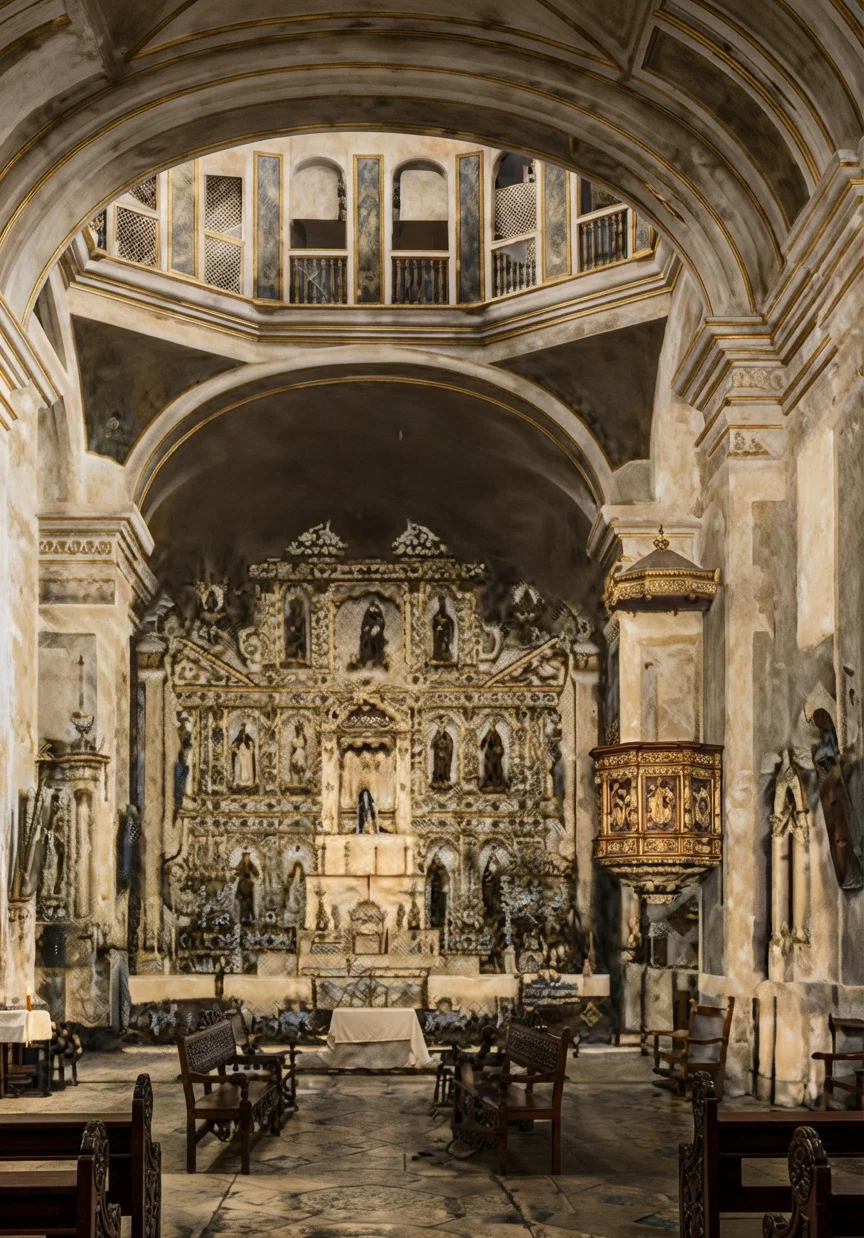
INTERIOR OF CHURCH, SANTA ANA, P. I.
INDUSTRIOUS AND CALLING FOR LIGHT
Leon Roda said: "I address you in behalf of the Ilocano people, who live in the northwestern part of the island of Luzon. They number about 850,000 souls. They are very industrious, and come behind none in intellectual attainments. We have opened up one mission among this tribe. Elder Roy Hay is in Vigan, and has been studying the language for one year. My people are in great darkness, and I long to have the third angel's message made known to them. I desire to be released from work among the Tagalog people, and be sent to labor for my people, the Ilocanos."
SHOULD BE TAUGHT THAT JESUS IS COMING
Augustin Panaga said: "I am the only Sabbath keeper among the 160,000 Cagayan people. None of them know that Jesus is soon coming, and they are not prepared to meet Him. My request is that I may be sent with some foreign worker to give this message to my people."
PROSPECTS FOR HARVEST OF SOULS
Ricardo Sabella said: "The Visayan people, whom I represent, live in the southern islands of the group, and outnumber all the other tribes. They number 3,222,000 souls. We have started work in two of the largest islands of the Visayans; and the prospect is very bright for many souls being won for the Master."
PLEADS FOR LITERATURE FOR HIS PEOPLE
Daniel Balayo said: "I am the only Sabbath keeper of the Bicol people. There are less than 570,000 of them, but they must hear this message. I am distributing our Tagalog literature. My request is that you will soon provide literature in the language of my people, that I may take the message to them."
EARNESTLY REQUESTS PAMPANGAN LITERATURE
Apolonio de Jesus said: "I represent the Pampangan people. They live just north of the Tagalog people; but thus far, no one has been there to tell them of the soon coming of Jesus. I am now seventy-three years of age, yet I am very busy selling our Tagalog books. I request you to print books in the language of the Pampangan people, and I will take the message to them."
WHAT COULD NOT SUCH PEOPLE DO?
Men and women possessing the earnestness, intelligence, and consecration manifested by these believers, are a great asset to our cause in the Philippines. Given good training and leadership, they will be a great help in quickly proclaiming the message for this time to all the people in these islands. A. G. D.