Your ShelfYour Projects

Signs of the Times, Vol. 37, No. 43.

In This Issue

Signs of the Times

Nov 1, 1910

Pacific Press Publishing Association · Mountain View, California · Nov 1, 1910

In This Issue

Leading General Articles

The Value of Bible Study, By Mrs. E. G. White - - - - - - 3
The Revelation of Jesus Christ—The Introduction to the Study of the Apocalypse - - - - - - 5
The Master's Coming—No. 1. His First Advent a Literal Coming, Foretold by Prophecy and Fulfilled in Fact, By Charles L. Taylor - - - - - 6
Jesus Saves (editorial) - - - - 9

The Outlook

The Papal Outlook - - - - - 10
"Troublous Times Shall Come" - - 10
The Would-Be Arbitrator of the Nations 11

Missions

The Beggar-Leper—A Type, By J. N. Anderson - - - - - - 14

Poetry

Lay Hold, By L. G. Culver - - - 4
When God Dwelt Among Us, By Delwin Rees Buckner - - - - - 6
Is There No Death? By George E. Tack - 7

Question Corner

Under the Law - - - - - 2
A Perfect Sacrifice - - - - - 2
In the Days of These Kings - - - 2

Our Bible Reading

Prophecy: Its Object and Importance - 8

The Story

Shiloh: the Man of Sorrows—Chapter 35. In the Evil Council - - - - 12

Truth of the Bible

Schedule for the Week Ending November 12
Sunday, November 6 Acts 8, 9
Monday, " 7 " 10, 11
Tuesday, " 8 " 12, 13
Wednesday, " 9 " 14, 15
Thursday, " 10 " 16, 17
Friday, " 11 " 18, 19
Sabbath, " 12 " 20, 21
THIS whole week is upon the book of Acts, chapters 8-21 inclusive, bringing in the wonderful conversion of Paul and much of his ministry. Very instructive indeed is the life of the apostle in his teaching, and this is especially true of the latter part of chapter 20, in the instruction which he gave to the elders of the Ephesus church.
Our Bible Band.—We are gratified and glad of the postal card responses we are getting from Our Bible Band members. So many, in addition to the answer to our questions, tell how much they have been blessed and helped.

Truth of the Bible

Lord Rochester was an avowed infidel, and a large portion of his time was spent ridiculing the Bible. He was described as a great wit, a great sinner, and a great penitent. He was converted by the Holy Spirit in the use of the Word. In reading the fifty-third chapter of Isaiah, he was convinced of the truth and inspiration of the Scriptures and the Divinity of Christ. He trusted in the atonement, and died in expectation of heavenly happiness.

"IF YE WILL INQUIRE, INQUIRE YE."

This Inquirers' Department is conducted for the purpose of helping those who are studying the Bible. The answers are oftentimes only suggestive. They are never to be considered infallible, only as they agree with the infallible Word. The writer who may answer them does not consider that his opinion is infallible. He will simply give the best that he has, and plead with the inquirer to search the Word. Such questions only will be answered as, to the editors, seem to minister to the good of the readers and to the mission of the paper. We can not answer repeatedly in the same volume questions upon the same scripture. The name and address must accompany question, not for publication, but as an evidence of good faith, and that answer may be made by letter if deemed advisable. No letters are answered which do not contain the name of the writer. It is well always to enclose stamp for reply.

3274.—Reverend

Is it right to use the word "reverend" as applied to man?
The English word occurs but once in the Bible, namely, in Ps. 111:9, and is then applied to God: "Holy and reverend is His name." But the original word yawray occurs more frequently and is rendered "affright," "be afraid," "dread," "fear," etc. It is not applied to man, but is applied to inanimate objects. Words undergo a change of meaning by usage; sometimes they are elevated in their meaning; sometimes the word is degraded. That is true with the term "reverend;" it does not mean what it formerly meant; it has come simply to mean a title for a minister or preacher, and it is generally applied to such, utterly incongruous tho it may be to its original meaning. Inasmuch as it is so generally applied, the best way perhaps is to use the word not in its original sense, but in its now ordinary sense. It would be better, however, it seems to us, to use "pastor" or "elder" to designate preachers, instead of "reverend."
Another word which has undergone the same degradation or debasement is that of "divinity." The former expression "Divinity of Christ," meant the Deity of Christ; but the new human religious view makes all men by nature as truly divine, tho perhaps not to the same degree as was Jesus. According to the new use those who wish to speak of the "Divinity of Christ" in the old meaning of the term must use the word "deity" instead of "divinity." Human usage generally lowers the value of words instead of enhancing them. The Gospel of Jesus Christ did the very opposite — it took Greek words which were low in their origin and made them of divine import. It is good to know that in the wealth of our language if a sacred term does become so abused as to lose its original meaning, we have another to take its place.

3277.—The Resurrection

Do all the wicked rise from the dead when Christ comes or only those who pierced Him? and then what becomes of them? G. H.
The first verses of Daniel 12 would seem to indicate that some of the wicked dead are raised when our Lord stands up to reign. That would be just before His coming. They would be raised in order that they might see the awful fruits of sin and witness the second coming of Christ. They would, of course, perish when the rest of the wicked perish in the glory of His coming. The general resurrection of the wicked, however, does not take place until the end of the thousand years, as shown in Rev. 20:5, 6, "The rest of the dead lived not again until the thousand years were finished." That is, the special resurrections are not taken account of in the great general statements. In the second general resurrection doubtless those who were raised previous to His first coming would be raised again. The first resurrection of these wicked then would be incidental, as would their second death. This would not, however, be the second death to which the book of Revelation refers.

3272.—Under the Law

Please tell me the meaning of 1 Cor. 9:21 in regard to the law. J. O. J.
"Under the law," with the exception of its occurrence in Rom. 3:19 and 1 Cor. 9:21, means under the condemnation of the law. "Under the law" is the opposite of having one's sins forgiven, or being "under grace." Rom. 6:14, 15. To be "under the law" is to be under the lordship of sin, and those under the dominion of sin are condemned by the law. The expression in Rom. 3:19 comes from the Greek, en to nomo, literally "within the law," subject to its scope and jurisdiction. In 1 Cor. 9:21 we have en nomos, which ought to be "within law to Christ." All other expressions come from hupo nomon, which means literally "under the law," or "under law." In the light of these simple facts read 1 Cor. 9:21. To the Jews Paul counted himself a Jew, as he really was; to them under the law, or sinners, he counted himself also a sinner, even the chief of sinners, in order that he might win sinners. To those who had no knowledge of the written law of God, he placed himself alongside them, poor and ignorant; yet he was not free from God's law, and was bound within law to the grace of Christ, to serve and win all. The apostle placed himself alongside all men that he might win all. See tract, "Under the Law, or Under Grace?" "Bible Students' Library," No. 163.

3273.—The Thieves on the Cross

Mark 15:32 and Matt. 27:44 seem to include both the thieves, while Luke 23:39 says "one of the malefactors railed on Him." Does there not seem to be a contradiction here?
The matter will be readily understood if our querist will but take this thought into consideration: In the beginning both of the thieves probably railed on Jesus, but the patient suffering of the Master touched the heart of one of them and brought him to repentance. Matthew and Mark in a general statement speak of both. Luke is more specific and tells of the repentance of one.

3275.—Perfect Sacrifice

Please explain Deut. 15:21. J. C.
Verses 21 and 22 read as follows: "And if it have any blemish, as if it be lame or blind, any ill blemish whatsoever, thou shalt not sacrifice it unto Jehovah thy God. Thou shalt eat it within thy gates: the unclean and the clean shall eat it alike, as the gazelle, and as the hart." The one point in the scripture is that the sacrifice offered to God shall be perfect. Every sacrifice offered typified in some sense the Lord Jesus Christ; and as He was a perfect moral sacrifice, so every beast offered for sacrifice should be physically perfect as typifying the perfect offering of Jesus. The permission to eat did not imply that everything rejected for sacrifice should be eaten. It merely granted permission to eat things that are good, meats that are clean, as the hart and the gazelle, and yet which might be physically imperfect; for instance, an animal might be lame and still be healthy.
It is possible that our correspondent may refer to the 21st verse of the previous chapter, where permission was given to the children of Israel to give that which died of itself to strangers, but which they themselves should not eat. In thus doing they would only sell to the stranger when the stranger knew that the animal had died of itself. That would be taking no advantage of the stranger when he knew it. It was customary, and is still, in some lands, for people to eat that which died of itself. Therefore when Israel sold such a carcass the stranger bought it with the fullest knowledge of what it meant.

3276.— In the Days of These Kings

In Dan. 2:44 it reads, "In the days of these kings shall the God of heaven set up a kingdom, which shall never be destroyed." It did not say a thousand years after, but in their days a kingdom shall be set up which shall consume all these kingdoms, and it shall stand forever.
M. B.
All this is very simple when we will take into consideration the fact that the prophet is not speaking of his days, but of days to come. That dream of Nebuchadnezzar, shown to Daniel in vision, had to do not simply with Babylon, which existed in the days of the prophet, but with Medo-Persia, Grecia, and Rome in its entire career, down to the very last divisions of that empire, represented by the division into iron and clay. That is what we have at the present time. "And in the days of these kings,"—this divided condition of the great Roman Empire,—God will set up His kingdom.

3278.—Moving-Picture Shows and Theaters

Is it right and in harmony with the Bible for Seventh-day Adventists or any other Christians to attend moving-picture shows and theaters? S.
As to moving-picture shows, it would depend wholly on their character. A moving-picture show might be highly educational as well as entertaining and uplifting. Generally, moving-picture shows have views more or less degrading and suggestive of evil. Where this is the case, it would seem as tho those who were followers of Him who turned away His eyes "from the seeing of evil," would not want to indulge in such entertainment, and above all would not want to pay for it. There is evil enough in the old world, and sad, wicked scenes enough, without seeking others.
We do not see that a Christian has any use whatever for the theater, notwithstanding all the defense of it which has been made. Its tendency is always downward, and it depends for its success upon the actors and actresses unselfing themselves. To be a success they must live the very part they act. If the part be evil, they must live and think the evil. That of itself is wholly wrong. For extended discussion of the subject see "Apples of Gold Library," No. 89, entitled "Great Popular Evils."

Value of Bible Study

By Mrs. E. G. White
Said Christ: "Search the Scriptures; for in them ye think ye have eternal life: and they are they which testify of Me." No one can neglect the Word of God, and yet attain to Christian perfection. But by carefully searching that Word, we become acquainted with the divine Model; and in order to imitate the Pattern, it must be frequently and closely inspected.
As we study the life of Christ, we discover in ourselves defects of character; our unlikeness to Him is so great that we can not be His followers without a very great change in our life. Still we study, with a desire to be like our great Exemplar; we catch the looks, the spirit, of our beloved Master. By beholding, by "looking unto Jesus, the author and finisher of our faith," we become changed into the same image. We can not imitate the life of Christ while we are looking away from Him; we must do it by dwelling upon and talking of Him, by seeking to refine the taste and elevate the character, by trying through earnest, persevering effort, through faith and love, to approach the perfect Pattern. The attention being fixed upon Christ, His image, pure and spotless, becomes enshrined in the heart as the Chiefest among ten thousand, and the One altogether lovely. Even unconsciously we imitate that with which we are familiar; and by gaining a knowledge of Christ, of His words, His habits, His lessons of instruction, and by imitating the virtues of the character we have so closely studied, we become imbued with the spirit of the Master, which we have so much admired.

Exemplifying Christ

Those who know the blessedness of a union with God, should not fail to exemplify the life of Christ in their daily conversation, in pure and virtuous characters. By doing good, by being courteous and beneficent, they adorn the Christian doctrine, and show that the truth of heavenly origin beautifies the character and ennobles the life. Christ's followers are "living epistles, known and read of all men." Their daily lives recommend the truth of God to those who have been prejudiced against it by nominal professors, who have a form of godliness, while their lives testify that they know nothing of its sanctifying power.
The Word of God has been sadly neglected, instead of being appreciated as it should have been. This book, revealing the will of God to man, deserves to be held in the highest esteem; for it gives instruction of inestimable value to all classes. Its teachings are so plain that even the humblest and most ignorant can understand them, and learn so to order their conversation and to be so circumspect in deportment as to bring no dishonor or reproach upon the cause of their Redeemer. If they have living faith in God, they will not by their inconsistencies furnish occasion to bring the truth into disrepute when it should be a savor of life unto life.
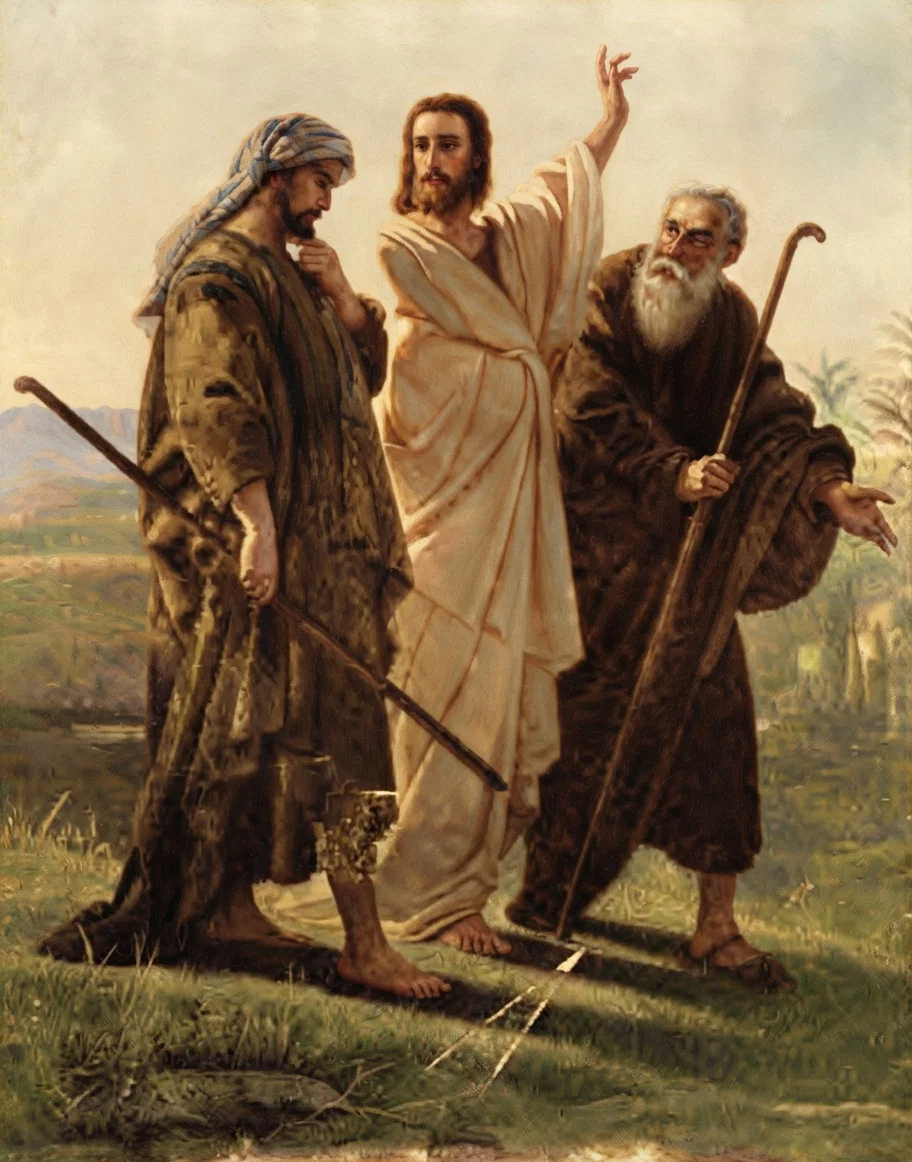
Plockhorst ON THE WAY TO EMMAUS

Life-Knowledge for All

The truths of God's Word, received into the heart, have an animating power; and those who will frame any excuse for neglecting to become acquainted with the Scriptures, will neglect the claims of God in many respects. The character will be deformed, the words and acts a reproach to the truth.
The injunction of our Saviour to search the Scriptures should be religiously regarded by every man, woman, and child who professes His name.
Parents plead trifling excuses for not interesting themselves in Bible lessons with their children, and they fail to become conversant with the Scriptures. Fathers excuse themselves from disciplining their own minds. They do not seek first the kingdom of God and His righteousness, but exalt the temporal above the spiritual and eternal. This forgetfulness of God and His Word is the example they give their children, which molds their minds after the worldly standard, and not after the exalted standard erected by Christ. Mothers, too, are unfaithful to their trust. The inward adorning of the mind and the culture of the soul are neglected as tho inferior to the adornment of the apparel. Their own minds and the minds of their children are starved in order to follow custom and fashion.
Fathers and mothers, take up your long-neglected duties. Search the Scriptures yourselves; assist your children in the study of the sacred Word. Make diligent work because of past neglect. Do not send the children away by themselves to study the Bible; but read it with them, teach them in a simple manner what you know, and keep in the school of Christ as diligent students yourselves.
Jesus, the greatest Teacher the world has ever seen, recognized the value of the Holy Scriptures, and expounded them to His disciples. After His resurrection, He drew near to two of them as they were on their way to Emmaus, talking, as they went, of the disappointed hopes occasioned by the death of the beloved Master. They told Him of the Prophet mighty in word and deed who had been taken by wicked hands and crucified. And now it was the third day, and strange reports had been brought to their ears that Jesus had risen, and had been seen by Mary and certain of the disciples. Jesus said to them, "O fools, and slow of heart to believe all that the prophetshave spoken; ought not Christ to have suffered these things, and to enter into His glory?" And beginning at Moses and the prophets, "He expounded unto them in all the Scriptures the things concerning Himself."

Strength for Trial

Jesus reproved the disciples for not being acquainted with the Scriptures that testified of the Messiah. Had they been familiar with the Scriptures, their faith would have been sustained in the hour of trial, and their hope would have remained unshaken; for the treatment Christ would receive at the hands of those He came to save was plainly stated in the prophecies. The disciples were astonished that they had not recognized Jesus at once, as soon as He spoke with them by the way, and that they had failed to remember the Scriptures which He had brought to their mind. They had lost sight of the divine Word; but when the things spoken by the prophets were brought to their remembrance, faith revived, and hope again sprang up in their hearts. And when He was parted from them, they said one to another, "Did not our heart burn within us, while He talked with us by the way, and while He opened to us the Scriptures?"
The apostle tells us: "All Scripture is given by inspiration of God, and is profitable for doctrine, for reproof, for correction, for instruction in righteousness: that the man of God may be perfect, thoroly furnished unto all good works." If Christians would earnestly search the Scriptures, more hearts would burn with the vivid truths therein revealed. Their hopes would brighten as they dwell upon the precious promises strewn like pearls all through the sacred writings. In contemplating the history of the patriarchs, the prophets, the men who loved and feared God and who walked with Him,—in dwelling upon the virtue and piety of these holy men of old,—the spirit which inspired them would kindle a flame of love and holy fervor in the hearts of those who would be like them in character.

The Gospel of God

THE following from an article written by the late Theo. L. Cuyler, like many others from his pen, is ever timely. It advocates unswerving adherence to the simple and pure Gospel, unadulterated by the sophistical admixtures of the Critics:
"There is abroad in some quarters an impression that the Bible is not in touch with these modern times, that its possibilities have been exhausted, and that, in order to retain its hold on the masses, the church 'must more closely aline itself with liberal and advanced thinking.' There is manifest, too, a growing taste for 'sociology;' and many ministers are tempted to give undue prominence to the discussion of problems that belong to social science and political economy.
"The Bible does, indeed, contain seed-corn principles from which all wise social reforms must spring. It teaches with divine authority the duty of the strong to provide for the weak, the necessity of honest dealing and honest wages, the stewardship of money, the claims of temperance and Christian charity, and the duties that belong to Christian citizenship. No wise minister will ignore these pressing and practical questions, and when he does occasionally discuss them he ought to do so with fearless plainness of speech.
"But the Word of God goes a great deal deeper than any problems of social philosophy. It goes to the root of things. It strikes down into the depraved human heart as the source of all the sins and the wrongs, and the sorrows and the sufferings, that exist in this present evil world. Satan's throne is in the unregenerate heart; and out of that heart proceed the evil thoughts, the cruelties, the adulteries, the thefts, the murders, the falsehoods, and all the swarm of mischiefs and miseries that afflict society. Christ's Gospel is the only remedy that can reach that heart; and therefore it is the one chief and foremost duty of every Christian minister to preach that Heaven-sent Gospel and to press it home upon every conscience. Jesus Christ, the Healer of sick bodies, came into this world chiefly to save sin-sick souls. He preached heart repentance and holy living.
"Paul and his fellow apostles did not go about lecturing on sociology, even in that corrupt age. They grappled with the mightier problem of man's utter heart-depravity, and wrought for nothing less than men's souls, and their entire regeneration by the Holy Spirit. That is the prime office of the Gospel of redemption. The wonder-working Gospel of atonement, faith-regeneration, and supporting grace—which is God's masterpiece—has no more run out than the law of gravitation has run out, and it is no more 'antiquated' than are fresh air and sunshine. . . .
"Human nature—whether in mansion or in hovel—has not changed since the apostle's day. Christianity has not changed, and never will change. It provides for the life that now is, and infinitely more for the life that is to come. The infinite God knew what He was doing when He gave to His sinning, suffering children a Gospel that covers the heart and renovates the whole man, through the incoming of Christ Jesus. To His ministers He entrusts this life-giving Gospel—not to be altered or overlaid or veneered, much less to be apologized for or concealed. The sublime purpose of this Gospel is to bring God to man and man to God. Its two principles—as Pascal well said—are the corruption of human nature and redemption by Jesus Christ. As time can never 'antiquate' these two principles, the precious Gospel is as fresh, and as strong, and as indispensable and powerful as when it was thundered from the lips of Paul."

Lay Hold

By L. G. Culver
Tune—Stand up, stand up for Jesus
LAY hold, lay hold on Jesus; Lay hold upon His name; Lay hold on every promise, Surrender not your claim— Your claim to full salvation, Eternal life above, Unmeasured gift of mercy, Unmeasured gift of love.
Behold, behold His visage, Behold how strangely marred; His hands, His feet and body, Forever, ever scarred. Behold His love and mercy, Expressed in words but few: "O Father, forgive them; They know not what they do."
Through Christ must come each blessing, Each blessing unto all; The rain and light from heaven That still on us do fall. Yes, manna still is falling, In rain-drops from above, The gift of God through Jesus, Twained gift of twofold love.
Get ready, O, get ready, Your Saviour to behold; Get ready for those mansions, Prepared for all His fold. Get ready, O, get ready; His coming draweth nigh; Soon will the saints of ages Be with their Lord on high.
Bath, New York.

A Watered Garden

"THOU shalt be like a watered garden." Isa. 58: 11. Reader, are you like a watered garden? Or are the fruits of the Holy Spirit withering and dying? Are the weeds of evil choking out the good? Is the soil becoming dry and hard? If so, make haste, destroy every evil weed, break up the fallow ground. It is left with you to put the garden in readiness to receive the showers of blessing that God is waiting to bestow.
"Not one of us will ever receive the seal of God while our characters have one spot or stain upon them. It is left with us to remedy the defects in our characters, to cleanse the soul temple of every defilement by coming to the Fountain. Then the latter rain will fall upon us, as the early rain fell upon the disciples on the Day of Pentecost." H. A. ST. JOHN.

KEEP your promises.

Passion Seen Through a Microscope

He submits himself to be seen through a microscope, who suffers himself to be caught in a fit of passion.—Lavater.

Prepared for the Lord’s Coming

IN the Scriptures, the constant note, the continually occurring exhortation, is, to be prepared for the Lord's coming.—Dean Henry Alford.

The Revelation of Jesus Christ

Introduction

IN this and subsequent articles it is purposed to enter upon the study, with our readers, of the most wonderful, and to many the most mysterious, book of the Bible, and proceed in easy stages to its close. These studies will not aim to be exhaustive, but expositive, practical, suggestive. Our readers are invited to follow us prayerfully, for only so may we arrive at the truth. We wish them also free to ask questions; for questions oftentimes open avenues to glorious light.

The Name

The book is called in our common version, "The Revelation of St. John the Divine," for which there is absolutely no authority save tradition. The American revision (which we shall use with the common version) gives only "The Revelation of John," which simply means the Revelation sent by John. The Greek term "Apocalypse," meaning "revelation, disclosure," is only a part of the title, the first words of the book supplying the whole—"The Revelation of Jesus Christ."

The Writer

Is John, the beloved disciple, the brother of James, who assumes no title dearer to him than "your brother and companion." Inspiration uses the same expression to designate John's faithfulness that the Lord used to designate Moses; namely, "servant;" "Moses, My servant," "John, His servant." What better reveals the noble character of the man than the position that the angels delight in? for one who excelled in power declares to John, "I am thy fellow servant." Rev. 19:10. Blessed are those who serve such a Master.

The Time and Place

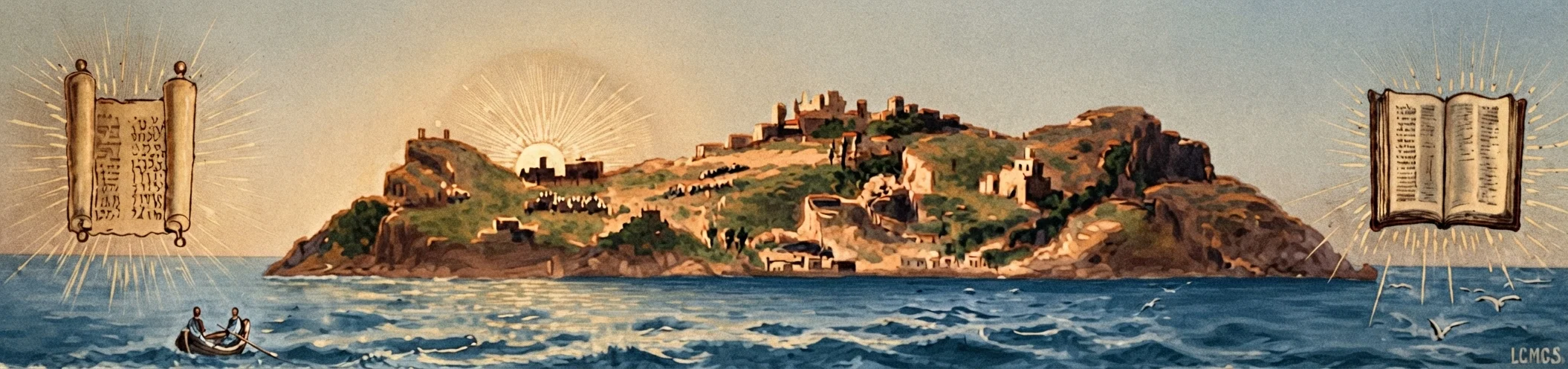
The time of the writing of the book was about A.D. 95 or 96, where it is generally placed by all save the Higher Critics. The place was the rocky Isle of Patmos, about twenty-four miles west of the coast of Asia Minor. Here John was banished by the Emperor Domitian, through whose darkened soul Satan thought to destroy the torch that Christ had lighted in John. But the gloom of his captivity was banished by the glory of God, and his isolation was replaced by the companionship of immortals. The rugged sea-girt isle became a gate of Paradise, and the anteroom of the audience-chamber of Heaven.

The Contents

The contents of the book are remarkable. It is the epitome of all the prophecies, of all the ethical teachings, of all the books which have come before. It sets a divine seal upon them all. The references of Bibles which give them will cite to every book in the Bible except eight; two of the eight have references to the Revelation; while the six others refer to the same great facts, truths, principles, but being small, personal, or purely historical, are not considered of sufficient import to note in reference. But every book in the Book of books finds echo in the Revelation. This it is, doubtless, which gives to its Greek its strongly Hebraistic mold. The practical, soul-stirring truths of all the ages shine with added luster in their new settings, and the prophecies of the past are enlarged and carried forward to the eternity of the glorious consummation.
PATMOS
PATMOS
It is one book, not several. It is a divine drama of the ages. It has its stage, its scenery, its settings. It has its plans, its plots. It has its Hero and heroine and their loyal retainers. It has among its characters kings and warriors. It has its conspirator, its deep, dark-dyed villain. It has its romance, its marriage, its blessedness, its dénouement, its eternal glories which wait.
The one Central Figure is Jesus Christ. The whole plan of the book, of the grand, poetic drama, circles round the one Triumphant One. It presents Him in its very beginning a Conqueror; it reveals His work for His church in this world, in her conflict with the spiritual powers of darkness, and the secular powers controlled by the spirit of evil. All the various phases of her struggles and sufferings, of their efforts, seeming successes, and utter failures, are set forth with a startling vividness, often in highly symbolic language, in moving, acting, living figures in the world's great arena, but all tending to the one great consummation, the extirpation of all evil, and the absolute triumph and everlasting reign of the Good.
While its practical, ethical lessons are taught in language easily understood, its prophecies frequently are presented in striking symbols. It deals in all the imagery of the prophets of the past. It has the living creatures of Ezekiel and Isaiah; the horses, the lamp-stands, the olive-trees, the golden oil, of Zechariah; and the beasts and year-day periods of Daniel.
The numbers three, four, seven, ten, and twelve play an important part in the scheme of the book. Three is the sacred number, four a world number, and seven the perfect number, denoting completeness, fulness. There are seven lines of prophecy in the book that span the Christian era to the consummation of the Gospel message, as follows:
  1. Seven churches reveal the internal condition, the spiritual state, of the church of Christ throughout the Gospel age.
  2. Seven seals reveal the Gospel working through the events of earth to a triumphant end in the triumph of its Author.
  3. Seven trumpets usher in, one by one, great changes and events in the history of nations affecting the work of God in the earth.
  4. The two witnesses, testifying of the power of God through the Dark Ages of earth, in sackcloth.
  5. The seven-headed dragon's reign and his persecution of the church of Christ are shown from the beginning to the end.
  6. The seven-headed composite beast, and the two-horned lamblike beast, are prophetic symbols of powers which the dragon uses in his work against Christ Jesus.
  7. The seven-headed scarlet-colored beast with his gaudy female rider, covering the same period of time as the dragon, but emphasizing the harlot's work and the last days. Nearly all of these are subdivided by seven.
We have also the seven-hued rainbow, the seven lamps of fire, the Lamb with seven eyes and seven horns, the sevenfold ascription of praise to the Lamb, the seven angels with the seven bowls of wrath, the sevenfold judgments, the sevenfold triumph, the seven promises to the victor, and more,—all speaking of the completeness of the wonderful revelation of Jesus Christ.
The Revelation is a fitting close to the Scripture canon. It carries us from the apostolic days, with their backward connecting links with the vital past, to the glorious consummation of a sinless earth, a deathless,all-victorious King, and immortal subjects. Who would not indeed ardently and devoutly explore this great treasure-house of divine knowledge of potency to save to the uttermost?
THE Master will not keep His hand under our arms when we go on forbidden ground. Presumptuous Peter needed a sharp lesson, and he got it. That bitter cry at the foot of the stairs bespoke an awful fall. How many such are rising daily into God's listening ears.
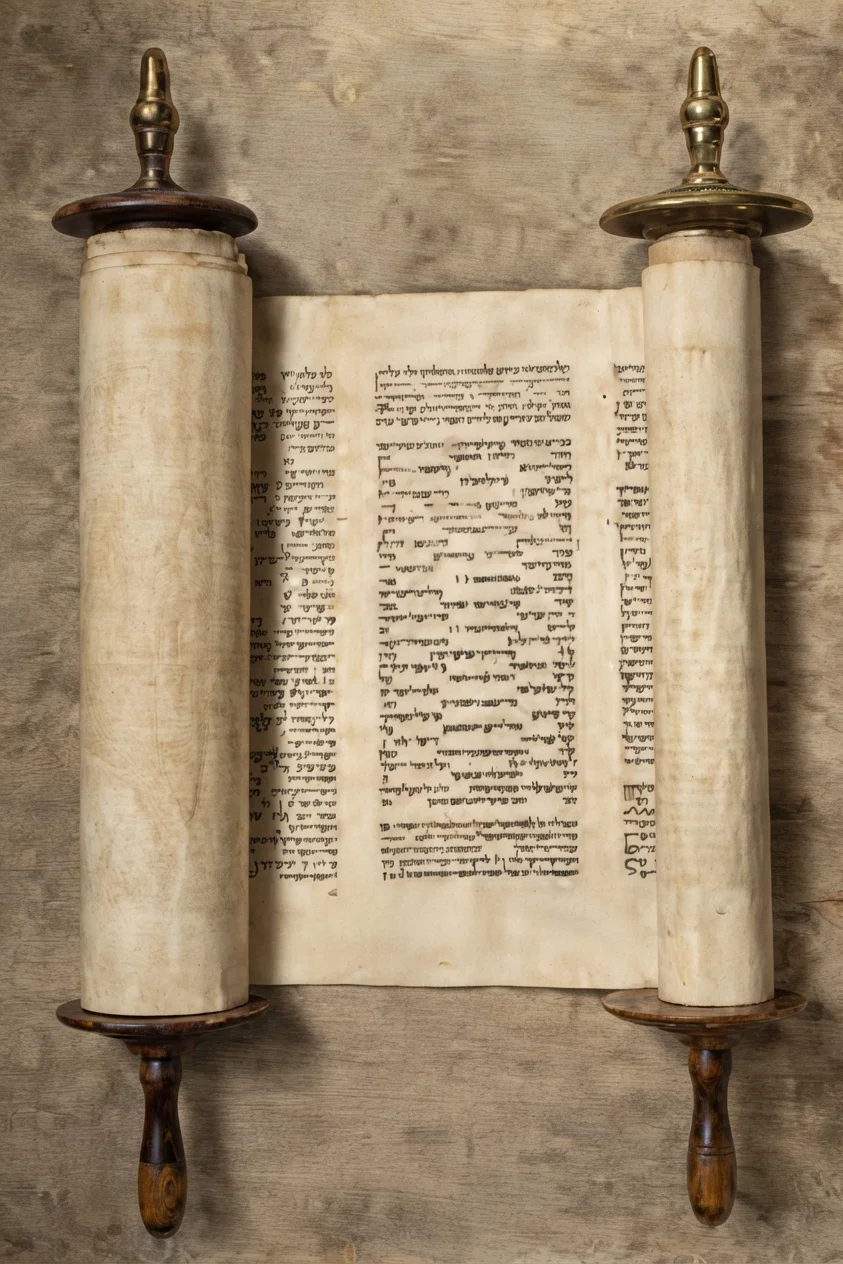
Ancient Scroll of the Scriptures
Continue reading: The Master's Coming