Your ShelfYour Projects

Signs of the Times, Vol. 37, No. 43.

In This Issue
Earlier text: The Master's Coming

The Papal Outlook

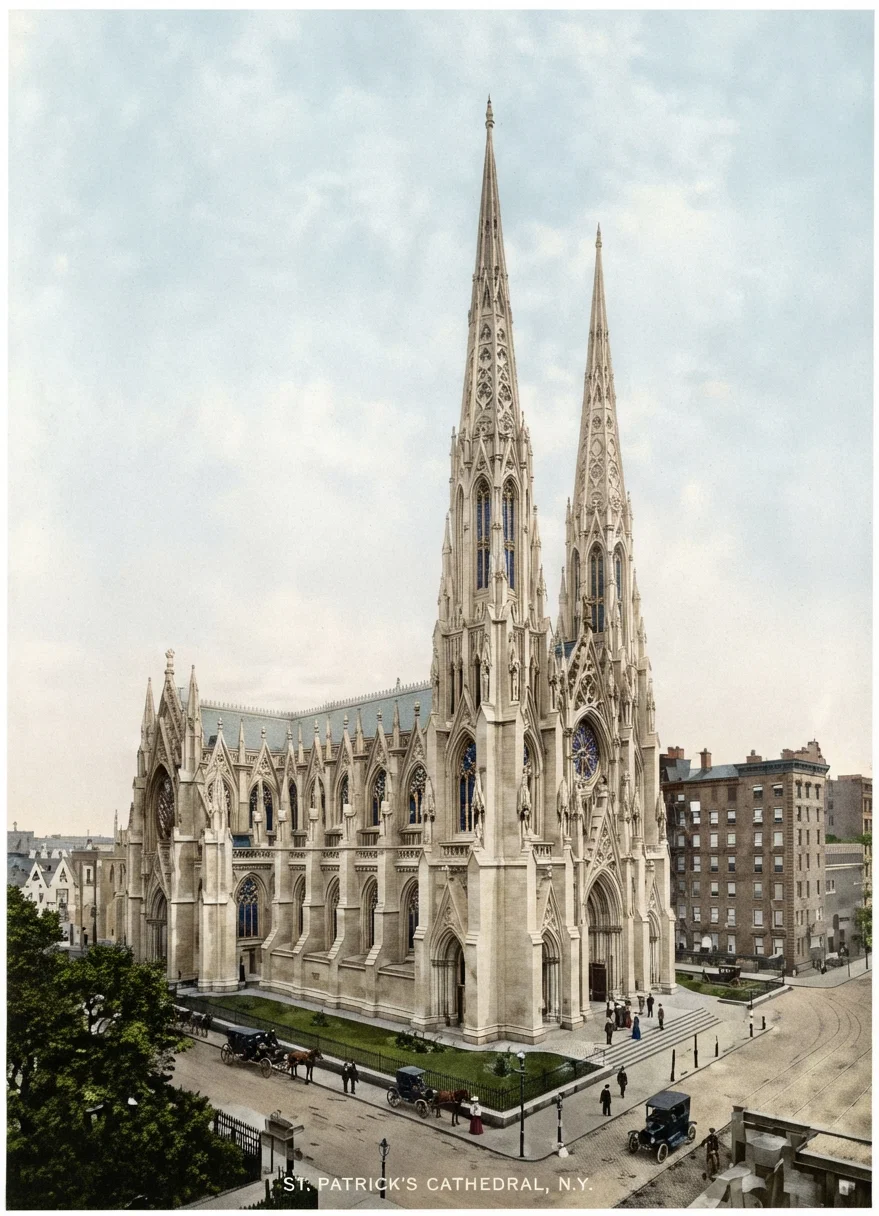
MEASURED by the recent immense Eucharistic Congress in Montreal, account of which was given quite fully in this journal, by the dedication of the great Saint Patrick's Cathedral in New York City free from debt, and by other events scarcely less notable, Roman Catholic influence in the New World can scarcely be said to be waning. An item published by us last week states that the pope looks upon America as the hope of the Papacy. The same sentiment is echoed by the Roman Catholic press.
Roman Catholics not only believe that the Roman Catholic Church is strong, vigorous, and full of winning possibilities, but that on the other hand Protestantism is weak, divided, decadent, dying, dead, and consequently complete Catholic victory of America is only a matter of time. For instance, the editor of the "Western Watchman," Dr. D. S. Phelan, had this to say in a sermon preached March 20, published in his paper of March 17, 1910:
"It is plain that any man who runs can see — non-Catholics want a church that has no God in it; and they won't have any church that has a God in it. And all the churches, except the Catholic Church, are churches that have no God in them. As the Jews said to Moses, 'We will listen to you, but we do not want God to speak to us,' so outside the Catholic Church you have mere men talking everywhere, men preaching everywhere, men teaching everywhere; and the non-Catholic world are perfectly willing to listen to men. In all the pulpits of the sects you will find men giving their views, men airing their opinions, men telling the world what they know. Men are speaking; and no voice was ever yet heard in a non-Catholic church but the voice of a man. Why will the world listen to a man and not to God?"
And this from the same journal of February 24, 1910:
"Where religion is not publicly taught and supported by the state, private morality must languish and crime must increase and grow apace. We have a great deal of religiosity still left in this country, despite all the efforts of Protestantism to eliminate it. It would be a mistake to compute the prevalence of religion outside the Catholic Church in the United States by the number of people who adhere to the different heretical denominations. There is more religion among the Protestants who belong to no church than there is among those affiliated to the different sects. But we can not expect this religiosity to last forever, deprived, as it is, of the necessary aliment of faith. Protestantism is dying out, and when it disappears there will open before the eyes of the unchurched masses of this country an awful abyss of blank infidelity."
Still another from an editorial in the "Western Watchman" entitled, "No Wonder; They Know No One There":
"Even well-informed Catholics do not understand how the very essentials of Christianity have disappeared out of the faith of Protestants. With them religion means doing good to the neighbor and fighting the Catholic Church while life in this world lasts; and as for the future, if there is a future, they hope to have the best going. . . . We would like to enlarge, rather than curtail the hopes of our separated brethren; but we must tell them the truth. Catholic theology holds out very little hope of salvation for them; and Catholic theology is the truth of God systematized and made comprehensible and consistent with reason. Poor Protestants! We should pray for them, that God may open their eyes to see His truth, and their hearts to appreciate His love."
Similar opinions of Protestants and Protestantism could be greatly multiplied from Catholic sources. Regarding Protestantism as they do, why should they not expect its speedy downfall? Why should they not expect a vigorous, united Catholicism to conquer?
The mere opinion of Roman Catholics, or their severest condemnation, would be of little account, if Protestantism had the life to resent such imputations, or the keenness to feel the force of their truthfulness, and so repent. But they do little of either. Nay, more, many count the Catholic Church as a mother or sister church, an ally against the forces of evil. One Protestant gave $5,000 toward the expenses of the Eucharistic Congress at Montreal, to be abused for his religion by Dr. Vaughan of England. A few papers protest, but these generally are of small circulation, and published by small religious bodies with limited influence. Is it true that there is not enough real Protestantism in the great Protestant bodies to protest? It certainly looks that way.
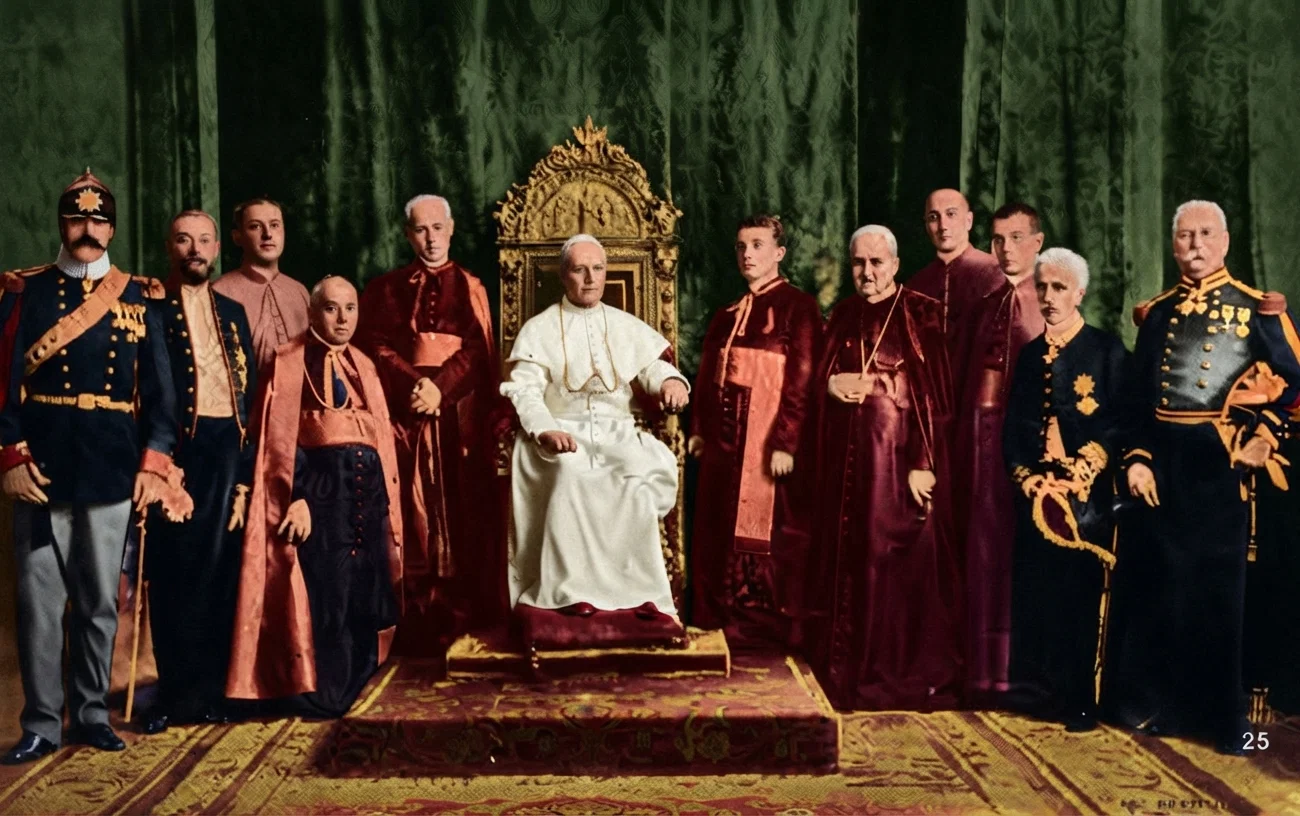
POPE PIUS IN HIS COURT
The loose "Liberalism" which possesses many is not born of conviction of truth, or of faith in God's Word, or in love of man. It is born of lack of Bible belief, and infidel indifference to things religious. In this modern "Liberalism" the old writers are no more. The story of creation is ridiculed; the fall of man is a myth; the incarnation, the resurrection, the second coming of Christ, are repudiated. The vicarious atonement and justification and regeneration by faith are unreasonable. Even the Master was mistaken. Why should those who have lost faith in all these great foundation truths of Christianity or those who are led by them, protest against the baleful errors of the Papacy? And why should not the Papacy make progress, with its hoary traditions, its religion of the human?
Yet God's Word still stands, and all the great foundation truths of Christianity, the historic truths of apostolic and partly of Reformation times, are still mighty through God to save men. Preach the Word.

"Troublous Times Shall Come"

In the Springfield Union of July 31, Mr. Rudolph Spreckles is quoted as follows regarding an early financial crisis in this country:
"The financial control of the country is to-day centered in the hands of two great interests. When the two men in control of these interests engage in battle with each other for the supremacy, a revolution, the most destructive the world has ever seen, will follow—a revolution that will not only paralyze or wreck many of our great industries, and overthrow unnumbered financial institutions, but will imperil the safety of the Government itself.
"I have been engaged in business since I was seventeen, and have noticed year by year a gradual reduction in the number of firms handling large industries or engaged in banking, until to-day the reduction must excite alarm. It is a significant commentary on business conditions, that two men have it in their power to embarrass the United States Government. The concentration of wealth is the great evil of modern times, for it places in a few hands the power to precipitate panics and control legislation.
"Each time one of these panics has occurred, certain interests have come forward to relieve the situation by the releasing of large amounts of money. If men can break a panic by bringing forward their hoarded millions, it is evident they can cause a panic by withdrawing from circulation a few hundred millions of dollars."
Mr. Spreckles then gives his view as to the remedy for corrupt financial conditions, which he asserts he is doing all in his power to reform, by adding:
"What is needed to-day is a quickening of conscience of the great wealth holders. One trouble with the trusts is that the men whose capital is invested in them are not sufficiently concerned to take an active interest to their management. So long as they continue to receive large dividends they wink at practises in a corporation that they would not countenance in their own personal business."
We agree with Mr. Spreckles that the only human remedy of these evils is the quickening of the conscience of great wealth holders. But this is not a mechanical or political matter. Noble men are doing all that humans can in politics and out, but conditions grow worse. "The quickening of the conscience" can only come through right attitude to the great moral law as revealed in God's Word, to the Gospel of Christ, in the reception of the Holy Spirit. But the Scriptures reveal that human hearts, surfeited with the greed of gain, will reject the pleadings of the Spirit, refuse to recognize the obligation to moral law, and fail to reconcile their hearts to God. In the face of such stubborn rebellion against divine requirements, the prophetic Word tells us "perilous times shall come." Men will be "covetous," "lovers of money." See 2 Tim. 3.1-5. Already the prophecy is fulfilling, and until men's hearts are changed their existence will make impossible prosperous times. Indications do not point toward repentance on the part of the majority.

On Liberty

If all mankind, minus one, were of one opinion, and only one person were of the contrary opinion, mankind would be no more justified in silencing that one person than he, if he had the power, would be justified in silencing mankind.—Essay on Liberty, by John Stuart Mill.

The Program of the World's Christian Citizenship Conference to Be Held in Philadelphia Nov. 16-20, 1910

We have not space to give this program in full; we therefore omit the general devotional exercises of every day, many of the reports from various countries, and the general addresses by members, and note only the leading addresses. The object and scope of the conference is fairly given.

Opening Session

WEDNESDAY, NOVEMBER 16, 2:30 P. M. Addresses of Welcome — By Gov. E. S. Stuart and Dr. M. G. Brumbaugh. Response — By the President, Dr. S. F. Scovel. Address — "The Moral Accountability of Nations," T. P. Stevenson, D.D., LL.D., Philadelphia, Pennsylvania. Address — "The Bearing of National Life on Personal Religion," O. P. Gifford, D.D., Boston, Massachusetts. NOVEMBER 17, 9:30 A. M. Report — "The British Government and the Christian Religion," The Rev. John Lynd, D.D., Belfast, Ireland. Report — "British Administration in India," The Rev. Charles E. Parker, Methodist Episcopal Missionary in India. Report — "The German and Holland Governments and Christianity," The Rev. Dr. James F. Dickie, Berlin, Germany. Address — "Political Changes in the Near and Farther East as Related to the Kingdom of Christ," The Rev. C. A. R. Janvier, D. D., returned missionary from India. Address — "Christ the Ruler of Nations," The Rev. W. I. Wishart, D.D., Pittsburg, Pennsylvania. NOVEMBER 17, 2:30 P. M. Report — "The French and Belgian Nations and Christianity," Prof. O. G. Guerlac, Editor of the Protestant Christian Daily Journal, Paris. Address — "National Responsibility Toward the Negro Race," J. W. Holley, D.D., Atlanta, Georgia. Address — "Providential Preparation of the World for the Kingdom of Christ." Address — "Christian Governments and Foreign Missions," The Rev. Arthur J. Brown, D.D., Secretary Presbyterian Board of Foreign Missions. NOVEMBER 17, 7:45 P. M. Address — "Christian Civilization and the Liquor Traffic," The Hon. J. Frank Hanley, Ex-Governor of Indiana. Address — "The Children of the Nation and the Foes to Moral Purity," Anthony Comstock, New York. Address — "The Federal Council of the Churches of Christ as an Aid to Civic Betterment," The Rev. H. B. MacCauley, D.D., Trenton, New Jersey. NOVEMBER 18, 9:30 A. M. Report — "Mohammedanism and National Life," The Rev. John Van Ess, D.D., Missionary in Arabia. Report — "The Roman Catholic Countries of Southern Europe," The Rev. G. T. Berry. Addresses — "National Christianity and Public Education," The Rev. Henry C. Minton, D.D., Trenton, New Jersey; The Rev. Robert Ellis Thompson, D.D., LL.D., President Central High School, Philadelphia. Address — "The Lord's Day and National Welfare," The Rev. David J. Burrell, D.D., President of the Alliance of the Reformed Churches. NOVEMBER 18, 2:30 P. M. Report — "National Christianity in the United States," The Rev. R. C. Wylie, D.D., LL.D., Pittsburg. Address — "Foreign Missionary Educational Work a Basis for Christian Commonwealths," F. E. Meigs, D.D., University of Nankin, China. Address — "Emigration and Immigration as Related to Christian Citizenship," Bishop William Horn, D.D., Cleveland, Ohio. NOVEMBER 18, 7:45 P. M. Address — "Responsibility of Municipal Governments for Morals and Religion," The Hon. H. B. F. McFarland, Washington. Address — "Peace by Arbitration," The Hon. John W. Foster, Washington. Address — "The Inadequacy of Other Religions than Christianity to the Needs of National Life." NOVEMBER 19, 9:30 A. M. Address — "National Religious Observances," The Rev. Francis E. Clark, D.D., LL.D., President of the United Societies of Christian Endeavor. Address — "National Christianity in Fundamental Law," The Rev. Sylvester F. Scovel, D.D., LL.D., Wooster University. NOVEMBER 20, 4:00 P. M. Address — "National Religion and World-Wide Evangelism," The Rev. J. F. Carson, D.D., Brooklyn. Address — "A Revival of National Religion," The Rev. H. H. George, D.D., Pittsburg. Address — "The Civic Mission of the Christian Church," The Rev. J. T. McCrory, D.D., Pittsburg.
St. Patrick's Cathedral, New York City, a magnificent structure costing millions, recently dedicated free from debt.
About 800,000 acres of the Crow Indian reservation in Montana has been thrown open to highest bidders. Persons will not be required to show any qualifications as to age, citizenship, or otherwise. Likewise about 700,000 acres will be opened to the public within the former Uinta Indian reservation in Utah, on November 1.
The whole state of California is joining in the campaign to advertise San Francisco as the location for the Panama-Pacific Exposition to be held in 1915. Two million post-cards have been sent out to be distributed over all the country by enthusiasts, necessitating an extra force of postal clerks in handling the mail.
It is said that the Census Bureau has strong evidence that some of the northern Pacific Coast cities have cheated in their census reports by padding their lists. President Taft urges punishment of persons responsible for the figures.
Nearly ten million aliens have arrived in the United States, according to census reports, during the last ten years — an average of a million a year. In this number Italians take the lead.
A little girl laughed at a reprimand, and was discharged. Other employees protested, which finally resulted in a strike of 12,000 neckwear workers in New York.
Stanley Ketchel, who holds the world championship as middle-weight pugilist, was killed by an outlaw working as a farm-hand near Conway, Missouri.
A Pacific Coast Congress representing Hawaii, Alaska, and the eight Pacific Coast states and territories, will be held in San Francisco, November 17, 18, and 19, to adopt measures to restore speedily on a large and efficient scale, the American merchant marine, so that the United States can take its place in the marts of the world along with the other great nations, and to have a greater battle-ship fleet in the Pacific waters. The congress will be held under the auspices of the Merchant Marine League, and the call has been signed by Governor Gillett.
In the opinion of the Government Treasury Department the danger of a possible money shortage this fall has passed. The banks, seeing several months ago what threatened to be a money shortage, and knowing they could expect no aid from the Government, owing to its enormous expense of digging the Panama Canal, piled up gold in their vaults, built up reserves, and cut down loans. Ten million dollars has recently been transferred from New York depositories to other banks.
At a dinner of the Knights of Columbus, a Catholic Society, where he was a guest, Colonel Roosevelt praised the Catholics for their work, but said he favored the broadest measure of religious toleration, adding: "There is no other country where Catholic and Protestant get on as we do here. We must never permit anything to make us deviate from this standpoint."
The belief that a large proportion of the Hindu immigrants are suffering from hookworm disease may be the means of stopping the influx of these people. The Hindus have been arriving in San Francisco at the rate of three hundred a month, somewhat to the consternation of the residents of the Pacific Coast.
Three prominent men of Seattle, Washington, have been arrested on indictments returned by the Tacoma Grand Jury, charging conspiracy to defraud the Government in the Alaska coal cases, and warrants for the arrest of others are being served. It is charged that 17,000 acres have been entered upon by dummies.
The Republican insurgents have lost a strong man in the death of Senator Jonathan P. Dolliver, which will also be greatly felt by the United States Senate. He was among the ablest orators of the progressives.
Human life seems to be a very cheap commodity in Chicago. According to statistics furnished by Chief of Police Steward, in the last four years there have been 693 murders and but 132 convictions.
In a district of Washington, D. C., it is stated that a ban has been placed on chickens as an article of diet on the supposition that they are the direct cause of infantile paralysis.
The construction of a "Peace" bridge over Niagara River is proposed as a memorial of the one hundred years of peace and friendly relations of the United States and Great Britain.
The Illinois Republican convention has rejected a proposed plank in their platform favoring national medical legislation, or rejecting what has been called in some circles the "medical trust."
Thirty missionaries sailed for the Orient recently under the auspices of the American Baptist Foreign Mission Society. This is the largest number ever sent out at one time by this society.
Five persons were shot by an unknown man in ambush while driving near Little Rock, Arkansas, recently.
Twenty-seven lost their lives as the result of a traction car wreck at Carlinville, Illinois.

The Would-Be Arbitrator of the Nations

It is well known that the Papacy has had little to do with the peace congresses which have been held in later days. The pope has acted as arbitrator in one or two disputes singly; but he can not fall in with these international agreements unless he is first. The following from the editor of the "Western Watchman," in his issue of April 21, 1910, shows to some extent how this is regarded:
"We have tentative international courts of arbitration for the settlement of disputes between nations; but they are mere 'mute courts,' without authority or power to enforce their judgments. They beguile the weak powers into fancied security, and enable the strong ones all the better to prepare for war. International law is what it always was since sin came into the world: 'Let him take who has the power; and let him keep who can.' Justice and right have fled to brutish hearts, and man's worst enemy is man. The world was advancing towards universal peace when the pope came to be recognized as the arbitrator of kings and courts. The Middle Ages afford us the only theory of international arbitration that this world will ever know. But the power and authority of the sovereign pontiff is now the scorn of the strong and the despair of the weak. There is no 'God of battles' any more; and the only divinity that now rules in the counsels of war is the diety that always sides with big battalions. Here is another fountain of peace, prosperity, and progress poisoned by the devil. A modern government is a Babel of confusion, and its end is dissolution."
When will Protestants learn the lesson, so often affirmed and reaffirmed by Roman Catholics, that the Papacy has not changed? They still look upon the darkness of the Middle Ages as the noontide of glory for the church.

Shiloh: the Man of Sorrows

Chapter XXXV. In the Evil Council

"What meanest thou, Jazer?" demanded the quiet figure in the corner,—the ruler whom Shaphan had called Nicodemus.
The face of the speaker was pale, and his voice shook with suppressed excitement, while he fixed his fine, intelligent eyes full upon the scribe.
"How darest thou, Jazer, speak thus of that astonishing miracle whereof five thousand men bear witness? Besides, thou, thyself, didst eat of the bread and of the fishes. Thou didst go to Bethsaida that thou mightest catch the Miracle-Worker in His words; but instead, thou didst tarry to be fed of His bounty. Shame, shame upon thee, Jazer!"
The speech had been so sudden, so convincing, so pregnant with the eloquence of truth, that for the moment no man in the chamber seemed prepared to make reply. The fine face of the speaker was flushed with indignation, while the countenance of Jazer was white with rage. His deep eyes blazed with anger, and he was about to reply, when the door of the chamber suddenly opened, and the sentinel hastily admitted a man in the robes of a priest.
"I have news for the council, O Caiaphas!" he exclaimed, without pausing to be seated. "I heard of this assembly at thine house, and I knew these men were called together that it might be determined what should be done with the Nazarene; for behold, all the world goeth after Him, and every day He doeth more miracles than have been done by priest or prophet since the world began. Knowest thou, O Caiaphas, and thou, O Annas,"—excitedly pointing a trembling finger at the aged high priest,—"knowest thou that the man Simon the leper, of Bethany, hath to-day been healed of his leprosy by this Jesus of Nazareth?"
"What sayest thou, O Issachar!" panted Caiaphas. "Surely Simon the leper is a dead man from the crown of his head even unto the soles of his feet. Verily thou sayest falsely!"
"As the Lord liveth, I know whereof I speak; for I, even I, Issachar the priest, am he before whom many lepers from Jerusalem and the coast around about have come, that sentence may be pronounced, even as thou very well knowest, O Caiaphas. And also, I am he before whom this man, even Simon of Bethany, presented himself a long time ago for examination according to the law; and I it was who pronounced him unclean. Verily, I am accustomed to sights of horror; but in this man's body the plague was more loathsome, more fierce and rapid, than in many others. Yet when I pronounced him unclean, and said unto him, 'O Simon, the curse of the Almighty pursueth thee,' the man wept, and pleaded that he might be allowed yet a little longer time; for he was loath to believe the horrible thing had come upon him. Yea, O Caiaphas, I know the man, and I know the horrible extent of his malady. When but last week I saw him afar off, as I passed by the abode of these wretches, the man's face was so disfigured that I scarcely knew him,—and would not, save that his abba is always crimson; it is thus that his wife Prisca knoweth—"
"Why speakest thou not plainly, O Issachar?" said Annas. "Thou hast told us nothing. How knowest thou that this Jesus of Nazareth hath healed this man?"
"I will tell thee, O Annas. This morning there came into my presence a young man whose springing step and ruddy countenance spoke plainly of perfect health of body and of mind. It took but the second glance to convince me who it was that stood before me.
" 'Who art thou?' I cried in astonishment.
" 'Examine me, O Issachar, thou priest of Israel, and I will tell thee my name, even tho thou thyself already knowest.'"
"So I took the two birds which he had brought, and the cedar wood and the scarlet and the hyssop, and did unto him according to the law of Moses, for his cleansing. Then he saith unto me, 'I am Simon of Bethany; and behold, Jesus of Nazareth hath healed me of my plague.'"
"Then I asked him, 'Dost thou believe that this Carpenter of Nazareth is the Messiah because He hath healed thee, O Simon?'"
" 'Nay, verily; I say not so,' he made answer, 'but of a truth I account the Man a great prophet.' Thus declared Simon of Bethany."
"Now verily we know that thou speakest not truth!" exclaimed Jazer, exultingly; "for this Nazarene healeth no man except he first acknowledge Him to be the Messiah; for thus have I heard many declare. And indeed," continued the scribe, "have I not one who longeth to be loosed from her infirmity, which hath bound her these twelve years, even mine own sister Huldah, whom I love? yet would I rather be pleased that she die in her infirmity, than that this Nazarene mock me, a scribe of the holy temple, by laying His hands upon her, even Huldah, mine own sister, that she might be loosed from her infirmity through the power of Beelzebub!" And the scribe rolled his sunken eyes impressively upward.
"Yet surely thou knowest, O Jazer," insisted Nicodemus, "that the Nazarene hath healed whole multitudes in one day; and I myself have seen many healed of diseases and infirmities, who knew Him not, nor yet acknowledged they Him to be the Messiah; for He hath healed many demoniacs, even they who were in no wise able to believe upon Him,—being madmen!"
"Verily, Nicodemus, thou also art a follower of this Impostor, and thy words betray thee!" shouted Caiaphas, waving his arms furiously.
"And thou a member of the Sanhedrin!" bellowed many angry voices.
Nicodemus arose and quietly left the chamber, and the council broke up in confusion. (To be continued)

Not Mourning, but Remembering

By C. A. Smith
WE do not mourn for the stars so bright, That shine on our path in the dreary night, And pass from our sight away; But we think of the joy their rays have given, As they shed their light where our feet have striven Along our darkened way; And we know they rise on other eyes, And other hearts their light will prize As they sink with silver ray; And we know each passing star foretells The coming dawn, from which there wells The joy of the golden day.
We do not mourn for the blooms of spring, That wide their fragrance softly fling, As they open, and, passing, fade; For we know the luscious fruit will come, A blessed gift to each heart and home, 'Neath the green leaves' tender shade; And we know that the summer's gorgeous flowers, That cheer and charm this world of ours As they wave on each swaying blade, But betoken the welcome harvest-time, When all rich nature seems a-rime O'er hill and dell and glade.
We do not mourn for the birds a-wing, That float and soar as they gladly sing To us on every hand, And then, without a word or tear, Leave us, to pass with notes of cheer To gladden some other land; But we think of the gladsome songs they've sung, And how our hearts in response have rung To the joyous singing band; And we'd urge them on with quicker flight, To make some other sad land bright, Could we the birds command.

Worth of Friendship

THE more we love, the better we are; and the greater our friendships are, the dearer we are to God. Let them be as dear, and let them be as perfect, and let them be as many as you can; there is no danger in it; only where the restraint begins, there begins our imperfection. It is not ill that you entertain brave friendships and worthy societies; it were well if you could benefit all mankind; for I conceive that is the sum of all friendship.
A good man is the best friend, and therefore soonest to be chosen, longer to be retained, and, indeed, never to be parted with unless he cease to be that for which he was chosen. For a good man is a profitable, useful person, and that is the band of an effective friendship. For I do not think that friendships are metaphysical nothings, created for contemplation, or that men or women should stare upon each other's faces and make dialogs of news and prettinesses, and look babies in one another's eyes.
Friendship is the allay of our sorrows, the ease of our passions, the discharge of our oppressions, the sanctuary to our calamities, the counselor of our doubts, the charity of our minds, the mission of our thoughts, the exercise and improvement of what we meditate. He only is fit to be chosen for a friend who can give counsel, or defend my cause, or guide me right, or relieve my need, or can and will, when I need it, do me good. To love such a person and to contract such friendships is just so authorized by the principles of Christianity as it is warranted to love wisdom and virtue, goodness and beneficence, and all the impresses of God upon the spirits of brave men.—Jeremy Taylor.

Conviction from Time

A YOUNG man attended a ball and was highly delighted with the diversion. In the midst of their enjoyment the clock struck one. That striking passage of Dr. Young's instantly rushed upon his mind:
"The bell strikes one—we take no note of time, But from its loss:—to give it then a tongue Is wise in man. As if an angel spoke, I feel the solemn sound; if heard aright, It is the knell of my departed hours."
Conviction seized the youth. He left the ball-room, retired to his closet, and gave himself to Christ.

Intention of the Bible

"THE Bible is a strange book," said an infidel objector to an aged minister. "A wonderful book," was the reply. "It has some strange characters among its saints," said the objector, "such as David and Solomon. If such men lived in our day we would say that they deserved to be sent to state prison for life." "Worse than that," replied the minister. "If they got what they deserved they would be sent to hell forever. But you probably are mistaken as to the object of the Bible. It is not meant to show how good men are, but to show how the grace of God brings salvation to the very worst of men, and makes saints out of the vilest sinners."

Humility

It is the student who stands before the house of knowledge, modest, patient, single-minded, conscious only of his own poverty and the unspeakable riches within, to whom wisdom will open her gates. No blustering, conceited person will fare very well in her courts. Humility and patience are the first requisites. The greatest scholars are always the humblest of men.—Great Thoughts.
Continue reading: 75 cents will bring you a neat Canvassing Carrier