Signs of the Times, Vol. 22, No. 43.

MEN VERSUS THINGS

Signs of the Times

Oct 29, 1896

Pacific Press Publishing Company · Oakland, California · Oct 29, 1896

MEN VERSUS THINGS.
An Important Lesson for Our Time is found in the following incident in the life of Christ: "And he was teaching in one of the synagogues on the Sabbath. And, behold, there was a woman which had a spirit of infirmity eighteen years, and was bowed together, and could in no wise lift up herself. And when Jesus saw her, he called her to him, and said unto her, Woman, thou art loosed from thine infirmity. And he laid his hands on her; and immediately she was made straight, and glorified God. And the ruler of the synagogue answered with indignation, because that Jesus had healed on the Sabbath day, and said unto the people, There are six days in which men ought to work; in them therefore come and be healed, and not on the Sabbath day." (Luke 13:10-14.) In this is drawn the contrast between Jesus Christ and formal, hypocritical professors of religion; and the difference was manifest by one of the tests of the ages—regard for humanity.
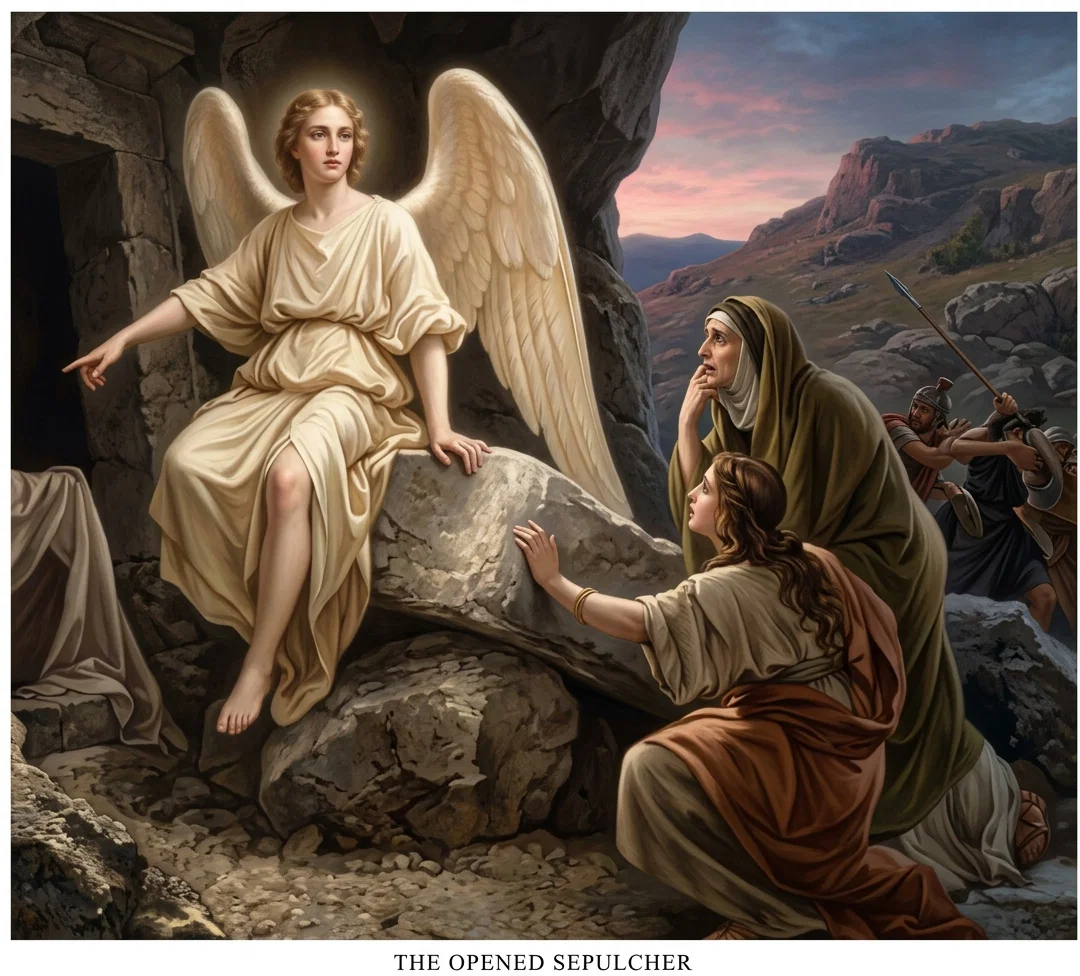
THE OPENED SEPULCHER.
The One Precious Object to the mind and heart of God on this sin-cursed earth is man, including all mankind. God loves him with an everlasting love; loves him even in sin; loved and loves him so much that he gave his only-begotten Son to save him from sin and death. Jesus Christ came to save MEN; let it never be forgotten. For here are his own words: "The Son of man came . . . to give his life a ransom for many" (Matt. 20:28); "the Son of man is not come to destroy men's lives, but to save them" (Luke 9:56); "for the Son of man is come to seek and to save that which was lost" (Luke 19:10). In all this "God is no respecter of persons;" for he "hath made of one blood all nations of men." (Acts 17:26.) All are men in his sight, and his love extends to all.
The worth of man is shown in the price which God paid for him—the life, the eternal sacrifice, of the Son of God. For it was not for a period of thirty-three and a half years merely that Jesus took upon him humanity, but for eternity. The giving of self was an eternal sacrifice, that he "might bring many sons unto glory." This is God's estimate of the worth of man, man perfected in Christ, a perfection made possible unto all; and therefore each man, as an individual, was and is of eternal worth in the sight of God. "Forasmuch as ye know that ye were not redeemed with corruptible things, as silver and gold, from your vain conversation [course of life] received by tradition from your fathers, but with the precious blood of Christ, as of a lamb without blemish and without spot." (1 Peter 1:18, 19.)
Jesus Christ ever exalted the man above the thing, howsoever holy man regarded the thing. The Jew regarded the gentile nations as accursed; but Jesus ignored the dear tradition, and took a long journey away up to Sidon, that he might heal the child of the poor Syrophenician woman. What were national traditions and prejudices and laws compared with the poor suffering soul? Jewish traditions had so bound about the Sabbath law as to make it a burden instead of a blessing. These traditions were to them dearer than the lives of their fellow creatures. Rubbing out wheat in the hands was to them threshing, and therefore a violation of the Sabbath. Jesus rebuked not his disciples for relieving their hunger in that way. When the sick were healed by our Lord, on the Sabbath day, not once, but often, the rebukes of the self-righteous Pharisees were similar to that found in the scripture at the beginning of these notes.
To them the thing was more than the man, the human being. Their Sabbath law, their property in sheep and oxen, were more to them than the suffering, bowed woman. Tremendous in its sifting justice was Christ's reply: "Thou hypocrite, doth not each one of you on the Sabbath loose his ox or his ass from the stall, and lead him away to watering? And ought not this woman, being a daughter of Abraham, whom Satan hath bound, lo, these eighteen years, be loosed from this bond on the Sabbath day?" (Luke 13:15, 16.) On another similar occasion he asked, before he healed the withered hand: "What man shall there be among you, that shall have one sheep, and if it fall into a pit on the Sabbath day, will he not lay hold on it, and lift it out? How much then is a man better than a sheep? Wherefore it is lawful to do well on the Sabbath days." (Matt. 12:11, 12.) No wonder that Luke tells us (13:17) that "when he had said these things, all his adversaries were ashamed; and all the people rejoiced for all the glorious things that were done by him." The man was more than the property, more than the institution; the man was more than the thing.
To-day history repeats itself. The difference is only this: In Christ's time it was the oppression of men by the wrong laws and traditions respecting the right day; but now it is the oppression of men by the wrong traditions and laws respecting the wrong day. But the spirit is the same, that of oppression and persecution; the methods are largely the same; spying, trapping, assumption of divine authority; and the result will be the same, the persecution of those who observe the true Sabbath of the Lord in the Lord's way. We know that it is said that the Sunday, or sabbath, laws are in the interest of this class or that class; but the exaltation of the thing is the abasement of the man. It draws distinction between class and class; sets man to hunting, hounding, and persecuting his brother, and puts in durance vile as criminals Christians who observe the same Sabbath as did Jesus Christ, and who endeavor to observe it in the same way, and counts as "Anarchy," all opposition to the unholy tradition and the unrighteous law.
The religious world is not alone. The spirit of the church is leavening the state, even as of old. When this government sprang into being, Civil and Religious Liberty, Equality of Men, Equal Rights to All, and Special Privileges to None, were principles which were emblazoned upon her banners and engraven in the hearts of her founders. They were written in her Charter of Liberty, and in her Bill of Rights, and they brought happiness and prosperity to all classes where they were allowed free exercise. They reached all classes in a general way when the gyves of bondage were struck from the slave one-third of a century ago. But since that time, in ever-increasing measure, the thing has been exalted and the man abased. It is the "sabbath" that must be protected; it is the flag that must be honored; it is the church that must be revered; it is the wealth, and gold, and bonds, of the country that must be protected; while man in soul and body famishes, suffers, perishes. All that the Sabbath—God's Sabbath—stands for, and all that the flag was designed to mean, all that the church and government were to do, are prostituted in the dust, before the things exalted in their place. It is not the Lord's Sabbath that any human law can "promote," "protect," or "preserve;" it is but the hollow counterfeit, the exaltation of which is designed to exalt the class which make it their shibboleth. It is not the honor of the country which men are so anxious to protect when they ignore the impoverished millions and dying thousands. "The Sabbath was made for man," said Jesus Christ; made to be a blessing. But the exaltation of the thing—as interpreted by the formal professors of his day—resulted in the crucifixion of the Man Jesus Christ as a blasphemer, a traitor, albeit he was the truest and holiest Sabbath-keeper of them all. And so to-day those who keep the same Sabbath that he kept and those who plead for the equal rights of men—all men—are denounced as "Anarchists," and enemies to the government. It is the wine of Babylon which is making drunken alike both church and state, and they do not know it; and the people that look and long and hope that the words of their leaders will be confirmed (Eze. 13:5, 6) have against hope seen their sun sink ever down and down toward the hopeless, coming night when and where the judgments of God will reveal the wretched counterfeits and subterfuges which a world-blinded church and a church-blinded world have substituted for the things, and laws, and methods of righteousness ordained of God. (See Eze. 13:10-16; Isa. 59:2-20.)
But God has foretold it all—all the past and coming religious persecution which results by exalting things above men. Read it in the seventh chapter of Daniel, in the twelfth and thirteenth chapters of the Revelation, in the twenty-fourth chapter of Matthew, and in other scriptures. Read that it all will be fulfilled, because those who do it know neither the Father nor the Son; and yet they believe through it all, even as men perish before them, that they are doing "God-service." (See John 16:1-3.) Read its partial fulfilment in the persecution of Christ and his apostles and his disciples all through the Dark Ages. Its final fulfilment is beginning in the Sunday laws and growing intolerance and persecutions of these present days.
God has foretold the oppression of the poor, even in our days, which comes by exalting the thing above the man. Said the apostle and prophet James: "Go to now, ye rich, weep and howl for your miseries that are coming upon you. Your riches are corrupted, and your garments are moth-eaten. Your gold and your silver are rusted; and their rust shall be for a testimony against you, and shall eat your flesh as fire. Ye have laid up your treasure in the last days. Behold, the hire of the laborers who mowed your fields, which is of you kept back by fraud, crieth out; and the cries of them that reaped have entered into the ears of the Lord of Sabaoth. Ye have lived delicately on the earth, and taken your pleasure; ye have nourished your hearts in a day of slaughter. Ye have condemned, ye have killed the righteous One; he doth not resist you." (James 5:1-6, R. V.) This is not a prophecy against farmers; it embraces all who meet its terms. The persons who have always been among the greatest sufferers are the agriculturalists, the farming community, the products of whose labors sustain the world. Truly they have suffered hard times in the Old World, and are suffering in this. The hoarding of riches, the unequal laws, the "making the ephah [the measure] small and the shekel [the dollar] great" (see Amos 8:4, 5), resulting in depriving the farmer, the laborer, of his hire—all are remembered of God. Thus again the Spirit of God, in sympathy with men, voices their cry through the prophet: "O mighty God, . . . thou art of purer eyes than to behold evil, and canst not look on iniquity; wherefore lookest thou upon them that deal treacherously, and holdest thy tongue when the wicked devoureth the man that is more righteous than he? and makest men as the fishes of the sea, as the creeping things, that have no ruler over them? They take up all of them with the angle, they catch them in their net, and gather them in their drag; therefore they rejoice and are glad." (Hab. 1:12-15.) How graphically is portrayed in the above the work of the overreacher, the covetous, the oppressor! He devours men, he makes them as the fishes of the sea, or the creeping things, for whom none will care. The loss of a thousand dollars is more than men; the money must be saved, the men, compelled to depend upon their employer, may go and starve. If the millions are not increasing fast enough, the wages must come down. What matters it? they are only men; and what are men compared with protected, fostered institutions? If the income is not piling up, increase the price of coal or oil or ice. The discharge of men, or the cut in wages, or the advance prices in the necessities of life, or the unequal law, the "unrighteous decrees" "to turn aside the needy from judgment, and to take away the right from the poor" (Isa. 10:1, 2),—all these are "legal," and expedient, and good business policy. And so it goes, till by such laws and policy the "proud man," drunken with the wine of Babylon, "neither keepeth at home, who enlargeth his desire as hell, and is as death, and can not be satisfied, but gathereth unto him all nations, and heapeth unto him all people." . . . He "increaseth that which is not his," and "ladeth himself with pledges;" that "getteth an evil gain for his house, that he may set his nest on high, that he may be delivered from the hand of evil" (Hab. 2:7, 9, R. V.); "that join house to house, that lay field to field, till there be no place, that they may be placed alone [as rulers] in the midst of the earth" (Isa. 5:8).
Our lesson, O Christian brethren and sisters, wherever you are, by whatever name you may be called, is to regard men as God regards them, more precious than all things else in the earth. Tell the people that God loves them. Let the poor, the oppressed, the needy, the destitute, the sin-bound, see God's love in you, in word, in act, and in deed. Let the great sympathy of Christ flow through your life to the longing yet despairing souls of earth. Men are more than things. Lowell sings truly:— "Tho we break our fathers' promise, we have nobler duties first; The traitor to Humanity is the traitor most accursed. Man is more than Constitutions; better rot beneath the sod Than be true to Church and State while we are doubly false to God! We owe our allegiance to the state; but deeper, truer, more To the sympathies that God hath set within our spirit's core:— Our country claims our fealty; we grant it so, but then, Before Man made us citizens, Great Nature made us men." The message—God's message—to you, O struggling one, is to come to him. You may not believe it; but taste and see that God is good. Men may have led you to hope in this world; but you have found its fruit Dead Sea apples, ashes and bitterness. You have trusted man, and have found disappointment, trial, oppression, and loss. O come to Christ. He will not disappoint. He does not promise you here the wealth and honor and fame of this world; but he will give you his peace, his rest, his presence. He will not force you; love does not use coercion. He asks you to come. But he does not ask you to take one step that he has not taken before you. He does not ask you to tread one path but what has been marked by his blood-stained footprints. Nay, he will do more. He has not only gone all the way before, but he lived all his life in Jesus of Nazareth, that he might live it all in you once more. The little while here will he abide with you by his Spirit, his power, and then in all the eternity of bliss that knows no sorrow or pain or toil or oppression, you will dwell with him. Never mind what others do; in Christ "be thou the true man thou dost seek." O come, come to him; we know he is true; we invite you again, come to Christ, the Fountain of Life, the Living Water, the Bread of Life, the embodiment of all the exceeding riches of God's grace for you. He says: "Come unto me, all ye that labor and are heavy laden, and I will give you rest. Take my yoke upon you, and learn of me; for I am meek and lowly in heart; and ye shall find rest unto your souls. For my yoke is easy, and my burden is light."

The Son of God

THE CONTROVERSY OF THE AGES. NO. 4.

The Son of God.

PRE-EMINENTLY He who afterward became Jesus had been declared to be THE SON OF GOD before the world was. He was one with the Father, possessing glory with the Father (John 17:5), of “the very image of His [the Father's] substance” (Heb. 1:3, R. V.); but his claim to the eternal Sonship and equality in counsel and work and honor had been disputed by that being who stood next to the Son, the one above all others who in himself sealed up the sum of all created wisdom and beauty (Eze. 28:12). He not only disputed the right of the Word of God to his position, but he led others to do the same, and a third of heaven's spirits of light revolted. The universe became divided by the entrance of sin.
But the doubts of Satan and his myrmidons did not affect the fact of the Sonship of the Word. He was the eternal Son of God still. To him the Father said, “Let US make,” etc. His omnipotent power, his divine majesty, might have been vindicated when Lucifer rebelled, by the instant destruction of all the rebel host; but such a course would have sown doubts in the minds of beings who were on probation but were yet loyal. Neither was it God's power that was alone called in question, but God's character. It is that which the adversary has persistently and unremittingly assailed from the beginning of sin. If God's creatures can be led to believe that God is not love, that he is unjust, partial, implacable, unmerciful, they will not serve him; they fall an easy prey to Satan.

Efforts to Save.

For the reasons that God is merciful, loving, kind, just, he did not destroy Lucifer and the rebellious hosts. He gave him and them the opportunity to repent and turn. He pleaded with them as only God could plead, to restore them to righteousness and life. “How do we know this?” We know it because it is thus that God pleads now, and he is eternally the same—“with whom is no variableness nor shadow of turning.” The Son of God did not aspire to be equal with God, “did not meditate a usurpation” to the throne of the universe when he saw Lucifer plotting for eternal dominion (see Phil. 2:5-7, R. V., and Adam Clarke's translation), but he “emptied himself,” gave himself, then and there, for the sinners. He took the form of a servant, became an angel among the angels, that he might redeem angels, but they would not. And when they rejected the righteousness and life so freely offered, he came lower still to those duped by Satan—fallen man—stooping even to death, that he might redeem the fallen who wished to be redeemed, and vindicate to the universe to all eternity the character of God. That was the work of the Word of God, the Eternal Logos, when he became Michael, when he became Jesus the Man of Nazareth; when he was anointed the Christ, when he died our Sacrifice on Calvary. And during all this time all the hosts of evil, with all the baleful, deceptive, cruel devices of sin, were brought against him, that God's character might be marred, that the Great Vindicator might fail.
But Eternal Love waited and loved still. Right is Might, but it must be manifest in the way of Right. And so Jesus lived the right against all the assaults of the enemy, vindicating the decision of the Father in the councils of eternity, vindicating his right to share with Eternal Love the throne of eternal dominion, and by his eternal sacrifice lifting mankind to heaven's glory. Yet when he died for the sins of others all the hosts of evil rejoiced in hellish triumph.
But sin can not entomb righteousness for aye. Darkness can not abide by the living light. Death can not destroy life. Christ was righteousness and life and light; and the grave, the depth, the nadir, of sin could not hold the Prince of righteousness and life. He died, not for his own sin, but for those of the world, which he voluntarily bore; but he arose because in him was righteousness and therefore life.
The very fact that sin and Satan could not hold him in the grave was a demonstration that he was righteous. Love—justice, mercy, infinite goodness—was personified in him. The motives which sustained him in all his temptations and sufferings were vindicated by his resurrection. And for this reason the apostle declares that Christ Jesus was “determined to be the Son of God with power, according to the spirit of holiness, by the resurrection from the dead.” (Rom. 1:4, margin.) God had stated it before, yea, even in the beginning. It was determined by the resurrection. That act demonstrated the truthfulness of God's word in the beginning. It showed that the Eternal Logos embraced within himself the eternal principle—Right is Might; in the absolute righteousness is the absolute power over all opposing forces.

The King of Glory.

Again, God said to Moses that his glory was his goodness; it was all demonstrated in Christ's character and in his resurrection. He was by his triumph shown to be worthy of the everlasting dominion over all God's created works, and how much more over the perversion of those works—sin and death. He won righteousness and life, not alone for himself, but for all those who had before trusted or who would ever trust in him. Therefore when he died, the very earth, responsive to his anguish, opened the graves of righteous ones. (Matt. 27:52,53.) When he ascended up on high he led, to grace his triumph, a multitude of captives, gatheredfrom the power of sin and Satan. (Eph. 4:8, margin.) Not as did warriors of old did he lead them heavenward; not chained to his chariot wheels, the chains the emblems of hopeless bondage, but captives set free in the wondrous, boundless dominion of love, bound by love's free cords (ever adoring but never confining) to the great heart of Infinite Love. His triumphal entrance to the eternal city, escorted by angelic hosts, is thus prophetically described by the song of victory recorded in the twenty-fourth psalm. As Jesus, with the saints redeemed forever from death's dominion, and the cohort of attending angels, near the heavenly city, the angels break forth in joyous song:—
“Lift up your heads, O ye gates; And be ye lift up, ye everlasting doors; And the King of Glory shall come in.”
The watching messengers of God from within the portals inquire:—
“Who is the King of Glory?”
The triumphant escort return reply in joyous pæan:—
“Jehovah strong and mighty, Jehovah mighty in battle. Lift up your heads, O ye gates; Yea, lift them up, ye everlasting doors; And the King of Glory shall come in.”
Once more, that they may hear again the new song, the watchers ask:—
“Who is this King of Glory?”
And once more, clearer, stronger, more triumphant, growing gladder with its repetition, comes the joyous reply:—
“Jehovah of Hosts, He is the King of Glory.”
He has demonstrated his right to the name of the Father, by showing forth the glory, the goodness, of the Father in a life of suffering, triumphant over sin. He vindicated the eternal love of the Father to the inhabitants of heaven, forevermore. He demonstrated the power of righteousness over sin, in sinful flesh. He won for all eternity and for all who would yield to him the victory of righteousness and life over sin and death. On the eve of his terrific crowning struggle with the powers of darkness he said: “Now is the judgment [Greek, crisis] of this world;” but it was not doubtful to his confident faith, for he continues: “Now shall the prince of this world be cast out. And I, if I be lifted up from the earth, will draw all men unto me.” (John 12:31, 32.)
How true it all was! The crisis was met; Satan was cast out; Christ was lifted up, a mark of hatred, obloquy and scorn, to die, but in dying he conquered. Then was fulfilled the scripture:—
“And I heard a loud voice saying in heaven, Now is come salvation, and strength, and the kingdom of our God, and the power of his Christ; for the accuser of our brethren is cast down, which accused them before our God day and night.” (Rev. 12:10.)
Then also did the angels of God learn the riches of his grace as never before, as declared by the apostle Paul (Eph. 3:10, 11):—
“That now unto the principalities and the powers in the heavenly places might be made known through the church the manifold wisdom of God, according to the purpose of the ages which he purposed in Christ Jesus our Lord, in whom we have boldness and access in confidence through our faith in him.” (R. V. margin.)
Glorious things has God wrought for us, and for the universe, through the weakness of the flesh. It has been the power of righteousness manifest in the weakness of a flesh of sin. But the victory is forevermore. What was wrought in Christ was wrought for all. And so the apostle prays, as every one may pray, in all the assurance of faith:—
“That the God of our Lord Jesus Christ, the Father of glory, may give unto you the spirit of wisdom and revelation in the knowledge of him; the eyes of your understanding being enlightened; that ye may know what is the hope of his calling, and what the riches of the glory of his inheritance in the saints, and what is the exceeding greatness of his power to us-ward who believe, according to the working of his mighty power, which he wrought in Christ, when he raised him from the dead, and set him at his own right hand in the heavenly places, far above all principality, and power, and might, and dominion, and every name that is named, not only in this world, but also in that which is to come; and hath put all things under his feet, and gave him to be the head over all things to the church, which is his body, the fulness of him that filleth all in all.”
There Christ sits enthroned in eternal power and righteousness and love, for all who will come to him, and, reader, for you. (To be continued.)

The First and the Last

"Fear not; I am the first and the last; I am He that liveth, and was dead; and, behold, I am alive for evermore. Amen; and have the keys of hell and of death."

THE SABBATH AND THE SUNDAY. NO. 7.

Prominent in the long controversy between the Sabbath of the Lord and its rival, "the wild solar holiday of all pagan times," is the controversy that waged in England during the seventeenth and the beginning of the eighteenth century. Publications were written on all sides of the question. Some of the writers contended, and with truth, that Sunday was only a church day, with no sacredness attached to it; but they said as a church festival it ought to be kept, at least to the extent of attending church, etc. And the great mass of professed Christians so regarded it. Open markets were held even in the church-yards on that day, and all sorts of games and sports were in evidence after the services were over. Those who advocated this sort of Sunday keeping generally held that the seventh-day Sabbath was not binding upon Christians, admitting, at the same time, that the law was not abolished, and that there was no scripture authority for Sunday. Prominent among these writers were Dr. Francis White, Lord Bishop of Ely, of the Church of England, author of "A Treatise of the Sabbath Day, Containing a Defence of the Orthodoxall Doctrine of the Church of England, against Sabbatarian Novelty," 1635; and Peter Heylyn, D.D., a learned clergyman of the Church of England, author of "The History of the Sabbath in Two Books," 1636.
Others took the ground, now advocated by so many, that God only requires "a seventh part of time," which, before Christ, fell on the seventh day, but since on Sunday. This idea was started, or greatly elaborated, by Nicholas Bound, D.D., of Norton, England, a dissenter from the state church. About 1595 he published a work called "The True Doctrine of the Sabbath," in which he contended for a holy observance of Sunday according to the commandment. Other publications followed in the same line.
But this position respecting the law of God did not go far enough, and its effect was to lead men back to the true foundation, the law and word of God, which declare the seventh day to be the Sabbath of the Lord our God. There were at that very time Sabbath-keepers in England, previous to the opening of the seventeenth century, but the controversy had not grown to be widespread. Among the prominent writers in defence of the Sabbath of the Lord were John Trask (1618), Theophilus Brabourne (1628, 1632), Edward Stennett (1658), and others, men eminent for their enlightened zeal and devotion to God's truth. It was to meet Brabourne's work that Heylyn and White wrote their books at the command of the king. Trask, for preaching God's truth,
"was censured in the Star Chamber to be set upon the pillory at Westminster, and from thence to be whipped to the fleet, there to remain a prisoner."
This and the imprisonment of one year broke his spirit and he recanted. His wife, a noble, educated, and virtuous woman, was "a schoolteacher of superior excellence," but it was learned that she taught school
"only five days in the week, and resting upon Saturday, it being known upon what account she did it, she was carried to the new prison in Maiden Lane."
So says Pagitt, in his "Heresiography," page 209, London, 1661. She was counted a criminal because she kept the fourth commandment. She lay in prison for fifteen years, when death came to her release.
Brabourne was a learned minister of the established church. Tyranny and oppression were also brought against him. The same also was true of Stennett. Francis Bampfield, another able minister, was imprisoned in Newgate for life, and all his goods forfeited, for preaching the truth of the law of God. He died a martyr to his faith Feb. 16, 1683. His brother, who had been a speaker in one of Cromwell's Parliaments wrote also in behalf of seventh-day observance, and was imprisoned in Ilchester jail. Mr. James, for preaching the same truth, was, about the middle of this century (1661), sentenced to be hung, drawn, and quartered, which sentence was carried out by professed Christians. It was through such a baptism that the Christian Sabbath-keepers of the seventeenth century came. From such noble stock sprang the Seventh-day Baptists of America, who have bravely held aloft the banner of God's Sabbath truth to the present day.
Before us as we write are nine books written on the Sabbath question, pro and con, bearing the following dates: 1635, two of 1636, 1641, 1654, 1673, 1700, and two of 1724. All of these are bound books, yellow with age. They are silent evidence of the agitation which in that period existed, and faintly prophetic of the wider agitation incident to greater Biblical research in these our days. They also show that God had faithful witnesses for his truth in those days, even as in all preceding times. Now his truth is shining out from his word and the historic page clearer than ever before; and multitudes are in the valley of decision. May they decide aright.
Continue reading: THE LAW EXALTED BY OBEDIENCE