We arrived in Papeete, Tahiti, in July a year ago. After staying four or five days at the headquarters, we took steamer for Raiatea, about one hundred twenty miles distant. Here was to be our home; and we were soon settled on the mission plantation, and ready for work. We began by teaching in English the few English-speaking children who were there; these were mostly young people from Pitcairn. We also took some native Tahitian children who wished to learn English. This association with the native children was a source of great help to us in learning the native language, which we realized was essential for us before we could labor directly for the native people. Our school was never large. We had only about twenty-five students.
School work for these people has never proved what we would like to see. There did not seem to be the demand for the school that there was for some other kinds of work. So at our conference, held in Papeete, Tahiti, in July, it was decided to change our plans somewhat, and not try to have a large school. If a few desired to attend school, it was thought that the one in charge of the plantation could arrange to teach them. This left us free to do something else, and the conference, very early in its session, voted to send us out with some other young native workers into new island territory.
As soon as possible after the conference, we left on our missionary schooner “Tiare” (flower) for our new field of labor. We first stopped at the island of Huahine. Here we have a neat little church building, and a few native Sabbath-keepers. Our schooner went on with her load of freight, and we remained with these people till the schooner's return. During this time we studied the prophecies with our believers and the people of the village, and visited nearly all the subscribers to our native paper, on this island. We secured a few new subscribers, and handed out quite a little reading-matter.
Just two weeks and three days brought our schooner again. We packed up our few belongings and boarded her that same day to return to Raiatea again. Here we remained about four weeks. We held a few meetings, and assisted our little companies in their Sabbath meetings. Brother Deane, the native young man with us, being a blacksmith, improved a few days of his stay in doing some needed repair work on the mission farm wagons. I took the opportunity to go around the island in the interests of our native paper. This required nearly a week.
As soon as possible, we planned to go to our new field. This was the island of Borabora. We took passage on a little cutter, and after eighteen hours with light head wind, we reached what was to be for a time our home and field of labor.
Assisted by a kind white man of the island, we soon found a comfortable frame house with galvanized iron roof, which, when we had washed and scrubbed thoroughly, furnished a very neat home for us.
Here we are now, having been located only a few weeks. This is not a large island. One can easily walk around it in two days. We hope to be able to get the truth before every person on the island. This will necessitate our traveling about quite a little, for there are two settlements besides scattered houses outside of the little settlement in which we live. This is practically new territory for our truth. Brother B. J. Cady visited the island about a year ago, and stayed two or three days. He found the people anxious that he should stay, or that he should send some one to teach them. They seemed pleased that we have come. Of course they are more ready to receive us and talk with us than they are to receive the message that we bring, but we hope for some fruit as the result of our labor in this place. They seem much interested in the prophecies, and say that they know the seventh day is the true Sabbath. Pray for us that we may so present the blessed truth to these people that some of them will accept it.
Society Islands.
The Silesian Conference
By Guy Dail
GUY DAIL
JANUARY 5-9 about two hundred of our brethren assembled for their annual meeting at Breslau, Silesia, the second city of Prussia in size, with over half a million inhabitants. Besides the local workers, Elder L. R. Conradi, H. F. Schuberth, O. Lupke, and the writer were present. We were favored with pleasant weather. The business sessions were held in the chapel rented by the Breslau church, one of our neatest chapels in all Germany, while the public lectures (attended by from three hundred to seven hundred persons) were delivered in two of the finest halls of the town. The illustrated lectures of Elder Schuberth were of special interest. The missionary spirit made itself felt by the delegates again voting one thousand marks for the Galician Mission, and four hundred marks toward the educational fund for the training of laborers in the German Union Conference. To assist in the payment of the money demanded by the purchase of seventy acres of land recently secured at a very reasonable figure for the Friedensau school, over thirteen hundred marks in pledges and cash was raised in about half an hour. Thirty copies of “Ministry of Healing” were sold among the delegates (seventy-two in number) and among the other brethren in attendance. The results of the tent-meetings conducted by others of the conferences in the union encouraged the Silesian Conference to vote that a gospel tent be secured for the summer’s effort. The discussion of the young people’s work and the training of our children proved of more than usual interest.
As to the growth of the field: three new companies, with a combined membership of thirty-eight, were received; during the year, one hundred twenty-eight persons were baptized, six were added by vote, the net gain being eighty-three; so that the present membership of the two provinces in this field (Posen and Silesia, with about seven million people, among whom are many Poles) is six hundred seventy-four, belonging to thirty-one churches and companies. The tithe of 1909 was thirty-one thousand eighty-eight marks, against twenty-seven thousand two hundred fifty-three the previous year. After settling all the bills, there was a small surplus left for the year 1909.
One instance was related, showing how a Catholic family became interested in the Bible, purchased a copy of the Holy Scripture, and how the priest, through the help of the servant girl, who secretly took it from the house, got possession of the book and had it burned. The priest invited the man to visit him, while the man in turn asked the priest to take the time to call upon him and his family in their own home, to speak with them concerning the Word of God; but the priest did not come. Later the man, with his wife and one of his daughters, was baptized; and through their zeal in scattering our literature among their customers, often from sixty to seventy persons assembled in their house to hear the truth explained, and as a result, an earnest, wide-awake company was received at this conference.
In another place, after fourteen lectures had been held, the clergy of the town invited a man to come and speak against the Adventists. Our worker, knowing what to expect, carefully presented the Sabbath question the day before the minister referred to arrived. The clergyman came; he spoke against us. He started out to prove his assertions by the Bible, but used tradition and the Fathers much more than he did the Word of God. He gave one unique explanation13of Antichrist; it is, according to him, “Antiochus, who will be resurrected from the dead in the last days, and go out to deceive the nations.” He sneered at Farmer Miller, the founder of Adventism, forgetting that the lad Martin Luther was a poor boy, singing from house to house that he might secure the coveted education. This opposition has served very largely to create still more interest, and to bring to a knowledge of the message those who are seeking for light.
Brother G. Perk, who was again chosen president, and the dozen workers assisting him, desire to be remembered before the throne of grace by our brethren everywhere, that the work of God in their field may advance more rapidly than ever. There is special need for laborers among the Poles, as we have only one man who can give his whole time to this nationality, and the work among this Catholic people goes slowly here, although it does move some. Let us not cease to think on the cause in the Silesian Conference.
Insterburg, Germany.
Missions of New Guinea
By S. W. CARR
S. W. CARR
THERE are four missionary societies at work in Papua besides our own, in the separate districts allotted to them. They are the London Missionary Society, Roman Catholic, Methodist, and Anglican. The London Missionary Society was the first to commence operations in the Torres Straits in 1871, under Messrs. Murray and McFarlane, of the Loyalty Islands, together with a number of Loyalty islanders; but actual work on the mainland commenced at Port Moresby with the arrival of the Rev. W. C. Lawes, of Niue, and a number of South Sea island teachers, in 1874. The location was found to be very unhealthful; for within two years the local cemetery contained eighteen graves. Since then native teachers from Rarotonga, Samoa, Niue, and the Loyalty Islands have, under the London Missionary Society, been used of God in bringing the savage tribes along the southern coast to a knowledge of the gospel. Much, very much, remains to be done, both on the coast and inland, and the spirit displayed by many of these South Sea islanders deserves our highest commendation. During the first twenty years more than one hundred twenty of these died in New Guinea of fever, or were poisoned or murdered.
The following reveals the true missionary spirit. The natives on Darnley Islands tried to prevent the Lifu teachers from going to Murray Islands to carry the gospel. “There are alligators on Murray Islands, and snakes, and centipedes,” said they. “Hold!” said one of the teachers named Tepeso, “are there men there?” “O, yes,” was the reply, “there are men, of course, but they are such dreadful savages that it is no use thinking of living among them.” “That will do,” said he, “wherever there are men, missionaries are bound to go.” Later Tepeso, with his wife and child, fell victims to the fever. These South Sea teachers receive from fourteen to twenty pounds a year in wages.
The names of Dr. Lawes and James Chalmers will ever be connected with the early history of New Guinea. The former translated the New Testament and a number of the Old Testament books into Motuan, and was for many years connected with the work at Port Moresby, and later established the main London Missionary Society training-school at Kapakapa. Retiring from active mission work in 1906, he died in Sydney the following year. Chalmers, or “Tamate,” as he was called by the natives, spent many years of arduous labor exploring and establishing stations, and was eventually murdered, together with the Rev. O. F. Tomkins, in 1901, at Goaribari, an island in the Gulf of Papua. These are the only white missionaries who have been murdered in New Guinea.
The territory of the London Missionary Society extends from the Dutch boundary, taking in the Torres Strait Islands, right along the southern coast to East Cape, a distance of more than one thousand miles. There are thirteen white missionaries at as many stations, one only being located inland, about forty miles from Kapakapa.
The gospel is being preached in many different languages and dialects in this vast territory, and in six of these, portions of the Bible have been translated. There are eighty-six South Sea and eighty-nine New Guinea teachers employed, and school is conducted three or four days a week in every village where a teacher is stationed, the total attendance being about five thousand.
The white missionaries seem excellent Christian people, with whom we hope to continue on good terms. The London Missionary Society spends about thirteen thousand pounds each year in the territory, but on account of financial difficulties word lately came from the directors of the society in England to retrench. May the heart of every Seventh-day Adventist be filled with the same spirit as prompted the following reply from one of the missionaries: “How can we go back! Let those who order us to retreat furnish us with the spirit of retreat.”
Port Moresby.
Father of the White Man and Indian
By Egerton R. Young
THE following touching incident is related by Dr. Egerton R. Young, the “missionary pathfinder of Canada:”—
“‘Missionary,’ said a savage, stalwart-looking Indian to him, ‘gray hairs here, and grandchildren in the wigwam, tell me that I am getting to be an old man, and yet I never before heard such things as you have told us to-day. I am so glad I did not die before I heard this wonderful story. Yet I am getting old. Gray hairs here, and grandchildren are yonder, tell the story. Stay as long as you can, missionary; tell us much of these things; and when you have to go away, come back soon.’”
“He turned as if he would go back to his place and sit down,” said Dr. Young in narrating the story, “but he only went a step or two ere he turned round and said:—
“‘Missionary, may I say more?’”
“‘Talk on,’ I replied; ‘I am here now to listen.’”
“‘You said just now, “Notawenan” [our Father].’”
“‘Yes, I did say, “Our Father.”’”
“‘That is very new and sweet to us,’ he replied. ‘We never thought of the Great Spirit as Father. We heard him in the thunder, and saw him in the lightning and tempest and blizzard, and we were afraid. So, when you tell us of the Great Spirit as Father—that is very beautiful to us.’”
“Hesitating a moment, he stood there, a wild, picturesque Indian; yet my heart had strangely gone out in loving interest and sympathy to him. Lifting up his eyes to mine again, he said:—
“‘May I say more?’”
“‘Yes,’ I answered; ‘say on.’”
“‘You say, “Notawenan” [our Father]; he is your Father?’”
“‘Yes, he is my Father.’”
“‘Then,’ he said, while his eyes and voice yearned for the answer: ‘Does it mean he is my Father—poor Indian’s Father?’”
“‘Yes, O, yes!’ I exclaimed, ‘he is your Father, too.’”
“‘Your Father—missionary’s Father—and Indian’s Father, too?’ he repeated.”
“‘Yes, that is true.’”
“‘Then we are brothers!’ he almost shouted out.”
“‘Yes, we are brothers!’ I replied to this inquiry.’”
“The excitement in the audience had become something wonderful, and when the conversation with the old man had reached this point, and in such an unexpected and yet dramatic manner had so clearly brought out, not only the Fatherhood of God, but the oneness of the human family, the people could hardly restrain their expressions of delight.”
“The old man, however, had not yet finished, and so, quietly restraining the most demonstrative ones, he again turned and said: ‘May I say more, missionary?’”
“‘Yes, say on; say all that is in your heart.’”
“Then came his last question, which millions of weary souls dissatisfied with their false régimes are asking:—
“‘Missionary, I do not want to be rude, but why has my white brother been so long time in coming with that Great Book and its wonderful story?’”
Shame That We Were Not More Joyful
WHEN we shall live in that Day, we shall look with wonder on one another, and say, “Shame, that we were not of better cheer, braver, stronger, and more joyful, to trust Christ and to endure all tribulations and crosses and persecutions, since this glory is so great.”—Luther.
Spread of the Truth Among the Jews
By Frederick C. Gilbert
WE are sure there are many of our dear people who are interested in the advancement of the third angel's message among the lost sheep of Israel. These people, to whom the Lord originally gave the oracles to give unto our fathers, certainly must have the last warning message before the blessed Messiah comes to earth the second time. The work among these people must be conducted on plans quite different from those employed in work for other nationalities, still we can thank God and take courage at the omens which we constantly see as we progress. The bitter spirit of opposition and persecution is waning wherever the words of truth penetrate; because the Jews are made to see that what they supposed was the Christian religion is not Christianity at all.
GOOD TIDINGS HOME, CONCORD, MASS.
In laboring for the Jews the great difficulty is to get them to see the relation between Sabbath-keeping and Christianity; between the Old Testament and the New Testament; between Jesus and the Jews. So-called Christianity, under the guise of Roman and Greek Catholicism, has so bitterly and relentlessly persecuted the Jews that the masses have for centuries regarded the Christian religion as their most-to-be-dreaded foe. But we thank the blessed Lord that there is balm in Gilead for them; and the oil of grace, which can heal their wounds and their mistakes, is the gospel of Jesus, as given in the blessed third angel's message.
For some time the Jews, in localities where we have been laboring, have noted a difference between us and other Christian workers among them. They call us “the Sabbath Christians,” while they call the others “the Sunday Christians.” It is wonderful how the bitter prejudice of the Jew is stilled when he learns that there are Christians who observe the seventh day of the week, and who abstain from the eating of swine's flesh. It is a marvel to many of them when they learn there is a whole denomination of Christian people who have implicit faith in Moses and the prophets, and who really believe the decalogue as spoken by Jehovah upon the summit of Sinai.
I am sure of this; if our dear people everywhere could realize what a mighty weapon the blessed Christ has placed in their hands to utterly destroy all Jewish prejudice, they would make more strenuous efforts to bring this truth to the Jews. We do not have to go to them as we do to the Gentiles. We do not have to argue or discuss with them about the Sabbath, or the sanctuary, or the tithing, or many of these other things which the Gentiles regard as so singular and so strange. These are the Jews by birth and by inheritance.
But what they need to see is that Jesus is the Christ, the Son of the living God, and that this Jesus is portrayed in the Old Testament; that Jesus, their Messiah, observed the same laws and ordinances that the Lord told them to observe, and that this same Jesus told his followers to do the same thing; and that there are to-day thousands all over the world who are following the same Jesus in all the commandments which Jehovah gave to his people through Moses and the prophets.
Beloved reader, if you have never talked on these subjects with the Jewish friends and neighbors in your community , just try it. Send to the Good Tidings Home, Concord, Mass., for a supply of Jewish literature, and then call on some of your Jewish friends and neighbors, telling them that you have some Jewish literature you would like to have them read, and also that this literature is not given away by the people whom they regard as missionaries, but by a denomination who are Christian Sabbath-keepers.
We are sure that you will be agreeably surprised to see how many Jews there are, who, though at first they may refuse to receive your literature, will accept it eagerly when they learn some things about your belief. The Jew must know Seventh-day Adventists. He must know there is such a people in existence. When he learns this, there will come a great change over him concerning the truth of the gospel.
We are glad to say that we are receiving constant encouragement from Jews as well as from our people, where this literature is being circulated. God is certainly moving upon the hearts of the Jews at this time. The angel has indeed come down, and has troubled the waters. Those who step in will surely be healed. We must do what we can to persuade the Jews to step in. Here is a sample letter from a Jew touching this point:—
“DEAR FRIEND GILBERT: I ask you to please read my letter through, and give me a right answer. As I heard you speaking many times, I found out that it is the best way to get acquainted with you. I read certain books [meaning tracts], and while reading them, they gave me much love, and I want you to give me more love, and to take away the darkness of my eyes, and give me the true light; for I realize that I am a sinner. I see that the suffering Messiah is calling me, Come to me, poor sinner, and I will give you rest. And I want to have this rest. I want to study the Word of God. I want to have his holy name, who was pierced for our sins, and believe on him, of whom the prophet wrote that the suffering Messiah will give his life for us poor sinners.
“How happy I am to tell you that I found the true light, religion. Please answer me, for I want to study the Word of God, and give my heart to him, and be cleansed through his blood.
“Lord God, bless me, and give me strength and light to come through thy Son. Bless Brother Gilbert, and all who believe in him. Amen.
“Please, Brother Gilbert, answer me at this address, me a poor sinner.
“LOUIS ROSENTHAL.”
We might give many similar letters, which convince us that the Holy Spirit is able to work upon the Jewish hearts if we will but work together with God.
We are glad to say that at the present time we have three young Jewish people at the South Lancaster Academy, and we trust they are preparing to enter the work of the Lord. The Lord has been blessing the work at the Good Tidings Home at Concord, Mass., and we feel that this Home is destined to do a good work for the poor lost sheep of Israel.
In the Good Tidings of the Messiah, a monthly magazine, you will find much that will teach you how to work for the Jews. If you do not read it, send to Good Tidings of the Messiah, Concord, Mass., for a sample copy, or send your subscription for a year (twenty-five cents).
Be sure to pray for the work among the Jews. The Lord loves them, and has a people among them yet to be saved.
F. C. GILBERT.
Another Forward Move
By Ole Andres Olsen
IT is a matter of interest to note with what rapidity one forward move follows another in the advance of the message. This time it is three new quarterly magazines that are being launched by the International Publishing Association, of College View, Neb.,—one in the German language, Die Zeichen der Zeit (Signs of the Times), another, the Tidens Tecken (The Signs of the Times), in the Swedish language, the subscription price of each being, singly, thirty cents a year. These two magazines will occupy the same position among the vast population of Germans and Swedes in this country that the Signs of the Times and The Watchman do among the English-speaking people. A magazine is also being launched in the Danish-Norwegian, Lys Over Landet (Light over the Land), a health and temperance quarterly, at thirty-five cents a year, single subscription.
Any of these magazines may be obtained in quantities of five to forty at five cents a copy, and fifty or more at four cents a copy; and they sell at15ten cents each, the same as the Signs of the Times and The Watchman magazines.
We truly feel that this is an important move, and one that should prove a great blessing to the work; and this will be so if all will take hold and give them a wide circulation. First of all, we may rightly expect that our German and Scandinavian brethren and sisters will take a lively interest in the circulation of these publications. We have all noted with much interest the success that has attended the sale of the magazines in the English, and there can be no reason why there should not be the same success in these foreign languages. We urge our people of the foreign nationalities to take a hearty interest in this move, and to improve the opportunity here afforded to bring the message to thousands of our fellow foreigners through the circulation of these magazines.
This opportunity is not confined to our German and Scandinavian people, but is equally open and available to all our people. Those engaged in selling our magazines in the English language will find it to their great advantage also to carry these in the German and Scandinavian. By this means, they will not only advance their own sales, but will also have the satisfaction of bringing the truth to the people of these nationalities.
Neither is this good work confined to those who devote all their time to selling our magazines, but an opportunity is thus opened to all our people to engage in a missionary work that will be productive of great good, by bringing the truth in these magazines to thousands of souls that have not heard it as yet.
In many a community where our English-speaking people live will be found Germans, Swedes, Danes, and Norwegians, that are easily accessible, and here is an excellent opportunity to do good missionary work. Even though you can not speak any of these foreign languages, you can bring them the truth in these magazines in their own language, and not only in these magazines, but we have also other publications in these same languages presenting the various lines of truth, and these should be freely circulated among all who can read.
Has not the time fully come when we should enter upon a campaign for the circulation of literature bearing this last message in advance of anything that we have done heretofore? The whole situation certainly calls for a decisive forward move, and when all take hold with a whole-hearted zeal and interest, we shall see much accomplished. Holy angels stand ready to co-operate with human agencies to make the work effectual, and in a little from this will be the glorious harvest ingathering.
O. A. OLSEN.
The Canvassing Work in South Africa
By G. H. Clark
THE statement in the Testimonies that “there shall be delay no longer,” is meeting its fulfilment in the South African field to-day.
For about six years the average sale of books per annum in this territory has been between four thousand and five thousand dollars. When I arrived here the last of August, 1909, there were seven canvassers bravely “holding the fort” under very discouraging circumstances.
The time for the Lord to work had fully come. Before leaving America, the secretary of the Publishing Department advised me to start with a few canvassers in the field; but in less than four months we have thirty canvassers for books and six for papers and magazines. Eight of these are students from Union College, Cape Town, who are earning scholarships. This is the first time that an effort to earn scholarships has been made in this field.
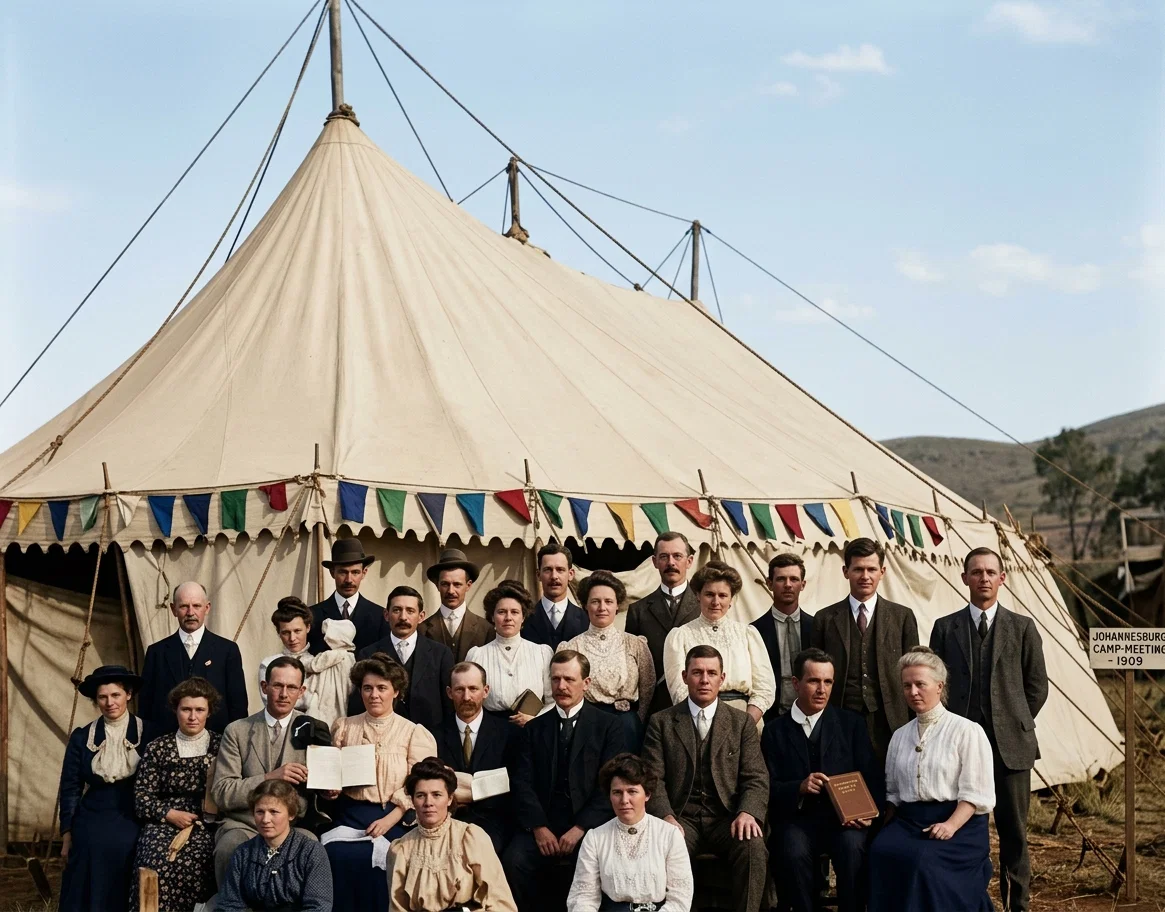
During the camp-meeting at Johannesburg, the Spirit of the Lord was abundantly poured out, and about twenty persons decided to attend the canvassers' institute which followed immediately. This institute was greatly blessed of God. The report for the first three weeks following this institute totals a value of twenty-three hundred seventy-two dollars in that one conference alone.
G. H. CLARK, GENERAL AGENT OF THE SOUTH AFRICAN UNION CONFERENCE, WITH HIS COMPANY OF CANVASSERS AT THE CAMP-MEETING AT JOHANNESBURG
In the Cape Colony Conference we expect to hold a two-weeks' institute at the close of the camp-meeting. Doubtless several new canvassers will be secured at that time.
It is wonderful how the Lord is laying this work upon our strong young men and women from twenty to thirty-five years of age. They are enjoying the work very much, and the Lord is greatly blessing them.
The officers of the union and local conferences have labored most earnestly with me in an effort to bring this branch of the Lord's work into its rightful place. The Lord is doing, and will continue to do, a mighty work in South Africa.
Almost every week our Sabbath-keepers are asking for something to do. We are encouraging them to enter the field and distribute the printed page. The average results from the work of our agents are indicated by the fact that during the past four or five weeks, nine of our agents have sold books to the value of three thousand seventy-five dollars, or an average of seventy-five dollars a week for each agent.
Our youngest canvasser in South Africa, Hugh Williams, the fourteen-year-old son of Elder E. R. Williams, recently secured twelve orders for “Coming King” in eight hours. The total orders for books, including the sale of papers, since the first of September have amounted to seven thousand one hundred fifty-two dollars.
We have given these facts and figures, not because we wish to emphasize the value of the books sold, but because we wish to set forth the wonderful manner in which the Lord is working for us. Beloved, let us all take our place in this closing work of God.
G. H. CLARK.
The Danish-Norwegian Seminary
By R. A. Underwood
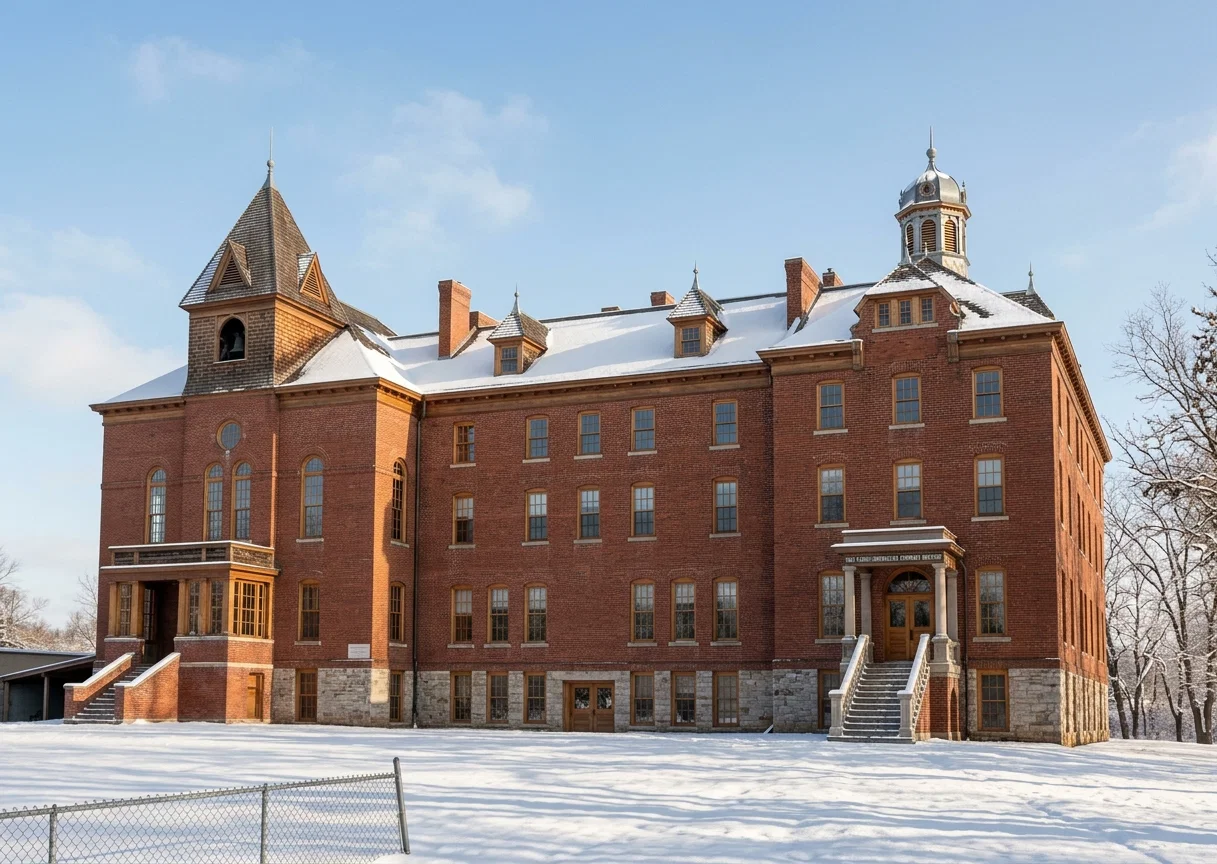
The accompanying picture presents the building recently purchased by the Northern Union Conference for the Danish-Norwegian school. The artist said that it was impossible to get as good a picture of the building in the winter as could be secured in the summer season. As has already been stated in a previous issue of the REVIEW, it cost about forty thousand dollars to erect this building.
It is in good repair at the present time, it having been built but seven years ago. The structure has solid brick walls. The inside floors are all hardwood and hardwood finish. The chapel is on the second floor in the left end of the building. It is a beautiful assembly-room. There are sixty-two students' rooms in the building, and a large dining-room in the basement.
Extending to the left of the building, which is but slightly shown in the picture, is a covered basement, the erection of which cost seven thousand dollars. The plan was to have this left wing of the building correspond to the right wing from the center of the building. There is a large gymnasium and several class-rooms in this basement, which we shall be able to utilize in the school.
Since writing my former article, our committee has received title to the furniture that was in the college, which consists of chapel seats, dining-room chairs,16tables, sixty-two iron bedsteads, mattresses, and other fixtures.
Through the generosity of the Hutchinson people, this furniture, which had been inventoried at about thirteen hundred dollars, we secured for three hundred dollars, the citizens making up the difference.
Brother George Axelsen, wife and daughter, are now living in the building.
We have purchased a good team of horses at a cost of four hundred thirty-five dollars. Brother Axelsen has already begun to cut timber for the dimension material to go into a barn which will have to be built this summer. We must have a barn that will accommodate not less than four horses and about twenty cows. The barn will be located about twenty-five rods to the left of the college building. The building faces the south. The grove in the rear is not seen in the picture. Lying just north and west of the seminary are about ten acres that will make a beautiful grove. This will not be cleared, but kept for the campus of the school.
NEW DANISH-NORWEGIAN SEMINARY BUILDING
February 1 we passed over to Mr. Jones, in addition to the two thousand dollars we had already paid, thirty-five hundred dollars, and gave notes for the remaining purchase price of the school building. The abstract of the land, which includes the one hundred sixty acres, is in readiness; however, it will take about a month for it to pass through the court in the county in which it is located before we can secure a title.
I am glad to report that a number of isolated friends who are interested in seeing the Danish-Norwegian people have a seminary in which their own youth will receive a special training, have responded with donations of from five to a thousand dollars. We are very anxious that this school shall be all paid for before we open it next fall. The notes that we are obliged to give for the property will be interest bearing. Possibly there may be some of our brethren who would be glad to lend The Northern Union Conference Association, Incorporated, some means at a low rate of interest, or without interest, for a time, until the donations come in sufficiently to cover the expense of equipping this school.
This morning's mail brought a touching letter from a brother in Nebraska, who is over eighty years of age, lying upon his bed unable to sit up. He expressed his great interest in the school, and accompanied the letter by a check for twenty-five dollars. To such as he and others who may give to assist this school I can say that a statement found in the Testimonies places our schools in no second position in connection with our work. In a leaflet sent out to teachers and students, dated October, 1893, is the following important statement: "Of all institutions in our world the school is the most important." When we consider the influence and the effect of the training of the student for service in the cause of Christ, and the unmeasured duration of the influence going out from our schools, we shall recognize that this statement is none too strong. Surely there is no enterprise or object to which we can give our means that can possibly bring greater results and more satisfactory rewards than the means invested in preparing a place for the training of our youth in our colleges and seminaries.
I wish to thank those who have already responded to the invitation to assist in placing this school upon its feet, and still say that there is opportunity and a great need of others quickly responding to this providential opening to plant this institution as a tower of strength and a beacon of light to the world in connection with the third angel's message. Send all contributions to T. D. Gibson, treasurer of the Northern Union Conference, 2718 Third Ave., South, Minneapolis, Minn.