I was teaching a country school and “boarding round.” One week I was in a lovely Christian home. Few children are loved as fondly as was the little boy who was the only child at that house. His father worked and sacrificed that he might be educated and have a start in life, and his mother provided good, wholesome food, kept him clean and comfortable, and taught him good manners.
Yet at my first meal in that home I was made heartsick by the untruths which were told to the child by both parents, without a suspicion, seemingly, that they were doing wrong. When the fond mother tied on the little boy's bib, I heard her say, “Now you must be good, or God won't love you.” Lie number one. Under this threat the boy became nervous. He spilled a little milk.
Then it was the father's turn. “Now the lady will go away and tell all the people that our little boy spills his milk.” Lie number two.
Presently the father said to me: “Don't you want a boy? I will trade you this one for a hen.” Number three.
The boy sought his mother's eye anxiously, to see whether this was really meant, but she did not meet his gaze. As I could not say to him, “Your father is not speaking the truth,” I smiled reassuringly at him. Papa went on: “Or, I'll trade him for a pig,—he eats like a little pig. You could put him in the pen with your pigs at home.” Lie four.
The boy was slow at eating, and had not finished when we left the table. Papa said, “If you eat so much, you will turn into a little pig.” Lie number five. “You are almost fat enough to sell now. When you get fat enough to kill, you could be killed, like the other little pigs.” Lie number six.
The father went out, laughing. By the shades of livid color that passed over the face of the tortured child, I knew that he had, unfortunately, seen pigs slaughtered. In his dilated, horror-stricken eyes I saw that his imagination pictured the frightful scene, and placed himself in the place of the victim. He ate no more. All the digestive fluids were turned to poison. I helped him down from his high chair, took him in my arms, and gave him my watch to hold, while I told him about my brother's pet squirrel. But in the midst of the most engaging part of the story he looked up earnestly into my eyes, and said, “I hope when my papa does sell me, I can go to you.” I told him his father was only in fun, that papas never sold their little boys, that it was against the law, and therefore could not be done.
Just then his mother came to put him to bed early, so that she and I could chat without interruption.
We visited late, and just as I entered the guest-chamber, the house rang with agonized screams, and I found both the parents bending over the child's bed, while he, sound asleep, with wide-open, unseeing eyes, was hoarsely screaming, “I ain't a pig! I ain't a pig! Don't kill me.”
At last, after having water dashed in his face, he seemed to recognize his mother's voice, and clutched her with a deathlike grip, which could not easily be unclasped,—nightmare amounting to delirium tremens caused by untruths, indigestion, and an excited imagination! It might easily have proved fatal.
I learned, then and there, that it is not enough to earn and cook food for a child—he must be permitted to eat undisturbed. I also learned that the processes of digestion and assimilation can not be carried on at all while the mind is controlled by fear, anger, jealousy, or grief. — Union Signal.
Fatal Parley
It is dangerous to parley with the enemies of righteousness. One who is doing a good work and living a good life will often hear propositions from the enemy. Many have been deceived by such plausible invitations. Young men living a pure and honest life are frequently invited to hold a conference with those who are living another kind of life. They like to tell what they know about the tricks of business, the pleasures of sin, and the ways of the world. Why not hear what they have to say for their cause? Of course, you will not be persuaded to join them. Your mind is made up, and your choice settled. But what harm can there be in hearing what they have to say? It is a dangerous snare.
Nehemiah was invited to such a conference with the enemies who had tried to hinder the building of the walls of the city. They pretended to desire to communicate to him something which would be beneficial to both sides. They were for settling the matter by a parley. But Nehemiah understood the scheme. If they could get him outside of the walls of the city, they could easily lay hands on him and put a stop to the work. His reply was memorable. This is what he said: “I am doing a great work, so that I can not come down: why should the work cease whilst I leave it, and come down to you?” He was too busy. He was busy about great things. The work was urgent. He could not be spared for a day; no, not for one hour.
This reply has been a lesson to the people of God in all subsequent ages. The way to defeat such wicked schemes is to be busy. Be busy about some great thing. Trifling occupations may not be sufficient to fortify one against the proposition of the enemy for a parley, but a great work will hold the worker. Some one may say, I have no great work on hand. Moses had a great work to do, and so had Daniel and Paul and Wesley, but my work is trifling. The student, the clerk, the mechanic, the business man, has nothing very important in hand. The works of most men are mere trifles. The president of a great college said the other day that a student came to him not long ago and asked, “What is worth while?” Sure enough. The busy tribes of flesh and blood seem like so many ants building little mounds to be washed away by the first rain.
But it is not really so. There is something worth while, and every one may engage in it. We are indeed all engaged in it. We are building, not a wall such as Nehemiah built, but a character. We are making, not only a living, but a life. Every thought we think, every word we utter, enters into that structure. If you leave your work to go down for a parley, even the parley will enter into the temple. We are doing a greater work than Nehemiah did. Each one may say to those who solicit him to leave it for a conference, “I am doing a great work; . . . I can not come down.”—Christian Advocate.
A Choked Giant
By C. H. Spurgeon
THERE is a quaint story of a giant, who had long fed upon windmills, and at last was choked by a pat of butter; and, assuredly, his counterpart may be seen in the evolutionists of our day, who are unable to receive the Bible account of the creation. The hypotheses of our present philosophers are enough to tax the credulity of a monk of the Middle Ages, yet many take down these windmills as pigeons swallow peas. The teaching of revelation is fitted for the capacity of a child, but our wise men are choked with such simple fare.
We confess we have not enough faith to be an infidel, or an agnostic, or even an evolutionist. We find ourselves for once standing up for reason, and demanding that our faith should not be overstrained. We can believe what is revealed; for, sublime as it is, there is a kind of truth-likeness about it; but we can not believe what we are now taught with such tremendous authority; for, in the first place, it is not worth believing, and in the next place, it looks so dreadfully like a lie that we had rather not. No, thank you, dear sir, we will keep to our bread and butter.; our throat is not yet adapted to the disposal of windmills.—C. H. Spurgeon.
PHILIP GIDDINGS
By Philip Giddings
Morsels
PHILIP GIDDINGS
THEY may seem alike, but 3 is not E. They look in opposite directions, and are reversals: one’s foot is where the other’s head is,—like Judas and Jude.
From the same root whence comes knee (brk) comes blessed. The kneeling man is the blessed man. “Behold, he prayeth” at “the street . . . called Straight.” Acts 9:11. There is where he lives — at Straight Street — whose attitude is prayer. The one at prayer is tapping heaven. In the tactics of the Christian soldier, knee-drill is superlative,—
For Satan flees
At once he sees
The weakest saint upon his knees.
Of the four P’s, prayer comes before praise, practise, and preach. The prayer-seed develops into praise-blossom, then into practise-fruit, whose seed is in itself—the preach-seed—for propagation.
On the Way to Abyssinia
By Anol Grundset
ANOL GRUNDSET
AUG. 18, 1909, at noon, we left New York for Abyssinia, East Africa, via Hamburg. We enjoyed most pleasant weather across the Atlantic, with hundreds of passengers on board, most of whom were Germans, this being a German liner. We found some Americans and a few Scandinavians. Most of the passengers were bound for Germany, a few for other parts in Europe, but to my knowledge we were the only ones bound for far-away Africa. Some were14in pursuit of health, others of riches, and two lads, in the bloom of youth, were going to advance their musical education at Vienna.
I must confess that a queer feeling comes over a person when he passes the Liberty statue in New York harbor, and sees the last glimpse of America's shores, separated by the mighty deep from loved ones and home land; yet I was comforted by the thought of being a co-worker with God in sounding the third angel's message in a distant land, and considered this a great privilege. What a mighty, glorious truth for a dying world!
We stopped two days in Zurich, Switzerland. Elder and Sister E. O. Reinke, recently from New York, in whose home we were entertained, made our visit there pleasant, and one long to be remembered. I spoke twice to the people, through an interpreter.
One thing which impressed me was that at every place we stopped throughout Germany, Scandinavia, and other parts of Europe, we found congregations of Sabbath-keepers and I felt to exclaim, “Behold what God hath wrought!” In the lives of thousands, Jesus has come, his abiding Spirit making sweet the path of sacrifice and trial. I shall long remember the young people's society in Zurich, their zeal and earnestness witnessing a repetition of early days and true reformation.
Our next stop was at Genoa, Italy. We were again made glad by meeting here Elder L. Zechetto, lately of New York. We spent two days at this place, visiting points of interest, and preparing for sailing. As we could not speak the language, our brother's help was much appreciated.
We boarded an Italian ship leaving Genoa September 28. Many things of interest en route by way of Naples, Messina, Alexandria, the Suez Canal, and the Red Sea, might be mentioned, but time will not permit now. We arrived in Massaua, October 14, having enjoyed good weather all the way, except part of one stormy night in the Mediterranean. The heat in Massaua was almost unbearable. I know of no better way to describe the fearful heat of this place than to liken it to a continual electric-light bath.
Next we took an African railway to Ghinda, and next day began our ascent into the mountains, with mule teams. We were happy to reach Asmara by Sabbath. And, having ascended six thousand feet above sea-level, we found the atmosphere much cooler.
We are very grateful to God, who has safely brought us to this place. We are of good courage, trusting in his keeping power, desiring to be used in the blessed cause.
Asmara, Eritrea.
Tinnevelli District, South India
By J. S. JAMES
J. S. JAMES
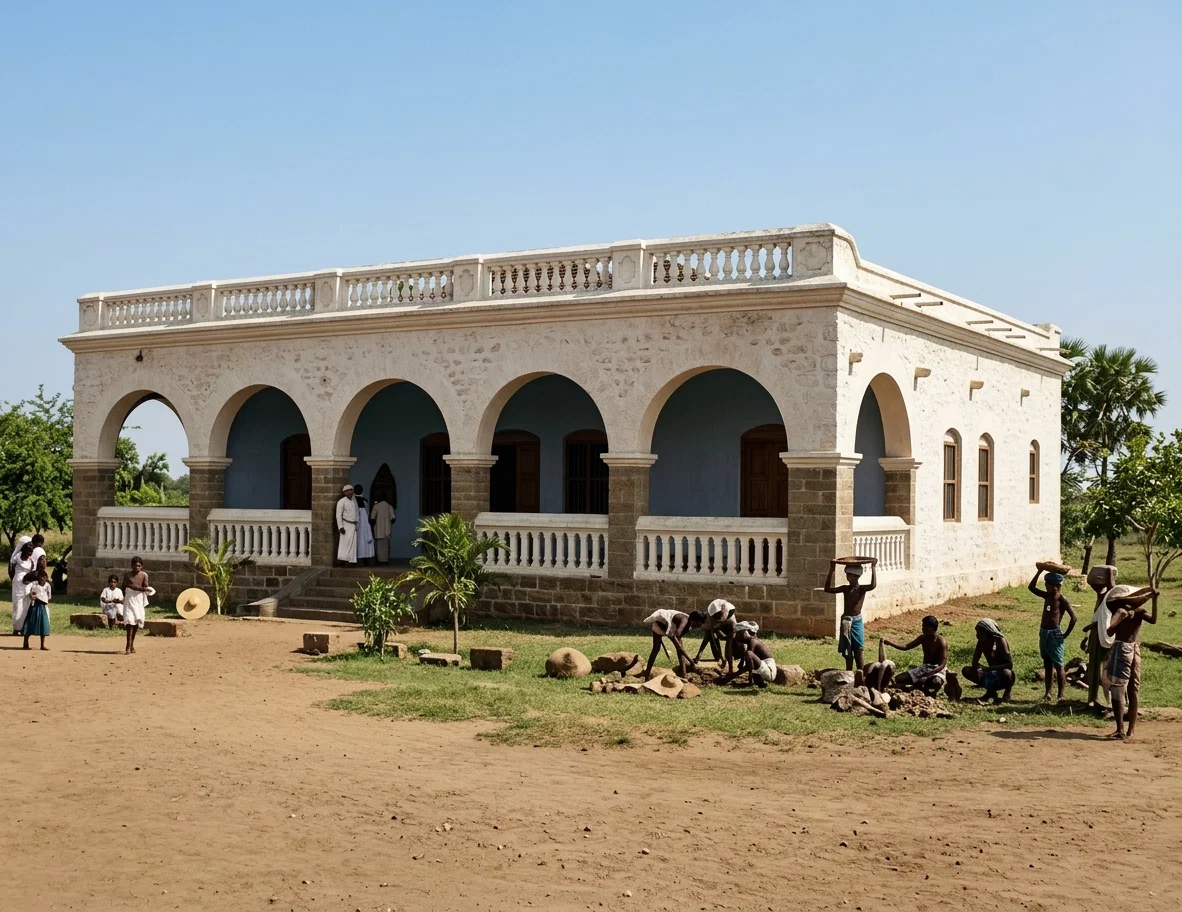
Since my last report to the Review, we have completed the building of a mission bungalow, a picture of which is given herewith. This is the first structure erected by mission funds for our work in India; consequently we had but a scant stock of experience from which to draw. We are especially thankful to God for his protecting and guiding hand which has been over us as the work has progressed. We now have a building in which we may live with some comfort in all seasons of the year, away from the noise and disease of the native village, and free from damp.
We definitely decided to begin work on this building the nineteenth of February. Ten days later the work was begun, and the building was practically completed by August 1. This work took us through the most trying season of the year, and it was with considerable anxiety that we began. This time last year I was laid low with a sunstroke, and I was ill prepared, physically, to encounter the exposure to the sun and heat. But we knew God was able to protect us, and that he was acquainted with all the conditions under which we must labor, so we committed all our plans to him, and went earnestly to work. Almost from the first, it was necessary for me to take the personal oversight of the work. This kept me going and coming in the hot sun much of every day. I was as well protected as my work would permit by wearing a large sun-hat, and dark glasses, and carrying a double covered umbrella, the under cover of which was of a deep-red color. This last item I consider very important, and worthy of mention for the benefit of those living in the tropics who are affected by the sun. Red and orange are the only colors which will effectually neutralize the dangerous rays of the sun. The principle is well illustrated in the photographer’s use of a red or orange light in the dark room to protect his sensitive plates, and at the same time give sufficient light. The government of India has so far recognized this principle as applied to clothing for the protection of her soldiers in the tropics that a patented cloth with one side showing red or orange is being made up into uniforms. Many of the leading merchants are now selling a tropical underwear in deep-red and orange colors for the general public.
FRONT VIEW OF BUNGALOW, TINNEVELLI DISTRICT, SOUTH INDIA
Building a house in India is a much harder task than the same work at home. Frequently we find our Western ideas obsolete, and we must conform to conditions and circumstances. Many times we question the logic and methods of our Oriental brothers, and fail to discern their standpoint of reasoning. I had declared over and over again, after looking at the way most houses in India were built, that if ever I built a house, I would demonstrate a few advance ideas in building. Well, I have had my chance. I worked in a few of my pet ideas in this building, but strange to say, when it was finished, it looked remarkably like every other building of its kind in India. The very things I could not see then, I now find a good and sensible reason for. Such is the value of experience, and a closer acquaintance with the native mind and customs.
Our hearts have been greatly cheered and encouraged by the recent news that we are to have the addition of a man and his wife to our small force. For a long time we have hoped to start some kind of school work among the Tamil people, but no one could be secured to look after it. A good school is greatly needed, and would add quite materially to the permanent results of our work.
It seems, as fast as we fill one opening, there comes a call from another. A few days before leaving Tinnevelli for Mussoorie—where I am taking a short rest—I was visited by a native evangelist into whose hands had fallen some of our Tamil tracts. He has been working on a self-supporting basis for a number of years, having established an orphanage and school and three native Christian congregations. As soon as he read our tracts, he became convinced of their truthfulness, and set about to better inform himself and teach his people. He has a good knowledge of English, and I have supplied him with other tracts on present truth, which are not in Tamil. This man lives in a prosperous farming community about thirty miles north of where we are located in the Tinnevelli District. He has written me several letters begging that we send some missionaries to his place to further instruct them in the truth, and to carry on the work in the surrounding country. When I return to south India, I expect to visit this locality and investigate his work. He seems to be a sincere seeker after truth. He was educated in the Baptist faith.
If this situation proves to be a door opened of the Lord, where are the workers to place in it and develop the work? Our daily prayer is that God will open up some way whereby these millions may hear the truth.
The Gospel of the Kingdom
By L. D. Santee
L. D. SANTEE
“And this gospel of the kingdom shall be preached in all the world for a witness unto all nations; and then shall the end come.” Matt. 24 : 14.
AWAY from the ties of home and friends,
And voices that bid you stay,
You must go till the work of the Master
ends:
Soldiers of Christ, away!
Where sable faces look for the light,
By the streams with their sands of
gold,
The truth must go to the land of night;
There, must the truth be told.
And far away, ’neath a wind-swept sky,
Where the landscapes are drear and
gray,
There do the heathen in darkness die:
Heralds of Christ, obey!
There are souls you will point to the
One above.
In the wake of the setting sun,
You have circled the earth with your
work of love,
And the east and the west are one.
When the work is done, and the flags are
furled,
Rest will be long and sweet.
Morning comes at the end of the world:
Servant of God, be fleet!
Moline, Ill.
Lights in Albania, Turkey
By ROBT. S. GREAVES
ROBT. S. GREAVES
My wife, one of our sisters, and I have just returned from a trip to Albania, where we visited an isolated Sabbath-keeping family, and held a number of meetings. This is the first time I have been into the interior of the country. Previously my work has been confined to Smyrna.
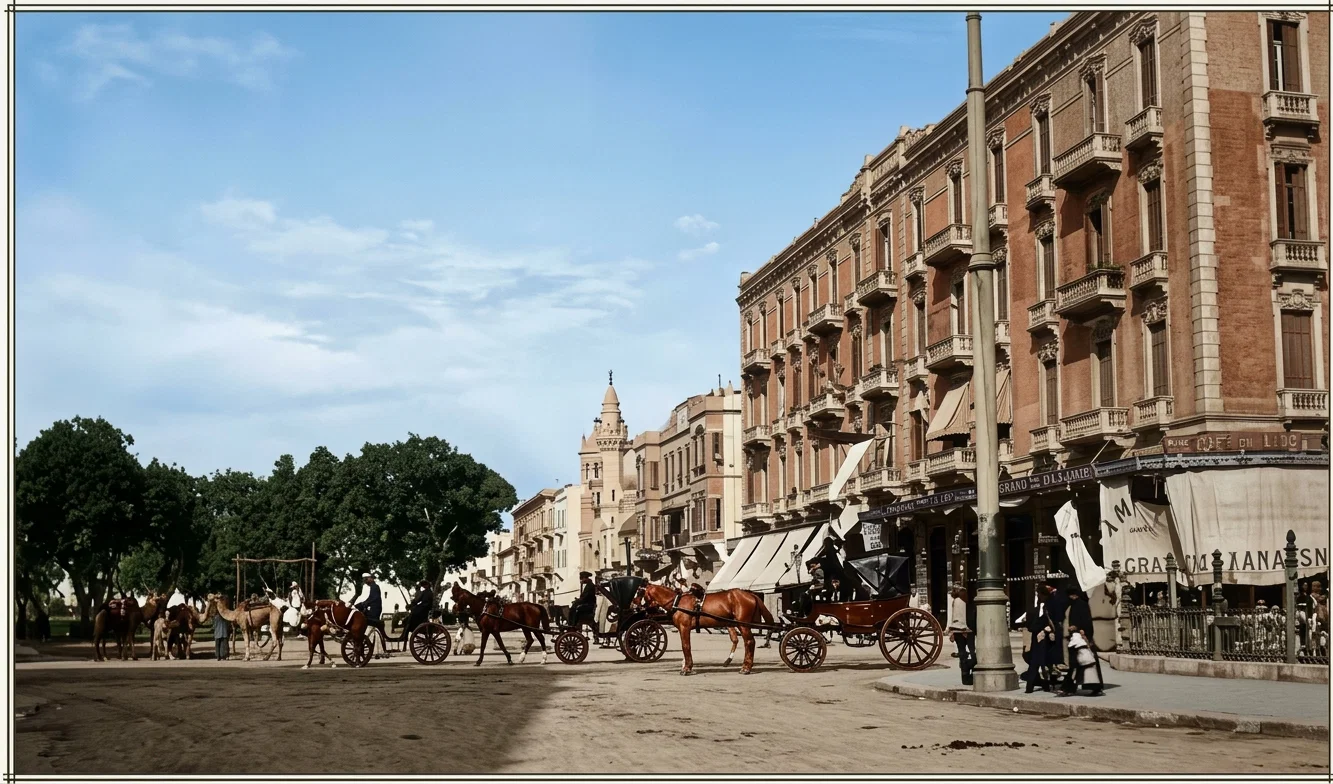
A SCENE IN ALEXANDRIA, EGYPT
We found this family shining as a bright gleam in the midst of great darkness. The Greek orthodox religion largely prevails throughout this territory, and owing to this family's fidelity to the Sabbath truth, its members were excommunicated from the church, and afterward boycotted by the people. These shocks seem to have had the same effect upon them that gusts of wind have on trees which stand exposed in the open, and which are compelled to strike their roots firmer and deeper, in order to be able to withstand the storms. This brother and his wife have learned to trust more fully in the precious promises of God, and are stronger for the experiences through which they have passed.
Our services were well attended, and several are much interested. But their faith is not yet strong enough to encounter the church's excommunication and such treatment as our brother received. The dear Lord never deserts his children. When this brother, who is a weaver, could not find sale for the articles he wove, some Jews proved to be his friends, and sold them for him. Thus a way of escape was opened to the faithful commandment-keeper when the prospect was very dark. Now the situation is much better, for the people have gradually become accustomed to buying from him again.
Our visit caused quite a stir in the village, and a little while before leaving, I asked the sister if she did not fear that persecution might again set in. She replied, “No; that is the time when we are strong.” This showed us plainly that the spirit of the early Reformers still lives, and that even in this country there are honest souls who will yet do and dare for the sake of conscience. We think that in the near future others will take their stand.
Although this place is in Turkish territory, the Greek element prevails, but the language is mixed with Albanian words. The sister who accompanied us acted as interpreter, and we got along nicely, being thankful that we were able to make ourselves well understood.
It was my privilege to baptize Brother and Sister Brakas and their eldest daughter, and they were full of rejoicing to be able to follow our dear Saviour's example in being buried in the water. We rejoiced, and praised our Heavenly Father for leading out these dear souls to be such bright lights, and we hope these same mountains may witness many similar scenes. We were a happy company as we descended the hills to the clear river below. Two of the children were too young to climb down among the rocks, so their father carried one, and I the other, for he wished his whole family to be present.
I think our work is not going to stop in Albania with these first fruits; for these dear people, who came into the truth by reading a tract which some one had given them, have a missionary spirit, and are trying to help their neighbors to see the light which is so precious to them.
During my stay of about nine days, we had a number of meetings and studies, and were often kept busy between times in answering the questions of interested ones.
The Bible custom prevails here when guests are departing, and we had something of Paul's experience of which we read in Acts 21:5: “And they all brought us on our way, with wives and children.” We felt sorry to see some walking so far, for the children had to be carried back, but their wish was to come. We formed quite a procession, with our mules and drivers going ahead, and the company following. What especially touched our hearts was to have four Greeks, who had been attending our services, risk the ban of the church, and walk publicly by our side through the village, and afterward for about half an hour on the way. One of them had already been threatened by the priest; but it was evident that the Word of God was having its effect, and making them all strong. After they left, I mounted my mule; but our brother and his daughter would not leave us, and still kept walking on and on. They would not hear of riding on my animal, for this was their way of showing their appreciation of us.
Our Father's care was over us, and we returned safe to Smyrna. Our prayers regularly go up to heaven for our brethren in Albania, and we ask you also to remember them, and that you will not forget us in Smyrna.
Scatter Hope
“SCATTER hope. Whatever is calculated to inspire hope is a blessing. It isn’t what you tear down but what you build up that counts.”
Fijian Missionaries Leaving for Distant Islands
A MISSIONARY, in describing the home-leaving of a Fijian band of missionaries departing for distant islands, says: “On my return to Suva, I had the pleasure of being present at a farewell meeting given to nineteen native missionaries, who, with their wives and children, making a party of ninety, were leaving for work in the distant islands. It was a most impressive gathering, the fine Jubilee church being thronged with interested worshipers, and the brethren, mostly in their fresh, white suits, sitting at the head of the building. Going into this foreign work is often a greater sacrifice to them than to us, for they are lovers of home and friends, and many of them felt their position keenly; one who had been a helper in the missionary's family, could scarcely control his voice to speak. A fine-looking man, who, after furlough, was returning to work in New Guinea, said: ‘Our mission is to save souls, but here is a life that I have saved,’ lifting up a colored child, who was being buried alive as a baby when he rescued him. He added, ‘I leave my people, the country of my ancestors. I have no land now; heaven is my land.’” Who knows but some of these missionaries may have been sent to New Guinea by the loving Father above, there to learn from our workers the fuller meaning of the gospel contained in the third angel's message?
Harvest Ingathering for Missions
By A. J. S. Bourdeau
From far-away Turkey comes an order for five copies of the Missions REVIEW. Our laborers in foreign fields have thus far ordered a total of 5,727 copies.
A sister in Minnesota, sixty-nine years of age, writes: “I have had good success in return for seventeen copies of the Missions REVIEW distributed. I expect to secure ten dollars, or even more. I am so glad to have a part in this work.”
Mrs. Mary Williams, of Missouri, recently sent us her solicitor’s card, containing the names of ten donors who gave $2.25 to our foreign missions. She secured this amount through the distribution of the ten extra copies of the Missions REVIEW sent her some time ago.
Prof. H. R. Salisbury, president of the Foreign Mission Seminary of this city, informs us that the donations secured by the teachers and students of that institution average over $1.50 each to date. They have set their mark at two dollars each, and are sanguine of reaching it.
Mrs. E. J. Pilgrim, of Texas, secured $2.10 with the ten extra copies of the Missions number of the REVIEW sent to her as a subscriber to the REVIEW. She says: “I gathered this means by the use of those ten copies. If you wish, you can send me ten more copies. I will do what I can to help in the work.”
Mrs. O. M. Kelley, of New York, has forwarded her “official solicitor’s card” containing the signatures of three persons who donated $1.25 to foreign missions. In all, she received twenty copies of the REVIEW. She says: “I have sent some away to friends. I will keep at work until the last paper is gone, and will do the very best I can.”
Mrs. G. W. Payne, of Mississippi, sends the following encouraging item in regard to her campaign work: “I am an isolated Sabbath-keeper. Although very busy, I found a few moments to canvass. I have collected $13.50 for five copies of the REVIEW. On presenting the paper to a friend, he said, ‘Put me down for two dollars.’ Yesterday while out I met him again, and he said, ‘I read that paper, and it is fine. Add two dollars more for me.’ I enjoy the work.” This sister thus received an average of $2.70 for each of the five copies distributed.
Brother W. H. Covell, field missionary agent of the California Conference, writes: “I went out yesterday, worked three hours, distributed fifty papers, and collected $3.25. I also secured two excellent names for missionary correspondence, and am looking for a nice check from a prominent lady in —. Mr. William R. Beatty collected the same amount, $3.25. His wife secured eight dollars, and aims to make her total donation fifty dollars.”
Mrs. Rose Brown, of Wisconsin, has had good success in the work thus far. She says: “I have so far distributed nearly forty copies of the Missions number of the REVIEW and have received seven dollars in donations. I am still working with the paper.” If every one of our workers could collect on an average seventeen cents a paper, as this sister has done, what a large amount would be gathered in for the cause of foreign missions.
Brother Jasper Wayne, of South Dakota, has just sent in his check for $48.15 received by him from the distribution of sixty-four copies of the Missions REVIEW. He says: “I have been handling our periodicals in this way for the last five years. My time is well taken up with business, but I would not miss these annual ingatherings, as it puts me in touch with so many precious souls that I could not reach in the ordinary course of business.” Seventy-five cents a copy is certainly a good average.
Brother J. W. Bressie, principal of our intermediate school located at Chico, Cal., reports that the school was dismissed on November 17 in order that the students might engage in the Harvest Ingathering campaign. He says: “Some secured nearly five dollars; others only distributed papers, but all did something. The students and church-members have already secured donations amounting to seventy-five dollars. We expect to raise one hundred dollars.” This is an excellent report from so small a school and church.
Mrs. M. A. Duncan, aged seventy years, lives in one of the largest cities in New Jersey. She informs us that she has enjoyed some blessed experiences in her work of soliciting funds in that city. She writes: “I received the ten copies of the Missions REVIEW. I had already taken twenty-five copies through our church. When I took them, I made up my mind to secure ten dollars; and so I did. When I received the ten extra, I made up my mind to make it fifteen dollars; and so I did. Although it is difficult to go from house to house and ask for money, I do love this blessed truth as I never loved any other church.” A. J. S. BOURDEAU.
Central America — a Needy Field
By Mahlon Wood
MAHLON WOOD
CENTRAL AMERICA is one of the most needy fields on the globe to-day, both financially and otherwise, having to depend on the United States for all she uses. Her need spiritually is much greater. With an estimated population of nearly two million and a half, two thirds of this number are in grossest darkness, and have never heard the gospel, while one third do not even know there is a God. There is one tribe yet uncivilized. The people of this tribe believe that when one dies, he continues his work the same as before his death; so all he has, besides his house, is put into the grave with him. There is yet another tribe who believe that their dead become very hungry after eight days, and return for their portion of the good things. So a large feast is made, consisting of rum, pork, and cat, and casava for bread, and carried to the grave. Here it is partaken of by the stronger-hearted among them, or by dogs, so the mourners become satisfied that their loved ones have been provided for.
Let us remember that it is only the third angel’s message that can better these conditions, for although the gospel has been preached to a part of the inhabitants of Central America for over a century, at the present time there is not one native minister, and no native doctors and nurses. They have only a few native teachers. They know nothing of the power and principles of the gospel, and are willing to believe everything except the truth. The children believe that the sooner they drink rum and use tobacco, the quicker they become men and women. To tell them that a hot bath is good for a cold, and a cold bath for a fever, makes them think that you have gone mad. These good people believe that their dead become a “duppy,” and roam about all night, and are capable of doing you great harm if you are found outside your house. In the morning these “duppys” return to heaven or hell, as the case may be. They are greatly afraid of obia and the obia man, and believe that most of the trouble and disasters that happen to them are caused by the obia men or obia women working obia on them. There are many professed obia men and women among them.
This pictures but faintly the great need of Central America for the gospel.
In America on Furlough
By H. H. VOTAW
At the invitation of Elder E. T. Russell, the General Conference Committee recommended that I should attend the camp-meetings of the Central Union Conference. The privilege of so doing was greatly appreciated. To travel through the rich agricultural districts of these States of the Middle West was to appreciate anew the vast resources of the United States. But this was not the best part. To attend our meetings, to meet those who love this message more dearly than anything else on earth, to hear their interest expressed in words and to see it manifested by their gifts, was to have my courage renewed. We shall feel, more than ever before, as we stand face to face with the blackness of darkness of heathenism in Burma, that we are not alone in the work, but that the people of God in the home lands are one with us in our labors.
Following the camp-meetings, I went to Oklahoma, near Woodward, where my brother and sister reside. My mother had come from Ohio, in order that we might all visit together. We had expected to spend a month or so in doing nothing but visiting, but God led us to hold some meetings in response to very urgent invitations.
I preached for about three weeks every night. During the day Mrs. Votaw and I visited a great deal with those who became interested. We distributed over twenty-six hundred pages of literature free, took orders for thirteen books, and placed the REVIEW in the homes of all the new believers. Sixteen were baptized. Three others were received into the church, to be baptized at a later time, and two backsliders renewed their consecration to the Lord.
Since we were not laborers of the Oklahoma Conference, we were glad to have present when the candidates were accepted for baptism and church-membership, Elders D. F. Sturgeon and J. Ebel.
Brother Ballenger, who is elder of the Woodward church, allowed his farm work to suffer in order to furnish us with horses, so that we might do the visiting that was necessary.
Sister Ballenger, having had experience as a Bible worker, is holding public Bible readings in the same schoolhouse in which our services were held, and we expect others will take their stand for the truth.
We were urged very strongly to go into the adjoining school district and hold another series of meetings, but felt that we could not now. The call of Burma, the land we love so well, is in our ears, and we hope to sail by the first of the new year. We are visiting now in Ohio. H. H. VOTAW.
GUY DAIL
By Guy Dail
Turkey
CONSTANTINOPLE.—After a journey of sixty-eight hours from Hamburg, via Leipsic, Dresden, Vienna, Budapest, Belgrade, and Adrianople, I was pleased to reach this city, so beautifully situated. Brother Voight, who had arrived a week before, to look after our publishing interests in this field, met me at the station, and took me at once to the home of Elder Z. G. Baharian, where I met Elder E. Frauchiger and family, and Brother Scior and wife, who had arrived a day earlier than I.
Yesterday we had Sabbath services with the twenty-five brethren and sisters living in and near Constantinople. Two are converted Jews, five of them are Greeks, and the others are Armenians. One Turk who is not one of us, one Armenian who used to be with us, and a young man whose parents are in the truth but who makes no profession, were present. After the preaching services, in which Brethren Frauchiger and Scior and the writer took part, we had the Sabbath-school. The word spoken was translated from English into Armenian, and then from that into Greek. As Brother Scior can not speak English, he talked in German, and I translated what he said into English, and from the English Brother Baharian interpreted into Armenian. We were all accorded a hearty welcome by the brethren, and felt at home at once; but we longed for the time to come when it would be possible for us to get along without translators.
We expect to visit the company at Bardisag on Wednesday, and to have meetings with them over Sabbath. Returning, we shall meet Brethren L. R. Conradi and Robert Greaves here, and have a council November 1-5. We also expect to see Dr. F. W. Vasenius and his wife, who come from Finland via Odessa, en route to the Abyssinian mission field. Elder H. F. Schuberth, who is not far from here, also expects to call at Constantinople for a short time.
I hope you will remember us and the work here in your prayers, that just the right plans may be laid for advancement both among the Europeans of the city, for whom Brethren Scior and Frauchiger will especially labor, and among the native races.