Under the above heading, the Word and Way, a Baptist journal issued at Kansas City, Mo., gives a concise statement of the situation, closing with a most significant confession. Following is its presentation of the subject:—
Protestantism—historical Protestantism, we mean—started with a millstone about its neck. All the years of its life it has been handicapped by the Romanism that has clung to it. It needs nothing so much as to rise up in protest against its own Romish tendencies and characteristics. It can never compete with Romanism until it repudiates what of Romanism it has brought forward in itself. Protestantism proper, in its several divisions, is but a more or less modified form of Romanism.
The Reformers did not shake the dust of Rome from their feet and go clean away. Not by a long ways did they divest themselves of all that was Romish. They stopped midway between Rome and the truth, and built into their ecclesiastical systems much of the material which they carried with them from Rome. It is in this ground that lies between, we find nine-tenths of the ecclesiastical and theological unrest and turmoil. Here things are in a perpetual ferment. Protestantism continues to divide and subdivide. Protestantism can not survive, and build into itself that which is a survival of Romanism. It must, in time, go to pieces and apart. One part, by the law of affinity, will go to Rome, and the other part, by the same law, breaking every tie that binds it to Rome, will go to that which is Rome’s opposite. Ritualism, sacerdotalism and sacramentalism can never be satisfactorily and permanently adjusted to anything except full-fledged Episcopacy.
The Church of England and the Episcopal Church of this country are but modified copies of the Church of Rome. The Methodist Church is but a modified copy of the Episcopal Church. Presbyterianism presents some decided variations from the others mentioned, but all are but different species of the genus Episcopacy.
Episcopacy in all its forms, infant baptism, baptismal salvation, salvation by works, ritualism, holy days, and so on, have all been brought over from Rome. Baptists are not Protestants.
It is seldom that we find the Roman-Protestant situation more clearly and concisely defined, or so frank a confession on the part of an organ of any professedly anti-Roman denomination. However, in the matter of “holy days, and so on,” which “have all been brought over from Rome,” the Baptists (excepting a small faction) hold on to the most prominent one of all, and are falling into the observance of the others, along with all the denominations mentioned in the foregoing article. The prime “holy day” of Rome, the one which she holds up as her badge of ecclesiastical authority, is Sunday. As long as the Baptist denomination continues to wear this “millstone about its neck,” its gradual adoption of Easter observance, “and so on,” is but logical. Like Protestantism, the Baptist body “can not survive and build into itself that which is a survival of Romanism.”
Genuine Protestantism is “Rome’s opposite.” It breaks “every tie that binds it to Rome.” Yet, in the face of this assertion, the Word and Way says, “Baptists are not Protestants.” If it means Protestants of the compromising sort, it would be well if it were true; but so long as they hold to any of the Roman “holy days,” to Roman immortal-soulism, Roman eternal-tormentism, “and so on,” they are confessedly “between Rome and the truth,” and, “by the law of affinity,” it is only a question of time when those who continue to so hold “will go to Rome.”9Of course such Baptists, or such of any denomination, as do not “shake the dust of Rome from their feet and go clean away” are not Protestants.
In time, and evidently in a very short time, there will be but two classes of religionists in the world—those who hold to Rome, and those who protest by word and deed against Rome, in whatever form. The prophet John, in the vision given to him of the last days, was shown that Rome would so far regain its lost power that all the world would wonder after, or worship, that system, excepting those whose names are written in the book of life. See Rev. 13:1-8. Not only so, but apostate Protestants will assist in the endeavor to compel all to do so. Verses 11-17.
Which Is the Greater Disgrace?
By Editor
Much has been said in the press concerning the disgrace to the United States Senate because one of its members has been convicted of receiving money for illegal services, yet, as his case has been appealed to a higher court, it is said the Senate will not take action until it be finally decided whether he shall really have to undergo the penalty of conviction. If he should manage to get clear through some technicality, his place would not be vacated unless he should choose to resign, altho he has acknowledged his guilt. Therefore, it is not in doing illegal things, such as abetting illegal corporations, that the great body feels itself disgraced; the really tender point, the heinousness of the crime, lies in a member's being unlucky enough to be convicted. And this rule seems to pervade nearly all, if not all, the law-making bodies of the world, as also other departments of the various governments. If the newspapers speak the truth, the exceptions are rare.
Current Events and News
THERE are two widows of Revolutionary soldiers living. One of these is Rebecca Mayo, now over ninety years old, who resides in the South. Stephen Mayo, her husband, had four terms of service in the Revolution, and fought at the battles of Brandywine and Germantown. At the age of twenty-four Mrs. Mayo married Mr. Mayo, when he was seventy-seven years of age. The Committee on Pensions of Congress has reported in favor of increasing Mrs. Mayo's pension from twelve dollars a month to twenty-five dollars a month. The other surviving widow is Esther S. Damon, of Plymouth Union, Vt. It would be interesting to know how long Stephen Mayo lived after his marriage.
Christian Advocate.
The war in the Orient has revealed one of the pitiable, superstition-breeding characteristics of the Russian orthodox religion. Many "sacred images" have been sent to the seat of war to influence or turn the tide of battle in favor of Russia. The great general was presented with many of these "ikons" before his departure for the East, some of which were said to have wonderful powers. Now Admiral Verkhovsky has shown the empress an image of the virgin for which wonderful properties are claimed. This image is to be sent to Port Arthur to help the Russians to retrieve their lost prestige.
The Lewis and Clark Centennial, at Portland, Oregon, in 1905, from June 1 to October 15, will be among the great exhibitions of the world, tho not as large as the St. Louis Exposition. It will cover 405 acres of land and natural lake, and will represent a total outlay of over $5,000,000. The Federal Government has made appropriation, and the President has invited foreign nations to participate. This is the first Pacific Coast exposition to be held under government patronage.
There have been great demonstrations in Italy during the week over the visit of the French president. There have been naval and military reviews, and great demonstrations by the populace, and all in spite of the fact that the French president is persona non grata with the pope and authorities at the Vatican. The pope has protested to the world against the visit of M. Loubet. It had been given out by officials of the Vatican some time ago that the pope would not see M. Loubet when he should come to Rome; but the Italian Government has given him a very warm reception. It was the pope's inability to influence the Italian Government in this matter that caused him to protest to the world at large. And still President Loubet is president of one of the oldest Catholic countries, a country which has stood for the protection of Catholic missions and missionaries in all parts of the world.
The temperance people of Boston are engaged in an endeavor to wipe out some of the most objectionable features of the saloon business in that city. Hereafter no saloon-keeper will be allowed to sell liquor to women except in original bottles. Drinking by women at bars has been in vogue in the north and west ends, especially among the foreign elements. This reform has extended to the cleaning out of many of the second-class hotels; and some druggists whose principal business was liquor-selling have gone out of the business. What is known as the red-light district will be attacked next.
A speech made by Emperor William, on April 28, has aroused the suspicion that Germany contemplates interfering in the oriental war. The emperor made an appeal for domestic harmony, "in order that the fatherland may be found united and courageous if it should become necessary to intervene in international affairs now moving the world." Most of the political authorities assert that it is impossible to put any other construction on his majesty's remarks than to conclude that he looks to the widening of hostilities, demanding either diplomatic or armed interference on the part of Germany.
The dowager empress of China has ordered the provincial governors to abandon her birthday celebration and to use the money collected for that purpose to equip 72,000 troops immediately. It is asserted on the best authority that the Russians intend to declare martial law in territory outside that in which their jurisdiction is now recognized. China has many thousands of troops already in this vicinity, and there have been grave fears of a collision between them and the Russians, especially on account of the reported excesses of the Russian troops.
The great Louisiana Purchase Exposition was opened at St. Louis, Mo., on May 1. President Roosevelt pressed the button in Washington which set in motion all the machinery of what is probably the greatest international fair ever held. The grounds are much larger than those of the great exposition held at Chicago or the last one held in Paris. There was an immense concourse of people present on the first day of the exposition, estimated at more than two hundred thousand.
The street-car men of San Francisco are on the point of declaring a strike on all the lines of the city. Negotiations between the men and the company have been in progress for some time; but the final offer of the company has been refused by the street-car operators. The latter have decided to wait three days before declaring a strike.
The strike of Santa Fe machinists, which was inaugurated at San Bernardino, is spreading to other places along the line. A stringent injunction has been served upon the strikers against trespassing upon the company's property, or interfering in any way with the operation of its various shops.
It is reported that the Chilean Government has instructed its minister at Washington to inquire whether the United States Government will defend Peru in case Chile shall proceed forcibly to annex the two Peruvian provinces of Tacna and Arica, which Chile is disposed to do.
A train on the Michigan Central has attained the remarkable speed of 111.9 miles per hour. It was a special train carrying the president of the road, and the speed named was maintained only for 3.73 miles. This is the fastest time made by any train in the world except the electric train in Germany.
Government forces of Santo Domingo have been defeated in an engagement with the rebels. The rebel movement seems to have taken on new life, and there is prospect of an attack upon the republic of Haiti.
The Panama Canal Bill was signed by President Roosevelt on April 28. It was one of the very last measures passed by the Congress which is now adjourned.
The German army has adopted the automobile for use in ambulance work and also for the transportation of arms and ammunition.
A DISCOURAGING OUTLOOK.
It is estimated that the reduction in wages accepted by the coal miners will save to the coal mining companies $18,000,000 a year. That the public will reap the advantage of this enormous sum in securing cheaper coal is out of the question. There may be some temporary price-cutting here and there, but in the long run the operators will hold a large part of that $18,000,000 a year. It is not only the miners, but many others who are affected by that cut. In having $18,000,000 less a year to spend, the small dealers in the mining districts are bound to feel the effects, while the consumption of less food, clothing, etc., in a similar amount by the miners is bound to react upon other industries. Instead of preventing an industrial depression by reducing wages, hard times will come all the faster. That is natural under the present system of production.
Not satisfied with the general reduction of 5½ per cent in the wages of the miners, the coal barons of the central Pennsylvania field chopped off 6.08 per cent and hammered wages down to 62 cents a ton for many of their employees. Even this amount will not be paid at many pits. "It is an easy matter to make agreements," said a miner to the writer in Charleroi, Pa., last week, "but it is another thing to carry them out to the letter. Many of the operators in this district have no more regard for their signature or word of honor than the meanest thief. They pretend to pay a certain scale, and then coax or bully the men individually to take less, promising steady work and other advantages. This game is especially played with foreigners, who do not understand the English language and the trickery of the capitalists." Of course it is a hard matter to prevent such abuses. They show the lengths to which men go to acquire wealth, and surely the mine operators furnish some splendid examples of the cannibalism of capital.—Cleveland Citizen.
Then when we add to this oppression the organized efforts of the labor unions to keep every laborer who does not join them from getting employment at any price, the outlook for the wage-earning classes is gloomy indeed. Men who have principle enough to aspire to individual independence—and they are by far the larger class—have two unmerciful enemies to contend with, the oppression of capital monopoly on the one hand, and the tyranny of labor-union monopoly on the other. Is it not time for the poor to be taking refuge in Him who is above all powers and principalities, whose coming to execute judgment is near at hand? In this sin-cursed world there is no hope for better days; but "according to His promise," those who trust His promise may joyfully "look for new heavens and a new earth, wherein dwelleth righteousness." See 2 Peter 3:9-14. The only assurance of hope in this world lies in the infallible promise, "Trust in the Lord, and do good; so shalt thou dwell in the land, and verily thou shalt be fed." Ps. 37:3.
THE WAR IN THE EAST.
ALL reports now coming from the seat of war indicate that the forces of the opposing powers are in actual contact. The Japanese have crossed the Yalu River, and are now forcing back the advance Russian posts upon the main body of the army. The war correspondents have now been allowed to go to the front, and the military observers have also received orders to proceed to the place of expected battle. Engagements have occurred; but the main bodies of the two armies have not yet come in contact. It was the policy of the Russian commander to have small forces only at the river to oppose the crossing, his design being simply to impede the Japanese progress as much as possible and inflict upon them as much punishment as was in his power to do, without risking a general engagement. In the fighting which occurred immediately after crossing the river, the Japanese casualties amounted to 700 and the Russian to about 800. The Japanese commander reports that he captured twenty-eight quick-firing guns, many rifles, much ammunition, twenty officers, many non-commissioned officers and men. The Japanese continue operations in the vicinity of Port Arthur, but no combined attack has yet been made upon that place.
Girls Lured to Cities by False Offers
A Sioux City, Iowa, despatch to the Cedar Rapids Gazette tells of three girls, one aged 18 and two aged 16, who were intercepted when just ready to depart for St. Louis. They had been infatuated by the glittering prospect of a career on the stage during the great fair. They had been engaged by an agent, whom they refused to identify, to become members of a "merry-merry" comic opera chorus, and were to receive a fabulous salary, a fine boarding-place, and all expenses paid. The procurer had told the girls that a woman would meet them at St. Louis, and take them to their boarding house. He also told them that he had sent two other companies of girls from the city. And it has been discovered that men and women agents are engaged in various cities procuring girls by such flattering offers, and beguiling them to the great show city for immoral purposes. Girls, as well as parents and guardians, need to be on their guard against, not only St. Louis, but the allurements of every city.
ECONOMY AND THRIFT IN THE HOME.
By Mrs. L. D. Avery-Stuttle
IT was New Year’s morning. Auntie Hale sat at her knitting in the pleasant south sitting-room, which had been devoted to her use since her advent into the home of her nephew, Bryan Stanwood, and his young wife, Milly. A large, sunny room it was, cozy and comfortable; for young Stanwood always declared that the dear old lady who had been to him more than a mother since his early childhood should never want for anything that it was in his power to supply. And now, as she sat by the cheerful fire, watching the red flames as they glowed and curled up the chimney, while the click, click of her needles played a merry tune, Auntie Hale felt that the lines had indeed fallen unto her in pleasant place.
“There’s just one thing that troubles me,” she murmurs softly to herself. (Auntie Hale had a great habit of keeping up a one-sided dialogue between herself and an imaginary somebody, whom Bryan often declared must be her guardian angel.)
“Yes, there’s just one thing that troubles me. Bryan is thrifty and economical, I brought him up to that, but Milly,—well, Milly’s a right smart young woman, and makes him a good, loving wife, but I think I’ve noticed a worried look on Bryan’s face lately, and I might as well own up to you,” she continued, gravely, growing more confidential toward her imaginary guest—“I might as well own up to you that Milly is inclined to be a little mite extravagant! there! it’s the first time I ever owned it; but she’s a nice little woman, and I think when she has had a few years’ experience, she’ll be all right. But experience teaches a dear school. I know how ‘tis; I was young once myself, and foolish and vain,” and Auntie Hale sighed, and her eyes grew misty, as faithful memory carried her back to the days when she, too, was a young wife.
“Good morning, auntie, good morning,” cries a merry voice, while the door is noiselessly opened, and a pair of soft hands are pressed gently over the dear old eyes.
“You see, I’ve taken you prisoner, auntie, and the only way you can buy your freedom is by guessing who your captor is, and telling her a story; come, now!”
“It couldn’t be anybody but Mistress Milly Stanwood, for nobody cares to hear an old lady’s foolish stories but her,” smiled Auntie Hale, as “Mistress Milly” drew up a low rocker and prepared for a good visit.
“It’s early in the day for a chat now, I know, auntie, but you see I’m going to have company for dinner, and we are invited out this evening, and I thought while I was waiting for Hannah to do the dusting, I’d come into your room and sew the lace in the neck of my gown, and have a cozy chat with you, auntie. By the way, how do you like my new gown? Mrs. DeVoe just finished it.”
“It is quite elegant, indeed, dear; it reminds me very much of one I had years ago, when I was just about your age.”
“You? why, I thought—excuse me, auntie, but Bryan always said Uncle Robert was a poor man, and you know this gown cost fifty dollars, auntie.”
“Mine cost even more than that, my dear, for heartache and tears are more expensive than gold; but it taught me a lesson that I have never forgotten.”
“There, auntie, I knew I could coax a story out of you; of course you will tell me all about it. But really, to tell you the truth, Bryan did look a little serious when he handed me the money for this dress; but I was determined never to appear at that party to-night at the Truesdale’s in my old gown. Mrs. Smith wore such an elegant outfit last month at our party, and I was just bound, auntie, that mine should be as fine. Of course Mrs. Smith’s husband draws a larger salary than Bryan, but—O, dear, auntie, I do so long to be rich, sometimes; I’m awfully tired of being poor. There are so many things I want. The parlor furniture looks so old-fashioned; you know it belonged to Bryan’s mother years and years ago, and I saw Mrs. Gillett looking at it the other day when she called, and I fancied I saw her lip curl,—and that settled me! I’m determined to have a new parlor suit at once. I suppose Bryan will oppose me, but I just can’t stand ridicule, auntie, and—I won’t!”
“That was my weak point once, dear; I know how you feel, and I’ll tell you my little story, since you desire it, tho the telling of it always gives me pain, even after these many years.
“When we were first married, your Uncle Robert and I lived in a neat little cabin which he had built with his own hands, and quite proud we were of it. I well remember when the last finishing touch was given; then we were quietly married, and began living in our cozy nest. There was nothing elegant in our furnishings, I can assure you. But I planted wild cucumber vines at the windows, and Robert made me some round posy beds which I bordered with little stones, and planted with marigolds and bachelor buttons, and O, what a garden we had! I helped Robert in the care of it, and very proud we were of our long rows of cabbage and beets and potatoes and corn. What a simple, happy life we led! We had no carpet on the floor, which it was my delight to keep clean and white. There were but three rooms—a bedroom, a tiny kitchen, and a sitting-room, dining-room and parlor all in one. There was a large braided rug in front of the bed, and one before the fireplace in the sitting-room; a white pine table, half a dozen stools of the same material, and a row of shelves for our few dishes and cooking utensils, and an old-fashioned grandfather’s clock in the corner,—these, with a tiny wardrobe which I had improvised for our best clothes, comprised—”
“Why, auntie, you haven’t mentioned any chairs at all. Where did you sit? I really think now, it must have been cozy and nice. I don’t believe I should consider it any hardship at all to live like that,—so romantic, you know,” and little Mrs. Stanwood smiled as she gave the last stitch to the rich, creamy lace, and shook out the elegant gown daintily. “Very romantic, certainly, auntie; but what about your chairs? you know I take a peculiar delight in nice easy chairs and plenty of them.”
“Chairs? O, the white-pine stools, and a bench, if we were crowded with company, answered nicely; at least it is all we had at that time. Indeed, Milly, I should have pronounced the furniture in your parlor,—even if it is a little out of date,—almost too elegant to use at all, and I am afraid your friend, Mrs. Gillett, would have curled her lip more scornfully at my simple furnishings than you fancied she did the other day. But I must finish my story:—
“One gloomy day in September Robert came home from the village, about ten miles distant, bringing a young woman with him—a distant relative. I remember well how daintily she was dressed, and how entirely out of harmony her fine ribbons seemed to my dazzled eyes, in contrast with our plain surroundings and my simple frock.
“And so, little by little, I grew discontented with my lot, and envied my foolish guest her gaudy attire, until, in an evil hour, when she taunted me with my poverty, I listened to her suggestions.
“‘These ugly stools will never do, Jane,’ she said one day; ‘Mr. Brown is coming to call on us, from the city, you know, very soon, and, really, it will never do to offer him a bench to sit upon.’
“I flushed, and began a remonstrance, but she continued, without heeding me:—
“‘And you, Jane,—I shall be quite ashamed to present you in that calico frock,—seems to me Cousin Robert ought to afford you a better gown; if you don’t happen to have the money, Mr. Green, the merchant at the village, will trust you,—he knows Robert,—and what is the use in looking so mean and shabby?’
“I felt the hot blood mount to my temples, but I said nothing, for already I had asked myself the same foolish question many times since my guest had come, and, having once entertained a thought of envy and discontent, it became easy to listen to any suggestion from the tempter.”
(Concluded next week.)
BABY HELP.
By Mrs. F. M. Butts
“Oo want me, mama?”
In the early morning the voice rang through the house, full of interest and enterprise. Little Nan was three months short of her third birthday, yet she was overflowing with the delightful sense of helping mama. Up and down the stairs she toiled on the make-believe errands that mama invented; or, with a feather duster almost as tall as herself, she dusted furniture already clean; she scrubbed and rubbed and swept, all the time singing at the top of her sweet voice; and if her mother disappeared for a moment, she called out, “Oo want me, mama?”
I was interested in this little house-worker, and her mother’s way of letting her “help,” and all the more, as I had often observed opposite ways. It is very easy for a mother to make a child feel that she is a bother instead of a help; and very common I think for mothers to treat very little children as if they were little animals or something less intelligent; scarcely one in a hundred realizing that education begins almost at birth, and that of all important things it is important that a mother should keep in perfect sympathy with her child. When the baby girl wishes to help, she is told to keep away from this and to get out of that; she gets a slap for soiling her pinafore; a scowl for some other innocent accident belonging to the helping; a cross word for nothing at all except for being a child, and being present when the great god, work, is being sacrificed to.
The little tender heart, as really anxious to serve, as full of good-will, as any grown-up heart, gets its first experience of discouragement, of ingratitude, of unsympathy,—and from its mother. Undoubtedly the mother will wonder six, seven, or eight years hence why the child is so unfeeling, so careless about helping, never noticing when she is worn11out, and in need of help.
If you wish a vine to climb over your trellis, and give you blossom and shade, will you persistently push away its tiny, clinging tendrils? In that case it will climb up some other support, and lavish its young, lovely life in the new direction. A mistake of this kind can never be entirely remedied.—Mrs. F. M. Butts.
PATIENCE.
By Frances E. Bolton
BY FRANCES E. BOLTON.
“Ye have need of patience.”
WHAT do I need, dear Lord, that I desire
And have not? That I pine
For gifts that Thou couldst give? that like a fire
There burns great wants within this heart of mine?
“Patience.”
Why must I weep to-day and urge and pray?
Is Thine ear heavy that it can not hear?
What must I learn to brighten my dark way?
What must I have to make life's meaning clear?
“Patience.”
And will these ruins about my being cast
Curb my proud spirit to obey Thy will?
What will life's discipline work out at last
To compensate me for these days of ill?
“Patience.”
Yes, as a seed that's buried in the mold,
Watered by lowering clouds, breaks from the sod,
And lifts up stalk of leaves and flower of gold,
So from life's pain there grows to please thy God,
“Patience.”
For every sorrow there is ministry
Of heaven's strength to help thy discipline,
Till thou shalt bow in pure humility,
And Godlike majesty shall trace within
“Patience.”
Wait but on God, the King omnipotent,
And know no plea in vain, no want unknown,
And sweet will be thy spirit's deep content,
And Heaven itself at last will lift and crown
“Patience.”
A STORY WITH TWO SIDES.
A WOMAN stood at the bar of justice, and by her side two stalwart policemen. Her name was called, and she answered. The judge asked the clerk to read the charge against her.
"Disorderly conduct on the street, and disturbing the peace," read the clerk.
"Who are witnesses against the woman?" asked the judge; and the two policemen stepped forward to be sworn.
"Now tell the story," said the judge, and one of them began:—
"I arrested the woman in front of a saloon on Broadway on Saturday night. She had raised a great disturbance, was fighting and brawling with the men in the saloon, and the saloon-keeper put her out. She used the foulest language, and with an awful threat struck at the keeper with all her force. I then arrested her and took her to the detention house and locked her up."
"The next witness will take the stand," said the judge, and the other policeman stepped up.
"I saw the arrest, and I know it to be just as stated. I saw the woman fighting as the saloon-keeper put her out on the street. I heard the vile language she used in the presence of the crowd that gathered in the street."
"Call the saloon-keeper. What do you know of this case?"
"I know dis vomans vas makin' disturbance by my saloon. She comes there and she makes trobles and she fights mit me, and I puts her the door oud. I know her all long. She vas pad vomans."
Turning to the trembling woman, the judge said: "This is a pretty clear case, madam; have you anything to say in your defense?"
"Yes, judge," she answered in a strangely calm tho trembling voice.
"I am not guilty of the charge, and those men standing before you have perjured their souls to prevent me from telling the truth. It was they and not I who violated the law. I was in the saloon last Saturday night, but I'll tell you how it happened.
"My husband did not come home from work that evening, and I feared he had gone to the saloon. I knew he must have drawn his week's wages, and we needed it so badly. I put the little ones to bed, and then waited all alone through the weary hours, until after the city clock struck twelve. Then I thought: The saloon will be closed, and he will be put out on the street. Probably he will not be able to get home, and the police will arrest him and lock him up. I must go and find him and bring him home. I wrapped a shawl around me and started out, leaving the little ones asleep in bed; and, judge, I have not seen them since."
Here the tears came to the woman's eyes, and she almost broke down, but restraining herself, she went on:—
"I went to the saloon where I thought most likely he would be. It was about twenty minutes after twelve, but the saloon, that man's saloon"—pointing to the saloon-keeper, who seemed to want to crouch out of her sight—"it was still open, and my husband and these two policemen," pointing to those who had so lately sworn against her, "were standing at the bar with their lips still wet with drink, and the flecks of foam not yet settled in the empty glasses before them.
"I stepped up to my husband and asked him to go home with me, but the men laughed at him, and the saloon-keeper ordered me out. I said, 'No, I want my husband to go with me.' Then I tried to tell him how badly we needed the money he was spending, and again the keeper cursed me and ordered me to leave. Then I confess I could stand no more, and I said, 'You ought to be prosecuted for violating the midnight-closing law.'
"At this the saloon-keeper and policemen rushed upon me and put me out into the street, and one of the policemen, grasping my arm like a vice, hissed in my ear, 'I'll get you a thirty days' sentence in the workhouse, and then see what you think about suing people.' He called a patrol wagon, pushed me in, and drove to the house of detention, and, judge, you know the rest. All day yesterday I was locked up, my children at home alone, with no fire, no food, no mother."
It was well that the story was finished, for a great sob choked her utterance, and she could say no more.
"Dismissed," said the judge in a husky voice, and the guilty woman who had so disturbed the peace passed out of the court room.
But what of the saloon-keeper who had violated the law by keeping open after twelve o'clock at night? And what of the policemen who violated their obligation by drinking while on duty, and who threatened an honest woman with a sentence in the workhouse if she dared to tell the truth? O, nothing at all. They were too guilty to be prosecuted.—Cincinnati Living Issue.
SHALL I BET?
"Yes!" shout 20,000 bookmakers; "for we live on the losses."
"No!" cry half a million of fathers, mothers, wives; "that's how the misery of our home began."
"Yes!" whispers covetousness; "you may win money more quickly than by working."
"No!" answers prudence; "very few win in the long run."
"Yes!" urges selfishness; "you will have easy times if you are lucky."
"No!" replies conscience; "others would suffer for your ease; you may drug me for a while, but there will be remorse afterwards."
"Yes!" say the sporting newspapers; "you will buy us more eagerly."
"No!" rejoins duty; "you will neglect me, and employ your thoughts elsewhere."
"Yes!" laughs the saloon-keeper; "betting men are my best customers."
"No!" murmurs the savings-bank; "they seldom patronize me for long."
"Yes!" votes the drinker; "what should I do without you?"
"No!" sighs the prison governor; "my jail is filling."
"Yes!" mutters the devil; "it's a short road to hell."
"No!" commands your Maker; "do as you would be done by. Strive to be honest and pure. Do not try to be rich by making others poor. Work for honest wages. Keep your self-respect. Do not imperil your soul for a price."—Unidentified.
SOME HOMELY VIRTUES.
By Ian Maclaren
THOROUGHNESS.—The reason why men fail is, in five cases out of six, not through want of influence, or brains, or opportunity, or good guidance, but because they are slack; and the reason why certain men with few advantages succeed, is that they are diligent, concentrated, persevering and conscientious—because, in fact, they are thorough.
KINDNESS.—Might we not resolve that every day we will do at least one act of kindness to some neighbor? Let us write a letter in such terms that the post will bring pleasure next day to some house; make a call just to let a friend know that he has been in your heart; give a young man, just starting in business, some bit of work to encourage him in his first year; send a gift on some one's birthday, or on his marriage day, or on Christmas Day, or on any day you can invent. Let us make children glad with things which they long for and can not obtain. And there are a thousand other things which we could do within a year if we had eyes to see and a heart to feel, and had the will to take some trouble.
THRIFT.—Justice is seldom done to the thrifty, and a great deal more than justice is done to the thriftless. Will people never understand that whether we live simply or extravagantly, whether we pay our debts at once or after several years, whether we use the gifts God has given us for selfish or noble ends, is really a moral question? The thriftless nation, the thriftless family, the thriftless person has broken one of the laws, both of nature and of Christ.
COURTESY.—One resents keenly that class of people who are honest and well meaning, but who are persistently discourteous and are not ashamed!—I mean the man who is credited with what is called a bluff, blunt manner, and who credits himself with a special quality of downrightness and straightforwardness. He considers it far better to say what he thinks, and boasts that he never minces his words, and people make all kinds of excuses for him, and rather talk as if he were a very fine fellow, beside whom civil-spoken persons are little better than hypocrites. As a matter of fact, no one can calculate the pain this outspoken gentleman causes in a single day both in his family and outside. Nor have I ever been able to understand why he is praised, or even tolerated, and why he is not sharply dealt with as an offender against the social peace.
'His bark,' it is said, 'is worse than his bite,' and one hopes it may be, but I do not see what consolation it is for me, when this ill-mannered person barks at my heels, that he has not also bitten me.—Ian Maclaren.
Real Economy
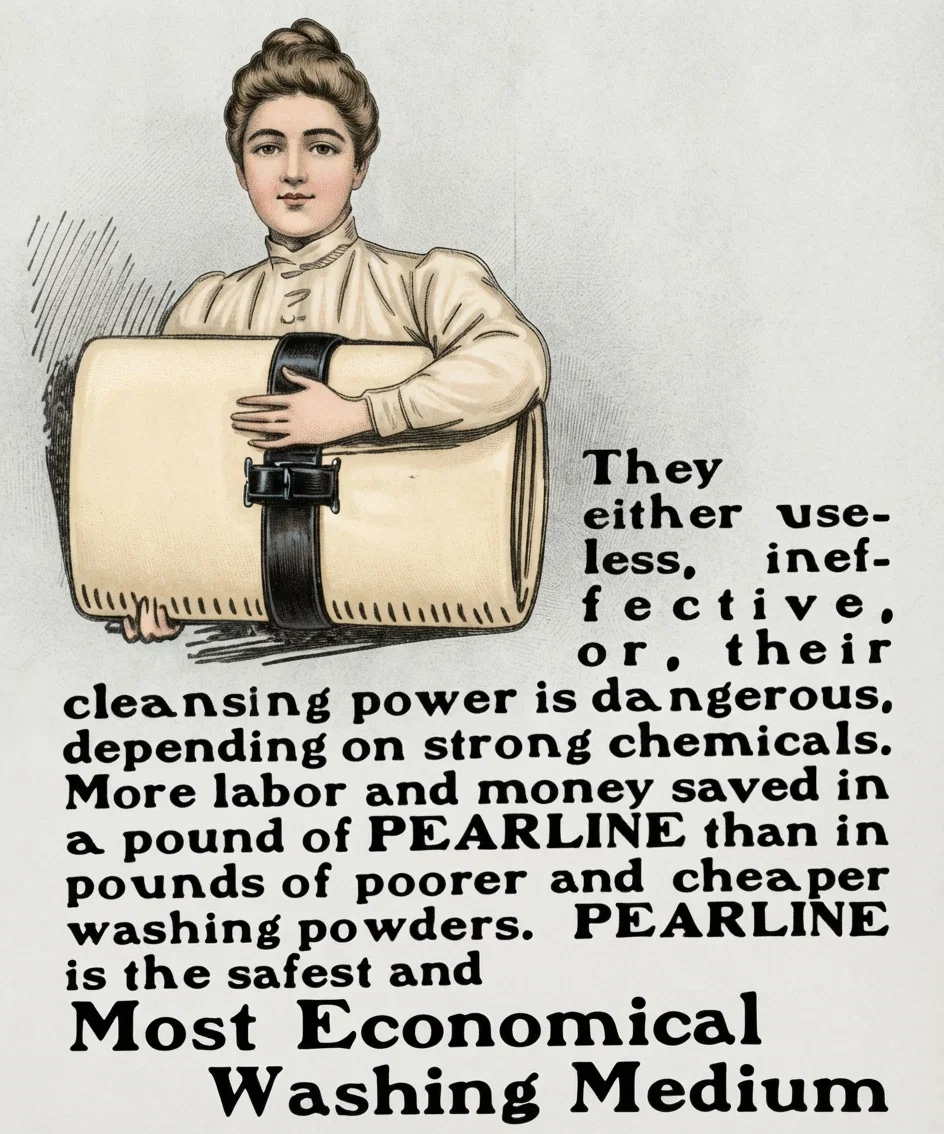
Real Economy is impossible with cheap washing powders. They are either useless, ineffective, or, their cleansing power is dangerous, depending on strong chemicals. More labor and money saved in a pound of PEARLINE than in pounds of poorer and cheaper washing powders. PEARLINE is the safest and 702 Most Economical Washing Medium
Real Economy is impossible with cheap washing powders. They are either useless, ineffective, or, their cleansing power is dangerous, depending on strong chemicals. More labor and money saved in a pound of PEARLINE than in pounds of poorer and cheaper washing powders. PEARLINE is the safest and Most Economical Washing Medium 702
"The Home Over There"
By Editor
We have sung about it, but do we all know where it is to be? See what page seven of the "Scripture References" says about it.
The price of the pamphlet is 2 cents, or $1.40 per hundred. ADDRESS PUBLISHERS OF THIS PAPER