Your ShelfYour Projects

Review and Herald, Vol. 86, No. 48.

God’s Infinite Care

Review and Herald

Dec 2, 1909

Review and Herald Publishing Association · Tacoma Park Station, Washington, D. C. · Dec 2, 1909

God’s Infinite Care

WORTHIE HARRIS HOLDEN
The ear of the Infinite One bends low To catch thy faintest cry; There’s never a call that He does not hear,— Never a moan or sigh.
Thou gazest toward heaven in mute appeal, In sorrow too deep for word, But the eye of the Infinite sees thy need, His compassionate heart has heard.
O wonderful love that in mercy bends To us in our night of woe! O marvel that Infinite Love on us Unceasing thought should bestow!
For Israel’s Guardian never sleeps; Each child hath His constant care,— Unerring in judgment, unfailing and strong, To answer His children’s prayer.
When earth shall again be a paradise, And we enter into rest, Our eyes shall then see what our hearts now know, That His will and ways are best.
Portland, Ore.

The Protestant Magazine and Life and Health

For December
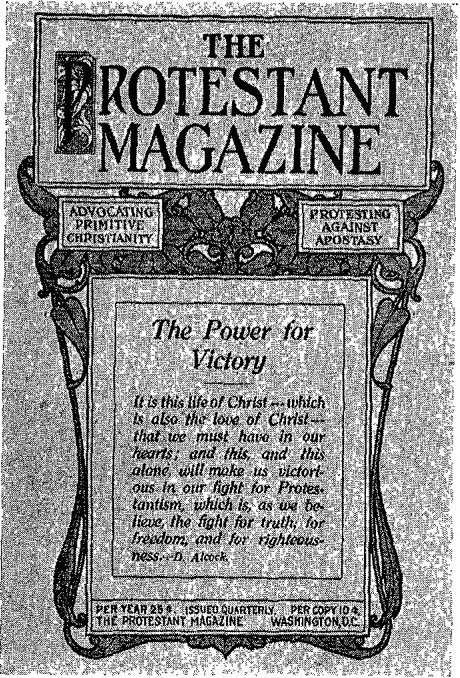
The Protestant Magazine, in dealing with the doctrines of the Roman Catholic Church, does not attack any member of that communion. There is a wide difference between exposing the falsity of a doctrine and aspersing the character of those who hold the doctrine.
The only safe and consistent course for Protestants is to accept and obey the Word of God regardless of creeds, traditions, or customs.
From the contents of the third issue of the Protestant Magazine it will be clearly evident that any one who abandons the plain teachings of the Word of God and adopts a church creed, the teaching of some commentator, or the mere customs of the majority, is really repudiating one of the fundamental principles of Protestantism.

Prices

Annual subscription, 25 cents; 10 annual subscriptions, one order, cash with order, 15 cents each. Annual foreign subscription, 35 cents. Single copy, 10 cents; 5 to 20 copies, 5 cents each; 25 to 400 copies, 4 cents each; 500 to 800 copies, 3½ cents each; 1,000 copies or more, 3 cents each.

The Protestant Magazine

Protesting against ecclesiastical error, and promoting gospel truth.
Teaching the fundamental principles of true and false Christianity.
Revealing the difference between genuine and professed Protestantism.
Showing wherein professed Protestantism is stretching her hands across the gulf to Roman Catholicism.
Interpreting the meaning of Rome’s control of the political parties of the great cities of America, the public press, public-school text-books, etc.
Citing Rome’s present ruling power.
Predicting a time when Rome will again rule the world.
Naming the present contending forces that will finally be victorious.
The December Life and Health
Attractive and Unusually Instructive
The December Life and Health Attractive and Unusually Instructive
The Protestant Magazine
Third Number
The Protestant Magazine Third Number

Partial Contents

of the Third Issue—Fourth Quarter
1909
The True and the Counterfeit Gospel ........................................ Editorial
The Headship of the Church ........................................ Editorial
The Spiritual Decline of the Churches ........................................ Editorial
The Only Explanation (of the vitality and the success of the Papacy) ........................................ Editorial
The Papacy in Prophecy. Is the Pope Antichrist? ........................................ Editorial
The Attempted Healing of Babylon ........................................ By P. T. Magan
The “Higher” Criticism Untenable: Whence It Proceeds and Whither It Leads ........................................ By Gavin Carlyle
A Roman Catholic Warns Protestants ........................................ From a converted Catholic
Rome’s Substitute for Christ ........................................ By C. M. Snow
The Doctrines of the Roman Catholic Church ........................................ By Pope Pius IV
The Master-Stroke of Rome’s Policy ........................................ By J. A. Wylie
Assumption of Civil Power ........................................ By J. O. Corliss
News Notes and Extracts
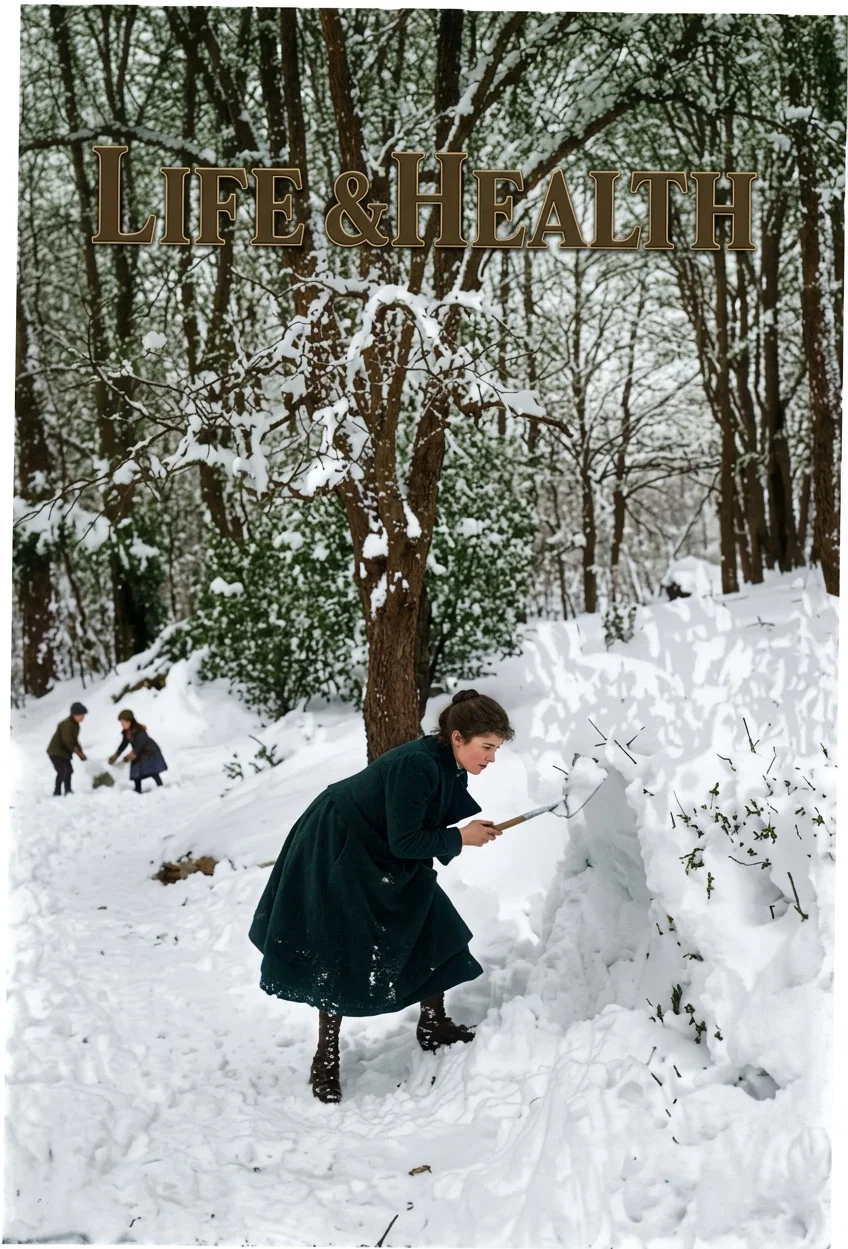
The December number of Life and Health contains a volume of practical matter on a large variety of health topics, such as: Illustrated home physical culture exercises for contracted chest, round shoulders, development of the neck, stimulating the action of the blood-vessels, intestinal troubles, indigestion, development of the legs, the abdominal muscles, and other parts of the body; that which is necessary to render milk comparatively safe from the transmission of disease germs; the proposed cure for uric acid; how whooping-cough is transmitted, and the best treatments for it; how to treat boils; treatments for anemia and eczema; alcohol in the treatment of disease; suggested remedy for the cure of pellagra; mental healing; use of “day camps” in the treatment of tuberculosis; when milk is dangerous; cow’s milk as infant’s food; the relative compositions of various milks; concerning cancers; the best kind of materials for underwear; preventives of insanity; important things parents should know about the care of infants; public opinion and diet, and a large variety of other topics too numerous to mention.

Prices

Annual subscription price, $1; single copy, 10 cents; 5 to 20 copies, 5 cents each; 25 to 400 copies, 4 cents; 500 to 800 copies, 3½ cents; 1,000 or more copies, 3 cents.
Order from the State Tract Societies, or Write

Review and Herald Publishing Association

South Bend, Ind.              Takoma Park, Washington, D. C.              New York City

From the Dark Places

Editorial

From the Dark Places

HERE, just before the week of prayer and the annual offering, let us listen to a few words received from workers in some of the dark places of the earth.
“Pray for Us.”— From Peru, Elder A. N. Allen writes: “Always remember us in your noon-hour prayer service [held for a few moments daily in the General Conference office], as we always remember the brethren at home in our prayers.”
Where Need Abounds.— Dr. R. Russell, of Korea, who finished his medical work in Washington, a year ago, writes: “All the time I was in the medical school, I asked God to send me to a field where I could see that I was needed. He has answered that prayer above all our expectations, and we daily thank him for his sustaining and keeping power.”
Unworked and Waiting.— From Ecuador, for which field the Mission Board is looking for a man to join him, Elder W. W. Wheeler writes:—
The people of this country are not asking us to start a school anywhere; they are not asking for meetings anywhere; they are not calling for our books anywhere; they are not asking for a sanitarium. But how all those things are needed! They burn the Word of God in the streets before our eyes, and when there are no police about, they stone us from their villages. There is a barrier of prejudice and hatred to be broken through by loving ministry. I do hope some one will answer the Lord’s call to come to this field, and that those who have the Lord’s money will improve the opportunity to invest it where it will bring large returns.
The Closing Harvest.— Writing on the train in Korea, going to an unentered region, Elder C. L. Butterfield saw thousands of laborers in the rice fields hurrying to gather the ripened crop. He says:—
While looking at the fields, I think of the great field—the world—“white already to harvest.” But where are the reapers? As we look at Korea with its millions, Japan on one side with her tens of millions, China on the other side with her hundreds of millions, and then think that we have sent only about fifty workers to all these millions, we can but say, “The laborers are few.” I believe if our people in the home land could only see with their own eyes what we see among these millions, they would give as never before—give some of the large farms; give some of the valuable horses and cattle; give some of the bank accounts; yes, and give their sons and daughters to help save the precious fruit of the harvest of the world.

A Timely Visitant

DISCUSSING the ministry of angels, in his commentary on the book of Daniel, Melanchthon, the associate of Luther, tells of the providential deliverance of Simon Grinæus, of the University of Heidelberg. Grinæus had come to the Diet of Spires, in the year 1529. This was the year in which the famous protest of the Protestant princes was presented.
The clerical champion of the Catholic side at the council was Faber, bishop of Vienna, who violently opposed the reformed teaching. Grinæus one day remonstrated privately with Faber concerning positions he had taken. Faber, on learning the name of his visitor, who was famous as a scholar and reformer, pretended he desired to confer with him more at leisure, and invited him to come to his lodging next day. Grinæus gladly promised to do so. Melanchthon says:—
When he had departed from Faber, he came straightway unto us, and was scarcely set at the table (for it was supper time), reciting a part of his talk with Faber unto me and others there present, when I, sitting with my company, was suddenly called out of the parlor by a certain ancient fatherly man, who, showing a singular gravity in his countenance, words, and behavior, spake unto me, and said that the sergeants would by and by come unto our lodging, being sent by the king's commandment, to carry Grinæus to prison, whom Faber had accused to the king; commanding that Grinæus should straightway depart out of the town; and exhorted me that we should in no case delay the time.
And so, bidding me farewell, he departed. But what old man this was, neither did I know him, nor afterward could I understand. I, returning again unto my company, bade them rise, and told them what the old man had said unto me.
By and by, we, taking Grinæus in the midst of us, carried him through the street to the river Rhine, where after we had staid upon the hither bank awhile, until Grinæus, with his companion, was carried over in a small boat, returning again to our lodging, we understood that the sergeant had been there, when we were but a little way gone out of the house.
Now in what great danger Grinæus should have been, if he had been carried to prison by this cruelty of Faber, every man may easily conjecture; wherefore we judged that this most cruel intent and purpose of him, was disappointed by God's merciful providence. And as I can not say what old man it was that gave me this warning, even so likewise the sergeants made such quick speed, that except Grinæus had been covered and defended by the angels, through the marvelous providence of God, he could never have escaped.
Concerning the truth of this matter, there be many good men yet alive, which know both the same, and also were present at the doing thereof. Therefore let us give thanks unto God, which hath given us his angels to be our keepers and defenders.
The calm scholar and theologian of the German Reformation, Melanchthon, was not the man to be misled by fancy; and all the setting of the case convinced him, beyond a doubt, that an angel of the Lord had brought the warning and pointed the way of escape. “Are they not all ministering spirits, sent forth to minister for them who shall be heirs of salvation?”
Surely angels were in Spires, as the forces of earthly powers gathered there in a great crisis in the history of the work of God. As the angels ministered to patriarchs and prophets and believers in olden time, so have they shielded reformers, led the way before missionaries, and are still with the Lord's children for the finishing of the work, whether seen or unseen. Thank God for the blessed truth of the ministry of angels!
W. A. S.

Only One Way

WHICHEVER way we turn, our eyes and ears are constantly assailed by human devices for the salvation of men. Says the great scholar, “A new religion is needed;” and he furnishes its framework, to be built upon and finished by human wisdom. Say the great philosophers, “A new plan of salvation is needed;” and they furnish the plan, which is based entirely upon human wisdom and power.
Restless humans, as unsatisfied with the plans of the Infinite in reference to their soul’s destiny as were Adam and Eve in reference to their future, turn from what God has to what man professes to have, and in that turning, start upon the long road that bears ever away from the one path that leads to eternal life. In theosophy (God-wisdom) thousands upon thousands are taught to find all that humanity can hope for in the eternal beyond. Perfect trust in that system, invariably eliminates Jesus from any share in the rewards of the soul beyond this life. He is not in all their thought—as a Saviour. The ancients built a tower from whose top they expected to step into heaven unaided by any power save their own. God smote it with the lightnings of heaven, and smote their hopes and shattered their trust at the same time. So will he do with the tower of theosophy and the trusts and hopes of the theosophists when their theories come up face to face with the great fact of his second coming.
The Unitarian sets forth a plan whereby, through a life of good deeds and moral thoughts, man advances, step by step, from the court of the Gentiles into the holy of holies, presenting himself as his own savior, and pushing aside Jesus, the Lamb of God slain from the foundation of the world as “a ransom for many.” But the day must come when they who have put their trust in that system will see written over the door of the audience-chamber of the Infinite the words: “Neither is there salvation in any other: for there is none other name under heaven given among men, whereby we must be saved.” That will be a sorrowful awakening.
The Roman Catholic is taught to believe that the sacrifice of Christ is insufficient for man’s salvation; that Christ must be sacrificed over and over in the mass as a propitiation for sin and to appease the wrath of God; that Christ can not, in justice, forgive sins, and that forgiveness can only be received through Mary. But in the morning of the Judgment day, how these wicked and foolish inventions of men will wither in the scorching blast of divine wrath! It will be a bitter day for the millions who have put Christ to one side and trusted in such a system as a substitute for him.
But the world is full of just such systems. It is a concerted plan to blind the eyes of men to the one essential of salvation. Not all will be attracted by one plan, so there are many. There can be but one way into the city of God from the wilderness of this world. Christ is that way. “I am the way, the truth, and the life: no man cometh unto the Father, but by me.” “He that . . . climbeth up some other way, the same is a thief and a robber.”
Everything that is outside the plan of God will perish. All human plans for affecting the salvation of men are outside God’s plan; and when he brings in again the harmony which sin had destroyed, all those things will be among the ashes of sin’s overthrow. The antediluvians trusted in themselves rather than in God, and the flood came and took them all away. The postdiluvians trusted in their tower as the “gate to heaven.” God smote it and scattered them. The Jews finally came to trust in the cold forms of their temple worship. They forsook him to whom the temple and its services pointed, and crucified him. Then God declared, “Your house is left unto you desolate,” and he rent the temple veil and permitted heathen hands to desecrate the temple in which they trusted.
God has never yet recognized any human scheme which was designed to take the place of a divine plan, and he never will. “Every plant, which my Heavenly Father hath not planted, shall be rooted up,” said Jesus. No human scheme can bring salvation. There is only one Saviour, and all these human devices seek to eliminate him. In them, therefore, there is no Saviour. All who turn from God’s one way, and put their trust in theories and schemes of men, will find themselves overwhelmed in the ruin of those schemes, as the antediluvians were in the flood of waters. There was salvation then in the ark and nowhere else; there is salvation to-day in God’s plan of redemption, and in no other. Those who trust in human plans are not only opposing God’s work, but their own best interests as well. The heathen of old trusted in their visible images which their own hands had made. Men and women out of the ark of safety to-day are trusting in images also, images of the mind which human brains have devised and placed in the very temples of God. And these are as surely leading them to eternal ruin as ever did the worship of the images of old. They have no Saviour. The way is narrow, and their load of sin is wider than the way.
But for us alone to know this will do such persons no good. They, too, must be made to know it. The time has come for every one who knows the true way to make it known to those who have been deceived by the glitter and the platitudes of the scores of false systems that are in the world to-day. The faithlessness of many of the professed followers of Christ has helped to make these human devices so successful in their delusive operations. This gives double reason for diligence now in making known the true way. Our own salvation waits on our faithfulness in this regard. A slow and wavering campaign is not in God’s ordering. Whatever shines will attract. Therefore, “Arise, shine; for thy light is come, and the glory of the Lord is risen upon thee.” To a small people has been given a great message, but there is a great guaranty behind it. We have no reason to fear or doubt. The message committed to this people is as sure as the unshakable rock of God’s Word, in which we read it. And when that message has been given, another thing is sure—the coming of the Redeemer. May the glad day of that work’s completion not be postponed by our indifference or lack of faith or love of ease. In the midst of all the cries of false religions and false systems of salvation, let the message of the everlasting gospel ring clear and true, until the witness has been borne to the world and a people been gathered out whom Christ will not refuse to recognize as the sheep of his pasture.
C. M. S.

The Priest on the Throne

Of the position which Jesus occupied after his ascension, we read in the following scriptures:—
“So then the Lord Jesus, after he had spoken unto them, was received up into heaven, and sat down at the right hand of God.” Mark 16:19.
“The God of our fathers raised up Jesus, whom ye slew, hanging him on a tree. Him did God exalt with his right hand to be a Prince and a Saviour, to give repentance to Israel, and remission of sins.” Acts 5:30, 31.
Jesus had himself prophesied of this before the council of priests and scribes when they demanded of him, “If thou art the Christ, tell us:” —
“But from henceforth shall the Son of man be seated at the right hand of the power of God.” Luke 22:69.
Then was fulfilled that wonderful prophecy recorded by Zechariah:—
“Thus speaketh Jehovah of hosts, saying, Behold, the man whose name is the Branch: and he shall grow up out of his place; and he shall build the temple of Jehovah; even he shall build the temple of Jehovah: and he shall bear the glory, and shall sit and rule upon his throne; and he shall be a priest upon his throne; and the counsel of peace shall be between them both.” Zech. 6:12, 13.
In order that he might form that union between divinity and humanity which would enable him to become “amerciful and faithful high priest in things pertaining to God, to make propitiation for the sins of the people,” Jesus took the flesh, and after having offered himself as the true sacrifice for sin, he ascended into heaven to minister in behalf of man in the heavenly sanctuary. This is clearly set forth in this language:—
“Now in the things which we are saying the chief point is this: We have such a high priest, who sat down on the right hand of the throne of the Majesty in the heavens, a minister of the sanctuary, and of the true tabernacle, which the Lord pitched, not man.” Heb. 8:1, 2.
The same truth is again set forth in these words:—
“For Christ entered not into a holy place made with hands, like in pattern to the true; but into heaven itself, now to appear before the face of God for us.” Heb. 9:24.
And again:—
“And every priest indeed standeth day by day ministering and offering oftentimes the same sacrifices, the which can never take away sins: but he, when he had offered one sacrifice for sins forever, sat down on the right hand of God; henceforth expecting till his enemies be made the footstool of his feet.” Heb. 10:11-13.
These statements taken together constitute a plain description of the experiences of Christ at his ascension. He who had been “despised and rejected of men,” who declared that he did not have where to lay his head, was accorded royal honors in the heavenly courts. But while accepting a place “on the right hand of the Majesty on high,” he did so as the representative of man in whose behalf he appeared in the presence of God, presenting in his priestly ministration the wondrous sacrifice which he had already offered on Calvary. The position which he had left that he might seek and save that which was lost, he had now won back, as the Son of man; but not for himself alone had this been done, and he, therefore, took the place of power, not in order that he might inflict punishment, but that as priest upon the throne, he might be “an Advocate with the Father,” to minister grace and mercy to every penitent believer.
This position of honor and power which was occupied by Christ after his ascension is further mentioned in other places:—
“If then ye were raised together with Christ, seek the things which are above, where Christ is, seated upon the right hand of God.” Col. 3:1.
“That ye may know . . . what the exceeding greatness of his power to us ward who believe, according to that working of the strength of his might which he wrought in Christ, when he raised him from the dead, and made him to sit at his right hand in the heavenly places, far above all rule, and authority, and power, and dominion, and every name that is named, not only in this world, but also in that which is to come.” Eph. 1:18-21.
In view of a peculiar interpretation which has been placed upon some of these texts it seems proper to inquire whether these different expressions are designed primarily to indicate with exactness the literal place where Christ was to sit, or whether they are intended to set forth his exaltation and that accession of power and authority which would constitute him an all-sufficient Saviour. A consideration of some other passages of Scripture may help to settle this question. The promises made to the overcomer are expressed in phrases somewhat similar to those already quoted. Thus we read:—
“He that overcometh, I will give to him to sit down with me in my throne, as I also overcame, and sat down with my Father in his throne.” Rev. 3:21.
This assurance of sharing royal honors with Christ is again expressed in these words:—
“If we endure, we shall also reign with him.” 2 Tim. 2:12.
By comparing these two statements, it is evident that it is not bodily position upon a material throne, but kingly authority, which is promised to the overcomer. This is clearly stated in another place:—
“And he that overcometh, and he that keepeth my works unto the end, to him will I give authority over the nations.” Rev. 2:26.
After the same manner Jesus replied to the high priest when he said to him, “I adjure thee by the living God, that thou tell us whether thou art the Christ, the Son of God.” Jesus answered:—
“Thou hast said: nevertheless I say unto you, Henceforth ye shall see the Son of man sitting at the right hand of Power, and coming on the clouds of heaven.”
The meaning of such language may be readily understood by comparing it with the forms of expression now employed when speaking of the position occupied by rulers. King Edward VII, as ruler of the English people, is said to sit on the throne of England, and this he does not only when he is in the throne-room and in a formal manner gives audience to representatives of other nations, but likewise when he may be in any part of his kingdom engaged in duties of any kind; in other words, the king is always on the throne.
So also the president of the United States always sits in the executive chair, whether he is actually in the White House, or whether he is touring the country, and whether he is literally sitting or standing.
In the same way the premier of England is always at the king’s right hand, whether he is actually associated with the king at Windsor or Buckingham Palace, or whether the king may be in France or Germany, while he himself is at his office in Downing Street.
This seems to be sufficient to indicate clearly that to sit on the throne with the Father, or to sit at the right hand of God, means that Christ was exalted to the place of great power and authority; and inasmuch as he was a priest upon the throne, he could be “a minister of the sanctuary and of the true tabernacle,” fulfilling the ministry typified in the work of the earthly priests, and at the same time be at the right hand of God, and sit with the Father on his throne.
The attempt to make these scriptures teach literal position, and to deduce from them such conclusions as would confine Christ in his ministry to a particular spot or place, leads to confusion in the interpretation of the Scriptures, and to conclusions out of harmony with the evident meaning of the revelation made concerning Christ and his work.
W. W. P.

Following the Lord Afar Off

THE disciples chosen by our Lord presented many phases of character. Thomas was of a careful, conservative nature, who could be convinced only by the sight of his eyes. Peter, on the other hand, was quick and impulsive, ready to speak and act, not only for himself but for his fellows as well.
When the Lord asked his disciples who he was, Peter was quick to declare that he was the Christ of God. When the Lord warned his followers that they should all forsake him and flee, thereby seeking to fortify them against the great trial of their faith, impulsive, self-confident Peter resented this imputation of weakness. He assured his Master that although all men should forsake him, he would forever remain steadfast; and had the Master's kingdom been one of this world, and of a nature to be defended by the sword, no doubt Peter would have been a valiant and steadfast soldier. He was quick to draw his sword in the garden in defense of his Master, but when he saw the Lord surrounded and made a prisoner, and marched off amid the ridicule and scorning of the motley throng that surrounded him, his courage fled, and his hope well-nigh forsook him. The record is: “And Peter followed afar off.”
Rash and impetuous Peter still loved his Lord. There was something which still drew him on to the palace of the high priest, and although in his weakness he dissembled, and in the hall mingled with the indifferent, reckless throng, his heart still went out in yearning for his divine Lord. But this veryattitude of dissembling on his part was the source of further weakness and further failure. Accused by those who stood by of belonging to the following of Jesus, he repeatedly denied the accusation, and finally, to give emphasis to his denial, he vehemently declared with cursing and swearing that he even did not know the Lord.
With what interest must the Master himself, wholly unmindful of his own safety, have regarded the attitude of his erstwhile follower. What a pang the denial of Peter must have brought to his loving heart! But he offered no words of rebuke, and yet he would indicate to Peter that he had taken cognizance of his attitude. The record says: “And the Lord turned, and looked upon Peter.” What commingled emotions must that look have expressed!
In it Peter saw love, sorrow, and rebuke blended. He realized the poignancy of the grief he had caused his loving Master. He saw as never before the baseness and ingratitude of his own selfish heart. He realized that in the time when the Lord needed most of all his sympathy and help, in the time when all had forsaken him and fled, he himself had added to his own cowardice the sin of base denial. As these feelings rushed in upon the heart of Peter, he was overwhelmed. He remembered the word of the Lord, who had warned him beforehand of the part he was to act, “and Peter went out, and wept bitterly.” These were such tears as he had never shed before. They were tears of genuine sorrow and contrition of heart. His life of selfishness stood out before him in clear outlines. The days that Christ spent in the tomb were to Peter days of humiliation and mourning.
From this state of mind he was startled the third day after the crucifixion by a message sent him from the Lord. Mary had visited the tomb. An angel had revealed himself to her, with the most startling but joyous announcement that the Lord had risen. He sends a message to her companions. He says: “Go your way, tell his disciples and Peter that he goeth before you into Galilee: there shall ye see him, as he said unto you.” Why was Peter singled out from all the others as a recipient of a special message? The Lord knew of Peter's grief, and he takes this first opportunity to send to him a message of hope and cheer. Is it any wonder that Peter with bounding feet hastened to the open sepulcher? And with what feelings must he have met his Lord later in the day, as Christ gave him audience! Sweet indeed must have been the assurance of forgiveness from the divine lips. Joyful indeed must have been the heart of Peter as he realized once more that Christ recognized him as his own.
There are many Peters in the world to-day, impulsive, headstrong, and selfish, following their Lord afar off, and denying him in their Christian experience. There are many who have a name to live, and yet are dead, whose profession is a mere formality. There are also grieving Peters, those who see their weakness and unworthiness, those who realize that they have denied the Lord who bought them with his own precious blood. To this class the words of the Saviour come to-day: Go and tell Peter that I have risen. Christ is not in the grave. He sits on the throne of grace to minister to the poor and needy, the weak and fallen. His mighty hand is stretched down to the lowest depths to save. He will grasp every hand reached out to him. He will fill every heart open to receive his grace. May God grant that we shall not follow him afar off, but that we shall come near, and enjoy the communion of his blessed presence.
F. M. W.

God's Changeless Purpose

Although the specific plans of God's work may change, his purpose is unalterable. When Jehovah could no longer reach Israel as a nation independent of other nations, he permitted her to be overthrown as a nation, her people to be carried away captives of an idolatrous king, even with the vessels of his own holy sanctuary. There, in their afflictions, he knew they would remember him. They did so, and he again brought them out of bondage with substance. They rebuilt the city and the sanctuary, and re-established his worship in that consecrated place. So it was not a change of purpose, but a change of plan to accomplish the same eternal purpose; and the change of plan was made necessary by the vacillating course of his people. God meant that his people should be a free people. He permitted them to be a subject people in order that he might reach their hearts, and release them from the bond service of sin.
When his people renounced his kingship, and demanded a king of flesh, the Lord still wrought for them through his prophets, and through every king who would heed the counsels of his voice. His purpose was to have a people who would rightly represent him to the nations of this earth that did not know him. When they refused to be that light, the Lord allowed them to go down into the very darkness which they were to have dispelled; and they stayed there until they had found again the light which they had hidden.
The Lord had promised that the scepter should not depart from Judah until Shiloh came; but when Judah dishonored and trampled upon her sacred charge, then God allowed the earthly rulership of Judah to cease. But the promise was not broken. Christ as the prospective offspring of that tribe held that scepter himself in heaven. The nation had so linked itself with the wicked customs and idolatrous practises of heathendom that God could no longer, either in justice to himself or to the world, leave that scepter in the hand of apostate Judah. Lacking a true representative, the scepter naturally reverted to the Giver, and was held in trust, as it were, until he should come personally to exercise it in his own right, tangibly in the earth.
Christ is entitled to sit on the throne of his father David, not merely by the fact of his birth in the tribe of Judah, but also because he had, through his sinless life and his sacrifice, redeemed the entire possession of this earth from the dominion of Satan. That is, primarily, why it is Christ's right. That is, primarily, why the kingdom and dominion under the whole heaven are placed under his control. He 'whose right it is' is soon coming to claim that dominion.
Unrighteousness wrenched the scepter from the hand of Israel's earthly king, and righteousness puts it into the hands of Christ. Unrighteousness sent that nation captive to Babylon, the symbol of confusion and spiritual darkness. Righteousness is releasing a people even to-day from spiritual darkness and soul bondage, and will enable them soon to stand upon the sea of glass, approved of God, without guile, without spot or wrinkle, or any such thing. Disloyalty to God has cast angels, as well as nations, under chains of darkness to wait for condemnation and execution. Loyalty to him and his holy law will place even frail and faulty men in the place where angels might have stood. 'Here are they that keep the commandments of God' will be said of those who are counted worthy to share in the fulfilment of God's promise to his children. It will be said of those called to fill places left vacant by the 'angels who kept not their first estate.'
The Lord declares that his word shall not return unto him void, but shall accomplish his purpose. He purposed that man should be established in this earth forever; and so, since the fall of man, God has been gathering together in this wrecked and forfeited home of man a company of tried and true children for the peopling of this same earth when it should be restored to its original loveliness. That purpose will soon be accomplished; and Christ himself, who won back the forfeited inheritance of man, will rule that kingdom forever, even forever and ever. He is of the 'seed of David,' the Redeemer of the purchased possession, the Shiloh who was to come, and 'whose right it is' to rule the realmof righteousness. God's purpose is the same through the ages, though the details of its outworking may change from century to century. His ultimate purpose is the rule of righteousness in every portion of his realm. So sure as God exists, just so certain will he triumph over sin, and he has so arranged it that the frailest mortal that ever stood upon this earth may share in that glorious triumph.
It is a wonderful opportunity given to mortal man; and it is to the glory of God that he can take the weak things of this world and with them overthrow the kingdom and powers of darkness; that he can take sinful men and with them bring in the rule of everlasting righteousness—not because of their sin, but because of their loyalty and submission to him in his unchanging purpose. To have a part in that triumph is the greatest privilege that man could ask, and to share in the glorious result of it will satisfy every redeemed soul.
C. M. S.
Continue reading: Visit in Central New England