Your ShelfYour Projects

Signs of the Times, Vol. 33, No. 28.

OLD LIBERTY BELL

Signs of the Times

Jul 10, 1907

Pacific Press Publishing Company · Mountain View, California · Jul 10, 1907

OLD LIBERTY BELL
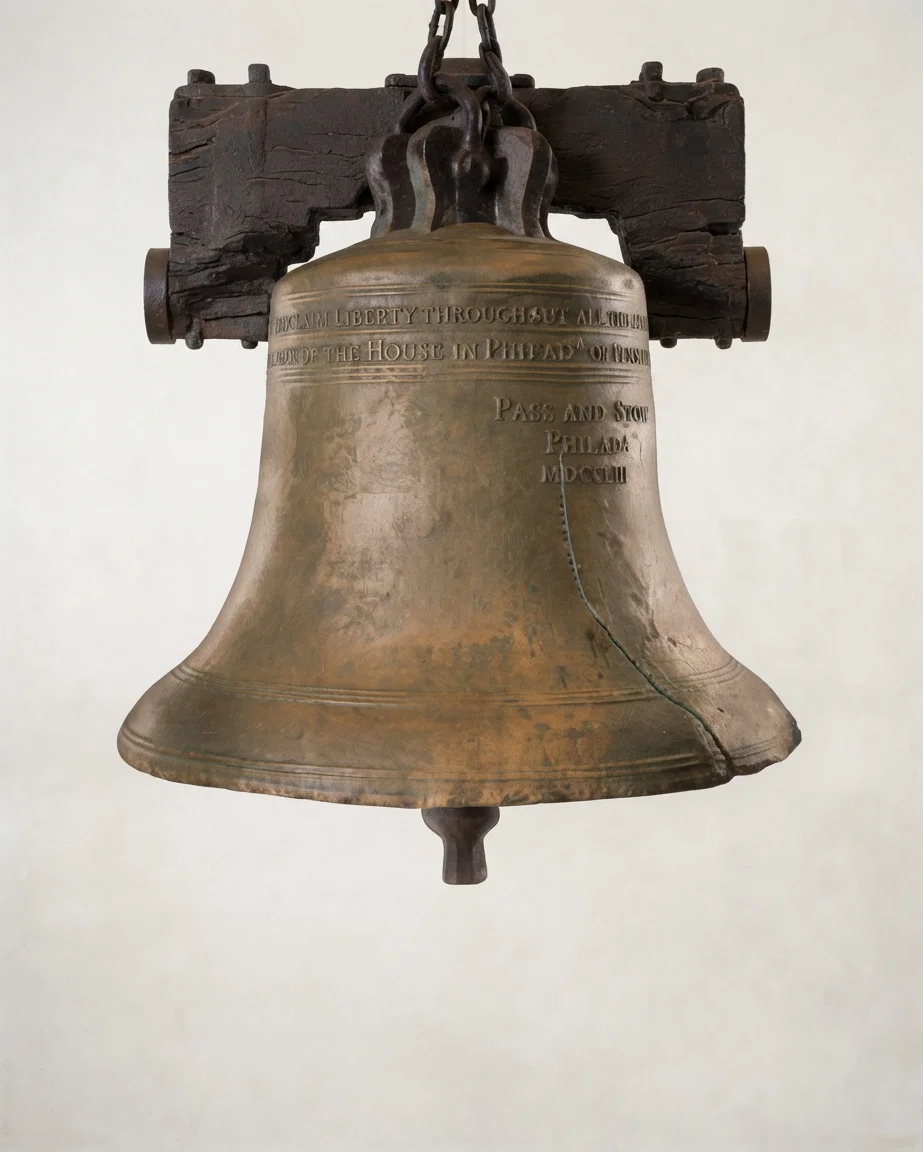
The casting of the Old Liberty Bell was done by Pass & Storr, Philadelphia, 1753; weight 2080 pounds. Its very making seemed to be prophetic of the results of the Revolution that followed. It bore the inscription, “Proclaim liberty throughout all the land unto all the inhabitants thereof,” from Lev. 25:10. It was cracked July 8, 1835, while being tolled in memory of Chief Justice John Marshall. It now occupies a central position in Independence Hall.
OLD LIBERTY BELL The casting of the Old Liberty Bell was done by Pass & Storr, Philadelphia, 1753; weight 2080 pounds. Its very making seemed to be prophetic of the results of the Revolution that followed. It bore the inscription, "Proclaim liberty throughout all the land unto all the inhabitants thereof," from Lev. 25:10. It was cracked July 8, 1835, while being tolled in memory of Chief Justice John Marshall. It now occupies a central position in Independence Hall.

With Our Inquirers

“If ye will inquire, inquire ye.”
[All questions to this department will be answered which to the editors will seem to minister to the good of the readers and to the mission of the paper. The same question can not be answered repeatedly in the same volume. The name and address must accompany question, not for publication, but as an evidence of good faith, and that answer may be made by letter if deemed advisable. It is well always to enclose a stamp for reply.]

2146.—Shadows of Things to Come.

What is meant in Col. 2:16, 17 where meats, drinks, holy days, and sabbaths were just shadows of false images, and in Romans 14 Paul says very clearly that one day is not above another? S.
1. As to Col. 2:16, 17. It is sufficient to remark that all shadows, all types, rites, and ceremonies came in in consequence of sin, pointed forward to Christ, and were lost in Him, even as the shadow is in the substance. Among these things were various yearly or typical sabbaths. See Leviticus 23, and especially verse 38. While the Sabbath of the Lord was given before sin entered at all, and in the very nature of the case is not typical or shadowy in nature; but even then there is nothing whatever in Col. 2:16, 17 which would indicate that it was not duty to keep the Sabbath. The thought is not, Let no man pay any attention to eating or drinking or in respect of feast days or Sabbath days, and so on. Not at all. The question is not a prohibition of these things in any way. It is that the Christian finds his headship in Jesus Christ, and Christ alone, and His word is, of course, the thing to which the Christian should look for his leading and guidance. And therefore he is not to be judged by man, "Let no man therefore judge you in meat, or in drink, or in respect of an holy day, or of the new moon, or of the sabbath days." Do not be condemned by what men say as to what your duty is or is not. Take Christ Jesus and His word for your guide. If we follow teachings of men alone we will really follow shadows, even tho these teachings are of things divinely ordained. If we follow Moses alone we shall still wear over our face the veil of unbelief; but if we look beyond the human to Christ Jesus, God's glory and His law will be written in our hearts.
2. The same truth is taught in Romans 14, "One man esteemeth one day above another, another esteemeth every day alike. Let each man be fully assured in his own mind." Not in any way does this tell us that one day is like every other day. It only speaks of two different classes, one of whom esteems all days alike, and the other one day above another. The teaching is that every man should be fully assured in his own mind. "He that regardeth the day, regardeth it unto the Lord." The clause that follows in the Common Version is not in the Revised Version, but the thought is, and the thought of the chapter is, "Let us not therefore judge one another any more; but judge ye this rather, that no man put a stumbling-block in his brother's way, or an occasion of falling." If the Christian is well instructed in the Lord Jesus Christ, he will never use Rom. 14:5, 6, nor any other text, to excuse him from doing that which is enjoined by the word, and tho he may be doing his duty he will not set himself up as judge over the hearts of others. God alone is Judge.

2147.—The True Seventh Day.

What grounds have you for saying that Saturday is the day God set apart? Is not our calendar one gotten up by man, and have there not been years of mistakes made in reckoning? The Jews had a different calendar. Such being the case, is it not foolish to claim that Saturday is Sabbath, when the whole Christian world keeps Sunday and thus fills the Spirit of the commandment by keeping one day in seven holy?
1. We do not teach that Saturday is the day set apart. Sometimes this is said in a loose way, but it is not critically correct. Our civil day is not identical with the Bible day. The Bible day is from even to even, the evening beginning at sunset, "From even unto even shall ye celebrate your Sabbath." See Gen. 1:5, 8; Lev. 23:32. Luke 4:31, 40 and Mark 1:32 and Matt. 8:16 clearly show that the Sabbath closes at sunset. Therefore only about three-fourths of Saturday is identical with the Biblical seventh day, which begins with our Friday night sunset, and closes Saturday night at sunset.
2. Our yearly calendar is a human calendar, but not so the calendar of the week. There may have been years of mistakes in human reckoning so that chronologists would not agree, but all authorities of any worth whatever agree as to the identity of the week. That is a matter not of chronological record only, but of human experience. It is not an uncommon thing for an individual to forget the day of the week. It is an uncommon thing for a whole family to go astray, tho such instances have been known; but no one ever heard of a township forgetting the day of a week, or of a State, to say nothing of a nation and nations. Whatever may have been the condition of the world previous to the Exodus, God fixed the Sabbath by a great threefold weekly miracle for forty long years in the wilderness. See Exodus 16. There could be no question as to its divine appointment and divine approval and identity. He placed the commandment regarding that sacred day in the very heart of His great moral law, so that there could be no question among His followers as to the nature of the commandment itself. Whatever may have been Israel's condition, we again have a divine identification of the day at the time of the death of Jesus. Two days are placed in juxtaposition; one the first day of the week, the other the day previous to that day, the seventh day of the week, which is said to be "the Sabbath day according to the commandment." Luke 23:56; 24:1. Consequently down to the time of Jesus Christ, the Sabbath is immutably fixed by inspiration. Since that time, the Jews have been scattered to every country of the world; still there is agreement among them in regard to the Sabbath. They are all holding to the sacredness of the same day. It was true at that time, and for centuries previous, that the first day of the week was the great heathen sun's day, devoted to sun-worship; and those two days have held their relative places from that time forward, so that the very languages of the nations prove the same thing. For instance, in a chart of the week, prepared by a noted antiquarian, the late William Jones of London, it is demonstrated that one hundred sixty-two languages give the order of the week, and the great majority of them call the seventh day the Sabbath, or by a name which shows its sacred character.
3. The simple fact that the world keeps Sunday is no evidence of a mistake in the day of the week, for the great majority of them which do this do it simply because they have been taught that, or from a wrong conception of what the Scriptures mean. The greater part of the Christian world consider themselves baptized by sprinkling, and yet the majority of Christian scholarship declares that baptism means immersion. The great majority of the world is heathen. We keep the spirit of God's commandment when we do just as far as lies in our power what He has commanded. These are the words of Jesus, "Why call ye Me Lord, Lord, and do not the things which I say?" This interpreting of God's commandments by keeping the spirit of them has led to a fatal perversion of His truth, and to all the errors which have cursed Christianity from the early centuries to the present time.

2145.—Church and Commercialism.

Will not the church be lost in the vortex of commercialism and capital the same as all other interest, profit, and rent-taking institutions? A. J. C.
No, God's true church will not be. While she is in the world and under present conditions, so far as business transactions are concerned, she may of necessity conform to some plans and means and customs of the world in the doing of business. She must render to Caesar that which is Caesar's; at the same time she must render to God that which is God's. There are some of the so-called fundamental propositions of Socialism that are not sound. For instance, labor is not the only producer of wealth. Brain comes into it as well as brawn. Again, the socialistic argument is from a purely human standpoint, making no account whatever of the power of God and the regenerating grace of Jesus Christ. The truest mode of living in the world is taught in the Scriptures, but no man can reduce it to life of himself. It must be by the power of God. The truest economy in the world is taught in the Scriptures, but he who endeavors to put it into practise apart from the Gospel of Jesus Christ will utterly fail. Blessed is the man whose hope and trust is in God and not in man. Jer. 17:5-8.

2148.—Chosen David. 2 Chron. 6: 5, 6.

Please explain the above scripture. What does it mean, "Neither chose I any man to be a ruler over My people Israel," in the fifth verse; then it says, "And have chosen David to be over My people"?
Simply this, that up to that time the Lord had not chosen any one to be the leader; God Himself was their leader, and He appointed His own lieutenants or under shepherds. So He appointed Joshua, Samuel, and others. When the children of Israel asked for a king, the prophet told them that it was not the Lord's will that they should have a king. It would bring them trouble, but they insisted and He gave them Saul, a man of their own choice. Up to that time the center of worship had been in the tabernacle, the ark, and that had been in no settled place; but at the time this passage is spoken, the Lord declared that He had now chosen David to be leader over His people and Jerusalem to be the city. It was simply a change that the Lord made in His dealings with that people, based upon their needs and condition. David was also chosen to be the great ancestor of Christ. Why the Lord chose him was because of his spirit of devotion to God.

2149.—Immortality and Eternal Life.

Is there any difference between immortality and eternal life? Do Christians not have immortal life but mortal bodies? 1 Thess. 5:10-12; Rom. 8:8-17.
E. L. O.
The terms mortal and immortal are not applied to life in all the Scriptures, but to the person, the body. It is not consistent, it seems to us, to speak of life as mortal or immortal. There is life which is temporal, soulical life, and beasts have that in common with man. There is life which is eternal, which comes direct from the great eternal God. Christians do have eternal life, according to the scriptures cited above; but Christians are not immortal, nor have they any promise of being immortal until Christ our Lord shall come and the last trumpet shall sound. 1 Cor. 15:51-54. Immortal means incorruptible, that which in its very nature will not die. In a certain sense it may be said that man was immortal when he came from God; that is, no seeds of corruptibility were in him; and that incorruptibility would have continued had man remained obedient; but man sinned and the candidate for absolute immortality became mortal. Immortality will be achieved now only by the incorruptible character thru Christ. When man's character is incorruptible, God will give that character an incorruptible body. This will be discussed doubtless more fully in future special numbers of the SIGNS OF THE TIMES.

Roger Williams, the Apostle of American Liberty
By Abdiel
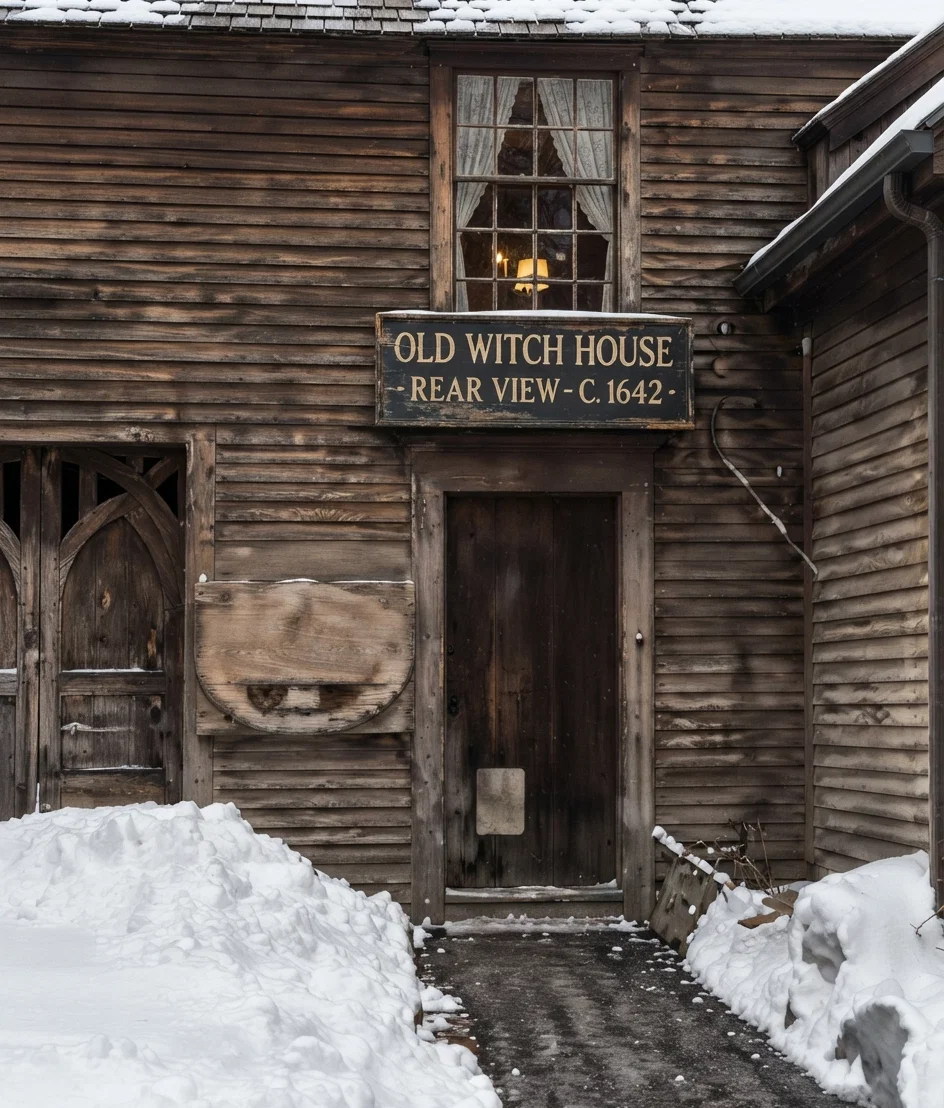
Rear View of "Old Witch House."
It was that truly great American, James Russell Lowell, scholar, poet, statesman, who said: "And they are slaves most base Whose love of right is for themselves And not for all the race." The Roman Catholics thru the long centuries of medievalism believed in religious liberty for—Roman Catholics. The Church of England, which broke from the power of Roman intolerance, believed in religious liberty for—the Church of England. Therefore she forced out the Puritans. The Puritans believed in religious liberty for—the Puritans. Therefore they banished Roger Williams. But Roger Williams believed in religious liberty for all; for the other man as truly as for himself. A brief sketch of his early career may be of interest. The year of his birth wanders all the way from 1599 to 1606. He is said to have been born in Cornwall, in Wales, and in London, and to have been educated in Oxford and in Cambridge. But to adopt and adapt the words of a noble-minded Briton in a eulogy of Washington, "It matters but very little what immediate spot may have been the birthplace of such a man as Roger Williams. No people can claim, no country can appropriate him. The boon of Providence to the human race, his fame is eternity and his dwelling-place creation." In a land which gave the highest type of human civil liberty to the world, his name should be engraved and penciled in glowing letters of gold, highest among her sons in her granite tablets of fame, but more indelibly still should the divine principles which made him the man he was be written upon the hearts of all Americans. Sifting the evidence of his early years, he was probably born in Cornwall, Briton, in 1599. At an early age he went to London and became acquainted with the eminent lawyer, Sir Edward Coke, who, noting his quickness to learn and ability as a reporter, placed him in Charter House School (then
Sutton's Hospital). He matriculated in Cambridge University in 1624, July 1, and received his B.A. in January, 1627. He studied first law, then theology. He was invested with holy orders by the Church of England, but soon after espoused the cause of the Puritans. In December, 1630, he sailed with his wife for America, arriving in Boston, Feb. 5, 1631. Recognizing his learning and eloquence, he was, April 12, 1631, made assistant pastor to Mr. Sketon of the church at Salem, but on that very day the court of Massachusetts at Boston disapproved the act.
Front view of "Old Witch House," Salem, Mass., where Roger Williams lived, and which a half century later was used as a court-house to try "witches." The building, rejuvenated, is now used as a drug-store.
Williams was too outspoken to suit them. He contended that the lands taken from the Indians should be paid for. Opposition was so great that he left Salem that year and became assistant pastor at Plymouth, where he learned the language of two Indian tribes. Here he was suspected of Anabaptist principles. In 1633 he returned to Salem, first as assistant, then sole pastor. In 1636, because of his liberal principles, he was banished from Massachusetts Colony, leaving with a few followers in the dead of winter for a home among the Indians, first settling on a tract of land given him by the great chief Massasoit on Seekonk River, but finding this claimed by Plymouth, they pushed on to the site of Providence, so named in gratitude to God, on land bought and paid for from the chiefs Canonieus and Miantonomoh. Here Mr. Williams became a Baptist, and founded the first Baptist Church in America. Here he founded a colony on the broadest, freest principles of civil and religious liberty, composed of people of various beliefs and no beliefs, which endured longer and in greater peace and stability than any other American colony. A charter was granted to the new colony, March 14, 1644, on the solicitation of Williams, who went to England for the purpose in 1643. Great was the rejoicing of the colonists that they were free from the intolerance of Massachusetts and Plymouth. Williams went to England again in 1651, remaining to 1654, meeting and becoming friendly with Milton and Cromwell. He acted as president of the colony, 1654 to 1658. After the English Revolution, Charles II, in 1663, reissued, with no restrictions, the liberal charter of Rhode Island plantation, its principles forming the fundamental law of Rhode Island for 180 years. The following are the principles which made Roger Williams the grand character he was, which led Massachusetts, under the intolerant teachings of Cotton Mather, to banish him; and which founded the freest and most peaceful of all American colonies, Rhode Island.
  1. Roger Williams was a Christian by personal faith and relationship with Jesus Christ.
  2. As such, he opposed infant baptism, or sprinkling. One of his declarations was, "Christening does not make Christians."
  3. In simple justice he denied the right of Massachusetts to "take the Indian's land without purchase," the opposite of which custom he faithfully followed in all his dealings with the Indians, and so by his influence over great chiefs, saved the Massachusetts and Plymouth colonies from destruction by a federation of the Indian tribes. In their troubles, the men who banished him sought his wise counsel, and he freely gave it.

Gallows Hill Where “Witches” Were Executed.

Roger Williams, the Apostle of American Liberty.

(Continued from Page 3.)
  1. "He held that it was not lawful to require a wicked person to swear or pray, which were both forms of worship, and that the power of the civil magistrate extends only to the bodies, goods, and the outward state of men, and not to their souls or their consciences."
  2. He maintained that "no human power had the right to intermeddle in matters of conscience, and that neither Church nor State, neither bishop nor king, may prescribe the smallest iota of religious faith."
  3. As a Christian, he did not believe in any union of Church and State, or any legal complications, ties, or obligations between religion and the civil authorities. His first trouble at Salem was for "denying the right of magistrates to punish Sabbath-breaking and other religious offenses, as belonging to the first table of the law."
  4. He held that in matters of religion "man is responsible to God alone."
In defense of these views, he published in 1644, in London, his book entitled, "Bloody Tenent of Persecution for Cause of Conscience." It was written in the form of a dialog between Truth and Peace. Such was Roger Williams. God in His providence sent this servant of His to Massachusetts to save those new-planted colonies from the curse of religious tyranny. The city of Salem might have been a glorious beacon light, if, instead of banishing Williams they had retained him. When Williams was driven out in the pitiless forest cold of January, 1636, the people of Salem drove out from their own hearts the love of truth and liberty. Behold the result: The very city where Williams preached, only fifty-five years later was putting innocent persons to death as witches. In the very house where Williams lived, those accused witches were tried, and from there led forth to Gallows Hill for execution. If Williams had been permitted to remain, this black blot had never been
seen on Massachusetts, and the term "Salem witchcraft" would have never been heard. Williams died at the ripe age of eighty-four, eight years before the Salem witchcraft, but the colony which he founded knew naught of such troubles. There were agitators and opponents, whom he contended against by speech and pen, whom he could have banished, but would not, because they had the same rights as did he. America may forget him or honor him; it matters little; but forgetting his principles, leaving them out of her life, the blood of souls will stain her garments, and Ichabod shall be written over the ruins.
Continue reading: Civility and Morality